Asean sees fewer Covid-19 infections in a day, but numbers still high
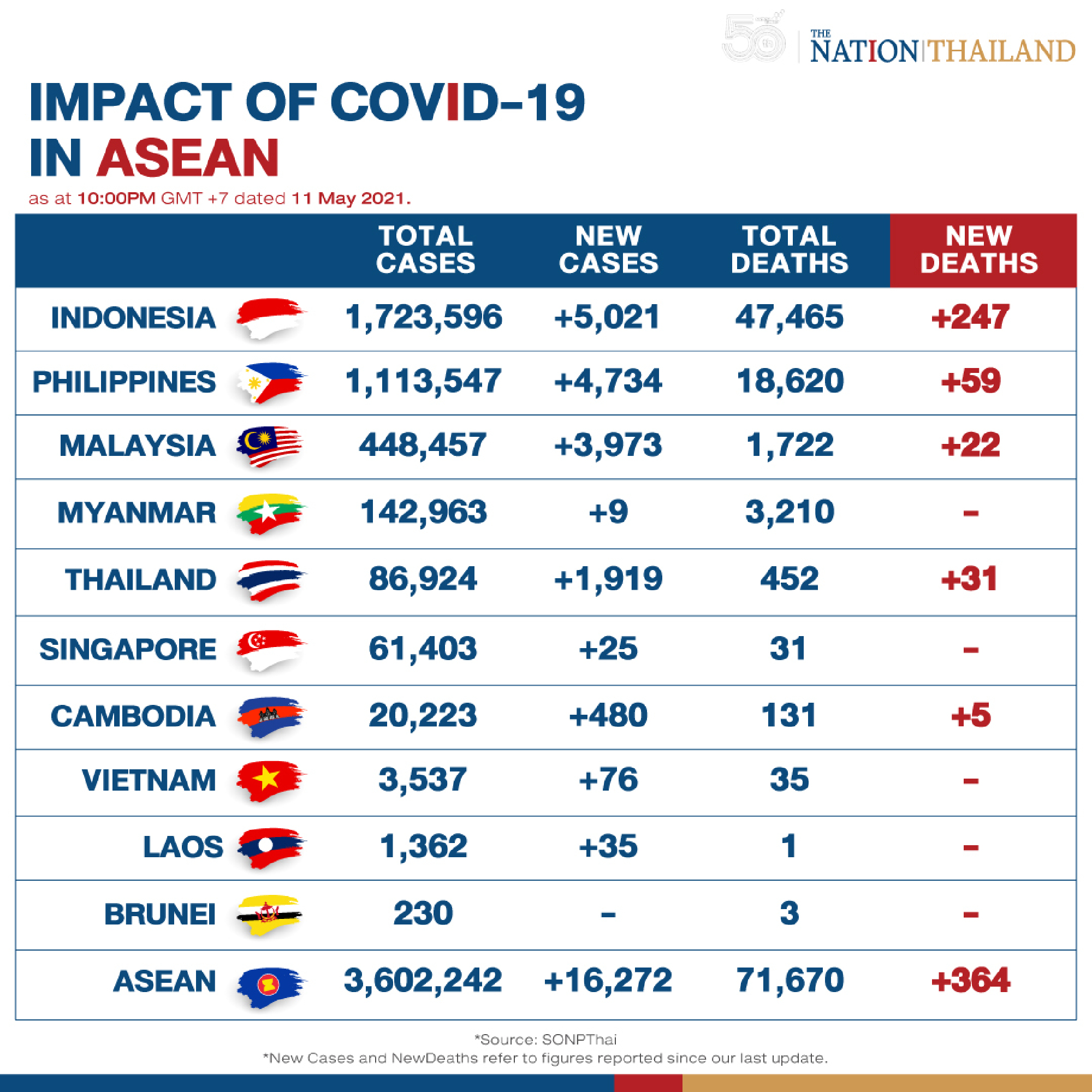
Southeast Asia reported 16,272 new Covid-19 cases on Tuesday, a decrease from infections the previous day, with total cases so far crossing the 3.60 million mark.
Covid-19 cases in Indonesia rose by 5,021 in one day to 1,723,596, with 247 more deaths, bringing the total number of patients who died to 47,465. The biggest Islamic country is bracing for a post-Eid infection surge after hundreds of thousands, if not millions, seek to travel to spend the Muslim holiday with their families.
The Philippines has detected its first two cases of the Indian coronavirus variant, known as B.1.617, in two Filipino seafarers who returned in April from the United Arab Emirates and Oman.
The Southeast Asian nation’s daily infections fell to a near eight-week low after the health ministry reported 4,734 new cases, the lowest single-day tally since March 17. With 1.1 million infections, the Philippines has the second-highest number of Covid-19 cases and deaths in the region.
Meanwhile, Vietnam’s National Institute of Hygiene and Epidemiology on Tuesday announced that seven patients linked to the National Hospital for Tropical Diseases cluster are infected with the Indian variant.
Hanoi has announced a ban on gatherings of more than 10 people and ordered the closure of food and beverage outlets in vulnerable areas amid rising Covid-19 fears. Vietnam is facing its most challenging Covid-19 wave, with 528 community cases being detected across 26 cities and provinces since April 27.
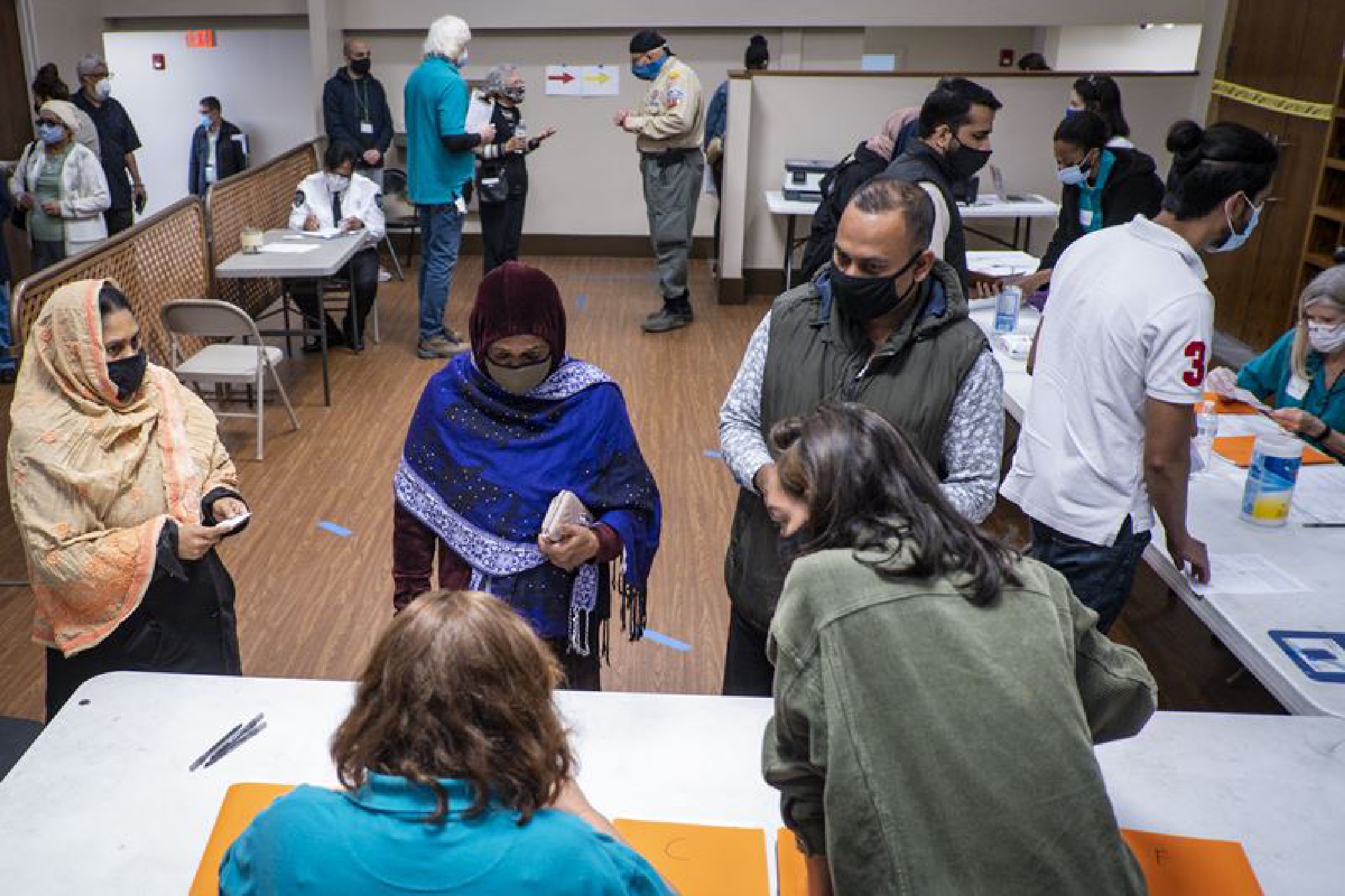
Vaccination drives at area mosques have been successful in reaching Muslims and non-Muslims alike
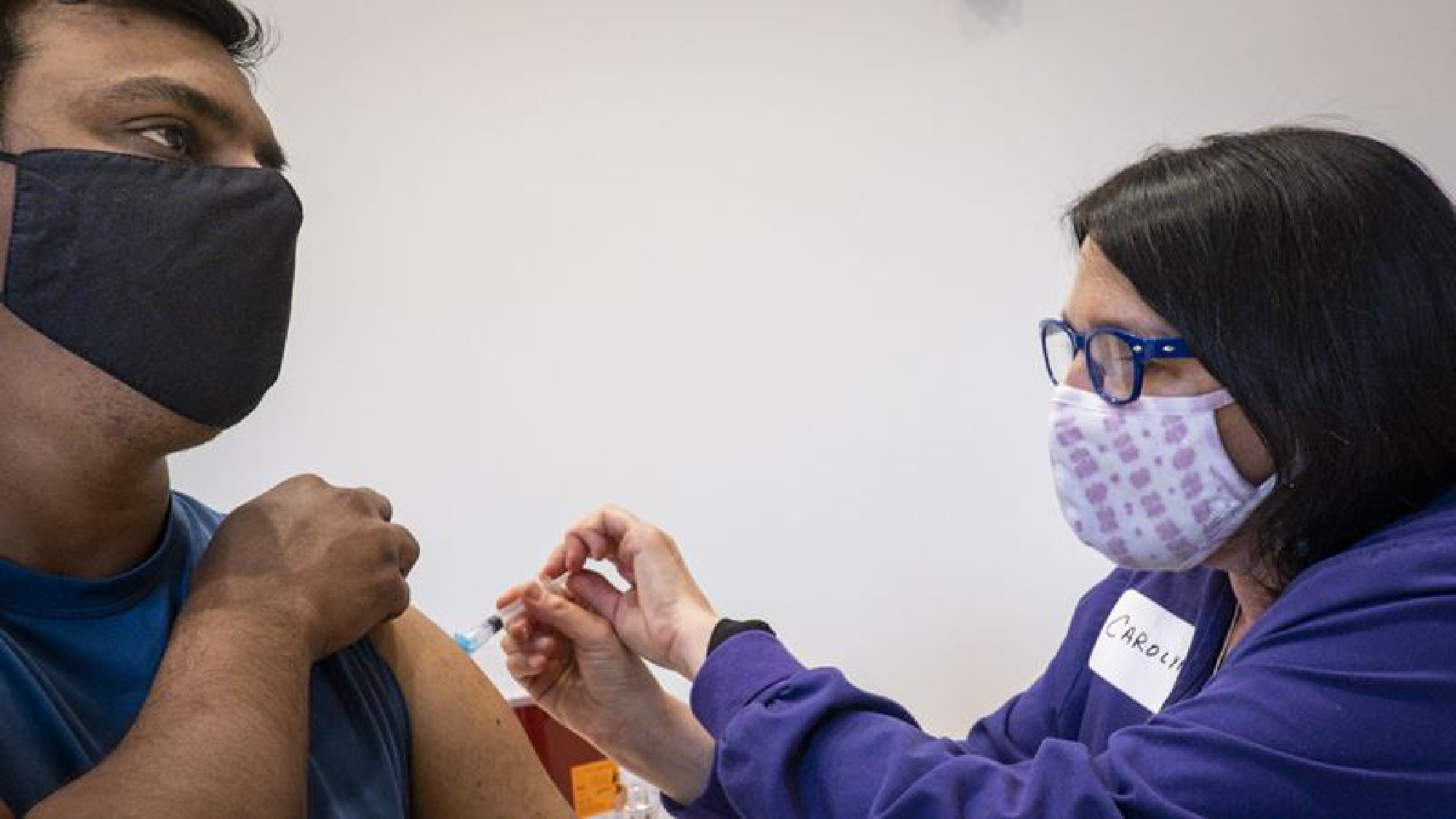
On Sunday, Rizwan Jaka walked around the prayer hall of the All Dulles Area Muslim Society (ADAMS) Ashburn, Va. mosque holding a mic talking about possible side effects after being vaccinated against the coronavirus. He was speaking to a room of people who sat in chairs six feet apart on floors covered with plastic sheets, some swinging their arms to prevent soreness from the shot they just got while others checked their phones and watches to count down the 15-minute waiting period. Behind Jaka, chairman of ADAMSs board of trustees, volunteers filled out vaccination cards.
This was the second vaccination clinic at the mosque, held jointly with the neighboring synagogue, Beth Chaverim Reform Congregation, for people who had received their first dose at the same location weeks earlier on April 11.
Muslims fast during Ramadan, but Jaka encouraged people to prioritize their health by breaking the fast if they experienced any side effects. “Remember, you can make up a fasting day after Ramadan if you need to,” Jaka said, addressing the Muslims in the room. The first shot had been given the day before the holy month started, but the second shot came just days before the end of the observance.
Now, as Ramadan comes to a close, the coronavirus vaccines are offering Muslims the hope of standing shoulder to shoulder in prayer again. Since the start of the pandemic, the ADAMS Center has streamed prayers virtually. Branches of the center recently began opening at limited capacity, praying six feet apart to stay within safety guidelines. But it’s far from pre-pandemic levels. The organization has 11 locations across northern Virginia. During Ramadan, 4,000 to 7,000 congregants would worship every night of the holiday, according to Jaka.
“[The] community collectively made prayers for the vaccinations,” said Syed Moktadir, president of the ADAMS Center, and thus, the ADAMS community has been “quite receptive” to vaccination so people can return to a semblance of normalcy.
Moktadir said the ADAMS Center was among the first in Fairfax County to offer free clinics and “get vaccines to . . . all religions, all faith groups, all ethnicities.” The center also held multiple clinics at its other locations in parts of northern Virginia. Since mid-February, Moktadir said, the center has vaccinated approximately 12,000 people of all faiths; about 700 people were vaccinated at the ADAMS Ashburn mosque and BCRC synagogue clinic alone. ADAMS also had a clinic in partnership with My Dr’s Pharmacy on two Friday nights during Ramadan.
Among some Muslims, there was a concern that getting the coronavirus vaccine would be considered breaking the fast while observing Ramadan. The Islamic Medical Association of North America, a network of Muslim American health care professionals, affirmed that receiving the vaccine would not invalidate the fasting period.
“We’ve done evening [vaccinations] especially [for] people who are fasting in the month of Ramadan, in the event there is a concern about nutrition,” Moktadir said. For example, the center offered vaccinations as late as 11:30 p.m. At the Friday night clinics, the center administered a combined total of about 150 to 200 vaccines.
A similar faith-based vaccination push called Faith in the Vaccine has been happening in D.C. On Friday, religious leaders from the area appeared at Masjid Muhammad, the Nation’s Mosque, to encourage residents to “take the shot” at the vaccination clinic the mosque was holding that day. The mosque held another clinic the following day as well, hoping to entice community members to get vaccinated at a place they are familiar with.
Kimberly Henderson, the director of the D.C. Health Office of Communication and Community Relations, said Faith in the Vaccine has been successful, with more than 4,600 shots given through the program, which started in February. “The emotions and expressions of the persons when they receive the vaccine because they’re coming to a place that they know, that they’re familiar with, that has been successful,” Henderson said.
As of Monday, 35.2% of the D.C. population is fully vaccinated. In Virginia, that figure is 37.7%. Nationally, it is 34.8%.
Vaccination drives at area mosques have been successful in reaching Muslims and non-Muslims alike
Some people at the Ashburn clinic said they appreciated that the center had reached out to them about vaccination. “I am an active member of this community. I got an email from them that they are taking up the demand for the vaccine, so I took the opportunity to take the vaccine from them,” said Fahim Amin Baig, an ADAMS Center member who received his second shot on Sunday. “ADAMS has given clear [communication] that it is permissible to take the vaccine during the fasting.”
Both ADAMS and Masjid Muhammad plan to keep working to get people vaccinated, regardless of their faith. But, as Ramadan ends, Imam Talib Shareef of Masjid Muhammad said that getting the shots during Ramadan had a big benefit: “The rewards with almighty God in terms of opening things up to you go further when you do a good deed in this month than any other month in the calendar. This is a good deed. If you get your vaccine during this month, you get the reward multiplied many times beyond just that one person to the humanity you can reward and also go beyond this life into the next life to give you an experience that you can never [have] otherwise.”
The GOP Impeachment 10 try to navigate Cheneys demise and their own futures
WASHINGTON – When 10 Republicans voted to impeach President Donald Trump on Jan. 13, it marked a historic milestone: It was the most House members from a presidents party to vote to remove him from office.
But since that vote, the 10 lawmakers have cut different paths in grappling with the fallout as they consider their political futures in a party still beholden to Trump.
Reps. Liz Cheney, R-Wyo., and Adam Kinzinger, R-Ill., have made their votes career-defining, arguing that pushing back against Trump’s false assertions that the 2020 election was stolen is about protecting democracy and the soul of the Republican Party.
Others, such as Reps. Anthony Gonzalez, R-Ohio, Jaime Herrera Beutler, R-Wash., and Peter Meijer, R-Mich., have vocally defended their votes and Cheney amid a caucuswide push to oust her from leadership, though they have not sought to make it a marquee issue.
The rest have quietly moved on, even if they stand by their decision, seemingly in line with House GOP leadership’s argument that what is important now is opposing President Joe Biden’s agenda and regaining the majority in the 2022 midterms, not what happened after the 2020 election.
If Cheney is ousted from her leadership post this week as expected, it would highlight how much the January vote to impeach Trump by the 10 GOP lawmakers was not the start of some bigger movement, but a momentary blip of resistance in a party that has been wedded to Trump since he entered the White House in 2017 and remains loyal to him still.
“He revels in score-settling, so most of these folks have smartly just tried to keep their heads down. Cheney has taken a different approach, and while it’s super commendable, he will take great pleasure in seeing her removed from power,” Brendan Buck, who served as an adviser under former House speaker Paul Ryan, R-Wis., said of Trump. “They’ll all have targets on their back, but Cheney really sent up a flare to attract his ire, and I’m sure they’re watching and learning.”
Cheney has increasingly been at odds with her party and fellow House GOP leaders over her decision to continuously call out Trump on his false claims that the election was stolen and his role in the Jan. 6 Capitol attack. She has made clear she will not stop, and her colleagues are expected to vote her out of leadership during a conference meeting Wednesday. Rep. Elise Stefanik, R-N.Y., is expected to replace her as House GOP conference chair, the No. 3 position in leadership.
In a letter sent to his Republican colleagues on Monday, House Minority Leader Kevin McCarthy, R-Calif., said it was time for Cheney to go.
“All members are elected to represent their constituents as they see fit, but our leadership team cannot afford to be distracted from the important work we were elected to do and the shared goals we hope to achieve,” he wrote officially announcing the vote to remove Cheney from leadership.
Mutual respect for casting a consequential vote has bonded the 10 pro-impeachment House Republicans, as has the backlash they have received for rebuking Trump. Eight of the 10 have been censured by the Republican Party in their states, with Gonzalez most recently being admonished and facing calls to resign.
In the early days after the vote, some of the 10 flirted with the idea of banding together to make joint statements on consequential issues, believing they could have influence based on their moral authority.
But the only public position nine of them took as a unit was sending a letter to House Speaker Nancy Pelosi, D-Calif., to express opposition to an investigation into whether to overturn a razor-thin result in Iowa’s 2nd Congressional District. They argued that such a move would further undermine trust in the electoral system and noted that they voted to impeach Trump because “the integrity of our election system was being attacked and trust in it was being eroded – with disastrous consequences.”
Although they never did much as a group once it became clear that opposing Trump was increasingly treacherous, some of these lawmakers, or aides familiar with their views, said the takedown of Cheney has been demoralizing to watch.
“I think it’s very much viewed as a massive defeat,” said one of the 10 lawmakers, who spoke on the condition of anonymity to share candid views in a tense political climate. “Having someone in leadership was validation and proof . . . that even though Trump was attacking us, we still have leadership backing us and are allowed to survive within the conference.”
The 10 who voted to impeach Trump were Reps. Cheney, Kinzinger, Gonzalez, Herrera Beutler, Meijer, John Katko (N.Y.), Fred Upton (Mich.), Dan Newhouse (Wash.), Tom Rice (S.C.) and David G. Valadao (Calif.). Many of them, with the exception of Cheney, represent competitive districts. She faces a primary challenge fueled by Trump’s call to get rid of her. Seven Senate Republicans voted to convict Trump, but they have been given more slack by their Senate peers, and only one, Sen. Lisa Murkowski, R-Alaska, is up for reelection next year and faces a Trump-backed challenger.
Most of the 10 House lawmakers stand at a crossroads in figuring out how to navigate the reality that their party has embraced Trump’s falsehoods and their own political futures and consciences.
Even those who have publicly voiced support for Cheney have said privately that they find it difficult that a majority of their colleagues do not want to acknowledge Trump’s role in undermining democracy, but also find it counterproductive to constantly attack him.
“It’s not entirely effective to go after Donald Trump every time he puts out a statement because we understand he’s a force in the Republican Party,” said a Republican aide who works for one of the 10 members and, like others, spoke on the condition of anonymity because they were not allowed to speak on the record. “When pure falsehoods are said, you have to call that out, but at the same time, doing so repeatedly gets you into this vicious cycle where eventually constituents will really start to wonder, ‘What are you actually focusing on and doing in Congress?’ “
Many Republicans loyal to Trump said over the past week that their problem with Cheney wasn’t her vote to impeach, but her decision to continue challenging the former president, which they referred to as a “distraction” or “unproductive.” They have ignored that Trump frequently brings up his election loss and hardly seems ready to move on. Party leaders have given him a pass because, they have said, they cannot win back the House without Trump and his base of supporters strongly involved.
Neither McCarthy nor Minority Whip Steve Scalise, R-La., have recently told the other nine to fall in line, but the message from leadership is clear: You will not be punished for your Jan. 13 vote, but making an issue of it and antagonizing Trump will not be tolerated.
This message has been underscored with one of the purest expressions of love and support on Capitol Hill – campaign cash. Leadership PACs associated with McCarthy have contributed to the reelection campaigns of Katko, Meijier, Valadao, Upton, Gonzalez and Herrera Beutler. McCarthy has every incentive to see those members – who are mostly from swing districts – reelected, in hopes they will support him for speaker if Republicans win the House.
Members of the pro-impeachment 10 have been generous with one another, too. Federal Election Commission records show their political action committees have contributed to the reelection campaigns of other pro-impeachment members. Valadao is slated to appear at a fundraiser in Washington state next month for Newhouse.
Rep. Jim Banks, R-Ind., leader of the conservative Republican Study Committee, was one of the first in recent weeks to publicly suggest that Cheney head for the exits, but he has also made clear that there is a place in the party for members who embrace its agenda, while minimizing their impeachment vote. He pointed to Rice as an example of someone who has traveled this path and has embraced Banks’s argument that the party needs to fully embrace the working-class voters who went for Trump.
Rice’s vote to impeach was a surprise, and he has been mostly quiet about it. He was the only one of the 10 not to sign the letter to Pelosi about the Iowa race.
In a statement to The Washington Post, Rice credited Trump for hastening the move of White working-class voters to the GOP but said he continues to support keeping Cheney in her post.
“I support Liz Cheney. She is a very good leader, thoughtful and strong. She has a right to her opinion regarding President Trump. Her opinion has nothing to do with her qualification as our conference chair,” Rice added.
Other members have avoided getting involved in the Cheney fight, while making clear they are on board with moving forward when she is gone.
“If something happens with Liz – and that remains to be seen – but if it does and [Stefanik] puts her name into the ring, I will absolutely support her,” Katko said on a call with reporters Friday. “She knows that if we ever want to be back in control of Congress again, people like me have to win and we have to flourish and we have to have a big tent as the Republican Party.”
Valadao’s office said it “will not be responding” to questions about whether he will support Cheney staying in leadership during Wednesday’s closed caucus vote. The offices of Upton and Newhouse did not respond to a request for comment.
Stefanik has been courting the support of the impeachment group and placed calls to some of them over the weekend, according to one of the lawmakers.
Kinzinger, meanwhile, continues to work the cable news and Sunday morning news circuits, but the scope of his influence remains unclear.
“Right now it’s basically the Titanic,” Kinzinger said of the party Sunday morning on CBS News’s “Face the Nation.” “We’re like, you know, in this – in the middle of this slow sink. We have a band playing on the deck, telling everybody it’s fine, and, meanwhile, as I’ve said, you know, Donald Trump’s running around trying to find women’s clothing and get on the first life boat.”
Published : May 11, 2021
By : The Washington Post · Jacqueline Alemany, Marianna Sotomayor
FDA authorizes Pfizer coronavirus vaccine for adolescents 12 to 15 years old
WASHINGTON – The Food and Drug Administration cleared the first coronavirus vaccine for emergency use in children as young as 12 on Monday, expanding access to the Pfizer-BioNTech shot to adolescents before the next school year and marking another milestone in the nations battle with the virus.
The decision that the two-shot regimen is safe and effective for younger adolescents had been anticipated by many parents and pediatricians, particularly with the growing gap between what vaccinated and unvaccinated people may do safely. Evidence suggests that schools can function at low risk with prevention measures, such as masks and social distancing. But vaccines are poised to increase confidence in resuming in-person activities and are regarded as pivotal to returning to normalcy.
“Adolescents, especially, have suffered tremendously from the covid pandemic,” said Kawsar Talaat, an assistant professor of international health at the Johns Hopkins Bloomberg School of Public Health. “Even though they’re less likely than adults to be hospitalized or have severe illness, their lives really have been curtailed in many parts of the country. A vaccine gives them an extra layer of protection and allows them to go back to being kids.”
Expert advisers to the Centers for Disease Control and Prevention are scheduled to meet Wednesday to recommend how the vaccine should be used in that age group, and the vaccine can be administered as soon as the CDC director signs off on the recommendation.
Children rarely suffer serious bouts of covid-19, the illness caused by the coronavirus. But there is no way to predict the few who will become dangerously sick or develop a rare, dangerous inflammatory syndrome. Out of more than 581,000 covid-19 deaths in the United States, about 300 have been people under 18 – a tiny fraction of the total. But that exceeds the number of children who die in a bad flu season.
Children appear to be less efficient at spreading the virus, though their role in transmission is still not fully understood – another reason for pediatric vaccinations.
Clinicians also worry that with a new virus with many unknowns, the possibility exists for long-term effects of infection, even from the mild or asymptomatic courses of illness common among children.
The Pfizer-BioNTech vaccine, already authorized for adolescents 16 and older, was the first to be tested in younger adolescents. The FDA’s decision will provide a potential path for other vaccine makers to follow, most of which have launched or plan to initiate trials of their vaccines in teenagers and younger children.
The agency based its authorization on a trial of nearly 2,300 adolescents between 12 and 15 years old, half of whom received the same two-shot regimen shown effective and safe in adults. Researchers took blood samples and measured antibody levels triggered by the shots and found stronger immune responses in the teens than those found in young adults. There were 18 cases of covid-19 in the trial, all of them among adolescents who received a placebo, suggesting that the regimen offered similar protection to younger recipients as it does to adults.
Robert Frenck, the researcher who led the adolescent trial at Cincinnati Children’s Hospital Medical Center, said the study was designed to test whether it triggered immune responses, not whether it prevented disease. But because of the number of children who became ill in the placebo arm of the trial, it also became evident the vaccine offered robust protection.
“That really points out how much covid there is in the adolescent community,” Frenck said.
The data has not been published or peer-reviewed, but Kathryn Edwards, a pediatric infectious-disease specialist at Vanderbilt University Medical Center, said the results announced by Pfizer were “pretty exciting – it looked very effective and the immune responses were really good.”
Edwards said she is comfortable that the benefits of vaccinations are clear among teens, noting that while children, in general, are at lower risk of severe covid-19 than adults, older adolescents seem to be more like adults in their risk for covid-19 than the very youngest children.
Audrey Baker, 15, and Sam Baker, 12, rolled up their sleeves for shots in the Pfizer-BioNTech trial at Cincinnati Children’s Hospital Medical Center. Audrey said she had no hesitation about signing up, and misses little things about how life used to be – eating in restaurants and seeing family.
“I just trusted the science,” Audrey said. “I knew it was tested in adults. I was really just joining, hoping that maybe I could get vaccinated and help out science.”
Sam said he was more hesitant, in part because participating meant many follow-up lab tests. But he decided to do it and thinks he may have gotten the vaccine in the trial because he developed a headache and fever after his second dose.
Their mother, Rachel Baker, said she was relieved because of Sam’s symptoms.
“The biggest benefit has been that I feel a weight off my shoulders,” Rachel said. “We haven’t changed how we do anything. . . . We’re still masking, we’re still social distancing, but we’re a bit calmer about it all.”
Cody Meissner, a pediatrician at Tufts Medical Center and a member of an external advisory committee to the FDA, said a pediatric vaccine is needed. But he said he would like to see more safety data because the messenger RNA technology at the core of vaccines from Pfizer-BioNTech and the biotechnology company Moderna does not have a long, established safety record, and its first large-scale use began in December.
Meissner abstained from the December vote that overwhelmingly recommended authorization of the Pfizer-BioNTech vaccine for people 16 and older, because he thought the vaccine should be authorized in people 18 and older.
“For those who are eager to get it, it’s important for them to understand that this is very rarely a severe disease in young adolescents, number one, and this is an entirely new vaccine,” Meissner said. “I just don’t want people to get too swept up in fear of hospitalization and death from covid-19 for the first few decades of life.”
Many other physicians take comfort knowing that 250 million shots of messenger RNA vaccine have been given in the United States alone. Serious side effects, such as a risk of anaphylaxis, are extremely rare. Because the trial in teens was an “immune bridging” trial designed to test whether the vaccine triggered immune responses similar to those in adults, researchers did not need to recruit tens of thousands of people to see if those who received a vaccine were protected against illness. The immune bridging technique is commonly used to expand access to vaccines that have been proved effective and safe to adolescents or other populations.
The expansion of eligibility to children will probably ignite debates in families about when to get vaccinated, and among policymakers about whether it should be required.
Dorit Reiss, a law professor focused on vaccine policy at the University of California Hastings College of Law, said children probably will not be mandated to receive a coronavirus shot until the vaccines win full approval and not just emergency use authorization.
She predicted that acceptance of the vaccine will evolve as more children are vaccinated and depend on the state of the pandemic. She noted that when vaccines are introduced, the rollout often starts slowly before accelerating.
“Nervousness about a new vaccine is normal, especially when it’s for kids,” Reiss said. “Parents that are nervous now might feel different in a few months, once their friends’ kids have gotten vaccinated. And the views of the kids are also going to matter – if teens are going to think this is going to make their lives easier.”
Opening up vaccinations to children may sharpen a debate unfolding globally about the equity of vaccine access. Talaat said that while she is eager for her children to have access to a vaccine, she is troubled by the global inequities because high-risk front-line workers or older people still do not have access to vaccines in countries where the coronavirus is out of control.
Moderna announced Thursday that an initial analysis of its teen trial found that its vaccine was 96% effective among participants who received at least one dose. Moderna is in discussions with regulators about the data. Pfizer-BioNTech and Moderna are testing their vaccines in children as young as infants. Johnson & Johnson is planning pediatric trials of its single-shot vaccine.
Trials in younger children are expected to take longer because researchers must step down gradually in age and determine a safe and effective dose. William Gruber, senior vice president of vaccine clinical research and development at Pfizer, said data from tests in children as young as 2 years old may be available by September or October, with data on children as young as 6 months possible by the end of the year.
Within each age category, a separate risk-benefit assessment may take place. In the youngest children, given the low risk from the coronavirus, side effects may figure more prominently into the analysis. Researchers may end up choosing a lower dose of vaccine. The understanding of children’s role in transmission may also evolve and help guide vaccine use and public policy.
“We are proceeding carefully, cautiously,” Edwards said. “We’re using the same rigid guidelines we use in all vaccines, and we take this very seriously. I think as time goes on and more information becomes available, some of the questions may be easier to address.”
U.S. Navy shares photos of enormous Arabian Sea weapons seizure
The U.S. Navy has shared photographs of an illicit arms shipment that it said it found aboard an intercepted ship in the Arabian Sea.
The images, taken Saturday, showed thousands of weapons laid out across the rear deck of the USS Monterey, part of the Navy’s 5th Fleet, which is headquartered in Bahrain.
In a statement, the 5th Fleet said the weapons included “dozens of advanced Russian-made anti-tank guided missiles” and “thousands of Chinese Type 56 assault rifles,” as well as hundreds of Kalashnikov machine guns, sniper rifles and rocket-propelled grenade launchers.
The weapons were found during a routine flag verification check of a stateless dhow traveling in international waters, the Navy said, with members of the USS Monterey’s U.S. Coast Guard Advanced Interdiction Team taking part in the inspection.
The destination for the weapons was not immediately clear. Similar shipments intercepted by the Navy and its allies had been bound for Houthi rebels in Yemen, U.S. officials said.
“That the US Navy seized another shipment of Iranian weapons bound for Yemen should come as no surprise,” Sen. Tom Cotton, R-Ark., tweeted Sunday, referring to a 2013 seizure of Chinese weapons.
A U.N. Security Council resolution in 2015 imposed an arms embargo on the Houthis. The Iranian-backed Shiite rebels have been engaged in a battle for control of Yemen with the internationally recognized government, which is supported by a Saudi-led military coalition.
Shahrokh Nazemi, head of the media office at the Permanent Mission of Iran to the United Nations in New York, said in an email on Monday that Iran “categorically denies being in any way involved.”
Saeed Khatibzadeh, spokesman for the Iranian Foreign Ministry in Tehran, also denied involvement in the weapons at a weekly news conference Monday.
In the past, Iranian officials have denied allegations that they were exporting weapons to the Houthis.
Last year, after U.N. Secretary General António Guterres said that weapons seized by U.S. forces in November 2019 and February 2020 that were suspected to be intended for attacks on Saudi Arabia were “of Iranian origin,” Iran’s mission to the United Nations told Reuters that there were “serious flaws, inaccuracies and discrepancies” in Guterres’s statement.
Oil climbs with gasoline as cyberattack knocks out U.S. pipeline
Crude oil climbed along with gasoline in New York after a cyberattack put the largest oil-products pipeline in the U.S. out of action.
West Texas Intermediate and Brent both rose as gasoline surged as much as 4.2% to the highest since May 2018, before paring gains. Colonial Pipeline, a supplier of gasoline, diesel and jet fuel to the eastern U.S., was forced to halt operations late Friday, and said Sunday that it is still working toward a restart of the key artery that’s vital to energy flows across the country.
In addition to the unpredictability about when the pipeline’s full capacity will be restored, the fallout will be determined by the geography of the company’s U.S. network and the progress in tackling the pandemic as gasoline and jet fuel demand picks up before summer. While a rush for replacement products could emerge on the East Coast — leading traders to source cargoes from Europe or Asia — Gulf Coast refiners may have to trim runs, hurting U.S. crude demand.
“If this can be fixed in a couple of days, we might see a few short-term blips in prices,” S&P Dow Jones Indices Head of Commodities & Real Assets Fiona Boal said in a Bloomberg Television interview. “If it’s prolonged, I think the impact could be much more extreme.”
Oil has surged by a about a third this year as the rapid roll-out of coronavirus vaccines across the U.S. and Europe prompted the lifting of social-distancing measures and travel curbs. Consumption of fuels including gasoline and jet fuel has been rising as millions of people return to work, boosting personal mobility and the use of cars. The recovery in demand has the potential to make the Colonial outage feel all the more acute.
The Colonial network is the main source of gasoline, diesel and jet fuel for the East Coast, with capacity of about 2.5 million barrels a day on its system from Houston as far as North Carolina, and another 900,000 barrels to New York. U.S. gasoline stockpiles have hovered near a four-month low since March, while distillate inventories are just below the five-year average for this time of year.
The shutdown is likely to cause fuel pile-ups, as well as shortages, along different parts of the extended supply chain, and there’s concern that some refineries may be forced to reduce processing rates.
“For now, the market is giving the company the benefit of the doubt that this will be resolved in short order,” said John Kilduff, founding partner at Again Capital. Still, “the pain at the pump will go national, if New York Harbor and other East Coast supply points see supplies dwindle,” he warned.
Traders and shippers are seeking vessels to deliver gasoline that would have otherwise gone via the Colonial system, according to people familiar with the matter. Others are securing tankers to store gasoline in the Gulf, they said. At least one gasoline-hauling tanker has already halted outside the U.S. Gulf, as traders assess where the fuel will be needed most.
Amid the disruption, there could also be calls to suspend Jones Act, according to Again Capital’s Kilduff. The law requires goods shipped between U.S. ports to be moved on vessels built, owned, and operated by the nation’s citizens or permanent residents.
Even before Colonial’s system was forced offline, gasoline had rebounded strongly this year on rising demand from motorists. U.S. refiners were ramping up output for summer demand, with the biggest spike expected at the start of the Memorial Day holiday on May 31, a three-day weekend for most Americans.
Published : May 11, 2021
By : Syndication Washington Post, Bloomberg · Sharon Cho, Jeffrey Bair, Alex Longley
Gaza militants fire rockets near Jerusalem as violence swells
Gaza Strip militants fired rockets toward the Jerusalem area and southern Israel on Monday as weeks of confrontations between Israel and the Palestinians exploded on the day Israel celebrated its control over the contested city.
Arocket landed on a house in Kiryat Anavim, outside Jerusalem, but no one was hurt, according to Channel 12. Antitank fire from Gaza struck a car in southern Israel, but no one was seriously injured, Army Radio said.
One of seven rockets fired toward Israeli territory was intercepted by a missile defense system, the military said. Rockets headed for open areas aren’t intercepted.
The attack coincided with a 6 p.m. deadline the Gaza Strip’s militant Hamas rulers had set for Israel to vacate the al-Aqsa Mosque, a Jerusalem shrine that earlier in the day had been the site of one of the most serious confrontations between Israel and the Palestinians in years. Air raid sirens were heard over Jerusalem for the first time since 2014, and the shrine was vacated, as was the parliament building, Israel media reported. The shekel fell 0.4%.
“Al-Qassem Brigades are now firing missiles against the enemy in occupied Jerusalem in response to its crimes and aggression against the holy city and the harassment of our people in Sheikh Jarrakh and the al-Aqsa Mosque,” a spokesman for Hamas’s military wing, Abu Obeidah, said in a statement.
Sheikh Jarrakh is a traditionally Arab neighborhood near the mosque that has become a recent flash point for violence over Israeli plans to evict some longtime Palestinian residents from their homes.
In the morning confrontation, Palestinians hurled rocks, other heavy objects and firecrackers from the al-Aqsa Mosque compound, which is Islam’s third-holiest site and the location of Judaism’s biblical temple. Israeli police stormed the mount, firing stun grenades and rubber bullets. The Associated Press reported that more than 300 Palestinians, 21 Israeli police officers and seven Israeli civilians were wounded.
As Jerusalem seethed, militants in Gaza again launched rockets and flaming balloons into southern Israel, setting fires but causing no injuries. The rocket fire led authorities to revise the flight paths of air traffic headed to Ben-Gurion International Airport, the Kan broadcaster reported.
The Israeli military ordered the closure of roads adjacent to Gaza, and the cancellation of some trains in the country’s south. A military drill scheduled for Tuesday was also canceled “to focus all efforts on preparations and readiness for escalation scenarios.”
Prime Minister Benjamin Netanyahu called a meeting of his security cabinet to discuss the swelling confrontations.
The escalating clashes coincided with Israel’s celebration of Jerusalem Day, marking its capture of the city’s eastern sector from Jordan in the 1967 Middle East war. The day is traditionally a fraught one as a parade by Jewish nationalists cuts through the Muslim Quarter of the Old City, in a display of Israeli hegemony that Palestinians deplore.
Israeli officials allowed the parade to go ahead. But in an effort to de-escalate tensions, police barred Jewish visitors from the hilltop compound and later changed the route of the parade to skirt the Muslim neighborhood, instead planning to divert marchers to the Western Wall, Judaism’s holiest prayer site at the foot of the shrine.
Israeli media reported that march organizers canceled the event because of the route change.
The city has been experiencing its worst unrest in years since the beginning of the Muslim fasting month of Ramadan more than three weeks ago. Israeli restrictions on gathering at a traditional Ramadan meeting place outside the Old City touched off the tensions, but after they were lifted, protests were rekindled by the threatened evictions.
The violence is flaring at a time when Netanyahu’s rivals are trying to piece together a government after the fourth election in two years.Over the weekend, Palestinian medics said dozens of Palestinians were wounded in confrontations with security forces at the al-Aqsa
Mosque compound and in other parts of the city. The shrine, known to Jews as Temple Mount and to Muslims as Haram-as-Sharif, or Noble Sanctuary, is the most contested piece of land in the Israeli-Palestinian conflict and has been a frequent site of violence.
Palestinians who seek the city’s eastern sector as the capital of a future state, as well as most of the international community, consider east Jerusalem occupied territory.
Published : May 11, 2021
By : Syndication Washington Post, Bloomberg · Alisa Odenheimer
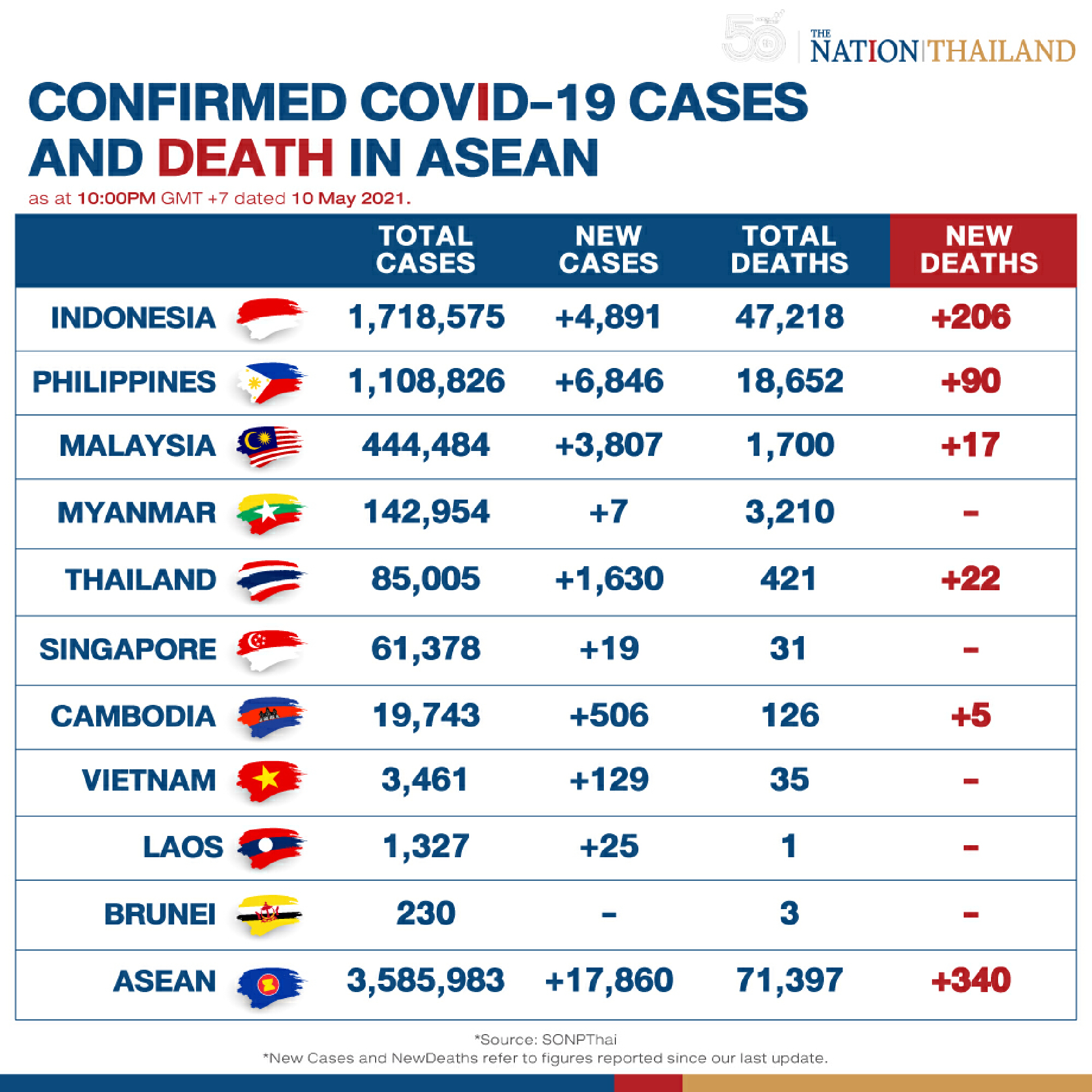
Total Cases crossed the 3.58 million infected with 17,860 New Cases reported across Southeast Asia on Monday.
Malaysia will start a month nationwide lockdown on Wednesday while the new daily infected case climb up to 3,807 as the government seeks to contain infection rates.
Vietnam announced additional 129 new coronavirus infection cases while the National Steering Board for Covid-19 Prevention and Control express dispatch to the People’s Committees of provinces and cities nationwide that Covid-19 prevention at workplace and business and production establishments in many provinces and cities has not been strictly implemented and positive cases have been reported in an industrial park.
Tokyo gives a taste of what Covid era Olympic games will be like
The Tokyo Olympics went off without a hitch. That is, at least, at a test event at the citys National Stadium in preparation for the main spectacle.
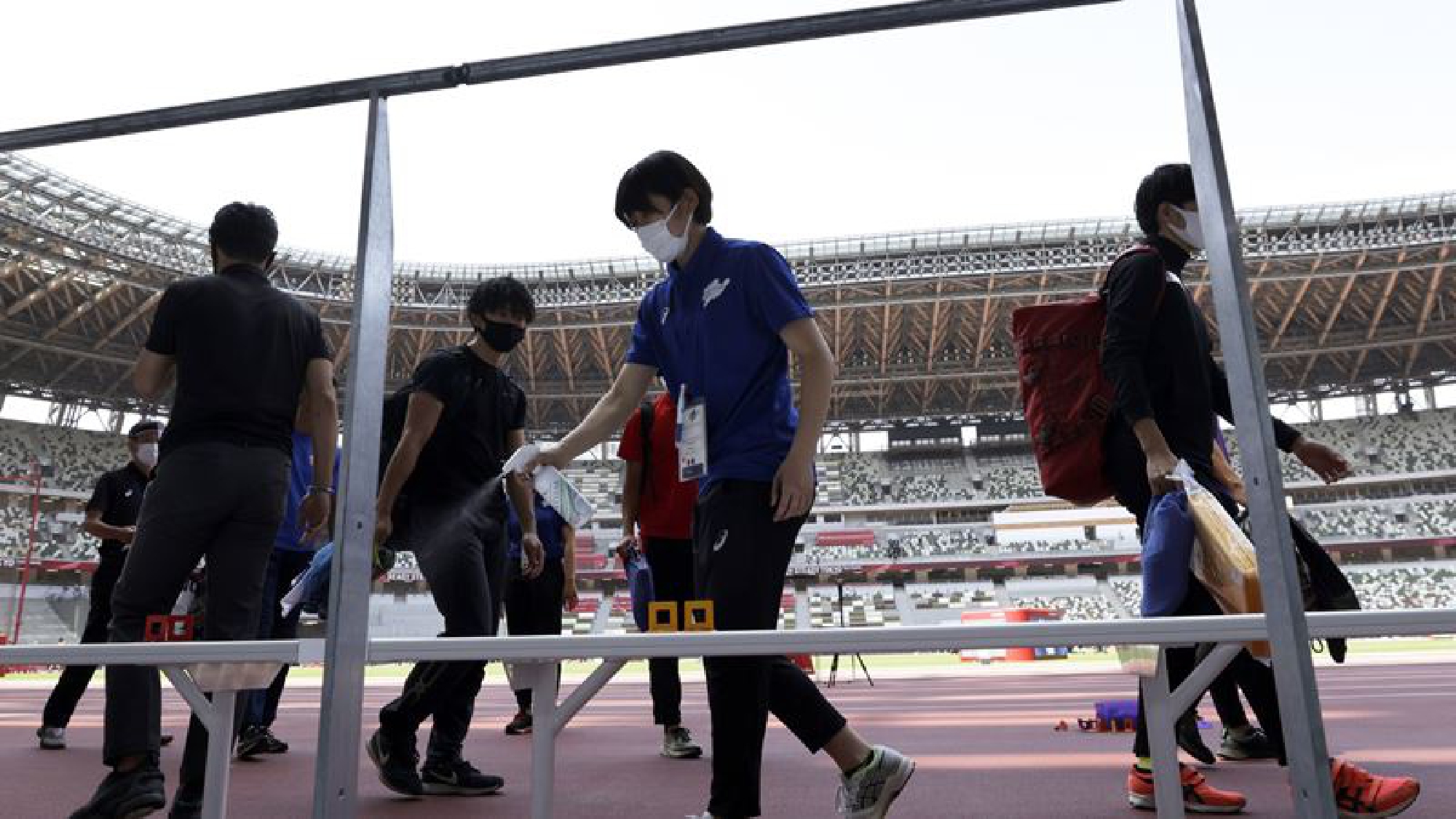
About 1,600 athletes, organizers and media got an early look Sunday at what the games will be like when they kick off on July 23. There was a full day of 100-meter heats, hammer throws and pole vaulting to make sure the Omega clocks, jumbo displays and robots on the field were in good working condition.
A key focus was how such a large-scale event can be held safely in the middle of a pandemic. Already delayed once, the Tokyo Olympics will be one of the most unusual in the 125-year history of the modern games. While international athletes will come this summer, overseas spectators will not. Hotel rooms will mostly be empty, while restaurants and department stores won’t get a boost from the usual flood of visitors.
“It’s important to have this simulation so that we are prepared for any circumstance,” Seiko Hashimoto, Japan’s Olympics chief, said at a briefing Friday.
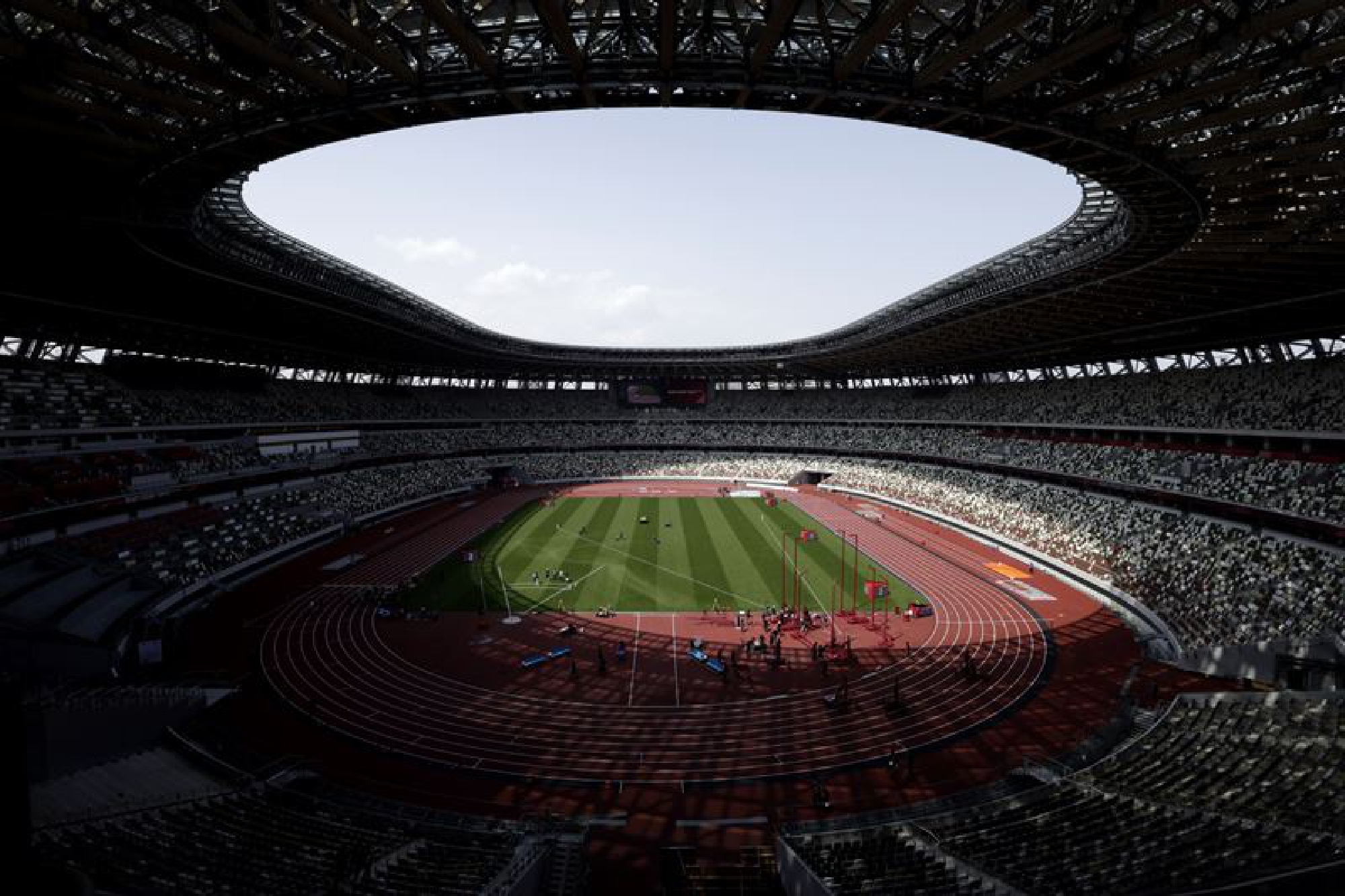
The National Stadium, designed by Japanese architect Kengo Kuma, is ready. Completed at the end of 2019, the 68,000-seat venue is in pristine condition. Thick wooden rafters hold up the roof, and the plants adorning the exterior have been properly watered. The concession stands weren’t open, and there was plenty of room to walk around and take in the space.
It’s a place that most people will only see on television. Although the white and green seats will be limited to those who obtain tickets in Japan, it’s not clear yet whether the number of spectators will be reduced further, or eliminated altogether, in order to prevent the spread of coronavirus infections during the 16 days of the quadrennial games.
Anti-infection protocols were, for the most part, normal. Media attendees on Sunday were required to track their temperatures and self-monitor health conditions for a week before, as well as after. Temperatures were checked again at the entrance, and face masks were mandatory.
Overseas attendees – there were about 20 from the World Athletics organization overseeing track and field events – were tested and quarantined for four days. The only people without masks were the 420 athletes who competed, including nine overseas competitors who traveled to Japan and 11 already in the country.
“I’d never been more nervous in my life entering the stadium,” said Sarasa Tanaka, who competed in the women’s 100 meter sprint on Sunday. “But once I ran, I discovered it was easy to run. I want the games to go ahead.”
Hovering nearby was Yannis Nikolaou, senior communications manager for World Athletics, telling local staff to make sure there was more space in the athletes interview area to ensure that there will be at least 2 meters of separation between them, as well as from cameramen and journalists. The current setup didn’t allow enough space, he told them, for the athletes and press that will be packed into the area in July.
The area for post-competition interviews is located alongside an indoor circular road deep underneath the stands for the movement of people and equipment. It’s a key corridor, with staff on bicycles and Toyota Motor forklifts. Two fire trucks and two ambulances were also on standby, part of emergency drills being held at the same time.
There’s a simmering debate whether there will be enough medical staff and facilities in Tokyo to handle any large outbreaks. More than 60,000 athletes, coaches, national team staff, media and other essential workers will converge on the metropolis from more than 200 countries.
Japan’s government is determined to go ahead with the event, despite rising infection numbers and parts of the world still struggling to get the pandemic under control. Prime Minister Yoshihide Suga has staked his administration on pulling off a successful Tokyo Olympics, even though the games are persistently unpopular among the public. An weekend opinion poll by the Yomiuri newspaper showed 59% of respondents saying the games should be canceled.
Completing the picture on Sunday was a throng of demonstrators across the street from the stadium. At least two dozen people marched, holding signs saying “Corona Olympics of the Dead” and “IOC and NBC Kill People,” while chanting “Stop the Olympics!” and “Stop the Olympic Torch!” Dozens of policemen marshaled them along.
While Japan has seen much lower transmission rates compared with other developed nations, its vaccination campaign is lagging behind places such as the U.K., the U.S. and parts of Asia. Olympic organizers are relying on a series of six “playbooks” of rules for participants of the Olympics and Paralympics, detailing how they can move around and socialize in order to manage the risks of what will be the world’s biggest Covid bubble.
Tokyo gives a taste of what Covid era Olympic games will be like
There were a bit more than 1,000 staff running Sunday’s test event, a small fraction of the estimated 150,000-plus personnel that will be necessary to help the Olympics and Paralympics run smoothly. It’s not clear how many of them will be vaccinated in time for the games, given the slower pace of inoculations in Japan.
Vaccines for athletes and delegations will be available thanks to an agreement announced last week between the International Olympic Committee and Pfizer and BioNTech, which are donating their doses for the games.
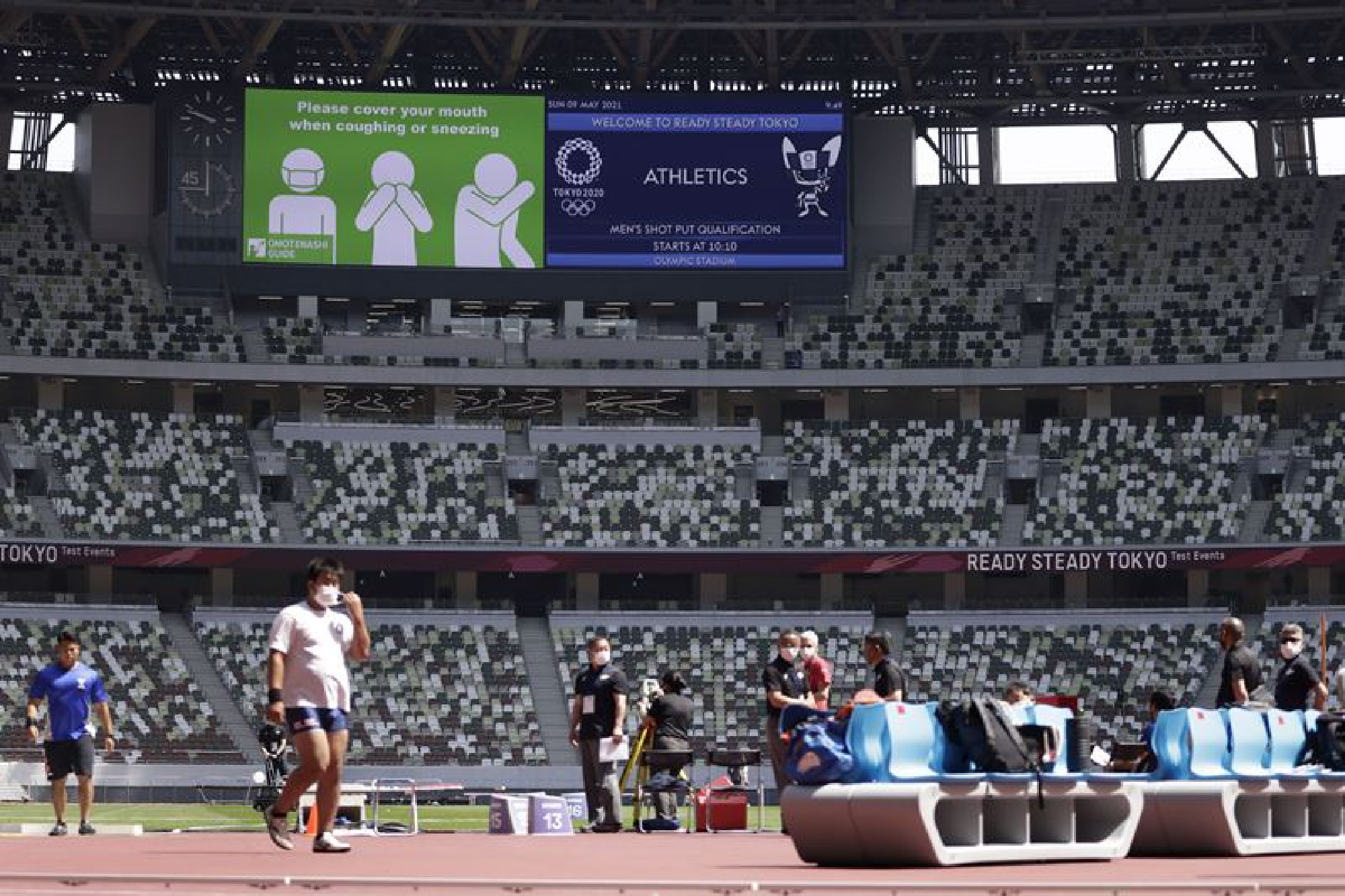
On the field Sunday, various competitions proceeded as they would during the main event, although the sound of starting guns came from speakers, as did simulated cheering from spectators. The clocks tracked heats, with athletes gazing at the big screens to see their track times. Remote-controlled robotic cars scurried around to fetch hammers and javelins thrown on to the pitch.
The test event, while involving vastly fewer people than the number who will be here in about two and a half months, was most notable for how normal it was.
Tokyo gives a taste of what Covid era Olympic games will be like
“Is it perfect? No,” Sebastian Coe, the president of World Athletics who was in Tokyo for the test event, said of the pandemic-era games. “The vast majority of athletes I speak to want to get into the games on the understanding that this will not be the type of games that they’ve experienced before. Are they accepting of that situation? Yes.”
Published : May 11, 2021
By : Syndication Washington Post, Bloomberg · Reed Stevenson
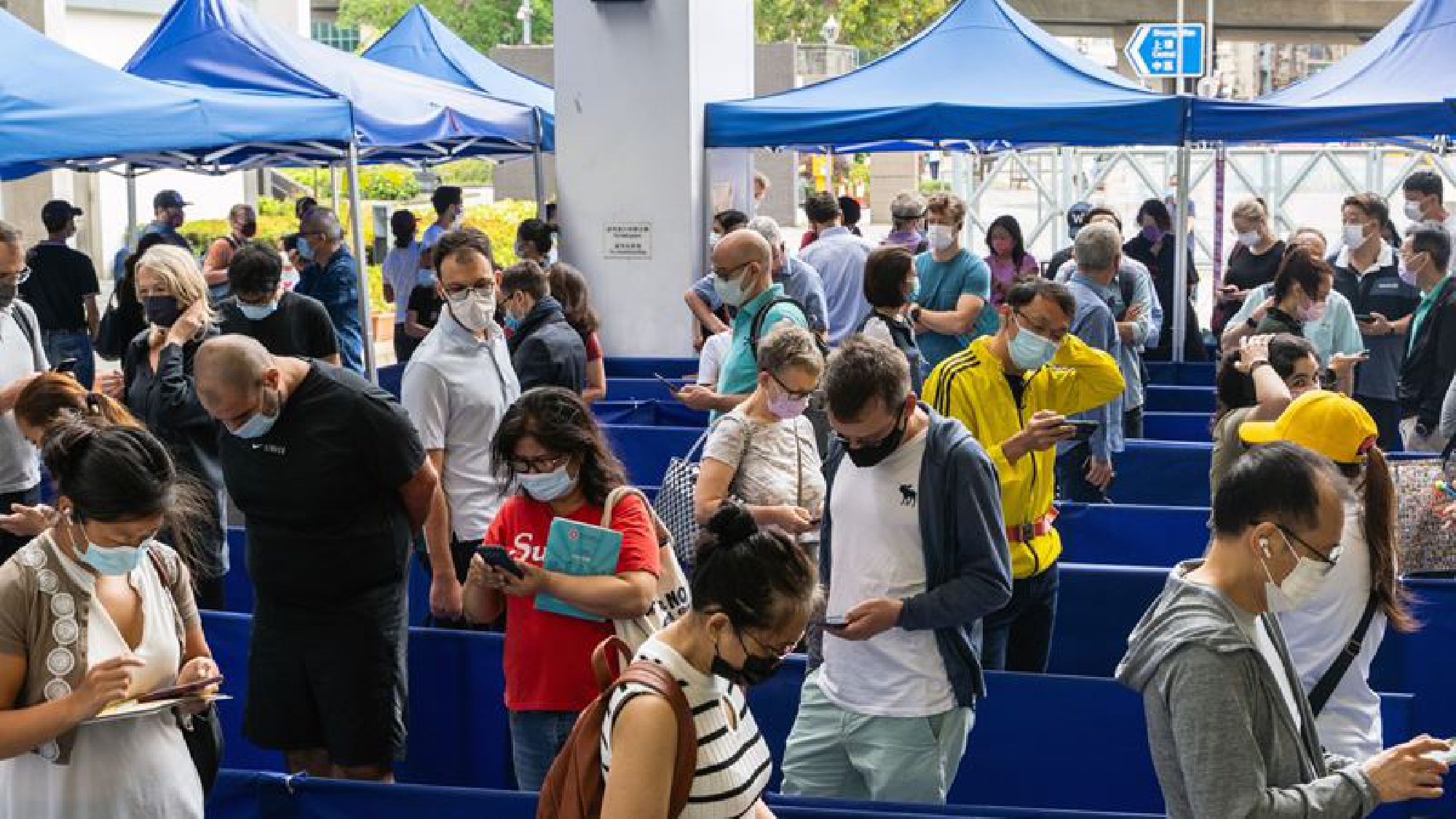
Unused shots pile up as mistrust mars Hong Kong vaccinations
There are few places in the world easier to get a coronavirus vaccine than Hong Kong.
Shots are free and available to everyone over the age of 16. Bookings are made via an easy-to-use government website and people can be in and out of the 29 vaccination centers dotted throughout the city in 20 minutes. They even get a choice between two shots – a Chinese-made one from Sinovac Biotech Ltd., or the Pfizer-BioNTech vaccine that’s the most effective in the world.
Most people, however, are choosing not to get vaccinated.
According to Bloomberg data, enough doses have been administered to cover 11.6% of a population of 7.5 million since late February. That’s behind leading places like the U.K., at 39.7% and Singapore at 19.4%, where available doses are so in demand that most of the adult population has not yet been granted access. In Hong Kong, so many shots are languishing that the government has warned people that some will expire in September. On Sunday, vaccine appointment bookings dropped to their lowest in a month, with just 2,100 taking the Sinovac shot and 6,800 receiving the BioNTech jab.
The situation is making Hong Kong a conspicuous global outlier. While other developed economies with strong vaccine supplies such as Germany, the U.K. or the U.S. see vaccine reluctance as a challenge to overcome later in their inoculation drives, Hong Kong has faced skepticism from the start, fueled by a breakdown of communication between the unpopular, unelected government and population.
The slow uptake is likely to further delay the city’s return to normalcy, and undermine its attractiveness as a business hub amid signs of an exodus of expatriates and locals alike. Hong Kong Monetary Authority Chief Executive Eddie Yue said the city’s low vaccination rate could make international firms question whether to set up base here.
Vaccine reluctance has been generally higher in the Asia-Pacific region, where early containment success has meant that people don’t fear covid-19 as much. Hong Kong has seen less than 12,000 cases and 210 deaths since the pandemic began, while peers like Taiwan, Singapore, New Zealand and Australia have been similarly less-affected by the pandemic.
What makes the dynamic harder to resolve in Hong Kong is a deeper well of mistrust stemming from unprecedented street protests in 2019 as well as a subsequent crackdown by Beijing and local authorities that has eroded key political freedoms.
With political distrust permeating through every sphere of Hong Kong life, some see a refusal to heed government calls to take the vaccine as a form of resistance — particularly as covid-19 restrictions and the national security law means forms of dissent have mostly been snuffed out.
“I won’t take the vaccine, because my friends and I just don’t want to follow any instructions or recommendations from the government,” said a 16-year-old student who gave her surname as Chau. “I don’t trust anything from them. We’ll do our best to resist and fight against the government in the way we still can.”
Elaine Tsui, a lecturer in health psychology at Hong Kong Baptist University, said that vaccine hesitation is driven by three psychological factors: convenience, complacency and confidence. In the city, getting a shot is convenient but there’s high complacency due to the perception that covid-19 doesn’t present a significant health threat to residents. Yet where the population stands out is in confidence — or the lack of it, she said.
With the level of distrust in government “more severe” in Hong Kong than many other places due to the events of the last few years, people are more prone not just to vaccine skepticism, but conspiratorial readings of any public health initiative linked to the government, she said.
Media reporting is one way this unfolds, she said. In Hong Kong, medical incidents or deaths among people after they get vaccinated are widely reported, though some have very little link to the shot.
In one example, a 41-year-old man died this month five days after an accident where a barbell fell on his chest in a gym during a workout, with media reports adding that he had taken the BioNTech vaccine earlier. Overall, 16 people have died after taking the Sinovac shot, though the government said none have been linked to the vaccine.
That’s contributed to the distrust of vaccines, despite overwhelming scientific evidence in Hong Kong and globally showing their safety.
Selene Yau, a 24-year-old marketing professional, said that news of the deaths and side effects are scaring people regardless of their politics.
“My relatives and I have different political views, but we still want to wait and see. There is a lot of news about the adverse reactions spreading on social media and WhatsApp groups,” said Yau.
The febrile atmosphere also puts pressure on government officials to act cautiously in ways that have then further raised resistance. One example was an abrupt 12 day suspension of the BioNTech vaccine in March after healthcare workers reported packaging defects like “loose lids” and “stains” to the government and company.
“In other places it may not have risen to what it rose to in Hong Kong,” said Ben Cowling, head of the University of Hong Kong’s department of epidemiology and biostatistics, noting that the BioNTech factory that manufactured those shots had also sent doses to many other places around the world without issue.
The Hong Kong government said in a statement that a number of officials have “led by example by getting vaccinated,” and added that it would “go public to clarify misinformation and misconception about the safety and benefit of taking vaccines.”
To stoke interest in vaccinations, the government has relaxed social distancing rules for vaccinated people, allowing them to visit bars and gather in bigger groups at restaurants. A travel bubble with Singapore scheduled for the end of the month will also only be opened to vaccinated Hong Kong residents.
Those measures haven’t boosted vaccination takeup significantly. After an initial one-day bounce, bookings have stayed flat for both types of vaccines.
On Friday, the government announced that vaccinated people would also be subject to shorter periods of quarantine if they’re found to be close contacts of infected people or are traveling from a handful of low to medium risk places.
While experts say even stronger incentives are needed, a government adviser suggested the Hong Kong atmosphere of distrust limits their policy options.
“Since the trust level is not high, so we can’t push it like mainland China or elsewhere, so we must do it in a voluntary basis and every individual must decide for themselves,” said Lam Ching Choi, a doctor and adviser to Hong Kong’s leader. “It’s a very delicate position for the government.”
The government is now reaching out to local celebrities to convince people to get vaccinated. Secretary for the Civil Service Patrick Nip publicly thanked Hong Kong billionaire Li Ka-shing for publicizing on his foundation’s Facebook page that he received a BioNTech shot and asking others to do so too.
Still, much of the population looks set to dig their heels in — even front-line medical workers at risk of being infected.
Hanson Chan works as a nurse at a public hospital that handles covid-19 patients. Vaccine development was rushed and the prospect of rare side effects worries him, he said.
“The government keeps saying those cases of abnormal side effects have no clinical evidence to indicate that they are caused by the vaccine — that may be a fact,” Chan said. “However it’s not convincing enough for residents to believe this argument from the government’s mouth.”
Published : May 11, 2021
By : Syndication Washington Post, Bloomberg · Iain Marlow, Felix Tam
 Vaccination drives at area mosques have been successful in reaching Muslims and non-Muslims alike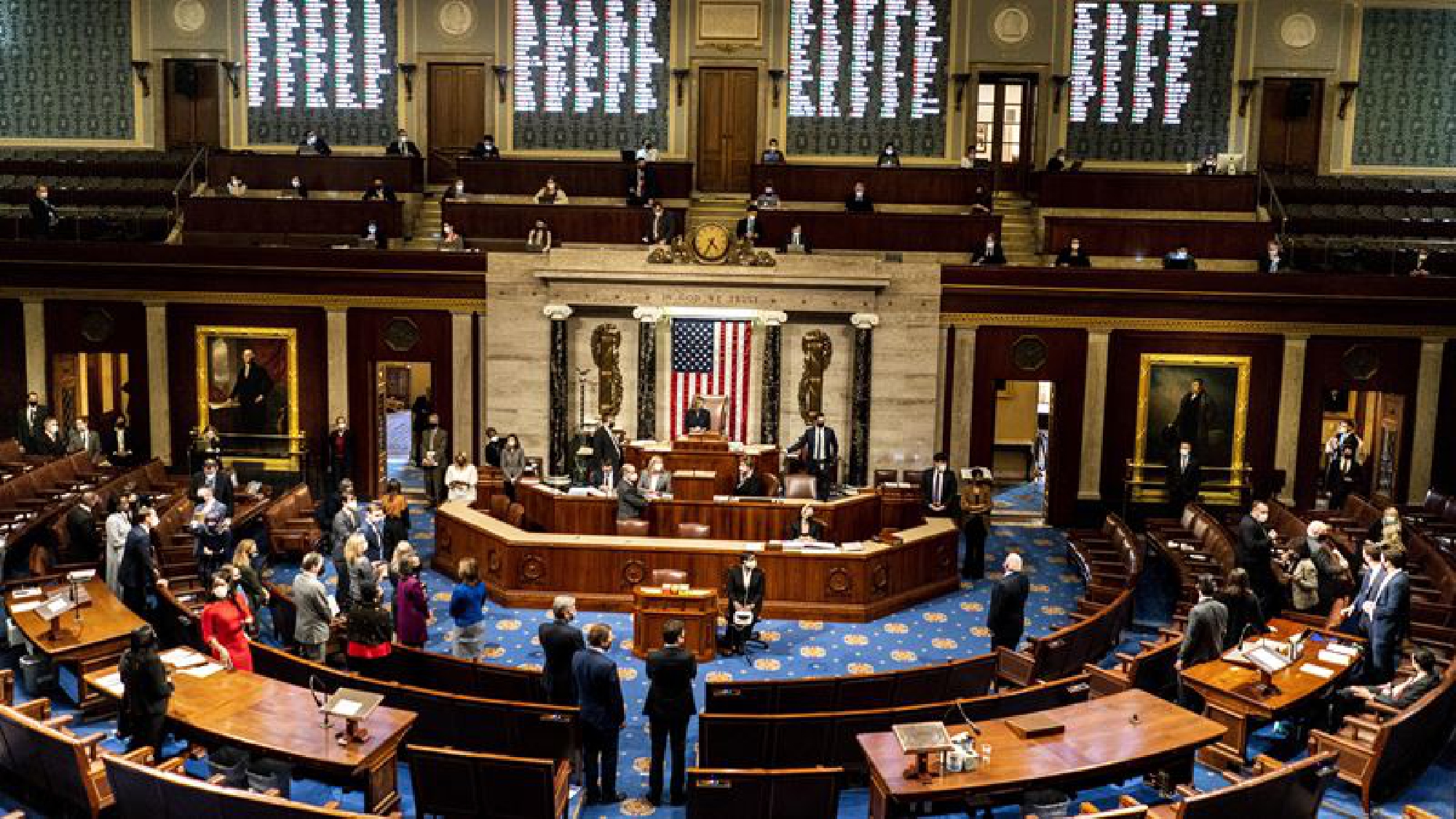



 Tokyo gives a taste of what Covid era Olympic games will be like
 Tokyo gives a taste of what Covid era Olympic games will be like