Biden wants to move energy offshore, but choppy seas are ahead #SootinClaimon.Com

#SootinClaimon.Com : ขอบคุณแหล่งข้อมูล : หนังสือพิมพ์ The Nation.

https://www.nationthailand.com/international/40000672

Biden wants to move energy offshore, but choppy seas are ahead


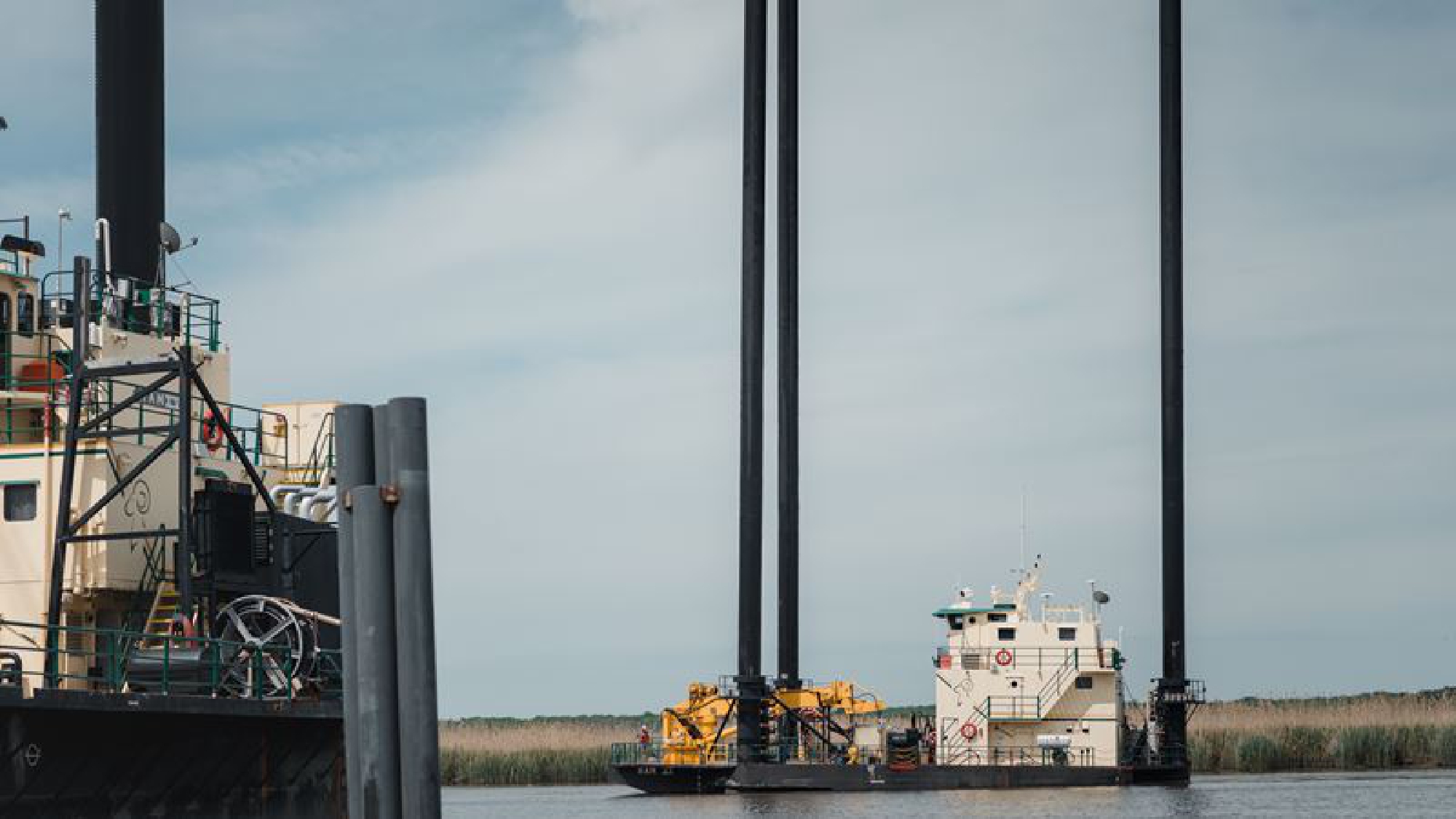
DORCHESTER, N.J. – In his three decades servicing oil platforms in the Gulf of Mexico, boat captain Keith Piper rode out all manner of storms and gales. Still, he had never faced the elements that tested him last winter at a wind farm off the coast of Rhode Island. Subzero temperatures. Snow. A noreaster blowing 70 miles per hour. Coffee sloshing in the pot and his 500-ton liftboat – propped above the waves on four hydraulic legs – vibrating from the force of the wind.
Biden wants to move energy offshore, but choppy seas are ahead

Given the rock-hard bottom of the continental shelf, unlike the Gulf’s forgiving sands, any mistake setting the boat legs down and the impact on board would feel like being slammed head first into concrete. “It shakes everything and breaks everything,” he said.

These are the discoveries being made at the dawn of America’s offshore wind industry. Up and down the East Coast, developers and government agencies are preparing for the massively complex and costly challenge of placing thousands of wind turbines taller than the Washington Monument miles out into the Atlantic. The Biden administration has set a goal that industry players call highly ambitious, if not unrealistic: to produce 30,000 megawatts of electricity from offshore wind farms by 2030, enough to power 10 million homes. Meeting this goal is one of the few available paths for President Joe Biden to reduce the country’s reliance on fossil fuels and fight climate change.

The obstacles ahead are staggering. The United States is decades behind Europe and Asia in developing offshore wind. Only seven offshore turbines are running – the five in Rhode Island, plus two in Virginia – and together the projects produce just 42 megawatts of electricity. China alone installed more than 3,000 new megawatts of offshore wind energy last year, more than half the world’s total.

Far larger efforts are on the horizon, though. Vineyard Wind, the first large-scale U.S. offshore wind farm, is expected to receive its final federal permit from the Interior Department within days. It calls for 62 turbines generating 800 megawatts just more than a dozen miles southeast of Martha’s Vineyard, Mass. Fourteen other projects from North Carolina to Maine are in other stages of permitting that, under a disdainful President Donald Trump, became a seemingly endless process.

“The Achilles’ heel of the industry has been the federal permitting process,” said David Hardy, chief executive of Ørsted Offshore North America, the U.S. offshoot of the Danish energy giant that has been involved in both existing American projects and has applications pending for several more. “It was, to be blunt, stalled under the Trump administration.”

Hardy is encouraged by Biden’s interest. A recent call with offshore industry leaders included four Cabinet members as well as White House climate adviser Gina McCarthy, with administration officials vowing to provide federal loans and accelerate permitting, he said. The Bureau of Ocean Energy Management has committed to processing the 14 pending proposals by 2025.

“We’re taking an all-of-government approach to ensure that we are successful in developing offshore wind,” bureau director Amanda Lefton said in an interview.

The aggressive timetable will require a massive new industry, with steep investments in new ports, boats, factories, and upgrades to electrical grids. The first U.S.-built vessel capable of installing the offshore turbines is being completed in Texas at a cost of $500 million. Until more ships are ready, projects in this country must rely on boats from Europe, an exchange complicated by the continent’s own demand for wind energy and maritime trade laws here.

There are other hurdles, too, particularly intense opposition from some coastal communities and commercial fishermen. Even when that’s overcome, construction can only move forward during certain months because of bad weather and the threat to migratory patterns of the North Atlantic right whale, a critically endangered species.

It all makes offshore wind farms – multibillion-dollar infrastructure projects – a still-risky proposition, according to developers and others in the industry.

“Everybody’s sticking their toe in the water right now,” said Piper, the boat captain who’s now based in Dorchester for that very reason. “But nobody wants to stick their whole foot in yet.”

– – –

Bill White leaned into a brisk breeze as he crossed the vast and largely empty expanse of compacted gravel at the edge of Buzzards Bay. There is wind here but so far little else.

Yet two years from now, he envisions 500 workers – electricians and engineers, longshoremen and seafarers, all tiny specks next to turbine blades longer than a football field, nose cones called nacelles that are large enough to hold elevators and 3.5-million-pound steel columns known as monopiles, which get hammered deep into the seafloor.

It is White’s job to make Vineyard Wind a reality, and this lot at the Marine Commerce Terminal in New Bedford, Mass., a historic whaling community, is where it will happen. The site is the first port in the country built specifically to withstand the turbine components’ crushing weights. Other facilities are being developed in New York, Connecticut, Rhode Island and Maryland. In New Jersey, a $250 million factory will be completed in two years and begin building the monopiles that anchor wind turbines in place. Siemens Gamesa is considering a future factory in Virginia to make turbine blades.

“These will be some of the biggest construction projects our country has seen,” said White, vice president of offshore wind for Avangrid Renewables, one of two companies leading Vineyard Wind. “This will be a massive mobilization.”

He has long envisioned this future. A veteran of the State Department and the Clinton White House, he spent more than a decade trying to advance offshore wind energy with the state of Massachusetts and then the private sector. He lived through Cape Wind, a proposed project off the coast of Nantucket, Mass., that was defeated by lawsuits and well-funded opponents such as the Koch brothers. The first meetings to discuss the location of what would become Vineyard Wind were in 2009.

“It’s been a hell of a long road,” he said.

Thousands of wind turbines are already spinning across the country, but developers see greater potential offshore because of more powerful sustained winds, the proximity to large coastal cities thirsty for electricity and the space for vast activity.

White’s company is a subsidiary of the Spanish energy company Iberdrola. Its partner is Copenhagen Infrastructure Partners out of Denmark. So far, European companies dominate these early efforts to bring offshore wind to the United States. Vineyard Wind’s onshore substation will be built by a Swedish company, its cables by Italian and Belgian firms. General Electric will supply the turbines.

Developing the domestic supply chain and expertise to get U.S. wind farms up and running is one of the big obstacles ahead. When Dominion Energy in Virginia launched its two-turbine pilot 27 miles off the coast of Virginia Beach, the only boats capable of doing the installation work were in Europe. Because of the project’s small scale, it took three rounds of bidding to secure the parts and vessels needed, Dominion senior vice president Mark Mitchell recalled.

A century-old law made the situation even tougher. The Jones Act says only U.S.-built-and-operated ships can move goods between U.S. ports. To install the Virginia turbines, supplies shipped from Europe were first staged in Canada before being ferried on repeated trips to the construction site. The repeated snags prompted Dominion to invest in the ship now being built in Brownsville, Texas. A jack-up vessel, it will be able to put down legs on the seafloor and then use hydraulic power to lift itself above the waves and create a secure working platform. It is expected to be ready in 2024 for Dominion’s wind farm expansion.

Even after a wind farm goes online, much can go wrong. That was why Piper and his men headed out last October aboard the Ram XV, a vessel that resembles a giant floating platform with 175-foot vertical legs. Its wind-energy niche is drilling and cabling work, and it was dispatched to the Rhode Island wind farm to help bury transmission cables that had become exposed by shifting sands.

The liftboat left the dock in Dorchester, making its way down the Maurice River, into Delaware Bay and then up the New Jersey Coast before turning east. During the four-month assignment, several major storms hit, at times forcing the crew to shelter in the Block Island harbor, Piper recalled. Temperatures plummeted to minus-10 degrees at one point, freezing the boat’s water-making machine. A sewage line had to be thawed with an acetylene torch.

“It was brutal,” said David Morgan of Aries Marine, the oil services company that owns the boat. “Very, very difficult job. Right through the worst time of the year.”

– – –

Those who oppose wind farms find many reasons to do so. The sight of them can be enough to sour a waterfront homeowner’s mood, although the projects in the pipeline are slated for many miles offshore and so turbines will appear tiny, if not invisible, from land.

Environmentalists, who support moving away from fossil fuels to combat climate change, are torn. They worry about risks to birds, fish and marine mammals, particularly the North Atlantic right whale.

Only about 360 of the whales remain, migrating every fall from New England to as far south as Florida. Noise from underwater construction and increased boat traffic is the most serious threat posed by the new crop of wind farms, according to Mark Baumgartner, a marine ecologist at the Woods Hole Oceanographic Institute who uses buoys and underwater gliders to monitor right whale sounds.

“We already have a fairly industrialized ocean, with shipping traffic and fishing activities. Adding these large wind farms with many, many, many turbines is certainly concerning,” he noted.

Wind farm developers have pledged to restrict construction for several months each year to avoid disturbing the whales. Vineyard Wind plans to use compressed air to form an underwater curtain of bubbles to try to dampen construction noise. Vessels involved will have spotters scanning for whales and orders to halt work if they appear.

The Biden administration’s goals will face the determined resistance of commercial fishermen, whose trawl nets and lobster pots ply the same stretches of ocean as several of the areas designated for future wind farms. This is no small business. New Bedford, Mass., with its scallop industry, has been the most lucrative fishing port in the country for the past two decades, taking in more than $430 million in 2018.

Wind farm prep work has already generated conflicts. Large survey vessels, which have a sled that drags below them with cables and sonar, have repeatedly damaged nets and other equipment as they mapped the ocean floor, according to several commercial fishermen.

In August, a survey boat working for Ørsted was about nine miles southwest of the tip of Long Island, close to where 67-year-old Ace Auteri, had laid out rows of fish pots to catch sea bass. “I’m there and he’s trawling, he’s dragging his gear literally 50 feet off my line of gear,” Auteri recounted recently. “I called him on the radio and I told him, ‘Hey, look, you’re way too close to my gear here. You’re going to get into it.’ “

Auteri returned a few days later and found his fish pots gone. Convinced the boat had torn through them, he complained to Ørsted’s liaison to the fishing industry but felt he was getting a runaround. He decided not to file a formal claim, though he estimates he lost $10,000 in gear and lost income from the missing traps. “I could see I wasn’t going to get paid for it.”

An Ørsted spokesman said the company does not comment on such individual situations or claims.

But many commercial fishermen are worried about more than nets and pots. They fear they will lose fishing grounds because it will be dangerous to maneuver among the wind farms, particularly during poor weather and low visibility. When close to turbines, they report persistent problems with their radar navigation systems identifying false objects. They also worry that construction and underwater drilling – and then noises from normal turbine operations – could disturb fish and shellfish populations.

Vincent Carillo, of Montauk, N.Y., who owns a scallop boat called the Nemesis, said that for years he has heard government fisheries regulators talk about the ocean as a public resource.

“And now they just leased it all off to foreign companies,” the 55-year-old Carillo said. “I don’t understand how they can just lease the bottom out like that when for centuries we have been fishing on those grounds.”

Wind farm developers have been negotiating extensively with fishermen, with Ørsted taking hundreds of meetings with them “to understand their concerns and try to adapt to work with their needs,” Hardy said.

Vineyard Wind’s developers have agreed to pay $37.7 million to commercial fishermen in Massachusetts and Rhode Island to compensate them for future losses. They also reduced the size of the project by 60 percent and agreed to place turbines one nautical mile apart.

“This is an unknown to them,” White said of the fishermen. “And we’ve had them at the table, but there’s still a lot of uncertainty.”

He expects legal challenges from opponents if the federal permit is approved. Even so, he feels the wind’s at his back these days, and the future he has long imagined may finally be on the horizon.

“I think it’s coming,” White said. “I think it’s just about here.”

Published : May 09, 2021

By : The Washington Post · Joshua Partlow
Most police departments in America are small. Thats partly why changing policing is difficult, experts say. #SootinClaimon.Com
#SootinClaimon.Com : ขอบคุณแหล่งข้อมูล : หนังสือพิมพ์ The Nation.

https://www.nationthailand.com/international/40000671

Most police departments in America are small. Thats partly why changing policing is difficult, experts say.


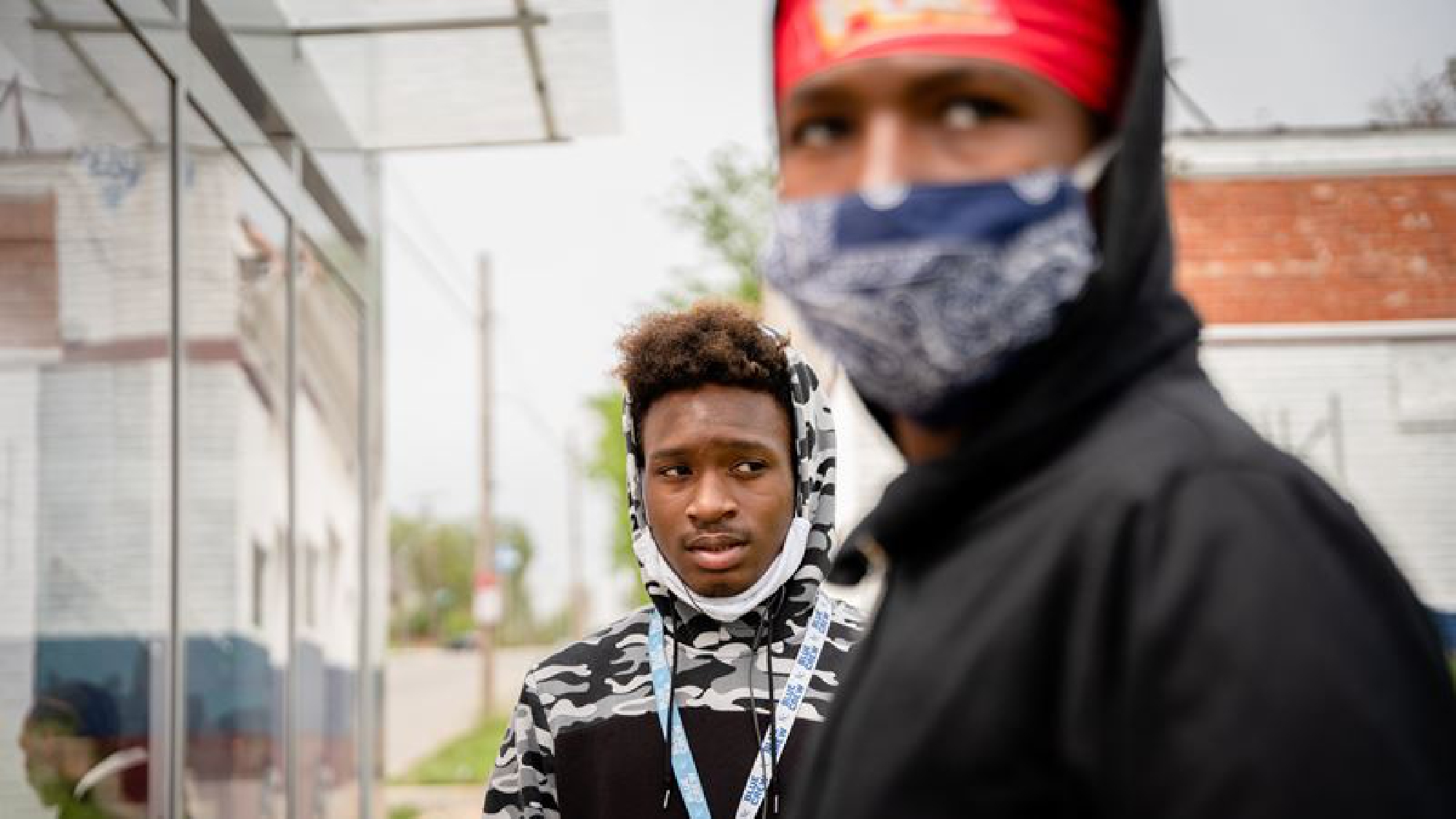
While big-city police tend to get the most attention, the agencies that have been in the spotlight recently for uses of force – fatal shootings of Black men in Brooklyn Center, Minn., and Elizabeth City, N.C., and pepper-spraying a Black and Latino man in Windsor, Va. – are more illustrative of what American law enforcement looks like: small departments in places that rarely make the news.

Most police departments in America are small. Thats partly why changing policing is difficult, experts say.

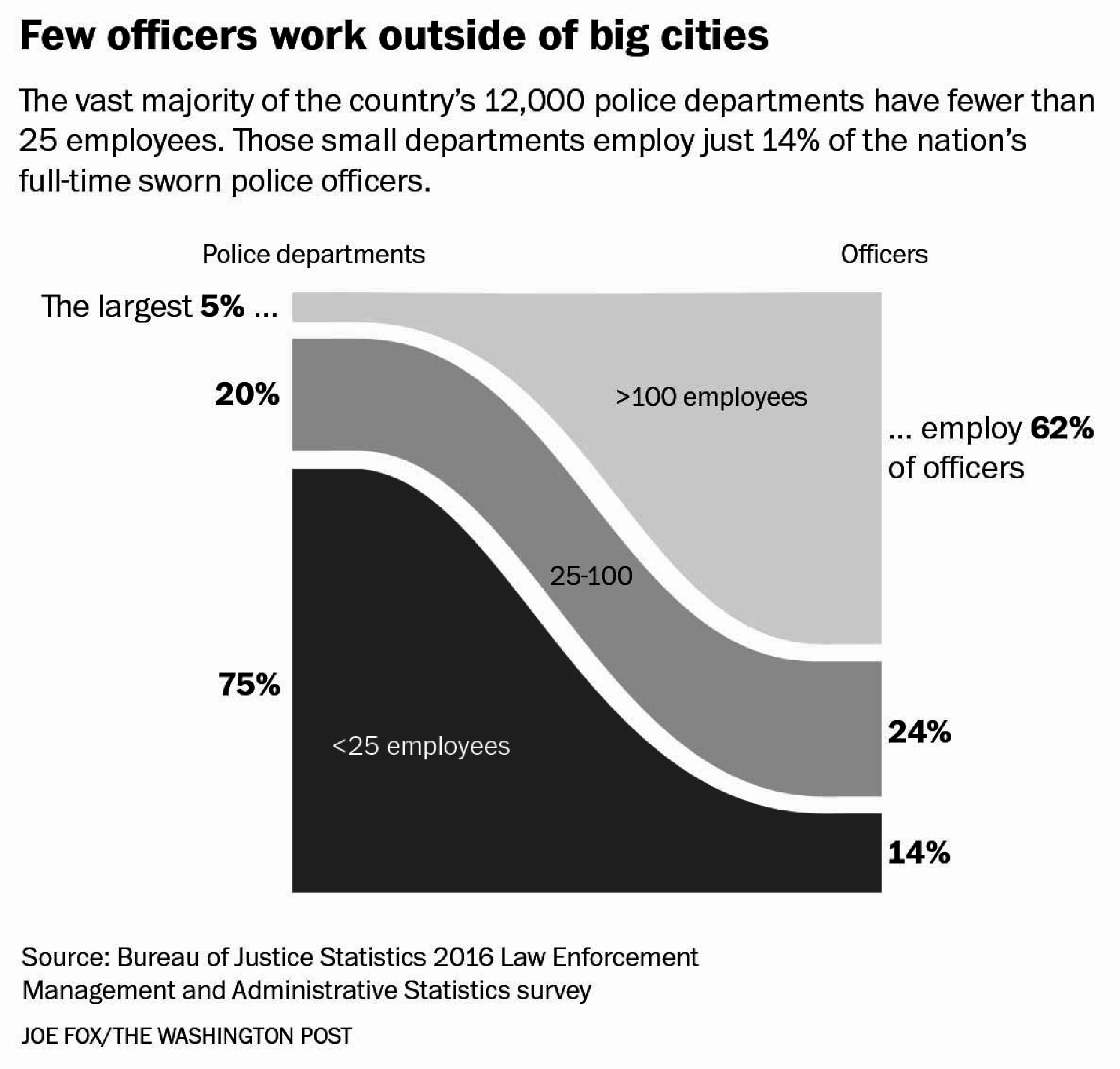
According to a federal survey in 2016, there are more than 12,200 local police departments nationwide, along with another 3,000 sheriff’s offices. And most of those don’t look like the New York Police Department, which employs more officers than Brooklyn Center, in suburban Minneapolis, has residents.

Nearly half of all local police departments have fewer than 10 officers. Three in 4 of the departments have no more than two dozen officers. And 9 in 10 employ fewer than 50 sworn officers. Brooklyn Center, which has 43 officers, and Windsor, which reported a seven-member force, fit comfortably in that majority.

Experts say that while smaller departments have their benefits, including being able to adapt to their communities and hire officers with local ties, these agencies also are typically able to avoid the accountability being sought as part of the national movement to restructure and improve policing. These departments’ often limited resources and the decentralized structure of American law enforcement complicate efforts to mandate widespread training and policy changes, experts say.

“You want to change American policing, figure out how to get to . . . the departments of 50 officers or less,” said Chuck Wexler, executive director of the Police Executive Research Forum, a Washington-based group that works with police departments. “How do you reach them? How do you get to them? . . . That’s what the American people keep wondering.”

Former Charlotte police chief Darrel Stephens said smaller departments will have a harder time diverting officers to training to learn new tactics or practices, since they have fewer officers to put on the streets overall.

“I don’t want to denigrate them, because there’s a lot of good people doing things in the right way for the right reasons,” Stephens said. “But their capacity is just limited.”

But there are also other differences, owing to the remarkably localized nature of American policing.

Policies and practices can vary significantly from department to department. These differences can include how departments approach the use of force as well as the levels of training and specialization involved.

“It’s unlike any other country,” Wexler said. “In places like the United Kingdom, you have a Home Office, you have standards. In Germany or Israel . . . they have a national police. Our policing is completely fragmented, decentralized, with no national standards.”

The smaller departments in the spotlight recently have come from three very different communities, and all involved officers doing what police described as relatively routine police work: traffic stops and serving warrants.

In Brooklyn Center, an officer shot and killed 20-year-old Daunte Wright during a traffic stop; the police chief said the officer, who resigned and was charged with manslaughter, meant to user her Taser, not her service weapon.

Police in Windsor stopped and held Army 2nd Lt. Caron Nazario at gunpoint in December for not having a permanent rear license plate. In video footage that spread widely last month, the officers are heard yelling and berating Nazario and are seen striking and pepper-spraying him before handcuffing him. One of the officers involved was fired amid the public outrage over the footage, recorded by the officers’ body cameras and Nazario’s cellphone.

On April 21, sheriff’s deputies in Elizabeth City shot and killed Andrew Brown Jr. while attempting to serve a felony warrant, officials said, an episode that has spurred intensifying questions, criticism and protests.

These were not the only police departments to have drawn attention recently. Former Minneapolis police officer Derek Chauvin was convicted of murder last month in the death of George Floyd, and police in Chicago and Columbus are under scrutiny after fatal shootings of children. But those departments, all among the country’s largest, are the outliers.

The Pasquotank County Sheriff’s Office in North Carolina, whose officers were involved in the Elizabeth City shooting, for instance, has 55 sworn deputies for a county of more than 39,000 residents. Sheriff’s offices differ from police departments in that police chiefs are usually appointed and sheriffs are typically elected. But the numbers remain pronounced: More than 3 in 4 sheriff’s departments have fewer than 50 officers, according to the federal survey.

While policing has become the subject of protests and fraught national debates, exactly what kinds of departments are charged with keeping citizens safe – including how many there are, the number of officers they employ and their demographic makeup – often gets glossed over.

The 2016 federal survey is the most recent available, according to the Justice Department. A new survey is in the field, but it is unclear when that data will be released, the department said.

The latticework of law enforcement draped across the country doesn’t just include departments of varying sizes, but forces with distinct procedures that often exist side by side in neighboring communities.

That means “the rules of policing change depending on where you are,” said Dennis Kenney, a former Florida police officer and a professor at the John Jay College of Criminal Justice in New York.

“It’s not even county to county,” he said. “It’s city to city. Within a county, you can have one police department that has one set of policies and another that has another set of policies. And certainly the level of training varies greatly.”

Most police departments in America are small. Thats partly why changing policing is difficult, experts say.Most police departments in America are small. Thats partly why changing policing is difficult, experts say.

Kenney was an officer with the Bartow, Fla., police department in the late 1970s and early 1980s, when it had around 40 officers, he said. Since then, he has consulted with a number of other police agencies, including national departments in Colombia and Thailand.

One key difference in having thousands of police departments, rather than one central force, is how long it takes for changes in training or policies to ripple outward, he said.

“I spent a good amount of time working with the Colombian national police,” Kenney said. “And if you want to make a change in their agency, basically you’ve got a general to convince and it flows downhill from there.”

In the United States, “if you’re trying to do systemwide things or things that involve collaboration, then it’s much more difficult,” he said.

Kenney pointed to community policing, a concept that involves building ties between officers and the communities they patrol, as an example. Advocates of the approach had to sell it to thousands of different agencies, he said.

“Local policing is the most decentralized institution in the United States and the world,” said Stephens, the former Charlotte chief.

“There are pros and cons” to the American system, said Christy Lopez, who oversaw the Justice Department’s investigation into the Ferguson, Mo., police department after 18-year-old Michael Brown was shot and killed by a police officer in 2014.

“It’s a very big country with different challenges in parts of it,” said Lopez, who now teaches law at Georgetown University. “I like the idea we have different agencies that can experiment . . . and be responsive to that particular community. I think there’s value to that.”

But with this diffuse system, much more attention is usually paid to the largest departments, such as those in New York (which has roughly 36,000 police officers), Chicago (more than 12,000 officers) and Los Angeles (about 9,000 officers).

While most individual police departments are small, the majority of officers nationwide work for the biggest forces, patrolling communities where the largest populations live. Departments with at least 100 officers account for 5% of all police agencies nationwide, but they employ more than 6 in 10 full-time officers.

Those officers police communities that also may still have news organizations who can provide scrutiny and coverage.

“The places you hear the most about might not be the worst places,” Lopez said. “They might be the places with the loudest advocacy groups, the most robust media markets or even just they’re better about sharing their information.”

Additionally, policing across the country is still shrouded in opacity in significant ways. The number of people shot and killed by police is tracked by The Washington Post. Other details of uses of force – including how many times police across the country fire their guns and miss, or hit people who survive – remain unknown.

When it comes to smaller police departments, “there’s just no oversight and no accountability, to a very large extent,” Lopez said.

“They’re never going to have a police commission. They’re never going to have a civilian review board,” she said. “They’re never going to have a major media outlet focus on them.”

That, she said, is why there needs to be more transparency built into policing, such as state policies mandating certain details be made public. “So that no matter how small the agency is, there are certain things they’re required to do and certain things we are required to know about them,” Lopez said.

Some experts said it might be good to review whether every police agency is necessary and whether any could be consolidated. Such calls are not new, they said.

“You don’t need to have five or 6,000 or 10,000 officers. Sometimes you get lost in all of that,” said Stephens, who was Charlotte’s second police chief after the city consolidated its police with Mecklenburg County. “An agency of 150 or 200, 250 officers isn’t that large to begin with, but it’s generally in a much better position to provide the full array of services.”

But trying to merge departments could be difficult in some cases, because many politicians are loath to give up an agency operating under their aegis.

“Mayors and city managers and city council people just don’t want to give up control,” said Kenney, the former Florida police officer. “As a result, small cities will maintain very small agencies because they like . . . being able to get a response from the police when they want it.”

Ultimately, he said, “we like localized control over the police.”

Published : May 09, 2021

By : The Washington Post · Mark Berman

To mask or not to mask? With vaccines and new guidelines, the mask-faithful navigate a weird gray area. #SootinClaimon.Com

#SootinClaimon.Com : ขอบคุณแหล่งข้อมูล : หนังสือพิมพ์ The Nation.

https://www.nationthailand.com/international/40000670

To mask or not to mask? With vaccines and new guidelines, the mask-faithful navigate a weird gray area.


When David Díaz went for a recent 5-mile run in Iowa City, he took along a partner he has depended on for more than a year: his face mask.

To mask or not to mask? With vaccines and new guidelines, the mask-faithful navigate a weird gray area.
Díaz, 29, knew he did not have to. He’s fully vaccinated, and recent federal guidance says unmasked, outdoor ex ercise is safe. At first, he wore the mask around his neck. But after passing people one block later, he pulled it up – and then began wondering why. Was he posturing? Was he showing concern for others? Was he worried passersby would view him as an anti-masker? Was he actually being anti-science?

“At what point are you doing more harm than good and letting fear or something rule your life?” Díaz, a data analytics consultant, said days later. “It’s still a thing I’m trying to work through.”

Some Americans never fully embraced face masks, those swaths of fabric that became one of the seminal flash points of the U.S. coronavirus pandemic. But for many across the nation who did, rising vaccination rates and shifting public health advice are forcing a recalibration of a relationship with an accessory that has served as a shield against a deadly pathogen, a security blanket during a crisis, and a symbol – of regard for the common good, liberal politics or belief in science.

Now, after months of advising Americans to wear masks and stay six feet from most others, the Centers for Disease Control and Prevention says vaccinated people can, among other things, gather unmasked indoors and that everyone can exercise outdoors with household members – and with faces bared to the world. Suddenly, in the spring of 2021, donning a mask for a solo stroll outside, where scientists have found scant evidence of transmission, has become the unscientific approach.

“If I know it doesn’t offer me additional protection, it’s okay to wear it anyway – it’s okay to have that kind of cognitive dissonance,” said Zoë McLaren, an associate professor at the University of Maryland at Baltimore County who studies policies to combat infectious diseases. “You want people to understand the actual risks, and then they can choose the level of precaution they want to take.”

McLaren said she thinks the latest CDC guidance, with its traffic-light colored rubric, is scientifically sound, if a bit dense. It’s been criticized by others, including “The Daily Show” host Trevor Noah, who slammed it for being “unreadable” and allowing vaccinated people to do only “two more things without a mask on.” Others complain it is too complicated and it requires people to know whether others are vaccinated.

James Clark, vice president of public safety at the Urban League of Metropolitan St. Louis, said people in the north St. Louis areas where he works initially resisted masks, then “got fashionable” with them. But now Clark worries people are misinterpreting the CDC guidance.

“I think [the CDC] should have been a lot more succinct in their messaging because I see people now walking into gas stations without a mask on, and the gas station cashier says, ‘You can’t come in without a mask,’ and then the person says, ‘Well, I thought we didn’t have to wear masks no more?'”

That confusion is common, said Faisal Khan, director of the St. Louis County Department of Public Health.

“People are so fixated on wanting to see their own individual situation represented or explained by those guidelines, and that’s never the purpose of the guidelines,” said Khan, who said his office receives a continual stream of calls and emails with “people screaming at us about why they cannot take their masks off” or questions about “which situation they should be masked in or not.”

At a macro level, mask-wearing in the United States has not been driven by public health advice or mandates, researchers and pollsters say. It is strongly associated with political affiliation. An Ipsos poll released this week found that 57% of Americans said they always wear masks when they leave the house, with Democrats more than twice as likely to do so than Republicans.

But there are signs of a new trend: The poll found that 63% of all vaccinated respondents always wear masks outside their homes, down from 74% in mid-April.

That is “a relatively significant shift,” said Chris Jackson, senior vice president and head of polling at Ipsos. “I do think that is somewhat attributable to CDC’s updated guidelines, and Democrats essentially having some sort of signal that yes, it is okay to change your behavior.”

At a micro level, however, this can feel like an awkward, in-between stage of coronavirus risk assessment. To wear or not to wear is not necessarily a simple question.

In State College, Pa., Nate Whitehill found himself taken aback on a recent evening when he saw a group of college students crossing a street unmasked. Then he had what he called an “epiphany,” remembering the CDC approved, if the students were vaccinated. And yet although he has had his Johnson & Johnson shot, Whitehill said he is figuring out the contours of vaccinated life. He recently went to his first pandemic-era dinner inside a restaurant, but he still wearing his mask outdoors.

“It’s hard to say when it’s going to hit that comfortable point that people can just be outdoors without a mask and not only not worry about covid, but also not have to worry about what the people around you are thinking,” said Whitehill, 31, who works at Pennsylvania State University. “It’s not like you’re going to run up to people and say, ‘I’m vaccinated.'”

To mask or not to mask? With vaccines and new guidelines, the mask-faithful navigate a weird gray area.To mask or not to mask? With vaccines and new guidelines, the mask-faithful navigate a weird gray area.

Rob Hart, who’s been vaccinated since taking part in the J&J trial last fall, almost wanted to do that the other day. Hart, a novelist, said he still believes in the value of masking in public, in part to signal concern about others’ welfare. But as he emerged from a subway station in Manhattan, he took off his mask to get some fresh air. A man about 20 feet away – his own mask below his chin – promptly yelled at Hart for being uncovered.

“I was kind of speechless for a minute,” Hart said, adding: “This is such a weird gray area, because supposedly if you’re vaccinated and distanced, you don’t have to wear a mask. But how do we know if the people who aren’t wearing masks are vaccinated?”

On a cool but sunny afternoon this week, Roxana Henning, 46, watched as her 9-year-old son, Nathaniel, pumped his legs on a swing at an uncrowded park in the Chicago suburb of South Barrington. A few feet away, a sign warned that the playground was not sanitized and advised visitors to wear masks.

Henning, a part-time cardiovascular nurse who is vaccinated, did not wear one. But she said she planned to in a few days, when she expected to attend an in-person, outdoor church service for the first time in 14 months.

“I don’t have to protect myself, right?” she says. “But I want to protect other people.”

Nathaniel, on the other hand, donned a blue surgical mask.

“It just makes me feel comfortable and a bit safer,” the boy said. “The only time I ever enjoy taking it off is at home.”

Adding to the confusion in some places are local mask ordinances, which may differ from CDC guidance. In Massachusetts, Gov. Charlie Baker, a Republican, recently relaxed the state mask mandate for people outdoors and able to distance. But the Boston suburb of Brookline is keeping its town mandate for now.

At Tatte, a popular cafe on Brookline’s main drag, Beacon Street, Samantha Wong ate pastries with a friend at an outdoor table surrounded by chickadees searching for poppy seeds and crumbs. Wong, a 24-year-old portrait photographer who’s had her first vaccine dose, said she would continue to wear her mask outside even after receiving her second.

“I worry that people taking off their masks outside will lead to everyone not wearing one, and then will lead to people taking them off inside,” she said. “And I’m worried about the variants.” Asked when she might feel comfortable leaving it at home, Wong said: “Maybe fall 2022? Or maybe even spring 2022?”

Brookline resident Kathleen Vandenberg, 46, lives just 20 feet from the Boston border. She is planning to start running again next week – and when she does, she’ll do so in Boston. She has mild asthma, and breathing while running is easier without a mask. But she plans to keep it on her chin – not for anyone’s safety, but to avoid being seen as anti-mask.

Vandenberg, a senior lecturer in rhetoric at Boston University, knows that is a “symbolic and social” choice. But so, she said, is Brookline’s. The town has recorded fewer than 2,300 covid-19 cases since the start of the pandemic and has high vaccination rates.

“All along, we’ve been told to ‘follow the science.’ And the science says that the risk of transmission outside is low, especially if you’ve been vaccinated and keep your distance,” Vandenberg said. “The mask-wearing mandate here seems like it’s more about shame than science,” she said.

Jared Wilkins, lead pastor of Parkcrest Christian Church in Long Beach, Calif., is fairly sanguine about it all. He has started having more one-on-one coffees, outdoor lunches and front-porch visits with congregants. Often, these meetings involve a delicate conversation – about the other person’s vaccination status, whether to sit outside, whether to mask.

“There’s this weird balance that we’re in right now, when we haven’t reached herd immunity, and for people who are vaccinated, the risk is incredibly low,” Wilkins said. “For the next couple of months, it’s just going to be weird, so let’s lean into that weirdness.”

The default has been to mask, said Wilkins, 39, who’s partially vaccinated. But once he’s fully inoculated, he plans to “act vaccinated,” he said, by easing up on the mask – in part to encourage others to get their vaccines. “I’m not going to be reckless, but for us, it’s really important to follow our city and state guidelines and ask, ‘What are we modeling in this moment?'”

Sue McAvoy and Bill Tucker were not thinking much about modeling when they met the other morning for a walk on Atlanta’s BeltLine, a popular trail system built on former rail corridors. Friends since college, the two 65-year-olds, both vaccinated, were simply delighted to have their first in-person meetup since the fall of 2019.

Both said they remain cautious. McAvoy, a retired career adviser and self-described “super-hugger,” said she has taken the opportunity to meet – and hug – several close friends since getting vaccinated, but she still avoids most indoor spaces other than the grocery store.

Tucker, a retired investment banker, misses visiting his local LA Fitness four times a week, as he did regularly before the pandemic. He doesn’t feel safe there, he said. “I do hope that the numbers improve enough that this all ends real soon,” he said.

But on this day, under cloudy spring skies, the old friends were at least together again. And neither wore a mask.

Published : May 09, 2021

By : The Washington Post · Karin Brulliard

Atlanta Mayor Keisha Lance Bottoms says she wont seek reelection #SootinClaimon.Com

#SootinClaimon.Com : ขอบคุณแหล่งข้อมูล : หนังสือพิมพ์ The Nation.

https://www.nationthailand.com/international/40000658

Atlanta Mayor Keisha Lance Bottoms says she wont seek reelection


Atlanta mayor Keisha Lance Bottoms, a Democrat, an early supporter of President Joe Biden who was touted as a potential running mate, said Friday she would not seek reelection this year because she no longer has the fight in her heart to continue in the job for another four years.

Atlanta Mayor Keisha Lance Bottoms says she wont seek reelection

During a sometimes emotional news conference at Atlanta City Hall, Bottoms told reporters she had been torn since her early months in office about whether she would seek reelection. Bottoms added the past year has been an exceptionally difficult time to lead the city and that it was time to give voters the opportunity to select a new mayor.

“It is time to pass the baton on to someone else,” Bottoms said, noting that that is why there are elections every four years.

She acknowledged many of the challenges the city has been through over the last three years, including a crippling cyberattack and a federal investigation into alleged corruption in city government that she inherited from the previous administration.

The last year has been especially difficult. “There was last summer. There was a pandemic. There was a social justice movement. There was a madman in the White House,” Bottoms said, referring to former president Donald Trump and the unrest that engulfed Atlanta and other cities following the killing of George Floyd. “And at every turn, and every opportunity, this city rose above and I am so proud of that.”

Bottoms is one of several Black women who created buzz in political circles for their roles as chiefs of the some of the nation’s largest cities. They have largely been praised for their response to the coronavirus pandemic, which has had a disproportionate impact on Black communities. Bottoms in particular drew attention for clashing with Georgia Gov. Brian Kemp, a Republican, who sought to override her decision to keep Atlanta businesses closed after he lifted state coronavirus restrictions sooner than federal health officials recommended.

But Bottoms and other mayors, including Chicago’s Lori Lightfoot, a Democrat, and District of Columbia Mayor Muriel Bowser, a Democrat, also have been criticized by activists for their resistance to calls to defund their police departments and their responses to ongoing incidences of police using lethal force against Black and Latino residents. They also have faced pressure to address the rise in violent crime in their cities.

Bottoms said there was no single reason for why she decided not to seek a second term. She noted she had already raised more than a half-million dollars for her campaign, and had received private polling that showed her easily ahead in the mayor’s race.

“I can be mayor again,” Bottoms said, but added “just because you can do something, doesn’t mean you should do it.”

But Bottoms referred to “a divine voice inside all of us” that helped her reach her decision.

“This is not something I woke up and decided yesterday,” she said. “This is something I have been thinking about for a very long time.”

Bottoms already had at least one high-profile challenger for the Nov. 2 election – Atlanta City Council President Felicia Moore – and the incumbent mayor’s decision not to seek reelection is likely to attract several more candidates.

Rep. Nikema Williams, D-Ga., chair of the Georgia Democratic Party, thanked Bottoms for her leadership and wished her well “as she finishes out her term.” Williams, in a statement, also said the party looks forward to “engaging with voters throughout Georgia’s capital and electing another strong Democratic mayor for the city of Atlanta come November.”

Bottoms, 51, who was elected mayor of Georgia’s capital in 2017, gained a national profile in the wake of last year’s unrest following Floyd’s murder in police custody in Minneapolis. She was praised for a forceful, personal appeal to protesters, including some who had begun vandalizing property in Atlanta’s downtown. “This is not a protest . . . This is chaos. A protest has purpose.”

Just two weeks after Floyd was killed, Bottoms faced her own police crisis when a White Atlanta police officer fatally shot a 27-year-old Black man, Rayshard Brooks, in the parking lot of a Wendy’s restaurant. The shooting intensified the ongoing protests against racial injustice and sparked widespread community outrage.

Bottoms quickly moved to fire the officer, Garrett Rolfe and accepted the resignation of her police chief. But the decision outraged Atlanta police officers, who said they felt abandoned by city leaders.

On Wednesday, Atlanta’s Civil Service Board reversed the decision and reinstated Rolfe, concluding that city leaders had not afforded him due process. The board’s decision has become fodder for Bottoms’s critics, who said it represented her hasty and inconsistent leadership style.

Bottoms defended her actions on Friday, saying she had to act swiftly last summer to avoid further social unrest.

“I firmly believe it was the right decision,” Bottoms said. “If you go back to last summer and the challenges we were facing in this city . . . I firmly believe if I had not made this decision, that this city would have seen much worse.”

In her remarks Friday, Bottoms vowed to address the spike in crime, which has drawn criticism from her one-time ally, former mayor Kasim Reed. During a recent radio interview, Reed did not mention Bottoms by name, but said the level of crime across the city was “unacceptable.”

Reed’s outspokenness stunned political observers, some of whom saw it as pointed criticism of Bottoms’s leadership. Reed and Bottom had been close politically, with Bottoms serving in Reed’s administration before becoming mayor.

“For Reed to come out as directly as he did about crime and link it to bad choices or inaction by the current mayor, it’s quite incredible,” Michael Leo Owens, an associate professor of political science at Emory University said this week before Bottoms announced her decision.

Reed was scheduled to speak with The Washington Post on Friday afternoon, but abruptly canceled after Bottoms’s decision became public. Some Georgia political observers believe Reed is now considering whether to enter the race.

According to Atlanta police crime statistics, the city has recorded 44 homicides this year, 16 more than at the same point last year. There were a total of 157 homicides in Atlanta last year, which was the city’s deadliest year in more than two decades.

Assaults, burglaries and auto thefts are also up by at least 30 percent compared to this point last year, crime statistics show.

In recent months, perceptions about crime in northern Atlanta neighborhoods have provided momentum for a campaign to allow Buckhead, a tony majority-White commercial corridor, to form its own municipality.

On Friday, Bottoms said fighting crime would remain a chief focus until she leaves office in January.

“We’ve had a very challenging year in this city and we are unfortunately not alone,” Bottoms said. “Across the country. We’ve seen a spike in crime and it has so much to do with people emerging from this pandemic. I will continue to do everything I can do alongside [Police Chief Rodney Bryant] and the other men and women of this city to make sure that this city is safe. And I’m doing that not because I’m mayor, but because I’m a mother in this city. “

But Moore, the city’s council president, had vowed that Bottoms’s record on public safety issues would be a key tenant of this year’s campaign.

In an interview with The Post earlier this week, Moore said Atlanta was facing a “crisis,” and she blamed Bottoms for not doing enough to boost morale among police officers. Moore also suggested that Bottoms had been too focused on presidential politics and Atlanta’s national image instead of working to develop a more effective crime-fighting strategy.

“I think she has done an excellent job of keeping the national profile up for the city of Atlanta,” said Moore, who announced Friday that she has raised $480,000 for her campaign. “I am going to be a mayor who is going to focus on Atlanta, and making sure we keep our city running and operating safe going forward.”

Bottoms, who first announced her decision in a letter late Thursday night, wrote that she is “not yet certain of what the future holds.”

“It is my sincere hope that over the next several months, a candidate for mayor will emerge whom the people of Atlanta may entrust to lead our beloved city to its next and best chapter,” she wrote in the letter.

Deborah Scott, chief executive of Georgia STAND-UP, said she supported “the hard decision” that Bottoms “had the courage to make.”

She also said it was “a tremendous opportunity” for voters to choose a mayor who will be more responsive to the needs of all city residents. “Atlanta is the most unequal city in the country. It’s not always black-and-white here. It’s about resources and who can afford to live in the city,” said Scott, whose nonprofit advocates for and organizes marginalized communities to push for social and economic justice.

Tanya Washington, a professor at Georgia State College of Law who has lived in Atlanta for 18 years, said she thought Bottoms’s speech Friday was honest and poignant. “It took a lot of courage and grace to step out of the race and to do so early enough in the election cycle to give other people who may not have wanted to run against her the opportunity to throw their hat into the ring,” she said.

Now that she doesn’t have to worry about running for reelection, Washington said, Bottoms can more aggressively tackle issues such as affordable housing, reducing homelessness, gentrification and income inequality.

“I look forward to her making good on a lot of promises she made when she came into office because now she’s liberated to do so,” Washington said.

Published : May 08, 2021

By : The Washington Post · Tim Craig, Vanessa Williams

Washingtonian staff goes on publishing strike after CEOs op-ed about remote work #SootinClaimon.Com

#SootinClaimon.Com : ขอบคุณแหล่งข้อมูล : หนังสือพิมพ์ The Nation.

https://www.nationthailand.com/international/40000656

Washingtonian staff goes on publishing strike after CEOs op-ed about remote work


WASHINGTON – Washingtonian magazine staffers launched a day-long protest on Friday in response to an op-ed written by their boss, who warned that continuing to work from home as the pandemic subsides could make employees less valuable and easier to “let go.”

Washingtonian staff goes on publishing strike after CEOs op-ed about remote work

Cathy Merrill, chief executive of the District of Columbia-centered magazine, shared her concerns about the popularity of remote work in a Washington Post op-ed published Thursday, originally titled: “As a CEO, I want my employees to understand the risks of not returning to work in the office.”

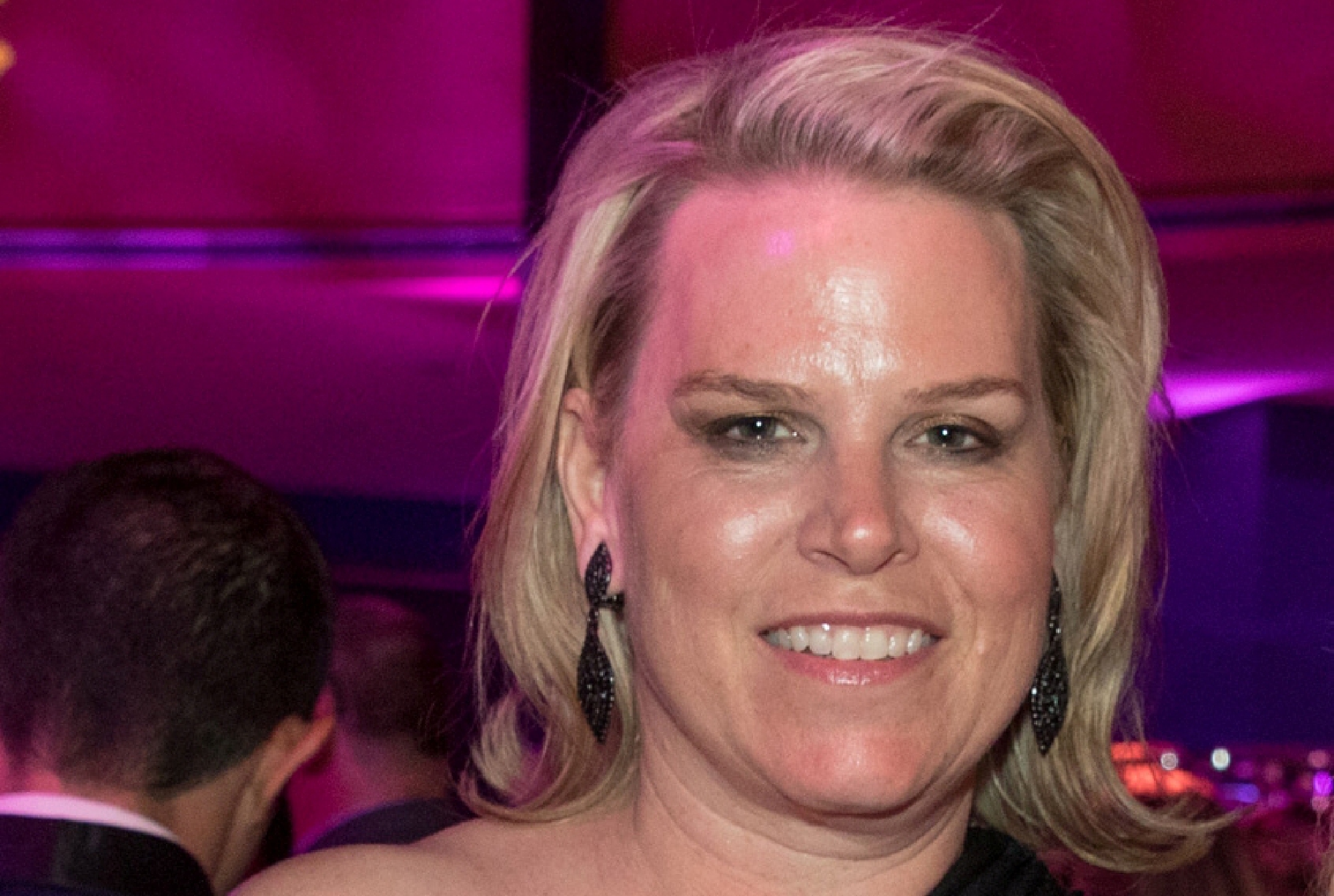
Cathy Merrill, CEO of Washingtonian Magazine at the 2019 White House Correspondents’ dinner after party. Photo for The Washington Post by Evelyn Hockstein.

While some employees may want to “work from home and pop in only when necessary” after the pandemic, Merrill argued, the dynamic may create a “strong incentive” for bosses to convert full-time workers into contractors, who get paid by the hour or output and lack benefits such as health-care coverage and retirement accounts.

“Although there might be some pains and anxiety going back into the office, the biggest benefit for workers may be simple job security,” she wrote in her conclusion. “Remember something every manager knows: The hardest people to let go are the ones you know.”

Washingtonian staffers were shocked. Many perceived the op-ed to be directed in part to them – a veiled threat to their jobs.

The magazine’s assistant photo editor, Lauren Bulbin, called the article “truly terrifying.”

“I feel really humiliated,” she said. “Every single person I know in my life read that op-ed and contacted me about it,” she said. “People I respect in the media industry and beyond came to me and were really shocked that this is where I’m working.”

By Friday morning, many of Washingtonian’s editorial staff of about 25 pledged that they wouldn’t publish anything on the magazine’s website or social media channels for the day. More than a dozen tweeted identical messages: “We want our CEO to understand the risks of not valuing our labor” and “we are dismayed by Cathy Merrill’s public threat to our livelihoods.”

Merrill has spent the hours since the op-ed published doing damage control. About 10 minutes before her employees announced their strike on Twitter, she sent them a memo saying she would not change their health-care coverage, retirement plans or status to contractors.

“My intent was to write about how worried I and other CEOs are about preserving the cultures we built up in our offices,” she told employees. “But I understand that some of you have read it as threatening.”

She echoed that sentiment in a Friday email to The Post. “I have assured our team that there will be no changes to benefits or employee status,” Merrill said. “I am sorry if the op-ed made it appear like anything else.” She added that she was proud of her employees’ work during the pandemic and that the company “embraces a culture in which employees are able to express themselves openly.”

But the magazine’s website remained lifeless as of Friday afternoon; the most recent stories were a day old. Those participating in the work-stoppage include senior editors, top food critics and Web producers.

The action was especially notable because Washingtonian staff have no union, which typically affords employees protection for engaging in collective action such as strikes.

“We felt a little bit of trepidation, but we also understood this was a really public, egregious statement,” writer and Web producer Rosa Cartagena said. “We’re trying to use our public platforms to respond publicly as well, and to share how disappointed we feel by seemingly not being valued by the owner.”

Like many other publications, Washingtonian reverted to remote work during the pandemic last spring. Employees there have been told to begin returning to the office over the next several months, with a hard reopening in the fall.

Staffers at Washingtonian said they were struck by Merrill’s argument that remote work makes it harder to give employees feedback and stunts their professional development, especially because the magazine has published some of its most-read online stories during the pandemic, such as food writer Jessica Sidman’s exposé on working at the Trump International Hotel restaurant.

Merrill has written several essays for The Washington Post’s editorial page, which operates independently from reporters in the newsroom. In March last year, she called the Centers for Disease Control and Prevention recommendation to halt gatherings for several weeks “a death sentence for small businesses.”

In Thursday’s op-ed, Merrill wrote that she had discussed the downsides of remote work with fellow chief executives and estimated that unofficial office duties such as “helping a colleague, mentoring more junior people, celebrating someone’s birthday – things that drive office culture” made up 20 percent of their work.

“If the employee is rarely around to participate in those extras, management has a strong incentive to change their status to ‘contractor,'” she wrote. “Instead of receiving a set salary, contractors are paid only for the work they do, either hourly or by appropriate output metrics.” She added that would also mean not having to pay for health-care coverage, retirement savings, bonuses and parking.

The op-ed attracted national attention on Thursday night as several prominent journalists tweeted criticisms. By midmorning Friday, The Post had changed the headline on the op-ed to “As a CEO, I worry about the erosion of office culture with more remote work,” removing the language that directed the message at Merrill’s employees.

Washington Post editorial page editor Fred Hiatt said he asked the headline to be changed early on Friday, before he knew about the strike, “to something that I thought better captured the piece.”

Remote work has been popular throughout the pandemic, according to Gallup. A January poll found that nearly half of those surveyed said they would keep working remotely after restrictions lift simply because they preferred it, and 17 percent would still want to stay out of the office because of coronavirus concerns. Only 39 percent said they would want to return to the office.

Other media organizations plan to begin reopening their offices in the coming months. The Washington Post will bring back a limited number of employees back July 6, with a full return anticipated in the fall. The New York Times headquarters will reopen in September, with bosses exploring a “long-term vision for remote working.” CNN doesn’t plan a full return until after the summer.

Published : May 08, 2021

By : The Washington Post · Elahe Izadi

Nationals flip the power on, blast four homers in 11-4 rout of the Yankees #SootinClaimon.Com

#SootinClaimon.Com : ขอบคุณแหล่งข้อมูล : หนังสือพิมพ์ The Nation.

https://www.nationthailand.com/international/40000655

Nationals flip the power on, blast four homers in 11-4 rout of the Yankees


NEW YORK – Before Friday night, with a month of baseball in the books, the Washington Nationals were perhaps the last team to choose in a home run-hitting contest. That logic cut both ways. Their pitchers had allowed homers at a higher rate than any staff in the league.

Nationals flip the power on, blast four homers in 11-4 rout of the Yankees

Their batters left the park more often than just five other clubs.

But then the Nationals outslugged the New York Yankees – a group known for slugging – in a series-opening 11-4 win in the Bronx. Josh Bell, Yan Gomes, Josh Harrison and Juan Soto went deep, in that order, accounting for eight runs. Harrison’s homer charged a six-run eighth that was helped along by three errors by the Yankees. He hopped out of the box, aware he had scorched Jonathan Loáisiga’s fastball, before trotting home behind Victor Robles (who’d reached on a wide throw by DJ LeMahieu) and Trea Turner (who’d poked a go-ahead RBI single).

Washington’s power stood up to two solo shots from LeMahieu and another by Gary Sánchez, all off starter Patrick Corbin. It was an odd way for the Nationals (13-15) to snap a three-game losing streak, especially since they hit only two homers in 27 innings while being swept by the Atlanta Braves this week.

Soto made his first start since returning from the injured list Tuesday, plugged in as the Nationals’ designated hitter. He’s not yet cleared to play right field because he hasn’t consistently thrown at full strength. But Manager Dave Martinez was relieved to get Soto, the club’s best hitter, more than a single pinch-hit appearance. Soto finished with a groundout, two strikeouts looking, a single in the eighth and a two-run homer to left-center off Luis Cessa in the ninth.

But in a twist, after weeks of searching for a burst of power, the early pop was provided by Soto’s teammates. Bell erased LeMahieu’s first homer with a solo shot off Yankees starter Jameson Taillon in the second. Taillon tested Bell with a high four-seam fastball. Bell lifted it 432 feet to center. Gomes then pushed Washington ahead with a two-run blast to left, his fourth of the season and third of the past week – showing that his bat picks up when playing most days. And his next task was helping Corbin hold down the Yankees (16-16).

For the most part, the pair was able to. A handful of hard-hit balls found the Nationals’ defense. Corbin retired eight straight between the third and sixth before . LeMahieu, though, tagged Corbin with his second homer to start the sixth, also going to the short porch in right. Through six innings, the teams combined for six total hits and five homers. The only other knock was LeMahieu’s one-out single off Corbin in the third.

The surprise, then, was that the Nationals were hanging in this type of game. Their hitters had produced a homer in less than 3 percent of at-bats, a rate that put them in the bottom third of the league. Their pitchers, by contrast, entered with MLB’s worst home run rate for starters and relievers (4.3 percent of all batters faced had put the ball in the seats). On Friday afternoon, with Giancarlo Stanton and Aaron Judge looming in the Yankees’ order, Martinez recognized his staff’s inability to keep hits in the yard. Then Corbin and Tanner Rainey left Stanton and Judge hitless in eight at-bats.

“With the way these guys swing the bats, you’ve got to hit your spots, and you’ve got to get ahead,” Martinez said of the Yankees. “You’ve got to really focus on getting ahead of these hitters. Because all the way down that lineup, these guys can hit the ball a long way.”

The count was even, 1-1, on LeMahieu’s homer in the first. With the next two, Corbin was actually ahead. Of the three critical pitches, only the third – the one resulting in LeMahieu’s second homer of the night – was well inside the strike zone. Otherwise, Corbin was beat even when he was hitting his spots.

But the box score doesn’t recognize those details. It just read 3-3 as the seventh passed without a run. Then it read 7-3, the Nationals leading, once Harrison’s homer flew over the left field fence. That ticked to 8-3 after Kyle Schwarber singled in Soto. It ticked to 9-3 because Gomes’s grounder rolled below shortstop Gleyber Torres’s glove. By the time Soto’s blast left the park in the ninth it was a tried-and-true blowout.

Published : May 08, 2021

By : The Washington Post · Jesse Dougherty

Florida man tried to track his robbery victim by attaching an iPhone to his car, police say #SootinClaimon.Com

#SootinClaimon.Com : ขอบคุณแหล่งข้อมูล : หนังสือพิมพ์ The Nation.

https://www.nationthailand.com/international/40000654

Florida man tried to track his robbery victim by attaching an iPhone to his car, police say


Hed been at the Millenia Mall in Orlando, Fla., for less than an hour when he allegedly zeroed in on the shopper with the bags from Gucci and Louis Vuitton. Now Derrick Maurice Herlong followed closely behind as the man he was planning to rob loaded his purchases into the trunk of a silver Lexus and drove toward downtown, police said.

Florida man tried to track his robbery victim by attaching an iPhone to his car, police say

At some point, the man stopped at a 7-Eleven. That’s when, according to a chain of events described in an arrest affidavit, Herlong and an accomplice took an extraordinary step to make sure they didn’t lose him: They attached a homemade tracking device – an iPhone rigged with magnets – to the bottom of the man’s car.

Minutes later, the pair cornered the man as he entered a gathering at a nearby apartment, robbing him at gunpoint, stealing his car and fatally shooting another man, 32-year-old Jacaris Rozier, according to police.

Orlando police documents released Thursday detail how investigators identified Herlong, 37, as the suspect in the Feb. 19 killing of Rozier. Herlong has pleaded not guilty to murder, home invasion, carjacking and grand theft, records show. His defense attorney declined to comment on the charges Friday.

The documents, first reported by Orlando’s News 6, also offer a window into the highly unusual method Herlong is said to have used to surveil his victim and are bound to raise some concerns for the privacy-conscious.

According to the arrest warrant, Herlong laid the groundwork for his alleged crimes weeks earlier at a Panda Express restaurant in another part of town. Investigators said he stole a purse and wallet from a worker there in late January, then used her identification to buy the iPhone at a Metro PCS store.

On Feb. 18, Herlong or someone associated with him activated the phone using an iCloud account in the restaurant worker’s name, according to the affidavit. Investigators said they confirmed the timeline using surveillance footage, receipts and interviews. They also said they found Herlong’s number in the device.

The following day, Herlong staked out the victim at the Millenia Mall, according to police, who said surveillance footage showed him with two accomplices, neither of whom was identified.

When homicide detectives canvassed the shooting scene in the city’s Thornton Park neighborhood, they found the victim’s Lexus nearby. As the vehicle was being loaded onto a tow truck, the truck’s driver noticed a small nylon bag hanging from the undercarriage, police said.

The affidavit described the contents: “Attached to the bag were two magnets. Inside the bag was an Apple IPhone set to ‘do not disturb’ and wrapped in a sealed Ziploc bag. The phone’s battery was close to or at full charge, indicating it had been placed there recently.”

Within a week, investigators linked the iPhone to Herlong, according to the affidavit.

The suspects “targeted [the victim] for a robbery due to his purchases of high end, expensive items,” police said in the affidavit. “They could be seen making overt efforts to follow [the victim] away from the mall as they tried to find a suitable location to commit the robbery.”

“In an additional effort to ensure they did not lose their quarry, the group used a new Apple IPhone, as an improvised vehicle tracker, placing it on vehicle at an opportune time,” police said. They added that only someone with access to the iCloud account created in the restaurant worker’s name would be able to track the phone.

A search of Herlong’s apartment in the city’s southwest turned up several bags and articles of clothing from Gucci and Louis Vuitton, along with a Metro PCS receipt bearing the restaurant worker’s name and boxes for the phone, according to police. They also found during a search of his Mercedes SUV an assault-style rifle that matched the description of the weapon used in the shooting, the affidavit says.

Officers also found more than a dozen cellphones on the property, including multiple Androids and prepaid Tracfones, records show.

Turning an iPhone into an improvised tracking device is relatively simple – a quick Google search turns up many tutorials on how to do it. It’s illegal to spy on a person with a GPS phone without their consent, but there are legitimate reasons for using the devices, such as tracking personal belongings.

Private investigators sometimes use prepaid phones and other devices to monitor suspected cheating spouses, operating in a legal gray area in which they try to skirt laws against nonconsensual GPS tracking. Domestic abusers also sometimes monitor their partners’ devices to keep track of their whereabouts.

But Bill Marczak, an expert in surveillance at the University of California at Berkeley, said he was unfamiliar with any cases involving a suspect using a cellphone to track a victim. It may not even be that efficient, he said.

“Haven’t heard of this modality of ‘planting a cell phone on someone’ being used by criminals before,” he said in an email. “I don’t immediately see why someone would prefer to plant an iPhone rather than a purpose-built GPS tracker (which would be cheaper, and have much longer battery life than the iPhone).”

Herlong’s next scheduled court appearance is a pretrial hearing on Oct. 26. He could face 25 years or more in prison if convicted on the second degree murder charge.

Published : May 08, 2021

By : The Washington Post · Derek Hawkins

IBM downgraded by S&P as deal spree clouds ability to cut debt #SootinClaimon.Com

#SootinClaimon.Com : ขอบคุณแหล่งข้อมูล : หนังสือพิมพ์ The Nation.

https://www.nationthailand.com/international/40000612

IBM downgraded by S&P as deal spree clouds ability to cut debt


IBM Corp. was downgraded by S&P Global Ratings because an acquisition spree adds doubt to the companys timeline for reducing debt.

IBM downgraded by S&P as deal spree clouds ability to cut debt

S&P cut IBM one notch to A- with a stable outlook, according to a report Thursday. The credit rater expects IBM to pursue additional takeovers to bolster its hybrid cloud and artificial ingelligence capabilities. Coupled with the planned spinoff of its managed infrastructure services business, there’s uncertainty IBM can reduce leverage to a certain level in the next year or two, S&P said.

Chief Executive Officer Arvind Krishna has been on a spending spree as he seeks to transform IBM into a more modern technology company, focusing on fast-growing markets like AI and cloud services after years of stagnation.

The first step along that road was IBM’s purchase of Red Hat, completed in 2019 for $34 billion. Since then Krishna, who became CEO last year, has stepped up the pace, spending about $1 billion on acquisitions in the first quarter of this year, according to S&P. IBM also said it’d buy Turbonomic Inc. in April in a deal valued at as much as $2 billion.

The efforts appear to be paying off, as IBM recently reported its biggest revenue gain in 11 quarters, though there was only a 1% increase in sales. The stock has gained 15% this year.

While the M&A spree has helped lift IBM’s debt load to $56.4 billion, total debt has declined $17 billion since its 2019 peak, and could fall as much as $10 billion over the next two years, Bloomberg Intelligence analysts Robert Schiffman and Suborna Panja said in an April 30 report.

Last October, Krishna announced plans to spin off IBM’s managed infrastructure services unit into a separate publicly traded company, which will be called Kyndryl and be based in New York. The division, currently part of IBM’s Global Technology Services division, handles day-to-day infrastructure service operations like managing client data centers and traditional information-technology support for installing, repairing and operating equipment.

IBM’s shares and bonds were little changed in early trading in New York.

Published : May 07, 2021

By : Syndication Washington Post, Bloomberg · Molly Smith, Molly Schuetz

Weekly jobless claims fall below 500,000, setting new pandemic low #SootinClaimon.Com

#SootinClaimon.Com : ขอบคุณแหล่งข้อมูล : หนังสือพิมพ์ The Nation.

https://www.nationthailand.com/international/40000610

Weekly jobless claims fall below 500,000, setting new pandemic low


Weekly jobless claims hit a pandemic-era low for the fourth consecutive week, the Labor Department reported Thursday, with 498,000 Americans filing for initial unemployment benefits during the week ended May 1.

Weekly jobless claims fall below 500,000, setting new pandemic low

That’s down 92,000 from the previous week’s upwardly revised level, a bigger decrease than economists expected and the lowest figure since March 2020. The streak of declines, which started with a surprise drop in mid-April, suggests the recovery is gaining traction, pulling scores of people back into the folds of the labor market as business restrictions continue to loosen and vaccination numbers climb.

Signs of an economic rebound are abundant: Hunger, which has hovered near historic highs for much of the pandemic, is decreasing. The number of families behind on rent fell by more than 2 million in March. The S&P 500 has notched at least 21 records since President Joe Biden took office, the most seen in the first 100 days of any new administration since that of John F. Kennedy. Business optimism is bouncing back in the manufacturing and service sectors. Consumer confidence and retail sales have surged.

“A bigger than expected decline in new jobless claims is a most pleasant surprise,” Mark Hamrick, a senior economic analyst at Bankrate, said Thursday in comments emailed to The Washington Post. “The healing of the job market, including reduction of unemployed and those seeking and receiving jobless aid, is as important an economic thread as any being monitored amid the reopening story.”

States reported 101,214 initial claims for Pandemic Unemployment Assistance, for gig and self-employed workers, for the week that ended May 1. Nearly 7 million PUA claims were continued in mid-April for benefits that are set to expire in September.

California, Florida, New York and Virginia had the biggest decreases in first-time unemployment claims last week. Kentucky, Minnesota and New Jersey were among the only states to post increases in weekly claims greater than 1,000.

This time last year, more than 2.7 million Americans were applying for initial unemployment benefits, and the national unemployment rate ranged from 15 to 20%. At the height of the coronavirus pandemic, weekly claims surpassed 6 million.

But the rebound has cascaded unevenly through the economy, a dynamic that many economists refer to as “K-shaped” because of the diverging prospects for rich and poor Americans. Poverty rose to 11.7% in March, the highest level of the pandemic, according to research from the University of Chicago and the University of Notre Dame, with children and women being hit the hardest.

Women would need nearly 15 straight months of job gains at last month’s level to recover the more than 4.6 million net jobs they have lost since February 2020, according to the National Women’s Law Center. Those who are employed are experiencing greater burnout and feeling more pressure at work, according to data from McKinsey.

“How do I file for unemployment?” was the most Googled question nationwide the past year, according to research from CenturyLinkQuote.com.

Economists are looking toward Friday’s monthly jobs report for a fuller employment picture. The private payroll report that ADP released Wednesday showed gains of about 742,000 positions from March to April.

“With jobless claims hitting a pandemic-era low, anticipation for the full jobs picture tomorrow mounts,” Mike Loewengart, managing director of investment strategy at eTrade, said Thursday in comments emailed to The Washington Post. “Today’s read is another proof point that we’re one step closer to full economic recovery, sooner than some may have expected.”

Employers are believed to have recovered nearly 1 million jobs across the board in April after gaining more than 900,000 the previous month. That would put the national unemployment rate in the “high 5% range,” Hamrick said, a level not seen since late 2014.

But vaccinations, a key engine for the recovery, have been slowing. More than 107.3 million Americans are fully vaccinated, according to data tracked by the national Centers for Disease Control and Prevention. Biden announced a new vaccination goal on Tuesday, saying he wants 70% of adults to have received at least one dose by July 4.

Even with major gains in the labor market, there is still a long way to go before employment reaches pre-pandemic levels. More than 16 million Americans were drawing unemployment benefits across all programs in April. In 2019, average weekly initial claims hovered around 218,000.

Published : May 07, 2021

By : The Washington Post · Taylor Telford

Hopes surge for boosted vaccine supply after U.S. voices support for waiving patents, even as uncertainty remains #SootinClaimon.Com

#SootinClaimon.Com : ขอบคุณแหล่งข้อมูล : หนังสือพิมพ์ The Nation.

https://www.nationthailand.com/international/40000609

Hopes surge for boosted vaccine supply after U.S. voices support for waiving patents, even as uncertainty remains


NAIROBI – When South Africa and India proposed it in October, the idea seemed straightforward: Waive intellectual property rights on coronavirus vaccine recipes and production technology so the world can produce as many doses as possible and end the pandemic as fast as possible.

Hopes surge for boosted vaccine supply after U.S. voices support for waiving patents, even as uncertainty remains

Instead wealthy, mostly Western nations, including the United States, with powerful pharmaceutical lobbies, rejected the idea and then cut deals with vaccine makers to effectively hoard doses. The World Health Organization’s head called it a “catastrophic moral failure,” and other critics likened it to “vaccine apartheid.”

Seven months later, as the U.S. vaccine rollout nears its peak and life veers back toward normal, Washington has reversed its position to support a short-term waiver, angering drug companies while infusing hope into efforts to ramp up vaccine production as severe shortages coincide with enormous waves of virus infections in India, Latin America and other parts of the developing world.

“The notion that ‘no one is safe until everyone is safe’ is true, and the Biden administration seems to have finally taken that to heart,” said Fatima Hassan, a South African human rights lawyer and founder of the Health Justice Initiative, which was part of a global campaign for a generically produced “people’s vaccine.”

“Did it take them seeing people in India dying on television to make this decision?” she asked. “Maybe, but however late this comes, attention now needs to turn immediately to getting other vaccine-producing countries to follow.”

The statement, issued Wednesday by U.S. Trade Representative Katherine Tai, said the United States will move forward with international discussions to waive the protections for the duration of the pandemic.

World Trade Organization Director General Ngozi Okonjo-Iweala said in an interview Thursday that she was pressing member countries to reach an agreement on the waiver no later than December.

“It’s not overnight that we’re going to be able to scale up,” she said, adding that “it is very difficult to say now whether there is going to be a consensus.” She described the U.S. announcement as “helpful” and said it would give momentum to talks.

The U.S. statement did not appear to be a move coordinated with U.S. allies.

The German government voiced opposition to the U.S. proposal in a statement Thursday, saying it would have “significant implications” for vaccine production. The statement said the limiting factor in manufacturing vaccines is production capacity and quality control rather than patents. “The protection of intellectual property is a source of innovation and must remain so in the future,” it said.

Canada and Britain’s trade ministers as well as the European Commission president issued statements indicating their willingness to continue discussions, but they did not commit to any change of stance.

The European Union’s top vaccine czar, Thierry Breton, pointed to concerns about supply chains, expressing skepticism that it made sense to open up the patents immediately. He noted there were many barriers to speeding up production, including access to the raw materials.

“When we will be able to reach this without destabilizing the ramp-up and the supply chain, . . . I could tell you, ‘Yes, the supply chains now are solid, the ramp-up is effective, so yes, it is the time to do it,'” Breton said. “Personally I think it will be good to do it quickly, but as I said always, everything at its time.”

French President Emmanuel Macron took time on the sidelines of a visit to a vaccination center to say that he was in favor of “opening up intellectual property” but that a waiver wouldn’t have much effect without a concrete plan to transfer technology and know-how.

Those technical details – like how quickly a factory in India, for instance, could actually start churning out vaccine doses based on Pfizer’s formula should they gain access to it – were certain to be tricky if a temporary waiver does eventually come through. And even that is not a given.

It remained unclear whether other countries that had been blocking the waiver, which include almost all of Europe as well as Japan, Canada, Brazil, Australia and Singapore, would follow suit. Those negotiations, which would take place under the auspices of the World Trade Organization, would determine whether Washington’s change of stance leads to the ramping up of production of generic vaccines.

The process to hammer out a deal could take months and result in a narrow interpretation of intellectual property rights. The WTO has met 10 times in the past seven months on the original waiver proposal. The organization’s rules stipulate that any decision has to be made by consensus, meaning any country could hold up a coordinated move on intellectual property waivers.

Ultimately, such a waiver might come into effect only later this year, once vaccine manufacturers in the West have boosted production.

Western pharmaceutical giants such as Pfizer stand to make billions of dollars off coronavirus vaccines alone, and they have received billions more in subsidies from the U.S. government. The industry opposed the short-term waiver, warning of dire consequences for vaccine development and manufacturing going forward.

On Monday, the Pharmaceutical Research and Manufacturers of America condemned the U.S. decision. “In the midst of a deadly pandemic, the Biden administration has taken an unprecedented step that will undermine our global response to the pandemic and compromise safety,” president and CEO Stephen Ubl said in a statement.

Wednesday’s news was welcomed in India and South Africa, both hit hard by the pandemic but where vaccination campaigns are far behind those in the United States and Europe.

South African President Cyril Ramaphosa praised the new U.S. stance in a statement and said the “anticipated temporary waiver provides a global response” to the pandemic.

“For countries that do not currently have manufacturing capacity on certain medical technologies, the waiver could open up more supply options and avoid countries being reliant on only one or two suppliers,” he said.

India’s Ministry of External Affairs welcomed the U.S. decision, calling it an “important step for enabling rapid scaling up of manufacture and timely availability of affordable Covid 19 vaccines and essential medical products.”

“We are hopeful that with a consensus based approach, the waiver can be approved quickly at the WTO,” the ministry said in a statement issued Thursday.

The Indian government had been lobbying for a relaxation of the patent regime for coronavirus vaccines for months. Prime Minister Narendra Modi brought up the topic in a call with President Joe Biden in April, and Indian diplomats have reportedly reached out to U.S. senators to appeal for their support.

A spokesman for Serum Institute of India, one of the world’s largest vaccine makers, did not immediately respond to a request for comment on the move. Serum is manufacturing vaccine doses under licensing deals with large U.S. and European pharmaceutical companies.

The vaccine supply crunch has made it difficult for Covax – a World Health Organization-backed effort to equitably distribute vaccine doses – to get off the ground. The program aims to deliver up to 2 billion doses by the end of the year, targeting 20 percent of the population of participating low- and middle-income countries, but under current conditions, some countries could be waiting until 2023 to secure what they need.

So far, Covax has delivered only 53 million doses, with deliveries well behind schedule.

The huge wave of infections in India – where many of Covax’s doses are being manufactured – has slowed the international effort’s timeline, leaving many countries wondering when or if their next doses will arrive. For months now governments, public health experts and rights advocates have urged policymakers to address the growing gap by focusing not just on sharing available doses but on dramatically expanding supply.

Many of these voices now stress that a waiver is a helpful but not sufficient step toward ramping up vaccine production.

“The US must also demand that pharma companies that received significant amounts of US taxpayer funding to create these vaccines share the technology and know-how with other capable manufacturers to protect more people worldwide,” Doctors Without Borders said in a statement.

Since October, at least 60 countries became co-sponsors with India and South Africa on the proposal, and at least 40 more voiced their support. Most of them are in the Global South, which includes Latin America, Africa, and South and Southeast Asia.

“This development represents true leadership in a time of need,” said John Nkengasong, director of the Africa Centers for Disease Control and Prevention, the continent’s main public health body. “When the history of the covid-19 pandemic will be written, the decision of this waiver by the U.S. government will be remembered as pivotal in our fight against this terrible virus.”

The U.S. announcement came as a win for South Africa, India and the broad coalition they built at the WTO, where delegations of civil servants, not politicians, persevered against a bloc of the world’s most powerful nations who seemed unready to budge.

“How could we have a situation with a global pandemic, and you keep considering vaccines a commodity?” said Hassan, the South African campaigner. “It was and is absurd. In a sense, it was rich countries and their pharmaceutical companies saying that intellectual property claims and the interests of shareholders on a very narrow set of items mattered more than the lives of millions of people – people in the Global South, in particular.”

Published : May 07, 2021

By : The Washington Post · Max Bearak, Emily Rauhala