Snow, rugged terrain hinder recovery of Alaska helicopter crash that killed five, including one of Europe’s richest people #SootinClaimon.Com

#SootinClaimon.Com : ขอบคุณแหล่งข้อมูล : หนังสือพิมพ์ The Nation.

https://www.nationthailand.com/news/30404282

Snow, rugged terrain hinder recovery of Alaska helicopter crash that killed five, including one of Europe’s richest people

InternationalMar 30. 2021

By The Washington Post · Teo Armus, Loveday Morris, Lateshia Beachum

A helicopter crash in the Alaskan wilderness killed five people, including one of Europe’s richest residents, after the chopper went down on Saturday during a backcountry heli-skiing trip.

Among the victims was Petr Kellner, 56, who was the Czech Republic’s richest person and one of the 70 richest people in the world last year, according to Forbes.

The Alaska Department of Public Safety said rescuers over the weekend recovered the bodies of Kellner and four others: Benjamin Larochaix, 50, a resident of the Czech Republic; heli-skiing guides Greg Harms, 52, and Sean McManamy, 38; and Zachary Russell, 33, who was piloting the helicopter.

A sixth person, who has not been named as of late Sunday night local time, was in serious but stable condition and being treated at a hospital in the Anchorage area. A rescue team found no other survivors.

It is not immediately clear what caused the Airbus AS350 B3 helicopter to crash. It was due back at around 6:30 p.m., local time, and was reported overdue by 8:30 p.m., National Transportation Board member Tom Chapman said in a virtual news conference Monday afternoon. A search-effort operator found wreckage about an hour after that, near Palmer, Alaska, which lies 45 miles north of Anchorage, Chapman said.

The commercial aircraft rolled downhill 800 to 900 feet from an elevation of about 5,500 feet, Chapman said.

Victim recovery was expedited as a snowstorm threatened to obscure the area that Chapman described as having rugged terrain and weather conditions, but he said a full recovery of the site, including wreckage, was a priority. Chapman said the exact weather conditions at the time of the crash were still unknown, and details from the flight recorder had not yet been recovered.

The chopper had been chartered for a backcountry heli-skiing trip by the Tordrillo Mountain Lodge, a representative for the lodge, Mary Ann Pruitt told The Washington Post. With packages starting at $15,000 per person, the lodge bills itself as a multisport luxury facility in the remote Tordrillo mountain range.

Kellner and Larochaix, the two Czech victims, were “loyal and frequent guests” at the Tordrillo lodge, Pruitt said. Kellner, whose net worth was estimated at $17.5 billion, made his fortune selling office supplies and then buying a stake in the Czech Republic’s largest insurance company, Forbes reported.

The billionaire was the founder and majority shareholder of the Netherlands-based PPF Group, an investment fund with business spanning telecoms, finance, biotechnology, mining and real estate. The company has assets exceeding $50 billion, according to its website.

“His professional life was known for his incredible work ethic and creativity, but his private life belonged to his family,” the company said in a statement, adding the funeral would be for close family members only.

Born in North Bohemia in what was then Czechoslovakia, Kellner started his career selling photocopiers after the fall of communism in 1989, Czech media reported. He built his business empire by acquiring stakes in formerly state-owned enterprises as the country made its transition to capitalism. Most notable was a holding in what had been the state-run insurer.

Last year, PPF acquired CME, a media and entertainment company that broadcasts more than 30 television channels in Europe, from AT&T. Sen. Marco Rubio, R-Fla., was among those who raised concerns about the sale, alleging that Kellner and his company worked as a “proxies” for China.

The company has dismissed such allegations against it as “unfounded” and said that it is committed to freedom, democracy, entrepreneurship, professionalism, and a plurality of opinions. Kellner was also a former co-owner of the Czech soccer team Slavia Prague, which said it had received the news with “great sadness.”

“Slavia would like to offer its deepest and most sincere condolences to the family and friends of Mr. Kellner,” the club tweeted.

Czech Prime Minister Andrej Babis also wrote his condolences on Twitter, calling Kellner’s death “an incredible tragedy.”

Kellner’s hobbies included snowboarding and kitesurfing. Larochaix, who also died in the crash, was a freestyle snowboarding coach, according to media reports.

Heli-skiing, in which a helicopter shuttles athletes to untouched patches of powdery snow, has developed a reputation as a pricey, sought-after goal for many skiers. It is banned for environmental reasons in some European countries, according to the BBC.

McManamy had worked as a heli-ski guide for over a decade, including the past five years at Tordrillo, Pruitt said. He was also an avalanche instructor and an experienced mountain guide at Denali, the tallest peak in North America.

Relatives said McManamy developed an early love for skiing and the outdoors while growing up in New England, a passion that eventually took him to wilderness training school in Colorado. He split his time between Girdwood, Alaska, and California, where he and his wife, Caitlin, had recently purchased an apartment.

“He was a great person. He was adventurous and dedicated but devoted to family as well,” his uncle, Rob McManamy, told The Washington Post. “We all admired him because he was doing things most of us can only dream about.”

Harms, who had worked at Tordrillo for 15 years, was “one of the most experienced guides in the business” and a pioneer in Alaskan heli-skiing, Pruitt said. Through his own company, Third Edge Heli, he led excursions to mountain ranges in Chile.

In Alaska, meanwhile, the Coloradan had recently set a world record for making 101 runs over a 24-hour period, according to the lodge’s website.

Russell, of Anchorage, was employed by Soloy Helicopters, the company confirmed to The Post. The Wasilla-based outfit owns and operates a fleet of 17 helicopters for a range of industries, including firefighting and diamond and seismic drill exploration, its website said.

Rescuers found wreckage from the helicopter about 21 miles from the town of Palmer, the National Transportation Safety Board’s local office told the Anchorage Daily News. Crews were working to recover the debris before a forecast snowstorm moved in.

“It’s in an area of very steep terrain, snow-covered terrain, right around 5,000 to 6,000 feet . . . on the north side of Knik River,” Clint Johnson, Alaska chief of the NTSB, told the Daily News.

In a statement, the Tordrillo Mountain Lodge said it was the first time it has faced “an event of this measure” in its 17 years in business.

WHO Wuhan report leaves question of coronavirus origins unresolved #SootinClaimon.Com

#SootinClaimon.Com : ขอบคุณแหล่งข้อมูล : หนังสือพิมพ์ The Nation.

https://www.nationthailand.com/news/30404281

WHO Wuhan report leaves question of coronavirus origins unresolved

InternationalMar 30. 2021

By The Washington Post · Emily Rauhala

A joint World Health Organization-China report on the origins of the coronavirus says it most probably jumped from animals to humans via an intermediate animal host, downplays the possibility it leaked from a lab and suggests next steps in a complex search mired in controversy, according to a copy obtained by The Washington Post.

The report, set to be released Tuesday, offers the most detailed look yet at what happened in Wuhan, China, in late 2019 and early 2020. However, the findings are far from conclusive and will be overshadowed by questions about China’s lack of transparency – and the WHO’s apparent inability to press for more.

The team recommends further study of the possible path of transmission between animals and humans and on transmission through frozen food – a once-fringe theory favored by the Chinese government. It does not recommend additional research on the lab leak hypothesis.

But WHO director general Tedros Adhanom Ghebreyesus, who was not part of the Wuhan mission, offered somewhat contradictory messaging at a news conference on Monday, saying “all hypotheses are open” and warrant future study.

Given China’s coverup of the outbreak in Wuhan, the WHO’s early praise for the country’s response, and the fact that it took a full year to get a joint Chinese-international team on the ground for a brief visit, the critical but challenging search for clues faced skepticism from the start.

Secretary of State Antony Blinken told CNN last week he had concerns about “the methodology and the process,” including “the fact that the government in Beijing apparently helped to write it.”

“I don’t think the global community can have confidence in this report, because of China’s lack of transparency on necessary data sources, as well as the close relationship the team had to have with China,” said Larry Gostin, a professor of global health law at Georgetown University.

“This was an expert panel who worked diligently but were blocked from finding all that it could,” he continued. “As a result, we may never know the origins of the pandemic.”

Questions about Chinese interference will be hard to shake. The terms of reference set out by WHO member states called for a collaboration between Chinese and foreign scientists, not an independent investigation or audit. Much of the data was collected by Chinese scientists ahead of the visit and then analyzed by the joint team.

Among the report’s findings is that the market linked to early cases was not necessarily the source of the virus, as some once believed, but may have been the site of an early outbreak or an accelerator, as a virus that was circulating in December 2019 spread between close-packed stalls. It does not draw a firm conclusion and calls for additional research on the role of this and other markets.

According to the report, 233 Chinese health institutions reviewed 76,253 records of cases of respiratory conditions from October and November 2019, found 92 cases compatible with SARS-Co-V2, but later ruled out each case, concluding that significant transmission before December was unlikely.

But the report questions whether the clinical criteria used to select those cases was sufficiently broad and notes that the results were based on serological testing conducted about a year later. It says the possibility of transmission before December 2019 cannot be excluded and recommends a review of methods and additional studies on Chinese blood samples.

The report reiterates the team’s belief that the virus most probably jumped from an animal, potentially a bat or pangolin, to an unknown intermediate animal host, then to humans, but the path of transmission remains a mystery. It recommends additional studies on livestock and farmed wildlife that may be susceptible to SARS-CoV-2, such as cats and mink.

The mission concludes it is extremely unlikely that the virus accidentally leaked from a lab in Wuhan – a theory many scientists downplay for lack of evidence, but that others are not ready to dismiss after a single visit.

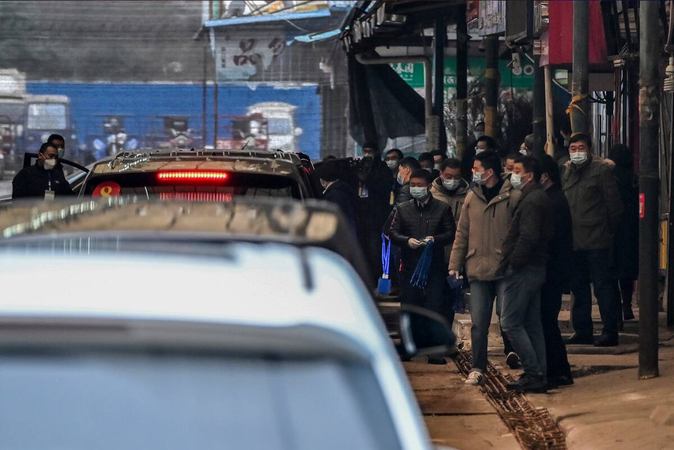
The visit to the Wuhan Institute of Virology lasted a few hours, according to scientists on the trip. They got a tour of the facility, heard about the lab’s rigorous safety protocols and were told the lab was not working with viruses close to SARS-CoV-2.

One member of the team said in a post-trip television interview that researchers at the lab were sick in the fall of 2019 – a potentially interesting finding that had been raised by the Trump administration – but then dismissed its relevance and offered little else.

The final report states that there was no direct infection of workers, but does not go into detail or recommend further research on the topic.

It also notes that three laboratories in Wuhan were working with either coronavirus diagnostics or on isolation and vaccine development. All were “high quality” and “well managed,” it said, but it did not specify if the joint mission saw additional evidence, such as audits, to substantiate the claims.

The report also notes that a Wuhan Center for Disease Control lab moved on Dec. 2, 2019 – a new detail – but that it “reported no disruptions or incidents caused by the move.”

The search for the origin of any virus is challenging, but the circumstances surrounding the first known cases of this one made launching a credible investigation particularly tough.

When a novel coronavirus hit Wuhan in late 2019, Chinese officials downplayed the risk, undercounted cases and silenced would-be whistleblowers. Then, through the early weeks of the crisis, the WHO amplified some of the official Chinese line, giving a false sense of reassurance and eroding public trust.

Foreign scientists on the trip generally agree the timing and level of access was suboptimal, but stressed that they were able to obtain information the world did not have before.

Even though the Huanan market had been shut for a year and its contents removed, for instance, seeing the proximity of the stalls and the layout helped, said WHO team member Hung Nguyen-Viet, a Vietnamese expert on livestock and human health.

In interviews, Hung and another expert on the trip, Keith Hamilton of the World Organization for Animal Health, said research on the market pointed to the need for additional investigation in southern China. It is unclear if China will allow foreign scientists to return.

Dominic Dwyer, an Australian microbiologist and infectious-disease expert on the mission, stressed that the team did not have the mandate, personnel or time to conduct a formal audit on labs.

“You could do, if so desired, a more detailed forensic examination,” he said. “But that is another whole negotiation and discussion.”

“What stands out starkly is that this is the kind of situation where member states are expecting results from WHO that they have not empowered it to produce,” said Mara Pillinger, a senior associate in global health policy and governance at Georgetown’s O’Neill Institute for National and Global Health Law. “They needed permission to go in, to conduct research, and on the report.”

In general, the foreign scientists on the trip took pains to praise their Chinese counterparts, noting their technical expertise and professionalism. They also acknowledged the limits of working with data collected before they arrived that may or may not be complete.

“At the end of the day,” said Hung, “They show us what they show.”

In echo of George Floyd killing, a woman dies after police in Mexico pin her down #SootinClaimon.Com

#SootinClaimon.Com : ขอบคุณแหล่งข้อมูล : หนังสือพิมพ์ The Nation.

https://www.nationthailand.com/news/30404280

In echo of George Floyd killing, a woman dies after police in Mexico pin her down

InternationalMar 30. 2021

By The Washington Post · Jennifer Hassan

Face down and with her hands behind her, a woman cries out. She is surrounded by four police officers. One pins her to the ground, kneeling on her back.

Moments later, she lies handcuffed and silent, barefoot and motionless, as onlookers record the incident, which unfolded Saturday in the Mexican beach resort city of Tulum.

In videos published on Mexican news sites, officers can be seen picking up her limp body and carrying her toward a patrol vehicle. In the clips, they load her onto the back of the truck and appear to roll her over before driving away from the scene.

On Sunday, police confirmed that the woman had died, and opened a homicide investigation.

Later in the day, the four officers were jailed. Prosecutors said they were being charged with femicide.

The Salvadoran government and local media identified her as Victoria Salazar Arriaza, a 36-year-old Salvadoran mother of two who was living in Mexico on a humanitarian visa.

She died of broken vertebrae, according to a statement Monday from the Quintana Roo state prosecutor’s office. It accused police of using “disproportionate” force and said that the four officers would be taken into custody on suspicion of committing femicide.

“The law will be applied rigorously so this crime doesn’t go unpunished,” the statement said.

Mexican media quoted local officials as saying police detained the woman after getting a call that she was acting aggressively toward employees of a convenience store.

The videos have been viewed millions of times on Twitter, sparking widespread anger and calls for justice.

Mexican President Andrés Manuel López Obrador denounced the “brutal killing.”

On social media, users expressed horror at the incident and used the hashtag #JusticiaParaVictoria denounce police brutality. The hashtag soon gained traction, becoming one of the top trends in the country on Twitter.

Police brutality is hardly uncommon in Mexico, but it has received new attention since the death of George Floyd, a Black man who died while being detained by a White Minneapolis police officer during an arrest in the United States in May last year. During his arrest, Floyd told officers he was unable to breathe, uttering the phrase at least 25 times while he was restrained.

In video taken by onlookers, then-Officer Derek Chauvin placed his knee on Floyd’s neck for more than nine minutes – a widely criticized restraint method.

Chauvin has been charged with second- and third-degree murder and second-degree manslaughter. His trial begins Monday. The other three officers at the scene of Floyd’s death – J. Alexander Kueng, Thomas Lane and Tou Thao – were fired and charged with aiding and abetting and will be tried separately in August.

Floyd’s death triggered a global outcry, with thousands denouncing police brutality from the streets of London, Paris and other cities around the world.

On Sunday, demonstrators marched in the streets to demand justice for Salazar Arriaza. Some carried signs that read “Tulum Corrupto.” They chanted “justice for Victoria” and “no more corrupt killer police.”

Salvadorans also demanded justice for the victim.

The Salvadoran Foreign Ministry condemned the incident Monday and said it would continue to work closely with the Mexican government so that “the full force of the law can be applied.”

Nayib Bukele, the president of El Salvador, in a tweet Monday, promsied that his government would take care of Salazar Arriaga’s two children. “We only ask for justice,” he tweeted. “That those who did this face all the weight of the law.”

Tulum’s mayor, Victor Mas Tah, described the behavior of the officers as “deplorable” and offered his condolences to the victim’s family. Mash Tah, who is seeking reelection, demanded a thorough investigation into the incident.

“As a government authority, we join in with the calls from civil society, collectives, and associations. We will not allow these situations in Tulum,” he said Sunday, adding that the situation was “unacceptable.”

Japan’s Kyoto cherry blossoms peak on earliest date in 1,200 years, a sign of climate change #SootinClaimon.Com

#SootinClaimon.Com : ขอบคุณแหล่งข้อมูล : หนังสือพิมพ์ The Nation.

https://www.nationthailand.com/news/30404279

Japan’s Kyoto cherry blossoms peak on earliest date in 1,200 years, a sign of climate change

InternationalMar 30. 2021

By The Washington Post · Jason Samenow

During an exceptionally warm March in Japan, the cherry blossoms in Kyoto peaked Friday, the earliest in more than 1,200 years of records. The bloom fits into a long-term pattern toward earlier spring flowering, a compelling indicator of climate change, experts say.

The March 26, 2021, peak bloom date surpassed the previous record holder of March 27, 1409, nearly a century before Christopher Columbus sailed to America. The long-term record dates back to 812 A.D., not longer after Charlemagne was crowned Holy Roman Emperor.

“The Kyoto Cherry Blossom record is incredibly valuable for climate change research because of its length and the strong sensitivity of flowering to springtime temperatures (warmer springs equal earlier flowering, typically),” said Benjamin Cook, a research scientist at Columbia University who specializes in reconstructing climate data from the past.

Unique for its longevity, the cherry blossom records show that the average peak bloom date was relatively stable for about 1,000 years, from about 812 to 1800. But then, the peak bloom dates slope abruptly downward, revealing a shift earlier and earlier in the spring.

“Since the 1800s, warming has led to a steady trend toward earlier flowering that continues to the present day,” Cook said. “Some of this warming is due to climate change, but some is also likely from an enhanced heat island effect due to increased urbanization of the environment over the last couple of centuries.”

The data is a treasure, having been maintained by emperors, aristocrats, governors and monks over the centuries. Most recently, Yasuyuki Aono, a scientist at Osaka Prefecture University, has tracked the blossoms and posted the data online.

Cherry blossoms have burst unusually early all over Japan this spring. In Tokyo, they reached full bloom March 22, their second-earliest date and earliest since 1953, according to the Japan Forward. It marked the ninth consecutive earlier-than-normal bloom, the Forward reported, after nearly a week during which high temperatures climbed to at least 68 degrees (20 Celsius). The average full bloom date is March 25.

In Kyoto, the shift toward earlier blooms has been most rapid in the last 100 to 150 years. In 1850, the average flowering date was about April 17; now, it’s closer to April 5. During this time, the average temperature in Kyoto has risen by about 6 degrees (3.4 Celsius).

The shape of the trend line through the blossom flowering dates resembles a hockey stick – with a flat handle but sharply sloping blade. Studies documenting temperature changes over the past 1,000 to 2,000 years have taken on a similar shape, reflecting a relatively stable climate through the mid-1800s, and a quickly warming one since.

“Evidence, like the timing of cherry blossoms, is one of the historical ‘proxy’ measurements that scientists look at to reconstruct past climate,” said Michael Mann, a professor of climate scientist at Pennsylvania State University who has published numerous studies on temperature changes through recent millennia. “In this case, that ‘proxy’ is telling us something that quantitative, rigorous long-term climate reconstructions have already told us – that the human-caused warming of the planet we’re witnessing today is unprecedented going back millennia.”

The trends toward earlier blooms in Japan have also been observed in the cherry trees at the Tidal Basin in Washington gifted by Japan in 1912. Since 1921, the National Park Service has kept a record of their peak flowering dates.

In the century of records, the average peak bloom date of the Yoshino cherry trees in Washington has advanced six to seven days, from about April 5 to March 31.

In 2021, the blossoms in Washington peaked on Sunday, several days ahead of the recent 30-year average. In 2020, they peaked March 20, tied for the third earliest on record.

Canadian officials recommend pausing AstraZeneca vaccine for people under 55 #SootinClaimon.Com

#SootinClaimon.Com : ขอบคุณแหล่งข้อมูล : หนังสือพิมพ์ The Nation.

https://www.nationthailand.com/news/30404278

Canadian officials recommend pausing AstraZeneca vaccine for people under 55

InternationalMar 30. 2021

By The Washington Post · Amanda Coletta

TORONTO – A panel of scientists in Canada on Monday recommended against the administration of the AstraZeneca vaccine in people 55 and younger, citing “substantial uncertainty” over its benefits for that age group because of “rare” cases of serious blood clots reported in Europe.

The National Advisory Committee on Immunization cast the guidance as a “precautionary measure” to be taken while the incidents, primarily reported in women under 55, are investigated further. It said the rate at which the clotting occurs is not known “with certainty.”

No vaccine-related clotting has been reported in Canada.

The panel’s recommendations are nonbinding, but Canada’s 13 provinces and territories, which are responsible for administering the vaccines, had decided to adopt a “unified position” and suspend the vaccine’s use in that demographic, Howard Njoo, the country’s deputy chief public health officer, told reporters in Ottawa.

Supriya Sharma, chief medical adviser to regulator Health Canada, said it would issue “additional terms and conditions” on the authorization of the vaccine, including a requirement that AstraZeneca conduct “a detailed assessment of the benefits and risks of the vaccine by age and sex in the Canadian context.”

Health Canada approved the vaccine for all ages in late February. Days later, the panel recommended against its use in those 65 and older because of “limited” data on its efficacy in that age group. Weeks later, the panel reversed itself, citing the results of studies in Britain.

“This vaccine has had all the ups and downs. It looks like a roller coaster,” Caroline Quach-Thanh, chair of the panel, told reporters. “The problem is because they are evolving, we are evolving our recommendations.”

The change in guidance comes after trust in the vaccine was shaken in Europe. Several countries there temporarily halted its use this month while Europe’s medical regulator conducted a review. It concluded on March 18 that AstraZeneca’s vaccine was “safe and effective,” though it said it could not rule out a link to the rare blood clots.

The announcement also comes as infectious-disease experts warn that parts of Canada are experiencing a third wave of the pandemic. The country’s vaccine rollout is the second-slowest among Group of Seven countries.

Canada has received 500,000 doses of the AstraZeneca vaccine from India’s Serum Institute. An additional 1.5 million doses were due to arrive this week from the United States.

Giant ship blocking Suez Canal is finally freed #SootinClaimon.Com

#SootinClaimon.Com : ขอบคุณแหล่งข้อมูล : หนังสือพิมพ์ The Nation.

https://www.nationthailand.com/news/30404277

Giant ship blocking Suez Canal is finally freed

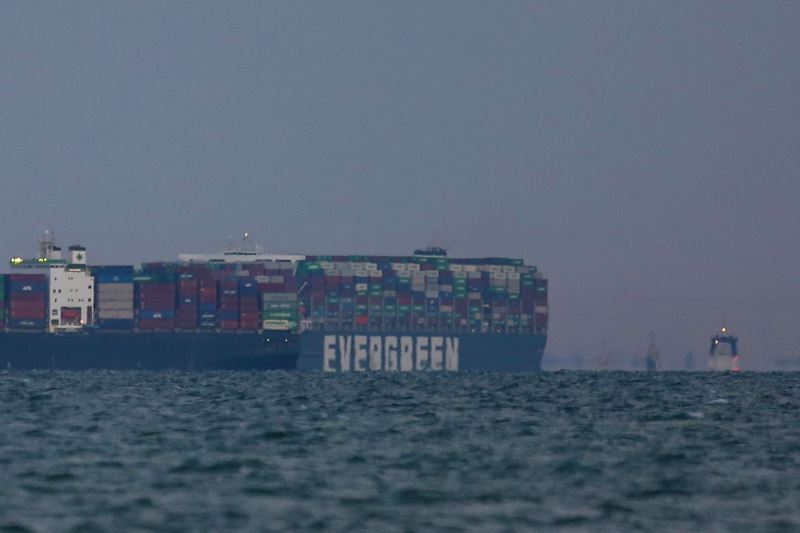
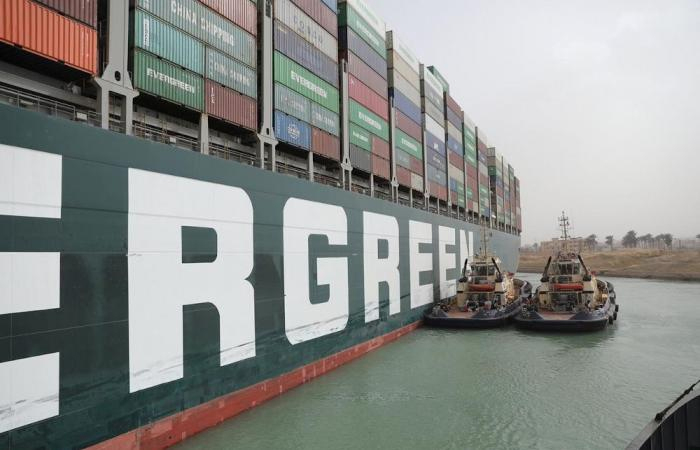
InternationalMar 30. 2021The Ever Given container ship moves along the Suez Canal towards Ismailia after being freed from the canal bank in Suez, Egypt, on Monday, March 29, 2021. The giant Ever Given container ship was finally pulled free from the bank of the Suez Canal, allowing for a massive tail back of ships to start navigating once again through one of the world's most important trade routes. Photographer: Islam Safwat/BloombergThe Ever Given container ship moves along the Suez Canal towards Ismailia after being freed from the canal bank in Suez, Egypt, on Monday, March 29, 2021. The giant Ever Given container ship was finally pulled free from the bank of the Suez Canal, allowing for a massive tail back of ships to start navigating once again through one of the world’s most important trade routes. Photographer: Islam Safwat/Bloomberg

By Syndication Washington Post, Bloomberg

Ships on Monday started moving again through the Suez Canal after the giant container ship that lay stranded across the critical waterway for a week was finally tugged free.

Hundreds of vessels carrying everything from oil to livestock had been forced to wait in line after the Ever Given got stuck in the canal. The accident was a stark reminder of the fragility of global trade infrastructure and threatened to further strain supply lines already stretched by the pandemic.

Horns sounded in celebration as the container ship — which is longer than the Eiffel Tower and weighs 220,000 tons — limped up the canal after a painstaking rescue operation that saw teams of tugs and dredgers working day and night.

Salvage teams used the tides and a full moon to pull the ship from deep inside the sandy bank it had smashed into last week amid high winds and poor visibility. As part of their efforts, they shoveled 1 million cubic feet (30,000 cubic meters) of sand and even removed part of the canal wall.

Part of the problem was a five-day wait for two large tugboats, according to Peter Berdowski, chief executive officer of Boskalis Westminster, the parent company of the salvage team.

“We were enormously helped by the strong tide, the forces of nature that push hard, even harder than the two tugboats can pull,” he told Dutch radio.

“The men were euphoric of course. But there was a tense moment when this giant was floating freely. You need to bring it under control quickly with the tugboats before it gets stuck on the other side, we would have gone from bad to worse. Those were a tense 10 minutes.”

The Ever Given container ship enters the Great Bitter Lake after being freed from the Suez Canal in Suez, Egypt, on March 29, 2021. MUST CREDIT: Bloomberg photo by Islam Safwat

The Ever Given container ship enters the Great Bitter Lake after being freed from the Suez Canal in Suez, Egypt, on March 29, 2021. MUST CREDIT: Bloomberg photo by Islam Safwat

The Suez Canal Authority said it could take around a week to clear the lineup of ships. On Monday evening, at least three ships were on the move, according to vessel-tracking data.

Egyptian authorities were desperate to get traffic flowing again through the waterway that’s a conduit for about 12% of world trade and about 1 million barrels of oil a day. This has been the canal’s longest closure since it was shut for eight years following the 1967 Six Day War.

Firms including A.P. Moller-Maersk A/S and Hapag-Lloyd AG were forced to reroute their ships via the southern tip of Africa, which can add two weeks on to a journey between Europe and Asia. At least one ship appeared to do a double U-turn on Monday as news of the salvage operation emerged.

The long-term impact of the canal’s $10-billion-per-day closure will likely be small given that global merchandise trade amounts to $18 trillion a year. Yet so many ships being thrown off schedule will ensure cargo delays for weeks, if not months. The dozen or so container carriers that control most of the world’s ocean freight are already charging record-high rates on some routes, and shortages of everything from chemicals and lumber to dockside labor already abound.

“The dominoes have been toppled,” Lars Jensen, chief executive of SeaIntelligence Consulting in Copenhagen, wrote on social media over the weekend. “The delays and re-routing which have already happened will cause ripple effects” which will be felt for several months.

Companies from Ikea to Caterpillar Inc. flagged potential impacts and tens of thousands of live animals are stuck on ships in the area. Consumer goods, industrial inputs, and commodities from oil to coffee are caught up in the jam, with Asian exporters and European importers affected most directly.

The blockage held up about $400 million an hour, based on rough calculations from Lloyd’s List that suggested westbound traffic to Europe is worth around $5.1 billion a day and eastbound traffic is approximately $4.5 billion.

White House increased tax proposal as it sought to address tensions over next big spending plan #SootinClaimon.Com

#SootinClaimon.Com : ขอบคุณแหล่งข้อมูล : หนังสือพิมพ์ The Nation.

https://www.nationthailand.com/news/30404275

White House increased tax proposal as it sought to address tensions over next big spending plan

InternationalMar 30. 2021President Joe Biden walks to board Marine One on the south lawn of the White House on March 26. MUST CREDIT: Washington Post photo by Demetrius FreemanPresident Joe Biden walks to board Marine One on the south lawn of the White House on March 26. MUST CREDIT: Washington Post photo by Demetrius Freeman

By The Washington Post · Jeff Stein

WASHINGTON – When President Joe Biden’s team began putting together his infrastructure and jobs package this February, the White House National Economic Council circulated an internal proposal calling for about $3 trillion in new spending and $1 trillion in new tax hikes, according to three people with knowledge of the matter.

But soon enough, some members of the economic team second-guessed themselves, concerned that the plan could jeopardize the nation’s long-term financial stability. The officials worried that the large gap between spending and revenue would widen the deficit by such a large degree that it could risk triggering a spike in interest rates, which could in turn cause federal debt payments to skyrocket, said the people familiar with the matter.

The two-pronged package Biden will begin unveiling this week includes higher amounts of federal spending but also significantly more in new tax revenue – with possibly as much as $4 trillion in new spending and more than $3 trillion in tax increases, said the people, who spoke on the condition of anonymity to describe private dynamics.

The two-pronged package that Biden will begin unveiling this week includes higher amounts of federal spending and significantly more new tax revenue – with possibly as much as $4 trillion in new spending and more than $3 trillion in tax increases, said the people, who spoke on the condition of anonymity to describe private dynamics. One person familiar with the matter said that the early infrastructure draft did not include every tax increase the White House was eventually considering for its ultimate proposal, and that the administration believes the tax hikes can advance its goal of reducing income inequality.

The choice to increase the bill’s tax hikes because of its effect on the deficit reflects how concerns over the nation’s spending imbalance are shaping the White House’s internal policy debate. But it also sets up the administration for an enormous political challenge in convincing Congress to pass a package of tax increases on wealthy Americans and companies that together would represent the largest tax hike in generations.

The shift in strategy reveals just one of the many ways the White House has grappled with shaping Biden’s second major legislative effort, which the administration will kick off this week at an event in Pittsburgh.

Biden’s “Build Back Better” agenda is ambitious in scope, aiming to confront global climate change, rebuild the nation’s infrastructure, revive domestic manufacturing, and transform U.S. child care, among other goals.

The path toward crafting the legislation has exposed the White House to crosscutting demands from key allies. This account is based on interviews with seven senior administration officials involved in the effort, as well as more than a dozen congressional officials, labor leaders, activists, and economists involved in the crafting of the package.

One core tension is to what degree Democrats should emphasize investments in traditional physical infrastructure seen as more likely to garner GOP support – such as roads and bridges – rather than child care and other social spending that liberal economists increasingly have emphasized as critical to ensuring robust economic growth.

It is unclear to what extent Biden has the political capital to do both. Already, the administration has decided to trim its sails somewhat and is not expected to make a child anti-poverty initiative permanent or embrace a plan from Sen. Elizabeth Warren, D-Mass., to devote as much as $500 billion to push mass transit away from fossil fuels.

“We know that Republicans and particularly blue-collar men really like the physical building kind of infrastructure and see that as leading to good paying jobs for men in particular. And women and the Democratic base really respond to what you might call softer infrastructure – child care; school; caregiving responsibilities – which have come home very vividly during covid,” said Celinda Lake, a Democratic pollster who advised Biden’s 2020 presidential campaign. “It’ll be a challenge, but they have a major opportunity here to do both in a way that both helps these constituencies and is majorly appealing to them as voters.”

Republicans have already begun to attack the White House for embracing large spending and tax plans – which would largely reverse former president Donald Trump’s 2017 tax cut – that reflect Democratic priorities with very narrow majorities in Congress.

Biden’s coming push to raise the corporate tax rate would damage the competitiveness of American firms and push them to relocate jobs abroad, conservatives say. Although Biden hosted a bipartisan group at the White House for infrastructure discussions, Republican lawmakers have complained of little outreach from the administration or interest in their ideas.

“It’s like Republicans saying, ‘We’ll do infrastructure but pay for it by reversing the Affordable Care Act.’ They don’t really have a seat at the table,” said Donald Schneider, who served as chief economist to Republicans on the House Ways and Means Committee. “This process seems even more insincere than the way the stimulus played out.”

Despite their narrow margins, administration officials have begun comparing their coming efforts to Franklin Delano Roosevelt’s New Deal or Lyndon B. Johnson’s Great Society programs. They see their proposals as more impactful than those put forward by any modern Democratic president, including Barack Obama.

“If you look at what makes the Democratic Party what it is, and what’s considered our greatest hits – our ‘Abbey Roads,’ if you will – it’s not doing something small with Dwight D. Eisenhower or when Bill Clinton triangulated. It’s about creating programs that create a floor of justice and decency in this country,” said Rep. Andy Levin, D-Mich., who met with officials at the White House last week to discuss the infrastructure plan. “We have that opportunity again now.”

On Wednesday, Biden will unveil the first part of his agenda focused on jobs and improving America’s economic competitiveness.

The plan will center on proposals to repair the nation’s physical infrastructure, such as its bridges, railways, ports, water systems and more, as well as revive domestic manufacturing; invest in research and development; expand clean energy investments, and create a nationwide infrastructure for electric vehicles. This part of the plan also will include major investments in child care and educational facilities, and major investments in caretakers for the elderly and disabled amid the nation’s major aging crisis.

The second part of the plan, which will be unveiled next month, is expected to include initiatives to expand child care; provide paid family and medical leave; approve an expansion of health care and the Affordable Care Act, and extend a larger child benefit recently approved by Congress, among other measures. White House officials have said no decisions have been made about which of the proposals they would aim to move through Congress first.

The proposals are the result of months of behind-the-scenes work across numerous agencies to forge consensus on dozens of knotty policy questions. Although they had some disagreements over its provisions, Democrats in the House and Senate were unified in clamoring for a coronavirus relief bill and gave the White House leeway in shaping the new president’s first bill.

The senior White House officials tasked with assembling the package – primarily National Economic Council Director Brian Deese and Susan Rice, director of the Domestic Policy Council – faced much fiercer tensions between its allies than it did over the $1.9 trillion stimulus plan.

Over the past two months, leading business groups privately told the administration that the infrastructure package should be focused primarily on physical capital projects – such as roads and bridges – rather than on the caregiving priorities, such as child care, three people familiar with the internal conversations said. Lobbyists urged the White House to jettison the care economy investments, which also would reduce the amount of tax revenue necessary to fund the package.

Centrist Senate Democrats also are more interested in big investments in roads and bridges than in the care-economy investments, which some viewed as reflective of a liberal wish list. That is in part because Republicans are more likely to support an infrastructure package, and many moderate Democrats such as Sen. Joe Manchin, D-W.Va., have said they want to return to bipartisan policymaking.

“There’s some broad skepticism we can do the other piece in a bipartisan way and there’s a strong desire for the next bill to be bipartisan,” said one aide to a centrist Democratic senator, speaking on the condition of anonymity to frankly reveal internal dynamics, about the White House’s caregiving proposals.

Democrats may use the parliamentary procedure known as reconciliation to approve an infrastructure package with a narrow majority that would not require Republican votes, the same way they approved the coronavirus relief bill. Bill Hoagland, senior vice president at the Bipartisan Policy Center, citing conversations with Senate Democratic staff, said: “The difficulty is all the advocacy groups have seen the possibility of using reconciliation to move their agendas [for] things that do not normally fall into definition of infrastructure – child care; public health care. The moderates and the center will say, ‘Wait a minute let’s deal with those through the normal appropriations process.'”

But White House officials assembling the package also faced demands from key constituencies to not let the caregiving proposals be of secondary importance to more traditional infrastructure investments.

Some people close to the White House said they feel that the emphasis on major physical infrastructure investments reflects a dated nostalgia for a kind of White working-class male worker. In private discussions with the White House National Economic Council, the Council of Economic Advisers and the Domestic Policy Council, SEIU International President Mary Kay Henry urged the administration to follow through on its promise to approve major investments in the care economy.

Henry said she reminded the White House of promises Biden had made in person to low-wage service workers – disproportionately minorities and women who also helped elect him in the fall.

On National Equal Pay Day, Council of Economic Advisers economists Cecilia Rouse and Heather Boushey talked at the White House media briefing about the need for major caregiving investments.

On a private Zoom call earlier this month, economists Heidi Shierholz, Darrick Hamilton and Larry Katz presented Rouse, Boushey and other senior Biden officials with evidence that federal investments in care work would do more to generate jobs and economic growth than physical infrastructure, Shierholz said.

“We’re up against a gender and racial bias that this work is not worth as much as the rubber, steel and auto work of the past century,” Henry said. “The key job right now is we have to in the public imagination and in the congressional debate widen the lens, so that people understand that investment in caregiving is an investment in infrastructure.”

Part of the jockeying over the second effort reflects the broader uncertainty surrounding the administration’s next priority. Biden had initially pledged to release an infrastructure and jobs package that included caregiving investments in February. The process was delayed as the administration worked to finalize and implement the relief package.

But the infrastructure package also involved much more extensive input from a range of senior officials than the relief bill, which was modeled largely after prior coronavirus relief bills.

The climate components of the bill were written in part by Gina McCarthy, White House national climate adviser and former head of the Environmental Protection Agency. Her deputy – Ali Zaidi, a former Obama administration official – took extensive meetings with climate activists as they pressed the administration on how to approve Green New Deal-like investments in clean energy.

Jennifer Granholm, secretary of the Energy Department, was also closely involved in producing the bill. A former governor of Michigan, Granholm pushed for provisions aimed at blunting the impact of job loss in Appalachia and other parts of the country dependent on fossil fuel industries, particularly through money for retraining.

Mark Mazur, a former Obama administration official tapped to deal with tax policy at the Treasury Department, took the lead in drafting a menu of tax increases that were then submitted to the White House for review. Kimberly Clausing, who was an international tax and trade expert at UCLA, helped draft the provisions aimed at taxing multinational profits abroad.

The tax component is expected to be the heaviest lift politically for the administration. The White House is studying a range of tax hikes on wealthy investors, corporations and rich people to pay for the package. Steve Rosenthal, a tax expert at the nonpartisan Tax Policy Center, said the tax increases would be the largest in decades.

But in other ways, the process revealed the limits of the White House’s willingness to be ambitious in its policy goals.Biden’s campaign plan called for more than $7 trillion in health, energy, infrastructure and child-care investments, according to estimates from Americans for Tax Fairness, a left-leaning think tank.

Lindsay Owens, a liberal economist at the Groundwork Collaborative and former aide to congressional Progressive Caucus Chair Rep. Pramila Jayapal, D-Wash., said of early reports of Biden’s plan: “Congress will need to beef up the draft significantly to come anywhere close to addressing decades of underinvestment in infrastructure and to take on the climate crisis.”

Almost immediately after the relief legislation passed, Sens. Sherrod Brown, D-Ohio, Cory Booker, D-N.J., and MichaelBennet, D-Colo., began a campaign to lobby the White House to permanently extend the expanded child benefit in the stimulus, according to two people familiar with their efforts. The Democratic senators pressed Vice President Harris, Deese, White House Chief of Staff Ron Klain and White House Council of Economic Advisers member Jared Bernstein, the people said.

The White House agreed to the Democratic senators’ demand only in part, including in the package an extension only through 2025. Making it permanent would increase the 10-year cost of the bill by as much as $500 billion.

“It’s really worrisome – they’re raising a ton of money in this package and this is our opportunity to ensure this lasts,” one senior Democrat involved in the effort said. “This is the chance, right now, to really slot this in.”


Giant vessel afloat in Suez, service provider says #SootinClaimon.Com

#SootinClaimon.Com : ขอบคุณแหล่งข้อมูล : หนังสือพิมพ์ The Nation.

https://www.nationthailand.com/news/30404258

Giant vessel afloat in Suez, service provider says

InternationalMar 29. 2021

By Syndication Washington Post, Bloomberg · Jack Wittels, Salma El Wardany, Mirette Magdy

Salvage teams freed the Ever Given in the Suez Canal, according to maritime services provider Inchcape, almost a week after the giant vessel ran aground in one of the world’s most important trade paths.

While the ship was floating again, it was not immediately clear how soon the waterway would be open to traffic, or how long it would take to clear the logjam of more than 450 ships stuck, waiting and en route to the Suez that have identified it as their next destination.

The backlog is one more strain for global supply chains already stretched by the pandemic; the canal is a conduit for about 12% of global trade. Some ships have already opted for the long and expensive trip around the southern tip of Africa instead of Suez.

The breakthrough in the rescue attempt came after diggers removed 27,000 cubic meters of sand, going deep into the banks of the canal.

Warm weather propels D.C. cherry blossoms to bloom days ahead of schedule #SootinClaimon.Com

#SootinClaimon.Com : ขอบคุณแหล่งข้อมูล : หนังสือพิมพ์ The Nation.

https://www.nationthailand.com/news/30404237

Warm weather propels D.C. cherry blossoms to bloom days ahead of schedule

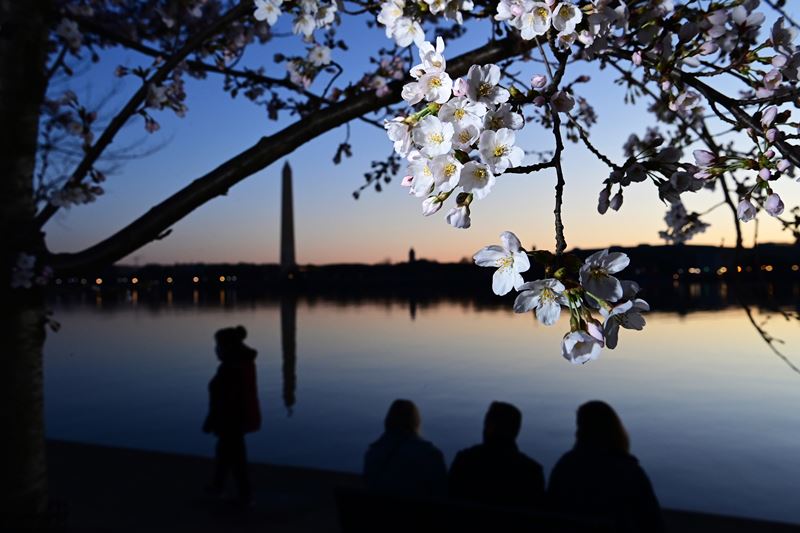
InternationalMar 29. 2021People gather near the Tidal Basin in Washington to see the blooming cherry trees on Saturday, March 27, 2021. MUST CREDIT: Washington Post photo by Matt McClainPeople gather near the Tidal Basin in Washington to see the blooming cherry trees on Saturday, March 27, 2021. MUST CREDIT: Washington Post photo by Matt McClain
By The Washington Post · Tara Bahrampour, Jason Samenow

WASHINGTON – Echoing the sentiments of many Americans itching to get out after a year of hibernation, Washington’s cherry blossoms burst Sunday into full-on cotton-candy splendor, several days earlier than predicted.

The surprisingly swift peak bloom happened ahead of forecasts from The Washington Post and the National Park Service, which had predicted peak bloom between Wednesday and Saturday, and Friday and April 5, respectively.

A little more than two weeks ago, after a chilly February and early March, the cherry trees at the Tidal Basin had hardly developed buds. But the unusually warm weather, particularly since Thursday, when it reached 10 to 20 degrees above average, propelled them through their six stages.

MUST CREDIT: Washington Post photo by Matt McClain

MUST CREDIT: Washington Post photo by Matt McClain

This year’s first day of peak bloom is four days head of the average date over the past 30 years and almost a week ahead of the 100-year average of April 3.

March 15, 1990, marks the earliest peak bloom on record, while April 18, 1958, was the latest. Last year, the peak occurred on March 20, tied for the third-earliest on record.

Once peak bloom occurs, the blossoms can remain on cherry trees for another week or so if it’s warm and winds are light.

‘Vaccine passports’ are on the way, but developing them won’t be easy #SootinClaimon.Com

#SootinClaimon.Com : ขอบคุณแหล่งข้อมูล : หนังสือพิมพ์ The Nation.

https://www.nationthailand.com/news/30404235

‘Vaccine passports’ are on the way, but developing them won’t be easy

InternationalMar 29. 2021

By The Washington Post · Dan Diamond, Lena H. Sun, Isaac Stanley-Becker

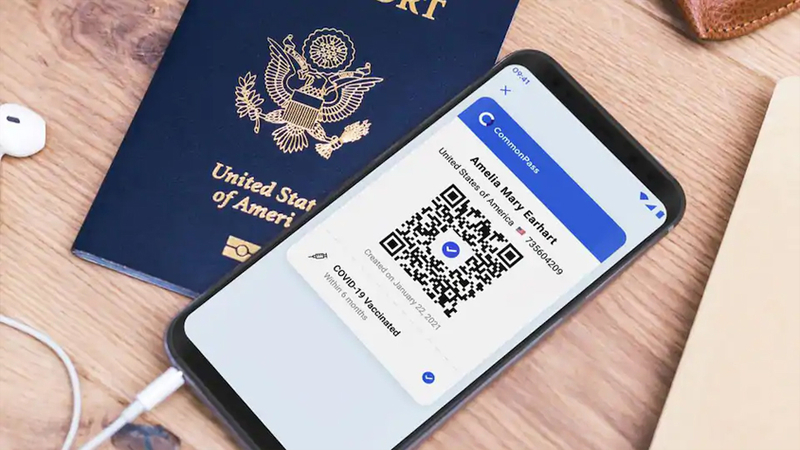
The Biden administration and private companies are working to develop a standard way of handling credentials – often referred to as “vaccine passports” – that would allow Americans to prove they have been vaccinated against the novel coronavirus as businesses try to reopen.

The effort has gained momentum amid President Joe Biden’s pledge that the nation will start to regain normalcy this summer and with a growing number of companies – from cruise lines to sports teams – saying they will require proof of vaccination before opening their doors again.

The administration’s initiative has been driven largely by arms of the Department of Health and Human Services, including an office devoted to health information technology, said five officials who spoke on the condition of anonymity to discuss the effort. The White House this month took on a bigger role coordinating government agencies involved in the work, led by coronavirus coordinator Jeff Zients, with a goal of announcing updates in coming days, said one official.

The White House declined to answer questions about the passport initiative, instead pointing to public statements that Zients and other officials made this month.

“Our role is to help ensure that any solutions in this area should be simple, free, open source, accessible to people both digitally and on paper, and designed from the start to protect people’s privacy,” Zients said at a March 12 briefing.

The initiative has emerged as an early test of the Biden administration, with officials working to coordinate across dozens of agencies and a variety of experts, including military officials helping administer vaccines and health officials engaging in international vaccine efforts.

The passports are expected to be free and available through applications for smartphones, which could display a scannable code similar to an airline boarding pass. Americans without smartphone access should be able to print out the passports, developers have said.

Other countries are racing ahead with their own passport plans, with the European Union pledging to release digital certificates that would allow for summer travel.

U.S. officials say they are grappling with an array of challenges, including data privacy and health-care equity. They want to make sure all Americans will be able to get credentials that prove they have been vaccinated, but also want to set up systems that are not easily hacked or passports that cannot be counterfeited, given that forgeries are already starting to appear.

One of the most significant hurdles facing federal officials: the sheer number of passport initiatives underway, with the Biden administration this month identifying at least 17, according to slides obtained by The Washington Post.

Those initiatives – such as a World Health Organization-led global effort and a digital pass devised by IBM that is being tested in New York state – are rapidly moving forward, even as the White House deliberates about how best to track the shots and avoid the perception of a government mandate to be vaccinated.

One of the teams working on vaccine passports is the Vaccination Credential Initiative, a coalition endeavoring to standardize how data in vaccination records is tracked.

“The busboy, the janitor, the waiter that works at a restaurant, wants to be surrounded by employees that are going back to work safely – and wants to have the patrons ideally be safe as well,” said Brian Anderson, a physician at Mitre, a nonprofit company that runs federally funded research centers, who is helping lead the initiative. “Creating an environment for those vulnerable populations to get back to work safely – and to know that the people coming back to their business are ‘safe,’ and vaccinated – would be a great scenario.”

Anderson’s team is aiming to release its free software standards in April, hoping developers will use them to help build digital vaccine records that allow people to show they have been inoculated. The Vaccination Credential Initiative includes the Mayo Clinic, Microsoft and more than 225 other organizations, many of which have pledged to use the code when administering shots.

Biden administration officials privately acknowledge the high stakes of the effort.

Proof of vaccination “may be a critical driver for restoring baseline population health and promoting safe return to social, commercial, and leisure activities,” according to the March 2 slides prepared by the Office of the National Coordinator for Health Information Technology and obtained by The Post. But officials at the session – attended by more than 150 staff from the health, defense, homeland security and other departments, and even far-flung agencies such as NASA – warned of the “confusing array” of efforts underway to create credentials.

“A chaotic and ineffective vaccine credential approach could hamper our pandemic response by undercutting health safety measures, slowing economic recovery, and undermining public trust and confidence,” one slide reads.

Micky Tripathi, whom Biden tapped as the national coordinator for health IT, recently said federal officials are concerned with a variety of health-tech challenges, including protecting the credentials against fraud, ensuring data security and making certain that low-income populations aren’t squeezed out.

“How do we make sure that whatever is available is accessible to everyone so no one is left behind or feeling like they can’t participate in the return of their day-to-day activities?” Tripathi asked at a virtual meeting hosted by the Health IT Leadership Roundtable on March 11.

Tripathi told the group he didn’t like the term “vaccine passports,” adding that “passports are something that are issued by governments. … I think of them as vaccine credentials or certificates.” Tripathi did not respond to a request for comment.

The Centers for Disease Control and Prevention, which is participating in the WHO’s effort to create “digital vaccination certificates,” also is preparing to help advise on the passport rollout. The health agency says it is expecting to play a role in determining which organizations will credential and issue the certificates, in addition to informing the public, according to CDC documents reviewed by The Post.

The Biden administration has promised to release more information about its efforts. Asked by Hawaii Gov. David Ige on Tuesday about the state of the passport initiative, Zients told governors he would provide a more detailed briefing this week, according to two peopleon the call, speaking on the condition of anonymity to describe the private conversation.

Federal officials defended the pace of the project.

Taking time to get the credentialing project right “is very, very important because this has a high likelihood of being either built wrong, used wrong or a bureaucratic mess,” said one official, speaking on the condition of anonymity to discuss the effort. The official said some of the considerations include how to adjust for the spread of variants, how booster shots would be tracked and even questions about how long immunity lasts after getting a shot. There’s “a lot to think through,” the official said.

“Many people see this as a key aspect to getting things closer to normal,” said Kristen McGovern, a partner at health-care consultancy Sirona Strategies and former chief of staff at the Office of the National Coordinator for Health IT. But the technical challenges are significant and given that so many separate efforts are underway, “it would be an almost herculean task to come up with a single standard” for all the vaccine credentials to follow, McGovern said.

There is evidence vaccine passports could motivate skeptical Americans to get shots. Several vaccine-hesitant participants at a recent focus group of Trump voters led by pollster Frank Luntz suggested their desire to see family, go on vacation and resume other aspects of daily life outpaced fear of the shots, particularly if travel companies and others moved to require proof of vaccination.

“We love to travel. We love to take cruises. I would get it to travel,” said Debbie of Georgia, who like others in the focus group was identified only by her first name.

Some attendees dissented and warned that requiring a credential would backfire.

“I would change my travel plans,” said a man identified as Patrick of Tennessee.

Public health and ethics experts agreed that the Biden administration needed to strike a careful balance: Encourage shots and support the private-sector initiatives but don’t put too much federal emphasis on the looming passports.

“If it became a government mandate, it would go down a dark road very quickly,” said Brian Castrucci, who leads the Bethesda, Md.-based de Beaumont Foundation, a public health group funding Luntz’s research into why some Americans are balking at the vaccine. “It becomes a credential. It becomes a ‘needing your papers,’ if you will. That could be dangerous – and it could turn off people.”

“It has to be that everyone can get it, and it’s their choice, as it were,” said Ezekiel Emanuel, a University of Pennsylvania bioethics expert who co-authored a Journal of the American Medical Association article last year about the ethics of such certificates and advised Biden’s transition team on the coronavirus. “The one thing I am concerned is that some people won’t be able to get vaccinated for a variety of reasons.”

Emanuel added that the passports will be an element of global travel – not just domestic policy. Key aviation and travel associations on March 22 called on the White House to finalize its vaccine credential plan by May, saying it was essential for the safe resumption of international travel.

Donald Rucker, who led the health IT office during the Trump administration, said myriad technical issues await the rollout of vaccine credentials, including how they are tracked, whether they are enforced and who pulls together the initial records of which Americans have gotten shots.

Rucker said keeping vaccine credentials could help officials better understand coronavirus vaccination, including possible long-term side effects, if the data is connected with the health information exchanges that states maintain.

“The tracking of vaccinations is not just simply for vaccine passports,” Rucker said. “The tracking of vaccinations is a broader issue of ‘we’re giving a novel biologic agent to the entire country,’ more or less.”