By Syndication Washington Post, Bloomberg · Andreo Calonzo
The Philippines said Chinese “maritime militia” vessels have expanded into more disputed South China Sea areas, even after the Southeast Asian nation protested and the U.S. aired concerns over the ships’ presence.
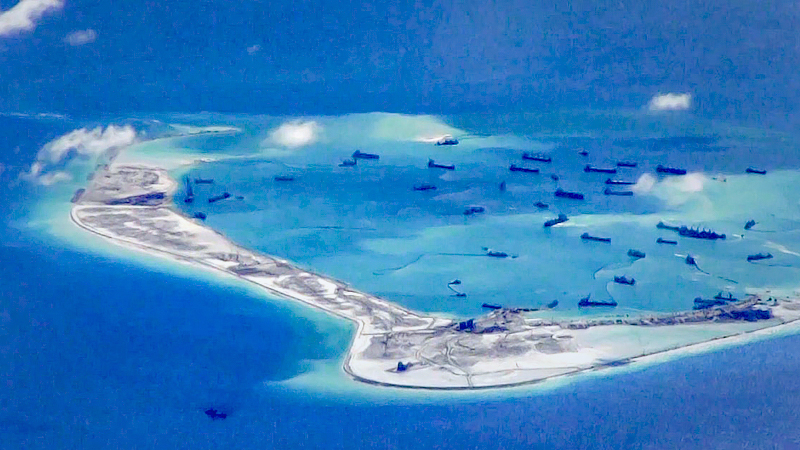
More than 250 Chinese vessels were seen in areas including Whitsun Reef and Thitu Island, as well as an island group known in the Philippines as Kalayaan, a government task force said Wednesday, citing air and sea patrols on March 29. It added that four Chinese Navy ships were also spotted at Mischief Reef, also known as Panganiban Reef.
The Chinese ships’ presence in the contested waters comes despite Philippine President Rodrigo Duterte’s efforts to build closer ties with Beijing, while keeping good relations with the U.S. China earlier said that its vessels near a disputed reef were sheltering from the wind.
The Philippines repeated its call for the Chinese vessels to immediately leave the disputed areas, saying their presence is “hazardous to navigation and safety of life at sea.”
“Their swarming also poses a threat to the peaceful exercise of sovereign rights of the Philippines in its exclusive economic zone,” the Southeast Asian nation said, adding that more Philippine Navy and coast guard ships have been deployed to patrol in the South China Sea.
By Syndication Washington Post, Bloomberg · Michelle Fay Cortez, Jason Gale
Nearly three dozen scientists vetted by the World Health Organization and the Chinese government gathered in Wuhan, China, early this winter to start the arduous task of finding the origins of covid-19 and determining how it spread like wildfire around the world.
Six weeks after that trip, the working group this week delivered an analysis that laid out four possible scenarios and recommended next steps for digging deeper to find the pandemic’s genesis. The 123-page report, and a nearly 200-page supplement, was immediately engulfed by criticism, with a dozen nations including the U.S., the U.K. and Japan questioning its structure and insights.
The most unexpected detractor was WHO Director General Tedros Adhanom Ghebreyesus, who helped negotiate the details of the trip and agreed to the scope of the work back in July. He said the theory that the virus escaped via a laboratory accident needed to be more thoroughly vetted, a hypothesis that has been vigorously denied by the Chinese government.
“There’s obviously a lot of politics,” said John Mackenzie, an Australian virologist who led a 2003 WHO-convened mission in China to study the origins of SARS, leaving him well-versed on the delicacies of undertaking such a study. “He should be standing by his committee’s report.”
“I just find it very strange that he’s demeaning it and he’s deflecting from it,” said Mackenzie, an emeritus professor at Curtain University in Perth who serves on the WHO’s emergency committee for covid-19.
It’s not that controversy was unexpected: the mission was fraught from the start, with China resisting the scientists for months before relenting to a team of experts that comprised of a local expert for every foreign one. Still, the furor now threatens to undermine scientific progress in understanding how the coronavirus came about, and the chance of WHO-led further investigation in both China and other countries — which the experts have always said is needed — is growing faint.
“Multiple attacks daily, demonstrably false, but gullible followers believe them,” said Peter Ben Embarek, an expert on zoonotic diseases at the WHO who led the international team of scientists, in a Twitter post on what he described as “right-wing media outlets.” “Real issue is that this undermines science and ironically puts U.S. citizens at risk by leading us into rabbit hole conspiracies instead of better understanding of how to prevent pandemics.”
The WHO experts, who traveled to China in January after months of negotiations, were presented with reports from local researchers, rather than being allowed to conduct their own analysis, some said in media interviews after the trip. They also didn’t have unfettered access to raw material or the lab in Wuhan that has become central to the controversy. Instead, they were required to work within the parameters negotiated by the Chinese government and the WHO more than six months before the mission began.
Their official report, itself delayed for weeks, was questioned even before its official release. The U.S. has “real concerns about the methodology and the process” of the report, including that the Chinese government “apparently helped to write it,” Secretary of State Antony Blinken told CNN on Sunday, ahead of publication.
On Tuesday, hours after it was published, a joint statement from 14 countries including the U.S., the U.K., Australia, Japan, South Korea and Norway, bemoaned a lack of access to “complete, original data and samples.” Scientists from five of the countries took part in the mission.
China dismissed the criticism as not “serious or responsible” on Wednesday. “They want to spread rumors and push their hidden political agenda,” said Chinese Foreign Ministry spokeswoman Hua Chunying at a briefing in Beijing. “The experts have said they went to places they wanted to, and they met with people they wanted to.”
Some among the WHO expert team, made up of virologists, epidemiologists and other public health experts, argued that not many countries would allow unfettered access to confidential data, and noted that their work seemed to be taken out of context. At the heart of the controversy appears to be a mismatch between the slow speed and cautious precision of scientific work, and the political symbolism thrust on the origins investigation.
Marion Koopmans, a Dutch virologist who was a member of the WHO team, mused on Twitter about whether other countries would allow outsiders to conduct a similar investigation.
While much of the criticism has focused on the report’s dismissal of the laboratory leak theory, the scope of study included no mention of research specifically on labs in Wuhan, or any role they may have played.
A true audit of the lab is a “much more complex process, and that’s not what we were there to do,” said Dominic Dwyer, a microbiologist based in Sydney who was part of the team.
The lab leak theory took off when it was promoted by the Trump administration. There has been nothing to suggest it emerged from a lab in China or anywhere else, Ben Embarek said.
Maria Van Kerkhove, the WHO’s technical lead on covid, defended the report, saying the epidemiology and molecular data from 2019 is the most comprehensive she has seen, while the animal section provides details on the species that were sampled.
“We were able to create a space for the science,” said Ben Embarek. “We were never pressured to remove critical elements from our report. Personally, I am very proud of this report and, like my other colleagues, we all stand behind it on both sides, despite all the interest and the pressure and the immense difficult environments we have faced over the past few months.”
An Asian American woman was walking through the Hell’s Kitchen neighborhood of Manhattan on Monday morning when a stranger approached.
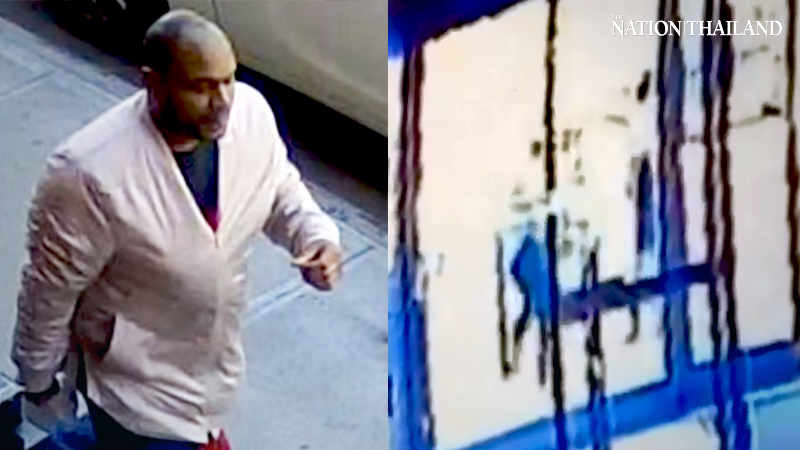
The 65-year-old woman stopped abruptly outside a luxury condo tower, surveillance video shows. Suddenly, the man kicked her in the stomach, knocking her to the sidewalk, and then brutally stomped on her head again and again. All the while, police said, he spewed slurs at her.
As the woman was viciously attacked, video appears to show at least three people in the condo’s lobby passively watching the violence. When the attacker walks away, leaving the injured woman prone on the sidewalk, one man – reportedly a security guard – calmly shut the door on her.
The video has led to new calls for an end to the rising tide of violence against Asian Americans and raised questions about the bystanders’ conduct.
“The cold hearted building security guard not only failed to render aid, he closed the door on the victim,” the New York Police Department’s Asian Hate Crimes Task Force wrote in a since-deleted tweet about the video, WABC reported.
Early on Tuesday, the company that manages the condo tower announced that the staffers involved in the incident have been suspended.
“The staff who witnessed the attack have been suspended pending an investigation in conjunction with their union,” the Brodsky Organization wrote in an Instagram post, which also noted the company is trying to identify a “third-party vendor” who was also on the scene “so that appropriate action can be taken.”
The case was one of two attacks on Asian Americans in New York caught on video and publicized on Monday, on the same day that city leaders gathered in Brooklyn to urge quick action to halt a rising tide of racist violence and threats.
“This is absolutely vile. These attacks against Asian-American New Yorkers must end,” New York City Council Speaker Corey Johnson, D, said on Twitter, linking to a video of the attack on the woman. “Hate has no place here and we must always call it out when we see it.”
In recent weeks, Asian Americans in New York have reported being punched in subway cars, spit on and pummeled with metal pipes – an ugly echo of a national trend that activists say gained traction as former president Donald Trump has used racist terms to tie the coronavirus pandemic to China.
The first attack shared by the NYPD on Monday took place onboard a Manhattan-bound subway car in Brooklyn. Police have not said when the attack took place, but a video of the incident shows an Asian man wearing a backpack being shoved by another passenger, who then starts punching him in the face repeatedly. Eventually, the passenger locks the man in a chokehold, tightly gripping his neck until he passes out on the floor of the train.
“The NYPD is aware of this video and is investigating,” the NYPD Hate Crimes Task Force said on Twitter on Monday morning.
The attack in Hell’s Kitchen happened just before noon on Monday, police said, as the unidentified victim was walking along West 43rd Street. The woman was headed to church, WABC reported, when the attacker yelled, “F— you, you don’t belong here,” and began assaulting her.
Video shows one man in the building’s lobby watching the entirety of the attack. That man, who appeared to be tying a stack of boxes onto a cart, stared out the glass doors as the woman was repeatedly kicked in the head, but made no move to assist her. Two other men, who were security guards according WABC, then walked toward the entrance as the assailant left, and closed the door on the victim.
The woman “sustained a serious physical injury,” the NYPD said, and was taken to NYU Langone Hospital, where she was in stable condition. The NYPD’s Hate Crimes Task Force is investigating the case.
City officials, activists and celebrities decried the video and urged a swift arrest for the attacker.
“This is absolutely disgusting. Asian Americans belong in New York and are an integral part of our city,” tweeted Scott Stringer, New York City’s comptroller and a candidate for mayor. “We have to continue to speak out, we have to continue to protect our AAPI neighbors, and we have to act immediately to #StopAsianHate.”
Others questioned the apparent lack of action from the bystanders in the lobby.
“This is despicable. The attack and the guard’s inaction and closing the door on the victim,” tweeted actress Gemma Chan.
Rep. Grace Meng, D-N.Y., who was among the officials calling for an end to anti-Asian hate crimes at the meeting in Brooklyn earlier on Monday, said the video reinforced a profound lack of empathy for Asian Americans.
“We’ve gone from being invisible to being seen as sub-human,” Meng tweeted. “We just want to be seen as American like everyone else.”
China cuts number of elected legislators in Hong Kong, delays elections
InternationalMar 31. 2021Hong Kong Chief Executive Carrie Lam
By The Washington Post · Eva Dou, Theodora Yu
SEOUL – China has sharply reduced the number of directly elected legislators in Hong Kong and delayed the city’s elections until December, in the latest erosion of its democratic institutions.
The electoral changes announced Tuesday cut the number of directly elected seats in Hong Kong’s legislature to 20 out of 90, from the current 35 of 70. A new committee to vet candidates for public office will give national security authorities sway over who can run.
Members of the district councils – the only fully democratic body in Hong Kong – will be excluded from the committee that selects Hong Kong’s chief executive.
“This is shocking and difficult to comprehend for Hong Kong people,” said Lo Kin-hei, chairman of the city’s Democratic Party.
It’s the latest move by China’s central government to tighten its grip over Hong Kong after a series of massive pro-democracy protests. Dozens of Hong Kong activists were arrested earlier this year under the national security law, essentially neutralizing the city’s long-cherished democratic movement.
The overhaul of Hong Kong’s legislature will mean easier control for China’s central government, with only a minority of seats directly elected by the population.
Hong Kong Chief Executive Carrie Lam said Tuesday that Hong Kong unwaveringly supports the amendment.
Referring to the pro-democracy movements since 2014, Lam said the government needs to deal with the “chaos” of the past few years that was enabled by “loopholes in the legislation” and restore order in the Legislative Council.
The move drew sharp criticism from Western officials on Tuesday. In a post on Twitter, British Foreign Secretary Dominic Raab called the electoral changes a “clear breach” of China’s commitments under the Sino-British Joint Declaration signed in 1984 ahead of the 1997 handover of Hong Kong to China.
Layla Moran, a member of Britain’s Parliament, called for the British government to act. “Words of condemnation have done nothing to protect Hong Kong’s democracy,” she said.
The new vetting procedure for public office candidates includes initial screening and background checks by the Hong Kong police’s national security department. Lo, of the Democracy Party, said police involvement essentially means they can choose who can run for public office.
Lam said the vetting committee does not aim to bar pro-democracy candidates from running for these public positions.
“As long as they can prove to be [patriots], and not be disloyal or collude with foreign forces . . . and as long as they want to serve the Hong Kong citizens, they can still [run],” she said.
Andrew Leung Kwan-yuen, president of Hong Kong’s Legislative Council, announced Tuesday that the election will be delayed until December.
The move was cheered by Chinese state media. State broadcaster CGTN said Tuesday that the legislative changes would provide “much-needed stability” in Hong Kong and prevent future violent protests.
A former British colony, Hong Kong was returned to China in July 1997 after Beijing pledged that the city’s way of life would remain unchanged for 50 years. This meant Hong Kong enjoyed a high degree of autonomy and democratic government and much greater free speech than mainland China.
But under President Xi Jinping, the Chinese central government has significantly increased control over Hong Kong’s affairs, especially following a series of massive pro-democracy protests in the city. The passage of the Hong Kong national security law last year put the city under similarly oppressive speech restrictions as in the mainland.
Dozens of activists were arrested in January under the national security law and charged with “conspiracy to commit subversion.” Many were either candidates in or helped facilitate a primary in July designed to select pro-democracy candidates who would run in the upcoming legislative election.
Tuesday’s overhaul of Hong Kong’s legislature has been expected, with China’s rubber-stamp national parliament voting in mid-March to make these amendments to Hong Kong’s Basic Law.
By The Washington Post · Shane Harris, Emily Rauhala, Ben Guarino, Chris Mooney
Shortly after evidence emerged that a new coronavirus was spreading in the Chinese city of Wuhan in January 2020, speculation mounted about the origins of the lethal pathogen.
Right-wing news outlets in the United States published tendentious and thinly sourced reports that the virus may have come from the Wuhan Institute of Virology, famous in the scientific community for researching coronaviruses in bats. In April, President Donald Trump suspended U.S. funding for the World Health Organization, which he accused of being subservient to Chinese officials, and said that the U.S. government was investigating the lab as a potential source of the virus.
“A lot of people are looking at it – it seems to make sense,” he said.
Since then, more information has accumulated that the virus may have first infected humans after moving through animals, and the “lab-leak theory” usually has been framed as a political distraction, promulgated by a president deflecting attention from his administration’s response to the pandemic, and not as a serious scientific question.
No consensus has emerged on where the virus originated, and there are far more scientists who think it developed naturally than who entertain the possibility that it came from a lab.
That made it all the more surprising when, on Tuesday, the head of the WHO said that his agency hadn’t sufficiently examined the lab scenario.
“Although the [WHO] team has concluded that a laboratory leak is the least likely hypothesis, this requires further investigation, potentially with additional missions involving specialist experts, which I am ready to deploy,” Director General Tedros Adhanom Ghebreyesus said at a news conference marking the release of a highly-anticipated report on the virus’s origins, which concluded that the virus probably jumped from an infected animal into a human.
Tedros voiced frustration with the level of access Chinese authorities gave the WHO, an unusually public rebuke from an agency that has been mostly solicitous to Beijing.
In recent interviews, some members of the WHO team that flew to Wuhan to gather information have acknowledged that they lacked the expertise, resources or mandate to determine whether the virus may have emanated from a lab.
The lab-leak theory is far from proved, but Tedros’s openness was applauded by those who have argued that some circumstantial evidence points to the Wuhan lab as a possible source.
“Making these assertions despite the incredible pressure being placed on him and the WHO represented a bold defense of the organization’s integrity in the face of Chinese government efforts to manipulate and restrict the covid-19 origins examination process,” said Jamie Metzl, a National Security Council staffer in the Clinton administration and a member of a WHO expert advisory panel, who had helped organize an open letter calling for more scrutiny of the Wuhan lab, unrestricted by Chinese authorities.
Officially, the Biden administration is open to the possibility of a lab leak. A State Department document, published five days before Trump left office, and which has not been retracted, alleged that “several researchers” at the lab became sick in the fall of 2019 with covid-like symptoms, before the first identified case of the disease, and claimed that the lab “has engaged in classified research, including laboratory animal experiments, on behalf of the Chinese military since at least 2017.”
Versions of the lab-leak theory imagine that an infected worker may have unknowingly passed the virus to others in Wuhan or that an infected animal may have escaped or been sold.
Lab officials have said they possessed no samples of the virus, SARS-Cov-2. And Shi Zhengli, a renowned coronavirus researcher at the lab, has said none of the staff were infected and that the Chinese military has no connection to the institute.
The WHO report states there was no direct infection of workers but does not go into detail or recommend further research on this or other topics.
From the outset, the WHO investigation was unlikely to unearth much evidence that the virus emanated from a lab.
When a joint international-Chinese team convened in Wuhan in the final days of the Trump administration, their itinerary was focused on exploring possible paths of transmission between human and animals – and even a theory pushed primarily by the Chinese government about transmission via frozen seafood – rather than the lab hypothesis.
The group visited the Wuhan Institute of Virology for a few hours, hearing about the lab’s research and safety record and getting assurances that scientists there were not working with viruses closely related to SARS-CoV-2, according to interviews with three foreign scientists on the team and a summary included in the annexes of the WHO’s report.
At a post-trip news conference, Peter Ben Embarek, a Danish food safety expert serving as the WHO lead, described the conversation with staff at the lab as “long, frank and open,” and he appeared satisfied with the short visit and Chinese assurances.
“They’re the best ones to dismiss the claims and provide answers to all the questions,” he said, surprising some experts and U.S. officials, who were reluctant to take the staff’s word at face value.
The international team’s level of interest in exploring the lab theory seemed low, either because they saw it as a politically motivated hoax, thought the evidence pointed in other directions, or did not believe the team had a mandate – or the appropriate staffing – to investigate a Chinese lab.
Dominic Dwyer, an Australian microbiologist and infectious-disease expert on the mission, said he didn’t think the possibility of a lab accident could be ruled out but stressed that the team wasn’t equipped to investigate the hypothesis.
“So, I mean, yes, we did a three-hour visit, and it was sort of managed in the sense that there’s a lot of people there and we did a tour,” he said. “But we did get to ask questions and so on.”
Hung Nguyen-Viet, a Vietnamese expert on livestock and human health on the team described the institute as a “nice lab and well organized” and the discussions with Chinese scientists there as spirited but collaborative.
Hung emphasized that the team agreed that a lab leak was the least likely path of the virus and therefore put their time and energy into exploring other hypotheses.”You would need another team and set of people who really have expertise” to investigate the hypothesis further, he said.
The WHO report also addressed suspicions that the Wuhan institute may have been experimenting with a virus related to SARS-Cov-2 before the outbreak, which in turn might have set the stage for an accidental release.
At a mine in Mojiang, in China’s southern Yunnan province in 2013, scientists discovered the closest known relative to the coronavirus, called Ratg13. It shares 96% of its genetic identity with SARS-Cov-2.
That’s hardly close enough to mean that Ratg13 itself could have sparked the pandemic. That 4% gap would take decades of evolutionary time to bridge.
Still, Ratg13 may be an important clue to the coronavirus’s origins. Yet oddly to some observers, when lab staffers first showed how closely Ratg13 is related to the novel coronavirus, in an article in the journal Nature in early 2020, they did not highlight that it came from the mine. Nor did they note that in 2012, several mine workers who had been tasked with cleaning bat feces there were sickened with a respiratory illness that some have since argued resembles covid-19. Three died.
The Wuhan institute scientists later acknowledged that the cases of the sickened miners initially drew them to conduct extensive research, since they “suspected that the patients had been infected by an unknown virus.”
The new WHO report, however, says institute staffers told investigators the miners’ illnesses “were more likely explained by fungal infections acquired when removing a thick layer of guano,” or bat feces.
The report does not elaborate on that suggestion, which is mentioned briefly in one of the report’s annexes under a category titled “Conspiracy Theories.”
Meanwhile, there is a larger body of evidence that SARS-CoV-2 emerged in nature.
“My view is: This is another example of a bat virus jumping into humans, either directly or through an intermediate host,” said Tony Schountz, an expert in bat-borne viruses at Colorado State University.
When asked whether a lab accident may have been responsible for the Wuhan outbreak, Schountz said it was possible “but, you know, tomorrow I could win the lottery.”
Other virus specialists described WHO’s exploration as sufficient. “I’m not particularly disappointed that they didn’t dig deeper into the Wuhan Institute of Virology,” said Joel Wertheim, an associate professor of medicine at University of California at San Diego. “I don’t think that idea merited as much investigation as looking for the earliest cases.”
Wertheim and his colleagues, in a paper published recently in the journal Science, suggested that the first case of covid-19 may have emerged as late as mid-October to mid-November 2019, before a large cluster of cases linked to a seafood market in Wuhan.
In their models, Wertheim and his co-authors also found coronavirus outbreaks were much more likely than not to fizzle out, especially in rural communities with fewer connections between people. “It’s not fair to characterize this virus as sort of the perfect vessel for human-to-human transmission,” he said. The pathogen seemed to need a denser, urban area to become a pandemic.
“Even if you believe this came through the lab, what you’d have to then show is that the lab had a virus that was very close to SARS-CoV-2. They haven’t found that,” said David Robertson, head of viral genomics and bioinformatics at the University of Glasgow. If laboratory scientists “did have it, I don’t think they would have hidden it. It wouldn’t have occurred to them.”
By The Washington Post · Loveday Morris, Luisa Beck
BERLIN – German Chancellor Angela Merkel on Tuesday said the country will halt the use of AstraZeneca’s coronavirus vaccine for people under 60 due to concerns that is causing rare but occasionally deadly blood clots.
Merkel said the government “cannot ignore” a recommendation for such a move by the country’s vaccine committee and new data about blood clots developing after being vaccinated with the vaccine developed by the Swedish-British pharmaceutical giant AstraZeneca and the University of Oxford.
Germany’s medical regulator, the Paul Ehrlich Institute, said earlier that it had recorded 31 cases of cerebral venous thrombosis, a rare kind of brain clot that can result in hemorrhaging, among 2.7 million people who have received the vaccine in the country.
All were under age 63, and all but two were women. Nine people have died of the clots.
“We all know that vaccination is the most important tool against the coronavirus,” said Merkel, but she said there were other options for younger people.
“We are not faced with the question of AstraZeneca or no vaccine,” she said. “Instead we have several vaccines at our disposal.”
AstraZeneca said that “patient safety remains the company’s highest priority” and that a causal relationship between the vaccine and blood clots had not been established by British and European regulators.
“Regulatory authorities in the UK, European Union, the World Health Organization have concluded that the benefits of using our vaccine to protect people from this deadly virus significantly outweigh the risks across all adult age groups,” AstraZeneca said in its statement. Younger Germans will still be able to receive an AstraZeneca vaccine if they consult with a doctor and sign a waiver.
After an initial review this month, the European Union’s medical overseer, the European Medicines Agency, had deemed the vaccine “safe and effective,” but it said it is continuing to investigate a “possible link” between the vaccine and rare cases of particularly unusual blood clots.
The EMA said that the risks outweighed the benefits, and it added a blood-clot warning to the product about two weeks ago. At the time, it said 25 cases were being investigated among 20 million vaccinations across Europe.
Germany had resumed vaccinations with AstraZeneca after the recommendations, having recorded three deaths before pausing.
But there have been growing calls from parts of the medical community to reassess. Of particular concern has been the risk for younger women, who have made up the majority of the blood-clot cases in Germany.
In an open letter to health authorities, the heads of five university hospitals in the German state of North-Rhine Westphalia, wrote that there was an “extremely unfavorable risk/benefit profile for the use of the AstraZeneca vaccine” for women ages 20 to 29 because of the unlikelihood of dying from the coronavirus, according to excerpts carried by Germany’s DPA news agency.
While the EMA continues its investigations, experts in Germany and Norway who have treated patients suggest that the rare type of blood clots are caused by an overactive immune response triggered by the vaccine.
Some other countries that had initially paused AstraZeneca this month had been more cautious about restarting vaccinations. France limited its use to people over 55 years old.
Norway, where regulators say four people died of blood clots among about 120,000 people who received the AstraZeneca vaccine, has continued its pause. Sweden has resumed AstraZeneca use for people over 65.
The vaccine has not been approved in the United States, where the independent medical board overseeing its trials took the unusual move last week of accusing the company of providing an “incomplete view” of its efficacy data in its U.S. trials.
Regulators in Britain, where the majority of AstraZeneca vaccines in Europe have been administered, said they had found five cases of blood clots as of March 14 but they have not updated numbers since.
“There is a time lag between reports received and publication to allow us time to fully evaluate the data before we issue any conclusions on it,” it said.
A Canadian panel of scientists on Monday recommended against the administration of the AstraZeneca vaccine in people 55 years of age and younger, citing “substantial uncertainty” over its benefits for that age group because of “rare” cases of blood clots reported in Europe.
Canada’s National Advisory Committee on immunization cast the guidance as a “precautionary measure” while Health Canada, the country’s drug regulator, investigates. It said the rate at which the clotting incidents occur is not known “with certainty.”
No such cases have been reported in Canada, which has administered about 300,000 doses of the AstraZeneca vaccine.
The panel’s guidance is nonbinding, but Canadian provinces, which are responsible for the administration of vaccines, said they would follow the advice.
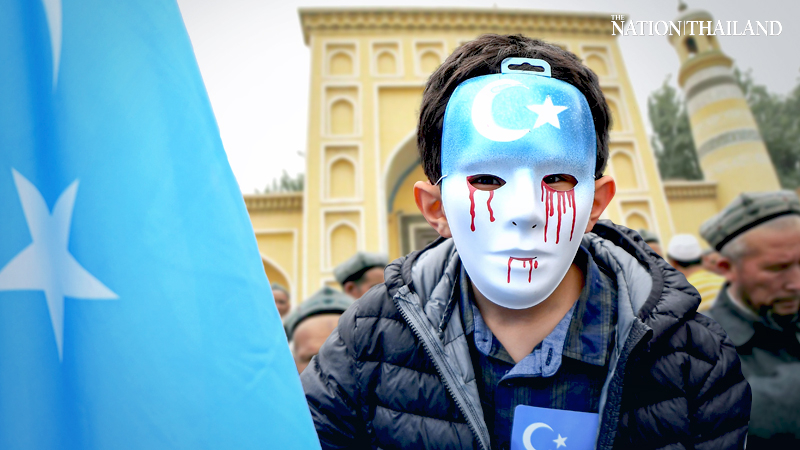
WASHINGTON – The Biden administration declared China’s treatment of Uyghur Muslims a genocide in an annual human rights report Tuesday, formalizing its dire assessment of a campaign of mass detention and sterilization of minority groups in the Xinjiang region.
The move comes amid a sharp plunge in relations between the world’s two largest economies following a tense meeting of top diplomats in Alaska and underscores the Biden administration’s willingness to spotlight atrocities regardless of the impact on sensitive bilateral relations.
“Genocide and crimes against humanity occurred during the year against the predominantly Muslim Uyghurs and other ethnic and religious minority groups in Xinjiang,” reads the report.
In unveiling the document, Secretary of State Antony Blinken said human rights were going in the “wrong direction” in “every region of the world,” calling out attacks on freedoms in Russia, Uganda, Venezuela, Ethiopia, Belarus and elsewhere.
Blinken sought to demonstrate a clear break with the Trump administration’s approach to human rights by sharply rebuking a commission setup by former secretary of state Mike Pompeo that prioritized religious liberty and property rights while dismissing LGBTQ and abortion rights.
“There is no hierarchy that makes some rights more important than others,” Blinken said. “Past unbalanced statements that suggest such a hierarchy, including those offered by a recently disbanded State Department advisory committee, do not represent a guiding document for this administration.”
Blinken also reversed a Trump-era decision to scrap the report’s sections on abortion rights, saying that will appear in the future.
The China section of the report says that genocide against minority groups in Xinjiang continues and includes “the arbitrary imprisonment or other severe deprivation of physical liberty of more than one million civilians; forced sterilization, coerced abortions, and more restrictive application of China’s birth control policies; rape; torture of a large number of those arbitrarily detained; forced labor; and the imposition of draconian restrictions on freedom of religion or belief, freedom of expression, and freedom of movement.”
Beijing has vociferously denied the claims of genocide and sought to underscore the mistreatment of Black Americans and Washington’s destabilizing wars in the Middle East.
Pompeo first officially declared a genocide in Xinjiang during the waning days of the Trump administration. Blinken affirmed Pompeo’s assessment during his confirmation hearing, but the word’s inclusion into Tuesday’s report formalizes the outlook as an official U.S. government assessment.
“Using the term genocide in the report indicates profound concern in the administration about appalling Chinese government human rights violations against Uyghurs, Kazakhs, Kyrgyz and other Turkic communities,” said Sophie Richardson, a China expert at Human Rights Watch.
The move may also put further pressure on the Biden administration to punish China for its alleged actions. “The next step is to map out a strategy to back an independent investigation, gather evidence and pursue accountability,” Richardson said.
Blinken’s relationship with his Chinese counterpart, Yang Jiechi, got off to a rocky start during a two-day meeting in Alaska on March 18 and 19. Before the first formal discussions even began, the U.S. and Chinese delegations harshly criticized each other in extended improvised remarks, which resulted in both sides claiming a breach in diplomatic protocol.
During the report’s unveiling at the State Department, Blinken was asked if his condemnations of China and Russia could come at the expense of cooperation from the two powers on other issues, such as the military crackdown in Myanmar. Blinken suggested that no trade-off was necessary.
“Whether it’s China or Russia or anyone else, we’re not standing against any of those countries,” Blinken said. “We’re not trying to, for example, contain China or keep it down. What we are about is standing up for basic principles, basic rights and a rules-based international order.”
By The Washington Post · Jeff Stein, Juliet Eilperin, Alyssa Fowers
WASHINGTON – The White House on Wednesday is expected to unveil a plan to spend $2.25 trillion on a jobs and infrastructure package that could form a cornerstone of President Joe Biden’s economic agenda, two people familiar with the matter said.
Biden’s plan will include approximately $650 billion to rebuild the country’s infrastructure, such as its roads, bridges, highways and ports, the people said. The plan will also include in the range of $400 billion toward home care for the elderly and the disabled, $300 billion for housing infrastructure and $300 billion to revive U.S. manufacturing. And it will include hundreds of billions of dollars to bolster the nation’s electric grid, enact nationwide high-speed broadband and revamp the nation’s water systems to ensure clean drinking water, among other major investments, the people said.
The people, who spoke on the condition of anonymity to reveal internal deliberations, cautioned that White House officials were still making last-minute adjustments to the plan and that details were subject to change.
White House press secretary Jen Psaki has said the proposal will be paid for in new tax hikes. These hikes will be particularly focused on corporations, seeking to reverse much of President Donald Trump’s 2017 tax law, the people familiar with the plan said. The plan will also include approximately $400 billion in clean-energy credits on top of the $2.25 trillion in new spending.
A White House spokesman declined to comment on the new details that have emerged.
The plan, which Biden will introduce in Pittsburgh on Wednesday, forms one part of the “Build Back Better” agenda that the administration aims to introduce. Psaki has said the administration within weeks will introduce a second legislative package. That second package is expected to include an expansion in health insurance coverage, an extension of the expanded child tax benefit, and paid family and medical leave, among other efforts aimed at families, the officials said.
White House officials have not explained whether they will seek to have both efforts pass at the same time or try to get Congress to approve one first. The combined price tag of the plans could top $4 trillion.
The jockeying around these efforts has already begun, as Biden’s allies push for inclusion of their priorities in the next major legislative effort. Centrist Democrats have said the package should be targeted to win Republican votes, seeking a return to bipartisan policymaking after a contentious and partisan vote over Biden’s $1.9 trillion relief plan. But liberal lawmakers and some economists are pressing the administration to use Democrats’ narrow majorities in Congress to confront some of the nation’s biggest problems, such as climate change, with solutions they say are necessary to address the scale of the crises.
The White House will brief Democratic leadership and also separately brief Democratic and Republican leaders of relevant committees about the plan Tuesday, according to multiple Senate officials who spoke on the condition of anonymity to reveal internal planning.
Congressional aides expect a bruising legislative battle that will prove significantly more difficult than the relatively quick passage of Biden’s relief plan, in which Democrats were held together in part by the need to combat the pandemic. Despite some objections, almost every Democrat in both chambers voted for Biden’s plan.
“I’m getting a little confused about how we’re going to get anything done. It’s only going to get more difficult from here on out,” said Jim Manley, who served as an aide to former Senate majority leader Harry Reid, D-Nev. “There’s not only more divisions over where to go, but there’s a certain sense of spending fatigue setting in on Capitol Hill.”
On Monday, Sen. Edward Markey, D-Mass., and Rep. Debbie Dingell, D-Mich., unveiled a climate and infrastructure plan that called for $10 trillion in spending over the next decade. Biden’s initial campaign pledge to invest $2 trillion over four years was already inadequate to confronting climate change, and his coming proposal may be even less so, said Robert Pollin, an economist at the University of Massachusetts at Amherst, who helped craft the Markey-Dingell plan. Pollin said a $3 trillion investment amounted to only about 1.3% of the country’s gross domestic product.
Climate experts have warned the world faces devastating consequences if it does not reverse global warming.
“That was itself skirting on the edge of being inadequate relative to the climate goals and infrastructure goals,” Pollin said of Biden’s initial plan.
Leah Stokes, an assistant professor of political science at the University of California at Santa Barbara, said in an interview that the amount of money designated for the power sector per reports on Biden’s proposal representsless than what isneeded to extend renewable energy tax credits and lower consumers’ bills as utilities shift to cleaner energy sources.
“We need more spending on climate change if we want to meet this crisis at the scale that’s necessary,” Stokes said. “We definitely need more spending on the electricity grid and on rebates for home retrofits for electrification.”
Still, Josh Freed, who runs the climate and energy program at the center-left think tank Third Way, argued in an email that the emerging proposals could still shift the nation’s climate trajectory. He noted that the Energy Department is now spending about $12 billion on energy innovation, so the plan would mark a major boost in that area.
“Our analysis shows that the federal investment could end up being matched by an equal amount of private capital, which would go a long way to getting us to our climate goals,” he said. “This a bold set of investments that does get the grid, homes, and clean energy innovation on track to meet the goal of net-zero by 2050, and it creates a lot of jobs now to put us on the path to a real economic recovery.”
Other challenges to the effort have emerged.
For example, on the campaign trail Biden called for a major investment in home-based care services, aiming to clear massive backlogs in states for disabled and elderly people on Medicaid in need of caretaking assistance. While details on the plan are unclear, some Democrats have called for a much bigger expansion of home care than Biden contemplated as a presidential candidate.
Biden’s team is also eyeing as much as $3 trillion in new tax hikes to pay for the two programs, primarily on wealthy investors, rich people and businesses. Those have already come under heavy criticism from congressional Republicans, who say such hikes will damage U.S. competitiveness and drain the nation of vital economic activity as it struggles to rebound from the pandemic.
Biden’s tax plan is expected to raise the corporate tax rate from 21 percent to 28 percent, end federal subsidies for fossil fuel companies and increase the global minimum tax paid from about 13 percent to 21 percent, as well as other measures aimed at taxing corporations that shelter profits offshore to avoid taxes.
Senate Minority Leader Mitch McConnell, R-Ky., said this month that Republicans would not support tax increases to pay for infrastructure. “I don’t think there’s going to be any enthusiasm on our side for a tax increase,” McConnell said.
However, some Democrats are already saying they will vote against Biden’s package unless it includes tax changes that Republicans also oppose. Rep. Thomas Suozzi, D-N.Y., said in a statement Tuesday that he will oppose any deal that does not reverse the limitation on state and local tax deductions imposed by Republicans in their 2017 tax law. That threat could be backed up by other lawmakers in high-tax states who have sought to reverse the GOP provision, although tax experts have said such a change would primarily benefit high-earners.
The White House is pressing forward despite the emerging divisions. “After all the jokes about infrastructure weeks, we’re going to have a real serious effort to get both infrastructure spending on roads and bridges and programs like broadband,” said Howard Gleckman, a tax expert at the nonpartisan Tax Policy Center think tank. “I think there’s pretty broad bipartisan support is a big infrastructure plan. There is not bipartisan support for paying for it.”
With the prolonged closure of early childhood development centres in high-risk areas of Samut Sakhon, Unicef (United Nations International Children’s Emergency Fund) has started distributing “magic boxes” to help engage young children.
So far, 1,000 magic boxes – packed with books, toys and learning materials – have been delivered to families with children under the age of six in Thai and migrant communities in areas that have been severely affected by the outbreak.
The agency is also working closely with the local administration and non-governmental organisations to ensure disadvantaged children and families receive the supplies and support they need.
Extended school closure has affected children’s ability to learn and poses long-term consequences for their well-being, especially for young children from the most excluded and vulnerable groups.
“The first six years of life are the most important for the child’s growth and lifelong learning as children’s brains develop most rapidly during this period,” said Kyungsun Kim, Unicef’s representative for Thailand. “Therefore, any disruptions to play, stimulation and learning during this period will negatively impact a child’s development. We know that many early childhood development services have been interrupted due to the pandemic, meaning children’s physical, emotional and social development relies entirely on their caregivers at home. That’s why we came up with the idea of the ‘magic box’ to help parents with limited resources play and read with their young children at home so children will continue to learn and develop during this crucial period of life.”
Even before the pandemic, few parents were engaging their young children in activities that support their learning and development. According to the recent survey, only six in 10 mothers and three in 10 fathers engage in four or more activities that promote learning and school readiness. Also, only three in 10 children under the age of five have at least three children’s books at home. This situation is even worse among the poorest families.
Apart from distributing these magic boxes and other supplies, Unicef is also helping the NGO Proud Association organise recreational activities and provide psychological first aid to children and migrant families suffering during the pandemic.
French truckers, airports, landlords fret over new climate law
InternationalMar 30. 2021The law will supplement Macron’s policies that are supporting electric cars. MUST CREDIT: Bloomberg photo by Cyril Marcilhacy
By Syndication Washington Post, Bloomberg · Francois de Beaupuy
French trucking companies, airports and landlords are among those that have most to lose as Parliament starts discussing a law that cracks down on carbon emissions and pollution tied to travel, manufacturing, farming and housing.
From Monday, the French parliament’s Lower House starts debating a bill that includes 69 articles with measures such as the end of some domestic flights, new taxes on trucking, and a ban on renting badly insulated homes. It also includes stronger sanctions for pollution of soil, air and water.
The Climate and Resilience bill is based on proposals of an assembly of 150 randomly picked citizens created by President Emmanuel Macron. Coming a year ahead of next year’s presidential election, it’s a response to the Yellow Vest movement which, almost three years ago, violently rejected Macron’s push for higher environmental taxes on gasoline and diesel.
The law will supplement Macron’s policies that are supporting electric cars and squeezing fossil fuels from housing and manufacturing as voters are increasingly worried about climate change. While the citizens’ assembly and the Green party say the bill isn’t going far enough to reduce France’s emissions, businesses fear the legislation will add red tape and leave them at a disadvantage to European rivals.
The government said it will help road-freight companies switch to cleaner vehicles as the law foresees a progressive elimination of a tax break on diesel for truckers from 2023. However, electric or hydrogen lorries won’t be credible options for years, truckers lobbies say.
“It’s not by trying to tax French companies that there will be a shift to other transport means,” said Florence Berthelot, general delegate of FNTR, a French truckers federation. “There will still be as many trucks tomorrow, only that they won’t be French anymore.”
The planned legislation is also angering airport operators as it will ban domestic flights when there’s a train alternative of less than 2 1/2 hours, except for a limited number of connections. The bill will also force airlines to compensate emissions for all domestic flights from 2024 by purchasing carbon credits.
The ban, which will reduce flights from Paris to Bordeaux, Lyon and Nantes that carried almost a million passengers a year before the coronavirus pandemic, is “a tough blow to the attractiveness of territories” affected by the measure, Thomas Juin, president of the Union of French Airports, said last month. “Shrinking air transport in a single country is an illusion.”
Another controversial measure of the Climate and Resilience bill is a ban on renting badly insulated housing from 2028 that would apply to 4.8 million homes, even as the government is working on measures to help fund renovation works.
“This is a key dent to a fundamental part of property rights,” Jean-Marc Torrollion, chairman of the FNAIM federation of real-estate agents, said. Without appropriate government aid, a large proportion of 1.8 million badly-insulated homes currently rented will be removed from the market, further fueling housing tensions, he said.
While the measure may hurt homeowners, it may be a boon for companies involved in renovation and insulation works, which are already currently benefiting from government subsidies.
The Climate and Resilience bill includes other measures, such as:
– Creation of a tax on nitrogen-based fertilizers from 2024 pending failure to reach targets on related emissions
– Gradual obligation to use organic food in public and private canteens
– Ban on advertising for fossil energies, and the creation of a code of conduct to reduce advertising on polluting products
– Increased restraint on advertising screens in shop windows
– Reinforcement of environmental criteria in public procurement
– Mandatory creation of low-emission zones in cities of more than 150,000 inhabitants where most polluting cars will be banned by the end of 2024. About a third of existing vehicles may be concerned by the measure, according to Ecology Minister Barbara Pompili
– Ban on sales of cars emitting more than 95 grams of CO2 per kilometer by 2030, with limited exceptions for some professional vehicles
– Protecting farmland and forests by halving the pace of transformation of theses areas into construction areas during the coming decade
 Hong Kong Chief Executive Carrie Lam

 President Joe Biden
 The law will supplement Macron’s policies that are supporting electric cars. MUST CREDIT: Bloomberg photo by Cyril Marcilhacy
 SootinClaimon.Com