
Indian states fight each other for jobs with laws to hire local #SootinClaimon.Com

#SootinClaimon.Com : ขอบคุณแหล่งข้อมูล : หนังสือพิมพ์ The Nation.

https://www.nationthailand.com/news/30404422

Indian states fight each other for jobs with laws to hire local

InternationalApr 02. 2021A man sits outside shuttered stores in New Delhi on Aug. 31, 2020. MUST CREDIT: Bloomberg photo by Anindito Mukherjee.A man sits outside shuttered stores in New Delhi on Aug. 31, 2020. MUST CREDIT: Bloomberg photo by Anindito Mukherjee.

By Syndication Washington Post, Bloomberg · Bibhudatta Pradhan

A short drive from the capital of New Delhi, Gurugram has become one of India’s wealthiest cities with business-friendly policies that have attracted multinationals such as Alphabet’s Google, PepsiCo and Nestle India. But suddenly that reputation is at risk.

A slowing economy and a dearth of new jobs has prompted northern Haryana state, where Gurugram is located, to implement a new law last month that limits private companies from hiring workers from other states. Passed by a government controlled by Prime Minister Narendra Modi’s ruling Bharatiya Janata Party, such laws are quickly becoming popular with other states.

The law in Haryana has raised concerns among foreign business groups and prompted them to look elsewhere. One Korean logistics company that recently shifted operations to Gurugram is now drawing up alternate plans because its skilled workforce doesn’t meet requirements under the new law.

“The current restriction is something opposite of ease of doing business,” said Hee Chul Jung, secretary-general of the Korean Chamber of Commerce and Industry in India. “The new regulation could scare future investors away that favor flexibility and a dynamic business environment.”

Millions of jobs were lost during last year’s nationwide lockdown, dealing a blow to Modi’s promise of generating adequate employment for the world’s youngest and biggest workforce as the economy suffered its worst contraction since 1952. Now more states are forcing companies to hire local, setting up internal trade barriers that could further hinder growth in Asia’s third-biggest economy.

The southern state of Andhra Pradesh led the way in 2019 with a step for reserving jobs for locals in factories. The mines-rich state of Jharkhand then approved a similar policy last month, while a top regional party in Tamil Nadu has also promised a job-protection plan if wins upcoming elections.

The law in Haryana took effect last month. It provides a 75% quota for job seekers from the northern state for posts in private companies with a monthly salary of less than $683 (50,000 rupees).

“This cure is worse than the disease itself,” said Ravi S. Srivastava, professor and director of the Centre for Employment Studies, Institute for Human Development. “They are doing this for short-term political appeal. This is easier than creating proper infrastructure and an environment for more jobs.”

Unlike Singapore’s move to offer incentives to companies that hire local workers, the laws in Haryana and other Indian states force businesses to comply. Rather than strong-arming investors, the government should skill people so they can be recruited easily, said Himanshu Baid, chairman of the medical technology division at the Confederation of Indian Industry. “Industries need the best human resources from where ever they are available in the country,” he said.

Dushyant Chautala, Haryana’s deputy chief minister, defended the move during a press briefing in March, saying it would bring jobs to young people and strengthen industries. He couldn’t be reached for comment through several phone calls to his office and residence.

While the laws are ostensibly aimed at helping young workers, labor rights advocates have warned they aren’t compliant with constitutional guarantees including freedom of movement, a right to livelihood, and no discrimination based on place of birth.

“The way the Haryana law stands, it looks excessive and of an excluding nature,” said Tanima Kishore, an advocate in the Supreme Court of India, who has worked on labor rights. “It can be challenged on the ground that it violates people’s constitutional right to carry on any occupation or trade in any part of the country.”

Apart from possible legal flaws, the law risks pushing away companies that have helped make Gurugram attractive. The city is a hub for offshore back-office operations and needs a workforce highly proficient in the English language, a skill that may not be easily available in any one state.

“It is a slippery slope,” said Jean Dreze, a visiting professor with Ranchi University in eastern India. “If many states emulate these policies there is a risk of adverse effects on employment opportunities for large numbers of disadvantaged workers.”

2 entrepreneurs urge Brazil to let them buy doses to aid vaccination effort #SootinClaimon.Com

#SootinClaimon.Com : ขอบคุณแหล่งข้อมูล : หนังสือพิมพ์ The Nation.

https://www.nationthailand.com/news/30404421

2 entrepreneurs urge Brazil to let them buy doses to aid vaccination effort

InternationalApr 02. 2021Patients wait in line to receive a dose of the Sinovac Biotech Ltd.'s CoronaVac coronavirus vaccine at a clinic in Rio de Janeiro on March 31, 2021. MUST CREDIT: Bloomberg photo by Andre CoelhoPatients wait in line to receive a dose of the Sinovac Biotech Ltd.’s CoronaVac coronavirus vaccine at a clinic in Rio de Janeiro on March 31, 2021. MUST CREDIT: Bloomberg photo by Andre Coelho

By Syndication Washington Post, Bloomberg · Felipe Marques, Martha Beck

In the global race for coronavirus vaccines, Brazil is limping behind. Less than 10% of the population has received its first shot while the pandemic rages unchecked, killing more than 3,500 people a day.

The man behind Taco Bell and Pizza Hut brands in the country thinks he can do better. Carlos Wizard Martins is leading a group of business executives who want to buy coronavirus vaccines themselves, donating shots to the government while also immunizing their employees. Martins said he offered last week to deliver as many as 10 million shots to the nation, but has yet to hear back from the government.

“The sluggishness of Brazil’s public sector is deeply troubling because while they study our proposal, people are dying,” he said in a video interview.

Martins and Luciano Hang, the firebrand billionaire owner of department store chain Havan, went on a marathon of meetings with government officials last week. They also lobbied for a change in a recently approved law that requires any vaccines bought by the private sector to be donated to Brazil’s public health system, known as SUS, until 78 million people in priority groups have been immunized.

Martins called the law “useless” to both companies and the country as it only delays immunizations.

“Brazil’s situation is only going to get worse,” Martins said. “Soon, we will have 5,000 dead a day and it’s all because of governmental inefficiency.”

In an emailed response to questions, the health ministry confirmed a meeting with Martins and said Minister Marcelo Queiroga supports the private sector’s push to acquire vaccines as determined by laws. It declined to comment on specifics of the offer.

Though Martins criticized the public sector’s red tape, he stopped short of naming President Jair Bolsonaro as a culprit. In fact, Martins was briefly named an aide at the health ministry last year, only to withdraw a few days later after coming under fire for suggesting Brazil should recount its covid deaths.

Martins declined to say whether he still supports the president, who’s been harshly criticized for his handling of the crisis. The businessman says Brazil’s response has always been haunted by the “ghost of ideology.”

Martins, 64, made his fortune by creating a network of 2,600 franchised language schools in Brazil, a business he sold to Pearson Plc for about $570 million in 2013. Born in the southern city of Curitiba to a seamstress and a truck driver, he learned to speak English through the local chapter of the Mormon Church. Later, he taught the language as a side job, which evolved into his Wizard schools.

Now, his main activity is franchising some of the U.S. most iconic fast-food brands in Brazil, including Pizza Hut, KFC and Taco Bell, businesses that suffered a heavy blow from the pandemic. The brands’ 360 stores are “currently operating at loss,” Martins said. He also owns Mundo Verde, a chain of health supplement stores, and a stake in another language school venture, Wiser Educacao, both of which are faring better during the crisis despite the government’s “very weak” support to companies.

Martins’s businesses have a total of 50,000 employees, he said. They would be first in line for a shot if he has his way. He estimates Brazil will take four to five months to immunize risk groups. After that, under the current law, companies can keep as many as half the shots they buy, donating the rest to SUS.

The government has been under pressure to speed up vaccinations, as the nation registered more than 321,500 dead from the virus. So far, Brazil has administered 22.6 million doses, according to data collected by Bloomberg. That’s enough to give one shot to 8.4% of the 212 million population, and fully immunize just 2.4%. At the same time, the nation is leading the world in new cases of the disease and this week notched back-to-back daily records of over 3,700 deaths.

Martins wants the legislation changed so he can start vaccinating his employees right away, donating the same number of doses he uses to the government. He says other companies, such as Carrefour SA’s Brazil unit, signaled interest as well.

Carrefour is “looking into possibilities, but there’s nothing concrete,” the company said in an emailed statement.

Even if Martins pulls off the regulatory changes he’s hoping for, getting 10 million shots to Brazil seems like a tall order at a time governments around the world are scrambling for vaccines. No purchase agreements have been signed, he said, adding he’s hoping to pay $5 to $10 per dose. He declined to specify which vaccines the group is looking to buy.

Alan Eccel, who owns foreign-commerce consultancy NDI and worked with Hang in the past, is behind securing the shots. Negotiations include only vaccines approved by local regulators and still require authorization from several branches of the government, he said, adding he’s talking to either the laboratories themselves or local representatives in hopes to gain access to any surplus doses they might have.

On Wednesday, health regulator Anvisa cleared Johnson & Johnson’s single-dose vaccine for emergency use in the country. It had already authorized shots from Sinovac Biotech Ltd, Pfizer Inc and AstraZeneca Plc.

Martins is confident he can deliver the shots if the government does its part.

“In Brazil, the education, the economy, the sports are all paralyzed. Even churches are paralyzed. We can’t accept spending 2021 as hostages of the pandemic,” he said.

Hong Kong’s Jimmy Lai, Martin Lee found guilty over 2019 protest #SootinClaimon.Com

#SootinClaimon.Com : ขอบคุณแหล่งข้อมูล : หนังสือพิมพ์ The Nation.

https://www.nationthailand.com/news/30404420

Hong Kong’s Jimmy Lai, Martin Lee found guilty over 2019 protest

InternationalApr 02. 2021

By Syndication Washington Post, Bloomberg · Kari Lindberg, Chloe Lo

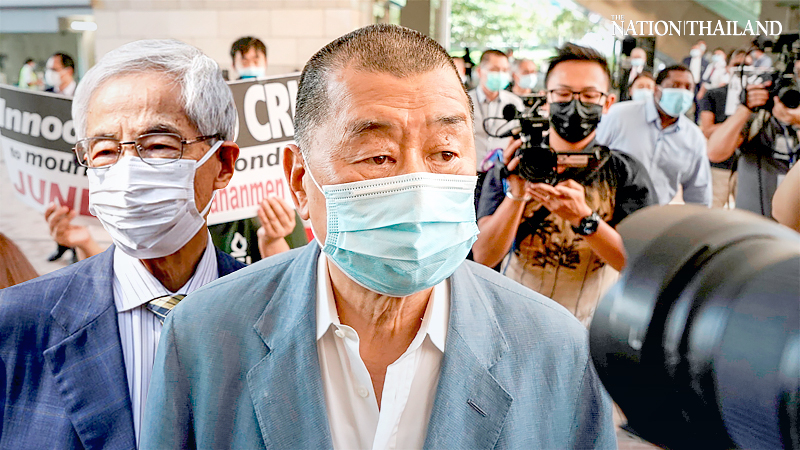
Hong Kong’s “father of democracy” Martin Lee and media mogul Jimmy Lai were among a group of opposition activists found guilty for attending an unauthorized protest in 2019, in the latest blow to the city’s beleaguered opposition.

Lee, 82, who helped lead the pro-democracy camp during the former British colony’s transition to Chinese rule, was convicted Thursday in a court in the West Kowloon area along with fellow activists Albert Ho, Leung “Long Hair” Kwok-hung, Lee Cheuk-yan, Cyd Ho and Margaret Ng. The court set sentencing for April 16.

“We are very disappointed with the verdict because what we have done is only exercising our constitutional rights,” Lee Cheuk-yan said outside the courtroom. “But it’s a badge of honor for us that we are convicted for walking together with the people of Hong Kong for democracy and freedom.”

Martin Lee declined to comment on the verdict. Diplomats from the European Union, Germany, Sweden, Canada, Australia and New Zealand attended the hearing.

The court case is the latest in a series of major setbacks in recent weeks for Hong Kong’s pro-democracy camp. The group on trial comprised veteran activists who have for years supported causes such as human rights and women’s rights, and organized vigils commemorating the 1989 crackdown on student demonstrators in Tiananmen Square.

The decision comes shortly after top Chinese lawmakers approved a sweeping plan that effectively ends open elections in Hong Kong. The city’s government separately charged some 47 prominent opposition figures with “conspiracy to commit subversion” under a national security law imposed last year that carries sentences as long as life in prison.

Martin Lee was among 15 prominent democracy activists accused last year of participating in a historic — but unauthorized — march on Aug. 18, 2019. The mostly peaceful demonstration was one of the biggest held during months of unrest over proposed extradition legislation, with an estimated 1.7 million people attending.

The case is part of a push to disband Hong Kong’s democratic institutions and clamp down on the opposition’s moderate wing, according to Michael Davis, a professor of law and international affairs at O.P. Jindal Global University in India and a former law professor at the University of Hong Kong.

“The government has chosen 15 people very carefully out of the 1.7 million protesters, and all are moderate democratic activists and politicians,” Davis said. “It’s very hard to separate this trial from the current effort to prevent participation in the political process.”

Hong Kong police have swept up many of the city’s established opposition leaders among the more than 10,000 activists arrested since the protests erupted in June 2019. Some, such as Jimmy Lai, face multiple prosecutions, including charges under the national security law.

Two former opposition lawmakers, Au Nok-hin and Leung Yiu-chung, had previously pleaded guilty to charges related to the August 2019 protest. Six other people are expected to go on trial over the demonstration later this year.

Martin Lee, a London-trained lawyer, has stoked Beijing’s ire for more than three decades, dating back to his support for the Tiananmen Square protests and subsequent defeat of the pro-establishment camp in Hong Kong’s first direct legislative elections. He sat on the committee that drafted Hong Kong’s post-handover charter, founded the Democratic Party and served as a lawmaker until his retirement in 2008.

Chinese authorities have accused him of being a “traitor” for testifying before the U.S. Congress, and in August 2019 labeled him as part of a “New Gang of Four” in a publication under the Communist Party’s top legal body. The piece also named Lai and Ho, a former Democratic Party leader and chief executive candidate, as members of the “gang” — a reference to a Communist Party faction jailed for attempting to seize power after Mao Zedong’s death in 1976.

Nonetheless, Martin Lee had avoided arrest until last year. In an op-ed published in the Washington Post last year, he described his arrest as “part of a large plan” to snuff out dissent in Hong Kong.

“But once Hong Kong’s human rights and rule of law are rolled back, the fatal virus of authoritarian rule will be here to stay,” he said.

The Suez Canal ship is free, but the shipping industry’s ‘humanitarian crisis’ isn’t over #SootinClaimon.Com

#SootinClaimon.Com : ขอบคุณแหล่งข้อมูล : หนังสือพิมพ์ The Nation.

https://www.nationthailand.com/news/30404418

The Suez Canal ship is free, but the shipping industry’s ‘humanitarian crisis’ isn’t over

InternationalApr 02. 2021

By The Washington Post · Antonia Noori Farzan

For nearly a week, the world was fixated on the spectacle of a mammoth cargo carrier blocking the Suez Canal, causing billions of dollars of damage to the global economy with every passing day.

It was a surreal experience for advocates who have spent the past year trying to draw attention to the hundreds of thousands of mariners who are stranded on container ships because of the pandemic, creating what has been described as a “humanitarian crisis at sea.” While more than 90% of goods used worldwide are transported by ship, few consumers stop to think about the lengthy ocean voyage involved, or the plight of seafarers who go months or years without seeing their families to make that possible.

The crisis in the canal forced the world’s attention on ships that despite their massive size are often all but invisible, suddenly making plain the extent to which global trade relies on vessels such as the Ever Given and their crews, who predominantly come from developing nations.

“Hero is a strong word, but they really have kept society moving for the past 13 months,” said Stephen Cotton, the general secretary of the International Transport Workers’ Federation, which represents seafarers worldwide.

For many of the seafarers who found themselves stuck in the Suez Canal last week, the delays were a new source of stress that added to what has already been a difficult year. When countries closed their borders to prevent the spread of the coronavirus in March 2020, hundreds of thousands of workers at sea were left stranded, unable to return home or set foot on shore when their ships arrived in port. Under international labor standards, crews are required to rotate off ships every 11 months to avoid burnout, but many long ago hit that milestone and still have no idea when they might be able to disembark.

“Seafarers must not be forgotten as soon as this incident is over,” the United Kingdom-based International Chamber of Shipping said in a Monday statement after the Ever Given was freed.

About 200,000 mariners worldwide are either unable to leave their ships or travel to ports to relieve crew members who have exceeded their contracts, according to the organization.

That has added new strain to what was already a taxing job: Seafarers must work long shifts, often staying up overnight to keep watch, while bunking in cramped quarters and having little to no contact with the outside world. In September, the Consumer Goods Forum pleaded with the United Nations for help, warning that well-intentioned travel restrictions had “inadvertently created a modern form of forced labour.”

Advocates for mariners have warned that crew fatigue is a safety issue, and that seafarers’ mental health is suffering. The International Seafarers’ Welfare and Assistance Network found that the number of reported suicides among seafarers roughly doubled over the past year; it said the true extent of the problem may be vastly understated.

“When someone goes overboard, there is always a question mark: Was it suicide or was it an accident?” executive director Robert Harris told Lloyd’s List last month. “I’ve been told by at least two shipping companies that sometimes it is suspected as suicide, but it is reported as ‘missing at sea’ because the family wouldn’t get a payout from the protection and indemnity club.”

It is not clear whether crew exhaustion was a factor in the grounding of the Ever Given. The International Transport Workers’ Federation has determined that the 25 crew members – all Indian nationals – were not yet over-contract, and that all had been onboard for less than six months.

Still, the organization has called for an investigation that will examine whether larger systemic issues in the industry, such as crew fatigue, played a role. “We always worry that it’s very easy to blame seafarer error,” Cotton told The Washington Post. Rather than single out a culprit, “we want to understand what happened so we can make sure it doesn’t happen again.”

Abdulgani Serang, the general secretary for National Union of Seafarers of India, wrote on social media Saturday that he had been in touch with the crew, who he described as “fine but stressed out.”

The shipping industry uses the term “sea blindness” to describe the general public’s lack of awareness about the critical role seafarers and ocean networks play in global commerce. While the United Nations has designated ship crews as essential workers and urged other governments to do the same, that designation has led to little change, and many mariners still have no idea when they might be able to take a break or return home, more than a year into the pandemic.

Meanwhile, as coronavirus vaccines become available worldwide, people working at sea do not have ready access to vaccination clinics or medical facilities. More than half the shipping industry’s workforce comes from developing nations, where vaccines are in short supply, Guy Platten, the secretary general for the United Kingdom-based International Chamber of Shipping, told The Washington Post on Friday.

Such logistical challenges will continue to be an issue long after the traffic jam in the Suez Canal is unsnarled. Hopefully, Platten said, one takeaway of the Ever Given saga is that consumers will be more aware of the lengthy and arduous voyage that products take to get to their door, and “think about the seafarers who deliver those goods that we all take for granted.”

‘Chargers everywhere’: Biden maps $174 billion path for EV boom #SootinClaimon.Com

#SootinClaimon.Com : ขอบคุณแหล่งข้อมูล : หนังสือพิมพ์ The Nation.

https://www.nationthailand.com/news/30404416

‘Chargers everywhere’: Biden maps $174 billion path for EV boom

InternationalApr 02. 2021A Tesla Inc. vehicle charges at a charging station in San Mateo, Calif., on Sept. 22, 2020. MUST CREDIT: Bloomberg photo by David Paul MorrisA Tesla Inc. vehicle charges at a charging station in San Mateo, Calif., on Sept. 22, 2020. MUST CREDIT: Bloomberg photo by David Paul Morris

By Syndication Washington Post, Bloomberg · Keith Laing, Ari Natter

The U.S. auto industry sees President Joe Biden’s infrastructure package as accelerating a global shift toward electric vehicles, thanks to the $174 billion proposed for charging stations, planned consumer rebates for American-made EVs and a pledge to electrify the government’s fleet.

The proposal, which requires congressional approval, is likely to be targeted by progressives as too little in scope and by Republicans as unfairly using taxpayer funds to help the alternative energy sector while harming others, such as the oil industry. Market researchers, oil-energy advocates and other critics warn that it may not be enough to make a dent in the sale of gas guzzlers in the U.S. any time soon.

“The numbers tell the current story,” Michelle Krebs, executive analyst at Cox Automotive, which conducts market research for auto dealers. EVs made up only 2% of new car sales in 2020, while SUVs and pickup trucks comprised about 70%. “However, we know there is interest in EVs. Our consumer survey on upcoming EV pickup trucks showed interest, especially among young buyers.”

Biden’s plan directs $174 billion to electric vehicles, including sale rebates and tax credits for consumers to buy American-made cars, in addition to industry incentives. The centerpiece of the plan made public Wednesday is to help build a national network of half a million charging stations through grants to state and local governments and the private sector.

“Efforts that incentivize wider-scale EV adoption, build out the necessary infrastructure, and facilitate consumer awareness are essential components to EV market expansion,” said John Bozzella, president and chief executive officer of the Alliance for Automotive Innovation, a trade association that represents major automakers such as Ford Motor Co., General Motors Co., Stellantis NV, Honda Motor Co. and Toyota Motor Corp.

Installing charging stations nationwide is something industry and environmental groups regard as essential to increase the adoption of electric vehicles by consumers worried about getting stranded on a long road trip in an electric car.

“Seeing chargers everywhere will make consumers feel comfortable purchasing electric vehicles,” Katherine Garcia, deputy director of the Sierra Club’s Clean Transportation for All program, said in an interview.

The 500,000 charging stations is “of critical importance,” said Genevieve Cullen, president of the Electric Drive Transportation Association, which represents companies that stand to benefit from the move such as GM, the utility CenterPoint Energy Inc., and the electric vehicle charging network EVgo Services LLC. “It’s the right start.”

The plan to wean American motorists off gas-powered automobiles is part of a broader $2.25 trillion infrastructure blueprint that also calls for sweeping spending to achieve the White House’s climate goals — such as net-zero emissions in the U.S. by 2050. It also comes in stark contrast to former President Donald Trump, who rolled-back fuel economy requirements put in place by his predecessor and called for an end to a key EV consumer tax credit seen as helping to launch the industry.

“The combination of a Biden administration and a blue Senate sets the stage for a green tidal wave in the U.S. to kick off, with electric vehicles the centerpiece,” said Dan Ives, a senior equity research analyst at Wedbush Securities wrote in a research note Wednesday. “For the EV sector, the Street has been awaiting this day since Biden was elected.”

Shares of EV makers may get a fresh lease on life from Biden’s plan. EV stocks had rallied hard last year, partly in anticipation of more favorable industry policies after the election, but the intense investor enthusiasm had started showing signs of strain this year, as sentiment toward risky, high-multiple stocks soured amid a rise in Treasury yields.

EV stocks gained in trading Thursday. Tesla Inc. rose more than 3% while smaller companies that typically take their trading cues from Tesla rose, too, with Workhorse Group Inc., Lordstown Motors Corp., Nikola Corp., Nio Inc., XPeng Inc. and Fisker Inc. all higher.

Some critics of Biden’s plan questioned whether the scope will even come close to what is needed to shift consumers from gas-powered vehicles.

The 500,000 charging stations “wouldn’t even amount to 50% of what is needed in California alone,” said Tom Pyle, a former Trump adviser and the president of the American Energy Alliance, a free-market advocacy group. “The notion it would be built in the U.S. with union paying jobs is also a fantasy when you consider the entire supply chain is based in China.”

“It’s a pipe dream built on a foundation of lies,” Pyle said.

Biden also called for the electrification of the federal government’s entire fleet of more than 600,000 vehicles — including the U.S. Postal Service, which recently earned scorn of environmentalists and Democratic lawmakers for selecting the military and emergency truck maker Oshkosh Corp. for part of a $6 billion contract for more than 100,000 mail-delivery vans over Workhorse Group.

“It forces the U.S. Postal Service in the game,” said Scott Sklar, director of sustainable energy at George Washington University’s Environment & Energy Management Institute. “The U.S. government is a huge customer so that could propel the U.S. EV industry into a world leadership position vis-a-vis China.”

Congress in the coming months is expected to put its own flourishes on the final package — which House Speaker Nancy Pelosi, D-Calif., said she wants to see completed by July 4.

Among likely candidates for inclusion is a $454 billion plan to remove gas-power vehicles on the road by 2040, a measure championed by Senate Majority Leader Chuck Schumer, as well as the expansion of an existing $7,500 consumer tax credit for the purchase of electric vehicles.

Sen. Debbie Stabenow and Rep. Dan Kildee, both Michigan Democrats, are working with the White House and Democratic leadership on a plan to do away with an existing 200,000-vehicle per manufacturer cap on the tax credit. Among possible tweaks to the credit are making it refundable and targeting it better toward middle and lower-income motorists.

U.S. jobless claims rise as labor market recovery remains choppy #SootinClaimon.Com

#SootinClaimon.Com : ขอบคุณแหล่งข้อมูล : หนังสือพิมพ์ The Nation.

https://www.nationthailand.com/news/30404415

U.S. jobless claims rise as labor market recovery remains choppy

InternationalApr 02. 2021

By Syndication Washington Post, Bloomberg · Reade Pickert

Applications for U.S. state unemployment insurance unexpectedly rose last week but remained near the lowest levels of the pandemic as the labor market meanders toward full recovery.

Initial jobless claims in regular state programs increased to 719,000 in the week ended March 27, up 61,000 from the prior week, Labor Department data showed Thursday. Economists in a Bloomberg survey estimated 675,000 claims. The prior week’s figure was revised down to 658,000, which is below the Great Recession’s peak.

The unexpected increase in claims underscores the choppy nature of the labor market recovery and indicates it will take time to recoup the millions of the jobs lost because of the pandemic. However, vaccinations are increasing and business restrictions are easing, suggesting employment will accelerate in the coming months.

Virginia, Kentucky and Georgia led states with the biggest increases in unadjusted claims from the prior week. The data have been volatile during the pandemic amid backlogs, fraud and new programs.

The figures come a day before the monthly employment report. The median forecast of economists in a Bloomberg survey calls for a 650,000 gain in payrolls in March, the most in five months, and some economists are expecting an increase of 1 million.

Historical revisions to initial and continuing claims for 2016-2020 were also released Thursday. The pandemic peak was revised down to 6.149 million initial jobless claims in regular state programs from 6.867 million.

Continuing claims — an approximation of the number of people filing for ongoing state benefits — fell to 3.79 million in the week ended March 20. To some extent, the decline in that figure reflects an improvement in the labor market, but millions of Americans have also exhausted those benefits and moved to federal programs

Continued weeks claimed for the federal pandemic program that extends the duration of unemployment benefits, known as Pandemic Emergency Unemployment Compensation, fell to 5.52 million in the week ended March 13. This program was extended into September in the $1.9 trillion relief package passed last month

Applications for Pandemic Unemployment Assistance — which was also recently extended by Congress and provides benefits to those not traditionally eligible — totaled 237,025 last week

Russia unveils world’s first coronavirus vaccine for dogs, cats and other animals #SootinClaimon.Com

#SootinClaimon.Com : ขอบคุณแหล่งข้อมูล : หนังสือพิมพ์ The Nation.

https://www.nationthailand.com/news/30404377

Russia unveils world’s first coronavirus vaccine for dogs, cats and other animals

InternationalApr 01. 2021

By The Washington Post · Miriam Berger

Russia has registered the world’s first coronavirus vaccine for dogs, cats, minks, foxes and other animals, the country’s agriculture safety watchdog said Wednesday.

Called Carnivak-Cov, the vaccine was developed by scientists at the Federal Service for Veterinary and Phytosanitary Surveillance, also known as Rosselkhoznadzor, Russia’s Tass News Agency said.

While many scientists say the virus causing covid-19 initially jumped from bats to humans, perhaps through another intermediary, infections have since been reported worldwide in animals, from zoos to mink farms.

It remains unclear how easily the virus can move between animals and humans. But after repeated outbreaks among minks at farms in Denmark and elsewhere in Europe, millions of the furry animals were killed precautionarily to cut any further transmission. Scientists have been particularly worried about mutated variants of the virus developing in minks and other animals going on to infect humans.

Russia has already approved three coronavirus vaccines for use in humans on an emergency basis. Rosselkhoznadzor deputy head Konstantin Savenkov said Wednesday that this would be the world’s first authorized for widespread animal inoculations.

The vaccine could be mass produced as soon as April, although the agency did not say when it would be on the market.

“Carnivak-Cov, a sorbate inactivated vaccine against the coronavirus infection . . . is the world’s first and only product for preventing covid-19 in animals,” Savenkov told Tass News.

Two U.S. companies, New Jersey-based veterinary pharmaceutical company Zoetis and the North Dakota-based Medgene Labs, have also been developing coronavirus vaccines for use among minks and other animals.

Scientists in Russia launched clinical trials in October and tested the vaccine on dogs, cats, foxes, including Arctic foxes, and minks, among other animals. Mass production of the vaccine could begin in April, according to Savenkov.

“The outcome of the research gives us grounds to conclude that the vaccine is safe and has strong immunogenic effect,” Savenkov said.

The vaccine is expected to produce antibody resistance that lasts at least six months.

Savenkov told Tass News that “domestic animal-breeding enterprises and commercial firms from Greece, Poland and Austria” are planning to purchase the vaccine, while companies from the United States, Canada and Singapore, among others, have expressed interest in it.

Russia’s coronavirus vaccine for humans have so far not been approved for use in the United States or Europe.

Earlier this year Zoetis’s vaccine was administered on a trial-basis to nine infected apes at a San Diego zoo. They have since recovered.

Jailed Russian opposition leader Navalny declares hunger strike #SootinClaimon.Com

#SootinClaimon.Com : ขอบคุณแหล่งข้อมูล : หนังสือพิมพ์ The Nation.

https://www.nationthailand.com/news/30404376

Jailed Russian opposition leader Navalny declares hunger strike

InternationalApr 01. 2021Alexei NavalnyAlexei Navalny

By The Washington Post · Robyn Dixon

MOSCOW – Jailed Russian opposition leader Alexei Navalny declared a hunger strike on Wednesday after unsuccessful attempts to get medical care for severe back pain, according to an Instagram post in his name.

Navalny survived an August assassination attempt with a chemical weapon that the U.S. State Department blames on Russian security agencies, but he was jailed when he flew back to Russia in January after treatment in Germany.

He was sentenced to 21/2 years in prison for breaching parole conditions in a 2014 fraud case, partly because he failed to report to authorities while under treatment in Germany.

Navalny last week requested painkilling injections for back pain and a right leg so numb that he says it barely supports his weight.

“I have the right to call a doctor and get medicine. Neither of which I am given, stupidly,” the Wednesday post said. It said the numbness was moving to his left leg.

The Kremlin has declined to comment on Navalny’s complaints, calling it a matter for prison authorities.

The post said he was lying in his cell on his bed on a hunger strike, in what he called a major violation of prison rules. He was reading the Bible, the only book made available to him in prison.

The post said was also being “tortured by sleep deprivation,” woken up eight times every night by a guard shining a torch in his face to supposedly ensure he has not absconded.

“Why do prisoners go on hunger strikes? This question worries only those who have not been prisoners. From outside, everything looks complicated. But from the inside, it’s simple: You don’t have any other methods of struggle, so you go on a hunger strike,” the post said. Navalny is denied Internet access, and his team has not indicated how the posts in his name are made, but he meets regularly with his attorneys.

The post said other prisoners were afraid and told him that “the life of a convict is worth less than a pack of cigarettes.”

Navalny is serving his term in Penal Colony No. 2, a notorious prison that former inmates claim uses constant psychological pressure to “break” inmates.

Vyacheslav Kulikov, a member of a commission that monitors prisoners’ conditions, said Monday that monitors visited Navalny and recorded his requests for painkilling injections.

However Vladimir Grigoryan a member of the monitoring commission from Vladimir, around 111 miles east of Moscow, the nearest large town to Penal Colony Number 2, told independent Dozhd TV that “Navalny is just faking it so don’t worry about him.”

Grigoryan who worked in the prison system for 30 years said prisoners like Navalny demanded medicines that ordinary Russians could not get.

Earlier this week, Navalny posted a photograph of himself in prison, with head shaven, and reported that he had received six reprimands in two weeks for rule violations such as getting up 10 minutes too early or going to meet his attorney wearing a T-shirt. “I’m not kidding,” ran a post in his name Monday describing the reprimands.

“It seems the song ‘Bad Guy’ is the soundtrack of my prison sentence,” Monday’s post ran. After two reprimands, prisoners are sent to the punishment cell, where conditions were “close to torture,” he said.

Being reprimanded beneath a portrait of President Vladimir Putin on the wall reminded him of being a schoolboy and getting in trouble, he said in Monday’s post.

Russian authorities rounded up key members of Navalny’s team in January and placed them under house arrest. But Ivan Zhdanov, direction of Navalny’s Anti-Corruption Foundation is outside Russia. His father Yuri Zhdanov was arrested and placed in detention Friday. Ivan Zhdanov said his father’s arrest was political and aimed at himself. He called the case “an entirely new level of baseness and meanness from the presidential administration.

“I won’t hide it. For me this is the worst thing that could happen.”

Navalny’s team is collecting the names of people willing to join street protests this spring, and recording the numbers in an online map. Once 500,000 people join, they say a protest will be held. So far nearly 360,00 people have signed up.

What’s in Biden’s $2.25 trillion infrastructure and tax proposal #SootinClaimon.Com

#SootinClaimon.Com : ขอบคุณแหล่งข้อมูล : หนังสือพิมพ์ The Nation.

https://www.nationthailand.com/news/30404370

What’s in Biden’s $2.25 trillion infrastructure and tax proposal

InternationalApr 01. 2021Contractors work on a portion of Van Ness Boulevard under construction in San Francisco on March 22, 2021. MUST CREDIT: Bloomberg photo by David Paul Morris.Contractors work on a portion of Van Ness Boulevard under construction in San Francisco on March 22, 2021. MUST CREDIT: Bloomberg photo by David Paul Morris.

By Syndication Washington Post, Bloomberg · Laura Davison

President Joe Biden released a sweeping plan to pump money into transportation, renewable energy, manufacturing and efforts to combat climate change — funded by undoing some of the tax breaks that corporations received during the Trump administration.

The $2.25 trillion, eight-year proposal is a follow-up to the $1.9 trillion economic relief bill passed earlier this month. To cover the costs, Biden wants to raise corporate taxes to 28% from 21%. The plan also seeks a minimum tax on profits U.S. corporations earn overseas, increasing the rate to 21% from roughly 13%.

The White House plans a second major package, which could cost $1 trillion or more, later in April to focus on social measures, including expanding health care and paid-leave access and extending the child tax credit –offset by tax increases on wealthy individuals.

Biden will offer his opening argument for the first phase of spending Wednesday in Pittsburgh. Here’re some of the key elements in the plan:

–Transportation

The plan provides $620 billion for transportation. That includes $115 billion to improve bridges, highways, roads and $20 billion for road safety, which will upgrade 20,000 miles of roads and highways. There’s $85 billion to modernize public transportation systems and $80 billion for Amtrak. The plan provides $25 billion for airports and $17 billion for ports, inland waterways and ferries. Biden is also calling for $20 billion for transportation projects for disadvantaged communities.

–Electric Vehicles

The transportation funding would specifically direct $174 billion to electric vehicles, including sale rebates and tax incentives for consumers to buy American-made cars. It also would provide grants to state and local governments and the private sector for 500,000 charging stations by 2030. It includes funds to electrify school buses and federal vehicles such as Postal Service trucks.

–Research and Development

Biden is calling for $180 billion to upgrade the country’s research infrastructure and labs at universities and federal agencies. The funding would also be directed toward climate-science research and addressing gender and racial inequalities in the science, math and technology fields.

–Manufacturing Boost

A $300 billion initiative to boost American manufacturing incorporates a number of bipartisan initiatives that Senate Majority Leader Chuck Schumer had planned to move in a broader China bill this spring. Biden will call on Congress to invest $50 billion in semiconductor manufacturing and research — as envisioned by the CHIPS Act. There’s also $50 billion for the National Science Foundation to create a technology directorate, modeled after the Endless Frontiers Act.

In addition, he is asking for $50 billion to create a new office at the Department of Commerce dedicated to monitoring domestic industrial capacity and funding investments to support production of critical goods.

–Workforce Development

Biden is proposing $100 billion for workforce-development programs, including training for those who have lost their jobs, as well as apprenticeship initiatives.

–Electric Grid

Biden is offering $100 billion to build a more resilient electric grid. He is also proposing a 10-year extension and phase-down of an expanded, refundable investment tax credit and production tax credit for renewable energy generation and storage.

The plan calls for high labor standards and allowing workers on the projects to join unions and bargain collectively. The goal is to move toward 100% carbon-pollution free power by 2035. The plan also directs $16 billion to clean up abandoned mines and gas wells.

–Carbon Capture

The plan would create 10 carbon-capture facilities retrofitted in large steel, cement and chemical production facilities. It expands the bipartisan Section 45Q tax credit for carbon capture, making it refundable and easier to claim. Another $10 billion would be spent on a Civilian Climate Corps that employs Americans in conservation work on public lands and waters.

–Clean Water

The plan includes $45 billion to eliminate lead pipes nationwide. It also calls for $56 billion in grants and low-cost loans to states, tribes, territories and disadvantaged communities to improve water systems and $10 billion to bolster rural-well and waste-water systems.

–Broadband Internet

Biden is proposing $100 billion to bring high-speed broadband internet to all Americans. The plan also includes measures to make pricing more transparent and competitive and includes short-term subsidies for low-income households.

–Housing

The proposal would provide $213 billion to build and renovate more than than two million affordable homes. The plan includes tax credits to build housing for low-income families and $40 billion for public housing.

–Schools, Child Care

The plan includes $100 billion to improve public school buildings, with $50 billion in direct grants and an additional $50 billion leveraged through bonds. The plan also calls for $12 billion for community-college facilities and technology and $25 billion to upgrade child-care facilities and provide incentives for employers to offer on-site child care.

–Elder Care, VA Hospitals

Biden is asking Congress to approve $400 billion for housing and care for the elderly and people with disabilities. He is also proposing $18 billion for the modernization of Veterans Affairs hospitals and clinics.

–Corporate Tax Hikes

The plan would raise the corporate tax levy to 28% from 21%, increasing the rate established in President Donald Trump’s tax law. The plan would also institute a 15% minimum tax on a corporation’s profits for financial-reporting purposes. This would prevent companies from racking up tax breaks to whittle down their tax bill to nothing.

–International Taxes

The plan would also impose a minimum tax on the profits U.S. corporations earn overseas, increasing the rate to 21% from the roughly 13%. It also includes several measures that would penalize companies that move assets and jobs offshore and eliminates current preferences to book profits overseas.

–Eliminate Oil, Gas Tax Breaks

The plan would eliminate all tax preferences for the oil and gas industry and would also require companies that pollute to pay into the Superfund Trust Fund to cover the cost of fuel-related cleanup.

–IRS Audits

The plan calls for additional funding for the Internal Revenue Service to increase audits on corporations. The White House says it will release additional details about tax examinations on individuals in the coming weeks.

NY man arrested after attacking Asian woman in broad daylight #SootinClaimon.Com

#SootinClaimon.Com : ขอบคุณแหล่งข้อมูล : หนังสือพิมพ์ The Nation.

https://www.nationthailand.com/news/30404369

NY man arrested after attacking Asian woman in broad daylight

InternationalApr 01. 2021

By Syndication Washington Post, Bloomberg · Shelly Banjo

The New York Police Department has arrested a man in connection with a suspected hate crime against a 65-year-old Asian woman outside a Midtown Manhattan luxury apartment. The man in the incident was captured on video kicking the woman to the ground and then stomping on her in broad daylight Monday, while shouting “you don’t belong here.”

Brandon Elliot, 38, a parolee out on supervised release, was charged with felony assault as a hate crime early Wednesday, according to Police Commissioner Dermot Shea.

On Tuesday New York Mayor Bill de Blasio called the crime “disgusting” and vowed to bring the perpetrator to justice.

“I’m very frustrated by these attacks,” de Blasio said during a press briefing Tuesday. “I know a huge effort is being expended to educate, to get people involved in the solution, to find the perpetrators, to bring them to justice.”

A surveillance video, released by the police Tuesday, showed a man kick the woman outside an apartment building at 360 W. 43rd Street while the building’s security guards looked on but didn’t intervene. One guard then shut the door.

The Brodsky Organization, which manages the luxury Manhattan apartment building, said staff who saw the attacks were suspended “pending an investigation in conjunction with their union,” according to a statement Tuesday. “The Brodsky Organization condemns all forms of discrimination, racism, xenophobia and violence against the Asian American community.”

The victim of the attack, a Filipino immigrant, remains in the hospital recovering from a fractured pelvis, according to The New York Times.

The attack comes as the city’s hate crimes task force is reporting an increase in attacks and racially charged violence against Asian New Yorkers they said increased during the pandemic when U.S. political leaders insisted on referring to the coronavirus as the “Chinese flu.”

The incidents have led to protests by Asian-American leaders and community activists in New York and globally, as they respond to an outbreak of violence that includes a March 16 shooting in the Atlanta metropolitan area where eight people died, including six women of Asian descent.

President Joe Biden on Tuesday announced plans to address the hate crimes against the Asian-American community, including increasing access to hate crime data and requiring new training for local police.

U.S. Attorney General Merrick Garland on Tuesday directed Justice Department employees to give priority to investigating and prosecuting hate crimes and incidents, noting “the disturbing trend in reports of violence against members of the Asian American and Pacific Islander community,” according to a memo to department employees.

Garland, who became the nation’s top law enforcement officer almost three weeks ago, ordered a review to be completed in a month to determine specific steps that can be taken to better combat hate crimes.

“We must recommit ourselves to this urgent task and ensure that the department makes the best and most effective use of its resources to combat hate,” Garland wrote.

Read More: Asian-American Groups Grapple With Police Response to Violence

Stop AAPI Hate identified nearly 3,800 anti-Asian incidents since last March, 6.2% of which were targeted at people over 60 years old and an overwhelming 68% at women.

“It’s disgusting and outrageous,” de Blasio said, of the video. “But then to see a security guard standing nearby and not intervening, it’s absolutely unacceptable. Look, I don’t care who you are. I don’t care what you do, you’ve got to help your fellow New Yorker.”