Players and coaches continued Friday to call attention to the wide disparities between the men’s and women’s NCAA basketball tournaments, prompting widespread condemnation of the NCAA and calls for an independent investigation into the situation inside the women’s bubble.
It started with a pair of images shared online: the single dumbbell rack and stack of yoga mats that served as training equipment for women’s players inside the NCAA’s San Antonio tournament bubble, and the massive, state-of-the-art weight facility that had been custom-built for men’s players competing at sites in Indiana.
In addition to complaints of subpar facilities, meals, and player gifts, college officials revealed that women’s team players were being administered a different, less accurate coronavirus test than players in the men’s bubble.
The NCAA’s reassurances that it would work to fix the problem, improving facilities for the women’s teams, did little to quell anger and frustration from college coaches and administrators, as well as prominent professional basketball players who spoke up online.
On Friday, the NCAA’s Committee on Women’s Athletics, a collection of college presidents, administrators, and players, demanded an independent investigation into the disparities in a letter to Mark Emmert, the organization’s president.
The letter said the disparate treatment inside the bubbles “sets back women’s college athletics across the country.”
The stark difference in the treatment of players in the two tournaments touched a nerve for many people at a time of increasing awareness over issues of equity in women’s sports. In a tweet Thursday, Las Vegas Aces star A’ja Wilson called the women’s tournament facilities “beyond disrespectful.”
Other prominent athletes, including the NBA’s Stephen Curry and U.S. women’s soccer star Alex Morgan, also criticized the NCAA online.
NCAA officials acknowledged what they called a “blemish” in their tournament efforts.
“We fell short this year in what we’ve been doing to prepare,” Lynn Holzman, the NCAA’s vice president of women’s basketball, told journalists Friday. She said the NCAA was “actively working” on improving the women’s facilities, including exercise facilities and food.
An NCAA spokesperson told The Washington Post that officials initially thought there was not enough square footage for a weight training facilities at the convention center playing host to the women’s tournament. They later found the space, the spokesperson said.
But coaches and others inside the women’s bubble questioned the NCAA’s claim that space issues had prevented the organization from building a comparable facility for women and men. The rack of dumbbells that served as the women’s sole weight training equipment was located in an enormous and empty part of the convention center, according to several videos posted online.
Geno Auriemma, coach of the Connecticut women’s team, told reporters at a news conference Friday that his team was receiving different coronavirus tests than men’s teams. The rapid antigen tests given to women are faster than PCR tests given to men, but “have a higher chance of missing an active infection,” according to the Food and Drug Administration.
In a statement, the NCAA said that its medical advisory group had determined that both tests were “were equally effective models for basketball championships,” and that it had worked with local providers and officials in San Antonio and Indianapolis to create the testing regimens.
Critics also pointed to images of the “swag bags” provided to players at both tournaments, which showed that the men had been given a large number of items custom-designed for this year’s March Madness tournament in Indianapolis, while the women’s bag included only a few generic items, including a 150-piece puzzle and a towel that said “NCAA women’s basketball.”
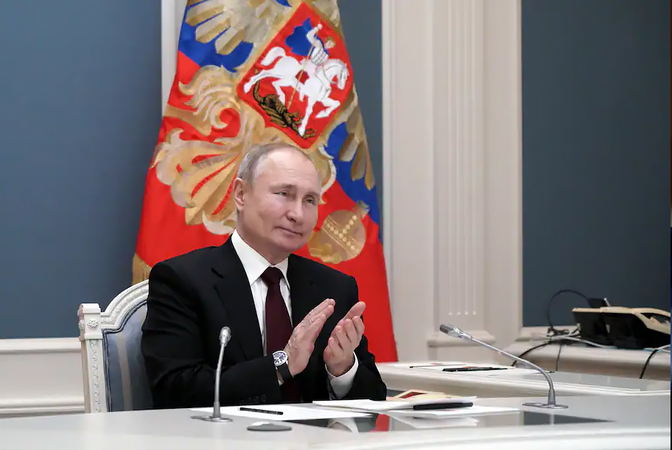
MOSCOW – Responding to President Joe Biden’s comments that he thinks Russia’s president is a killer, Vladimir Putin suggested Thursday that the U.S. leader is projecting his own flaws and wished his American counterpart “good health.”
“I say that without irony and not as a joke,” Putin said.
Biden’s remarks in an ABC News interview broadcast Wednesday prompted the Kremlin to summon its ambassador to the United States back to Moscow to discuss how to proceed with the “very bad” relations between the two countries.
Putin spokesman Dmitry Peskov also seemed to imply that they could get worse, warning Thursday that Russia’s response to Biden’s remarks will be “absolutely clear.” He didn’t elaborate.
“It’s clear that [Biden] doesn’t want to normalize relations with our country. This is what we’ll be guided by from now on,” Peskov said.
The Biden administration has imposed sanctions on Russia over the poisoning of opposition leader Alexei Navalny in August. Navalny has said Putin is responsible for nearly killing him; the Kremlin has denied it has any connection to the toxic attack. After recovering in Germany for five months, Navalny returned to Russia in January and was immediately jailed.
When asked by ABC News if he believes Putin is a killer, Biden answered, “I do.” Biden also described Putin as having no soul, adding that he would “pay a price” for allegedly meddling in the 2020 U.S. presidential election, something the Kremlin denies.
Moscow then took the unusual move of temporarily recalling its ambassador to the United States, Anatoly Antonov, in what’s believed to be the first such instance in more than 20 years.
Antonov is leaving Washington for Moscow on Saturday, the Russian embassy said, adding that his trip is “to discuss ways to rectify Russia-U.S. ties that are in crisis.”
“The current situation is a result of the deliberate policy of Washington that during the past years was making steps to bring – in essence, intentionally – our bilateral interaction into a deadlock,” the embassy said in a statement.
Peskov, the Kremlin spokesman, declined to comment when asked if diplomatic relations between the countries could be severed entirely.
In his first comments on Biden’s interview, Putin responded Thursday with a Russian schoolyard expression suggesting that Biden’s accusations revealed more about him than the Russian president. The phrase can be roughly translated as, “I know you are, but what am I?”
Speaking on a video call with residents of Crimea marking the anniversary of its 2014 annexation from Ukraine, Putin pointed to the United States’ history of killing Native Americans and slavery.
“Each nation and every state has very hard, dramatic, and bloody events in their history. But when we assess other people or even when we assess other states and other nations, we always sort of look in the mirror, and we always see ourselves there. Because we always attribute to other people that which we breathe ourselves and what we essentially are,” Putin said.
Russian government officials have reacted angrily to Biden’s remarks. Konstantin Kosachev, a deputy speaker of the Russian parliament’s upper house, said in a Facebook post that Biden’s “gross statement sends any expectations for the new U.S. administration’s policy toward Russia down the drain.”
“Recalling the Russian ambassador from Washington to Moscow for consultations is a prompt and adequate reaction, the only correct one in this situation. I suspect that it won’t be the last one if the American side doesn’t offer explanations and apologies,” he added.
Foreign Ministry spokeswoman Maria Zakharova told Russian state television on Thursday that Moscow expects an explanation for Biden’s comments.
“Why do we always have to translate their strange, unintelligible political gibberish into normal speech?” she said.
WASHINGTON – Over the past few months, the Federal Reserve has joined an international group of central banks focused on climate risk, pointed to climate change a threat to financial stability and established its Supervision Climate Committee.
The Fed’s increasing focus on how climate change can threaten the financial system is garnering praise from Democrats and scorn from Republicans, who say the Fed should stick with helping lower America’s unemployment rate and keep prices stable.
On Thursday, Republicans on the Senate Banking Committee told Fed Chair Jerome Powell in a letter that they were concerned the Fed might use its supervision of the banking system to “further environmental policy objectives,” which “would be beyond the scope of the Federal Reserve’s mission.”
Led by Sen. Patrick Toomey, R-Pa., the lawmakers wrote that the Fed lacks “jurisdiction over and expertise in environmental matters,” questioning whether it had the authority to police climate risks.
In a statement, a Fed spokesperson said the central bank had received the letter and plans to respond. Powell, for his part, has said many financial institutions are already focusing on how climate change will affect their business models over time. The Fed’s attention to these issues is a natural outgrowth of the central bank’s job, he says.
“We’re looking at the same thing from the standpoint of a regulator and supervisor, so research and basic work to lay out a framework, which will take some time, but it is time for us to do that,” Powell told lawmakers in the House last month.
Beyond the Fed’s oversight of the banking system, climate issues have put the Fed up against political jockeying on Capitol Hill. During the Banking Committee’s hearing on climate risk Thursday, a first, Toomey said the Fed’s attention to climate issues ultimately betrayed Fed independence. Powell did not testify at the hearing.
“By straying from its core mission and authorities in support of vague and ill-defined climate goals, the Federal Reserve’s actions threaten to undermine its credibility,” Toomey said in opening remarks.
Democrats, meanwhile, have called on all financial regulators, including the Fed, to increase their oversight to include issues tied to climate change.
“We can’t always predict what it might be,” Chair Sherrod Brown, D-Ohio, said at Thursday’s hearing. “In this case, though, we can predict something that’s going to hurt the economy. We know that climate change threatens the country’s financial stability.”
Powell has said the government’s response to climate change must come from elected officials in Congress and the White House. The Fed’s role is to ensure the resilience of the financial system, including through the regulation of banks and other financial institutions.
“Climate change is an emerging risk to financial institutions, the financial system, and the economy,” Powell told reporters in December. “And we are, as so many others are, in the very early stages of understanding what that means, what needs to be done about it, and by whom.”
The Fed is not alone among financial regulators taking a more formal approach to climate change. Under the Biden administration, the Securities and Exchange Commission named a senior policy adviser oversee the agency’s work related to climate risk and other environmental issues. The Commodity Futures Trading Commission this week established a Climate Risk Unit to focus on the role of derivatives in understanding, pricing and addressing climate-related risk.
In a stark departure from the Trump era, the Biden White House has launched its climate agenda, with a focus on clean energy jobs and environmental justice, as one of its top priorities. That push has trickled down to agencies including the SEC and CFTC, whose leadership changes under new administrations.
But those shifting winds also put Powell in a difficult spot. The Fed avoids politics at all cost, staking much of its authority on its independence from Capitol Hill and the White House.
“They try so hard to stay out of politics, but they always operate in a political context,” said Claudia Sahm, a former Fed economist and now a fellow at the Jain Family Institute, on the Fed’s attention to climate risk. “That’s just D.C.”
Politics may not influence the Fed’s decisions or policymaking, but it does shape how central bankers talk about their work in public, Sahm said.
Climate change is “a good study of how the Fed’s rhetoric changed from Trump to Biden,” Sahm said.
“This is not going to be an activist Fed. But they’re going to be more open about what they’re doing, because they’re not going to be tweeted at by the president,” Sahm said, referring to Trump’s habit of criticizing Powell and airing his displeasure with Fed policies. “They don’t want to get in a fight with progressives either.”
Recently, the Fed has been more upfront with its work on climate risk.
In November, the Fed added a section on the implications of climate change to its Financial Stability Report, noting that “climate change adds a layer of economic uncertainty and risk that we have only begun to incorporate into our analysis of financial stability.”
In a statement at the time, Federal Reserve Gov. Lael Brainard said markets struggle to analyze and price climate risk, exposing the need for more research and transparency across the financial system.
“It is vitally important to move from the recognition that climate change poses significant financial stability risks to the stage where the quantitative implications of those risks are appropriately assessed and addressed,” Brainard said.
In December, 47 GOP lawmakers cautioned the Fed against joining the Network for Greening the Financial System, an international group of central banks focused on managing climate risk, without making a public commitment to only implementing policies that best serve the U.S.’s financial system. The Fed had participated in NGFS discussions and activities for more than a year beforehand and was among the world’s only major central banks that was not an official member.
The Fed formally announced that it had joined the group on Dec. 15, despite GOP concerns.
In January, the Fed tapped a senior official to run a new team examining climate change and its financial risks. Kevin Stiroh, previously head of the New York Fed’s Supervision Group, will run the board’s committee.
Last month, Brainard said it might be helpful to subject lenders to a form of “scenario analysis” that could help lenders and regulators judge whether the industry is prepared for climate change. The Fed is “closely following the climate scenarios being developed by other central banks and supervisory authorities . . . so we can learn from their experiences,” Brainard said.
In November, Greg Baer, president and chief executive of the Bank Policy Institute, wrote in an opinion article that it’s important for bankers and their regulators to measure and manage climate risk “in a way that provides an accurate picture of what is at stake.”
“But trying to capture climate change effects decades in advance – without considering the extraordinary adaptability of the financial system and economy – and incorporating those results into the regulatory capital framework is no easier than predicting how pandemics or machine learning will affect banks by 2050,” Baer wrote in the American Banker.
Plastic prices hit record high to stoke inflation concerns
InternationalMar 19. 2021Green PVC pellets. MUST CREDIT: Bloomberg photo by Eilon Paz,
By Syndication Washington Post, Bloomberg · Kevin Crowley
For anyone looking for examples of inflation these days, raw materials are a good place to start. Copper, steel — even lumber — are either near or at record highs. And so too are plastics, which are often overlooked but are on a tear right now.
Although they’re the building blocks of thousands of everyday products, plastics and their chemical ingredients don’t trade on major commodity exchanges, and large price moves are largely invisible to the wider world. Yet polyvinyl chloride, or PVC, is in the midst of a dramatic rally, driven by a combination of rebounding global consumer demand and production outages from last month’s Texas freeze.
More than 60% of U.S. PVC is still offline nearly a month after freezing weather hit Texas and Louisiana and decimated the power grid, according to ICIS, a data provider. U.S. export prices have nearly doubled to a record high of $1,625 a tonne over the past year. PVC is a major construction material used for pipes, cable insulation, flooring and roofing, and the U.S. has become the world’s biggest exporter of the plastic in recent years.
But PVC is just the tip of the iceberg: prices of polypropylene, used for packaging consumer goods, are at record levels and more than double the 2019-2020 average, according to ICIS. The cost of high density polyethylene, used for shampoo bottles and grocery bags, is at the highest since 2008.
“Today we don’t have enough volume to even meet the needs of the domestic customers” never mind exports, said Bob Patel, chief executive officer of chemicals giant LyondellBasell Industries, referring to polyethylene. “I think we’ll be well into the fourth quarter before we see conditions back to normal,” he told the JPMorgan Industrials Conference this week.
Even before the freeze, the industry was struggling to rebound from back-to-back hurricanes last year, meaning the supply shortfalls will have knock-on effects both domestically and around the world, not least in a housebuilding sector already under pressure from skyrocketing lumber prices. The supply constraints also come just as the U.S. government is unleashing a new round of stimulus and demand for consumer goods is surging, adding to concerns around higher inflation.
Federal Reserve Chair Jerome Powell said the U.S. central bank sees the price effects of supply problems across the economy as temporary.
“We could also see upward pressure on prices if spending rebounds quickly as the economy continues to reopen, particularly if supply bottlenecks limit how quickly production can respond in the near-term,” Powell said in his opening statement before a press conference Wednesday. “However, these one-time increases in prices are likely to have only transient effects on inflation.”
The bottlenecks are already becoming evident in plastics. Honda and Toyota are reducing production of vehicles across North America due in part to the shortage of petrochemicals in their supply chains, the Japanese car giants said this week. Production lines and potentially entire plants are expected to be temporarily halted for several days in Kentucky, West Virginia and Mexico, Toyota spokeswoman Shiori Hashimoto said Wednesday.
Petrochemicals account for more than a third of the raw material costs in the average vehicle, according to ICIS. The car industry is also struggling due to a shortage of semiconductors.
Two of LyondellBasell’s ethane crackers in Texas are back up and running after the winter storm, but a third in Corpus Christi, Texas, will only start up in another three weeks, Patel said. Exxon Mobil, Royal Dutch Shell, Chevron Phillips Chemical Co., Westlake Chemical, Dow Chemical among others have also experienced severe disruptions at their Gulf Coast operations.
Patel estimates the freeze alone will reduce U.S. production of polyethylene, the most common plastic compound, by about 12% this year.
The Texas freeze is a “tipping point” after “an accumulation of a lot of bad production and supply scenarios over the past year,” said Jeremy Pafford, head of North America at ICIS. “That’s a cost somebody eventually is going to have to eat and that usually means the consumer.”
While not as pronounced and widely discussed surges in prices of softwood lumber and steel, the increase in plastics prices is starting to show up in the real economy. According to the Labor Department’s latest report on producer prices, the cost of plastic pipes was more than 16% higher in February than a year earlier. And the data doesn’t take into account the recent price spike.
The supply crunch is running headlong into strong demand for building materials and packaging over the past year. Consumers spending more time at home has led to a hot housing market in the U.S. as people seek more space while grocery and online shopping have increased markedly. These trends are likely to continue as the economy reopens, especially as President Joe Biden’s $1.9 trillion relief bill works its way through the economy.
The bill “included infrastructure program, rental and mortgage assistance, which could support PVC demand in the construction sector in the near term,” Bloomberg Intelligence analyst Horace Chan wrote in a March 16 note.
Longer-term, petrochemicals are set to be the biggest source of oil demand growth due to economic expansion and increased use of plastic in consumer goods globally, according to the International Energy Agency’s Oil 2021 report. Liquefied petroleum gas and naphtha, used as chemical feedstock in Asia and Europe, will account for nearly 70% of higher demand through 2026, compare with 2019 levels, the report said.
In the U.S., where ethane is the primary feedstock, the Gulf Coast petrochemical industry had been booming until the recent operational setbacks due to cheap natural gas liquids from country’s shale fields including the Permian Basin.
It all contributes to reopening higher inflation expectations, particularly in housing, as the U.S. moves toward reopening as the Covid-19 vaccination rate increases, according to Stephen Stanley, chief economist at Amerherst Pierpont Securities.
“It may be a sign of things to come in the sense that once the economy fully reopens we’re likely to see parts of the economy where demand is intense at least for a period of time, leading to some price pressures,” he said. “Housing was the first place where it came about but now we’re seeing it more broadly.”
By Syndication Washington Post, Bloomberg · Ragini Saxena
India will offer tax breaks to owners who hand in their old vehicles for recycling as part of a program that’s aimed at removing millions of gas-guzzling cars and pollution-belching trucks and buses from the roads.
Road-tax rebates of as much as 25% for new cars for personal use and 15% for commercial use will be offered to consumers, Nitin Gadkari, the minister of road transport and highways, said in parliament Thursday. The nation’s so-called cash-for-clunkers plan was outlined in the Feb. 1 budget but details weren’t given at that time.
Automakers are also being urged to offer 5% discounts off new cars if a person offers up their old one. Other incentives include waiving the registration fee for new vehicles and setting a scrap value for old cars that’s at least 4% of a fresh model’s price.
India’s carmakers are counting on the plan to boost sales, which have been smashed by a widespread fall in demand amid the pandemic-induced recession. Mahindra & Mahindra Ltd., India’s largest SUV maker, last year reported its first quarterly loss in nearly two decades, and Maruti Suzuki India Ltd. posted its first-ever loss in the three months ended June 30.
It should also help the environment. The South Asian nation has some of the worst air quality in the world, and the toxic smog costs the country as much as 8.5% of its gross domestic product, according to World Bank calculations, as well as shortening the lives of citizens.
The push to get old cars off roads will also mean that autos more than 20 years old and commercial vehicles more than 15 years old will need to undergo fitness tests. If the fitness certificate isn’t kept current, those vehicles will be deregistered. It will also cost more to get a fitness certificate for cars more than 15 years’ old, plus vehicles used by various government agencies will be automatically de-registered after 15 years.
Data from India show that 5.1 million light motor vehicles are older than 20 years and 3.4 million light motor vehicles are older than 15 years. About 1.7 million medium and heavy commercial vehicles are older than 15 years and don’t even have a valid fitness certificate.
BOJ reportedly mulling wider yield range among tweaks
InternationalMar 19. 2021Haruhiko Kuroda, governor of the Bank of Japan, speaks during an event hosted by business lobby Keidanren (Japan Business Federation) in Tokyo on Dec. 24, 2020. MUST CREDIT: Bloomberg photo by Kiyoshi Ota.
By Syndication Washington Post, Bloomberg · Toru Fujioka, Sumio Ito
The Bank of Japan ends three months of speculation Friday when it is expected to tweak its bond yield management and asset buys after a policy review that could still have sizable implications for investors given the BOJ’s dominant presence in markets.
The central bank is considering widening the movement range around its 10-year bond yield target to 0.25 percentage point from around 0.2, according to a Nikkei newspaper report Thursday that strengthened the yen and pushed up yields.
The BOJ will also scrap its 6 trillion yen annual buying target of exchange-traded funds, the report added. The Nikkei 225 stock index briefly fell by more than 1% following the report.
The report adds to speculation over the likely tweaks the central bank will unveil, though the BOJ is widely expected to keep its main policy rates unchanged at the meeting.
As a way of convincing investors that further rate cuts are still a viable option if needed, Governor Haruhiko Kuroda and his colleagues may also hint at steps that could be taken to lessen the toll its policies are taking on banks.
Since the BOJ announced the review in December, jumps in U.S. Treasury yields that far outrun those in Japan have helped weaken the yen. That’s bolstered Kuroda’s case that the BOJ’s yield-curve control framework is working effectively, and needs only small adjustments so it can be held in place longer to deal with a worsened inflation outlook.
Still, with the BOJ now the biggest single holder of Japanese stocks and bonds, even small changes can have big implications.
“The aim would be to make its yield curve control policy more flexible, and give itself more leeway to reduce asset purchases when market conditions allow,” Masujima, economist with Bloomberg Economics, wrote in a report.
For the BOJ, the risk is leaving any impression that it’s backpedaling on stimulus, especially after the European Central Bank last week made clear it intends to step up its bond buying, while the Federal Reserve overnight continued to project near-zero rates at least through 2023.
Kuroda is likely to stress his readiness to ease further when he meets reporters in Tokyo, usually at 3:30 p.m., following the BOJ’s policy statement expected around noon.
What to look for:
– If the BOJ sets its yield movement band at 0.25% from the current range of around 0.2 percentage point either side of zero, attention will focus on how the band is characterized. After leaving plenty of room for interpretation over the width of the target range, the BOJ could say it had 0.25% in mind all along when it said the range was around 0.2%.
– The BOJ could try to raise the low volatility of Japanese yields also by adjusting its bond operations, its monthly buying plan or even its fixed-rate operations used for suppressing yield jumps.
– To signal that a rate cut is still a real option, the BOJ could offer some kind of analysis that shows the side-effects on banks can be managed.
– Increasing lending incentives or adjusting the structure of the BOJ’s reserves so that more of them are exempted from the negative rate or earn interest are measures that could make a rate cut more palatable for commercial lenders.
– Most analysts see the BOJ signaling its intention to buy fewer exchange-traded funds when stock prices are high while remaining aggressive when needed. A key question is how the bank will convey the shift.
– To convey that message, the bank could ditch its 6 trillion yen ($55 billion) annual purchasing target, while keeping the current 12 trillion yen-per-year upper limit on the buys.
WASHINGTON – The Biden administration’s first faceoff with China began in Alaska on Thursday with a testy exchange between Secretary of State Antony Blinken, who chided Beijing for “cyberattacks on the United States” and “economic coercion toward our allies,” and China’s top diplomat, Yang Jiechi, who detailed America’s own human rights problems, citing recent Black Lives Matter protests.
The world’s two remaining superpowers presaged the meetings with elaborate public posturing, unveiling dueling agendas that appeared to offer little space for common ground amid disagreements over trade, Tibet, Hong Kong, the western Xinjiang region and the coronavirus pandemic.
Blinken cited China’s actions in those areas as threats to “the rules-based order that maintains global stability” at the top of Thursday’s meeting, which included Yang, China’s State Councilor Wang Yi and U.S. national security adviser Jake Sullivan.
Wang criticized new U.S. sanctions against Chinese officials for actions in Hong Kong, saying, “This is not supposed to be the way one should welcome his guests.”
After Wang ended his comments, government handlers began to usher the media out of the conference room, but Blinken waved at them to stay as the top U.S. diplomat added that the United States “is not perfect,” but throughout history it has dealt with its challenges openly. When the media was again ushered out, Yang told reporters to “wait” and raised a finger at the U.S. side, accusing Blinken of speaking in a condescending tone.
The ad hoc remarks and tense back-and-forth marked a sharp break from the heavily choreographed diplomatic engagements that usually occur between U.S. and Chinese officials. But this first meeting had long shown signs of breaking the ordinary mold.
No agreements and no joint statements are expected to result from the meetings in snow-covered Anchorage, U.S. officials said, as the Biden administration hangs onto some of the hard-line China policies implemented under President Donald Trump.
“We do not seek conflict,” Sulivan told his Chinese counterparts at the top of the meeting, “but we welcome stiff competition.”
The four top officials are scheduled to meet three times over the next two days in conversations that “will be pretty tough,” a senior administration official told reporters as temperatures dipped to 14 degrees outside Anchorage’s Hotel Captain Cook, the venue for the conversations.
Blinken set the stage for a confrontational encounter in remarks in South Korea before boarding a plane for Anchorage.
“We are clear-eyed about Beijing’s consistent failure to uphold its commitments, and we spoke about how Beijing’s aggressive and authoritarian behavior are challenging the stability, security and prosperity of the Indo-Pacific region,” he said.
Chinese officials immediately shot back.
“There’s no room for China to compromise on issues related to sovereign security and core interests, and its determination and will to safeguard its core interests is unwavering,” Chinese Foreign Ministry spokesman Zhao Lijian said.
Dispensing with the pomp and circumstance associated with official visits, the four officials are set to hold formal business meetings instead of stately affairs that entail banquets and cultural events. U.S. officials in Alaska said they wanted to avoid a simple recitation of talking points and create space for the two sides to discuss issues and ask each other questions.
“This will be a frank conversation in calling out Beijing’s actions,” State Department deputy spokeswoman Jalina Porter said.
Blinken arrived in Alaska after visits to U.S. treaty allies in Japan and South Korea, where he was joined by Defense Secretary Lloyd Austin. During his stop in Tokyo, the two governments issued a joint statement criticizing China’s treatment of Uyghur Muslims in western Xinjiang province and coercive and “destabilizing behavior” toward its neighboring countries.
“We will push back if necessary when China uses coercion or aggression to get its way,” Blinken said in Japan.
China’s official media organs initially sounded a positive note when the Anchorage meetings were announced, with an editorial in China Daily calling it a “welcome development, reviving hopes that the two countries will be able to demonstrate the wisdom and resolve to navigate ties away from conflict and confrontation.”
But as U.S. officials downplayed the meeting, calling it a “one-off” that entails no intention of “follow-on engagements,” Chinese messaging dimmed in response, with the Chinese ambassador to the United States, Cui Tiankai, saying, “We don’t hold overly high hopes.”
The challenge for U.S. officials will be in balancing what Blinken has called a “complex relationship” that has significant stakes for combating the coronavirus pandemic and climate change given Beijing’s status as the world’s largest emitter of greenhouse gases.
Blinken had made clear he would open the discussions from a tone of confrontation.
“Among the factors that drive the administration’s messaging is not wanting to expose a flank and invite criticism of being appeasing to Beijing,” said Danny Russel, a vice president at the Asia Society Policy Institute and a former career diplomat. “They are disabusing people of the expectation that this is going to produce some solutions or even negotiations. But it’s an opportunity to lay our priorities and level-set.”
U.S. officials told reporters ahead of the trip that Blinken and Sullivan would emphasize U.S. concerns over China’s “increasingly aggressive activities across the Taiwan Strait” and other issues China considers internal matters, such as its treatment of Uyghur Muslims and control over Taiwan. “We will absolutely make those points very clear,” said an official, who like others spoke on the condition of anonymity to discuss the sensitive discussions.
China, in turn, has indicated that it wants the Biden administration to reverse sanctions imposed by the Trump administration, including limitations on U.S. technology sales to Chinese telecommunications companies and chipmakers.
Given the wide gulf between the two countries, the chances of a breakthrough are limited, but they will have the benefit of very few distractions.
“When you’re in Anchorage, there are not Congress people around and there are a finite number of reporters,” Russel said. “You’re basically sequestered.”
By The Washington Post · Loveday Morris, , William Booth, Luisa Beck
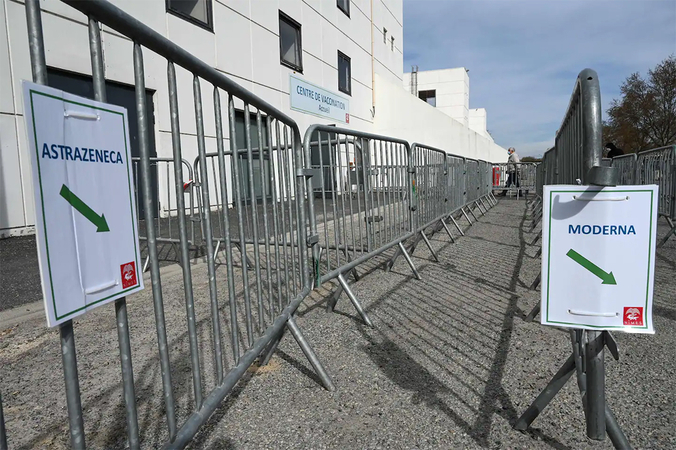
BERLIN – Europe’s medical regulator said Thursday that AstraZeneca’s vaccine was “safe and effective,” but that it could not rule out a link to highly unusual types of blood clots and said a warning would be added to the product.
Many of the countries in Europe that had paused the use of the Oxford-AstraZeneca vaccine – including Germany, France, Italy and Spain – announced that they would resume Friday or early next week. Ireland said it would announce its decision Friday, and Sweden said it would next week.
“If it was me, I would be vaccinated tomorrow,” said Emer Cooke, the head of the European Medicines Agency. “But I would want to know if anything happened to me after vaccination, what I should do about it, and that’s what we’re saying today.”
In addition to the warning, the agency said it would conduct outreach to health-care providers and the public about the signs and symptoms to watch for.
The suspensions of the AstraZeneca vaccine have split both the scientific community and the countries in Europe, with some continuing their vaccination campaigns as others warn that the extremely unusual and deadly nature of blood clots detected, even if in small numbers, warrant caution.
Norwegian experts said Thursday that their investigations into three cases of unusual clots among health workers there, one of whom died, found they were likely caused by an immune response to the vaccine.
Even with the European regulator reiterating that the benefits far outweigh the risks, experts say the damage has been done, with trust in the vaccine already diminished. The pause comes as several European countries warn they are at the beginning of a third wave of the pandemic, with an already slow pace of vaccinations and new more contagious variants spreading rapidly.
The potential ramifications stretch much further than the continent. Easier to store and handle than other products on the market, the offering from AstraZeneca, which developers have said will be distributed on a not-for-profit basis, is a major tool in the fight against the spread of the coronavirus in developing countries.
AstraZeneca has said that the 37 blood clotting incidents reported among the 17 million shots given in Europe are far lower than to be expected in the normal population, and the World Health Organization has said it continues to think that the benefits outweigh the risks.
Experts from the EMA agreed on both counts, but said their investigation was focused on a small number of normally extremely rare brain clots that have been reported in countries, including Germany and Norway, following vaccinations, including in younger people and notably among women.
Their panel said the vaccine “may be associated with” those cases, which include 18 incidents of a rare brain clot known as cerebral venous sinus thrombosis, three of which were reported in the United Kingdom. It’s a kind of stroke that can be deadly.
There have also been seven cases of an unusual condition in which blood clots form in vessels throughout the body. While such symptoms may be linked to the coronavirus itself, “we still feel that we see sufficient information to include a warning,” said Sabine Straus, head of the EMA’s safety committee.
She said that “younger women” seemed to be notably affected, but that it was too early to issue specific guidance, and the agency is looking into whether there could be increased risk for people on contraceptive pills. Women on the pill are already at a higher risk of the rare clots in the brain.
In Britain, where 11 million shots have been administered, almost double the amount across the entire European Union, the medical regulator continues to urge people to get their vaccines.
June Raine, the chief executive of the Medicines and Healthcare Products Regulatory Agency, Britain’s counterpart to the EMA, said they had received a “very small number” of reports of “an extremely rare form of blood clot” in the brain along with lower levels of platelets following vaccination, but that such events could occur among those who haven’t been vaccinated, or those who have coronavirus.
“While we continue to investigate these cases, as a precautionary measure we would advise anyone with a headache that lasts for more than 4 days after vaccination, or bruising beyond the site of vaccination after a few days, to seek medical attention,” she said in a statement on Thursday.
Concerns were first triggered in Austria in early March. As the country vaccinated medical workers, a 46-year-old nurse died of multiple blood clots. Another medical worker at the same hospital suffered a pulmonary embolism. Austria suspended use of that batch as a precaution.
Last week, Europe’s regulator said that it found no evidence of a causal link with the vaccine in those cases, and it maintains that there is no problem with a specific batch.
Given that decision, Germany had initially said it would go ahead with its AstraZeneca vaccinations, with its health minister assuring people of its safety on Friday. But it reversed course after recording eight cases of a rare type of brain clot among 1.6 million doses of vaccine administered. Half of them were in the course of a few days.
Germany said that among the 1.6 million doses of the vaccine administered, the eight cases of a rare type of blood clot, called cerebral venous sinus thrombosis, which occurs in a vein in the brain is higher than one would normally expect.
It said that among a group that size, one case could normally be expected. Johns Hopkins University says it normally affects about 5 people in 1 million each year.
Given the seriousness of the condition, Germany said it had little choice but to pause until there was an expert review.
Norway has reported four similar cases after administering 130,000 doses of the vaccine.
Steinar Madsen, medical director at the Norwegian Medicines Agency, said all four people were under 50 years old, and that two are now dead.
He described the type of blood clot as very rare. “What I can say is that this picture with low platelet counts, blood clots and internal bleeding is very unusual,” he said. “Even experts have not seen cases directly similar to this.”
Experts at Oslo University Hospital said Thursday they think there is a link to the vaccine and three cases of hospitalizations there.
“Our findings support the early theory that the patients had a strong immune response, which led to antibody creation which can ignite blood platelets and cause a thrombosis,” said Pål Andre Holme, the lead physician looking into the cases. He said he could not be certain that the vaccine was the cause, but “I see no other possibility as of today.”
He said he was “surprised” by his team’s findings and that he had not seen a similar response caused by other vaccines. He said his team is continuing its studies and cannot yet say whether the three health workers shared any underlying conditions that could explain why they had such a reaction to the vaccine.
Denmark has recorded one death in a 60-year-old recently vaccinated woman, who had “a highly unusual disease pattern,” which also included a low platelet count and blood clots in small and large vessels.
Spain has said it has had one such case in a 46-year-old teacher who died of a blood clot to the brain, which contributed to its decision to pause its rollout.
The EMA said there were three cases of the brain clots recorded among those who had had the vaccine in Italy.
Amid the pauses, there has been resistance from some parts of the scientific community, particularly in Britain.
Before the EMA annnoucement, Ian Douglas, a professor of pharmacoepidemiology at the London School of Hygiene and Tropical Medicine, said there appears to be no strong evidence that the events are causally related, though he didn’t rule it out.
He said that even if the vaccine was causing some concerning side effects, those most be weighed in a risk-benefit analysis: How serious are the side effects and how numerous when balanced against the drug’s benefits.
“We do this all the time with all medicines,” he said. “You have to weigh the risks and benefits.”
Douglas said he was deeply concerned that the actions taken by European countries would reduce use of this or any vaccine and that European countries acted rashly. To pause the AstraZeneca vaccine, which is desperately needed, requires a higher level of certainty of harmful effects than has been shown, he said.
“If you take action too early it is very easy to lose trust,” he said. “Confidence is easily lost and less easily regained.”
Experts in Germany have speculated that Britain may not be picking up as many similar cases because it began with vaccinations of older people, generally at lower risk of such complications and a population in which deaths might be less notable.
“I think the most likely explanation is different populations being vaccinated,” said Peter Arlett, head of data at the EMA said Thursday.
Klaus Cichutek, president of the Paul-Ehrlich-Instituts, Germany’s regulator, said they had analyzed “large data sets” from Britain and found few cases.
“But the focus and the gaze was not yet focused on such cases either,” he told German broadcaster ARD. “On the other hand, it may be the case that in the U.K. another age group, another population group, was vaccinated.”
Some have alleged that the decision in some countries to suspend the vaccine is political. Paul Hunter, a professor of medicine and infectious diseases at the University of East Anglia, said evidence of a link was weak and he believed herd mentality was at play.
“If Germany is doing this, we don’t want to be seen as less protective than the Germans,” he said. “Many people, including me, don’t think this is real. This is very likely a random association – and not a causal relationship.”
Hans Kluge, the World Health Organization’s Europe director, reiterated Thursday that blood clots occur all the time. The detection and reporting of such events is testament to strong surveillance systems, he said.
“In vaccination campaigns, it is routine to signal potential adverse events,” he said. “This does not necessarily mean that the events are linked to the vaccination.” The WHO is conducting its own assessment and has said details will be made public as soon as possible.
Even before the concerns over blood clots, AstraZeneca had been suffering from an image problem in Europe. Trial data came under fire from the scientific community, while there was also confusion over dosing and efficacy rates.
In Europe there had been reports that AstraZeneca appointments were not being taken up amid particular skepticism over its efficacy.
“Even if it turns out that the vaccine is harmless for most, it will unfortunately not be easy to rebuild trust,” Ulrich Weigeldt, chairman of the German Association of General Practitioners, told Redaktionsnetzwerk Deutschland on Thursday.
Myanmar is descending into chaos. A Yangon neighborhood is in the eye of the storm.
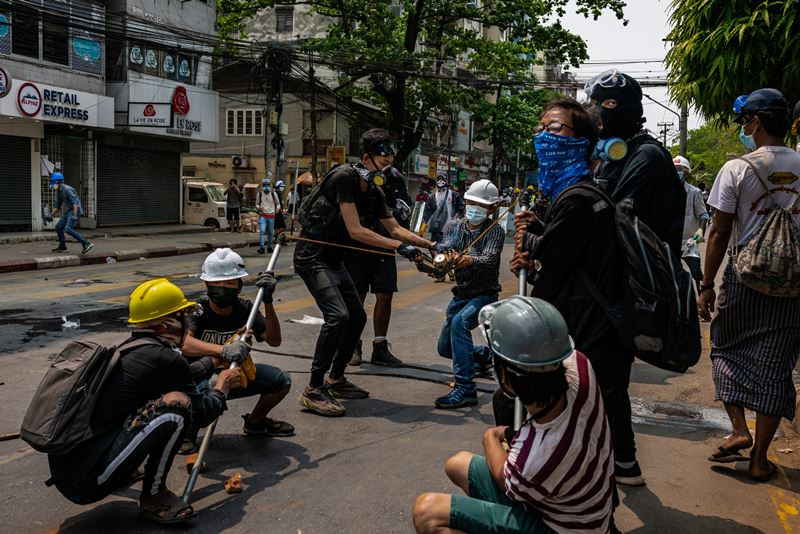
InternationalMar 19. 2021Anti-coup protesters with homemade shields line up during a protest in the Sanchaung neighborhood of Yangon, on March 14. MUST CREDIT: photo for The Washington Post.
By The Washington Post · Shibani Mahtani
When Moe and two friends moved into a shared apartment in Yangon in 2019, they chose the city’s Sanchaung neighborhood for its lively bars, restaurants and new malls. Striking out on their own for the first time, the young professionals thought they had finally made it as adults – and decorated their digs with stuffed toys and colorful cushions.
Then came the military coup.
Last week, Moe, 23, sat huddled in a bedroom, contemplating torture or death, with her housemates and 13 female protesters. Police officers were rattling on the door, she said, screaming for them to emerge and threatening to arrest them after another day of street battles between security forces and civilians.
“Before the coup, I could have never imagined my life would turn out this way,” Moe said. “I don’t think I could have ever been prepared.”
A food delivery employee checks his phone after encountering a barricade in the Sanchaung neighborhood of Yangon. The neighborhood has emerged as the heart of the anti-coup resistance. MUST CREDIT: photo for The Washington Post.
Since the military seized power Feb. 1, hundreds of thousands across Myanmar have protested the ouster of the elected government led by Aung San Suu Kyi. The armed forces, known for campaigns of slaughter against ethnic and religious minorities, have responded by turning weapons on unarmed civilians, killing at least 200, including more than 60 on Sunday, according to human rights groups. Two officials from Suu Kyi’s party have died in custody – one tortured so badly that all of his teeth were missing, according to human rights organizations and his family.
The descent into chaos is playing out most starkly in places such as Sanchaung, a jumble of streets wedged between the gleaming Shwedagon Pagoda and the murky Yangon River that has emerged as the heart of the resistance movement. Starting in 2010, when the military loosened its five-decade grip on power, the area boomed as middle-class families, expatriates and small businesses moved in, followed by malls and high rises. Many of its apartments and hair salons are now staging grounds for protesters.
“Everyone wanted to live here. It was very metropolitan. It represented the future of Myanmar,” said Htun, a 37-year-old Sanchaung resident. “We have lost everything: our freedoms first, then our businesses, our restaurants, our offices, and our townships, which have turned into a battlefield.”
Moe, Htun and others interviewed by The Washington Post spoke on the condition that only part of their names be published, citing security concerns. The military has condemned the protests as “riots” and “incitement,” and said authorities “are exercising restraint as peacefully as possible.”
Protesters throw a homemade smoke bomb toward security forces. Sanchaung residents have offered assistance and shelter to anti-coup demonstrators. MUST CREDIT: photo for The Washington Post.
Spontaneous protests flared immediately after the coup, but within 48 hours became more coordinated. Among the groups acting as representatives of the resistance is the General Strike Committee of Nationalities, a coalition of ethnic minority activists and others. After security forces cracked down on protesters at rally sites, such as the Sule pagoda, the group shifted tactics and organized protests mainly in Sanchaung, which it viewed as strategically located and especially receptive to its goals.
“Many Sanchaung residents experienced military atrocities before,” said Maung Saung Kha, a committee member, noting that ethnic minorities from around Myanmar, formerly known as Burma, had settled in the area. “They know the true colors of the military, and when the chance of revolution presented itself, they were ready.”
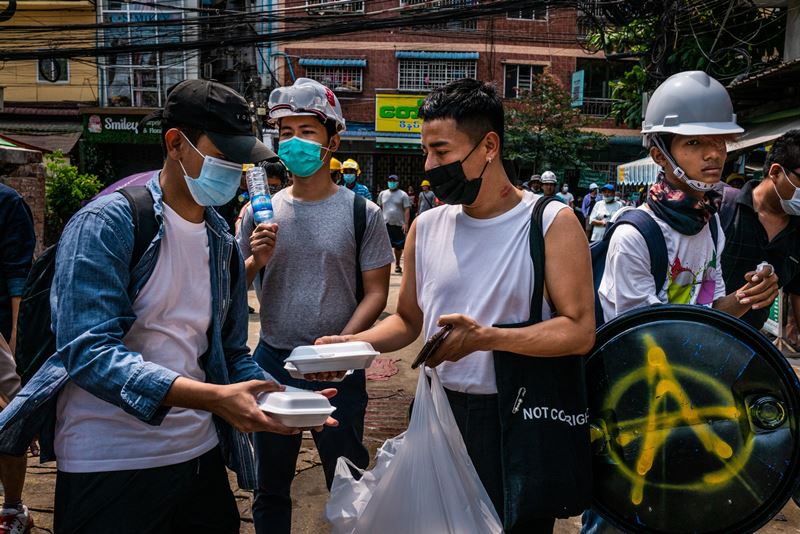
Sanchaung’s overwhelmingly young, middle-class and diverse community stepped up, helping demonstrators who poured in from other parts of the city. Htun, Moe and others began receiving protesters, providing them with food, water, shelter, protective gear and other essentials. When police fired rubber bullets or tear gas at the crowds, the dissidents would melt away into apartments and shops.
Volunteers arranged themselves into more than 10 rescue teams, providing medical assistance and security for anti-coup demonstrators. These groups patrol the neighborhood on bicycle, apprehending or threatening those suspected of working as informants for the security forces.
“Protesters feel safe here. They feel well taken care of,” Htun said.
Sanchaung residents give food to the anti-coup protesters. MUST CREDIT: photo for The Washington Post.
On March 8, security forces changed tactics, according to protesters and residents in Sanchaung. After using rubber bullets and stun grenades to disperse protesters – who once again took shelter in safe houses – security forces sealed off a section of Sanchaung, trapping hundreds of demonstrators. Police and soldiers threatened to arrest and “punish” anyone caught helping the resistance fighters, according to those who heard the warnings.
May Lay, 38, who runs a beauty salon on one of the barricaded streets, said 13 protesters were sheltering in her premises when the security forces descended on the neighborhood late in the afternoon.
Peering out from her salon, May Lay saw officers break down her neighbor’s door and forcibly remove the occupant and five protesters he was hiding. More than 2,000 have been arrested or detained since Feb. 1, according to the Assistance Association for Political Prisoners (Burma); some have not been seen or heard from since.
Knowing that she and the black-clad protesters in her salon had to leave quickly, May Lay turned to camouflage. She dressed the protesters in sarongs, T-shirts, blouses and flip-flops to make them look like ordinary residents. One protester had identifiable gray hair, which May Lay dyed black. Armed with decoy bags of trash, the protesters sneaked out, telling officers they were on their way to buy groceries.
Others had closer encounters. On a parallel street, police officers saw Moe and her housemates peering out from behind a curtain, and threatened to shoot them, she said. Officers then demanded that the group – the three housemates and the 13 protesters – come down to the street and comply with investigators.
The group rushed into a bedroom as officers ascended to their fifth-floor apartment and tried unsuccessfully to enter, Moe said. The missing doorknob and bits of metal that remain in its place are a testament to how close they came.
Salai Thurein, a 35-year-old member of one of the local rescue teams, said it was especially challenging to hide the protesters’ gear, including makeshift metal shields and hard hats. But virtually every resident within the barricaded area took in some equipment, he said, stashing it in backyards, on rooftops and in drains.
Security forces eventually pulled back early the next day, after arresting several dozen protesters. They took revenge on Sanchaung by smashing cars and destroying shops – but for residents and protesters, that was the best-case scenario.
“We averted a catastrophic event,” Htun said.
Residents light candles as part of a protest in Sanchaung to pray for those who have died during the protests. MUST CREDIT: photo for The Washington Post.
Protests against the military’s power grab have intensified and spread. On Sunday, Hlaing Tharyar, an impoverished neighborhood packed with garment factories, became the latest flash point. Soldiers and police took a far more violent approach there than in Sanchaung, killing at least 30, according to doctors at a nearby hospital. Hlaing Tharyar and several other neighborhoods are now under martial law, meaning perceived crimes can be punished with hard labor or the death penalty.
Some protesters say they will soon abandon peaceful tactics and arm themselves, threatening a significant escalation of an already volatile situation. Myanmar is awash with weapons after decades of ethnic conflict.
“We now consider it a battle,” said Naing Min, a 27-year-old physician who witnessed the killings in Hlaing Tharyar. “They have guns, and we have knives, slingshots and homemade weapons. We might be able to kill them, too.”
A committee representing members of Suu Kyi’s National League for Democracy, who were ousted in the coup, said in a statement that people have “the full right to defend themselves or others” in response to the military’s actions.
Longtime observers of Myanmar are warning of an imminent major lethal crackdown – similar to the one the military inflicted on the Rohingya in 2017, in which thousands were killed. The Special Advisory Council for Myanmar, which comprises former United Nations officials who investigated the Rohingya abuses, said in a statement that the military’s actions, including Internet blackouts, are consistent with “past major military offensives.”
“Without immediate political intervention, a major crackdown with fatal consequences is inevitable,” the statement added.
WASHINGTON – President Joe Biden has sought to blunt a reported surge in anti-Asian bias incidents by ordering the federal government not to use xenophobic language to describe the coronavirus and calling accounts of “vicious hate crimes” during the pandemic “un-American.”
But Asian American leaders are warning that a deepening geopolitical confrontation between the United States and China is contributing to the heightened suspicion, prejudice and violence against their communities in ways that could continue to intensify even after the pandemic begins to subside.
Advocates called Biden’s rhetorical efforts a welcome corrective to former president Donald Trump, who railed against the “China virus” and “kung flu.” Yet the broadening conflict among the world’s two largest economies – on trade, defense, 5G networks, cybersecurity, the environment, health security and human rights – has contributed to a growing number of Americans calling China the “greatest enemy” of the United States, according to a Gallup poll this week.
The survey found that 45% of respondents named China as the top threat, more than twice as many as a year earlier, when the country was ranked on par with Russia. Democrats and Republicans have voiced bipartisan support for a tougher U.S. policy, including economic sanctions on Beijing over cyber intrusions, human rights violations and crackdowns on democracy in Hong Kong.
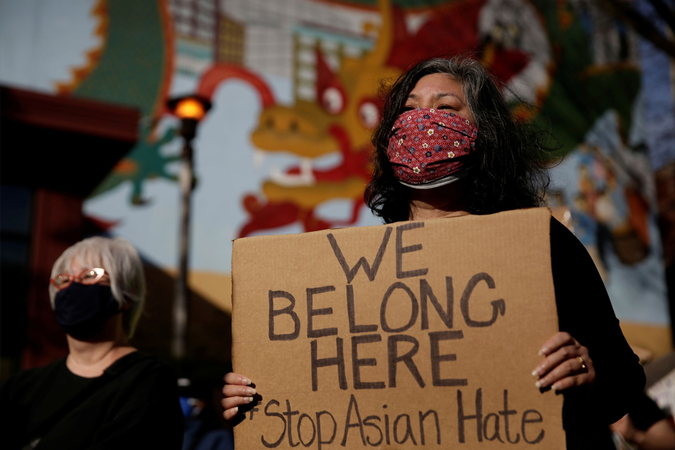
“When America China-bashes, then Chinese get bashed, and so do those who look Chinese. American foreign policy in Asia is American domestic policy for Asians,” said Russell Jeung, a history professor at San Francisco State University who last year helped found Stop AAPI Hate, short for Asian American and Pacific Islanders, an advocacy group that has tallied more than 3,000 incidents of bias and hate during the pandemic.
“The U.S.-China cold war – and especially the Republican strategy of scapegoating and attacking China for the virus – incited racism and hatred toward Asian Americans,” Jeung said.
A number of violent assaults on Asian Americans over the past two months, including some that went viral after being caught on video, have drawn political and media attention to escalating fears over public safety. The slaying of eight people, including six women of Asian descent, at three Georgia spas on Tuesday sparked demands for an urgent response from authorities. Police arrested Robert Aaron Long, a White man, in connection with the killings and cited as a potential motive Long’s interest in eliminating “sexual temptation.”
Not all of the cases appear to have a link to anger over the pandemic or were necessarily motivated by racial resentment. But advocates said they have collected enough anecdotal evidence through self-reporting portals set up last year by community groups to illustrate that attacks are spiking.
And they are fearful that the intensifying competition between Washington and Beijing is contributing to scapegoating of Asian Americans in echoes of earlier periods of widespread hostility during geopolitical tumult and heightened nationalism in the United States.
They pointed to the Chinese Exclusion Act in 1882 that banned the immigration of Chinese laborers amid national economic anxiety, the internment of more than 120,000 Japanese Americans during World War II, and attacks on mosques and Muslim Americans in the wake of 9/11.
“For as long as Asians have been in America, we’ve been scapegoated, treated as outsiders and seen as untrustworthy. Too often, these prejudices are exploited for political gain,” said Christopher Lu, who served as White House Cabinet secretary and deputy labor secretary in the Obama administration. “As troubling as our current situation is, I am concerned that things are going to get much worse as U.S.-China tensions grow.”
Asian American leaders acknowledged the need for the United States to develop a tougher strategy to counter the Chinese Communist Party’s influence campaign across the globe. The question, advocates said, is how the federal government and elected officials speak publicly about the challenge and how far they go to counter it.
Trump sought to blame Beijing for the outbreak of the pandemic, employing xenophobic language that was echoed by his supporters and other Republican officials and condemned by Democrats.
But in April, weeks after the onset of the pandemic, Biden also drew heat from Democratic Congress members and community groups for a campaign advertisement that accused the 45th president of having “rolled over for the Chinese” in managing the coronavirus and cast China as a looming threat.
Biden’s campaign apologized for the language and aired a revised version of the ad. But the episode illustrated the intensifying effort of both parties to appear tougher on Beijing.
“It is clearly a difficult line to walk, however I do believe there is a way of disagreeing with China’s policies without denigrating the Chinese people themselves,” said Rep. Judy Chu, D-Calif., chair of the House Congressional Asian Pacific American Caucus.
Chu praised Biden for issuing an executive action in January aimed at barring federal agencies from blaming China for the pandemic and instructing the Justice Department to improve data collection on hate crimes. In a prime-time address to the nation last week about his administration’s coronavirus response, Biden decried attacks and harassment against Asian Americans who have been “forced to live in fear for their lives just walking down streets.”
“It must stop,” Biden said.
White House aides, including domestic policy adviser Susan Rice and senior adviser Cedric Richmond, met virtually with Asian American advocacy groups two weeks ago to hear their concerns. They pledged to use the power of the administration to combat violence but offered few specifics, according to activists who participated who, like others, spoke on the condition of anonymity to discuss a private conversation.
Chu and others have pushed Biden to elevate more Asian Americans to high-level jobs in his administration, noting there is only one Cabinet-level official of East Asian descent, Katherine Tai, who was confirmed Wednesday as U.S. trade representative.
Attorney General Merrick Garland met with advocates on a video call Wednesday that lasted about 45 minutes, telling them he recognized that regardless of whether the Georgia killings were racially motivated, he understood the larger context in which the crime took place and the sense of alarm within the community, according to a person who participated.
Asian American leaders have raised questions about the Justice Department’s “China Initiative,” launched by the Trump administration in 2018, to amplify ongoing U.S. government efforts to counter the Chinese government’s attempts to steal billions of dollars a year in U.S. intellectual property.
Advocates have said the program has led to unfair racial profiling of scientists and academics of Chinese descent. They pointed to the case of University of Kansas researcher Franklin Tao, a permanent U.S. resident who was indicted in 2019 and accused of failing to disclose an alleged teaching contract with a Chinese university while conducting federally funded research. His lawyers have denied the charges.
“Publicly available information suggests at least 60 cases that have been filed had a reference to the China Initiative. Only a quarter of them have actually involved charges of espionage,” said John Yang, executive director of Asian Americans Advancing Justice, which has advocated on behalf of Tao, whose case is pending. Yang’s organization has asked the Biden administration to put a moratorium on the program and conduct a review of it.
“This goes to the perpetual foreigner stereotype we always talk about,” Yang said, “where in various points in history, we are targeted unfairly.”
Justice Department officials met with Asian American advocates two weeks ago, but they declined to comment on the future of that program. They have pledged to develop new grant programs for local police agencies to report on hate crime data and efforts to translate federal hate crime reporting portals into Chinese and other Asian languages.
At her confirmation hearing last week, Lisa Monaco, Biden’s nominee for deputy attorney general, offered credit to the Trump administration for focusing on cyberthreats from China and said she expects to “double down” on the strategy. “This is an area I think we have a great deal more to do,” she told senators.
On Wednesday, the Biden administration announced economic sanctions against two dozen Chinese and Hong Kong officials. The move came in advance of Secretary of State Antony Blinken’s first meeting with Chinese counterparts in Alaska later this week.
Last week, during a House Foreign Affairs Committee hearing, Rep. Ted Lieu, D-Calif., asked Blinken about concerns among some advocacy groups that restrictions on assignments for U.S. diplomats has disproportionately blocked Asian American Foreign Service officers from work in Asian countries.
“It sends a false message that people who look like me would be more disloyal,” Lieu told Blinken, who said he shared the concerns about inequities in the system. “As you manage the relationship with China, I want to remain vigilant that fear of a foreign country does not negatively impact the Asian American community.”



 Green PVC pellets. MUST CREDIT: Bloomberg photo by Eilon Paz,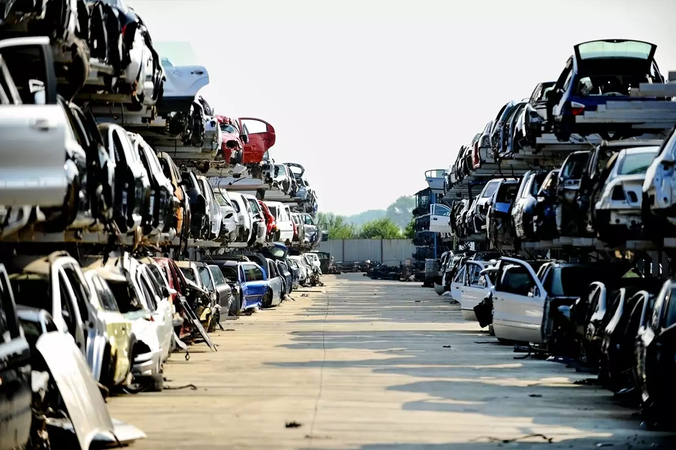
 Haruhiko Kuroda, governor of the Bank of Japan, speaks during an event hosted by business lobby Keidanren (Japan Business Federation) in Tokyo on Dec. 24, 2020. MUST CREDIT: Bloomberg photo by Kiyoshi Ota.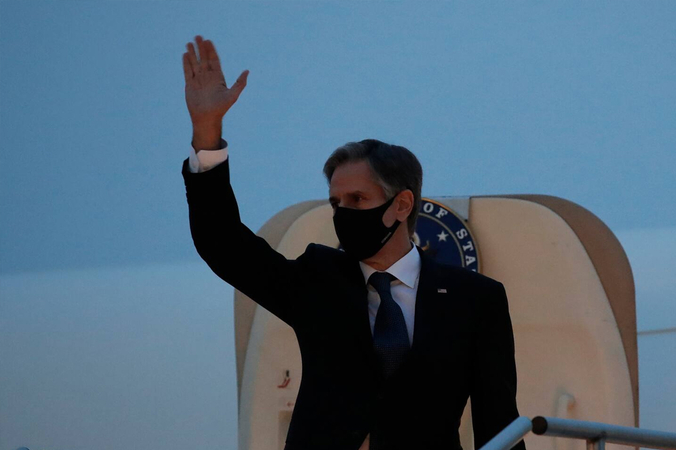
 Anti-coup protesters with homemade shields line up during a protest in the Sanchaung neighborhood of Yangon, on March 14. MUST CREDIT: photo for The Washington Post.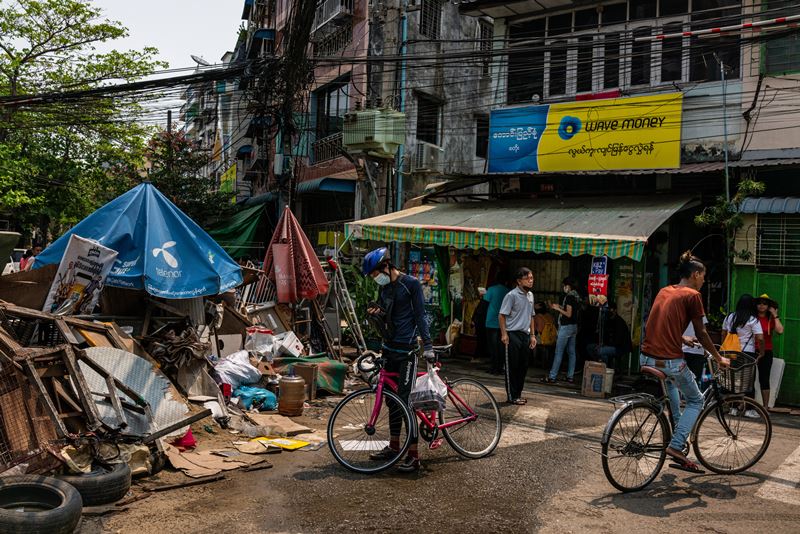

 SootinClaimon.Com