Senior Democrats explore tax largely hitting Fortune 1000 companies not paying $15 an hour #SootinClaimon.Com

#SootinClaimon.Com : ขอบคุณแหล่งข้อมูล : หนังสือพิมพ์ The Nation.

https://www.nationthailand.com/news/30403128

Senior Democrats explore tax largely hitting Fortune 1000 companies not paying $15 an hour

InternationalFeb 28. 2021The U.S. Capitol is seen in Washington, D.C., on Feb. 26, 2021. MUST CREDIT: Washington Post photo by Salwan Georges.The U.S. Capitol is seen in Washington, D.C., on Feb. 26, 2021. MUST CREDIT: Washington Post photo by Salwan Georges.

By The Washington Post · Jeff Stein, Erica Werner

WASHINGTON – Senior Democratic lawmakers trying to find a backup plan to a minimum-wage increase are exploring new tax penalties on firms with more than $2.5 billion in gross receipts that do not pay at least $15 an hour, according to two people familiar with the matter.

The measure, which aides cautioned was still under discussion and subject to change, would aim to levy a 5% annual tax on these large corporations if they pay below $15 an hour, according to the two people, who spoke on the condition of anonymity to share details of private deliberations. Democrats might aim to ratchet up the 5% penalty over time for large firms that do not increase their wages, although that measure is also preliminary and could change, the people said.

The plan being discussed would overwhelmingly hit companies in the Fortune 1000, many of which have seen record profits during the pandemic. The penalty would likely start almost immediately after the law is passed.

Senate Finance Committee Chairman Ron Wyden, D-Ore., and Senate Budget Committee Chairman Bernie Sanders, I-Vt., called on Democrats to pursue these levies after the party was dealt a setback on its original plan to raise the minimum wage.

The Senate’s parliamentarian said Thursday that the $15-an-hour minimum wage is inadmissible under the rules of the procedure Democrats are using to pass President Biden’s $1.9 trillion stimulus with a narrow majority. The White House has ruled out overruling the parliamentarian, and centrist Democrats such as Sen. Joe Manchin III, D-W.Va., have said they would not change the rules of the filibuster in the Senate, imperiling the provision.

“It is cold comfort to know that majority support for raising the minimum wage could be meaningless because of arcane Senate rules,” Wyden said in a statement earlier this week. “We couldn’t get in the front door or the back door, so we’ll try to go through the window.”

But the backup plan on the wage increase faces significant political and practical hurdles. Economists say administering such a tax could prove complicated and create tax games in which corporations could avoid paying the penalties and raising worker pay. The vast majority of minimum-wage workers do not work at giant corporations. And it remained highly uncertain whether the rest of the congressional Democratic caucus would go along with the plan being discussed by Wyden and Sanders. The White House has not yet taken a position on the measure.

“We just got that today and it’s a complicated piece of work. We’re going to have to look at that very carefully,” Jared Bernstein, a member of the White House Council of Economic Advisers, told MSNBC when asked about the plan Friday night.

The House included the $15-an-hour minimum wage in the $1.9 trillion stimulus package it passed in the early morning hours of Saturday. House Speaker Nancy Pelosi, D-Calif., and other senior Democrats, including White House officials, have vowed to find another vehicle for approving the minimum-wage increase during Biden’s administration. Senate Majority Leader Charles Schumer, D-N.Y., is also exploring the tax penalties idea, but has not formally endorsed it.

Wyden and Sanders prefer a federal $15-an-hour minimum but argued that the new plan is better than doing nothing for minimum-wage workers. But they do not have much time. Democrats agree that Biden must sign the bill into law before mid-March to prevent millions of Americans from losing unemployment benefits. The Senate will also need time to debate and vote on the bill. That gives Wyden and Sanders only about one week at most to write the complicated new tax measure and sell it to the entire Democratic caucus.

Potential land mines abound. One major question is whether the franchises of large corporations would be subject to the penalty. The vast majority of McDonald’s chains, for instance, operate as franchises and could escape a tax penalty aimed at large corporations, said Arindrajit Dube, a professor of economics at the University of Massachusetts at Amherst.

Wyden has said his plan would include “safeguards” to prevent companies from either outsourcing or using contractors to avoid paying the $15-an-hour wage, although details remain sparse.

“At the end of the day, you’re going to be left with most minimum-wage workers in 21 states stuck at $7.25. . . . I think it’s going to be fairly modest in terms of impact,” Dube said. “It’d be a small sliver.”

Mark Weisbrot, co-director of the Center for Economic and Policy Research, a left-leaning think tank, said it would be “impossible” to monitor firms sufficiently to ensure they do not skirt the rules with subcontractors or by other means.

“Anybody who wants to pay less than $15 under these alternatives will do it,” Weisbrot said. “So it’s not going to do the job. . . . Democrats should just overrule the Senate parliamentarian.”

Congressional Republicans have vowed to oppose the measure, with House Minority Leader Kevin McCarthy, R-Calif., on Friday calling it “stupid.” Rep. Kevin Brady of Texas, the ranking Republican on the House Ways and Means Committee, has said it would penalize firms for employing young and low-wage workers.

The pandemic has concentrated attention on large employers who have not passed on profit to their employees. The Brookings Institution, a center-left think tank, found in December that top retail companies’ profits soared by $17 billion compared with last year, or by 40%. The report also found that “with few exceptions” retail workers had seen only minimal gains as a result, with surveyed companies increasing wages by only 10%.

The United States has never gone longer without increasing its federal minimum wage in the eight decades since the law was passed.

“At most of the biggest retail companies in America, the gap between the struggles and sacrifices of low-wage frontline workers and the wealth they create for their employers and shareholders is wider than ever,” the report said.

Europe’s recovery choices will leave it a year behind the U.S. #SootinClaimon.Com

#SootinClaimon.Com : ขอบคุณแหล่งข้อมูล : หนังสือพิมพ์ The Nation.

https://www.nationthailand.com/news/30403127

Europe’s recovery choices will leave it a year behind the U.S.

InternationalFeb 28. 2021The Euro sculpture illuminated outside the Eurotower, the former headquarters of the European Central Bank in Frankfurt, Germany, on Dec. 15, 2020. MUST CREDIT: Bloomberg photo by Alex Kraus.The Euro sculpture illuminated outside the Eurotower, the former headquarters of the European Central Bank in Frankfurt, Germany, on Dec. 15, 2020. MUST CREDIT: Bloomberg photo by Alex Kraus.

By Syndication Washington Post, Bloomberg · Alexander Weber

While the U.S. rushes toward a blockbuster fiscal stimulus package to accelerate its recovery from the coronavirus crisis, much of Europe is pootling along in the slow lane.

President Joe Biden’s $1.9 trillion stimulus bill, if congressional leaders pass the full amount, would take his administration’s spending in 2021 to more than three times as much as euro-area countries have planned, according to UniCredit.

As a consequence, most economists expect the U.S. economy to reach its pre-pandemic size around the middle of 2021, roughly a full year before the currency bloc.

JPMorgan Chase estimates the “fiscal thrust” – the boost from discretionary government spending minus the drag of expiring tax breaks and support measures – will add 1.8% to U.S. output this year. For the euro zone, it’ll subtract 0.1%.

Europe’s go-slow is partly a result of its unwieldy makeup. The European Union’s 27 sovereign governments set their own fiscal policies, it took months of negotiations last year to agree on a common 750 billion-euro ($910 billion) recovery fund. Proposals for how to spend the money are still being processed, and funds probably won’t start being distributed until the second half of the year.

Such careful consideration has its benefits. Get it right, and the EU will have a well-structured suite of projects that enhance productivity and growth potential for years to come. Get it wrong though, and the continent could be blighted for just as long.

“The question is what do we want to achieve,” said Carsten Brzeski, an economist at ING Germany. “Do we want this short-term momentum or do we want to use the money to improve the structure of the economy in a sustainable way? In Europe it’s the latter that we need.”

The EU’s recovery fund, combined with a 1.1 trillion-euro multi-year budget, is a breakthrough package for the union. The money will be spent between now and 2027, with more than half intended for “modernization” such as digitization and fighting climate change.

Not only is it the EU’s largest-ever stimulus package, the recovery fund is financed by jointly backed bonds – the first time the EU has agreed to such a measure.

It’s temporary, but European Central Bank officials hope it will ultimately lead to a permanent joint fiscal capacity, effectively the equivalent of the U.S. federal budget.

The bloc has long struggled with smoothing out economic differences between countries, and the pandemic has exposed that flaw once again. National fiscal programs have been far more generous in wealthy nations such as Germany than in weaker ones such as Italy and Spain.

Not everyone is convinced Europe has got it right though. Erik Nielsen, UniCredit’s chief economist, says the difference in spending plans compared to the U.S. is “mind-boggling” and the euro-zone approach is “severely inadequate.” It’ll lead to a muted recovery, higher unemployment, deeper economic scars and weak inflation, he said in his report.

Such an outcome would be all too familiar for the euro zone. Fixation on austerity to reduce debts after the 2008-2009 global financial crisis, rather than boosting growth through consumption, condemned the bloc to a sluggish recovery which turned into a sovereign debt crisis and double-dip recession.

Nielsen cites the so-called output gap as a key indicator of the problem. That gauge of unused economic potential is hard to measure precisely, but it’s widely considered to be bigger in the EU than in the U.S. at the moment. That means Europe should be doing more, not less, to boost its economy.

The International Monetary Fund estimates the U.S. output gap was 3.2% of gross domestic product in 2020, and 5.1% in the euro zone.

Still, some economists argue that the vagaries of the output gap make it a poor foundation for policy decisions. Maria Demertzis, deputy director at the Bruegel think tank in Brussels, said European countries are right to focus on support for struggling parts of the economy and investment. Measures to boost consumption aren’t targeted enough, she said.

Experience from 2020 also indicates that European consumers will probably go out and spend as soon as they’re allowed to do so. Households are sitting on hundreds of billions of euros in savings they accumulated during lockdowns that could further fuel the recovery.

“Generous government support through the pandemic means European economies are set to rally once restrictions are lifted – a big chunk of slack will vanish, even without an extra fiscal boost,” said Jamie Rush, chief European economist at Bloomberg Economics. “In an environment of rising global yields, I see targeted stimulus offering the best value for money.”

Biggest foreign-worker exodus since WWII adds to Britain’s woes #SootinClaimon.Com

#SootinClaimon.Com : ขอบคุณแหล่งข้อมูล : หนังสือพิมพ์ The Nation.

https://www.nationthailand.com/news/30403126

Biggest foreign-worker exodus since WWII adds to Britain’s woes

InternationalFeb 28. 2021Commuters cross London Bridge in the City of London on Feb. 15, 2021. MUST CREDIT: Bloomberg photo by Jason Alden.Commuters cross London Bridge in the City of London on Feb. 15, 2021. MUST CREDIT: Bloomberg photo by Jason Alden.

By Syndication Washington Post, Bloomberg · Andrew Atkinson

Foreign workers are leaving Britain at the fastest pace since World War II, presenting a challenge to an economy already roiled by Brexit and the coronavirus.

London alone has lost 700,000 people over the last year, recent research suggests. The implications are profound for the Treasury, landlords and the chances for a recovery from the worst slump in three centuries.

“The risk is that people don’t come back, so we have skill and labor shortages and we lose some output, growth and tax revenue permanently,” said Jonathan Portes, a King’s College London economics professor who estimates well over 1 million foreign-born workers may have left. “Given how migration has driven economic growth, particularly in London, that could be bad news.”

Chancellor of the Exchequer Rishi Sunak and the Office for Budget Responsibility will confront some of those realities this year and perhaps in the budget on March 3. For the Treasury, fewer migrants ultimately means less economic output and tax revenue to pay down the huge debts accumulated to help people and businesses cope with Covid-19.

A turn in migration flows would reshape the politics of immigration after a decade of government efforts to limit the numbers arriving. Longer term, it could also exacerbate the demographic problem that the U.K. shares with countries from Germany to Japan: how to support a rapidly aging population.

A theoretical scenario where migration dries up instead of rising by around 100,000 a year could cost the U.K. about 1% of output after five years. That would raise the budget deficit by 0.7% of gross domestic product, based on a rule of thumb used by the OBR, the U.K. fiscal watchdog.

The loss of foreign workers may actually be a boon in the short term. Unemployment is rising, and swathes of the economy including hospitality remain closed for at least six weeks. Once those restrictions ease, a post-Brexit immigration system that makes it harder for EU citizens to settle in Britain means that jobs previously done by low-skilled migrants may be harder to fill.

“Those jobs won’t be eligible for long-term work visas,” said Madeleine Sumption, director of the Migration Observatory research unit at the University of Oxford and an adviser to the government. “The government has made it clear it doesn’t want to allow a lot of exceptions.”

The flight of foreign workers marks a rapid turn from the trend of the past 20 years, where immigration generated more jobs, income for universities and higher housing costs. Now, there’s evidence of a shift.

Rents in London fell 8.3% last year, according to property website Zoopla. While its director of research Grainne Gilmore can’t connect that trend to migration, about three quarters of recent arrivals from overseas live in privately rented accommodation.

It’s impossible to say exactly how many people have left. That’s because the pandemic has limited government data collection. Statisticians are relying heavily on the Labour Force Survey, which has suggested the foreign-born population shrank by almost 900,000 to 8.3 million in the year through the third quarter.

Some say the true picture may be far worse. In a blog last month for the government-funded Economic Statistics Centre of Excellence, Portes and co-author Michael O’Connor put the drop at about 1.3 million people. London, they calculated, may have lost about 8% of its population.

Hospitality and retail have been particularly hard hit. Foreign workers accounted for 30% and 18% of employment in those sectors respectively.

“We are still expecting business failures and high unemployment, so we don’t know what workforce may be required,” said Kate Nicholls, chief executive of the lobby group UK Hospitality. “The best thing the chancellor can do is provide financial support.”

EU citizens once drawn by the prospect of better pay and jobs have found their home countries faring far better than Britain during the pandemic.

“Economic developments in countries where many migrants came from in the early 2000s are actually quite positive,” said Professor Christian Dustmann, director of the Centre for Research and Analysis of Migration at University College London. “They’ll say why should I leave? Poland is doing as well as the U.K. There are a lot of opportunities here, so I’ll stay at home.”

Inside Russia’s mass arrests: Claims of beatings, threats and ‘war’ against rights monitors #SootinClaimon.Com

#SootinClaimon.Com : ขอบคุณแหล่งข้อมูล : หนังสือพิมพ์ The Nation.

https://www.nationthailand.com/news/30403125

Inside Russia’s mass arrests: Claims of beatings, threats and ‘war’ against rights monitors

InternationalFeb 28. 2021Alexei NavalnyAlexei Navalny

By The Washington Post · Robyn Dixon

MOSCOW – Authorities call it “Plan Fortress” – a secretive emergency protocol to lock down Russian police stations in case of armed attack. Now it’s being used with a new goal: to keep out human rights lawyers trying to aid Russians held after mass arrests during pro-opposition demonstrations.

The effort to freeze out the lawyers – detailed by the independent police watchdog group OVD-Info – conveys the siege mentality of Russian authorities after sweeping crackdowns on protesters and others backing jailed opposition leader Alexei Navalny.

But the Kremlin’s effort to portray the protests as foreign-fomented violence to undermine the country is beginning to erode.

As some of the more than 11,000 detainees emerge from crowded detention centers, they tell of the violence, fear and potential rights violations.

Many detainees were beaten with truncheons or shocked with Tasers and described going up to 16 hours without food, water, access to toilets, according to reports compiled by OVD-Info, rights lawyers and interviews by The Washington Post. Some women were threatened with rape, according to Grigory Durnovo of OVD-Info.

Police have filed more than 90 criminal charges and more than 9,000 misdemeanor charges among those arrested across 125 cities during waves of protests calling for the release of Navalny, who returned to Russia from Germany on Jan. 17 after being treated for a near-fatal nerve agent poisoning in August in Siberia.

There have been no acquittals, OVD-Info reported.

It is unclear how rights groups and others will pursue the claims by the detainees. But, in the past, similar allegations against Russian authorities have brought appeals to the European Court of Human Rights, which has repeatedly condemned Russia’s crackdowns on the right to protest, unlawful arrests and detentions.

The State Department last month strongly condemned Russia’s “use of harsh tactics against protesters and journalists.”

Kremlin spokesman Dmitry Peskov said there have been “no repressions.” He described specific accounts from detainees of abuses as inventions or distortions.

The cases, however, have started to build a compendium of alleged abuses that could add fuel to expected opposition protests in the spring and summer, with Russian authorities eager to quash protest movement before parliamentary elections planned for September.

According to OVD-Info accounts, some protesters were taken to special rooms for beatings in police stations in Moscow and St Petersburg. Detainees said they were not allowed have their phones to call lawyers or family. Those who tried to stand up for their rights were denied access to a toilet for many hours, or were given longer sentences, Durnovo said.

The reports by OVD-Info, lawyers and detainees could not be independently verified by The Post, but they conform with videos, accounts by local media and human rights groups and evidence to the European Court of Human Rights from previous protests.

“Now we see a war against human rights lawyers or organizations like ours,” Durnovo said. “They are hiding people from human rights lawyers or making the situation tougher for them than it would be if there was no lawyer.”

He said an opposition volunteer, Alyona Kitayeva, reported that a policeman put a plastic bag over her head, kicked and beat her and threatened to shock her unless she unlocked her phone.

Detainees describe police cells without mattresses, heating or pillows. Some told of being waked in the middle of the night for no apparent reason, loaded into vans and driven to other stations.

“Tightening the screws. That is what is happening right now,” said St. Petersburg lawyer Sergei Loktev, who represented some protesters. “If someone has a different view to the authorities, that opinion must be destroyed.”

A speech by President Vladimir Putin on Wednesday to the board of the FSB, the domestic intelligence agency that succeeded the KGB, underscored the Kremlin’s unease. Putin described the pro-Navalny movement as Western campaign to “provoke internal instability” and “ultimately weaken Russia and put it under external control.”

His words echoed the warnings of neighboring Belarusian dictator, Alexander Lukashenko, when he faced mass protests last year. He jailed the main opposition figures, unleashed brutal police violence against peaceful protesters and clung to power, in what some analysts see as a road map Putin is following.

Judges have refused to allow accused protesters to call witnesses, rejected evidence and threw out appeals according to detainees and lawyers. Russia’s Investigative Committee published at least eight Chinese-style video “confessions” in criminal cases, with humiliating public apologies.

Every well-known member of Navalny’s team who did not flee the country was arrested and later put under house arrest. All but one of his 38 regional coordinators was arrested.

In the rush to arrest and convict, the system at times became absurd.

Yevgeny Agafonov, a 45-year-old deaf man, was arrested by riot police in St. Petersburg on Jan. 31. In a written statement, Agafonov said he was only on his way to an art supply store. He was charged with protesting, blocking traffic – and chanting slogans. He is not able to speak.

Agafonov’s lawyer, Sergei Loktev, was stunned when Judge Yulia Ushanova went ahead and convicted him, slapping on a fine.

Political analyst Vladimir Pastukhov, honorary senior research fellow at University College of London, wrote in the independent news and commentary website MBKh that Putin has abandoned legal procedures with the protesters “even as a decoration.”

Timofei Krit, 34, a Moscow State University physicist, said he was not protesting and presented video evidence of his Jan. 31 arrest standing under a railway station clock at 12:45 p.m. The charges against him say he was yelling slogans in another part of Moscow at 3 p.m. He was convicted and was sentenced to 10 days in prison.

“You can be arrested for just walking out, doing your own thing. It’s like living under a military curfew that no one announced,” he said.

He described frigid, crowded cells. “It was so cold we could not sleep. We knocked at the door trying to call somebody, but no one came.”

Dmitry Yepishin, 22, expelled from university in St. Petersburg for participating in a 2017 protest, said he was interrogated without a lawyer at 3 a.m. and spent 40 hours being ferried around before being put in a cramped detention center for migrants at Sakhorovo, about 40 miles southwest of Moscow.

“There were about 200 of us trapped. The OMON [riot police] surrounded us, pushing from both sides. We shouted that we didn’t have weapons, but they started beating people,” he said, describing his arrest. “It was frightening and horrifying.”

Conditions in detention were “absolutely unacceptable and aimed at humiliating people and intimidating them,” said Alexander Golovach, 30, who investigates corrupt state contracts at Navalny’s Anti-Corruption Foundation and spent four days behind bars for protesting. He fears he will be arrested again.

“I’m not going to lie. I’m worried. But I can’t step back. These unprecedented measures of restraint and attempts to intimidate people and frighten them do not work.”

In mid-February, as the temperature sank to -15 degrees, relatives of convicted protesters lined up outside Sakharovo detention center to deliver food parcels.

“Russian authorities are trying to scare people as much as they can and to remove the most active people and get them out of the picture. It’s a totalitarian and authoritarian turn in the country,” said one person in the line, Yelena Gabelaya, furious that the court rejected video evidence that she believes proved that police charges against her son were false.

Sergei Kozakov, 50, waiting with a food parcel, vowed to join the next protest, angered by repressions and falling living standards.

“There is no feeling of hope now. We don’t see any light. It’s total darkness. It is as if we are in a prison camp. There are no laws. There is no truth, only lies,” he said.

Vlad Melikov, 19, a student arrested at his first protest, said conditions were terrible, but the camaraderie during five days detention reminded him of childhood summer camp. His cell mates included a prominent scientist, a doctor working with covid-19 patients and a PR manager.

“We laughed the whole five days. Before, I was not interested in politics, but now I’ll always go to protests,” he said. “These are my kind of people. Everyone there was cool.”

Some Iran ties preclude a U.S. visa #SootinClaimon.Com

#SootinClaimon.Com : ขอบคุณแหล่งข้อมูล : หนังสือพิมพ์ The Nation.

https://www.nationthailand.com/news/30403124

Some Iran ties preclude a U.S. visa

InternationalFeb 28. 2021Arash, right, was sent to the IRGC when he began his mandatory military service a decade ago, and spent his service playing clarinet in a marching band, according to Mahdis, his American wife, on the left. MUST CREDIT: Family photo.Arash, right, was sent to the IRGC when he began his mandatory military service a decade ago, and spent his service playing clarinet in a marching band, according to Mahdis, his American wife, on the left. MUST CREDIT: Family photo.

By The Washington Post · Kareem Fahim, Erin Cunningham

ISTANBUL – When Mahdis, an American teacher from Southern California, applied for a U.S. visa for her Iranian husband four years ago, she had no idea that his mandatory military service would stand in their way.

But a Trump administration decision two years ago to designate Iran’s Islamic Revolutionary Guard Corps (IRGC) as a terrorist organization has meant that everyone associated with the group, including those like her husband, Arash, who were forced to join it as part of their compulsory service, would no longer be eligible for residency in the United States.

It did not matter that Arash served years before the terror designation or that he was assigned a noncombat role, playing clarinet in a marching band. Earlier this month, the couple received a letter from the State Department telling them his permanent residency visa had been refused, she said. Hundreds of other Iranian men – some with American wives or family members in the United States – have received similar letters over the past two years or were expecting them soon, according to Mahdis and other relatives who share stories and advice in several online chat groups.

President Joe Biden has signaled his intent to break with Trump’s “maximum pressure” approach toward Iran, which included sweeping sanctions, as the new administration seeks to rejoin the 2015 nuclear deal between Tehran and world powers and bring Iran back into compliance. But a repeal or revision of the IRGC designation could be politically delicate for Biden, who faces domestic pressure to impose tougher terms on Iran even if the United States rejoins the nuclear agreement.

Under Trump, U.S. officials took a hard line with Iran in part to force it to abandon expansionist military policies in the Middle East, in which the IRGC plays a leading role. Critics said Trump’s pressure campaign did little to change Iran’s behavior and that some of the punitive measures were counterproductive, overzealous or unusually broad.

The Revolutionary Guard designation marked the first time Washington had branded a foreign government entity a terrorist group, a move with potentially sweeping consequences because it could invite other countries to impose similar sanctions on the U.S. military or other parts of the U.S. government.

Depending on interpretation, the policy targeted not just IRGC leaders and operatives but everyone associated with the sprawling security organization, from accountants to clarinet players, who had served since the Iranian revolution in 1979.

A State Department spokesman said in an email message that the terrorism designation “remains” and as a result, IRGC members were ineligible for U.S. visas, along with anyone who provides “material support to, solicited funds for, or recruits members for the IRGC.” Asked whether the United States was considering any changes to the current policy, the spokesman said, “We do not discuss or confirm internal deliberations of our designation process.”

Conscripts and their relatives say the way the designation is interpreted is unfair.

Beginning at age 18, Iranian men are required to complete 18 to 24 months of military service. They are not allowed to select which branch of the military they enter. Iranian officials have said that roughly 400,000 men show up for their compulsory service each year and are sent to either the army, a law enforcement agency or the IRGC. The latter has 640,000 soldiers or reservists, including its domestic Basij militia, according to the U.S. Defense Intelligence Agency.

“It’s unfair, because it’s mandatory,” Mahdis said in a telephone interview from Iran, where she was visiting Arash. While some Iranian men are exempt for medical reasons or because they are only sons, for everyone else there is no opting out. Proof of military service is vital – to obtain a passport, to get a job, even to buy a motorcycle – according to Mahdis, who, along with others interviewed for this article, spoke on the condition that her last name be withheld for safety reasons.

Arash, who had loved music since he was a teenager, ended up playing in the IRGC band and teaching music to other soldiers, she said.

Mahdis still lives in California. Her frequent separations from Arash since they were married seven years ago have taken a toll, she said, causing her to miss work opportunities and the couple to spend a fortune traveling to see each other. Now that his U.S. visa has been denied, they were considering other options – living in Turkey, perhaps, or somewhere in Europe.

“My problem is, I grew up in America,” she said. “My childhood was there, my memories, my cartoons. I want my kids to have the same experience.”

Another IRGC veteran, Mehrdad, 53, worked as an architect when he did his compulsory service nearly three decades ago, said his wife, Saedeh. It was all but a footnote in their lives, which included sending a daughter to one of Iran’s most prestigious medical engineering programs before she went to study in the United States.

Saedeh, 52, was able to get a U.S. visa, but Mehrdad’s application was rejected after he spoke about his military service during his consular interview. The IRGC was not listed on his military card, “but since we had sworn to tell the truth and being sent to military service is compulsory – and we did not consider ourselves part of that organization – my husband told them,” Saedeh said.

She has given up her job as a speech therapist to shuttle between her daughter in the United States and her husband in Iran. “It is absolutely unfair that he got rejected according to a law that should not apply to him,” she said.

When Secretary of State Mike Pompeo announced the IRGC designation in April 2019, he cited the group’s attacks against the United States in Lebanon in the 1980s and the work of its operatives to “destabilize” the Middle East “from Iraq to Lebanon to Syria and to Yemen.”

“The IRGC masquerades as a legitimate military organization, but none of us should be fooled,” Pompeo said.

From its beginnings as a force parallel to the army after the Iranian revolution, the corps ballooned in size and stature during the Iran-Iraq war and became a powerful political and economic player as Iran recovered during the postwar years, according to Narges Bajoghli, a professor of Middle East studies at the School of Advanced International Studies at Johns Hopkins University.

U.S. sanctions imposed on Iran over the years have actually helped to enrich the organization, which has control of Iran’s borders and the capital required to profit from legal as well as illicit trade, she said. Subgroups of the IRGC include the Quds Force, which is focused on clandestine overseas operations, including training and directing proxy forces in Syria that support President Bashar Assad, and in Iraq, where Iranian-backed militias have carried out deadly attacks on U.S. forces.

The Trump administration’s terrorism designation appeared focused on the activities of the Quds Force and its operatives. But “you don’t have people doing their mandatory service in those roles. You are standing guard. You are pushing papers,” Bajoghli said.

Paris Etemadi Scott, an immigration lawyer and legal director of the California-based Pars Equality Center, represents three clients who have been refused admission to the United States because of the designation. She said her organization and a law firm are preparing to file a lawsuit challenging the policy on the grounds that the “creep into mandatory service needs to be clarified.” The suit would not contest the overall sanctioning of the IRGC.

Elham, 29, an American doctor, witnessed her husband’s military service firsthand. She joined her husband, Yaser, also a doctor, when the IRGC sent him to a rural village near Iran’s border with Pakistan a few years ago.

Yaser, now 30, applied for his U.S. visa soon after the couple married in 2016. He sat for his consular interview three years later and is still waiting for a response. The couple have nervously been watching the conversation in the chat rooms, as tales of rejection pile up.

“To be honest, we don’t have a Plan B,” said Elham, who lives in Falls Church, Va. “I am a U.S. citizen. I am entitled to bring my spouse there.”

How U.K. and Israel raced to global lead in covid vaccinations #SootinClaimon.Com

#SootinClaimon.Com : ขอบคุณแหล่งข้อมูล : หนังสือพิมพ์ The Nation.

https://www.nationthailand.com/news/30403123

How U.K. and Israel raced to global lead in covid vaccinations

InternationalFeb 28. 2021People queue outside a covid-19 mass vaccination center at Rabin Square in this aerial photograph taken in Tel Aviv, Israel, on Jan. 4, 2020. MUST CREDIT: Bloomberg photo by Kobi Wolf.People queue outside a covid-19 mass vaccination center at Rabin Square in this aerial photograph taken in Tel Aviv, Israel, on Jan. 4, 2020. MUST CREDIT: Bloomberg photo by Kobi Wolf.

By Syndication Washington Post, Bloomberg · Eric Pfanner

The U.K. and Israel have raced ahead of most of the rest of the world in covid-19 vaccinations, speeding shots to millions of people.

Although new variants of the coronavirus are raising concern, the crash immunization programs show signs of working. Case numbers, hospitalizations and deaths are falling in both countries, allowing their governments to set out plans for reopening.

Bloomberg News spoke with Kate Bingham, former head of the U.K.’s Vaccine Taskforce, and Ran Balicer, chair of the covid advisory committee at Israel’s Ministry of Health, about how these countries were able to move so quickly and what the world can do to prepare for future pandemic challenges. Their comments have been edited for clarity.

Q: When buying vaccines, you had to lock in supplies without knowing which shots would work. How did you decide what to acquire?

Bingham: Our approach was to build a portfolio of different vaccines. That meant blending the most clinically advanced vaccines, about which we knew the least — which are the mRNA vaccines and the adenoviral-based vaccines — with the more established vaccine formats. That’s the protein adjuvant-based vaccines and the whole inactivated virus vaccines. So our approach was to pick the most promising across the different formats, with the hope that at least one or more of them would be successful.

A: In Israel you’ve done it largely with one vaccine so far. How did that come about?

Balicer: Israel was fortunate to get enough from Pfizer to allow a very wide vaccination campaign. The vast majority of our populations at risk have now been covered. We are beginning to see the benefits of this vaccination program as we see a massive decline in the rates of severe morbidity.

Q: Some people in the European Union are skeptical about the AstraZeneca vaccine, which the U.K. is relying on alongside the Pfizer shot. How well does it work?

Bingham: When you’re running different trials in different places with different mutations, it may not be exactly apples to apples, but the evidence we’re seeing out of Scotland is that the AstraZeneca vaccine is demonstrating a higher level of reduction in hospitalization versus the Pfizer vaccine. But the fact is both are effective, both are safe and if anyone gets offered those vaccines they should take them.

Q: How will the new variants affect strategies, and how well are we prepared to deal with them?

Bingham: Part of our strategy has been to make sure we are able to pivot quickly if there are serious mutations that evade the current vaccines. At the moment that’s not the case. The evidence we have is that the vaccines we’ve got will address the U.K. variant and the South African variant and the Brazil variant. We have doses coming from Novavax, which shows very profound effects against those different variants.

Beyond that we have two different strategies. One is to explore mixing and matching different vaccines so as to provoke different immune responses. And we’ve invested in manufacturing so that we can pivot quickly to update the vaccines to address those potential variants if they evade the current responses.

Balicer: The U.K. variant was the key driver of the surge in new cases we’ve seen in recent months. We’ve been able to get it under control thanks at least in part to the massive vaccination campaign, which our data suggests has been highly effective. All of the data we have about vaccine effectiveness stems from the time when the new variant was the dominant strain of the virus, so this is good news.

At some point we will have strategies mixing and matching different vaccines, and I also believe both Pfizer and Moderna will be able to create new adapted vaccines that will be more appropriate for those new variants as they come along.

Q: Do you think that at some point we’ll get so-called multivalent vaccines that work against whatever new variant comes along?

Balicer: We haven’t been able to do that for flu, but flu is mutating in a different way from coronavirus. While I maintain the hopes, I’m not sure we’ll be able to develop such a vaccine. We might need to update our vaccine campaign on a yearly basis or a seasonal basis depending on the variants that come in. I think the jury is still out on this question.

Q: How much of a responsibility do the U.K. or Israel have to ensure equitable vaccine distribution around the world?

Balicer: As a small country, there’s fairly little that can be done. What we are trying to do is get evidence out about the effectiveness of the vaccine, and in that way help other countries tackle vaccine hesitancy.

Bingham: It was a core responsibility and one that we’ve taken very seriously. An important part of what we’ve done in the U.K. is to make sure that the clinical trials we’ve supported and run generate data that can then be used by regulators around the world to make sure those vaccines are approved as quickly as possible.

Q: This won’t be the last pandemic the world faces. What can we do to respond even more quickly next time around?

Bingham: The current vaccines, albeit highly effective, are not particularly suitable for widespread distribution around the world. We have costly cold chains and storage, complicated logistics, we’re using glass. We need to find formats that address all of that — scalable, stable, cheap, ideally no health-care professionals involved, so no needles, no on-site dilutions. That is where we should be investing.

Balicer: We also need to improve our surveillance mechanisms. It’s thanks to the tremendous efforts of the U.K. which has been doing massive, systematic sequencing that we have the information in time for other countries to prepare for whatever the variants will bring in. Our surveillance mechanisms need to be harmonized to allow us to reach conclusions in a quicker way.

We need to improve our ability to create less costly and less fastidious vaccines that we will be able to produce quickly and disseminate in all countries regardless of their ability to have more expensive logistics in place.

House Democrats pass Biden’s $1.9 trillion relief plan despite setback on minimum wage #SootinClaimon.Com

#SootinClaimon.Com : ขอบคุณแหล่งข้อมูล : หนังสือพิมพ์ The Nation.

https://www.nationthailand.com/news/30403122

House Democrats pass Biden’s $1.9 trillion relief plan despite setback on minimum wage

InternationalFeb 28. 2021House Speaker Nancy PelosiHouse Speaker Nancy Pelosi

By The Washington Post · Erica Werner, Jeff Stein

WASHINGTON – The House approved President Biden’s $1.9 trillion stimulus plan early Saturday and sent it to the Senate, as Democrats defied united GOP opposition to advance the massive relief package aimed at stabilizing the economy and boosting coronavirus vaccinations and testing.

The legislation, Biden’s first major agenda item, passed 219-212. Republicans unanimously opposed the bill, a strikingly partisan outcome just a month after the new president was inaugurated with calls for bipartisanship and unity. All but two Democrats voted in favor.

The vote closed shortly after 2 a.m. Saturday after a long day of debate, with Republicans repeatedly decrying the legislation as a partisan boondoggle and Democrats defending it as much-needed relief. Even bigger fights await in the Senate, where Democratic unity will face greater tests.

The action in the House came after the Senate parliamentarian ruled that the $15 minimum wage in the legislation is not permitted under Senate rules. House Democrats included it anyway, and it’s not clear how the issue will get resolved.

Ahead of the vote House Speaker Nancy Pelosi, D-Calif., pledged that even if the Senate takes out the minimum-wage increase – the No. 1 priority for many liberals – the House will “absolutely” pass the revised legislation and send it to Biden to sign.

“The sooner we pass the bill and it is signed, the sooner we can make the progress that this legislation is all about – saving the lives and the livelihood of the American people,” Pelosi said at a news conference Friday.

Beyond the minimum-wage increase, the sprawling relief bill would provide $1,400 stimulus payments to tens of millions of American households; extend enhanced federal unemployment benefits through August; provide $350 billion in aid to states, cities, U.S. territories and tribal governments; and boost funding for vaccine distribution and coronavirus testing – among myriad other measures, such as nutritional assistance, housing aid and money for schools.

Democrats hope to push the legislation through both chambers and get it signed into law by March 14, when enhanced unemployment benefits are set to expire. It is uncertain whether disputes over the minimum wage or other issues could complicate that timeline, although Pelosi insisted Friday that the March 14 deadline would be met, adding: “I would like it well before that.”

On Thursday night, the Senate’s parliamentarian ruled the wage hike as written could not proceed under reconciliation, the budgetary maneuver Democrats are using to pass the stimulus bill through the Senate without GOP votes.

Liberals erupted, with some even suggesting the nonpartisan parliamentarian should be fired, but Pelosi and other House leaders indicated Friday they’re ready to move beyond the dispute and save the minimum-wage fight for another day, while insisting they’d get it done one way or another.

As an alternative to the minimum-wage increase, Senate Democrats are exploring a tax hike on large corporations that do not pay a $15-an-hour minimum wage. Senate Majority Leader Chuck Schumer, D-N.Y., is considering a move to include the provision in the relief bill in the Senate, according to two Democratic aides who spoke on the condition of anonymity to discuss internal thinking. It was uncertain whether the proposal would prove viable or command enough support to advance.

The vote on the massive legislation came as the economy showed some signs of progress. Personal income rose 10 percent in January, the Commerce Department reported Friday, thanks largely to the December stimulus package Congress passed. New claims for unemployment insurance fell sharply last week as coronavirus cases continue to decrease and vaccine distribution becomes more widespread.

Still, only slightly more than half the 20 million jobs lost during the pandemic have returned, and Federal Reserve Chair Jerome Powell has said the real unemployment rate is closer to 10 percent, meaning the economy has a long way to go to recover to its pre-pandemic levels.

Congressional Republicans argued throughout hours of debate Friday and early Saturday that Biden’s stimulus is poorly targeted and too expensive, and that it includes measures unrelated to the pandemic. Congress approved some $4 trillion to fight the pandemic last year, including $900 billion in December, and Republicans said that is more than enough, especially in light of signs the economy is improving.

“This isn’t a relief bill. It takes care of Democrats’ political allies while it fails to deliver for American families,” said House Minority Leader Kevin McCarthy, R-Calif. “We already know what is the best stimulus plan out there: It is to fully reopen our economy. To do that, we need our economy to go back to work, back to school and back to health.”

Democrats, however, argued that more financial assistance is sorely needed for families, and more money should be directed to boost vaccine development and production and help the health-care system days after the country reached the grim milestone of 500,000 covid deaths.

“If you don’t think Congress has more work to do here, then you either don’t get what American families are going through, or you don’t care. I don’t know how else to say it,” said House Budget Committee Chairman John Yarmuth, D-Ky. “Well, we cannot wait, and we aren’t going to wait.”

Democrats and Republicans also sparred over the process, with Republicans complaining that they had been shut out of negotiations. Democrats argued that even if the legislation did not command support among Republicans in Congress, it was broadly supported by the public – and by many GOP mayors and some governors.

Biden made some efforts at bipartisan outreach after unveiling his proposal, including meeting with a group of 10 Senate Republicans who made a $618 billion counteroffer. He ultimately dismissed their ideas as too meager and made the decision to move forward without GOP support, repeatedly defending his proposal in recent days and challenging critics to tell him: “What would they have me cut?”

Republicans fumed over Democrats’ go-it-alone approach, but Democrats countered that Republicans took the same tack when they controlled both chambers of Congress and the White House at the start of the Trump administration and pushed through an unpaid-for $1.5 trillion tax-cut bill.The two Democrats opposing the legislation Saturday were Kurt Schrader of Oregon and Jared Golden of Maine. Golden has argued that the House should have pursued a stand-alone vote on a vaccine-funding bill before turning to larger relief legislation.

While House passage of the legislation had been all but assured, the outlook is trickier in the Senate, where moderate Democrats have raised questions about a number of provisions, including the structure of the state and local aid. The Senate is split 50-50 between Democrats and Republicans, so if Republicans remain opposed, Democrats can pass the legislation only if they stay united and Vice President Kamala Harris breaks the tie.

The budget reconciliation process allows legislation to pass the Senate with a simple majority vote instead of the 60 votes usually required. But it also contains limitations, prohibiting certain measures that do not affect the federal budget in particular ways. The parliamentarian determined that the minimum wage did not pass that test.

If the Senate passes the bill without the minimum-wage increase and sends it back to the House, liberals will have to make peace with supporting it anyway. Raising the minimum wage from its current level of $7.25 an hour was some liberals’ top priority in the bill, and they were irate over the parliamentarian’s decision. Some called on Schumer to try to overturn it or move to eliminate the filibuster, the 60-vote threshold that protects minority rights in the Senate.

“Democrats are just going to have to make a choice about using, really going to the mat and really using every lever of power that we have to govern for the majority of the American people,” said Rep. Pramila Jayapal, D-Wash., chair of the Congressional Progressive Caucus. “In two years, I don’t think we can go back to voters and say, ‘Look, I know Republicans, Democrats, independents support this, we promised it, but because of an unelected parliamentarian who gave us a ruling, we couldn’t do it.’ “

The White House, however, has indicated that Biden intends to respect the parliamentarian’s ruling. And Democrats do not have the votes to overrule the parliamentarian or eliminate the filibuster in the Senate anyway, because of opposition from at least two moderate Senate Democrats: West Virginia’s Joe Manchin and Arizona’s Kyrsten Sinema.

Biden administration preparing another tent facility to cope with border influx #SootinClaimon.Com

#SootinClaimon.Com : ขอบคุณแหล่งข้อมูล : หนังสือพิมพ์ The Nation.

https://www.nationthailand.com/news/30403110

Biden administration preparing another tent facility to cope with border influx

InternationalFeb 27. 2021 A sign outside of a reopend facility in Carrizo Springs, Texas, that will begin housing migrant children this week. 
photo for The Washington Post by Sergio Flores. A sign outside of a reopend facility in Carrizo Springs, Texas, that will begin housing migrant children this week. photo for The Washington Post by Sergio Flores.

By The Washington Post, Karen DeYoung

WASHINGTON – U.S. border officials are preparing to open another tent facility in South Texas to cope with soaring numbers of migrant families and children crossing into the United States in recent weeks, according to three Homeland Security officials involved in the planning.

The temporary facility is expected to open in the coming weeks in U.S. Customs and Border Protection’s Del Rio sector, and will be similar to another “soft-sided” structure the agency opened in Donna, Tex., three weeks ago. That site and other Border Patrol facilities are under increasing capacity strain from the burgeoning influx of Central American minors and family groups in U.S. custody.

Officials are also looking at the possibility of opening additional sites in Arizona, but those plans are less advanced, according to one official.

The Del Rio sector tent facility, which will be located near the town of Eagle Pass, is distinct from another temporary shelter the Biden administration opened this week in Carrizo Springs, Tex., where Health and Human Services is holding migrant teens who crossed the border without a parent.

President Biden has used executive authority to reverse several Trump administration border policies, but he is facing a looming crisis as more and more minors and family groups enter without authorization. The number of minors arriving without a parent has grown to more than 300 each day in recent weeks, a fourfold increase since last fall.

Late Thursday night, 130 adults and teens arrived in a group near Mission, Tex., according to Brian Hastings, the Border Patrol sector chief in Rio Grande Valley. “In less than a 24 hour period, this area alone saw more than 500 illegal entries,” Hastings said in a tweet.

The Trump administration used a pandemic-related public health order to rapidly send border-crossers back to Mexico, but the policy was denounced by immigrant rights groups for sending vulnerable minors to dangerous border cities. Biden ordered CBP to stop “expelling” minors, and since then the number of teens and children arriving without parents has ballooned.

U.S. law requires CBP to deliver unaccompanied minors to HHS within 72 hours, but the volume of new arrivals has led to backups, and Homeland Security officials are scrambling to find more shelter space. Pandemic distancing protocols have reduced capacity by about 40 percent in the HHS shelter network.

HHS’s Office of Refugee Resettlement oversees the shelters and works to vet sponsors who can assume custody of the minor – typically a parent already living in the United States or other relative. After migrant advocacy groups criticized the Biden administration this week for opening influx facilities, HHS said it would begin paying for airfare to deliver minors to family members and sponsors who cannot afford the travel costs.

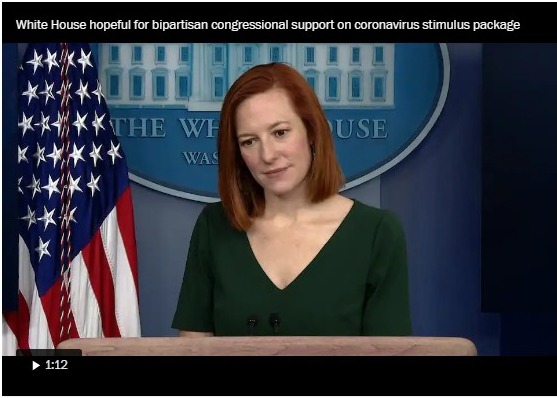
“What is happening now is there are children fleeing [persecution], fleeing threats in their own countries, traveling on their own, unaccompanied, to the border,” White House press secretary Jen Psaki told reporters Thursday. “And our focus is on approaching this from the view of humanity and from – and with safety in mind.”

Biden officials have faced daily questions from reporters and criticism from other Democrats who say the government should not be holding the migrant children, and allowing them to reunite with relatives as quickly as possible.

HHS and other agencies that care for the minors say they need to screen sponsors carefully, a task made more challenging when these adults lack legal status, a permanent address and other records. In 2014, teens were released to traffickers who put them to work on an egg farm in Ohio, an incident that outraged lawmakers and led to a more thorough vetting process.

“Each day brings new reports of a surge of arrivals at the U.S. southern border, which we know will increase the risk of trafficking in persons, especially for unaccompanied children arriving in greater numbers,” said Sen. Rob Portman, R-Ohio, the ranking GOP member on the Senate Homeland Security and Governmental Affairs committee, in a statement.

“I urge the Biden administration to ensure that these children do not fall victim to human trafficking, abuse, or other harm and that the agencies of jurisdiction improve their operations and meet their responsibilities under the law,” Portman said.

Family groups pose a different challenge to the administration. The Biden administration has continued to use the Trump-era pandemic order, known as Title 42, to quickly return them to Mexico. But last month, Mexican authorities stopped taking back some family groups in the Rio Grande Valley and other sectors, citing capacity limits in its shelter system.

The Biden administration started releasing those families into the U.S. interior in late January, typically after giving them a notice to appear in court and affixing some sort of GPS monitoring device to track their whereabouts.

Democratic officials in South Texas, a region devastated by the pandemic, have urged the Biden administration to stop the releases. Earlier this month, Del Rio Mayor Bruno Lozano implored Biden to halt the practice in a video uploaded to YouTube.

“I am pleading and requesting with you to put a halt to any measures regarding the release of immigrants awaiting court dates into the city of Del Rio and surrounding areas,” Lozano said.

Internal communications among DHS officials show agency leaders scrambling to avert a humanitarian crisis.

DHS Secretary Alejandro Mayorkas has asked U.S. Immigration and Customs Enforcement to help process families and transport them further north, away from the border towns and cities where local officials are upset with Biden, according to a Feb. 12 internal email obtained by The Washington Post.

Critics of the Biden administration, including some Democrats, have compared the tent facilities to the chain link enclosures denounced as “cages” during the Trump administration’s Zero Tolerance 2018 crackdown, when thousands of minors were separated from their parents by the government.

The McAllen, Tex., warehouse that is the Border Patrol’s largest facility for families and children is closed for a major renovation that includes the removal of the chain link fencing used to separate teens by gender and age. The chain link will be replaced with more humane-looking dividers, CBP officials say.

As attacks against Asian Americans spike, Jeremy Lin pushes for action #SootinClaimon.Com

#SootinClaimon.Com : ขอบคุณแหล่งข้อมูล : หนังสือพิมพ์ The Nation.

https://www.nationthailand.com/news/30403109

As attacks against Asian Americans spike, Jeremy Lin pushes for action

InternationalFeb 27. 2021Jeremy Lin, the former New York Knicks star guardJeremy Lin, the former New York Knicks star guard

By The Washington Post, Glynn A. Hill

Violence against and harassment of Asian Americans have spiked in the United States in the past year. Jeremy Lin, the former New York Knicks star guard, spoke out this week via social media, recounting his own recent experiences with anti-Asian racism and pushing for change.

“Something is changing in this generation of Asian Americans. We are tired of being told that we don’t experience racism, we are tired of being told to keep our heads down and not make trouble,” Lin, who plays for the NBA G League’s Santa Cruz Warriors, wrote in an Instagram post Thursday.

“We are tired of being invisible, of being mistaken for our colleague or told our struggles aren’t as real.”

Lin, who was born in California to Taiwanese parents, played in the NBA for nine years and became the first Asian American player to win an NBA championship when the Toronto Raptors defeated the Golden State Warriors in the 2019 NBA Finals. But he said that experience has not protected him from being called “coronavirus” on the court.

Such an incident fits into a broader surge of anti-Asian slurs and violence, which advocates anticipated would be amplified by former president Donald Trump’s anti-China rhetoric over the coronavirus pandemic.

Stop AAPI Hate, a group that tracks incidents of violence, harassment and discrimination against Asian Americans and Pacific Islanders in the United States, reported more than 2,800 incidents from March through December 2020.

Those incidents include a Korean man who was chased out of a convenience store restroom in California, a 67-year-old individual in New York who was spit on, as well as a further catalogue of threats, insults and physical assaults. An 84-year-old man from Thailand died as a result of injuries he suffered after an attack in San Francisco last month.

Some law enforcement agencies have reported an increase in bias attacks against Asian Americans, including New York City’s hate crimes task force, which investigated three such incidents in 2019, but saw a ninefold increase last year. Fears, anxieties and anger about those episodes have produced patrol groups in California and New York to combat that harassment.

Lin told NBC Sports Bay Area this week that he is “angry and heartbroken” about these incidents, and discussed what they have engendered in him.

“The first one is just this emotion of like, ‘Are you kidding me?’ Who does this, or why would you do this? And there’s an anger and a confusion and a frustration,” Lin said. “But as I take more time . . . after a while I feel bad. I feel bad for somebody who harbors hate for somebody else who they’ve never met just based on skin color or I don’t even know, so that makes me want to do something.”

Lin is 10th in G League scoring, averaging 19.6 points in 31.3 minutes through five games, although he has missed the last four. He has twice played in China and for eight teams throughout his NBA career, highlighted by a stint with the Knicks during which he captivated the league. A three-time All-Ivy League selection at Harvard, Lin recounted the discrimination he’s faced during his playing career on The Debrief podcast earlier this week.

“Growing up I only really experienced the overt racism like: ‘Oh, you’re a Chinese import. Oh, your eyes are so whatever,'” Lin said. “A lot of people [in the stands] are drunk but to see the violence on their face and their eyes are red . . . and they’re just like ‘The orchestra’s on the other side of campus,’ or ‘Can you even see the scoreboard with those eyes?’ or ‘Go back to China.’

“I’m playing in places that also have Asians in those same student sections. It was a little mind-boggling at the time but I learned a lot from it.”

Lin said he experienced “less of that” in the NBA, although he hopes coaches and scouts stop describing players of Asian descent as “deceptively” athletic. The league, for its part, released a statement against anti-Asian violence on Tuesday.

FDA says it will ‘rapidly work’ to approve Johnson & Johnson single-dose coronavirus vaccine after advisory panel’s unanimous vote #SootinClaimon.Com

#SootinClaimon.Com : ขอบคุณแหล่งข้อมูล : หนังสือพิมพ์ The Nation.

https://www.nationthailand.com/news/30403108

FDA says it will ‘rapidly work’ to approve Johnson & Johnson single-dose coronavirus vaccine after advisory panel’s unanimous vote

InternationalFeb 27. 2021

By The Washington Post, Carolyn Y. Johnson, Laurie McGinley

WASHINGTON – The Food and Drug Administration said Friday evening that it will “rapidly work” to authorize the Johnson & Johnson single-shot coronavirus vaccine, shortly after an expert committee unanimously recommended the vaccine.

In a statement, the agency said it has notified the company and federal officials involved in vaccine distribution so that they can prepare to ship the vaccine shortly. The FDA may issue an emergency use authorization as soon as Saturday, with the first few million doses of a shot that is relatively simple to store, handle and administer distributed next week.

On Friday, the agency’s vaccine advisory committee strongly endorsed the Johnson & Johnson vaccine, which will be the third coronavirus vaccine in the United States and the first to require just a single dose.

The third vaccine will arrive as the United States this week marked the grim milestone of 500,000 deaths at a crucial moment in the pandemic. After weeks of declining new cases, the downward trend has stalled – a change that makes many experts uneasy that officials are relaxing restrictions and people are letting their guard down just when variants capable of spreading faster or slipping by some aspects of immunity are poised to take off.

The Johnson & Johnson vaccine was 85% effective at protecting against severe cases of illness, and there were no deaths or hospitalizations a month after participants received the vaccine. The vaccine was less effective at preventing moderate to severe cases of illness, and some experts have feared there could be an erroneous perception among the public that they should wait for other vaccines, which could prolong the pandemic and leave people unprotected.

“It’s a relatively easy call; it clearly gets way over the bar, and it’s nice to have a single-dose vaccine,” said Eric Rubin, an infectious-diseases specialist at the Harvard T.H. Chan School of Public Health and a member of the advisory committee. “It’s a bit challenging about how to use it clinically right now, but the demand is so large, it clearly has a place.”

Adding another vaccine will help bolster the nation’s limited supply of the two authorized shots, one made jointly by Pfizer and its German biotech partner, BioNTech, and the other from Moderna. It should help accelerate the vaccination campaign, although the initial impact of the Johnson & Johnson vaccine is expected to be modest as the company ramps up manufacturing over the next month, with the first 20 million doses expected to be delivered by the end of March.

“There are limited options to control the virus,” said Gregory Poland, director of the Vaccine Research Group at the Mayo Clinic, who spoke to the FDA advisers as part of the Johnson & Johnson presentation and is a paid expert consultant to the company. “We need vaccines that are effective and well-tolerated, and – importantly – ones that are simple to deploy.”

Poland argued that a one-dose vaccine could speed up and simplify the effort to reach individual and herd immunity, making mass immunization campaigns that could end the pandemic more logistically feasible.

Johnson & Johnson applied to the FDA for emergency use authorization in early February, submitting clinical trial data involving 44,000 participants in eight countries. The data showed the vaccine was 72% effective in preventing cases of moderate to severe covid-19 in the United States, where variants of concern have only recently begun to be detected.

In South Africa, where a variant capable of evading some parts of immunity became dominant late last year, it was 64% effective against moderate to severe illness. Across countries, it was completely effective in preventing hospitalization and deaths a month after study participants received the shot.

During thepresentation to FDA advisers, company officials underscored the strong protection the vaccine provided against severe bouts of illness, the outcome that is of greatest concern. That protection was just as robust even in regions of the world where concerning variants have arisen.

Johnson & Johnson, like other companies, is working to create a second generation of the vaccine tailored to the variants as a precaution. An updated version of the vaccine would be ready to be tested in people in a small study before summer, in case it is needed, said Johan Van Hoof, global therapeutic area head of vaccines for Janssen, the Johnson & Johnson division that developed the vaccine.

The emergence of the variants has raised a debate among experts about when and whether vaccines might need to be updated – and whether they protect not only against illness, but infection.

“In the long run, we have to stop infection in order that we don’t give the coronavirus the opportunities to mutate and adapt. . . . We know that nobody’s going to be safe until we are all able to shut down the virus replication,” said A. Oveta Fuller, an associate professor of microbiology and immunology at the University of Michigan Medical School.

Compared with the first two vaccines, Johnson & Johnson’s one-shot vaccine was tested during a more complicated phase of the pandemic, when a variant capable of slipping by some immunity had emerged.

The United States backed the development of the vaccine and has ordered 100 million doses through $1.5 billion in contracts. Federal health officials have said 3 million to 4 million doses could be shipped next week, if the vaccine is authorized, with 20 million doses total expected in March. The remaining doses are scheduled to be delivered by the end of June.

“During the last two months, we have all seen it is critically important to manufacture and distribute vaccines quickly and efficiently. And Janssen’s vaccine offers logistical and practical advantages to help simplify the distribution and expand vaccine access,” Van Hoof said.

There was some discussion among committee members about another trial testing two doses that is expected to report results later this year. Van Hoof said the company settled on a one-dose vaccine trial first because there was good evidence to suggest that it would be highly effective and that such a vaccine would be the best tool to get the pandemic under control and to reach more people.

The first coronavirus vaccines in the United States were authorized in December. They are being distributed nationally in an unprecedented drive to stem covid-19.

The advisory committee, which includes pediatricians, infectious-disease doctors and biostatisticians, heard presentations by the FDA, the Centers for Disease Control and Prevention and Johnson & Johnson. The stage was set for the committee’s positive recommendation on the vaccine by the FDA’s upbeat assessment, issued Wednesday.

The efficacy rate was lower, about 42%, in preventing moderate to severe illness in adults 60 and older who had diabetes, obesity or other chronic medical conditions. But the FDA said there was a high degree of statistical uncertainty regarding the data, which might reflect a smaller number of participants in that category.

The FDA, in deciding whether to clear a product, usually follows the nonbinding advice of its outside experts. An emergency use authorization is not a full approval. It is a temporary clearance that can be granted relatively quickly during a public health emergency and requires a lower level of evidence. But the FDA decided last year to use criteria for coronavirus vaccines that were nearly as rigorous as what is used for approvals.

A CDC advisory committee is scheduled to meet after the FDA’s expected authorization to recommend who should get the vaccine.

All the vaccines in late-stage development work by introducing the immune system to versions of the spike protein that dots the outside of the coronavirus. But the Johnson & Johnson vaccine adds a different technology to the mix, one that takes a more established approach than the Pfizer-BioNTech and Moderna products.

The new vaccine uses a harmless cold virus that has been genetically tweaked so that it cannot make copies of itself. That cold virus acts as a vector to deliver a gene encoding the spike protein to cells. The Pfizer-BioNTech and Moderna vaccines, in contrast, deliver a strip of genetic material called messenger RNA that carries the instructions to build the spiky protein found on the outside of the virus.

In all three vaccines, cells follow genetic instructions to construct the spike and the immune system learns to recognize the real thing from these replicas.