2021 looks like a black hole for battered European tourism
InternationalFeb 15. 2021People socialize at Camoes Square ahead of the afternoon curfew in Lisbon, Portugal, on Nov. 22, 2020. MUST CREDIT: Bloomberg photo by Jose Sarmento Matos.
By Syndication Washington Post, Bloomberg · Paul Tugwell, Flavia Rotondi, Alberto Brambilla
Across Southern Europe’s tourist hotspots, all they can do is get ready and hope.
Vaccinations for the coronavirus are being rolled out, but it’s going to be months before enough shots are delivered that people can start crowding onto planes, taking cruises, or hanging out in packed bars along the beach. That means businesses are largely in the dark about this year’s summer season.
The expectation is that it will be better than 2020, but that’s a low bar to hit. On the Greek island of Santorini, just three cruise ships arrived last year, compared with close to 600 in 2019. European Commission figures released on Thursday showed non-resident holiday nights in Italy, Spain and Greece fell at least 70%, and it warned the industry to brace for another quiet year.
“Tourism flows on the whole are not expected to fully recover to their pre-crisis levels in 2021,” the commission said. In Italy, tourism will lag behind the broader economic recovery as visitors “only gradually return as uncertainty diminishes.”
For those in the industry, that’s already apparent less than two months into the year. Paolo Manca, who runs the Felix Hotels chain in Sardinia, says he would normally see summer reservations at 30% by now as people grow weary of long winter nights. Instead, he’s looking at near empty books.
It’s a difficult situation for owners, who still have maintenance and hiring costs with no guarantee of income.
“We need to be ready without knowing if we can open,” said Manolis Karamolegos, who owns Meltemi Hotels and Resorts in Santorini and is president of the local hoteliers ‘association. “We can’t leave preparations to the last minute.”
The temple of the Parthenon in Athens, Greece, Oct. 4, 2020. MUST CREDIT: Bloomberg photo by Yorgos Karahalis.
Tourism is crucial for many places along Southern Europe. It accounts for 21% of the economy in Greece, and 17% in Portugal. It’s often the main employer in regions where other industries are absent, providing crucial income for families and support for local economies.
The outlook will improve as vaccinations continue, with pent-up demand leading to more spontaneous holiday bookings. But the emergence of vaccine-resistant strains across the continent could scupper that.
Even if there’s a surge in last-minute bookings, the benefits won’t be felt evenly. The European Commission says they will favor destinations at home or within driving distance over places like Greece and Portugal.
Meanwhile, as the European Union’s inoculation campaign progresses slowly — and controversially — governments are looking at any opportunity to help tourism.
Greece wants the European Union to create a certificate so those who are inoculated can travel freely. It’s already made an agreement with Israel, which is the world leader in vaccinations, according to the Bloomberg Vaccine Tracker.
TUI, the world’s biggest tour operator, said this week it’s sticking with plans to offer four-fifths of its usual holiday program this summer. It’s betting that the rapid pace of the U.K. vaccine rollout will boost demand from British sunseekers.
But its enthusiasm isn’t shared by the U.K. government. Transport Secretary Grant Shapps advised Britons this week against booking holidays yet given the uncertainty.
“I simply don’t know the answer to the question of where we’ll be up to this summer,” he said. “The best advice is do nothing at this stage.”
Some hotels in Southern Europe are seeing stronger domestic demand, which will offset some, but not all, of the hit to revenue. In Portugal, Pestana Hotel Group Chief Executive Officer Jose Theotonio said rooms in his January sales were snapped up by locals, as ongoing fear of travel bans and quarantines deterred foreign visitors.
While vaccines should bring to an end such harsh measures, it’s still very unclear when. And governments have often been haphazardly introducing restrictions, keeping businesses, and their potential customers, on edge.
“We need precise indications from the government, in terms of safety guidelines, protocols, in order to plan ahead,” said hotelier Manca, who is also head of hoteliers’ association Federalberghi Sardegna. “For tourism, lack of clarity is as damaging as covid itself.”
By The Washington Post · Tory Newmyer, Matt Zapotosky
The Biden administration is sending a clear signal to Wall Street that the industry’s Washington cops are back on the beat. Regulators and federal prosecutors are probing potential misconduct in the GameStop trading frenzy, as the Securities and Exchange Commission moves to restore harsher penalties on wrongdoers.
Attorneys in the Justice Department’s criminal division are conducting a wide-ranging investigation into possible market manipulation from the trading surrounding GameStop, and recently issued a subpoena to Robinhood as part of that, a person familiar with the matter said. The probe, though, appears to be in its early stages.
SEC acting chair Allison Herren Lee in a radio interview earlier this month said the agency already is investigating the matter “from a number of different angles, and they’re very significant.”
Specifically, she indicated the agency is looking into whether brokers such as Robinhood complied with regulations when they limited trading in certain so-called “meme stocks.” And she said the agency is looking for signs of market manipulation amid the trading mania. A Robinhood spokesman declined to comment.
Beyond the GameStop probe, Lee said Thursday that the agency is reversing a policy that shielded financial firms settling charges from further punishment. Under the Trump-era approach, the SEC bundled settlement agreements with waivers that allowed the targeted companies to continue raising money in public markets.
Lee in a statement said the new policy marks a “return to the division’s long-standing practice” and ensures “that the consideration of waivers is forward looking and focused on protecting investors, the market, and market participants from those who fail to comply with the law.”
The same day, the SEC announced it suspended trading in SpectraScience, a defunct company that had seen its stock zoom amid social media chatter. The agency said in a statement that “certain social media accounts may be engaged in a coordinated attempt” to boost the share price of the company, a Minnesota-based business that had not filed any reports since 2017.
The suspension itself was unremarkable. The SEC acted similarly more than 100 times last year. But the agency used the move as an opportunity to remind investors they should “exercise tremendous caution when investing based on social media or a sudden surge of enthusiasm for a particular security, especially where that interest does not appear tied to any news about the company or industry,” Melissa Hodgman, the acting head of the agency’s enforcement division, said in a statement.
Taken together, the SEC’s moves “certainly signal a changing of the guard,” said Philip Moustakis, a former senior counsel in the SEC’s enforcement division now with Seward & Kissel.
But Moustakis also noted that despite invoking the GameStop frenzy in its announcement of its latest trading suspension, the SEC did not halt trading in GameStop itself. He said that signals the agency “made an initial determination that the facts and circumstances here don’t give rise to sufficient concerns about manipulation to warrant a suspension” of that stock or others that saw dramatic run-ups thanks to attention they attracted from amateur investors.
The matter is poised to get further scrutiny in the coming week, when the House Financial Services Committee convenes a Thursday hearing on it. The panel’s witness list so far includes Robinhood CEO Vlad Tenev, Citadel CEO Ken Griffin, Melvin Capital CEO Gabriel Plotkin, Reddit co-founder Steve Huffman, and Keith Gill, the trader with a huge online following who helped set off the GameStop surge.
DAKAR, Senegal – Public health officials in Guinea declared a new epidemic of Ebola on Sunday after recording seven cases and three deaths – the first resurgence since the hemorrhagic fever devastated the West African nation and two neighbors from 2014 to 2016.
More than 11,300 people died in the last outbreak, the deadliest on record, which started in a rural Guinea village before tearing through Liberia and Sierra Leone.
Health investigators are rushing to trace and isolate suspected contacts, said Sakoba Keita, head of the National Health Security Agency. The country is building a new Ebola treatment center.
But resources are thin in Guinea, one of the world’s poorest countries, which was already battling the coronavirus pandemic on top of outbreaks of yellow fever and measles.
“We are facing four epidemics at the same time,” Keita said.
The nation of 13 million has recorded 14,895 coronavirus infections and 84 deaths.
An Ebola vaccine rollout is expected to begin as early as this week in the southeast region of Nzerekore, Keita said, where the latest outbreak was detected.
Authorities blamed the spread on the Feb. 1 funeral of a nurse.
It’s unclear if Ebola caused her death, Keita said, but seven people who attended the burial later showed the telltale symptoms: diarrhea, vomiting and bleeding.
Three died: One man and two women.
“Faced with this situation and in accordance with international health regulations, the Guinean government declares an Ebola epidemic,” Guinea’s health ministry said in a statement Sunday.
The government urged anyone with symptoms to contact a doctor. Officials set a goal: Containment in six weeks. “Together, we will win!” Remy Lamah, the health minister, said in a statement.
Ebola is spread through contact with bodily fluids. Corpses of those who died from the illness are also infectious.
The World Health Organization called for a swift response to the threat in Guinea.
“It’s a huge concern to see the resurgence of Ebola in Guinea, a country which has already suffered so much from the disease,” said Matshidiso Moeti, the WHO’s regional director for Africa. “However, banking on the expertise and experience built during the previous outbreak, health teams in Guinea are on the move to quickly trace the path of the virus and curb further infections.”
The last outbreak began in the same region. The first case, reported in December 2013, was an 18-month-old boy in a rural village. Doctors believe he was infected by a bat.
The contagion blazed through Conakry, the capital, and into neighboring countries. Officials recorded 28,616 cases in Guinea, Liberia and Sierra Leone before the outbreak was contained.
Also Sunday, the Democratic Republic of Congo confirmed a fourth new case of Ebola in North Kivu, where a flare-up of the virus was reported on Feb. 7. (The outbreaks are not thought to be linked.)
Authorities declared the end of Congo’s nearly two-year outbreak in June after more than 2,200 deaths.
Mexico hopes to work with Cuba on covid vaccine Phase 3 trial
InternationalFeb 15. 2021A healthcare worker administers a dose of the Pfizer BioNtech covid-19 vaccine at the Centenario Hospital Miguel Hidalgo in Aguascalientes, Mexico, on Jan. 14. MUST CREDIT: Bloomberg photo by Mauricio Palos
By Syndication Washington Post, Bloomberg · Fabiola Zerpa
Mexico is in talks with Cuba to host part of a trial on a covid-19 vaccine in an effort to draw more supplies from international laboratories as doses run short in the country and the death tally grows.
So far, just 0.5% of Mexico’s population has received at least one vaccine against the coronavirus, compared with 11.5% in the U.S., according to the Bloomberg vaccine tracker.
The country received 870,000 AstraZeneca vaccines from India on Sunday and is preparing to start inoculations of its elderly, officials said during a press briefing headed by President Andres Manuel Lopez Obrador. Of the total, 10% will be channeled to Mexico City.
AMLO, as the president is known, pledged during the briefing from Oaxaca state to vaccinate more than 15 million people above 60 years of age by mid-April with at least a first dose.
Mexico is negotiating with Cuba to host part of a Phase 3 vaccine trial and will announce it once health regulator Cofepris approves it, Foreign Minister Marcelo Ebrard said. Cuba has four vaccine candidates in trials, the Wall Street Journal reported in January.
Mexico is racing to reach vaccine deals with several companies and nations, among them China, Russia and now Cuba, as inoculations remain slow. AMLO said Mexico is looking at developing its own vaccines.
So far, Mexico has inked deals with the United Nations’s vaccine system COVAX, Pfizer/BioNTech and China’s CanSino Biologics. The country was first in the region to start a vaccination plan in late December, but the pace has lagged.
Mexico reported 173,771 deaths from the virus as of Saturday night, the third most in the world. Total cases are approaching 2 million.
Other details from Sunday’s press conference:
– The first batch of AstraZeneca vaccines are being sent to seven states by land and to the rest of Mexico’s states by air so that all states receive some shots. Mexico City is getting 87,000 of the initial doses. AstraZeneca vaccines that arrived Sunday are ready to administer and another 1.2 million such doses from India are due to arrive in March. The Indian shipment was going to be reduced to 500,000 doses, but Mexico pressed India to deliver the full amount, AMLO said.
– Pfizer will deliver 490,000 vaccines on Tuesday and a second batch the following week, Ebrard said. The Pfizer batch will go toward second doses for health care workers.
– Vaccination of elderly will go ahead in all states, starting with 330 small towns, so that the least fortunate are also being vaccinated, AMLO said.
– Russia’s Sputnik V vaccines are supposed to arrive next weekend.
– China’s Sinovac is set to send Mexico 1 million doses in the coming days, Ebrard said.
Biden aide feels heat from all sides on White House equality vow
InternationalFeb 15. 2021Rep. Cedric Richmond, D-La., speaks during a news conference on Capitol Hill on July 1, 2020. MUST CREDIT: Bloomberg photo by Erin Scott
By Syndication Washington Post, Bloomberg · Mario Parker
As President Joe Biden seeks to address racial inequities across the U.S., he’s turned to former congressman Cedric Richmond to help keep a promise to end discriminatory practices ranging from housing to voting rights – a task complicated by the risk of alienating Republicans whose support is needed on key legislative priorities.
Richmond, a Louisiana lawmaker who led the Congressional Black Caucus during the Trump administration, heads Biden’s Office of Public Engagement. There, he’s the counterpart for outside groups and activists ready to hold the president accountable for his pledge to address the nation’s deep-seated racial divisions.
Together with his promise to fight inequality across all policies, Biden campaigned on healing the nation’s political rifts and working across the aisle to restore civility in Washington. But many Republicans have rejected the president’s call to address racial disparities – and even the notion that institutionalized racism exists – setting up a potentially persistent conflict for Richmond to negotiate.
“We’re listening to everybody and we’re going to take input, but that doesn’t mean that we’re going to compromise our values,” Richmond said in an interview. “I’ll just give you one old African proverb as a way to think about it: When two elephants fight only the grass suffers. And so we want to make sure that the people are not the grass – that you have endless fighting and they never get help.”
Biden has staked his presidency on bringing the coronavirus pandemic to heel and reinvigorating the U.S. economy after the crisis dealt a disproportionate blow to minorities.
But aside from immediate relief, civil rights groups demand structural changes that would help address racial economic disparities and rights going forward. That includes passing a new voting rights law to expand ballot access, even as Republican legislatures attempt to enact measures that would tighten rules on voting – moves that would disproportionately affect minority groups, their advocates say.
“It’s important that President Biden has named racism as one of the crises that he must attack, along with covid, along with the climate crisis and the economy,” said Judith Browne Dianis, executive director of the Advancement Project National Office, a civil rights group. “And so our task, as the outside groups, is to make sure that they are being real on their commitment.”
As the main conduit between Biden and outside liberal groups pushing to undo former President Donald Trump’s policies and advance a progressive agenda, Richmond will deal with issues ranging from unequal health care to police brutality. Other important administration figures on those issues, Dianis said, include Catherine Lhamon, who’s in charge of racial justice and equity on the Domestic Policy Council; Kristen Clarke, Biden’s nominee for assistant attorney general for the Civil Rights Division; and Vanita Gupta, his nominee as associate attorney general.
“I might be what my dad used to call a jack of all trades, a master of none. In baseball terminology, more of a utility player,” said Richmond, a former college ballplayer who helped Democrats dominate Republicans in their annual charity game.
Biden, Richmond recounted, “said over and over on the campaign trail that he wants to be a very transformational president, that he wants to empower groups that generally were not empowered. And he wants his legacy to be that of the most empowering president to ever govern.”
Biden made significant moves in his first weeks in office, issuing directives to rescind Trump’s ban on diversity training for federal workers, prevent discrimination in housing and end the use of private prisons. The president has infused his pandemic response with measures to address the virus’s out-sized toll on Black and Brown Americans, and has outlined plans to invest $150 billion in minority-owned small businesses and increase spending for Historically Black Colleges and Universities.
Richmond said these early steps are a key signal to the public that Biden’s pledge to work toward equity was serious.
“That is a big deal. That means we are looking for and watching and being intentional about equity throughout government. So that means advertising, procurement, that means education,” Richmond said in an interview. “But even within our Covid package and Covid response, so far we’ve done it through a lens of racial equity, too.”
Richmond, 47, graduated from Morehouse College, a Historically Black College and University in Atlanta, before earning his law degree from Tulane University in New Orleans.
He was first elected to Louisiana’s House of Representatives when he was 26 years old, and served for 11 years before being elected to the U.S. House in 2010. He chaired the Congressional Black Caucus from 2017 to 2019 – a period characterized by deep racial strife as Trump’s divisive rhetoric helped fuel a resurgence of white supremacism.
Under Richmond’s leadership, the caucus delivered a 125-page report to Trump rebutting his “what have you got to lose?” pitch to Black voters during his 2016 campaign. The report was titled: “We Have a Lot to Lose: Solutions to Advance Black Families in the 21st Century.”
The group champions many of the issues on Biden’s agenda, such as criminal justice reform, eliminating health disparities and addressing the wealth gap. But Richmond can also help Biden reach across the aisle; as a lawmaker, he cultivated relationships with key Republicans including Steve Scalise of Louisiana, the second-ranking GOP member in the House, who calls Richmond a “close friend.”
Republicans have already signaled that an uphill battle awaits Biden’s initiatives on race.
Senate Minority Leader Mitch McConnell refused to allow a floor vote on the voting rights bill when his party controlled the chamber under Trump. Sen. Tom Cotton of Arkansas has taken issue with Biden’s plan to end systemic housing discrimination and boost home ownership in communities of color.
“Is it ever appropriate for the government to treat people differently based on their race?” Cotton asked during a confirmation hearing for Marcia Fudge, Biden’s nominee for secretary for Housing and Urban Development.
And Sen. Rand Paul, R-Ky., said that Biden’s inaugural address, which focused heavily on inequality, amounted to an allegation that Republicans were racist.
But Joe Trippi, a Democratic strategist, said Biden and Richmond may be able to win “surprise” Republican votes on some equity measures. For example, he said former Sen. Doug Jones, D-Ala., whom he previously worked for, cosponsored legislation with Sen. Ted Cruz, a Texas Republican, on reviving cold cases from the Civil Rights era.
In Richmond, Biden has “an astute politician” who can manage the challenge, said James Clyburn, the third-ranking Democrat in the House.
Clyburn – who is largely credited with saving Biden’s faltering campaign when he endorsed him ahead of South Carolina’s Democratic primary – was instrumental in introducing Biden to Richmond, leading to the prominent White House role. Clyburn is a powerful political figure among Black Americans and civil rights groups and said he expects Richmond to be involved in all major policy discussions at the White House.
“He will make a very effective adviser to the president,” Clyburn said, cautioning Biden to heed Richmond’s counsel. “If he doesn’t, he’ll hear from me.”
Biden has signaled he has no intention of defining Richmond’s role narrowly or limiting him to inequality issues. On Feb. 5, for example, Richmond was part of an Oval Office meeting to discuss the pandemic relief package with House Democrats.
Richmond is “a young man but a seasoned politician,” said Marc Morial, president of the National Urban League and former mayor of New Orleans, who has known Biden’s aide since his political career began two decades ago.
“The president needs him around the table on every big decision.”
‘Dearest Sweetheart’: The passion and poignancy of wartime love letters
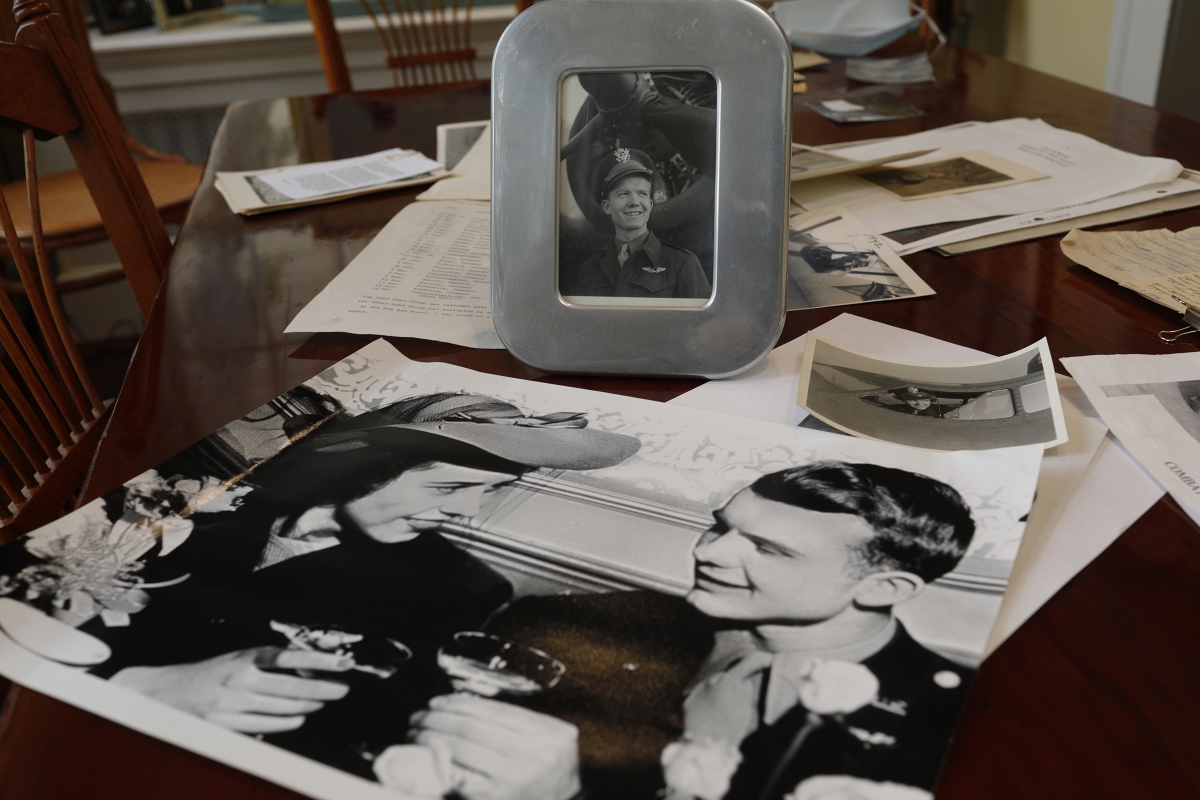
InternationalFeb 15. 2021Celia Straus shows her collection of letters and photos from her parents, Raymond and Patricia Brim, to historian Andrew Carroll of the Center for American War Letters. MUST CREDIT: Photo for The Washington Post by Robb Hill
By The Washington Post · Gillian Brockell
“Darling, I hope you like this rather weird pose. This was the surprise I had for you and I do hope you like it. I love to keep you well supplied with pictures, so you won’t ever have a chance to forget me … so this photo is from me … Lots of love and millions of kisses, Pat.”
Those are the words Patricia Brim, 20, wrote to her husband, Raymond, on Valentine’s Day 1944, with a photo of her “rather weird pose” attached. Raymond was in the Army Air Corps, fighting the Nazis in Europe on dangerous bombing runs. A little more than a year earlier, he had gone AWOL from his air base in Wyoming for 48 hours so he could quickly marry Patricia in Utah before being sent overseas.
“My dad said a hundred times, a thousand times: ‘I swore to myself I would come home to Pat,'” said their daughter Celia Straus on Saturday.
He did. Now, 77 years later, Straus, who lives in Washington, D.C., is handing her mother’s love letters over to a longtime acquaintance, historian Andrew Carroll.
“These are really rare,” Carroll told The Washington Post. “Back then it was mostly men writing home to their wives, so they (the wives) could keep the letters. But if the wives wrote the husbands, they (the husbands) couldn’t in many cases hold onto them.”
A photo of Patricia Brim, which she had taken on Valentine’s Day 1944, to give to her husband, Raymond, who was serving in World War II. Two love letters she wrote to him are with the photo. MUST CREDIT: Photo for The Washington Post by Robb Hill
Carroll knows this better than anyone; he has been collecting war letters since his sophomore year of college in 1989. His family home in D.C.’s Georgetown neighborhood burned down that year. He was upset over the loss of family memorabilia, so, perhaps to console him, an older cousin showed him a letter the cousin had sent his wife during World War II.
When Carroll tried to return the letter, the cousin told him, “Keep it. I probably would have thrown it away anyway.”
“And that was the spark,” Carroll said.
Since then, Carroll has collected more than 100,000 war letters. He has letters from American conflicts from the Revolutionary War through the wars in Iraq and Afghanistan (which now come in email form). He has often picked up old letters in person, earning him the nickname “the historian who makes house calls.”
There was a book compilation of the letters, a PBS documentary, and a play that made it to the Kennedy Center. The latest iteration is a podcast, called “Behind the Lines,” with journalist Barbara Harrison.
Other than descriptions of combat, the most common subject of the letters is love.
“Everything becomes more vivid in the prism of warfare,” Carroll said, “The letters of faith are a little more philosophical; the letters of love are a little more impassioned, because a lot of them realize this might be the last letter their spouse receives.”
There are tragic ones. During World War II, a woman named Gene Sobolewski, who was in the Women’s Army Auxiliary Corps, sent a letter to her fiance on the front lines:
“Dearest Sweetheart,
I didn’t write to you last night, Honey, but I guess you won’t miss one letter. You get my mail in bunches anyhow. Besides, I always write about the same subject, hundreds and thousands of books were written about it also. I’m talking about ‘love.'”
Months later, the letter was returned to her unopened with red letters on the envelope: “Deceased.”
“It’s heartbreaking,” Carroll said. “Because they weren’t married, she was not officially notified. His parents got the official notification, so this was how she found out the love of her life was gone forever.”
Sobolewski eventually married another service member and had children, but she kept the unanswered letter her entire life. Her daughter donated it to Carroll.
There are happy stories, too. Nathan Hoffman had gone on only five dates with Evelyn Giniger in New York City before he was shipped overseas during World War II. They wrote each other every day, and because of Hoffman’s assignment as an Army clerk, he was able to keep her letters. When he returned to his hometown of Waco, Texas, 16 months later, she was there waiting for him. They married soon afterward.
They were still happily married in 1999 when they donated their complete collection – more than 2,000 letters, Carroll said. Months later, director Steven Spielberg contacted Carroll. Spielberg said was directing a special millennium celebration show for CBS and hoped to have an elderly couple read their World War II letters onstage; might Carroll know anyone who fit the bill?
That was how the Hoffmans found themselves on the steps of the Lincoln Memorial on New Year’s Eve, surrounded by celebrities and in front of President Bill Clinton, reading their sweet nothings aloud.
“My dearest Evelyn, in leaving I have only one regret – that I was unable to see you just one last time. There was so much that we didn’t get around to talking about, a great deal that I’m sure each of us would have said that now will have to wait . . .”
“My dear, every day I miss you a little bit more. And today, I miss you like tomorrow. The knowledge that you’re getting closer to the front makes me tremble every time I think of it. I wonder how you must feel. All I can do is pray and keep a hopeful heart …”
Nathan Hoffman died in 2005, Evelyn Hoffman in 2011. They were married for 59 years.
Raymond and Patricia Brim married on Dec. 7, 1942, at St. Mark’s Cathedral in Salt Lake City. To do so, he went AWOL from his base in Cheyenne, Wyo., for 48 hours. His crew covered for him. MUST CREDIT: Photo for The Washington Post by Robb Hill
Carroll has acquired letters from gay and lesbian service members, but none of them are love letters – an empty space he very much hopes to fill. He is still haunted by a radio interview he did 15 years ago, when a man called in and said he and his boyfriend used to send each other love letters in code during the Vietnam War. Carroll told the man he would be honored to have the letters; the man said he would consider it, but Carroll never heard from him again.
He has tried, without success so far, to contact Secretary of Transportation Pete Buttigieg, about a letter he spoke of on the campaign trail. Buttigieg described writing a “just in case” letter to his parents in 2014 before leaving for Afghanistan. He vowed to come out of the closet if he returned home safely.
“It’s funny to think that I wrote that trying to project a sense that I didn’t have any resentment over missing out on things, when what I was missing out on then was now the most important thing in my life,” Buttigieg told USA Today in 2019. He met his husband, Chasten, after returning from Afghanistan in 2015.
For a time, Carroll rented the apartment next door to his own just to store the letters. In 2013, he donated the collection to Chapman University in California, and it became the Center for American War Letters, where they will be preserved and digitized.
He was still making house calls on the center’s behalf when the pandemic hit. Though the work has been put on hold for nearly a year, the center is still accepting submissions. “We’ve actually seen a huge uptick in donations throughout the pandemic, and it’s because people are trapped in their homes,” Carroll said.
Straus, who works with veterans experiencing PTSD and traumatic brain injury, has known about Carroll and his letter-collecting mission for years; they have worked together on veteran support projects. Her parents were happily married for 65 years until her mother’s death in 2007. Her father died in 2019, and she inherited the old manila folder stuffed full of letters. Reading them is inspiring, she said, because the immediacy “makes me grasp the bravery of these kids.”
Straus has received the coronavirus vaccine, and Carroll followed strict guidelines so he could safely meet with her Saturday and accept the letters.
“I hope their story inspires others to save their letters from relatives who served, because they are so important to our country,” she said. “Particularly right now.”
So, in honor of Valentine’s Day, here is a transcript of one her mother’s letters, written for a different holiday, Christmas 1943:
– – –
My darling,
This is just to try and half express what I feel – because it’s Christmas and because you’re over there and I’m here so far away from you. Of course, I’m writing it way ahead of time but the feeling is the same and always will be, dearest, for that matter.
To say that I am thinking of you, dear, is not to touch it. Christmas Eve is when it will be the worst, because all I’ll see is us last year – having our little supper and our tree – and church in the snow and all that. We were afraid we’d be homesick and darling, I can truly say I’ve never in my life been less homesick or more happy. It was all heaven, every moment with you – loving you as I do, and knowing that I have a husband who is so wonderful and sweet and tender and loves me so terribly.
Darling, I’ve missed you terribly since you went away, but it’s nothing to how I’ll feel when you read this. I’ve tried to send a few things to help make it a better Christmas but perhaps I can promise that next year, when we’re together, we’ll have our love and happiness and the most perfect Christmas in the world. Ray, my dearest darling, I love you. I love you with all my heart and body and soul. Nothing can ever change it. And so, darling, a Merry Christmas and God keep you always,
Agency founded because of 9/11 shifts to face threat of domestic terrorism
InternationalFeb 15. 2021Kevin McAleenan, the acting homeland security secretary
By The Washington Post · Nick Miroff
WASHINGTON – On a Saturday morning in August 2019, a 21-year-old White man with ear protectors, safety glasses and an AK-47-style rifle walked into a crowded Walmart in El Paso, Texas, his pockets bulging with ammunition. He had driven hundreds of miles across the state, prosecutors say, because he wanted to kill Latinos.
Kevin McAleenan, the acting homeland security secretary, was at a Coast Guard picnic in Virginia that day, and soon the urgent messages began arriving. A sinking feeling of horror set in as the magnitude of the attack became clear. “It was devastating,” he said.
Twenty-three people were killed in the deadliest attack targeting Hispanic people in modern U.S. history.
About 5,000 U.S. Customs and Border Protection (CBP) employees live in El Paso, and six lost family members that day. “To have an individual attack us, at one of the home bases of our agency and specifically going after Hispanic Americans who make up a majority of our employees in that area, was very personal for us, and it galvanized an effort that was already underway,” McAleenan said.
For years leading to the El Paso attack, the Department of Homeland Security (DHS) – created to prevent another attack like the ones on Sept. 11, 2001 – had been under growing pressure to do more to address domestic extremism. Within seven weeks of the El Paso massacre, McAleenan released a plan for “countering terrorism and targeted violence” in the department’s pivot from foreign threats to homegrown ones. It was the first time the DHS had identified the extent of the danger posed by domestic violent extremists and white supremacists.
The plan got little attention or support from the White House, and although the DHS was more direct about domestic threats, the effort made little difference on Jan. 6, when the department was one of several federal agencies caught flat-footed. Since the attack on the Capitol, calls have intensified for the DHS to turn its attention inward and do more to protect Americans from other Americans.
The Jan. 6 attack has left many lawmakers, and especially Democrats, insisting that domestic terrorism has eclipsed the threat from foreign actors such as the Islamic State and al-Qaida. The DHS and its agencies are responsible for securing the country’s borders, ports, transportation and cybersystems, generally leaving the monitoring of extremist groups and terrorism investigations to the FBI. But the DHS and its agencies have nearly eight times as many employees as the FBI, and calls for the department to play a more muscular role in combating domestic extremism have policymakers looking at new ways to use its resources.
The proposals have revived some of the civil liberties concerns that arose after the creation of the department as a large, internal security bureaucracy with a broad mandate. And the possibility of the department scrutinizing Americans has added to the unease, because providing homeland security is less controversial when the threats are foreign.
The DHS used its National Terrorism Advisory System to warn the public about attacks by domestic groups for the first time last month, citing “a heightened threat environment across the United States” in a bulletin issued a week after President Joe Biden’s inauguration.
“Ideologically-motivated violent extremists with objections to the exercise of governmental authority and the presidential transition, as well as other perceived grievances fueled by false narratives, could continue to mobilize to incite or commit violence,” the warning stated.
Rep. Bennie Thompson, D-Miss., chairman of the House Homeland Security committee, has long insisted that the DHS should protect Americans from the gravest dangers they face; domestic extremists and white supremacists, he said, present the most urgent, lethal threat.
“A lot of them mask themselves under some guise of being patriots or some form of citizen, but the question is, what do they advocate? It’s violence. It’s overthrowing legitimately elected officials,” Thompson said in an interview.
“So in my mind, those types of individuals who want to exercise violence to bring change, they are domestic terrorists, and we have the obligation to identify who they are and prosecute them to the fullest extent of the law.”
During a hearing Thompson held this month, lawmakers of both parties spoke favorably of new legislation to address domestic terrorism. Experts warned that the Jan. 6 attack was viewed as a “victory” for extremists and a “watershed moment for the white supremacist movement.”
Rep. Michael McCaul, R-Texas, the committee’s former chairman, joined lawmakers calling for specific federal sanctions for domestic terrorism, potentially applying the same penalties as exist for terrorism that originates overseas. Such legislation could include penalties for providing material support to domestic groups, as well as laws holding technology companies responsible for violent and extremist content on their platforms.
“It sends a strong message about where Congress is that we’re going to treat domestic terrorism on an equal plane as international terrorism,” McCaul said.
– – –
Contrary to some television portrayals, the DHS does not have a standing contingent of armed homeland security agents with a specific mandate to stop domestic terrorism. But it has agencies and programs that could expand to devote more attention and resources to risks posed by homegrown extremists.
The DHS’s Office of Intelligence and Analysis collects information from the FBI, private contractors and state and local law enforcement agencies to organize and disseminate threat reports. Its employees and contractors generally lack the training and experience of FBI investigators, and they rely heavily on open-source material.
The office did not generate a specific warning about the possibility of right-wing groups storming the Capitol on Jan. 6 in an attempt to keep President Donald Trump in power.
Homeland Security Investigations, a branch of U.S. Immigration and Customs Enforcement (ICE), has about 6,000 agents nationwide who investigate drug smuggling, human trafficking and illicit goods or currency. The branch has not focused on countering domestic extremism, but it’s an armed component of the DHS that, in theory, could have a more hands-on role stopping homegrown terrorists and white supremacists.
The DHS’s most tangible institutional response is the Office for Targeted Violence and Terrorism Prevention, founded in 2019 to address “a growing threat from domestic actors – such as racially and ethnically motivated violent extremists, including white supremacist violent extremists, anti-government and anti-authority violent extremists, and others.”
Its work is primarily preventive, not investigative, providing grants to state and local law enforcement programs and issuing threat briefings and assessments. The office remains relatively small, with a staff of about 30, but it’s expected to grow in the coming years with more congressional funding.
“In the post-9/11 world, the threat was foreign terrorism,” said Tom Ridge, the first DHS secretary. “The CIA and the military were the tip of the spear, and we filled the defensive gap. But now there’s another adjective in front of terrorism: domestic terrorism.”
The well-known failure of law enforcement and security agencies to properly share information ahead of the 9/11 attack was a justification for the creation of the DHS, Ridge noted. So an immediate challenge for the department will be coordination among federal agencies that collect and share information on domestic groups, he said.
Much of it arrives through state and local law enforcement agencies, and the DHS’s biggest asset, Ridge said, “is its relationships with state and local authorities.”
Yet Ridge cautioned against the DHS turning its attention away from foreign threats and other priorities. “What people don’t understand – and people need to understand – is that DHS has so many other tasks embedded in its mission,” he said. “It’s a multitask organization, and DHS has to be careful moving in that direction because I still don’t think it’s their primary job.”
Another risk is partisanship, and the perception that the DHS will be used to stigmatize or harass groups that do not support the party in power.
In September, the former head of the DHS’s Intelligence and Analysis Office, Brian Murphy, filed a whistleblower complaint that included allegations that senior DHS officials sought to minimize warnings of the threat posed by white supremacists while giving more prominence to left-wing antifascists and anarchists. Murphy told his supervisors that it would constitute “censorship of analysis and the improper administration of an intelligence program,” according to his account.
His claims remain under investigation with the DHS’s inspector general. Other former DHS officials, including some who are critical of Trump, insist that the department did not play down the threats of right-wing and white supremacist groups. They point to new DHS programs and strong language in recent reports clearly identifying the threat posed by domestic extremists.
McAleenan, the former acting DHS secretary, also noted a major increase in FBI investigations of domestic extremists and white supremacists in recent years.
“What was missing was a whole-of-government approach and an emphasis from the White House that it was a priority,” McAleenan said.
McAleenan had taken over the DHS after Trump soured on Kirstjen Nielsen and removed her in April 2019. Nielsen directed staffers to develop plans for countering targeted violence and domestic hate groups, particularly after the 2017 mass shooting in Las Vegas and the 2018 attack on the Tree of Life synagogue in Pittsburgh.
Then came El Paso.
“We’d been tracking domestic terrorist threats and increased threats from white supremacists, but El Paso brought it home in a visceral way,” McAleenan said.
The gunman posted a missive before the rampage at Walmart espousing racist theories of demographic replacement that echoed Trump’s statements about an immigrant “invasion.”
“El Paso made it clear we needed a reorientation of DHS towards the current threat, both with respect to white supremacy but also domestic extremism more broadly,” said Daveed Gartenstein-Ross, a counterterrorism consultant who worked with McAleenan to come up with the plan for the DHS’s expanded role countering targeted violence and terrorism.
An effort by a DHS analyst in 2009 to identify white supremacists and other extremists groups as a growing threat had fallen apart amid a backlash from Republicans who viewed it in partisan terms. The chilling effect lingered for years and discouraged analysts from devoting time and resources to domestic threats that lacked a link to foreign groups.
The Strategic Framework after the El Paso attack was a “green light” from DHS leadership, Gartenstein-Ross said, signaling that hateful, racist and violent Americans were an urgent threat, and a priority for the department.
– – –
In October, the DHS identified violent extremism in the United States as the leading domestic terrorism danger, noting that white supremacists were responsible for more killings in 2018 and 2019 than any other type of attacker.
“The primary terrorist threat inside the United States will stem from lone offenders and small cells of individuals,” said the department’s first Homeland Threat Assessment. “Some U.S.-based violent extremists have capitalized on increased social and political tensions in 2020, which will drive an elevated threat environment at least through early 2021.”
The coronavirus pandemic was making matters worse, the report noted, by creating an environment that could “accelerate some individuals’ mobilization to targeted violence or radicalization to terrorism.”
It was a description, in general terms, of the anger and fury that fueled the Capitol attack.
Chad Wolf, the former acting DHS secretary who published the threat assessment, said the DHS had a contingent of border officers and agents on standby on the day of the Capitol riot, but they were not called on by Capitol Police. “We don’t have jurisdiction for the protection of the U.S. Capitol,” he said.
During last summer’s street protests after the death of George Floyd in Minneapolis police custody, Wolf was criticized by Democrats and former homeland security leaders for sending DHS agents and officers to quell civil unrest and use force against sometimes-violent protests targeting a federal courthouse in downtown Portland, Ore.
Trump was campaigning on a “law-and-order” message, echoed by DHS leaders, that fueled the politicization of the department’s domestic role. And the scenes of CBP and ICE tactical officers in military fatigues stuffing suspects into rental vehicles in Portland quickly became a symbol of heavy-handed federal law enforcement.
Wolf said he welcomed the bipartisan calls after Jan. 6 for a greater DHS focus on domestic extremism. “On the same token, I get frustrated because when we were in the thick of it last summer in Portland, there were no huge calls, except for vocal Republicans, saying we have to call out violence. I think there’s a fine line – and we dealt with it – between protected First Amendment speech and what is considered hate and criminal activity,” he said.
In a House hearing this month about new domestic terrorism legislation, former DHS adviser Elizabeth Neumann warned committee members that the threat probably would persist for “10 to 20 years.”
Neumann, who was a DHS counterterrorism adviser in the Trump administration, helped oversee the creation of a new contingent of DHS “regional coordinators” who work with state and local officials to prevent radicalization and recruitment by hate groups.
The approach places a greater emphasis on the social and psychological factors that lead to extremist violence. The DHS has a dozen regional coordinators across the country, and Neumann said the goal is to expand their presence to every state.
“What we have been seeing the last five to six years is individuals with unmet needs who quickly radicalize according to whatever ideology they stumble upon,” Neumann said in an interview.
“We’re dealing with a phenomenon in this country of vulnerable, disaffected individuals who are being preyed upon, or seeking it out themselves. And when it comes to prevention, what we’ve learned is that law enforcement agencies aren’t necessarily the best to do interventions,” she said.
“If someone has planned an attack, that is law enforcement territory. That person is too far gone. But when a person is on that journey to radicalization, their family members and loved ones notice changes in their behavior.”
Neumann predicted that it will take five to 10 years to build out a more robust effort at the DHS to prevent radicalization and extremism. What’s challenging about the current moment, Neumann added, is the speed with which radicalization occurs, as individuals can quickly go from embracing an ideology to planning an attack.
“We have so many people talking online and using war metaphors,” she said. “Are they using those terms to actually mean war? It’s very hard to discern when you have so many people participating in angry rhetoric.”
By The Washington Post · Amy B Wang, Felicia Sonmez
WASHINGTON – Of the 57 “guilty” votes that rang out on the Senate floor Saturday, only one – uttered by Sen. Richard Burr, R-N.C. – elicited gasps from around the chamber.
The North Carolina Republican had given no previous indication he was leaning toward voting to convict former president Donald Trump for inciting an insurrection, after a pro-Trump mob overran the U.S. Capitol on Jan. 6 in a violent siege that left five people dead.
But the days-long trial had convinced Burr of Trump’s culpability, he said in a statement afterward.
“The evidence is compelling that President Trump is guilty of inciting an insurrection against a coequal branch of government and that the charge rises to the level of high crimes and misdemeanors. Therefore, I have voted to convict,” Burr said. “I do not make this decision lightly, but I believe it is necessary. By what he did and by what he did not do, President Trump violated his oath of office to preserve, protect, and defend the Constitution of the United States.”
Ultimately Burr was joined by six of his GOP colleagues, who voted alongside all 50 Democrats to convict Trump. However, it fell short of the number of votes needed – two-thirds of the senators present – for Trump to be convicted. In a 57 to 43 vote, the Senate acquitted Trump of the charge of inciting an insurrection, concluding the former president’s second impeachment trial.
Burr, along with Sens. Bill Cassidy of Louisiana, Susan Collins of Maine, Lisa Murkowski of Alaska, Mitt Romney of Utah, Ben Sasse of Nebraska and Patrick Toomey of Pennsylvania were the Republicans who voted with Democrats to convict Trump.
Burr acknowledged that he had believed the trial to be unconstitutional when he started. However, Burr said he had made his decision as an impartial juror, believing the question of constitutionality to be established precedent after the Senate voted to proceed with the trial.
Cassidy had late last month also voted against the constitutionality of the trial but changed his mind Tuesday after considering arguments from the House impeachment managers and from Trump’s defense. The Louisiana senator left the chamber before the vote was done Saturday.
In a lengthy statement, Sasse blasted Trump’s repeated lies about the election having been stolen from him and and also defended the constitutionality of the trial.
“The president abused his power while in office and the House of Representatives impeached him while he was still in office,” Sasse said. “If Congress cannot forcefully respond to an intimidation attack on Article I instigated by the head of Article II, our constitutional balance will be permanently tilted. A weak and timid Congress will increasingly submit to an emboldened and empowered presidency. That’s unacceptable. This institution needs to respect itself enough to tell the executive that some lines cannot be crossed.”
Immediately after the vote concluded, Toomey told reporters it was the “right call” to vote to convict Trump but gave no further comments. In a statement issued later, he acknowledged he had voted for Trump but that Trump’s behavior after the election “betrayed the confidence millions of us placed in him.”
“As a result of President Trump’s actions, for the first time in American history, the transfer of presidential power was not peaceful. A lawless attempt to retain power by a president was one of the founders’ greatest fears motivating the inclusion of the impeachment authorities in the U.S. Constitution,” Toomey said. “His betrayal of the Constitution and his oath of office required conviction.”
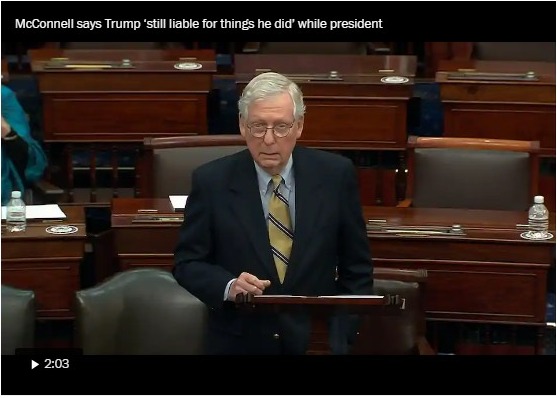
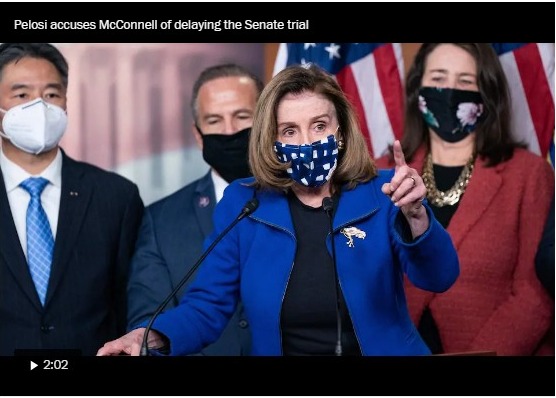
But it was Senate Minority Leader Mitch McConnell, R-Ky., who voted to acquit Trump, who gave a befuddling speech on the Senate floor afterward, arguing the former president is “practically and morally responsible” for provoking the Jan. 6 attack on the Capitol – but that the Senate was upholding the Constitution by acquitting him.
“The Senate’s decision today does not condone anything that happened on or before that terrible day,” McConnell said. “It simply shows that senators did what the former president failed to do: We put our constitutional duty first.”
Trump, by contrast, appeared to take his acquittal as a vindication of his actions before, during and after the Jan. 6 attack. In a statement, Trump called his second impeachment by the House “another phase of the greatest witch hunt in the history of our Country” and hinted at a return to national politics.
McConnell spent much of his remarks condemning Trump’s actions and directly linking them to the Jan. 6 insurrection. The former president’s supporters, he argued, launched their violent attack “because they had been fed wild falsehoods by the most powerful man on Earth, because he was angry he lost an election.”
“There’s no question – none – that President Trump is practically and morally responsible for provoking the events of the day,” McConnell said at one point. “No question about it.”
He argued, however, that it was beyond the power of the Senate to hold Trump accountable for those actions.
“This body is not invited to act as the nation’s overarching moral tribunal,” McConnell said. “We’re not free to work backward from whether the accused party might personally deserve some kind of punishment.”
Immediately after Trump’s impeachment by the House last month, McConnell blocked the Senate from swiftly beginning a trial while Trump was still in office. At the time, McConnell said Trump had “simply no chance” of a “fair or serious trial” before Joe Biden’s inauguration Jan. 20.
But on Saturday, McConnell sought to deflect blame for that decision.
“Speaker [Nancy] Pelosi’s own scheduling decisions conceded what President Biden publicly confirmed: A Senate verdict before Inauguration Day was never possible,” he said.
In January, McConnell’s office informed aides to then-Minority Leader Charles Schumer, D-N.Y., that he would not agree to immediately reconvene the Senate to begin a trial, despite pressure from Schumer to invoke rarely used emergency powers that allow the two Senate leaders to unilaterally reconvene.
Without mentioning his own role in blocking an earlier trial, McConnell said Saturday that he might have voted differently if Trump were still president.
“If President Trump were still in office, I would have carefully considered whether the House managers proved their specific charge,” he said.
Biden’s vaccine push runs into distrust in the Black community
InternationalFeb 14. 2021Michelle Chester administers a coronavirus vaccine to Dr. Yves Duroseau at Long Island Jewish Medical Center on Dec. 14. MUST CREDIT: photo for The Washington Post by Sarah Blesener.
By The Washington Post · Cleve R. Wootson Jr., Frances Stead Sellers
Former Tuskegee, Ala., mayor Johnny Ford rolled up his right sleeve and smiled behind his mask as the first dose of coronavirus vaccine entered his arm – a televised display of faith he hoped would save Black families from suffering.
Ford became mayor soon after the disclosure of the infamous Tuskegee Study of Untreated Syphilis in the Negro Male in 1972, and he spent years seeking justice for victims of the abominable government-run program. Now he’s trying to persuade Black people that vaccines fast-tracked by that same government are not only safe, but vital.
Ford, whose wife nearly died of the virus this winter, is frustrated that so many African Americans are still resisting the vaccine. “For those folks who want to stand around and debate, let them debate,” Ford said. “I’m sorry for them and regret that they want to do that. But if they don’t want to take it, then please move out of the way of those who do want to take it.”
The vaccine hesitancy that Ford is fighting has emerged as a crucial test for the Biden White House, which has repeatedly said racial equity will be central to his presidency. The administration is planning a sweeping campaign to promote the vaccine to minorities, but activists like Ford say the problem is already critical.
Cameron Webb, Biden’s senior policy adviser for covid-19 equity, acknowledged the administration is “swimming upstream” when it comes to vaccine hesitancy. He said it is working to get information into the hands of influencers and community leaders who can spread the word and dispel rumors.
Biden addressed the issue directly Thursday when he visited the National Institutes of Health, where he was hosted by NIH Director Francis Collins and Anthony S. Fauci, who is spearheading the administration’s covid-19 response.
“I know people want confidence that it’s safe. Well, listen to Dr. Fauci. I did. I got my shots,” Biden said. “It’s safe. And we need more people to get vaccinated to beat this pandemic.”
Resistance to the vaccines is not limited to minorities. A hard-line anti-vaccine movement based on misinformation, for example, uses emotional appeals on social media to win over Americans of various political stripes.
Vaccination disparities can result from lack of access as well as hesitancy, said Robert A. Bednarczyk, a professor of global health and epidemiology at Emory University. “We talk food deserts,” Bednarczyk said. “Do we know where physician deserts are? Where nurse deserts are?”
Another factor is “vaccine gentrification,” said White House covid-19 adviser Andy Slavitt: Inoculation sites will be set up to provide easy assess to underserved or minority communities, only to have wealthier suburbanites drive in and use them.
But hesitancy among African Americans is a particular source of concern to a government that’s become more sensitive to the inequities imposed on Black communities for centuries. The pandemic has had an outsized effect on people of color – killing Black Americans at nearly three times the rate of White Americans – and the White House wants to use the unprecedented national vaccination drive to help address that disparity.
Biden has invoked the Defense Production Act to increase vaccine supplies and marshaled federal resources to balloon the number of vaccination sites. Last Tuesday, the administration announced it would ship vaccines directly to local health centers in underserved communities.
But such scaling-up efforts will not amount to much if people don’t take the vaccines.
Vaccine hesitancy has declined over time, to the relief of many activists, but it is still significant. While the data is uneven on who is getting the vaccine, according to a recent Kaiser Family Foundation poll, 43% of Black adults say they plan to “wait and see until it has been available for a while, to see how it is working for other people” – compared to 31% of the overall population who say that.
Such delays can be dangerous, especially as new virus variants emerge that may be less affected by the current vaccines. Fauci said hesitation by Black Americans means a vulnerable population could “suffer doubly.”
“We can’t fail at this,” Fauci said in an interview. “We’ve got to get a substantial proportion of the African American population to embrace the idea of vaccines.”
He added, “It would be really tragic . . . if a demographic group that has already suffered disproportionately from this terrible pandemic should – for reasons that are understandable but unfortunate – feel that they don’t want to take the one tool that can prevent them from getting infected, from getting sick, and from dying.”
Fauci has spent months trying to debunk vaccine myths with Black audiences. He has videotaped conversations with NBA star Stephen Curry. Since last summer, he has been dialing into Zoom gatherings of Black churches to answer congregants’ questions.
He often finds himself addressing the misconception that political pressure prompted vaccine-makers to skip safety steps. Other unfounded worries tilt toward the conspiratorial: that mRNA vaccines can alter a person’s DNA, make people infertile, or allow the government to track a person’s movements.
The Biden administration says it will soon launch a full-scale persuasion program aimed at minorities. While Fauci will play a role, he and other officials concede that the White head of a public health agency might not be the best person to reach Black and brown audiences.
“Who is giving the vaccine – and where you are getting it – matters,” said Ala Stanford, who founded the Black Doctors Consortium in April to address health disparities through testing and now vaccination.
She praised Vice President Kamala Harris for getting a vaccine on television, but said even such role models have less impact than a neighbor, relative or friend.
“The vice president matters,” Stanford said. “But it matters more that your barber got it.”
The Department of Health and Human Services is running ads about the vaccine and other virus safeguards on 2,300 radio stations, 40 of them minority-owned. HHS is also targeting minority audiences in newspaper ads and providing experts to host Facebook Live town halls sponsored by the Black Coalition Against Covid-19.
The Centers for Disease Control and Prevention, for its part, is funding campaigns by groups like the National Urban League, the National Council of Negro Women and the Conference of National Black Churches. And it’s partnering with retired football stars Warren Moon and Franco Harris, in hopes that “trusted messengers” can increase vaccine confidence.
Outside government, the Ad Council, a nonprofit run by the advertising industry, has prepared videos featuring doctors from diverse backgrounds. In one of them, Valerie Montgomery Rice, president and dean of the Morehouse School of Medicine, says it’s critical to have Black doctors involved in the vaccine push.
“This will go a long way to building the trust we need between the underrepresented minority communities and the health system at large,” she says.
But such efforts are up against decades of mistrust stemming from government abuse of Black bodies in the name of science. For 40 years, government-financed doctors allowed syphilis to run unchecked through Black test subjects in the Tuskegee experiments, knowing for much of that time that penicillin would cure them.
In 1951, doctors biopsied a cancerous tumor in a woman named Henrietta Lacks, cells that became the first immortalized cell line. The cells have been used in many experiments and continue to feature in medical research today – even though Lacks, a Black woman, never consented and was not compensated.
And J. Marion Sims became “the father of modern gynecology” by experimenting on enslaved women without anesthesia. A statue honoring his achievements stood in New York’s Central Park until 2018.
That history is now being compounded by wariness of the record speed at which the coronavirus vaccines were created. Several versions were midwifed by “Operation Warp Speed,” a government program shepherded by former president Donald Trump, who made no secret of wanting a fast cure at almost any cost, at one point tweeting at an official, “Get the dam vaccines out NOW.”
The best antidote, said Webb, the Biden adviser, is communication from trusted figures.
“We’re not trying to sell anybody a vaccine, but I believe that if people have accurate, truthful information about what we know and what we don’t know, they’ll make the decision that’s in their best interest,” Webb said. “There are a lot of myths and disinformation out there that clouds that picture, so part of our work is helping to sift through all that.”
Part of the sifting, Webb stressed, is ensuring that minority and underserved communities actually have a steady supply of vaccines; it’s no use convincing people that a vaccine is necessary, after all, if they can’t get it.
Early vaccination data has been spotty, in part because not all recipients report their race or ethnicity. But the figures that do exist suggest racial disparity has already crept into inoculation efforts.
In New York City, for example, 12 percent of people over 65 who received at least one dose of vaccine were Black, even though Blacks make up 22 percent of the city’s over-65 population.
For Ford, the former Tuskegee mayor, the goal for the next few months is clear: convince as many people as possible to take the vaccine.
The virus tore through his family this winter, pinballing the former mayor and his ailing wife from hospital to hospital as she tried to beat an infection that nearly killed her. Ford spent nights in a cot by her bedside while doctors debated putting her on a ventilator. As he cared for his wife, they missed the funeral of his first cousin, who succumbed to covid.
In his 50 years in office – as mayor, state representative and now city councilman – Ford figures he’s built up a lot of credibility, which he now intends to put on the line to motivate his community.
“The disease does not discriminate,” Ford said. “Whether you are a judge or a mayor or Black or White, it doesn’t care. I can testify to how dangerous this disease is. And that’s why my life’s work now is convincing other Black people that they should be tested and receive the vaccine as soon as possible.”
The vaccine, he said “may not be perfect. But it’s way better than getting covid.”
Australia faces the unthinkable: Life without Google
InternationalFeb 14. 2021The Google logo in an arranged photograph on Jan. 22, 2021. Bloomberg photo by David Gray.
By Syndication Washington Post, Bloomberg · Angus Whitley, Georgina McKay
Imagine a world without Google, the search engine so pervasive it’s the starting point for more than five billion queries a day. That’s the reality facing Australia, where the tech giant is threatening to unplug its homepage in a standoff with the government.
Google opposes a planned law that would force the company and Facebook to pay Australian publishers for news content. The Internet juggernaut’s ultimatum to local lawmakers — change the legislation, or else — has left a digital vacuum hanging over a nation that essentially knows just one way to navigate the web. Google runs 95% of Internet searches in Australia.
Potential fallout from the spat goes far beyond Australia for Alphabet Inc.-owned Google, whose dominance of global advertising has made it a target for watchdogs worldwide. If the company backs down in Australia, the pay-for-news law risks becoming a template for jurisdictions including Canada and the European Union that are following the quarrel and keen to shorten Google’s lead.
But disabling what is arguably the world’s most famous website would hand all of Australia to rivals, including Microsoft’s Bing and DuckDuckGo, which have failed to dislodge Google as the gateway to the web. These search-engine competitors would suddenly have a playground for development and a foothold to advance on the global stage.
Software-engineering student Patrick Smith exemplifies Australia’s Google dependency. The 24-year-old from Canberra said he sometimes racks up 400 Google searches a day to help with his studies, catch up on news and look up recipes. Smith said his browser from the previous day shows 150 searches — in the space of just five hours.
“The prospect of Google search disappearing is frightening at best,” Smith said. “It’s quite reflexive of me to Google something, anything, that I’m even mildly not sure of.”
Searching for ‘best beach Sydney’ shows the variance in performance among Google’s competitors. DuckDuckGo’s first result was an ad for a hotel more than 1,000 kilometers away in Queensland, with Sydney beach reviews listed below a second ad link. Search Encrypt, which touts its data-protection capability, said: ‘It looks like there aren’t any great matches.’ Bing’s initial suggestion was Bondi Beach Post Office. Only Google returned a real beach, Bondi, first up.
The world-first legislation will be considered by Australia’s parliament from the week starting Feb. 15 after a key senate committee recommended Friday that the bill be passed.
“The government expects all parties to continue to work constructively towards reaching commercial agreements,” Treasurer Josh Frydenberg said in a statement welcoming the senate report.
People visit Bondi Beach in Sydney on Oct. 13, 2020. MUST CREDIT: Bloomberg photo by Brent Lewin.
The government says the local media industry — including Rupert Murdoch’s News Corp. and Sydney Morning Herald-publisher Nine Entertainment Co. — has been bled of advertising revenue by the tech giants and should be paid fairly for content.
Google argues it drives traffic to their websites, and that being forced to pay to display snippets of news breaks the principle of an open Internet. It also opposes the law’s final-offer arbitration model that determines how much it should pay publishers.
Facebook has said it may stop Australians from sharing news on its platform if the law is enacted, an unprecedented step.
Australia’s entire economic output is less than Alphabet’s $1.4 trillion market value, so it may be surprising the distant and tiny market is suddenly so important. But the Internet titans are so keen to avoid Australia setting a global precedent that Alphabet Chief Executive Officer Sundar Pichai and Facebook’s Mark Zuckerberg broke into their diaries in recent weeks for phone hookups with Prime Minister Scott Morrison or his ministers.
Sniffing an opportunity, Microsoft President Brad Smith and CEO Satya Nadella also reached out.
Grabbing the free hit, Smith told Morrison that Microsoft would invest to “ensure Bing is comparable to our competitors.” This week, Smith wrote in a blog post Thursday that the U.S. should adopt its own version of the Australian law.
DuckDuckGo, a search engine that says it doesn’t track its users, is also trying to cash in.
“There’s a growing global demand for privacy online and Australians don’t have to wait for government action” to stop using Google, DuckDuckGo said by email. Search Encrypt says its results expire after 30 minutes of inactivity.
Non-profit alternatives have also been suggested. The Australian Greens party this month asked the government to consider setting up a publicly owned search engine rather than let Microsoft muscle in. “We should not seek out another foreign giant to fill the gap,” said Senator Sarah Hanson-Young.
To be sure, Australia wouldn’t be the first Google-free nation in the world. In China, where the site is blocked, Baidu is the leading search engine.
But Australia would stand out as a westernized democracy without access to the site and Google’s departure could set the nation back years in terms of fast access to information.
With two decades of data in the vault, and processing an estimated 5.5 billion searches a day, Google is regarded as peerless in tailoring results for individuals and their idiosyncracies.
“Bing is not going to be able to compete with Google in terms of quality out of the blocks,” said Daniel Angus, Brisbane-based associate professor in digital communication at Queensland University of Technology. “Australians might have to relearn how to use search.”
Google again performed best under the search, ‘australia leader,’ showing Morrison and his Liberal party at the top of the page — sourced from an official government site. Bing gave similar details, though took it from Wikipedia. DuckDuckGo prominently displayed ads for team leader jobs in Western Australia, with photos of Morrison and his title sporadically appearing when the search is refreshed. Search Encrypt drew a blank once more.
There are signs Google’s hardline stance may be softening. Morrison said his meeting with the company was “constructive” and “should give them a great encouragement to engage with the process.” Google declined to comment on the meeting, though said in a statement it proposes compensating publishers through its News Showcase product, under which the company pays select media outlets to display curated content.
Some older Australians who’ve lived in a pre-Google world have fewer concerns. Gino Porro, the 58-year-old owner of the Li’l Darlin bar and restaurant in Sydney’s Darlinghurst, uses Google and hasn’t heard of any other search engines. But he sees a return of word-of-mouth recommendations instead of online reviews if Google shuts down its homepage. “Customer service is important, not Google,” he said.
But back in Canberra, Googling student Smith is uneasy about the possible shutdown and how well a replacement would perform.
“I honestly feel that my life would become significantly more difficult,” he said.
 People socialize at Camoes Square ahead of the afternoon curfew in Lisbon, Portugal, on Nov. 22, 2020. MUST CREDIT: Bloomberg photo by Jose Sarmento Matos.


 A healthcare worker administers a dose of the Pfizer BioNtech covid-19 vaccine at the Centenario Hospital Miguel Hidalgo in Aguascalientes, Mexico, on Jan. 14. MUST CREDIT: Bloomberg photo by Mauricio Palos
 Rep. Cedric Richmond, D-La., speaks during a news conference on Capitol Hill on July 1, 2020. MUST CREDIT: Bloomberg photo by Erin Scott
 Celia Straus shows her collection of letters and photos from her parents, Raymond and Patricia Brim, to historian Andrew Carroll of the Center for American War Letters. MUST CREDIT: Photo for The Washington Post by Robb Hill
 Kevin McAleenan, the acting homeland security secretary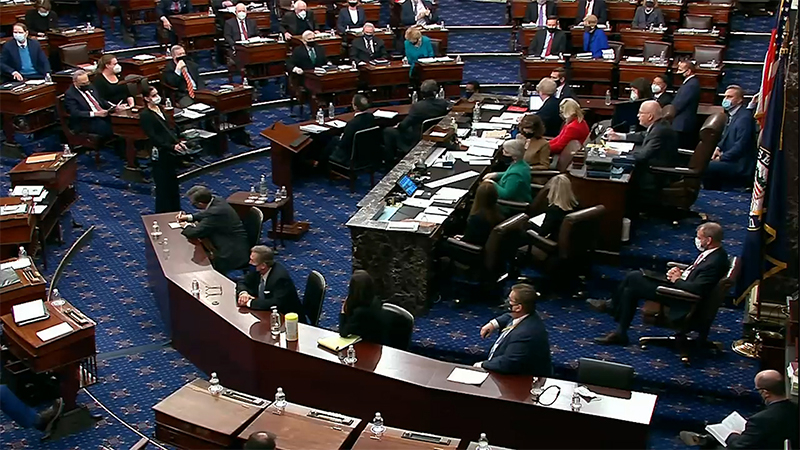
 Michelle Chester administers a coronavirus vaccine to Dr. Yves Duroseau at Long Island Jewish Medical Center on Dec. 14. MUST CREDIT: photo for The Washington Post by Sarah Blesener.
 The Google logo in an arranged photograph on Jan. 22, 2021. Bloomberg photo by David Gray.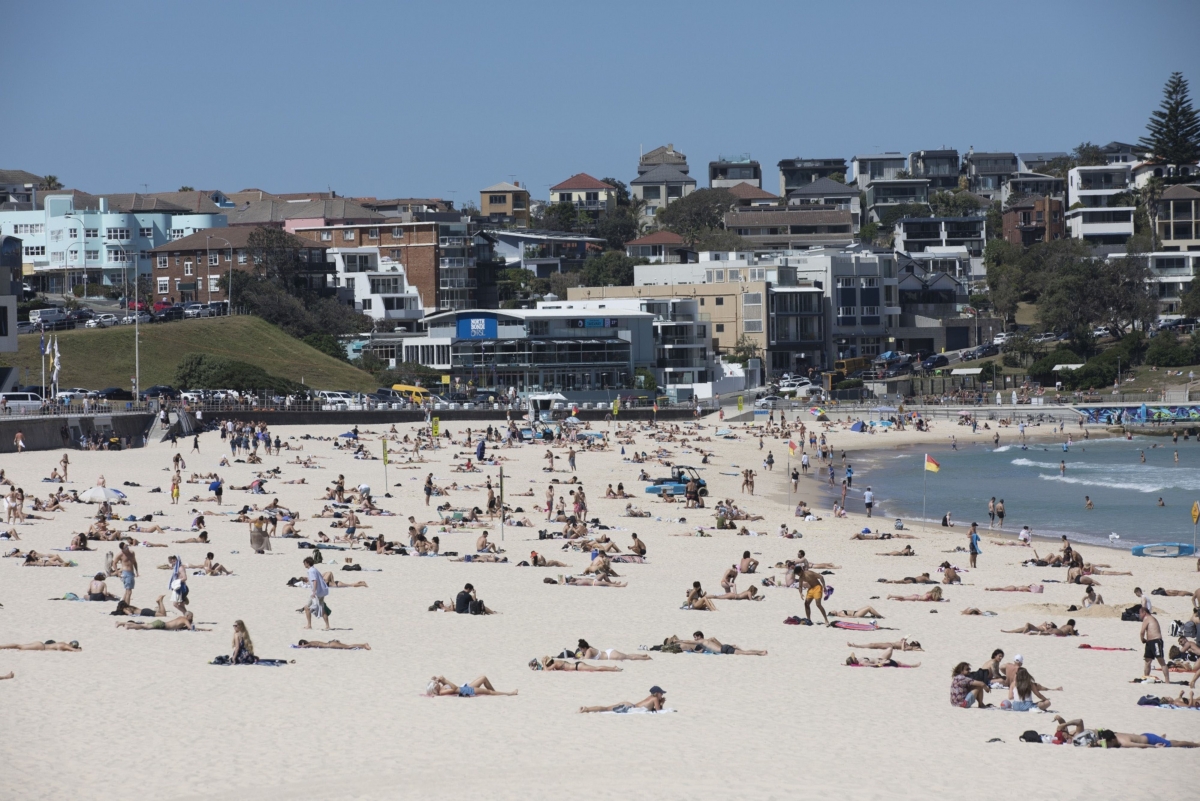
 SootinClaimon.Com