Democrats pivot back to Biden’s stimulus with Trump’s trial done #SootinClaimon.Com

#SootinClaimon.Com : ขอบคุณแหล่งข้อมูล : หนังสือพิมพ์ The Nation.

Democrats pivot back to Biden’s stimulus with Trump’s trial done

InternationalFeb 17. 2021The Capitol building at dawn in Washington, D.C., on Tuesday, Feb. 9, 2021. MUST CREDIT: Bloomberg photo by Stefani Reynolds.The Capitol building at dawn in Washington, D.C., on Tuesday, Feb. 9, 2021. MUST CREDIT: Bloomberg photo by Stefani Reynolds.

By Syndication Washington Post, Bloomberg · Laura Davison

With Donald Trump’s impeachment trial behind them, Democrats are quickly pivoting back to President Joe Biden’s priorities, particularly his $1.9 trillion stimulus plan and confirming the rest of his cabinet.

Lawmakers face a short turnaround to approve another round of stimulus payments, jobless compensation and funding for schools and vaccines before key benefits from the last round of pandemic aid expire on March 14. In less than four weeks, Democrats must pass a bill out of the House and get all 50 Senate Democrats to back the legislation.

That will likely require amending some provisions, such as the $15 federal minimum wage requirement, that at least two Democratic Senators — Kyrsten Sinema of Arizona and Joe Manchin of West Virginia — say they won’t support. Any changes made in the Senate would mean that the bill would have to go back to the House for another vote.

The eagerness of congressional Democrats to move past Trump was evident from start to end of the shortest Senate impeachment trial in history. The agreement on the trial format between Senate Majority Leader Chuck Schumer and GOP leader Mitch McConnell kept the proceedings compressed, and the four days of arguments ended ahead of schedule.

After Senators voted on Saturday to allow witnesses to testify — a surprise result that risked delaying the trial’s conclusion by several weeks — House impeachment managers and the former president’s defense team agreed to enter a public statement into the record. That let the chamber move on to a verdict that day, acquitting Trump.

Although Democrats expressed disappointment in the outcome, they said they are ready to put the former president behind them and focus on Biden’s priorities.

“We in Congress need to move forward with delivering the expanded unemployment checks, the stimulus checks, the reinvestment in our economy that the American people so desperately need and deserve,” Senator Chris Coons, a Delaware Democrat who is close to Biden, said Sunday on ABC’s “This Week” program.

Biden continued pushing ahead as the trial was going on, meeting with a group of governors and mayors as well as leading chief executives including JPMorgan Chase’s Jamie Dimon and Walmart’s Doug McMillon to rally support for his stimulus plan. With Trump’s impeachment no longer consuming national attention, Biden plans public events this week to refocus the country on fighting the pandemic and bolstering the economy, including a town hall event Tuesday in Milwaukee.

Although seven Republicans joined with Democrats in voting to find Trump guilty — falling short of the 67 votes required for a conviction — it’s unlikely that bipartisan showing will repeat itself on the economic relief legislation.

Ten Republican lawmakers — including Senators Susan Collins of Maine, Mitt Romney of Utah and Lisa Murkowski of Alaska, who all voted to convict Trump — have floated a $618 billion stimulus proposal that keeps Biden’s plans for school and vaccine funding, but pares back unemployment benefits and stimulus checks, and completely eliminates key Democratic priorities, including $350 billion in state and local aid and family tax credits.

These Republicans had a series of meetings with Biden and White House staff on the potential for a bipartisan stimulus approach, but despite both sides calling the meetings productive, there has been little movement to bridge the gap between Biden’s $1.9 trillion proposal and the GOP plan, which is approximately one-third of that.

House committees approved the legislation last week under a fast-track budget reconciliation framework, that will allow them to move the bill with simple majorities in both chambers, thanks to a tie-breaking vote from Vice President Kamala Harris in the Senate. Neither chamber is scheduled to be in Washington this week, but the House Budget Committee is planning to assemble the bills approved in committee to prepare the stimulus package for a vote on the House floor the week of Feb. 22.

House Speaker Nancy Pelosi has said that she will send the bill to the Senate as soon as it passes the House. Schumer is looking for ways to speed up the process once the bill reaches him, which include bypassing Senate Finance Committee approval for parts of the bill in order to get the legislation to Biden before federal unemployment benefits expire on March 14. Republicans have criticized that approach, saying Democrats should follow the regular legislative process.

Despite several hurdles to clear an economic relief bill in the coming weeks, Democrats have already set their sights on their next move: an infrastructure and jobs bill. Biden has already begun meeting with senators of both parties to discuss potential proposals on physical infrastructure upgrades, rural broadband internet and renewable energy investment.

In a move that could ease negotiations on an infrastructure bill, House Appropriations Chair Rosa DeLauro and Senate Appropriations Chair Patrick Leahy’s plan to restore lawmaker-directed spending, known as earmarks, which Congress banned a decade ago. The practice allows lawmakers to insert funding for pet projects into legislation and is seen as a useful tactic to get members to back large ambitious bills, but it has been the source of scandal and abuse by some lawmakers.

DeLauro plans to release details about reinstating earmarks in the coming weeks, House Appropriations spokesman Evan Hollander said. It will include more transparency and limits on the total dollar amounts and recipients.

Spread of South African variant in eastern France triggers calls to suspend AstraZeneca vaccine rollout to health workers #SootinClaimon.Com

#SootinClaimon.Com : ขอบคุณแหล่งข้อมูล : หนังสือพิมพ์ The Nation.

Spread of South African variant in eastern France triggers calls to suspend AstraZeneca vaccine rollout to health workers

InternationalFeb 17. 2021

By The Washington Post · Rick Noack

PARIS – Concern about the spread of coronavirus variants in eastern France has prompted an acceleration of vaccination in that region, as well as calls to suspend the rollout of the Oxford-AstraZeneca vaccine to the health care workers there who had been first in line to get it.

AstraZeneca vaccinations in France only began Feb. 6. But the French government’s top vaccine adviser, Alain Fischer, suggested in a weekend interview with the Journal du Dimanche newspaper that health workers in Moselle – where variants first detected in South Africa and in Brazil are suspected to be particularly widespread – should not receive that particular vaccine, one of three authorized in the European Union.

Instead, Fischer recommended administering either of the two authorized mRNA vaccines, developed by Pfizer-BioNTech and by Moderna, as a “precautionary measure” because they allow individuals to obtain protection more quickly.

According to the paper, Fischer also cited the preliminary South African research finding that the AstraZeneca vaccine provided “minimal protection” against mild to moderate coronavirus cases caused by the variant known as B.1.351. The South African researchers left open the possibility that the vaccine may still prevent severe cases of the disease caused by the variant, but the South African government paused its rollout of the vaccine last week.

Both Pfizer-BioNTech and Moderna have claimed their vaccines are effective against more contagious variants of the virus.

The eastern region of France announced Monday that it would receive 30,000 additional vaccine doses from the government – all of them from Pfizer-BioNTech, according to France’s public broadcaster. It was not clear whether the choice was a deliberate response to the recommendation by the government’s top adviser. The French health ministry confirmed that it was sending additional doses to the region but did not immediately respond to a request for further details.

French health minister Olivier Véran said last week that he continued to support the AstraZeneca vaccine, saying it provided sufficient protection against “nearly all the variants.”

The AstraZeneca vaccine – which is not yet authorized in the United States – remains a key component of Europe’s immunization strategy, and Fischer defended its use elsewhere in France, saying Monday that he did not want to imply that “it’s not good.”

But whereas the European drug regulator authorized it for all adults last month, French authorities had recommended it only for people under 65, citing a lack of sufficient data for its efficacy among older people.

And now, the suggestion that its use should be further limited has prompted additional questions in a country that already had one of the highest rates of vaccine skepticism in the world.

“It seems unwise to immunize caregivers” with the Oxford-AstraZeneca vaccine, Jérôme Marty, president of the UFML health care workers union, said Tuesday. He cited doubts over its efficacy against the variant first found in South Africa but also more general objections.

Health care workers tend to be exposed to particularly high viral loads, Marty said, and are disproportionately likely to transmit the virus to vulnerable people. His union has demanded that health care workers across France receive preferred access to the Pfizer-BioNTech or Moderna vaccines, which have a higher efficacy.

In the eastern French region that has seen a surge in suspected variant cases, union representative Monique François said Monday that only a few health workers appeared to have signed up to receive the AstraZeneca vaccine.

“It proves that some have questions,” François told BFM TV, calling for additional BioNTech-Pfizer shots.

Between 4 and 5% of new coronavirus cases across France are estimated to be caused by the variants first detected in South Africa and in Brazil, according to the French health ministry, and both strains are believed to be highly transmissible.

Officials have expressed growing concern over the spread in the east, along the German border. Officials said they had detected 300 suspected new cases of the South African and Brazilian variants within four days last week, though that figure had not yet been confirmed through detailed sequencing.

France has opted to speed up vaccinations in the region – a deviation from the approach pursued in some other countries, where harder-hit areas have not received more vaccines per capita than other places.

The strategy shift was welcomed by doctors unions this week. “We need to act quickly in the areas that are most affected by variants,” Marty said.

French doctors are also concerned that the South African variant could more easily reinfect people who already had covid-19. In what appears to be one of the first such cases, a 58-year old man is in a critical condition in a French hospital after being reinfected with the South African variant, according to a study published last week.

The government in France hopes that accelerated vaccinations and a nationwide 6 p.m. curfew will keep the variants in check. But the country has been among the slowest and most cautious in Europe to roll out its vaccination programs. And like the rest of Europe, it now faces a shortage of doses.

The French government has resisted calls for a local lockdown, even as politicians in neighboring Germany pondered possible border closures.

World fashion capitals look at possible $600 million shortfall, thanks to covid #SootinClaimon.Com

#SootinClaimon.Com : ขอบคุณแหล่งข้อมูล : หนังสือพิมพ์ The Nation.

World fashion capitals look at possible $600 million shortfall, thanks to covid

InternationalFeb 17. 2021In 2011, Roberto Cavalli's Fashion Week party was held at the Battersea Power Station in London. This year, the virus has forced cancellation of fashion shows for a second season in the fashion capitals of New York, London, Paris and Milan. The power station is shown on March 28, 2010. MUST CREDIT: Bloomberg photo by Simon DawsonIn 2011, Roberto Cavalli’s Fashion Week party was held at the Battersea Power Station in London. This year, the virus has forced cancellation of fashion shows for a second season in the fashion capitals of New York, London, Paris and Milan. The power station is shown on March 28, 2010. MUST CREDIT: Bloomberg photo by Simon Dawson


By Syndication Washington Post, Bloomberg · Kim Bhasin, Angelina Rascouet, Flavia Rotondi

Each year over four weeks in February and March, thousands of fashion executives, celebrities, influencers and models hopscotch between the world’s style capitals to attend runway shows. Attached to them is a multimillion-dollar economy that pumps both investment and tourist spending into New York, London, Paris and Milan.

For the second season in a row, all of that has been erased by the pandemic. Almost all shows will be virtual, as they were last September. The luxury hotels normally packed with fashion’s finest will be near empty, local clubs and venues won’t be welcoming many for nightly parties, museum and art exhibitions will be ghost towns, and high-end boutiques will miss out on the cash that flows from a flood of shoppers willing to shell out thousands for a dress or handbag.

All told, the four cities could miss out on more than $600 million in economic activity this season, according to data compiled by Bloomberg.

Here’s a look at what it’s like on the ground in the world’s four prime fashion hubs as the industry braces for a second lost season:

New York

Not long after last February’s shows ended, New York City became the epicenter of the global coronavirus pandemic, leaving tens of thousands dead. A late-year resurgence in the Northeastern U.S. led to renewed restrictions on business in Gotham, though infection rates have recently started to decline again. Nevertheless, New York’s Fashion Week, which began this past weekend, is being held virtually.

More than 100 events are on the calendar, from panels to presentations on live streams and a few runway shows that actually include physical elements. Mainstays like Rebecca Minkoff and Jason Wu will take part as usual, and more than a dozen young designers will be spotlighted by the Black In Fashion Council.

The Council of Fashion Designers of America said it expects business this spring to be tougher than last fall. “This season, even more than last, will be a great challenge for all of us as the world grapples with an increasingly devastating pandemic and economic downturn,” Tom Ford, chairman of the CFDA, wrote in a letter to the industry.

New York’s Fashion Week usually generates hundreds of millions of dollars in annual revenue, surpassing that of the U.S. Open tennis tournament the city also hosts each year, according to the state legislature’s Joint Economic Committee. During normal times, they attract 150,000 attendees who fill Manhattan’s hotels, light up the night life and spend lots of money.

London

It’s been a mixed start of the year for London, with a more easily transmitted virus variant forcing a third lockdown while the vaccine rollout raises hopes that another catastrophic surge can be avoided. The British Fashion Council is holding a digital-only event starting Feb. 19 that will showcase both women and menswear by 95 designers-with names including Victoria Beckham.

London’s Fashion Week usually brings in more than $374 million (£269 million), according to FashionUnited’s Business Intelligence. Oxford Economics estimates 240,000 direct jobs representing more than one-quarter of the U.K. fashion industry’s workforce have been lost because of the pandemic. Including indirect jobs, the toll spikes to 350,000.

Back in 2011, nightclub owner Carlo Carello organized Roberto Cavalli’s Fashion Week party at the Battersea Power Station. He’s had to fire 80% of the staff at the Raffles club, an iconic venue in the posh Chelsea neighborhood. “We’d be heaving every night of the week, we’d normally have two or three Fashion Week parties on,” Carello said of pre-pandemic times. “A business like ours is being decimated.”

Making things worse is another malaise looming over the U.K. fashion industry: Brexit. Walpole, the organization representing luxury brands such as Burberry, said smaller fashion brands have stopped doing business with the European Union for the time being because “there’s an imperfect understanding” from country to country of duties that need to be charged, now that the U.K. is on its own.

A worker prepares to close a restaurant before curfew in Duomo Square in Milan on Oct. 26, 2020. Each of the four Milanese fashion weeks has brought in about 30 million euros in tourism spending, a number that this year will be reduced about 80%, says the head of the Italian Fashion Chamber. MUST CREDIT: Bloomberg photo by Francesca Volpi

A worker prepares to close a restaurant before curfew in Duomo Square in Milan on Oct. 26, 2020. Each of the four Milanese fashion weeks has brought in about 30 million euros in tourism spending, a number that this year will be reduced about 80%, says the head of the Italian Fashion Chamber. MUST CREDIT: Bloomberg photo by Francesca Volpi

Milan

When this year’s fashion shows begin in Milan on Feb. 23, they will be fully digital, apart from a few presentations where a limited number of buyers and media have been invited to watch, socially distanced. Opening night will be an Instagram live party with a DJ set instead of an in-person blowout in a city that suffered some of the pandemic’s worst loss of life last spring.

To keep the city involved-and to allow passersby to watch live shows by icons such as Armani, Prada, Fendi and Dolce & Gabbana-the Italian Fashion Chamber will put up big screens in strategic locations across central Milan.

“It will be a symbolic gesture,” said Carlo Capasa, the chamber’s chairman and chief executive officer. “A reminder for the people of Milan that fashion is still part of everybody’s life, resilient despite the covid crisis, still able to incarnate the city’s values: creativity and efficiency.”

In past years, each of the four Milanese fashion weeks would bring in about 30 million euros in spending at places like hotels and restaurants. Capasa expects that income to be cut by at least 80%.

Barriers block access to the Louvre museum during coronavirus lockdown measures in Paris on April 14, 2020. A year ago, Louis Vuitton's Nicolas Ghesquiere set up his catwalk inside the Louvre, a monumental show that fashion filmmaker Loic Prigent described as "a swan song to covid-free times." MUST CREDIT: Bloomberg photo by Cyril Marcilhacy

Barriers block access to the Louvre museum during coronavirus lockdown measures in Paris on April 14, 2020. A year ago, Louis Vuitton’s Nicolas Ghesquiere set up his catwalk inside the Louvre, a monumental show that fashion filmmaker Loic Prigent described as “a swan song to covid-free times.” MUST CREDIT: Bloomberg photo by Cyril Marcilhacy

Paris

A year ago, Louis Vuitton’s Nicolas Ghesquiere set up his catwalk inside the Louvre, a monumental show that long-standing fashion filmmaker Loic Prigent described as “a swan song to Covid-free times.” Gone are the days when A-list celebrities would huddle in the front rows at the world’s the most visited museum. This time, the womenswear Paris Fashion Week will be an online affair. It kicks off on March 1.

The Institut Francais de La Mode estimates that Paris Fashion Weeks generated 450 million euros annually before the pandemic. While new estimates since the virus struck haven’t come out yet, the amount has predictably dropped, according to Pascal Morand, chairman of the Federation de La Haute Couture et de La Mode, which organizes the event.

Five of Paris’s 12 premier hotels, dubbed Palaces, are currently open, though with occupancy rates hovering between 5% and 15%, Christophe Laure, chairman of the UMIH Prestige hotel industry group said. During a normal pre-covid Fashion Week, all Palaces would be open with 80% to 100% of their rooms booked. The situation “is pretty worrying,” Laure said.

Morand said covid-19 has at least democratized access to the shows, thanks to their digital format-and the numbers show it. The Louis Vuitton’s fall menswear show by Virgil Abloh in January 2020 has been viewed just under 500,000 times on the brand’s YouTube page, whereas the 2021 show has already amassed more than double that amount.

Nevertheless, Morand looks forward to the day when traditional fashion shows return, since the digital experience “will never fully replace” the feeling of being there.

Myanmar generals defend coup, dismiss impact of U.S. sanctions #SootinClaimon.Com

#SootinClaimon.Com : ขอบคุณแหล่งข้อมูล : หนังสือพิมพ์ The Nation.

Myanmar generals defend coup, dismiss impact of U.S. sanctions

InternationalFeb 17. 2021Brigadier-General Zaw Min Tun, the lead spokesman for the State Administration CouncilBrigadier-General Zaw Min Tun, the lead spokesman for the State Administration Council

By Syndication Washington Post, Bloomberg

Myanmar’s junta again defended its move to oust the civilian government in the face of nationwide protests, dismissing the impact of U.S. sanctions while showing no signs of a compromise with demonstrators.

Brigadier-General Zaw Min Tun, the lead spokesman for the State Administration Council, said Tuesday the military’s actions were in line with the 2008 constitution and “not a coup.” He added that the regime was taking steps to fight Covid-19 and wanted to attract foreign investment, while seeking to discredit protesters by showing videos of violence against authorities.

“To ensure democracy and prosperity, people should cooperate with us without being emotional,” Zaw Min Tun said in the military’s first official press briefing since the Feb. 1 coup. He said the junta would proceed with an election according to its timeline while “trying not to be violent as much as possible.”

The remarks signal Myanmar’s army is looking to improve its image after tens of thousands of people have hit the streets in defiance for more than a week, including on Tuesday, drawing support from democracy activists in Asia and Western governments. U.S. President Joe Biden sanctioned coup leader Min Aung Hlaing and other top generals while foreign investors have reassessed plans to put money in the country.

Zaw Min Tun said the generals expected sanctions and dismissed their impact, saying it had experience of such things when Myanmar faced international isolation prior to its shift toward democracy a decade ago.

“We will make sure to keep good terms with the UN and all the countries,” he said. “Our council is trying to strengthen ties with all countries.”

The regime shut down the internet for a second straight night, part of efforts to disrupt telephone and internet access to prevent demonstrators from organizing. They have also made changes to the telecommunications law to impose harsher prison sentences for illegal online activity, while also granting themselves new powers to intercept communications and detain dissidents.

Myanmar’s military leaders have struggled to gain control of the streets since ousting the government led by Aung San Suu Kyi, whose party won a landslide victory in November elections. She has urged the country’s 55 million people to oppose the army’s move, calling it “an attempt to bring the nation back under the military dictatorship.”

Suu Kyi and other political leaders are among more than 400 people detained since the coup, a number that keeps rising by the day. Police filed an additional charge against her, Reuters reported on Tuesday, citing her lawyer. Zaw Min Tun said Suu Kyi was in “good health,” while adding that authorities were investigating money laundering at a foundation she runs.

While police and soldiers have largely avoided confronting protesters in major cities like Yangon who have ignored a ban on public gatherings, several demonstrators have been injured in crackdowns — including a woman shot in the head who is now on life support in Naypyidaw, the capital.

Zaw Min Tun declined to say whether the woman was hit with a rubber bullet or live bullet, as protesters have alleged. “We will give you all the information about what the girl did to the police,” he told reporters.

He also urged civil servants to return to work, saying “we will unavoidably take actions against these civil servants after a certain period.” He added that the government was “operating as normal” despite the protests.

According to a copy of the amended telecommunications law seen by Bloomberg News, anyone found guilty of perpetuating a cyberattack to threaten national sovereignty or unity may now face up to five years in prison and fines of as much 30 million kyat (about $22,570). Those who commit such attacks to hurt Myanmar’s relationship with other countries face even stiffer penalties, up to seven years in prison and a 50 million kyat fine.

Those found guilty of spreading fake news or hoaxes online to cause public panic, or publishing private information of another individual without their permission, meanwhile face up to three years in prison and fines of as much as 5 million kyat.

Telenor Group, which owns one of two wholly foreign owned telecommunications providers in Myanmar, on Monday joined mounting opposition to the junta’s proposed cybersecurity bill, saying it gives the regime broad powers including the ability to order lawful interception. The Asia Internet Coalition, whose members include Facebook Inc., Apple Inc. and Google, stated on Feb. 11 that the bill allows for unprecedented censorship, violates privacy and would “significantly undermine freedom of expression.”

“The current very short and limited consultation has not allowed for the required dialog on the proposed Cyber Security Bill,” Telenor said in a statement. “We are concerned that the proposed bill does not progress relevant regulatory frameworks and law for a digital future, nor promotes and safeguards digital safety and rights.”

Power outages plague Texas, other states amid deadly cold, snow #SootinClaimon.Com

#SootinClaimon.Com : ขอบคุณแหล่งข้อมูล : หนังสือพิมพ์ The Nation.

Power outages plague Texas, other states amid deadly cold, snow

InternationalFeb 17. 2021Snow and ice blanket downtown Cleveland, Miss., on Tuesday, Feb. 16, 2021. MUST CREDIT: Photo for The Washington Post by Rory DoyleSnow and ice blanket downtown Cleveland, Miss., on Tuesday, Feb. 16, 2021. MUST CREDIT: Photo for The Washington Post by Rory Doyle

By The Washington Post · Andrew Freedman, Paulina Firozi, Jason Samenow, Matthew Cappucci

At least 14 people are dead in four states from the effects of a record-shattering cold snap and winter storms since Sunday. In Texas, as the electricity grid struggled to keep pace with record demand, people were turning to unsafe means to heat their homes. A woman and a girl died of carbon monoxide poisoning in Houston after a car was left running in a garage to keep them warm, according to police.

https://www.washingtonpost.com/video/c/embed/56b20897-118c-4b43-99a8-16b6e66955cb?ptvads=block&playthrough=false 

The Arctic air has also claimed the life of at least one homeless person in Houston, and a 10-year-old boy died after he fell through ice near Millington, Tenn. A tornado associated with the storm system that helped draw Arctic air to the south struck in North Carolina overnight, killing at least three and injuring 10.

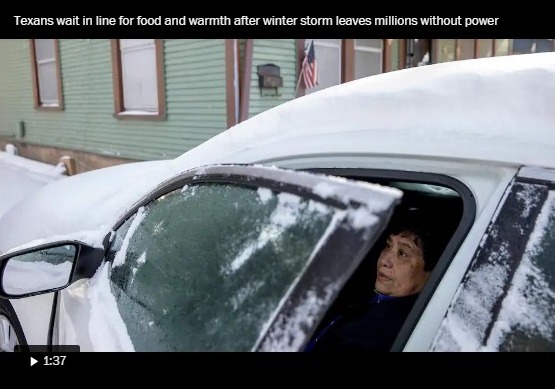
A third of electric customers in Texas were without power Tuesday morning according to PowerOutage.us, because of snow and ice, an overloaded power grid and emergency measures to reduce the electricity demand affecting a number of cities as well as rural areas. About 4.3 million customers were affected.

https://www.washingtonpost.com/video/c/embed/d18e33f3-1676-489d-8427-f3220650ba5a?ptvads=block&playthrough=false

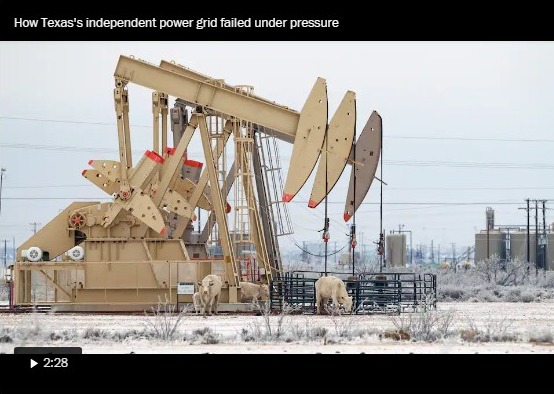
Texas is unusual in that its electric grid is nearly entirely independent from the rest of the country. When demand exceeds supply, the state is largely unable to import electricity from neighboring states, as is a customary practice almost everywhere else in the country.

The demand, largely driven by the need to heat homes in brutal Arctic temperatures, ran the risk of overwhelming the power grid and triggering uncontrolled outages. The Electric Reliability Council of Texas announced Monday that it was instituting rotating power blackouts.

The blackouts have been anything but rolling; many people have had outages lasting at least 24 hours. The electricity taken off the grid was enough to power 2 million homes.

The U.S. Department of Energy temporarily lifted pollution restrictions to allow power plants to operate and produce at full capacity.

Social media was ablaze with widespread reports that downtown areas, such as in Austin, were lit up “like a shiny island in a sea of black” while neighboring suburbs remained dark in the frigid cold.

Texas Gov. Greg Abbott, a Republican, criticized private power companies.

In a call to the local ABC13 station late Monday, Abbott said outages were in part a result of private power generation companies having “fallen short.”

“There’s a separate part of the system that is not working right now, and those are the private companies that generate the power that goes into ERCOT. And it’s those private companies that generate power that are not working,” Abbott told ABC13. “They were working up until about midnight last night, but after midnight, some of them literally froze up, and were incapable of providing power, and some are still incapable of providing power.”

ERCOT is the Electric Reliability Council of Texas. It handles about 90% of the state’s electricity load.

Abbott was asked about preparations made to prevent such outages after a cold wave that hit Texas in 2011. He said not enough was done to “gauge for this type of event, because the last time we had this type of weather was more than 100 years ago.”

The Federal Energy Regulatory Commission announced that it would open a joint inquiry alongside the North American Electric Reliability Corp. into power systems.

The regulatory agencies said the inquiry would include work with other federal, state and regional agencies and utilities to help identify problems with system performance, and to help assess what can be done to address those problems, according to a release from the agency.

“For now, the emphasis must remain on restoring power to customers and securing the reliability of the bulk-power system,” FERC Chairman Rich Glick said in a tweet.

The agency said the inquiry would formally begin in the “days ahead.”

A decade ago, the two agencies also conducted an inquiry and produced a report on the severe cold-weather event the Southwest experienced in 2011.

Corpus Christi issued a boil order after a “major water main break” led to low water pressure or no water for some customers. The city has issued an order to boil water before drinking it, cooking with it, or making ice, or instead to purchase bottled water.

In North Carolina a tornado tore through the southern part of the state late Monday, the Brunswick County sheriff said in a morning news conference.

Sheriff John Ingram said early Tuesday that at least three people were killed and 10 were injured in a storm that caused “a lot of destruction” along Highway 17 between the North Carolina coastal communities of Sunset Beach and Ocean Isle Beach, near the border with South Carolina and about 40 miles southwest of Wilmington, N.C. The devastation has left many buildings destroyed and residents trapped in their homes, authorities said, though the full severity of the damage remains unclear. Trees and power lines were also reported down throughout the area.

At midnight, a tornado was spotted in Honey Island, N.C., according to WWAY, about 45 miles west of Wilmington. Shortly thereafter, the National Weather Service reported power lines down along Highway 17 in Brunswick County.

A second winter storm is heading to the same region. Winter storm warnings were issued in parts of Texas, Oklahoma, Louisiana and Arkansas as more dangerous winter weather approached.

Millions lose power in Texas as freeze sows energy-market chaos #SootinClaimon.Com

#SootinClaimon.Com : ขอบคุณแหล่งข้อมูล : หนังสือพิมพ์ The Nation.

Millions lose power in Texas as freeze sows energy-market chaos

InternationalFeb 16. 2021

By Syndication Washington Post, Bloomberg · Brian K. Sullivan, Naureen S. Malik, Javier Blas

Millions of households in Texas are suffering rolling blackouts for the first time in a decade as an unprecedented Arctic freeze sends temperatures plummeting across much of the U.S., roiling energy markets.

Large swaths of Dallas, Houston and other cities are being plunged into darkness for an hour at a time — and in some cases longer — as surging demand for heat pushes the power grid to the brink. The situation is poised to become more dire as temperatures are forecast to fall to as low as 3 Fahrenheit (minus 16 Celsius) in parts of the state.

“Every grid operator and every electric company is fighting to restore power right now,” said Bill Magness, head of the Electric Reliability Council of Texas, which runs the state’s grid.

The extreme cold that’s crippling Texas’s power market is part of a larger weather pattern gripping much of the U.S. Winter storm warnings, advisories and watches stretch from New Mexico to Maine. In the past week, about 800 daily records for cold temperatures have been set in the U.S. as arctic air pushes all the way to the Gulf of Mexico. Accuweather called it one of the busiest winter-weather patterns in decades.​

Texas is the home of the U.S. energy industry, and the impact of blackouts hitting its major cities; oil and gas production falling because of the cold weather, and power prices soaring to eye-watering levels is highly symbolic of a world that’s trying to get its grip on a battle against climate change, moving away from hydrocarbons.

The extreme cold appears to have caught Texas’s highly decentralized electricity market by surprise. When they warned of possible blackouts Sunday, grid operators said they’d likely last for 15 to 30 minutes at a time. On Monday morning, officials said they were lasting considerable longer.

“These are not rolling blackouts. We are dealing with system-wide power outages across the state,” Houston Mayor Sylvester Turner said on Twitter.

These are the first rolling blackouts caused by cold weather since 2011. Spikes in electricity demand usually happen in summer in Texas when air conditioning use rises. A loss of frequency on the grid has caused 30 gigawatts of generation to halt. Many stations will have been undergoing scheduled maintenance, leaving the grid more exposed during unusually large spikes in demand.

Rotating outages will likely last throughout Monday morning and are a possibility until the weather conditions ease, Ercot said in a statement.

Parts of Texas were colder than Alaska, according to the National Weather Service. The temperature at 5 a.m. in Houston was 18 degrees Fahrenheit, matching the reading in Anchorage. In the Dallas-Fort Worth area it was 5 degrees Fahrenheit.

Frigid temperatures and a parade of storms in the U.S. follow other instances of extreme winter weather this year that have snarled ports and upended energy markets in Asia and Europe. Texas, which isn’t accustomed to winter’s full fury, is getting a big taste. President Joe Biden declared a state of emergency, mobilizing federal assistance to aid local response efforts.

“We would expect to be in emergency operations tomorrow through at least Tuesday morning,” said Dan Woodfin, a senior director at Ercot.

The power crunch is being compounded by a lack of wind generation with output more than halving to 4.2 gigawatts. Wind turbines may freeze in bitterly cold weather, reducing efficiency, and the blades can ultimately stopping spinning.

Earlier, spot electricity prices in Texas’ West hub surpassed the grid’s cap of $9,000 per megawatt hour, a 3,466% increase from Friday, according to data compiled by Bloomberg. LNG exports from the U.S. also plummeted after the freeze shut ports and wells, and oil production also took a hit, with Permian oil production plunging by as much as one million barrels a day. West Texas Intermediate futures rose by as much as 2.5%, above $60 a barrel for the first time in more than a year.

The cut to crude supplies is threatening to unleash a rush for everything from propane to heating oil, fuels that are used in mobile heating devices.

Odessa, one of the largest oil producing areas in the Permian Basin, still has power. While San Antonio has lost power with rolling blackouts lasting 10-15 minutes, according to sources on the ground.

In Houston, there are long lines to refill household propane canisters and firewood is selling out. The city may pick up as much as 2 inches (5 centimeters) of snow overnight, along with ice and sleet, the National Weather Service said. It will get hit by another storm bringing ice and freezing rain Wednesday.

“It is going to be a cold week,” said David Roth, a senior branch forecaster at the U.S. Weather Prediction Center. “The southern plains are in a cold pattern and it is going to take a while for them to break out of it.”

A mix of freezing temperatures and precipitation is paralyzing wind farms in Texas. That would be devastating for power plants with contracts to provide a certain amount of electricity at specific times if they need to instead buy it on the spot market to meet their obligations. At the moment, that power is exceedingly expensive.

“When wind-turbine blades get covered with ice, they need to be shut down,” said Joshua Rhodes, a research associate who focuses on energy at The University of Texas at Austin.

The grid is Texas has relatively little connection with the rest of the country, making it an island when it comes to supplies.

The storms will largely miss major cities along the East Coast, Bob Oravec, senior branch forecaster with the U.S. Weather Prediction Center said. While there could be some snow showers and ice in New York and Boston, the bulk of the accumulation will be in upstate New York and interior New England Monday to Tuesday.

Seoul offered free covid tests for pets and soon found its first case in a lethargic, vomiting cat #SootinClaimon.Com

#SootinClaimon.Com : ขอบคุณแหล่งข้อมูล : หนังสือพิมพ์ The Nation.

Seoul offered free covid tests for pets and soon found its first case in a lethargic, vomiting cat

InternationalFeb 16. 2021

By The Washington Post · Simon Denyer

TOKYO – The Seoul government said it had found its first case of covid-19 in a cat on Monday, shortly after offering free tests to pets in the South Korean capital.

Experts say there is no evidence cats or dogs can pass the novel coronavirus to humans, but they have nevertheless placed the cat in a 14-day quarantine. It was tested after having symptoms of vomiting and decreased activity, and after the family it lives with were all found to have contracted covid-19, officials said.

The Seoul Metropolitan Government announced last week it would offer free coronavirus tests to symptomatic dogs and cats, shortly after a kitten at a religious facility in the southeast of the country was found to have contracted the virus.

In the United States, the Centers for Disease Control and Prevention says a few pets have been infected with the virus that causes covid-19, mostly after the animals were in close contact with infected humans, although globally such cases have been rare.

Since the beginning of the outbreak, scattered reports of animals contracting the disease have raised fears that pets or farmed animals such as mink could become a reservoir for the disease, prompting widespread culling in infected mink farms.

The CDC, however, says that “based on the limited available information, the risk of animals spreading the COVID-19 virus to people is considered low,” while most animals who had contracted the virus had experienced mild illness and fully recovered.

“There is no evidence that viruses can spread to people or other animals from a pet’s skin, fur or hair,” it says.

Seoul’s city government said it would provide tests only to animals that showed symptoms such as fever or breathing difficulties after coming into contact with infected humans.

The kitten found positive last month was placed into quarantine at a nearby animal shelter but did not show any symptoms, and so after 14 days was released, local health authorities said.

In an online briefing last week, disease control official Park Yoo-mi reminded people to keep their pets “at least two meters away from people and other animals when walking them.”

Research has shown that cats can spread the disease to other cats, at least in a laboratory setting.

Over the weekend, the San Diego Zoo Safari Park said a troop of western lowland gorillas had made a full recovery after several had contracted the coronavirus, but in Pakistan officials said two 11-week-old white tiger cubs appear to have died of covid-19 last month.

Biden administration targets invisible climate threat seeping from grocery store freezers #SootinClaimon.Com

#SootinClaimon.Com : ขอบคุณแหล่งข้อมูล : หนังสือพิมพ์ The Nation.

Biden administration targets invisible climate threat seeping from grocery store freezers

InternationalFeb 16. 2021

By The Washington Post · Juliet Eilperin, Desmond Butler

WASHINGTON – Some of the climate impacts of a grocery store trip are obvious, like the fuel it takes to get there and the electricity that keeps its lights glowing, conveyor belts moving and scanners beeping. But then there are the invisible gases seeping out into the atmosphere when you reach for your ice cream of choice.

In nearly every supermarket in America, a network of pipes transports compressed refrigerants that keep perishable goods cold. Most of these chemicals are hydrofluorocarbons (HFCs) – greenhouse gases thousands of times more powerful than carbon dioxide – which often escape through cracks or systems that were not properly installed. Once they leak, they are destined to pollute the atmosphere.

The Biden administration now sees eliminating these chemicals from the nation’s refrigerators as low-hanging fruit in its broader effort to rein in climate pollutants. The Environmental Protection Agency issued a public call last week for companies to report production and import data on HFCs.

Under the American Innovation and Manufacturing Act, which passed in December, the EPA must phase down the production and import of these potent greenhouse gases 85% over the next 15 years.

“The environmental benefits here are very large, they’re very important,” said Cindy Newberg, who directs the stratospheric protection division in the EPA’s Office of Air and Radiation. The new law, she added, “provides explicit authority for us to do this work, and that’s incredibly important to the agency, and for all of us.”

A new undercover investigation by an advocacy group suggests that some supermarkets are leaking climate-damaging refrigerants at a higher rate than regulators have assumed. The industry estimates that every year supermarkets lose an average of 25% of their refrigerant charge – chemicals introduced in the 1990s to replace ones depleting Earth’s ozone layer.

Armed with high-tech sensors, undercover investigators for the Environmental Investigation Agency (EIA) have documented widespread leakage of HFCs at grocery stores in the District of Columbia, Maryland and Virginia. While Walmart and other supermarket companies have pledged to curb their use of these chemicals, more than half the stores the EIA surveyed were emitting these climate-warming refrigerants.

Out of 45 supermarkets surveyed – including 20 Walmarts as well as stores operated by ALDI, Costco, Giant, Harris Teeter, Safeway, ShopRite, PriceRite, Trader Joe’s and Whole Foods – investigators found leaks in 55% of them. (Whole Foods is owned by Amazon, whose founder and CEO, Jeff Bezos, owns The Washington Post.) The investigation did not determine the exact amount of HFCs released.

“This is a systemwide, industry-wide problem,” said Avipsa Mahapatra, climate lead for the EIA advocacy group. “In reality, they could easily check for this.”

None of the companies contacted for this story provided a comment on the survey itself, but a few noted their commitment to curbing these pollutants.

Whole Foods said it is “proud to be a leader among U.S. supermarkets in our efforts to reduce emissions of hydrofluorocarbons.” A little more than 30 of its stores have switched to carbon-dioxide refrigerants, and it touts one market in Brooklyn that has become 100% HFC-free.

Walmart noted that it has pledged to reach zero emissions across its operations within two decades, a goal that includes “transitioning to low-impact refrigerants for cooling and electrified equipment for heating in our stores, clubs and data and distribution centers by 2040.”

Commercial refrigeration, which includes grocery stores, restaurants and food processing, accounts for about 28% of U.S. emissions of HFCs. Air conditioning for commercial buildings and homes represents between 40% and 60% of emissions, according to federal data.

The EIA survey was based on a limited sample in one region of the United States. The investigators were also not able to measure the overall quantity and rate of leakage. But it suggests that large supermarket chains may be unaware of the extent of the problem, and do not have regular monitoring in place. In some cases, the leaks persisted months after they were detected.

The investigators, who began their survey in 2019, used leak detectors that they could insert in refrigerators and freezers as well as an infrared camera that could film fugitive greenhouse gases.

The food retail sector represents one part of the puzzle of how to drastically cut back on emissions in the coming years. HFCs trap thousands of times more heat than carbon dioxide, and with increasing sales they are projected to represent nearly a fifth of climate-warming emissions by mid-century. It’s a growing problem: The hotter Earth gets, the more people need cooling infrastructure.

According to new data released Friday, HFC emissions in the United States rose by 4 million metric tons between 2018 and 2019. The 38,000 supermarkets in the United States use thousands of pounds of HFCs each year, according to the EPA, with each store having the equivalent climate impact of 300 cars on the road. Taken together, it is equal to 49 billion pounds of coal being burned each year.

While monitoring for leaks and upgrading refrigeration systems translate into long-term savings by reducing energy use, stores operating on tight margins cannot always afford it.

Ratio Institute co-founder Jonathan Tan, whose organization works with the food retail industry, policymakers and conservationists on the issue, estimated that while it can cost a store between $50,000 to $100,000 to make repairs to a system, transitioning from current refrigerant to a less-potent greenhouse gas such as carbon dioxide can cost between $1 million and $2.5 million.

Walmart said private companies would need government help in making the transition. “We also believe that private and public sector action is needed to foster innovation and enable an economically viable phasedown of HFCs globally,” it said in a statement.

Europe is making a swifter transition than the United States. More than 26,000 supermarkets in European countries are using lower-impact refrigerants, compared with 600 stores in the United States.

The EPA has regulated earlier generations of refrigerants for decades under the 1987 Montreal Protocol, the landmark global treaty aimed at repairing the ozone layer. Those compounds – chlorofluorocarbons and hydrochlorofluorocarbons – damaged the ozone layer that shields Earth from damaging ultraviolet rays from the sun. HFCs made an appealing substitute because they did not deplete ozone, but they warmed the planet instead.

In 2016, the Obama administration helped broker the Kigali Amendment, through which countries pledged to phase down HFCs. But the agency’s effort to regulate the refrigerants ran aground during the Trump administration.

One rule identifying “unacceptable” uses of HFCs was partly overturned by the U.S. Court of Appeals for the D.C. Circuit in 2017. The administration rewrote the rule, but the same court said it did not follow proper procedures and did not need to abolish the Obama-era requirements altogether. Last year, Trump officials withdrew another Obama-era rule, which required companies to detect and repair leaks from any appliance or piece of equipment using more than 50 pounds of HFCs.

President Donald Trump declined to submit the Kigali Amendment to the Senate for ratification: President Joe Biden signed an executive order last month instructing his secretary of state to take that step.

The federal government has pursued cases against grocery chains, and won, when it comes to leaks of older refrigerants that damage the ozone layer. In 2019, for example, Southeastern Grocers agreed to spend $4.2 million to reduce coolant leaks and pay a $300,000 civil penalty. But HFCs are in a different category.

“EPA’s recognized that it is a significant contributor to climate change and has tried to take action,” said Tom Land, a longtime agency staffer who retired in 2019 after working on international climate negotiations and the agency’s voluntary refrigerants program, GreenChill. “It basically had to stop; it didn’t have authority.”

Food retailers that participate in the GreenChill program have a leak rate of 14.3%, nearly half the industry average. Kristen Taddonio, senior climate and energy adviser at the Institute for Governance & Sustainable Development, said in an interview that reinstating regulations mandating leak detection could help grocers make greater reductions.

“It’s like that old adage, you can’t manage what you can’t measure,” said Taddonio, who worked on energy efficiency at the EPA and the Energy Department between 2004 and 2015.

Historic Arctic outbreak brings dangerous cold, snow and ice to Central and Southern U.S. #SootinClaimon.Com

#SootinClaimon.Com : ขอบคุณแหล่งข้อมูล : หนังสือพิมพ์ The Nation.

Historic Arctic outbreak brings dangerous cold, snow and ice to Central and Southern U.S.

InternationalFeb 15. 2021

By The Washington Post · Matthew Cappucci, Andrew Freedman

A historic Arctic outbreak continues to bring a bone-chilling deep freeze to the central United States, as the coldest air in generations plunges south and is accompanied by snow and ice all the way to the Gulf of Mexico. Some cities will see their lowest temperatures in more than a century as high-impact winter storms roll across the country.

Temperatures about 50 degrees below average occupy an enormous swath of the central United States, stretching from the Rockies to the Mississippi Valley and the Midwest. At least 15 states could see temperatures of minus-10 or colder, while lows near the U.S.-Canada border flirt with minus-40.

More than 50 million people could see temperatures dip below zero during the next several days as the record-setting deep freeze envelops the country.

Meanwhile, Gov. Greg Abbott issued a state disaster declaration for Texas, where every one of the state’s 254 counties was under a winter storm watch, warning or advisory leading up to the approaching storms.

“Extreme impacts” were likely, according to the National Weather Service. Oklahoma Gov. Kevin Stitt declared a weather disaster emergency for his state, as well, with every county under a winter storm warning. The cold is expected to be damaging in these areas, with pipe bursts in homes adding to ice-induced power outages.

The core of the cold was found bleeding south over the Plains on Sunday morning. This air originated in Siberia and crossed the Pole before moving south into North America.

Numerous daily temperature records are falling during this cold snap, and even some all-time records. For example, the temperature in Bottineau, N.D., fell to minus-51 degrees Saturday morning, an all-time record. Bismarck reported a low of minus-28 early Saturday and was sitting at minus-25 to start Sunday morning.

Grand Forks, N.D., hadn’t reported a temperature above zero since Feb. 6 and probably won’t until at least Monday afternoon. Saturday’s high temperature was minus-12, up from a morning low of minus-27.

Minneapolis had dropped below minus-10 degrees seven of the past nine nights, with Sunday’s low falling to minus-17. Subzero readings had also been observed in Omaha, Des Moines and Chicago, while International Falls, Minn., set a daily record early Saturday at minus-42 degrees.

Wind chill warnings and advisories are in effect from Nebraska to Illinois and northwest to Montana and the Dakotas, indicating the risk of frostbite from the combination of cold air and winds.

The climax of the cold air outbreak is expected Monday night, when temperatures between minus-10 and minus-15 could pour as far south as the Texas Panhandle, with single digits and teens making it to the Gulf of Mexico. Houston could start early Tuesday at 10 degrees, which would be its coldest reading since 1989.

Oklahoma City may hit minus-11 on Tuesday morning, a temperature not observed there in 116 years. In Texas, the electrical grid was under strain because of heavy demand from the impending cold.

The cold air’s push south is associated with a deep dip in the jet stream, a narrow river of strong upper-level winds slicing across the country. A steep temperature contrast between the frigid air and relatively mild air to the south and east will spark winter storms that are poised to bring a rare dose of prolonged winter weather to tens of millions.

Depending on its effect on agriculture and the broader economy, this cold snap could end up on the list of 2021′s billion-dollar weather events because of its wide scope, duration and severity.

Snow had already broken out in the Texas Panhandle and much of Oklahoma early Sunday, with moderate snow reported in Amarillo, Texas, and Tulsa. In Albuquerque, a severe thunderstorm warning was issued for a lightning-producing snow squall as the developing system got underway Saturday night.

The dangers of the winter weather was highlighted on Thursday in Fort Worth, when at least six people were killed during the morning in a 133-car pileup on icy roads slickened by freezing drizzle. Now, the Metroplex is bracing for a plowable snowfall of 3 to 4 inches, which will again lead to hazardous driving conditions.

Snow will increase in coverage and intensity across the Lone Star State and Oklahoma throughout the day on Sunday, with heavy snow possible at times with an isolated rumble of thunder. Five to 10 inches of snow was expected in Oklahoma City, where single-digit temperatures dropping below zero Sunday night were expected to lead to a fluffy powder and winds were forecast to lead to blizzard conditions at times.

There was a chance that Austin could see more snow from the system than the 4.5 inches Washington, D.C., has measured this winter.

In Texas, freezing rain and sleet could make it to such places as Brownsville and Corpus Christi, even dipping into Tamaulipas, Mexico. Winter storm warnings were up for every county in Texas. Houston was expecting 1 to 2 inches of snow, along with a 10th to a quarter of an inch of ice.

For the first time, the National Weather Service issued a wind chill warning that covers Houston. The warning, in effect from Sunday night through noon local time on Tuesday, calls for wind chills to potentially drop below zero.

More snow is forecast to pile up north of the city, where up to 6 inches could fall in College Station, followed by a steep drop in temperatures with wind chills heading below zero.

“Prepare for power outages and have nonperishable food and water on hand,” wrote the National Weather Service in Houston. “Do not travel unless it is an emergency.”

Sleet and freezing rain were likely across most of Louisiana except for the Florida Parishes and greater New Orleans, with a dangerous glaze of 0.1 to 0.3 inches of ice likely in Lake Charles, a region ravaged by back-to-back hurricanes during August and October 2020.

The storm will pull northeast on Monday, affecting such places as Memphis, Louisville and Cincinnati with snow and Jackson, Miss., Nashville and Lexington, Ky., with freezing rain and ice.

Ice storm warnings are also up in Charleston, W.Va., where up to a quarter-inch of ice is expected. This could cause outages as trees take out power lines.

Thereafter, significant snow accumulations are expected in the Northeast and interior New England, with a messy mix for some and rain near the coast. On the warm side of the storm, flooding and severe weather could occur Monday and Tuesday in parts of the southeastern United States and Florida.

There is a growing chance that yet another winter storm laden with snow and ice could spin up from the Southern Plains through the Mississippi and Tennessee valleys on Wednesday and Thursday, again pulling into the Northeast.

The barrage of storminess and extreme cold can be traced back to an early January disruption of the polar vortex, which allowed lobes of extreme cold to ebb south over North America, Europe and Asia. A weaker polar vortex has a tougher time bottling up Arctic air at high latitudes, allowing for cold air outbreaks in areas where we reside.

The cold pattern looks to ease late in the week, along with a moderation in temperatures and, perhaps, a slight quieting of the weather pattern currently affecting the country.

French carmaker rivalry defies Macron’s EV battery vision #SootinClaimon.Com

#SootinClaimon.Com : ขอบคุณแหล่งข้อมูล : หนังสือพิมพ์ The Nation.

French carmaker rivalry defies Macron’s EV battery vision

InternationalFeb 15. 2021Emmanuel Macron, France's president, at a European Union (EU) leaders summit in Brussels on Dec. 11, 2020. MUST CREDIT: Bloomberg photo by Geert Vanden Wijngaert.Emmanuel Macron, France’s president, at a European Union (EU) leaders summit in Brussels on Dec. 11, 2020. MUST CREDIT: Bloomberg photo by Geert Vanden Wijngaert.

By Syndication Washington Post, Bloomberg · Tara Patel

President Emmanuel Macron’s vision for France Inc. to join forces in building batteries for cars of the future isn’t going exactly as planned.

The more than 120-year rivalry between Peugeot and Renault has proved too fierce to overcome, even for a 5 billion-euro ($6 billion) project backed by their powerful shareholder, the French government. Instead, PSA Group, now part of Stellantis, and oil giant Total are pushing ahead without Renault, which may pursue its own plans with South Korea’s LG Chem.

Macron sought to form a united front because batteries will be one of the most powerful forces to reshape Europe’s auto industry in decades. Getting significant regional production up and running to counter Asian dominance and meet the needs of a booming electric-car market will take years, and it’s been made more difficult by the pain inflicted by the pandemic.

“Every carmaker with plans to make and sell electric vehicles in Europe will need to eventually source batteries in the EU,” said Jean-Louis Sempe, a Paris-based analyst at Invest Securities. “To be competitive, they will have to internalize this as much as possible and it will cost a lot of money.”

France and Germany, where the electric revolution is making obsolete thousands of jobs in areas like engine and transmission-making, have led the political push over the past few years for developing a local battery cell industry in a bid to take back control of a car part that can make up 40% of an EV’s value. Yet other carmakers are further along in sorting out battery-supply strategies than the French.

Volkswagen and BMW have teamed up with startup Northvolt AB, which has plans for factories in Sweden and Germany, while Tesla Chief Executive Officer Elon Musk has said he’ll produce cells at the company’s auto plant that’s under construction outside Berlin. BMW will also source batteries from China’s Contemporary Amperex Technology Co. Limited that is building a site in Erfurt, Germany.

In France, the inability of Renault and Stellantis to work together on what is effectively the country’s only viable project to date has become increasingly clear. The companies have long battled to woo customers of affordable cars and even Macron’s strong-arming them to work together in what was dubbed the ‘Airbus of Batteries’ has failed so far.

“Renault doesn’t want to be in a supply agreement with PSA due to their historic rivalry,” Sempe said. Their talks “may have ended in a clash, but for diplomatic reasons no one is saying so.”

Carlos Tavares, the CEO of Stellantis, has left the door open for his competitor, stating “Renault is very welcome.”

“Renault could bring us something from a technological point of view,” said Yann Vincent, who heads the joint venture with Stellantis and Total called Automotive Cells Company. “But the business plan was built without them so we can move ahead without them.”

At Renault, executives seeking to turn the loss-making automaker around have sent ambiguous signals. Chairman Jean-Dominique Senard has said the carmaker wants battery production close to its factories in northern France and could join ACC if it’s “treated at parity.”

CEO Luca de Meo has said only that the company is in talks with many companies about future supplies. Other parties include LG Chem, which provides batteries for Renault’s best-selling Zoe model from its plant in Poland, and tiny French startup Verkor.

A little more than a year after Macron journeyed to a small town in southwestern France to promote ACC, an official in his office said discussions are ongoing about participation in the project including with Renault. Macron has looked to back innovation in industries like battery cells, automation and aeronautics as a way to safeguard jobs in France and keep factories going in regions outside the capital which have suffered from decline in the past decades.

Batteries can make up roughly 40% of the value of an EV depending on the model. They weigh hundreds of kilograms, making long-distance supply chains unworkable both environmentally and as vehicle output grows.

Governments are putting an eye-watering amount of subsidies into battery projects, as part of an effort to make Europe more self-sufficient. Electrified cars will account for 35% of sales by 2030, in a market that typically exceeds deliveries of 15 million vehicles annually, according to BloombergNEF.

The European Commission last month unveiled a second package in as many years bringing the total sum of support to 6.1 billion euros. Automakers BMW, Stellantis’s Fiat Chrysler Automobiles and Tesla were listed as direct recipients along with companies ranging from chemical makers to power producers. The bloc expects the funds to generate another 14 billion euros in private investment.

Europe will need at least eight to 10 battery factories to support a market making 15 million battery-electric and plug-in hybrid vehicles annually, according to Jean-Luc Brossard, who oversees R&D at France’s auto lobby La Plateforme Automobile. This would include a couple in southern Europe to supply car factories in Italy, Spain and Portugal, he said.

Stellantis’s ACC will get 1.3 billion euros from France and Germany and has pledged to open plants in both countries. The project will have an initial production capacity of 8 gigawatt-hours and aims for 48 gigawatt-hours by 2030, enough to supply 1 million electric vehicles annually. By then, the European market will be about 400 gigawatt-hours, according to a company forecast.

ACC is far behind Northvolt, which was founded in 2016 by former Tesla executives and expects to start churning out cells later this year at a factory in Skelleftea, Sweden. It aims to grab a quarter of the European battery market, establishing 150 gigawatt-hours of manufacturing capacity in Europe by 2030. Aside from the BMW-backed plant of China’s CATL, LG Chem already has a plant in Poland.

As EV sales grow, the potential for battery-supply bottlenecks is increasing. Tesla’s Musk this month said cell production was “the primary limiting factor” on raising vehicle output. He has urged global suppliers to boost capacity, saying Tesla will “buy as much as they can send to us.”

Competition in a tight market is adding tension for suppliers and carmakers alike. This week, SK Innovation Co. was banned from importing South Korea-made-batteries into the U.S. for 10 years, after rival LG Chem accused it of stealing battery-making secrets. The decision spells potential trouble for Ford and VW’s EV plans, with Ford calling for the companies to work out a settlement.

If Renault opts to develop its own battery production at a French factory, the country could end up with two plants instead of one. ACC is still refining the type of battery technology it plans to adopt and has started discussions with a range of carmakers on selling future output from its plants, according to Vincent.

“There is more than enough room for all the battery projects out there now,” he said.