Russian opposition leader Navalny calls for protests after court orders him to be held for 30 days #SootinClaimon.Com

#SootinClaimon.Com : ขอบคุณแหล่งข้อมูล : หนังสือพิมพ์ The Nation.

Russian opposition leader Navalny calls for protests after court orders him to be held for 30 days

InternationalJan 19. 2021
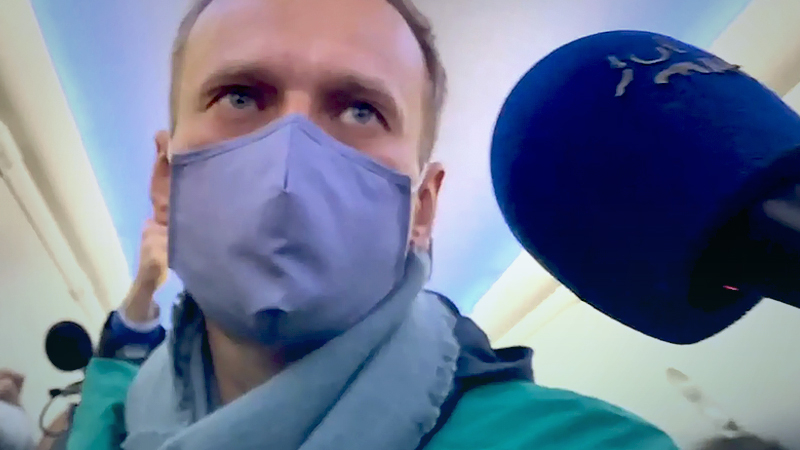
The Post was with Russian opposition leader Alexei Navalny on the plane taking him to Moscow from Berin on Jan. 17, five months after a nearfatal
poisoning. (The Washington Post)

The Post was with Russian opposition leader Alexei Navalny on the plane taking him to Moscow from Berin on Jan. 17, five months after a nearfatal poisoning. (The Washington Post)

By The Washington Post · Robyn Dixon

MOSCOW – Russian opposition leader Alexei Navalny called on Russians to take to the streets in mass protests after a court ordered Monday that he be held in custody for 30 days after his return to Russia.

He said Monday’s abrupt court hearing, to which a handful of pro-Kremlin media were admitted, was a sign of Russian President Vladimir Putin’s fear and weakness.

“They are afraid of you,” he said in a video message after the verdict, calling Putin’s regime a gang of monstrous crooks. “They are afraid and that is why they do things urgently and secretly.

“So I appeal to you: Don’t keep quiet. Resist! Take to the streets! No one can protect us but ourselves, and there are so many of us that if we want to achieve something, we will achieve it.”

International pressure mounted for Navalny’s release as he was abruptly summoned to the hearing, which he described as “the highest degree of lawlessness.” His lawyers said they were given just minutes’ notice of the hearing.

Navalny faces another hearing Feb. 2 over prison authorities’ claims that he violated conditions set down in a three-and-a-half-year suspended jail sentence relating to a 2014 embezzlement conviction, a case Navalny and the European Court of Human Rights have called a political prosecution. At that point, the original jail term could be reinstated.

Navalny’s Anti-Corruption Foundation announced plans for mass protests across the country Jan. 23.

“I don’t know what’s going on,” Navalny, 44, said in a video comment in court, where pro-Kremlin media had been ushered in. He said he thought he would meet his lawyers but found himself suddenly facing a court hearing.

The hearing took place at the Khimki police department near Moscow’s Sheremetyevo Alexander S. Pushkin International Airport, where he was arrested Sunday after flying home to Russia from Germany. He had been receiving medical treatment in Germany after an August poison attack.

“I don’t understand. Why was no one warned? No summons? I have seen a lot of mockeries of justice but this time the grandpa in his bunker is so afraid that the criminal code has been just torn apart and dumped,” he said, referring to Putin.

In an appeal to the judge, he said it was absurd that only select media representatives were admitted to the court, “but real journalists who are standing outside in the frost are not allowed in.”

His lawyer Olga Mikhailova told Judge Elena Morozova that no notice of the hearing had been given to Navalny’s legal team: “It is secret even for me. Having entered here, I found out that a court session was underway. Is this open?” The judge then gave Navalny’s lawyers 30 minutes to read the case materials and 20 minutes to consult with Navalny.

Eerily, a poster on the wall of the hearing room depicted Genrikh Yagoda, the infamous head of the NKVD, Stalin’s secret police, from 1934-1936. Yagoda supervised show trials and executions of officials during Stalin’s purges.

Dozens of Navalny’s supporters gathered outside the court, chanting “Alexei!” as the temperature dipped to -4 degrees Fahrenheit.

Yulia Navalnaya, who returned with her husband from Germany on Sunday, posted a supportive Instagram message to Navalny: “When you were poisoned I wrote that we could cope with everything and we could cope with that,” she wrote, adding the same was true now. “There is nothing we cannot cope with. Everything will definitely be fine!”

Russian authorities have dismissed Western alarm over Navalny’s arrest amid calls for his release by U.S., British and European officials.

Foreign Minister Sergei Lavrov brushed off the international criticism, describing it as an attempt by Western officials to distract from their own problems.

“It looks like Western politicians view this as an opportunity to divert attention from the deepest crisis the liberal development model has ever found itself in,” he said at a news conference in Moscow.

Lavrov said there were no grounds to open an criminal case into the poisoning, because no poison was found in Navalny’s system when he was hospitalized in Omsk, the Siberian city where his plane landed after he fell ill during a flight to Moscow. He added that German authorities had provided no material evidence of poisoning.

Navalny has blamed the poisoning on Putin and Russia’s domestic security agency, the FSB, a successor to the KGB.

Navalny’s arrest has been condemned by U.S. and European officials, who have called for his immediate release.

“We note with grave concern that his detention is the latest in a series of attempts to silence Navalny and other opposition figures and independent voices who are critical of Russian authorities,” U.S. Secretary of State Mike Pompeo said in statement Sunday.

NATO Secretary General Jens Stoltenberg on Monday joined the calls to release Navalny.

British Foreign Secretary Dominic Raab tweeted Monday, “it is appalling that Alexei Navalny, the victim of a despicable crime, has been detained by Russian authorities. He must be immediately released.”

Raab added that rather than arresting Navalny, Russia should be explaining “how a chemical weapon came to be used on Russian soil.”

German Foreign Minister Heiko Maas also called for Navalny’s immediate release, saying Russia was bound by its own constitution and respect for civil rights. Charles Michel, president of the European Council, called the arrest unacceptable.

Ursula von der Leyen, president of the European Commission, issued a statement Monday condemning the arrest and calling for his immediate release.

“Detention of political opponents is against Russia’s international commitments,” she said.

The French Foreign Ministry said it was following the case with “utmost vigilance” and demanded that authorities release him.

Commenting on Navalny’s arrest, Carl Bildt, former Swedish prime minister and co-chair of the European Council on Foreign Relations, said, “I guess he is accused of having survived the authorities’ attempt to kill him.”

He dismissed Russian authorities’ claim that Navalny’s future would be determined by the courts.

“Is there anyone who believes this statement by the authorities in Russia?” he tweeted. “Everyone knows who decides.”

Amnesty International called for Navalny’s immediate unconditional release, calling him a prisoner of conscience and adding that “Russian authorities have waged a relentless campaign against Navalny.”

The office of United Nations High Commissioner for Human Rights Michelle Bachelet said she was “deeply troubled” by Navalny’s arrest, and called for his immediate release and respect for his rights.

Putin and other Kremlin officials routinely underscore their disdain for Navalny by refusing to ever use his name, resorting to a range of constructions such as “the blogger,” or “the Berlin patient,” or “the patient who is in a coma for reasons yet to be determined.”

A military laboratory in Germany found incontrovertible evidence that he was poisoned with a Novichok group agent, a finding confirmed by labs in France and Sweden. Russian authorities deny the poisoning and have blamed Germany.

Europe and Britain have sanctioned Russian officials over the attack.

Investigative reporting group Bellingcat linked Navalny’s poisoning to members of a special unit within the FSB, by analyzing flight and mobile phone records.

Navalny has accused Putin of direct involvement. Last month he called a member of an elite toxins unit of the FSB team, Konstantin Kudryavtsev, while posing as an official compiling a report for Russia’s National Security Council.

In revelations highly embarrassing to Russian authorities, Kudryavtsev said the team had worked well on the project, explaining that the only reason Navalny survived was because of the actions of the pilot diverting the flight to Omsk and the medical team at Omsk airport. He described an intense coverup operation that included twice cleaning Navalny’s clothing, in particular his underpants.

Navalny had been under intense security surveillance for years before his arrest, and faced repeated arrest and harassment including having his bank accounts and those of his family frozen last year. Authorities recently announced new embezzlement charges against him, meaning he could face a lengthy jail term if convicted.
Biden choices for CFPB, SEC signal pivot to robust enforcement #SootinClaimon.Com

#SootinClaimon.Com : ขอบคุณแหล่งข้อมูล : หนังสือพิมพ์ The Nation.

Biden choices for CFPB, SEC signal pivot to robust enforcement

InternationalJan 19. 2021

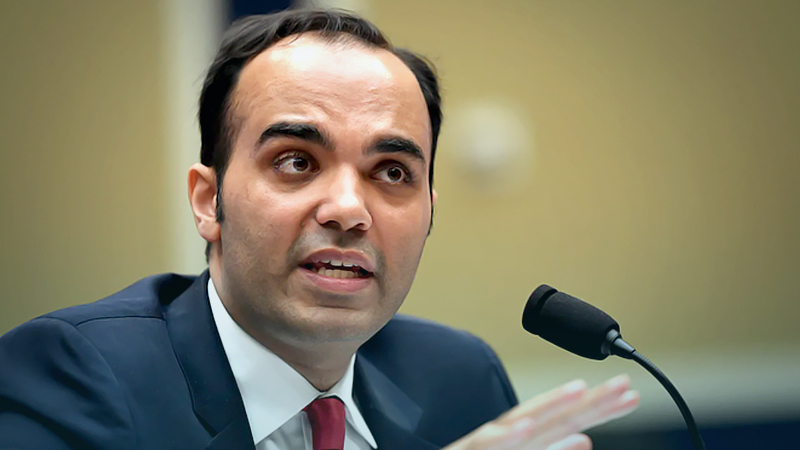
Rohit Chopra, head of the Federal Trade Commission, testifies during a House subcommittee hearing in 2019. President-elect Joe Biden is set to nominate
Chopra as the director of the Consumer Financial Protection Bureau. (Susan Walsh/ AP)

Rohit Chopra, head of the Federal Trade Commission, testifies during a House subcommittee hearing in 2019. President-elect Joe Biden is set to nominate Chopra as the director of the Consumer Financial Protection Bureau. (Susan Walsh/ AP)

By The Washington Post · Tory Newmyer

WASHINGTON – President-elect Joe Biden is set to nominate Rohit Chopra, the former student loan ombudsman for the Consumer Financial Protection Bureau, to lead the consumer finance agency.

And Biden will tap Gary Gensler, the former chairman of the Commodities Futures Trading Commission, to run the Securities and Exchange Commission.

The choice of the Obama-era regulators to lead two key agencies overseeing the financial sector signals the incoming Biden team’s intent to provide an aggressive check on the industry after four years of deregulation and light-touch enforcement under the Trump administration.

“Our administration will hit the ground running to deliver immediate, urgent relief to Americans; confront the overlapping crises of COVID-19, the historic economic downturn, systemic racism and inequality, and the climate crisis; and get this government working for the people it serves,” Biden said in a statement. “These tireless public servants will be a key part of our agenda to build back better – and I am confident they will help make meaningful change and move our country forward.”

Chopra, who has served since 2018 as a Democratic commissioner on the Federal Trade Commission, is an acolyte of Sen. Elizabeth Warren, D-Mass. He worked with her on establishing the Consumer Financial Protection Bureau (CFPB) before joining it in 2011 to lead its efforts in exposing abuses in the student lending market.

Chopra brought a background as a graduate of the University of Pennsylvania’s Wharton School, who, as a consultant with the global management firm McKinsey & Co., had focused on student debt and other consumer credit markets. At the CFPB, he called out private student lenders for their treatment of borrowers and helped lay the groundwork for President Barack Obama’s Student Aid Bill of Rights, focused on providing borrowers more power with loan servicers. He has been a similarly outspoken industry critic at the FTC, pressing for more aggressive enforcement actions against tech companies and others. Chopra declined to comment Monday on his appointment to lead the CFPB.

Sen. Sherrod Brown, D-Ohio, expected to chair the Senate Banking Committee that will handle Chopra’s nomination, praised his selection, calling him a “bold and experienced choice.”

“I am confident that Mr. Chopra will not only return the CFPB to its central mission – protecting consumers – but also ensure the agency plays a leading role in combatting racial inequities in our financial system,” Brown said in a statement.

Democrats have criticized the agency’s current director, Kathy Kraninger, saying she undermined the office’s mission by rolling back rules on businesses and not enforcing those on the books. She is serving a five-year term that runs through 2023. But because of a Supreme Court ruling in June, Biden can fire her as soon as he takes office.

Biden to propose major immigration legislation this week #SootinClaimon.Com

#SootinClaimon.Com : ขอบคุณแหล่งข้อมูล : หนังสือพิมพ์ The Nation.

Biden to propose major immigration legislation this week

InternationalJan 19. 2021

President-elect Joe Biden

President-elect Joe Biden

By The Washington Post · Seung Min Kim

WASHINGTON – President-elect Joe Biden propose major changes to the nation’s immigration laws the day he is inaugurated, including an eight-year pathway to citizenship for immigrants who do not have legal status and an expansion of refugee admissions, alongside an enforcement plan that deploys technology to patrol the border.

Biden’s legislative proposal, which is expected to be sent to Congress on Wednesday, also includes a heavy focus on addressing the root causes of migration from Central America, a key part of Biden’s foreign policy portfolio when he served as vice president.

The centerpiece of the plan from Biden and Vice President-elect Kamala Harris is the eight-year pathway, which would put millions of qualifying immigrants in a temporary status for five years, then grant them a green card once they meet requirements such as a background check and payment of taxes. They would be able to apply for citizenship three years later.

To qualify, immigrants must have been in the United States as of Jan. 1, a move meant to blunt any rush to the border.

Beneficiaries of the Deferred Action for Childhood Arrivals – which granted key protections for “dreamers” – and the temporary protected status (TPS) program for migrants from disaster-ravaged nations could apply for a green card immediately. The details were described by transition officials who spoke on the condition of anonymity because they were not authorized to speak publicly.

The president-elect’s plan has received praise from pro-immigration advocates and Democratic lawmakers who have toiled to change the immigration system for decades. But it also comes at a time when the Republican Party, led by President Donald Trump, has shifted rightward on immigration, complicating efforts at a deal that can get enough GOP support.

In a significant contrast with the Obama administration – which was criticized by the Latino community for not tackling immigration when Democrats controlled the House, the Senate and the White House early in Barack Obama’s presidential tenure – Biden has made immigration his chief legislative priority behind the immediate health and economic relief stemming from the ongoing coronavirus pandemic.

“Having leadership makes a big difference,” Sen. Robert Menendez, D-N.J., said in an interview Monday. “You cannot achieve immigration reform without presidential leadership, and from what I see, the seriousness of their purpose to start off with gives me a real good feeling that the president-elect is actually going to use capital to try to make this happen.”

The Biden effort would mark the most substantial attempt at a comprehensive immigration overhaul since the Senate passed legislation in 2013, only to have it collapse in the House, controlled by Republicans, the following year.

After that collapse, pressure from Democratic lawmakers and immigration advocates pushed Obama to issue a wide-reaching effort aimed at protecting parents of U.S. citizen children and green-card holders who were in the country illegally, but that action was promptly blocked in the courts.

Under Trump, the GOP-controlled Senate tried to pass various revisions to U.S. immigration laws, prompted by the outgoing president’s attempt to cancel the temporary protections for the immigrants. Trump was ultimately rebuffed by the Supreme Court on his push to end DACA.

Biden’s bill will have three overarching pillars, the transition officials said: provisions to address the causes of migration, border management and a path to citizenship.

The focus on Central America reflects the message that Biden has already relayed to senior officials in the region: that he will advocate for policy changes aimed at what drives scores of migrants there to come to the United States illegally to seek safe harbor.

“Ultimately, you cannot solve problems of migration unless you attack the root causes of what causes that migration,” said one official, pointing to the various reasons – from economic to safety – that drive migrants to flee their home countries. “He knows that in particular is the case in Central America.”

Transition officials are aware of recent reports of the increased numbers of migrants at or heading to the border in anticipation of the end of Trump’s presidency, and urged them to stay in their home countries. They emphasized that newly arriving immigrants would not qualify for the legalization program that Biden proposes.

Biden wants to move the refugee and asylum systems “back to a more humane and orderly process,” said the official. But “it’s also been made clear that that isn’t a switch you flip overnight from the 19th to the 20th, especially when you’re working with agencies and processes that have been so gutted by the previous administration.”

The president-elect hopes to reinstate a program granting minors from Central America temporary legal residence in the United States. The Trump administration terminated the program in August 2017, officials said. The administration also wants to set up a reunification program for Central American relatives of U.S. citizens that would allow those who have been approved for U.S. residency to be admitted into the country, rather than waiting at home for an opening. The program would be similar to ones that existed for Cubans and Haitians but were also ended by the Trump administration.

The Biden proposal would also put in place a refugee admissions program at processing centers abroad that would better help identify and screen those who would qualify to be admitted as refugees into the United States.

As for border enforcement, the plan calls on the Department of Homeland Security to develop a proposal that uses technology and other similar infrastructure to implement new security measures along the border at and between ports of entry. Biden has long vowed not to expand the border wall Trump has extended.

“This is not a wall, this is not taking money from [the Department of Defense],” a transition official said, referring to how Trump helped to finance his wall, after pledging that Mexico would pay for it. “It’s a very different approach.”

The legislation from the Biden White House also will contain several revisions to the legal immigration process, according to transition officials.

It would bolster the number of key employment- and family-based visas available, by recapturing unused visas from previous years and exempting spouses and children of green-card holders from quotas that restrict immigrants from immediately entering the country.

It also would grant work permits for spouses and children of temporary worker visa holders, though the number of available H-1B visas (for high-skilled foreign workers) and H2-B visas (for lower-skilled nonagriculture workers) would not be expanded, officials said.

Doctoral graduates in the science, technology, engineering and mathematics fields are also exempted from visa limits that critics say have led to talented immigrants moving elsewhere in the world, depriving the United States of their ingenuity.

The incoming administration has already said Biden will issue a flurry of executive orders on his first day, including one that would repeal the ban on citizens of some majority-Muslim nations from entering the United States. In another potential executive action, the Biden administration plans to review TPS programs “across the board” to see which programs ended by the Trump White House – including benefits for immigrants who fled from El Salvador, Nicaragua or Haiti – could be reinstated.

Transition officials declined to rule out other immigration executive actions if attempts at legislating fail, but they stressed that only Congress can implement certain changes, such as a path to citizenship.

“The president-elect supports resources that are there, and his secretary of homeland security will use them in a smart and humane way,” said another official. “But we really need Congress to step up.”

To win passage, the administration would have to retain all Democratic votes as well as persuade at least 10 Republican senators to cross the aisle. Some proponents of the 2013 effort – such as Sen. Lindsey Graham, R-S.C., and Marco Rubio, R-Fla. – remain in the Senate, though many others have since left.

Under Trump, Republican lawmakers favoring a more restrictive immigration system have gained a larger platform and, along with the president, have pushed measures limiting not only illegal but legal migration into the United States.

“He’s unveiling his draft immigration bill this week, and it’s what you’d expect from the party of open borders: Total amnesty, no regard for the health or security of Americans, and zero enforcement,” Sen. Tom Cotton, R-Ark., tweeted Monday. “Let’s be clear: Joe Biden is prioritizing amnesty ahead of the pandemic or getting Americans back to work. We can’t let him get away with it.”

Menendez, who worked on the 2013 immigration effort, said he believed the proposal from the incoming Biden administration was “definitely” more liberal than the compromise he helped negotiate as part of the “Gang of Eight,” which ultimately included a surge of border security resources that advocates said was too draconian.

“The Biden-Harris administration is going to be strong partners in helping undo a lot of the Trump administration’s cruel and divisive immigration policy over the last four years,” he said.

Internet regulation takes on greater urgency as pandemic highlights digital divide #SootinClaimon.Com

#SootinClaimon.Com : ขอบคุณแหล่งข้อมูล : หนังสือพิมพ์ The Nation.

Internet regulation takes on greater urgency as pandemic highlights digital divide

InternationalJan 19. 2021

President-elect Joe Biden

President-elect Joe Biden

By The Washington Post · Cat Zakrzewski, Tony Romm

WASHINGTON – The Biden administration’s agenda, already focused on the coronavirus, will face immediate pressure to address a related tech issue: access to home broadband that has become essential to continuing work, school and other important activities during the pandemic.

The country is in the midst of another surge in the virus – this time with a more contagious strain – and schools and offices nationwide are again closing their doors. The pandemic is highlighting a persistent digital divide, in which Americans without a strong and affordable Internet connection are increasingly boxed out of work and education opportunities.

President-elect Joe Biden promised throughout his candidacy that he would prioritize expanding Internet access as he made fixing the nation’s infrastructure a central tenet of his campaign message. His “Build Back Better” plan, a response to the dual health and economic crises, calls for the creation of “universal broadband” for every American.

That could set the stage for Democrats to finally make good on a long-standing push to expand federal funding for Internet access.

“Broadband access and deployment should be in every recovery package, in every infrastructure package,” said Sen. Ron Wyden (Ore.), the ranking Democrat on the Senate Finance Committee, whose work has paved the way for emergency broadband rebates. “That’s something you can really move in the next few weeks.”

The Biden transition team is exploring immediate actions it can take to bring relief to Americans in need of an Internet connection.

Once under Democratic control, the Federal Communications Commission will be positioned to make changes to the E-rate program, which helps schools and libraries obtain affordable broadband access. The transition landing team already has received recommendations for changes to the program, which the FCC is expected to enact, according to three people who spoke on the condition of anonymity to describe private conversations with the Biden camp.Democrats have been pushing for changes to the program so that its funding can be used to expand Internet access for students attending school virtually.

Last year, House Democrats passed a bill that would allocate $80 billion to deploy broadband to unserved areas. With victories in two recent Senate runoff elections in Georgia, Democrats are better positioned to ensure that such goals are achieved in future infrastructure packages.

There’s also pressure for Biden to follow through on campaign promises to undo the Republican FCC’s efforts to further deregulate the Internet. Democrats fiercely opposed a 2017 vote that dismantled Obama-era rules that required broadband companies to treat all websites equally. This created concerns that companies such as AT&T and Comcast could speed up service for their own services, while blocking or slowing down traffic to competitors.

Once Democrats again have a 3-2 majority on the FCC, they also will be well-positioned to restore the Obama-era rules. There will be two Democrats and two Republicans on the commission after current Republican Chairman Ajit Pai is expected to depart this week. Democrats are expected to nominate another commissioner, who must be confirmed by the Senate. The timeline for nominations is unclear, as the Senate is under pressure to confirm key members of Biden’s Cabinet while also addressing pandemic relief and the impeachment of President Trump.

There are some immediate actions that the Biden administration can take in the interim. Lawmakers and activists are pressuring the incoming administration to immediately withdraw from a federal lawsuit brought under the Trump administration challenging California’s net neutrality law. The lawsuit reflected Republicans’ efforts in recent years to repeal Obama-era rules that required AT&T, Verizon and other service providers to treat all Internet traffic equally – and stop states from adopting their own similar provisions.

A group of 13 Democratic lawmakers, led by Rep. Anna G. Eshoo (Calif.), sent a letter to Merrick B. Garland, Biden’s nominee for attorney general, last week. The lawmakers called Garland to make dismissing the case one of his first actions after the inauguration to ensure that it does not obstruct states’ efforts to regulate on many tech policy issues. The judge hearing the case has called on the Justice Department to say by Feb. 9 whether it will to drop the government challenge to California’s law.

Democrats also could try to leverage their narrow control of Congress to pass legislation that would enshrine net neutrality principles into federal law, and thus make it less susceptible to legal challenges and reversals under future Republican administrations. However it’s unclear how much of a priority that will be for lawmakers amid the pandemic, impeachment and economic fallout.

Sen. Edward J. Markey (D-Mass.) is optimistic that Democratic control of Congress will put Democrats “in a position to act” on passing a strong net neutrality bill. If Congress passed such a measure, Democrats would not have to worry about a future Republican-run commission again overturning it.

Tom Wheeler, who was chairman of the Federal Communications Commission under President Barack Obama, warned tech policy wonks against getting caught in the minutiae of individual issues, and to keep their eye on how Internet regulation can be used to confront the pandemic, the economic crisis and racial injustice.

“The Biden administration exists in a different environment that puts that kind of thinking in second place behind broader thinking about how do we deal with the collection of existential challenges that exist today,” Wheeler said.

Biden inherits bipartisan momentum to crack down on large tech companies’ power #SootinClaimon.Com

#SootinClaimon.Com : ขอบคุณแหล่งข้อมูล : หนังสือพิมพ์ The Nation.

Biden inherits bipartisan momentum to crack down on large tech companies’ power

InternationalJan 19. 2021President-elect Joe BidenPresident-elect Joe Biden

By The Washington Post · Cat Zakrzewski

WASHINGTON – Antitrust action is perhaps the most formidable tool in the incoming administration’s arsenal to rein in Silicon Valley.

President-elect Joe Biden is ascending to power after months of bipartisan momentum to expand antitrust enforcement against the tech industry and update existing competition laws for the digital era. Before even taking the oath of office, Biden and his staff are already under pressure to scale up that work.

The recent violence at the Capitol and its aftermath is adding fresh urgency, as tech platforms’ role in amplifying violent rhetoric highlights the industry’s broad power and influence over American democracy.

Democratic control of the White House and Congress could result in reforms to competition laws governing large tech companies’ business practices and even more litigation that could force breakups or significant structural changes at some of the world’s largest corporations.

“Basically, the Biden administration is inheriting a lot of momentum and a big opportunity to make online communications safe for democracy and fair in the commercial sphere,” said Sarah Miller, who leads the American Economic Liberties Project.

Biden and Vice President-elect Kamala D. Harris, both moderate Democrats, are not the most likely politicians to take on power in Silicon Valley. They were not as aggressive as some of their more liberal peers, such as Sens. Elizabeth Warren, D-Mass., and Bernie Sanders, I-Vt., in calling to break up specific tech giants during the Democratic presidential primary.

Biden has said little specifically about how he intends to address antitrust issues in Silicon Valley, but he promised throughout his candidacy that he would take on growing economic concentration and monopoly power.

Consumer advocates and liberal Democrats want the Federal Trade Commission and the Justice Department under Biden to be significantly tougher on the tech giants than they were during the Obama presidency. Facebook, Google and Amazon did not have a single merger blocked between 2009 and 2016.

And many expect these agencies will be as the tech industry’s fortunes in Washington have significantly dwindled in the intervening years. The incoming officials at the Justice Department and the FTC will inherit a pair of federal antitrust lawsuits filed last year against Facebook and Google that are widely expected to proceed after the transition.

Both Democrats at the FTC supported a lawsuit against Facebook by the agency, which argued that the company is an illegal monopoly that should potentially be broken up. The Justice Department also filed a lawsuit in the fall against Google. The suit received broad bipartisan support.

But Biden is under pressure to expand this litigation. A recent report from the American Economic Liberties Project, an anti-monopoly group led by a member of Biden’s transition team, called on the incoming Justice Department to commit to “seeking a Google breakup.” The department’s lawsuit currently focuses on the power the company exerts over search, and the group wants it to challenge the company’s position in travel, maps and the App Store.

The group also called on the FTC to bring an antitrust case against Amazon, which has faced scrutiny over its treatment of third-party sellers. (Amazon Chief Executive Jeff Bezos owns The Washington Post.)

Antitrust is also increasingly a priority in Congress. Now that Democrats will control the House and the Senate, they will be able to use their powerful perches to call in executives to testify about competition in the industry. Last year, House Democrats led a grilling of the chief executives of Apple, Amazon, Facebook and Google on these issues.

Biden’s campaign said last year that he plans to work with Rep. David Cicilline, D-R.I., who led an investigation that found that Amazon, Apple, Facebook and Google engaged in anti-competitive tactics. The report recommended broad changes to laws that would punish big companies, such as making it illegal for Amazon and Google to give greater preference to their own products over competitors’ merchandise on their platforms. The recommendations also included expanding federal regulators’ powers to block future tech mergers.

Those recommendations could serve as a blueprint for legislation in the coming months. However, it remains to be seen how much of a priority antitrust policy will be in the new Congress, as lawmakers also grapple with the coronavirus pandemic, the economic crisis and the second impeachment of President Donald Trump. Cicilline, who declined to comment for this article, is one of the managers of the impeachment process.

“There’s an extent to which this is part of those crises,” said Charlotte Slaiman, competition policy counsel at the consumer group Public Knowledge. “The misinformation that is spreading on social media is making it harder for us to contain the coronavirus pandemic. It is making it harder for our democratic processes to function properly. I think this still absolutely needs to be a high priority with those other concerns.”

As Trump departs, scholars seek to understand his reign – and what it says about American democracy #SootinClaimon.Com

#SootinClaimon.Com : ขอบคุณแหล่งข้อมูล : หนังสือพิมพ์ The Nation.

As Trump departs, scholars seek to understand his reign – and what it says about American democracy

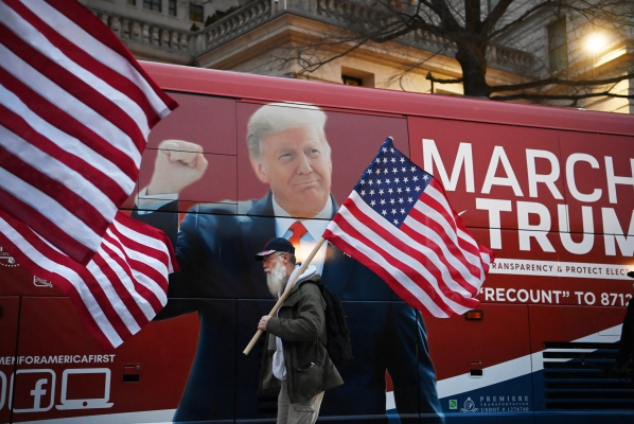
InternationalJan 18. 2021Thousands of Trump supporters violently storm the U.S. Capitol on Jan. 6, 2021, to support President Donald Trump's baseless claims that he won the election. MUST CREDIT: Washington Post photo by Michael Robinson ChavezThousands of Trump supporters violently storm the U.S. Capitol on Jan. 6, 2021, to support President Donald Trump’s baseless claims that he won the election. MUST CREDIT: Washington Post photo by Michael Robinson Chavez
By The Washington Post · David Nakamura · NATIONAL 

WASHINGTON – More than 30,000 falsehoods and lies. Nearly 400,000 coronavirus deaths. Rising white nationalism. Financial self-dealing. A social media ban. Two impeachments. A deadly attack on the U.S. Capitol.

President Donald Trump’s four years in office come to a close Wednesday after a reign defined by constant chaos, corruption and scandal, a tenure that numerous scholars predict is destined to rank him among America’s worst presidents.

Trump’s claims of policy victories – including a raft of conservative judges and steps toward Middle East peace – will be vastly overshadowed by his mismanagement of the pandemic and his unprecedented assault on the U.S. election results, they said.

“You never want to be ranked below William Henry Harrison, who was only president for one month. If you rank below him, it means you’ve harmed the country,” presidential historian Douglas Brinkley of Rice University said. “Now you’re getting into James Buchanan and Andrew Johnson territory. Trump will automatically be in that category.”

Yet as Trump departs the White House – and the daily controversies and social media warfare he provoked begin to subside – the historians preparing to reckon with his legacy said it’s not just Trump who will be examined under the harsh reflection of history’s mirror, but also American society and the nation’s commitment to democracy.

Trump’s relentless attacks on civic institutions, provoking of racial and social divisions, trampling of political norms, broadsides against the free press and impugning of America’s international allies have raised profound questions about the nature of American governance and the endurance of the values the United States has long professed to cherish, scholars said.

“Trump and Trumpism have brought those flaws into sharp relief,” said Matthew Dallek, a political historian at George Washington University. “The fact that 74 million people could vote for someone who is a conspiracy theorist and a perpetual liar and encouraged violence and the Proud Boys and white supremacy – in that sense, the Trump presidency will be important for those reckoning with ‘What does it mean to be an American?’ And also what does it mean to live in what a lot of people thought was the world’s greatest experiment in democracy, when it turns out that experiment is incredibly fragile?”

The Trump years have been something of a boon for political historians and scholars who were vaulted into slots as cable television analysts and newspaper pundits to assess his presidency in real time. Now, the more traditional work begins, as they gain distance from the day-to-day political combat and wade through historical records of the past four years to make broader judgments about his place in history.

It is here that some raised concerns over the volume and reliability of the records that can help guide them. Before his Twitter account was shutdown in the wake of the U.S. Capitol siege on Jan. 6, Trump had posted nearly 60,000 tweets and retweets to more than 88 million followers – offering a moment-to-moment reflection of his mind-set.

Yet scholars said other records, such as memos and interviews with aides, are more tenuous. Some worried that Trump and his associates will destroy documents despite laws meant to preserve them, while others voiced concerns that White House aides, who like their boss have a record of misleading the public, will be unreliable narrators of his presidency.

“I wonder if there will be the same documentation of Trump’s own decision-making and processes that we have with other presidents,” said Joseph Crespino, a history professor at Emory University in Atlanta. “He’s not a reader or a note taker or a memo writer. That will be a challenge.”

In many ways, Trump’s presidency was so aberrant – a real estate promoter and reality television star with no political or military experience winning the highest elected office with a minority share of the popular vote – that it is difficult to place him within the continuum of his peers, historians said.

Yet they also emphasized that Trump did not come out of nowhere – that his rise to political prominence behind a false birther conspiracy seeking to delegitimize his predecessor, President Barack Obama, is rooted in the Republican Party’s history of racial grievance politics and its leaders’ increasing willingness to embrace the far-right wing.

Likewise, they said, Trump’s use of new social media tools to spread disinformation was made possible by rapidly changing technologies, but the rhetoric he employed to radicalize his base is steeped in language of American demagogues – from Joseph McCarthy to Father Charles E. Coughlin to George Wallace.

Historians “will think less in terms of analogy [to past presidents] and think more in terms of puncturing the mythic past that both Trump and the people opposed to him alight on – that America had a pure form of democracy that we either lost because of Trump or that Trump brought back,” said Nicole Hemmer, a historian who specializes in conservative media and is working on the Obama Presidency Oral History at Columbia University.

“There’s a lot more continuity here than we might think,” Hemmer said. “We might not be able to pluck one person out of the past and say that is what Donald Trump is like. But we can understand that throughout American history there has been racism and fascism and anti-democratic forces and say he is drawing from those powerful influences.”

Ruth Ben-Ghiat, a New York University historian who studies fascism, said Trump is best understood in comparison to authoritarian-leaning figures abroad who have employed similar tactics of sowing division and chaos – which she called “crisis politics” – to wield power.

In her view, Trump’s critics missed an important point when they mocked Trump for being lazy by spending so much time golfing and tweeting. Like other autocrats, she said, Trump focused on using his presidency to enrich himself – in Trump’s case by constantly promoting his private resorts and golf courses.

And the president deployed his social media accounts to delegitimize criticism and maintain allegiance from his followers, fostering a “personality cult that is way out of proportion to any other president, including Ronald Reagan,” Ben-Ghiat said.

“I don’t think we can use the same frame of reference as with other presidents because Trump never intended to govern in a recognizable presidential manner,” she emphasized. “His aims and goals were totally different.”

Republicans have called such criticism of Trump’s presidency overblown and faulted his critics for fanning the divisive political partisan and cultural divides that led to mass social justice protests last summer and violent clashes between Trump supporters and counterprotesters since the election.

Trump’s GOP allies also have pointed to successes in the party’s conservative agenda – including three conservative Supreme Court justices, a Republican-backed tax cut, broad environmental and business deregulation – as evidence of the president’s achievements. And they noted that Trump won 74 million votes in 2020, the second-most ever in a presidential election to Biden’s 81 million, reflecting his deep support among the public.

Yet historians said Trump’s tenure is virtually certain to be defined by the tumultuous events of the past year, during which he has actively sought to play down the risks of the global pandemic, used government force to clear protesters from a park just beyond the White House gates last June, falsely claimed victory over President-elect Joe Biden and helped incite a pro-Trump mob that stormed the Capitol, resulting in the deaths of five people.

To Leah Wright-Rigueur, associate professor of American history at Brandeis University, Trump’s presidency has been a case study in the “naked, unadulterated pursuit of power and self-interest, at the cost of 400,000 lives and at the cost of the American union.”

She added that Trump’s four years have dramatically exposed what racial minorities and other marginalized Americans have long understood – that the nation’s democracy has always been “brutal, exclusionary and flawed” for many citizens.

The storming of the Capitol “will be the moment everybody remembers about Trump’s presidency,” Wright-Rigueur said. “It tells the story about the failures of American democracy – not just about Trump, but also the centuries-old lies we tell ourselves about who we are.”

Trump administration bailed out prominent anti-vaccine groups with more than $800,000 in loans during pandemic #SootinClaimon.Com

#SootinClaimon.Com : ขอบคุณแหล่งข้อมูล : หนังสือพิมพ์ The Nation.

Trump administration bailed out prominent anti-vaccine groups with more than $800,000 in loans during pandemic

InternationalJan 18. 2021

By The Washington Post · Elizabeth Dwoskin, Aaron Gregg · NATIONAL, HEALTH, HEALTH-NEWS 

WASHINGTON – Five prominent anti-vaccine organizations that have been known to spread misleading information about the coronavirus received more than $850,000 in loans from the federal Paycheck Protection Program, raising questions about why the government is giving money to groups actively opposing its agenda and seeking to undermine public health during a critical period.

The groups that received the loans are The National Vaccine Information Center, Mercola Com Health Resources LLC, Informed Consent Action Network, Children’s Health Defense Co., and the Tenpenny Integrative Medical Center, according to the Center for Countering Digital Hate, a U.K.-based advocacy group that fights misinformation, which conducted the research using public documents. The group relied on data released in early December by the Small Business Administration in response to a lawsuit from The Washington Post and other news organizations.

Several of the Facebook pages of these organizations have by penalized by the social network, including being prohibited from buying advertising, for pushing misinformation about covid-19.

Vaccines are largely considered safe and effective, and clinical trials for both Moderna and Pfizer vaccines did not raise serious safety concerns. But many Americans hold skeptical attitudes about vaccination, attitudes public health experts have said are attributable in part to misinformation. Nearly 40% of Americans say they definitely or probably would not get the vaccine, according to a December survey by Pew Research Center. Certain groups, including Republicans and Black Americans, are even more skeptical, Pew found.

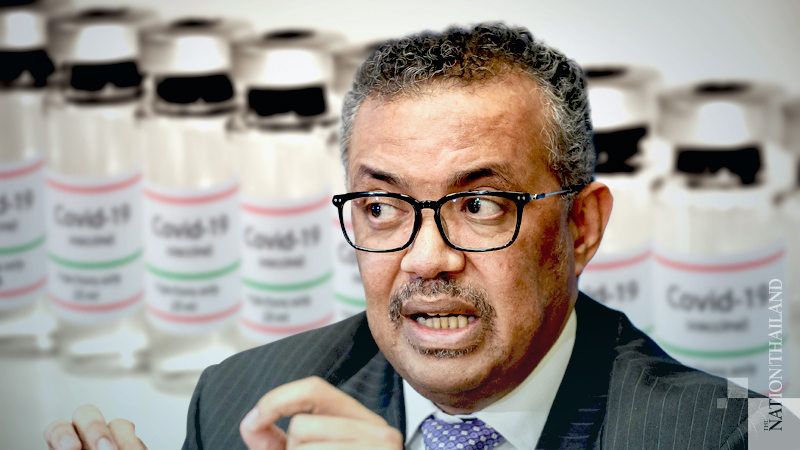
Public health officials, including WHO Director General Tedros Adhanom Ghebreyesus, have called vaccine misinformation “a major threat to global health that could reverse decades of progress made in tackling preventable diseases,” and last year the organization partnered with Facebook to help counter misinformation on its platform with content from authoritative sources.

The smallest loan of $72,000 went to the Tenpenny organization, which is run by Dr. Sherri Tenpenny, an osteopathic physician and social media figure who actively uses online forums to promote alternative health and argue against child and other forms of vaccination. A popular page run by Tenpenny was banned from Facebook in December for spreading misinformation, though she still has tens of thousands of followers on Instagram.

The largest loan of $335,000 went to Mercola, an organization affiliated with the well-known anti-vaccine activist and businessman Dr. Joseph Mercola. One of Mercola’s groups on Facebook was deemed by the left-leaning human rights group Avaaz to be one of the leading “superspreaders” of misinformation about the coronavirus. His Facebook pages in English and Spanish together have more than 2.7 million followers.

The Children’s Health Defense Co., founded by Robert Kennedy Jr., says it does not oppose vaccines, but is dedicated to raising questions about their safety. The group has questioned whether the coronavirus vaccines that have received emergency approval from the FDA are safe, along with questioning whether children should be vaccinated.

The group has posted on its social media channels about the “great reset” conspiracy theory, which holds that “global elites” such as Bill Gates will use the pandemic to advance their interests and push forward a globalist or Marxist plot to destroy American sovereignty and prosperity and control the population. In a CNBC interview last October, Gates said it was “unfortunate” that both he and director of the National Institute of Allergy and Infectious Disease Dr. Anthony Fauci had been targeted by conspiracy theorists, and worried that falsehoods and misleading information about the virus was undermining the country’s ability to respond to the pandemic.

Organizations tied to Kennedy were responsible for the majority of Facebook advertising critical of vaccinations, until Facebook restricted the group’s ability to advertise in 2019 on the grounds that it spread misinformation, according to a study in the journal Vaccine. Facebook has also removed the group from its recommendation algorithms so that it is not suggested to other users as a potential interest, and has demoted it in its news feed so that it shows up on people’s Facebook pages less frequently, and has blocked the ability of users to “like” the page.

In 2020, the group sued Facebook and its fact-checking partners for the ad ban and for debunking the group’s posts with fact-checking labels, costing the group 95% of its website traffic from Facebook, according to the lawsuit.

In an interview, Kennedy, an environmental lawyer and a nephew of former President John F. Kennedy, said his organization is “scrupulous about obeying the law” and questioned whether there is any law or regulation that would prevent his organization from receiving federal help.

“I’ve never heard anybody say that a loan is only available to people who don’t question the government,” Kennedy said.

The other four PPP recipients described in this story did not respond to requests for comment.

The anti-vaccine groups are ramping up their tactics and messaging at a moment when more and more Americans are searching for accurate information about the coronavirus vaccine. Encouraging the safe use of vaccines is considered a vital component of the government’s efforts to alleviate the public health crisis.

The Center for Countering Digital Hate previously exposed a conference in which anti-vaccination activists planned to seize upon people’s doubts and fears to undermine confidence in the coronavirus vaccine.

“Lending money to these organizations so they can prosper is a sickening use of taxpayer money. These groups are actively working to undermine the national covid vaccination drive, which will create long-term health problems that are felt most acutely in minority communities and low-income neighborhoods,” said Imran Ahmed, Chief Executive of Center for Countering Digital Hate.

While it’s unclear whether the anti-vaccine groups broke any rules, their receipt of public assistance is in many ways a consequence of the scattershot way in which the Paycheck Protection Program delivered hundreds of billions of dollars into the economy with few guardrails or preconditions.

The program was built around a controversial decision to allow businesses to self-certify their own eligibility for a taxpayer-backed loan. The SBA does not hand out the loans itself; rather, it empowers a network of approved lenders to quickly process them on its behalf.

Although the SBA reserves the right to audit specific PPP loans, the government performed almost no vetting of specific loan recipients beyond a basic check to determine whether the applicant had already received a loan.

The self-certification policy allowed the government to quickly pump money into a struggling business community during the chaotic months of April and May, by cutting much of the red tape typically associated with loan approvals.

But the broad eligibility criteria and lack of vetting meant numerous questionably-deserving organizations were among the millions of loan recipients. Massive restaurant and hotel chains such as Shake Shack and Sonic benefited handsomely from loans to their affiliates. Debt-collectors and high-interest lenders pocketed more than $500 million. A defense contractor with billions in sales received one.

In some cases the government has tried to claw back money after press coverage highlighted certain recipients. In April it asked publicly traded companies to return funds, and it later accused local Planned Parenthood affiliates of improperly accessing PPP loans.

It’s unclear whether the SBA will take issue with anti-vaccination groups receiving PPP funds.

SBA spokeswoman Carol Wilkerson declined to comment on whether the anti-vaccine organizations were legally eligible for the loans they received. She added that the agency is reviewing loan forgiveness applications to ensure compliance with the rules, and that the next round of PPP funding include more vetting on the front-end before an organization gets a loan.

She suggested that they probably did meet the requirements; the PPP program was open to a wide range of businesses and nonprofits.

“In general, if PPP applicants [or] borrowers met the requirements, they got a loan,” Wilkerson said.

The SBA has previously said in informational materials that a business appearing in its PPP loan database “doesn’t mean that SBA has made an affirmative declaration that a borrower is eligible.”

Misinformation about covid-19 spread widely across social media throughout the pandemic, shared by everyday people as well as anti-vaccine activists and supporters of the QAnon conspiracy theory. Now some of those groups have turned their attention to the vaccine, making baseless arguments, for example, that the U.S. government will force people to take it, that it contains microchips, and the people will be compelled to wear some biological marker to prove that they had the vaccine.

The social media pages of the anti-vaccine groups point to articles and research highlighting stories of adverse impacts from the coronavirus vaccine, or warning against forced vaccinations and passports, or the dangers of masks. Many of the posts are factual, but use fearmongering or present a distorted picture of the dangers of vaccines.

Facebook has banned misinformation about the coronavirus and the coronavirus vaccines, and has cracked down on large Facebook groups that oppose or question vaccination, including four of the five groups that received the PPP loans, said spokeswoman Dani Lever.

In recent months, the company also suspended two major groups, including the 100,000-plus-member Stop Mandatory Vaccination, as well as pages belonging to several of the movement’s leading figures. The National Vaccine Information Center is also prohibited from advertising, and the Informed Consent Action Network’s page has been labeled with a link to the World Health Organization and is not being recommended to users by the company’s algorithms, Lever said.

The company did not ban the groups for misinformation, but for what it said was abusive behavior, such as using paid troll farms in North Macedonia and the Philippines to spread messages.

Despite Facebook’s actions, major anti-vaccine accounts on social media platforms have gained more than 10 million new followers since 2019, including 4 million additional followers on Instagram and 1 million on Facebook, according to CCDH.

“These organizations have been sowing the seeds of doubt about vaccines and public health for years,” said Erica Dewald, advocacy director at a pro-vaccine nonprofit called Vaccinate Your Family.

“Now, in the middle of a pandemic, they are accepting funds for the chaos they’ve helped to create,” she said.

WHO chief warns of ‘catastrophic moral failure’ as rich countries dominate vaccine supplies #SootinClaimon.Com

#SootinClaimon.Com : ขอบคุณแหล่งข้อมูล : หนังสือพิมพ์ The Nation.

WHO chief warns of ‘catastrophic moral failure’ as rich countries dominate vaccine supplies

InternationalJan 18. 2021

WHO Director General Tedros Adhanonom Ghebreysus

WHO Director General Tedros Adhanonom Ghebreysus

By The Washington Post · Paul Schemm, Jennifer Hassan · NATIONAL, WORLD, HEALTH, HEALTH-NEWS 

The head of the World Health Organization warned Monday that the world is on the brink of a “catastrophic moral failure” if wealthier nations don’t ensure the equitable distribution of vaccines to combat the coronavirus pandemic.

WHO Director General Tedros Adhanonom Ghebreysus, who repeatedly has warned richer countries against excluding poorer ones by cutting bilateral deals with vaccine suppliers, took his rhetoric up a notch in his opening remarks at an executive board session.

“I need to be blunt: The world is on the brink of a catastrophic moral failure – and the price of this failure will be paid with lives and livelihoods in the world’s poorest countries,” he said, noting that while 39 million doses have been administered in more than 40 higher-income countries, one poor country has so far just given out 25 doses.

While Tedros hailed the vaccine rollout as a great scientific achievement, he noted that there were lessons to be learned from past global pandemics when vaccines took a long time to reach developing countries. The current crisis was a chance to “rewrite history,” by ensuring that vaccines are distributed fairly between countries and to those who need them the most.

WHO has partnered with several vaccine makers to provide 2 billion doses to a consortium of low-income countries in an initiative dubbed Covax, but Tedros said there are concerns the vaccines won’t be delivered.

“Even as they speak the language of equitable access, some countries and companies continue to prioritize bilateral deals, going around Covax, driving up prices and attempting to jump to the front of the queue,” he said.

He called on wealthier countries to hold off on vaccinating their young and healthier adults so that older people and front-line health workers in developing countries could receive their doses of the vaccine.

His warning came as wealthier nations such as Britain scramble to vaccinate the vulnerable amid a fresh outbreak of the virus which experts say was triggered by a new and highly contagious variant that his since been identified in many other countries.

The British government has vowed to vaccinate its four priority groups – which include National Health Service workers and care home residents by Feb. 15.

England’s Department of Health and Social Care said Sunday that an estimated 45 percent of people over the age of 80 have now been vaccinated and that over 1 million people within the age group had been invited to book their vaccine appointments.

In Europe, several countries including Sweden and Finland have expressed concern and anger that shipments of the Pfizer vaccine have been delayed, calling the setback – which the U.S. firm called a temporary delay – “unacceptable.”

The president of the European Commission, Ursula von der Leyen, said last week that Pfizer had agreed to supply the EU with 600 million doses this year.

Those in Africa face a much longer wait for help, with the Africa Centers for Disease Control and Prevention estimating the a distribution program may not begin until April.

Ahmed Ogwell Ouma, deputy director of the Africa CDC, said last month that those in African nations were “often holding the short end of the stick.”

India, which has the second-highest coronavirus caseload in the world, is also beginning mass vaccination efforts and hopes to immunize around 300 million people by summer – despite concerns that one of the vaccines may not work.

FBI screens U.S. troops for possible insider threats ahead of inauguration #SootinClaimon.Com

#SootinClaimon.Com : ขอบคุณแหล่งข้อมูล : หนังสือพิมพ์ The Nation.

FBI screens U.S. troops for possible insider threats ahead of inauguration

InternationalJan 18. 2021National Guard troops march through the downtown area of Washington on Sunday, Jan. 17, 2021. MUST CREDIT: Photo for The Washington Post by Astrid Riecken
Photo by: Astrid Riecken — For The Washington PostNational Guard troops march through the downtown area of Washington on Sunday, Jan. 17, 2021. MUST CREDIT: Photo for The Washington Post by Astrid Riecken Photo by: Astrid Riecken — For The Washington Post

By The Washington Post · Paul Sonne, Dan Lamothe, Missy Ryan 

WASHINGTON – U.S. defense officials say the federal government is screening the 25,000 National Guard troops who have begun flowing into the nation’s capital to secure the inauguration because concerns about extremism in the ranks are intensifying.

The screening comes after a number of pro-Trump rioters involved in storming the U.S. Capitol on Jan. 6 were found to have military ties, raising questions about extremist sentiment within the armed forces. Dozens of people on a terrorist watch list were in Washington as the deadly riot unfolded.

A U.S. defense official, speaking on the condition of anonymity to discuss the sensitive preparations, said the Army is working with the FBI to vet all service members supporting the inauguration. The Army maintains awareness of threats but does not collect domestic intelligence itself, the official said. It was not immediately clear how extensive the FBI vetting of the military personnel would be.

The screening comes as thousands of troops in camouflage uniforms patrol the streets of the nation’s capital, which has turned into a fortress of security barriers and fences in the lead-up to the inauguration. Many of the guardsmen are armed, but they often do not have magazines loaded in their rifles.

Maj. Gen. William Walker, commanding general of the District of Columbia Guard, said in an interview with Defense One that the screening represented an “extra layer” of security for this deployment on top of the continuous monitoring that the U.S. military does of its service members.

“For this deployment everybody is screened additionally, but it’s more of a reassurance, because we do everything we can do (to) know our guardsmen, our soldiers and airmen,” Walker said.

Army Secretary Ryan McCarthy, who is overseeing the D.C. Guard and the military’s preparations for the inauguration, said in an interview with The Associated Press that the vetting process has not flagged any potential problems with the troops coming to help protect the inauguration.

“We’re continually going through the process, and taking second, third looks at every one of the individuals assigned to this operation,” McCarthy told the AP, which reported that the screening is being carried out by the FBI and is scheduled to be completed by Inauguration Day – Wednesday.

McCarthy told the AP that he has told commanders to keep an eye out for any problems within their units.

Because D.C. is not a state, its Guard answers to the president, but his authority is traditionally delegated to the defense secretary and the Army secretary, who assume operational control on the president’s behalf.

The extra screening of the forces flowing into the city from states demonstrates the high level of concern U.S. officials have heading into the week. President Donald Trump is set to be the first outgoing president since 1869 to skip his successor’s inauguration.

A second defense official said the Pentagon received 143 notifications of extremism-related probes last year from the FBI, 68 of which were related to suspected domestic extremism among current and former service members – a category that includes White nationalism, anti-fascist, antiabortion and anti-government beliefs. Most of the cases were related to veterans, the official said.

In a statement, the Army said it is working with the Secret Service to determine which service members supporting the inauguration require additional background screening.

All service members go through an annual program that requires them to report information regarding known or suspected extremist behavior in the ranks, the Army said. The Army also noted that the D.C. Guard is providing additional training as service members arrive in the city, instructing them to report anything they see or hear that seems inappropriate to the chain of command.

“There is no place for extremism in the military and we will investigate each report individually and take appropriate action,” the Army said in the statement. “The Army is committed to working closely with the FBI as they identify people who participated in the violent attack on the Capitol to determine if the individuals have any connection to the Army.”

To enter any branch of the U.S. military and receive a security clearance, all personnel undergo background checks, the Army added.

In a statement, Capt. Chelsi Johnson, a spokeswoman for the National Guard, said all members coming to Washington for the deployment “go through a credentialing process.”

“That information is shared with the requesting federal agencies and added to their database,” Johnson said. “We cannot speak for those agencies and how they use the information.”

Russian opposition leader Alexei Navalny detained on his return to Moscow #SootinClaimon.Com

#SootinClaimon.Com : ขอบคุณแหล่งข้อมูล : หนังสือพิมพ์ The Nation.

Russian opposition leader Alexei Navalny detained on his return to Moscow

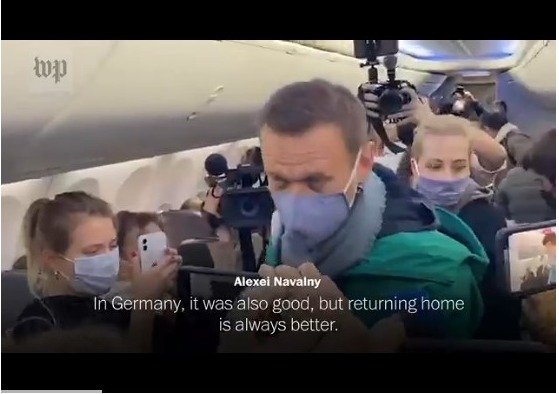
InternationalJan 18. 2021Alexei Navalny returns to Mosocow after recovering in Germany from a near-fatal nerve agent poisoning. MUST CREDIT: Washington Post photo by Loveday MorrisAlexei Navalny returns to Mosocow after recovering in Germany from a near-fatal nerve agent poisoning. MUST CREDIT: Washington Post photo by Loveday Morris
By The Washington Post · Isabelle Khurshudyan, Loveday Morris

MOSCOW – In his return to Russia on Sunday, five months after he left in a coma from a near-fatal poisoning, Kremlin critic Alexei Navalny made it as far as border control.

Before Navalny’s passport could be stamped, police officers at Moscow’s Sheremetyevo Alexander S. Pushkin International Airport surrounded and detained him. He gave his wife a hug and a kiss goodbye before being led to a private room.

The 44-year-old opposition leader’s arrest was expected, but he chose to fly to Russia anyway. Before his arrival, Russian authorities said he was on a wanted list for allegedly violating the terms of his suspended sentence from a 2014 embezzlement conviction. Navalny and the European Court of Human Rights have called that case a political prosecution.

But the move to jail him could have far-reaching consequences for the government of President Vladimir Putin. Navalny says Putin ordered Russian state security agents to poison him with a nerve agent during a trip to Siberia in August. The Kremlin has denied the accusation.

Navalny’s team said Sunday that the chaos surrounding his return, including the diversion of his flight to Sheremetyevo after supporters gathered at the Moscow airport where he was scheduled to land, show how serious a threat Putin considers Navalny.

His arrest is expected to trigger protests by his supporters, and a response from Western governments, perhaps in the form of more sanctions, is also possible.

“Mr. Navalny should be immediately released, and the perpetrators of the outrageous attack on his life must be held accountable,” Jake Sullivan, President-elect Joe Biden’s choice for national security adviser, tweeted Sunday. “The Kremlin’s attacks on Mr. Navalny are not just a violation of human rights, but an affront to the Russian people who want their voices heard.”

Amnesty International declared Navalny a “prisoner of conscience” Sunday night.

Russia’s Federal Penitentiary Service said Navalny would be in police custody “until a court ruling.” It’s unclear when his case will be heard. Hours after his detention, his spokeswoman tweeted that his whereabouts were not known. His lawyer was not allowed to join him.

Navalny, standing before a backdrop of the Kremlin at the Sheremetyevo airport before he went to border control, said Sunday was his “best day in the past five months.”

“This is my home,” he said. “I came here, and everybody is asking, ‘Aren’t you afraid?’ No, I am not afraid.”

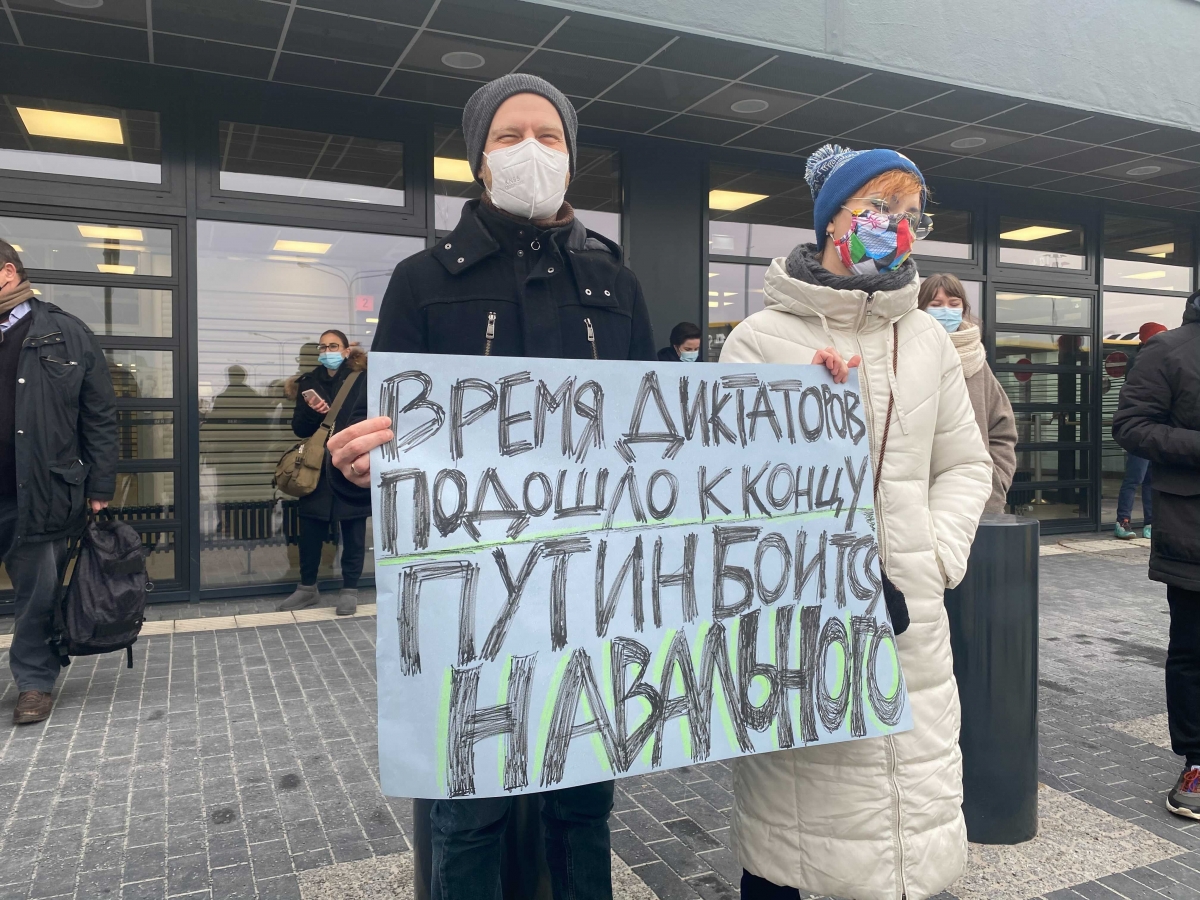
Ekaterina Raykova-Merz and Andreas Merz-Raykov wait outside Berlin airport Terminal 5 for Navalny to arrive. Their sign reads "The time of dictators has come to an end. Putin is afraid of Navalny." MUST CREDIT: Washington Post photo by Loveday Morris

Ekaterina Raykova-Merz and Andreas Merz-Raykov wait outside Berlin airport Terminal 5 for Navalny to arrive. Their sign reads “The time of dictators has come to an end. Putin is afraid of Navalny.” MUST CREDIT: Washington Post photo by Loveday Morris

Navalny had been staying in Berlin, where he was treated for his poisoning, including more than two weeks in a medically induced coma. He was escorted onto the flight by German security officials for his protection: Two black Audis with tinted windows surrounded by police cars could be seen on the tarmac. Airport officials warned journalists that they were not allowed to take pictures.

As Navalny made his way to his seat in the 13th row, reporters on the plane lobbed questions at him. He encouraged them to take their seats and fasten their seat belts so the flight could take off on time.

Asked what he expected in Moscow, Navalny replied with his signature humor: subzero temperatures, he said, and a warm welcome. He took a selfie with the flight attendants and watched the Cartoon Network series “Rick and Morty” during the flight.

At Moscow’s Vnukovo International Airport, where Navalny was scheduled to arrive, riot police were deployed to disperse a gathering crowd. More than 50 people were detained, according to the monitoring group OVD-Info.

People gathered at the airport said they were waiting for pop star Olga Buzova. Navalny’s team called it a Kremlin-backed effort to compete with his supporters.

As Navalny’s flight neared Vnukovo, flight radar showed it turning away, and its arrival was pushed back. The arrivals board showed that the plane had been diverted to Sheremetyevo.

On the plane, the captain announced that “a technical issue” caused the change. Other flights were diverted, too, and Navalny later apologized to affected passengers.

“I didn’t believe it until the last minute,” Navalny said on the plane. “There are several planes in the air above Vnukovo Airport right now, and they’re keep passengers in the air because they are afraid.”

At the news, some of the crowd started to leave Vnukovo. “I think if we all head to Sheremetyevo now, they’ll turn the plane back around to Vnukovo,” said onlooker Danila Buzanov, 25.

Buzanov called Navalny a Nelson Mandela-like figure. He said his arrest would make things worse for the Kremlin. Navalny’s return, he said, “is such a brave thing to do, and it’s such a message for people of how to not be afraid and fight until the end.”

Tatiana Stanovaya, head of political analysis firm R. Politik, wrote on the Telegram messaging app that Navalny’s arrest would trigger protests that would test “how far [Russian security services] and the most repressive apparatus of the state can go.”

Despite the change in airport, Navalny’s supporters showed up at Sheremetyevo and chanted the name of Navalny’s wife, Yulia, as she exited the border control area.

In Berlin earlier Sunday, Ekaterina Raykova-Merz and Andreas Merz-Raykov waited to greet Navalny before his departure, holding up a sign that read, “The time of dictators has come to an end. Putin is afraid of Navalny.”

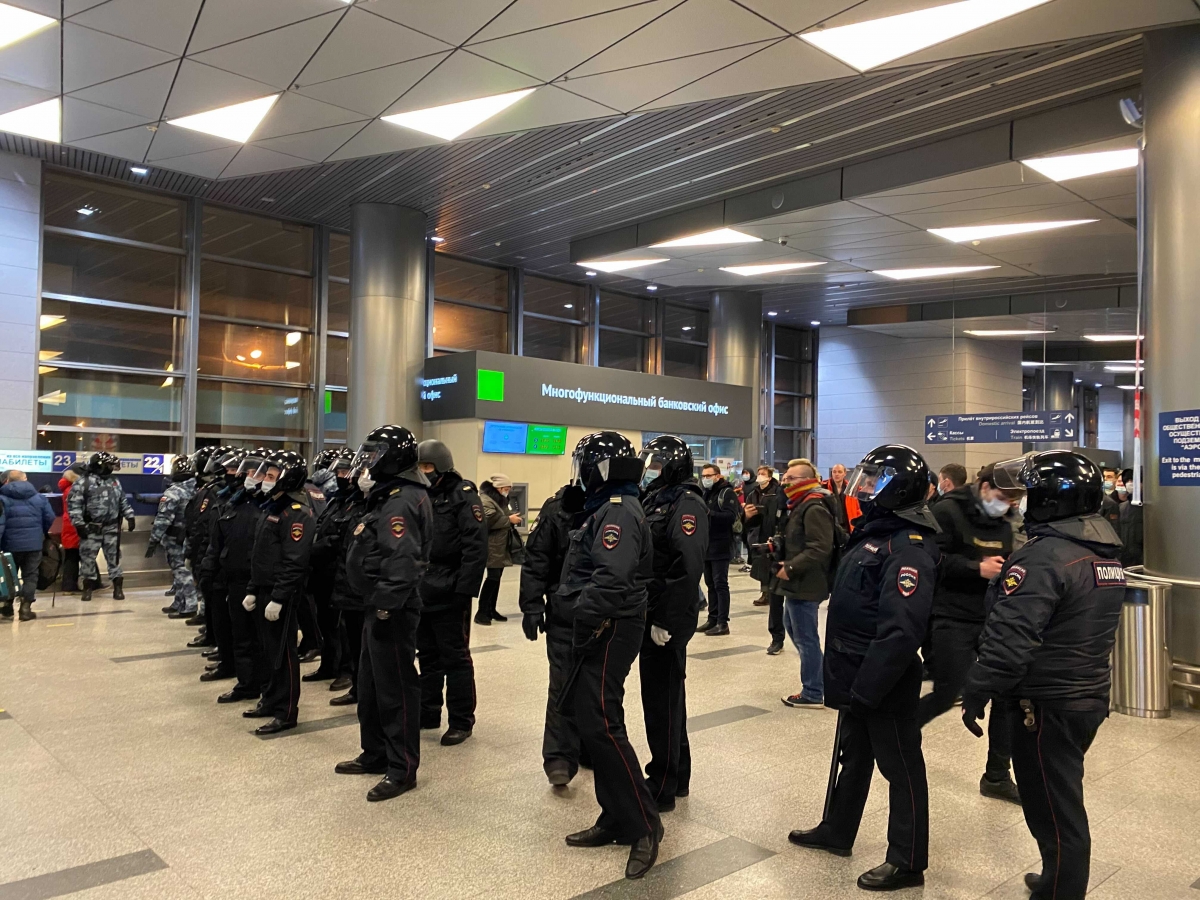
Riot police at Moscow's Vnukovo International Airport await Alexei Navalny's return. MUST CREDIT: Washington Post photo by Isabelle Khurshudyan

Riot police at Moscow’s Vnukovo International Airport await Alexei Navalny’s return. MUST CREDIT: Washington Post photo by Isabelle Khurshudyan

German doctors have said Navalny was poisoned with a nerve agent similar to the Soviet-era Novichok, which was used to poison former Russian double agent Sergei Skripal and his daughter in Salisbury, England, in 2018. Western intelligence blamed Russian agents for that poisoning.

The investigative website Bellingcat reported last month that telecommunications and travel data show that eight Russian state security agents were in the vicinity when Navalny was poisoned in Tomsk.

The Kremlin has denied any role in Navalny’s poisoning and has rebuffed Western calls for an investigation.

Putin, during a December news conference, seemed to confirm that Navalny was being watched, but he denied that Moscow was responsible for his poisoning. Without referring to Navalny by name, Putin laughed and asked: “Who needs him anyway? If we had really wanted, we’d have finished the job.”

Andrei Kolesnikov, chairman of the Russian Domestic Politics Program at the Carnegie Moscow Center, tweeted that “Navalny’s reception by the authorities at the airport is the best evidence of how afraid they are of him.”

“They themselves are inflating the importance of Navalny,” Kolesnikov said. “This disavows Putin’s ironic question: ‘Who needs him?’ “

But the government’s messaging on Navalny – alleging without evidence that he’s working with the CIA – has had some success in shaping Russian public opinion.

Forty-nine percent of Russians polled by the independent Levada Center in late December said the poisoning was either staged or “a provocation of Western special services.” Fifteen percent said it was an attempt by authorities to eliminate a political opponent.

Navalny’s return under threat of arrest could boost his popularity. Other prominent activists, such as businessman Mikhail Khodorkovsky and chess legend Garry Kasparov, continue to criticize the Kremlin, but from abroad.

Ruslan Karadanov, who went to the Berlin airport Sunday to show support, said Navalny was “very brave” to go back.

“If he wants to continue his political activity, he has no other choice,” he said. “Here in Germany, he’ll just be forgotten.”

In announcing his homecoming, Navalny said he “never considered the choice whether to go back or not.”

“I never left,” he said on Instagram. “I ended up in Germany, arriving there in an intensive care box, for one reason: they tried to kill me.”