A massive security operation is underway in Washington, D.C., ahead of President-elect Joe Biden’s inauguration on Wednesday, two weeks after a pro-Trump mob stormed the Capitol.
As images of National Guard troops circulate online, some in the United States have compared the capital to a war zone. The commentary has drawn pushback from people who have lived or worked in areas actually beset by conflict, who say such remarks are misleading and trivialize the reality of war.
“It’s extremely degrading to people who have actually lived through war and foreign occupation and have actually seen tanks rolling down their streets and foreign soldiers occupying their land or their own soldiers deployed against them,” said Jasmine el-Gamal, a former Pentagon adviser who worked in Iraq as a translator following the U.S. invasion in 2003. “That’s a conflict situation. That’s a war zone.”
Resorting to these comparisons rather than putting events within U.S. historical context, she told The Washington Post, “does U.S. citizens a huge disservice and it does international viewers a disservice when they are trying to understand what’s happening to the United States and how we got here.”
On Friday, CNN anchor Wolf Blitzer tweeted a picture of members of the U.S. National Guards standing in a street with the caption: “I spotted these National Guard troops at a normal Washington street corner not even near the Capitol. So many streets have been closed. It reminds me of the war zones I saw in Baghdad or Mosul or Falluja. So sad.”
“HOW is the current situation in DC Baghdad??,” demanded a Twitter user named Soroya. “Are bombs dropping on everyone’s heads?? Have hundreds of thousands of people died?? Stop comparing like it’s even remotely the same.”
“Why, did your family get shot to pieces inside your car before you took this photo,” asked Patrick Osgood, an analyst who focuses on Iraq.
Others shared more caustic takes.
“The day of the storming of the Capitol, I was looking at my Twitter timeline and it was basically just full of people jumping to so many conclusions and comparisons and saying, ‘Oh my gosh this is what happens in the Third World or the Middle East,”” Gamal said.
“For people who live outside and looking at the U.S. and want to be heard and understood, these comparisons feel like a huge slap in the face,” Gamal said. “For Americans who don’t know these experiences, it makes them think they know what its like.”
Faysal Itani, an adjunct professor of Middle East politics at George Washington University, called conditions in Washington “qualitatively different” from conflicts in places like Lebanon, where he is from, and elsewhere in the Middle East.
But he was not surprised comparisons were being made.
“The Middle East has become the go-to aesthetic … the template for breakdown and violence” in the United States, he said.
Americans, Itani said, often view their country in one of two modes: “It’s either a pristine place … that somehow functions according to different rules” than the rest of the world, “or it turns out it’s imperfect and we’re back in Baghdad.”
The novelist Phil Klay, an Iraq War veteran, said he understood why people in the United States “are looking for the language to describe a circumstance that is truly bizarre and feels extremely unsettled.”
But he said he meets this kind of description with “an eye roll.”
“The situation is extremely serious in the context of American democracy,” he told The Post. “But I don’t think that comparing D.C. to a war zone leads you to consider how we got to this particular place and what we need to do to respond to it.”
Rasha Al Aqeedi, an Iraqi senior analyst at the Center for Global Policy in Washington, said that comparing any military activity to Iraqi cities such as Mosul and Baghdad has the effect of “normalizing that conflict and military war belong there. We tend to forget the human beings actually live there.”
She urged people to look instead for “analogies based on the human experience and not violence and the military.”
By The Washington Post · Natalie Gryvnyak, Isabelle Khurshudyan, Erin Cunningham
KYIV, Ukraine -In the year since their loved ones died in the downing of Ukraine International Airlines Flight 752 in Iran, they’ve learned the nuances of aviation law. They’ve scanned Iranian news sites daily for any clues on why the passenger plane was shot down just minutes after takeoff from Tehran.
They’ve consoled each other. They also shared their anger.
“It’s like we’re frozen in time. We’re stuck,” said Navaz Ebrahim, whose newlywed sister and brother-in-law were among the 176 killed Jan. 8, 2020, when missiles struck the plane bound for Kyiv.
The past year has turned into a waiting game for answers and closure. Iran, while admitting responsibility for the air disaster that killed all on board, has rebuffed calls for a more transparent investigation, blaming “human error” and denying any systemic flaws. While the government has said it has made arrests over the incident, names have not been released.
Tehran says it has offered the families of those killed $150,000 per victim, but several families said they want justice, not money, and have called on Ukraine or one of the other countries with citizens killed in the crash to bring a case against Iran to the International Court of Justice.
There were 82 Iranians, 63 Canadians, 11 Ukrainians and 10 Swedes on the plane, as well as Afghans, Germans and British nationals.
“What they’re offering to the families right now is blood money,” Ebrahim said. “They just want to close the case.”
Saghar Nourian and her sister, 26-year-old Ghazal, were visiting their family in Iran when a U.S. drone strike killed a top Iranian military commander, Maj. Gen. Qasem Soleimani, in Baghdad on Jan. 3, 2020.
Saghar and her husband flew home to the United States on Jan. 6, but Ghazal’s flight back to Canada wasn’t for two more days.
Just hours before Ghazal’s flight, Iran fired more than a dozen short-range ballistic missiles at military bases housing U.S. troops in Iraq. But the airspace remained open for Ukraine International Airlines Flight 752 to Kyiv.
“I talked to (Ghazal) 30 minutes before boarding, and she didn’t know about the high tension between Iran and the U.S. It was me telling her about it,” Saghar said. “She started crying. She was super worried, not for herself but for the family in Iran.”
Saghar fainted when she saw the news three days later that Iran admitted to shooting down the plane. Iranian President Hassan Rouhani called it a “disastrous mistake.” Iran claimed that the operators who fired missiles were unable to distinguish the passenger jet from potentially hostile aircraft and proceeded without contacting their superiors.
According to the military prosecutor in Tehran, Gholam Abbas Torki, six people were arrested for their role in the tragedy, five of whom have been released on bail. The trial is scheduled to start later this month, said Torki, who led the state’s investigation.
Victims’ families said that alone isn’t sufficient. They have demanded to know the names of those charged, their punishment and a detailed explanation as to what went wrong. But under International Civil Aviation Organization rules, Iran leads the investigation because the plane was downed in Iran.
Iran’s Civil Aviation Organization said this month that it had distributed a draft of the final accident report to the concerned countries, after which the findings will be made public.
Hamed Esmaeilion, who lost his wife and young daughter in the crash and is the spokesman for the Association of Families of Flight PS752 Victims, said the families want the case brought to the International Court of Justice regardless of what the final accident report says.
The families have lost confidence in Iran to investigate its own actions fairly, he said.
“In case Ukraine sees that our efforts don’t take us anywhere, we don’t exclude a possibility to refer this dispute to an international legal forum,” said Ukrainian Foreign Minister Dmytro Kuleba in a statement to The Washington Post.
Andriy Guck, a Ukrainian aviation lawyer representing the family of one of the victims, said he doesn’t expect Ukraine to take that action until after it is finished evaluating the final accident report from Iran, perhaps not until early spring.
Ironically, a precedent for International Court of Justice involvement is the Iran Air flight shot down by the U.S. military over the Persian Gulf in 1988, which killed all 290 people aboard. The two sides reached a settlement in 1996 at the International Court of Justice in which the United States did not admit liability but agreed to pay up to $300,000 to families of each of the passengers.
Separate from Iran’s investigation of the crash, Ukraine opened its own criminal case. But Kuleba expressed frustration with Tehran’s lack of cooperation and said it “significantly delays the process at every stage.”
“We have sent several requests for legal assistance to Iran. Some of them have never been responded to; the responses we did receive have so far been unsatisfactory,” he said. “Furthermore, during our talks Iran agreed to set up a joint investigation team, but no practical steps have been taken in this direction since.”
Iran, cash-strapped in part due to U.S. sanctions, said it would offer the families of the deceased $150,000 per victim, though none of the families are believed to have accepted or received that payment.
Iranian officials have accused Canadian and Ukrainian authorities of stalling negotiations and “politicizing” the tragedy, saying the two nations are not “ready” to discuss compensation. Kuleba said Ukraine hasn’t “received any official information on the matter from Iran.”
Peter Neenan, a partner at London law firm Stewarts, wrote in a commentary that an appropriate compensation would be $400,000 per victim, a calculation he based on the United States paying $300,000 to victims’ families in the 1988 tragedy.
Katerina Gaponenko, the widow of the flight’s captain, Volodymyr Gaponenko, said she doesn’t expect to receive reparations for at least three years.
She got some financial support from the Ukrainian government and her husband’s insurance through the airline, but with two young girls at home, she appealed to Kyiv Mayor Vitali Klitschko for help finding work. He placed her in a job at the Kyiv City State Administration that she started this week.
She’ll wait for compensation if it means getting answers.
“The key issue for me is to hear the real reason for the plane crash,” she said. “We cannot bring back to life the captain, the crew and the passengers. The matter of reparation is not the key one in this case.”
D.C. mayor takes national spotlight in preparing for inauguration, making case for statehood
InternationalJan 18. 2021D.C. Mayor Muriel Bowser, a Democrat, holds a news conference on Friday, Jan. 15. MUST CREDIT: Washington Post photo by Bill O’Leary
By The Washington Post · Julie Zauzmer, Michael Brice-Saddler
WASHINGTON – Workers had just fenced off all of Capitol Hill – not just the congressional complex but Mayor Muriel Bowser’s Capitol Hill: the wide plaza that locals bike across on sunny days and the gentle hill where they take their children to sled in the snow.
Bowser looked at her city’s geographical and symbolic heart, transformed into a militarized zone. Then, she laced her hands together, pivoted toward a group of 50 National Guard troops in her high-heeled boots – and made a pitch, of all things, for their tourism.
“I know you probably won’t have a lot of time to enjoy our beautiful city,” she said to the volunteers from Virginia who had left their homes and families to protect the nation’s capital from insurrectionists, catching sleep on its cold marble floors. “When you come back, please be sure to do exactly that.”
Since the Jan. 6 storming of the Capitol, and throughout an unprecedented military clampdown to prevent further violence at President-elect Joe Biden’s inauguration, Bowser has popped up everywhere.
She held two news conferences in the hours during and after the riot, while federal authorities answered no questions from the reporters. In the following days, with near-silence from Trump administration about the attack, Bowser spoke authoritatively to a nation hungry for information and reassurance.
The 48-year-old Democrat has stayed on message, just as she did when addressing the National Guard troops – using the unfolding national crisis to make the case for the city of Washington, her native home.
Bowser, first elected in 2014,has been in the national spotlight before, most recently in late spring. She abandoned her years-long reluctance to speak strongly against President Donald Trump, whose cooperation she believed she needed, to criticize his response to the protests over the death of George Floyd.
The tangle quickly escalated far beyond the personal barbs they both fired on Twitter. Four days after federal law enforcement used tear gas to clear peaceful protesters from the street so Trump could pose for a photo, the city awoke to find that Bowser had ordered “Black Lives Matter” painted in enormous yellow letters yards from where the president had stood.
Photographs of Bowser’s taunting brainchild circulated around the world.
Now, the cameras are trained on Bowser again. From “Good Morning America” to “Face the Nation” to “The Situation Room,” she has been interviewed by almost every national network over the past two weeks. A few of her regular news conferences, ordinarily streamed only on the local government-access cable station, have gone live coast-to-coast.
“Certainly this time last year we didn’t expect to be in this situation. Even last week, we didn’t expect to be,” Bowser said at one of those briefings Wednesday, her third in three days.
Anthony Williams, who was mayor of Washington during the Sept. 11, 2001, terrorist attacks, said he has been glued to Bowser’s appearances. “She’s done a great job of stepping up and showing national leadership, notwithstanding the fact she isn’t given the respect as the governor of a state,” Williams said. “Yet she has state responsibilities. On top of that, she has national responsibilities.”
For most inaugurations, the public role of the District of Columbia mayor is to roll out the welcome mat for hundreds of thousands of tourists, then watch the parade from a reviewing stand outside the Wilson Building, D.C.’s city hall.
Not this year. When it became clear that the U.S. Secret Service would attempt to shut down a large swath of the city because of the seriousness of the threat of right-wing violence on Inauguration Day, it was Bowser – not Trump or Biden – who made the announcement.
It was Bowser who told Americans in stark terms not to travel to town for inaugural events. People across the 50 states heard her words and canceled their plane tickets.
“If you take the preparation we did in 2009 and preparations she has to do now in 2021, the degree of difficulty which she’s operating under is at least tenfold, maybe twentyfold,” said former mayor Adrian Fenty, an early political mentor of Bowser’s. He was mayor when Barack Obama’s first inauguration brought unprecedented crowds and threats to the incoming president’s safety.
D.C. Mayor Muriel Bowser, a Democrat, approaches Virginia National Guard troops guarding the Capitol on Tuesday, Jan. 12, 2021. MUST CREDIT: Executive Office of Mayor Muriel Bowser photo by Khalid Naji-Allah
Bowser’s chief of staff, John Falcicchio, said that the mayor has spoken with Biden and Vice President-elect Kamala Harris since Jan. 6, and that Bowser’s stay-home announcement was a message the Biden team wanted to send.
“Mayor Bowser has been solely focused on how to keep people away from D.C.,” Falcicchio said, noting that the circumstances have called for a complete reversal of Bowser’s ordinary demeanor. “She travels the world trying to get people to come to Washington, D.C., to see all the great things that we have.”
For support, Falcicchio said, Bowser has leaned on a network of Black Democratic mayors across the country, a group that includes San Francisco’s London Breed, Atlanta’s Keisha Lance Bottoms and Chicago’s Lori Lightfoot.
“Especially in the last year, African American women mayors have come to the forefront of the American political dialogue,” he said. “There’s a collection of women who have stepped forward and assumed that mantle.”
The shutdown of the monumental core was Bowser’s latest somber announcement in a year full of them as she has wielded her executive authority to close businesses to limit the spread of the novel coronavirus and impose curfews after sporadic rioting during Black Lives Matter demonstrations.
“We’ve seen this year, we’ve had to do some extraordinary things to keep people safe,” she said last week.
Bowser said she considers communicating with D.C. residents her “first responsibility,” but the invitations to speak to the rest of the country have allowed her to help shape the inaugural plan.
“I do feel a responsibility to also communicate directly with the American people,” she said. “I’m using my power as the mayor of the best city in the world to convene people.”
Starting hours after the attack on the Capitol, Bowser has steered almost every conversation to her pitch for D.C. statehood. Again and again, she noted that the building ultimately was secured by police officers from a city whose residents do not have voting representation in Congress.
While the images of chaos and military preparations being beamed around the world may not cast the nation’s capital in the most positive light, statehood advocates are hoping Bowser’s decision to fill what seemed like a national leadership void has educated millions about the cause.
“In times of great concern, you need leadership, and we’re not getting that at the federal level. The mayor is stepping up,” said Josh Burch, the founder of Neighbors United for D.C. Statehood. “And when she uses those moments to teach about our status and why statehood isn’t just important for us, but important for them, she’s doing a great of seizing the opportunity that’s given to her.”
Fenty said he is hearing from acquaintances across the country who have seen Bowser on television – and in at least one case, is suddenly interested in D.C. statehood.
He reflected on his own experience in the days leading up to Obama’s 2009 inauguration. The mayor and the incoming president met up 10 days before the swearing-in. They got into a car headed north, out of downtown and through some residential neighborhoods. Fenty did not know the destination.
Obama, it turned out, wanted to stop at Ben’s Chili Bowl, a famed neighborhood eatery. Falcicchio, who was an aide to Fenty at the time, remembers crowds cheering as if the Beatles had stopped by.
Bowser took her own car ride through Washington in the lead-up to this inauguration.
After midnight on the night of the attack on the Capitol, she and acting D.C. police chief Robert Contee circled the city to assess the state of affairs.
At the Capitol, they stopped to thank Inspector Robert Glover, the D.C. officer who had been the commander on the scene. Bowser told Glover that people would remember what he had done that day.
Then, they drove on and looked out at what the day had wrought, riding mostly in silence.
By The Washington Post · Ellen Nakashima, Mark Berman, Matthew D. LaPlante
WASHINGTON – The dramatic move by big technology firms to evict tens of thousands of users from their social media accounts because of concerns over violence is posing a challenge for law enforcement, which has lost a valuable resource to monitor the growing threat.
In the days after a pro-Trump mob rioted at the U.S. Capitol, Twitter suspended more than 70,000 accounts, Facebook purged an undisclosed number, and Amazon Web Services booted Parler – one of the more popular platforms among far-right domestic extremists – entirely offline.
The FBI has warned about the potential for violence through Wednesday’s inauguration in capitols across the country, saying domestic violent extremists “pose the most likely threat . . . particularly those who believe the incoming administration is illegitimate.”
The targeted accounts and platforms have increasingly seethed with rage over perceived but unfounded grievances and conspiracy theories: criminal immigrants invading the country, an election stolen from President Donald Trump and Satan-worshipping Democrats trafficking in child sex. Communications on these platforms provided law enforcement with insights into disparate groups or movements – some paramilitary, some avowedly white supremacist – and which might be planning violent attacks.
But when the toxic online discourse coincided with an unprecedented assault on the Capitol that left five dead, U.S. tech firms shut accounts and kicked Parler off the Web, leading thousands of users to migrate to encrypted apps and less-moderated platforms such as Telegram, which is based overseas.
“It’s good news and bad news,” said John Miller, deputy commissioner of intelligence and counterterrorism for the New York Police Department, the largest metropolitan police force in the nation. “The good news is for a moment it interrupts the conversation to a mass audience that seems to be growing. The bad news is they’re going to have to find another platform. And you’re going to have to find that platform to follow them.”
The shift to fringe platforms also concentrates the users into smaller forums, where “they will be met by others just as angry and disaffected as they are without any moderating influence from a broader public” said Rita Katz, founder of the SITE Intelligence Group, which tracks online extremism.
The violent discourse is not entirely muzzled. One site, TheDonald.win, which was instrumental in mobilizing Trump supporters to participate in the Jan. 6 attack on the Capitol, is still up and running, still trafficking in violent ideas, said Katz.
On Jan. 10, for instance, a thread posted on TheDonald discussed arresting and executing House Speaker Nancy Pelosi, D-Calif., and other political leaders for “sedition and treason,” according to SITE.
At the end of day, said Katz, the advantage to the public safety outweighs the disadvantage to law enforcement of losing a surveillance window. “When these extremists are on mainstream media, they spread blatant disinformation,” she said. “Pushing them off is one of the most crucial steps in curbing far-right radicalization and conspiracy theories online.”
State and local law enforcers have used social media to anticipate the size of protests and whether they might turn violent. It “helps us track the flow of protest interest and track the interest of those who had, in the past, been known to be unlawful at a protest,” said Nick Street, a spokesman for the Utah Highway Patrol, which is charged with protecting the state Capitol. “It just means we can better do our job by knowing who is coming and the amount of people who are coming.”
The smartest and most ardent violent extremists have always used more secure, encrypted channels. And, Street noted, many protesters were aware that law enforcement agents might be watching public forums. “You’d see comments . . . like ‘Hey, stop talking about it here, the cops are watching,’ ” Street said. “Well, like, yeah we’re watching. No kidding. Why wouldn’t we be?”
Even if law enforcement is not monitoring all comments, said one former federal agent, there is no harm with extremists thinking so, if it subdues their activity. “Let ’em think everybody’s a fed,” said the former agent, speaking on the condition of anonymity to be candid.
Some agencies rely on the public and researchers to alert them to potential violent acts being discussed online rather than devote scarce resources to monitoring social media. And the recent crackdown has eliminated a tip channel.
Mass attackers, for instance, often have expressed desires to carry out violence in online postings or to acquaintances, a phenomenon that researchers call “leakage.”
“There are many things that are reported to us by the community that they see on Twitter and Facebook,” said Andrew Walsh, deputy chief of the Las Vegas Metropolitan Police Department. “The trade-off is these platforms are used by people to discuss the plotting and planning of violence, so [their] loss is problematic. But it’s also problematic that people have a forum to promote and advertise violence.”
Open-source social media is not an infallible tool for law enforcement. Even when content is accessible, it’s often not detailed enough to enable authorities to act swiftly. Robert Bowers, who is charged with killing 11 people at a Pittsburgh synagogue in 2018, made a series of anti-Semitic statements on a far-right site. “I can’t sit by and watch my people get slaughtered. Screw your optics, I’m going in,” he posted on Gab, officials said, less than two hours before entering the synagogue and opening fire. He did not say which synagogue he was attacking.
Most planning of violent criminal activity is done in closed chats and on encrypted platforms, officials said. Last fall the FBI said it thwarted an anti-government group’s plan to kidnap Michigan Gov. Gretchen Whitmer, a Democrat, by infiltrating discussions over several months that the plotters thought were shielded in a private Facebook group and encrypted chats.
But the bureau said a member worried about the group’s plans to kill police officers had agreed to become an informant. In October, state and federal officials announced charges against more than a dozen people it said were involved in plots, among them members of the Wolverine Watchmen, a self-described militia group, and their associates.
“The FBI with a warrant can spy on closed, nonencrypted chats, but having informants or undercover sources inside these closed virtual networks is important to understanding the nature of the threat,” said Javed Ali, a former senior FBI counterterrorism analyst who now teaches at the University of Michigan.
The crackdown on domestic violent extremists resembles in some ways Silicon Valley’s gradual push several years ago to remove foreign terrorism content – particularly related to the Islamic State – under pressure, at times, from the federal government, though some officials said content can be retained for intelligence purposes. But it differs in one important respect: Domestic voices have far more protection under federal law. And the tech firms, though they are not bound by the First and Fourth amendments, have been loath until recently to take down even clearly misleading and dangerous statements.
For social media companies, the decision to remove foreign terrorist content was easier, said Clint Watts, distinguished research fellow at the Foreign Policy Research Institute and a former FBI special agent. He noted that “it’s international. Everybody hates [the Islamic State]. They are not voters, and they are not donors,” he said.
But domestic far-right voices range the gamut from gun-toting, camouflage-clad paramilitaries to suburban moms. “They are voters and donors. They are American citizens,” Watts said. Also, foreign terrorist groups are illegal. The extremist ideology QAnon and far-right groups including the Proud Boys and the “boogaloo boys” are not.
Deciding when a violent extremist’s posts cross the line from aspirational to operational and merits taking action is also difficult, said Tom O’Connor, a former FBI special agent who worked on domestic terrorism cases for 23 years.
“When a horrendous event takes place like this at the Capitol, people want the FBI to start monitoring everything,” he said, “whereas just weeks ago, the same people would have criticized the FBI for reviewing the postings of U.S. citizens.”
Monitoring encrypted venues may be beyond the reach of most state and local law enforcement agencies. But that is less of a concern for organizations such as the FBI and the NYPD, and expert groups such as SITE.
“Wherever they end up,” said Miller, “we’ll find them.”
Man charged with smashing Capitol glass with Trump flagpole seconds before shooting
InternationalJan 18. 2021Tony Naples, left, and Gary Phaneuf salute at a memorial for Ashli Babbitt on Jan. 7, 2021, in Washington. Babbitt was shot and killed during the riot at the Capitol the day prior. MUST CREDIT: Washington Post photo by Matt McClain
By The Washington Post · Spencer S. Hsu
WASHINGTON – Federal prosecutors have arrested a Kentucky man who they say was part of a violent crowd that stormed the House Speaker’s Lobby during the breach of the U.S. Capitol, smashing a window with a flagpole moments before a woman was fatally shot, court filings show.
An FBI charging affidavit alleges that Chad Barrett Jones is the man shown in video at Ashli Babbitt’s left on Jan. 6, wearing a red-hooded jacket and gray skullcap and striking the lobby door’s glass panels as a mob chanted “Break it down!” and “Let’s f—–g go!”
Jones allegedly used a flagpole to break the glass, the affidavit says.
Seconds later, Babbitt, 35, an Air Force veteran from Southern California, was shot by a police officer as she tried to enter the lobby, an inner sanctum that leads to the House floor. Hers is one of five deaths linked to the riot, which was carried out by supporters of President Donald Trump who wanted to stop Congress from certifying President-elect Joe Biden’s election victory.
District of Columbia police and U.S. Capitol Police are investigating the shooting of Babbitt, and the officer involved has been placed on administrative leave. Acting U.S. attorney Michael Sherwin of Washington has said investigators are probing all aspects of the shooting of Babbitt, including whether the officer, whose name has not been released, used excessive force. They are also examining whether the shooting was foreseeable and occurred during felonies committed by others, in which case those individuals could face felony murder charges.
Dozens of people have been arrested for their roles in the Jan. 6 riot. On Sunday, Capitol Police arrested Couy Griffin, a county commissioner in Otero County, N.M., who heads a group called Cowboys for Trump and has spoken openly about his involvement in the storming of the Capitol.
Images from a Facebook video that Griffin posted shows that he was within the restricted area of the building, the FBI said in an affidavit. In the video, on the Cowboys for Trump Facebook page, Griffin said he had “climbed up on the top of the Capitol building and . . . had a first row seat.”
He also raised the specter of a future gun rights rally at the Capitol, saying there would be “blood running out of that building” and promising, “we will plant our flag on the desk of Nancy Pelosi and Chuck Schumer.”
Griffin said at a commission meeting last week that he planned to return to Washington to protest the inauguration and would bring guns with him, the affidavit said. He was arrested Sunday afternoon just north of the Capitol.
The affidavit said Griffin was interviewed by the FBI on Monday and told agents “that he hopes a change in leadership can be accomplished ‘without a single shot being fired’ but noted that there was ‘no option that’s off the table for the sake of freedom.’ “
Jones, of Mount Washington, Ky., was arrested Sunday. He is charged with assaulting a federal officer, civil disorder, obstruction of justice, destruction of property and trespassing. To support those charges, prosecutors submitted a statement by FBI Special Agent Javier Gonzalez narrating the three minutes before Babbitt was shot.
Citing video footage published by The Washington Post and on YouTube, the agent described apparent lawmakers and officials awaiting evacuation yards behind lobby door, which was barricaded with chairs and protected by officers.
One man splintered the glass door panels with punches as the crowd shouted at officers, including one person who cried out “F— the blue” multiple times, the statement by Gonzalez says.
Another voice warned the officers to leave, saying he did not want to see them get hurt. Three officers appeared to move to one side as colleagues in tactical gear arrived, the statement says.
But within seconds, a man identified as Jones allegedly struck the glass with a wooden flagpole at least 10 times, attempting to break in. A police officer, with gun raised, appeared to shoot Babbitt, with Jones still in view at the left, holding the pole, the FBI agent said.
The FBI interviewed a relative and a close friend of Jones who had identified him from footage of the shooting, the agent said. Court papers say the relative, identified as W-1, told the FBI that he spoke with Jones on the night of Jan. 6.
The relative allegedly described Jones’s clothing to FBI agents as a way of identifying him, and said Jones was “using a rolled up Trump flag to attempt to break the glass on an interior door,” the court papers say.
In three FBI interviews, the witness told agents that he contacted Jones after watching news of Babbitt’s death and told him that he needed to contact the FBI or an attorney. Jones allegedly responded by saying he wanted to explain to another close friend “why it all was happening and why it was a hoax.”
That friend, identified as W-2, also allegedly told FBI agents that he recognized Jones from video circulating on the Internet as the man wearing a red jacket and a gray cap, breaking a window inside the Capitol, and standing next to Babbitt.
The FBI said the friend told agents that Jones called him on Jan. 7, saying he was in trouble, admitted that he broke the glass and “called himself an idiot.” According to the affidavit, the friend said Jones told him that he was in the middle of the crowd and had been able to walk into the Capitol “without any problem.”
Jones attended a previous Trump rally in Washington, his relative allegedly told the FBI, adding that he saw on Facebook that Jones was going to the Capitol on Jan. 6. The “Stop the Steal” demonstration that day was inspired by Trump’s repeatedly debunked claims that he lost reelection because of fraud.
At least three others were arrested or charged in their home states over the weekend, the U.S. Justice Department said.
One was Brandon Fellows, 26, of Albany, N.Y., who told Bloomberg News that he had “no regrets” about entering the Capitol and that his Bumble dating profile was “blowing up” after he posted a picture of himself there.
Photos on social media sites show Fellows with his feet propped on a table in the private office of Sen. Jeff. Merkley, D-Ore., and sitting on a police motorcycle outside the Capitol, wearing costume hat, fake orange beard and a red, white and black jacket and “USA” in blue letters, the FBI said. He was charged with trespassing and disorderly conduct on Capitol grounds.
On Saturday, two cousins were arrested and charged with assaulting police, civil disorder, and other offenses during the riot. One allegedly told a witness that he would return to Washington, armed, for future pro-Trump demonstrations and not go home “unless he was in a body bag,” the FBI said.
An FBI affidavit said Cody Page Carter Connell of Louisiana allegedly described events in a conversation on social media, saying he and his cousin Daniel Page Adams of Texas stormed police and breached the Capitol after Adams “got clubbed and shot with rubber bullet.”
“But we pushed the cops against the wall, they dropped all their gear and left,” the FBI quoted Connell as allegedly saying.
“We will be back and it will be a lot worse than yesterday,” Connell allegedly wrote on Facebook, the FBI said.
WASHINGTON – A 22-year-old Virginia man whose Facebook page features a photo from the Jan. 6 riot at the U.S. Capitol was arrested near the Capitol complex on Sunday, carrying three high-capacity magazines, 37 rounds of unregistered ammunition and a Glock 22 firearm.
The arrest of Guy Berry of Gordonsville, Va., was reported by District of Columbia police and confirmed by his aunt, who said she was his primary caregiver when he was a child and who spoke on the condition of anonymity to protect her privacy.
The aunt said she saw Berry on Jan. 6 and knows he was not was at the Capitol that day, when a mob of supporters of President Donald Trump forced their way into the building to try to stop the certification of his election defeat.
She said her nephew often voiced pro-Trump sentiments and “always carries his gun.” Asked why, she said, “Just because he can.”
“He’s one of those open-carry people,” the aunt said, adding that she and her nephew disagreed over politics and his decision to carry a firearm.
“I keep telling him Black men can’t walk around with guns on his hip, but he doesn’t believe me,” she said. She said that she received a voice mail from him early Sunday saying he had been arrested, but that she had not yet spoken with him.
Also this weekend, Capitol Police say they arrested a woman for impersonating a police officer, stopping her at a security checkpoint in place for Wednesday’s inauguration.
The areas around the Capitol and the White House, as well as much of downtown Washington, are under a massive lockdown following the breach of the Capitol, which resulted in the deaths of a Capitol Police officer and four others.
Law enforcement agencies have warned of the possibility of additional violent protests on Sunday and through Wednesday’s inauguration of President-elect Joe Biden in Washington and at state capitols.
But with a huge police and National Guard presence around key government buildings and Washington’s monumental core, no major protests or violence had materialized by 3 p.m. Sunday.
A valid security credential is needed to enter the sprawling and unprecedented security zone, with many checkpoints in place.
Police said Berry was walking in the Capitol area just after midnight Sunday, with a firearm “clearly visible” in a holster. He was stopped near a police checkpoint, and officers concluded he was not permitted to carry a handgun in the District of Columbia. They then discovered that he had the magazines and ammunition, so they arrested him, police said.
He was arrested for carrying a pistol without a license, possession of a large-capacity ammunition-feeding device and unregistered ammunition.
Berry is pictured on his Facebook page wearing a black cowboy hat, with his arms folded, looking down at the camera. His cover photo is a wide shot of the U.S. Capitol during the riot, with two large “Trump 2020” signs on display and smoke rising.
A post on Election Day shows video of Berry, again in his cowboy hat, saying he “did my part” and voted, exulting that he “put a shovel of coal in the Trump train–choo, choo!” Above this video, he wrote, “I see smoke in the district. . . trump better win #TrumpTrain.”
Berry’s Facebook page bio says, “A warriors mentality, with a poets soul.”
In 2017, Berry was arrested in Charlottesville, Va., for shooting a firearm within 1,000 feet of a school, a felony. The case was later dropped. Berry’s aunt said that the case did not involve an altercation with anyone and that her nephew had shot into the ground. Nonetheless, she said, the arrest derailed his plans to enlist in the military.
Since then, Berry has worked off and on, driving trucks, she said. She said he was supposed to start working Monday driving a truck for a gas company.
In a separate incident, the woman arrested on Saturday was stopped by Capitol Police about 8:45 a.m., at a checkpoint.
She presented what was identified as a military challenge coin, a pocket-size medallion that is typically given out by military commanders, Capitol Police said.
The woman, whose name was not released, said she was a law enforcement officer. But as she was being questioned, she drove off. She was stopped shortly thereafter and placed under arrest, police said.
Capitol Police said she was charged with false impersonation of a law enforcement officer, failure to obey an officer and fleeing a law enforcement officer.
The woman was taken for evaluation at the D.C. Comprehensive Psychiatric Emergency Program and later processed at Capitol Police headquarters and then transported to the D.C. Central Cell Block.
On Friday, a Virginia man who has been working as a private security guard in the D.C. area was arrested after law enforcement found at least one firearm and ammunition in his truck as he tried to enter an inauguration security checkpoint.
Wesley Allen Beeler, 31, of Front Royal drove his Ford F-150 up to a checkpoint near the Capitol, where he was met by Capitol Police officers, according to the court documents.
In an interview, he said he forgot that his firearm was in his truck when he left his home in Virginia, where he said he has a license to carry. A person with knowledge of Beeler’s actions, who spoke on the condition of anonymity because the case is pending, said Beeler has no extremist ties, cooperated fully with law enforcement and was cleared from further investigation, except for the charge of violating D.C. law by carrying a pistol without a license.
InternationalJan 18. 2021Cardiologist Yee Se Choa Ong, who worked at CCOM Medical Group in Muskogee, decided to practice in Oklahoma in part because of its high rate of heart disease. MUST CREDIT: Photo for The Washington Post by Shane Bevel
By The Washington Post · Marc Fisher, Lori Rozsa, Mark Kreidler, Annie Gowen
In a Connecticut hospital room, a woman less than 48 hours from death posted on Facebook: “It is now just a matter of trying to keep me comfortable till I pass.”
A few days before Christmas, less than a week before he died at home, a California man texted his daughter: “Vaccines on the way. Gettin kinda close.”
Four hundred thousand Americans have now died of covid-19. It took 12 weeks for the death toll to rise from 200,000 to 300,000. The death toll has leaped from 300,000 to 400,000 in less than five weeks.
The numbers are huge and the coronavirus pandemic has dramatically changed daily life, from work to play to the most basic of human relationships. Yet these are, by and large, invisible deaths: Coronavirus victims who die in the hospital often spend their final days cut off from family and friends, their only human contact coming from medical personnel hidden behind layers of protective gear. Even those who die at home often decline in quarantine, keeping a lonely vigil over their body’s fight.
Beyond death, covid’s casualties suffer further indignities: Storage in refrigerator trucks parked outside overwhelmed funeral homes, funerals that must be closed to mourners, lonely burials, cremations delayed by weeks or months because of the backlog.
The pace of death has never been faster, despite all efforts by scientists, public health officials and politicians. The historically swift development of effective vaccines, improved treatment of the most severe cases and a stronger consensus around mask-wearing have failed so far against the shortcomings of an overwhelmed health-care system, a painfully slow start to the vaccination campaign, and a continuing political divide over how serious the virus is and how hard to try to contain it.
Just three months ago, Anthony Fauci, the nation’s infectious-disease chief, imagined that “if we don’t do what we need to in the fall and winter, we could have 300,000 to 400,000 covid-19 deaths.”
Now, with more than 1 of every 1,000 Americans dead from the virus, a University of Washington model that predicted the current totals forecasts 567,000 U.S. deaths by April 1, a number that could jump above 700,000 if mask mandates are eased in the interim.
In the middle of a grim winter marked by mass death, seemingly uncontrolled illness and the most unnerving threat to U.S. democracy in more than 160 years, amid the rapid acceleration of coronavirus cases and deaths, an increasing portion of Americans are ready to take the vaccine – 60 percent, according to an Axios-Ipsos survey this month, up from 48 percent a month earlier. In addition, a majority remain worried about catching the virus (77 percent in a Quinnipiac poll last month.)
Each death from covid-19 is at once a number and a unique tragedy, and each is a strangely distant demise – so many invisible deaths in lonely places.
– – –
“Dear friends, I’ve been in the hospital for over a week with Covid,” Earla Dawn Dimitriadis wrote on Facebook on Dec. 1. She explained that paramedics had found her at home, “lethargic and barely hanging on … Unfortunately they are unable to keep my levels up. There was damage done to my lungs and pneumonia set in. I’m unable to talk on the phone, due to lack of oxygen. But now that I have my phone I can post some. Please pray “
Her friends replied with 205 prayers, hugs and crosses.
They were friends from the after-school program in Stamford, Conn., where Dimitriadis, 66, had spent more than 25 years, teaching art and running operations. They were customers of the business she’d created to sell jewelry she made at home. They knew her as a woman who posted online not about politics but about the beauty of a blue moon, the importance of finding one’s true path and the sweetness of her cat, Chatty Cathy.
Later that day, from the ICU at St. Vincent’s Medical Center in Bridgeport, she posted again: “When I was a little girl, I would grab the Sears catalogue and circle my ‘wishes.’ I usually never received any of the items, but it always would make me feel good inside. … So during my time here in the hospital, (I’m) putting together a wish list of things I love, and make me smile. It helps to get me through these days in isolation ICU and focus on beauty instead of all these machines and monitors.”
Beneath that message, she posted photos of bejeweled dragonflies, their wings spread wide, their direction strong and clear.
Dimitriadis grew up in New York’s Hudson Valley and didn’t get past junior high school. But as an adult in Connecticut, she had three children, went back to school, earned a bachelor’s degree and a master’s in psychology, wrote plays, developed her art and launched her business.
On Dec. 3, she posted: “I’m losing the battle with Covid … I’m ready to go and not be in pain anymore. I love you all … This will probably be my last post. Be kind to each other. I love you “
The comments poured in: “Keep fighting!” many said. People prayed for her. A woman apologized “that I was not so open to your help.”
“I can’t lose you,” a grandson wrote.
On the phone, Dimitriadis told her two daughters to be strong, that this loss would make them stronger, recalled Jennifer Ritz Sullivan, 36, the younger daughter.
“She was fine with everything in life,” Sullivan said. “She told us she would always be with us.”
Dimitriadis, who declined to be put on a ventilator, was struggling to breathe through an oxygen tube. She couldn’t talk after that last call, but she posted on Facebook a few songs that comforted her, songs of faith by Josh Groban and Alan Jackson, and Gerry and the Pacemakers’ version of “You’ll Never Walk Alone:”
“At the end of the storm, there’s a golden sky, and the sweet silver song of a lark …”
On Dec. 4, Sullivan received a brief text from her mother: “They’ll be moving me into hospice soon.”
A nurse told Sullivan they would turn down Dimitriadis’s oxygen “and it was just a matter of time.” Sullivan stayed up all night, waiting.
At 10 a.m. on Dec. 5, Sullivan sent her mother one last text:
“Mom, I don’t want to bother you. I know you can’t read this but I want you to know. I’m sitting outside and it is snowing. I am talking to you out loud hoping that you can hear me. I’m thinking about all the good times that we had. Thinking about the way your hands were always the softest, your skin was always warm and soft, and smelt like tea rose …”
“I am so proud to be your daughter,” Sullivan texted. “I love you to the moon and back. I look forward to seeing you again.”
There would be no reply.
A few hours later, while her daughters were on the phone with each other sharing stories and photos, they got the call.
Dimitriadis had posted the details of her decline even though “she’d tried to shield people from pain all her life,” Sullivan said. “But in her final days, dying by herself, she wanted to share with folks that this is possible for anyone to get. She told her story for a reason.”
– – –
When the coronavirus first hit South Florida, Steven Neher, a nurse practitioner, and his longtime partner, Christian Riddell, who works in customer service for Air Canada, decided they needed to be strict about following the guidelines.
Neher worked at the Hillsborough County Falkenburg Road Jail in Tampa, a place, like any enclosed community, where viruses spread easily. But for months, the facility seemed clear of the coronavirus.
“For the longest time, we never knew anybody who got it,” Riddell said. “We hardly went anywhere, and we’d wear masks if we did.”
Neher, 49, and Riddell, 48, figured that as relatively young men with no health problems, “even if we did end up getting it, it might be like a bad flu and we’d just get over it,” Riddell said.
Then, the week before Thanksgiving, a worker at the jail tested positive. Two days later, Neher felt fatigued.
“In the 10 years I’ve known him, he’s never gotten sick to the point where he spent the day in bed, or even a half-day,” Riddell said. They’d met on the dating site Match.com and six months later, “he knew I was his forever.”
The couple ran a home-based business called Tipsy Candles, and their candle-making studio, filled with five-pound jugs of each fragrance, produced a powerful aroma when they cooked.
Suddenly, Neher couldn’t smell a thing. He lost his sense of taste. He went to a clinic for a coronavirus test. Positive.
He “asked for what he called the Trump cocktail, all the medications he thought he needed,” Riddell said. He got vitamins, antibiotics, steroids and an inhaler.
Neher “was like, ‘I have this, and I’m going to get rid of it,'” Riddell recalled.
The couple had a small Thanksgiving at home, and Neher started feeling better. But in early December, he started having trouble breathing.
On Dec. 4, he got a portable oxygen unit. They stacked pillows in their bed to prop Neher up as he slept. Riddell tucked their two dachshunds – Reese and Truffles – into Neher’s arms, and Riddell slept on the floor next to the oxygen machine.
The next day, Neher knew he had to be hospitalized. He couldn’t make it to his front door and needed an ambulance.
“It was hard for him to move, it was hard for him to breathe,” said Denise Bruscino, a critical-care nurse and longtime friend who texted with Neher throughout the days. “He was very anxious because he felt like he couldn’t breathe. He wanted anxiety medication so he could sleep, but they needed to keep him awake and upright to help his breathing.”
Neher’s friends wanted to decorate his room with poster-size photos of his family, friends and dachshunds, but the hospital wouldn’t allow it.
“Covid patients are very alone,” Bruscino said. “The only contact they have is with the staff, who are dressed head to toe in gear with face shields and masks and gowns and gloves and booties. You just barely see our eyes. It’s a very scary time for them.”
Neher was put on a ventilator, and could no longer call.
After a week in the hospital, things were looking up, Riddell said. They texted often.
But on Dec. 27, Riddell texted and nothing came back.
Neher spent his days mostly unconscious, sedated because of the tube in his throat. He’d be awakened only for doctors to check his neurological functions – a squeeze of a nurse’s hand, a blink. Then he’d be put back to sleep, Bruscino said.
“He knew what was going on the whole time, right up to the end,” Riddell said. “When doctors said they were going to intubate him, he gave the thumbs-up. They kept telling us, sometimes it takes 30 days, or 60 or 80, for people to get better. They kept saying that, even the night before he passed away.”
On Dec. 29, Neher’s heart stopped. Doctors restarted it. It didn’t work.
“It all happened so quickly,” Riddell said. When he went to pick up his partner’s backpack, a nurse told Riddell that Neher had “told her that he was scared. And I couldn’t be there with him.”
– – –
Yee Se Choa Ong, 76, worked long hours as a cardiologist in Muskogee, Okla., where he had settled with his wife, Ann, after medical school.
Growing up in the Philippines, Ong knew about the medical needs of rural areas, and Oklahoma, which ranks near the top in the United States for rates of heart and lung disease, seemed a place where he could help.
For more than four decades, Ong and his wife – a Kentucky native with a master’s in child mental health – devoted themselves to their clinic, their children hanging out in a play area as Ong finished his rounds.
As the coronavirus hit the area hard – Muskogee County has lost 58 residents – and the town’s small hospital was overwhelmed, Ong’s hours got longer.
“He had patients in the hospital who were dying their last breath on this earth and they said, ‘This can’t be covid, you must be mistaken, covid is a hoax to make Trump look bad,'” said Ong’s daughter, Jasmine Ong, 43, a veterinary student in Colorado.
On a Thanksgiving Zoom call, Ong told Jasmine that the hospital was full. A couple of days later, around midnight on Nov. 28, Ong collapsed – probably from exhaustion – at the hospital while taking care of covid patients. He hit his head and suffered a traumatic brain injury.
Hospitalized in Tulsa, he seemed to be recovering, and kept asking nurses to let him have his cellphone and clothes so he could get back to work. He even tried to recruit one of his nurses to come work for him in Muskogee.
On their video chats, Ong told his daughter he wanted to take a long road trip to see her in Colorado, then drive to see her brother Emil in the Bay Area. Ong also wanted to go back to his home city of Cabanatuan in the Philippines, which he had not visited since 1972, to see his siblings again and help poor patients there. Jasmine could be his medical assistant, he said.
“He kept making plans for the future,” Jasmine said.
But on Dec. 16, he began to have trouble breathing. Both he and Ann – who had been at his bedside the whole time – tested positive for the coronavirus. His conditioned worsened rapidly, he was quickly put on a ventilator, and he died Dec. 21, with Ann holding his hand.
Earlier that night, she had held the phone to his ear so Jasmine and her brother could say their goodbyes.
“I just said all the things you say to your father when you know he’s going to die,” Jasmine said, “that you love him and you’re very proud of him and thanks for being my dad and doing everything you’ve done for me.”
Jasmine blames the loss – to her family and to Muskogee – on Oklahoma’s leaders, chief among them Gov. Kevin Stitt, a Republican and Trump acolyte who has resisted a mask mandate as the virus has ravaged the state.
“You have blood on your hands – make no mistake,” she wrote on Facebook. “You have deprived an entire community of one of its greatest champions and hardest workers.”
– – –
On his last day, Jim Matzorkis told his daughter he was feeling a little better – but he didn’t want to jinx it. There was too much good stuff just ahead. It was five days until Christmas, a week and a half before he would retire as executive director of the Port of Richmond in Northern California’s East Bay. Matzorkis had plans.
His covid case had been relatively mild, at least in comparison with stories he’d heard. Matzorkis, 68, awoke on Thanksgiving morning feeling like he had a cold, or perhaps the flu. He tested positive for the coronavirus a couple of days later but never developed respiratory problems. Then again, he told his family, he never felt “quite right” after that.
He never saw a doctor in person.
“They didn’t want him to come in, because he wasn’t experiencing any of the major symptoms that people are being hospitalized for,” said Ileana Matzorkis, 32, the younger of two daughters born to Jim and his wife, Beverly, his high school sweetheart. “They just did a few e-visits.”
Jim ensconced himself downstairs in their bluff-side home in Montclair, a wooded neighborhood along the Oakland Hills in the Bay Area, quarantining for 10 days while his wife stayed upstairs. Then his doctor told him he was no longer contagious and could resume activities. Matzorkis had plenty of them in mind.
Born to a Greek family, a man of outsized enthusiasm, Matzorkis and his wife had moved to San Francisco for college and taken jobs with Bill Graham Presents, the legendary concert promoter. The job led to an unfortunate brush with fame: In 1977, at the Oakland Coliseum, he was savagely beaten by members of Led Zeppelin’s management and road crew. Matzorkis sued for $2 million and won.
He left the music business and immersed himself in family and his Greek roots, taking his daughters, Melanie and Ileana, to Crete several times – a tradition he asked them to continue even if he were not around.
As Christmas 2020 neared, Matzorkis kept telling his daughters he didn’t feel fully himself. He got fatigued, lacked appetite. Friends checked on him constantly.
He was a person of meticulous routines, and on the night of Dec. 20 he was performing one of them, checking every lock in the house before going to bed. About 11 p.m., “he was coming back from locking an upstairs door, and he yelled out for my mom, and he collapsed in the hallway,” Ileana said. “He knocked down the railing on the stairs when he fell. His heart just stopped.”
Beverly called 911 and tried to perform CPR. Paramedics arrived and did the same, but Matzorkis was gone before his daughters arrived from their nearby homes.
In the wake of his death, and absent an autopsy, his family traced the possibilities. Matzorkis had been on medication for high blood pressure, and several years earlier he had dealt with blood clots.
He’d been in fine health recently, but his past clots made him an almost textbook example of a person vulnerable to covid’s ravages.
“I’m not blaming anyone, but I wish he could have seen a doctor in person,” Ileana said. “Maybe, with his history, someone would have thought about the effects of covid on his heart.”
Matzorkis had been especially keen to resume travel – to Greece, of course, but also to Mexico, where he planned to add to his massive collection of top-shelf tequilas. Instead, his daughters cleaned out his desk at the port, arranged for burial in his family’s plot in Cleveland and helped their mother adjust.
They’ll have a memorial service when conditions allow. “But when will that be – and what will have happened between now and then?” Ileana said. “That’s the scary part.”
The call for unity came from one of President Donald Trump’s most loyal supporters in Congress, nearly a week after a pro-Trump mob rampaged the U.S. Capitol in a riot that left five people dead.
“What happened at the Capitol on Jan. 6 was as wrong as wrong can be,” Rep. Jim Jordan, R-Ohio, told colleagues during a virtual committee meeting about Democrats’ demands that Trump be removed from office. Now was the time for “healing,” and in Jordan’s opinion, that meant allowing the president to finish out his term.
The committee chairman, Rep. Jim McGovern, D-Mass., pressed him on one point. Hadn’t Jordan and more than 140 other Republicans given oxygen to the false conspiracy theory pushed by Trump that motivated the Capitol rioters – that the election had somehow been stolen – when they had voted to object to certifying the electoral college results?
“We all want healing. But in order to get to healing, we need truth, and we need accountability,” McGovern said, adding: “So my question for you is: Will you admit that Joe Biden won fair and square, and the election was not rigged or stolen?”
McGovern’s question was met with 17 seconds of silence before Jordan said Biden would indeed be inaugurated president – a clear dodge of the question about the nature of Biden’s victory.
As Biden prepares to be sworn into office surrounded by more than 20,000 National Guard troops protecting the inauguration from one of the gravest domestic terrorism threats in U.S. history, Democrats and other Trump critics are pushing Republicans to renounce the party’s embrace of the falsehood that inspired the Capitol attack and is motivating many of the Trump supporters vowing to take up arms again.
So far, the efforts have been largely fruitless. Even as much of corporate America threatens to withhold donations from lawmakers who objected to the election results, and social media companies cancel accounts – including Trump’s – spreading the false conspiracy theories, the bulk of elected Republicans continue to follow Trump’s lead in refusing to acknowledge that Biden’s win was legitimate and fair.
“Donald Trump incited the violent part of his base to harm people because he made them believe the Big Lie, that he won by a landslide,” Rep. Ted Lieu, D-Calif., a House impeachment manager, tweeted Saturday. “All Trump has to do to prevent further political violence is say one sentence: ‘the election was not stolen.’ “
But so far, Trump and his allies have refused to do that. In their comments about the election, congressional Republicans have hedged, equivocated and accused Democratsof being divisive – even as they continue to promote a falsehood linked to ongoing violence.
Sen. Ted Cruz, R-Texas, one of the most outspoken supporters of Trump’s fraud claims, issued a joint statement with a half-dozen other GOP senators on Jan. 2 alleging “unprecedented allegations of voter fraud, violations and lax enforcement of election law, and other voting irregularities.” On Jan. 6, hours after an insurrection forced lawmakers to flee, Cruz voted against certifying the results – then argued it was time for unity the following day.
“We must stand side-by-side as Americans,” Cruz said, even as he continued to defend his objection as “the right thing to do” and called for an electoral commission, implying there was wrongdoing in the 2020 election.
House Minority Leader Kevin McCarthy, R-Calif., another Trump ally, acknowledged Biden’s victory but also couched his statement with a proposal for a commission, lending credence to the false notion that there was election fraud that needs to be investigated.
“I really do believe that you pushing (impeachment) is going to further divide our country, further the unrest and possibly incite more violence,” Rep. Debbie Lesko, R-Ariz., who voted against certifying the election results, said on Tuesday. “Please, let’s just move on and heal the country.”
The allegation of widespread election fraud has been debunked over and over again. Trump’s lawyers have lost or had tossed out dozens of court cases challenging the results of the election. Dozens of state and local election officials from both parties have affirmed the integrity of their voting processes.
Attorney General William Barr said there was no evidence of widespread fraud. (He has since stepped down.) And on Friday, the Justice Department ended its investigation of the Pennsylvania election – more specifically, into nine ballots found thrown away in the state – saying there was “insufficient evidence to prove criminal intent on the part of the person who discarded the ballots.”
Still, some Trump allies have shifted their message on voter fraud after pressure from outside forces. Dominion Voting Systems, whose voting machines have been at the center of some of the wildest election-related conspiracy theories, has filed several lawsuits against Trump’s lawyers and right-wing media outlets.
When threatened with legal action, a number of Trump’s media allies have apologized for perpetuating the president’s false claims of voter fraud. The conservative magazine American Thinker issued an unprecedented statement of contrition on Friday, retracting several pieces that had falsely accused Dominion of conspiring to steal the election from Trump. Thomas Lifson, the magazine’s editor and publisher, acknowledged those pieces had relied on “discredited sources who have peddled debunked theories” that had “no basis in fact.”
“Industry experts and public officials alike have confirmed that Dominion conducted itself appropriately and that there is simply no evidence to support these claims,” Lifson said in the statement. “It was wrong for us to publish these false statements. We apologize to Dominion for all of the harm this caused them and their employees. We also apologize to our readers for abandoning 9 journalistic principles and misrepresenting Dominion’s track record and its limited role in tabulating votes for the November 2020 election. We regret this grave error.”
Right-leaning news channels Fox News and Newsmax have also aired similar segments walking back prior suggestions of wrongdoing by voting machines manufacturers when faced with possible legal action.
While Republican lawmakers have not faced the same legal liabilities, those who have doubled down on their support for Trump’s claims of election fraud have faced fallout in other ways. Sen. Josh Hawley, R-Mo., led efforts to object to Biden’s win and still voted against certifying the electoral college votes even after the Capitol siege. He has since lost a book deal and was condemned by some of his longtime GOP allies and constituents.
On Saturday, Axios reported that the communications director for Rep. Lauren Boebert, R-Colo., had quit after the congresswoman’s unapologetic support for QAnon and Trump’s conspiracy theories. Cruz’s communications director left her job this week for similar reasons. Elected officials from Mississippi, Kansas and Missouri who voted against certification have faced growing pressure to state that the election was not stolen or resign.
“Mississippi and the nation must hold U.S. Sen. Cindy Hyde-Smith and Reps. Trent Kelly, Steven Palazzo and Michael Guest accountable for their complicity in the lies that Donald Trump has used to foment fear, doubt and, ultimately, insurrection,” stated a Jackson Free-Press editorial this week.
Ten House Republicans ultimately voted with Democrats to impeach Trump on an article of “incitement of insurrection,” and a handful of GOP senators have voiced support for or left open the possibility of voting to convict him.
One of them, Sen. Ben Sasse, R-Neb., has not held back in excoriating Trump for pushing lies and conspiracy theories about the election, and has said the Republican Party is at a crossroads moving forward.
“The violence that Americans witnessed – and that might recur in the coming days – is not a protest gone awry or the work of ‘a few bad apples.’ It is the blossoming of a rotten seed that took root in the Republican Party some time ago and has been nourished by treachery, poor political judgment, and cowardice,” Sasse wrote in a fiery essay published by the Atlantic on Saturday. “… Until last week, many party leaders and consultants thought they could preach the Constitution while winking at QAnon. They can’t. The GOP must reject conspiracy theories or be consumed by them. Now is the time to decide what this party is about.”
Pence is helping Biden make the transition more normal – but their cooperation has risks for each
InternationalJan 18. 2021Vice President Mike Pence, presiding over Congress’s affirmation of the election results on Jan. 6, passes a document to a staffer. MUST CREDIT: Washington Post photo by Bill O’Leary
By The Washington Post · Annie Linskey
When Vice President Mike Pence takes his seat near Joe Biden at the inauguration on Wednesday, he will be symbolically turning his back on President Donald Trump’s baseless assertion of a stolen election and creating the powerful image of a peaceful transfer of power – an image his boss has sought to upend.
That comes after Pence last Thursday called Vice President-elect Kamala Harris to congratulate her, offering her Air Force Two to travel to the inauguration, a courtesy Biden extended to Pence four years ago. Most dramatically, Pence on Jan. 6 rejected efforts to disrupt Congress’s certification of the election results, making him the target of a violent mob as he formalized Biden’s win.
At a time when big factions of each party view the other as contemptible, Biden and Pence are haltingly cooperating to shore up the traditional exchange of power. It’s a dynamic helpful to both, as Biden works to enhance his legitimacy with Republicans and Pence seeks to regain credibility after the Trump years.
William Kristol, who was Vice President Dan Quayle’s chief of staff, said cooperating with Biden lets Pence shape his post-Trump political brand. “Is there a market for ‘civilized Trump acquiescence but not totally crazy’ conservatism? Probably,” Kristol said. “Playing that middle ground – civilized Trumpism with a civil face – isn’t a bad place for him to be, really.”
And for Biden, the Pence link lets him argue that he’s not naive to embrace bipartisanship. “He wants to say that Trump is an aberration both for the country and for the Republican Party,” Kristol said. “From the point of view of his governance, it is good for making that case.”
If the dynamic is helpful to both figures for the moment, it is also fraught. Many Democrats still despise Pence for enabling Trump’s destructiveness for four years and do not want Biden to help rehabilitate him. Pence, meanwhile, hopes to curry favor among the GOP base and potentially challenge Biden in 2024, so working with him now could carry a cost.
The two leaders have never been personally close. But as Trump refuses to acknowledge his election loss, their relationship has quietly become critical – and may be even more so in the coming months if Trump continues to rile up his followers by declaring that he was cheated.
Despite faithfully backing even Trump’s most dubious actions for four years, Pence in recent days has taken on the traditional role, eschewed by Trump, of representing an outgoing administration, for example traveling to California and New York this weekend to bid farewell to military troops.
Four years ago it was Biden who was the outgoing vice president, welcoming Pence as he took office. He offered Pence help settling into the vice-presidential residence at the U.S. Naval Observatory, and he continued calling regularly to check on Pence, aides to both men said, until he ran into trouble with liberals for calling Pence “a decent guy” in early 2019.
They already knew each other by then, having overlapped in Congress for eight years before Biden became vice president. During the Obama administration, Pence joined the GOP House leadership and then became governor of Indiana.
The differences between the two men are evident. They’re separated in age by 17 years – Pence is 61, Biden 78. In Congress, they served in different chambers and different parties, battling on everything from the Iraq War to gay rights, putting them in the same newspaper articles but rarely in the same room.
But they shared courtesies over the years, stemming from a mutual respect for institutions, allies of both men said. During the departure of a president determined to shatter norms, that commonality is suddenly crucial.
“Pence is a gentleman, and he takes the office and the decorum seriously,” said Olivia Troye, a former aide to Pence who left the Trump administration over concerns about its handling of the pandemic and later appeared in an ad endorsing Biden. “At the inauguration, I have no doubt that he will be respectful. That is just the kind of man Pence is. He is not the kind of man who throws tantrums.”
Trump, in contrast, plans to skip the ceremony, making him the first outgoing president to boycott his successor’s inauguration since Andrew Johnson declined to attend President Ulysses Grant’s swearing-in in 1869. Instead, Trump is expected to fly to his Mar-a-Lago resort in Florida on Wednesday morning.
Allies of both men now wonder whether Pence will step into the role traditionally occupied by former presidents, especially if Trump is a pariah in his post-presidency or actively works to undermine the Biden administration. That could mean, for example, joining with former presidents to support Biden in moments of national crises.
“I would love to see him fulfill that role, because I think he’s great at it,” said one former Pence aide, who spoke on the condition of anonymity to discuss a former boss. “It’s something that the country needs.”
One person close to Biden, who has not spoken to the president-elect about Pence, said the next few days will further clarify Trump’s standing. Any additional violence from pro-Trump agitators, for example, would make it even more attractive to lean on Pence, the person said, speaking on the condition of anonymity to discuss a sensitive matter.
Jen Psaki, Biden’s incoming White House press secretary, said Biden and Pence have not spoken in recent days. Devin O’Malley, a spokesman for Pence, declined to comment for this story.
Many Democrats are loath to give Pence credit after what they consider years of sycophancy to Trump.
“He can’t shed four years of intimate Trumpism by 30 seconds of doing some of the right things,” said Rep. Bonnie Watson Coleman, D-N. J, who contracted covid-19 after sheltering in the Capitol with Republican lawmakers refusing to wear masks. Citing Trump’s policies on race, coronavirus and other issues, she said of Pence, “He earned every bit of our skepticism and reluctance to trust him on any level.”
Transportation Secretary-designate Pete Buttigieg memorably summed up Democrats’ scorn for Pence when he was running for the Democratic nomination, calling him “a cheerleader for the porn star presidency.”
Amy Walter, national editor of the Cook Political Report, said the recent assault on the Capitol changed the landscape for the vice president. “When you have people running through the Capitol saying, ‘Hang Mike Pence,’ you don’t have a lot to lose in saying, ‘I’m going to work with the incoming administration,’ ” Walter said.
In presiding over the Jan. 6 joint session of Congress that certified the 2020 election, Pence reprised a role that Biden himself played four years ago. Biden had also faced a party with raw emotions, though not violent ones. As presiding officer, Biden swatted aside several objections and instructed the sergeant-at-arms to remove protesters from the gallery.
Democrats did not challenge the election results in 2016 as forcefully as many Republicans did this time, but they repeatedly noted that Trump had lost the popular vote and received help from Russia. In that tense atmosphere, Biden met with Pence multiple times, hosting Pence and his wife at a lunch in the Naval Observatory just one week after Hillary Clinton conceded.
Biden’s office issued a statement at the time saying the two had discussed their work in Congress and “their friendship dating back many years,” according to a newspaper account. (A Biden transition aide said the suggestion of a long friendship seemed overstated, though it had come from Biden’s vice-presidential office.)
One Biden aide recalled creating binders and briefing top Pence staffers in a “dutiful” attempt to ease the transition. A former Pence aide agreed, saying, “I do think Biden and his team did what they could to make a smooth transition for us.”
After Pence took office in January 2017, Biden regularly reached out, according to two people familiar with their conversations. “Biden did make a habit of staying in touch with Pence until, of course, primary politics made that untenable,” said a Pence confidant, who spoke on the condition of anonymity to share internal talks.
The break came, according to this person, in early 2019 as Biden, then considering a presidential run, faced criticism from Democratic activists for calling Pence “a decent guy.” Biden made the comment during a speech at the University of Nebraska at Omaha, where he recounted how foreign leaders reacted poorly to a Pence speech because of their dislike for Trump.
Biden described Pence as “a guy who’s a decent guy – our vice president – who stood before this group of allies and leaders and said, ‘I’m here on behalf of President Trump,’ and there was dead silence. Dead silence,” Biden said.
Many Democrats were upset that Biden would characterize Pence as “decent,” given his hostility to gay rights and abortion. Biden had to soften the comment, saying, “There is nothing decent about being anti-LGBTQ rights, and that includes the vice president.”
Wednesday’s inauguration won’t be the first time that Pence has attended a ceremony celebrating Biden’s ascent. In 2009, Pence had just been elected to chair the House Republican Conference – making him the third-ranking House Republican – and he dined on seafood, pheasant and duck at a lunch at the Capitol following the swearing-in ceremony for President Barack Obama and Biden.
By the time Pence came to the House in 2001, Biden had already been a senator for nearly three decades. If Biden is gregarious, Pence is courtly; while Biden’s political persona is that of a friendly neighbor, Pence projects a courteous schoolteacher.
In late 2008, Pence described himself as leading a “cheerful opposition” to the Obama administration. That played out in budget battles, including a hard-fought showdown in 2011. Biden, negotiating with Congress on behalf of the Obama administration, made a proposal to cut about $33 billion in spending, but Pence opposed it as too small-bore.
“By picking a fight and winning this one small step toward fiscal discipline, the American people will see … that we can fight and we can win,” Pence told a tea party rally outside the Capitol.
Pence also criticized the Obama-Biden stance toward Iraq, which in 2010 included withdrawing troops. “To make their point, Mr. Obama and Mr. Biden even voted to deny necessary funding for our troops,” Pence charged in an op-ed in The Washington Times.
But especially by the standards of today’s rhetoric, Pence was not nasty or personal. In June 2010, he chastised fellow Republican Rep. Joe Barton of Texas for accusing the Obama administration of a “shakedown” of BP over the Gulf oil spill, saying in a statement with other Republican leaders that Barton’s comments were “wrong.”
And Pence was gracious in November 2010 when Biden traveled to Indiana. “Obviously, every Hoosier should welcome our president and vice president to the Hoosier state,” Pence said. “The more Indiana and our communities and our economy can be in the forefront of the thinking of this administration, we welcome it.”
Tipsters, tech-savvy kids, pharmacy hopping: How Americans are landing coronavirus vaccines
InternationalJan 17. 2021Ramona Cohen, 75, waits in line at a Giant grocery store in Washington, D.C. in the hope of getting a leftover dose of the coronavirus vaccine on Jan. 15, 2021. MUST CREDIT: photo for The Washington Post by Amanda Andrade-Rhoades.
By The Washington Post · Fenit Nirappil, Karin Brulliard, Sarah Fowler
Four days into her coronavirus vaccine hunt, Ramona Cohen struck out again.
The Safeway in her Washington, D.C., neighborhood had no doses left after its last Thursday appointment. She still had four pharmacies left to try to a tip from her mail carrier that a grocery store a few miles away was giving away leftover vaccine.
It was another frustrating day in a quest that started Monday, when the city opened registration to those 65 and older. Cohen spent 12 hours that day making futile attempts to book appointments by phone and online, only to be foiled by messages saying no appointments were available or interminable waits on hold. When a health department employee who eventually did pick up suggested she call back the next day, Cohen jokingly vented that she doesn’t even buy green bananas.
“You don’t know what tomorrow brings. We don’t have much time left,” Cohen, 75, said. “I consider myself old as it is, and I want to keep going.”
Millions of American seniors are engaged in similarly frantic hunts for the coronavirus vaccine they qualify to receive – but only if they can get their hands on it.
The expanded availability of the two authorized coronavirus vaccines has unleashed a free-for-all among pandemic-weary Americans clamoring for lifesaving protection and a return to some type of normalcy.
Those searching for a shot face a decentralized system of vaccine distribution operated by cash-strapped public health departments and a disparate network of clinics and medical providers, all crushed by unprecedented demand for a shield against the virus decimating American life.
While many Americans have had no problem getting shots, others like Cohen have spent hours trying to get vaccinated, to no avail. The challenges in vaccinating people mirror the botched rollout of coronavirus testing as a mix of government and private providers navigate unfamiliar terrain while communicating with the public in different ways.
Some vaccine appointment websites crashed almost as soon as they launched. Older Americans are enlisting their kids and grandchildren to stay on the phone and keep refreshing websites until they land an appointment. Tiny intelligence networks are forming around the country to scour for morsels of information on how to get a leg up on the vaccine search.
Claire Hannan, executive director of the Association of Immunization Managers, said these struggles are unavoidable as the federal government defers distribution to localities without the resources to create a centralized sign-up for vaccines or to hold mass inoculation drives.
“In any way you slice it, the supply is just so limited right now and the number of seniors is so large that there’s no perfect way to do it,” Hannan said in an interview. “It’s going to take time for everyone to get vaccinated, and it’s impossible to schedule everybody at once.”
Ramona Cohen, 75, speaks to an employee at a Safeway grocery store pharmacy in Washington D.C. on Jan. 15, 2021. MUST CREDIT: photo for The Washington Post by Amanda Andrade-Rhoades.
At least 11 million people have received a dose of a coronavirus vaccine so far, according to Washington Post data. The Trump administration has urged states to start vaccinating everyone 65 and older as the pace of injections lag far behind targets. But some experts and health authorities warn the attempt to speed up distribution could lead to false hope and an even more overburdened public health system.
“Ultimately, what we’re concerned about is there’s just not that strong of a supply of vaccine right now,” said Marcus Plescia, chief medical officer of the Association of State and Territorial Health Officials. “People have been led to believe there’s vaccine out there, and we’re going to open up the priority scheme. As a result, you now have a lot of people who have been led to believe that the vaccine is available, who are going out and getting in all these lines.”
Some have uncovered creative paths to success in their quests for vaccination.
A 72-year-old Atlanta woman secured coveted vaccinations for herself, her husband and her sister after refreshing her iPhone, iPad and laptop simultaneously until the online appointment page finally loaded.
A 69-year-old retired special education teacher expecting to wait for months lucked out when a central California coast hospital offered extra doses to former volunteers and their loved ones.
A healthy Arkansas man in his mid-30s cut ahead of senior citizens thanks to a family friend who was a pharmacist running a clinic with more doses than patients.
“Personal contacts are unfortunately filling the information void. That has helped me rationalize jumping ahead because I don’t really want to wait for my state to figure out how to be efficient with administering the vaccines,” said the man, who spoke on the condition of anonymity to avoid social repercussions. “I am a wealthy White man, so I do feel guilt that my privilege is definitely giving me another advantage in this world, but at the end of the day, I’m making a decision that I think will keep my family safe.”
The start of vaccinations for senior citizens and some essential workers was an early stress-test of mass inoculation drives for the general public. They were quickly overwhelmed.
Maricopa County, the largest in Arizona, upgraded its servers before launching an online portal that promptly crashed. Some Florida counties turned to Eventbrite, a website usually used to find bar crawls and book clubs, to organize vaccination drives. Macomb County in Michigan reported 100,000 hits in the first five minutes of its online system, which was set up to schedule 4,200 appointments.
“Unfortunately, there is not a system in the world that could accommodate that type of volume,” county executive Mark A. Hackel wrote in an email to residents.
The Centers for Disease Control and Prevention plans to encourage people to use VaccineFinder as a national resource for finding shots, but a public search function has not launched while supplies are still limited.
In the meantime, some jurisdictions allow people to leave their name on a waiting list, allowing them to avoid the nonstop flurry of calls and emails dominating vaccine searches elsewhere. But others are banking on being able to break through the logjam with persistence.
Bryce Covert, a New York City writer, has been waking up at dawn daily to help her 67-year-old mother on Long Island secure an appointment since Democratic Gov. Andrew Cuomo announced senior citizens would be eligible for vaccines.
But the task is not as simple as booking a flight. The state website directed her to several small medical facilities offering the vaccines, but their online appointment system had error messages and their listed phone numbers led to recordings saying they were out of supply. Covert has spent hours waiting on hold on a state hotline but has yet to speak to a person. By Friday, the small sites were no longer listed and the website for a newly added university hospital hasn’t functioned all morning.
“It feels like I’m trying to get a Beyoncé ticket,” Covert said. “It feels like I’m fighting bots on TicketMaster.”
Ramona Cohen hugs pharmacy manager Kathy Hershey after Hershey gave her a vaccine against covid-19 on Jan. 15, 2021 in Washington D.C. MUST CREDIT: photo for The Washington Post by Amanda Andrade-Rhoades.
The stakes are higher for Covert’s mother than watching a concert. She wants to reunite with her 95-year-old mother who lives in Colorado and has a rapidly deteriorating memory. They called off their last visit in March when the first wave of coronavirus shutdowns started.
After six hours of intermittent refreshing Friday afternoon, Covert secured her mother a Feb. 3 vaccination slot. Covert is hoping for an easier time booking the second shot, allowing her mother to celebrate her grandmother’s 96th birthday in late March.
Those who prevailed in their online appointment hunts said an early start was key to success.
Courtney McAlexander, 35, was working from home in Clarksdale, Miss., on Tuesday afternoon when she picked up a call from her mother. Mississippi Republican Gov. Tate Reeves had just announced that senior citizens and those with underlying medical conditions, like McAlexander, who has Type 1 diabetes, now qualify for the vaccine.
That launched a seven-hour blitz for McAlexander and her husband, Kevin Lewellyn, 37, to claim the precious appointments.
“Our millennial skills kicked in and the years of when we were younger trying to get concert tickets from Ticketmaster,” said Alexander. “The website would go down, the website would come back up, and we were just essentially clicking anything we could click to try to get appointments, and we slowly but surely got appointments for myself, my mother and both of his parents.”
They were the lucky ones. The next day, Mississippi announced it had run out of vaccines and could no longer book appointments. The state signed up 52,000 people for shots over the next two weeks.
Reeves told The Post that the high volume was a good sign of widespread interest in the vaccine.
“Even though we certainly had short term challenges, people were willing to do everything they could to either get an appointment online or get through to the call center,” said Reeves, who ordered National Guard staffed drive-through vaccination sites to speed up distribution. “When you flood any system, it’s going to lead to challenges, challenges that we recognize and are now fixing.”
Instead of enduring crashing websites and hold music, other vaccine hunters opted to get offline and take their hunt into the real world.
Glee Noble of Bloomington, Ind., who turns 79 this month, figured she had no chance of getting a shot since the state is prioritizing those older than 80. She would periodically check the state website hoping they would lower the age threshold.
But her 72-year-old asthmatic boyfriend decided to stop waiting and walked two blocks to a county vaccination site at a medical office. He came back vaccinated and urged her to try, too. She lucked out as one of six to receive leftover doses at the end of the day.
“I’m a – knock on wood – fairly healthy almost 79-year-old, and there were people there who were with walkers and wheelchairs and I thought, ‘Oh, I’m a healthy person. I shouldn’t be getting this. People who are frail should be getting this,’ ” Noble recalled.
But she feels less guilty when she remembers hearing nurses fret they wouldn’t vaccinate enough people and would have to keep caring for a crush of covid-19 patients.
Hannan, of the immunization managers group, said the stories of leftover doses suggests broad vaccine networks are hampering, rather than helping, distribution.
“We are seeing the more we spread out the doses to different private sector providers, the less opportunity we have to have large scale vaccination and make sure every dose is used,” Hannan said.
Joel Alpert, a Michigan attorney, tried getting his vaccine appointment by checking daily on a government website. His eyes lit up when he finally saw an available slot at 9:20 a.m. Except the facility was 20 miles away, and his clock read 9:14 a.m.
He turned to a network of friends, relatives and fellow Jewish senior citizens in the Detroit suburbs who would text and email each other tips. Acting on one, Alpert drove 35 minutes to a hospital he heard was processing in-person applications and found an employee holding hundreds of forms. He got a callback offering a Sunday appointment the next day.
“I don’t think that getting a vaccination should be based upon luck or ploys or schemes,” Alpert, 68, said. “I assumed our federal government had some sort of plan, a plan that had been in existence all along. I figured it would be like a military war game that they would be ready for this eventuality.”
In the District, Cohen was determined to find a vaccine – somewhere, anywhere. She has a cousin who has cancer, and she would like to visit her. She has a family function in Arizona in April, but she doesn’t want to get on a plane until she’s been vaccinated.
She misses going to her synagogue. She misses hugs. So Cohen, who works at a law firm, continued to plot new strategies.
On Friday afternoon, she hit a downtown Giant supermarket, where an employee told her they had tossed three unused vials the night before. Cohen took her spot behind one person also hoping for leftovers, and soon the queue grew to about 20.
After the last appointment, the pharmacy had two doses left – and finally, on day five of her quest, Cohen got her shot.
“I’m so relieved. It overcame any of the despair and the frustration,” she said shortly after. “But I feel bad for everybody else who can’t get it.”


 D.C. Mayor Muriel Bowser, a Democrat, holds a news conference on Friday, Jan. 15. MUST CREDIT: Washington Post photo by Bill O’Leary
 Tony Naples, left, and Gary Phaneuf salute at a memorial for Ashli Babbitt on Jan. 7, 2021, in Washington. Babbitt was shot and killed during the riot at the Capitol the day prior. MUST CREDIT: Washington Post photo by Matt McClain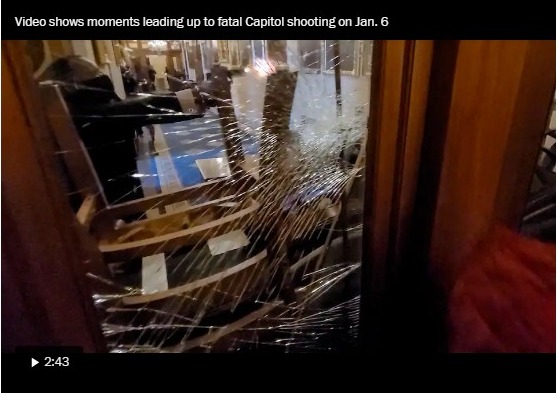
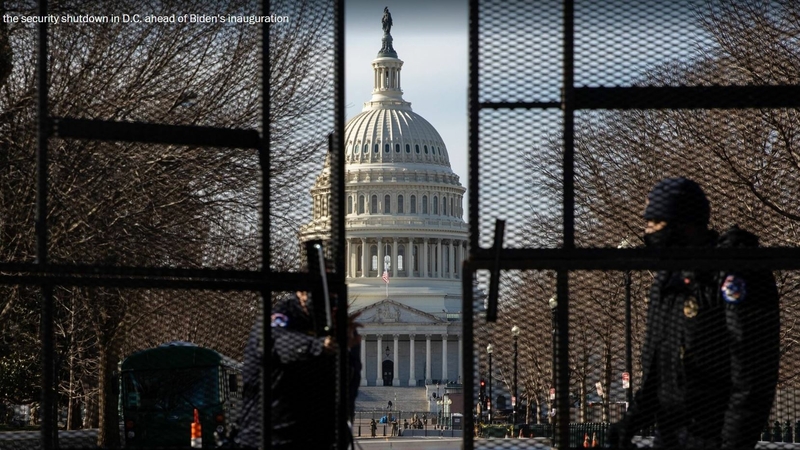
 Cardiologist Yee Se Choa Ong, who worked at CCOM Medical Group in Muskogee, decided to practice in Oklahoma in part because of its high rate of heart disease. MUST CREDIT: Photo for The Washington Post by Shane Bevel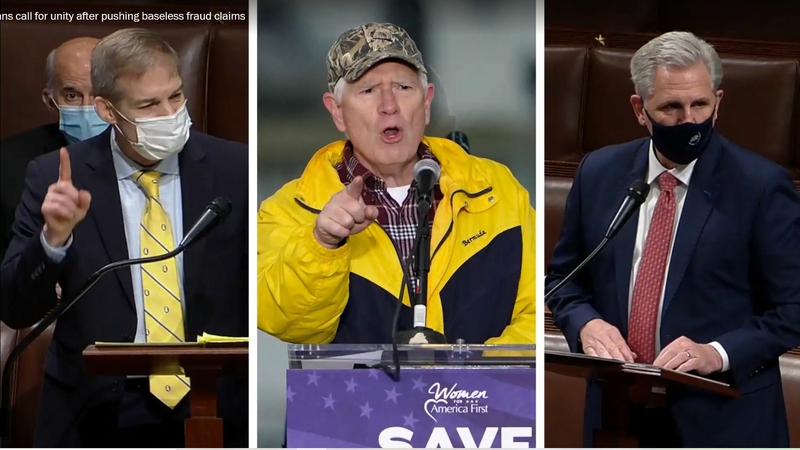
 Vice President Mike Pence, presiding over Congress’s affirmation of the election results on Jan. 6, passes a document to a staffer. MUST CREDIT: Washington Post photo by Bill O’Leary
 Ramona Cohen, 75, waits in line at a Giant grocery store in Washington, D.C. in the hope of getting a leftover dose of the coronavirus vaccine on Jan. 15, 2021. MUST CREDIT: photo for The Washington Post by Amanda Andrade-Rhoades.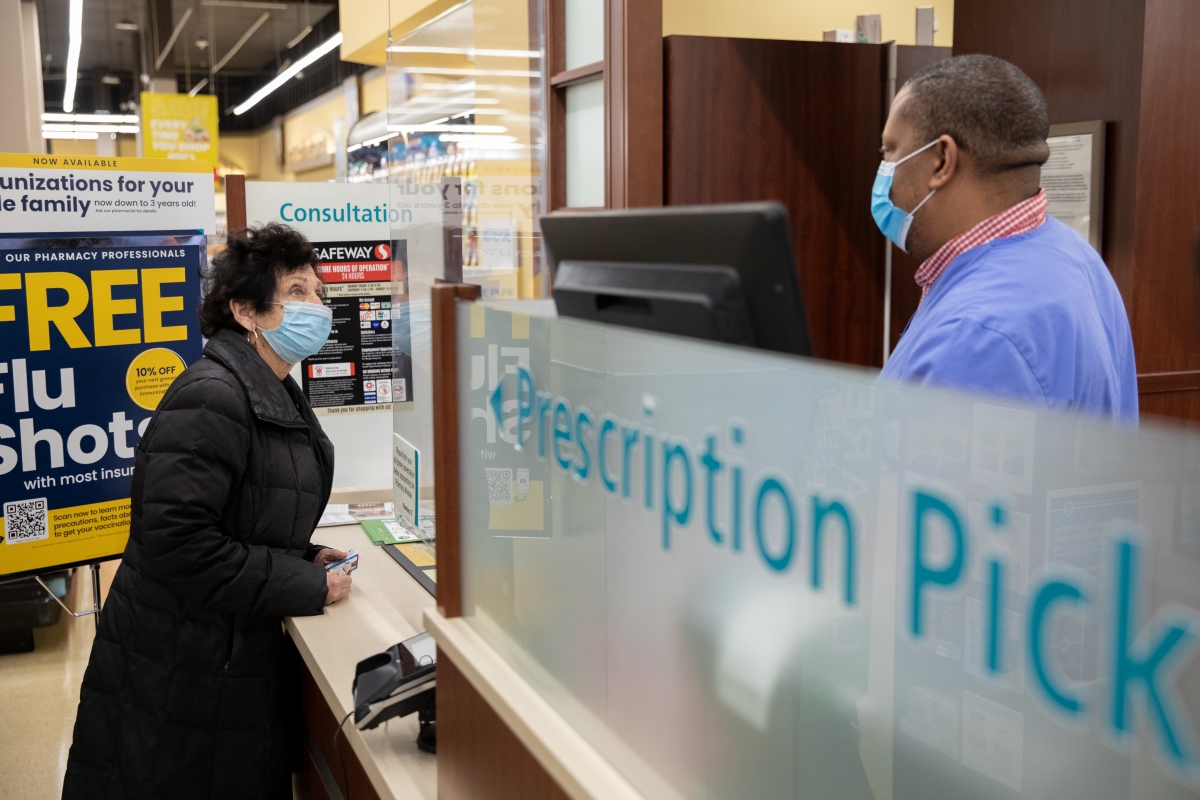
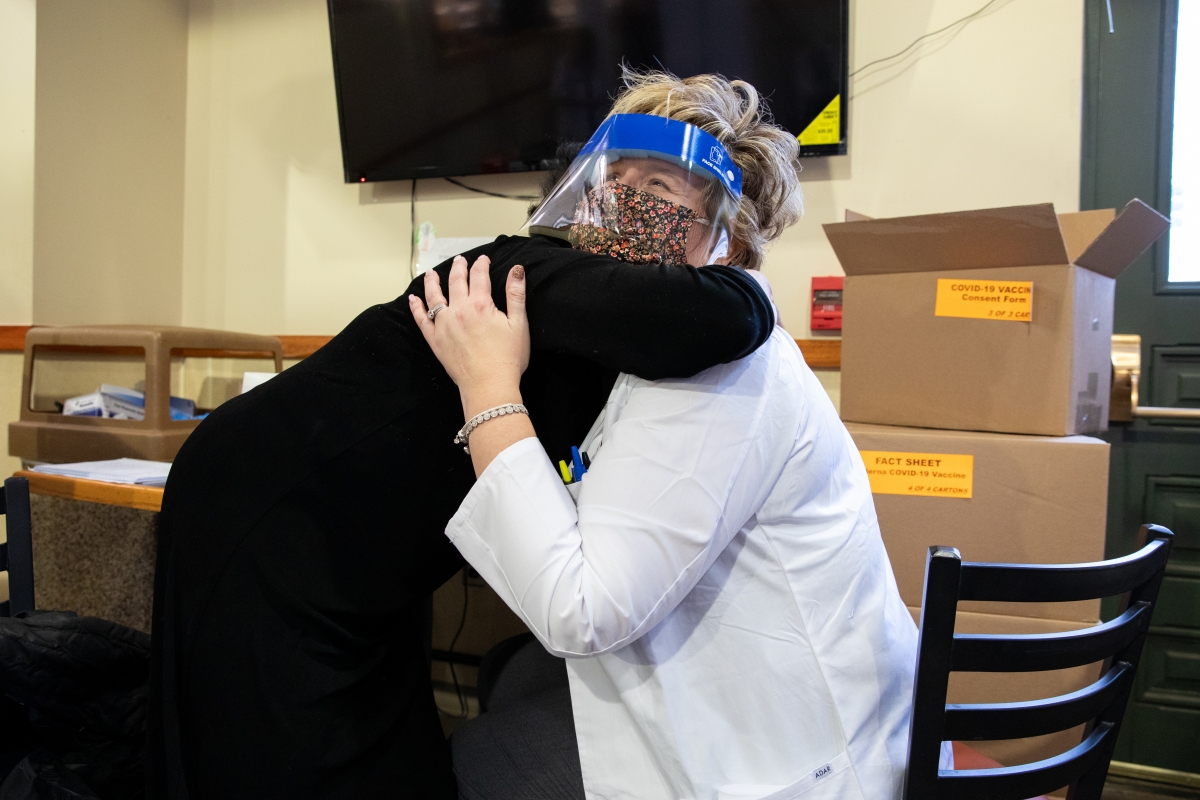
 SootinClaimon.Com