By The Washington Post · Min Joo Kim · WORLD, COURTSLAW, ASIA-PACIFIC
SEOUL – Over nine months starting in spring 2019, Cho Ju-bin lured his victims – whom he called “slaves” – with calculated precision.
From his home in Seoul’s suburbs, the 25-year-old orchestrated one of South Korea’s most infamous sex crimes. Under an online alias as the “Doctor,” he blackmailed at least 74 young women, including minors, into sharing sexually explicit videos of themselves, then sold the footage online through a chat group on the encrypted app Telegram.
On Thursday, a court convicted Cho of organizing a crime ring and violating child protection laws, and jailed him for 40 years.
The case fueled a national outcry in South Korea over what has emerged as a major societal problem: men secretly recording sexually explicit footage of women, or blackmailing their victims into doing so, and then selling the material online.
It’s a crisis fueled by a lack of respect for women in Korean society and a culture of impunity, exemplified by weak laws against digital sex crimes and often low penalties for sex offenders.
In sentencing Cho, the Seoul Central District Court said he needed to be “isolated from society for an extended period” given the number of victims, the damage he inflicted on them and the social repercussions of the crimes.
“The defendant lured and threatened a large number of victims into producing sexually degrading videos and raised a lot of money through distributing them to many people over an extended period,” the court said. “In particular, he inflicted irreparable damage by releasing the identities of many victims.”
Cho had lured women through social media, sometimes by posting fake modeling or employment advertisements, and then conspired with workers at local government offices to obtain their personal information so he could blackmail them. He then sold access to chatrooms for up to $1,300, paid in cryptocurrency.
The scale of the operation stunned the nation. Local media said that up to 260,000 people potentially viewed the content, though police say that number includes double-counting and nonpaying members. More than 2 million people signed a petition demanding the names of everyone who viewed the content to be made public.
“At the time, I was hardly concerned about human dignity and I just used people and sex as tool for crimes,” Cho told prosecutors, according to local media reports. “Now I declare an end to my life as a devil.”
Prosecutors had sought a life sentence for Cho. Both they and Cho have a week to appeal the verdict. Cho’s attorney could not be reached for comment.
The police have detained 124 suspects in relation to the crime ring.
In Thursday’s ruling, sentences of 15 years or less were handed down to some of Cho’s accomplices. A 24-year-old man, under the alias “Donald Putin,” was convicted of stealing victims’ personal information and supplying it to Cho to threaten the women. Others sentenced on Thursday included a 16-year-old and a public servant.
The outcry has provoked an official reaction.
In March, South Korea’s Justice Ministry established a task force to address online sexual crimes, and pledged to set up prevention measures and improve support for victims. In April, South Korea’s parliament passed a law increasing penalties for illegal sexual imagery, outlawing possession and viewing of such material.
Outside the Seoul court, women’s rights activists declared the verdict “not an end, but the beginning of rooting out sexual abuse on Telegram.”
A spokeswoman for the Joint Committee for Sex Abuse on Telegram, consisting of sexual violence hotlines and nongovernmental organizations, called for proper support measures for sex abuse victims who were “left neglected.”
The impact that Cho’s crimes had on the lives of young women was underlined this week in a public letter from an unnamed victim.
“You guys were confident about impunity and tried to scare me, devour me,” she wrote. “Seeing your faces getting revealed one by one, I only then realized that my life had been completely destroyed.”
By The Washington Post · Paul Schemm, Danielle Paquette · WORLD, AFRICA
Ethiopian Prime Minister Abiy Ahmed announced Thursday that the final operation to take the capital of the rebellious Tigray province could begin after a 72-hour ultimatum to surrender had expired.
Ethiopia’s military intervened in the rugged northern province after local forces there attacked an army base and made off with military equipment Nov. 3, sparking three weeks of unrest in which federal forces have taken over much of Tigray.
With communications to the province cut, it was impossible to verify whether the military operation against the regional capital of Mekele had begun. Government forces said they had surrounded the city of 500,000 with tanks from 30 miles away.
“The Ethiopian National Defense forces have now been directed to conclude the third and final phase of our rule of law operation,” said the statement from the prime minister’s office. “We call on the people of Mekele and its environs to disarm, stay at home and stay away from military targets, and take all necessary precautions.”
The government campaign is against the political party controlling the province, the Tigrayan People’s Liberation Front, which once dominated the coalition that ruled the country for nearly 30 years. With the rise of Abiy, they retreated to their power base in Tigray and in recent months relations with the central government have soured dramatically.
At least 40,000 refugees have fled the fighting into neighboring Sudan, and there have been reports of hundreds of civilians massacred. Photos blazed across social media of people with bullet and machete wounds.
“It is vital that humanitarian services, as well as basic services, are provided,” said Aaron Maasho, senior adviser and spokesman for the Ethiopian Human Rights Commission in the capital, Addis Ababa.
Some advocates in the city worried soldiers advancing on Mekele would trigger indiscriminate violence.
“A bloodbath,” said one, who spoke on the condition of anonymity, fearing for their safety. Without internet access, it was unclear how many residents heard the prime minister’s warning to stay home.
The Ethiopian government has insisted its quarrel is only with the TPLF and not against the Tigrayan people and said the grace period was for the local forces to surrender.
“The last peaceful gate which had remained open for the TPLF clique to walk through has now been firmly closed as a result of TPLF’s contempt for the people of Ethiopia,” the statement added.
In messages to media outlets, the TPLF leadership has insisted that government forces have suffered several defeats. The Ethiopian government has countered by reporting surrenders among TPLF forces.
There has been widespread international concern about the campaign and calls for mediation that have been rejected by Abiy, last year’s Nobel Peace Prize winner, who has said the operation is an internal matter.
President-elect Joe Biden’s national security adviser nominee, Jake Sullivan, urged dialogue this week facilitated by the African Union.
“I’m deeply concerned about the risk of violence against civilians, including potential war crimes, in the fighting around Mekelle in Ethiopia,” he said on Twitter.
The U.N. refugee agency has warned that a “full-scale humanitarian crisis” is unfolding in Tigray, and there are fears that food and water may be running out in this province of 6 million.
As supplies precariously dwindled, aid workers said they had no way to reach people who had been forced from their homes for weeks.
Thousands – including pregnant women and those battling illness – were crossing the Sudanese border each day in search of safety, they said. Spouses have been separated. Children have lost touch with their parents.
The prime minister’s office said in a Thursday statement that it would provide essentials to the rush of displaced citizens and clear the way for humanitarian groups, adding that the government “stands to support all Ethiopians that have fled to return to their communities.”
The pledge appeared to open a new path for desperately needed assistance, said Nigel Tricks, regional director of the Norwegian Refugee Council in Nairobi.
“People have gone from having a roof over their head,” he said, “to absolutely nothing.”
By Syndication Washington Post, Bloomberg · Pratik Parija · BUSINESS, WORLD, US-GLOBAL-MARKETS, ASIA-PACIFIC
Almost 300,000 farmers from various states are on their way to India’s capital to protest against new agricultural laws they say will severely hurt their incomes, according to two farm groups.
About 100 leaders representing farmers have been arrested in Haryana, Uttar Pradesh and Uttarakhand, the Samyukt Kisan Morcha and the All India Kisan Sangharsh Coordination Committee said in a joint statement Thursday. The authorities in several states are trying to stop farmers from marching toward New Delhi, they said.
“We want the three bills to be repealed in toto,” Yogendra Yadav, a member of the coordination committee told a virtual press conference Wednesday. “We don’t subscribe to the view that” they are going to boost earnings of farmers, he said.
Analysts and industry experts have said that a slew of reforms introduced by the government in September have the potential to change the face of Indian agriculture, which has been hampered by low yields and inefficient smallholdings. The new rules make it easier to sell crops in other states, while a rise in production would boost exports and farm incomes, they said.
However, farmers are worried that the new measures will eventually kill the government’s price support regime for crops and leave them at the mercy of big corporations that would control the market.
Before the new amendments, farmers in most states were restricted from selling their crops outside government-facilitated wholesale markets and faced legal hurdles in transporting harvests to other states.
Central to the reforms is an amendment to the Essential Commodities Act, a 1955 law. Earlier, when prices rose due to higher demand, the law’s price-control measures kicked in, discouraging investment to increase production.
Farmers from Punjab braced water cannons at the state’s border with Haryana as they moved toward New Delhi, the Press Trust of India reported. The Haryana Police blocked the Amritsar-Delhi highway with trucks to stop tractor-trolleys of protesting farmers, the report said.
Trump says he will leave if electoral college votes for Biden
InternationalNov 27. 2020President Donald Trump arrives to speak in the James S. Brady Press Briefing Room at the White House on Tuesday, Nov. 24, 2020. MUST CREDIT: Washington Post photo by Jabin Botsford
By The Washington Post · Josh Dawsey · NATIONAL, POLITICS
WASHINGTON – President Donald Trump said on Thursday that he would leave the White House if the electoral college voted for Joe Biden next month, though he vowed to keep fighting to overturn the election he lost and said he may never concede.
“Certainly I will, and you know that,” he said when asked if he would leave the White House if the electoral college picked Biden.
Though advisers have long said he would leave on Jan. 20, it was Trump’s first explicit commitment to vacate office if it did not go his way.
Trump said he planned to continue to make claims of fraud about the results and said, without evidence, that Biden could not have won close to 80 million votes. His legal team has been widely mocked – and has lost almost every claim in every state, as officials certify results for Biden.
“It’s going to be a very hard thing to concede,” he said of the election. Aides have privately said Trump will never concede that he lost.
Asked whether he would attend Biden’s inauguration, he demurred. “I know the answer,” he said, though he declined to provide it.
Even as most of his lawyers have quit and many campaign officials say the effort to overturn the election is going nowhere, Trump said it was going “very well.”
The president made the remarks in the diplomatic room of the White House after he spoke to soldiers across the world. The Thanksgiving session – an annual tradition for Trump – marked the first time he took questions since the election.
He planned to have dinner with his family at the White House on Thursday night and spent much of the day at his golf club in Virginia.
The president also said he planned to campaign in Georgia for two Republicans in Senate run-offs set for January. The races are key to the party keeping the majority. Trump said he may go as soon as Saturday, though a White House spokesman later said he meant next Saturday.
Republicans close to Trump have said he was largely uninterested in the run-offs until his Thursday appearance. He railed against Georgia officials, who he believes have not intervened enough as the state has counted ballots and certified results for Biden.
Trump’s continued rhetoric has worried Republicans working on the race, who fear his campaign against the election could discourage some supporters from voting.
“I’m very worried about that,” Trump said, when asked if Georgia’s senate run-off elections would be legitimate.
“You have a fraudulent system,” he said he told Sens. Kelly Loeffler and David Perdue. He said his supporters feared the race was illegitimate.
Trump continued to falsely claim that there had been widespread voter fraud in his election, without offering proof. And he again falsely said Republican poll watchers were not allowed to observe in Pennsylvania, though his lawyers have said in court that some were allowed to observe.
Aides say Trump has begun discussing a 2024 presidential bid, but he said on Thursday he was still focused on 2020.
“I don’t think it’s right he’s trying to pick a cabinet,” Trump said of Biden. Trump had blocked a presidential transition for several weeks but relented this week and allowed his team to go forward.
Trump also glancingly addressed the coronavirus pandemic, which has killed more than 250,000 in the United States, though mainly to brag. “The vaccines – and by the way, don’t let Joe Biden take credit for the vaccine… Don’t let him take credit for the vaccines, because the vaccines were me,” he said.
Trump’s imprint on Supreme Court shows conservative effect in key coronavirus ruling
InternationalNov 27. 2020Justice Neil Gorsuch, left, is accompanied by Chief Justice John Roberts Jr. following his investiture ceremony at the Supreme Court in June 2017. MUST CREDIT: Washington Post photo by Ricky Carioti
By The Washington Post · Robert Barnes · NATIONAL, HEALTH, POLITICS, COURTSLAW, RELIGION
The Supreme Court’s new conservative majority showed its muscle on Thanksgiving Eve, with Justice Amy Coney Barrett playing a key role in reversing the court’s past deference to local officials when weighing pandemic-related restrictions on religious organizations.
Justice Amy Coney Barrett. MUST CREDIT: Washington Post photo by Demetrius Freeman
All three of President Donald Trump’s nominees to the court were in the 5-to-4 majority that blocked New York Gov. Andrew Cuomo’s restrictions on houses of worship in temporary hot spots where the coronavirus is raging.
The court’s most conservative justices distanced themselves from Chief Justice John Roberts Jr. Justice Neil Gorsuch, Trump’s first nominee, went out of his way to say that lower courts should no longer follow Roberts’s guidance of deference, calling it “mistaken from the start.”
“Even if the Constitution has taken a holiday during this pandemic, it cannot become a sabbatical,” Gorsuch wrote. Rather than applying “nonbinding and expired” guidance from Roberts in an earlier case from California, Gorsuch said, “courts must resume applying the Free Exercise Clause.”
“Today, a majority of the court makes this plain.”
The halt of Cuomo’s orders, which had been allowed to remain in place by lower courts, was the first evidence that Roberts may no longer play the pivotal role he has occupied over the past couple of years. He has been at the center of the court, with four members of the court consistently more conservative than him, and four more liberal.
Barrett’s replacement of liberal Justice Ruth Bader Ginsburg means there are now five members of the court – a majority – more willing to move the court quickly in a more conservative direction.
And pandemic-related restrictions on worship services have drawn the ire of the conservatives for months.
They were previously outvoted when Ginsburg was alive, as she and the other liberals joined with Roberts to leave in place restrictions in California and Nevada that imposed limits on in-person services at houses of worship.
In the cases involved in the court’s midnight order Wednesday, the Roman Catholic Diocese of Brooklyn and Jewish organizations led by Agudath Israel challenged Cuomo’s system of imposing drastic restrictions on certain neighborhoods when coronavirus cases spike.
Under Cuomo’s plan, in areas designated “red zones,” where the virus risk is highest, worship services are capped at 10 people. At the next level, “orange zones,” there is an attendance cap of 25. The size of the facility does not factor in to the capacity limit.
The diocese said in its petition that the plan subjects “houses of worship alone” to “onerous fixed-capacity caps while permitting a host of secular businesses to remain open in ‘red’ and ‘orange’ zones without any restrictions whatsoever.”
And the Jewish organizations noted Cuomo, a Democrat, had specifically mentioned outbreaks in Orthodox Jewish neighborhood when imposing the restrictions. “This court should not permit such remarkable scapegoating of a religious minority to stand,” the organizations said in court documents.
Cuomo attributed the court’s order to its more conservative majority. “I think that Supreme Court ruling on the religious gatherings is more illustrative of the Supreme Court than anything else,” Cuomo told reporters. “It’s irrelevant from a practical impact because the zone that they were talking about has already been moved. It expired last week. I think this was really just an opportunity for the court to express its philosophy and politics.”
Technically, the court’s order blocks Cuomo’s restrictions from being reimposed while legal challenges continue. But the court’s unsigned opinion would appear to make the ultimate outcome clear.
“Even in a pandemic, the Constitution cannot be put away and forgotten,” the opinion said. “The restrictions at issue here, by effectively barring many from attending religious services, strike at the very heart of the First Amendment’s guarantee of religious liberty.”
The opinion was endorsed by Barrett, Gorsuch and Justices Clarence Thomas, Samuel Alito Jr. and Brett Kavanaugh, Trump’s second appointment to the court. It was mild compared with recent comments from Alito and the Gorsuch opinion, which no other justices joined.
Alito, who did not write a separate opinion, recently told the conservative legal organization the Federalist Society that the pandemic “has resulted in previously unimaginable restrictions on individual liberty.”
“It pains me to say this, but in certain quarters, religious liberty is fast becoming a disfavored right,” Alito said.
President Donald Trump speaks gestures toward Justice Brett Kavanaugh during the 2019 State of the Union. MUST CREDIT: Washington Post photo by Melina Mara
But Justice Stephen Breyer, writing for fellow liberals Sonia Sotomayor and Elena Kagan, said that it was a strange time for the court to be offering relief.
“The number of new confirmed cases per day is now higher than it has ever been,” Breyer wrote, and New York has accounted for 26,000 of the more than 250,000 deaths nationwide. According to The Washington Post, there have been more than 34,000 coronavirus fatalities in New York.
“The nature of the epidemic, the spikes, the uncertainties, and the need for quick action, taken together, mean that the State has countervailing arguments based upon health, safety, and administrative considerations that must be balanced against the applicants’ First Amendment challenges,” Breyer wrote.
Sotomayor was more pointed in a separate opinion joined by Kagan: “Justices of this court play a deadly game in second guessing the expert judgment of health officials about the environments in which a contagious virus, now infecting a million Americans each week, spreads most easily.”
Roberts noted in his opinion that the restrictions might be unduly restrictive but said Cuomo has already eased them, essentially giving the churches and synagogues the relief they had requested.
“The Governor might reinstate the restrictions. But he also might not,” the chief justice wrote. “And it is a significant matter to override determinations made by public health officials concerning what is necessary for public safety in the midst of a deadly pandemic.”
Gorsuch disagreed.
“It is time – past time – to make plain that, while the pandemic poses many grave challenges, there is no world in which the Constitution tolerates color-coded executive edicts that reopen liquor stores and bike shops but shutter churches, synagogues, and mosques,” he wrote.
Gorsuch’s solo opinion was at times scathing and sarcastic. He noted that Cuomo had designated, among others, hardware stores, acupuncturists, liquor stores and bicycle repair shops as essential businesses not subject to the most strict limits.
“So, at least according to the governor, it may be unsafe to go to church, but it is always fine to pick up another bottle of wine, shop for a new bike, or spend the afternoon exploring your distal points and meridians,” Gorsuch wrote. “Who knew public health would so perfectly align with secular convenience?”
Gorsuch criticized Roberts for relying on one of the court’s 1905 precedents for his position that the court should defer to local officials during health crises.
The chief justice seemed taken aback. He said his earlier opinion in the California case only asserted that the Constitution chiefly leaves such decisions to local officials.
That, he wrote, “should be uncontroversial, and the (Gorsuch) concurrence must reach beyond the words themselves to find the target it is looking for.”
He also defended the liberal justices from Gorsuch’s tough words, even though Roberts did not join their dissents.
“I do not regard my dissenting colleagues as ‘cutting the Constitution loose during a pandemic,’ yielding to ‘a particular judicial impulse to stay out of the way in times of crisis,’ or ‘shelter(ing) in place when the Constitution is under attack,’ ” Roberts wrote, quoting Gorsuch’s opinion.
“They simply view the matter differently after careful study and analysis reflecting their best efforts to fulfill their responsibility under the Constitution.”
Conservative religious organizations praised the court’s action.
“Governor Cuomo should have known that openly targeting Jews for a special covid crackdown was never going to be constitutional,” said Eric Rassbach, vice president and senior counsel at the Becket Fund, which represented Agudath Israel. Covid-19 is the disease caused by the coronavirus. “The Supreme Court was right to step in and allow Jews and Catholics to worship as they have for centuries.”
But Donna Lieberman, executive director of the Liberties New York Civil Union, said the court’s action was dangerous.
“New York’s temporary restrictions on indoor gatherings do not discriminate against houses of worship, and, in fact, treat them better than comparable non-religious gatherings,” Lieberman said in a statement. “The Supreme Court’s decision will unfortunately undermine New York’s efforts to curb the pandemic.”
The cases are Roman Catholic Diocese of Brooklyn v. Cuomo and Agudath Israel v. Cuomo.
Trump’s baseless election fraud claims in Georgia turn Senate runoffs into a ‘high-wire act’ for Republicans
InternationalNov 27. 2020Sen. Kelly Loeffler, R-Ga., in Atlanta on Election Night. MUST CREDIT: Washington Post photo by Melina Mara
By The Washington Post · Cleve R. Wootson Jr., Amy Gardner · NATIONAL, POLITICS
GRIFFIN, Ga. – Sen. David Perdue was encouraging a crowd at a gun club south of Atlanta to support him and fellow Republican Kelly Loeffler in their bid for Georgia’s Senate seats, which he called the only thing standing between America and “a radical socialist agenda.”
But five minutes into the senator’s speech, a man interrupted.
“What are you doing to help Donald Trump and this fraud case?” the man screamed, as one woman said “Amen” and the crowd applauded. “What are you doing to stop what’s been going on here and this election fraud?”
The Republican candidates in Georgia’s dual Senate runoff campaign are navigating a highly unusual political labyrinth – caught in the middle of an intraparty war that has erupted since President Trump narrowly lost the state to President-elect Joe Biden and has turned his fire on the Republican leadership there.
The infighting now threatens to turn off the very Republican voters Perdue and Loeffler need to stave off challenges from their Democratic rivals, Jon Ossoff and the Rev. Raphael Warnock.
Trump and his allies have repeatedly, and falsely, accused Georgia Secretary of State Brad Raffensperger and Gov. Brian Kemp, both Republicans, of presiding over a fraudulent election. Trump has pushed the baseless claim that the Dominion Voting Systems machines used in Georgia were rigged as part of a global conspiracy, and Perdue and Loeffler have called for Raffensperger’s resignation.
But therein lies the conundrum: Perdue and Loeffler are traveling the state pleading with Republican voters to turn out on Jan. 5 – effectively asking Trump supporters to put their faith in the same voting system their president claims was manipulated to engineer his defeat.
“What did (Trump) get, 73 million votes? Those folks don’t just disappear. Trump’s blessing goes far here,” said the Rev. Benny Tate, of Rock Springs Church, who has been traveling with Perdue on campaign stops and prayed before Monday’s event. “There are folks that didn’t come out to vote necessarily Republican, they came out to vote for Donald Trump. I think it’s imperative that (Perdue and Loeffler) do get the Trump voters back. I think it remains to be seen whether they actually come back.”
Loeffler and Perdue are walking what one Republican strategist called “a high-wire act right now, to figure out exactly where the candidates should be relative to the president.”
Complicating the senators’ pitch to voters is the call by some Trump advocates for voters to protest the voting system in ways that some GOP strategists fear will merely result in effective votes for the Democrats.
One prominent Trump ally, Atlanta attorney Lin Wood, who unsuccessfully sued Georgia election officials to stop the certification of the vote, has urged Republican voters not to vote in elections with Dominion machines.
Wood has attacked Perdue and Loeffler for not doing enough to help, and told his 631,000 Twitter followers last weekend that if the senators don’t step up their support, he would take a pass on Jan. 5.
“If not fixed, I will NOT vote in GA runoff,” he tweeted.
Asked whether his efforts would depress GOP turnout, Wood told The Washington Post via email that the Dominion machines “have no integrity” and insisted that “Georgia can vote by written ballot if necessary in January.”
Raffensperger, among the most outspoken who have said such talk will hurt Loeffler’s and Perdue’s chances, expressed exasperation at Wood’s comments. A statewide audit of the presidential result, in which every ballot was recounted by hand, disproved the claims about the voting machines.
“I really don’t know what he’s thinking,” Raffensperger said in an interview. “If the people don’t use the machines then I guess they vote absentee and then their ballot will be scanned on a Dominion machine,” he said. “People need to get a grip on reality.”
Nonetheless, support for the claims being spread by Trump and his supporters is clearly strong in the state’s GOP base.
Hundreds of people attended “Stop the Steal” protests outside the Georgia Capitol and governor’s mansion on Saturday.
Four senators have called for a special legislative session to address voting issues before the runoff.
And the state Republican chairman, David Shafer, has echoed questions about the state’s voting system. He signed a letter along with the state party executive committee demanding fresh scrutiny of signature verification on mail-in ballots.
“We have grave concerns as to whether or not proper verification took place,” the letter said.
No evidence has surfaced that ballots with nonmatching signatures were counted.
The Perdue and Loeffler campaigns did not respond to requests for comment.
Perdue has privately pointed to the challenges of campaigning in the Trump era, and the potential benefit of running now without the president on the ticket.
Addressing donors on a conference call earlier this month, Perdue spoke of an “anti-Trump vote in Georgia” and said the runoff is about getting “enough conservative Republicans out to vote” who might have opposed the president’s re-election. Details of the call were shared with The Post by a person who provided a precise account of the discussion.
“I’m talking about people that may have voted for Biden but now may come back and vote for us because there was an anti-Trump vote in Georgia,” Perdue said. “And we think some of those people, particularly in the suburbs, may come back to us. And I’m hopeful of that.”
The odd political dynamics have come across in part through the absence of some potential campaign-trail headliners.
Trump has tweeted in favor of Loeffler and Perdue, but he has not committed to showing up on the campaign trail, though Vice President Mike Pence did lead a rally.
Kemp, the governor, has also avoided making any runoff campaign appearances on behalf of his state’s two Republican senators. The governor has been walking a line between supporting the integrity of the election result – he signed the certification on Friday of the presidential race votes – and agreeing that improvements can be made to signature verification and voter-identification rules. Kemp did not respond to a request for comment.
Republican strategists say they hope that some of tensions will fade in the weeks before the runoff, giving the party time to air enough attacks to tarnish the Democrats. They say Georgia remains a conservative state with a history of runoff campaigns going the GOP’s way. And the absence of Trump on the ballot could help win back suburban voters who rejected his style but still want to support conservatives.
One person who has been helpful for the two Senate candidates is Trump’s elder son, Don Jr., who tweeted that Georgians should “IGNORE” calls to boycott the runoffs.
“We’re not as divided as you think,” said one Republican strategist involved in the race.
Still, many Republicans remain concerned that the public hostility within the party – as well as efforts to foment distrust of voting – pose serious threats to Loeffler and Perdue.
And those tensions do not appear to be going away. Trump, for his part, has continued to push as recently as Wednesday the unfounded claims about Georgia’s voting machines.
Raffensperger hasn’t shied away from the divisions, either. His tenor hardened after Loeffler and Perdue called for his resignation – and after death threats began filtering in through social media to him and his wife.
Now, he makes no secret of his disdain for the unfounded attacks on him.
“If Republicans don’t start condemning this stuff, then I think they’re really complicit in it,” Raffensperger said in the interview. “It’s time to stand up and be counted. Are you going to stand for righteousness? Are you going to stand for integrity? Or are you going to stand for the wild mob? You wanted to condemn the wild mob when it was on the left side. What are you going to do when it’s on our side?”
By The Washington Post · Brittany Shammas, Mark Guarino, Jacqueline Dupree · NATIONAL, HEALTH, HEALTH-NEWS
For a few months, coronavirus-weary Chicago residents got a reprieve from the strict regulations that shuttered the nation’s third-largest city during the spring.
After infections plummeted in early June, restaurants welcomed diners back inside. Movie theaters, fitness centers and bowling alleys reopened their doors. And the barriers came down on the bike pathway along the city’s cherished lakefront.
But with new coronavirus cases surging beyond the springtime peak, Chicago is now hunkering down. Statewide measures have closed some businesses and limited the capacity at others, while officials are urging residents to stay home. Again.
“We’ve been through a heck of a lot this year,” Lori Lightfoot, the city’s Democratic mayor, said during a recent news conference. “And it’s not over.”
Across much of America, the picture is similar. Major metropolitan areas were the face of the pandemic before being overtaken by spikes in less populated parts of the country in September. Since then, the nation’s worst outbreaks have been concentrated in rural parts of the Upper Midwest.
Yet dramatic increases have been reported in many major American cities in recent weeks, with some being hit harder than they were during their previous peaks. Testing has greatly ramped up since the start of the pandemic, but that alone does not explain the growing caseloads.
“The dreaded fall wave, in many places, is upon us,” said Josh Michaud, an epidemiologist and associate director for global health policy at the nonprofit Kaiser Family Foundation. “And that includes in metropolitan areas.”
In Cook County, where Chicago is located, the seven-day average of new cases hit a record high of 4,654 on Nov. 17 – far outpacing the peak of 1,690 during the spring surge. Deaths are lower than the numbers seen in the spring but have climbed in recent weeks.
With winter approaching, business owners who stayed afloat by turning to outdoor service have been investing in heating lamps, hoping to keep customers coming even in temperatures that can drop below freezing.
Michelle Foik, co-owner of Eris Brewery & Cider House, said she saw the shutdown of indoor dining as inevitable. The facility’s patio has been “our saving grace,” she said, but she worries about what will happen this winter. She’s torn between relief that the rise in cases was met with more restrictions and concerned over the impact on her business.
“Believe me, we need the money,” Foik said. “We’re a start-up. We are investing in our future, but if this become a longtime shutdown, it just hurts everything.”
At NorthShore University HealthSystem, infectious-disease specialist Kamaljit Sandhu Singh said he and other health-care workers were “exhausted physically and mentally” as hospitalizations and intensive care unit admissions increased.
He said the pandemic reminded him of growing up during the Vietnam War: “I could never wrap my name around the number of soldiers’ lives lost, but the pictures were compelling.”
Cases are surging on Chicago’s West and Southwest sides, where the virus spread at a disproportionate rate in the spring and the majority of residents are Black or Latino. Kiran Joshi, senior medical officer at the Cook County Department of Public Health, said “a myriad of factors” play into why those areas are surging highest, but that a common attribute is that people there “experienced structural racism over decades.”
The second peak in Chicago mirrors those in metropolitan areas across the country. In recent weeks, counties home to cities including Philadelphia, Los Angeles, Detroit, Las Vegas and Minneapolis have seen new cases surpass their past highs. Miami-Dade County has been trending up again, while Salt Lake County is experiencing its first major peak of the pandemic, with cases and hospitalizations rising since early October.
In Maricopa County, which includes Phoenix, Valleywise Health “had a little breather” after the summer’s surge in Sun Belt states, said Michael White, the health system’s chief clinical officer. But the seven-day average of new cases, which hovered around 500 a day in late October, exceeded 2,000 on Monday.
“We’re hanging in there is how I would describe it,” White said. “Our biggest concern always is, as we continue to see this case count rise, that that certainly can lead to more folks needing hospitalization down the road, on top of a time where we usually see a higher rate of hospitalizations for non-covid-related illnesses.”
Phoenix-based Banner Health is projecting that 125 percent of the system’s licensed hospital beds will be full by the first week of December. Hospital administrators believe they have stocked up on enough personal protective equipment, ventilators and beds to weather the surge, Chief Clinical Officer Marjorie Bessel said during a news conference Tuesday. They worry most about staffing – they’ve hired nearly 1,000 health-care workers from out of state and are recruiting 900 more.
The health system always beefs up its staff for the winter months, Bessel said, but the coming weeks are expected to be markedly different from previous years and even the Sun Belt’s summer surge.
“The entire country is surging at the same time,” she said.
Health officials attribute the virus’s resurgence in cities to several factors, including eased restrictions, increased gatherings and what’s being called “covid fatigue.” Eight months into the pandemic, “there is no longer that sense of urgency,” said Mouhanad Hammami, chief health strategist in Wayne County, home to Detroit. “When you live with something, it is no longer urgent, and you tend to get desensitized to it.”
Some authorities in Chicago blamed rock-bottom hotel prices and the state-imposed indoor dining ban, suggesting it may have caused parties to relocate to hotel rooms or other spaces, such as Airbnb rentals. On Nov. 12, Lightfoot told reporters that current restrictions apply to both.
“I know the hotel industry was hit hard and is in many instances is on life support, but that cannot include parties,” she said. “I urge the hotel industry to be much more diligent about who is coming in. … People think it’s party time. It’s not.”
Officials in many hard-hit cities also point to increasingly widespread transmission across the United States, which has been reporting record-setting numbers of infections. Over the past week, the country had well over 150,000 new cases each day. Ahead of Thanksgiving, traditionally a time of significant travel and extended family get-togethers, health experts feared the number would only continue to climb.
“We would love to be that shining city on the hill where we’re avoiding all this,” said Philadelphia Department of Public Health spokesman James Garrow. “But I don’t know that anybody’s going to be able to avoid this.”
Mortality rates have improved from earlier in the pandemic – a change attributed to improved therapeutics and knowledge of how to handle covid-19, the disease caused by the virus. Still, authorities in areas that are seeing spiking infections have reacted with alarm, noting that the explosion in cases will inevitably drive up the death toll.
In Los Angeles County, where hospitalizations are up and deaths increased slightly last week, Public Health Director Barbara Ferrer on Friday described the data as looking “really bad right now” and added that the county had experienced “three terrible days in terms of case rates and increases in hospitalizations.” She said health officials were hoping deaths “don’t go up … as much as earlier in the pandemic.”
With rapidly rising case numbers has come a return to some of the restrictions of the spring. In Los Angeles, health officials suspended outdoor dining for the first time since May. They warned that a stay-at-home order could follow if the situation worsens.
Wayne County’s health department on Friday strongly recommended that schools shift to virtual instruction through mid-January, noting that the current wave “is at a level higher than the first peak in April 2020.”
Philadelphia on Nov. 20 imposed new “Safer at Home” restrictions, which required schools to shift to online learning, restaurants to suspend indoor dining, and gyms and indoor fitness classes to close. Movie theaters, casinos and bowling alleys were also shuttered and indoor gatherings of more than one household prohibited.
“The hope is that by implementing these restrictions as soon as we could – and we’re doing it ahead of at least a lot of surrounding counties and states – that we’ll be able to head off getting to a point where we outstrip our capacity and get to a point worse than we were in April,” Garrow said.
Months after the first shutdowns in the United States, a better understanding of how the coronavirus spreads means that this latest wave of restrictions can be more targeted, Michaud said. Authorities can focus on what is believed to carry the greatest risk of transmission: venues where people are crowded together indoors for extended periods of time.
“In the spring, we didn’t know a whole lot about the virus and exactly what were the activities that were the riskiest,” he said. “We know a whole lot more now. And that means that we don’t have to put in a Chinese-style lockdown to have an effect on transmission. You can be much more surgical in your approach.”
But among some already battered by earlier shutdowns, the new restrictions drew frustration.
The Illinois Restaurant Association released a statement objecting to the state’s ban on indoor dining, arguing that it “will force people into less controlled, private gatherings with no safety precautions – resulting in the exact opposite of slowing the spread” of the virus. The organization said that without being allowed to serve indoors in some capacity, “our state’s largest private sector employer will be pushed to the brink of permanent devastation.”
Mark Domitrovich, co-owner of Chicago restaurants Ina Mae Tavern and Frontier, said he was trying to “string together as much as an outdoor dining situation as we can get” because takeout and delivery alone weren’t enough to get by.
“At this point we’re trying to grind it out. To try to drive as much business as possible,” he said. “It’ll run out at some point and it doesn’t seem like the cavalry is on the way either, so we’re just praying right now.”
Biden’s conciliatory tone has some Democrats concerned
InternationalNov 27. 2020President-elect Joe Biden delivers remarks last week after a virtual meeting with U.S. governors, including some Republicans, during which he vowed a bipartisan assault on the coronavirus. MUST CREDIT: Washington Post photo by Salwan Georges
By The Washington Post · Annie Linskey, Sean Sullivan · NATIONAL, POLITICS
WILMINGTON, Del. – Republicans had been gearing up for the first partisan brawl of the new administration – a battle over whether to confirm the woman widely believed to be on Joe Biden’s shortlist for secretary of state.
They blasted Susan Rice as a polarizing throwback to an interventionist style of foreign policy or, as one senator put it, the “Typhoid Mary” of the Obama administration for what they saw as her role in multiple controversies. Some Democrats urged Biden to pick her anyway, to stand by an experienced hand in foreign affairs who could be one of the most prominent Black women in his government.
That fight will have to wait.
Biden’s choice of the lower-profile Antony Blinken, an establishment figure with close ties to the president-elect for decades, is widely seen as less likely to kick up a political storm in the closely divided Senate that will vote on his confirmation.
But while the State nomination, along with several other Cabinet picks rolled out this week, underscore Biden’s intention to govern as a conciliator and not a partisan warrior, some on the left worry that his early moves signal weakness even before he steps into the Oval Office. They say Biden, 78, naively believes the Senate still functions as it did during his 36 years there, with potential for compromise and conciliation.
“To meet Republicans where they are is to meet them in Fantasyland,” said Rebecca Katz, who worked as a top aide to Nevada Democrat Harry Reid when he served as Senate majority leader. “We don’t have any time to spare. Sometimes you’ve got to fight. We can’t fold before we’ve had one fight.”
On Capitol Hill, other Democrats are sounding similar warnings.
“There is still plenty of room for bipartisanship, but real bipartisanship, from a position of strength, not begging Republicans to confer bipartisanship upon us if we do things their way,” said Sen. Sheldon Whitehouse, D-R.I., who is worried that Biden’s outreach to the GOP is being met with resistance.
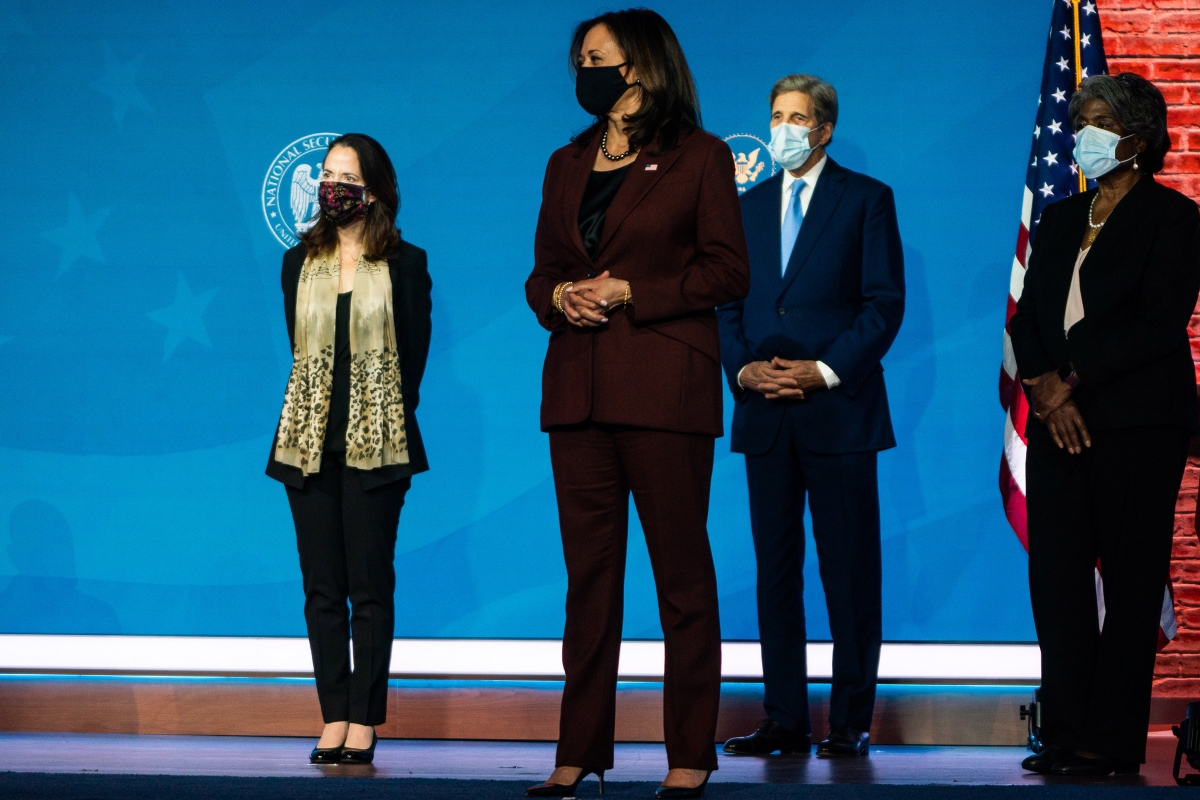
Vice President-elect Kamala D. Harris, center, appears onstage as President-elect Joe Biden introduces nominees for his administration on Tuesday. So far his picks have underscored his conciliatory posture. MUST CREDIT: Washington Post photo by Demetrius Freeman
But Biden is making clear through his early moves that he meant it when he said, for months on the campaign trail, that he would turn down the partisan heat in Washington. His team has quietly reached out to Republicans in the House and Senate and expressed public sympathy for their delicate political calculation in weighing the potential backlash from Trump’s base if they acknowledged the election results, according to a person familiar with the strategy who like others spoke on the condition of anonymity to share internal thinking and private discussions.
So far, Biden can boast some success with his approach. Along with other olive branches to Republicans, he backed away from filing a lawsuit to force the General Services Administration to release resources for his transition. The GSA instead relented after a pressure campaign that came first from Democrats, and then Republicans, along with back-to-back-to-back losses in state courts for the president’s attempt to overturn the election results.
“I’m making a judgment based on many years of experience and how to get things done with the opposition,” Biden said recently when asked why he had declined to pursue a legal challenge against Trump’s refusal to cooperate with a transition.
The tension between picking fights and pursuing conciliation so far is typified by questions about Rice, who was a finalist in Biden’s vice-presidential search and was mentioned by Biden allies as a possible secretary of state when she didn’t get that post.
“Susan will land in another key job,” said one Biden insider. The person declined to say whether the position would be one requiring Senate confirmation.
The person also scoffed at the notion that Rice was set to get the job but for Biden’s reluctance to launch a fight with Republican senators.
“Tony was always the choice. Always,” the person said, referring to Blinken. “Anyone who thinks Tony was not going to get this doesn’t know Joe Biden.”
Rice was a leading candidate for secretary of state during Obama’s second term. The Stanford University-educated foreign policy phenom had risen quickly in the diplomatic ranks, becoming one of the country’s youngest assistant secretaries of state.
But she withdrew from consideration amid furor over her initial comments about the 2012 armed attacks on U.S. facilities in Benghazi, Libya – which killed four Americans, including the U.S. ambassador to Libya – that relied on what turned out to be inaccurate talking points supplied by the White House and CIA. Eight congressional panels investigated the events; none found that Rice had been deliberately misleading.
Instead, Obama named Rice as his second-term national security adviser, a job that does not require Senate confirmation. She worked closely with Biden as vice president, often hashing out policy ideas with him in the West Wing.
Before the Blinken selection, GOP senators lined up to oppose Rice, even as they refused to fully acknowledge Biden’s victory. It was Sen. Tom Cotton, R-Ark., a member of the Armed Services Committee, who called her the “Typhoid Mary” of the Obama administration’s foreign policy. Sen. Lindsey Graham, R-S.C., a member of the Foreign Relations Committee, said in an interview that “she’s a hard person to confirm.”
Biden’s common-ground approach was part of his pitch to America – and how he worked during a Senate career that preceded his two terms as vice president.
“I’ve known him a long time, and I don’t think guns blazing is ever going to be his style,” said Biden’s friend and donor John Morgan. “He is an institutionalist. He’s friendly with both sides. And I think the reason he was chosen to be vice president was because of his relationships.”
As he awaited official recognition of his victory, Biden has showcased bipartisan meetings. Speaking to a group that included Republican governors, he vowed a bipartisan assault on the coronavirus. During a meeting with mayors, he noted that there are not “blue cities” or “red cities.” A panel of medical experts he named to advise him on the pandemic included two former Trump administration officials.
Biden’s attempts at unity offer a direct contrast to the way in which Trump whooshed into the presidency four years ago, condemning the Washington establishment, making a series of early Cabinet decisions that were highly controversial and working to undo the actions of his Democratic predecessor.
While Biden is expected to take on issues unpopular on the right via executive order, such as mitigating climate change and liberalizing immigration rules, his early focus will be on containing the virus and bolstering the economy – two issues where there has been recent history of bipartisan agreement.
“I am hopeful that I’m going to be able to get cooperation from our Republican colleagues in the Senate and the House, as well as the governors, to build a consensus as to how we proceed when we do,” Biden said recently.
The conciliatory tone goes beyond just the divide between parties.
When talking about his then-unnamed pick for treasury secretary last week, he eagerly pointed out that they would be “accepted by all elements of the Democratic Party.” Former Federal Reserve chair Janet Yellen, who has been tapped for the position, fits that bill.
Biden’s recent meeting with national security officials included retired Gen. Stanley McChrystal, who clashed with Biden over troop levels in Afghanistan and was fired by President Barack Obama in 2010 after he disparaged administration officials, including Biden, in comments to a reporter for Rolling Stone.
On Monday, Biden named former secretary of state and Senate colleague John Kerry to be a special presidential envoy for climate, adding him to the National Security Council – showing he has no hard feelings about a February cellphone call in which Kerry, then in Iowa as a surrogate for Biden, was overheard musing about jumping into the Democratic primary.
Part of Biden’s calculation is the reality he faces in a closely divided Senate – a chamber now in Republican hands. Even if Democrats win both of Georgia’s runoff elections on Jan. 5, the chamber would split 50-50, giving him the smallest possible edge with the tie-breaking vote of Vice President Kamala Harris.
That will require maintaining some relationships with Republicans and keeping the Democratic left happy. Already, Sen. Bernie Sanders, I-Vt., the liberal leader who rallied his forces on behalf of Biden during the general election, is worried that Biden’s posture to reach out to the right will leave the left wing of the party untended.
“It seems to me pretty clear that progressive views need to be expressed within a Biden administration,” Sanders said in an interview with the Associated Press. “It would be, for example, enormously insulting if Biden put together a ‘team of rivals’ – and there’s some discussion that that’s what he intends to do – which might include Republicans and conservative Democrats – but which ignored the progressive community.”
Sanders is hoping that Biden will tap him to be labor secretary, according to a person familiar with his ambitions, although that could reignite GOP campaign talking points that Biden is captive to the left. Biden avoided a similar fight by skipping over Sen. Elizabeth Warren, D-Mass., as treasury secretary, a position she sought, according to several Warren allies.
“You can only pick one or two battles,” said a Biden insider, explaining Biden’s approach to nominations.
Biden, in an NBC interview Tuesday night, indicated he was reluctant to select Democratic senators or House members for his Cabinet because of the potential impact on the party’s legislative strength.
Democratic members urged Biden not to dial back any Cabinet choices.
“He should go by the person that he feels is the most qualified,” said Rep. Gregory Meeks, D-N.Y. “Don’t worry about the political aspects of the Republicans, many of whom still have not acknowledged that he’s the president of the United States.”
Rather than gearing up for a fight, Biden has said he expects some back-and-forth with Senate Majority Leader Mitch McConnell, R-Ky., when it comes to Cabinet nominations.
“I take McConnell at his word,” Biden said recently when discussing his process for making selections. “I understand he said that he will make it clear who he’s prepared to support or not support and that’s a negotiation that I’m sure we’ll have.”
Last week, Biden’s newly minted chief of staff, Ron Klain, offered a more traditional posture on the Cabinet, saying that Biden would not defer to GOP leaders on his choices.
“On these executive branch nominations, these are the choices for the president to make, and then the Senate needs to act on those choices,” Klain told CNN’s Wolf Blitzer.
However, some Democrats have been quick to point out that Republicans are showing no indication they’ll work with Biden – even as he tries to work with them.
Some Democratic operatives see Biden’s current strategy as an effort to claim the higher ground with the American public and predict it will be short-lived.
“Biden’s entire message – which I did not enjoy, but I think I understand the political calculation – has always been seeking cooperation as part of his ‘healing America mission,’ ” said Adam Jentleson, a former deputy chief of staff to Reid. “It’s fine for Republicans to be the ones to shoot first and break any sort of cease-fire that may exist.”
Thailand and emerging Asean are not getting the investment needed to help the world meet the UN Sustainable Development Goals (SDGs), new research from Standard Chartered has revealed.
“The $50 Trillion Question” investigates how some of the world’s biggest asset managers – with a combined US$50 trillion in assets under management (AUM) – are investing at this critical time for the global economy and environment.
The research is based on a survey conducted between July and August 2020, among a panel of the world’s top 300 investment firms with total assets under management (AUM) of more than US$50 trillion.
It found that 20 per cent are unaware of the UN’s Sustainable Development Goals (SDGs).
Meanwhile only 13 per cent of their $50 trillion of investment is linked to the SDGs
Just 22 per cent of the AUM is invested in Asia.
The lack of investment in emerging markets puts the chances of meeting the 2030 SDG deadline at risk.
Of those already investing in the largest emerging Asean markets (Vietnam, Indonesia, Thailand, the Philippines and Malaysia), 39 per cent say they will likely increase their investment in the future. Thailand was seen as particularly attractive with 45 per cent of high-growth investors.
The research also shows Covid-19 may have made it even harder for emerging markets to get the investment they need. Some 70 per cent of investors believe the pandemic has widened the capital gap further.
Biden’s conciliatory tone has some Democrats concerned
InternationalNov 26. 2020President-elect Joe Biden delivers remarks last week after a virtual meeting with U.S. governors, including some Republicans, during which he vowed a bipartisan assault on the coronavirus. MUST CREDIT: Washington Post photo by Salwan Georges
By The Washington Post · Annie Linskey, Sean Sullivan · NATIONAL, POLITICS WILMINGTON, Del. – Republicans had been gearing up for the first partisan brawl of the new administration – a battle over whether to confirm the woman widely believed to be on Joe Biden’s shortlist for secretary of state.
They blasted Susan Rice as a polarizing throwback to an interventionist style of foreign policy or, as one senator put it, the “Typhoid Mary” of the Obama administration for what they saw as her role in multiple controversies. Some Democrats urged Biden to pick her anyway, to stand by an experienced hand in foreign affairs who could be one of the most prominent Black women in his government.
That fight will have to wait.
Biden’s choice of the lower-profile Antony Blinken, an establishment figure with close ties to the president-elect for decades, is widely seen as less likely to kick up a political storm in the closely divided Senate that will vote on his confirmation.
But while the State nomination, along with several other Cabinet picks rolled out this week, underscore Biden’s intention to govern as a conciliator and not a partisan warrior, some on the left worry that his early moves signal weakness even before he steps into the Oval Office. They say Biden, 78, naively believes the Senate still functions as it did during his 36 years there, with potential for compromise and conciliation.
“To meet Republicans where they are is to meet them in Fantasyland,” said Rebecca Katz, who worked as a top aide to Nevada Democrat Harry Reid when he served as Senate majority leader. “We don’t have any time to spare. Sometimes you’ve got to fight. We can’t fold before we’ve had one fight.”
On Capitol Hill, other Democrats are sounding similar warnings.
“There is still plenty of room for bipartisanship, but real bipartisanship, from a position of strength, not begging Republicans to confer bipartisanship upon us if we do things their way,” said Sen. Sheldon Whitehouse, D-R.I., who is worried that Biden’s outreach to the GOP is being met with resistance.
But Biden is making clear through his early moves that he meant it when he said, for months on the campaign trail, that he would turn down the partisan heat in Washington. His team has quietly reached out to Republicans in the House and Senate and expressed public sympathy for their delicate political calculation in weighing the potential backlash from Trump’s base if they acknowledged the election results, according to a person familiar with the strategy who like others spoke on the condition of anonymity to share internal thinking and private discussions.
So far, Biden can boast some success with his approach. Along with other olive branches to Republicans, he backed away from filing a lawsuit to force the General Services Administration to release resources for his transition. The GSA instead relented after a pressure campaign that came first from Democrats, and then Republicans, along with back-to-back-to-back losses in state courts for the president’s attempt to overturn the election results.
“I’m making a judgment based on many years of experience and how to get things done with the opposition,” Biden said recently when asked why he had declined to pursue a legal challenge against Trump’s refusal to cooperate with a transition.
The tension between picking fights and pursuing conciliation so far is typified by questions about Rice, who was a finalist in Biden’s vice-presidential search and was mentioned by Biden allies as a possible secretary of state when she didn’t get that post.
“Susan will land in another key job,” said one Biden insider. The person declined to say whether the position would be one requiring Senate confirmation.
The person also scoffed at the notion that Rice was set to get the job but for Biden’s reluctance to launch a fight with Republican senators.
“Tony was always the choice. Always,” the person said, referring to Blinken. “Anyone who thinks Tony was not going to get this doesn’t know Joe Biden.”
Rice was a leading candidate for secretary of state during Obama’s second term. The Stanford University-educated foreign policy phenom had risen quickly in the diplomatic ranks, becoming one of the country’s youngest assistant secretaries of state.
But she withdrew from consideration amid furor over her initial comments about the 2012 armed attacks on U.S. facilities in Benghazi, Libya – which killed four Americans, including the U.S. ambassador to Libya – that relied on what turned out to be inaccurate talking points supplied by the White House and CIA. Eight congressional panels investigated the events; none found that Rice had been deliberately misleading.
Instead, Obama named Rice as his second-term national security adviser, a job that does not require Senate confirmation. She worked closely with Biden as vice president, often hashing out policy ideas with him in the West Wing.
Before the Blinken selection, GOP senators lined up to oppose Rice, even as they refused to fully acknowledge Biden’s victory. It was Sen. Tom Cotton, R-Ark., a member of the Armed Services Committee, who called her the “Typhoid Mary” of the Obama administration’s foreign policy. Sen. Lindsey Graham, R-S.C., a member of the Foreign Relations Committee, said in an interview that “she’s a hard person to confirm.”
Biden’s common-ground approach was part of his pitch to America – and how he worked during a Senate career that preceded his two terms as vice president.
“I’ve known him a long time, and I don’t think guns blazing is ever going to be his style,” said Biden’s friend and donor John Morgan. “He is an institutionalist. He’s friendly with both sides. And I think the reason he was chosen to be vice president was because of his relationships.”
As he awaited official recognition of his victory, Biden has showcased bipartisan meetings. Speaking to a group that included Republican governors, he vowed a bipartisan assault on the coronavirus. During a meeting with mayors, he noted that there are not “blue cities” or “red cities.” A panel of medical experts he named to advise him on the pandemic included two former Trump administration officials.
Biden’s attempts at unity offer a direct contrast to the way in which Trump whooshed into the presidency four years ago, condemning the Washington establishment, making a series of early Cabinet decisions that were highly controversial and working to undo the actions of his Democratic predecessor.
While Biden is expected to take on issues unpopular on the right via executive order, such as mitigating climate change and liberalizing immigration rules, his early focus will be on containing the virus and bolstering the economy – two issues where there has been recent history of bipartisan agreement.
“I am hopeful that I’m going to be able to get cooperation from our Republican colleagues in the Senate and the House, as well as the governors, to build a consensus as to how we proceed when we do,” Biden said recently.
The conciliatory tone goes beyond just the divide between parties.
When talking about his then-unnamed pick for treasury secretary last week, he eagerly pointed out that they would be “accepted by all elements of the Democratic Party.” Former Federal Reserve chair Janet Yellen, who has been tapped for the position, fits that bill.
Biden’s recent meeting with national security officials included retired Gen. Stanley McChrystal, who clashed with Biden over troop levels in Afghanistan and was fired by President Barack Obama in 2010 after he disparaged administration officials, including Biden, in comments to a reporter for Rolling Stone.
On Monday, Biden named former secretary of state and Senate colleague John Kerry to be a special presidential envoy for climate, adding him to the National Security Council – showing he has no hard feelings about a February cellphone call in which Kerry, then in Iowa as a surrogate for Biden, was overheard musing about jumping into the Democratic primary.
Part of Biden’s calculation is the reality he faces in a closely divided Senate – a chamber now in Republican hands. Even if Democrats win both of Georgia’s runoff elections on Jan. 5, the chamber would split 50-50, giving him the smallest possible edge with the tie-breaking vote of Vice President Kamala Harris.
That will require maintaining some relationships with Republicans and keeping the Democratic left happy. Already, Sen. Bernie Sanders, I-Vt., the liberal leader who rallied his forces on behalf of Biden during the general election, is worried that Biden’s posture to reach out to the right will leave the left wing of the party untended.
“It seems to me pretty clear that progressive views need to be expressed within a Biden administration,” Sanders said in an interview with the Associated Press. “It would be, for example, enormously insulting if Biden put together a ‘team of rivals’ – and there’s some discussion that that’s what he intends to do – which might include Republicans and conservative Democrats – but which ignored the progressive community.”
Sanders is hoping that Biden will tap him to be labor secretary, according to a person familiar with his ambitions, although that could reignite GOP campaign talking points that Biden is captive to the left. Biden avoided a similar fight by skipping over Sen. Elizabeth Warren, D-Mass., as treasury secretary, a position she sought, according to several Warren allies.
“You can only pick one or two battles,” said a Biden insider, explaining Biden’s approach to nominations.
Biden, in an NBC interview Tuesday night, indicated he was reluctant to select Democratic senators or House members for his Cabinet because of the potential impact on the party’s legislative strength.
Democratic members urged Biden not to dial back any Cabinet choices.
“He should go by the person that he feels is the most qualified,” said Rep. Gregory Meeks, D-N.Y. “Don’t worry about the political aspects of the Republicans, many of whom still have not acknowledged that he’s the president of the United States.”
Rather than gearing up for a fight, Biden has said he expects some back-and-forth with Senate Majority Leader Mitch McConnell, R-Ky., when it comes to Cabinet nominations.
“I take McConnell at his word,” Biden said recently when discussing his process for making selections. “I understand he said that he will make it clear who he’s prepared to support or not support and that’s a negotiation that I’m sure we’ll have.”
Last week, Biden’s newly minted chief of staff, Ron Klain, offered a more traditional posture on the Cabinet, saying that Biden would not defer to GOP leaders on his choices.
“On these executive branch nominations, these are the choices for the president to make, and then the Senate needs to act on those choices,” Klain told CNN’s Wolf Blitzer.
However, some Democrats have been quick to point out that Republicans are showing no indication they’ll work with Biden – even as he tries to work with them.
Some Democratic operatives see Biden’s current strategy as an effort to claim the higher ground with the American public and predict it will be short-lived.
“Biden’s entire message – which I did not enjoy, but I think I understand the political calculation – has always been seeking cooperation as part of his ‘healing America mission,’ ” said Adam Jentleson, a former deputy chief of staff to Reid. “It’s fine for Republicans to be the ones to shoot first and break any sort of cease-fire that may exist.”



 President Donald Trump arrives to speak in the James S. Brady Press Briefing Room at the White House on Tuesday, Nov. 24, 2020. MUST CREDIT: Washington Post photo by Jabin Botsford
 Justice Neil Gorsuch, left, is accompanied by Chief Justice John Roberts Jr. following his investiture ceremony at the Supreme Court in June 2017. MUST CREDIT: Washington Post photo by Ricky Carioti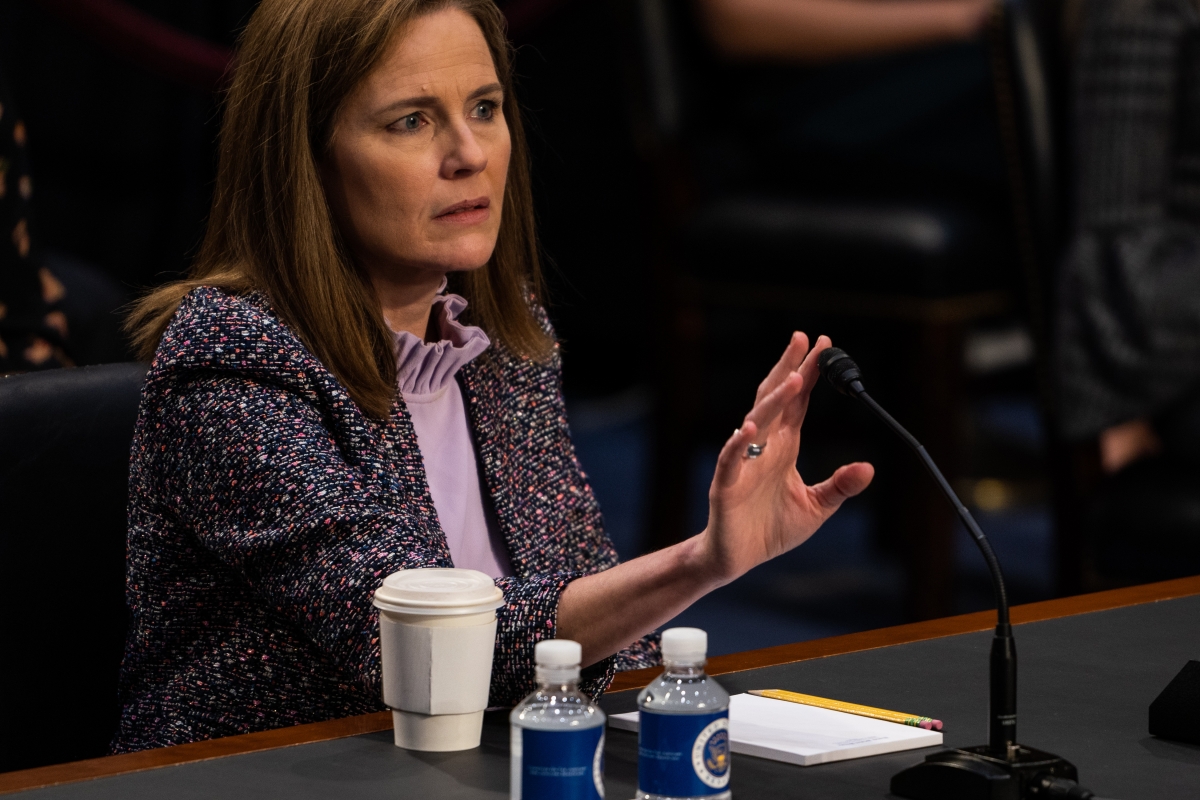

 Sen. Kelly Loeffler, R-Ga., in Atlanta on Election Night. MUST CREDIT: Washington Post photo by Melina Mara
  President-elect Joe Biden delivers remarks last week after a virtual meeting with U.S. governors, including some Republicans, during which he vowed a bipartisan assault on the coronavirus. MUST CREDIT: Washington Post photo by Salwan Georges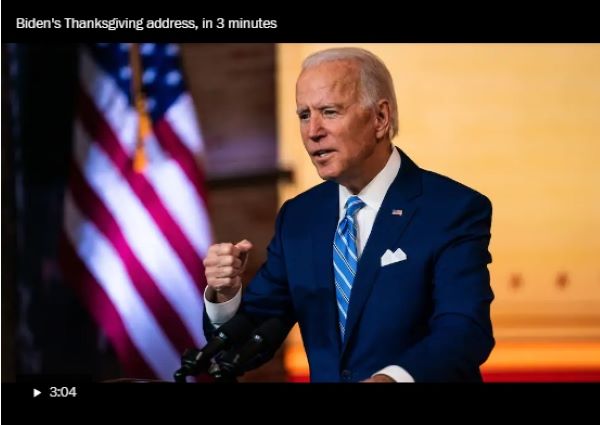
 President-elect Joe Biden delivers remarks last week after a virtual meeting with U.S. governors, including some Republicans, during which he vowed a bipartisan assault on the coronavirus. MUST CREDIT: Washington Post photo by Salwan Georges
  SootinClaimon.Com