Biden takes nostalgic journey amid search for votes #SootinClaimon.Com

#SootinClaimon.Com : ขอบคุณแหล่งข้อมูล : หนังสือพิมพ์ The Nation.

Biden takes nostalgic journey amid search for votes

InternationalNov 04. 2020Former vice president Joe Biden greets supporters at his childhood home in Scranton, Pa., on Tuesday, Nov., 3, 2020. MUST CREDIT: Washington Post photo by Demetrius FreemanFormer vice president Joe Biden greets supporters at his childhood home in Scranton, Pa., on Tuesday, Nov., 3, 2020. MUST CREDIT: Washington Post photo by Demetrius Freeman 

By The Washington Post · Sean Sullivan · NATIONAL, POLITICS

WASHINGTON – Joe Biden took a final lap through all-important Pennsylvania on Tuesday, seeking to generate one last burst of excitement in his 18-month pursuit of the presidency as his campaign braced for an uncertain conclusion to the most tumultuous race in modern history.
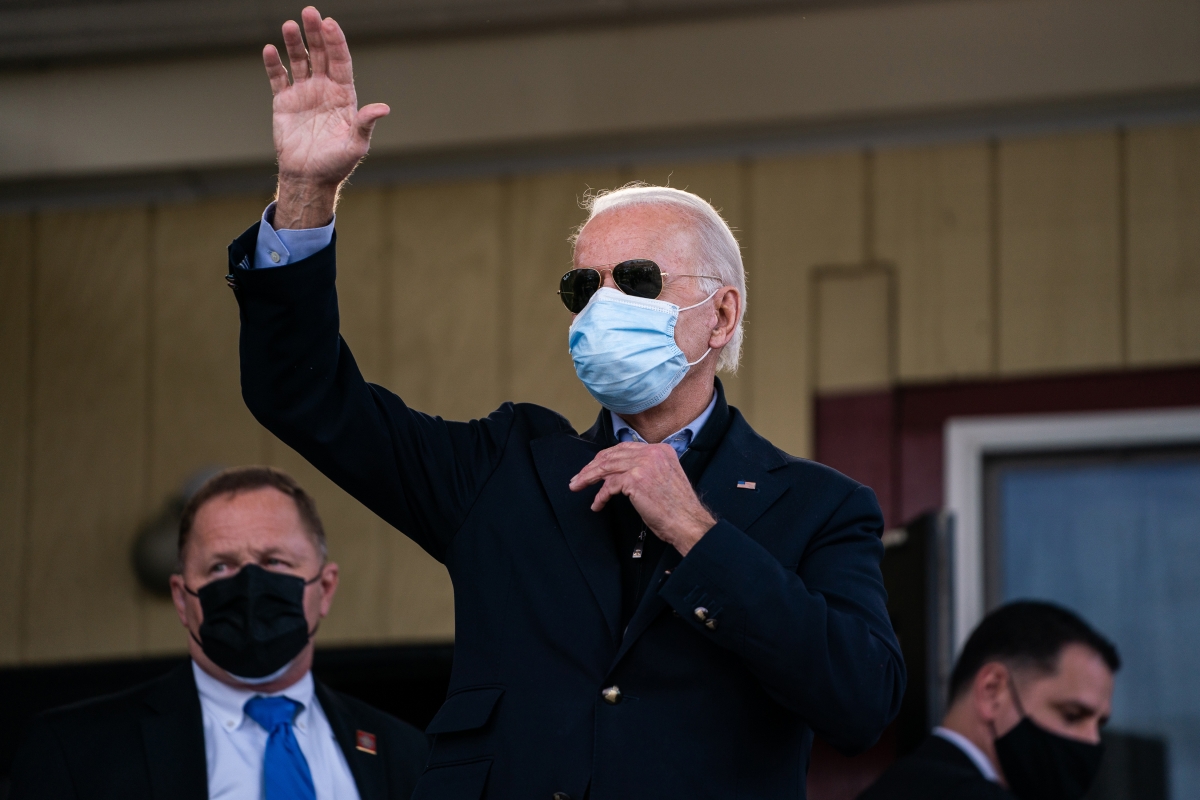
Former vice president Joe Biden stops by a restaurant in Philadelphia on Tuesday, Nov., 3, 2020. MUST CREDIT: Washington Post photo by Demetrius Freeman

Former vice president Joe Biden stops by a restaurant in Philadelphia on Tuesday, Nov., 3, 2020. MUST CREDIT: Washington Post photo by Demetrius Freeman

As he prepared to address the nation in his hometown of Wilmington, Del., on Tuesday night, the 77-year-old former vice president sought to crystallize the choice between voting for him and voting for President Donald Trump in the most crucial swing state on the map, wagering that another visit could give him an edge in a competitive landscape.

“Everybody knows who Donald Trump is,” Biden said in Philadelphia, echoing the themes he has emphasized throughout his third run for the White House. “He needs to know who we are. We choose hope over fear. We choose truth over lies. And we choose science over fiction.”
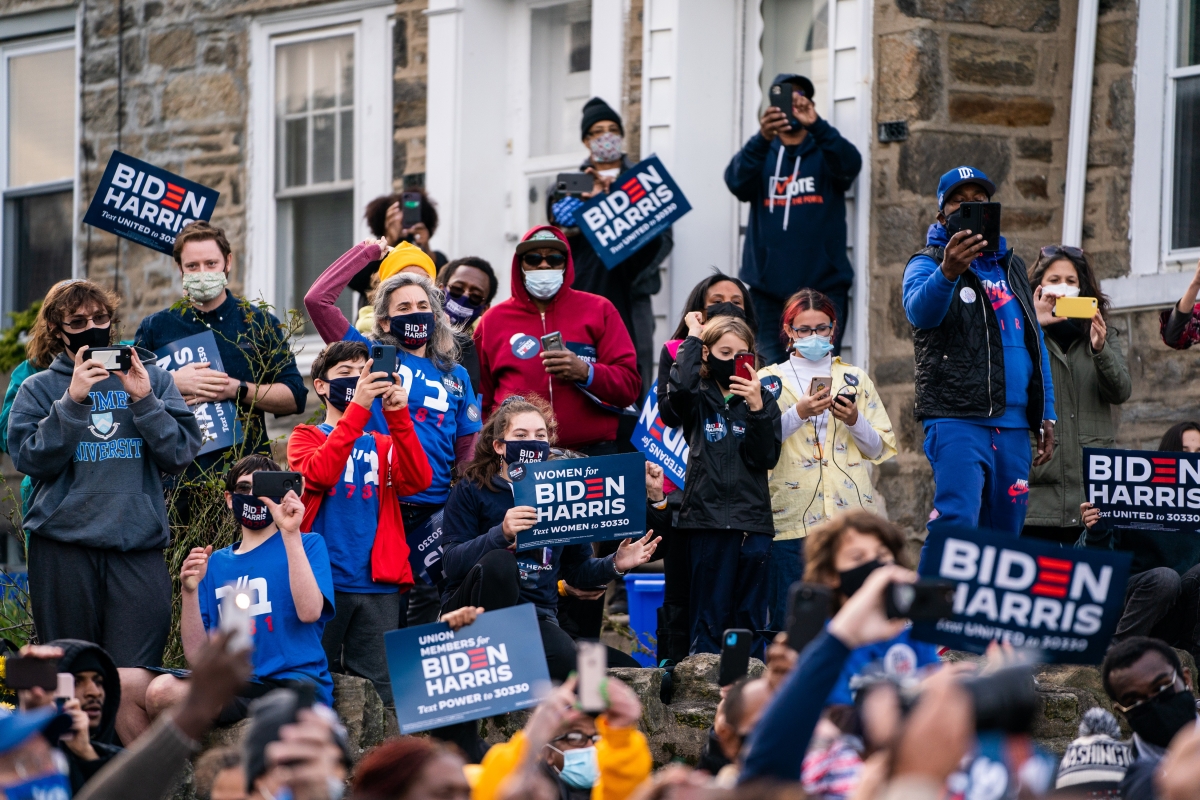
Supporters listen to former vice president Joe Biden at a campaign stop in the West Oak Lane neighborhood of Philadelphia on Tuesday, Nov., 3, 2020. MUST CREDIT: Washington Post photo by Demetrius Freeman

Supporters listen to former vice president Joe Biden at a campaign stop in the West Oak Lane neighborhood of Philadelphia on Tuesday, Nov., 3, 2020. MUST CREDIT: Washington Post photo by Demetrius Freeman

Biden carried with him the hopes of millions of Americans who seeking put an end to the chaotic Trump presidency. Once seen as a gaffe-prone and past-his-prime politician whose place in his own rapidly changing party was uncertain, Biden’s brand of moderation and espousal of unity earned him the trust of an anti-Trump coalition that prized electability above all else. But in a sharply divided country he also stood as the source of great disdain for millions of others determined to propel Trump to a second term.

The most consequential day of Biden’s decades-long political career hit many personal notes. As the sun rose over Wilmington, Biden attended Mass and visited the cemetery where his first wife and two of his children are buried. Then he flew to Scranton, where he stopped by the house he lived in as a child.

“It’s good to be home,” Biden said, greeting a few dozen supporters outside a local carpenters union hall. He told them he had won the handful of votes in the famed New Hampshire hamlet of Dixville Notch, where polls open just after midnight. “Based on Trump’s notion, I’m going to declare victory tonight,” Biden quipped, drawing laughs from the crowd.

But with Trump and his allies raising baseless concerns about fraud in mail-in voting and vote counting, Biden campaign officials were taking seriously the possibility that Trump might offer a misleading portrayal of the election results.

Asked whether he will respond if Trump claims victory prematurely, Biden insisted that voters would determine the outcome.

“Presidents don’t decide what votes are counted and not counted,” he said. “Voters determine who’s president. No matter what he does, no matter what he says, the votes are going to be counted.”

Biden campaign adviser Bob Bauer called GOP voting lawsuits “patently failing” and “meritless” and said they were “designed to generate the appearance of a cloud over the election.”

Pennsylvania and its 20 electoral votes stood perhaps the most coveted prize on Tuesday, though many observers did not expect a winner to be declared there right away, due to the ongoing tally of mail-in ballots that arrived in large numbers from voters concerned about showing up to the polls during a pandemic.

Both candidates spent much of their time in Pennsylvania during the closing days of the campaign, a reflection of its influence in the race to 270 electoral votes. Trump won Pennsylvania by less than a percentage point in 2016, and this year’s pre-Election Day polls showed a close contest there. Although Biden nominally led, Democrats had been nervous about his standing in Pennsylvania as the race neared the finish line.

“Pennsylvania’s going to pick the president,” said Lt. Gov. John Fetterman, a Democrat supporting Biden. Like many Pennsylvania Democrats, Fetterman was concerned about the prospect of high turnout among Trump supporters in White, rural counties across the state, similar to those who had pushed him over the top in 2016.

Final public polling showed Biden leading in most key battlegrounds. His campaign officials were upbeat Tuesday, voicing confidence that anger with Trump’s mismanagement of the pandemic was the dominant topic on the minds of voters and the one that would help propel Biden to the presidency. They said they had several ways to win, both with and without Pennsylvania.

“When we look to today, we feel like it is clear that we are winning,” said Biden campaign manager Jen O’Malley Dillon. “All the data that we’re looking at really underscores how many pathways believe we have to victory and how few Trump has.”

Across the country, Biden’s allies were also sounding cheery. In Michigan, where Trump won narrowly in 2016, Rep. Andy Levin, D-Mich., said voting was smooth at local polling places and Democratic enthusiasm was high.

“I’m like a 10-year-old kid about to walk into a huge room of presents or something,” Levin said excitedly in an afternoon phone interview. Levin, who represents a district in the suburbs of Detroit that incudes a county that flipped from President Barack Obama to Trump, added that “2020 is going to take its place along with 1932 and 1980 as a very rare moment when our country changes directions in a fundamental way.”

Biden, too, was upbeat as he whisked around his nostalgic tour of Pennsylvania. Before stepping into his childhood home in Scranton, he pointed to an older woman standing across the street. “She’s lived there since I was a kid!” he exclaimed.

Once inside the home, where a supporter named Anne Kearns now lives, Biden wrote a message on a living room wall: “From this house to the White House with the grace of God. Joe Biden 11-3-2020.” He had signed a bedroom wall when he ran for vice president in 2008.

The visit stirred excitement in the neighborhood. “He’s right there!” blurted out Mardan Daurilas, 19, a first-time voter who said he cast his ballot for Biden on Friday. More than a hundred people lined the streets to catch a glimpse of the Democratic nominee.

For a candidate who has limited his public appearances down the stretch compared with Trump, the stop in Scranton was reminiscent of pre-pandemic appearances Biden frequently made. But there were still blunt reminders of the coronavirus and its resurgence across the country. Biden wore a mask as he spoke. And the hugs and high-fives that were staples of Biden’s earlier campaigning were replaced by elbow bumps, in accordance with medical guidance during the pandemic.

Biden’s campaign aides have embraced the visible contrast the Democrat has struck with Trump, trumpeting his mask use and social distancing as proof to voters that as president he would be much more responsible about combating the virus than the Republican has been. Trump has frequently disregarded the advice of experts and continues to hold crowded political events in defiance of their guidelines.

At an afternoon restaurant stop in Philadelphia where Biden made a pitch to a crowd dominated by Black voters, some greeted the Democrat as “President Biden” and asked him to come closer to them.

“They won’t let me!” he said, staying at least 30 feet from the crowd.

“You’re your own man! Come over here and shake my hand!” one woman said to him, prompting some laughter in the crowd.

While in Philadelphia, Biden sat for a round of remote TV interviews with outlets in various swing states and greeted more than 100 supporters at a canvass kickoff.

“Turnout’s been incredible,” he told them. “Look: The country is ready. We’re going to have more people come this year than any time in American history,” he predicted.

He added, “I wont let you down.”

Biden received plenty of visible and vocal encouragement during his last day on the trail, which included some emotionally charged moments. At one point, a supporter asked him whether he would call a family friend dying of cancer.

But the reminders of the opposition he faced were also there. At a hoagie shop, a man in a red Trump 2020 hat was nearby.

A reporter asked Biden on Tuesday morning whether he had spoken with Trump.

“No, I haven’t,” Biden said.

Trump tones down bombast on Election Day #SootinClaimon.Com

#SootinClaimon.Com : ขอบคุณแหล่งข้อมูล : หนังสือพิมพ์ The Nation.

Trump tones down bombast on Election Day

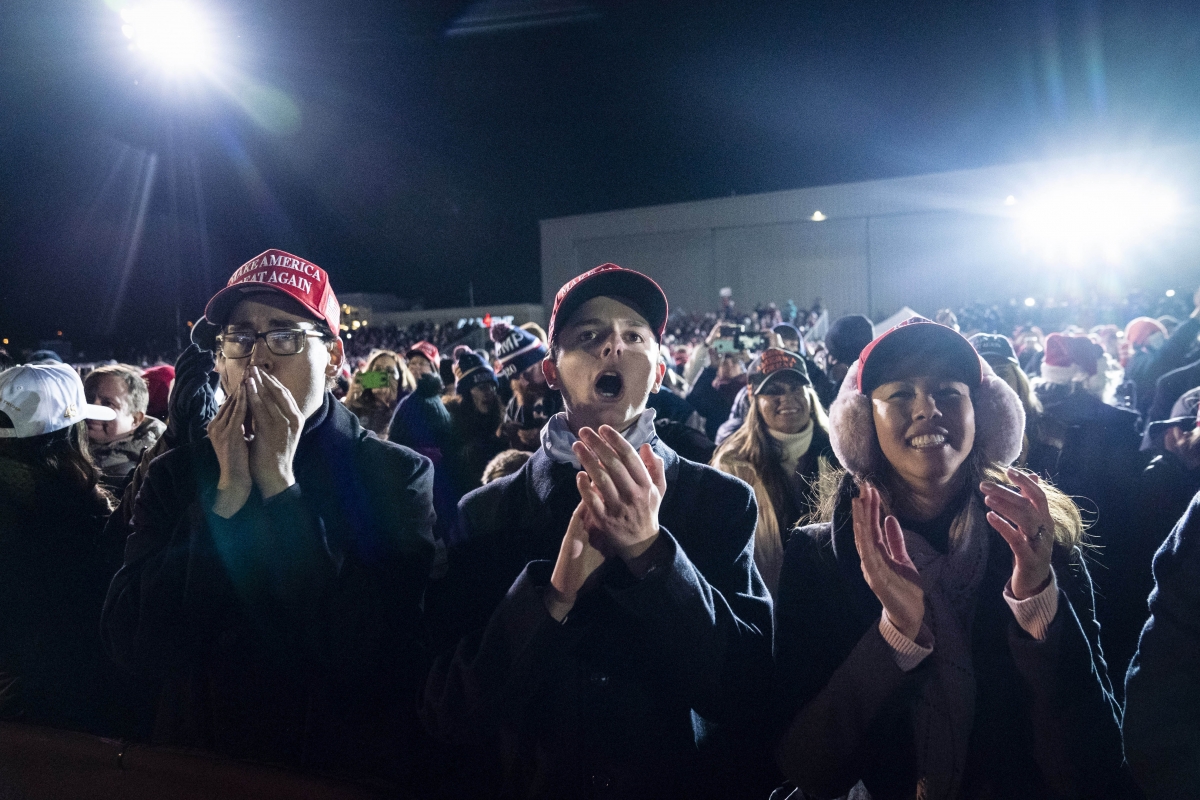
InternationalNov 04. 2020President Donald. Trump departs with Vice President Mike Pence after speaking during a rally at Gerald R. Ford International Airport in Grand Rapids, Mich., early Tuesday, Nov. 3, 2020. MUST CREDIT: Washington Post photo by Jabin BotsfordPresident Donald. Trump departs with Vice President Mike Pence after speaking during a rally at Gerald R. Ford International Airport in Grand Rapids, Mich., early Tuesday, Nov. 3, 2020. MUST CREDIT: Washington Post photo by Jabin Botsford 
By The Washington Post · David Nakamura, Josh Dawsey · NATIONAL, POLITICS

WASHINGTON – President Donald Trump woke up on Election Day – if he went to sleep at all – working on just a few hours of rest after returning to the White House in the early morning from a marathon day of campaign rallies. His first order of business: a call to “Fox & Friends” for a pep talk with the friendliest of news outlets.

Supporters cheer as President Donald Trump speaks during a rally at Gerald R. Ford International Airport in Grand Rapids, Mich., early Tuesday, Nov. 3, 2020. MUST CREDIT: Washington Post photo by Jabin Botsford

Supporters cheer as President Donald Trump speaks during a rally at Gerald R. Ford International Airport in Grand Rapids, Mich., early Tuesday, Nov. 3, 2020. MUST CREDIT: Washington Post photo by Jabin Botsford

But on the line with a trio of fawning news anchors, Trump did not strike his usual level of bombast. His voice was raspy, his tone more subdued.

Reporters speculated that he was fatigued after holding 14 rallies in three days, or that he was coming off the high of the campaign trail to confront the cold, hard reality of the polling numbers that showed him consistently trailing Democrat Joe Biden.

Asked about reports he would seek to declare an early victory before all mail-in votes were tallied, Trump demurred – he would only do so “when there’s victory. If there’s victory. I think we’ll have victory.”

“There’s no reason to play games,” added a president who for months has sought to erroneously discredit widespread mail-in voting as rife with fraud. He has vowed to dispatch his legal team to blitz swing states with lawsuits to freeze local election boards – a strategy that could portend a bitter, drawn-out dispute over the outcome stretching for days or weeks.

During the interview, Trump repeated falsehoods about the dangers of mail-in ballots, played down the threat of the novel coronavirus and insulted Democratic leaders. But he also sounded, in a few stray moments, almost reflective or wistful as the clock counted down to determine his political fate.

“There’s so much love at those rallies,” Trump said of the events, which drew tens of thousands of supporters who crowded closely together and eschewed masks despite the risks of the pandemic. “They even say, many of them, ‘We love you. We love you. We love you.’ “

For Trump, the question was whether the love of the MAGA die-hards would translate to another come-from-behind upset. The final day of the campaign meant a final chance for the president to rally the faithful, making private calls to key allies and flooding his Twitter feed with videos encouraging supporters to vote.

He also had planned a viewing party at the White House with campaign donors and supporters, a use of the complex for electioneering activities that drew rebukes from government ethics watchdogs. Trump’s campaign responded that the move to the White House was necessitated because a planned reception at Trump International Hotel a few blocks away would have violated the local District of Columbia government’s coronavirus safety regulations limiting crowd sizes.

Confined to the White House, a president who has barnstormed through swing states in the final weeks of the campaign was suddenly far more isolated. Workers had erected new security fences to keep the public farther away and create a broader ring of protection around the complex amid concerns about potential election night unrest.

As Biden traveled to Philadelphia to rally supporters with a megaphone in a state both campaigns viewed as crucial, Trump’s day was punctuated by a quick motorcade excursion across the Potomac River to the Republican National Committee’s campaign headquarters in Arlington, Va.

The president – accompanied by White House Chief of Staff Mark Meadows, press secretary Kayleigh McEnany and senior adviser Jared Kushner, his son-in-law – conferred with aides and greeted staffers who were dressed in blue and red MAGA masks, with Make America Great Again signs lining their cubicles.

“I feel very good. After doing that many rallies, the voice gets a little bit choppy, I think,” Trump said, drawing laughs and sounding more upbeat than he did on Fox News. “God did not design it for that much.”

Trump again criticized mail-in voting and railed against a Supreme Court order allowing ballots in Pennsylvania to be counted until three days after the election. Analysts have said Democrats are voting by mail in significantly higher numbers than Republicans in this election cycle.

“A lot of shenanigans, a lot of bad things happen with ballots when you say, ‘Oh, let’s devote days and days,’ and all of a sudden the ballot count changes,” Trump said. “You have to have a date [for the election], and the date happens to be November 3, and we should be entitled to know who won on November 3.”

Asked if he had prepared remarks, win or lose, Trump said: “I’m not thinking about concession speech or acceptance speech yet. Hopefully we’ll be only doing one of those two. And, you know, winning is easy. Losing is never easy. Not for me, it’s not.”

Though Biden has maintained a polling lead higher than Hillary Clinton’s advantage over Trump in the final days of the 2016 campaign, Trump and his team have maintained that a real path to victory remained.

Campaign officials were closely watching balloting in Pennsylvania and Arizona, which they viewed as the most likely to help the president clear 270 electoral college votes and win a second term. Privately, the officials were bullish on Trump’s chances in several other swing states – Florida, Georgia, North Carolina and Ohio.

Trump told associates that he felt confident that he would hold Florida, which he won in 2016.

“We believe this will be a tight race. It’s going to come down to turnout,” Trump campaign manager Bill Stepien told reporters on a conference call in the early evening. “We believe we are better prepared for that.”

The president’s political team had taken the unprecedented step of setting up a campaign war room in the Eisenhower Executive Office Building, a federal building next to the White House. Tim Murtaugh, a campaign spokesman, said the campaign was paying for the setup.

“Every piece of equipment, including WiFi and computers, was paid for by the campaign, and no White House staff is involved,” he said. “The arrangement has been approved by White House counsel.”

Stepien suggested that Biden’s Tuesday visit to Philadelphia, where he rallied supporters on the street with a megaphone, was a sign of late desperation.

By early evening, the president was ensconced at the White House, where he would presumably stay put for the night, watching along with the nation and the world as the results came in.

“My number last time was 306,” Trump said on “Fox & Friends” about his electoral college total in 2016. (His final total was technically 304 because two “faithless electors” refused to cast their electoral votes for him.)

“That was a big number,” he said. “And I think we’ll top it.”

Oil gains most in a month as OPEC+ hints at delay to output hike #SootinClaimon.Com

#SootinClaimon.Com : ขอบคุณแหล่งข้อมูล : หนังสือพิมพ์ The Nation.

Oil gains most in a month as OPEC+ hints at delay to output hike

InternationalNov 04. 2020

By Syndication The Washington Post,  Bloomberg · Andres Guerra Luz

Oil advanced the most in a month in New York as broader markets rallied and OPEC+ inched closer to delaying a planned easing of output cuts.

U.S. benchmark crude futures climbed as much as 4.1%, extending gains from Monday’s rally. Oil took its cue from stronger equities as millions of Americans headed to vote on election day. A weakening dollar also boosted the appeal for commodities priced in the currency, with the Bloomberg Dollar Spot Index falling as much as 0.7%.

OPEC and its allies will “accelerate” the recovery in oil markets at their next meeting, the group’s top official said, in another hint about a potential delay to a production hike scheduled for January. Algeria said that — along with Saudi Arabia, Russia and Iraq — it’s trying to persuade the rest of OPEC+ to extend current supply cuts, state-run news agency APS reported.

“This big selloff last week was a wake-up call to the OPEC+ group,” said John Kilduff, a partner at Again Capital. “The renewed shoulder-to-the-wheel type of action that appears to be emerging is helping to support prices.”

West Texas Intermediate for December delivery rose $1.47 to $38.28 a barrel at 10:02 a.m. in New York. Brent for January settlement advanced $1.31 to $40.28 a barrel.

Americans are voting in a presidential election that could reshape U.S. policy on a slew of energy-related areas such as fracking and how to address climate change. All the while, a swiftly evolving coronavirus situation in Europe is raising new threats to oil’s spotty demand recovery. Demand is recovering “at a very slow speed,” according to the Organization of Petroleum Exporting Countries’ Secretary-General Mohammad Barkindo.

“All eyes will be on the U.S. election today and tomorrow,” said Bjarne Schieldrop, chief commodities analyst at SEB AB. On the possible change of course by OPEC+, he said it would be “a relief for the market if it did not have to worry about an additional 1.9 million barrels a day of supply coming.”

The forward curves for both Brent and WTI show some underlying strength beyond the rally in headline prices. The spread between Brent’s nearest contracts is heading for a close at its tightest contango structure in a week, as is the prompt spread for WTI.

Sweden fights ‘very serious’ Covid resurgence with new curbs #SootinClaimon.Com

#SootinClaimon.Com : ขอบคุณแหล่งข้อมูล : หนังสือพิมพ์ The Nation.

Sweden fights ‘very serious’ Covid resurgence with new curbs

InternationalNov 04. 2020Pedestrians pass shops in Stockholm, Sweden, on Sept. 21, 2020. MUST CREDIT: Bloomberg photo by Mikael Sjoberg.
/Photo by: Mikael Sjoberg — Bloomberg
Location: Stockholm, SwedenPedestrians pass shops in Stockholm, Sweden, on Sept. 21, 2020. MUST CREDIT: Bloomberg photo by Mikael Sjoberg. /Photo by: Mikael Sjoberg — Bloomberg Location: Stockholm, Sweden 

By Syndication The Washington Post, Bloomberg · Niclas Rolander

Swedes face a new wave of restrictions after daily coronavirus cases hit a record, with the government warning of a grim winter ahead.

Prime Minister Stefan Lofven, speaking to reporters on Tuesday, said his country is now facing a “very serious situation” that requires tougher measures if the virus is to be fought back.

The resurgence of Covid-19 across Europe has caught the region off guard after a summer that left many countries assuming they’d brought the virus under control. But as citizens grew complacent and temperatures dropped, the pandemic has returned with a vengeance.

Lofven warned that the latest development is putting Sweden’s health-care system under pressure, as more intensive care beds get filled.

“The brief respite that we got during the summer is over,” he said. “How we act now will determine what kind of Christmas we will be able to celebrate, and who will be able to take part.”

At no point since the pandemic started has Sweden imposed a lockdown, relying instead on voluntary social distancing. That’s led to higher infection and mortality rates than in the rest of the Nordic region, but so far with few signs that Sweden has developed herd immunity.

Sweden’s new coronavirus cases hit a record of 4,062 on Friday. As of Tuesday, a total of 134,532 Swedes had been infected with the virus, with 5,969 fatalities.

Critics have called Sweden’s approach reckless. Those in charge of the policy say it will work better in the long run, and argue that sudden lockdowns aren’t a tenable way to fight a virus that’s likely to be around for years.

But there are signs Sweden’s government is ready to adopt a tougher approach as the country heads into an uncertain winter.

Anders Tegnell, Sweden’s state epidemiologist, said on Tuesday that “overall, the development is moving in the wrong direction in many different ways.” He added that “the main issue now is to really limit close contact to the immediate family.”

Sweden’s latest measures still take the form of recommendations, meaning people don’t face legal consequences if they ignore them. But Lofven said he wasn’t just handing out “some kind of friendly, general advice.”

“It is expected that everyone who is subject to these recommendations will follow them all day, every day,” he said.

As of Tuesday, Swedes in seven of the country’s 21 regions — representing roughly 70% of the population — will be required to:

–Avoid physical contact with people besides those with whom they share a home

–Avoid indoor spaces in which crowds can form

–Avoid parties, weddings, funerals and similar events

–Employers should ensure that staff who can work from home do so

Election Day voting opens with some lines, scattered glitches and ample anxiety across the nation #SootinClaimon.Com

#SootinClaimon.Com : ขอบคุณแหล่งข้อมูล : หนังสือพิมพ์ The Nation.

Election Day voting opens with some lines, scattered glitches and ample anxiety across the nation

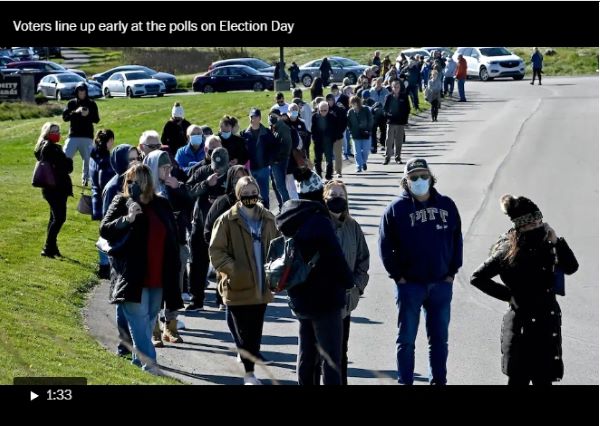
InternationalNov 03. 2020Voters line up outside the Hialeah John F. Kennedy Library in Hialeah, Fl., on Tuesday. MUST CREDIT: Washington Post photo by Michael Robinson Chavez
/Photo by: Michael Robinson Chavez — The Washington PostVoters line up outside the Hialeah John F. Kennedy Library in Hialeah, Fl., on Tuesday. MUST CREDIT: Washington Post photo by Michael Robinson Chavez /Photo by: Michael Robinson Chavez — The Washington Post 
By The Washington Post · Amy Gardner 

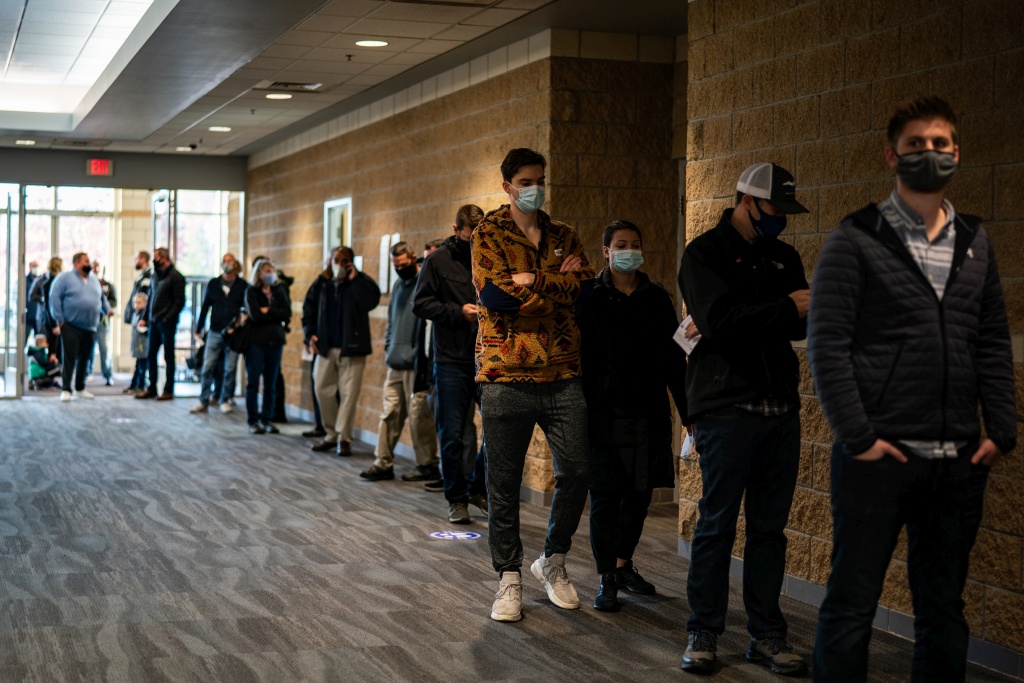
Americans lined up for a long election season’s final day of voting Tuesday, breezing through cavernous facilities in some cities and waiting by the hundreds in others, and contending with only few scattered glitches in the first hours of Election Day.

https://www.washingtonpost.com/video/c/embed/21083cb5-c45b-4ca7-ac22-560b781fd748?ptvads=block&playthrough=false

Nearly 100 million people had already cast ballots as voting got underway, a stunning figure that underscored how the coronavirus pandemic has transformed this year’s election, as a record number of Americans voted early or by mail to avoid the risk of infection.

Early turnout was light in Miami, Dayton, Atlanta and Louisville, prompting a tentative sigh of relief for election officials who have spent months preparing for complications arising from the pandemic. But long lines formed in other places, including New York City, Las Vegas, Green Bay, Wis., and St. Petersburg, Fla. – a reminder of the historic surge of interest in this year’s race for the White House between President Trump and former vice president Joe Biden.

“We don’t normally see lines this long, this early,” said Jonathan Kipp, an election administrator in Londonderry, N.H., where 563 people voted over the first hour. “Isn’t it great, though? People are looking to vote.”

Voters encountered a handful of obstacles Tuesday, including a snow quall in Manchester, N.H., and a few problems with machines and voter check-in systems in cities such as Columbus, Oh. and Philadelphia.

Voters wait in line at a polling location inside Ada Bible Church in Ada, Mich., on Tuesday. MUST CREDIT: Washington Post photo by Salwan Georges/ Photo by: Salwan Georges — The Washington Post Location: Ada, United States

Voters wait in line at a polling location inside Ada Bible Church in Ada, Mich., on Tuesday. MUST CREDIT: Washington Post photo by Salwan Georges/ Photo by: Salwan Georges — The Washington Post Location: Ada, United States

In many cities, the physical and economic toll of the coronavirus itself was on vivid display. In Kenosha, Wis., Angela Van Dyke waited along with about 100 other others in chilly temperatures as the sun rose Tuesday morning, despite her worries about exposure to the virus.

“It’s a civic duty to show up, even in the midst of a massive surge” of infections, said Van Dyke, who moved back to her home state from California after losing her job in architecture because of the pandemic. She accused Republican leaders in Wisconsin of being “lazy” in their management of the crisis, and she was apprehensive about safety protocols in her polling station as she stood in line.

In Omaha, nurse McKenna Hoffman, 33, stood in line to vote in part, she said, because of Trump’s poor management of the pandemic. Nebraska Gov. Pete Ricketts, R, a Trump ally, opposed a mask mandate in the state, and on Monday, the state set a record for hospitalizations, according to Washington Post data. During her shift in an intensive care unit Monday, McKenna said just three beds remained open.

“It’s worse now than it was in March,” she said. “It will come down to who to intubate.”

In a sign of what is expected to be an expanded electorate this year, first-time voters were among those at the front of the lines Tuesday.

Brian Dalley, 60, arrived at the Ada Bible Church in Cascade, Mich., before the sun rose and even before many of the election workers arrived. He was the first in a line of about 70 voters that stretched along the edge of the parking lot, under a waning moon, their faces illuminated by phones and their hands cradling hot coffee.

Dalley, who has never voted before, said he has been upset by the unrest this year, including protests against Trump, which he said were unpatriotic.

“You’re supposed to get behind your president,” he said, adding that it inspired him to vote for Trump – and straight Republican down the ticket.

In some states, Tuesday also marked the start of processing and counting the mountain of absentee ballots that election offices must contend with. Election officials in Pittsburgh announced the removal of ballots from a locked storage facility to begin what is expected to be a days-long process determining the final vote in Pennsylvania.

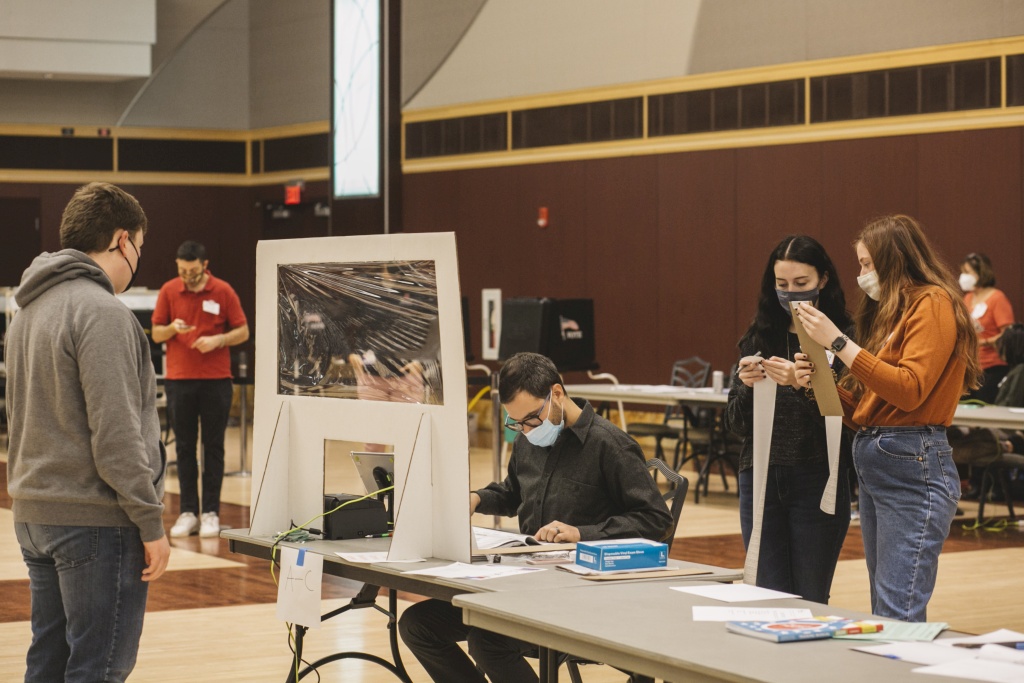
A few glitches also marked the first hours of voting. In Columbus, the Franklin County Board of Elections was checking voters in using paper poll books after technical difficulties sidelined an electronic check-in system, but officials said the move was not slowing down actual voting.

In Kansas City, police said they were investigating messages spray painted on the city’s iconic National WWI Museum overnight, including “Don’t Vote.” The building is serving as a polling station Tuesday.

Voters check-in on the campus of Ohio State University in Columbus, Ohio, on Tuesday. MUST CREDIT: Photo for The Washington Post by Andrew Spear /Photo by: Andrew Spear — for The Washington Post

Voters check-in on the campus of Ohio State University in Columbus, Ohio, on Tuesday. MUST CREDIT: Photo for The Washington Post by Andrew Spear /Photo by: Andrew Spear — for The Washington Post

One precinct in Philadelphia struggled with glitchy machines and briefly resorted to provisional ballots, but the machines were running by midmorning.

The Ohio secretary of state’s communications team announced Tuesday morning in a tweet that the Franklin County Board of Elections is checking voters in using paper poll books after not being able to upload all early in-person voting data into its electronic check-in system.

At least three states – Texas, Hawaii and Montana – exceeded their total 2016 turnout with early and mail voting this year, but other states have seen lower turnout that could foretell heavier Election Day traffic. Among battlegrounds, Pennsylvania had reached only about 40% of its 2016 levels by Monday, Ohio had hit 60%, and Michigan was also at 60%.

In other states, election officials who had encountered huge numbers of voters in the past several weeks said they were not sure what to expect Tuesday.

In Georgia, 3.9 million people had already voted as of Monday evening – edging close to the 4.2 million who turned out in 2016. The majority of the state’s 10 most populous counties had returned more than two-thirds of their mail ballots as of Saturday, according to the U.S. Elections Project.

On Monday, Fulton County Elections Director Richard Barron said that in some precincts in his county, home to downtown Atlanta, more than 80% of registered voters had cast their ballots either by mail or in person.

“This turnout has been amazing,” Barron said. Like other election administrators, Barron cautioned that Tuesday could still bring a crush of voting – and long wait times – but said that the upside was likely to be record-setting overall turnout, brought on by heavy interest in the race for the White House between President Donald Trump and former vice president Joe Biden.

“June taught us how difficult it is to run an election in the middle of a pandemic, but I think it also helped us to be prepared for what lies ahead,” Barron said. “It has made us better.”

Advocates remained nervous about the volume of mail ballots requested but not yet returned – and about fresh reports Monday of mail service delays in several battleground states. In Homestead, Fla., south of Miami, Postal Service executives announced that 62 ballots were found in a backlog of 180,000 pieces of mail over the weekend. All the ballots except one have now been delivered.

An estimated 27.2 million requested ballots had not been returned by Tuesday morning, according to the U.S. Elections Project, and the campaigns were urging their supporters to return ballots immediately to make sure those votes count.

In many cases, voters requested absentee ballots but then changed their minds about voting by mail, election officials said.

In Harris County, Tex., for instance, home of Houston, about half of the 90,000 ballots that haven’t been returned were surrendered by voters who chose to cast their ballots in person instead.

And in Florida, where 1.35 million mail ballots had not yet been returned, Republican consultant Rick Wilson estimated that voters planning to cast ballots in person accounted for about half of those.

In some states, however, it is more difficult for voters to change how they cast their ballots. In South Carolina, where about 35,000 mail-in ballots had not been returned by Monday afternoon, anyone who requested and received one will not be allowed to vote in person Tuesday. Those South Carolinians must instead return their mail-in ballots by 7 p.m. or cast a provisional ballot if they attest to never receiving their ballot in the mail.

Strategists from both parties said it was likely that more Republicans than Democrats got cold feet about voting by mail after months of attacks from Trump, who claimed without evidence that it would invite fraud. Polls have also indicated that a majority of Republicans planned to vote on Election Day, whereas most Democrats said they planned to vote early, either by mail or in person.

In the states that track voters by party registration, early-voting data reflected an advantage for Democrats, although in some states, notably Florida, that advantage had narrowed dramatically by the time early voting ended Sunday.

– – –

The Washington Post’s Michelle Ye Hee Lee in Washington, Brent Griffiths in Omaha; Kim Bellware in Kenosha, Wis.; Annie Gowen in Kansas City, Mo.; Keith O’Brien in Manchester and Londonderry, N.H.; Ryan Slattery in Las Vegas; Kayla Ruble in Detroit and Moriah Balingit in Cascade, Mich. contributed to this report.

‘This is how democracy crumbles’: Melanie Campbell on the fight to defend Black votes #SootinClaimon.Com

#SootinClaimon.Com : ขอบคุณแหล่งข้อมูล : หนังสือพิมพ์ The Nation.

‘This is how democracy crumbles’: Melanie Campbell on the fight to defend Black votes

InternationalNov 03. 2020“My mission in life is to do my part, but also to lift others along the way, make sure Black women are not invisible,” said Campbell, at right. MUST CREDIT: Washington Post photo by Melina Mara 

By The Washington Post · Vanessa Williams · NATIONAL, POLITICS, CONGRESS, WHITEHOUSE 
Melanie Campbell would love to be in Georgia, where a diverse coalition of activists has never been closer to flipping the state from red to blue. Or Florida, her home state, one of the top battlegrounds in the fierce fight for the presidency.

Instead, after a rough bout with covid-19, Campbell will spend this consequential election at home in Northern Virginia, directing and supporting Black female activists working to turn out Black voters across the South and in the critical swing states of Michigan and Pennsylvania.

Campbell is the convener of the Black Women’s Roundtable, one of the largest networks of women focused on using civic engagement to improve the lives of Black women, their families and their communities – improving access to health care, ending systemic racism, reforming the criminal justice system, lifting people out of poverty. The Roundtable was prepared to do double duty this year, making sure Black people participated in both the census and the national election. But the pandemic has created new challenges.

Instead of mobilizing voters by going door to door, the Roundtable is connecting with voters digitally on smartphones and tablets. When in-person early voting began, the women donned masks and worked the long lines at polling places, passing out water and snacks to keep people comfortable while they waited to cast their votes.

Now, with Election Day here, Campbell is worried about a Republican legal campaign to attack pandemic-related rule changes and limit access to the ballot. 

“There is a lot of concern – like this real concern – that there is such a systematic approach to suppressing people’s votes,” she said in a recent interview. “This is how democracy crumbles.”

The Black Women’s Roundtable is nonpartisan and does not endorse candidates. But Black voters overwhelmingly vote Democratic, and President Trump is deeply unpopular with them. In a Washington Post-Ipsos poll of Black adults this summer, 88% disapproved of the way Trump has handled his job, with 76% strongly disapproving. 

In 2016, more than 94% of Black women voted against Trump, more than in any other group of voters. This year, many are hoping to both boot Trump and make history by electing Sen. Kamala Harris, D-Calif., the first Black female vice president. 

Campbell has been talking with voting rights groups about to how defend the count. As she told organizers on a Zoom call a few weeks ago: “We will do what we have to do . . . . We know what’s going on – that folks are trying to just steal our vote from us – and we’re not going to have it on our watch.”

Campbell grew up in Mims, Fla., a small town on the Atlantic Coast. Her parents were educators and active in the local NAACP chapter. One of her earliest childhood memories was the night she huddled on the floor with her mother and sisters while her father and other men took up posts in trees and under houses to await a visit from the Ku Klux Klan, which was still active in Florida during the 1950s.

The youngest of six children, Campbell followed her older brothers and sisters to Atlanta, where she enrolled in Clark Atlanta University and took a corporate job upon graduation. But she soon found herself missing the action of the movement, and went to work for Maynard Jackson, then the mayor of Atlanta and one of the country’s highest-profile Black political leaders. While running the mayor’s office of youth services, she hired an outspoken student leader from Spelman College named Stacey Abrams, who had publicly questioned Jackson’s understanding of the frustrations of young people.

By 1995, Campbell had moved to Washington to work for the National Coalition on Black Civic Participation, where she found a mentor in Dorothy I. Height, a founding board member. Campbell became the coalition’s executive director in 2000 and president and CEO in 2011. 

“My mission in life is to do my part, but also to lift others along the way, make sure Black women are not invisible,” Campbell said. 

Oleta Fitzgerald is Southern regional director for the Children’s Defense Fund, based in Jackson, Miss. She said Campbell has helped to elevate the voices and stories of Black women in the rural South. 

“Not only does she say, ‘Come to the meeting,’ she puts you in the news conference. She talks about your report,” said Fitzgerald, who also works with the Southern Rural Black Women’s Initiative. “She’s a builder and makes space for people.”

Fitzgerald credited Campbell with helping Black female activists in Alabama influence the 2017 special election in which Democrat Doug Jones beat Republican Roy Moore for the U.S. Senate. Jones is unlikely to win reelection Tuesday in heavily Republican Alabama, but Campbell says she believes that over time the Roundtable can help loosen the GOP’s grip on the levers of power in the South. A large contingent of Roundtable women in Georgia is working to help turn that state blue.

“The majority of Black people live there,” she said of Southern states. “As a leader of an organization that focuses on Black civic engagement and empowerment and power-building for Black people, the South is key to that.”

This spring, Black voters in South Carolina resuscitated former vice president Joe Biden’s presidential campaign and set him on a path to capture the Democratic presidential nomination. A week later, the Black Women’s Roundtable held its annual meeting in Northern Virginia. The gathering pulsed with energy. 

Once again, Black women had flexed their political muscle. They were eager to talk about next steps. 

Within days, however, the nation began to shut down in the face of the coronavirus pandemic. Like many organizations, the Roundtable was forced to move its operations online. 

Through the summer, Campbell joined forces with other Black women leaders to push Biden to select a Black woman as his running mate. When Harris gave her acceptance speech at the Democratic National Convention in August, Campbell celebrated with friends at a virtual watch party.

Then Campbell attended a family funeral over Labor Day weekend. Despite taking precautions, she was infected with the coronavirus. After she struggled to get admitted to a hospital, a close friend connected her with a doctor who was able to get her into George Washington University Hospital, where she spent most of September. 

Salandra Benton, a Roundtable convener and executive director of the Florida Coalition on Black Civic Participation, has lost eight relatives to covid-19. She was terrified when she learned that Campbell, who she has known for more than 20 years, had fallen ill. 

With Campbell’s support, Benton had been able to help restore voting rights for Florida felons who had been released from prison. Last month, Benton partnered with the Florida Rights Restoration Coalition to host “Free the Vote” rallies around the state, aimed at encouraging felons to take advantage of their newly restored right to vote. 

“We’re doing everything we possibly can do, so that when Election Day comes we can say we left nothing on the table,” Benton said.

Latosha Brown, a Georgia organizer who also grew up under Campbell’s wing, said Black women are being asked to do too much. Brown is co-founder of the organization Black Voters Matter, which had to sue the state of Alabama to expand absentee voting so people could safely cast ballots during the pandemic.

“Black women are out here leading the charge of registering people to vote. Comforting voters at the polling sites. Advocating to make sure people are not being marginalized in the process – all those things that a government in a functioning democracy would normally have,” Brown said. 

“If Black women ever decide we don’t believe in democracy anymore, it’s over for this country,” she added. “It’s a wrap.”

On Sunday, Campbell held a virtual gospel hour, featuring music, prayer and a call to arms. 

“We know what’s up, we hear the drumbeat. We know what they’re trying to do,” she told the gathering. “So many of us are so worn out and tired. We needed this moment – I know I did – to remind ourselves that we are not in this alone. God is in control. 

“But He told us to work, work, work,” she said. “And that’s what we’re going to do.”

Moon says S. Korea’s 2050 carbon-neutral goal is ‘heavy promise,’ urges calm preparations #SootinClaimon.Com

#SootinClaimon.Com : ขอบคุณแหล่งข้อมูล : หนังสือพิมพ์ The Nation.

Moon says S. Korea’s 2050 carbon-neutral goal is ‘heavy promise,’ urges calm preparations

InternationalNov 03. 2020President Moon Jae-in speaks during a Cabinet meeting at Cheong Wa Dae in Seoul, Tuesday. (Yonhap)President Moon Jae-in speaks during a Cabinet meeting at Cheong Wa Dae in Seoul, Tuesday. (Yonhap) 

By The Korea Herald/ANN

President Moon Jae-in said Tuesday that South Korea is seriously committed to its stated aim of going carbon neutral by 2050 to support the global fight against climate change.

He called for national efforts to attain the goal via a “calm and cool-headed” approach, speaking during a weekly Cabinet meeting at Cheong Wa Dae.

“Carbon neutrality is the direction in which the world should move to respond together to the climate crisis,” he stressed. “We should actively participate in this global trend as a responsible member of the international community.”

The president described his relevant statement last week as a “heavy promise” that reflects Seoul’s commitment.

In an annual budget policy speech at the National Assembly, Moon announced that South Korea, one of the world’s most fossil fuel-reliant economies, will “strive to become carbon neutral by 2050” as part of the government’s Green New Deal drive.

He presented a vision for replacing coal-fired power generation with renewable energy.

In his opening remarks at the Cabinet session, Moon unveiled more details of the carbon-neutral campaign.

He instructed the authorities to meticulously draw up a road map for the energy transition from fossil fuels to environment-friendly sources in tandem with a review of plans to cut greenhouse gas emissions.

“In particular, I would like you to explore various measures to accelerate energy conversion such as decarbonization, the development of the hydrogen economy and the expansion of renewable energy use,” he said.

He pointed out that carbon neutralization is not an easy task for South Korea, which relies heavily on fossil fuels.

“But responding to climate change is not an option but a must,” he emphasized. (Yonhap)

HKSAR gov’t to implement national security law without fear: HKSAR chief executive #SootinClaimon.Com

#SootinClaimon.Com : ขอบคุณแหล่งข้อมูล : หนังสือพิมพ์ The Nation.

HKSAR gov’t to implement national security law without fear: HKSAR chief executive

InternationalNov 03. 2020Hong Kong Chief Executive Carrie Lam Cheng Yuet-ngor meets the press at Central Government Offices on Oct 27, 2020. [Photo by PARKER ZHENG/China Daily]Hong Kong Chief Executive Carrie Lam Cheng Yuet-ngor meets the press at Central Government Offices on Oct 27, 2020. [Photo by PARKER ZHENG/China Daily] 

By Xinhua/China Daily/ANN

HONG KONG — Chief Executive of the Hong Kong Special Administrative Region (HKSAR) Carrie Lam said on Monday that the implementation of the Law of the People’s Republic of China on Safeguarding National Security in the HKSAR is both timely and essential.

Lam made the remarks in a speech delivered at the opening of the Hong Kong Legal Week 2020. She said that she and the HKSAR government will continue to steadfastly implement the national security law in Hong Kong without fear or worry.

Lam said that the violent protests during the social unrest last year has undermined public perception of the rule of law, and exposed the shortcomings in Hong Kong with regard to safeguarding national security, thus the enactment of the national security law in Hong Kong is “both timely and essential.”

“Since then, law and order and stability in society has been restored and we now have an enhanced system for Hong Kong to accurately and comprehensively implement the ‘One Country, Two Systems’ principle,” she said.

Lam once again urged everyone in society, regardless of his or her political stance, to support the rule of law and respect the courts, judges and their rulings.

Geoffrey Ma Tao-li, chief justice of the Court of Final Appeal of the HKSAR, said at the opening that the rule of law is essential to Hong Kong’s prosperity, and he hoped that the society will cherish and protect it.

Ma said that the role and functions of the judiciary are clearly set out in the HKSAR Basic Law and the HKSAR enjoys independent judicial power including that of final adjudication, reflecting the constitutional arrangement under the “one country, two systems”.

Judges’ vows also reflect the independence of the judiciary, judges should uphold the HKSAR Basic Law, perform their duties faithfully and uphold the rule of law fearlessly and selflessly, he said.

Teresa Cheng, Secretary for Justice of the HKSAR government, said that the HKSAR government has already started projects that will promote the proper understanding and recognition of the rule of law at various levels in the society, hoping to raise the awareness on the importance of a law-abiding society.

The Hong Kong Legal Week is an annual flagship event of the Justice Department of the HKSAR government. In response to the challenges posed by COVID-19, for the first time, a series of webinars will be broadcast live from Nov 2 to 6.

More international students to be admitted to Japan’s national universities #SootinClaimon.Com

#SootinClaimon.Com : ขอบคุณแหล่งข้อมูล : หนังสือพิมพ์ The Nation.

More international students to be admitted to Japan’s national universities

InternationalNov 03. 2020Foreign students attend an entrance ceremony for the University of Tokyo in Bunkyo Ward, Tokyo, in October 2012. (Yomiuri Shimbun file photo)Foreign students attend an entrance ceremony for the University of Tokyo in Bunkyo Ward, Tokyo, in October 2012. (Yomiuri Shimbun file photo) 

By The Japan News/ANN

The education ministry plans to allow an increase in the number of foreign students studying at national universities from the 2022 academic year, in an effort to increase the universities’ international competitiveness and ensure the stability of their finances, The Yomiuri Shimbun learned Monday.

The Education, Culture, Sports, Science and Technology Ministry will send to national universities a notice that will allow an increase in their enrollment limit by next summer. The liberalization of tuition fees for foreign students is likely to be discussed as well.

Under the current system, a university hoping to increase its quota needs to apply to the Council for University Establishment and School Corporation, an advisory organization to the education minister, which will conduct an inspection as to whether the increase is appropriate.

Since the 1990s, when the population of 18-year-olds started to decline, the ministry has maintained the stance that no increase was allowed in national universities’ enrollment except for special cases, saying it would place a burden on the finances of competing private universities.

Total enrollment at all national universities has hovered around 96,000 since the 2005 academic year.

There were 13,070 foreign students studying at national universities in the 2019 academic year, about 3% of the total number of students. The ratio was lower than that for private universities, which stands at 3.7%.

By issuing the notice by next summer, the ministry envisions that an increased number of international students will be admitted to national universities from the 2022 academic year.

However, if the number of foreign students increases without any limit, it is feared that there will be a shortage of teachers and classrooms. The ministry will check in advance the level of enrollment.

The ministry’s plan to increase the number of international students is aimed at attracting more talented foreign students to improve university’s research capabilities and garner international recognition.

Major international university rankings are decided based on various statistics, such as research paper citations, the ratio of international students and other factors related to the globalization of universities.

On the World University Ranking 2021, released by British education magazine publisher Times Higher Education in September, only two universities in Japan ranked in the top 200 — the University of Tokyo at 36th and Kyoto University at 54th.

The government has set a goal of having at least 10 universities in the top 100 by 2023, but this is considered difficult to achieve.

Increasing the number of international students will aid in the management of national universities, as the increased tuition revenues will strengthen their financial base.

The ministry is considering a plan to liberalize national universities’ tuition fees for international students. Currently, the standard annual tuition for national universities is set at ¥535,800 for both Japanese and foreign students. The fees can be increased by up to 20% at each university’s discretion.

Among foreign students studying at universities in Japan in the 2019 academic year, the largest segment — 41.2% — came from China. This was followed by Vietnam at 19.8%, Nepal at 8.2%, South Korea at 7% and Taiwan at 3.3%.

Storm Goni forecast to hit Vietnam’s central provinces on Thursday #SootinClaimon.Com

#SootinClaimon.Com : ขอบคุณแหล่งข้อมูล : หนังสือพิมพ์ The Nation.

Storm Goni forecast to hit Vietnam’s central provinces on Thursday

InternationalNov 03. 2020Projected path of Goni storm. — Photo courtesy of the Vietnam Disasters Monitoring SystemProjected path of Goni storm. — Photo courtesy of the Vietnam Disasters Monitoring System 

By Viet Nam News/ANN

HÀ NỘI — The tenth storm to enter the East Sea this year is expected to make landfall in central provinces from Đà Nẵng to Phú Yên on Thursday, after ripping through the Philippines killing at least 16 people on Sunday.

At a meeting of Central Steering Committee for Natural Disaster Prevention and Control on Monday morning, director of the National Centre for Hydro-Meteorological Forecasting Mai Văn Khiêm said Storm Goni was weakening as it passed the Philippines however.

Around 30 hours after it hit the Philippines with wind speeds of up to 183km per hour, it entered the East Sea gusting up to 88km per hour.

At 1pm on Monday, the storm was 680km from Việt Nam’s Hoàng Sa (Paracel) Archipelago, moving westwards at 10-15km per hour.

Khiêm said that the storm would make landfall with wind speeds of 60-75 km per hour, and there was little chance of it gaining strength.

Heavy rain is forecast from Wednesday afternoon.

“Notably, the rain will blanket central areas already hit by the ninth storm of the year,” Khiêm said.

Provinces from Thừa Thiên-Huế to Phú Yên and north of the Central Highlands will see average rainfall of 100-200mm from Wednesday to Friday.

Provinces from Nghệ An to Quảng Trị will see average rainfall of 150-300 m from Thursday to Saturday. Flood warnings have been issued in river areas in provinces from Quảng Nam to Quảng Ngãi.

Minister of Agriculture and Rural Development Nguyễn Xuân Cường said that Goni was a super typhoon that lost strength when entering East Sea.

“It’s difficult to predict the storm’s developments, however” he said, calling for close observation of the storm.

“We must prepare for the possibility of flash floods, landslides and damage to dams and reservoirs,” Cường said.

Chairing the meeting, Deputy Prime Minister Trịnh Đình Dũng said even though the storm had weakened, people needed to stay alert.

He asked agencies and localities to call in all vessels from areas in the path of the storm.

People in coastal areas should evacuate, he said.

Meanwhile, according to power companies in the central region, supplies and resumed for 95 per cent of customers affected by the particularly strong ninth storm – Molave – in the central region last week.

About 213,000 people were still without power, mostly in Quảng Nam and Quảng Ngãi provinces.

On Monday afternoon, search and rescue forces recovered the eighth body of 11 people who were buried by a landslide in Phước Lộc Commune, Phước Sơn District in the central province of Quảng Nam on October 29. The seventh body was found on Sunday.

Meanwhile, bad weather and rough seas were posing difficulties in the search for 23 fishermen from Bình Định vessels – BĐ 97469 TS and BĐ 96388 TS.

BĐ 96388 TS sank 143.5 nautical miles off Cam Ranh on October 27 while seeking shelter from the ninth storm. There were 12 fishermen on board.

BĐ 97469 TS sank the same day about 172 nautical miles away from Hòn Tre Island with 14 fishermen on board.

On October 29, the Hong Kong-registered M/V Fortune Iris rescued three fishermen from BĐ 97469 TS.

As of Monday, Storm Molave had killed 31 people and injured 134 others, while 49 people remain unaccounted for. Damage has been estimated at VNĐ10 trillion. — VNS