InternationalNov 04. 2020The logo of Ant Group, an affiliate of Alibaba, is pictured at its headquarters in Hangzhou, Zhejiang province, on Oct 26, 2020. [Photo/Agencies]
By SHI JING China Daily/ANN
Fintech giant Ant Group’s initial public offering on the STAR Market will be suspended, the Shanghai Stock Exchange announced on Tuesday night.
The Shanghai bourse explained that Ant Group has reported major matters, such as the change in supervision environment concerning fintech, due to which Ant Group may not be able to meet listing requirements at the bourse or meet related information disclosure requirements. Based on the stock exchange’s regulations and sponsors’ opinions, Ant Group’s IPO on the STAR Market will be postponed. The fintech company and its sponsors are required to make relevant announcements.
China’s top financial regulators, including the People’s Bank of China, the China Banking and Insurance Regulatory Commission, the China Securities Regulatory Commission and the State Administration of Foreign Exchange, conducted a joint regulatory talk with Alibaba’s top management on Monday. Alibaba founder Jack Ma, Ant Group’s chairman Eric Jing and the fintech company’s CEO, Simon Hu, attended the meeting. Further details were not provided.
The Shanghai Stock Exchange also referred to the Monday meeting in its latest announcement.
Ant Group, which also filed for a dual listing on the Hong Kong Stock Exchange, announced on Tuesday it will suspend the listing on the Hong Kong bourse.
Ant Group, which filed in late August to float on the Shanghai Stock Exchange STAR Market, is poised to raise $34.4 billion in a record IPO, surpassing Saudi Aramco’s $29.4 billion listing last year. Ant Group is estimated to be valued at about $315 billion, based on public filings. Its debut on the two exchanges was scheduled for Nov 5.
SINGAPORE – Temasek Foundation has invested in the effort to develop a Covid-19 vaccine, said Temasek International executive director and chief executive officer Dilhan Pillay Sandrasegara on Tuesday (Nov 3).
He said this in response to a question on Temasek’s role in helping to procure and distribute the vaccine, during a discussion at the Temasek Trust Conversation.
Temasek Trust is the philanthropic arm of Singapore investment firm Temasek.
Mr Pillay said the foundation had invested in an entity considered to be a leader in the quest for developing an effective vaccine, but added that the responsibility for ensuring that sufficient vaccines are available is that of the Government.
The foundation will provide whatever help it can through its network and relationships as it is a collaborative effort, he added.
Amid the pandemic, Temasek has supported its foundation and partners in diagnosis, containment and contact tracing, treatment, protection and prevention, and enablement, which entails the donation of key supplies such as masks, test kits and ventilators to about 35 countries.
Reports have also said that Temasek is among the investors who have injected US$250 million (SGD$340 million) through private placement in German biotech firm BioNTech which is developing a Covid-19 vaccine.
Locally, Temasek has distributed 11 million masks to Singaporean residents and one million face shields to young schoolchildren and front-line workers in the food and beverage industry, while 250,000 oximeters – devices used to measure blood oxygen levels – were donated to various groups in the community.
By The Washington Post · Robert Mitchell · NATIONAL, POLITICS, WHITEHOUSE, HISTORY
Americans accustomed to learning on election night who their next president will be may mistakenly think, along with President Donald Trump, that the law requires a winner to be proclaimed that evening.
“I think it’s terrible when we can’t know the results of an election the night of an election in a modern-day age of computers,” said Trump, who also vowed to challenge the results in court.
But there is nothing in the Constitution or federal law that says the winner must be determined in the hours immediately after the polls close. And for much of American history, that would have been impossible.
The outcome of many presidential elections remained unresolved for days, weeks and – in one case – months.
In fact, in the early days of the republic, there was no single Election “Day.” States determined when they held their elections. Congress passed legislation in 1845 requiring the selection of presidential electors to occur on the Tuesday after the first Monday in November.
Election Day – and election night – was born. But it did not produce immediate clarity.
In 1848, the first presidential election held under the new law, the New York Herald reported on the day after the presidential election that the “probable result” was a landslide win by Whig candidate Zachary Taylor over Democrat Lewis Cass. The Herald was half right: Taylor won, but with only 47.3% of the vote to Cass’s 42.5%. The big story of the election was the 10.1% received by the anti-slavery Free-Soil Party led by former president Martin Van Buren.
Several factors clouded 19th-century election results. Newspapers depended on the telegraph for information and typically went to press with incomplete results. They often reported on returns through a partisan prism that downplayed unfavorable trends for their favored candidate. Vote-counting could be excruciatingly slow.
When the election was a landslide – as in 1872 when President Ulysses S. Grant walloped Democratic candidate Horace Greeley – the result was clear. But the partisan equilibrium of the Gilded Age produced one agonizingly close election after another, many of which went days before a winner could be determined.
– 1876
This one was historic. Americans waited four months before learning the outcome of the election. Republican Rutherford B. Hayes was not certified as the winner of the election (by one electoral vote, although he received fewer votes than Democrat Samuel Tilden) until March 2, three days before he was inaugurated in Washington.
– 1884
Democrat Grover Cleveland faced Republican James G. Blaine in a campaign whose outcome depended on New York, where vote totals came in with agonizing slowness. “It took more than a week,” historian Mark Wahlgren Summers has written, for Democrats to be sure that their candidate carried the Empire State and won the election.
– 1888
Four years later, Cleveland found himself in another nail-biter, this time against Republican Benjamin Harrison. Although the Los Angeles Herald published a wire story two days after the voting indicating that a Harrison victory appeared probable, the paper hedged its bets with a headline – “A Game of Guess” – that suggested the election was still up in the air. Harrison was elected but fell just short of winning a majority of the popular vote.
Election night uncertainty continued into the 20th century.
– 1916
More than two weeks passed before the election pitting Democratic President Woodrow Wilson against Republican Charles Evan Hughes was settled. “Presidential Vote Very Close; Both Parties Claiming Victory,” read the banner headline across the top of The Washington Post on Nov. 8, the morning after the election. Despite returns in the days that followed showing Wilson ahead, enough uncertainty remained to keep Hughes from formally conceding defeat until Nov. 22.
– 1948
Conventional wisdom, backed by polling, tabbed Republican Thomas E. Dewey as the likely winner over President Truman on Nov. 2. It seemed so probable that the headline on The Washington Post’s Election Day story read: “Dewey Deemed Sure Winner Today.” The Chicago Tribune, forced into an early press run because of a printer’s strike according to a history of the newspaper, splashed a banner headline across its Nov. 3 front page that declared “Dewey Defeats Truman.”
That’s not how things turned out. Returns coming in on election night showed a competitive race whose outcome, as The Post went to press, was uncertain. “Truman Takes Slight Early Lead in Both Popular and Electoral Votes,” The Post headline on Tuesday’s results read. The president’s narrow lead proved durable. Dewey stayed up until 8:30 a.m. Nov. 3 poring over the returns before taking a two-hour nap, studying the vote counts one final time, and sending a congratulatory telegram to Truman, United Press reported.
– 1960
Democratic presidential candidate John F. Kennedy held a narrow lead over Republican Vice President Richard Nixon as returns came during the evening of Nov. 8 and into the early morning hours of Nov. 9. The battleground state of Illinois swung back and forth until late returns from Chicago put Illinois in Kennedy’s column. Although Republicans from President Eisenhower on down wanted Nixon to challenge the returns, Nixon conceded defeat in a telegram released Nov. 9.
– 1976
Democrat Jimmy Carter and Republican President Gerald Ford closed a hard-fought campaign with an election night that dragged into the next morning before Carter could claim the presidency. Carter’s victory in Mississippi – no Democrat has carried the state since – put the peanut farmer and former Georgia governor over the top at 4 a.m. Eastern time, The Post’s David Broder reported.
– 2000
Democratic Vice President Al Gore and Texas Republican Gov. George W. Bush squared off in the most bitterly contested election since 1876. Election night came down to Florida, whose electoral votes would put one of the candidates into the White House, but confusion regarding the outcome in the Sunshine State continued for more than a month. On Dec. 12, a 5-4 U.S. Supreme Court decision ended recounts in Florida and effectively gave the election to Bush.
Of course, not all elections have been cliffhangers. Perhaps the most lopsided came in 1984 when President Ronald Reagan easily defeated Democrat Walter Mondale. Reagan carried 49 states, losing only Minnesota and the District of Columbia to Mondale.
CBS election night coverage began at 6:30 p.m., The Post’s Tom Shales reported. “Dan Rather and CBS News crowned Ronald Reagan president of the United States again, just after 8 o’clock, and about 52 minutes later Rather declared, ‘Walter Mondale has seen the light at the end of the tunnel – and it’s out,’ ” Shales wrote. “Life can be cruel, and so can anchormen.”
As Americans head to the polls Tuesday, the South Korean government is watching closely and bracing itself for uncertainty. Whoever is elected, the result will have a lasting impact on the Korean Peninsula and the bilateral alliance for the next four years.
Seoul’s national security officials and related ministries are monitoring the election that will determine whether US President Donald Trump will lead the country for another four years or Democratic challenger Joe Biden will sweep the White House as polls have suggested. The final polls were incredibly bullish on former Vice President Biden, who is leading nationally and in the most important swing states, but Trump’s reelection remains a possibility.
For Seoul, several critical issues hinge on the battle between the two candidates, who offer starkly different visions of the US’ role in the world. They include the stalled efforts to denuclearize North Korea, the Seoul-Washington defense cost-sharing standoff and the future of the alliance amid heated US-China rivalry.
Observers say Trump will likely double down on his “America First” agenda in regards to foreign policy, keeping up pressure on the US’ allies to pay their “fair share” of the defense costs. In contrast, Biden is pledging to strengthen the alliance with Seoul. As for North Korea, the Trump administration is expected to continue its top-down approach and to arrange for Trump to meet North Korean leader Kim Jong-un again. In contrast, Biden would likely opt for a “step-by-step” approach and push for tighter sanctions on Pyongyang, with a greater focus on coordinated efforts with allies and working-level talks, and less on summit diplomacy.
South Korea’s Foreign Ministry launched an internal task force in August, preparing possible responses under both scenarios — either Trump heading for a second term or Biden winning the White House. Its officials have been analyzing the two candidates’ election pledges and their basic positions on major issues in order to grasp how the election outcome will affect Seoul’s foreign policy. Led by First Vice Minister Choi Jong-kun, the team consists of officials from bureaus in charge of North America affairs, nuclear negotiation with Pyongyang and bilateral economic affairs, among others.
The Defense Ministry here is also analyzing and preparing for the election result and its impact on the Korean Peninsula and the alliance, as well as keeping close tabs on North Korea due to the possibility of any provocations, in mind of Pyongyang’s precedent of military actions around or after the US election.
“The South Korean and the US intelligence authorities are carefully monitoring related movements while maintaining close coordination,” JCS spokesperson Col. Kim Jun-rak said Monday, on whether the military detected any unusual movement in the North after reports of increased activity at Pyongyang’s main Yongbyon nuclear complex.
The Unification Ministry, which is in charge of inter-Korean affairs, said it is closely watching the result with related agencies and experts, due to the possibility of change in North Korea policy depending on the result.
Seoul’s key security officials are also planning to visit Washington after the election, in a move to manage pending issues on North Korea and the bilateral relations.
Foreign Minister Kang Kyung-wha is slated to meet her counterpart US Secretary of State Mike Pompeo in Washington after the election, though the exact timing hasn’t been decided yet. The two will address an array of outstanding bilateral issues, including the defense cost-sharing and deadlocked denuclearization efforts on North Korea.
Seoul’s top nuclear negotiator Lee Do-hoon is also expected to make a visit to Washington along with Kang, meeting his counterpart Deputy Secretary of State Stephen Biegun, who doubles as the US point man on talks with the North. The two sides are likely to discuss on how to move stalled talks with the reclusive regime forward.
Unification Minister Lee In-young could also visit Washington after the election for the first time since he took office in July, observers said. The ministry on Tuesday has neither confirmed nor denied Lee’s possible visit to Washington.
Depending on the election results, Seoul officials’ trip to Washington will likely be tasked with different agenda. If Biden wins, officials will likely take some time to build rapport behind-the-scenes with people and experts that have connection with Biden’s aides and circles.
If Trump wins, the authorities will likely double down commitment on its bilateral alliance to solve unsettled issues and put efforts to move forward in dealing with North Korea.
The election result might become apparent on Wednesday (Korea time), but could also take longer because of an unprecedented number of mail-in and early in-person votes this year.
By The Washington Post · Denise Hruby, Loveday Morris, Luisa Beck · WORLD, EUROPE
VIENNA – Peering out a window at Vienna’s main synagogue compound Monday night, Rabbi Schlomo Hofmeister watched as a gunman opened fire on customers in the bars and restaurants of the city’s main nightlife district.
The shots rang out – dozens of volleys, perhaps hundreds, he isn’t sure – sending people fleeing through the streets in panic and into bars to seek cover. The attacker followed them inside, Hofmeister said. More gunfire followed.
The shooting left at least five dead, including an assailant, a joint Austrian and North Macedonian citizen along with 22 people wounded.
The slain suspect was identified as Kujtim Fejzulai, 20, who had been sentenced to 22 months in detention for trying to join the Islamic State but was released from prison early.
The militant group on Tuesday claimed credit for the attack.
The shooting came amid an uptick in extremist violence in Europe, with four people killed in knife attacks in France over the past month. Britain on Tuesday raised its terror threat to “severe” as a “precautionary measure.”
Terrorist attacks have been extremely rare in Austria, however. The last major incident was in 1985, at the Vienna airport.
Monday’s attack unfolded as the city’s residents relished a few final hours of revelry before a new coronavirus lockdown. Armed with an assault rifle, machete and fake suicide belt, Fejzulai spread mayhem for nine minutes until he was killed, officials said. In the initial chaos, police reported that there were multiple attackers, but security officials backpedaled Tuesday, saying that the videos examined so far – among tens of thousands sent submitted by the public – indicated a single shooter.
“It was an attack motivated by hate – hate for our core values, hate for our way of life, hate for our democracy in which all people are equal in rights and dignity,” Austrian Chancellor Sebastian Kurz said in a morning news conference. “But it’s clear that we will not be intimidated by the terrorists. It is a battle between civilization and barbarism, and we will fight this battle with all determination.”
A total of 18 house searches have been carried out with weapons discovered and 14 preliminary arrests made, authorities said.
The Islamic State described Fejzulai as a “soldier of the caliphate” in a statement released by the group’s Amaq News Agency Tuesday evening. It named him by the nom d’guerre Abu Dujana al-Albani. Earlier, Islamist militant forums circulated an image they claimed to be of Fejzulai, said Rajan Basra, a researcher at the International Centre for the Study of Radicalisation at King’s College London. The picture showed a bearded man holding a large knife, a pistol and a Kalashnikov-style rifle. It was accompanied by a pledge to Islamic State leader Abu Ibrahim al-Hashimi al-Qurashi.
Interior Minister Karl Nehammer said the attack, coming after Fejzulai’s early release from prison, pointed to “gaps” in the country’s deradicalization efforts. The suspect had “fooled” the system, he said.
“This is obviously going to raise huge questions in Austria about why he was released early,” said Basra, who specializes in researching Islamist militants within criminal justice systems.
Fejzulai was sentenced in April 2019, but was released by December that year.
He had set out to Syria in September 2018, according to news coverage of his trial. He made it to an Islamic State safe house in Turkey, but was detained there and spent four months in a Turkish jail. He and a co-defendant said they’d been ready to fight with the Islamic State, but a defense lawyer argued that they had renounced the group.
Fejzulai explained his radicalization by saying he’d gone to the “wrong mosque,” according to Austria’s Der Standard newspaper’s report at the time.
Countries across the continent saw citizens leave to fight alongside the Islamic State, at the height of its self-declared Caliphate. And since then countries have struggled with how to repatriate and reintegrate those citizens.
“Every country around Europe is facing that same issue,” Basra said, noting that individuals have convinced experts that they have reformed, or were taken advantage of, and pose less of a threat than they do.
Austrian security officials said the whole system needed to be evaluated. There is never “absolute certainty” that a person has been correctly assessed, said police President Gerhard Pürstl.
The gunfire began around 8 p.m. Monday in Vienna’s “Bermuda Triangle,” an area of the city known for bars where one can disappear during a night of heavy drinking.
Hofmeister, the rabbi, said he could not be sure about the number of shooters, but that he saw at least one attacker who seemed “professional.”
“He wasn’t shooting around randomly. It was very targeted and coordinated,” Hofmeister said, adding that he had called the police.
The rabbi said there was no indication that the synagogue was a target. The building was closed at the time, and there was no activity inside, whereas the streets outside in the Innere Stadt neighborhood were busy.
“We are here in a popular nightlife district, the nightlife district of the city,” he said. “It was a very warm evening, so a lot of people were out, and it was the evening before the lockdown.”
As midnight approached, the one suspect had been killed by law enforcement officers, but authorities said the situation remained active. Heavily armed officers swarmed the capital, blocking roads and searching vehicles. Medics set up a triage area to treat the wounded. Police urged residents to stay inside during the manhunt – and to stay home from work and school if possible Tuesday.
According to an initial law enforcement assessment, the shooting took place at six locations. But authorities said assessments were still being made and more details would be released later.
As the shooter roamed the streets, an elderly man, an elderly woman, a young passerby and a waitress were killed “in cold blood,” Kurz said. Fourteen people were wounded, including a police officer who stepped between civilians and a gunman, he said. That officer was in stable condition Tuesday after surgery.
Sara, a 20-year-old Albanian who moved to Vienna a year ago, was drinking coffee nearby. She heard shots but did not think it was a “big deal,” she said. Sara said she was too scared to have her last name published, with attackers still potentially on the loose.
“We thought it was maybe a stupid guy shooting at someone or a fight on the street,” she said.
Then people began running. They moved to another bar. “A guy came to us running and told us it was a terrorist attack,” she said. “And then we were scared. We saw the panic. We saw a girl, she was running, she was injured. She was crying.”
Sara lives in an apartment in the area and said she barely slept. Before Monday night, she had thought Vienna was the “safest city in the world,” she said. “We never expected this to happen. I don’t know how we are going back to our normal lives after this.”
Despite having some of Europe’s most lax gun ownership laws and a relatively high rate of private gun ownership, mass shootings are rare in Austria. The initial reports that a synagogue may have been attacked brought back memories of 1981, when Palestinian militants armed with automatic weapons and grenades attacked the main synagogue during a bar mitzvah service and killed two people.
On Monday, Barbara Lovett, a 52-year-old opera singer manager, was watching a three-hour performance at the city’s opera house when the shooting started a half-mile away. It was only when she turned to her phone at 10 p.m., when the performance ended, that she realized what was happening. Police held the audience in the building.
Members of the orchestra began to play as they waited to be allowed to go home. “This is Vienna,” Lovett said, referencing a city famed for its opera and for producing classical composers such as Mozart, Strauss and Schubert. “We have to play music. That’s what we know.”
By The Washington Post · Joanna Slater, Gerry Shih, Rick Noack, Miriam Berger, Adam Taylor · WORLD, POLITICS
The U.S. presidential election has a global audience. And as the election moved into its final stages – with the prospect of a drawn-out count – the world was watching and weighing what could come next for U.S. foreign policy ranging from allies in Europe rivals such as China and Russia and outright foes such as Iran.
Over the past four years, Trump has upended the principles that have guided U.S. foreign policy for decades, preferring a transactional, personality-driven approach that has at times angered and unnerved some of America’s closest allies.
He has withdrawn the United States from multilateral agreements, including the Paris climate accord and Iran nuclear deal and set in motion a U.S. pullout from the World Health Organization amid a global pandemic. On other fronts, Trump has started several trade wars, restricted immigration and curtailed refugee resettlement.
Trump knows the world is watching. “China wants me out, Iran wants me out, Germany wants me out, they all want me out,” he said at a campaign rally Saturday. “But here we are, right?”
If Joe Biden wins, the election will mark a crucial pivot for U.S. foreign policy. He has said one of his first acts as president would be to “get on the phone with the heads of state and say, ‘America’s back, you can count on us.’ “
But Biden also noted that the United States – and the world – need patience as the votes are tallied, including many mail-in ballots. He said in Wilmington, Del., that he will wait until “there’s something to talk about” – which could be a day or more after polls close.
Russian hopes for a Trump victory were reflected by pro-Kremlin media, which emphasized the idea that U.S. democracy is fraying, facing likely post-election violence or even wider internal conflicts. State-owned Vesti television focused on the construction of a fence around the White House and reported that Trump would probably spend the night after the election “in a bunker.”
In Europe, where Trump is deeply unpopular in most countries, some looked to the potential for a transatlantic reset. Others looked with worry at the U.S. political fissures.
“Hatred has found its way into the [U.S.] political system. There is no longer a center, only polarization,” tweeted the chairman of the German parliament’s foreign affairs committee, Norbert Röttgen.
In private, European leaders said they were bracing for uncertainty. One senior European official sent a “fingers crossed” emoji when asked about the election. The official sent the message on the condition of anonymity for fear of bringing down Trump’s wrath.
London Mayor Sadiq Khan’s endorsement of Biden followed years of public clashes with Trump.
Many media outlets abroad are covering the election much as they would national elections in their own countries. German newspaper Bild built an Oval Office replica from which to broadcast online coverage.
In Canada, where two out of three people live roughly 60 miles of the U.S. border, citizens and lawmakers have been keeping an anxious eye on what the Canadian Broadcasting Corp. called their “second-favorite spectator sport.” Brazilian analysts offered intricate tutorials on U.S. politics, mapping out the potential economic and political implications. “Today is the most important day in decades for the future of global democracy,” Brazilian journalist Guilherme Amado tweeted Tuesday morning. “It will show the strength of right-wing authoritarian populism.”
Allies of Brazilian President Jair Bolsonaro, who has made strengthened ties with the Trump the cornerstone of his foreign policy, warned that a victory for Biden would jeopardize Brazil’s dominion over the Amazon rainforest. Biden has threatened economic costs if Brazil does not slow surging deforestation.
Latin American currency and stock markets rallied slightly Tuesday as investors bet on a Biden victory, Reuters reported. Analysts are predicting that Biden pledges to pass a stimulus package and free trade policies would benefit regional economies.
In China, the election dominated social media, with many analysts predicting that a Biden win could usher in a diplomatic respite. But some were also gloomy about the long-term prospects for China-U. S. relations.
“We hope after Biden comes back, we can at least resume high-level dialogue,” said Ding Yifan, a former adviser to China’s cabinet. “Biden wants to compete with China but also collaborate, and that’s how we frame the relationship, too. To see the democratic system in the world’s most powerful country go off the rails is not a good thing.”
For some pro-democracy protesters in Hong Kong, Trump has become a symbol of opposition to Chinese oppression. In Taiwan, some are worried that Biden would go too far down the path of conciliating China.
The U.S. relationship with the Middle East is also hanging in balance. Trump pulled the United States out of a nuclear agreement that the Obama administration and other world powers negotiated with Iran, and brought harsh U.S. sanctions to exert “maximum pressure” on the Iranian government.
Iran’s supreme leader, Ayatollah Ali Khamenei, said the results of the election would make no difference for Tehran’s foreign policy, and he mocked Trump for predicting fraudulent results. “This shows the ugly face of liberal democracy within American society,” he said.
In Israel, observers said a Biden win could accelerate the end of the current compromise government in Jerusalem and lead to elections in a matter of months.
Prime Minister Benjamin Netanyahu “has made his relationship with President Trump a key selling point to the Israeli electorate,” said Jason Pearlman, a communications strategist.
Israeli settlers in the West Bank gathered to pray for Trump’s reelection. Settler leaders have expressed concern that a Trump loss could mean a backpedaling of the U.S. Embassy move to Jerusalem and renewed U.S. criticism of Jewish settlements in the West Bank.
For some world leaders, the Trump years have meant moments of opportunity, particularly for like-minded, right-leaning nationalists. Several such politicians have expressed their hope that Trump will be reelected, including the leaders of Hungary, Brazil, the Philippines and Slovenia.
“Go, win, @realDonaldTrump,” tweeted Slovenian Prime Minister Janez Jansa from the home country of first lady Melania Trump.
Governments have begun to plan their responses in the face of ambiguous results, seeking to avoid the diplomatic confusion of the 2000 Bush-Gore election contest.
“The last thing you want to do is congratulate someone when it turns out a week later they didn’t actually win,” one European official said.
The official, who requested anonymity as he was not authorized to speak about the election, said various scenarios had been gamed out by governments, with the awareness that getting a final result might take weeks.
“We have to wait and see who the winner is. We’ll respond accordingly,” said Daniel Mullhall, Irish ambassador to the United States. “But obviously, it’s complicated. What I’m reading and hearing is that there may not be a clear result this evening.”
Many international observers expressed their fears for U.S. democracy. Trump has refused to commit to handing over power if he loses, and some U.S. allies spoke about the vote in terms often reserved for fragile democracies. “I hope for an outcome like what we have learned from the Americans: that the rules of democracy are accepted by everyone,” German Foreign Minister Heiko Maas told the Tagesspiegel newspaper on Sunday. “That means there are not only jubilant winners, but also good losers.”
John Hewson, former leader of the conservative Liberal Party in Australia, said the election exposed “fiction” over the perception of the United States as the world’s leading democracy, while Nigerian television journalist Mary-Ann Duke Okon tweeted, “U. S. media is sounding like they’re reporting on Africa’s elections.”
In Egypt – the president of which, Abdel-Fatah al-Sissi, Trump has called his “favorite dictator” – analyst Azza Radwan Sedky expressed her fear in the state-owned Al Ahram Weekly that no matter the outcome, the United States could descend into unrest.
“The world always looked upon the U.S. as the melting pot where races blend and live harmoniously,” she wrote. “It is where millions immigrate to achieve the unachievable elsewhere to realize the American ideals of democracy, equality, and human rights. This portrait is quickly eroding.”
By The Washington Post · Tony Romm, Isaac Stanley-Becker · NATIONAL, TECHNOLOGY, POLITICS
A wave of suspicious robocalls and texts bombarded voters as they began to cast their ballots on Tuesday, sparking fresh concerns about the extent to which malicious actors might harness Americans’ smartphones to scare people from the polls.
Across the country, voters have received an estimated 10 million automated, spam calls in recent days telling them to “stay safe and stay home,” according to experts who track the telecom industry. In Michigan, government officials on Tuesday said they had witnessed additional attempts to deceive their state’s voters in particular, including one robocall campaign targeting the city of Flint that inaccurately told people to vote tomorrow if they hoped to avoid long lines today.
The origins of the each of the calls and texts remain unclear, reflecting the sophisticated tactics that robocallers typically deploy in order to reach Americans en masse across a wide array of devices and services. State election officials have scrambled to reassure voters in response, with Michigan Gov. Gretchen Whitmer, a Democrat, pledging Tuesday to “work quickly to stamp out misinformation.” The FBI also has opened an investigation into the Michigan robocalls, a Trump administration official said.
The reach and timing of the “stay home” calls similarly caught the attention of state and federal government leaders, including New York Attorney General Letitia James, a Democrat, who said she had already sent subpoenas to investigate the source of the intrusion. Data prepared for The Washington Post by YouMail, a tech company that offers a robocall-blocking app for smartphones, shows that the calls have reached 280 of the country’s 317 area codes since the campaign began in the summer. The country’s top telecom carriers believe the calls are foreign in origin.
While the robocall did not explicitly mention the 2020 presidential election or issues that might affect voters’ well-being, including the coronavirus pandemic, it still created the potential for widespread panic or confusion. And it illustrated lingering, worrisome vulnerabilities in the country’s phone system, said Alex Quilici, YouMail’s chief executive.
“If you wanted to cause havoc in America for the elections, one way to do it is clearly robocalling,” he said. “This whole thing is exposing (that) it can be very difficult to react quickly to a large calling volume campaign.”
When Zach McMullen received a call Monday telling him it was “time to stay home,” he assumed the warning was related to the coronavirus. His co-workers at an Atlanta bakery had received the same message, and they initially figured it was the city government enforcing its public health guidelines.
But the “robotic voice” gave McMullen pause, as did the second call – and then the third, and the fourth – delivering the same monotone message on the same day.
“I think they mean stay home and don’t vote,” the 37-year-old concluded.
The torrent of calls illustrated the wide array of technologies that voters say are being used to convince and confuse them in the closing days of a dizzying presidential campaign. Four years after Russian agents exploited social media to spread divisive messages, Americans have come to expect similar efforts everywhere – including on their phones.
Robocalls long have represented a national scourge: Scammers contributed greatly to the 4 billion automated calls placed to Americans just last month, outwitting years of efforts by Washington regulators to crack down on the spam. But these tactics – dialing Americans en masse, sometimes illegally and without their consent – have taken on greater significance given the contentiousness of the 2020 presidential race. The same tools that have helped candidates and their allies reach their supporters properly also represent new avenues for falsehoods to spread widely and without much visibility.
“Election Day itself is the most vulnerable time for those kinds of suppressive efforts to really show up,” said Chris Deluzio, policy director at the University of Pittsburgh’s Institute for Cyber Law, Policy, and Security.
On Tuesday morning, Michigan Attorney General Dana Nessel warned local voters about a suspicious calls and texts that sought to sow confusion about the voting process. One text said a “typographical error” meant that people who are “intending on voting for Joe Biden” instead had to select President Trump, and vice versa. The text, which Nessel’s office shared with The Washington Post, attributed the information to the “Federal Berue (sic) of Investigation.”
“Dearborn voters, text messages are reportedly being sent to trick you into thinking there are ballot sensor issues,” Nessel tweeted. “Do not fall for it, it’s a trick!”
A senior official at the Department of Homeland Security said Tuesday that the FBI is investigating the robocalls, operating through its “normal criminal process.” The official added that he’d expect to see more such efforts, noting that prior elections have been occasions for similar tactics.
The Federal Communications Commission, which regulates the country’s telecom giants, declined to say if it is probing the matter. AT&T, Verizon and T-Mobile did not respond to requests for comment. In New York, the state’s attorney general pledged to hold perpetrators accountable “to the fullest extent of the law.”
“Attempts to hinder voters from exercising their right to cast their ballots are disheartening, disturbing, and wrong,” James said in a statement. “What’s more is that it is illegal, and it will not be tolerated.”
The “stay home” robocall appears to have bombarded Americans since the summer, sometimes yielding a roughly estimated half-million calls each day, according to data collected by YouMail. They all feature the same short, recorded message: A computerized female voice says it is a “test call” before twice encouraging people to remain inside. The robocalls have come from a slew of fake or unknown numbers, peaked in October and affected some other countries as well.
USTelecom, a trade association for AT&T, Verizon and other telecom giants, has sought to trace and combat the campaign in recent days, according to Brian Weiss, the group’s spokesman. He said early evidence suggests that the calls are “possibly coming from Europe,” though they are sometimes routed through other foreign telecom providers.
The unidentified actor behind the robocall campaign also appears to have relied on additional sophisticated tactics to ensure that the companies behind the country’s phone systems could not easily stop it, according to USTelecom and other robocall experts. That includes cycling through phone numbers, often using a number similar to the one owned by the person they are trying to dial, a practice known as spoofing.
Unlike most robocall scams, which seek to swindle Americans into returning the calls and surrendering sensitive information, the “stay home” campaign also has raised suspicions because the calls include no such effort.
“They’re usually threatening you to provide your Social Security number or something will happen to you,” said Giulia Porter, the vice president of marketing at TelTech, which owns the smartphone blocking app RoboKiller. “From this robocall, we can’t see anything that is indicating they’re actually trying to get something from you.”
The nature of the message raised alarms Tuesday with some state election officials, who sought to reassure local voters that their local polling places are safe. “Our voters and our poll workers will be kept safe,” said Robert Evnen, the secretary of state for Nebraska, in a tweet warning people about the robocall.
The concerns that they expressed – that it might succeed in turning people off from voting – reflect long-standing fears that the pandemic could undermine participation in the 2020 election. Numerous states have expanded opportunities to vote by mail in response to safety concerns, and election administrators have taken pains to retrofit in-person voting for the coronavirus, supplying hand sanitizer and other safeguards.
“My reaction was this is likely an attempt to get people not to vote,” said Kevin Porman, a 40-year-old living outside Indianapolis.
For some recipients, there was no risk of that.
Laurie Chiambalero, a nurse in Philadelphia who has a Boston area code, said she answered the call out of a belief that it might be a friendly public health reminder.
“But when I got it a second time,” she said, “it really felt like it was telling me to stay indoors the next few days because of the election.”Chiambalero, however, said she’d already cast her ballot. “They’re not intimidating me,” she announced.
Polls close in Virginia as three competitive congressional seats hang in the balance
InternationalNov 04. 2020Voters check in to get their ballots at the Philomont Volunteer Fire Department in Philomont, Va., on Tuesday. MUST CREDIT: Washington Post photo by John McDonnell
By The Washington Post · Gregory S. Schneider, Meagan Flynn, Laura Vozzella · NATIONAL, POLITICS
RICHMOND – Virginia voters turned out steadily Tuesday at the climax of an unusually long balloting season that will test the limits of the state’s new blue identity in a time of pandemic and uncertainty.
A long line of voters stretches through the parking lot just as the polls open Tuesday at the Hollin Hall Center in Alexandria, Va. MUST CREDIT: Washington Post photo by John McDonnell
Turbocharged by nearly four years of a Republican president who has proved deeply unpopular in the state, Democrats hoped to deliver a resounding win for former vice president Joe Biden over President Donald Trump and extend their gains in congressional seats.
Democratic majorities in the state legislature expanded absentee voting this year, leading to a deluge of early ballots over the past 45 days that could lead to historic overall levels of turnout despite concerns about spreading the novel coronavirus.
Results began to roll in shortly after polls closed at 7 p.m., but it was too early to tell whether outcomes would become clear Tuesday or take several more days because of the huge number of early ballots.
More than 2.7 million Virginians had already voted in person or by mail, according to state data – nearly 69 percent of the total number (3.98 million) who turned out for the 2016 contest, and nearly five times the 566,948 who voted early four years ago.
From the eastern suburbs that are gaining influence to the rural western towns that fear losing it, Virginia voters of every persuasion expressed anxiety about the weight of this year’s election.
“I felt like it was a choice between democracy and fascism, so it was an easy choice for me,” said Thomas Elmore, a retired CIA and naval officer voting for Democrats in a hotly contested suburb of Richmond.
But in the same precinct, Dale Harvey – a nurse in her 40s – and husband Cliff voted a straight Republican ticket “because we believe in the Constitution.”
Elections officials said late Tuesday afternoon that voting was playing out smoothly around the state, with no reports of voter harassment or intimidation at any polling places and only minor incidents around the need to wear masks indoors because of the pandemic. In Norfolk, however, authorities said they arrested a 63-year-old man for allegedly threatening to bomb a polling place.
While the presidential race dominated, the ballot also contained choices for all 11 of the state’s U.S. House seats, in addition to the Senate race. Three of the congressional districts are particularly competitive, with Democrats hoping to hold on to two they picked up in 2018 and possibly gain one more.
Voters were also deciding on two proposed constitutional amendments – one to create a bipartisan redistricting commission, the other to exempt disabled veterans from personal property tax on a car or truck.
While state law allowed registrars to process early votes as they came in, they could not be counted until after polls closed. All early ballots will be tabulated in the districts where they were cast and reported as absentee votes.
The state Department of Elections has instructed registrars to stop counting by 11 p.m. and report totals to that point. If the results are incomplete, counting will resume Wednesday morning – though final numbers will not be reported until Friday.
That could leave some outcomes temporarily in doubt. Tens of thousands of absentee ballots arrived by mail on Tuesday, and any ballot postmarked by Election Day can be accepted as late as noon on Friday. Officials said it could take several days to count those, with larger localities such as Fairfax County potentially pushing into Monday.
Virginia election officials will certify the results on Nov. 10.
A recent Post-Schar School poll of Virginia voters showed that a majority of early ballots had been cast for Democratic candidates and that people planning to vote on Tuesday were more likely to favor Republicans.
At the Spring Hill Recreation Center in McLean, Cory Mills, 40, wore a Trump hat as he voted for Republicans all down the ballot. He said that Operation Warp Speed, the Trump administration plan to produce vaccines, was “unprecedented” and that the Trump administration did the best it could in the early days of the pandemic.
But in Warrenton, Lauren Parker – who usually votes Republican – was undecided about her presidential vote until she got to her polling place. Thinking about Trump’s handling of the novel coronavirus, she wound up making a last-minute switch to Biden.
“I just thought that leadership is what’s most important to me right now,” said Parker, a 38-year-old teacher.
Virginia’s presidential preference has seemed predictable this year, with polls showing Biden holding a significant lead over Trump. The state has only become more blue since becoming the only former member of the Confederacy to support Hillary Clinton in 2016, and neither presidential campaign spent significantly here this year.
Democratic U.S. Sen. Mark Warner has held a significant lead over Republican challenger Daniel Gade in both polling and fundraising. Warner has raised almost $13.3 million compared with about $4 million for Gade, an Army veteran who lost a leg in combat in Iraq.
At the Kempsville library polling place in Virginia Beach, Carol Harrison, 59, voted early for the Democratic ticket and stayed to hand out party literature to other voters.
“I’m going to lose sleep if Trump wins,” she said.
By 5:20 a.m., there were already 30 people in line waiting to vote. When polls opened at 6, the line stretched a hundred yards down the side of the building and into the parking lot.
The scene was quieter at Lynwood Elementary School in Springfield several hours after polls opened. Democratic voter Steve Chozick, 52, who works in IT for the city of Arlington, said he was “terribly” anxious about the results of the election. He said that he is invested in Democratic policies, but his anxiety isn’t rooted in having the opposite party in power. It’s more about Trump specifically.
“I could live through another Republican administration,” Chozick said. “Not another administration that isn’t interested in governing.”
The real drama on Virginia’s ballot this year involved three congressional races: In the 7th and 2nd congressional districts, where Republicans were trying to reclaim seats they lost to Democrats in 2018, and the 5th, which became surprisingly competitive after incumbent Republican Rep. Denver Riggleman lost his bid for re-election to Bob Good in a GOP nominating convention.
In central Virginia’s 7th District, analysts predicted that Republican Nick Freitas, a state delegate, would have trouble overcoming the increasingly blue vote in the western Richmond suburbs, where the district is anchored. Voters in Chesterfield and Henrico counties had carried Democratic Rep. Abigail Spanberger to victory in 2018, part of a suburban revolt against Trump.
Spanberger presented herself as a moderate willing to stand up to Democratic Party leadership while focusing on issues affecting rural Americans: broadband access, soil conservation, prescription drug prices.
Freitas, meanwhile, pitched himself as a strict fiscal conservative seeking less government intervention in health care, supporting school choice and opposing virtually all gun restrictions. He launched a series of attack ads depicting Spanberger as leaning too far left for the district.
One voter who lives just outside Richmond, 40-year-old Amber Vitaliano, said she was so repulsed by harsh anti-Spanberger TV ads that the choice was easy.
“I saw the anti-ads that were bashing her and I said, ‘OK, that’s who I want to vote for,’ ” she said. “Negative ads just have the opposite effect. I question them.”
In the Virginia Beach-area 2nd District, Democratic Rep. Elaine Luria’s rematch against former congressman Scott Taylor turned bitter as smear ads and accusations of lying and scare tactics flew back and forth between them.
One voter in Virginia Beach, Josh Velazquez, 39, who said he historically has voted Republican, said he voted for Taylor in 2018 but decided to support Luria this time.
“I’ve been seeing her do a lot more for everybody,” he said. “If you’re making a difference, we’re going to hear about it and know about it. And that’s what I’ve been seeing a lot.”
Both Luria and Spanberger voted to impeach Trump in January, acknowledging that those votes could put them at risk in their red districts.
At the Robious polling place outside Richmond, Cliff Harvey, 56, said Spanberger’s vote to impeach Trump belied her pledge to work with both parties.
“We need the lies out,” he said. “Trump might not be a great person, but he seems to keep his promises.”
But Elmore, a former Republican who over the last decade has gravitated toward Democrats, thought Spanberger had done a good job of reaching across the aisle.
“She held all these town halls. She was very engaged,” said Elmore, 65, who last voted for a Republican for president in 2008, when fellow Naval Academy graduate John McCain was on the ballot. “I think she’s doing her best to be inclusive.”
The most unexpectedly tight race played out in the rural 5th District outside Charlottesville, with Democrat Cameron Webb showing strength against Good, the Republican nominee who ousted incumbent Riggleman and left Republicans divided.
Good, a former Campbell County board supervisor, ran on a far-right platform as a religious conservative, pledging unwavering support for Trump’s “America First” agenda. Trump won the district by 11 points in 2016 – but lingering bitterness over Riggleman’s ouster, and Webb’s made-for-the-times background, allowed Webb to put the race in play.
Webb, who, if elected, would become the first Black doctor in Congress, made his experiences as a physician a central part of his campaign, describing himself as a doctor working at the “intersection of social justice.” He also regularly spent time treating coronavirus patients on the overnight shift, expertise that some voters found especially attractive during the pandemic.
Donna Rowse, a 54-year-old voter in Charlottesville, said she voted for Webb because she trusted him to handle the health care issue.
On the presidential ticket, she said she would take “anyone” over Trump – but was glad it was Biden. “I want a president we don’t have to be ashamed of,” she said, “a president that isn’t going to divide the country, who cares about all of us, not just some of us.”
Virus trails economy as voters’ top issue, according to exit polls
InternationalNov 04. 2020Jennifer Bretsch waits to wipe down surfaces at the Charles Houston Recreation Center in Alexandria, Va., on Election Day, Tuesday, Nov. 3, 2020. MUST CREDIT: Washington Post photo by Matt McClain
By The Washington Post · Lenny Bernstein, Joel Achenbach · NATIONAL, HEALTH, POLITICS, HEALTH-NEWS
WASHINGTON – The virus that has confined many Americans to their homes for much of 2020 trailed the economy as the leading issue for voters, who cast ballots in huge numbers by mail and in person, early exit polls showed Tuesday.
About 2 in 10 voters said the pandemic that has killed more than 232,000 Americans and upended life around the globe was the most important issue on their minds as they selected a president and other officials to lead the United States out of its more than nine-month public health crisis. About the same number cited racial inequality, according to the data collected by Edison Research, a consortium of television networks.
But about one-third said they were primarily motivated by the economy, including 6 in 10 of the voters who supported President Donald Trump.
A slight majority of voters said it is more important to contain the coronavirus now, even if the necessary measures hurt the economy. About 4 in 10 said the economy is more important, even if restoring the nation’s economic health impedes efforts to limit the spread of the virus.
Amid the resurgence of the coronavirus in much of the United States, preliminary exit polling showed that voters are closely divided on whether U.S. efforts to contain the virus are going “well” or “badly.” But roughly twice as many voters say efforts to control the pandemic have gone “very badly” than say they have gone “very well.”
Millions of voters who cast ballots in person Tuesday were braving the worst stretch of the pandemic to do so. Nearly 88,000 new infections were reported Tuesday, bringing the U.S. total to more than 9.3 million cases. The virus continued its surge through the Midwest and Plains states. Seven states set records for hospitalizations of patients with covid-19, the disease caused by the coronavirus, including Indiana, Iowa, Ohio and Wisconsin.
Control of the White House and the Senate was up for grabs Tuesday, circumstances not lost on voters whose families and finances have been battered by the coronavirus.
“It’s very personal to me, because it’s right in my immediate family,” said Betty Sullivan, 59, as she stood in line to vote in Jackson, Miss., on Tuesday morning.
Two of Sullivan’s sons and three of her grandchildren have contracted the coronavirus. Her oldest son, who is 36 and lives in Atlanta, tested positive after going to a bar. Her youngest son, 32, apparently was infected by a co-worker. Her grandchildren, ages 6, 8 and 14, contracted the virus after being in day care and school in the past three weeks, she said.
“I think in the past, we’ve not really thought too much about voting; we’ve kind of been really, really casual about it sometimes, but, just with everything with the virus, with the pandemic, with the political climate, everybody now really realizes how important it is to get out, to come out and vote,” Sullivan said.
Regardless of the election outcome, the recent staggering increase in coronavirus cases has set the country on a difficult course for the next several weeks. A sharp rise in hospitalizations, already underway, follows the jump in infections, and a subsequent surge in deaths is expected in the weeks after that.
“The trajectory that we’re on is one that we should expect to be on for the coming weeks,” said Jennifer Nuzzo, senior scholar at the Johns Hopkins Center for Health Security. “We should expect to be hunkered down for the coming weeks.”
Stopping a surge in the pandemic, experts said, is extremely difficult.
“The virus doesn’t know elections, doesn’t know borders, doesn’t know demographics,” said Ali Mokdad, a University of Washington epidemiologist. “Unfortunately, the virus is taking its course irrespective of what happens today.
“The election is not going to change the virus,” Mokdad added. “Our behavior, our response to the virus, hopefully will change.”
Barring a major change in behavior, meaning much more widespread adoption of masks, social distancing and other mitigation measures, Mokdad said “some states, a large number of states, will have to do a hard stop, lockdown” by December or January.
Although mortality rates have improved thanks to better medical techniques and drugs, the key driver of the pandemic is rampant community spread in much the country.
“Even a vaccine won’t flick any switch. There will be the hard work of actually vaccinating people,” William Hanage, an epidemiologist at Harvard University’s T.H. Chan School of Public Health, said in an email Tuesday.
Columbia University epidemiologist Jeffrey Shaman said part of the problem is that human behavior is not easily changed. There is “huge inertia,” he said, and that will make it difficult for officials to slow outbreaks in many parts of the country.
And if the United States follows Europe and enters a new phase of restrictions, there probably will be growing pressure for another large relief package, something Congress has been unable to agree on since the first one expired.
“There’s growing evidence about the need for providing resources to help people comply with public health recommendations,” Nuzzo said. “I fear we have focused on increasing number and type of tests, but have not eliminated the disincentives that people may experience about getting tested. Lost income, in particular.”
Michael Osterholm, director of the Center for Infectious Disease Research and Policy at the University of Minnesota, said he hopes that after the election “we can come together as a country and collectively fight the virus and not each other. There are no longer red and blue states, counties or cities. They are all covid-colored.”
Crowd gathers outside White House as voters continue to cast ballots
InternationalNov 04. 2020A mask of President Donald Trump is seen as people gather near the White House on Election Day. MUST CREDIT: Washington Post photo by Matt McClain
By The Washington Post · Joe Heim, Justin Jouvenal · NATIONAL, POLITICS
WASHINGTON – Voters were still casting ballots across the country, but by Tuesday evening hundreds of people had already gathered outside the White House for what one hoped would become “a going-away party for Trump.”
Rodrigo Moreno of Austin, Texas, wears a shirt with images of Democratic presidential nominee Joe Biden as people gather Tuesday at Black Lives Matter Plaza in Washington. MUST CREDIT: Washington Post photo by Matt McClain
A drum line pounded out a steady beat, dancers waved flags while weaving to the music, and backers of Democratic presidential nominee Joe Biden occasionally chanted “Vote him out!” at Black Lives Matter Plaza. A handful of President Donald Trump’s supporters also were there.
Millie Landis, 19, and Cecelia Edwards, 20, sophomores at American University, compared the protest to a farewell to Trump. “We want him gone,” Landis said.
In the early evening hours the atmosphere was relaxed and peaceful, a far cry from the potential unrest local and federal officials have been bracing for in the nation’s capital in the wake of a bitter and unprecedented presidential election.
Several dozen District of Columbia police officers casually kept an eye on the scene and even mingled with the crowd. There was a tussle between police and a man who was at the plaza, though it was not immediately clear what prompted it.
The National Park Service had erected a tall fence around the White House in preparation for potential violence. City officials also opened an Emergency Operations Center and increased police and fire staffing to handle any issues. Two federal agencies said they had personnel on standby if needed.
Despite the preparations, D.C. Department of Homeland Security and Emergency Management Agency Director Chris Rodriguez told WAMU on Tuesday morning that the city had not heard of any concrete plans that might incite violence.
“We don’t have any specific or credible threats to the District of Columbia in the election period,” Rodriguez told the radio station. “However, we are concerned, and we did see violence of course over the summer from some of the First Amendment demonstrations that were here in the city. We are watching for that.”
Some downtown businesses had boarded up shops in anticipation of problems on Election Day or the days that follow.
Roughly a half-dozen groups had applied for and received permits to demonstrate near the White House and other downtown locations on or around Election Day, while others were still being processed. They include social justice and religious organizations.
A group called Shutdown DC, which has been active in the movement for racial justice over the summer and has protested Trump administration actions, organized the Tuesday evening event at Black Lives Matter Plaza. It was slated to go until midnight.
Martha Wilson, of Washington, said she came to the protest because she went to the first Women’s March the day after Trump’s inauguration and “wanted to bring it full circle.”
She rode her bike to the demonstration and wore a mask that read, “All will be well.”
“I hope I’m right,” she said.
Kehinde Ogun wore a bright red shirt with MAKE AMERICA GREAT AGAIN emblazoned on the front. Ogun, who is Black and said he is homeless, said he came to the gathering “to show support for my president.”
Ogun said he backed Trump because of the president’s push for prison reform.
Though the vast majority of the crowd supported Biden, Ogun said he had not heard any criticism or name-calling directed his way.
“Today has been very peaceful, thank God,” he said.
Journalists from Italy, Germany, South Korea and other countries converged on the plaza, interviewing demonstrators and broadcasting home to viewers closely following the U.S. election.
Lex Louffler garnered attention for his sign that read, “my kitten died today and Trump is still worse.” In an interview, Louffler said his kitten, Midnight, died this morning and showed a reporter a photo of the cat from earlier this week.
Louffler, who lives in northern Virginia, said he was demonstrating “as a reminder to Trump that we the people decide, not him.”
Almost everyone in the crowded street wore masks, and organizers offered hand sanitizer and masks to those who wanted them.
Personnel from the Federal Bureau of Prisons and U.S. Marshals Service have been readied for any potential unrest in D.C. and other cities across the country, officials familiar with the matter said.
The U.S. Marshal Service confirmed it was prepared if needed, saying in a statement, “While the US Marshals Service generally does not discuss any potential enforcement activities, we can confirm that deputy US Marshals stand ready to respond to violent acts of civil disobedience in the District of Columbia and other locations around the nation,” the agency said in a statement.
The area near the White House was the scene of major protests over the summer in the wake of George Floyd’s death in the custody of Minneapolis police. Some of the protests turned violent.
The Trump administration was widely criticized for sweeping protesters away from Lafayette Square near the White House on June 1, ahead of a photo op by Trump outside a nearby church.
![The logo of Ant Group, an affiliate of Alibaba, is pictured at its headquarters in Hangzhou, Zhejiang province, on Oct 26, 2020. [Photo/Agencies]](https://media.nationthailand.com//images/news/2020/11/04/30397305/800_54212af45831fc8.jpeg?v=1604457458) The logo of Ant Group, an affiliate of Alibaba, is pictured at its headquarters in Hangzhou, Zhejiang province, on Oct 26, 2020. [Photo/Agencies]
The logo of Ant Group, an affiliate of Alibaba, is pictured at its headquarters in Hangzhou, Zhejiang province, on Oct 26, 2020. [Photo/Agencies] 


 Voters check in to get their ballots at the Philomont Volunteer Fire Department in Philomont, Va., on Tuesday. MUST CREDIT: Washington Post photo by John McDonnell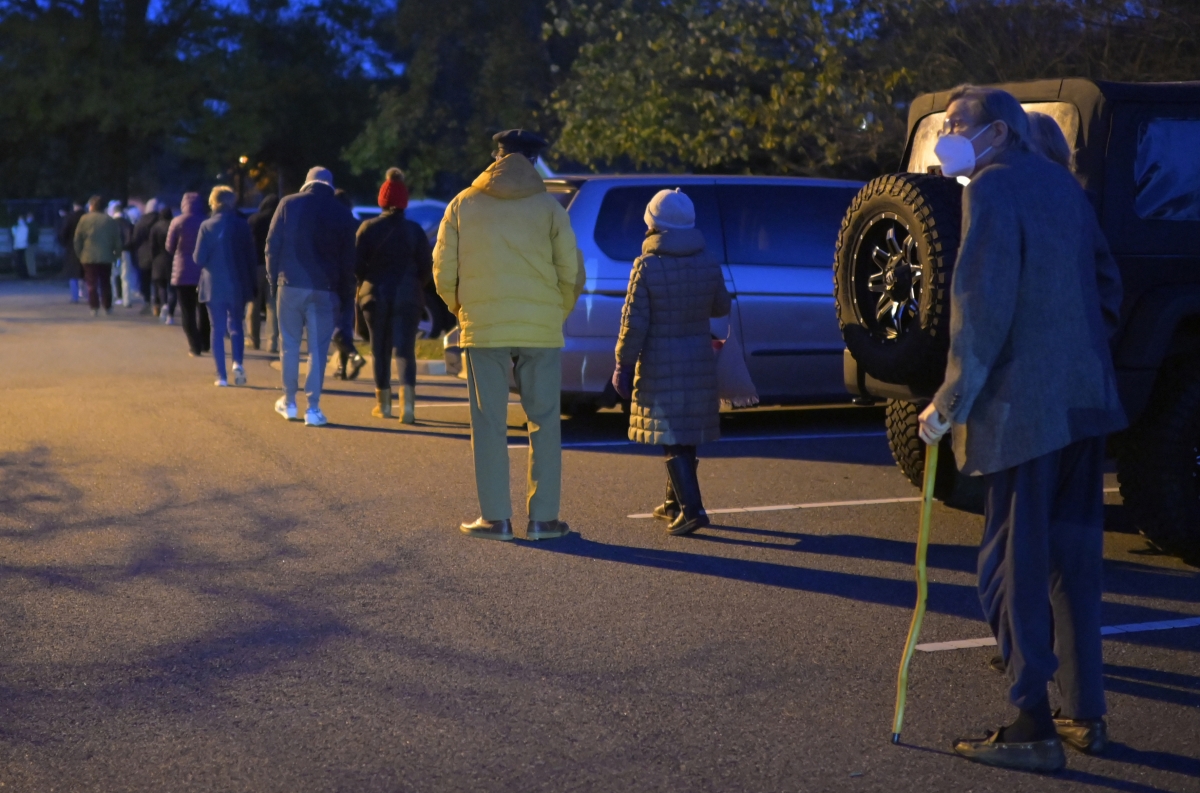
 Jennifer Bretsch waits to wipe down surfaces at the Charles Houston Recreation Center in Alexandria, Va., on Election Day, Tuesday, Nov. 3, 2020. MUST CREDIT: Washington Post photo by Matt McClain
  A mask of President Donald Trump is seen as people gather near the White House on Election Day. MUST CREDIT: Washington Post photo by Matt McClain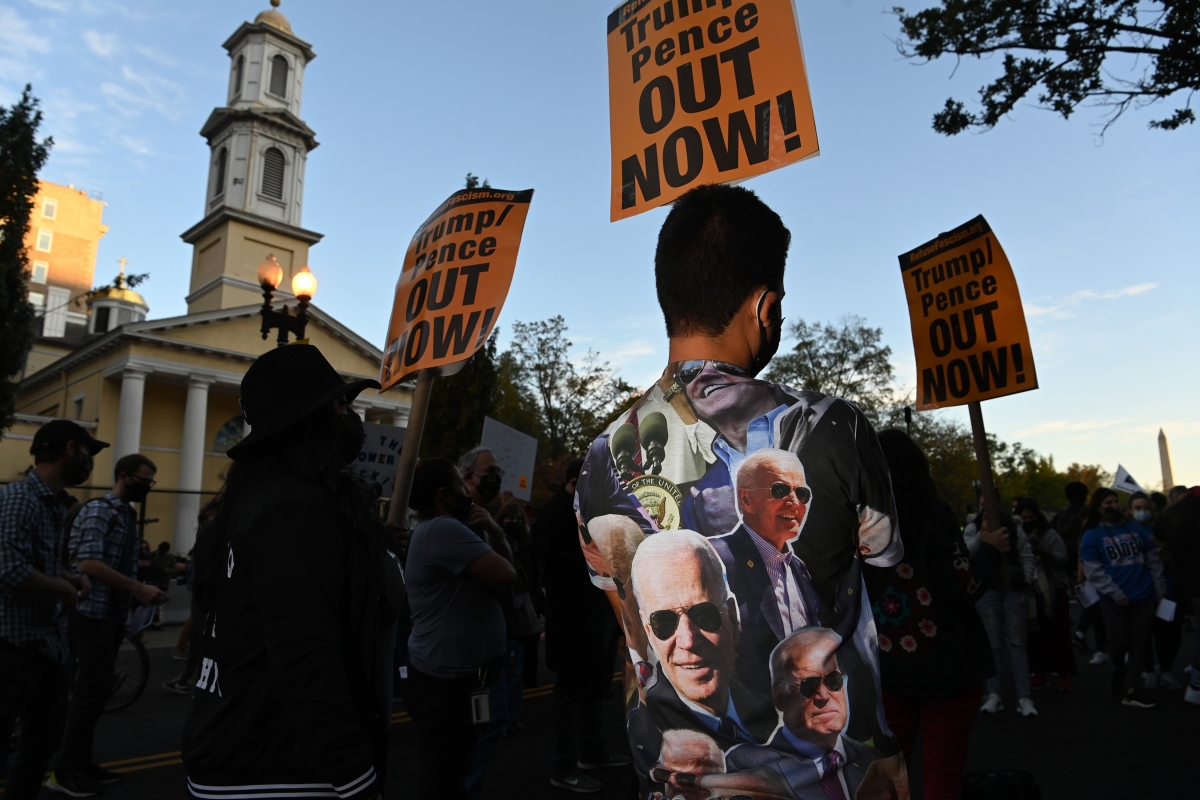
 SootinClaimon.Com