
Failure to renew UN-brokered truce spreads panic across war-ravaged Yemen

#SootinClaimon.Com : ขอบคุณแหล่งข้อมูล : หนังสือพิมพ์ The Nation.

https://www.nationthailand.com/world/middle-east-africa/40020711

Failure to renew UN-brokered truce spreads panic across war-ravaged Yemen

Failure to renew UN-brokered truce spreads panic across war-ravaged Yemen

TUESDAY, OCTOBER 04, 2022

Xinhua

As a six-month humanitarian truce brokered by the United Nations expired without extension, the fear for a return of violence to Yemen is spreading among the people in the war-torn country.

Many said that their hopes and aspirations for ending their woes inflicted by the more than seven years of deadly fighting were dashed as peace efforts were hampered by Yemen’s warring factions and chaos gearing up for return.
 

“The Yemeni people were deeply disappointed with the decision of the Houthis who rejected the UN proposal for extending the truce which succeeded in ceasing the brutal conflict during the past period,” an official of Aden’s local authority told Xinhua on condition of anonymity.

“Millions of people fear a descent into a new cycle of deadly civil war as the Houthis began with their military preparations for launching attacks in and outside the country,” said the official.

He said that the Yemeni government made concessions and informed the United Nations about its agreement to extend the truce, but the Houthi militia’s constant intransigence aborted peace efforts exerted by international and regional powers.

On Sunday, UN Special Envoy for Yemen Hans Grundberg announced that no agreement has been reached to renew the expired truce between the Yemeni warring parties.

“The UN Special Envoy regrets that an agreement has not been reached today, as an extended and expanded truce would provide additional critical benefits to the population,” his office said in a statement.

Although the UN proposal for extending the truce has reflected the main terms that the Houthis have been demanding since the truce began on April 2, the Houthis have yet to make a statement on why they rejected the extension.
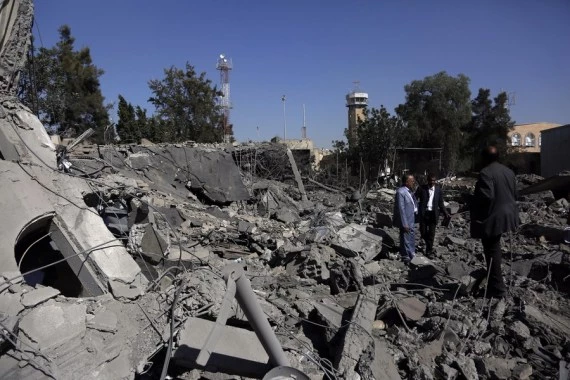
People stand on the debris of a destroyed building inside the Sanaa International Airport in Yemen on Dec. 21, 2021. The Saudi-led coalition involved in a war in Yemen on Monday launched airstrikes on the Sanaa International Airport held by the Yemeni Houthi rebels, the Saudi Press Agency (SPA) reported. (Photo by Mohammed Mohammed/Xinhua)

The Houthis on Saturday claimed that the government side did not remain committed to the previous six months of the truce, and warned foreign oil companies in the provinces controlled by the government to immediately cease operating or face missile attacks.

An official of Yemen’s Ministry of Oil and Minerals based in Aden confirmed to Xinhua that “the Houthi terror threats of attacking foreign oil companies operating in Yemen created a nationwide panic and badly affected the country’s deteriorating economy, particularly through pushing the national currency into further collapse just a day after failing to renew the truce.”

“The Houthi threats mainly aimed at creating an abrupt cessation of the government’s economic activities and loss of jobs, plunging the country’s people into mass famine,” said the official who asked to remain anonymous.

“Foreign teams working in limited oil sectors in the government-controlled provinces suspended their activities and started thinking about leaving Yemen over the fear that the Houthis would bomb their workplaces and oil facilities with missiles and explosive-laden drones,” he added.

Yemeni citizens living in the government-controlled provinces also expressed their anxiety as the Houthi group vowed to bomb the areas controlled by the pro-government forces with missiles and booby-trapped drones.

Earlier in the day, shelling attacks carried out by the Houthi militia targeted residential areas in the country’s southern regions just hours after the truce expiry, sparking sporadic fighting with the troops backed by the Saudi Arabia-led coalition.

The UN envoy on Sunday indicated that negotiations will continue to renew the UN-brokered truce, and reaffirmed his calls on the parties to maintain calm and refrain from provocations or any actions that could lead to an escalation of violence. “I urge them to fulfill their obligation to the Yemeni people to pursue every avenue for peace,” he said in a statement.

Breakthroughs in the past six months of the truce include the resumption of commercial flights to and from the Sanaa airport and the entry of fuel ships into the port of Hodeidah. However, the siege on Taiz city has not been lifted yet.

On April 2, the Yemeni government and the Houthis agreed upon a two-month truce brokered by the United Nations. The truce was later renewed twice through Oct. 2.

Yemen has been mired in a civil war since late 2014 when the Iran-backed Houthi militia seized control of several northern cities and forced the Saudi-backed Yemeni government out of the capital Sanaa.

Xinhua

Philippine president opens part of Metro Manila subway, promises ‘more ambitious endeavours’

#SootinClaimon.Com : ขอบคุณแหล่งข้อมูล : หนังสือพิมพ์ The Nation.

https://www.nationthailand.com/blogs/world/asean/40020708

Philippine president opens part of Metro Manila subway, promises ‘more ambitious endeavours’

Philippine president opens part of Metro Manila subway, promises ‘more ambitious endeavours’

TUESDAY, OCTOBER 04, 2022

Philippine President Ferdinand Marcos Jr on Monday inaugurated a portion of the Metro Manila Subway Project in Pasig City, vowing to pursue more infrastructure projects that will benefit Filipinos.

“Let the [groundbreaking] of this subway system signal our intention to the world to pursue even grander dreams and more ambitious endeavours that will bring comfort and progress to our people all over the country,” the president said in his speech at the event held at the Metrowalk Commercial Complex in Pasig City.

“Be assured that this administration will take the lead in identifying, pursuing and implementing projects as part of the ‘Build Better More Infrastructure Agenda’ that we have laid out,” he added.

The ceremony was for the subway’s 17.7-billion pesos (11.3 billion baht) Contract Package 104, which covers the construction of the Ortigas and Shaw stations that was given last April to the consortium of Megawide Construction Corp, Tokyu Construction Co Ltd, and Tobishima Corp.

The Department of Transportation is set to award two more contract packages for the project before the year ends.

Transportation undersecretary for railways Cesar Chavez said on the sidelines of the groundbreaking ceremony that the signing of Contract Packages (CP) 102 and 103 was expected to be held by the end of this month or the first week of November.

CP 102, which was won by Nishimatsu-DMCI Joint Venture, includes the construction of the Quezon Avenue and East Avenue stations. CP 103, which is set to be awarded to Sumitomo Mitsui Construction Corp, covers the works for the Anonas and Katipunan stations.

Half a million passengers a day

In his speech, the president said he looked forward to “brighter days” when the Filipino public would be enjoying the project’s benefits.

“Although it is a given that the construction of these structures will take time and cause disruption, let us be optimistic and just count these small inconveniences as a small price to pay for the fruitful results that this programme, this project will yield,” Marcos said, referring to the six-year closure of portions of Meralco Avenue.

The president said that once completed, people would be spared the perils of commuting, while the new infrastructure itself is expected to bring more business opportunities.

“As our people gain more time by cutting long hours of travel, they can now engage in more worthwhile and productive endeavours, making time for greater self-improvement or, equally important, spending quality time with their families,” he said.

The 17-station, 33-kilometre project, which will benefit some 519,000 passengers a day once completed by 2028, is the first underground railway in the Philippines that will connect Valenzuela City to Pasay City.

It will reduce travel time between Quezon City and Manila airport from an hour and a half to 35 minutes.

The project is being constructed under the Official Development Assistance programme of Japan International Cooperation Agency, which will finance 76 per cent of the project via a 370.8-billion pesos loan package. The remaining 24 per cent, amounting to 117.7 billion pesos, will be paid for by the Philippine government.

The idea of building a Metro Manila subway was first proposed in 1973 during the administration of Marcos’s late father and namesake, Ferdinand Marcos Sr.

In August 2016, the Duterte administration revived the plan for a Metro Manila subway as part of a long-term public transportation network to fight the worsening road congestion.

Partial subway operations are expected to start in 2025.

“We are running at full speed on this project. We owe it to the commuting public,” Bautista said during the event.

Philippine Daily Inquirer

Asia New Network

Countdown to the Historic Business and Trade Summit: Apec CEO Summit 2022

#SootinClaimon.Com : ขอบคุณแหล่งข้อมูล : หนังสือพิมพ์ The Nation.

https://www.nationthailand.com/world/asia-pacific/40020676

Countdown to the Historic Business and Trade Summit: Apec CEO Summit 2022

Countdown to the Historic Business and Trade Summit: Apec CEO Summit 2022

MONDAY, OCTOBER 03, 2022

What is in it for Thailand?  Who will benefit from this historic Summit? What are the opportunities we should be looking out for?

The upcoming Apec CEO Summit in Bangkok this November brings together the world’s top business leaders and will be a strong opportunity to stimulate the Thai economy towards recovery. The historic summit is among the most prominent platforms in the world for the business sector to discuss trade and investment ways forward. But what will people on the street gain from this remarkable event? Will there be any tangible results? How will the meeting of the top CEOs and business leaders bring change to our everyday life?

Asia-Pacific Economic Cooperation (Apec) was founded in 1989 as a platform for economic collaboration for 21 economies on the Pacific coast.  The forum was created as a ground for discussion among government officials.  For the policies and ideas to materialise private sector representatives were brought in.  In 1995 Apec Business Advisory Council or Abac was founded.  Each member economy has 3 Abac members who represent their economy discussing various issues which help to advance and uplift the economy in the Apec region.  A year after Apec CEO Summit was founded under the umbrella of Abac giving a unique opportunity for leading business communities in the region to discuss further economic development with economic leaders, academia and business leaders.  

The summit is a landmark opportunity for business leaders and policymakers to discuss issues of public interest. It is also a symbolic show of regional cooperation on the world stage.

Poj Aramwattananont, Chairman of the Apec CEO Summit 2022 and Abac Thailand Member, said the theme for this year’s event is: “Embrace, Engage, Enable.”

“All the leaders and speakers who were invited to share their vision at the summit are prominent figures who play a key role in charting the direction of the global economy. The summit is thus a perfect chance for Thai people to catch up on global trends and changes. We are confident that the summit will be a key platform for trade and investment for Thailand as the host. It will be a prime opportunity for the Thai private sector to display our potential to a global audience, whether in terms of investment, food security, tourism or finance,” Poj said.

What will people gain from the summit? What’s in it for Thailand?
The importance of the Apec CEO Summit cannot be overstated. It is one of the most prestigious stages where world leaders, thought leaders, policymakers and CEOs from some of the world’s largest and most innovative companies will gather to share their vision about economic development and the social issues faced by some of the largest and fastest growing economies in the world.

What may have been left unspoken is that the goal of the gathering is to ensure the well-being of local communities. The ultimate goal of the summit is centred around “people” who are a key part of driving economic growth. In the end, the summit delegates are representatives of the people who are stakeholders of each member economy and the driving force of the theme “Embrace, Engage and Enable.”

People’s Wellbeing 

Apec comprises 21 member economies, including superpowers such as the United States, China, Japan, Canada, South Korea and Russia. Home to over 2.9 billion people or about one-third of the world’s population, APEC economies have a combined gross domestic product of more than US$ 53 trillion (about 1700 trillion baht) — more than half of the world’s GDP. The group represents nearly half of the world trade. 

If the summit results in the region becoming more integrated — with trade barriers reduced and rules and laws more streamlined — there will be a trade boom which in turn will lead to a state of prosperity. When Apec’s overall trade grows, it creates development from upstream to downstream. Across the entire chain there is an improvement in people’s wellbeing, whether in terms of increased revenue, employment or regional expansion.

Ease of Doing Business
When cooperation at the policy level is extended to the private sector, the result is an ease of doing business internationally. This means an improvement in every business process and innovation, whether it involves starting a business, getting credit or dealing with permits.

For example, Apec’s regulatory reforms in dealing with construction permits have helped make it easier, cheaper and faster to build a new plant or office building. Indeed, Apec ranks among the top in the world for the shortest permit time. 

The ease of launching a new business in Asia-Pacific opens the door to investment and trade opportunities. The benefits in the form of life opportunities, profit, time and other resources belong to people from all backgrounds who are engaged in business. 

Clean World, Good Health
Since the private sector’s main mission is doing business, it plays an important part in maintaining the health of the entire world, whether it be the quality of the soil, water or the very air we breathe. The summit will help set the direction of the business as it aims to upgrade its sustainability scores covering multiple dimensions, whether it be food security, food safety or sustainable agricultural development which has been a long-standing problem in the Asia-Pacific region.
 
The central question is how to move forward with an assurance that people will not go hungry and can enjoy a state of well-being. The challenge involves how to improve the capacity of food production — both in terms of quantity and quality — without compromising the environment while ensuring that the negative impact on the food chain will be minimal. And how will the private sector develop clean technology that is friendly to the environment across the region and allow the people to enjoy peaceful coexistence and good health.

Green Energy for Less Carbon Intensity
Apec economies are determined to reduce energy intensity in the region by 45 per cent by 2030. In 2014, the bloc agreed to double the share of renewables in the energy mix by 2030.

Renewable energy is derived from naturally replenished sources such as sunlight, wind, water, geothermal heat, biomass or farm residue. With the goals in place, stakeholders in the private energy sector have been eager to invest in clean energy technologies. Investment has expedited the development of innovative technologies such as green hydrogen or advanced batteries with zero carbon emissions and long-term energy storage.  the production which can store more energy while leaving no carbon. 

We, the people, will all benefit as consumers of clean energy for a better future for our children. 

Health and Longevity
One of the agendas for this year’s summit is: “Rethinking Healthcare after the Pandemic.” Businesses have seen that the Covid-19 pandemic has put healthcare on the global agenda. As Covid-19 struck, a host of health-related new businesses emerged. These include telehealth, stand-alone hospitals and healthcare facilities, lab services and new innovations in drugs and vaccines. 

In 2021, the 15 biggest pharmaceutical companies in the world poured the US $33 billion into research and development, an increase of 45% from 2016. The shift underlines the change towards a greater focus on healthcare which will help people live longer while preparing us to cope better should there be another outbreak in the future. 

The summit, to take place from November 16-18, focuses on topics of interest and challenging issues that the world is facing and struggling to find mutually agreeable solutions. The summit outcome will certainly become an agenda for the private sector to start acting on, follow up on and address issues to help benefit the public. 

Since the summit’s goal is to ensure inclusive and sustainable growth in trade and business, it is essentially everyone’s business to help make it come true. It requires cooperation between the private sector and the public to help drive the economy so that all of us can enjoy benefits of growth together. 

APEC Business Advisory Council ( ABAC )

Nearly 30 killed in two years, looking for expensive rare herb in Myanmar’s mountainous north

#SootinClaimon.Com : ขอบคุณแหล่งข้อมูล : หนังสือพิมพ์ The Nation.

https://www.nationthailand.com/blogs/world/asean/40020668

Nearly 30 killed in two years, looking for expensive rare herb in Myanmar’s mountainous north

Nearly 30 killed in two years, looking for expensive rare herb in Myanmar’s mountainous north

MONDAY, OCTOBER 03, 2022

Some 30 people have died after jumping off the glacial mountains in Myanmar’s northernmost region of Putao over the last two years while looking for medicinal herbs, according to local herb finders and aid organisations.

Local sources attribute the series of deadly accidents to the price of a medicinal herb, locally called Baychi, increasing from 200,000 kyats (3,600 baht) in 2021 to about 1 million kyats (18,000 baht) this year.

A local herb seeker, U Ran Htee, said: “In the past years, the price was just 40,000 kyats per viss [about 1.6 kg]. It was 200,000 kyats last year. About 20 people died in the previous year. They had to find the herb in various dangerous areas, such as valleys, mountain tops and steep cliffs. This kind of herb is very rare to find. We have heard seven have died this year. Even professional mountaineers cannot survive if they jump off. There have also been many cases of broken bones. A person can get a maximum of 2 visses.”

Baychi herb is usually grown at an altitude of over 8,000 feet. It has good demand and fetches a good price in China. The price is now about 700,000 to 1 million kyats.

According to local sources, nearly 30 people have died over the past two years including pregnant women. Most climbers do not usually wear protective equipment.

Putao district has six townships with a population of 91,257, according to the 2014 national census.

Eleven Media

Asia News Network

South Korean president’s approval ratings drop after hot mic incident, poll shows

#SootinClaimon.Com : ขอบคุณแหล่งข้อมูล : หนังสือพิมพ์ The Nation.

https://www.nationthailand.com/world/asia-pacific/40020667

South Korean president’s approval ratings drop after hot mic incident, poll shows

South Korean president’s approval ratings drop after hot mic incident, poll shows

MONDAY, OCTOBER 03, 2022

President Yoon Suk-yeol’s approval ratings fell for the first time in four weeks after his remarks, caught on a hot mic in New York, caused an uproar in South Korea, a survey showed on Monday.

In the poll of 2,522 voters conducted by Realmeter from Monday to Friday last week, 31.2 per cent assessed Yoon’s job performance positively, down 3.4 percentage points from the previous week, according to Yonhap news agency.

Yoon’s disapproval rating was 66 per cent, up 3.8 percentage points.

The drop could be attributable to the hot mic controversy and Yoon’s accusation of media manipulation after he came under fire for using vulgar words in private remarks to aides caught on a hot mic during his trip to New York last month, according to Bae Cheol-ho, a senior analyst at Realmeter.

Though the recording of Yoon’s remarks was not clear due to noise, many thought that he had used foul language while talking about US Congress and US President Joe Biden. 
Yoon’s office rejected the claim, saying he was referring to South Korea’s opposition-controlled National Assembly and did not mention US Congress or Biden.

The poll has a margin of error of plus or minus 2 percentage points at a 95 per cent confidence level, Yonhap reported.

The Korea Herald

Asia News Network

Apec is on Track to Meet Aspirational Energy Goals

#SootinClaimon.Com : ขอบคุณแหล่งข้อมูล : หนังสือพิมพ์ The Nation.

https://www.nationthailand.com/world/asia-pacific/40020664

Apec is on Track to Meet Aspirational Energy Goals

Apec is on Track to Meet Aspirational Energy Goals

MONDAY, OCTOBER 03, 2022

Apec is on track to meet its aspirational goals to reduce energy intensity by 45 per cent by 2035, relative to 2005 levels, and to double the share of modern renewables by 2030, relative to 2010 levels, according to a newly launched energy report.

According to the Apec Energy Demand and Supply Outlook, energy intensity in Apec has been improving at an average annual rate of 1.9 per cent since 2005 or cumulatively at 22 per cent from 2005 to 2018. In the current scenario, where existing trends in technology development and deployment and current government programs and policies continue, Apec will reach its goal to reduce energy intensity one year earlier than expected, in 2034.

Energy intensity refers to the energy needs of an economy. Reducing energy intensity means using less energy to produce a product or a service.

Apec’s share of modern renewables increased from 6.1 per cent in 2010 to 8.7 per cent in 2018. The region is expected to meet the goal of doubling renewables four years ahead of schedule, in 2026. This suggests that Apec economies are well on their way to significantly accelerating the deployment of renewables. 

“The progress that we are seeing now has been achieved mainly through structural reform efforts in improving energy efficiency in the industry, transport and building sectors,” explained Kazutomo Irie, the President of the Asia-Pacific Energy Research Centre (APERC), which produced the report. 

“Apec economies have also increased their direct consumption of renewables in end-use sectors and increased in the share of electricity generated by wind and solar technologies,” he added.

Based in Tokyo, the centre was established in 1996 following the directive of Apec Leaders to foster a common understanding of, and solutions to, the energy challenges facing Apec member economies.

Since then, the centre has been conducting studies and analyses of each Apec member economy’s energy demand and supply trends, future energy demand and supply outlook, the development of their energy markets and responses to policy challenges. 

The report highlights the significant decoupling trend between energy demand and economic activity, that even with much higher economic output, end-use energy demand would only grow by a modest amount—around 14 per cent from 2018 to 2050. Decoupling refers to efforts made to ensure economic growth is achieved with less energy dependency.

“This increase in energy demand will support a more than doubling in economic activity. It shows that the decoupling story is influential in all Apec economies,” Irie explained. “Decoupling is driven by continued improvements to energy efficiency, at the same time, there is a shift away from more carbon-intensive fossil fuels such as coal and oil, supported by a growth in electrification.”

In her remarks at the report launch in Tokyo, Apec Secretariat Executive Director, Dr Rebecca Sta Maria, emphasized that while climate change is a global threat, its effects are especially felt in the Asia-Pacific region, “where thousands of vulnerable communities are exposed to extreme weather events.” 

“It is interesting to note at this point that, since the last Outlook was published in 2019, before Covid, the Apec region’s energy demand, supply, production, electricity generation, and CO2 emissions have all grown,” Dr Sta Maria added. “But it is also encouraging to see that Apec is pushing through its ambitious goal to reduce energy and increase the use of renewables through structural reforms and energy efficiency programs.”

Apec accounts for 56 per cent of world energy demand, 58 per cent of world energy supply and 68 per cent of world electricity generation. Apec accounts for 60 per cent of global CO2 emissions. 

Dr Sta Maria reiterated that more work needs to be done to accelerate progress and that the massive post-pandemic stimulus resources deployed by governments to accelerate recovery could be used, in part, to further integrate environmental sustainability. “Supporting a green, sustainable recovery is particularly important for Apec economies,” she concluded.

Apec Secretariat

Volcanic ash from Japan to bring clean drinking water to Indian children

#SootinClaimon.Com : ขอบคุณแหล่งข้อมูล : หนังสือพิมพ์ The Nation.

https://www.nationthailand.com/pr-news/world/asia-pacific/40020660

Volcanic ash from Japan to bring clean drinking water to Indian children

Volcanic ash from Japan to bring clean drinking water to Indian children

MONDAY, OCTOBER 03, 2022

Southern Kyushu is covered in a soil called “shirasu”, which is composed of fragile volcanic ash that often gives way to landslides. Taking advantage of the characteristics of shirasu — specifically, its high water permeability — Halvo Holdings Co has developed a coagulant to improve water quality that it will use to help ensure a clean water supply in India.

The coagulant, which allows for water to be purified without large equipment, is easy to employ: one simply adds it to a tank and stirs the solution. The company has partnered with Save the Children Japan, an organisation that supports children around the world, to provide drinking water to an elementary school in Delhi using this coagulant.

According to the company, groundwater in Delhi is contaminated mainly by industrial wastewater. Corporate representatives already visited Delhi in July to conduct a water quality survey. Thanks to the coagulant, the company will be able to provide about 220,000 litres of water per year, or enough for about 3,000 people, starting from early next year.

The coagulant is created by imparting an electric charge to shirasu, which has countless microscopic holes. It is already used to treat factory wastewater and purify rivers, as well as for international cooperation, such as the purification of water from the Mekong River in Vietnam.

The Japan Times

Asia News Network

Brazil election goes to runoff as Bolsonaro does better than expected

#SootinClaimon.Com : ขอบคุณแหล่งข้อมูล : หนังสือพิมพ์ The Nation.

https://www.nationthailand.com/world/americas/40020646

Brazil election goes to runoff as Bolsonaro does better than expected

Brazil election goes to runoff as Bolsonaro does better than expected

MONDAY, OCTOBER 03, 2022

Brazil’s presidential election is headed for a run-off vote, electoral authorities said on Sunday, after President Jair Bolsonaro’s surprising strength in the first-round spoiled rival Luiz Inacio Lula da Silva’s hopes of an outright win.

With 95 per cent of electronic votes counted, Lula was ahead with 47.6 per cent of votes versus 43.9 per cent for Bolsonaro, the national electoral authority reported. As neither got a majority, the race will go to a second-round vote on October 30.

Several opinion surveys had shown Lula leading Bolsonaro by 10-15 percentage points ahead of Sunday’s vote. The much tighter result dashed expectations of a quick resolution to a deeply polarised election in the world’s fourth-largest democracy.

Although he ended his 2003-2010 government with record popularity, Lula is now loathed by many Brazilians after he was convicted of accepting bribes and jailed during the last election. His conviction was later overturned by the Supreme Court, allowing him to face his rival Bolsonaro this year, along with nine other candidates from an array of smaller parties.

A career lawmaker turned self-styled outsider, Bolsonaro rode a backlash against Lula’s Workers Party to victory in 2018, uniting strands of Brazil’s right, from evangelical Christians to farming interests and pro-gun advocates.

He has dismantled environmental and indigenous protections to the delight of commercial farmers and wildcat miners while pushing an anti-gay and anti-abortion agenda.

Brazil’s leftist presidential candidate Luiz Inacio Lula da Silva said on Sunday he’s ready for a run-off vote, after securing 48.4 per cent of ballots in the first round election.

Brazil election goes to runoff as Bolsonaro does better than expected

Lula da Silva said he has never clinched victory in the first round.

Incumbent Bolsonaro warned voters that “a change could be worse” in Brazil.

He had questioned polls that showed him losing to Lula in the first round, saying they did not capture the enthusiasm he saw on the campaign trail.

He has also attacked the integrity of Brazil’s electronic voting system without evidence and suggested he might not concede if he lost.

Political observers had said a wide margin of victory for Lula could sap Bolsonaro of support to challenge the electoral results. But Sunday’s vote, extending a tense and violent election by another four weeks, revitalised his campaign.

His popularity has suffered since the coronavirus pandemic, which he dismissed as a “little flu”. Corruption scandals also forced ministers out of his government and focused a harsh spotlight on his lawmaker sons.

Reuters

Putin is losing and Nato will ‘crush him’ if he goes ahead with nuclear threat, says US general

#SootinClaimon.Com : ขอบคุณแหล่งข้อมูล : หนังสือพิมพ์ The Nation.

https://www.nationthailand.com/blogs/world/us-canada/40020645

Putin is losing and Nato will 'crush him' if he goes ahead with nuclear threat, says US general

Putin is losing and Nato will ‘crush him’ if he goes ahead with nuclear threat, says US general

MONDAY, OCTOBER 03, 2022

Retired four-star General David Petraeus told ABC News that the US and its allies would destroy Russia’s troops and equipment in Ukraine – if Russian president Vladimir Putin uses nuclear weapons.

“Just to give you a hypothetical, we would respond by leading a Nato – a collective – effort that would take out every Russian conventional force that we can see and identify on the battlefield in Ukraine and also in Crimea, and every ship in the Black sea,” Petraeus said on ABC’s “This Week with George Stephanopoulos”.

Ukraine on Sunday claimed full control of the eastern logistics hub of Lyman, its most significant battlefield gain from Russia in weeks, providing a potential staging post for further attacks to the east while heaping further pressure on the Kremlin.

The stinging setback for Putin was delivered after he proclaimed the annexation of four regions covering nearly a fifth of Ukraine on Friday, an area that includes Lyman. Kyiv and the West have condemned the proclamation as an illegitimate farce.

Nato secretary-general Jens Stoltenberg said the capture of the town, where Ukrainian flags were raised over civic buildings on Saturday, demonstrated that Ukraine is capable of dislodging Russian forces and showed the impact Ukraine’s deployment of advanced Western weapons was having on the conflict.

Ukrainian President Volodymyr Zelenskyy said on Sunday that the success of the country’s soldiers was not limited to the recapture of Lyman.

Ukraine forces have liberated the small Arkhanhelske and Myrolyubivka settlements in the Kherson region as well, he said.

Putin is losing and Nato will 'crush him' if he goes ahead with nuclear threat, says US general

Ukraine’s Interfax agency reported that according to Serhiy Cherevatyi, spokesman for the Ukrainian Eastern Group of Forces, the country’s forces recaptured Torske, a small village in the Donetsk region, about 15 kilometres east of the now-liberated Lyman.

Reuters was not able to immediately verify the reports.

Reuters

Apec summit in Bangkok a ‘golden chance’ to tackle Russia-Ukraine conflict: Don

#SootinClaimon.Com : ขอบคุณแหล่งข้อมูล : หนังสือพิมพ์ The Nation.

https://www.nationthailand.com/world/asia-pacific/40020643

Apec summit in Bangkok a ‘golden chance’ to tackle Russia-Ukraine conflict: Don

Apec summit in Bangkok a ‘golden chance’ to tackle Russia-Ukraine conflict: Don

MONDAY, OCTOBER 03, 2022

THE NATION

The Apec Economic Leaders’ Meeting in Bangkok next month is a golden opportunity for world leaders to tackle problems stemming from the Russia-Ukraine conflict, said Foreign Minister and Deputy PM Don Pradmudwinai.

Speaking to Krungthep Turakij newspaper, Don said that as the Covid-19 pandemic subsides, the world is facing fresh challenges from the Russia-Ukraine conflict, most notably food shortages and an energy crisis.

November’s three international meetings in Southeast Asia are a crucial opportunity for countries to address these problems, he added.

World leaders will gather at the Asean Summit in Phnom Penh, the G20 Summit in Bali and the Apec Economic Leaders’ Meeting in Bangkok.

Apec member Russia has been hit with severe economic sanctions by other members of the trade bloc, including the US, over its invasion of Ukraine. May’s Apec summit in Thailand ended without a customary joint statement after five members staged a walkout in protest against Russia’s invasion.

Don said he had spoken at last month’s United Nations General Assembly (UNGA77) in New York to urge key stakeholders of the Russia-Ukraine crisis to use November’s summits for talks to exit the crisis, possibly mediated by the UN.

He added that Thailand was among the first countries to propose a plan for peace in Ukraine at the United Nations.

“We believe the conflict can be solved through multilateral cooperation, and hope that world leaders and stakeholders will not miss this golden opportunity to tackle the Russia-Ukraine conflict,” he said.

“The meeting will not only cover economic issues but also address other problems at global and regional levels, such as food stability, the energy crisis, climate change, and disparity in Covid-19 recovery.”

He added that the Apec Economic Leaders’ Meeting in Bangkok would also be Thailand’s chance to show the world that it is ready to welcome international visitors again after fully opening.

Thailand is hosting Apec this year under the theme “Open. Connect. Balance” as the world recovers from Covid-19.

THE NATION