Residents of Bangkok, Pathum Thani, Nonthaburi, Ayutthaya, Saraburi and Lopburi have been warned of possible flash floods due to overflows from the Pa Sak and Chao Phraya rivers from Saturday as a full Pa Sak Jolasid Dam is about to release an increasing amount of water, the Disaster Prevention and Mitigation Department (DDPM) announced on Wednesday.
The upstream areas of Pa Sak river have experienced heavy rains since Sunday, resulting in a continuous rise of water levels, the DDPM reported.
The Royal Irrigation Department (RID) estimates Pa Sak Jolasid Dam will receive a hefty 133 million cubic metres of water between August 24 and 30, with the amount of water in the dam reaching a massive 355 million cubic metres, well above its optimal level, the DDPM said.
Therefore, the RID is set to increase water drainage from the dam – from 34.56 million cubic metres to 43.2 million cubic metres per day from August 27, which will drastically increase the water levels in both the Pa Sak and Chao Phraya rivers that flow through the six provinces.
The DDPM is therefore advising people who resides near the riverbanks to monitor the water level closely and follow the latest updates.
The department also said it is coordinating with related agencies to check the strength of flood levees and river dams in affected areas, and prepare for evacuation in case of any flash floods.
If you require assistance or would like to report a disaster, contact hotline 1784, Line @1784DDPM, or use the Thai Disaster Alert mobile application.
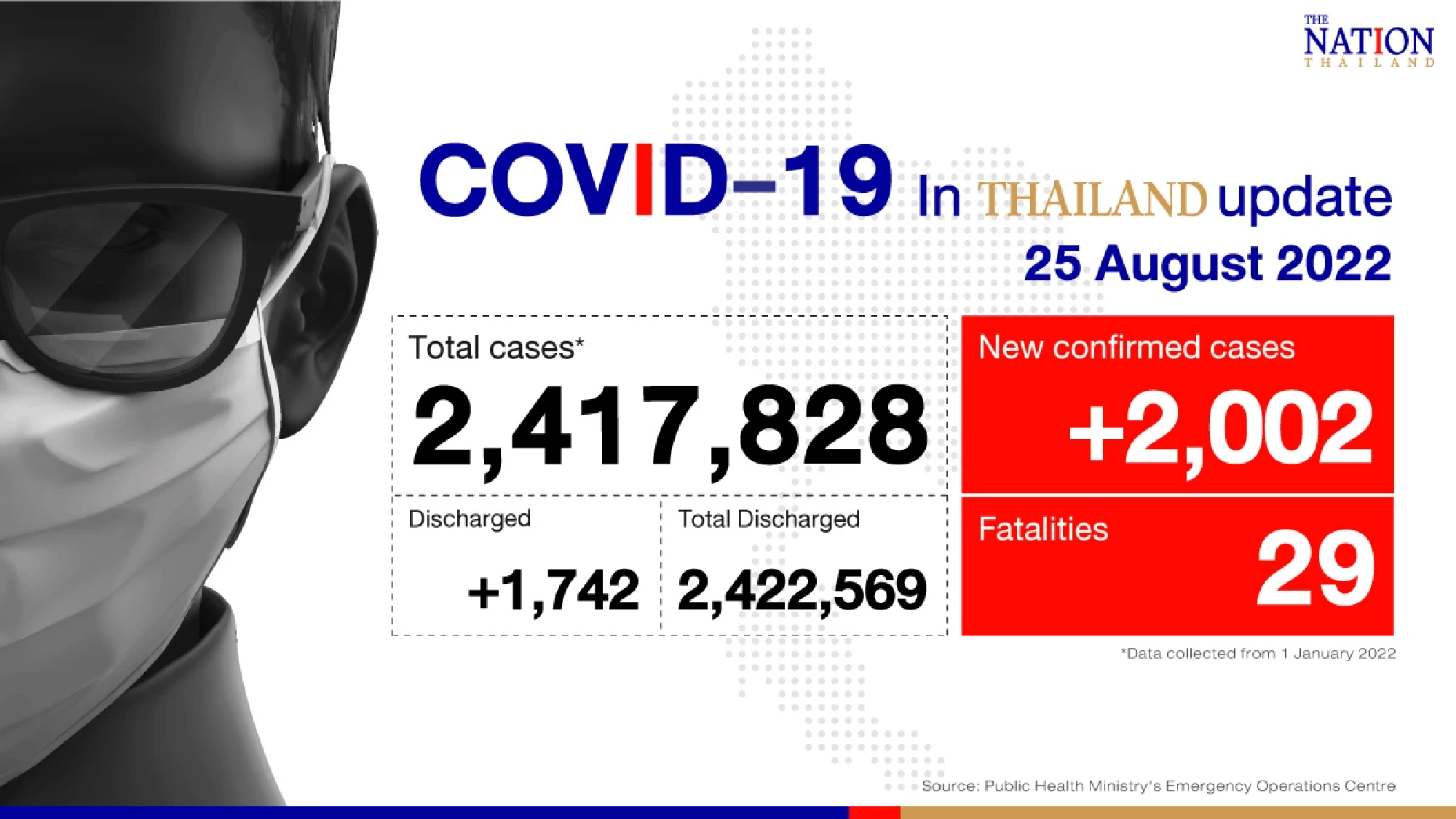
The Public Health Ministry reported on Thursday (August 25) that over the past 24 hours, 2,002 Covid-19 patients have been admitted to hospitals.
The death toll has risen by 29, while 1,742 patients have recovered and discharged from hospitals.
The number of cumulative cases in the country since January 1, 2022, stands at 2,417,828 with 10,440 deaths.
The country’s total caseload from Covid-19 stands at 4,641,263 – 4,591,063 of whom have recovered, 18,062 are still in hospitals and 32,138 have died.
Separately, another 3,756 people were given their first Covid-19 shot in the last 24 hours, 6,171 their second shot and 21,135 a booster, bringing the total number of Covid-19 vaccine doses administered nationwide to 142,546,210.
According to Worldometer, confirmed cases globally had risen to 603.57 million on Wednesday, 578.43 million of whom have recovered, 18.66 million are active cases (43,802 in severe condition) and 6.48 million have died (up by 2,061).
Thailand ranks 29th in the global list of most cases, which is topped by the US with 95.73 million, followed by India with 44.38 million, France with 34.41 million, Brazil with 34.33 million and Germany with 31.97 million.
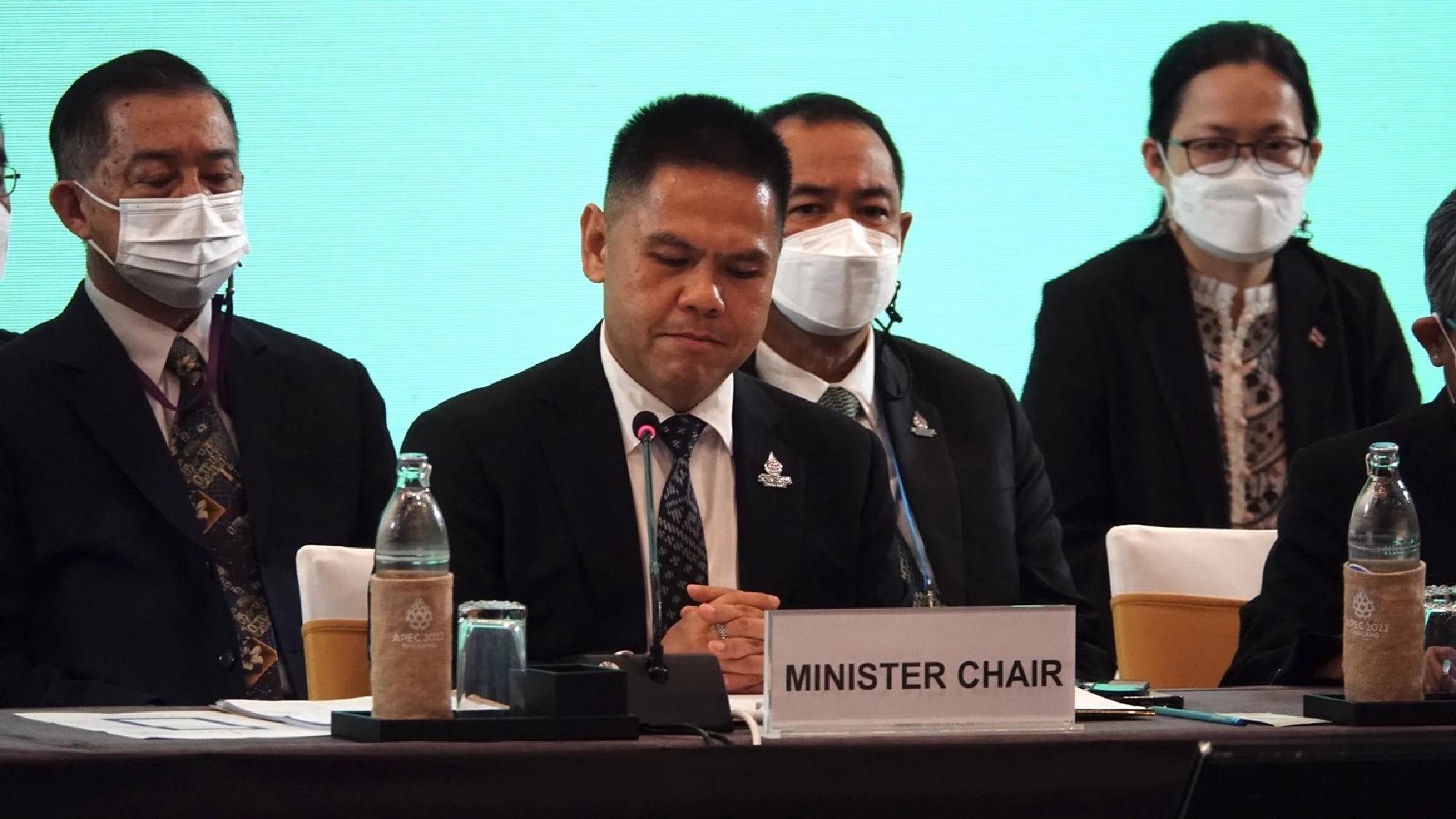
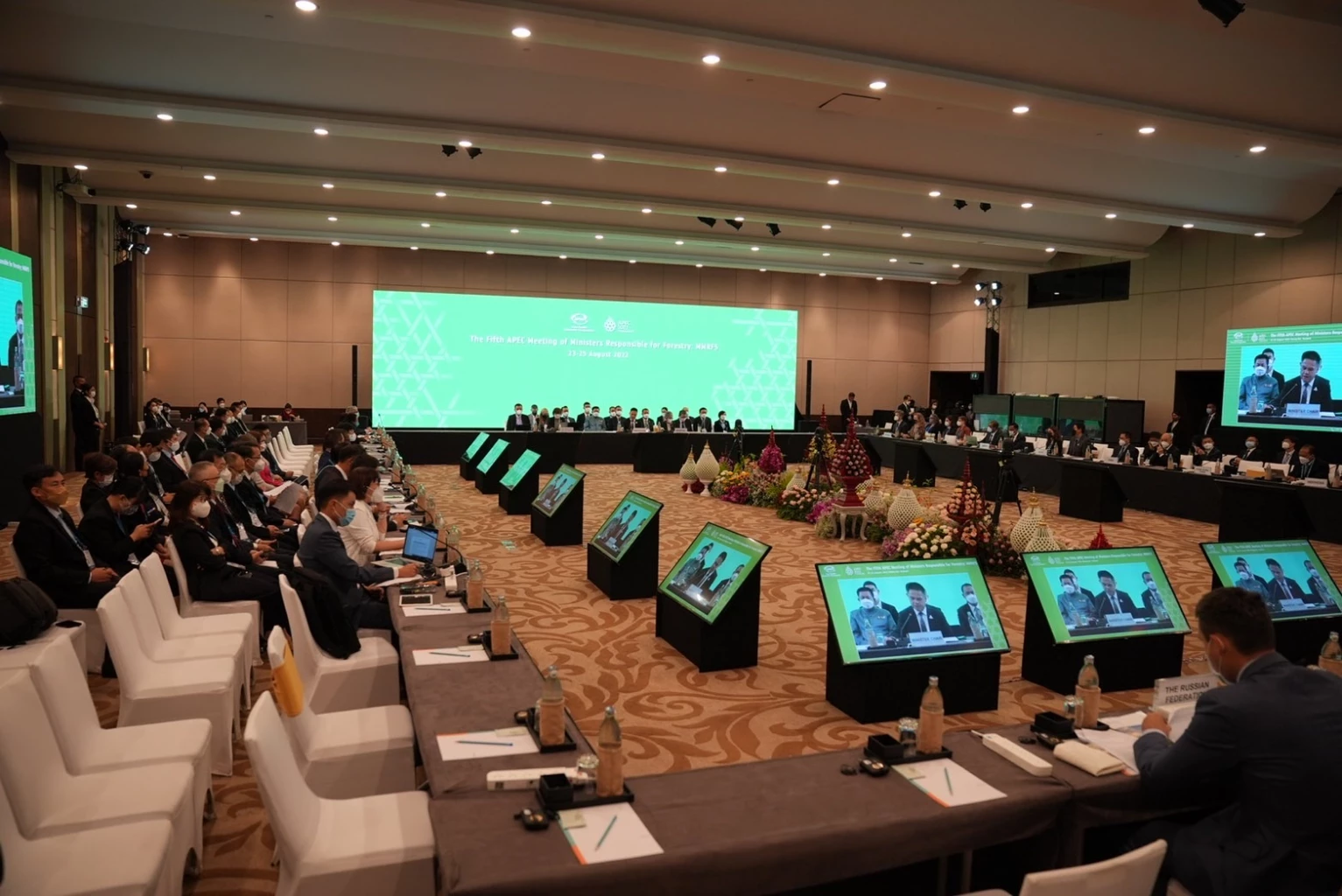
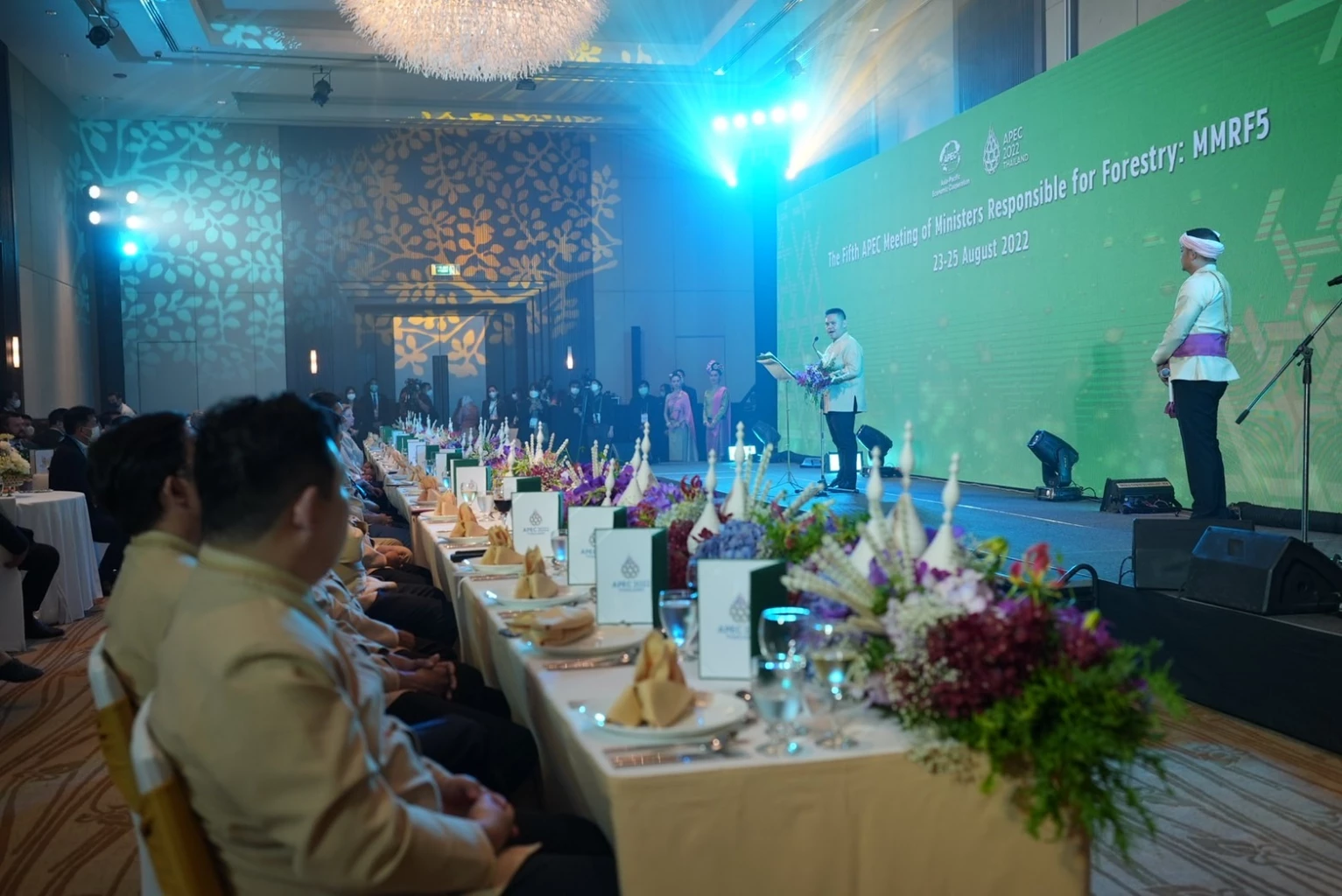
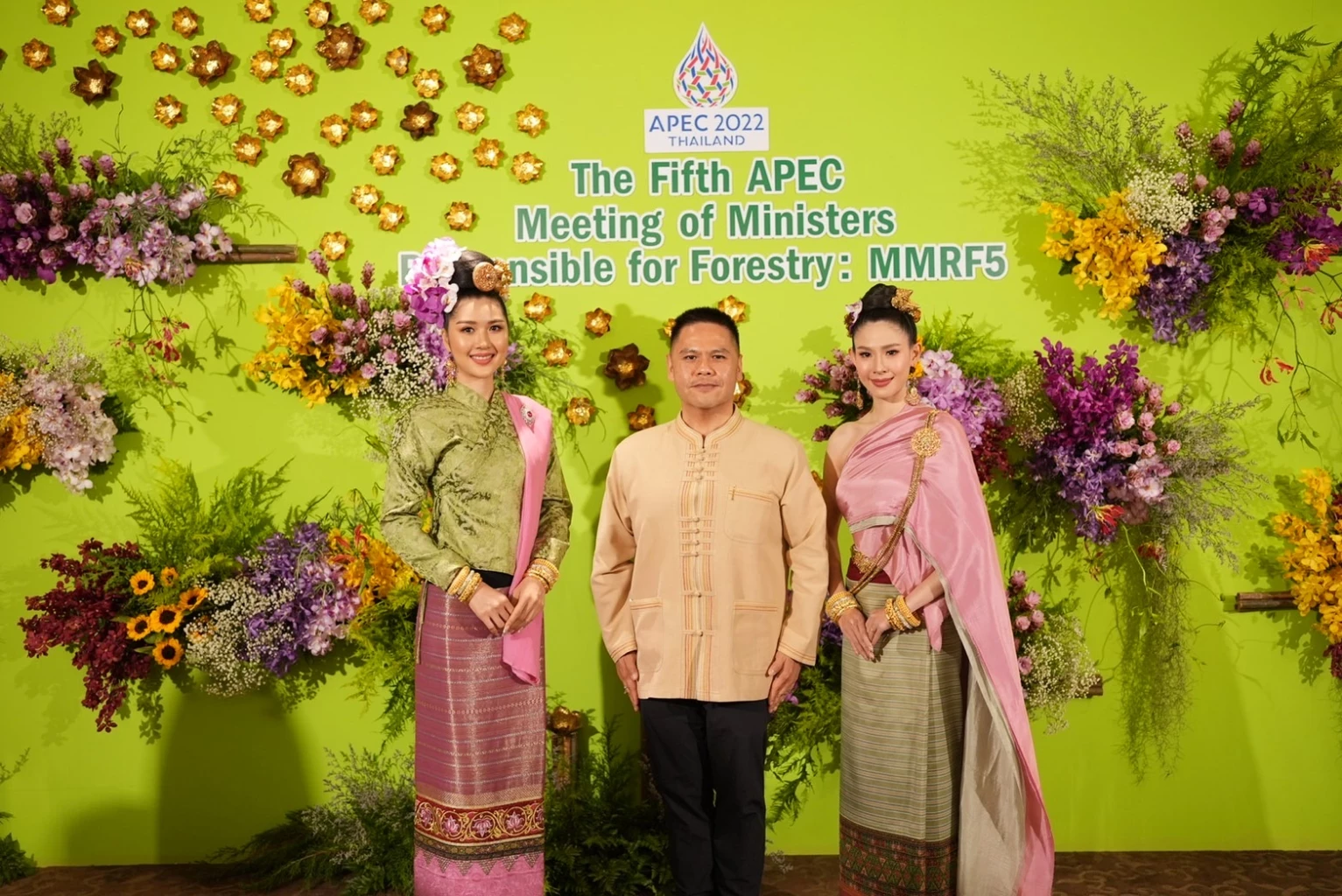
August 24, 2022 – Natural Resources and Environment Minister Varawut Silpa-archa presided over the Fifth APEC Meeting of Ministers Responsible for Forestry (MMRF5), which was held from August 23-25 at Le Meridien Hotel in Chiang Mai province.
It is the first time in 19 years that the APEC Meeting of Ministers Responsible for Forestry is held in Thailand.
The MMRF5 aims to promote cooperation in technical, operational, and financial aspects among members of the Asia-Pacific Economic Cooperation (APEC) to achieve sustainable economic development, reduce greenhouse gas emissions through forest management, and efficiently tackle climate change issues. The MMRF5 was held under the theme of APEC 2022 meeting that is “Open. Connect. Balance.”, with the Bio-Circular-Green (BCG) Economy Model as the overarching thinking.
Varawut said the meeting is highly successful as members of APEC agreed to use forest management as a key to solving several issues faced by APEC’s 21 economic zones, including illegal timber trading, sustainable forest management and achievement of the goal that Thailand has set in the 26th United Nations Climate Change Conference, also known as COP26, in which the country aims to become carbon neutral in 2050 and achieve net zero greenhouse gas emissions in 2065.
The Natural Resources and Environment Minister added that the meeting saw the exchange of opinions, experiences, and policies in anti-illegal timber trading. “Every country realizes that one of the causes of climate change is illegal deforestation,” he said. “As for Thailand, we will counter this problem with the use of BCG Model to expand the forest areas and minimise the impact of climate change. In the future, we will also introduce the carbon credit system as an economic cost.”
“We will use the MMRF5 stage to show our stance, and will adopt new knowledge presented by APEC members to create mutual benefits regarding forest management, community economic development, and climate change prevention,” said Varawut.
Varawut also thanked APEC forest ministers for joining the meeting and sharing ideas that will lead to increased cooperation in forest conservation. “I also thanked all members for promoting sustainable forest management in the region so that we have expanded the forest areas to 174.38 million rai or 27.9 million hectares,” he said.
After the meeting, APEC leaders paid a visit to the Queen Sirikit Botanic Garden in Chiang Mai’s Mae Rim district. The 6,500 rai garden is one of the most complete forest areas in the country that helps demonstrate Thailand’s potential in hosting the MMRF5.
Natural Resources and Environment Ministry permanent-secretary Jatuporn Buruspat added that Thailand will take the opportunity at the forum to call on and encourage APEC members to overcome any conflicts through cooperating, promoting, and developing initiatives by highlighting three “If” scenarios: 1) “Business-as-usual”, 2) “Aspiration” which calls on all APEC members to set milestones as a reference point to achieve targets such as the Sustainable Development Goals under the Paris Agreement on Climate Change and acting accordingly to produce concrete results and, 3) to trigger “Disruption” with expected environmental catastrophic changes.
Jatuporn noted that Minister Varawut will put forward the concept of Thailand’s initiative-BCG Model to the MMRF5, and will encourage all APEC members to deploy appropriate tools to promote legal timber trade, combat illegal timber business, and take other related actions.
Electronic Transactions Development Agency (ETDA) under the Ministry of Digital Economy and Society has disclosed its survey of Thailand Internet User Behavior 2022 (IUB 2022) for Thai users at the event “IUB 2022: WHAT’S NEXT INSIGHT AND TREND”.
It penetrates deep into Thai lifestyles at a time when the Internet has become indispensable. It has discovered that Gen Y has reclaimed their throne of maximum net usage with an average figure of 8 hours and 55 minutes, beating out Gen Z, the former champions, who this year used on average 8 hours and 24 minutes of Internet.
Overall, Thais used the net on average 7 hours and 4 minutes a day. They mostly used the Internet for e-Health (making online medical appointments) communicating online, watching TV shows/ clips/ movies/ listening to music online, watching Live Commerce to purchase goods and services online, and making financial transactions online (e-Payment). These were the Top 5 popular user categories.
Meanwhile, in terms of occupations, civil servants and government employees use the Internet more than other occupations by up to 11 hours and 37 minutes a day, meaning that the state sector is the readiest for digital!
EDTA Executive Director Chaichana Mitrpant said that ETDA has conducted the Thailand Internet User Behaviour survey continuously into the current Year 10.
Over the last decade, analysis of data from every survey year found that the online activities with continuous growth trends were online communication, online activity for entertainment such as watching movies or listening to music, buying and selling online, making financial transactions, and reading the news, online posts, articles or books.
Online activities with the trend to be reduced and which may eventually disappear in the future are searches for information with a search engine and sending and receiving e-mail. This is because, at the current time, people tend to search for information and send it to others more often through social media.
At the same time, downloading software, music, TV drama, and games to watch afterwards may no longer exist in the future, as they are replaced by streaming services which can be watched in real-time and retroactively on the same platform.
The survey of Thailand Internet User Behavior (IUB) 2022 was conducted with online questionnaires from a sample of 46,348 respondents nationwide. Distinguished by age cohort and province of residence in each region, between April and July 2022, it was found that this year, Gen Y (22-41) has regained their championship of Internet usage with 8 hours and 55 minutes, overtaking Gen Z (under 22), the Champions for one season, who came second with the Internet usage of 8 hours and 24 minutes.
They were followed by Gen X (42-57) with 5 hours and 52 minutes, and then the Baby Boomers (58 and up) with 3 hours and 21 minutes.
In the overall picture, it was found that Thai people use the Internet on average 7 hours and 4 minutes per day. The portion of the sample resident in Bangkok used the Internet the most at 10 hours and 5 minutes per day.
Meanwhile, the Northeastern region, the Central region and the Northern region were not very different from each other with averages of 6 hours and 59 minutes, 6 hours and 45 minutes, and 6 hours and 17 minutes, respectively. The South registered the least usage with an average of 5 hours and 35 minutes.
When considered by occupation, the new data was very interesting because civil servants/state employees took #1 ranking with the most Internet usage compared to other occupations of 11 hours and 37 minutes, reflecting the interest and readiness of state sector personnel to upgrade their work in the digital age, and working more electronically in e-Offices. They were followed by students, at 8 hours and 57 minutes, freelancers at 7 hours and 40 minutes, business owners or self-employed at 7 hours and 29 minutes, and private sector workers at 7 hours and 6 minutes.
The top ten online activities popular among online society found that Thai people mostly like to use the Internet for medical consultations and services (making appointments and medical consultation) at 86.16%, which may be from the COVID-19 pandemic generating the interest to book vaccinations, tests and telemedicine consultations, which can avoid spending time at hospitals to reduce the risk of infection with COVID-19.
This is followed by communication at 65.70%, watching television/ clips/ movies/ listening to music at 41.51%, watching Live Commerce for buying and selling at 34.10%, making financial transactions at 31.29%, reading posts/ news/ articles/ online publications at 29.51%, receiving and sending e-mail at 26.62%, shopping online at 24.55%, working/ meeting online at 20.67% and playing games online at 18.75%.
The activity to watch out for is Live Commerce because although it was only added to the survey for the first time this year, it hit the Top 5 most popular online activities for Thai people. This illustrates that Live Commerce is another activity worth watching as an item becoming more popular among Thai people.
The segment watching the most is Gen Y, at a rate of 64.65%, with females outnumbering males. This gave Gen Y the championship of “online shoppers” (88.36%), overtaking every generation. In this, they are followed by Gen X (84.55%), Gen Z (81.53%), Baby Boomers (74.04%) and Gen Builders (52.30%).
The product category most preferred by Gen Y is apparel (clothing, shoes, sports equipment and accessories), followed by cosmetics. Meanwhile, Gen X chooses to purchase apparel the most, followed by consumer products.
Gen Z goes for mostly apparel, followed by cosmetics. Baby Boomers buy consumer goods the most, followed by dried food, while Gen Builders mostly choose to buy fresh food. As for the reasons for shopping online, most choose to do so because of the price at 63.10%, the product range at 58.73%, user-friendly platform at 45.81%, promotions such as 11.11, 12.12 and Flash Sales at 44.39% and cheap or free delivery at 34.10%. The outlets most chosen by Thai people for their online shopping are e-marketplaces (such as Shopee, Lazada, Kaidee) at 75.99%, followed by Facebook, 61.51% Website, 39.7%, LINE, 31.04%, Instagram 12.95%, and Twitter at 3.81%.
As for social commerce channels most favoured by sellers to sell products or services, the most popular at 66.76% is Facebook, followed by e-Marketplace, 55.18%, LINE, 32.05%, Website, 26.67%, Instagram, 19.91% and Twitter 9.90%. As for payment channels, it was found that Thai people mostly favour payment by transfer through bank website or app at 67.32% followed by Cash on Delivery (COD) at 58.49%, payment from e-Wallet at 24.43%, credit card at 17.09% and online payment services such as PayPal or Google Pay at 15.51%.
As well as online shopping behaviour, this year’s survey also found that Gen Y and Gen Z were trending to become content creators more than other generations, as they are the Gens who most like to make online content. The content categories most popular among creators are video/ clip at 49.85%, writing an article/ content/ website at 41.79%, live broadcast at 36.77%, streaming games and other streaming at 11.86%, online radio at 10.32% and podcasts at 8.98%.
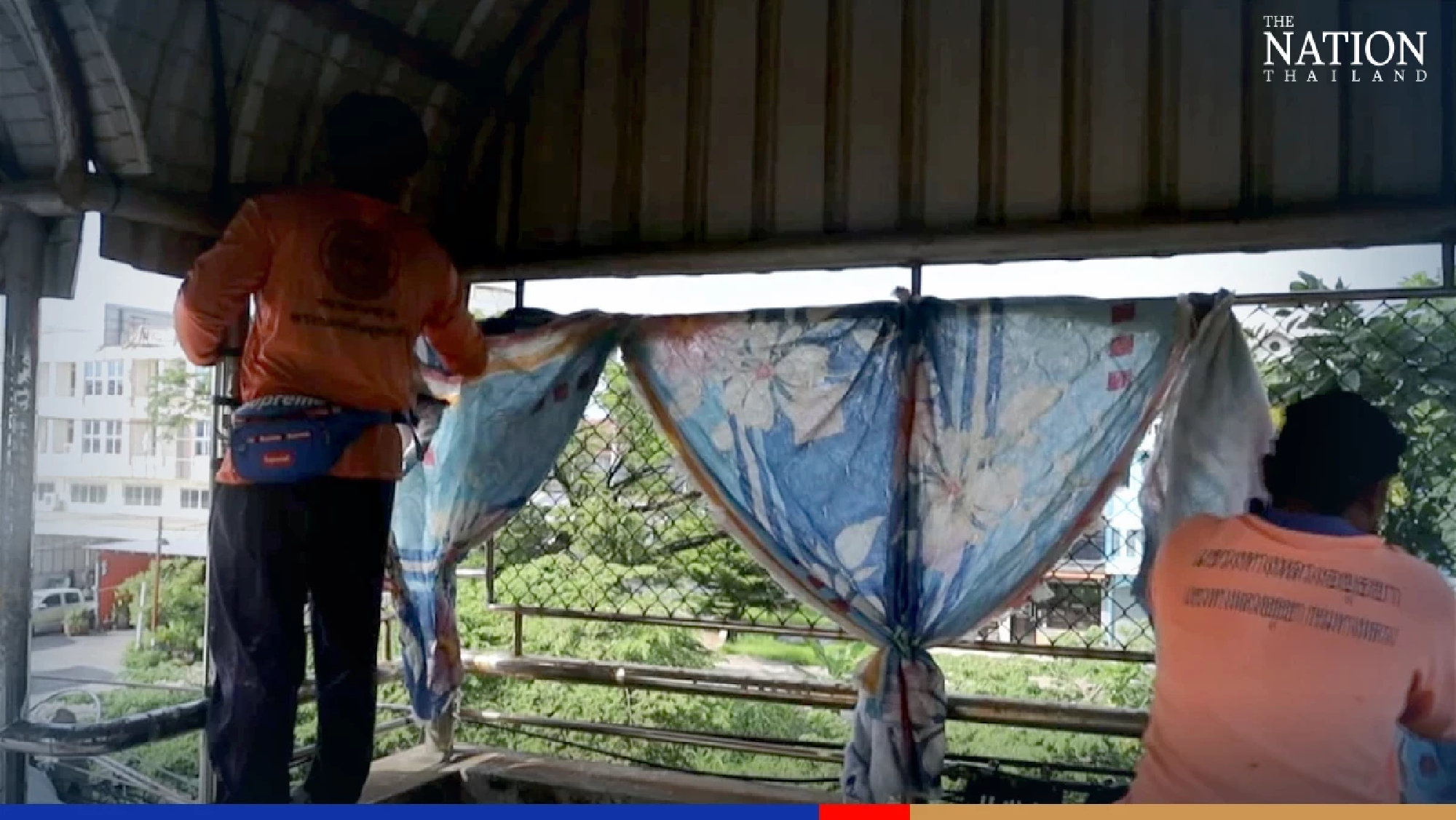
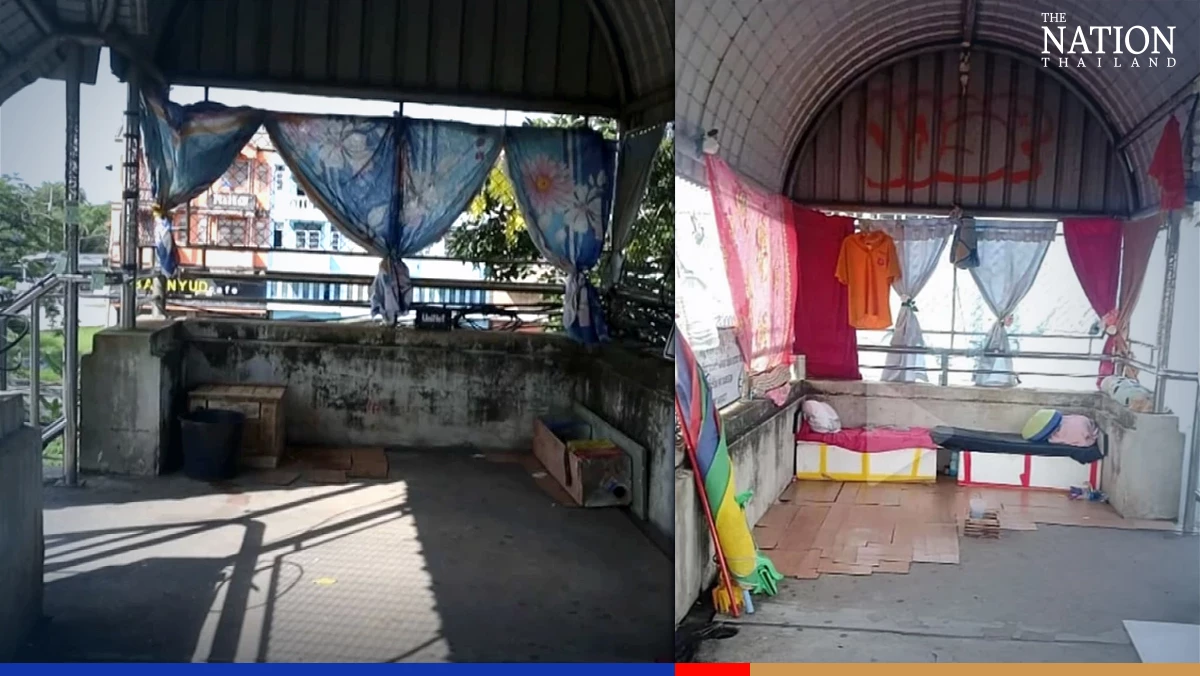
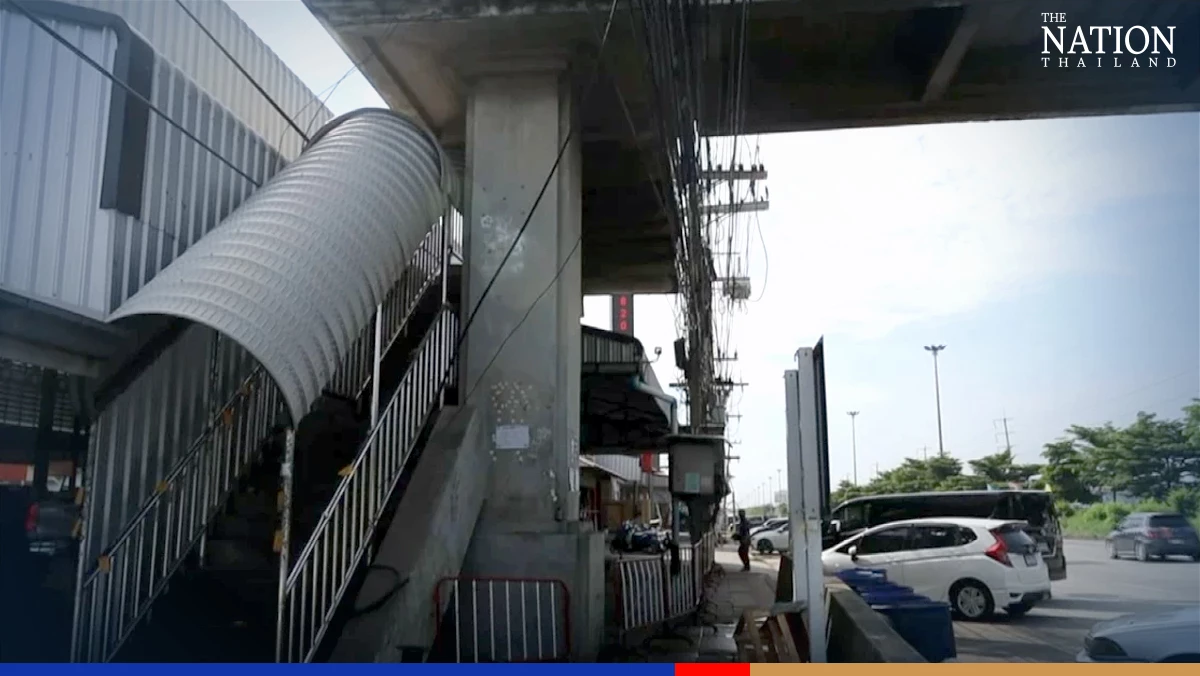
A residential area on a pedestrian bridge in front of Wat Khan Ham community in Ayutthaya’s Uthai district was razed to the ground on Wednesday “to ensure the safety of residents”.
The move came after a TikTok video clip of the pedestrian bridge decorated with colourful curtains, floor tiles and utensils went viral on social media.
The temporary officer for Ayutthaya Highway District, Thawat Changtham, said the district normally conducts cleaning operations and expels beggars regularly. He said the residental site sprung up a week after the agency sped up work on the Asian Highway.
Meanwhile, several residents in the area said beggars usually returned to the pedestrian bridge a while after they were expelled.
The residents also said they were afraid of the man who set up the residential site because he has “a big body with tattoos”.
The Cabinet on Tuesday agreed to dissolve the Prime Minister Delivery Unit (PMDU).
Government spokesman Anucha Burapachaisr said Deputy Prime Minister Wissanu Krea-ngam proposed to dissolve the PMDU because its operations were duplicated with other organisations and it had already accomplished its goal.
The PMDU is an organisation directly under the prime minister to support government operations strategically and in an integrated manner. It focused on tasks that could not be done or were delayed and affected the public due to the bureaucratic system.
It also focused on integrating various sectors, not just government agencies.
The PMDU sped up and monitored operations of the government sector, state enterprises and other government agencies.
It had also collected opinions to study, analyse and propose solutions to drive government policies or other matters assigned by the prime minister.
Almost 10,000 innocent investors fell victim to the Forex-3D Ponzi scheme after being lured by promised yields as magically high as 60 per cent per year.
The Nation reviewed the tactics used by the group running the nefarious scheme to lure their victims after a well-known actress and a number of other suspects were arrested.
On August 18, the Criminal Court denied bail to actress Sawika “Pinky” Chaidet, her mother Sarinya, brother Sarayut and 19 others who face charges of allegedly colluding to defraud others and disseminating fake information via computer.
Alleged mastermind Apiruk Kothi was nabbed in January last year while trying to sneak into the country from Cambodia after more than a year on the run.
The Department of Special Investigation (DSI) revealed that the foreign currency Ponzi scheme, operated via the www.forex-3D.com website and three Facebook pages, had defrauded 9,824 people since 2019 and their losses could amount to more than 2.48 billion baht.
The DSI explained that the scheme used current members to lure new victims with promises of high returns to both new investors and current members.
Subscribers to the scheme first received an activation code from a current “investor” and were made to invest at least US$500 (18,000 baht) to start with, before sinking in a required $2,000.
According to information from the DSI, the scheme lured victims to “invest” in one of five classes:
– Bronze Class, with a claimed 60:40 ratio of profit to be shared between the investor and the company. The minimum investment was $2,000.
– Silver Class, with a claimed 65:35 profit ratio and at least $7,500 in investment.
– Gold Class, with a claimed 70:30 profit ratio and minimum investment of $20,000.
– Platinum Class, with a claimed 75:30 profit ratio and at least $30,000 in investment.
– Diamond Class, with a claimed 80:20 profit ratio and a minimum $40,000 investment.
The victims had to sign contracts agreeing to withdraw their money only after having invested for at least three months.
The contracts also stated that they could receive the profits only after their investments brought in at least 8 per cent of profit.
Current members were also invited to send links to lure new victims with a promise of a 5 per cent share of profits from new investors.
The victims were promised they would receive returns at the rate of 8 to 10 per cent for a month, but the annual profits would shoot up to 20-60 per cent.
Residents in six provinces have been warned to beware of possible floods and runoffs from August 26 to 31.
In a Facebook post, the National Water Command Centre said on Wednesday that the Chi River level is expected to increase due to heavy rains, which would result in floods and runoffs the following provinces:
1. Maha Sarakham (Kantharawichai and Muang Maha Sarakham districts)
2. Kalasin (Kamalasai, Kuchinarai, Khong Chai and Rong Kham districts)
3. Roi Et (Changhan, Chiang Khwan, Thung Khao Luang, Thawat Buri, Phanom Phrai, Pho Chai, Phon Thong, Moei Wadi, Selaphum and At Samat districts)
4. Yasothon (Kho Wang, Kham Khuean Kaeo, Maha Chana Chai and Muang Yasothon districts)
5. Sisaket (Kanthararom and Yang Chum Noi districts)
6. Ubon Ratchathani (Khueang Nai and Muang Ubon Ratchathani districts).
The centre urged related agencies to follow weather forecasts and the water situation closely, prepare staff and equipment to deal with floods and publicise the issue in advance.
The agencies have also been urged to repair flood levees and clear the river.
The Tourism Authority of Thailand (TAT) and five partners launched a caravan drive from Bangkok to Pattaya on Tuesday in a bid to stimulate tourism.
Its partners are the PTT Dealer Association, PTT Oil and Retail Business, CP All, Dhipaya Insurance and the Office of SMEs Promotion.
TAT executive director for Tourism Products Thapanee Kiatphaibool said the caravan, which is a part of the “Road Trip” project, aims to enable PTT gas stations nationwide to create a good relationship with locals.
The activity features cash handouts to the Khao Kheow Open Zoo and the Royal Thai Navy Sea Turtle Conservation Centre for improving animal welfare and releasing sea turtles for environment preservation, she said.
Thapanee went on to say that TAT aims to increase the number of tourists visiting Thailand in the last four months this year – September to December.
“The cooperation with gas stations will help attract high-quality tourists to the country, especially to local communities,” she felt.
This event also allows locals to present their products, so PTT station operators can select these for sale, Thapanee said.
“The activity helps support the government’s policy to use the tourism industry to stimulate travel in many regions,” she added.
A rather nervous netizen spotted yet another damaged concrete slab on a U-turn bridge on Rama II Road even after it was supposed to have been closed and repaired.
Facebook user “Dukdik Poy” posted on Tuesday that she found cracked pieces almost coming loose from the concrete slab of the U-turn bridge near Wat Phrom Rangsi in Bangkok.
“I felt a little bit nervous when I was stuck in traffic as I had to wait just below the damaged Rama II U-turn bridge,” she wrote.
Loose concrete slabs on Rama II Road have recently led to a series of incidents involing injuries and deaths.
On July 18, a driver and passenger narrowly escaped death when an iron pillar plunged 20 metres down and onto their pickup truck.
On July 31, a falling beam killed two people and injured another two.
On August 3, a Facebooker user found four loose, partly damaged slabs on the Rama II highway, with the Mahachai highway police subsequently having to block the road to inspect the site and get repairs done.