FTX founder Sam Bankman-Fried charged with defrauding investors
WEDNESDAY, DECEMBER 14, 2022
US prosecutors on Tuesday accused Sam Bankman-Fried, the founder of cryptocurrency exchange FTX, of fraud and violating campaign finance laws and a judge in the Bahamas denied him bail, sending him to a local correctional facility instead.
Footage showed Bankman-Fried being escorted out of the Magistrate Court building in Nassau and getting inside a car followed by patrols. Earlier in the day, prosecutors were also seen leaving the courthouse.
The former FTX CEO, who was arrested in the Bahamas on Monday (December 12), was denied bail by a magistrate judge citing a “great” risk of flight.
He was ordered remanded to a correctional facility in the island nation until Feb. 8, where he will initially hold in the medical department, according to a local official.
The day’s events capped a stunning fall from grace in recent weeks for the 30-year-old, who amassed a fortune valued at over $20 billion as he rode a cryptocurrency boom to build FTX into one of the world’s largest exchanges before it abruptly collapsed this year.
Bankman-Fried has previously apologized to customers and acknowledged oversight failings at FTX, but said he does not personally think he has any criminal liability.
Earlier on Tuesday, US Attorney Damian Williams in New York said Bankman-Fried made illegal campaign contributions to Democrats and Republicans with “stolen customer money,” saying it was part of one of the “biggest financial frauds in American history.”
Bankman-Fried faces a maximum sentence of 115 years in prison if convicted on all eight counts, prosecutors said, though any sentence would depend on a range of factors.
‘The antidote to hate is love’ – Biden signs Respect for Marriage Act
WEDNESDAY, DECEMBER 14, 2022
US President Joe Biden signed the Respect for Marriage Act into law on Tuesday at a jubilant celebration that featured US singer Cyndi Lauper performing “True Colors” in front of thousands of supporters on the White House lawn.
The new law provides federal recognition to same-sex marriages, a measure born out of concern that the Supreme Court could reverse its legal support of such relationships.
Cheers erupted from the crowd as Biden signed the bill.
“Marriage is a simple proposition. Who do you love? And will you be loyal to that person you love? It’s not more complicated than that. The law recognizes that everyone should have the right to answer those questions for themselves,” Biden said. “Today’s a good day.”
The event featured performances by pop icons Lauper and British singer Sam Smith.
Made famous by her 1983 song “Girls Just Want to Have Fun,” Lauper, 69, said the act offered peace of mind to families like hers and Americans nationwide.
“We can rest easy tonight because our families are validated and because now we’re allowed to love who we love, which sounds odd to say, but Americans can now love who we love,” Lauper, an activist on LGBT issues who has been married to actor David Thornton since 1991, told reporters at a briefing prior to the performance.
“This is about respect,” House Speaker Nancy Pelosi said earlier in the event. “This is about taking pride… and it’s about time that we do so at the federal level.”
Senate Majority Leader Chuck Schumer, whose daughter and her wife are expecting a child, called it “a day of jubilation.”
The US House of Representatives on Thursday (December 8) gave final congressional approval to the legislation.
The House vote was 258-169, with all of the chamber’s Democrats and 39 Republicans voting in favour – though 169 of the chamber’s Republicans voted against it and one voted “present.”
The legislation won the support of LGBT advocates as well as a number of religious organizations and entities including the Church of Jesus Christ of Latter-day Saints, though many American religious conservatives still oppose gay marriage as a counter to biblical scripture.
Retail price of NGV to go up by THB1 per kg from Friday
WEDNESDAY, DECEMBER 14, 2022
The Energy Policy Administrative Committee has agreed to hike the retail price of natural gas for vehicle (NGV) by 1 baht, from 16.59 baht per kilogram to 17.59 baht, from Friday (December 16), Energy Minister Supattanapong Punmeechaow said on Wednesday.
Taxi drivers who have registered under PTT’s NGV subsidy campaign will still be able to buy the gas at the subsidised price of 13.62 baht per kg until March 15, 2023, he added.
PTT Plc is expected to use 2.68 billion baht to subsidise the campaign until it ends on March 15 next year, in a bid to help alleviate the financial burden of taxi drivers.
Supattanapong added that the committee also approved to maintain the wholesale price of liquefied petroleum gas (LPG) from refinery at 19.9833 baht per kilogram (VAT excluded). The move aims to limit the retail price of LPG for cooking at not over 408 baht per 15kg canister until January 31 next year.
Supattanapong said maintaining the LPG price amid the fluctuating global price will add more burden to the Oil Fuel Fund, but it is necessary to help reduce people’s cost of living.
The price of global LPG as of November 29 was US$633.6 per tonne, which should translate into retail LPG price of 480 baht per 15kg canister, 72 baht higher than the current domestic retail price.
“This has resulted in the LPG account of the Oil Fuel Fund running a 1.35-billion baht deficit each month, with accumulated deficit so far at 43.88 billion baht, approaching the deficit limit of not over 45 billion baht,” he said.
The committee also asked oil sellers to maintain the marketing cost of diesel at not over 1.4 baht per litre until March 31, 2023 to help reduce people’s cost of living and lessen the burden on the Oil Fuel Fund. This will apply to B7 and B20 biodiesel and regular diesel.
PM focuses on sustainability, cooperation in talks with EU leader in Brussels
WEDNESDAY, DECEMBER 14, 2022
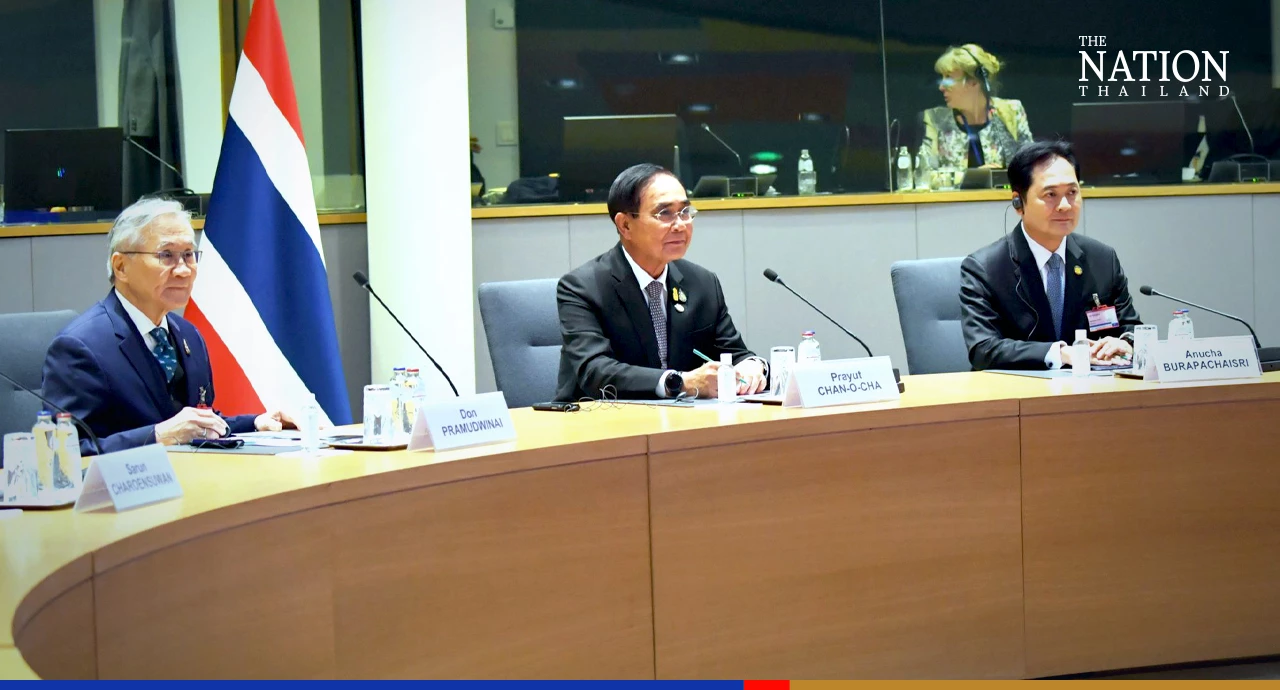
Discussions between Thailand and the European Union (EU) focused on sustainable development, environmental protection, and security and cooperation in the Indo-Pacific region, at the Asean-EU Summit in Brussels on Tuesday, government spokesperson Anucha Burapachaisri said on Wednesday.
Prime Minister Prayut Chan-o-cha had talks with European Council President Charles Michel on Tuesday as both sides aimed to increase cooperation between Asean and the EU.
Thailand and the EU are preparing to sign the Thai-EU Partnership and Cooperation Agreement, Anucha said without providing a timeframe.
“Thailand is ready to work closely with EU agencies in an open and creative manner,” he quoted Prayut as saying.
The government spokesperson said Michel praised Thailand for its role in Asean and expressed hope for enhanced cooperation between Thailand and the EU.
Anucha said Prayut told Michel that the Bio-Circular-Green economic model would drive Thailand’s economy towards sustainability and net-zero carbon emissions.
The EU is ready to cooperate with Thailand to enhance the private sector’s ability to adhere to environmental standards and to expand investment to promote innovation and research on sustainability and environmental-protection goals.
Tuesday’s talk also covered cybersecurity, maritime security and counterterrorism, Anucha added.
Cabinet presses ignition on Thailand’s 15-year space masterplan
WEDNESDAY, DECEMBER 14, 2022
The Cabinet on Tuesday approved Thailand’s 15-year masterplan for space development, which will tap Nasa expertise.
Ministers gave the green light to the National Space Master Plan 2023-2037 and the National Communication Satellite Policy to drive forward the Thai space industry with concrete measures, said deputy government spokesperson Ratchada Thanadirek.
The National Space Master Plan will guide development of a space economy for national security, prosperity and sustainability. These mission goals will be achieved through research, development and promotion of space security, economy, industry, innovation, technology, and exploration, according to the masterplan.
Among the eight strategies listed in the masterplan is international cooperation. Thailand’s space agency Gistda is already cooperating with US counterpart Nasa on projects including the northern space lab in Chiang Rai.
Meanwhile, under the National Communication Satellite Policy, the government will procure and own at least one communication satellite, to be operated by the National Telecom (NT) state enterprise. The satellite will be run for public services, security and commerce, but not in competition with any private companies, said Ratchada.
Currently the government uses communication channels from the Thaicom 6 and 7 satellites, operated by Thaicom Plc and Asia Satellite Telecommunications, respectively, as well as renting satellite channels from foreign operators.
Under the National Communication Satellite Policy, NT must complete an in-depth survey on usage needs of this satellite within three years.
Thailand eyes national big data institute to help with development
TUESDAY, DECEMBER 13, 2022
The Cabinet approved a draft decree on setting up a national big data institute that will help in Thailand’s development as a data-driven nation.
Deputy government spokesperson Tipanan Sirichana said on Tuesday that the decree was proposed by the Digital Economy and Society (DES) Ministry after its Government Big Data Institute (GBDi) reached the end of its tenure in June.
She said GBDi was set up in July 2019 and gave birth to more than 2,300 information technology personnel and oversaw 104 projects over the past three years. It was also in charge of a platform for the exchange of medical data among hospitals during the Covid-19 crisis.
“Since the timeline for GBDi has expired, DES Ministry has proposed that it be turned into a national big data institute,” she said.
The new institute would be responsible for providing big data analysis for government and private agencies, she said.
This move also matches the government’s Thailand 4.0 scheme and the 20-year national strategy, Tipanan added.
“The national big data institute established under this law will be the central agency driving, analysing and integrating the country’s big data,” she said.
According to her, the institute will have four main objectives:
• Strategizing the use of big data and how it can help with the development of the economy and society.
• Ensuring government and private agencies use big data for such things as developing policies and planning business.
• Providing big data-related analysis for government and private agencies.
• Promoting innovation related to big data.
“This institute will also help the government come up with development policies,” she said.
In addition, the institute will focus on analysing data related to health, environment, tourism, labour and justice sectors in the next five years.
Big data refers to data sets that are too large or too complex to be dealt with by traditional data-processing software.
Democrat-sponsored debate focuses on legalising football betting in Thailand
WEDNESDAY, DECEMBER 14, 2022
Speakers at a Democrat Party forum on Tuesday provided cautious support for legalising football betting, saying it can be done – but only after the necessary policing and legal reforms are implemented.
Football betting happens everywhere around the globe, so it should be made transparent to make it easier to control, forum moderator Watanya Bunnag said at the beginning of the “Listen, Think, Act” forum yesterday evening, which was broadcast live on the Democrat Party’s Facebook page.
She pointed out that it has been legal in England since 1960. In Thailand it is estimated that football betting was worth 180 billion baht in 2021 – equivalent to 1.12% of the country’s GDP, she added.
Watanya chairs the Democrat Party’s Bangkok Innovations committee. She is also the wife of Nation Group CEO Shine Bunnag.
At Tuesday’s forum she was joined by Assoc Prof Nualnoi Treera, director of the Center for Gambling Studies at Chulalongkorn University’s Faculty of Economics, Nuttakorn Vititanon, lecturer of Chiang Mai University’s Faculty of Political Science and Public Administration, Thanis Piriyaphokanon, managing director of Promes Co Ltd, and a football guru who goes by the name “Bell Field Edge”.
Chulalongkorn’s Nualnoi said the reason some countries have not legalised gambling is that it is not a conventional good or service. Moreover, the activity has a wide impact, from the individual gambler to society as a whole. Legalising gambling requires comprehensive rules to control it, she said.
Both Nualnoi and Watanya used England as an example. Watanya noted that football betting has been legal there since the enactment of the country’s football gambling law in 1960. The law was updated in 2005 to include measures to prevent gambling adverts from reaching youths and to require youths to receive education about gambling, she added.
Nualnoi said England did more than enact a law to legalise gambling: it also reformed its police force. Police reforms are necessary to efficiently crack down on illegal gambling, she said. If Thailand can reform its police force the way England did, then football betting can be legalised here, she added.
If a law is passed allowing football betting without police reform, Thailand will have both legal and illegal gambling, Nualnoi said, adding that this could cause an increase in violence and crime.
“If we legalise gambling without solving the current problems, we will face both legal and underground gambling. The legal ones will not be able to compete against the illegal ones because the legal ones will have to pay taxes, while the illegal ones pay only bribes [to police],” Nualnoi explained.
Nuttakorn said countries that legalised gambling did so because they wanted new sources of income. He said such countries cracked down on illegal gambling so that they would not compete against the sources of income of the state.
Nuttakorn said Thailand needed to reform its gambling law first because the existing law was outdated.
He said the new law must categorise gambling into types based on the level of their social impact. For example, he said, if the government considered that online gambling caused the greatest social impact, the law must be enforced against it strictly, while the government might be lenient on traditional games, such as betting on cockfighting.
“We have had 20 constitutions, but we have had only two pieces of gambling law since the change of the ruling system. So, I think this gambling law is very outdated and it’s about time to overhaul it,” Nuttakorn said.
He said the countries that legalised gambling saw that the state could protect the interest of players instead of letting them gamble on illegal websites. The government could also control access to gambling by age and regulate bookmakers, he said.
If Thailand wants to legalise gambling, a draft law must first be approved in a public referendum to win legitimacy.
Thanis told the forum that about 180 billion baht circulated in football gambling alone a year, while the government’s lottery tickets generated revenue of only 130 billion baht a year. The amount rises to 740 billion a year after combining all types of illegal gambling in Thailand, Thanis added, noting that this total comes close to annual revenues from the tourism industry, which totaled 800 billion baht in 2020.
Tourism is a high-cost activity, but gambling requires little cost so it could be a positive source of revenue for the country.
He said Thailand could build a platform for online gambling that can block access by children and youths by using blockchain. For example, the platform could alert parents with an SMS if their children attempt to use it.
The football guru, “Bell Field Edge”, said gambling on football matches was actually like buying stocks because betters would have to study football teams to attain the knowledge necessary to pick winners.
If football gambling is legalised, an effective system to prevent access by children and youths must be put in place.
Watanya concluded the forum by saying that revenue from football gambling would be significant but there must be a system in place to find a balance between increasing state revenues and minimising social impacts.
Burglar wearing bikini bra was not a man in disguise: police
WEDNESDAY, DECEMBER 14, 2022
A burglar caught on CCTV during a failed robbery of a construction-materials shop in Chiang Mai was arrested on Wednesday after police found a suspect who matched the one in the footage.
The suspect was not, however, a man disguised as a woman, as the shop’s owner concluded from the footage. He later shared the footage (along with his assumptions) with the media and police.
It was subsequently reported that a man wearing a wig and a bikini tried to break into the shop after climbing a chain link fence to gain entry to its doors. Iron grills over the doors, however, were enough to deter the would-be thief, who climbed back over the fence and left the scene.
On Wednesday, investigators from Chang Phueak Police Station detained 36-year-old Supannee (surname withheld) in an apartment in Chiang Mai, seizing a red bra and floral skirt from her as evidence.
Police said that Supannee admitted she was the one filmed attempting to rob the shop in Saraphi district. She also said she had done the same before.
Previously, she broke into a house in the Chang Phueak sub-district. Police said the owner of the house had reported a break-in to their station.
Supannee has been charged with theft, police said.
Lipe’s Sea Gypsy pupils battle workers to protect their passage to school
WEDNESDAY, DECEMBER 14, 2022
Several young pupils from the local Sea Gipsy community on Koh Lipe in Satun province battled construction workers on Tuesday morning in a desperate attempt to protect the only passage to school which has been used since the days of their ancestors.
The pupils of the Ban Koh Lipe School in Satun gathered in front of the school on Tuesday morning when workers were building an iron fence to block the road they have been using as access to their school.
The kids from the Urak Lawoi community tried to yank the steel pipes away from the workers and several of them were slightly injured during the fight.
Several other students sat down on the road and they raised their hands to show respect to the workers and begged them to stop blocking the school’s entrance.
The tension between the school and a business tycoon, who claimed the right to the land of the passage, started on November 25 when he sent workers to build the iron fence to block the school’s entrance.
The community has earlier sought help from the provincial administration and several agencies, including the National Human Rights Commission, to save the school and community from what they called intrusions by tourism business operators on the island.
The community has even launched a campaign on Facebook, urging tourists to boycott the island as tourism operators have been blocking the sea gipsy community from access to the sea, their graveyard and public utilities and trying to evict sea gipsy families who have been living on the island without land documents since the days of their ancestors.
On Tuesday, the students told local reporters that other access to the school have been blocked so they tried to protect the only remaining passage. They said the workers have already put up an iron fence to block the school entrance so they had to climb over it into and out of the school.
They decided to fight the workers to prevent them from further reinforcing the fence to prevent students from climbing.
“We cried, we begged. We rarely slept because we had to take turns to watch over the passage. If we don’t watch it, they will come to extend the fence,” a student said.
The students said workers also hit their hands when they tried to yank away steep pipes from the workers and students turned to seek help from policemen guarding the spot to no avail.
Sukhon Pa-ah, a resident of the Urak Lawoi community, said the road, which the tycoon claimed to own, has been used by local villagers for over 100 years as a passage to school, to a local hospital and to the beach.
Earlier, the community sent an open letter to the PM’s Office to seek help and Thatchayanut Jiathanakan, secretary to PM’s Office Minister Anucha Nakasai, has visited the island.
Thatchayanut said Anucha would visit Satun to hear the complaints of local people on Wednesday and Thursday during hearings to be held at the Satun provincial administration.
The sea gipsy people in the community said they have been using the road since 1909 so they wondered why the Satun land office could issue a land document to cover the public road.
In their complaint sent to the National Human Rights Commission late last month, the Urak Lawoi people said a woman, Dara Angchotphan, somehow managed to get a NorSor3 document to claim ownership of a plot that also covers the road in 2014.
Dara then sold the land to Komsak Eiewlek, who has been trying to occupy the land and evict Urak Lawoi people, leading to legal lawsuits.
The complaint said Komsak sent his workers to erect an iron fence to block the passage that the community has been using since 1909 as access to the school, a local hospital, a graveyard and access to the sea.
Gen Surin Pikulthong, a former chairman of a committee in charge of solving problems of sea Gypsies, said the Sea Gypsies on Lipe has migrated from Koh Lanta and two other islands to live on Lipe since the reign of King Rama V. Surin said their plight began since 1974 when the government announced the national park zone over their land. Their plights were later aggravated by tycoons who turned up to claim ownership over their land.
The annual Geminids meteor shower is best viewed on Wednesday night before 11pm, with stargazers in rural areas expected to get the best view, according to the National Astronomical Research Institute of Thailand.
There could be as many as 150 meteors per hour when the shower is most visible, from about 8 pm until 11 pm, the institute said.
The meteor shower can be viewed with the naked eye from locations that are distant from artificial lighting.
The institute said the Geminids meteor shower lasts from December 4 to 20, but the best time to observe it is tonight. The Geminids are associated with near-Earth object 3200 Phaethon, an asteroid that may have collided with another object in the distant past to produce the stream of particles that create the meteor shower.
The institute has opened three viewing sites. They are:
– Chiang Mai: A campsite at the Huay Lan Reservoir. For more information, call: 088-5477834.
– Nakhon Ratchasima: Chalermphrakiart Observatory at Suranaree University of Technology.
– Chachoengsao: Chalermphrakiart Observatory in Plaeng Yao district’s Tambon Wang Yen in Plaeng Yao district.

















 On Tuesday, the students told local reporters that other access to the school have been blocked so they tried to protect the only remaining passage. They said the workers have already put up an iron fence to block the school entrance so they had to climb over it into and out of the school.
 Earlier, the community sent an open letter to the PM’s Office to seek help and Thatchayanut Jiathanakan, secretary to PM’s Office Minister Anucha Nakasai, has visited the island.
 The institute has opened three viewing sites. They are:
 SootinClaimon.Com