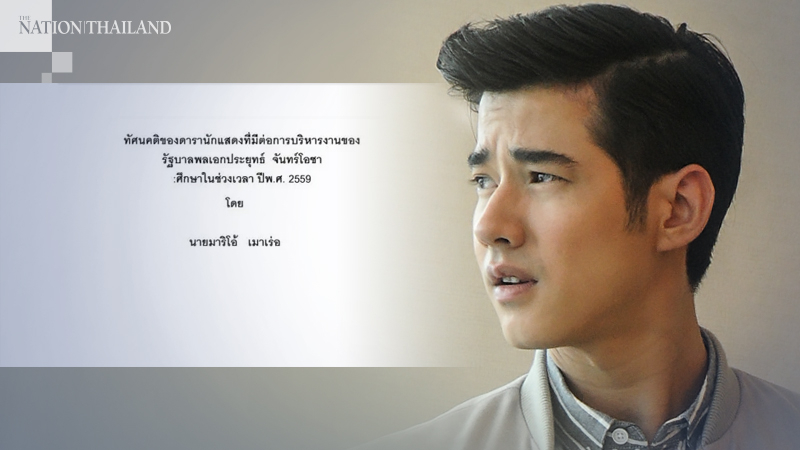
Heartthrob actor Mario Maurer has become the latest celebrity caught up in the Thai political crossfire, after netizens slammed his 2016 Master’s for being “salim” – ultraconservative or ultra-royalist.
Mario’s alma mater Krirk University hit back at the slurs on Tuesday, saying the actor’s thesis met academic standards and addressed the political context of 2016, just two years after General Prayut Chan-o-cha came to power in a coup.
For his Master’s in political communication, Mario had surveyed celebrities’ attitudes towards the Prayut-led junta regime, explained Asst Prof Nantana Nantawaropas, Dean of the College of Political
Communication. The resulting paper was assessed for research tools, test questionnaires, sample size, sampling method, analysis and discussion of results. Mario presented it to a committee of three experts and answered all their questions completely and clearly, earning a pass on October 27, 2016.
His research on the social media accounts of celebrities revealed that actors and actresses generally had a very positive attitude towards Prayut’s administration, though some expressed concern at suppression of free speech.
The dean noted that in 2016, the mood of the public and especially celebrities was more supportive of the prime minister. This may be completely different from the public mood today, he added.
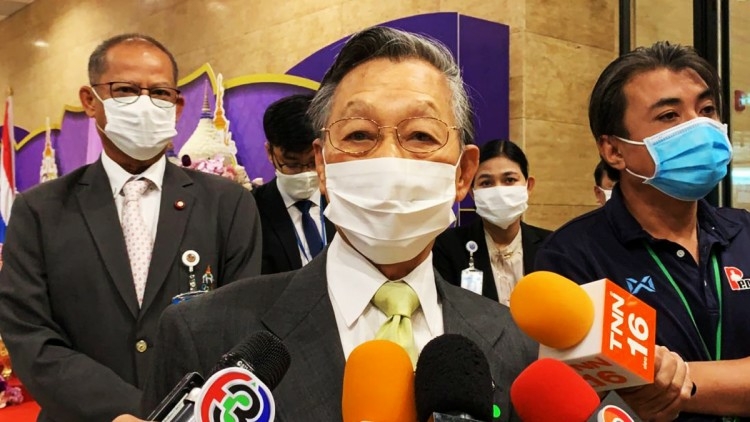
House Speaker Chuan Leekpai said on Wednesday (September 16) that the national budget for fiscal 2021 will miss its October 1 deadline because the House of Representatives wants more time to review all the documents. He said the delay cannot be blamed on the Budget Bureau.
“The bureau submitted the budget draft on June 16, but the House asked for extra time because its members want to thoroughly review the documents,” he said. “Normally the House will take seven days for the first reading, but this time they want 14 days, which has delayed subsequent readings.
“According to the law, the House of Representatives has 105 days to complete reviewing the budget, hence it has until September 28 to complete its consideration of the bill,” the House speaker said.
Meanwhile, government chief whip Wirat Rattanaset, who is also Palang Pracharat MP, said the House aims to complete the second and third readings of the budget before midnight on September 18.
“We have told MPs to strictly adhere to this timetable and have also ordered staff to ensure there are no power outages in Parliament during the budget reading,” he said.
On Monday, Deputy Prime Minister Wissanu Krea-ngam said he expected the budget’s implementation to be about a month late, while the government has said it can continue using the funds left over from the previous budget.
There will be no military roadblocks to stop protesters from the Northeast travelling to join an anti-government demonstration scheduled for Saturday (September 19) at Thammasat University’s Tha Phrachan campus in Bangkok, 2nd Army spokesman Maj-General Rachan Prachantasen said on Monday (September 14).
“Our intelligence units have been closely monitoring political movements in the Northeast region to assess whether the situation could turn violent in order to employ suitable preventive measures within the framework of national security,” he said. “However, the Army is not directly responsible for maintaining law and order at protest venues since the dissolution of the National Council for Peace and Order [in July 2019].
“Agencies in charge of keeping political protests in order are administrative offices and police, and the Army will not interfere with their work,” he added. “There would definitely be no such roadblocks to stop protesters from the Northeast from reaching Bangkok, as people have the right to freedom of expression under a democratic regime.”
Rachan also added that he believed not many people from the Northeast would travel to Bangkok to join the protest at Thammasat, as most of the northeastern protesters are likely to set up stages in their respective provinces on Saturday, giving speeches to local people.
The government would not do anything to trigger violence at the major anti-government rally on September 19, Prime Minister Prayut Chan-o-cha said on Monday.
Prayut said he had ordered all relevant state agencies to ensure the safety of the demonstrators and not to allow any third party to take advantage of the event.
Groups of student activists will stage the rally at Thammasat’s Tha Prachan Campus in Bangkok to call for a rewrite of the junta-drafted Constitution, a halt to intimidation of activists, and dissolution of Parliament.
House Speaker Chuan Leekpai has rejected a complaint by Palang Pracharat MPs that two separate motions to amend the Constitution should be postponed because certain opposition MPs had signed both of them.
Explaining his decision to dismiss the claim by Palang Pracharat MP Paiboon Nititawan, Chuan said that the two motions had different subjects despite their similar goal to amend the charter, and MPs could sign both without being repetitive.
Paiboon had cited the earlier repetitive-signing complaint about the Budget Procedures Act 2020 that Seri Ruam Thai Party leader Sereepisuth Temeeyaves filed with the Constitutional Court.
However, Chuan said that this latest case was a proposition on legal drafting, not a request to the Constitutional Court and the topic had not been addressed in the House agenda yet.
The first of the two motions submitted on August 17 focused on the setting up of a Constitution Drafting Assembly.
Four more charter-change motions were submitted on September 10, all focused on cancelling unelected senators’ power to elect the prime minister.
The ruling Palang Pracharat Party has sent a letter to House speaker Chuan Leekpai, opposing four letters submitted by the opposition parties on amending the Constitution.
Paiboon Nititawan, a Palang Pracharat MP, said that the party had examined the four documents of the draft amendments to the Constitution and found the repetition of names in the signing of letters demanding the setting up of a Constitution Drafting Assembly.
The four documents submitted on September 10 demanded revocation of senators’ power to elect the prime minister, and therefore might not be in accord with the Constitution, the ruling party argued.
Palang Pracharat opposed the drafts and requested the House speaker to hold them back from a debate before they were legally examined.
Paiboon said that seven drafts for amendments to the charter had been submitted to the House speaker; two were open for debate while five were waiting to be examined.
First ever dialogue on Thai monarchy arrives in Parliament’s ‘safe zone’
PoliticsSep 13. 2020School students attend a pro-democracy campaign on September 9 in Nonthaburi province. (Korbphuk Phromrekha/ #NationPhoto )
By By Thai PBS World Syndicate / ANN
A parliamentary committee has responded to demands for reform from the youth-led anti-establishment movement by organizing a dialogue forum to discuss their calls, including monarchy reform, on September 22.
The dialogue is aimed to provide an intimidation-free “safe zone” for the students to share their opinions on reform, said Padipat Suntiphada, chairman of the House Committee on Political Development, Mass Communications and Public Participation.
The move came after the panel last month invited students to hear their thoughts on charter amendment and other demands voiced by youth-led protesters since July.
Among the proposals submitted to the committee was the so-called “10-point manifesto” for reform of the monarchy. It seeks to, among other things, scrap the lese-majeste law, defund the royal family and bar the palace from expressing political opinions.
It marks the first time ever that monarchy reform is raised in Parliament and comes after protest leaders broke a decades-long taboo by challenging the palace’s status in public during protests in Bangkok early last month.
Proposals to curb royal power are expected to be raised again at a major student rally planned for September19. The students insist on having the rally on the Tha Prachan campus of Thammasat University despite objection from its administration. The students’ plan is to camp overnight there before marching to Government House the next day.
For the first discussion on monarchy in the safety zone, Padipat said the forum will be a two-way dialogue between proponents and opponents of royal reform and other issues.
The dialogue framework was designed by the Institute of Human Rights and Peace Studies at Mahidol University.
Around 40 young activists from anti-establishment groups like the Free Youth movement and United Front of Thammasat and Demonstration, and pro-establishment groups like Vocational Students Protecting the Nation, will be invited to participate in the talks.
“Most of their demands may be of concern to one group of people, but if we have to live on the same soil, they [the demands] should be discussed in a safety zone with freedom, academic principles and good intentions,” said Padipat, a Kao Klai (Move Forward) MP from Phitsanulok.
The anti-establishment movement’s core demands – a new Constitution, dissolution of Parliament and an end to intimidation of government critics – have echoed around the country. Some activists have gone further by calling for reform of the monarchy, a taboo topic in Thailand given a lese-majeste law that punishes royal insults with up to 15years in jail.
Government agencies have held youth forums, but their agenda has been limited to themes such as curriculum improvement, environmental issues and job opportunities for students. The core demands made by protesters are not being discussed.
Prime Minister Prayut Chan-o-cha has warned protesters to steer clear of criticising the monarchy and said they crossed the line when the 10-point reform plan was read out at a rally on August 10.
Since then, authorities have charged more than a dozen activists with offences ranging from sedition to incitement, but released them on bail as the government struggles with how to respond to the rallies.
Padipat hoped this panel’s forum would lead to another level of discussion in Parliament and has plans to hold more forums in other regions.
“If the forum receives good feedback, Parliament has to respond. If society lifts the ceiling [of discussion], how can MPs be afraid to talk?” he added.
“Personally, I think the safe zone [to debate the 10-point manifesto] is in Parliament. But I’m not sure when is the right time or whether we have to wait for the launch of a constitution drafting assembly [to discuss the monarchy while writing a new draft charter],” he added.
Parliament is scheduled to discuss charter amendment motions to pave the way for a Constitution rewrite on September23-24. However, none of the motions submitted by government parties and the opposition touches on Chapters 1 and 2 which deal with the monarchy.
Only the opposition Kao Klai Party, a reincarnation of the now-defunct Future Forward, has vowed to raise the topic of royal reforms on the floor.
Kao Klai secretary-general Chaithawat Tulathon said that whether they agree or disagree with the demands of students, people should listen and understand the topic of monarchy reform.
“We are concerned that blocking discussion of the chapters could lead to a deep clash of opinion between proponents and opponents,” said Chaithawat.
Piyabutr Saengkanokkul, co-founder of the Progressive Movement, another reincarnation of the disbanded Future Forward, said now that monarchy reform has been raised on protest stages outside Parliament, it was the duty of MPs as representatives of the people to address the issue in Parliament.
“[Talking about the monarchy] won’t lead to changes in the current regime, because it is still a constitutional monarchy,” said Piyabutr.
A poll by the National Institute of Development Administration (Nida) showed that over three-fourths of Thai people want to scrap the role of senators in picking the prime minister by rewriting Section 272.
The Nida Poll survey of 1,317 respondents aged over 18 in various regions from September 8-10 showed that most of them wanted the amendment to be successful.
More than 61 per cent strongly agreed with rewriting of Section 272 of Thai Constitution to revoke senators’ power to elect a prime minister, 16.48 per cent agreed, 8.96 per cent disagreed, 13.21 per cent strongly disagreed and 0.08 per cent did not follow the topic or were not interested in it.
Regarding holding of a general election after the House is dissolved, 69.27 per cent strongly agreed, 15.90 agreed, 6.24 per cent did not agree, 7.22 per cent strongly disagreed and 1.37 per cent did not follow the topic or were not interested in it.
However, 38.27 per cent believed that there was a role for senators in Parliament to balance the power of MPs, 31.66 per cent thought senators had no concrete success and were unnecessary, and 30.07 per cent were okay with keeping or removing senators.
Cabinet reshuffle on the cards after sudden exit of newly appointed finance minister
PoliticsSep 13. 2020From left: Supattanapong, Suriya, Santi and Narumon
By The Nation
Prime Minister Prayut Chan-o-cha is expected to reshuffle the Cabinet of his coalition government soon after Finance Minister Predee Daochai resigned on September 1 less than a month after his appointment, according to a source in the ruling Palang Pracharat Party.
Predee, a former chairman of the Thai Bankers’ Association, cited health reasons for his abrupt departure from the Finance Ministry, but some observers believe he had a conflict with his deputy over the annual promotion of senior officials at the ministry.
A Palang Pracharat source said that Energy Minister Supattanapong Punmeechaow, who is also deputy prime minister, is a candidate for finance minister.
If Supattanapong gets the nod, he will have two posts — deputy prime minister and finance minister.
Deputy Finance Minister Santi Prompat is expected to replace Industry Minister Suriya Jungrungreangkit who is tipped to become energy minister.
Deputy Labour Minister Narumon Pinyosinwat is likely deputy finance minister while an MP from the Palang Pracharat will become deputy labour minister, according to the source.
The Palang Pracharat MP’s name has been proposed to party leader General Prawit Wongsuwan, who is also deputy prime minister.
The Cabinet reshuffle is expected within this month or early next month, according to the source.
Opposition parties led by Seri Ruam Thai Party’s Seripisuth Temiyavej, Move Forward’s Pita Limjaroenrat, Wan Muhamad Noor Matha from Prachachart Party, Nikhom Boonvises from Thai People Power Party and Songkram Kitlertphairoj from Pheu Chart Party handed four motions for charter amendment to House Speaker Chuan Leekpai on Thursday (September 10).
Chuan said the motions will be added to the House agenda on September 23-24, adding that the examination of the four documents will be completed before the due date.
Sutin Klungsang, Pheu Thai Party whip, said some 170 MPs had signed the motion to amend the charter to “switch off” senators’ power to elect a new premier.
Cholnan Srikaew, deputy Pheu Thai leader, said the four motions include amendments to Articles 272 and 152, which revoke senators’ power to elect a premier, and Articles 270 and 271 which reduce senators’ say in reforms.
Other amendments focus on Article 279, which focuses on the National Council for Peace and Order’s authority, and Articles 83, 85, 88, 90, 92, 94 and 105 to improve the electoral system.
 Maj-General Rachan Prachantasen
  PM Prayut Chan-o-cha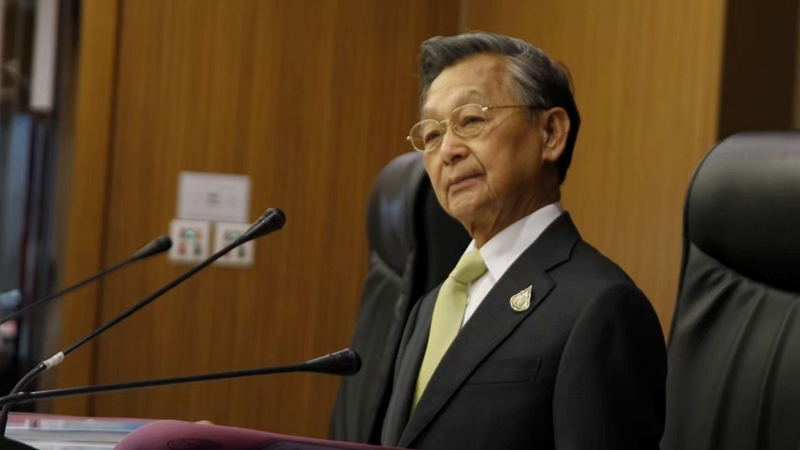
 Paiboon Nititawan
  School students attend a pro-democracy campaign on September 9 in Nonthaburi province. (Korbphuk Phromrekha/ #NationPhoto )
 From left: Supattanapong, Suriya, Santi and Narumon
 SootinClaimon.Com