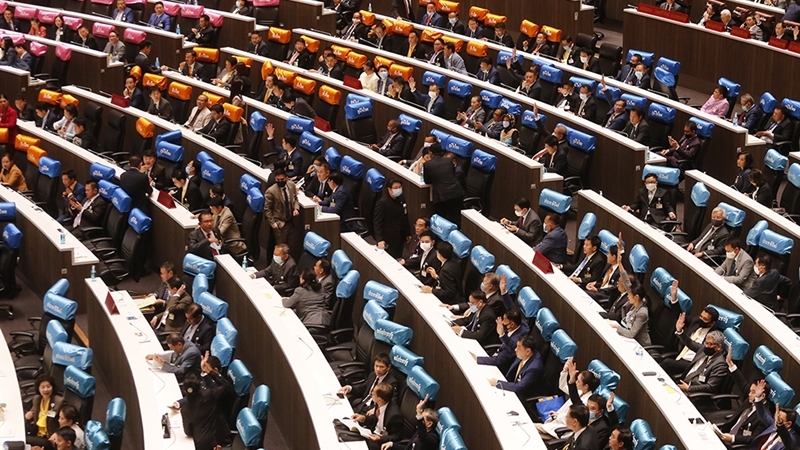
Senators could afford a sigh of relief on Thursday after Parliament voted to delay a decision on six motions for charter change.
Instead, a committee was set up to study the motions for Constitution amendments ahead of a vote on the motions in one month’s time.
Opposition Pheu Thai and Move Forward MPs walked out in protest after MPs and senators voted 431 to 255 to postpone the amendment vote and then 432-255 to set up the committee.
To pass, a motion needs the votes of at least 84 senators.
The committee set up to examine the proposed amendments will consist of 45 members – 15 senators and 30 MPs from the opposition and ruling coalition parties. Pheu Thai and Move Forward refused to nominate members from their parties. A rally of about 1,000 protesters gathered outside Parliament to press for charter change.
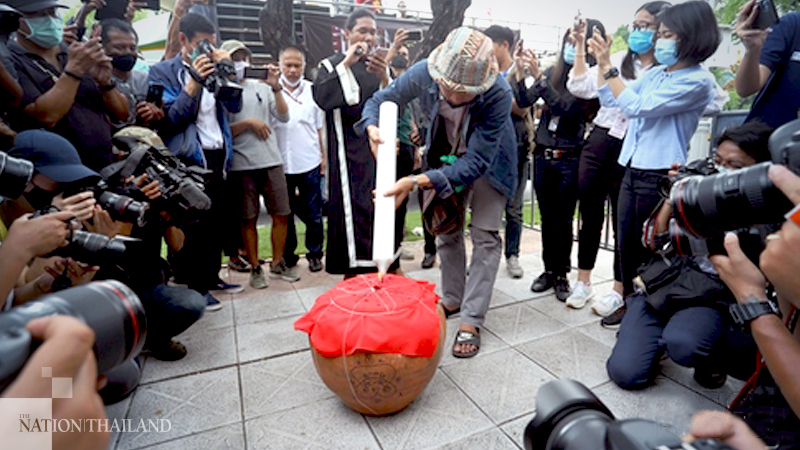
By The Nation Photo Credit: Nation Photo by Wanchai Kraisornkhajit The Free People group held a symbolic ritual in front of the Army headquarters in Bangkok on Wednesday (September 23) to “rid” the country of senators chosen by the junta.
The protesters called on the senators to stop participating in political activities and give up their seats.
The protesters were monitored by officers from the Nang Lerng Police Station.
Similar ceremonies were held on the same day outside the Defence Ministry and headquarters of the navy, air force and police.
Calling for reform of the monarchy – an emergent phenomenon
PoliticsSep 24. 2020The September 19 rally is the first huge night stay-over political protest of its kind since the 2014 military coup.
By Wichit Chaitrong The Nation Analysis
The huge youth-led protests on September 19 and 20 are bound to make history and forever lead to a sea change in Thailand’s political landscape, many academics believe.
The massive crowd joining the protest organised by the United Front of Thammasat and Demonstration group may show that a large number of people are ready to support the call for reform of the monarchy, an issue which has been taboo in Thailand due to the severe lese-majeste law.
Elderly protesters sleep in tents at the rally site in Bangkok’s Sanam Luang on September 19.
Pro-democracy leader Arnon Nampa,35, clearly broke the taboo for the first time during a speech at a demonstration on August 3 and later on August 10, with student leader Panusaya Sithijirawattanakul at Thammasat University’s Rangsit Campus later proposing a 10-point manifesto calling for reform of the monarchy. The two events were unprecedented in recent Thai history since the 1932 revolution, when Thailand changed from an absolute monarchy to a constitutional monarchy.
The anti-government protest has been developing rapidly across the country, especially among university and school students.
Conservatives and even some parents of students have blamed “masterminds” for being behind the student uprising. Some analysts have pointed to a conspiracy theory, accusing politicians and foreign agents of being behind the youth protesters, who also demand that a new Constitution be drafted, Parliament dissolved and an end to government intimidation of its critics.
Former red-shirt activist Bundit holds a banner reading “Waking up Thais, no longer be slaves” at the protest site on the night of September 19.
The emergent phenomenon might better explain the situation than the so-called conspiracy theory. The emergent process is a rather complex outcome generated by the interaction of numerous factors or elements. Many key events have taken place since the coup in 2014, including a crackdown on political dissidents, implementation of a military-sponsored Constitution, an allegedly rigged election, the unfair disbanding of two political parties, unelected senators picking a prime minister, enforced disappearance of individuals critical to the government and the palace, limited freedom of expression, heavy censoring of mainstream media and the proliferation of social media.
These recent developments, together with increasing awareness of human rights and discontent over inequality, are leading to the emergent phenomenon we are all witnessing today.
Regarding the open demand being made for reform of the highest institution, many observers flatly reject the conspiracy theory.
“I don’t believe somebody can trick the students, who have access to information which is globalised ,” Lae Dilokvidhyarat, a labour economist at Chulalongkorn University, told The Nation.
“Should former prime minister Thaksin and Thanathorn actually die, the on-going protest will not stop,” he said, countering the argument by critics that Thaksin Shinawatra and Thanathorn Juangroongreangkit, former leader of the disbanded Future Forward Party, are the masterminds behind the on-going protests.
Lae shared the views of other academics, who said earlier that students were courageous to openly criticise the monarchy while academics and others only wanted to talk about the sensitive issue and did not dare publicly discuss it.
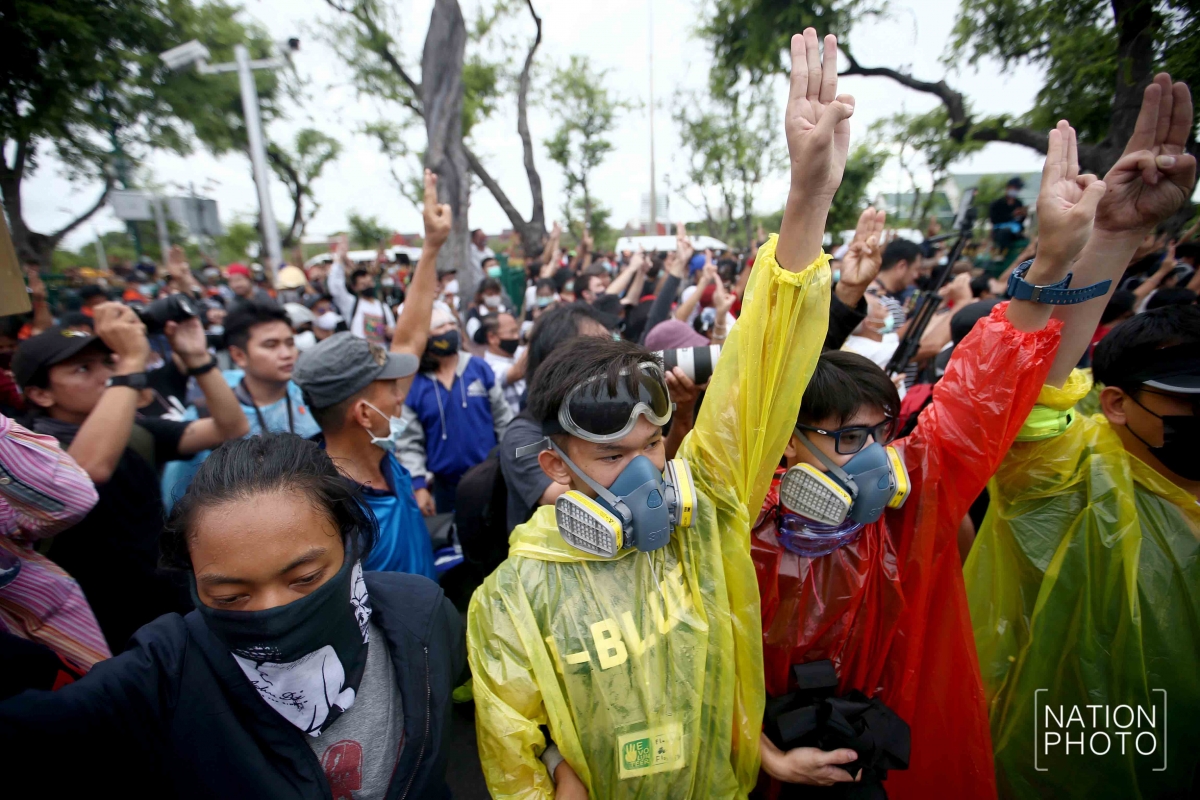
Taking a closer look at the demonstration site, the majority of protesters at the event on September 19 and 20 appeared to be youths, but there were also a large number of elderly people, both from the red shirt group and its rival, the former yellow shirts.
Protester Lek, 73, said he used to participate in protests organised by the yellow shirt conservative group. But he has now changed sides, and on the night of September 19, he acted as a guard for many elderly women who slept in a big tent at the protest site. Most of them are former red shirt protesters who came from provinces outside Bangkok, he said.
Meanwhile Bundit, a former red-shirt activist, held a banner reading “Waking up Thais, no longer be slaves”, welcoming anyone to snap a picture of him or grab a photo with him.
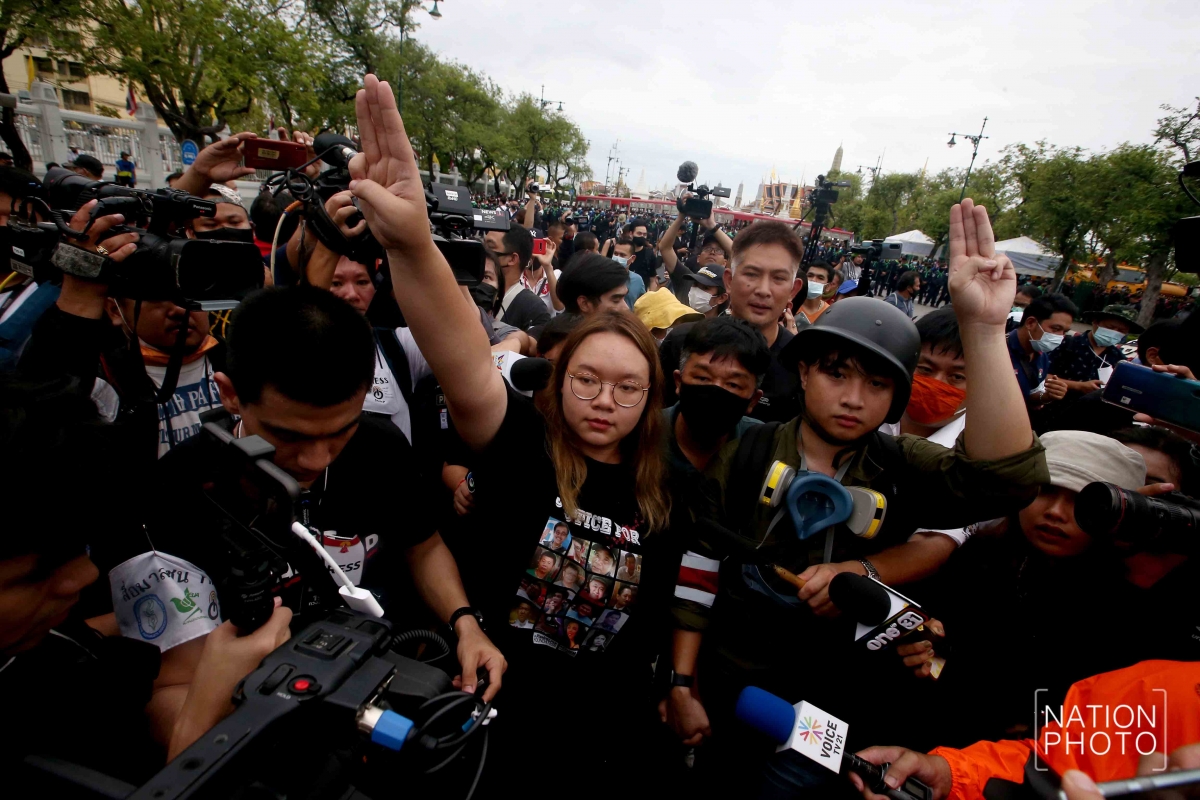
Protester leaders including Parit Chiwarak, 22, Arnon and Panusaya,21,reiterated their stance during speeches demanding palace reform, to the cheers of the large crowd.
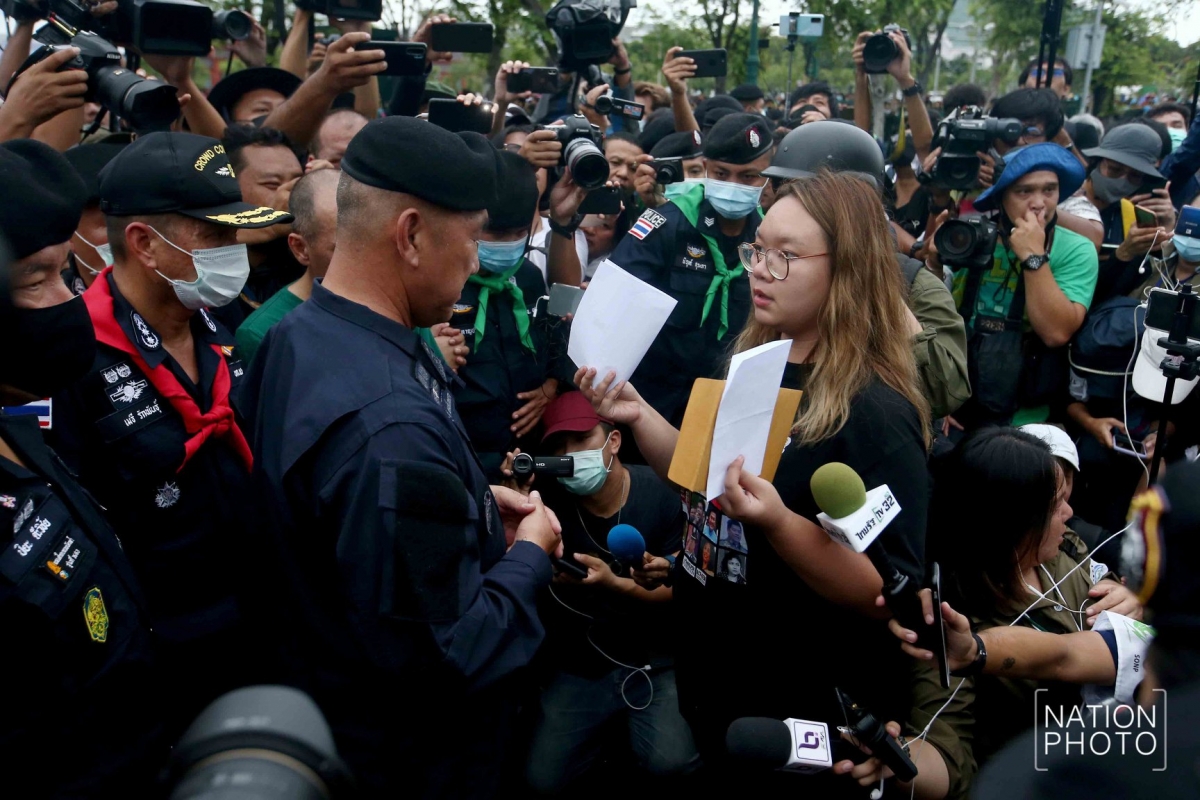
Panusaya Sithijirawattanakul, centre, leads protesters to hand the 10-point manifesto on monarchy reform to a police officer who acted as a representative of the Privy Council on Sunday (September 20).
On the morning of September 20, Panusaya led protesters to hand a letter demanding reform of the monarchy to a police officer, who acted as a representative for the Privy Council, His Majesty the King’s advisory body.
Referring to the first reading of the 10 demands to reform the monarchy on August 10, Manusaya earlier insisted there were no masterminds behind the student movement. Even their university lecturer, who was their adviser, did not know in advance what she would announce, Manusaya said.
Many academics have given credit to the young pro-democracy leaders for their courage to raise the sensitive issue publicly.
“I don’t think anyone could or can influence these students because they have easy access to information,” Titipol Phakdeewanich, dean of political science at Ubon Ratchathani University, told The Nation. “The government should respect their opinions and their youth power,” Titipol suggested.
He pointed out that it is a typical mindset of conservatives to point the finger and raise the bogey of a “suspected masterminded” as they try to de-legitimate youth power.
The September 19 rally also triggered protests in other provinces and in a number of countries in Europe and Asia, as well as in the United States, Australia and New Zealand where Thais live. The aftermath of the protest has also stirred widespread reactions.
Some critics, especially from the conservative camp, have downplayed the significance of the protest, insisting it does not match the student uprising against the dictatorship on October 14, 1973.
Lae, however, thinks otherwise:
“Now, the young generation has raised questions about the monarchy, challenging the old narrative of faith without questions,” he said.
Lae and many observers also see the strength of the young generation in using social media in their fight for full or true democracy.
Titipol shares a similar view, saying that although the September 19 rally has its limits, it nevertheless has significant impact.
The current student-led movement has not yet reached the large-scale student uprising seen in 1976, but it is still significant, while the establishment features a large alliance of military, police, civil servants, royalists and big businesses, he noted.
The government, he lamented, will continue to use legal tools to intimidate the activists.
“In the short run, the establishment may maintain their political power, but in the long run, as the younger generation replaces the old one, the new generation will come to rule,” Titipol argued.
Given the present situation, many are worried about a potential violent clash as the street protest intensifies and government and ultra-royalists continue to implement harsh legal means, such as lese-majeste and sedition charges, against protest leaders.
“To avoid the risk of violence, the two sides must talk,” said Anusorn Tamajai, chairman of the Pridi Banomyong Institute.
Others hope coalition government MPs and senators do not block the demands by the protesters and efforts by opposition MPs to draft a new Constitution.
Today, the rally at Parliament may demonstrate to what extent the protesters can successfully put pressure on MPs and senators.
The Constitutional Court has ruled that neither Palang Pracharat MP Pareena Kraikupt nor Bhumjaithai MP Srinuan Boonlue has violated the law and that they can continue holding their seats in Parliament.
The verdict said that Pareena did not use her position to push locals into demanding that former Future Forward Party leader Thanathorn Juangroongruangkit’s mother Somporn return land believed to be encroaching forest reserves in Ratchaburi’s Chom Bung district.
As for the case against Srinuan, the court said there was no evidence to show she was involved in the Public Health Ministry’s budget, which may have been the reason for her expulsion from the now-defunct Future Forward Party.
Srinuan, who defected to Bhumjaithai, reportedly asked Public Health Minister Anutin Charnvirakul for funds to build new hospitals in Chiang Mai. Anutin is Bhumjaithai leader.
Pheu Thai MP Sompong Amornviwat, who is also opposition leader, brought up the principles and reasons for the existence of Thailand’s Constitution. He was speaking at a joint Senate and House of Representatives meeting in Parliament on Wednesday (September 23).
The opposition has been pushing for the amendment of Article 256, so a charter drafting body can be set up.
However, more than half of the MPs and no less than a third of senators need to vote “yes” to put the amendment through. This requirement, Sompong said, makes amending the charter unnecessarily difficult and slow.
Hence, he said, it will be more appropriate to use majority voting in Parliament as well as a public referendum to push through charter amendments.
As for Articles 270 and 272, Sompong said they go against the principles of democracy and balance of power, especially Article 272 which gives unelected senators the right to choose a prime minister. Article 270 also gives senators a say in the implementation of reforms.
Meanwhile, chief government whip Wirach Rattanaset said the current state of affairs in the country is making it difficult to amend the charter and resolve conflicts.
The Senate approved the national budget bill for fiscal year 2021after a six-hour debate in Parliament on Monday.
The meeting was chaired by Suphachai Somcharoen, deputy speaker of the Senate.
The draft set the budget for the next fiscal year at around Bt3.285 trillion. Several senators debated the budget allocations for several ministries and departments, including the budget earmarked to buy Covid-19 vaccine when it becomes available. None of the senators commented on the budget allocation for the Ministry of Defence.
Of the 224 senators present in the upper house, 218 voted in favour, no one voted against and six abstained.
Deputy Prime Minister and Minister of Energy Supattanapong Punmeechaow, as the government’s representative, thanked the senators for approving the bill, and pledged to use the budget efficiently and in a transparent manner for the sake of all people.
Prime Minister Prayut Chan-o-cha will submit the bill within 20 days for endorsement by HM the King after which it will be announced in the Royal Gazette.
Protesters ended their two-day rally for democracy after pulling off a surprise on Sunday morning by submitting a letter to the Privy Council, outlining their demands to reform the monarchy.
After honouring the national flag at 8am, the Thammasat Coalition leaders came up together on the stage. Parit Chivarak, one of the leaders, surprised everyone when he announced that they would be submitting a letter to the Privy Council with 10 points for reforming the monarchy.
The protesters had all along been getting ready to march to Government House, when Parit announced the “biggest surprise” by saying they would be heading to the Privy Council office.
He emphasised to the protesters to use peaceful means, avoid clashes, control their emotions in the face of police confrontations and “go home safely”.
He also urged General Surayud Chulanont, president of the Privy Council, to personally come out and receive their letter.
At 8.45am, Panusaya ‘Rung’ Sithijirawattanakul, one of the leaders, was allowed to come up to the police line in front of the Supreme Court to submit the open letter outlining 10 points to reform the monarchy. A huge number of protesters waited on the road in front of the Supreme Court.
At 9.01am, a representative of the Privy Council, Pol Lt-General Phukphong Phongpetra from the Metropolitan Police Bureau, accepted the letter.
Rung walked back from the police line with co-leader Arnon Nampa, announcing victory.
Some observers believe the protest leaders had deliberately misled everyone by announcing plans to march to Government House when they actually intended to go to the Privy Council Office.
The protesters, however, were blocked by police near the Supreme Court and they ended up submitting their demands to a police officer, who received it on behalf of the Privy Council.
Protest leader Parit Chiwarak has called for a nationwide labour strike from October 14 as part of steps he has laid out to fight for the restoration of full democracy.
The labour strike would also commemorate the student-led uprising for democracy on October 14, 1973.
In a post on Facebook on Sunday, Parit, also known as Penguin, a leader of the United Front of Thammasat and Demonstration group that are organising the pro-democracy rallies, suggested eight ways in which everyone could play a role in fighting dictatorship:
“1. Stand straight, raise three fingers, respect the national flag, be it at home, school, shopping mall, bus station or a flea market.
2. When the Royal anthem is played in a cinema hall, do not stand up, but instead show three fingers.
3. Tie white ribbons to a fence, bag, or the wing mirror of your vehicle.
4. When you see a procession of dignitaries, whoever it is, honk loudly at them.
5. Place anti-dictator signboards along the overpass or at various communities, etc.
6. When [Prime Minister] Prayut [Chan-o-cha] visits any area, ask the local people to sign up to not welcome dictators.
7. Go on a strike from October 14 at the same time across the country.
8. Break the dictator’s account: ban SCB bank.”
Meanwhile, Parit announced on Sunday that the weekend rally would end at 9am, and the next rally would be held on September 24 in front of Paliament House to press their demand for amending the Constitution.
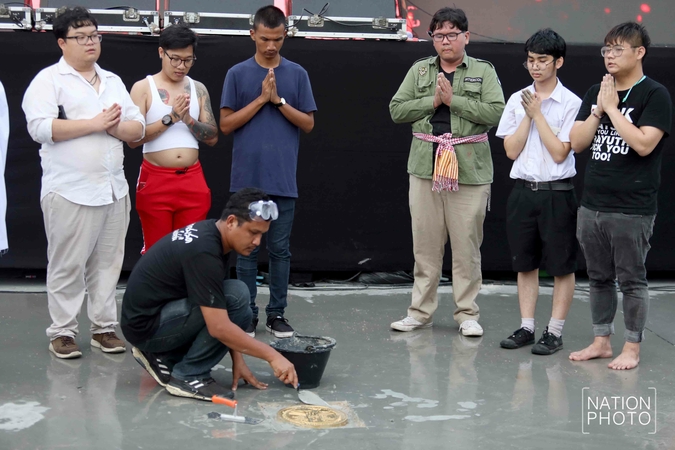
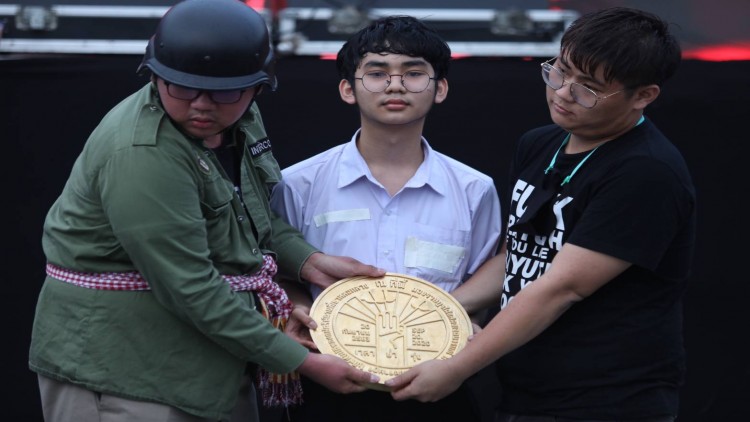
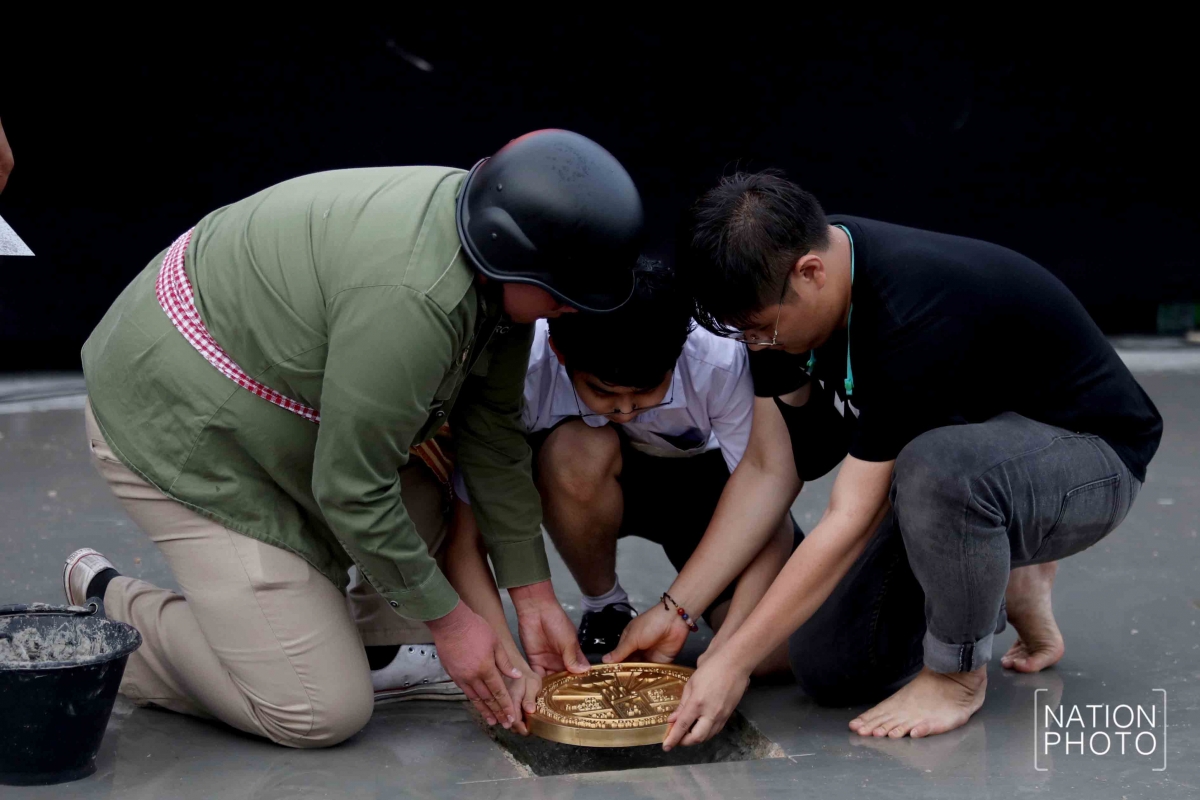
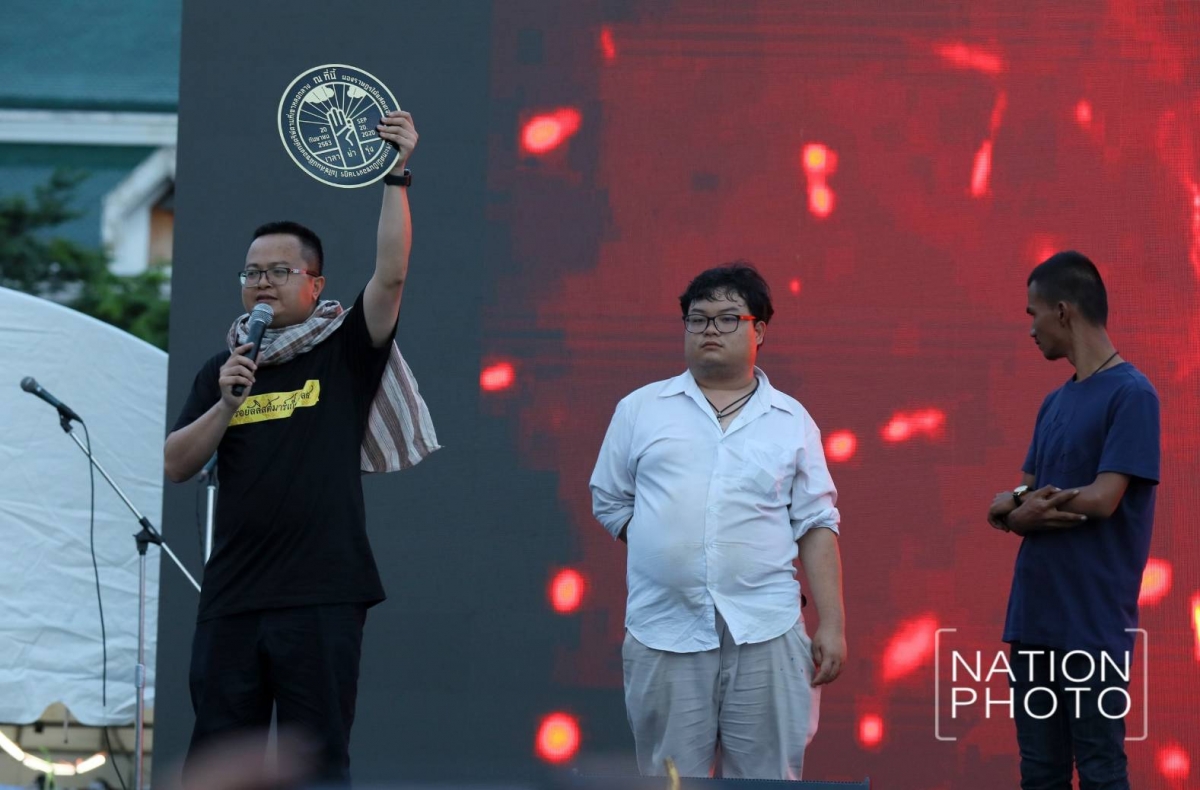
Anti-government protesters stepped up their defiance of the authorities by installing the “2020 coup memorial plaque” at the rally site in Sanam Luang in Bangkok on Sunday morning.
Tens of thousands of people began a pro-democracy rally on Saturday in Bangkok, bringing together protesters from across the country.
Music began playing at the rally site from as early as 6am on Sunday, as protesters stayed overnight.
The main protest organisers, the United Front of Thammasat and Demonstration group, at 6.41am installed a brass Khana Ratsadon (People’s Party) memorial plaque, similar to the plaque commemorating a 1932 coup. Khana Ratsadon (People’s Party) was a group of military and civil officers that led the 1932 revolution on June 24, 1932, changing the political system from absolute monarchy to constitutional monarchy.
The 1932 revolution memorial plaque had been installed at Royal Plaza in Bangkok’s Dusit district. However, on April 14, 2017 it was found missing and replaced with an ultraroyalist plaque.
The protesters on Sunday drilled the plaque into the concrete floor near the protest stage with the message that Thailand belongs to the people and not to the monarch.
“On this September 20, there will be an important ceremony, which is to place the memorial plaque of the Khana Ratsadon cast in brass, 11 inches [28 centimetres] in size, in the early hours of September 20 and jointly announce that this country belongs to all citizens. Today [September 19], the Khana Ratsadon 2020 has officially formed at this People’s Court. Tomorrow, the Khana Ratsadon announcement No. 2 will be read and everyone will be free,” anti-government protest leader Arnon Nampa said on Saturday night during his speech.
On Sunday at 8am, the leaders of the United Front of Thammasat and Demonstration have decided to march to Government House while officers have barricaded the area since last night.
The fiscal 2021 budget bill sailed through the House of Representatives on Friday (September 18) night after three days of debate.
The budget for the next fiscal year has been set at around Bt3.285 trillion. Of the 456 members of Parliament present in the house, 269 MPs voted in favour, 60 voted against and 127 abstained from voting.
Prime Minister General Prayut Chan-o-cha thanked the House for passing the bill, and vowed to use the budget for strengthening the country’s economy, ensuring sustainable development, reducing disparity and disbursing aid to all people throughout the country in a transparent manner. He also thanked the special committee on budget bill revision who carefully revised the draft based on suggestions from the MPs over the past three days.
Deputy House Speaker Suchart Tancharoen, who chaired the session, announced the conclusion of the meeting at 11.28pm. However, Amornrat Chokpamitkul, a party-list MP of Kao Klai Party raised her hand asking for a chance to discuss with the prime minister about the ID cards of people travelling from upcountry to Bangkok being checked. Suchart refused to give her the floor, as the topic was not on the agenda and turned off her microphone. Amornrat then approached the PM and had a word with him, but the details of their discussion were not revealed.


 The September 19 rally is the first huge night stay-over political protest of its kind since the 2014 military coup.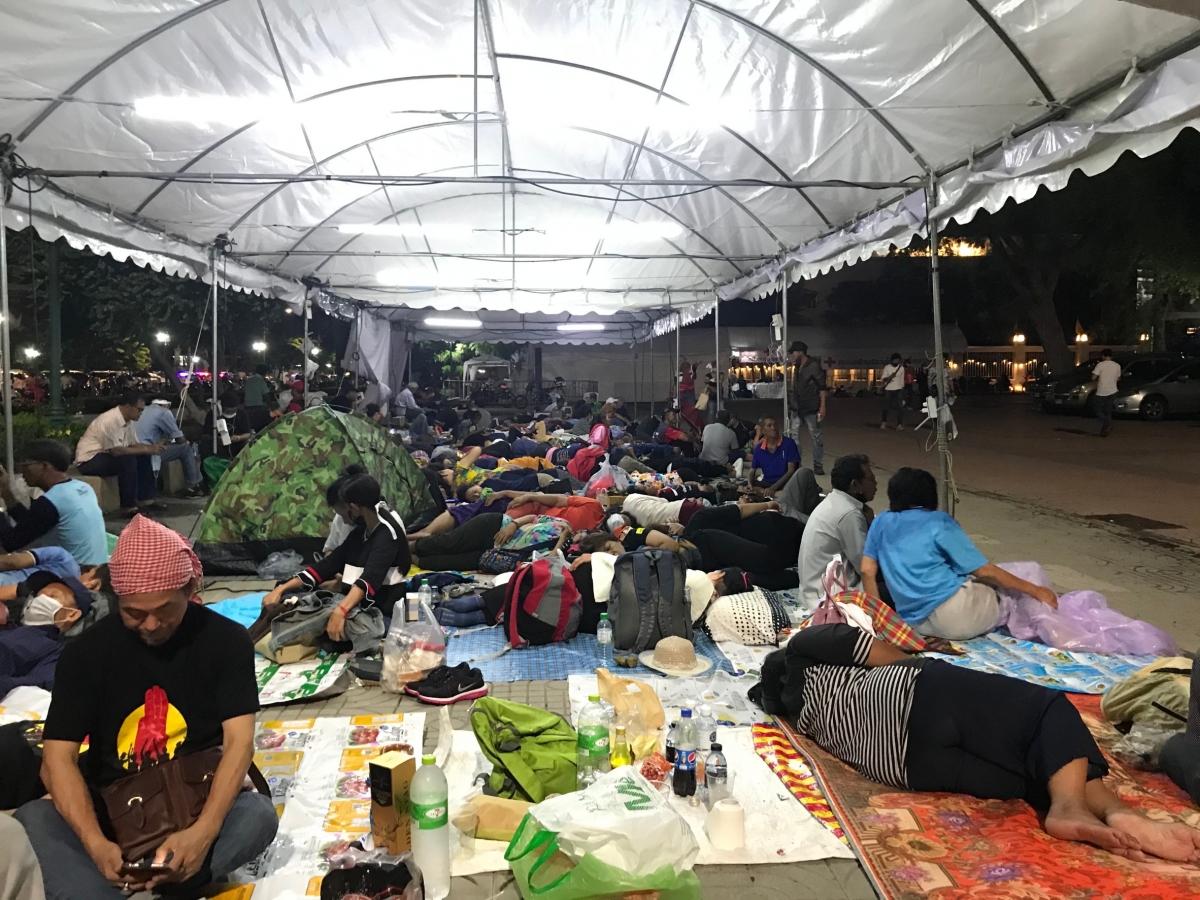

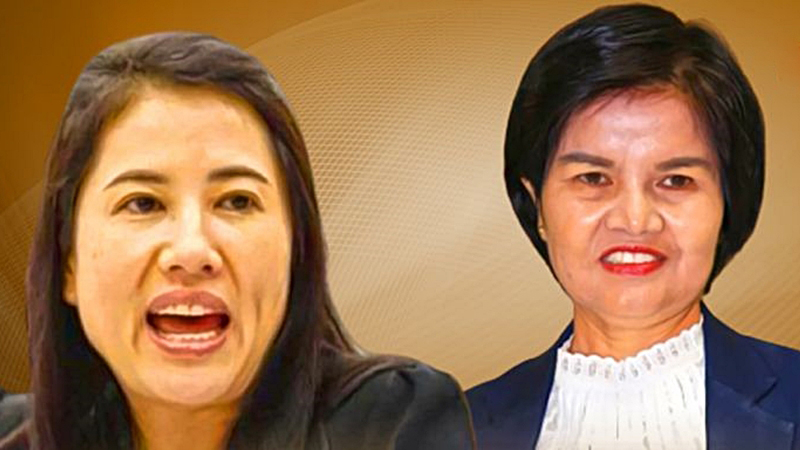 Pareena Kraikupt (Left), Srinuan Boonlue (Right)
  Pheu Thai MP Sompong Amornviwat
  (File Photo)


 SootinClaimon.Com