Amnesty urges new govt to lift restrictions on freedom of expression, limit arbitrary powers

ศาสตร์เกษตรดินปุ๋ย : ขอบคุณแหล่งข้อมูล : หนังสือพิมพ์ The Nation

http://www.nationmultimedia.com/detail/politics/30365166

Photo courtesy of Amnesty International Thailand

Amnesty urges new govt to lift restrictions on freedom of expression, limit arbitrary powers

politics March 04, 2019 17:43

By The Nation

The next government has been urged to lift undue restrictions on freedom of expression and limit arbitrary executive powers, as the country heads towards a general election on March 24.

“The new administration should end the criminalisation of peaceful dissent and other arbitrary limitations on freedom of expression,” Katherine Gerson, Amnesty International’s Thailand campaigner, said in a statement released on Monday.

“Over the last 10 years of political instability, the Thai authorities have often invoked national security to silence perceived critics and peaceful political opponents, and that has severely undermined trust in the country’s legal institutions,” she said.

“The next government must respect human rights, even in emergencies. It will need to strengthen legal protections to prevent the serious human-rights violations that have flourished under military rule and in the absence of accountability,” she added.

Amnesty International also called for parliamentary candidates, and those elected to the next government, to commit to Amnesty’s “Human Rights Agenda” for Thailand, which outlines nine top human-rights issues that they must prioritise.

These include the rights to freedom from torture and enforced disappearance, freedom of expression, and freedom of assembly and association, as well as the right to privacy in the design of cyber-security measures, Gerson said.

Other areas covered in the body’s “Human Rights Agenda” include establishing stronger protections for refugees and people seeking asylum, and abolishing the death penalty.

“The recent cases of Rahaf Mohammed and Hakeem Ali al-Araibi captivated millions of people around the world. Their ordeals starkly illustrate the risk to refugees of forcible return to places where they face huge danger,” Gerson said.

“The Thai government should act on its past commitments to improve the protection of refugees. With this election, the government should commit to codifying its respect for refugees into law,” she stressed.

Court acquits 21 yellow-shirt leaders over 2008 siege of Parliament

ศาสตร์เกษตรดินปุ๋ย : ขอบคุณแหล่งข้อมูล : หนังสือพิมพ์ The Nation

http://www.nationmultimedia.com/detail/politics/30365159

Court acquits 21 yellow-shirt leaders over 2008 siege of Parliament

politics March 04, 2019 17:00

By The Nation

2,079 Viewed

The Criminal Court on Monday acquitted 21 leaders of the now-defunct yellow-shirt movement in a case concerning the besieging of Parliament back in 2008.

The 21 leaders of the People’s Alliance for Democracy (PAD) had been accused of five crimes, including sedition.

The lawsuit stemmed from an October 2008 protest in which they led thousands of protesters to besiege the Parliament compound and block parliamentary members, Cabinet ministers and the then-prime minister, Somchai Wongsawat, from entering the chamber.

The demonstration escalated into a clash between security officers and protesters, resulting in injuries and damage to parliamentary properties.

Among the 21 found not guilty were five core PAD leaders who had already been imprisoned for other charges related to anti-government demonstrations at the time, including former media mogul Sondhi Limthongkul.

The court ruled that the political speeches made during the October 2008 protest had only been informative, providing facts concerning relations between the Somchai government and fugitive former PM Thaksin Shinawatra and their attempt to bring Thaksin back to Thailand.

Hence, the protest was deemed to have been peaceful and protected by constitutional rights as a way to scrutinise politicians by giving information to the people, the court said in acquitting the 21 protest leaders of the charges against them.

Thai general who led coup pines for ‘democracy’ in election ballad

ศาสตร์เกษตรดินปุ๋ย : ขอบคุณแหล่งข้อมูล : หนังสือพิมพ์ The Nation

http://www.nationmultimedia.com/detail/politics/30365155

File photo: Prayut Chan-O-Cha

Thai general who led coup pines for ‘democracy’ in election ballad

Breaking News March 04, 2019 16:30

By Agence France-Presse
Bangkok

2,653 Viewed

Junta leader Prayut Chan-O-Cha dropped his latest saccharine pop ballad on the Thai public Monday, pining for the “democratic path” nearly five years after he seized power from the country’s last elected government.

A former army chief who wants to return after March 24 polls as a civilian prime minister, Prayut has penned several ditties intended to inspire the nation since seizing power in 2014.

“New Day”, released on YouTube, captures the famously gruff 64-year-old general in reflective mood.

“We are looking for a new day in Thailand’s history… towards the democratic path,” the pop number — sung by two soldiers — says.

    “A ‘New Day’ for Thailand is coming so we can solve the mistakes of the past.”

Thailand remains deeply polarised five years after the army booted out the government of Yingluck Shinawatra from office.

Prayut led the coup, saying his hand had been forced after months of bloody protests against Yingluck’s government.

He has since clung on to power, repeatedly pushing back elections, muzzling dissent and carving out a new constitution which embeds the military’s role in politics for the next 20 years.

That has outraged Thai pro-democracy supporters, a disparate group which spans rice farmers and the urban poor, Bangkok middle classes and millenials who have spent large chunks of their life under junta rule.

The bloodless 2014 coup took out the elected government of Yingluck Shinawatra. Eight years earlier the army toppled the administration of her elder brother Thaksin, the billionaire ex-premier who heads the powerful political clan.

Thais have not had a general election since 2011.

After years of military rule, new electoral forces are emerging, muddying Thailand’s once clear political division between those who support the Shinawatras’ and the arch-royalist, conservative camp which is wedded to the army.

Future Forward, a party led by a photogenic billionaire has gained traction among Thailand’s youth for its strident anti-junta stance and vow to address inequality.

Seven million people aged 18-25 are eligible to vote for the first time this month.

“Our agenda has become the public’s agenda,” Future Forward leader Thanathorn Juangroongruangkit told AFP during campaigning on Sunday.

“We are making progressive ideas attractive again… sexy again.”

Prayut to campaign in Nakhon Ratchasima

ศาสตร์เกษตรดินปุ๋ย : ขอบคุณแหล่งข้อมูล : หนังสือพิมพ์ The Nation

http://www.nationmultimedia.com/detail/politics/30365147

file photo
file photo

Prayut to campaign in Nakhon Ratchasima

politics March 04, 2019 13:22

By The Nation

Junta leader Gen Prayut Chan-o-cha is set to appear on his election campaign stage in his Nakhon Ratchasima hometown next Sunday following the Election Commission (EC)’s ruling that he could do so despite his current status in the government.

Phalang Pracharat Party member from Nakhon Ratchasima Chamlong Krutkhuntod said on Sunday that Prayut, as the party’s candidate for prime minister would appear on the campaign stage alongside local constituency candidates.

According to Chamlong, Prayut would address his work in the past five years, focusing on how he had restored peace and order to the country as well as solved poverty through state welfare projects.

Sunday’s campaign stage will be the first Prayut has agreed to join after refusing to take part in any the prime ministerial debates last week.

Chamlong said it was expected that at least 20,000 voters from all constituencies in Nakhon Ratchasima would attend the event.

Former EC member Somchai Srisuthiyakorn, now running in the election under Democrat Party, however, warned Prayut not to abuse state resources in the election rally.

Prayut can only help in the election campaign outside office hours and should not use any PM privileges such as office cars or bodyguards during the rally.

Old habits return in election campaigning

ศาสตร์เกษตรดินปุ๋ย : ขอบคุณแหล่งข้อมูล : หนังสือพิมพ์ The Nation

http://www.nationmultimedia.com/detail/politics/30365119

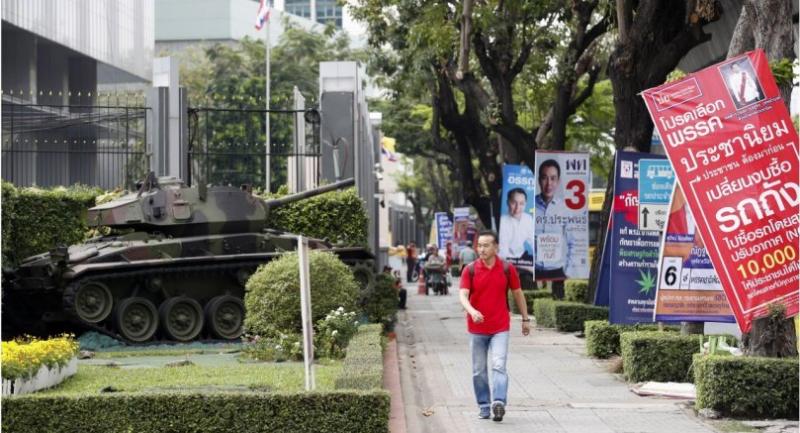
A Thai pedestrian walks past electoral campaign posters installed next to an army tank outside the 2nd Cavalry Division King's Guard in Bangkok, Thailand, 14 February 2019. // EPA-EFE PHOTO
A Thai pedestrian walks past electoral campaign posters installed next to an army tank outside the 2nd Cavalry Division King’s Guard in Bangkok, Thailand, 14 February 2019. // EPA-EFE PHOTO

Old habits return in election campaigning

politics March 04, 2019 01:00

By JINTANA PANYAARVUDH
THE NATION

3,017 Viewed

Campagining ahead of the March 24 election is getting livelier – and a little too heated in the view of some observers.

The old habit of rivals slinging mud at one another has revived in several constituencies, prompting critics to raise concerns about the quality of the view of some observers.

“The world has evolved but Thai politicians have failed to develop or employ new, creative methods in their campaigns to attract voters,” said Wilaiwan Jongwilaikasaem, associate dean for academic affairs at Thammasat University’s Faculty of Journalism and Mass Communication.

A Thai woman walks next to an electoral campaign poster of Bhumjaithai Party with its policy calling for unrestricted growing of marijuana and proposing cannabis as the country’s new cash crop, in Bangkok, Thailand, 14 February 2019. // EPA-EFE PHOTO

She notes that traditional posters and banners were still being used to familiarise voters with the candidates, though some parties are also making good use of social media and info-graphics.

However, she said, there was still a lack of focus on policies and the overall campaign is instead being used to propagate hate speech and smear rivals.

Voters will inevitably have difficulty deciding whether some accusations in circulation are even factual, Wilaiwan said.

“We expect the 7 million first-time voters, including those who have just turned 18, to be enthusiastic about casting their ballots. But what concerns me the most is whether their votes will be ‘quality votes’.”

A young couple walks past political parties’ electoral posters on a sidewalk in Bangkok, Thailand, 20 February 2019. // EPA-EFE PHOTO

Wilaiwan also wonders whether new voters will be able to play a major role in changing the face of politics, especially given such a short time before election day.

Although some young voters are interested enough to look into candidates’ qualifications and verify whether claims made are true or false, she pointed out that many more are attracted to specific candidates based only on their celebrity status.

The academic cited presidential elections the United States where there are typically only two rivals and they compete on policy. Candidates win or lose depending on what their parties have to offer.


Domination of populism

Fugitive former premier Thaksin Shinawatra’s now-defunct Thai Rak Thai Party introduced a slew of populist policies in the 2001 campaign and they’ve remained a signature of the Shinawatra camp, never failing to win elections. In fact, the policies are so popular that the camp has continued winning, no matter what the party’s name, be it the now-disbanded People Power Party or the current Pheu Thai Party.

This time around, though, many other parties are also embracing populist policies.

The main message candidates have been delivering to voters has not changed much, with many parties’ political discourses still “trapped” in either the fight for democracy or populist policies, said Titipol Phakdeewanich, dean of political science at Ubon Ratchathani University.

The Democrat and Future Forward parties are leaning towards populism, while the pro-junta Phalang Pracharat is disguising its policies under the theme of “reconciliation”, he said.

“But in reality, these discourses do not reflect any changes in Thai politics,” he said.

For instance, he said, the Democrat and Future Forward parties are offering a welfare state but have yet to show how it will be sustainable or if recipients would be self-reliant.

Phalang Pracharat Party is relying on the reconciliation discourse to explain why the military is still necessary to maintain order. It doesn’t understand true democracy, Titipol said.

The political discourse used by pro-junta parties is undermining the progress of Thai democracy, he added.

However, he said, though the election is not expected to bring massive change to society, it will at least encourage voters to pay more attention to democracy.

A boy sits between electoral posters of Democrat Party during a campaign in Thailand’s southern province of Narathiwat on February 16, 2019. // AFP PHOTO

“I think this election is more like a referendum on democracy or an indicator of how desperately Thai voters want democracy, rather than actually returning to true democracy. What we will have is just |pseudo-democracy,” he said.

“This election is being held just so that Thailand can be a part of international democracy. Otherwise it will be difficult for it to promote its economic policies internationally.”

Titipol, who lectures on political communication, said the most important concern was not about what politicians convey to voters, but rather voters being open to two-sided information.

“It doesn’t matter who you support, but you should make time to listen to all opinions so you can make a good decision,” he said.


Confusing posters

The easiest way for foreign visitors to recognise that Thailand is going to polls is that urban streets are clogged with candidates’ posters and banners.

This time, however, the Election Commission has barred parties and candidates from buying commercial advertising in print or on radio or television. The aim is to create a level playing field for everyone, so each party now has a slot on TV where it can air its policies.

Candidates thus have to rely more heavily on posters and visiting voters. Yet Wilaiwan finds the posters lining Bangkok streets more confusing than informative.

In previous elections, the poster’s main objective was to remind voters about who was running for which party and under what ballot number. The law now requires candidates, even of the same party, to have their own numbers. It renders the posters useless because they fail to achieve a key task, Wilaiwan said.

“This confusion could lead to many voided ballots in this election. Also, I’m afraid voters will be more easily influenced by canvassers,” she said.

Banners along the streets remain necessary and important, especially for rural voters who have limited access to candidates via other channels such as social media, said Professor Surapongse Sothanasathien, acting chair of the university council at Rajamangala University of Technology Phra Nakhon.

However, he said, the posters being used this time are less attractive even as they seem to follow the same style as in previous elections.

Surapongse, an expert in political communication, said an effective poster displays not just the candidate’s name, face and number, but also the party’s slogan, the constituency involved and the election date. A party’s logo or symbol is also important because it emphasises the party’s stance, he added.

Also, he said, logos of established parties like the Democrats and Pheu Thai are easily recognised and their meaning understood, but those of new parties like Future Forward are difficult to comprehend.

“The angled ‘spearhead’ might look cool and attract young voters, but I don’t understand what message they’re trying to convey,” the professor said. He believes this election season’s campaigns are failing.

“The atmosphere is not as exciting as it should be. Fewer advertisement spots and lacklustre debates [organised by other institutions] have made things not so interesting.”

New cyberlaw ripe for abuse, activists warn

ศาสตร์เกษตรดินปุ๋ย : ขอบคุณแหล่งข้อมูล : หนังสือพิมพ์ The Nation

http://www.nationmultimedia.com/detail/politics/30365116

File photo // AFP PHOTO

New cyberlaw ripe for abuse, activists warn

national March 04, 2019 01:00

By KAS CHANWANPEN,
ASINA PORNWASIN
THE NATION

3,474 Viewed

Election candidates urged to push for changes to prevent misuse by officials.

RIGHTS ORGANISATIONS and activists have red-flagged the recently approved cybersecurity law and are urging candidates in the March 24 election to push for amendments to narrow its interpretation and guard against infringements on freedom of expression and freedom of privacy.

While legislators insist that the law’s objective is to prevent attacks on the national computer system and would likely have no effect on online content, freedom watchdog group iLaw cites issues with Article 59 of the bill.

One clause lists challenges to peace and social order and to national security among cyberthreats.

The group says the clause could be interpreted to allow state action against any online content deemed offensive, and perhap also give the authorities access to the personal data of government critics. It could thus be abused to curtail freedom of expression, iLaw said.

It also sees potential for infringements on individual privacy.

Articles 61, 65 and 67 could enable the authorities to seize citizens’ personal communications devices if there was perception of a cyberthreat, iLaw said.

Court authorisation of such actions in the form of warrants could be issued retroactively, after the fact, and any data retrieved could be used to prosecute the device’s owner, it said – and in any criminal matter, not just instances of cybersecurity.

Sarinee Achavanuntakul, a champion of internet rights, echoed the concerns, stressing that the law requires stricter, narrower definitions. The legislation will have a significant impact on society and sets out hefty penalties for anyone convicted of crimes, Sarinee pointed out. Any possibility of the law being abused must be eliminated.

Proponents of the law have argued that the rights activists were simply biased towards the government, but Sarinee countered that anti-government groups had already learned the hard way that such legislation can be and is abused by people in authority.

She noted that the Computer Crime Law prohibits posting false information online to protect citizens from scams, but instead the junta-led government has often used it to silence and harass its critics, including former politicians and activists.

“I see this law as the product of some tug-of-war between security officials and legislators who knew more about the computer system,” Sarinee said. “Clearly, the computer experts lost, but they must have known that this goes far beyond merely protecting the computer system.”

‘Watch out’

So it’s crucial that the law be red-flagged now, she said. It has already been passed and awaits royal endorsement, but she urged citizens and the news media to keep their eyes on related organic laws to prevent further infringements on rights.

Sarinee said the political parties whose members had fallen prey to abuses of similar laws should press for amendments to this one.

People who work in data collection say the law is aimed at protecting the cyber infrastructure and would have no direct impact on online content.

The Personal Data Protection Act, also approved last week, would protect all of the individual information kept by service providers, said Apisilp Trunganont, co-founder and managing director of Pantip.com.

Patterned on strict European regulations, it has two main principles, he said. It requires data keepers to inform owners what they have stored and why, and it gives users the right to access their data and to ask that it be corrected or removed at any time.

Apisilp said Pantip.com planned to adjust its data collection to be in compliance with the new law. It will need a new feature allowing users to inform the site administrators that they don’t want their personal data stored.

“It’s an extra cost for further development, but not much,” he said. “It’s just a matter of adjusting the web page to display information about the law.”

Pantip has 5 million users, counting by ID or login. Their personal data includes email addresses and an ID number. Messages and comments posted are not considered personal data.

The site deletes within 15 days other personal data shared during registration.

The Computer Crime Law requires the site to store users’ traffic data for 90 days.

Shinawatra parties rally across Thailand as crucial court ruling looms

ศาสตร์เกษตรดินปุ๋ย : ขอบคุณแหล่งข้อมูล : หนังสือพิมพ์ The Nation

http://www.nationmultimedia.com/detail/politics/30365092

Thai Raksa Chart Party's member Chaturon Chaisang speaks to supporters during a campaign rally for the general election outside the Bangkok Metropolitan Administration, in Bangkok on March 1.//EPA-EFE
Thai Raksa Chart Party’s member Chaturon Chaisang speaks to supporters during a campaign rally for the general election outside the Bangkok Metropolitan Administration, in Bangkok on March 1.//EPA-EFE

Shinawatra parties rally across Thailand as crucial court ruling looms

Breaking News March 03, 2019 01:00

By AFP

2,884 Viewed

Parties aligned with Thailand’s powerful Shinawatra clan are staging major rallies this weekend ahead of a court ruling that could deal a gut punch to their prospects in national elections later this month.

Public gatherings are set to be held across the country Saturday — including in the Chiang Mai hometown of divisive billionaire ex-premier Thaksin Shinawatra.

Thaksin, who lives in self-exile to avoid jail in Thailand, is adored by rice farmers and large sections of urban working-class voters for his pro-poor policies and steering of the economy.

But he is despised by the royalist elite, whose allies have failed to beat him at the polls since 2001 and instead have relied on coups and court rulings to topple Shinawatra-backed governments.

Thousands of people massed in Bangkok’s historic centre late Friday for a defiant campaign by Thai Raksa Chart, one of several parties linked to the Shinawatra clan.

But Thai Raksa Chart could be dissolved by the Consitutional Court on March 7, after its bid to run a princess as candidate for prime minister spectacularly unravelled.

Supporters say the court has the future of Thai democracy in its hands — with the junta determined to return as a civilian government.

“If it is dissolved it will damage our hopes for democracy badly,” said Chailerm Phothijad, 55, at Friday night’s rally in Bangkok.

Thailand, which has been stuck on a carousel of coups, violent protests and short-lived civilian governments since 2006 when the army booted Thaksin from office, remains deeply polarised.

Nerves are mounting inside Thai Raksa Chart as the crucial ruling nears. But the party “will continue to campaign as we have been… and leave the issue of judiciary to the court,” said Umesh Pandey, a Thai Raksa Chart party list candidate.

Thailand’s contentious junta-drafted constitution allows the junta to appoint the 250-member senate, whose votes will count towards choosing the next prime minister.

There are 500 lower house seats up for grabs, 350 through constituencies and the remainder through the party list — a system of proportional representation meant to give smaller parties a foothold.

Junta leader Prayut Chan-O-Cha, who took power in a 2014 coup, wants to return as prime minister. With Thai Raksa Chart’s political fate in the balance, another anti-junta party led by a billionaire is emerging as an untested — but significant — force.

Future Forward, led by Thanathorn Juangroongruangkit, the 40-year-old scion of Thailand’s biggest auto-parts maker, has won favour among the kingdom’s millennials.

More than seven million people aged between 18 and 25 are eligible to vote this month for the first time, according to the Interior Ministry.

Analysts say if Thai Raksa Chart is disbanded its supporters may cast votes for Future Forward.

Royal Command against Princess Ubolratana’s PM run not legally binding, says law professor

ศาสตร์เกษตรดินปุ๋ย : ขอบคุณแหล่งข้อมูล : หนังสือพิมพ์ The Nation

http://www.nationmultimedia.com/detail/politics/30365082

Royal Command against Princess Ubolratana’s PM run not legally binding, says law professor

politics March 02, 2019 14:48

By Kas Chanwanpen
The Nation

The Royal Command issued by the King against his sister’s nomination as a candidate for prime minister had no legal binding, law professor Sawatree Suksri said on Friday.

Speaking at a public forum “Thai Raksa Chart party’s possible dissolution” held at Foreign Correspondents’ Club of Thailand on Friday, the professor said that considering both the legal system and the regime, the Royal Command issued two weeks ago disapproving the nomination of Princess Ubolratana Mahidol as Thai Raksa Chart Praty’s pm candidate, was not a law.

Thailand generally follows the civil law system, Sawatree said. To consider something a law, it must be written and passed by the legitimate legislative process as well as imposed on all people equally not specifically, she said.

This is unlike the common law system where opinions and past judgements are laws, she said.

The professor said Thailand works under a democracy with constitutional monarchy. The law states that the King can exercise power for the people but it must be through the three branches of power.

Considering these two frameworks, it can be said that the Royal Command was not a law, Sawatree concluded.

She said that another crucial question was whether the Royal Command should have a legal binding effect. The form and the content of the command should be examined, she said.

The Royal Command came out as the King’s personal note, she said, and was not countersigned by any agent in the three branches of power.

Unless this was about appointing or removing a members of the privy council or the King’s personal servants, she said the command has no legal effect.

Looking at the content, the command addressed the monarchy’s non-partisanship in politics and expressed the King’s disapproval of Princess Ubolratana being involved in it, Sawatree said.

The Royal Command imposed no orders on anyone, she added. So, it can be concluded that it was mere opinion, she said.

However, given the monarchy’s status in the country, it must be admitted that his opinion carries some weight, she said, adding that courts, judges and legal authorities may take on the King’s opinion according to their personal ideology.

Therefore, she said, the authorities should not take the Royal Command as a law if they uphold democracy with a constitutional monarchy.

However, if they leaned towards the absolute monarchy regime, it was likely that they would adopt it as a legislation, she said.

Also speaking at the panel, former Election Commission member Somchai Srisuthiyakorn viewed the status of the Royal Command differently.

Though Thailand is not ruled by the absolute monarchy regime, the monarchy is still the head of the state, he said, and the Royal Command should be respected. And when it disapproved of the controversial nomination, it must be nullified accordingly, he said.

Careful what you promise

ศาสตร์เกษตรดินปุ๋ย : ขอบคุณแหล่งข้อมูล : หนังสือพิมพ์ The Nation

http://www.nationmultimedia.com/detail/politics/30365055

  • Pheu Thai Party
    Pheu Thai Party

Careful what you promise

national March 02, 2019 01:00

By Wichit Chaitrong
The Nation weekend

2,957 Viewed

Depleted coffers, unpopular taxes, army resistance could leave ambitious welfare proposals unfulfilled

Political parties face formidable challenges if they intend to pursue their generous welfare pledges in earnest. If they are elected to govern, they’ll have to deal with a shortfall in tax revenues, inevitable coalition horse-trading and the inherent difficulties of trimming the defence budget.

The Future Forward Party has pledged to spend Bt650 billion annually on comprehensive social welfare, tacking Bt300 billion more on top of the current outlay. The party is promising monthly cash grants for children, youth and the elderly.

The proposal echoes a scheme once suggested by independent economist Somchai Jitsuchon, who also suggested boosting cradle-to-grave social welfare expenditures by Bt300 billion.

The Democrat Party has pledged universal grants of Bt1,000 per month for children up to age eight. Its plan for free education through vocational level is equally ambitious, since so many parents currently have to borrow from the Student Loan Fund to afford tuition fees, burdening them and often resulting in loans going unpaid.

The Pheu Thai Party has promised subsidies for rice farmers of Bt5,000 per tonne per family, up to a maximum output of 15 tonnes. It also vows to boost the minimum wage to help low-income earners. The party has done won all of the most recent elections, thanks in large part to its populist policies.

The Phalang Pracharat Party has pledged to cut the personal income tax rate by 10 per cent and increase wages.

The Action Coalition for Thailand Party is proffering cash transfers for underprivileged families, 12 months’ compensation for the unemployed and free vocational education.

Shortfalls in government revenues, however, are likely to render most if not all of these promises impractical.

Thai governments have run fiscal deficits ever since the 1997 Asian financial crisis, pushing public debt to 42 per cent of gross domestic product currently. That figure is expected to rise to 48.5 per cent in 2023 due to accelerated investment in major infrastructure.

That severely limits any additional spending on social welfare.

Future Forward has proposed higher land and building taxes as one solution to overcome budget constraints, arguing that the rates set out in legislation passed recently by the National Legislative Assembly were low.

Chatu Mongol Sonakul, leader of the Action Coalition, advocates merging the Revenue, Customs and Excise departments for more efficient collection of taxes.

Pairoj Vongvipanond, former dean of economics at Chulalongkorn University, agreed that land and building taxes could be higher, but the idea could prove unpopular among partners in any coalition government.

Chatu Mongol did not endorse a tax hike on land and property, because he said some people do not generate income from their real estate.

Somchai has long urged governments to increase the value-added tax from the current 7 per cent to 8 or 10 per cent to generate more funds for welfare schemes. No major political party has as yet dared support the notion, though, fearing damage to their popularity.

Constitutional requirements are likely to result in rival parties attempting to form a governing coalition, necessitating compromises over their stated policies.

Ambitious welfare proposals by some parties could thus fail to be implemented.

“They may have different proposals, but they’ll have to compromise if they join a coalition government,” said Chatu Mongol, who is also a former finance permanent secretary.

Fiscal prudence ought to also curb government spending, which is a good outcome, said Chatu Mongol.

Current permanent secretary for finance Prasong Poontaneathas puts the budget deficit for the fiscal 2019 at Bt450 billion and said the next government could face an additional deficit of Bt260 billion under fiscal-discipline law.

Pisit Puanpan, a senior economist at the Fiscal Policy Office specialising in macroeconomic policy, said the State Fiscal and Financial Disciplines Act 2061 (2018) set the debt ceiling at 60 per cent of GDP and restricts the budget deficit to 20 per cent of annual expenditures. It also limits fiscal obligation to 30 per cent of annual expenditures to prevent excessive off-budget spending.

Future Forward and other parties have promised to prioritise spending, for example by reallocating defence funding to social welfare.

But they are expected to face strong opposition from the Army. When parties including Pheu Thai recently proposed a 10-per-cent trim in defence spending, it drew strong protests from the military top brass. The military maintains significant political clout, so the elected government could find it hard to channel defence funding to other causes.

“How well the parties can advance their agendas depends on how strong a mandate they get from the voters,” Pairoj said.

Headache coming on for all

ศาสตร์เกษตรดินปุ๋ย : ขอบคุณแหล่งข้อมูล : หนังสือพิมพ์ The Nation

http://www.nationmultimedia.com/detail/politics/30365052

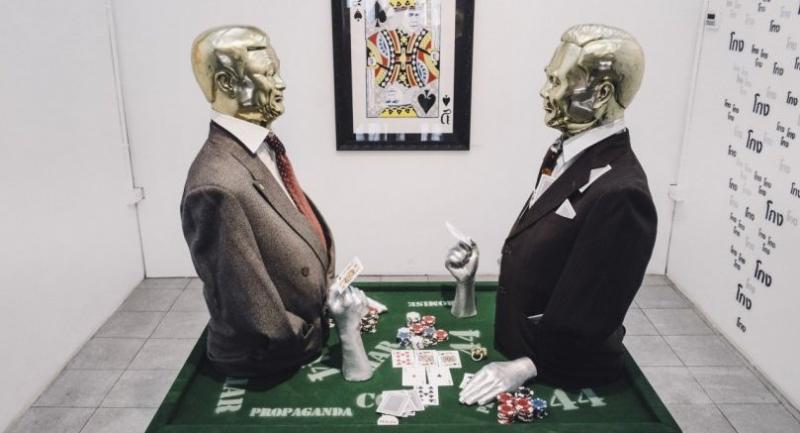
  •  Prayut Chan-o-cha looks like he’s got an unbeatable hand in his poker showdown against Thaksin Shinawatra. They’re the stars of an art exhibition by Headache Stencil, whose real name is best left unmentioned.  Photo courtesy of WTF Gallery
    Prayut Chan-o-cha looks like he’s got an unbeatable hand in his poker showdown against Thaksin Shinawatra. They’re the stars of an art exhibition by Headache Stencil, whose real name is best left unmentioned. Photo courtesy of WTF Gallery

Headache coming on for all

national March 02, 2019 01:00

By Phatarawadee Phataranawik
The Nation Weekend

3,430 Viewed

Thailand’s answer to Banksy cheekily skewers all combatants in the coming election

The last thing voters expect to witness in the lead-up to this month’s election is a face-to-face confrontation between Prayut Cha-o-cha and Thaksin Shinawatra, but you can actually see it right now.

And they’re playing a fierce hand of poker.

It’s just fantasy, of course, an imaginative installation that provocative street-artist Headache Stencil has included in his exhibition “Thailand Casino” currently on view at Bangkok’s WTF Gallery.

Headache (Mr Stencil?) told The Nation Weekend that he sees the coming election as being akin to “a dirty game in a casino”.

“I’m recording political history coming up to the election and showing the structures of control under the junta government,” he said.

The artist is not known for subtlety. He depicts Thaksin, the self-exiled former premier who still wields influence in Thai politics, holding a straight flush. But his nemesis Prayut, the coup leader and incumbent premier hoping to continue in the role as a civilian, holds a royal straight flush and his pockets are bulging with extra cards.

As if the message weren’t clear enough, Headache spells it out for you, adding the word “cheat” to the wall behind Prayut. Behind Thaksin is a calendar with February 8 marked on it, emphasis added by an enormous lightning bolt. That was the day the Thaksin-affiliated Thai Raksa Chart Party put Princess Uboratana’s name forward as its prime ministerial candidate.

It was indeed a bolt of lightning, but it fizzled later the same day when His Majesty the King put a stop to any member of the Royal Family venturing into politics.

Thaksin and Prayut are rendered as half-length sculptures perched on a card table of green baize. Other figures with starring roles in the election are depicted in pop-art paintings and, in the case of Thanathorn Juangroongruangkit of the anti-junta Future Forward Party, in a Banksy-style stencil-print.

Chatchart Sitthiphan of Pheu Thai and Army chief General Apirat Kongsompong are wearing boxing gloves, each looking for the knockout. Newin Chidchob of Bhumjaithai is puffing on marijuana as per his party’s endorsement of legalising cannabis for medicinal purposes.

Keeping an eye on the “dirty game” is Seripisut Temiyavet, leader of the Seri Ruam Thai Party, who happens to be a police general.

Army chief Apirat got involved when Pheu Thai, Future Forward and Seri Ruam Thai candidates started suggesting the military and its budget both needed to lose weight. He tried to silence the criticism by playing the ultra-patriotic, anticommunist 1975 song “Nak Paendin” (“Worthless”) often and loud.

The tune barked its epithets from 160 Army radio stations several times every day before even the ruling junta found it excessive. The lyrics describe anyone who challenges royal or military status quo as a “burden to the country” and an “enemy of the nation” in need of elimination.

It gave Headache Stencil a headache.

“The Army chief should remain neutral,” he said. “Politicians have the right to propose policies and the general has no business interfering. His action poisoned the atmosphere ahead of an election that will bring democracy back to the Kingdom again.”

This is the artist who tore a strip off Deputy Prime Minister Prawit Wongsuwan over his mysterious collection of expensive wristwatches with a head-spinning piece of wall art featuring Prawit’s portrait on an alarm clock, intended as sort of a wake-up call to citizens.

Headache came in for some official harassment and his stencilled statement was quickly scrubbed away.

He made his dangerous debut last year with a show called “Welcome to the Dark Side” at Voice Space, located in the Voice TV compound on Vibhavadhi Rangsit Road. It took caustic aim at the 2014 coup and military rule.

Prawit, co-leader of the coup, doesn’t escape notice in the current WTF exhibition. He’s a piggy bank now, etched with the words “Military Fund”, in case anyone wants to donate towards the purchase of tanks and submarines.

A painting titled “250:1” alludes to the 250 junta-appointed senators whose duty in the next government will be to make sure the Army gets whatever it wants.

“They will vote alongside the elected MPs to choose the next prime minister after the March 24 election,” Headache noted. “Critics expect them to naturally throw their support behind General Prayut.”

The more politics heats up, Headache said, the more paint he expects to spray on walls.

That should keep him busy throughout the campaign – the exhibition ends on Election Day – but probably beyond that too.

“Unlike doing graffiti out on the street where the junta can remove my art, here in the gallery I have more freedom of expression to record the dark side of Thai politics.”