Reluctantly into the future

ศาสตร์เกษตรดินปุ๋ย : ขอบคุณแหล่งข้อมูล : หนังสือพิมพ์ The Nation

http://www.nationmultimedia.com/detail/world/30366731

Photo/The Korea Herald

Reluctantly into the future

World March 30, 2019 01:00

By Lee Sunyoung
The Korea Herald
Asia News Network

5,395 Viewed

Seoul’s Itaewon district is getting a makeover and the long-established expatriate community is unimpressed

WILL AN expat-friendly neighbourhood in Seoul retain its charm amid a wave of gentrification? Some say Itaewon has lost its soul and is now just another hangout for young Koreans.

Others say the neighbourhood has become safer and trendier – suitable for a wider range of visitors. And, if you stand in the right place, you can still find the same expatriate-led culture thriving, they say.

Photo/The Korea Herald

Whoever’s right, the debate is typical of what happens when neighbourhoods become gentrified.

Outsiders discover a less-developed area with unique characteristics and a vibrant local community. Money flows in, and trendier, fancier places pop up. Rents rise and many of the original residents and their favourite haunts are priced out.

“Itaewon was a rather run-down area for many years,” says Lance Reegan-Diehl, a Canadian who worked and lived in the area for nearly two decades.

“There were lots of reasons for that – no one knows exactly why – but the ‘small-town feel’ of Itaewon is gone.”

He was among the expats feeling the loss of once-famed bars, restaurants and shops, many of which were also run by expats. Franchise coffee chains, beauty stores and big fashion-brand outlets have replaced them and the area seems to draw more young Korean customers.

Photo/The Korea Herald

Nestled in the shadow of the city’s central mountain Namsan, Itaewon had long enjoyed unparalleled status as the nexus of expatriate life in Seoul, with its close proximity to the US military base and a large number of foreign embassies.

In a socially conservative and racially homogenous country, the neighbourhood was unique in its striking cultural diversity and laissez-faire atmosphere, although some Koreans feared it to be infested with crime, says Moon Gwang-lip, a former journalist who’s written a book of essays on Itaewon and its foreign inhabitants.

“Itaewon was never sophisticated or high-brow, but it had raw elements of culture and community. The forces of gentrification appear to be eroding them,” he says.

What Itaewon is changing into is a tidier place with glossy shops that offer a not-so-different consumption experience for Koreans, he added.

The Korea Herald took a stroll down Itaewon’s main street last weekend from the landmark Hamilton Hotel through back alleys to the Seoul Central Mosque, up Antique Furniture Street and further north to nearby Gyeongnidan and Haebangchon.

The main street had steady but limited foot traffic from the direction of the Itaewon and Noksapyeong subway stations.

Quite a few retail spaces were vacant. Clothing shops specialising in large sizes, tailors and leather shops were nearly devoid of shoppers, but two Olive Young stores were bustling with mostly young Asian shoppers.

A casually dressed expatriate haggled with a street vendor over a fake Nike cap and then walked away.

“It’s difficult to make a living,” said the vendor, who declined to give her name. “Koreans don’t buy from my stall and not as many foreigners come here to shop anymore.”

Near the mosque, women in hijabs were grocery shopping at a halal supermarket while African expats casually chatted in front of a convenience store.

Intentional efforts are being taken by the Muslim community to preserve what has become known as “Islamic Street”, according to an official at the Yongsan-gu Office, who pointed out that an African community also makes its home in the area.

An Indian resident in Haebangchon said that, despite many changes, Itaewon still holds a unique charm for foreign residents and visitors.

“Of course it’s changed a lot, but Itaewon retains the same old charm that I fell in love with when I first came to Korea back in 2002.”

Yet Itaewon’s changes so far may look trivial once developers start tearing down old homes and rebuilding residential areas.

“Itaewon sits near those hot residential areas expected to get a major upscale makeover in the coming years. For better or worse, changes are inevitable,” said a local realtor.

Splendours of the South

ศาสตร์เกษตรดินปุ๋ย : ขอบคุณแหล่งข้อมูล : หนังสือพิมพ์ The Nation

http://www.nationmultimedia.com/detail/thailand/30367221

  • Khanom Jeen Pa Son, opposite Chao Mae Ma Cho Po Shrine, offers riceflour noodles with curries and a wide array of vegetables.
  • Travellers take photos in front of a mural painted by Alex Face and explore the city of Phang Nga in a song thaew, the local distinctive taxi.
  • The street-food eatery Khrua Nong earned a Michelin’s Bib Gourmand award for good value for money.

Splendours of the South

Thailand April 06, 2019 01:00

By Khetsirin Pholdhampalit
The Nation Weekend
Phang Nga

Taking a gustatory journey through Phang Nga province

LOCATED SOME 800 kilometres from Bangkok, the Southern coastal province of Phang Nga is well known for its stunning scenery. Less known but equally as stunning are its culinary creations that take the visitors on a palate-pleasing journey through its streets.

Phang Nga is one of 55 secondary cities being promoted by the Tourism Authority of Thailand to draw travellers eager for new experiences. The second edition (2019) of the Michelin Guide Bangkok has been happy to play along, extending its coveted ratings to the best dining venues in Phang Nga and Phuket.

The fishing village of Bang Pat on the mangrove peninsula of Phang Nga Bay is home to about 80 families, most of them Muslim. 

After a short flight from Bangkok to Phuket – the nearest airport to Phang Nga, I climb into a car for the 70-kilometre trip to the fishing village of Bang Pat on the mangrove peninsula of Phang Nga Bay.

A small 200-metre concrete bridge leads to the village, which is home to about 80 families, most of them Muslim. Fresh and dried fish, shrimp paste and palm sugar are on sale at very reasonable prices in front of many houses, which also offer comfortable homestays. I pass locals busy mending their nets before setting out to sea at night and other preparing sun-dried fish.

The Bang Pat Village offers fresh seafood and dried fish at affordable prices.

Her Majesty Queen Sirikit visited this village in 1997 with her son – the current King Maha Vajiralongkorn – to encourage its residents to preserve the mangrove forest and set up a crab bank to promote sustainable fisheries. Photos taken during their visit grace the walls of many homes.

The village is known for its fresh seafood and Khrua Aree is a seafood eatery packed with locals and tourists alike. Foreign travellers are dropped off at the pier for lunch after a morning spent visiting the various islands along this coast.

The seafood eatery Khrua Aree offers dishes at resonable prices, at Bt250 net per person for each meal.

Crab, fish, shrimps, squids, mantis shrimps and shellfish are cooked in different styles and each meal costs Bt250 net. Groups of up to four diners are invited to choose five dishes with seven offered to larger groups.

For our group of 15, the dishes on offer range from steamed crab, tom yum goong, stir-fried squid with ink, deep-fried sea bass, stir-fried Venus shells, spicy sea grape seaweed salad and fried rice with shrimp.

After lunch, we set off to explore the cultural route designed by the TAT’s Phang Nga Office and covering eight spots in the town’s Muang district. We pack into song thaew – the shared pickup taxi with a bench along each side of the cargo bed.

Travellers take photos in front of a mural painted by Alex Face and explore the city of Phang Nga in a song thaew, the local distinctive taxi.

The Song Thaew Cooperative of Phang Nga has joined the campaign, allowing eight to 10 interested travellers to hire the whole song thaew for a very reasonable Bt800 and takes them to visit the eight spots over the course of four to five hours.

Our schedule is tight and we only have time to visit three attractions. Driver Chanchana Saelim first takes us to the Phang Nga Museum housed in the Colonial-style building constructed in 1930 that once served as the town hall. After renovations, it opened as a museum in 2013 and relates the history of Phang Nga as a marine trading port and tin mining town.

The Phang Nga Museum tells the history of the Southern coastal province during its time as a marine trading port, emphasising its tin mines and cultural diversity. 

Among the exhibits are maps illustrating the marine peninsular route in Southern Thailand, the equipment used for mining tin, the distinctive dress of the Buddhists, Muslims and Thai-Chinese who inhabited the town, as well as photographs of the Sino-Portuguese row houses in the old town and the Southern-style food.

The next stop is Chao Mae Ma Cho Po Shrine, one of the most revered shrines among Thai-Chinese residents, and the residence of the goddess of the sea who is believed to give Chinese merchants and immigrants a spiritual anchor along the coast.

 Khanom Jeen Pa Son, opposite Chao Mae Ma Cho Po Shrine, offers riceflour noodles with curries and a wide array of vegetables.

Local guide Viriyah Hongkhao suggests we stop for food at local favourite Khanom Jeen Pa Son directly opposite the shrine. The self-service eatery is known for its rice-flour noodles and curries, which include nam yanam priktai pla and gaeng paa, priced at Bt30. Gracing the long tables are more than 20 vegetables – fresh, blanched and pickled – as well as fried dried small fish and pineapple for all you can eat.

Several walls in the city have been painted with colourful murals by Thai street artist Patcharapol Tangruen, aka Alex Face. He’s best known for his iconic three-eyed child Mardi, who peers out at passer-by with her eyes half-opened and a sense of weary vulnerability and who has graced walls in Bangkok as well as Singapore.

In Phang Nga, visitors are encouraged to ride song thaew to find the three Mardi murals in the city. In one Mardi is wearing a sarong and holding a metal pan to extract ore and in another, she is sitting behind a giant glass bottle containing a junk.

“Alex was commissioned by TAT and the local administrative office to paint three murals in the city to tell the history and the multi-cultural diversity of Phang Nga. He finished last month and the murals are now popular spots for visitors to snap a photo,” Viriyah says.

“Phang Nga is a charming and peaceful city where you can enjoy fabulous seascapes, mountain views and jungles bustling with wildlife. The city is also becoming a popular place for elderly Germans to live out their retirement. They rent a house and spend their time sunbathing and hiking.”

Members of Baan Pring Local Enterprise showcase how to make local sweet treats.

Our last stop is Baan Pring Local Enterprise, which produces such local foods and desserts as nam prik goong siab (Southern-style chilli dip made with dried shrimp) and local pastry tao sor in gift packaging. Visitors are also invited to knead the flour and cook the fillings.

The other five spots on the route are Phang Nga City Pillar Shrine, Chedi Khao Lang Bat, Tham Sam Rock Art, Saraphimuk Temple and Rai Foon Road and while we couldn’t visit them, we stop off at the popular viewpoint called Samed Nang Chee in Takua Thung district. To see the stunning scenes of Phang Nga Bay and pristine beaches from the top, visitors have to board four-wheel drive vehicles offered by the local community at Bt90 per person for a round trip.

 A traveller takes a selfie with a backdrop of Phang Nga Bay from Samed Nang Chee viewpoint.

The two-kilometre, zig-zag trail is high and steep, requiring skilled driving and visitors are told to grab the rack firmly. It is a thrilling experience and the view from the top makes it all worthwhile.

Samed Nang Chee is actually a good spot to watch the sunrise and to marvel at the Milky Way at night. The only blimp is the sign bearing the name Samed Nang Chee, which has a colourful Thai font and is out of place with the natural scenery.

The street-food eatery Khrua Nong earned a Michelin’s Bib Gourmand award for good value for money. 

My culinary journey in Phang Nga ends at the small street food eatery Khrua Nong in Takua Pa district that earned Michelin’s Bib Gourmand award for its good value for money. In this case, it means a maximum price of Bt1,000 for three-course meal.

The owners are husband-and-wife team Komson and Chanida Jewsakul who left behind their careers as a photographer and a secretary in Bangkok to operate this eatery 18 years ago. Despite its humble setting and compact space, Khrua Nong offers about 200 dishes made with fresh ingredients that are locally sourced.

“I returned to my hometown to take care of my mother. Cooking runs in the family. My grandfather had a Western-style restaurant when Westerners worked in the mines. My mother and her sister also run a made-to-order eatery. We started with just four tables and today can accommodate a maximum of 80 diners,” says Komson.

Komson and Chanida do all the cooking themselves in an open kitchen as diners watch on. During my visit, they had just taken delivery of fresh river prawns, which they used to make a delicious tom yum soup. A dish not to miss is the deep-fried spotted mackerel fillets seasoned with home-made soy sauce for Bt200. Other tempting choices include deep-fried soft shell crab with garlic (Bt160), stir-fried sato beans with shrimp and shrimp paste (Bt120), and stir-fried bai liang leaves with egg (Bt70).

“We were so honoured to get the prestigious Michelin’s Bib Gourmand award. From an overlooked eatery that normally serves local people, we are welcoming more customers from different provinces. We’re renovating the space by replacing the roof and building an additional toilet that is user-friendly for the elderly and handicapped,” Chanida says.

The writer travelled as a guest of Tourism Authority of Thailand’ southern region.

IF YOU GO

Learn more about tourist attractions in Phang Nga at Facebook.com/wonderful.phangnga

Bangkok Airways operates daily flights to Phuket. Check the flight schedules at http://www.BangkokAir.com.

The Song Thaew Cooperative of Phang Nga can be reached by calling Chanchana Saelim at (093) 794 9966.

Contact Khrua Aree at Bang Pat Village at (086) 274 4557.

Khanom Jeen Pa Son, opposite Chao Mae Ma Cho Po Shrine, can be reached at (086) 593 9658.

Contact Baan Pring Local Enterprise at (081) 537 5370.

Khrua Nong can be reached at (080) 389 5554.

Songkran’s fruity flavours

ศาสตร์เกษตรดินปุ๋ย : ขอบคุณแหล่งข้อมูล : หนังสือพิมพ์ The Nation

http://www.nationmultimedia.com/detail/thailand/30367061

Songkran’s fruity flavours

Thailand April 05, 2019 01:00

By THE NATION

2,215 Viewed

Travellers flying with Thai Smile between April 13 and 17 will be welcomed on board with two special fusion desserts created by Audrey Café.

“Thai Smile is committed to delivering excellence services beyond customer’s expectations as always. We provide inflight meals and beverages to all passengers for free on all flights and during festivals offer a special dish that symbolises the occasion,” said Nednapang Teeravas, chief customer service officer of Thai Smile Airways.


The Songkran treats are Mango Sago Panna Cotta that gets its crunch from pearl tapioca crumbled with young coconut meat and topped with mango. Marian Plum Panna Cotta adds a sweet and sour taste thanks to the slightly sour plum sauce.

“Audrey Cafe is delight to create these two special dishes with local seasonal fruits,” said Janista Charoonsmith, chief executive officer of Audrey Group.

“Panna cotta is our best seller. We’ve crafted two new desserts to cool passengers throughout the Songkran festival.”

The desserts are available on both domestic and international routes (except WE011, WE051, WE177, WE419 / 420, WE426 and WE609).

For flight information, go to http://www.ThaiSmileAir.com.

Cosying up to Conan

ศาสตร์เกษตรดินปุ๋ย : ขอบคุณแหล่งข้อมูล : หนังสือพิมพ์ The Nation

http://www.nationmultimedia.com/detail/world/30366735

A fan strikes the same pose as Detective Conan while taking a photo with a statue of him in front of JR Yura Station in Hokuei, Tottori Prefecture.(Photo/The Yomiuri Shimbun)

Cosying up to Conan

World March 30, 2019 01:00

By Naoko Sato
Yomiuri Shimbun
Asia News Network

Getting gleefully lost in the manga world in Tottori

A DETECTIVE. Ghoulish yokai. Gourmet dining.

What prefecture has these three disparate items in common?

Welcome to Tottori, the prefecture that produced Gosho Aoyama, 55, creator of the popular manga “Meitantei Conan” (“Detective Conan”); Shigeru Mizuki (1922-2015), of yokai manga “GeGeGe no Kitaro” fame; and Jiro Taniguchi (1947-2017), creator of “Kodoku no Gurume” (“The Lonely Gourmet”).

A fan strikes the same pose as Detective Conan while taking a photo with a statue of him in front of JR Yura Station in Hokuei, Tottori Prefecture.(Photo/The Yomiuri Shimbun)

It’s no surprise that manga fans from across Japan and around the world flock to the prefecture commonly referred to as the “Manga Kingdom.”

JR Yura Station, an entry point for Aoyama’s birthplace of Hokuei town, has a sign declaring it “Conan Station”. In front of the sign, young and old alike stop by a statue of Conan Edogawa, the main character of “Detective Conan”.

Striking the same pose as the young detective – pointing with his right index finger – they utter his famous line, “There is always only one truth!” and gleefully take photos.

The 1.5-kilometre Conan Street connects the station with the Gosho Aoyama Manga Factory, a museum where original Conan cels and other memorabilia are displayed. There, another statue of Conan stands next to statues of characters including frequent antagonist Kaito Kid. Everywhere one looks, someone is taking a photo with their favorite character.

The Jiro Taniguchi section in the Minato Sakai Koryukan hall in Sakaiminato. (Photo/The Yomiuri Shimbun)

“I’ve loved Conan since I was little, so I’ve always thought about coming here,” says Koharu Arie, 14, a second-year junior high schooler from Kama, Fukuoka Prefecture, who is visiting with her family. “I want to take loads of photos.”

The Detective Conan series made its debut in 1994 in the manga “Shukan Shonen Sunday”. High school-aged detective Shinichi Kudo is given a drug by a mysterious organisation, turning him into a child. In the persona of elementary school student Conan Edogawa, he sets about solving crimes in each mystery episode. In 1996, an animated cartoon was started and broadcast on the Nippon TV network.

The town, riding the character’s explosive popularity, started work on the commemorative street in 1999. The museum, which opened in 2007, has been thriving and drew about 127,500 visitors in 2017.

The manga is published in 25 countries and territories, with fans not only in Japan, but also in China, Taiwan, South Korea, Thailand and around the world. Every year, a Swiss family with a particular passion for manga visits the town for a weeklong stay, according to museum director Toshimitsu Ishida, 67.

“People come from around the world,” he says with a smile. “Conan is our town’s treasure.”

Nezumi-Otoko (Ratman) is one of the many characters sometimes seen on the Mizuki Shigeru Road in Sakaiminato, Tottori Prefecture. (Photo/Mizuki Productions)

As you near the Mizuki Shigeru Museum in the city of Sakaiminato, you might hear the visitors before seeing them, as screams of “It’s scary” and “Gyaaa”, ring through the halls of the memorial to the GeGeGe no Kitaro creator.

In 1993, a kilometre-long stretch of road connecting JR Sakaiminato Station with a shopping arcade was dubbed “Mizuki Shigeru Road.” It was lined with statues of phantoms, ghosts and other yokai characters from his most famous works, notably “GeGeGe no Kitaro” and “Akumakun.” The museum opened in 2003.

Along the road are a yokai shrine and souvenir shops paying homage to characters such as Kitaro’s father, Medamaoyaji, or the half-human, half-yokai Nezumiotoko.

“It’s really something that there are so many yokai,” says Seiji Yamada, 52, an office worker from Fujisawa, Kanagawa Prefecture, accompanied by his wife. “I am completely immersed in the world of yokai.”

Tottori native Taniguchi, of “The Lonely Gourmet” fame, is particularly popular in Europe, and was the recipient of France’s Knight of the Order of Arts and Letters and other awards. There are said to be many people who visit the Tottori Castle ruins, Kurayoshi city’s white-walled storehouses and other locations depicted in his classic works “A Distant Neighbourhood” and “Chichi no Koyomi” (My Father’s Journal).

To promote itself as the birthplace of popular manga artists, Tottori Prefecture declared itself the “Manga Kingdom” in 2012. The list of related activities is wide – providing subsidies to local governments and entities; holding events featuring anime voice actors; displaying related art objects in Tottori Airport, which was nicknamed “Tottori Sand Dunes Conan Airport;” and holding an exhibition at the Minato Sakai Koryukan hall in Sakaiminato to introduce Tottori native manga artists.

It was manga and anime that provided the spark for the prefecture to be ranked No 1 among the “top 10 tourist spots you need to visit in 2019” on an internet site aimed at foreign travellers.

“The thrill of two-dimensional objects such as manga and anime becoming three-dimensional is very attractive,” says Yoshiyuki Nomura, 44, director of the Manga Kingdom Secretariat of the Tottori Prefectural Government Tourism and Exchange Bureau.

From Conan-themed handkerchiefs and candy to Kitaro teacups, from yokan sweets in the shape of the Ittanmomen yokai to bags depicting the Nurikabe yokai … Before you know it, your suitcase for the trip home is packed with manga character goods.

It is intoxicating to wander in the “Manga Kingdom,” which surely leads to hefty spending. One easily falls under the spell.

IF YOU GO

Gosho Aoyama Manga Factory is a 20-minute walk from JR Yura Station

Mizuki Shigeru Museum is about 10 minutes on foot from JR Sakaiminato Station

From JR Osaka Station to Yura Station, it takes about three and a half hours by express and other trains. To Sakaiminato Station, it takes about four and a half hours.

Both museums are open every day.

Reluctantly into the future

ศาสตร์เกษตรดินปุ๋ย : ขอบคุณแหล่งข้อมูล : หนังสือพิมพ์ The Nation

http://www.nationmultimedia.com/detail/world/30366731

Photo/The Korea Herald

Reluctantly into the future

World March 30, 2019 01:00

By Lee Sunyoung
The Korea Herald
Asia News Network

Seoul’s Itaewon district is getting a makeover and the long-established expatriate community is unimpressed

WILL AN expat-friendly neighbourhood in Seoul retain its charm amid a wave of gentrification? Some say Itaewon has lost its soul and is now just another hangout for young Koreans.

Others say the neighbourhood has become safer and trendier – suitable for a wider range of visitors. And, if you stand in the right place, you can still find the same expatriate-led culture thriving, they say.

Photo/The Korea Herald

Whoever’s right, the debate is typical of what happens when neighbourhoods become gentrified.

Outsiders discover a less-developed area with unique characteristics and a vibrant local community. Money flows in, and trendier, fancier places pop up. Rents rise and many of the original residents and their favourite haunts are priced out.

“Itaewon was a rather run-down area for many years,” says Lance Reegan-Diehl, a Canadian who worked and lived in the area for nearly two decades.

“There were lots of reasons for that – no one knows exactly why – but the ‘small-town feel’ of Itaewon is gone.”

He was among the expats feeling the loss of once-famed bars, restaurants and shops, many of which were also run by expats. Franchise coffee chains, beauty stores and big fashion-brand outlets have replaced them and the area seems to draw more young Korean customers.

Photo/The Korea Herald

Nestled in the shadow of the city’s central mountain Namsan, Itaewon had long enjoyed unparalleled status as the nexus of expatriate life in Seoul, with its close proximity to the US military base and a large number of foreign embassies.

In a socially conservative and racially homogenous country, the neighbourhood was unique in its striking cultural diversity and laissez-faire atmosphere, although some Koreans feared it to be infested with crime, says Moon Gwang-lip, a former journalist who’s written a book of essays on Itaewon and its foreign inhabitants.

“Itaewon was never sophisticated or high-brow, but it had raw elements of culture and community. The forces of gentrification appear to be eroding them,” he says.

What Itaewon is changing into is a tidier place with glossy shops that offer a not-so-different consumption experience for Koreans, he added.

The Korea Herald took a stroll down Itaewon’s main street last weekend from the landmark Hamilton Hotel through back alleys to the Seoul Central Mosque, up Antique Furniture Street and further north to nearby Gyeongnidan and Haebangchon.

The main street had steady but limited foot traffic from the direction of the Itaewon and Noksapyeong subway stations.

Quite a few retail spaces were vacant. Clothing shops specialising in large sizes, tailors and leather shops were nearly devoid of shoppers, but two Olive Young stores were bustling with mostly young Asian shoppers.

A casually dressed expatriate haggled with a street vendor over a fake Nike cap and then walked away.

“It’s difficult to make a living,” said the vendor, who declined to give her name. “Koreans don’t buy from my stall and not as many foreigners come here to shop anymore.”

Near the mosque, women in hijabs were grocery shopping at a halal supermarket while African expats casually chatted in front of a convenience store.

Intentional efforts are being taken by the Muslim community to preserve what has become known as “Islamic Street”, according to an official at the Yongsan-gu Office, who pointed out that an African community also makes its home in the area.

An Indian resident in Haebangchon said that, despite many changes, Itaewon still holds a unique charm for foreign residents and visitors.

“Of course it’s changed a lot, but Itaewon retains the same old charm that I fell in love with when I first came to Korea back in 2002.”

Yet Itaewon’s changes so far may look trivial once developers start tearing down old homes and rebuilding residential areas.

“Itaewon sits near those hot residential areas expected to get a major upscale makeover in the coming years. For better or worse, changes are inevitable,” said a local realtor.

An elephantine task

ศาสตร์เกษตรดินปุ๋ย : ขอบคุณแหล่งข้อมูล : หนังสือพิมพ์ The Nation

http://www.nationmultimedia.com/detail/thailand/30366804

  • Visitors join a Walking with Giants tour.
  • Elephant masters from Surin’s Ban Ta Klang elephant village perform a traditional ritual to celebrate the Nation Elephant Day.
  • Animal osteopath Tony Nevin teaches visitors how to massage the elephants.

An elephantine task

big read March 30, 2019 01:00

By Pattarawadee Saengmanee
The Nation Weekend

A foundation dedicated to helping pachyderms and their mahouts holds and educational open day

SITTING ON a border of Thailand, Laos and Myanmar, the Golden Triangle Asian Elephant Foundation (GTAEF) in Chiang Rai recently opened its camp to celebrate the National Thai Elephant Day and give local and foreign visitors a chance to experience several educational activities about elephants and mahouts.

Set up in 2006 by the five-star Anantara Hotels chain, the foundation aims to solve the problem of elephants coming to city streets and generally improve elephant welfare in Thailand. Today, all elephants in its camp are rented from different villages to conduct the exclusive mahout and trekking programmes for the guests staying at Anantara Golden Triangle Elephant Camp and Resort and Four Seasons Tented Camp Golden Triangle.

 The Elephant Buffet is stacked high with fresh fruits.

“Anantara took over this property with its elephant camp back in 2002. We recognised the potential for tourism in the Golden Triangle and wanted to do more with the land. That gave birth to the idea of setting up the foundation and inviting mahouts to work with us rather than taking the elephants to towns to walk on the streets,” says John Roberts, director of Elephants and Conservation Efforts of Anantara.

“In those days, tourism in this part of the world was still relatively small and the mahouts had no other ways of making money.”

But despite the good intentions, the foundation hasn’t always had it easy. Last year, Anantara Hotels was put in the hot seat after the People for the Ethical Treatment of Animals (Peta) released worrying video footage showing mahouts using bullhooks to beat and jab elephants during the polo matches, resulting in all the big names drawing back their sponsorship.

Anantara took quick action and launched the inaugural King’s Cup Elephant Boat Race and River Festival to replace its annual polo match. The charity event is taking place this weekend, joined by veteran Thai Navy paddlers and international teams from China and the Philippines.

“To improve the situation, we provide a positive and targetted training programme that can help the villagers teach their elephants without using bullhooks or hitting them,” Roberts explains.

“All mahouts learn the basics for controlling an elephant from their parents. It’s like learning to drive with our parents. It might not be the best way but this is tradition and the techniques have been passed on from generation to generation for 4,000 years. We don’t want to touch their heritage. We just come up with a different way that can help them do better.”

The GTAEF camp in the luxury Anantara Golden Triangle Elephant Camp and Resort occupies 2,000 square metres as is home to 25 rescued elephants and a small village of mahouts and their families. Many of elephants here came from the streets but others used to work for illegal logging camps or elephant shows. The camp pays Bt25,000 a month to provide mahouts with an guaranteed income and also supports their spouses in their silk weaving group.

For the recent celebration, the lush jungle was transformed into a ceremonial ground, where a group of elephant spirit men from Surin’s Ban Ta Klang Elephant Village performed a Kui traditional ritual to pay respect to the guardian spirits.

A long table was set up in the middle of the lush grounds packed with offerings and nang pa kam, a sacred 100-year-old robe made from buffalo leather that has been used to capture a wild elephant in the past.

“Being an elephant spirit man is local wisdom and passed down from father to son. We pray in the Kui language and blow sang (a buffalo horn), which is traditionally used to capture wild elephants. The offerings include a chicken chin, a pig head, fruits and bai si,” explains Uncle Chalerm Salangam, 70.

“Today, our village has 300 elephants and we’ve trained a new generation of elephant spirit men to maintain our traditions.”

The elephants themselves were more excited about the buffet, eagerly tucking into watermelons, coconuts, bananas, sweet corn, pumpkins and pineapples.

Elephant masters from Surin’s Ban Ta Klang elephant village perform a traditional ritual to celebrate the Nation Elephant Day. 

A short walk from the ceremonial venue, development manager Laddawan Yonthantham was acting as a tour guide to give visitors an introduction to sustainable elephant welfare management.

“About 30 years ago, the government enacted legislation to ban logging in the jungle and mahouts became unemployed. To generate income, they shifted to putting on elephant shows at tourist attractions or took their elephants to the city essentially to beg. Raising elephants is expensive as they need 200 to 300 kilograms of pineapples, watermelons and sugar cane, depending on their weight – and the average weight of an elephant is 2,500 kilograms,” Laddawan says.

“Our camp offers natural space near the river so that the elephants can exercise and eat organic fruits from the local plantations. Initially, we purchased some overworked and street elephants from mahouts but they bought new elephants to sell to us again. So, we rented the elephants and hired the mahouts to conduct eco-friendly activities for our all-inclusive hotel packages.

“Mahouts can take advantage of Anantara’s staff welfare programme, which includes a residence, uniforms and three meals a day. Based on sustainable living, it aims to keep them from falling back into the same cycle.”

Hotel guests can register for trekking and riding an elephant or learn the basics of being a mahout while the elephants get additional exercise. As we walk around the property, we see domesticated giant Bo and her friends jumping into the Ruak river and having fun in the clear water as they take their daily bath.

“We limit work to three-and-a-half hours and even have a customised exercise routine for elephants so that they can stay healthy. They love jumping into a mud pond to cool down,” says Laddawan.

Mahout Wattana Salangam and his giant friend Bo have worked with the elephant camp for 14 years. Before that they were in Bangkok, roaming the streets to earn money.

“I was in debt so I took Bo to Bangkok. We would walk around the streets and would collect about Bt2,500 a day. We made ourselves a camp on vacant land to save money. Then we moved to the elephant foundation in Phetchaburi and had to take care of many elephants, most of them belonging to other people. It was dangerous because most elephants only obey their owners,” Wattana says.

“Here, I started on a salary of Bt18,000 and now receive up to Bt25,000, plus extra income from guest activities. I’m happy to work here. My elephant has enough food no matter if I have work or not.”

An elephant splashes dirt to chase off bugs on his back.

“Our foundation doesn’t support mahouts to breed their elephants. Today, there are more than 4,200 house elephants and not all of them live in good conditions. We can’t release them to the forest because they have no skills to survive. Normally, elephants live in a group and don’t accept strangers,” Laddawan says.

An in-house veterinarian team is in charge at the positive reinforcement target training station where elephants learn to perform certain tasks such as raising a foot in a purely positive manner. A small branch is used but no punishments are meted out. Instead the elephants quickly learn about rewards.

“Our camp set up this training in cooperation with Dr Gerardo Martinez, a world renowned large animal trainer from the Africam Safari Park in Puebla, Mexico. This target training can be used to train the elephant in the event that they need veterinary treatment. It can help feel free and release stress for both elephant and vet,” says Laddawan.

The camp also conducts Elephant Cognition (problem solving) Research. Here, visitors can see the elephants using their trunks to pick up tokens of different textures and work as a team.

Next door was the space for Elephant Osteopathy Demonstra-tions undertaken in collaboration with veteran British animal osteopath Tony Nevin. Adapted from techniques used with humans, the massage treatment is designed to relieve muscle tension and pain.

“We focus on the elephant’s spine and balance while walking. The massage starts from the neck and goes from rib to hip. This treatment can be used for other animals too, like giraffes, horses and ostriches,” Nevin says.

The Walking with Giants activity takes place in the early morning and takes guests to explore a trekking trail around the camp and learn about daily life of elephants. For example, elephants splash dirt over their back to chase bugs and black dung means they are eating too much dirt probably have flatulence.

Animal osteopath Tony Nevin teaches visitors how to massage the elephants.

“For the next step, we would like to help the elephants in several trekking camps have access to better welfare. We will also continue to train mahouts across Southeast Asia in positive reinforcement and elephant friendly training and handling techniques,” director Roberts says.

“We have teamed up with US Agency for International Development (USAID) to teach travellers not to buy ivory. We’re also working with Srinakharinwirot University, which is going to send students to the area where villagers are facing problems with elephants coming out from the forest. We will try to identify what is the best practice to keep both people and elephants happy when they come out from the national park.


PACHYDERM PARADISE

>> The Golden Triangle Asian Elephant Foundation is located in Anantara Golden Triangle Elephant Camp and Resort, Chiang Rai.

>> Find out details at http://www.HelpingElephants.org.

Pretty posh for Havana

ศาสตร์เกษตรดินปุ๋ย : ขอบคุณแหล่งข้อมูล : หนังสือพิมพ์ The Nation

http://www.nationmultimedia.com/detail/world/30366331

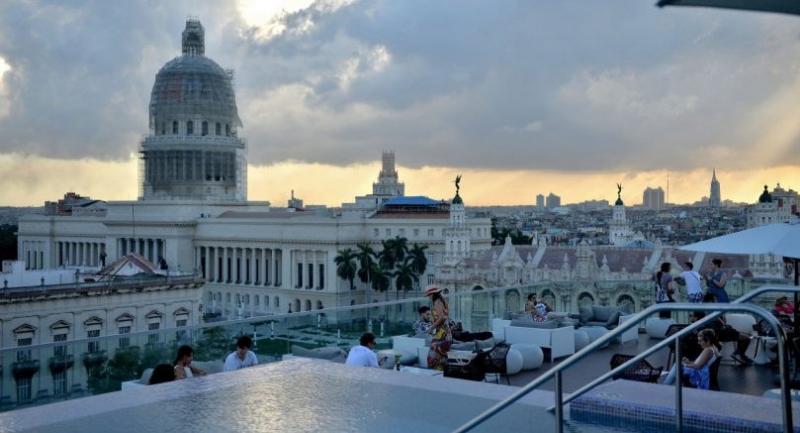
  • The swimming pool on the rooftop of the Gran Manzana Hotel in Havana is a tourist magnet.
    The swimming pool on the rooftop of the Gran Manzana Hotel in Havana is a tourist magnet.

Pretty posh for Havana

World March 23, 2019 01:00

By Agence France-Presse
Havana

Cash-strapped Cuba is now tapping into the high-end luxury tourist market

IN HAVANA there’s a shop selling a camera for more than US$25,000 (Bt790,000) – roughly 850 times the average monthly wage in Cuba.

The eye-popping sum earned predictable scorn on social media, but it begins to make sense when seen through the lens of the island’s fledgling bid to tap into the luxury tourism market.

The exclusive camera store and other boutiques featuring A-list brands like Versace and Armani are located in a shopping gallery on the ground floor of the swanky Gran Hotel Manzana.

The mere existence of the shops certainly seems incongruous in a country that has been governed as a one-party communist state since 1959, and where the average wage is $30 (Bt950) a month.

The swimming pool on the rooftop of the Gran Manzana Hotel in Havana is a tourist magnet. 

But the hotel isn’t exactly looking for locals to buy in – it attracts “a clientele of private planes, princes and celebrities”, according to general manager Xavier Destribats.

The Gran Hotel Manzana, the first ever five-star establishment in Havana, opened in 2017 in a sumptuous historic building that was, at the beginning of the 20th century, the island’s first shopping mall.

The property run by Swiss group Kempinski is “the first genuine luxury hotel in Havana”, said Destribats.

“It’s the first hotel with a 1,000-square-metre spa,” he said. All the rooms are at least 40sqm, with prices ranging from $370 for a basic room in low season to $5,000 for the presidential suite.

“There was a certain type of clientele that didn’t travel to Havana, or Cuba, because there wasn’t the standard of luxury five-star hotel like in cities such as Paris or London,” Destribats explained.

The hotel terrace offers stunning views over Havana’s colourful historic neighbourhood where many Cubans live in dilapidated buildings that have fallen into disrepair or have vegetation sprouting from them.

“It really doesn’t feel like Cuba, clearly not – it feels like being in the United States, Miami or Puerto Rico,” said Celia Liegeois, a 26-year-old from Paris.

Having travelled around the island nation for three weeks, she and a friend had decided to spend their last few days relaxing by the hotel’s rooftop pool.

Nearby, Suki Lu, a recently arrived 28-year-old Chinese television presenter, was impressed at what she saw. “It’s beautiful. Look at the sunset! It’s truly addictive,” she said.

“I live in Dubai, so when you talk about luxury hotels, the level there is really high, but I think I’ll like this hotel,” she said, while her friend used a camera drone to get an aerial view of the building.

The largest single group of visitors to the Gran Hotel Manzana – one-fifth of the total – is comprised of tourists from the US, although there are plenty of visitors from Europe, Asia and the Middle East.

The Kempinski group, which hopes to open two or three more hotels in Cuba, is of course not the only chain to show an interest in the ultra-luxury market.

In September, Spain’s Iberostar opened its second five-star hotel, the Grand Packard.

French hotel giant Accor is planning on opening its own luxury establishment on the Malecon, Havana’s famous seaside boulevard, next September.

Ancient American cars are still a common sight in Havana, like this one out front of the Gran Manzana.

It will include a chocolate shop on its ground floor and a restaurant and concert space on its roof.

The employees’ outfits will be designed by Spanish fashion designer Agatha Ruiz de la Prada.

However, there is a slight catch – in every case, the hotels are owned by Gaviota, the Cuban army’s branch dedicated to tourism.

The foreign hotel groups are only allowed to run the establishments, all built by French group Bouygues, which has a long-standing local presence.

Authorities don’t publish the army’s revenues, but this alliance between hoteliers and the military landed the luxury hotels on Washington’s blacklist.

US tourists are technically banned from staying in the hotels – but they can easily circumvent restriction by either paying in cash or booking through travel agents.

Beyond hotels, developers have more ideas to entice those with deep pockets.

“There’s a plan to build golf courses in partnership with real estate groups,” said industry expert Jose Luis Perello.

The opening of a luxury hotel means Cuba has turned a corner, he said.

“Since it opened up to international tourism more than 20 years ago, Cuba has focused all its plans and strategies on sun and beach tourism” for the masses, Perello said.

That category currently accounts for 73 per cent of the 70,000 hotel rooms on offer in Cuba. And those who rent them usually don’t spend much money.

The same goes for cruise ship tourists – while the number of cruises docking in Cuba has exploded, passengers only spend an average of $15 a day on land.

That isn’t great news for Cuba, which welcomed 4.7 million tourists in 2018 – it needs the cash.

The government, which has been subjected to US sanctions since 1962, used to depend on aid from Venezuela, its oil-rich ally. But with Venezuela in turmoil, Cuba is scrambling for other sources of hard currency and its economic growth has stagnated at around one per cent – not enough to cover the population’s basic needs.

Opening luxury hotels is “a new stage” but also “a necessity”, Tourism Minister Manuel Marrero Cruz has said.

Environmental threat?

ศาสตร์เกษตรดินปุ๋ย : ขอบคุณแหล่งข้อมูล : หนังสือพิมพ์ The Nation

http://www.nationmultimedia.com/detail/world/30366330

Fjadrargljufur Canyon, a popular tourist attraction in Iceland’s southeast, has been temporarily closed because a spike in foreign visitors was ruining the vegetation.

Environmental threat?

World March 23, 2019 01:00

By Agence France-Presse
Reykjavik

Blame it on the Bieber an Icelandic canyon is declared off-limits after swarms of the Canadian pop star’s fans trample through

ICELAND HAS blocked the millions of tourists who descend upon the volcanic island each year from visiting a canyon that has been overrun since it was featured in a Justin Bieber music video.

An influx of tourists and a humid winter have disrupted the Fjadrargljufur Canyon’s fragile ecosystem, so the Environment Agency of Iceland has closed the site to the public until June 1.

“During periods of thaw the path is completely muddy and is practically unusable for hikers,” agency adviser Daniel Freyr Jonsson said.

“Because the mud is so thick, visitors step over the fences and walk parallel to the path, which rapidly damages the plant life.”

Fjadrargljufur Canyon, a popular tourist attraction in Iceland’s southeast, has been temporarily closed because a spike in foreign visitors was ruining the vegetation. 

Fjadrargljufur is a gorge about 100 metres deep and two kilometres long, with steep green walls and a winding riverbed. The canyon was created by progressive erosion from water melting from glaciers 9,000 years ago.

The canyon was little known to foreigners until late 2015, when Canadian singer Justin Bieber featured the site in the video for his song “I’ll Show You”.

“Visits to the site have risen by 50 to 80 per cent per year since 2016,” said Daniel Freyr Jonsson, estimating that around 300,000 people visited the canyon last year.

A growing number of tourist sites in Iceland have been closed in a bid to preserve them.

The popular Reykjadalur Valley and its hot springs were temporarily closed in April last year and a hiking trail overlooking the Skogafoss waterfall is currently shut.

“The infrastructure is not set up to accommodate so many visitors,” said Daniel Freyr Jonsson. “Tourism in winter and spring, the most sensitive periods for wildlife in Iceland, was previously almost unheard of in Iceland.”

Since 2010 and the eruption of the volcano Eyjafjallajokull – which generated a lot of publicity for the island – the number of visitors has grown by 25 per cent per year on average.

Last year, a record 2.3 million people visited Iceland.

Thai Smile adds Kolkata flights

ศาสตร์เกษตรดินปุ๋ย : ขอบคุณแหล่งข้อมูล : หนังสือพิมพ์ The Nation

http://www.nationmultimedia.com/detail/world/30366146

Thai Smile adds Kolkata flights

World March 21, 2019 01:00

By THE NATION

2,399 Viewed

Thai Smile makes its way to East India with a new direct flight from Bangkok to Kolkata available from March 31.

Aiming to reinforce the full-service airline in the region with world-class aviation and service standards, and flying seamlessly with Thai Airways International, the latest route will be the gateway to East India, departing Suvarnabhumi Airport to Netaji Subhash Chandra Bose International Airport in Kolkata.

The airways will operate five flights per week – Tuesday, Thursday, Friday, Saturday and Sunday – with an option of Smile Plus (Premium Economy) and Smile Class (Economy).

Promotional prices start at Bt3,740 and passengers will get an inflight meal and beverages, seat selection, and baggage allowance up to 40 kilograms.

For TPI Summer, scheduled to start on March 31, Thai Smile has updated flights in India with three routes – three Lucknow flights, seven Mumbai flights and five Kolkata flights a week.

Booking can be made via the Call Centre at 1181, (02) 118 8888 or http://www.ThaiSmileAir.com.

Spotlight shines on women in tech

ศาสตร์เกษตรดินปุ๋ย : ขอบคุณแหล่งข้อมูล : หนังสือพิมพ์ The Nation

http://www.nationmultimedia.com/detail/world/30366144

Spotlight shines on women in tech

World March 20, 2019 10:48

By The Nation

2,378 Viewed

Booking.com has announced the recipients of the 2019 Technology Playmaker Awards.

 Now in its second year, the awards recognise women across the global technology scene who are trailblazing new paths, creating innovative products and experiences, positively impacting communities and inspiring future generations. At a gala ceremony held in London, UK recently, eight prizes were given out including seven individual category awards, one employer award, and the overall 2019 Technology Playmaker of the Year award.

The winners include a Mexican entrepreneur who has created a detection system to locate survivors following an earthquake; the founder of an NGO aiming to lift Nigerian girls and women out of poverty through technology education and empowering teachers as change agents; the creator of a device that allows women to test for cervical cancer at home; and the leader of a global movement to teach girls coding, AI and robotics. Each category winner received a 5,000-euro (Bt180,000) prize, and the Technology Playmaker of the Year, who was selected from among the individual winners, received an additional 10,000 euro. The seven categories recognised the tech contributions of women in areas ranging from positive business impact, innovative use of digital tools and emerging technologies, community impact and sustainable practices, rising tech talent, and an organisation that is demonstrating a commitment to achieving gender diversity in IT and technology.

Linda Liukas, Finland-based founder of Rails Girls, was named the 2019 Booking.com Technology Playmaker of the Year. This award is given to the individual category winner who judges felt has made the most impactful contribution to innovation in technology and driven social change at a global level. In addition to founding Rails Girls, a global movement that is teaching young women to program in over more than 300 cities worldwide, Liukas is the author and illustrator of “Hello Ruby”, a children’s picture book series translated into 25 languages about the world of computer science.

The 2019 Booking.com Technology Playmaker Award winners include Community Impact award for Martha Omoekpen Alade (Nigeria), founder of Women in Technology in Nigeria (WITIN), an NGO using technology to drive socio-economic empowerment in Nigeria in order to help 20,000 women and girls out of poverty by 2022.

The Business Leader award goes to Beena Ammanath (US), Global VP of AI, Data & Innovation at HPE and Founder and CEO of Humans for AI, a non-profit focused on increasing diversity in tech through the use of artificial intelligence.

The Young Technologist award goes to Betelhem Dessie (Ethiopia), founder and CEO of Anyone Can Code (ACC) in collaboration with iCog Labs, empowering children and young adults to innovate via coding, AI and robotics with the aim to solve society’s problems through technology

The Tech Innovator award goes to Sophie Hombert (France), founder of Aglae, the first luminescent plant company of its kind, developing a biodegradable nutritive serum that gives plants a luminescent effect

The Digital Leader award winner is Jill Zeret Jimenez Rodriguez (Mexico), founder of Zytreon Tecnologia Infinita, a technology firm that launched a detection system to locate survivors following an earthquake. The Employer Award is given to 1 Million Women to Tech (US), a global online technology education program dedicated to reaching one million women with free coding education by January 2020.

“We received an exceptionally high calibre of nominations from every corner of the world, and it is my pleasure to congratulate all of our inspiring finalists and winners. Their stories highlight the breadth and scale of achievements that women at all stages of their tech careers are making every day,” said Gillian Tans, chief executive of Booking.com. “We recognise the need to shine a light on role models in the tech industry, and set out to create a forum that brings together leading female technologists from different backgrounds to exchange ideas and perspectives and build connections with the aim to inspire future generations and achieve equal gender representation for women in tech.”

“I’m completely blown away to receive both the Role Model and overall Technology Playmaker of the Year 2019 Award. Initiatives like this help women feel seen and more widely recognised in general, as well as help to forge important and lasting relationships among like-minded, brilliant, world-changing women who work in the tech industry,” said Linda Liukas, winner of the 2019 Booking.com Technology Playmaker of the Year award. “Technology for me is about self-expression, creativity and joy. Women have so much to offer to the tech world and often make the mistake of trying to fit in too much. The moment I decided to step into my own possibility and curiosity, I started to build a career that looks like me.”

This year, the awards were open to global nominations, building on a European focus last year, and drew hundreds of entries from over 60 countries.

The judging panel was chaired by Tans and included leaders from global tech companies, academia and start-ups including Skyscanner, WeTransfer, Amazon Web Services, Spelman College, Delft University of Technology, NeuralBay, Wormhole and All Turtles, as well as representatives from the European Parliament and the Financial Times.

For more information about the winners, go to http://techplaymakerawards.com/this-years-winners.