Trudeau promises to get coronavirus under control, move further, faster on climate crisis #SootinClaimon.Com

#SootinClaimon.Com : ขอบคุณแหล่งข้อมูล : หนังสือพิมพ์ The Nation.

https://www.nationthailand.com/international/40009179


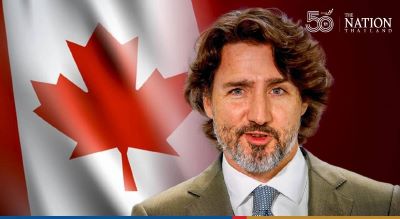
TORONTO – Prime Minister Justin Trudeau, deprived again of the majority he sought in an unpopular snap pandemic election in September, pledged Tuesday to get the pandemic under control and go “further, faster” to fight climate change.
His plan, presented in the Speech from the Throne for a new session of Parliament, was mostly a rehash of promises he has made in past addresses, budgets and campaign platforms, such as building affordable housing, working with the provinces to create a national child-care system, increasing immigration and advancing reconciliation with Indigenous people.

The address was delivered in a ceremony filled with ancient traditions, pomp and pageantry by the governor general, who represents Queen Elizabeth in Canada, but it was written by the prime minister and his aides.

It came more than two months after a federal election that produced a Parliament that looks virtually unchanged from the last one. Trudeau called the election betting voters would reward him for his response to the pandemic with a majority government.

Instead, they left his party 11 seats short of the 170 needed for a majority in the House of Commons, and dependent again on the backing of opposition parties to pass his agenda.

The speech said voters gave Parliament “clear” direction.

“Not only do they want parliamentarians to work together to put this pandemic behind us,” said Gov. General Mary Simon, reading the address. “They also want bold, concrete solutions to meet the other challenges we face.”

The speech was the first delivered by Simon, Canada’s first Indigenous governor general. The former diplomat, who is bilingual in English and Inuktitut, delivered parts of the address in both of those languages, as well as French, a language she has pledged to learn.

In a preface to the speech written by Simon herself, she noted the discoveries this year of unmarked graves near the sites of former residential schools for Indigenous children and urged Canadians to turn their “guilt” into action on reconciliation. She also delivered a stark warning about the planet.

“Our Earth is in danger,” Simon said. “From a warming Arctic to the increasing devastation of natural disasters, our land and our people need help. We must move talk into action and adapt where we must. We cannot afford to wait.”

Much as in the old Parliament, Trudeau is expected to rely on the left-leaning New Democratic Party and the separatist Bloc Québécois for support. Those parties are aligned with him on several key policy areas, including combating climate change.

The throne speech is typically put to a vote that the government must win to stay in power. The Bloc Québécois appeared to indicate that it would not bring the government down over the speech.

“Supporting might not be the best word,” Bloc leader Yves-François Blanchet said. “We will live with this empty piece of paper gently read in three languages.”

Other party leaders panned the speech.

“It really looked really empty,” said New Democratic Party leader Jagmeet Singh. “It was a government that’s run out of ideas and run out of steam. We see a throne speech that does not respond to the urgency of the crises that we’re up against.”

Still, he declined to say whether he would vote against it.

Conservative Party leader Erin O’Toole said that the throne speech lacked “a plan for the economy” and “a plan to tackle the cost of living crisis.”

“The reality facing Canadian families seem to be something that the Liberal government [is] all too happy to blissfully ignore,” he said.

The address contained one reference to inflation, which it described as “a challenge that countries around the world are facing,” and said the government would “prudently” manage spending and move toward “more targeted” economic aid for sectors still affected by the pandemic.

The speech came as the government responds to the aftermath of a once-in-a-century storm in British Columbia last week that caused flooding and landslides that have been blamed for at least four deaths, led to fuel rationing and destroyed key highways, effectively choking Vancouver off from much of the rest of Canada.

It pledged to cap and cut oil and gas sector emissions and to “strengthen action to prevent and prepare for floods, wildfires, droughts, coastline erosion and other extreme weather worsened by climate change.”

“The government is taking real action to fight climate change,” the government said. “Now, we must go further, faster.”

The speech, which is read in the Senate, usually provides a broad overview of a government’s agenda, but rarely provides nitty-gritty details on how programs might work or what they will cost. This one was no different.

It foreshadowed potential flash points, including a plan to revive a controversial bill from the last session of Parliament that would ensure streaming services “pay their fair share for the creation and promotion of Canadian content.”

With the pandemic not yet over, it remained unclear what format the new session of Parliament would take. The Liberals favor a hybrid Parliament with some lawmakers physically present in the House of Commons and others joining remotely. The Conservatives and the Bloc want all lawmakers to attend in-person.

“We want to see Parliament return to proper function,” O’Toole said.

Published : November 24, 2021

By : The Washington Post
Asean reported over 27,000 new Covid-19 cases on Tuesday #SootinClaimon.Com

#SootinClaimon.Com : ขอบคุณแหล่งข้อมูล : หนังสือพิมพ์ The Nation.

https://www.nationthailand.com/international/40009173


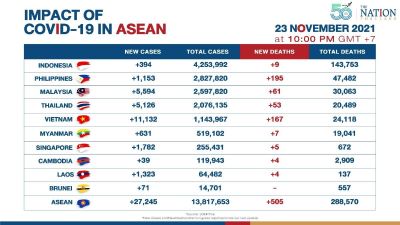
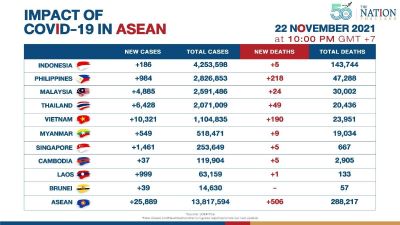
The number of Covid-19 cases crossed 13.87 million across Southeast Asia, with 27,245 new cases reported on Tuesday (November 23), higher than Monday’s tally at 25,889. New deaths are at 505, decreasing from Monday’s number of 506. Total Covid-19 deaths in Asean are now at 288,570.

Malaysia’s government is prepared to face the eventuality of the fourth wave of Covid-19 infection in the country following the Melaka state election last Saturday. Taking a lesson from the Sabah election last year, a very strict standard operating procedure (SOP) was set for the Melaka state election by not allowing large-scale campaigns to be held. The strict SOPs would also be used for the coming Sarawak state election to curb the spread of Covid-19.

Meanwhile, Malaysian budget airline AirAsia Group reported a net loss of 887 million ringgit on Monday, 4.1 per cent increase compared with a loss of 851.8 million ringgit a year earlier. It said enhanced lockdowns and travel restrictions in Malaysia and Indonesia impacted its aviation revenue, although its Philippines unit had a strong quarter.
 

Published : November 24, 2021

By : THE NATION

Apple sues Israeli spyware maker NSO over its Pegasus spyware #SootinClaimon.Com

#SootinClaimon.Com : ขอบคุณแหล่งข้อมูล : หนังสือพิมพ์ The Nation.

https://www.nationthailand.com/international/40009171


Apple announced Tuesday that it has sued Israel-based NSO Group over the use of its Pegasus spyware to attack Apple devices, the latest move in an escalating global campaign to curb surveillance abuses against smartphone users.

The suit, which seeks an injunction against NSO to stop it from using any Apple software, service or device, comes after the July publication of The Pegasus Project by The Washington Post and 16 other news organizations that detailed the use of Pegasus in dozens of attacks against journalists, human rights workers and political activists in countries across the world.

The NSO Group has repeatedly denied the conclusions of The Pegasus Project but also has been buffeted by a series of government and other actions fueled by the consortium’s findings, including a U.S. government decision earlier this month to blacklist the company.

NSO’s “notorious hackers” are “amoral 21st century mercenaries who have created highly sophisticated cyber-surveillance machinery that invites routine and flagrant abuse,” Apple claims in the lawsuit, which was filed in federal court in the Northern District of California.

NSO long has defended itself by saying that spyware is essential to combatting crime and terrorism in a world in which most communications are encrypted, making traditional wiretapping all but impossible. Breaking into a particular device, by contrast, allows police and spies to monitor the activities of individuals it is targeting – even when they use WhatsApp, Signal or other encrypted communications tools. The company has said it licenses Pegasus to dozens of military, intelligence and law enforcement agencies around the world but not before vetting its clients.

“Thousands of lives were saved around the world thanks to NSO Group’s technologies used by its customers,” NSO spokesman Oded Hershkovitz in a statement Tuesday. “Pedophiles and terrorists can freely operate in technological safe-havens, and we provide governments the lawful tools to fight it. NSO group will continue to advocate for the truth.”

Apple’s legal move follows a similar lawsuit by the Facebook-owned messaging service WhatsApp in 2019 that accused NSO of targeting 1,400 of its users with spyware. A U.S. appeals court ruled this month that the suit can proceed.

Those seeking to curb the use of spyware praised the growing use of lawsuits and other legal tools to combat NSO and similar companies, calling such moves key to challenging an industry capable of developing a seemingly endless number of new ways to attack phones and other computerized devices. It’s a cat-and-mouse game defenders – even at giant technology companies – are doomed to lose given the sprawling and ever-changing nature of software, experts say.

“You’re never going to get rid of all of the exploits,” said Johns Hopkins security researcher Matthew D. Green, using a common term for the software weaknesses exploited by hackers. He said lawsuits make it harder for companies like NSO Group to make big profits. “When companies like Apple turn on NSO and make it so that [surveillance] is not a profitable activity any more, that’s a good thing.”

In announcing its lawsuit, Apple singled out a particular attack on iPhones called FORCEDENTRY that had been discovered by researchers for Citizen Lab, a technology research group at the University of Toronto that has long worked to detail abuses of Pegasus. Apple released a patch for the vulnerability shortly after Citizen Lab reported it to the company in September.

“State-sponsored actors like the NSO Group spend millions of dollars on sophisticated surveillance technologies without effective accountability. That needs to change,” said Craig Federighi, Apple’s senior vice president of Software Engineering, in a blog post announcing the lawsuit.

“Apple devices are the most secure consumer hardware on the market – but private companies developing state-sponsored spyware have become even more dangerous,” he wrote. “While these cybersecurity threats only impact a very small number of our customers, we take any attack on our users very seriously, and we’re constantly working to strengthen the security and privacy protections in iOS to keep all our users safe.”

Among the findings of The Pegasus Project was that iPhones, despite their reputation for strong security compared to some other smartphones, had weaknesses that the NSO Group had learned to exploit to deliver spyware to the phones of targets.

In some cases NSO customers delivered Pegasus in such a stealthy way that users got no alert and needed to take no action in order for an infection to begin on their devices. Such “zero-click attacks” were an advance over previous generations that relied on users clicking on malicious links in text messages or other communication on their devices.

Once inside, Pegasus turned smartphones into sophisticated spying devices, revealing their locations, communications, pictures and other information. Pegasus, which also can be used to target Android devices, can activate microphones and cameras without users knowing.

The lawsuit accuses NSO of enabling customers to target U.S. citizens, despite the company’s pledge that its spyware “cannot be used to conduct cybersurveillance within the United States.”

Apple also said it was donating $10 million to support cybersecurity researchers and advocates against spyware. The company also said in its blog post that it had made recent improvements in its latest mobile operating system, iOS 15, and in particular to its Blast Door feature that’s intended to defend against malware, including Pegasus. It also is notifying users successfully attacked using the FORCEDENTRY exploit.

But by taking the fight to federal court, Apple has signaled that it is moving beyond technical approaches to combatting spyware to challenging the companies that make such hacking easy to execute, even for governments without advanced technological abilities.

“What Apple has done … is putting NSO’s business model into the toxic category for all but the most unscrupulous investors,” said said John Scott-Railton, a senior researcher at Citizen Lab.

Apple is suing under the Computer Fraud and Abuse Act, which was enacted in 1986, long before anyone imagined the interconnected world of mobile computing that now dominates everything from commerce to pop culture.

Legal experts say it’s still unclear whether the law, which prohibits anyone from “intentionally accessing a computer without authorization,” applies to companies like NSO Group. The company has argued in other lawsuits, including the one filed by WhatsApp, that it does not.

“It’s something that is sort of cutting edge when it comes to computer law,” said Tor Ekeland, a defense attorney who often represents clients accused of hacking offenses.

Apple also attempts to thread a legal needle, acknowledging that Apple itself wasn’t the target of the hacks, but that it was still victimized because NSO abused “Apple services and servers to perpetrate attacks on Apple’s users and data stored on users’ devices.”

The legal complaint argues that the federal court in Northern California has has jurisdiction in the case because NSO allegedly “created more than one hundred Apple IDs to carry out their attacks and also agreed to Apple’s iCloud Terms and Conditions (‘iCloud Terms’), including a mandatory and enforceable forum selection and exclusive jurisdiction clause that constitutes express consent to the jurisdiction of this Court.” Apple is based in Cupertino, Calif.

NSO has suffered a series of devastating blows in the months since the Pegasus Project investigation. This month, after the Commerce Department added the company to its red-flagged “entity list,” NSO’s new chief executive announced his resignation after only two weeks in the role. The U.S. government action has been seen as a Biden administration rebuke to the Israeli government, which approves all NSO Group exports – essentially dictating which countries can use Pegasus – but failed to prevent the abuses detailed in The Pegasus Project.

The company also faces significant financial peril. The credit rating agency Moody’s downgraded the company on Monday, saying it faced an “increased risk” of default on hundreds of millions of dollars in debt.

In recent months, an internal investigation discovered traces of Pegasus spyware in the phones of five French cabinet ministers. And in the U.K., a High Court judgment last month confirmed that the phones of Princess Haya, the ex-wife of Dubai’s ruler, as well as those of her legal and security advisers had been targeted with a Pegasus hack.

The White House raised concerns about NSO’s spyware to the Israeli government in July. Beyond the Commerce Department’s blacklist, members of Congress have also pushed for more severe financial sanctions and other measures to combat the spyware’s abuse.

Published : November 24, 2021

By : The Washington Post
Prayut offers 3-pronged strategy to ‘build a liveable world’ at Asean-China summit #SootinClaimon.Com

#SootinClaimon.Com : ขอบคุณแหล่งข้อมูล : หนังสือพิมพ์ The Nation.

https://www.nationthailand.com/international/40009155


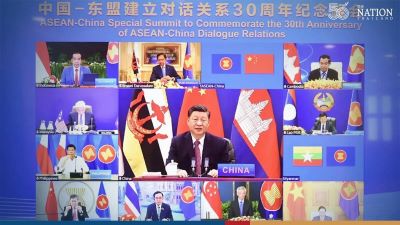
“PM Prayut told the meeting that the establishment of a comprehensive strategic partnership between Asean and China will enhance cooperation in all dimensions,” government spokesman Thanakorn Wangboonkongchana said.

He also told the meeting that Thailand is committed to improving people’s quality of life and boosting human potential in the 21st century under three key strategies:

• Reducing socio-economic disparity and improving the quality of life for people along the sufficiency economy philosophy.

• Promoting a grassroots society and economy through modern technology and innovation to boost the potential of people in all age groups, ensuring no one is left behind.

• Ensuring that all development projects are sustainable and eco-friendly, with a renewed focus on promoting the BCG (bio, circular and green) economy and achieving carbon neutrality by 2050 and zero greenhouse gas emissions by 2065.

Chinese president Xi Jinping, who chaired the meeting, offered a five-point proposal for the two sides to jointly build a “peaceful, safe, secure, prosperous, beautiful and amicable home together”.

“We need to pursue dialogue instead of confrontation, build partnerships instead of alliances, and make a concerted effort to address the various negative factors that might threaten or undermine peace,” Xi said at the meeting.

Xi said China would never seek to dominate or bully smaller countries, adding that his country supports Asean’s efforts to build a nuclear-weapons-free zone.

The president also unveiled a China-Asean health shield initiative, which, in addition to vaccine donations, includes an additional US$5 million donation to the Covid-19 Asean Response Fund, joint vaccine production and technology transfer to help the bloc build a primary-level public health system.

Last year, Asean and China became top trading partners as they jointly battled the Covid-19 pandemic and global economic downturn. Prayut highlighted these developments as fundamental for forging closer ties in the future.

“China and Asean nations must continue to maintain peace and stability under the 3M principles, namely mutual trust, mutual respect and mutual benefits,” Prayut said in his closing remarks.

He also praised Xi’s vision for “building a community with a shared future for mankind”, saying it demonstrates China’s commitment to addressing common challenges and creating a liveable world.

With inputs from Xinhua and China Daily

Related News

China, ASEAN in comprehensive strategic partnership, says X

AEC prepares for 20th Asean Summit to be held next week

Post-pandemic recovery, security high on ASEAN summit agenda

Published : November 23, 2021

By : THE NATION

Tightened COVID-19 restrictions spark protests, riots across Europe amid new pandemic wave #SootinClaimon.Com

#SootinClaimon.Com : ขอบคุณแหล่งข้อมูล : หนังสือพิมพ์ The Nation.

https://www.nationthailand.com/international/40009139


As winter arrives in the Northern Hemisphere, the European Union (EU) fears a new wave of COVID-19 infections. The level of concern for the COVID-19 situation in the EU was rated at 8.3 of 10, or “very high” last Friday by the European Center for Disease prevention and Control (ECDC).

In response to the tightened COVID-19 measures, demonstrations were held around Europe this past weekend, amid rising new cases and a new wave of pandemic.

In Belgium and the Netherlands, the protests intensified into rioting, prompting the police to use tear gas and water cannons.

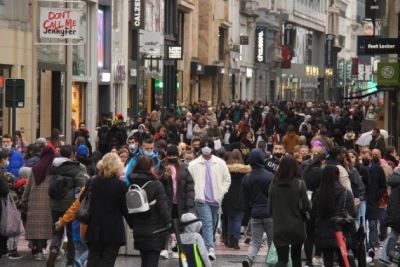
People walk on a business street in Brussels, Belgium, July 19, 2021. Belgium has witnessed a rise in COVID-19 cases recently. (Xinhua/Zhang Cheng)People walk on a business street in Brussels, Belgium, July 19, 2021. Belgium has witnessed a rise in COVID-19 cases recently. (Xinhua/Zhang Cheng)

Related Stories

RIOTS AND STRIKE

An estimated 35,000 people gathered in central Brussels on Sunday to protest against the reinforced measures that entered into force this weekend. These include the mandatory use of the COVID Safe Ticket (CST) and the obligation to wear face masks in areas where a CST is required.

The demonstration started shortly after 12 noon on Sunday near the Brussels North Station, with protesters brandishing banners saying “Together for Freedom” and “Resistance.”

The police used water cannons and tear gas to subdue demonstrators who threw fireworks at them.

Forty-two people were detained and two arrested, local police said late on Sunday and the mayor of the City of Brussels, Philippe Close, “strongly condemned” the riots.

In Rotterdam, the demonstration against the COVID-19 restrictions started last Friday evening when several hundred protesters gathered in the city center throwing fireworks and setting cars — among them at least one police vehicle — ablaze.

Photo taken on Nov. 1, 2021 shows a COVID-19 precaution notice to keep 1.5-meter distance in a shop in Amsterdam, the Netherlands. (Xinhua/Sylvia Lederer)Photo taken on Nov. 1, 2021 shows a COVID-19 precaution notice to keep 1.5-meter distance in a shop in Amsterdam, the Netherlands. (Xinhua/Sylvia Lederer)

The protest escalated into riot, and the police responded with water cannons and tear gas.

Around 50 people were arrested and four were injured and sent to hospital for treatment.

On Monday, Dutch Prime Minister Mark Rutte condemned the riots of the past three days in cities across the Netherlands and warned that everything possible would be done to punish the rioters.

“These are not corona protests, but pure violence by idiots, which has nothing to do with demonstrating,” Rutte said after consulting his fellow ministers.

Across Greece, restaurants and cafes remained closed last week in protest against the government’s new COVID-19 restrictions.

The measures have hit thousands of businesses hard, with many of them facing the risk of permanent closure, and further state support is urgently needed, the Panhellenic Federation of Restaurants and Related Professions (POESE) said in a press release.

“We are shutting down today so that we will not have to shut down forever,” protesters chanted during a rally held in the center of Athens.

“Catering stays closed throughout Greece” read banners on the closed doors of restaurants and cafes.

“We have suffered a lot in the past two years, we can’t cope with the difficult conditions,” labor union activist Iro Genetzaki told Xinhua during the protest.

People walk past a closed restaurant in Athens, Greece, on Nov. 16, 2021. (Xinhua/Marios Lolos)People walk past a closed restaurant in Athens, Greece, on Nov. 16, 2021. (Xinhua/Marios Lolos)
TIGHTENED COVID MEASURES

As winter arrives in the Northern Hemisphere, the European Union (EU) fears a new wave of COVID-19 infections.

The level of concern for the COVID-19 situation in the EU was rated at 8.3 of 10, or “very high” last Friday by the European Center for Disease prevention and Control (ECDC).

Wearing masks, hand-washing and ventilation are crucial non-pharmaceutical measures that must continue in order to fight COVID-19, and “it remains extremely important that we follow the non-pharmaceutical interventions,” said Stefan De Keersmaecker, European Commission spokesperson for Health, on Monday.

New measures to curb the spike in COVID-19 infections entered into force in Belgium on Saturday, making the use of the CST and the wearing of face masks mandatory indoors for everyone age ten and above.

The authorities reiterated their call for people to respect the 1.5-meter social distancing indoors and to limit social contacts outdoors, though no “bubbles” have been imposed for now.

In Greece, under the latest set of measures in effect since Nov. 6, in order to be served at cafes and restaurants, either indoors or outdoors, customers need to show proof of COVID-19 vaccination or recovery.

Unvaccinated individuals must present a recent negative rapid PCR (polymerase chain reaction) test to be able to enter retail shops, hair salons, public services and banks.

France’s Minister of Labor Elisabeth Borne on Monday called on French companies to strictly respect barrier gestures, especially the mask mandate, in order to enable the country to face the fifth COVID-19 wave.

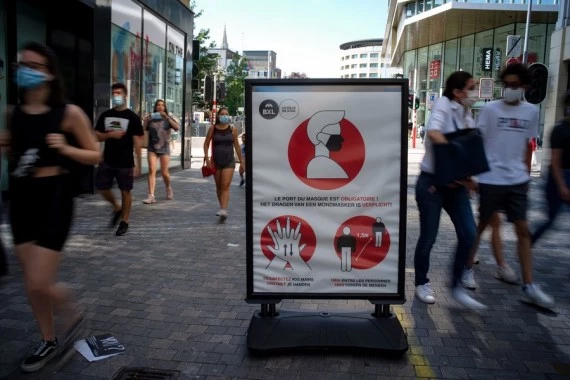
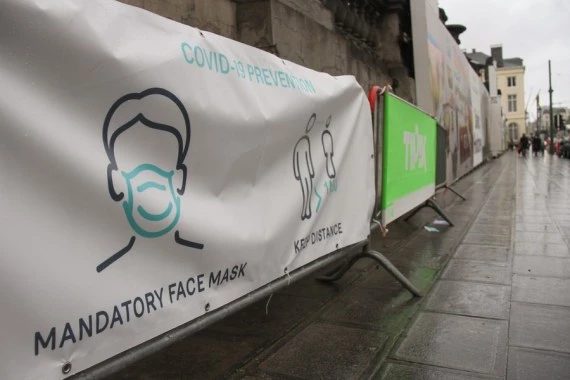
A sign to notice pedestrians wearing face masks and keeping social distance is seen in Brussels, Belgium, Nov. 5, 2021. (Xinhua/Zheng Huansong)A sign to notice pedestrians wearing face masks and keeping social distance is seen in Brussels, Belgium, Nov. 5, 2021. (Xinhua/Zheng Huansong)

“In business, we must re-mobilize to respect barrier gestures, put the mask back on in meetings, when we are in public spaces … It is very important at a time when we see that the pandemic is starting again,” she said.

In light of the worsening situation, France’s Vaccine Strategy Orientation Council (COSV) on Monday suggested that a booster shot for all adults should be considered.

In the face of the growing pandemic, Germany’s federal states have recently tightened their respective COVID-19 measures.

The southern state of Bavaria and the eastern state of Saxony have canceled their Christmas markets this year, and the western state of Hesse decided that only those vaccinated or recovered from COVID-19 will be allowed to enter indoor areas of restaurants, sports facilities and cultural institutions.

Gernot Marx, president of the German Interdisciplinary Association for Intensive Care and Emergency Medicine (DIVI), said at a live-streamed event on Monday that “the COVID-19 situation (in Germany) is very worrying and not under control at the moment.”

People walk past a sign to notify visitors of COVID-19 measures at a market in Berlin, Germany, on Nov. 15, 2021. (Xinhua/Shan Yuqi)People walk past a sign to notify visitors of COVID-19 measures at a market in Berlin, Germany, on Nov. 15, 2021. (Xinhua/Shan Yuqi)
Published : November 23, 2021

By : Xinhua

French PM tested positive for COVID-19, Belgian PM isolated #SootinClaimon.Com

#SootinClaimon.Com : ขอบคุณแหล่งข้อมูล : หนังสือพิมพ์ The Nation.

https://www.nationthailand.com/international/40009138


Belgian Prime Minister Alexander De Croo will be tested on Wednesday and will remain in quarantine until the result of his test, local media reported. The schedule of French Prime Minister Jean Castex is to be modified for the coming days in order for him to continue working in his isolation.

French Prime Minister Jean Castex has tested positive for COVID-19, French media reported on Monday.

Returning from Brussels Monday afternoon after meeting with his Belgian counterpart Alexander De Croo, Castex learnt that one of his daughters tested positive for COVID-19, Le Figaro reported.

De Croo will be tested on Wednesday and will remain in quarantine until the result of his test, local media reported.

Several senior members of the Belgian government will also go into quarantine to avoid any risks.

French ministers in the delegation include minister of the Armed Forces Florence Parly, Interior minister Gerald Darmanin, minister of Justice Eric Dupond-Moretti, and Secretary of State for European Affairs Clement Beaune.

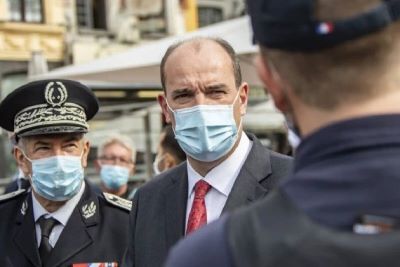
Belgian Prime Minister Alexander De Croo (Front) attends a tribute ceremony in Verviers, Belgium, on July 20, 2021. (Xinhua/Zhang Cheng)Belgian Prime Minister Alexander De Croo (Front) attends a tribute ceremony in Verviers, Belgium, on July 20, 2021. (Xinhua/Zhang Cheng)
Related Stories

Castex “immediately got a PCR (polymerase chain reaction) test, which turned out to be positive,” the French newspaper cited the prime minister’s office as saying.

The schedule of the French head of government is to be modified for the coming days in order for him to continue working in his isolation.

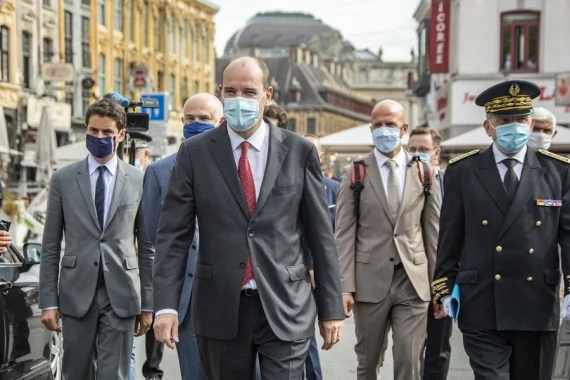
 French Prime Minister Jean Castex (C, front) visits Lille as mask-wearing becomes mandatory in the city center amid concerns about an increase in COVID-19 cases, northern France, Aug. 3, 2020. (Xinhua/Sebastien Courdji)French Prime Minister Jean Castex (C, front) visits Lille as mask-wearing becomes mandatory in the city center amid concerns about an increase in COVID-19 cases, northern France, Aug. 3, 2020. (Xinhua/Sebastien Courdji)

Published : November 23, 2021

By : Xinhua

Asean reported over 25,000 new Covid-19 cases on Monday #SootinClaimon.Com

#SootinClaimon.Com : ขอบคุณแหล่งข้อมูล : หนังสือพิมพ์ The Nation.

https://www.nationthailand.com/international/40009136


The number of Covid-19 cases crossed 13.81 million across Southeast Asia, with 25,889 new cases reported on Monday (November 22), lower than Sunday’s tally at 27,526. New deaths are at 506, increasing from Sunday’s number of 364. Total Covid-19 deaths in Asean are now at 288,217.

Singapore’s Public Health Ministry hopes to extend the Covid-19 national vaccination programme to children below the age of 12 in January next year. The ministry reported that children below the age of 12 now made up about 11.2 per cent of all Covid-19 cases in the country, increasing from 6.7 per cent in the last months. 

The ministry said that these children remain vulnerable because they are not yet eligible for vaccination to protect them from infection. And it’s generally harder to get them to comply with disciplined mask-wearing and safe separation and measures.

Meanwhile, Brunei’s Minister of Religious Affairs on Monday called on the public to protect themselves by getting vaccinated against Covid-19. He said the public should not be concerned about the vaccine as it is safe in Syarak with no impurities found to prevent us from taking it, adding that the vaccine proves to be effective and reduces the risk of infection. Parents were also urged to give consent to have their adolescent children, between the ages of 12 to 17, inoculated.
 

Published : November 23, 2021

By : THE NATION

Squeezed by mandates and restrictions, Europes anti-vaxxers rebel #SootinClaimon.Com

#SootinClaimon.Com : ขอบคุณแหล่งข้อมูล : หนังสือพิมพ์ The Nation.

https://www.nationthailand.com/international/40009132


Shouting cries of “freedom” and “resistance,” Europes unvaccinated are in open rebellion, taking to the streets against a host of new mandates and restrictions as the continents coronavirus cases soar. Their anger comes as their world is shrinking.

Squeezed by mandates and restrictions, Europes anti-vaxxers rebel

Branded with a proverbial Scarlet “A,” the anti-vaxxers of Europe are finding themselves ostracized from public life far more than their American counterparts.

Many are not taking it sitting down. The European Union is no stranger to protests against coronavirus measures. But the weekend saw a convergence of large and sometimes violent demonstrations in multiple countries. In what the mayor of Rotterdam, decried as an “orgy of violence” on Friday, Dutch police opened fire and arrested scores of rioters who set fires and lobbed stones at officers amid a new partial lockdown and proposed law that would ban the unvaccinated from entering businesses even with a negative coronavirus test. Thousands also marched against mandates or restrictions in Belgium, Croatia, Italy, Northern Ireland and Switzerland.

In Vienna, where the unvaccinated face the prospect of extended lockdowns and a revolutionary decree compelling them to take their jabs whether they like it or not, an estimated 40,000 demonstrators took to the streets Saturday, some of them clashing with police as night fell.

The simmering discontent was not confined to Europe. In Australia, thousands turned out against pandemic legislation in “freedom” marches in Melbourne, Sydney, Brisbane, Perth and Adelaide. France deployed special police forces to its overseas territory of Guadeloupe after days of unrest that saw protesters set fire to cars and block roads in opposition to French vaccine and health pass mandates.

The outburst of anger – particularly in Europe, a place American liberals often look to as a beacon of progressive values on climate change, social benefits and universal health care – illustrates just how challenging it may be for rich nations, now flush with vaccines, to overcome vaccine hesitancy and push closer to near-total coverage rates.

Europe’s creep toward winter has brought a dangerous escalation in cases – in some countries, the highest of the pandemic – and indoor gatherings in colder weather is not the only culprit. With nearly 67 percent of its population fully vaccinated, the European Union has leapfrogged the United States on doses administered. But across the continent, there are still stubborn geographic, demographic and ideological pockets of the unvaccinated serving as tinder for severe cases of the virus to rekindle.

In response, European leaders are embracing novel, coercive techniques to compel the unvaccinated to do their civic duty and take their shots, setting up a political experiment that is being closely watched on the other side of the Atlantic, where Washington has turned to more limited vaccine mandates for federal employees, government contractors, health-care workers and staff of large companies.

Italy’s “green pass” system imposes work suspensions or restrictions on access to a range of businesses for those without vaccinations or recent tests. France embraced a “health pass” requiring vaccination or a recent negative coronavirus test to access restaurants, cafes, movie theaters and more. In Romania, where the number of infections is skyrocketing, the unvaccinated were targeted in October for a special curfew that was later extended to everyone as cases continued to spike. Vaccination certificates are still required for regular activities like working out at gyms or shopping at malls.

No European nation has gone as far as Austria. A spike in cases coupled with vaccine hesitancy – 64 percent of the population is fully vaccinated, a rate lower than those in Italy, France, Portugal and Germany – prompted leaders there to announce a nationwide vaccination mandate starting in February. As a stopgap, the country last week declared a lockdown of the unvaccinated. The government later imposed Europe’s first broader national lockdown of the fall, one set to start Monday and last at least 10 days. After that, the lockdown may end for the vaccinated, but the unvaccinated will still face entry restrictions at hotels, restaurants, bars, nightclubs, gyms, cinemas, theaters, Christmas markets, ski resorts and for personal services such as salons.

That may leave anti-vaccine Austrians eating their schnitzels at home for the foreseeable future, and they are not amused. Some demonstrators wore a yellow star with the words “not vaccinated,” a reference the symbols warn by prisoners in Nazi concentration camps. The move drew outrage from officials like Interior Minister Karl Nehammer, who said the use of such symbols “insults the millions of victims of the Nazi dictatorship and their families.”

“Society is being massively divided and set against a group of people who are being shut out of public life and forced to do things we don’t want to do,” Katja Schoissenger, a mother of two protesting in Vienna on Saturday, told the New York Times. “I have nothing against people who want to be vaccinated. It is a free decision, and I think that’s OK and legitimate, but I am a young, healthy person and it’s not an issue for me.”

Some are questioning the imposition of such restrictions. Speaking to the BBC, Andrea Ammon, director for the European Center for Disease Prevention and Control, called mandatory vaccinations a “double-edged sword,” suggesting strict rules could make people who were still doubting the vaccines completely reject them. That could produce an even greater pool of government-resenting anti-vaxxers.

It’s unclear whether tough measures are worth the social unrest they cause. In Italy, my colleagues reported, vaccination rates ticked up 4.4 percentage points in the two months after the green pass law was announced. That was more than any other nation in Western Europe, but only marginally higher than the 3 percentage points increase seen across the European Union during the same period.

Europe’s vaccination holdouts share some commonalities with American anti-vaxxers, but they also have their own particular profile. They include members of far-right fringe groups, soccer fans, libertarians on both sides of the political spectrum and citizens scared off vaccines by an onslaught of misinformation.

Americans and European anti-vaxxers often share a distrust of government, but frequently for very different reasons. As Alix Kroeger wrote in the New Statesman, Europe’s vaccine resistant and hesitant tend to tilt geographically toward the southeastern part of the continent, those nations that once lived behind the Iron Curtain and where communist authorities and subsequent elected governments were often little trusted by the people, including on health advice.

Today, those nations – among them Romania, Bulgaria, Slovenia, Slovakia and Croatia – have by far the lowest vaccination rates in Europe.

“People don’t trust the state to act in the interest of the common good,” Florian Bieber, director of the Centre for Southeast European Studies at the University of Graz, in Austria, told Kroeger. “They don’t trust the messages coming from the state or even experts. They believe these are all driven by selfish interests.”

Published : November 23, 2021

By : The Washington Post

“Paradise for Dog Lovers” — Fantastic dog show in India #SootinClaimon.Com

#SootinClaimon.Com : ขอบคุณแหล่งข้อมูล : หนังสือพิมพ์ The Nation.

https://www.nationthailand.com/international/40009106


Pomeranian, Shih Tzu, German shepherd… In Amritsar, north India, a dog show is being held, attracting plenty of dog-lovers to bring their pets to participate. Dogs are playing happily in the show, as well as “making new friends.”

A Shih Tzu gets its hair combed during a dog show in Amritsar of IndiaA Shih Tzu gets its hair combed during a dog show in Amritsar of India

A pomeranian gets its hair trimmed during a dog show in Amritsar of IndiaA pomeranian gets its hair trimmed during a dog show in Amritsar of India

A German shepherd dog (R) looks at a pug during a dog show in Amritsar of IndiaA German shepherd dog (R) looks at a pug during a dog show in Amritsar of India

An American Bully dog is displayed during a dog show in Amritsar district of IndiaAn American Bully dog is displayed during a dog show in Amritsar district of India

A Shih Tzu dog shakes its head as it competes during a dog show in Amritsar district of IndiaA Shih Tzu dog shakes its head as it competes during a dog show in Amritsar district of India

Published : November 22, 2021

By : Xinhua

Israel reinforces security after fatal shooting attack in East Jerusalem #SootinClaimon.Com

#SootinClaimon.Com : ขอบคุณแหล่งข้อมูล : หนังสือพิมพ์ The Nation.

https://www.nationthailand.com/international/40009105


Israel reinforced its security forces in East Jerusalem on Sunday amid rising tensions in the flashpoint city following a shooting attack that killed one civilian and injured four.

At about 9 a.m. local time (0700 GMT), the attacker, identified by Palestinian media as Fadi Abu Shkhaidem, opened fire at civilians outside the Al-Aqsa Mosque compound, a contested site holy to both Muslims and Jews.

One person was critically injured in the shooting and died hours later in hospital, while four more sustained various degrees of injuries, according to statements from the Israeli government and medical facilities.

Israeli state-owned Kan news TV identified the victim as Eliyahu Kay, 26, from Modiin, a city west of Jerusalem. He recently migrated from South Africa to Israel and was employed at the Western Wall, known in Islam as the Buraq Wall, as a tourist guide.

The assailant was shot and killed by the police at the scene, the police said in a statement, adding two of the four injured were police officers who were wounded by shrapnel.   

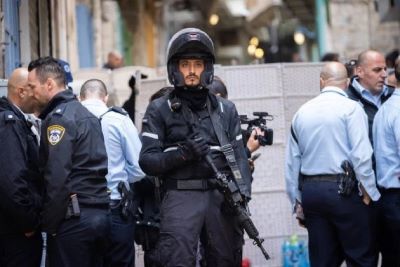
Israeli police officials gather near the site of a shooting incident in JerusalemIsraeli police officials gather near the site of a shooting incident in Jerusalem

Related Stories

Israeli Minister of Public Security Omer Barlev described the shooter as a member of Hamas and from the Shuafat refugee camp in East Jerusalem. During a tour at the scene, Barlev told journalists that the attacker used a submachine gun.

According to Barlev, the assailant arrived at the Al-Aqsa Mosque for prayers every day. “Today he arrived with a weapon and decided to shoot, unfortunately,” he said.

Israeli police officials gather near the site of a shooting incident in JerusalemIsraeli police officials gather near the site of a shooting incident in Jerusalem

The attacker Abu Shkhaidem, 42, was a teacher at a religious high school in Jerusalem, according to Israeli media.

No group has claimed responsibility for the attack but Hamas praised it and confirmed that Abu Shkhaidem was its member.

Speaking at the start of the weekly cabinet meeting, Israeli Prime Minister Naftali Bennett said he ordered security forces to be on alert to prevent possible “copycat” attacks that might follow Sunday’s attack.

“I have directed the security forces to prepare accordingly and be alert, also over concern for copycat attacks,” he said. “We need to be on heightened alert and prevent future attacks.”

It was the second attack in East Jerusalem within a week. On Wednesday, a Palestinian teenager was shot dead after he stabbed two police officers, the police said.

Israel occupied the West Bank and East Jerusalem, which are claimed by the Palestinians, in the 1967 Middle East war, and has controlled them ever since. The Palestinians have been seeking to establish an independent state on these territories together with the enclave Gaza Strip. 

People clean a pavement following a shooting incident in JerusalemPeople clean a pavement following a shooting incident in Jerusalem
 

Published : November 22, 2021

By : Xinhua