Two of the 17 foreign missionaries kidnapped by a notorious street gang in Haiti last month have been released, Ohio-based Christian Aid Missionaries said Sunday.
“Only limited information can be provided, but we are able to report that the two hostages who were released are safe, in good spirits, and being cared for,” the group said in a statement posted to its website. “We praise God for this!”
The Oct. 16 kidnappings of the missionaries and family members thrust the poverty-stricken Caribbean nation once more into the center of an international crisis. The group included 16 Americans and a Canadian. Authorities from the United States and Canada have said they are working closely with Haitian counterparts to secure their freedom.
The gang, 400 Mawozo, demanded $1 million per person held. The United States does not pay ransoms for kidnapped citizens.
For Haitians rich and poor, gang violence and kidnapping for ransoms have become commonplace. The country is suffering a surge in abductions that analysts say is the worst in the country’s history.
400 Mawozo has gained notoriety in Haiti for its use of mass kidnappings and abducting groups such as Christian clergy that were previously considered off-limits.
Haiti, the poorest nation in the Western Hemisphere, has the world’s highest rate of kidnappings per capita.
The Russian missile test that shattered a dead satellite this week highlights a growing threat of space debris just as companies such as SpaceX and Boeing Co. make plans to launch as many as 65,000 commercial spacecraft into orbit in coming years.
The anti-satellite weapon smashed a Russian orbiter into at least 1,500 pieces, forming a belt of debris hurtling around the Earth at speeds up to 17,000 miles an hour. It forced ground control to awaken the sleeping crew of the International Space Station and ask them to close hatches and scramble into docked spacecraft for safety.
It also added to the amount of junk speeding through space thanks to failed satellites, discarded rocket boosters and weapons tests. This just as technology entrepreneurs and defense companies have announced plans to deploy constellations of satellites, adding to about 4,550 from all countries currently in orbit.
The Russian anti-satellite test “just makes everything worse,” said Brian Weeden, director of program planning for Secure World Foundation, a group that works for sustainable use of space.
“It’s not like the movie ‘Gravity’ where one thing happens and everything goes ‘boom,'” Weeden said. Instead there is “a tipping point, where it starts to accelerate” and the orbital environment deteriorates over decades.
Low-Earth orbit is an area of major concern because because that’s where companies want to locate small observation and communications satellites. These include Elon Musk’s Space Exploration Technologies Corp., which has more than 1,700 Starlink satellites already orbiting and plans is asking regulators for permission to add 30,000 more to provide broadband internet from space.
The U.S. Federal Communications Commission is reviewing a slew of applications from SpaceX and other companies rushing to take advantage of lower launch costs and growing appetite for data. Low orbits offer minimal lag time for data to bounce between a user on the ground and the spacecraft. Boeing, Amazon.com’s Kuiper Systems, and Astra Space Inc. were among companies submitting recent applications at the FCC for more than 35,000 satellites.
Already in some low-Earth orbits, the number of new objects and fragments generated from collisions exceeds those removed by natural atmospheric drag, the FCC said last year as it adopted rules to ease the threat from orbital debris. The agency regulates satellites because the spacecraft use wireless frequencies.
Other regions have sufficient densities of orbital debris to lead some analysts to conclude that they are close to or have already reached a “runaway” status, where the debris population will grow indefinitely, the FCC said.
“We’re at a time of transformative change in the human use of space,” said Jonathan McDowell, an astronomer at the Center for Astrophysics Harvard & Smithsonian research institute. “We are seeing more and more satellites getting damaged by orbital debris hits. Occasionally satellites get destroyed.”
There are about 4,550 operating satellites in orbit, with 3,790 in low-Earth orbit, according to a Sept. 1 tally by the Union of Concerned Scientists.
Satellite operator Viasat Inc. has warned of dangers from large constellations, saying failure risk of at least some satellites is high when thousands are in orbit.
With huge orbiting fleets, “dramatic increases in space collisions, and new space debris, are expected within just a few years,” Jim Bridenstine, a Viasat board member and former NASA administrator, told lawmakers at a U.S. Senate hearing last month.
More than 27,000 pieces of orbital debris are tracked by the Department of Defense, according to NASA. Near-Earth orbits hold much more debris that’s too small to be tracked, but large enough to threaten human spaceflight and robotic missions.
Those aboard the International Space Station took shelter for three passes of the debris field caused by the strike on the Russian satellite, Cosmos 1408, NASA said in a Nov. 15 statement.
Roughly a week before Monday’s missile strike by Russia, NASA moved the ISS to avoid a close encounter with debris remaining from a test by China that destroyed a weather satellite in 2007. The station has conducted 29 debris avoidance maneuvers since 1999, including three in 2020, NASA said in a May 26 posting online.
NASA has a set of long-standing guidelines for debris avoidance. Maneuvers are usually small and use the station’s Russian thrusters, or the propulsion systems on one of the docked spacecraft that carry passengers from Earth.
The Cosmos debris could cause problems for Musk’s SpaceX, astronomers said.
“There’s a real risk in the coming weeks that you could lose some of the Starlinks because they get in the way of this debris,” said McDowell.
SpaceX didn’t return emailed queries requesting comment. A Boeing representative also declined to comment on the risk to its fleet.
Nations are struggling with ways to reduce space debris, with techniques such as using magnetic plates to capture satellites, or using harpoons and nets, at the test stage, said McDowell. He suggested focusing on removing the largest pieces that may eventually cause the greatest number of fragments.
“At some point we have to start to clean this up,” he said.
BRUSSELS – Protests against coronavirus restrictions erupted across Europe – including clashes in Rotterdam and massive rallies in Vienna – as authorities announced more-stringent measures in an attempt to control rising cases ahead of the winter holidays.
At least seven people were injured and more than 50 arrested after protests in Rotterdam turned violent late Friday, with protesters throwing stones and police firing shots, according to Dutch police. Demonstrators decried a proposed law that would ban unvaccinated people from entering businesses even if they provide a negative test. They also protested a partial lockdown that went into effect last week and will last until at least Dec. 4, forcing restaurants and other establishments to close at 8 p.m.
In Vienna, tens of thousands of people took the streets Saturday after the country’s decision to mandate vaccines for everyone starting in February and impose new lockdowns beginning Monday.
In Italy, weekly protests against the coronavirus showed no signs of easing, with demonstrations in Rome including at the ancient Circus Maximus grounds. On social media, users posted videos from protests in other countries including France and Switzerland.
Ferd Grapperhaus, the Netherlands’ minister of security and justice, called for a “vigorous debate” over pandemic measures, but said “harassment and violence do not belong” there.
Rotterdam Mayor Ahmed Aboutaleb described the clashes as “an orgy of violence” and said “police felt it necessary to draw their weapons to defend themselves.”
One police officer was hospitalized with a leg injury and two protesters were struck by bullets. Officials are investigating whether they were hit with police gunfire, according to the Associated Press.
Europe is the world’s only region with coronavirus deaths on the rise, jumping by 5% since earlier this month, according to the World Health Organization. In response, authorities are tightening rules for those unvaccinated.
In Berlin, for example, only those who are vaccinated or have recovered from the virus can now go inside bars and restaurants. Greece reimposed some restrictions for unvaccinated people, the AP reported. Belgium mandated that people work from home at least four days a week.
The European Union relies on digital covid safe certificates to allow people to travel between E.U. countries without quarantining and – in many places – enter restaurants and other sites. The certificate shows if a person is vaccinated, has recently tested negative for the virus or has already recovered from the virus. The European Commission said Friday that the 27-nation bloc has so far issued 660 million certificates.
“The issuance of covid certificates is a very important tool to ensure safe, free movement in the European Union and also a very successful tool,” spokesman Christian Wigand told reporters Friday.
HOLLOMAN AIR FORCE BASE, N.M. – The U.S. government calls the 50-acre sprawl of tents on this desert Air Force base a “village.” The 4,300 Afghans temporarily housed here are the governments “guests.”
And the landscape of tents and trailers is called Aman Omid, which in Persian means “peace and hope” – the feelings U.S. officials say they are trying to foster here.
More than two months after the United States’ chaotic withdrawal from Afghanistan, the federal government is still in the process of resettling roughly 45,000 Afghans housed in temporary camps on U.S. military bases after they were airlifted from their home country.
Holloman Air Force Base in New Mexico is among eight facilities that became hubs for one of the largest humanitarian resettlement operations in U.S. history. Biden administration officials say about 73,000 Afghans have arrived in the United States since the fall of Kabul to the Taliban. Holloman received 7,100, half of them children, between late August and early October. They include Afghans who risked their lives to aid the U.S. government during its two-decade war effort in their country, officials say. Others are relatives of those who served or of U.S. citizens, as well as many others who felt at risk in Taliban-held Afghanistan.
“We are this generation’s Ellis Island,” Curtis Velasquez, the Air Force colonel who serves as the village “governor,” told reporters on a recent tour of the base. Reporters were shown an adult English class in progress, an impromptu cricket game and a cavernous dining hall that serves halal meals labeled in English, Dari and Pashto.
“We take pride in what we are doing here for our Afghan guests,” Velasquez said. He described the camp as “a safe haven where they can transition from that survival mode to a thriving mode.”
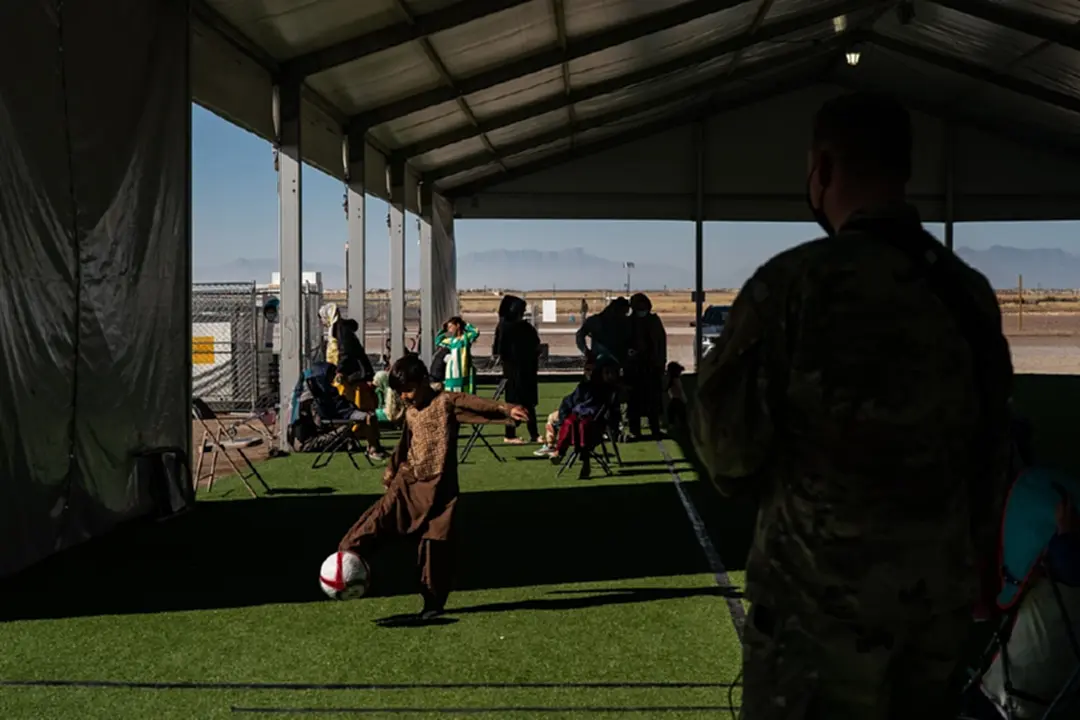
An Afghan boy plays soccer with a U.S military service member in a recreation center the refugee camp at Holloman Air Force Base in Alamogordo, N.M., on Nov. 4, 2021. MUST CREDIT: Washington Post photo by Salwan Georges
But the long-term fates of many Afghan evacuees are uncertain. While officials say all of the Afghans have been heavily vetted, most will start new lives in the United States as short-term “humanitarian parolees,” without an immediate path to permanent residency or the full host of benefits and services offered to refugees. To stay in the United States permanently, many – including those who served the U.S. mission – will need to navigate a severely backlogged visa and immigration system.
More ominous, Afghans and their advocates say, are the fates of the tens of thousands of others who were left behind.
– – –
As the name Aman Omid suggests, the official rhetoric at Holloman’s camp for evacuated Afghans centers on optimism, resilience and success.
The Afghans here are heroic and ambitious, say the military commanders and officials who run the camp, many of whom are themselves veterans of the war in Afghanistan.
“These Afghan guests have sacrificed much for America. I’d actually say that the majority of those in the village have risked more for American security than the vast majority of Americans have,” said Daniel Gabrielli, the Air Force brigadier general who heads operations at Aman Omid.
Less often acknowledged are the circumstances that brought them here: that America’s once-vanquished enemy, the Taliban, took control of the country as swiftly as the United States removed its last troops, and that American-affiliated Afghans were left acutely vulnerable and feeling betrayed. Officials also avoid dwelling on the fact that the Afghans housed here are the lucky ones – those who made it onto evacuation flights, amid panicked crowds, barricades and violence at Kabul International Airport. When Afghans ask what can be done to rescue the spouses, parents and children who didn’t make it onto a plane, the American officials at Holloman say they have struggled to provide helpful answers.
The U.S. State Department says its priority now is to facilitate the resettlement of those Afghans who are here and to assist any U.S. citizens and legal permanent residents still in Afghanistan.
The Biden administration has asked Congress to pass the Afghan Adjustment Act, a bill that would allow those paroled into the country to apply for green cards after a year, making it easier for them to become permanent residents and bring relatives left behind.
A State Department official said the government was working to evacuate some of those left behind, including parents and children separated at the airport, by “both chartering its own flights as well as working with airlines to reserve a certain number of seats on already-existing flights.” The official, who declined to confirm the effort on the record, did not say how Afghans who fear persecution from the Taliban might access a Taliban-controlled airport. But the official pointed to Qatar as the administration’s new formal go-between, per a memorandum signed by Secretary of State Antony Blinken earlier this month.
“I’ve not met one person who does not have family back there,” said Gabrielli.
“When the guests want to talk about their family back home, I encourage Airmen here to take the time to listen,” he added later in an email. “I will take unlimited time to hear their stories, and feel it builds trust and is cathartic for them as well.”
Those left behind include Rahatullah Doust’s wife and children. The 29-year-old former employee of the United Nations Development Program said his family tried to get into the Kabul airport multiple times, amid a frantic, surging crowd and Taliban sentries who beat people back, before deciding it was too dangerous to try again with a toddler and an infant.
“My daughter is very small – she wasn’t even 1-year-old – and I didn’t want to lose her. So I decided that, OK, I’ll go alone,” said Doust, who is now alone at Holloman. It is unclear how or when he’ll be able to bring his family to the United States. “I miss them,” he said, his eyes welling.
A 21-year-old at the camp, who gave her name only as Bibi, described her family’s own battle to reach an evacuation flight. Her father, a prominent Afghan businessman, didn’t make it.
“The Taliban was hitting everybody and they were attacking us. They hit my brother, my mom, my aunt,” she said. “My dad got separated in the airport.” He’s now in hiding “because the Taliban are searching for him,” she added.
– – –
In Washington, the Biden administration has walked a fine line in its attempts to persuade Americans to welcome tens of thousands of Afghans into their communities – emphasizing their valor and hard work – while also seeking to defend or deflect attention from the many thousands it did not evacuate.
Advocates for Afghans, including attorneys and veterans groups, estimate that there are potentially tens of thousands still in Afghanistan who are at risk because of their or their relatives’ affiliation with the U.S. occupation, and they want the Biden administration to do more.
“The U.S. military and diplomatic presence in Afghanistan may have ended in August but the U.S. government’s obligation did not,” Sunil Varghese, policy director for the International Refugee Assistance Project (IRAP), told reporters on a recent call, in which advocates lamented the Biden administration’s inaction.
“The U.S. has a legal and moral obligation to take action, and vulnerable Afghans cannot afford to wait longer,” Varghese said.
Rick Burns, who founded a nonprofit to assist Afghans and Iraqis and remains in touch with many, said, “We are receiving daily desperate pleas for help.”
“It is heart-wrenching and it is terribly difficult to have these conversations with people who you feel very personal relationships with and yet are in such horrible danger and such desperate situations in Afghanistan,” said Burns, a veteran of the wars in Afghanistan and Iraq.
At Holloman’s Aman Omid Village, officials avoid offering predictions on how quickly the Afghan families here will be able to leave and start over with apartments in new cities and short-term assistance from local resettlement agencies.
A couple thousand have already left. But the task force is authorized to run through March, meaning some of the thousands waiting for resettlement might still be here six months after their arrival – a product, officials and advocates say, of a national resettlement system that was largely dismantled by former president Donald Trump and still is not fully equipped.
In-demand resettlement destinations such as California, Virginia and Texas – where there are already large Afghan diaspora communities – are “saturated,” officials say; the resettlement groups simply can’t accommodate the numbers of Afghans who want to go there.
A screen mounted to the wall in the tent where State Department officials help Afghans navigate their resettlement cases advertises in a rotating slide show less-conventional options – places like Birmingham, Ala., and Chattanooga, Tenn. – that might be able to take them sooner.
In the meantime, camp infrastructure is steadily evolving to ease the long wait. The camp now has WiFi towers and indoor heating. The generators will soon be replaced with standard electricity.
There are communal TVs that play international cricket matches and Bollywood movies; English and cultural orientation classes; toys and art supplies for the children; and abundant dispensers of hot tea. Last week, the residents received winter coats and long underwear to prepare them for the months ahead. All of the adults are now vaccinated against the coronavirus, officials say.
As airmen move through the camp each day, children flock to them: to hang on their arms like a jungle gym, toss them soccer balls and try out newly acquired English phrases.
Some of the adults have noted that, with its cloudless blue sky, humming generators and horizon of arid mountains, the pale, gravelly landscape of Aman Omid’s tents and trailers bears a resemblance to Bagram Airfield – the former headquarters of U.S. military operations in Afghanistan. It was a base where many U.S. service members, diplomats and Afghans alike once worked, but has since been abandoned to the Taliban.
Gabrielli told reporters during the tour that being able to serve Afghans who helped the United States is deeply fulfilling for many of his airmen, particularly those who served, who may find “closure” in their participation here.
Asked whether there is much discussion of America’s Afghanistan legacy among airmen and others at the camp, Gabrielli said in an email that it has “personally been a humbling experience for me” to hear from Afghans about the military units they served with, as well as “listening to their stories and looking at the photos of them with American Generals and other leaders.”
He added: “I also encourage Airmen to keep in mind that while guests are happy and grateful for the opportunity to have a safe, new place to make their home, many are still grieving over the circumstances that brought them here.”
Inflation is dealing a fresh blow to the low-income workers whose finances fared worst when Covid-19 swept across Europe.
Many toward the bottom of the pay scale burned through savings as lockdown-induced furlough programs only partially covered their wages. Now, soaring energy and food costs are swallowing a disproportionate chunk of earnings to complete a double whammy.
Their plight stands in contrast to wealthier white-collar employees who squirreled away cash after swapping the office for home, aren’t so sensitive to swings in power prices and benefited as property and stock markets surged during the economic recovery.
The widening gap between the two groups — a major legacy of the coronavirus crisis — is a growing headache for euro-area policymakers.
Germany’s next government has committed to tackling unequal income distribution, while France has earmarked hundreds of millions of euros to help poor households cope with high electricity bills. Inequality considerations could be incorporated into decision-making at the European Central Bank, according to Executive Board member Isabel Schnabel.
The current squeeze on low-income households “is a very serious issue,” said Holger Schmieding, chief economist at Berenberg. While taming inflation is typically up to central banks, he said “this isn’t a matter for the ECB to do anything about at the moment — it’s a matter for governments to offer relief.”
Calls for action are only likely to grow louder. Even before the pandemic erupted, inequality was perceived to be too large, according to a report published Thursday by the Organization for Economic Cooperation and Development.
“Most people in most countries are strenuously calling for greater equality of economic outcome and opportunity,” the Paris-based group said.
The OECD found people generally favor re-distributive fiscal policies — meaning governments may face enduring pressure to act, even after inflation dies down.
Right now, it’s the path for prices — currently rising at the fastest pace since 2008 in the euro region — that’s under the spotlight.
The continent’s less well off tend to be more worried about inflation than higher-earners, according to European Commission survey data, with poorer households spending more of their incomes on the essentials where costs are currently surging.
In Italy, for instance, the price of tomatoes jumped 12% from a year ago in October, while increases for other food staples like pasta and olive oil are also outpacing headline inflation.
While conceding that the process is taking longer than anticipated, ECB President Christine Lagarde says price pressures will abate in 2022. But upside risks remain: supply chains, for one, could continue to see disruptions as ocean-freight rates stay elevated.
The debate is already widening.
Like other central banks, the ECB has been accused of contributing to rising inequality through quantitative easing. The ECB’s Schnabel said this month that “there is a risk that monetary policy may disproportionately benefit those in the higher ranks of the wealth distribution.”
ECB officials are set to review their asset-purchase programs in December.
Erik Nielsen, chief economist at UniCredit, said that while European income-distribution measures haven’t deteriorated as much as those in the U.S. and the U.K. in the last 10 or 20 years, the issue of inequality isn’t going anywhere.
“It’s more about a political feeling of fairness in life than anything else,” he said.
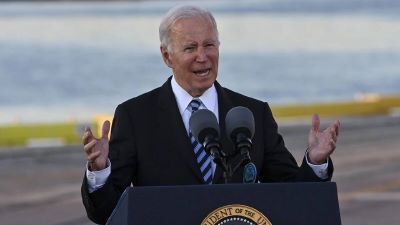
WASHINGTON – After nearly eight months of gridlock, President Joe Bidens push to overhaul the economy is finally gaining momentum as congressional Democrats overcome their internal divisions and advance his signature legislative initiatives.
Long stymied by seemingly intractable divisions, Biden in the same week signed into law a $1.2 trillion bipartisan infrastructure bill while also pushing through the House of Representatives a separate, $2 trillion social and climate policy measure that has become the centerpiece of the president’s vision to change the American economy. The president is also expected to pick the new chair of the Federal Reserve within days, a major decision shaping the nation’s economic fate.
The burst of progress on Biden’s economic agenda comes amid unresolved strains that the administration in recent months has struggled to confront, with high inflation emerging as a top concern for American voters amid the biggest price hikes in nearly three decades. Republicans have blamed the inflation problems on Biden’s economic agenda, but there are signs that the White House could soon push back more forcefully, saying that large corporations are partly to blame for the dramatic increase in costs.
White House aides also are hopeful that coronavirus booster shots, the authorization of vaccines for younger children, and predictions of fast economic growth for 2022 could represent a major turnaround. They have spent much of their first year in office refereeing legislative infighting and dealing with the pandemic’s continued economic impact.
“Consumers are out there in the economy buying goods; initial claims for unemployment [benefits] are almost where they were before the pandemic, and a lot of the disappointing job claims over the summer have been revised upward‚” said Mervin Jebaraj, director of the Center for Business and Economic Research at the University of Arkansas. “We’re coming to the end of 2021 in much better shape that I think most people expected even a few months ago, when delta was raging.”
Even as Biden secures long-awaited progress on his legislative agenda, the White House is weighing action to confront other problems. They are considering whether to escalate an attack on parts of corporate America over rising consumer prices, according to an administration official and three people with knowledge of the discussions who spoke on the condition of anonymity to reflect private meetings.
Several outside advisers have pitched senior White House officials – including White House Chief of Staff Ron Klain and White House National Economic Council Director Brian Deese – on an offensive in which the administration would amplify criticisms of large firms in heavily concentrated industries for passing higher prices on to consumers as they benefit from high profits, the people familiar with the matter said. The effort would be aimed at both directing voters’ attention to companies over inflation as well as giving companies a reason to think twice before raising prices. But the push could backfire, should it antagonize many of the firms it is highly dependent to resolve supply chain pressures ahead of the holiday season.
The White House took a step in this direction earlier this week, with Biden urging the Federal Trade Commission to escalate its investigation of anti-competitive behavior in the oil and gas industry, which the president alleged was leading to higher prices for drivers at the pump. Administration officials have discussed launching similar measures, with aides discussing calling attention to consolidation in the grocery sector as food prices rise, two people familiar with the matter said.
A senior White House official, who spoke on the condition of anonymity to reflect internal thinking, said the administration has been focused since the beginning of the administration on antitrust measures – from housing to agriculture – aimed in part at reducing consumer costs. Senior White House officials published an analysis in September on the role of concentration in the meatpacking industry on higher prices. The administration has also already appointed a number of aggressive antitrust advocates to key positions.
“The White House is working to make clear inflation is not happening for organic reasons; it’s happening because it’s profitable for enormous corporations to raise prices on consumers,” said Sarah Miller, executive director of the American Economic Liberties Project, a think tank that supports aggressive antitrust policy, who said her views had been made clear to the administration.
Miller acknowledged Biden’s letter to the FTC about oil and gas companies, but said: “I think that strategy can be expanded through resources the White House has to do a broader and more urgent investigation into rising prices in key industries for consumers and identifying excess profits that’s resulting in. They should do that now.”
Many economists are skeptical of whether publicly cajoling firms would actually lead them to lower their prices. And Biden has leaned heavily on the heads of companies such as FedEx, Walmart and Target over the supply-chain crunch, with the administration just this month touting executives’ commitments to stock their shelves ahead of the holidays. It is unclear how these corporations would react to being criticized over corporate consolidation.
Conservative and even some nonpartisan economic experts say that trends in consolidation since the start of the pandemic do not explain a massive increase in inflationary expectations over the last year.
“This is just a fantasy – there’s no corporate consolidation that explains it,” said Douglas Holtz-Eakin, a Republican policy analyst. “This is just an attempt to change the subject.”
The White House has found itself hemmed in on short-term price pressures even amid the advancements of the bipartisan infrastructure law and social spending bill – which are primarily intended to address long-term structural problems in the economy.
One of the federal government’s most traditional ways of dealing with inflation is through actions by the Federal Reserve, and Biden is expected to announce whom he will nominate to lead the agency in the next few days. Fed Chair Jerome Powell’s four-year term expires in early 2022.
In a previously undisclosed meeting at the White House on Monday, a bipartisan group of 10 centrist senators met with Biden around the signing of the bipartisan infrastructure law that they had helped broker. Biden gave comments to the group that were highly complimentary of Powell, two people who attended the meeting told The Washington Post, speaking on the condition of anonymity to reveal details of the private conversation. A White House spokesman said that the president had not yet made a decision about the Fed selection.
But later the same week, Powell came under increasing attack from two Democratic senators who joined Sen. Elizabeth Warren, D-Mass., in opposing the renomination of the central bank chair. Democratic Sens. Jeff Merkley of Oregon and Sheldon Whitehouse of Rhode Island said Powell had not done enough to use the regulatory power of the central bank to address the financial risks of climate change.
“President Biden must appoint a Fed Chair who will ensure the Fed is fulfilling its mandate to safeguard our financial system and shares the Administration’s view that fighting climate change is the responsibility of every policymaker,” Merkley and Whitehouse said. “That person is not Jerome H. Powell.”
Despite the internal divisions, the White House was buoyed Friday by passage through the House of the Build Back Better legislation. The bill would devote more than $2 trillion to dozens of key policy priorities, and the administration is eager to tout improvements to early-childhood education, energy policy, health care, housing, and other key policy areas where Americans are facing high costs.
“It puts us on the path to build our economy back better than before by rebuilding the backbone of America: working people and the middle class,” Biden said in a statement after the bill passed the House.
Conservatives have blasted the measure, with Rep. Jason Smith, R-Mo., saying in a statement: “Washington Democrats have spent months consumed by infighting and backroom dealmaking in pursuit of a partisan tax and spending agenda that bankrupts our economy, benefits the wealthy, and builds the Washington bureaucracy.”
The legislation will now head to the Senate, where Sens. Kyrsten Sinema, D-Ariz., and Joe Manchin, D-W.Va., have made clear it will have to undergo key changes before it can be approved. The revised package from the Senate would then have to be approved again by the House. Party leaders hope final passage of the bill could come before the end of the year.
Southeast Asia saw a decrease in new Covid-19 cases and related deaths on Saturday (November 20), collated data showed.
Asean countries reported 27,862 infections and 460 deaths on Saturday compared to 28,225 and 534 respectively on Friday.
– Singapore government will allow vaccinated people to hold gatherings and dine outdoor at a maximum of five people from the previous of two people, starting from Monday (November 22) onwards.
– International Labour Organisation revealed that Thailand, Phillippines, Brunei and Vietnam, where rely on tourism revenue, had laid off tourism-related personnel totalling over 1.6 million positions last year due to the Covid-19 crisis. The statistic was four times higher than layoffs in other industries.
If CDC Director Rochelle Walensky signs off on broader use, the extra shots could be available for all adults as soon as this weekend.
The U.S. Food and Drug Administration (FDA) on Friday authorized boosters of the Pfizer/BioNTech and Moderna COVID-19 vaccines for all adults.
The agency expanded emergency use authorization for booster doses of both the mRNA vaccines beyond who was previously eligible — boosters had been authorized for anyone 65 and older who was vaccinated with the Pfizer or Moderna vaccines at least six months ago and for certain adults at high risk of infection or of severe disease.
Pfizer and BioNTech requested authorization last week based on results of a Phase 3 trial involving more than 10,000 participants. It found boosters were safe and had an efficacy of 95 percent against symptomatic COVID-19 compared with the two-dose vaccine schedule in the period when the highly transmissible Delta was the dominant strain.
Moderna requested authorization of its 50-microgram booster dose for all adults on Wednesday. The company said the FDA based the Emergency Use Authorization (EUA) on the “totality of scientific evidence shared by the company,” including data that showed neutralizing antibodies had waned at about six months.
The outside vaccine experts of the U.S. Centers for Disease Control and Prevention (CDC) are scheduled to meet on Friday to discuss the FDA’s actions on the application from Pfizer-BioNTech and Moderna.
The advisers will recommend how the boosters should be used. If CDC Director Rochelle Walensky signs off on broader use, the extra shots could be available for all adults as soon as this weekend.
“The vaccine makers’ requests for broad authorization come as a growing number of states are offering boosters to all adults, going beyond the current guidance from the Centers for Disease Control and Prevention that recommends limiting eligibility to specific groups. Efforts to accelerate the booster campaign are designed to bolster waning immunity from the initial vaccinations and reduce breakthrough infections and viral transmission,” reported The Washington Post on Friday.
Using simple tools available at home, Palestinian boy Mohammed is passionate about making electronic devices by himself.
Mohammed al-Halaq, a Palestinian boy from Khan Younis in southern Gaza Strip, has made many electronic devices and robots using simple tools available at home.
The 14-year-old told Xinhua that he started making electronic devices when he was seven, and he used to disassemble toys powered by batteries.
The first toy he made for himself was a wooden car powered by batteries.
“I decided to make a racing car that has three tiers only… So I used wood to build the car body while manufactured its generator by linking electronic board with a battery,” he said.
Mohammed al-Halaq works on his inventions at home in the southern Gaza Strip city of Khan Younis, on Nov. 15, 2021. (Xinhua/Rizek Abdeljawad)
The teen spent about four days making his first toy, and gained praise from family and teachers with such an achievement.
His parents started to encourage him to invest in that hobby and provided him with a place where he could create small devices. His teacher encouraged him to create another toy using materials including wood, carton boxes, foam boards and plastic.
In a bid to improve skills, he went through specialized websites and YouTube videos, learning to make electronic devices.
He succeeded in making a small fridge with foam boards that contained a cooler made of capacitors powered by batteries. It also includes an external electronic board that shows the temperature in the refrigerator.
“Anyone can use it inside his own car, when he or she wants to go to the sea or to office,” the boy said. “You could stock it with bottles of drinks, bread or even chocolates.”
Mohammed al-Halaq works on his inventions at home in the southern Gaza Strip city of Khan Younis, on Nov. 15, 2021. (Xinhua/Rizek Abdeljawad)
Yet, his inspirations do not stop there. He dreamt of making a robot that would be used to help humans. Lacking experience or financial support, he joined a team of a non-profit organization, the Culture and Free Thought Association, that helps creative children with their own inventions.
After attending a series of workshops, al-Halaq succeeded in making his first robot that helps people with visual and hearing disabilities walk alone without fear of hitting an obstacle.
“The robot is like a small car that contains an electronic panel with sensors, and it works on a battery and remote control. As soon as the person who is using it approaches a wall or any obstacle on the road, the car rings an alarm, and the remote control vibrates in the user’s hand.”
Ahmed al-Saqqa, director of the scientific laboratory department in the institution, said his organization decided to sponsor the most creative children in Gaza, hoping that the Strip would have more inventors in the future.
Jamal al-Halaq, Mohammed’s father, said despite the security and political instability in Gaza, the family is determined to help the children develop their abilities so as to create a better future.
The Committee for a Responsible Federal Budget, a U.S. watchdog group, estimated that the bill would add about 750 billion U.S. ollars to the deficit over the next five years and about 160 billion dollars over ten years.
The U.S. House of Representatives on Friday narrowly passed President Joe Biden’s roughly 2-trillion-U.S.-dollar social spending and climate bill, sending it to the Senate, where it faces changes.
The House passed the so-called “Build Back Better” bill by a vote of 220-213, after House Republican Leader Kevin McCarthy on Thursday night delivered a lengthy floor speech to delay the final vote.
The bill includes 555 billion dollars in clean energy and climate investments, 400 billion dollars in funding for child care and free preschool, 200 billion dollars in child tax & earned income tax credits, and 150 billion dollars in home care for elderly and disabled Americans.
U.S. Senate Republican Leader Mitch McConnell (C) speaks during a press conference on Capitol Hill in Washington, D.C., the United States, Nov. 17, 2020. (Photo by Ting Shen/Xinhua)
“It puts us on the path to build our economy back better than before by rebuilding the backbone of America: working people and the middle class,” Biden said Friday in a statement after the vote.
The Congressional Budget Office (CBO) estimated on Thursday that the legislation would allocate 1.64 trillion dollars in new federal spending over ten years. If the tax credits in the bill are added to the spending tally, the figure would jump to 2.4 trillion dollars, well above Biden’s initial framework for a 1.75-trillion-dollar package.
The White House claimed that the framework would raise revenue of around 2 trillion dollars over a decade to fully pay for the social spending plan by imposing new taxes on the largest corporations and the wealthiest Americans.
But the CBO estimated that the legislation would increase the deficit by 367 billion dollars over ten years, not counting any additional revenue that may be generated by additional funding for tax enforcement.
The Committee for a Responsible Federal Budget, a U.S. watchdog group, also estimated that the bill would add about 750 billion dollars to the deficit over the next five years and about 160 billion dollars over ten years.
Now the bill goes to the Senate for consideration, where some senators have expressed concerns about the rising budget deficit and inflation pressures.
“Ninety percent of Americans are worried about inflation, but House Democrats just voted to let Washington D.C. print, borrow, and spend trillions more,” Senate Republican Leader Mitch McConnell said Friday in a statement.
“Our economy is shaky, but House Democrats just voted for historic tax hikes that would drain hundreds of billions of dollars out of U.S. industries and kill American jobs,” McConnell said.
Passage of the bill in the Senate will require unanimous support from the Democratic caucus, but the two key moderate Democrats, Joe Manchin of West Virginia and Kyrsten Sinema of Arizona, have yet to give their full public support. Democratic senators are expected to make extensive changes before voting on it, potentially in December, according to Bloomberg.





 An Afghan boy plays soccer with a U.S military service member in a recreation center the refugee camp at Holloman Air Force Base in Alamogordo, N.M., on Nov. 4, 2021. MUST CREDIT: Washington Post photo by Salwan Georges


 Mohammed al-Halaq works on his inventions at home in the southern Gaza Strip city of Khan Younis, on Nov. 15, 2021. (Xinhua/Rizek Abdeljawad)
 Mohammed al-Halaq works on his inventions at home in the southern Gaza Strip city of Khan Younis, on Nov. 15, 2021. (Xinhua/Rizek Abdeljawad)
 U.S. Senate Republican Leader Mitch McConnell (C) speaks during a press conference on Capitol Hill in Washington, D.C., the United States, Nov. 17, 2020. (Photo by Ting Shen/Xinhua)
