สถานีโทรทัศน์ท้องถิ่น KHOU-TV รายงานว่ารถยนต์ Tesla Model S ปีรุ่น 2019 กำลังเดินทางด้วยความเร็วสูงแต่ไม่สามรถเข้าโค้งได้และออกนอกถนน ชนเข้ากับต้นไม้และเกิดไฟลุกท่วม
หลังจากไฟดับลงเจ้าหน้าที่ระบุผู้โดยสาร 2 คนในรถโดยคนหนึ่งนั่งอยู่ที่เบาะผู้โดยสารด้านหน้าในขณะที่อีกคนอยู่ที่เบาะหลังของ Tesla
Tesla และสำนักงานบริหารความปลอดภัยการจราจรบนทางหลวงแห่งชาติไม่ตอบสนองต่อคำร้องขอความคิดเห็นในทันทีจากสำนักข่าวรอยเตอร์
อุบัติเหตุดังกล่าวเกิดขึ้นท่ามกลางการตรวจสอบอย่างละเอียดมากขึ้นเกี่ยวกับระบบขับขี่กึ่งอัตโนมัติของ Tesla หลังจากเกิดอุบัติเหตุเมื่อเร็วๆ นี้และในขณะที่บริษัทเตรียมเปิดตัวซอฟต์แวร์ “ขับเคลื่อนด้วยตัวเองเต็มรูปแบบ” ที่อัปเดตให้กับลูกค้าจำนวนมากขึ้น
By Syndication Washington Post, Bloomberg · Kelly Gilblom
“Godzilla vs. Kong,” the monster epic from Warner Bros. and Legendary, dominated the box office for a third straight week, showing that a new movie available for streaming at home can also draw fans to theaters.
The film took in $7.7 million in weekend sales in North American theaters, according to researcher Comscore Inc., further cementing its spot as the biggest movie release of the pandemic with cumulative sales now of $80.5 million. So far, “Godzilla vs. Kong” has exceeded analysts’ expectations, suggesting people are becoming comfortable with attending theaters more than a year into a global pandemic.
The performance is a major win for AT&T Inc.’s WarnerMedia division, which opted to release all of its 2021 movies on both HBO Max and in theaters. When the studio announced the move last year, filmmakers warned it would hurt cinema owners that were already struggling to survive the covid-19 virus and competition from streaming services.
“Warner has played an integral role in the early transition phase as we now cautiously approach the next stages of global box office recovery,” said Shawn Robbins, chief analyst for Boxoffice Pro. “The key now is to look forward.”
Most other studios have been wary about putting out big releases during the pandemic. The next big-budget movie due out will be another Warner Bros. feature, “Mortal Kombat,” on April 23. After that, audiences will have to wait until May 28 to see “A Quiet Place Part II” from Paramount Pictures and until summer for other highly anticipated films like Universal Pictures’ “F9,” part of the “Fast and Furious” series, and Walt Disney Co.’s “Black Widow.”
The decision to stream new movies the same day they come out on the big screen has posed some challenges for theaters. It’s not clear how many people are opting to watch movies at home instead of venturing out. Additionally, studio and theater executives have acknowledged that consumers no longer want to wait up to 90 days for movies to leave multiplexes and be available for home viewing.
But the combination of closings and the lack of new movies to show has worn down some of the theater owners who have resisted change. AMC Entertainment Holdings Inc. Chief Executive Officer Adam Aron said in an interview this week that attendance “quintupled” with the March 31 release of “Godzilla vs. Kong.” New films are a key part of recovery for cinemas, some of which have gone out of business because of the virus.
Other, returning pictures rounded out the other top spots at the box office this weekend. Universal’s “Nobody,” a thriller starring Bob Odenkirk that came out March, took in $2.5 million in sales. “The Unholy” made about $2.1 million and Disney’s “Raya and the Last Dragon,” an animated film about a warrior girl, made $1.9 million.
By Syndication Washington Post, Bloomberg · Ahmed Khalil El-Sayed
A passenger train derailed Sunday north of Cairo, leaving at least 11 people dead and about 1oo others injured, a Health Ministry official said, the latest in a string of rail accidents.
The derailment occurred when at least four of the train’s carriages went off the tracks shortly after its departure from a station in Qalyubia governorate en route to Mansoura, state media reported. Almost 60 ambulances rushed to the scene to transport the injured to local hospitals.
The crash was the third railway incident in Egypt in a month. In March, a crash in southern Egypt left 19 dead and sparked fresh calls for revamping the country’s aging railway infrastructure and a revision of safety protocols.
A logo is displayed on a Tesla electric vehicle in 2020. MUST CREDIT: Bloomberg photo by Nina Riggio
By Syndication Washington Post, Bloomberg · Noah Buhayar
A Tesla electric car that “no one” appeared to be driving crashed late Saturday in Texas, erupting into flames and killing the two passengers, according to local authorities.
One victim was found in the front passenger seat of a 2019 Model S, and the other was in the rear, Harris County Precinct 4 Constable Mark Herman said in a telephone interview. The car ran into a tree in the Carlton Woods subdivision near The Woodlands after traveling fast and failing to navigate a turn.
The position of the victims, statements and other physical evidence suggest that “no one was driving the vehicle at the time of impact,” Herman said. “It’s still under investigation.”
Herman said his office is coordinating with federal authorities, without specifying which ones, and did not know whether the Autopilot feature was engaged. It took more than 30,000 gallons of water to extinguish the fire, which burned for four hours, he added.
Tesla did not immediately respond to a request for comment Sunday.
Federal officials have criticized Tesla for fire risks related to the battery packs in its cars and for what they call insufficient effort to keep drivers from using the driver-assist function inappropriately. In a hearing last year, the National Transportation Safety Board’s chairman said “it’s time to stop enabling drivers in any partially automated vehicle to pretend that they have driverless cars.”
Tesla CEO Elon Musk has defended the safety record of his company’s vehicles. Last week, he shared a report on Twitter, saying that a Tesla with Autopilot engaged is now approaching a “10 times lower” chance of a crash than an average vehicle.
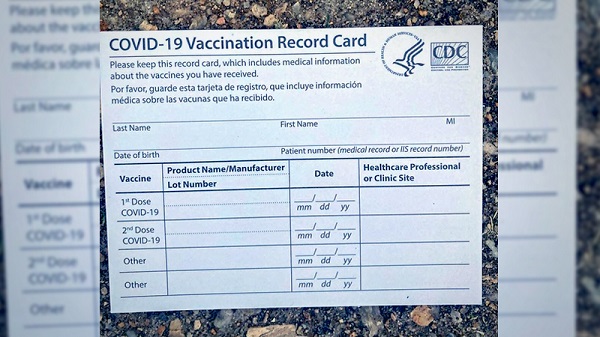
An “Authentic CDC Vaccination Record Card” was sold by eBay user “asianjackson” and sent to a customer. MUST CREDIT: Obtained by The Washington Post
By The Washington Post · Dan Diamond
One listing offered eBay customers an “Authentic CDC Vaccination Record Card” for $10.99. Another promised the same but for $9.49. A third was more oblique, offering a “Clear Pouch For CDC Vaccination Record Card” for $8.99, but customers instead received a blank vaccination card (and no pouch).
All three listings were posted by the same eBay user, who goes by “asianjackson” – using an account registered to a man who works as a pharmacist in the Chicago area – and all were illegal, federal regulators say. The account sold more than 100 blank vaccination cards in the past two weeks, according to The Washington Post’s review of purchases linked to it.
The listings are a “perfect example” of burgeoning scams involving coronavirus vaccination cards that could undermine people’s safety, as well as the success of the nation’s largest mass vaccination effort, said North Carolina Attorney General Josh Stein. Individuals might use them to misrepresent their vaccination status at school, work or in various living and travel situations, potentially exposing others to risk.
Stein, who led a recent effort with 47 colleagues demanding that eBay and other e-commerce platforms crack down on the scams,pointed to the FBI’s warning that anyone who makes or buys a fake vaccine card is breaking the law, and said he would consider prosecution, too.
“This is a concern that is national and bipartisan,” Stein added, saying the spread of fake vaccination cards “will extend the pandemic, resulting in more people sick and more people dead.”
At least 129.5 million Americans have gotten at least one or both doses of a coronavirus vaccine and have received a free proof-of-vaccination card with the logo of the Centers for Disease Control and Prevention, as officials push to inoculate the nation. But that vaccination drive has pitted people like asianjackson, selling blank or fake credentials, against law enforcement officials rushing to stop them – and warning that the full scope of the problem is impossible to grasp.
The clash has escalated as businesses and universities say they’ll require proof of vaccination before allowing Americans to board cruises, enter some stores and even return to college classes, prompting some vaccine-hesitant people to search for false IDs or make their own. And the showdown is unfolding amid a bitter national debate about whether Americans should have digital “vaccine passports” instead of paper cards, and whether the government should be involved in credentialing such efforts.
For months, officials have been a step behind the scammers, who have openly discussed strategies to fake the cards on social media, sold them on sites such as eBay and pulled blank photos off state websites. Federal officials’ decision to use paper cards that can be easily photocopied or even printed off a template, rather than a digital tracking system, worsened those risks.
“This is exactly the scenario that you want to guard against. It undermines the entire effort by having falsified cards out there,” said Jennifer Kates, who oversees global health policy for the Kaiser Family Foundation and reviewed asianjackson’s eBay listings. “It certainly bolsters the argument for a digitized mechanism – which isn’t a tamper-proof system, but certainly a more secure one.”
“Paper anything is ripe for fraud,” saidNenette Day, an assistant special agent in charge at the Department of Health and Human Services’ inspector general’s office who oversees whistleblower tips. Day said she has reviewed dozens of reported vaccination-card scams that range from Americans stealing blank cards to sharing tips on how to fake a card on social media. She described the trend as among the most frustrating chapters in a 20-year career that included responding to the 9/11 terrorist attacks as an FBI agent.
“I feel like nobody has taken this to its natural conclusion,” Day said, hypothesizing about a scenario where an unvaccinated person could illegally create a vaccination card and pretend to be immunized, using that to enter a high-risk environment such as a nursing home, then unknowingly spread the virus, potentially resulting in someone’s death. “It disturbs me, having been in law enforcement this long, this flippant attitude that people have.”
While e-commerce platforms cracked down on listings after recent news reports, there are already signs that the supply of the cards is bouncing back, said Saoud Khalifah, chief executive of Fakespot, a company that specializes in rooting out online fraud and that began tracking fake vaccine cards in February.
“We’ve seen ads on Facebook and TikTok and other social platforms being used to target these anti-vaxxers,” Khalifah said. “There’s demand from people who don’t want to get vaccinated, but also people who think they can use the cards to skip the line (and) say, ‘Hey, I got dose one, can I get dose two?’ “
Some federal officials involved in the vaccine drive said that last summer, they had initially discussed using digital systems to track the vaccine push and to help Americans manage getting shots. CDC officials believed they could harness the nation’s dozens of immunization information systems, which track shots administered by providers within a specific geographic area.
“IT/data infrastructure supports entire distribution, ordering, tracking process from end-to-end,” according to a July slide deck about the CDC’s planned vaccine rollout that was obtained by The Washington Post. The slide deck made no mention of using paper cards.
A CDC letter sent the following week, also obtained by The Post, similarly touted using IT systems to manage the vaccine rollout, including “record-keeping for the vaccine recipient,” with no mention of paper cards.
Pamela Schweitzer, a retired assistant surgeon general who helped with the coronavirus response last year, said that she and her colleagues were aware in June that the CDC was focusing on a “comprehensive IT infrastructure” to help Americans track their vaccinations before opting for paper cards as a fallback later in the year.
A former administration official closely involved in the vaccine effort who spoke on the condition of anonymity to discuss private conversations confirmed initial plans for “a digital system with digital reminders about when to get your shot, like, ‘Your library book is due in five days.’ ” But technical setbacks and time pressure forced the administration to rely instead on paper cards, which the CDC had positioned as a “fail-safe,” the official said.
“If there had been a vaccine during the 1918 flu pandemic, you could probably have used the same exact card – just with different logos at the top,” the official said, adding that the paper cards, which are passed around in health settings and potentially handled by sick patients, were not ideal for curbing safety risks. “It’s a hard, tactile object in the middle of the pandemic. It’s a pretty gross thing to have.”
Paul Mango, a former Trump administration official who helped oversee Operation Warp Speed, the administration’s vaccine accelerator, acknowledged that “there were many complexities, technical and otherwise, associated with digital vaccination tracking, so for exigency purposes, we fell back on vaccination cards.”
While state and local immunization registries do store individual coronavirus vaccination data, officials said there’s no current system that would allow businesses, schools and other organizations to easily check the databases to see if a visitor was presenting a falsified paper card.
HHS did not respond to questions about health officials’ decision to opt for paper cards and whether that increased the risk of scams. An HHS spokesperson pointed to an October playbook that instructed accredited vaccinators to provide “a completed COVID-19 vaccination record card to every vaccine recipient/parent/legal representative.”
Private-sector organizations, including pharmacies such as Walmart and Walgreens, have recently mounted a push for using digital “vaccine passports” for Americans to prove they’ve gotten shots, arguing such systems would better track vaccinations and protect against fraud. But federal officials have struggled to corral the initiatives and adopt a standardized approach, particularly as the issue has become politicized in recent weeks.
Even as public health officials warn about the risk of fraud, some states have inadvertently boosted it. The Post identified several states, including Tennessee and Texas, that posted blank card templates to their health department websites among their coronavirus-related resources. Some social media users have boasted that they had printed the documents to produce their own fake cards.
Day, the official at the HHS’s inspector general’s office, recounted an explosion of whistleblower tips related to vaccination card scams in the past month. “On any given day, it’s 40 to 50 percent of our covid-related complaints,” she said.
One report was about a woman who worked in a vaccination clinic and gave a blank card to her boyfriend. The boyfriend then detailed on social media how he had filled in the card himself and bragged about the accomplishment, Day said.
Schweitzer, who has volunteered at multiple vaccination clinics across Arizona, compared the abundance of blank vaccination cards at those sites to doctors not protecting their prescription pads.
“There’s limited control over these cards,” she said. “They’re all over the place. It’s pretty easy to get a stack.”
Asianjackson – the eBay account maintained by a man who works at a Chicago-area location of a national pharmacy chain – sold at least 110 blank vaccination cards through eBay, including 50 cards alone on April 11, according to a Post review. The Post obtained one of those cards, which was identical to the CDC vaccination cards dispensed by pharmacies, and sent from a Zip code in the greater Chicago area.
Law enforcement officials said they are alarmed by the possibility that eBay users such as asianjackson are taking blank cards from pharmacies or other health-care facilities where they work.
“That’s very troubling,” said Stein, the North Carolina attorney general. “That’s an instance where it’s an actually authentic card but illegally acquired and sold.”
When contacted by The Post through the full name offered on the eBaysales receipt, the man who uses the “asianjackson” account confirmed he lives in the Chicago area and works in a pharmacy, and listed other items sold through the account, such as empty boxes from luxury-goods retailers like Hermès and Chanel. But he claimed he had not used eBay this month and had no knowledge of any vaccination card sales.
“I need to get that straightened out with eBay,” the man said, claiming he had stopped using the service after his password was unexpectedly changed about two weeks ago. The Post is not identifying him because he disputes he sold the cards.
After The Post brought the listings to eBay’s attention on Thursday, the company removed them. “Our team has reviewed and taken appropriate action,” said eBay spokesperson Parmita Choudhury, who declined to disclose additional details about the account.
Pharmacies insist they have protections in place to track the blank cards they receive and would know if any cards were wrongly removed.
“Our pharmacies receive a limited number of CDC dose cards as part of the CDC immunization supply kits shipped to the stores that are receiving and administering coronavirus vaccines,” Walgreens spokesperson Erin Loverher said in a statement.
“We store and monitor the vaccination cards in our pharmacies and each vaccine card is a 1:1 match for the vaccine doses in a pharmacy’s inventory, so we would know if any are missing,” said Mike DeAngelis, a CVS spokesperson.
Still, scammers have had a field day, getting plenty of help from the public, not just in making fake cards but also in committing identity theft: Many Americans put pictures of their vaccination cards online, sharing information such as the day of their shot, their birthdays and other identifying details. The trend, intended to boost vaccine acceptance, has alarmed regulators. “While the #COVID19 vaccine helps protect against the virus, posting your vaccine card online opens you up to another type of plague – scammers who would use the document to steal your identity,” Ashley Moody, Florida’s attorney general, wrote on Twitter in February.
Day agreed that those pictures have helped scammers get the details right, including vaccine manufacturer and lot information. “They can fill out their cards, which would have at least some level of legitimacy, because they had the right numbers and letters for the lot numbers,” she said.
Khalifah, the Fakespot CEO, said regulators face persistent challenges because of how easy the cards are to exploit.
“Let’s speak bluntly about this. We’re talking about paper and stamps – technology that’s been around for a while,” Khalifah said, adding that some people selling cards online are involved in other long-running scams. “There’s overlap with these stores and others selling fake Gucci bags. They’ll leverage fake reviews, fake upvotes. There’s a lot of fraud.”
Officials said it’s impossible to get a true picture on the number of Americans who have faked vaccine cards themselves or have bought them online. “It’s not the kind of thing that the person buying is going to report. In some ways, they’re complicit,” Stein said.
“Anything that’s going to delay the end of this pandemic is incredibly unfortunate and counterproductive,” he added. “These vaccine cards will do just that.”
By The Washington Post · Karen DeYoung, Missy Ryan
WASHINGTON – Three months after taking office, President Joe Biden has reestablished the formal decision process, which his direct predecessor seemed determined to destroy, that has guided U.S. administrations through foreign policymaking since the Second World War.
Afghanistan was among the first major issues on which the process, organized and directed by the National Security Council, became fully operational. Dozens of high-level meetings were held, including four sessions with the president in the Situation Room. Military, intelligence and diplomatic assessments were compiled, and consultations were held with allies and lawmakers.
Yet at the end of the day, Biden did not budge from where he began nearly 13 years ago, when a visit to Afghanistan as vice president-elect persuaded him, he said last week, that “more and endless American military force could not create or sustain a durable Afghan government.”
His decision to withdraw all of the few thousand American troops remaining in Afghanistan by Sept. 11 – the 20th anniversary of the 2001 al-Qaida terrorist attacks that began the war there – defied the advice of senior military leaders and raised significant national security questions.
U.S. officials said Gen. Mark Milley, chairman of the Joint Chiefs of Staff; Gen. Frank McKenzie, head of U.S. Central Command; and Gen. Scottie Miller, commander of U.S. and NATO troops, advocated a conditions-based approach, additional time for negotiation, or, at a minimum, keeping some sort of residual counterterrorism force on the ground in Afghanistan. The generals said the fall of Kabul to the Taliban, waves of Afghan refugees rushing to neighboring countries and Europe, and the reemergence of al-Qaida as a potent terrorist threat were possibilities.
Defense Secretary Lloyd Austin, asked by reporters last week in Brussels whether the top brass had agreed with the “down to zero” decision, rebuffed the question, saying “their voices were heard, and their concerns taken into consideration.”
Officials said Austin, like his counterparts in uniform, supported a continued military presence, though he shared his personal views with a small group of people. A Defense Department official said Austin’s approach was informed by his own experiences in uniform, including in Iraq, where he oversaw the Obama administration’s rapid withdrawal of forces in 2011. Less than three years later, the Islamic State took over a third of the country.
CIA Director William Burns, in testimony the day before Biden’s Wednesday announcement, told Congress that “when the time comes for the U.S. military to withdraw, the U.S. government’s ability to collect and act on threats will diminish,” he said of possible resurgence by al-Qaida and other terrorist groups with global ambitions. “That is simply a fact.”
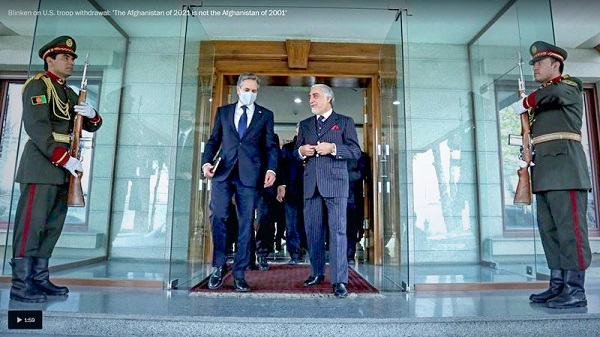
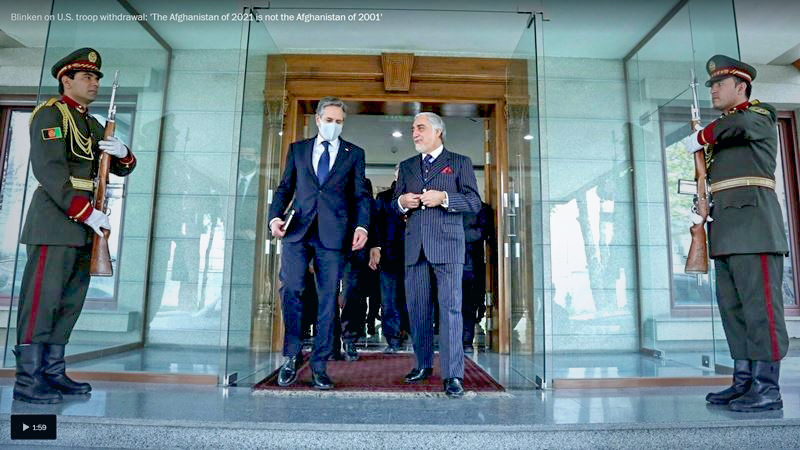
At NATO, where Secretary of State Antony Blinken and Austin officially informed the alliance of the decision last week, Secretary General Jens Stoltenberg indicated that NATO members with troops in Afghanistan had little choice but to follow suit. “In light of the U.S. decision,” he said, “all Allies agreed to the statement” of joint withdrawal.
To many in the White House, widely reported accounts of the disagreements miss the point, especially in light of President Donald Trump’s habit of not even consulting the military before tweeting abrupt diktats on troop withdrawals.
Even Trump, however, often succumbed to after-the-fact military pressure to reverse his decisions.
A senior administration official acknowledged that “there were people among [Biden’s] senior team on both sides of this question. It’s certainly not that everybody was in favor of one option or the other.”
But the decision process worked “exactly how the system was designed to work,” the official said, speaking on the condition of anonymity under White House ground rules. “These decisions do not rest in our democracy with the Pentagon. They rest with the president.” The military’s views “are extremely consequential, given its role in the policy that is made. But the policy decisions rest with the president.”
Although Biden supported the initial deployment of U.S. troops to Afghanistan two decades ago, his views had changed sharply by 2009, when he argued against the force surge the military advocated and President Barack Obama ultimately approved.
In 2011, he was an outlier in publicly saying that the Taliban “per se is not our enemy” and had never expressed a desire to attack the U.S. homeland. During his presidential campaign last year, he vowed to end America’s “forever wars.”
Administration officials have cited Trump’s 2020 agreement with the Taliban to withdraw by May 1 this year as limiting Biden’s options. “We started from the perspective of having inherited a policy that candidly was not in a very good place,” the senior official said. “We had the lowest troop numbers since the early years of the war. We had the Taliban feeling ascendant on the battleground and kind of fighting the Afghan government to virtually a stalemate.”
“And we had this May 1 deadline,” he said, after which the Taliban had threatened to resume attacking any remaining U.S. and other allied forces on grounds that the Trump agreement had been broken.
Neither the United States nor the Taliban have complied with other elements of the agreement, including full prisoner releases, the lifting of sanctions against the militants and a reduction in overall violence. The militants have not severed their ties with al-Qaida, according to the Pentagon and the United Nations. Inter-Afghan talks began last fall but have gotten nowhere.
But the deadline gave Biden a template for the withdrawal. “It is perhaps not what I would have negotiated myself, but it was an agreement made by the United States government, and that means something,” he said in his Wednesday announcement. “So, in keeping with that agreement and with our national interest, the United States will begin our final withdrawal . . . on May 1 of this year.”
Administration officials disputed any suggestion that the three-month National Security Council review was a mere formality. “We ran a real process,” the senior official said. In addition to the Situation Room meetings Biden led, “the principals” – the top national security officials – met without the president three times in sessions chaired by national security adviser Jake Sullivan. Their deputies met at least 10 times, the official said, as risks and options were honed for delivery to increasingly higher levels. Afghanistan was a frequent topic of discussion during the president’s daily intelligence briefing, often attended by Austin and Milley, officials said.
“It’s noteworthy that, unlike previous policy reviews, particularly on this subject . . . there was remarkably little backstabbing and leaking in the press, people saying they weren’t being heard, the process was being circumvented, or the president had already made up his mind when he went into this,” the official said.
During the course of those meetings, if not before, the president came to several key conclusions. He rejected the notion that U.S. troops could or should be used as leverage to stem inter-Afghan violence or promote negotiations.
He believed that anything other than a fixed departure timeline meant going back to war with the Taliban. And he concluded that there was no viable middle option between setting a date certain for complete withdrawal or staying indefinitely.
By the time of NATO’s winter meeting of defense ministers on Feb. 17, though the decision process was incomplete, Austin began informing allies of the direction it was heading. In March, alarmed by news reports suggesting that the lack of a decision meant an indefinite stay was becoming more probable, Blinken told NATO foreign ministers that getting out was a very real possibility.
In a news conference at the end of March, Biden gave the clearest public indication of his thinking, saying that full withdrawal was “unlikely” by May 1, but that “I can’t picture” U.S. forces still being in Afghanistan when 2022 begins.
Some experts have questioned whether a refusal to leave meant return to war with the Taliban was inevitable. Others have noted that the United States has often used its military forces as leverage in other countries such as South Korea and Japan, where tens of thousands of troops are deployed to dissuade North Korea from attacking and to fight back if it does.
The militants have insisted that the May 1 deadline is real, no matter what timetable Biden has set for departure, and any foreign troops remaining after that will be subject to attack. The United States and NATO have promised aggressive retaliation if they are attacked while heading for the exit.
But the bottom line, according to several senior administration officials, is that Afghanistan is no longer a high U.S. priority, as it was in 2001, compared with the threats of 2021, including Chinese and Russian aggression, terrorist surges elsewhere in the world, climate change, global health and nonproliferation. Public opinion has strongly supported withdrawal.
The administration has pledged that it will continue paying for Afghanistan’s own security forces, pressing for inter-Afghan negotiations, providing humanitarian assistance, and using diplomatic and economic tools to keep the Taliban from returning to the draconian policies and repression of women and minorities that characterized the last time it controlled Afghanistan from the mid-1990s until the 2001 U.S. incursion in pursuit of Osama bin Laden that quickly became war with the Taliban.
In an interview on Sunday with ABC’s “This Week,” Blinken seemed to accept an inevitable militant takeover. If the Taliban has “any expectation of getting any international acceptance, of not being treated as a pariah,” he said, “it’s going to have to respect the rights of women and girls” or risk the withdrawal of “international recognition” and “international status.”

 เมื่อ 13 เม.ย.โยชิฮิเดะ สุงะ นายกรัฐมนตรีญี่ปุ่น เปิดเผยว่ารัฐบาลของเขาได้ตัดสินใจจะปล่อยน้ำปนเปื้อนกัมมันตรังสีในจังหวัดฟุกุชิมะลงสู่ทะเล ท่ามกลางเสียงคัดค้านจากทั้งในและนอกประเทศ
 หนึ่งในการค้นพบที่ยิ่งใหญ่ที่สุดของวงการโบราณคดีอียิปต์คือเรือไม้โบราณที่ยังคงทนผ่านกาลเวลามาได้หลายพันปี


 ผู้แทนรัฐบาลแห่งชาติชี้ถ้าอยากแก้ปัญหาของเมียนมา อาเซียนต้องคิดให้รอบคอบ และต้องเชิญรัฐบาลแห่งชาติเข้าร่วมด้วย
 ตำรวจเปิดเผยว่าทั้ง 2 คนไม่ได้อยู่ในที่นั่งคนขับของรถขับเคลื่อนอัตโนมัติ
 ราคา Bitcoin ดิ่งหนักเพราะสาเหตุอะไรกันแน่ บางคนบอกว่าเพราะเหมืองในจีนไฟดับ แต่มันอาจจะมีอะไรที่ลึกกว่านั้นก็ได้