Poseidon 2M39 เป็นตอร์ปิโดนิวเคลียร์ใต้น้ำที่ออกแบบมาเพื่อกระทบพื้นมหาสมุทรก่อให้เกิดคลื่นสึนามิปนเปื้อนกัมมันตภาพรังสีที่สามารถแผ่รังสีร้ายแรงไปทั่วพื้นที่หลายพันกิโลเมตรทำให้ไม่สามารถอยู่อาศัยได้ และ Times of London รายงานว่าประธานาธิบดีวลาดิเมียร์ ปูตินของรัสเซียร้องขอการอัปเดต “ขั้นตอนสำคัญ” ของการทดสอบในเดือนกุมภาพันธ์จากรัฐมนตรีว่าการกระทรวงกลาโหม และคาดว่าจะมีการทดสอบเพิ่มเติมในปลายปีนี้
Photo by Kirsty Wigglesworth / POOL / AFPPhoto by Dominic Lipinski / POOL / AFPPhoto by Jonathan Brady / POOL / AFPPhoto by CHRIS JACKSON / POOL / AFPPhoto by Alastair Grant / various sources / AFPPhoto by Tolga Akmen / AFPPhoto by LEON NEAL / various sources / AFPPhoto by JUSTIN TALLIS / POOL / AFPPhoto by Kirsty Wigglesworth / POOL / AFP
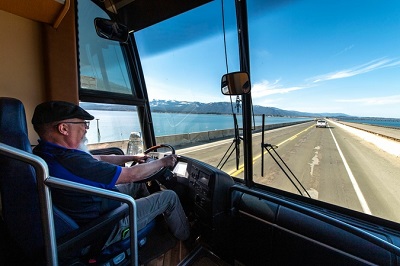
Bob Sonderman drives a Veterans Affairs mobile medical unit from Libby, Mont., to Sandpoint, Idaho, as part of a campaign to get rural veterans vaccinated against the coronavirus. Photo by Tony Bynum for The Washington Post
By Lisa Rein The Washington Post
LIBBY, Mont. – On the morning he was scheduled to get his first shot of coronavirus vaccine, Mike Jellesed woke in a fury and wheeled his pickup out of his trailer park, headed for the Veterans of Foreign Wars post in town.
A giant star-spangled bus that had crossed 160 miles of the Rocky Mountains from Spokane, Wash., was waiting for him in the parking lot. Inside were three Department of Veterans Affairs workers and 26 Moderna syringes ready to go. Jellesed, a 61-year-old Air Force veteran with scarred lungs that left him vulnerable to covid-19, had driven there with his 11-year-old son to tell the VA crew all the reasons – despite his scheduled appointment – he didn’t believe in the vaccine.
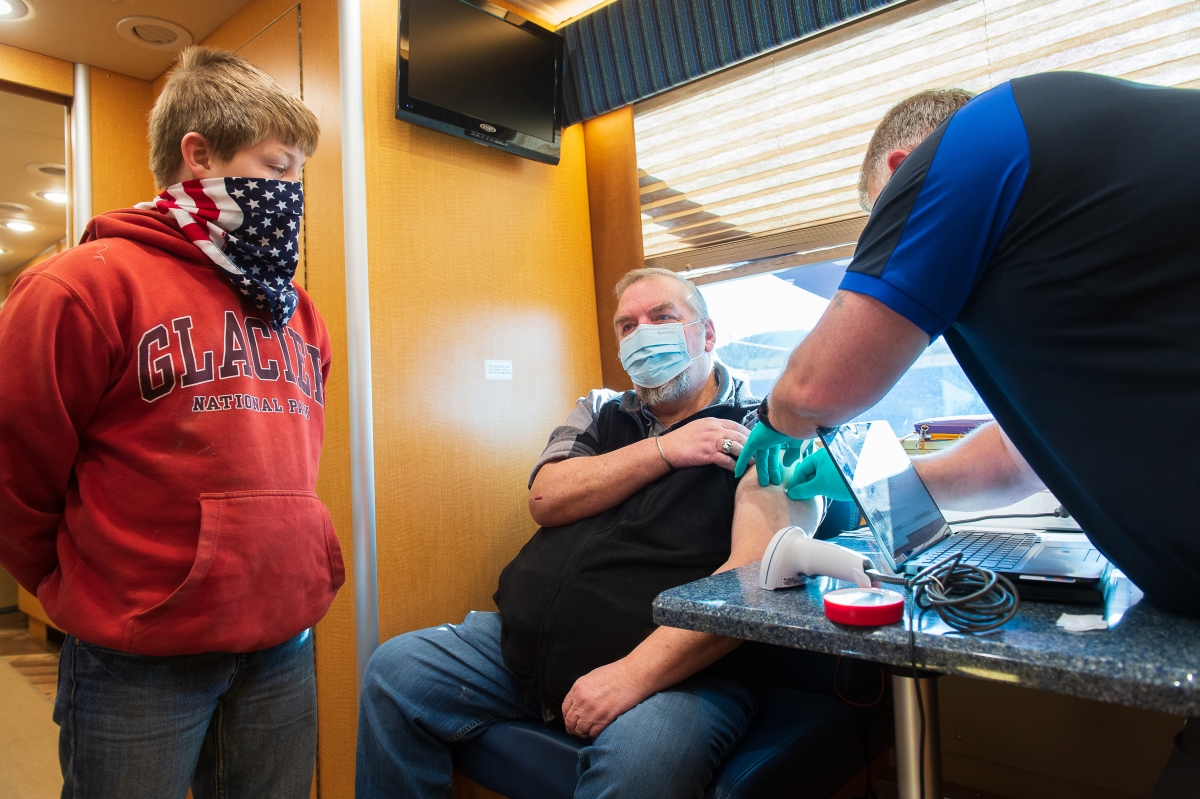
Logan, 11, and his father, U.S. Air Force veteran Mike Jellesed, 61 of Libby, Mont., after a long discussion, receives the Moderna Vaccine from RN Mark Sheldon on March 30, 2021. Photo by Tony Bynum for The Washington Post
He felt like a lab rat: “That’s what I am,” he said. “I don’t like being told what to do.”
The VA mobile medical unit’s third visit since January to Libby, an old mining and lumber town 70 miles from the Canadian border in a deep-red band of America, had been unexpectedly rough.
Even as the Biden administration’s campaign to inoculate the country accelerates each day, the agency has struggled to persuade a vulnerable population to protect itself and help the country get to herd immunity. The rugged communities that stretch from eastern Washington through the Idaho Panhandle into northwestern Montana include some of the country’s highest concentrations of former service members. Mostly conservative and White, they are also highly suspicious of coronavirus vaccines.
In many cities and suburbs, millions are lining up for shots they have waited more than a year to get. Here, the political and cultural currents are pulling in the other direction, against the federal government, public health experts and a new president many of these veterans distrust. VA’s halting and labor-intensive effort may be a warning for the country as vaccine advocates seek to persuade unwilling Americans to sign up.
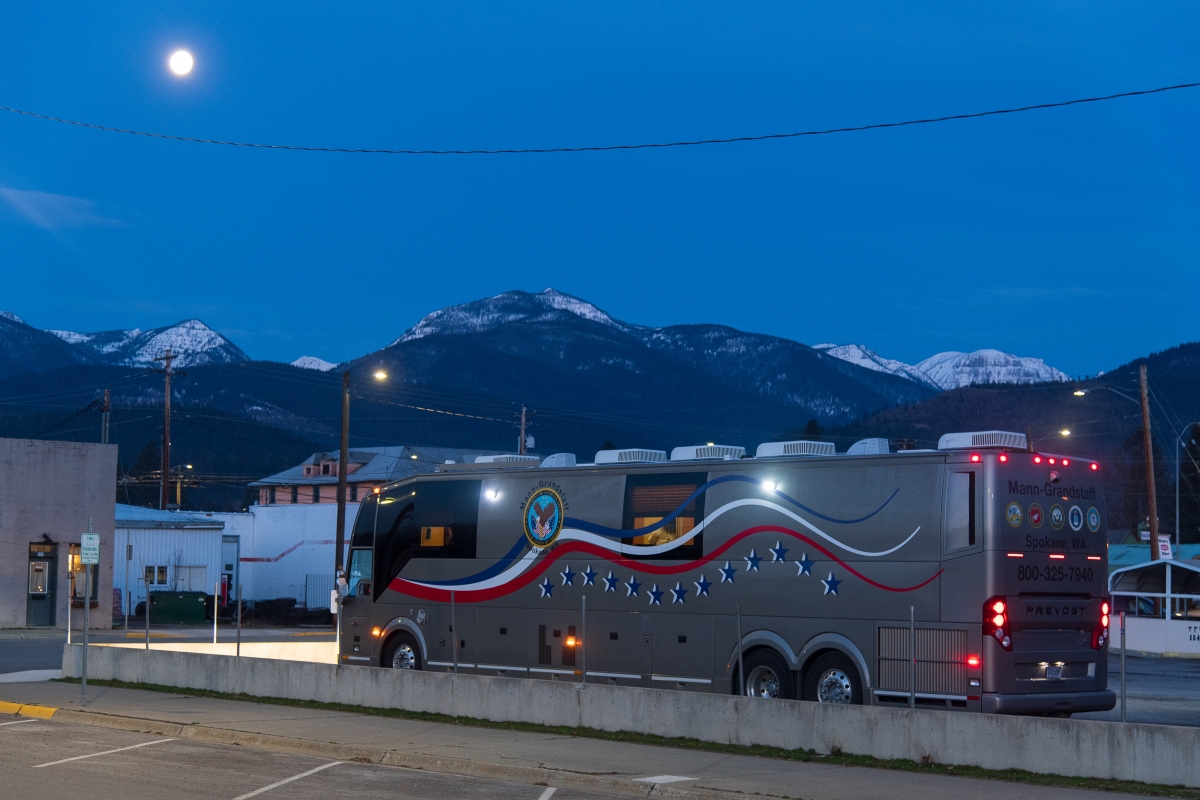
To counter the wariness, the agency’s Spokane hospital embarked in January on a mission to convince the roughly 46,000 veterans under its care that whatever was holding them back was the real danger. The 45-foot bus previously used as a primary-care clinic – 10 feet longer than a Greyhound and the height of a tractor-trailer, with two exam rooms, a triage room with a hospital bed, and a centrifuge to spin blood – has since logged 2,500 miles in a carefully waged campaign against skepticism.
Nationally, about 3 in 4 Americans have indicated a willingness to accept a vaccine. Yet just 1 in 4 veterans contacted by the Spokane VA for an appointment on the bus have said yes. And on a trip early this month, roughly 1 in 6 with appointments canceled or didn’t show.
When Jellesed arrived, he complained that the scheduler had unfairly pressured him by warning that his VA benefits, now the only source of income for his family of six, would be cut off if he turned down the shot.
He feared the vaccine was meant to harm people, to eventually cause cancer in those who got it.
“My wife’s totally against it,” he said. He explained that his reluctance came from “all the things I’ve read on Facebook.”
Yet he also knew people who had died in the pandemic and how lonely those deaths could be. A close childhood friend had flown in from California to see his mother when she was hospitalized with covid last year, but the hospital in Libby wouldn’t even let him inside before she died.
Jellesed’s elderly mother was home recovering from a stroke. If something else happened to her, he wanted to make sure the hospital would let him in to see her.
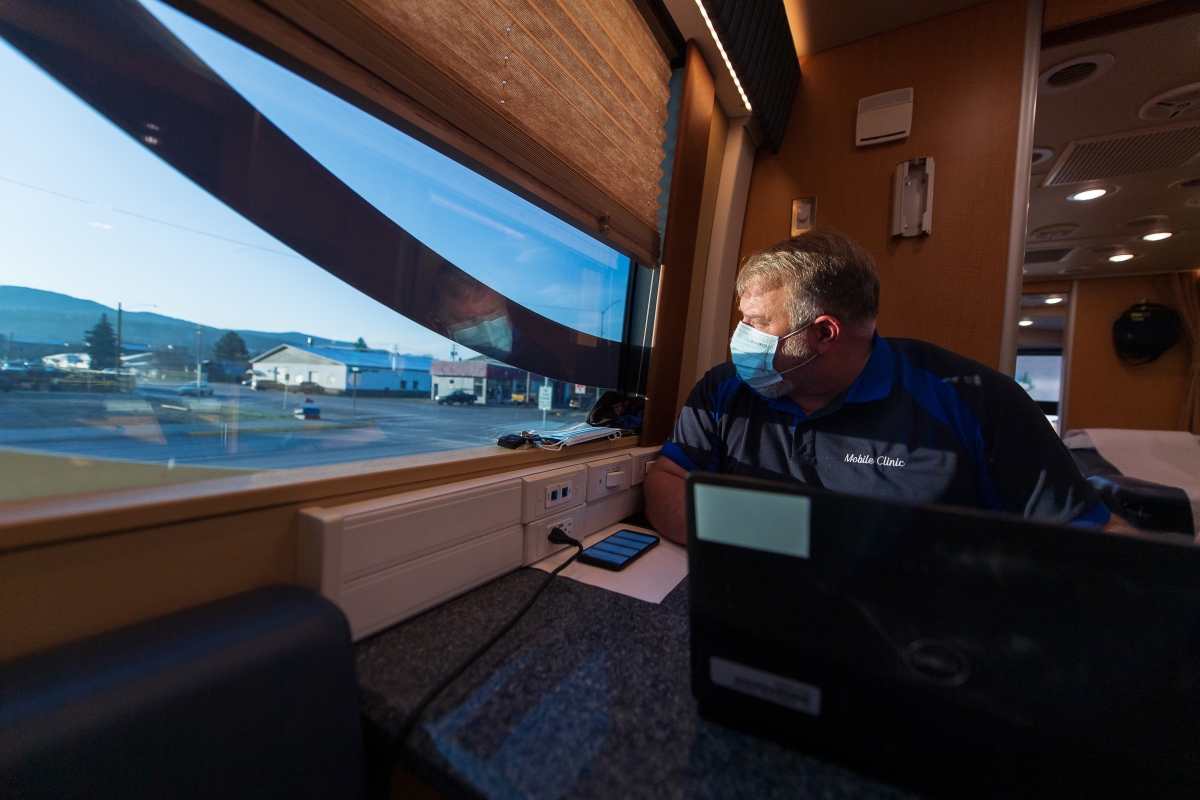
VA emergency room nurse Mark Sheldon, a Gulf War combat Marine, looks out the window of the mobile clinic in Libby, Mont., on March 30, 2021. Photo by Tony Bynum for The Washington Post
A little after 10 a.m., Mark Sheldon came to hear him out. The Gulf War combat Marine, now an emergency room nurse, is the Spokane hospital’s chief weapon on the ground. In almost three months on the road running the mobile clinic, along with a nurse practitioner and a driver, he had learned that pressure tactics do not work on cynical veterans.
He gently made the pitch for the vaccine, sharing that he also had wavered, after taking experimental drugs to protect against nerve agents during the war. He sensed that, for all Jellesed’s fury, the veteran could be swayed.
“I don’t want you to get this shot if it’s not what you want,” Sheldon told him. He promised Jellesed wouldn’t lose his benefits, regardless.
The outreach to veterans in the 64,000 square miles served by the Spokane VA begins with a phone call from a 20-year-old medical support assistant working in a cubicle at the hospital. She is paid $25,000 a year.
Kylee Flower, known by the staff for her oatmeal cookies and grace under pressure, is the agency’s first point of contact with hesitant veterans, a role requiring deft navigation around the minefields of politics, culture and misinformation.
The VA mobile medical unit has made three trips to Libby, Mont., since January. Photo by Tony Bynum for The Washington Post
As the bus rolled toward Libby, Flower was working ahead, trying to set up appointments for its next trip. She scrolled down an Excel file on her computer that listed veterans by age and illness, put on her headphones and wrapped her white Vans sneakers around the base of her chair.
“Hello, this is Kylee calling from the Spokane VA,” she began. “I’m calling for John. Hi, John! How are you? I was just calling to see if you wanted to get the coronavirus vaccine in Colville.”
John had signed up to get his shot at the local fire station. The next veteran, Donald, had already gotten vaccinated. The next call went to voice mail and Flower wrote herself a note to try again – twice. Then Ronald picked up.
“Hi, Ronald. How are you?” Flower asked. Did he want the vaccine? “No? OK. Sounds good. Thank you for letting me know.”
The “no” answers tend to be nonnegotiable.
“That’s the hard part,” Flower said after hanging up. “What I’ve been told is if they say no, no is OK. I don’t want to argue with them.” She said she would never threaten to pull benefits.
The veterans’ “no” reactions rest on several theories, she explained. The vaccine injects a microchip that will let the government track their movements. It can’t be safe, because it was developed too fast. They’ve quarantined for this long, so they don’t need it. Former president Donald Trump says they don’t need to get it, so they’re not getting it. None of these claims are true, but that doesn’t matter.
To settle on the right messaging, a hospital administrator wrote the objections on Post-it Notes and stuck them on the wall at a staff meeting. Everyone concluded that the workers should stay away from the word “government” in their conversations with the veterans.
That was only one issue to untangle in months of planning and improvisation at the 70-bed facility, which, as a test-pilot site, is still troubleshooting a rocky rollout of VA’s new electronic health-records system. For the vaccine push, fifteen schedulers were pulled from other duties to call veterans in five-year age increments, starting with a 102-year-old World War II veteran, who said yes.
Since late January, the schedulers had been making 580 calls a day, but the effort needed to get more shots in arms. The staff tried to speed up the system with a mass vaccination site at the city’s armory (but vaccine supplies were too unreliable) and email blasts (low response). After giving shots in the hospital’s dental clinic, the staff also took over the offices for treating substance abuse as they searched for more space last month.
For those beyond driving distance from the city, however, the one constant is the bus.
The crew had been 10 weeks on the road in cold and snow, 620 shots in with six weeks to go, and now, finally, the sun was shining on the VFW parking lot in Libby. Because of the town’s painful history – residents were exposed to toxic dust as mining company W.R. Grace dug millions of tons of asbestos-laced vermiculite from a nearby mountain – Libby was a priority. But this visit was quickly becoming muddled.
Even before Jellesed showed up, an Air Force veteran named Connie Giles arrived, angry that the new computer system was spitting out old prescriptions and medical records.
Bob Sonderman, the mobile clinic’s bus driver, who served in the Marines after the Vietnam War, was scrambling on the phone with colleagues in Spokane to find replacements for the no-shows. Those who actually canceled told him they had decided not to get the shot.
“I tell them, ‘That’s your choice, but you realize we’re gonna have to throw a covid shot away?’ ” he said in frustration. The crew hadn’t had to waste a syringe yet, but now the possibility was there. (The agency has not been allowed to give the vaccine to nonveterans, although a recently approved law expands eligibility.)
William Bishop, a 57-year-old Army veteran sitting nearby for 15 minutes of observation after his shot, said he had lost his father to covid last year. “It’s a duty to myself and a duty to my community,” he said, explaining why he was getting vaccinated. “I’m a veteran. Duty is what it’s about.”
His was not the prevailing view. For most veterans, the pressure not to get the shot was enormous.
Libby is an old mining and lumber town in northwest Montana. Almost 12% of its population of 2,700 is veterans. Photo by Tony Bynum for The Washington Post
“We have a lot of anti-vaxxers here,” said Dorian Bolling, a 39-year-old disabled Army veteran. “It’s growing. I mean, I’m hearing about microchips. VA here doesn’t have the best image with the vets.” But a bout with pneumonia a few years back had convinced her that she never wanted to feel that awful again.
“A lot of people think this is just the flu,” said Valerie Downing, next up for the shot with her husband, Clifford, whom she met in the Navy. Valerie got the coronavirus last year from the couple’s 6-month-old granddaughter, and four other members of the family got sick, too.
“A lot of people think they haven’t gotten sick yet, so why do I need a shot?” Clifford said. “Well, we know that life matters to God,” his wife said.
Mark Sheldon had managed to coax Jellesed and his son onto the bus. The nurse, now 50, with piercing blue eyes and a linebacker’s build, had returned from shooting shoulder-launched rockets in the Persian Gulf with herniations in his back, still-unexplained rashes and mental health issues, he said – along with a facility for de-escalating tense situations.
The two men sat around a small counter, and Jellesed rolled up his flannel sleeve. The nurse explained that the vaccine had definitely not been rushed into being. “They didn’t cut any corners. It’s a quality product,” Sheldon said.
“I’m not liking it, but I’m doing it because I have family I need to see,” Jellesed responded.
“We all have our whys,” Sheldon said. “My grandson is my why.”
The shot went in, and they shook hands. Sheldon told Jellesed that if he had truly felt he would lose VA care if he didn’t get the shot, “I need to fix that, because we’re better than that.”
On the dirt parking lot that afternoon, a veteran wheeled a battered bike toward the bus to get a closer view. He was homeless, 61 and at risk for the virus. He didn’t see the point of the vaccine, he said, mostly because “they could track you by this injection.”
An Air Force veteran in a camouflage jacket named Mike Aja walked up with his 4-year-old son, Shane. He was a “no,” too. He said he had heard that the average death rate had dropped last year, proof that the government was making too big a deal out of the virus. (Deaths actually are up markedly.) He said there was no way President Joe Biden was serious about the pandemic because he was letting thousands of undocumented immigrants flow across the border.
“You’re convincing us not to trust you,” Aja said, directing his skepticism at the president.
A small crowd had gathered at the VFW post, where the slot machines were in full use. The charismatic manager, Julie Mason, is a self-described conspiracy theorist with a QAnon sticker on her car’s rear windshield.
The post no longer carries broadcasts of NFL or Major League Baseball games “due to the disrespect shown towards our American Flag and the men and women that have sacrificed so much to defend it,” a sign on the back wall says.
Kenny Rayome Jr., an operator at the local water plant, and his wife, Megan, a lawyer in town, were relaxing over beers at the bar. They got mild cases of covid-19 last year, and Kenny’s uncle died of it. Megan suffers from lupus, an autoimmune illness. Still, they have no plans to get vaccinated.
“I’m just not afraid of it, I guess,” said Kenny, 40, whose family goes back six generations in Libby. During six years as a Navy submariner, he explained, “they told me what to do. Don’t tell me what to do now.”
It was the same sentiment around the bar. “I got plenty of little bugs overseas,” said Rob Hughes, 51, a retired Marine who owns a gun shop in town. “I’ve been shot at for a living. It’s not gonna hurt my feelings if a bug kills me.”
On the bus, the VA crew had found veterans for the unclaimed shots. But four had already canceled in Sandpoint, Idaho, their next stop, where a planned two-day visit had been condensed into one because not enough people were signing up.
Before sunrise, the bus rolled out of the Venture Inn and onto two-lane roads flanked by firs, bull pines and tamarack trees, with snow-covered mountains in the distance. It drove west past long-shuttered silver mines and sawmills, bald eagles, elk and deer, and small white markers where car crashes had taken lives on the winding roads.
Just across the Idaho border loomed a giant billboard that read: “Welcome to Trump Country.” Sandpoint’s spectacular lakefront setting is attracting wealthy outsiders; the picturesque ski town, population 8,400, now boasts art boutiques and a Sotheby’s storefront, while the long dirt roads around Lake Pend Oreille wind through the mountains to cabins where veterans and retired law enforcement officers settled years ago.
As the bus stopped on a side street near a clinic serving low-income residents, Jayne Shoda, the mobile clinic’s nurse practitioner, began pulling boxes of gloves, alcohol swabs and hand sanitizer from the cabinets. Sonderman fired up Paul McCartney’s “Wings” on the bus speakers, printed out Moderna information sheets and started calling to confirm appointments.
“Bob’s got the last flip phone in the VA!” Sheldon ribbed his colleague, as he pulled vaccine vials from the medical-grade refrigerator and loaded syringes.
After weeks on the road, they were a tight crew, despite political differences they had learned to live with. They all worried what the day would bring. “These are the first shots where we’re having such attrition,” Shoda said.
A young Marine veteran who had served in Iraq, with brown hair down to his shoulders, showed up without an appointment and explained that his doctor at the private clinic next door had just told him the vaccine was safe. It was hard to know whom to listen to, he said. “I’ve got anti-vaxxers in my life, and they’re full of fear and skepticism.” The veteran, who got the shot, spoke on the condition of anonymity, saying he was fearful of the pressure not to be vaccinated.
A Vietnam veteran named Knut Lyssand, 69, arrived in cowboy boots and a T-shirt that read: “The answer is beer.” He had been ready to cancel after talking to fellow veterans, but when he couldn’t sleep at 4 a.m., he turned on the television to Newsmax and heard a doctor say it was OK to get vaccinated.
By noon, there were still three no-shows. Sonderman reached one by phone who claimed he had never agreed to be vaccinated, “and I will never take a covid shot.” The crew had to throw out its first syringe in 10 weeks.
On the way back to Spokane the next morning, Sheldon concluded they needed to regroup. They were running out of willing veterans, and after second doses in Libby and Sandpoint, the bus would return to primary- care work. The hospital had canceled the upcoming clinic in Colville, Wash., after Flower, the medical support assistant, had trouble filling appointments.
“I feel by now if you wanted this shot, you’d be hustling to get it done,” Sheldon said.
The bus will head back to Libby for second doses April 27. Jellesed’s already on the list. After his first dose, he told family and friends the shot didn’t hurt – and had no side effects. But he is adamant that even after the second one, his vaccination will be just .01 percent more protection against the virus than if he hadn’t gotten it. “I’m just not seeing any benefit,” he said, explaining that he had read the statistic somewhere.
His wife and kids won’t get inoculated. But Jellesed is comforted in knowing that if his mother ends up in the hospital, he will be able to see her.
“These are the things you do for family,” he told his children. “It’s not for me. It’s for her.”
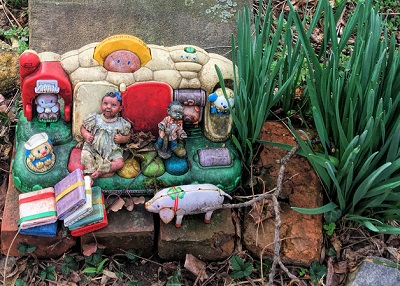
Karon Flage has visited Nannie’s headstone over the years and has taken photos of the toys left for her. Photo by Karon Flage.
By Theresa Vargas The Washington Post
WASHINGTON – Lindsey Brittain Collins discovered Nannie in the same way most people do: unintentionally.
Collins knew nothing of the girl on the day she decided to visit two adjoining historic Black cemeteries in Georgetown in 2016. She had been drawn to the tucked-away graveyards after learning that a small brick structure on the grounds may have served as a stop on the Underground Railroad.
The day she walked through the area, she passed overgrown weeds, broken grave markers and people using the space as a dog run.
Then, she noticed the dolls.
She saw several antique figures and other toys sitting in front of a headstone that offered just enough information to show that those gifts were for a girl who lived long ago and not long enough. The marker read “Nannie,” and it held two dates that indicated she died at the age of 7, just days before her birthday.
Born May 26, 1848
Died May 18, 1856
Collins also noticed something else on the ground: a laminated birthday card addressed to Nannie.
“I thought it was beautiful,” she says. She recalls thinking: “Who is it that has this connection to this young girl who died so long ago?”
An energy that Collins felt standing in that spot and the questions that remained with her after she walked away compelled her to return months later. She arrived not long after Nannie’s birthday and found a new doll and card. She knew then, she says, that the person who had left those earlier items was still around, thinking of Nannie.
“I continued to go back and visit over the years,” Collins says. She recalls seeing toys grow weathered. A doll that wore a tan dress one year lay in threads another year. But one thing remained consistent, she says. “Every year, after her birthday, without fail, there was a new doll and laminated birthday card.”
The grave marker of Edgar Allan Poe was known to draw a mysterious visitor each year on the writer’s birthday. In the darkness of night, a masked person would leave a bottle of cognac and three red roses.
A similar mystery has intrigued those who know about Nannie’s headstone.
Who leaves those cards and toys? they have wondered. Is it one person, or is it many? Is it a descendant, or is it a stranger? Will that person show up next month, on May 26, to mark another birthday?
Not even the people who are overseeing the preservation of those cemeteries have those answers. No one, it seems, has many answers when it comes to Nannie. The difference between Poe and Nannie: He was well-known. She is unknown. The identity of her birthday visitor isn’t the only mystery connected to her headstone. So, too, is her identity.
“There are mostly question marks,” says Patrick Tisdale when I ask him about Nannie on a recent evening. He volunteers with the foundation Mount Zion-Female Union Band Society Historic Memorial Park, which manages the restoration and preservation of the cemeteries by those names. “We don’t know anything about her beyond what is on her headstone.”
That headstone, though, offers some clues about the life she might have known.
It reveals that she was alive during a time when many Black people remained enslaved across the country. Her death came six years before President Abraham Lincoln issued the Emancipation Proclamation.
It also shows that she was connected to someone who had a comfortable level of wealth, Tisdale says. Many grave markers during that time were made of inexpensive wood, concrete or soft sandstone, he says. Nannie’s headstone was made from Virginia bluestone. Tisdale describes some of the other people in the cemeteries with bluestone grave markers as ship builders, businessmen and clergy.
Without a last name listed on her headstone, there is no way to know for sure who Nannie’s parents were or whether she was free or enslaved at the time of her death. But all the dolls that have been left for her are Black, and the placement of her headstone makes it probable that she was, too, Tisdale says. It sits on a side of the property that a group of free Black women obtained before Nannie’s death.
“Black women weren’t allowed to buy property at that time, but as Black women do, they found a way,” says Lisa Fager, executive director of the Mount Zion-Female Union Band Society Historic Memorial Park. “Nannie, as a young Black girl, was part of that. She was shown what free Black women could do. If I look at it like that, I think she was loved. “
Fager has found photos showing that some of the toys that now sit in front of Nannie’s headstone were placed there more than 11 years ago. She finds it amazing that no person or animal has disturbed or taken them.
“Who is she?” Fager says. “I want to know. It’s important to know our history.”
Since discovering Nannie’s headstone during a walk, Karon Flage has visited it every year or two. Each time she goes, she takes photos of the toys. She has also let her thoughts wander to the person who brings them.
“Is it an older woman and she’s leaving the toys her grandchildren have outgrown?” Flage asks. “Is it someone who lost a child and doesn’t have a grave to visit for some reason, so she visits this grave instead?”
Is it someone who wants to remain anonymous? If that’s the case, Flage says, she is fine not knowing any answers.
“Some mysteries you want to know the endings,” she says. “I don’t need to know the ending for this.”
There is a power to Nannie’s story, even with the unknowns, or maybe even more so because of them. She is drawing people to a historic Black cemetery and making them consider what life in Georgetown might have looked life for a Black girl in the 1850s. She is making strangers think about human connection – then and now.
During her visits, Collins has seen the cemetery change from a once-neglected space to a place that volunteers are actively working to restore.
She also developed an unexpected connection to Nannie’s mystery visitor. An artist who grew up in the Washington D.C. region, she was inspired by the dolls left at the site. She started working on a painting shortly after that 2016 visit. That eventually grew into pieces that she completed over the years and recently showed as part of an exhibit in New York.
The series features painted images of the dolls surrounded by concrete. Over time, as the concrete crumbles, the painting beneath it becomes more visible. It becomes unearthed.
Collins believes that one person has been bringing the cards for Nannie each year based on the similarities between them. She also suspects that person is elderly. But she stops herself from imagining much more. She doesn’t want to guess wrong – about Nannie or her mystery visitor.
Last year, Collins worried that the pandemic might keep the visitor from coming. She went to the cemetery shortly after Nannie’s birthday and found nothing new. She then went again in July, and learned that the coronavirus had delayed the birthday offering, not stopped it.
A tiny ballerina dangled in front of the headstone. Nearby, she found the laminated card.
“Happy Birthday, Nannie!” it read, before listing the age she would be now: “172.”
By Breanna Cooper, Lateshia Beachum, Joel Achenbach The Washington Post
INDIANAPOLIS – Residents held vigils here Saturday in memory of eight people gunned down late Thursday at a FedEx plant, as authorities said the 19-year-old gunman used two assault rifles to target his former workplace.
Police said the shooter, Brandon Hole, purchased the rifles legally last July and September, raising further questions as many call for tighter restrictions on powerful firearms and more safeguards on who can own them. Earlier last year, officials say, Hole’s mother had reported her fears that her son would attempt “suicide by cop,” leading authorities to question Hole and temporarily detain him for mental health reasons.
This latest mass shooting – the sixth in the United States in the past five weeks – left local leaders once again calling for action to stop these violent outbursts that have targeted offices, stores, places of worship, movie theaters, nightclubs, colleges and grade schools.
“We have to act against gun violence,” said Rupal Thanawala, president of the Asian American Alliance in Indianapolis. “I cannot say why this happened, but these people will not come back. Everyone should have the right to feel safe at work, at school, at houses of worship. But, people don’t have that anymore.”
The victims of Thursday’s shooting ranged in age from 19 to 74 years old, including a recent high school graduate with basketball talent and a 68-year-old Indian immigrant who loved long walks around his neighborhood. Four members of the Sikh community were killed. The massacre also hospitalized at least five people with one in critical condition, according to the Indianapolis Metropolitan Police Department.
On Saturday, officials released no new details about Hole’s motive. The gunman, who last worked at the FedEx plant in 2020, was found dead at the crime scene by police Thursday with what appeared to be a self-inflicted gunshot wound.
A person who knew Hole said he had suffered from mental illness, and said he did not get the treatment he needed.
“I feel really bad for the eight families that lost loved ones,” said a man who identified himself as a family friend who spoke in an interview with The Washington Post on the condition of anonymity because he does not want to be the family’s spokesperson. “Should have never happened at all. I do know that they did try to get him help, and they couldn’t.”
In a statement released Saturday, Hole’s family said, “we are devastated at the loss of life caused as a result of Brandon’s actions; through the love of his family, we tried to get him the help he needed.”
“Our sincerest and most heartfelt apologies go out to the victims of this senseless tragedy. We are so sorry for the pain and hurt being felt by their families and the entire Indianapolis community,” the statement reads.
No one answered the door at Hole’s home on Saturday. A “no trespassing” sign was on the front door.
Hole was known to law enforcement: Last spring, according to a brief statement released Friday by the FBI, his mother called police to say he might try to commit “suicide by cop.” The FBI said Hole was interviewed after items of an undisclosed nature were found in his bedroom. A shotgun was confiscated. Authorities have released no further details about that investigation.
Authorities may need time to piece together a “psychological autopsy” of the gunman, said Christopher Ferguson, a Stetson University professor of psychology who is an expert on mass shootings.
He said a common feature in many mass shootings is that the perpetrator has an untreated or undiagnosed mental illness and is an “injustice collector” who blames some group, or society generally, for all that has gone wrong in the person’s life.
“Other people are screwing them over. Society is evil. Society is hurtful. They are emotionally crushed by their relationship with society, and they’re very angry about it. So they want to die, but they want to bring other people with them,” Ferguson said.
The massacre has recharged the political debate about gun laws, with President Biden calling for a ban on military-style semiautomatic rifles and limits on ammunition cartridges. Some local leaders demanded new laws to keep weapons out of the hands of people known to pose a public threat.
Indianapolis City-County Council member Ali Brown, a Democrat, renewed a call Saturday for lawmakers to ban military-style assault weapons.
“We’re all shook to our core and we all feel the need to have something change,” she told a local TV station, WISH. “This country has a problem, and it was exhibited here in Indianapolis on Thursday night and pretty much every other day in Indianapolis.”
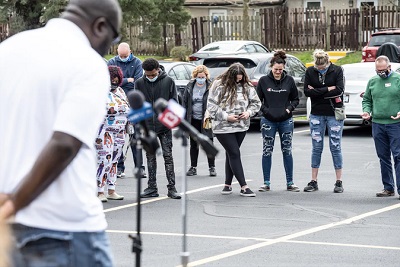
Early Saturday afternoon, DeAndra Yates, 38, who founded an anti-violence group in 2015 after her 13-year-old son Deandre was shot and injured, organized a prayer vigil in a church parking lot. “I know prayer vigils seem cliche now, but as a believer, I think prayer is our greatest weapon,” she said.
Another event organizer, Cathy Weinmann of the group Moms Demand Action, said she plans to send a letter to the governor demanding action: “‘Thoughts and prayers’ aren’t working,” she said.
An evening vigil brought even more calls for reform – and weariness.
“I have to be honest, I’ve been asking myself the same question since Thursday,” Indianapolis Mayor Joe Hogsett, a Democrat, told a crowd of roughly 200 people. “Oh, loving God, what more can we take?”
Eight candles were lit, the first one by Ryenne Beaty, a 19-year-old friend of victim Samaria Blackwell, also 19. After the shooting, she said, she waited 16 hours hoping her best friend of a decade would turn up safe.
Blackwell was “selfless, she said.
Michelle Parksey, 37, and Savana Delao, 20, were both supposed to be at work at the FedEx when the shooting occurred.
“I was on my way to work when I saw 20 cops fly be me, and for some reason I just knew they were going to FedEx,” Parksey said. “I was late, because I spent 40 minutes in the drive-through at Fazoli’s, which I was mad about, but they ended up saving my life. I would have been in the parking lot when he was shooting at cars.”
The single mom of three teenage sons said she’s thankful for every moment that she now has with her sons.
“If I would have gone to work that night, I wouldn’t have come home to my babies,” she said. “I’m all they have.”
They don’t know when employees will be able to return to work. Delao said she’s not sure she’ll be emotionally ready when the time comes. “I can just imagine in my head walking in there, and knowing bodies were laying there on the ground,” Delao said.
Delao knew Blackwell from work and said her smile and energy could light up a room.
“For someone that young to die, it’s just not fair,” Delao said. “I can’t understand it.”
Just days before the shooting, Parksey trained another victim, Karli Smith, 19, who was about to receive her first paycheck.
“She was awesome, it’s just heartbreaking,” Parksey said.
– – –
Beachum and Achenbach reported from Washington. The Washington Post’s Meryl Kornfield in Indianapolis and Alice Crites, Julie Tate, Fenit Nirappil, Hannah Knowles and Timothy Bella in Washington contributed to this report.

 ทำไมอิสราเอลจึงทำได้สำเร็จ? ยกเลิกข้อกำหนดหน้ากากป้องกันไวรัสโคโรนากลางแจ้ง
 คนเกาหลีใต้ขึ้นชื่อเรื่องความพิถีพิถันในการเลือกวัตถุดิบ และ Market Kurly ของ โซฟี คิม ก็เกิดขึ้นมาเพื่อการนี้

 ก่อนหน้านี้สหรัฐและญี่ปุ่นประกาศที่จะยืนหยัดร่วมกันเพื่อต่อต้านการรุกคืบของจีน และเทคโนโลยีแห่งอนาคตฏโดยเฉพาะ 5G ซึ่งคาดว่าเพื่อแข่งขันกับจีนโดยเฉพาะ
 ความสนใจจนเหมือนเป็นกระแสที่บ้าคลั่งต่อ Dogecoin ทำให้ระบบซื้อขายคริปโตของบริษัท Robinhood ถึงกับเจอภาวะโอเวอร์โหลด
 ท่ามกลางความตึงเครียดระหว่างรัสเซียกับชาติตะวันตก เมื่อต้นเดือนนี้มีรายงานข่าวการทดสอบอาวุธที่ดินแดนใกล้ขั้วโลกของรัสเซีย
 ประชาชนเมียนมาเรียกร้องให้อาเซียนยอมรับรัฐบาลพลเรือน แต่อาเซียนกลับไปเชิญรัฐบาลทหารไปคุยด้วย
 ภาพชุดงานพระศพเจ้าชายฟิลิปดยุคแห่งเอดินบะระจัดขึ้นเป็นการภายในโดยมีพระบรมวงศานุวงศ์เข้าร่วมส่งเสด็จเป็นครั้งสุดท้าย