Praying that truth and justice will prevail for all the innocent victims of this wicked slander. God bless and keep them safe.— Noor Al Hussein (@QueenNoor) April 4, 2021
Financial Times รายงานว่าธนาคารกลางของจีนขอให้ธนาคารและสถานบันการเงินที่เป็นผู้ให้กู้ ทำการควบคุมการจัดหาสินเชื่อเนื่องจากกังวลว่าการกู้ยืมที่เพิ่มสูงขึ้นทำให้เกิดฟองสบู่ของสินทรัพย์
หนังสือพิมพ์ Financial Times รายงานโดยอ้างถึงบุคคลที่ไม่ปรากฏชื่อที่มีความรู้เกี่ยวกับสถานการณ์ในจีนว่าเมื่อเดือนกุมภาพันธ์ธนาคารกลางของจีน หรือ People’s Bank of China สั่งให้ธนาคารต่างๆ รักษาระดับการปล่อยเงินกู้ใหม่ในไตรมาสแรกให้อยู่ในระดับใกล้เคียงกับปีที่แล้วแต่ไม่ถึงกับต้องในอยู่ในระดับไม่ต่ำกว่านี้
LG Electronics Inc. กำลังปิดหน่วยสมาร์ทโฟนเพื่อปรับปรุงการดำเนินงานและมุ่งเน้นไปที่โครงการในอนาคตเช่นส่วนประกอบของรถยนต์ไฟฟ้า หลังแผนกนี้ขาดทุนอย่างหนัก
LG จะยุติการผลิตและจำหน่ายผลิตภัณฑ์โทรศัพท์มือถือในวันที่ 31 กรกฎาคมเพื่อมุ่งเน้นทรัพยากรในด้านการเติบโตรวมถึงรถยนต์ไฟฟ้า (EV), บ้านอัจฉริยะ, หุ่นยนต์ และปัญญาประดิษฐ์
ทั้งนี้ โทรศัพท์คิดเป็น 8.2% ของยอดขาย LG ในปีที่แล้วและจะมีการสูญเสียรายได้ในระยะสั้น แต่บริษัทคาดว่าการปิดจะเป็นผลดีทางการเงินในระยะยาว จะเพิ่มความแข็งแกร่งให้กับธุรกิจชิ้นส่วนรถยนต์และยังคงพัฒนาเทคโนโลยีมือถือเช่นระบบเครือข่ายและกล้องรุ่นที่ 6
LG เริ่มผลิตโทรศัพท์มือถือครั้งแรกในปี 1995 และ LG เป็นหนึ่งในผู้บุกเบิกระบบปฏิบัติการ Android โดยร่วมมือกับ Google ของ Alphabet Inc. ในกลุ่มผลิตภัณฑ์สมาร์ทโฟน Nexus และผลิตกล้องและเทคโนโลยีการแสดงผลที่ดีที่สุดในกลุ่มนี้
LG Electronics เคยเป็นผู้ผลิตโทรศัพท์มือถือรายใหญ่อันดับ 3 ของโลกในแง่ของส่วนแบ่งการตลาด ในตลาดสหรัฐ LG เคยเป็นอันดับสามรองจาก iPhone ของ Apple Inc. และSamsung Electronics Co. จากประเทศเดียวกัน แต่ LG สู้คู่แข่งไม่ได้มาหลายปีและจากนั้น OnePlus ของจีนก็พุ่งพรวดเข้ามาแทนที่ท่ามกลางการสูญเสียส่วนแบ่งการตลาดไปทั่วโลกให้กับคู่แข่งจากต่างประเทศ
เจ้าของโรงแรมในรุ่ยลี่คนหนึ่งบอกกับ South China Morning Post ว่าตำรวจได้สั่งให้ชาวบ้านรายงานว่ามีคนจากเมียนมาที่เข้าพักที่โรงแรมรุ่ยลี่ตั้งแต่เดือนกุมภาพันธ์หรือไม่ เจ้าของโรงแรมคนนี้คิดว่าทางการอาจกังวลว่าความวุ่นวายในเมียนมาจะทะลักเข้ามา และจะเป็นปัญหาหากมีผู้ลี้ภัยจำนวนมากหลั่งไหลจากเมียนมาเข้ามาในเมือง
When police kill people, they are rarely prosecuted and hard to convict
InternationalApr 05. 2021Thousands of people protest the death of George Floyd in Minneapolis on June 5, 2020. MUST CREDIT: Washington Post photo by Salwan Georges
By The Washington Post · Mark Berman
The footage plays inside the downtown Minneapolis courtroom where Derek Chauvin is on trial, charged with murder. It shows George Floyd, a Black man, gasping for air under the White police officer’s knee.
That video is the centerpiece of the case against Chauvin, which prosecutors emphasized by urging jurors to “believe your eyes.”
But prosecutors face a steep legal challenge in winning a conviction against a police officer. Despite nationwide protests, police are rarely charged when they kill someone on duty. And even when they are, convictions often are difficult.
Between 2005 and 2015, more than 1,400 officers were arrested in a violence-related act committed on duty, according to data tracked by Philip Stinson, a criminologist at Bowling Green State University. In 187 of those cases, people were fatally injured in shootings or from other causes. The officers charged represent a small fraction of the hundreds of thousands of police officers working for about 18,000 departments nationwide.
Police charged with committing violent crimes while on duty were convicted more than half the time during that period. In the most serious cases – those involving murder or manslaughter – the conviction rate was lower, about 50%.
About 6 in 10 people charged with violent crimes were convicted, according to a federal report that examined cases adjudicated in the country’s 75 most populous counties in 2009. The number increased to 70% when murder was the most serious charge. Most criminal cases in the United States end in plea bargains, rather than court trials.
Chauvin’s case is different from many of the most high-profile police prosecutions in recent memory, in part because it centers on an officer who never fired his gun, experts say.
There are a few reasons it is difficult to convict a police officer, according to legal experts and attorneys who have worked on such trials: Police have considerable leeway to use force, can cite their training and are typically trusted by juries and judges.
“The law favors the police, the law as it exists,” said David Harris, a law professor at the University of Pittsburgh and an expert in policing.
“Most people, I think, believe that it’s a slam dunk,” Harris said of the case against Chauvin. But he said, “the reality of the law and the legal system is, it’s just not.”
Attorneys who have worked both sides of these cases say they invite heightened scrutiny and raise a host of issues about the authority police have, the force they are allowed to use and the dangers they could confront on the job.
“It’s fundamentally different than handling any other kind of case,” said Neil Bruntrager, a St. Louis-based attorney who has represented officers in high-profile cases.
“We grant [police] very significant power,” Bruntrager said. “And when we see the prosecution of a police officer for a line-of-duty act . . . what we’re really talking about is not the violation of that particular law, whatever it may be, but the violation of that trust.”
A key element that experts say factors into many of the cases is the Supreme Court’s 1989 Graham v. Connor decision, which found that an officer’s actions must be judged against what a reasonable officer would do in the same situation.
“A police officer can use force, but it has to be justifiable,” Bruntrager said. “And what the Supreme Court has told us is we have to see it through the eyes of the police.”
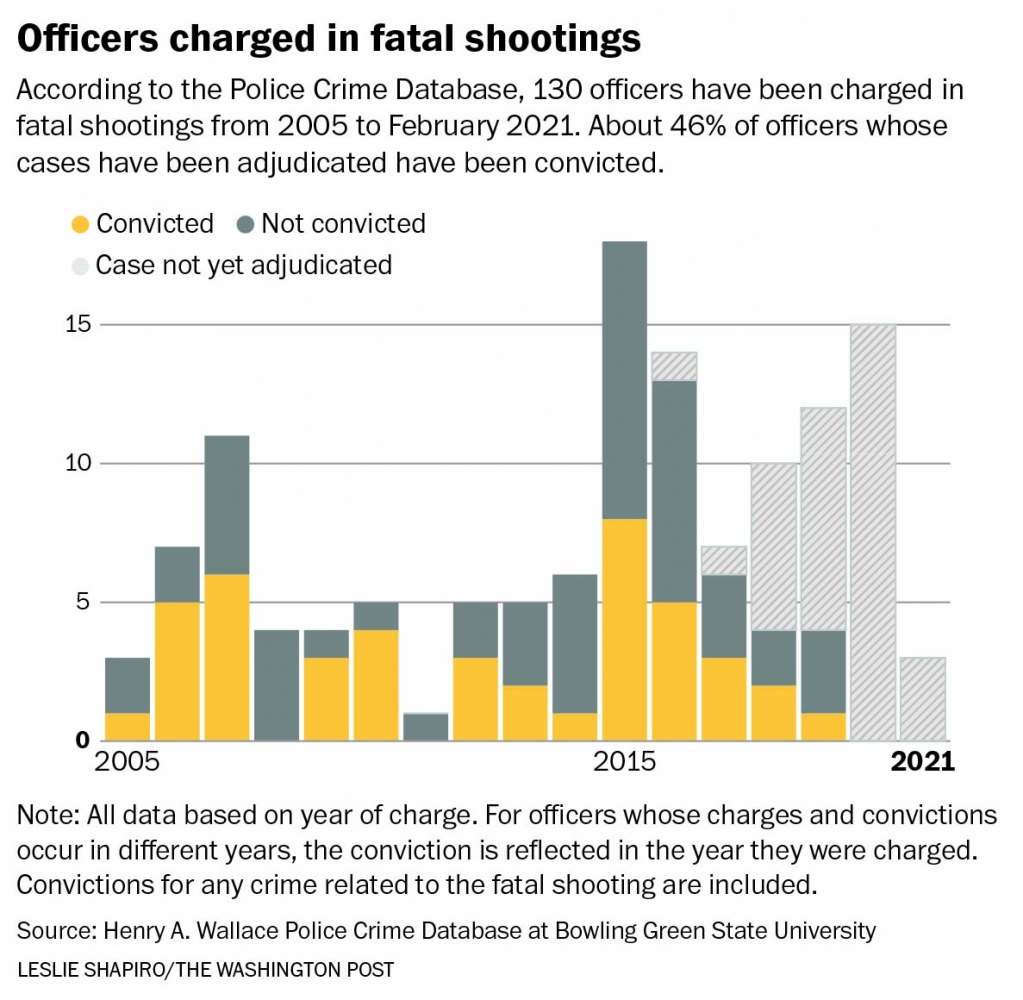
Police shoot and kill about 1,000 people a year, according to The Washington Post’s database tracking such cases. Most of these people are armed, and most of the shootings are deemed justified. When police are charged in fatal shootings, officers are convicted less than half the time, often on lesser charges.
Chauvin’s case is unlike those in key ways, experts say. “It’ll be much harder . . . for Mr. Chauvin to claim the usual justification of self-defense than it is when there are shooting deaths,” said Kate Levine, a professor at Yeshiva University’s Benjamin N. Cardozo School of Law. “It’s very hard for him to say, ‘I was in fear for my life when I knelt on this man’s neck.’ “
When police shoot and kill someone, the officers’ descriptions of what they saw and felt – and accounts of the danger facing them or someone else – can be a major part of the defense, experts say.
“In many of the shooting cases, the officer will say, ‘I perceived a threat in the form of reaching for a gun, or an aggressive move towards me,’ ” said Rachel Harmon, a law professor at the University of Virginia. “It is difficult for the state to disprove the perception of that threat.”
In this case, Harmon said, “there’s not the same kind of ability to claim a perception of a threat.”
Chauvin’s attorney argued in his opening statement that the officers charged in Floyd’s death felt the “growing crowd” at the scene was threatening. But Chauvin’s core defense, as presented in legal filings and his attorney’s remarks in court, appears to be focused on something else: making a case that he did not actually kill Floyd.
In court filings, Chauvin’s attorneys noted Floyd’s health issues and said he “most likely died from an opioid overdose,” trying to break the chain of causation between Chauvin’s knee and Floyd’s death. Medical experts have said say they disagree with the defense’s argument.
Debates over causation have come up in other cases not involving gunfire, including when people die behind bars or after being shocked by stun guns, said Craig Futterman, a University of Chicago law professor and director of the Civil Rights and Police Accountability Project. In those cases, he said, the argument is often made that “other contributing factors,” such as drugs in someone’s system, played a role.
The invocations of Floyd’s drug use in Chauvin’s trial also echo previous cases in another way, Futterman said.
“One of the standard strategies in the playbook that I’ve seen, when police officers are accused of misconduct, are charged with killing someone, is putting the victim and the victim’s character on trial,” he said.
But it’s unclear how that might play out in an evolving environment, in which attitudes on how police use force have changed, Harmon said.
“One of the things that’s really shifted in the public debate over use of force is that many people think that there’s too much force even against people who committed crimes, and may use drugs, and may have problems in their lives,” Harmon said. “The public tolerance for the argument that the victim of misconduct or victim of police use of force has done something wrong is less broad than it once was.”
Another key shift observers said may affect these cases is the changing way people may view police officers.
Juries have typically been inclined to trust officers, who come to court with no criminal record and with experience in testifying, experts and attorneys said. But, they said, recent years of repeated viral videos of police shootings and other uses of force may have chipped away at that perception.
The wave of protests that followed Floyd’s death last year was accompanied by a decline in public approval of police, and last fall voters in several places approved more scrutiny and oversight for police in their communities.
“It’s not an easy place to be in a position where you’re defending police officers who are charged these days,” said Bruntrager, the defense attorney who represented former officer Jason Stockley in St. Louis and former officer Darren Wilson in Ferguson, Mo.
Wilson’s fatal shooting of Michael Brown, a Black 18-year-old, fueled widespread unrest in 2014 and helped lead to a years-long nationwide focus on how police use force. Before then, Bruntrager said, if police “had any kind of credible defense, people wanted to believe that . . . police were following the law.”
“Now it is the reverse,” he said. “Now it is a situation where you start out with the idea where people believe police officers are violating the trust.”
But prosecutors still worry about persuading juries to convict on the most serious charges.
When Joseph McMahon, a former Kane County, Ill., state’s attorney, was preparing to try a Chicago police officer on murder charges, his team contacted other prosecutors who had charged officers – often unsuccessfully.
These prosecutors had spoken to the juries after their cases. Again and again, McMahon said, they reported hearing the same message about the officers from jurors: ” ‘We were convinced what he did was wrong. But we weren’t convinced what he did was murder.’ “
McMahon and his team were preparing a case against Jason Van Dyke, who fatally shot Laquan McDonald, a Black 17-year-old. Video footage of the shooting, which showed the officer firing 16 shots at the teenager, set off unrest when it was released in 2015. Van Dyke was charged with murder the same day the video was released.
After speaking to other prosecutors who said jurors in their cases could not bring themselves to convict the officers of murder, McMahon said he had Van Dyke charged with another 16 counts of aggravated battery, one for each gunshot.
“I didn’t want my jury to be faced with an all or nothing decision,” said McMahon, who was named special prosecutor in the case.
If the only option facing jurors involved the word “murder” in it, McMahon said, he was worried one or two jurors might be unwilling to sign off on it. Jurors get instructions about the legal definitions of specific crimes, he said, but people might still walk in with preconceived notions of what murder is and not think an officer’s actions fit the bill.
It wound up being unnecessary, he said. The jury convicted Van Dyke on all counts in 2018, including second-degree murder.
Chauvin, who was fired after Floyd’s death, is charged with second-degree murder and second-degree manslaughter in Floyd’s death, and the judge in the case reinstated a third-degree-murder charge during jury selection.
Attorneys representing police in controversial use-of-force cases have defended them by saying that they can use force and often have to make split-second decisions in tense, potentially dangerous moments.
Police officers are only human and can get “scared like everyone else” during stressful situations, said Dan Herbert, the Chicago attorney who represented Van Dyke. “The fact of the matter is that the law recognizes that police are allowed to use force, including deadly force, in a number of situations,” he said.
Eric Nelson, Chauvin’s attorney, invoked this argument during his opening statement when he called police uses of force “not attractive” but sometimes necessary.
Herbert said it is “probably naive” for the defense in Chauvin’s case to hope it can persuade a dozen jurors to vote to acquit.
Instead, Herbert said, Chauvin’s defense probably will aim to “pick off one or two of those jurors and possibly hang the case” by having the jury deadlock. The defense’s best chance heading into the trial, he said, probably was its attempt to break the chain of causation and argue that Chauvin did not kill Floyd.
Prosecutors sought to fight the defense’s claims of an overdose by having Floyd’s girlfriend testify about his struggles with substance abuse, a testimony aimed at establishing his tolerance for opioids.
The defense’s argument on that front could appeal to someone inclined to blame Floyd, rather than the police, for what happened, said Harris, the law professor at the University of Pittsburgh. Chauvin’s team does not have much else to work with, he added.
But while the prosecution must persuade every juror to vote to convict him, the defense just needs “one juror who feels a little funny about convicting a police officer,” Harris said.
“You have the law leaning in the direction of, give police the benefit of the doubt,” he said. “That seems a difficult thing to do with this video. But if somebody had that inclination, deep down, here’s your way to exercise it.”
While Asia wants a baby boom, Indonesia says enough Is enough
InternationalApr 05. 2021A closed store at Tanah Abang market in Jakarta in August 2020. MUST CREDIT: Bloomberg photo by Dimas Ardian
By Syndication Washington Post, Bloomberg · Claire Jiao, Grace Sihombing, Michelle Jamrisko
Countries across Asia are trying everything from fertility tours to baby bonuses to spur population growth in an aging world. Not so in Indonesia, where officials are trying to convince people to have fewer children.
The world’s fourth most-populous country is promoting later marriages, family planning and contraception to lower its fertility rate to 2.1 children per woman by 2025. That’s the “replacement rate” that would effectively flatten population growth in the country of 270 million, damping some concerns that overcrowding could mean fewer job opportunities and strains on government services.
Indonesia’s latest push – a family planning campaign starting from late January – follows a decades-long struggle to bring the fertility rate down from 3 children per woman in the early 1990s. The difference now, National Population and Family Planning Agency Head Hasto Wardoyo says, is that instead of just slowing population growth, Indonesia is aiming to simultaneously improve other factors such as health, education and employment.
“In the past, the focus was on reducing the quantity of the population. Now it’s more on improving the quality of the population,” Wardoyo said. “The quality and productivity of human resources must be improved because we’re currently in a demographic dividend period. If not utilized, the demographic bonus can actually become a burden for development, rather than development capital.”
That might appear to be a risky venture for an emerging market, especially one that has lured investors with its youthful demographics and cheap labor. China famously has found it’s a struggle to reset the habits of families who for decades were restricted to one child. And development economists generally advise that overpopulation tends to resolve itself as a country climbs the income ladder, making counter-efforts unnecessary.
Indonesia is saying it can’t afford to wait, especially as it’s bracing in the short term for potentially more pregnancies and less contraceptive use amid the pandemic’s stay-at-home orders.
Like many of her friends and relatives, Yulia Purnamasari said she got pregnant right after getting married in 2018. But when she and her husband realized the time and money needed to raise a child, they delayed having another baby so they could save up for a few years.
“We think it’s a plan that fits with our capacity with time, energy and money,” the 29-year-old working mother said. “We want to be able to provide our children with our maximum attention, care and education.”
Purnamasari said she didn’t know about family planning or how to access counseling where she lives on Lombok island in eastern Indonesia. Luckily, a local midwife was able to give her advice on contraception and installed an intrauterine device.
But Purnamasari still sees herself as an exception.
“My sister, for example, doesn’t do family planning and doesn’t use contraceptives regularly,” Purnamasari said. “If she gets pregnant out of plan, she just sees it as a blessing.”
The government’s campaign to make Purnamasari less of an exception, along with emphasizing a more digital-ready workforce, seems to be winning over analysts and investors.
The drive to develop human capital “aligns with broader strategies to move Indonesia up the industrial value chain in areas like electric vehicles and downstream processing, as well as accelerating growth in what is already Asean’s largest digital economy,” said Patrick Cooke, a managing editor of research firm Oxford Business Group, referring to a group of Southeast Asian nations. “On balance, I believe investors would be happier with rising prosperity and skill levels in Indonesia rather than an ever-rising population.”
Given the size of Indonesia’s population, even a modestly higher-than-average fertility rate can balloon the numbers. At its current pace of 2.3 children per woman, Indonesia will add 30 million people in the next decade – an increment that dwarfs the total population of Australia, United Nations projections show.
The new population strategy would be a fundamental reworking of the growth model that has Indonesia on course to be one of the world’s five largest economies by 2030, overtaking the likes of Germany, Japan, Russia and Brazil, according to Standard Chartered projections from 2019 using purchasing power parity exchange rates and nominal GDP. The country has long banked on its huge domestic market for consumption, while its abundant cheap labor has propped up sectors like manufacturing, mining and agriculture.
Indonesia’s efforts contrast with regional neighbors, especially in rapidly aging Thailand and Singapore.
In Thailand, the government has embarked on a long-term campaign to avoid being a rare economy that grows old before it grows rich. The central bank has warned repeatedly that Thailand could be the first developing country to become an “aged society” by next year, and is pushing to raise the retirement age, support reverse mortgages for the elderly and give employers incentives to hire workers older than 60.
Singapore has offered to increase cash support for citizens who have kids amid reports that many could delay parenthood due to job losses and wage cuts during the pandemic. The number of marriages in the city-state fell about 10% last year.
“To secure our future, we must make our own babies, enough of them,” Singaporean Prime Minister Lee Hsien Loong said in 2019.
As Indonesia embarks on the opposite course and seeks to change attitudes, it also faces the challenge of adapting to a higher-income economy.
Despite graduating to upper-middle income status last year, Indonesia lags countries in the Organisation for Economic Cooperation and Development – a group of richer nations, where it’s a “key partner” rather than a member – across a range of development indicators like health care spending, youth employment, tertiary educational attainment and life expectancy.
The pandemic has aggravated the situation, especially as Indonesia battles Southeast Asia’s worst coronavirus outbreak. The OECD warns of “severe” social fallout even if the economy returns to growth, as shrinking job opportunities threaten to swell the ranks of the poor to 36 million.
“Even without a pandemic, Indonesia’s job market is already quite tight with around 2.5 million new entrants to the workforce each year,” said Turro Wongkaren, director at the University of Indonesia’s Institute of Demography. If the government can’t keep people healthy, educated and employed, its “demographic bonus” can just as easily become a “demographic disaster,” he said.
Bringing down the fertility rate is a long and gradual process, according to Satyawanti Mashudi, a commissioner with the National Commission on Violence Against Women. It took the country more than two decades to lower the fertility rate from around 3 children per woman in 1991 to 2.4 in 2017, she said.
“As populations get wealthier they tend to have less kids, as they don’t rely on them when they are older and it becomes more expensive for education and other needs,” said Joshua Crabb, a senior money manager at Robeco in Hong Kong. “This is indicative of a growing middle class and a focus on the quality of life. Either way, it will be many years before that would impact the demographics of Indonesia, which is still very young.”
There are also deeply ingrained cultural and religious values at play. The predominantly Muslim nation has tight-knit extended families, and having more children is considered to bring more blessings from God, Mashudi said. Even when women are open to contraception, their husbands and relatives may not be supportive, she said.
The government also will have to confront a more-is-more mindset among Indonesian families, especially those in the provinces that still consider children as potential human capital for their businesses, Mashudi said.
“I once talked to a person in Kalimantan island about family planning and they said, ‘Why should I have fewer children? My family still has this large plot of land, so why should we have a small family?'”
Some say Indonesia may not have to do much at all. Fertility rates are falling across the world, although the pace is slower in Indonesia.
Potent socioeconomic forces such as rapid urbanization, rising incomes, and improving female education and labor participation are giving rise to smaller families, Asian Development Bank principal economist Donghyun Park said.
Indonesia would do well to prepare for the shift and invest in improving the productivity and innovation of its human capital, especially amid its “gaping shortage” of technical and professional skills, Park said.
Years of inadequate investment in education have led to a deficit of 1.3 million high-skilled workers in 2020, OECD data showed. The gap is estimated to grow to 3.8 million by 2030, equivalent to one-third of the high-skilled workforce.
ADB’s Park said Indonesia eventually will need to shift away from a growth paradigm of low-wage employment toward one geared for a higher-value knowledge economy.
“In short, Indonesia’s future growth model envisions better workers instead of more workers,” Park said.
World’s biggest wind farm may be answer to South Korea’s net-zero dream
InternationalApr 05. 2021Wind turbines manufactured by Doosan Heavy Industries & Construction Co. and the offshore substation stand at the Korea Offshore Wind Power wind farm in Buan, South Korea, on Thursday, March 25, 2021. MUST CREDIT: Bloomberg photo by SeongJoon Cho.
By Syndication Washington Post, Bloomberg · Heesu Lee, Will Mathis
The fishing grounds where Jung Kuenbae and his forbears have caught shrimp, butterfish and croakers for three generations are going to be turned into the world’s largest offshore wind farm. He’s okay with that.
“I initially opposed the idea when the plan was proposed because it will destroy our livelihood,” said Jung, who leads a group of local fishermen in some 200 ships that drop nets in the waters off the southwestern tip of the Korean peninsula. “But I realized the project is part of the country’s transition to cleaner energy, which is something we have to come to terms with, rather than fighting against it.”
The 48.5 trillion won ($42.8 billion) wind farm, to be built over the next decade off the southwest coast of the country, would generate up to 8.2 gigawatts of power, one of a catalog of grand projects the government wants to roll out with private sector backing to meet its ambition of becoming carbon neutral by 2050.
It’s a momentous challenge. South Korea’s industrial ascent since the 1960s has made it one of the world’s top 10 energy users, with electricity consumption per capita ahead of both Japan and Germany. And two thirds of that comes from fossil fuels. Renewable energy accounted for only 6.5% of South Korea’s generation in 2019, with nuclear making up the balance.
“South Korea will have to source almost all of its electricity from renewable energy if it’s ever going to reach climate neutrality by 2050,” said Lee Sanghoon, president of the New and Renewable Energy Center at Korea Energy Agency. It “is a daunting task.”
Many countries are scaling up wind energy. Developers set a record last year as they installed 96.3 gigawatts of wind turbines globally, according to clean energy research group BloombergNEF. That would be enough to power about 36 million American households. The International Energy Agency estimates that at least 160 gigawatts of wind has to be added per year by 2025 in order to meet the Paris Agreement’s goals.
After retaining power last year on the promise of a “Green New Deal,” President Moon Jae-in’s Democratic Party has brought a new urgency to the transition, with a proposal to get more than 20% of its energy from renewables by 2030. For South Korea, it’s not just about curbing emissions. Apart from a tiny amount of gas and coal, all its fossil fuels are imported, costing the nation $73 billion a year.
With its conventional hydropower resources almost fully utilized and a climate and topography ill-suited for large solar and onshore wind plants, the country is looking out to sea to solve the problem. It already has the world’s biggest tidal power plant at Sihwa Lake. But the government sees one of its best prospects is to harness 12 GW from offshore wind by 2030, compared with less than 0.2 GW now.
The open seas have more consistent wind speeds and provide space to install the biggest, most efficient turbines. Just by using sites in shallow water that are near to shore, the world could get enough electricity to meet all global demand. With floating turbines that go further out to sea, wind power could satisfy more than 10 times the world’s total electricity demand by 2040, an IEA analysis showed.
So far countries in northern Europe such as the U.K., Denmark and Germany have dominated the offshore wind industry, thanks to generous government subsidies and unusually shallow waters of the North Sea. But that’s starting to change. Last year China installed a record-number of offshore wind turbines to become the world leader in total capacity. U.S. President Joe Biden’s administration plans to rapidly scale up wind farms off the east coast.
About 80 miles from the Korean island of Shinan, where the fisherman Jung lives, maintenance workers in helmets and orange life jackets climb a 200 meter-tall tower at the nation’s biggest existing commercial offshore wind farm, 30 minutes by boat from the port of Buan. The project’s 60 MW capacity is less than 1% of the proposed new wind farm in Shinan.
The complex, in the Southwest Sea, will be expanded to 2.46 GW after 2027, according to Korea Offshore Wind Power Corp., a special purpose company formed by state-run Korea Electric Power Corp. and six other generators.
One of the major challenges to achieving these goals is local opposition. A BloombergNEF report in September predicted that South Korea could fall short of the government’s target wind power by 4.6 GW, mainly due to “severe opposition” from local residents.
To ease conflict with the community, the Shinan government in 2018 passed rules allowing them to acquire a 30% stake in local renewable energy projects. That will provide a windfall for residents of six of the islands in the archipelago this month when last year’s profits from two solar plants are distributed.
“Renewable energy will become a stable source of income for Shinan residents, who are mostly in their 70s and 80s,” said Kim Jung Dae, a 63-year-old farmer who represents a group of local residents. “I wouldn’t be surprised if Shinan became the most well-off island in the country.”
There are other challenges. Wind power in South Korea currently costs about $220 per megawatt hour, according to IHS Markit, among the highest in the world.
“You’d need the wind to blow at 13 meters per second all day every day to run at full capacity of 8.2 gigawatts, which is impossible,” said Joo Han Gyu, a professor at Seoul National University’s department of nuclear engineering. “The economics of these wind turbines make no sense and the increased cost will eventually fall upon individuals.”
South Korea’s wind ambitions also rely on a sustained effort from dozens of private companies. The Shinan wind project, for example, is composed of about 20 separate ventures by corporations including SK E&S Co. and Hanwha Engineering & Construction. That means plans could get scrapped or modified as each company goes through the long process of obtaining permits and calculating costs.
To help accelerate installations, a “one-stop shop” bill will be proposed in the first half of this year that will allow the government to take the helm in exploring potential offshore sites and getting required permits, said Yoon Sunghyuk, a director of the renewable energy division at the Ministry of Trade, Industry and Energy.
One answer may be to develop floating plants that can be moored further out than fixed turbines, which are limited to shallow water, said Lee from the Korea Energy Agency. Several such projects are planned by companies including Korea National Oil Corp. and Equinor ASA, which aim to jointly construct a 200-megawatt complex in the East Sea near Ulsan.
For Jung, sitting in his office in Mokpo, the country’s interest in offshore wind has led him to see the energy transition as an opportunity, rather than the end of his career.
“No one knows the sea here better than us. I’m sure there will be plenty of work we can do,” Jung said. “If you can’t turn the tide, it’s better to embrace the flow.”
By The Washington Post · Amy Goldstein, Jon Swaine, Christopher Rowland
WASHINGTON – The Biden administration said Sunday that the country will have sufficient coronavirus vaccine supply to meet the president’s goal of enabling every adult in the United States to get immunized by the end of May, despite the contamination of millions of doses at a troubled Baltimore manufacturing facility.
A senior administration official, who spoke on the condition of anonymity to discuss the sensitive matter, said health officials had negotiated for more than a week for an arrangement, announced late Saturday, under which Johnson & Johnson would take over responsibility for manufacturing at the plant. Johnson & Johnson developed one of the two coronavirus vaccines being made at the Baltimore facility where the cross-contamination occurred.
Federal officials were working over the weekend to pin down another U.S. site where the other vaccine produced in the facility – developed by AstraZeneca – could be manufactured and have identified potential locations.
Meanwhile, the company that owns the plant, Emergent BioSolutions, may be allowed to retain some of its employees in making the Johnson & Johnson vaccine, as long as it relinquishes all control of the manufacturing and quality inspections, the official said. Emergent Biosolutions is a major government contractor.
The developments followed the news that a batch amounting to 15 million doses of Johnson & Johnson’s vaccine was spoiled at the Emergent plant after being contaminated with ingredients for AstraZeneca’s vaccine.
The error was caught, and no contaminated vaccine left the plant, according to the companies involved. No doses had shipped, because the plant has not yet been certified by the Food and Drug Administration as a manufacturer of coronavirus vaccine.
When President Joe Biden took office in January, his administration inherited a scarcity of the two vaccines that the FDA had by then authorized for emergency use against the novel coronavirus, which can cause the illness covid-19. Those vaccines were developed by Pfizer-BioNTech and Moderna. Johnson & Johnson’s was authorized in late February.
The president and his aides have prioritized increasing vaccine supplies. A month ago, Biden pledged that stepped-up vaccine manufacturing would lead to enough doses for every adult who wanted one by the end of May.
On Sunday, the senior official said that, no matter what happens with the Baltimore plant or the manufacturing of AstraZeneca vaccine, which is not authorized for U.S. use, “there is enough vaccine for all adult Americans who want it by May 31.”
Federal rules specify that “live vector” vaccines should not be made at the same facility, but the official said it had been ambiguous whether the rule applies to the type of vaccines developed by Johnson & Johnson and by AstraZeneca, or whether two vaccines could be made in separate areas of a plant. “They proved they can’t,” the official said.
That official and two other administration officials who also spoke on the condition of anonymity to discuss the sensitive situation said that, in deciding which vaccine should continue at the Emergent facility, the Department of Health and Human Services chose to keep Johnson & Johnson because those shots could be used in the United States if the FDA certifies the plant for that use.
According to the officials, the Biden administration negotiated a path out of the plant’s contamination troubles without explicitly invoking the Defense Production Act, a 1950s-era law that has been used to accelerate vaccine-making material and other coronavirus-fighting supplies.
Johnson & Johnson said in a statement Saturday that it “is adding dedicated leaders for operations and quality, and significantly increasing the number of manufacturing, quality and technical operations personnel to work with the company specialists already at Emergent.”
The company said it expects to deliver 100 million doses of its single-shot vaccine to the U.S. government by the end of May.
Emergent spokeswoman Nina DeLorenzo said the company intends to stop making the AstraZeneca vaccine in the next few days.
AstraZeneca said in a statement that it is working with the federal government “to support agreed-upon plans for the development, production and full delivery of the vaccine.”
AstraZeneca did not say how much its departure from the Emergent plant could set back its manufacturing timeline in the United States. It has taken other manufacturers six months or more to ramp up new supply of coronavirus vaccine lines.
Unrelated to the contamination by Emergent employees, AstraZeneca already has been beset by problems with clinical trials, controversy over reporting of its data, and concerns in Europe about blood clots showing up as a rare side effect. In May 2020, the company predicted that it would begin delivering the first of 300 million doses of its vaccine for the United States in the fall, but it did not meet that promise, nor has the FDA authorized it for emergency use.
For Emergent to spoil raw vaccine substance amounting to 15 million doses suggests a breakdown in quality control at early stages of manufacturing that should have been caught in subsequent steps, said John Avellanet, an FDA compliance expert who is managing director at Cerulean Associates, a pharmaceutical consulting firm.
If contamination had been detected earlier in the process, he said, it probably would have affected far less product. Johnson & Johnson had said last year that Emergent would be making vaccine in single-use, 1,000-liter bioreactor bags. The magnitude of this incident indicates that more than one bag’s product was probably affected, Avellanet said, adding that it was highly unusual for so much vaccine substance to be ruined in one incident.
“This kind of thing just does not happen,” Avallenet said.
The changes in vaccine production at the plant were first reported Saturday by The New York Times.
The Washington Post reported last week that an FDA investigator flagged problems at the Baltimore facility six weeks before the Trump administration announced a $628 million deal with Emergent as part of Operation Warp Speed, the government’s program at the time to develop and produce vaccines to fight the novel coronavirus.
Emergent secured deals totaling more than $740 million with Johnson & Johnson and AstraZeneca to produce vaccines for both companies at the Baltimore site.
The Post reported last year that Emergent had benefited from billions of dollars in federal contracts as health officials directed public spending toward the threat of bioterrorism attacks at the expense of some preparations for a pandemic.
Emergent’s Warp Speed deal was made as part of a long-standing contract between the company and the agency within the Department of Health and Human Services responsible for preparing for public health threats.
At the time of the award, that agency was led by Assistant Secretary Robert Kadlec. The Post previously reported that before joining the Trump administration, Kadlec was paid as a consultant to Emergent and formed a start-up company with Emergent’s chairman. Kadlec did not mention either role in a questionnaire about his career that he completed for the Senate when it considered his nomination by Trump in 2017. Kadlec and Emergent previously told The Post that Kadlec’s past work for Emergent had no bearing on the firm’s government contracts.
By Syndication Washington Post, Bloomberg · Thuy Ong
Australia says it has given nearly 80,000 people a virus vaccination to set a new single-day high, boosted by strong stockpiles.
A record 79,283 people received an initial dose on Thursday, the latest day that such data is available, Health Minister Greg Hunt told a press briefing on Sunday.
“The supply at this stage is looking strong,” he said. “Given the great and enormous global competition, the fact we have this domestic supply is fundamental.”
Australia has nearly eliminated local transmissions by closing its international border to non-residents, but occasional cases have leaked into the community from quarantine hotels where returned overseas travelers must isolate for 14 days. States have imposed several snap lockdowns in recent months to contain clusters.
Australia has met its principal targets for vaccination start dates, Hunt added, and wants to see everyone who wants a shot getting an initial dose by the end of October. More than 841,000 vaccinations have been completed across Australia as of Saturday evening, he added.
The government is behind on its vaccine rollout plans, Mark Butler of the opposition Australian Labor Party said Sunday. Prime Minister Scott Morrison had promised 4 million doses would be given by the end of March, Butler said.
Australian authorities said on Saturday they were working with the European Union and the U.K. to investigate the first local case of an unusual clotting in a patient after receiving the AstraZeneca Plc vaccine.

 เมื่อพระอนุชาต่างมารดาของกษัตริย์จอร์แดนถูกกล่าวหาว่าวางแผนโค่นราชบัลลังก์และคุกคามความมั่นคงของประเทศโดยสมคบคิดกับกองกำลังต่างชาติ
 การเชือดฟินเทคอาจมีสาเหตุมาจากความกังวลของรัฐบาลเรื่องการปล่อยสินเชื่อง่ายเกินไป จนอาจทำให้เกิดหนี้เสียและภาวะฟองสบู่แตก
 หนึ่งในผู้บุกเบิกแอนดรอยด์หลายมาเป็นบริษัทใหญ่รายแรกที่ต้องเลิกผลิตสมาร์ทโฟน
 ยอดติดโควิด-19 ของจีนสูงสุดในรอบ 2 เดือน โดยเฉพาะที่เมืองชายแดนเมียนมา
 ตลาดจีนกำลังจะเป็นผู้ช่วยให้อุตสาหกรรมรถยนต์รอดจากวิกฤตได้หรือไม่? การเดิมพันของ Tesla อาจมีคำตอบ
 Thousands of people protest the death of George Floyd in Minneapolis on June 5, 2020. MUST CREDIT: Washington Post photo by Salwan Georges

 A closed store at Tanah Abang market in Jakarta in August 2020. MUST CREDIT: Bloomberg photo by Dimas Ardian
 Wind turbines manufactured by Doosan Heavy Industries & Construction Co. and the offshore substation stand at the Korea Offshore Wind Power wind farm in Buan, South Korea, on Thursday, March 25, 2021. MUST CREDIT: Bloomberg photo by SeongJoon Cho.