เช่นเดียวกับชาวกัมพูชาบางส่วนที่ไม่ต้องการให้มีการก่อสร้าง โดย Leng Chentha ชาวกัมพูชาในกรุงพนมเปญเผยกับ Radio Free Asia ว่า ไม่สนับสนุนการก่อสร้างหากสวนสนุกทำลายความงดงามของนครวัด
Billions in damage across the South prompts focus on who’s to blame, and who will pay
InternationalFeb 20. 2021With their power out since Monday morning, Evelyn Hernandez, 15, and her sister, Daeslyn, 1, use a samping stove on their family’s front porch in Houston to keep warm. Photo by Callaghan O’Hare for The Washington Post
By The Washington Post, Sofia Sokolove, Emily Wax-Thibodeaux, Mark Berman, and Griff Witte
AUSTIN, Texas – Millions of people across a storm-scarred South were bracing for one last night of extreme cold Friday following a devastating week in which dozens of people died, homes and businesses sustained billions of dollars in damage and basic services such as power and water catastrophically failed.
The reckoning over why – and who is to blame – was intensifying Friday, even as residents were still coming to grips with the scale of destruction. Across the region, homeowners who had fled frigid, energy-starved houses or apartments were returning after the lights finally switched back on. But once there, they discovered burst pipes, flooded floors, collapsed ceilings – and no water to drink.
In Texas, the epicenter of the disaster, more than 14 million people in 160 counties were still experiencing water-service disruptions, with impacts also being felt in Mississippi, Louisiana, Tennessee and beyond.
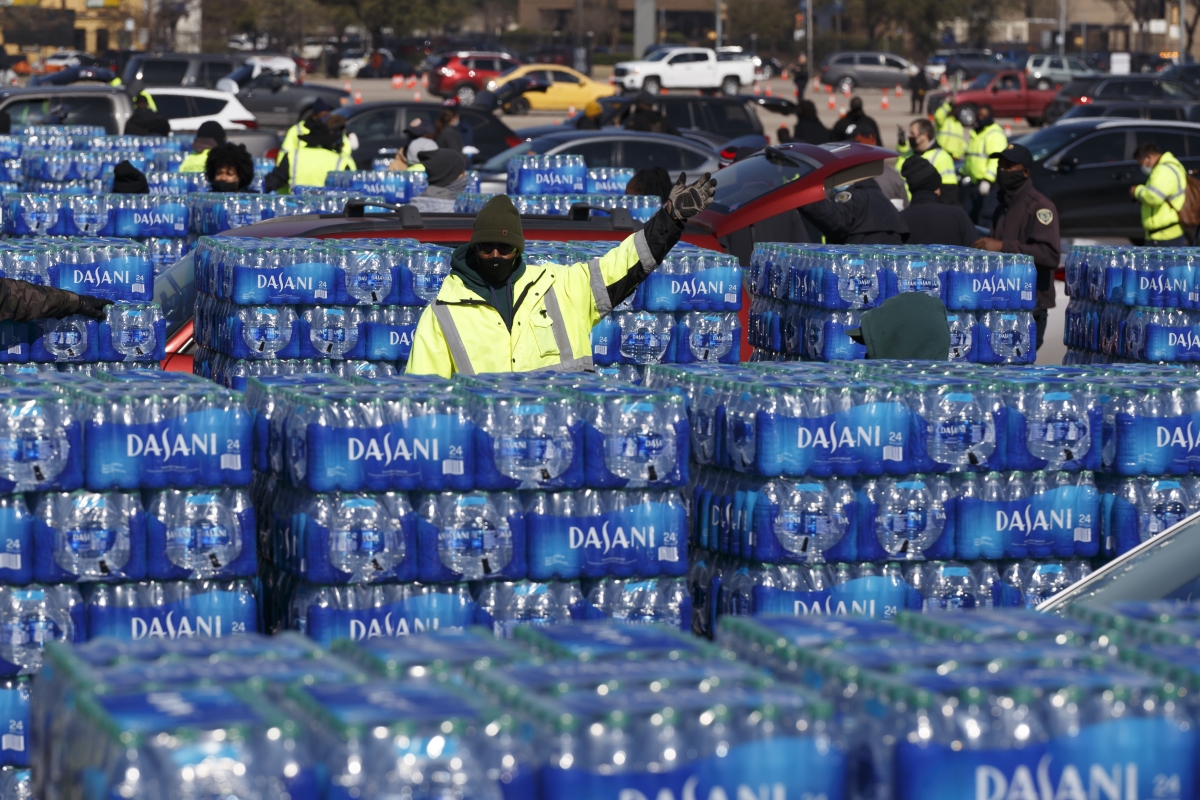
Houston, the nation’s fourth-largest city, was under a boil-water advisory. In Austin, Texas’s capital, much of the city was without running water, and officials could not say Friday when it might return. Bottled water had been stripped from the shelves of minimarts and gas stations, and lines were wrapped around some supermarkets, which were imposing purchase limits as residents scrambled for food.
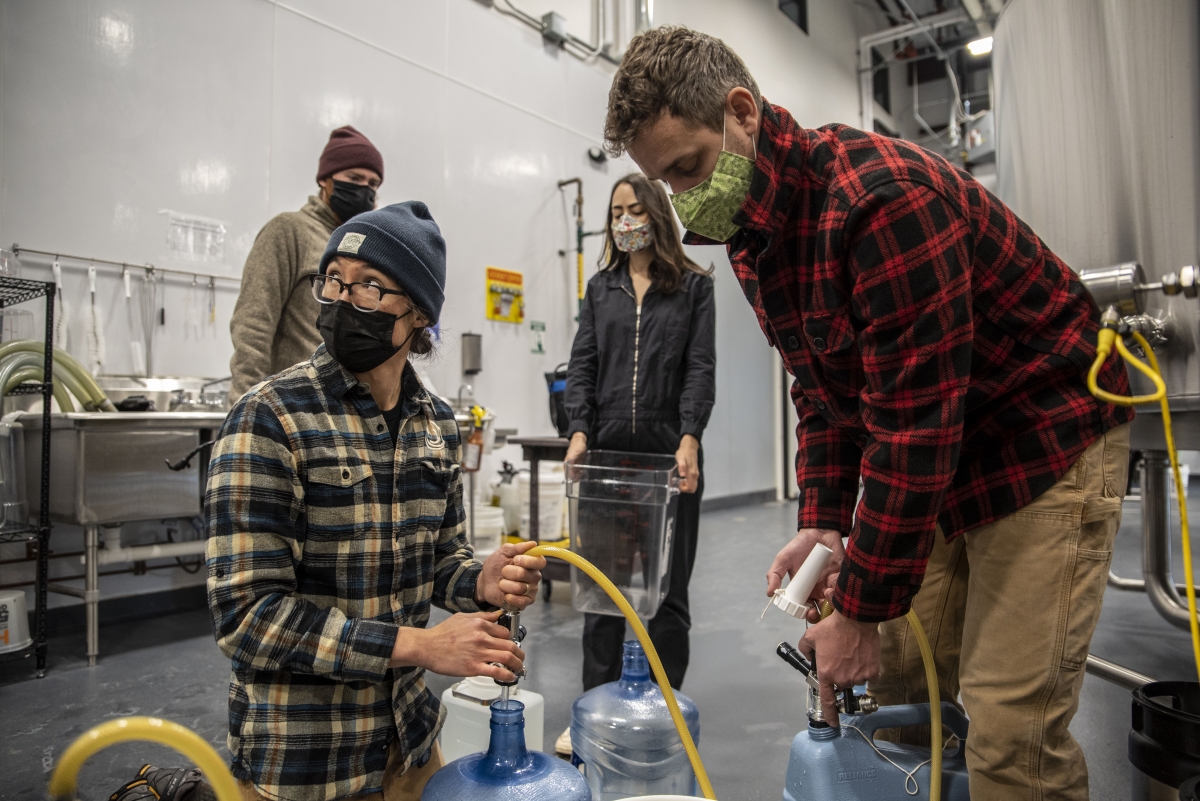
Will Jaquiss and Nao Ohdera fill containers with water for residents at Meanwhile Brewing Co. in Austin on Friday. Photo by Sergio Flores for The Washington Post
“We know that it’s intolerable,” said Texas Gov. Greg Abbott, a Republican, during a Friday afternoon news conference.
With a long recovery ahead, the focus was rapidly shifting to who would pay. The Insurance Council of Texas, an organization that represents the state’s home, auto, renters and business insurance agents, said the storm would be the “largest insurance claim event in [Texas] history,” with hundreds of thousands of claims expected.
“We are used to our storms in Texas with tornadoes, hurricanes and hail,” said Camille Garcia, communications director for the council. “But those hit smaller areas. This winter event reached every part of Texas.”
Some of the costs of recovery will be handled by the federal government. President Joe Biden said Friday he plans to sign a major disaster declaration for Texas, freeing up funds that can be tapped by individuals who have been impacted, as well as by the state and local governments.
Attention was also shifting Friday to whether the scale of the disaster could have been avoided. Congress is likely to open an investigation next week into what went wrong in Texas, and the state’s legislature is expected to conduct its own hearings.
Abbott, Texas’s governor, has consistently blamed the state’s electric grid operator for a lack of preparation and has called on its leadership to resign.
But the operator – the Electric Reliability Council of Texas (ERCOT) – said Friday that it had little control over the power suppliers and could not force them to better prepare for extreme cold.
“We don’t own the generation units. We don’t own the transmission,” said ERCOT chief executive Bill Magness in a video call with journalists. “It’s not really our role to do winterization.”
Independent authorities said it is up to the Public Utility Commission of Texas – which oversees ERCOT – to mandate that suppliers better prepare for extreme cold and penalize those that choose not to do so. Without such costs, experts said, the power suppliers will continue to neglect preparations, with predictable consequences.
“To save millions of dollars, the generators failed to weatherize, and the consequences are that people have died and it’s cost the state many billions of dollars in repairs to our homes and our buildings,” said Tom “Smitty” Smith, the former longtime director of the Texas office of Public Citizen.
The exact scale of the damage was still becoming clear on Friday. Karen Clark, co-founder and chief executive of Karen Clark and Company, a catastrophe modeling firm, said the bout of winter weather could cost $18 billion in insured losses, with the total economic damage likely to be higher. The damage was spread across 20 states, though most was in Texas.
Beyond the financial toll, there was the human one: The storms have killed at least 48 people since Sunday – including 30 in Texas, according to data compiled by The Washington Post.
Still, there were signs Friday that a halting recovery had begun. Millions of people who had lost power earlier this week had it restored by Friday, with ERCOT declaring in the morning that “operations have returned to normal” after days of rotating outages. Across Texas, Louisiana and Mississippi, the number of customers without electricity was down to about 300,000 as of Friday afternoon.
Houston city workers direct lines of cars waiting to receive bottled water at a high school sports complex. Houston, the nation’s fourth-largest city, was under a boil-water advisory Friday, as more than 14 million Texans were still experiencing water-service disruptions. Photo by Michael Stravato for The Washington Post
And after repeated blasts of Arctic wind – including one more moving in Friday night – the weather finally appeared poised to offer a respite, with temperatures forecast to climb Saturday and stay higher into next week.
But even with the thaw, peril lurked: The dramatic uptick in temperatures was expected to lead to potholes – and more burst pipes.
That’s damage the region can ill afford.
In Louisiana, Gov. John Bel Edwards, a Democrat, said Friday that authorities are “having to deliver bulk and bottled water to a big part of the state today” after nearly a million people were left without access to clean drinking water Thursday.
Edwards, who spoke during a Washington Post Live event, said temperatures were expected to hit record lows again late Friday, before several days of warming that he hoped would provide utility companies and authorities the opportunity to make extensive repairs to the state’s water and energy infrastructure.
Louisiana’s damage has been most extensive in Shreveport, located in the northwest part of the state.
“It’s been a rough one for us,” said Mayor Adrian Perkins, a Democrat, recounting how roughly six inches of sleet and snow made local highways so slick that even National Guard troops and tankers couldn’t reach the city with fresh water until Wednesday night.
Residents with four-wheel-drive trucks helped pull ambulances out of ditches. Area oil and gas companies supplied some “gray water” to hospitals for heating systems.
Power outages also continued to plague Mississippi on Friday, with one utility warning residents that it could take a few days for all the lights to come back on.
In downtown Tulsa, where hundreds of pipes had burst, the Chalkboard was hit with massive damage. Shannon Garner, who has owned the restaurant with her brother for nearly a decade, said she was still feeling shock and disbelief.
“The fire suppression system sprinklers just busted, and it was like it was raining in the kitchen,” she recounted. “We ended up with five inches of water in the dining room, and it went down into our wine cellar.”
The cumulative impact of the week’s power cuts and burst pipes was forcing residents of Austin to take extreme measures, including posting to neighborhood Facebook groups and Slack channels rumors of where food and water could be found.
“It feels like it’s just one thing after another after another,” Austin Mayor Steve Adler, a Democrat, said Friday on NBC’s “Today” show.
By 10 a.m. on Friday, at least 50 people armed with large plastic jugs, empty milk cartons and soda bottles were queued up for drinking water outside Meanwhile Brewery in South Austin, The scene was similar at a Natural Groceries store in north Austin, where people waited with mostly empty carts, holding pots, tea kettles and jugs to fill from the tap of a small sink labeled “kombucha rinse only!”
Brewery owner Will Jaquiss said that after its water was shut off Wednesday evening, the bar decided to give out all the potable water it had on hand, about 3,500 gallons. Staff shared 2,000 gallons on Thursday, including to four hospitals. The rest was swiftly doled out on Friday.
Nina Selzer Bellomio, a 47-year-old graphic designer who lives in northwest Austin with her two teenagers and husband, said she has been “harvesting snow, boiling it and using it to wash dishes. But the problem is we don’t have much food.”
The family moved from Boston in 2009, because her husband got a job in technology. At first, Austin seemed like a dream: cheaper housing, a vibrant counterculture and music scene.
But she said politics and the state’s refusal to better regulate its energy industry had made Texans like her family “feel like we are back in time, doing sponge baths at the sink. Hauling buckets of water. It’s like being a pioneer.”
To Houston resident and real estate agent Zory Calcaben, the week brought the elements indoors.
“I kid you not, the temperature was 22 degrees,” she said. “And we thought we had good insulation.”
The extreme conditions, she said, brought out the best in her neighbors.
“People were calling out for help, and amidst the sleet, the snow, the freezing cold, people were coming and helping each other,” she said.
But Calcaben said the week had also exhibited the worst in politicians and others who are, at least in theory, responsible for protecting the public from the sort of deprivations on display statewide.
“The ones who are supposed to ensure our safety, they seem to get away with everything,” she said.
That sort of anger was widespread in Texas on Friday, and it led some to predict that state leaders will have no choice but to initiate reform.
“Given the magnitude statewide of this crisis, I do think there will be changes,” said Sherri Greenberg, who spent a decade as a Democratic Texas state representative and now teaches at the University of Texas’s public affairs school.
But others were much more skeptical, given that any shift would probably require more aggressive government regulation – and higher upfront costs – in a state whose politics are dominated by conservative Republicans.
“The issue is Texas doesn’t want to spend the money on an expensive weatherization package,” said Jim Krane, an energy studies fellow at Rice University’s Baker Institute. “There is no mandate.”
Even with this week’s disaster, that may not change. Any reports taking stock of what went wrong “are going to arrive when it’s sunny, 87 and lovely,” said Calvin Jillson, a political science professor at Southern Methodist University
“And people are going to say, ‘Wow, that was terrible, but it’s going to be really expensive to deal with that, let’s think this through.’ “
Virginia universities are ramping up testing and at least one is banning in-person gatherings to deal with surging cases of the coronavirus and protect against a more contagious variant that was first detected in the state in late January.
More than 600 students have been sickened this week at the University of Virginia, spurring restrictions that have left the campus divided. And cases at the Virginia Military Institute have been on the rise since early this month.
Schools like George Mason University have also noticed an uptick in cases, and the campus is preparing to ramp up testing – with a goal of testing every student twice a week, said Gregory Washington, the university’s president.
Elsewhere, the number of coronavirus cases have recently been falling across the greater District of Columbia region.
U-Va. officials are blaming widespread incidents of noncompliance for that campus’s spike. But cases began to surge after a weekend of in-person fraternity and sorority recruitment events that U-Va. President Jim Ryan admitted at a town hall on Friday that “perhaps, we should have tried harder to discourage.”
Mitch Rosner, a professor and chair of the Department of Medicine, said about three-quarters of cases reported by the university are among students living off campus, but contact tracing efforts have not linked any cases from the university to the wider Charlottesville community.
A variant first identified in U.K. has thrown another wrench into the university’s ability to control the virus. Rosner said the strain – detected on the campus about a week ago – has not had a major influence so far on the ongoing outbreak.
The university has yet to disclose how many cases of the variant have been identified in the community. Rosner said capacity to sequence the viral genetic material is limited, and officials cannot provide data about how prevalent this variant is on campus at this time.
The surge of cases at U-Va. – including 229 new cases among faculty, staff, students and other employees reported on Tuesday – triggered restrictions designed to curb the virus’ spread. But some students at the university’s town hall questioned the decision to ban in-person gatherings and close essential services, such as the library. Students – particularly those who continue to follow the rules – feel unfairly punished.
“I’m sorry you’ve had to sacrifice and endure so much,” Ryan told students. “The days ahead will test the character of our community and I implore all of you to do the right thing.”
Recent outbreaks have also frustrated students at the Virginia Military Institute, which has 166 active cases, or roughly 10% of the school’s enrollment. Fifty-six cadets have been sickened since Monday.
The Lexington campus started to see a spike in cases around Feb. 2, four days before hosting the annual “Breakout,” a day of grueling military-style exercises after which first-year students – also called “rats” – become recognized as “fourth-class cadets” in the corps.
A cadet, who spoke on the condition of anonymity because of fear of reprisal, said the school’s commandant staff was not rigorously enforcing social distancing rules and mask-wearing at the breakout. The cadet, an upperclassman, said many students had their masks down or off entirely.
“The way kids here are being treated is sick. It’s not healthy for anybody to be here at the moment. They should have done a lot more to keep these kids safe and not [let the breakout] be a superspreader like it was,” said the cadet. “It’s inhumane what’s happening and they won’t send the Corps home for whatever reason and are completely oblivious to what is happening.”
Bill Wyatt, a spokesman for VMI, said the school offers a unique experience and many of the institution’s traditions cannot be replicated online. “Breakout is the culminating event of a first year cadet’s time as a ‘rat’ and an important educational experience,” Wyatt said in an email.
Wyatt added that breakout events were held outdoors, with mask usage and social distancing. Cadets and staff were briefed before the event on safety guidelines, but “even if all protocols are followed perfectly, transmission can still occur,” he wrote.
Washington, from George Mason University, said he is worried about the rise in cases on his campus but is not alarmed enough to issue the kind of restrictions seen at U-Va. Ninety-five students and 26 employees on the Fairfax campus have tested positive for the coronavirus since the semester started last month.
The campus tested every student twice this week and is gearing up to pull off the same feat every week for the rest of the semester by March 1, Washington said. He estimates the school will administer nearly 10,000 tests weekly to students, employees and about 500 athletes, who are tested three times a week.
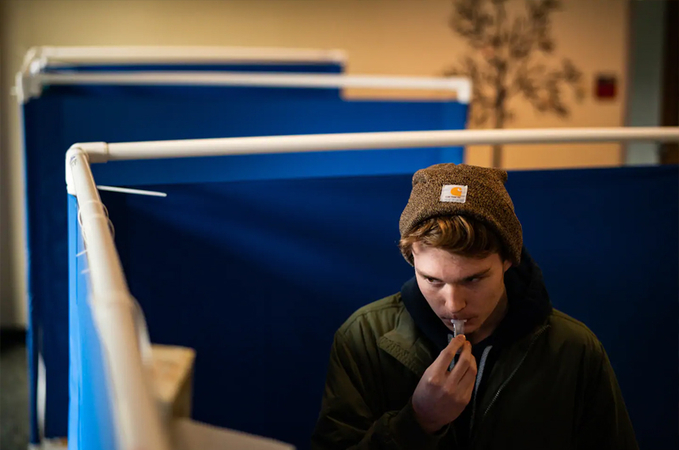
Last semester, the university tested about 1,000 people weekly, switching midsemester from nasal swab tests to saliva-based tests, which are cheaper to administer and can be processed on-campus, Washington said.
And although testing will be more common, Washington cautioned students this week to continue wearing masks and to avoid gatherings. He reminded students to complete daily health checks that officials use to detect the early signs of an outbreak.
“It’s just to remind people that we are not out of this yet. Don’t get too comfortable, don’t get too relaxed. Let’s double down on what we did previously,” Washington said in an interview.
Many of the warnings being issued at George Mason are to prepare students for the variant first identified in the U.K. Eleven incidents of the variant have been identified so far in Virginia, according to the Centers for Disease Control and Prevention. The federal agency expects the strain to be the predominant variety of the virus by March.
The variant has appeared on several U.S. campuses, including the University of Michigan and the University of California at Berkeley. An outbreak of the original strain of the virus and a cluster of variants at the University of Miami spurred a 10-day ban on large in-person gatherings, with the exception of face-to-face classes.
At Virginia Tech, the variant has not been detected so far on the Blacksburg campus, but officials are telling students to assume that it has already arrived.
“By this point in the fall, positivity was declining. It is now increasing,” Tim Sands, the university’s president, said Tuesday in a message to the community. He called the evolution of the virus “a complicating factor.”
Researchers have found the variant to be more infectious and some evidence suggests it can cause more severe symptoms than the original strain.
“We are seeing evidence among our student population that the prevalence of moderate symptoms is increasing,” Sands said, adding that the campus will double prevalence testing.
Other campuses have also noticed an uptick in cases. Virginia Commonwealth University has reported 346 cases among students since January. It took the campus almost three months to reach that number in the fall, data from the university show.
“It’s very tempting to feel like we’re out of the worst of this and, unfortunately, that just might not be true,” said Michelle Doll, an assistant professor in VCU’s School of Medicine and infectious diseases specialist. “Now is certainly the time to really go back to social distancing and make sure we are making good decisions.”
And it’s not just Virginia schools that are dealing with a surge. The University of Maryland at College Park announced Thursday it would limit in-person gatherings to five people – with the exception of in-person classes – following an increase in coronavirus cases on and around campus.
Seventy-seven U-Md. students and employees have reported contracting the virus since Monday, data shows, and officials have threatened additional restrictions if there is not a significant decrease in cases.
Recent developments have required schools to be particularly nimble.
“The thing about the virus is that it’s trying to survive, so it’s always changing,” Washington said. “We have to change when it changes.”
WASHINGTON – President Joe Biden delivered a stark warning Friday that “democratic progress is under assault” in much of the world, including the United States and Europe, telling allies that America would challenge authoritarians and seek diplomatic options for problems including Iran’s nuclear ambitions.
Biden asserted that democracies will fare better than autocracies in the competitions of the future and promised that the United States would again be an enthusiastic leader among them, as he charted a foreign policy agenda dominated by a post-Trump cleanup campaign.
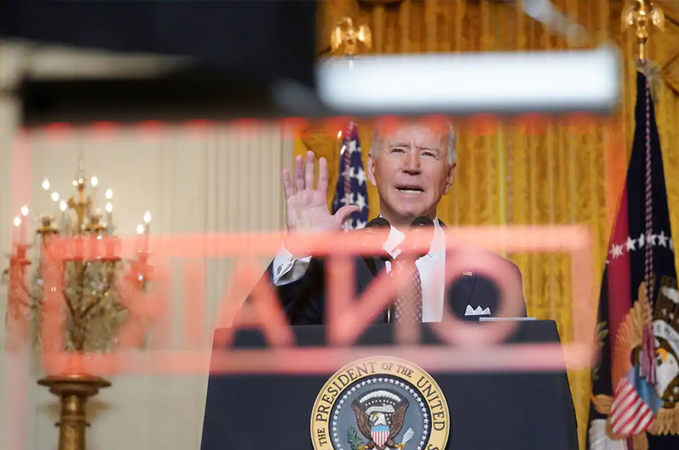
“I’m sending a clear message to the world: America is back. The transatlantic alliance is back,” Biden said in video remarks to the Munich Security Conference, an annual gathering of world leaders to discuss matters of war and peace. “And we are not looking backward; we are looking forward, together.”
Biden’s first speech to a global audience as president punctuated his determination to veer sharply from the path set by former president Donald Trump. In just the past two days, Biden has pledged $4 billion to a global vaccine initiative that Trump spurned; officially rejoined the Paris climate accords that Trump pulled out of; and moved to restart talks on the Iran nuclear deal that Trump rejected.
The new president warned of a rise in authoritarianism in many parts of the world and did not spare the threat in the United States, where a pro-Trump mob stormed the U.S. Capitol last month in an unsuccessful attempt to prevent Biden from becoming president. He suggested the world faces a fateful choice between autocracy and democracy as the best system to take on sweeping challenges such as the coronavirus pandemic.
“We are in the midst of a fundamental debate about the future and direction of our world. We’re at an inflection point,” Biden said. “I believe that – every ounce of my being – that democracy will and must prevail. We must demonstrate that democracies can still deliver for our people in this changed world.”
After focusing chiefly on domestic priorities in his first month in office, including the pandemic and its economic fallout, Biden flavored his discussion Friday with reminders that the pandemic is a global issue as well.
Speaking to the Munich conference from the White House before a trip to Michigan to tour a vaccine manufacturing site, he stressed the need for international cooperation to end the coronavirus outbreak. And he delivered a similar message in separate closed-door remarks to the Group of Seven large industrial democracies earlier Friday, encouraging other countries to follow his model of big-government investment to turn the tide of the pandemic.
Although Biden never mentioned Trump by name, he cast much of his agenda in deliberate contrast to the defeated Republican – a list of repairs that begins with repudiating the authoritarian model Trump found appealing.
“Democracy doesn’t happen by accident. We have to defend it, fight for it, strengthen it, renew it,” Biden said. “We have to prove that our model isn’t a relic of our history; it’s the single best way to revitalize the promise of our future.”
His appeal to global cooperation and inclusion was an answer to Trump’s populism and isolationism, epitomized in his “America first” slogan. Biden’s pledges to a common defense under NATO and a unified policy on Iran were markers of his return to traditional notions of what America means to Europe and vice versa.
Biden’s central message Friday was that the United States will work “in lockstep” with Europe, where the same nationalist strains that elevated Trump have produced semi-authoritarian leaders in Poland, Hungary and Turkey and where Russia seeks to bully democratically elected leaders.
Trump took Russian President Vladimir Putin at his word that Russia did not meddle in the 2016 U.S. election; Biden flatly said Russia “attacks our democracies and weaponizes corruption to try to undermine our system of governance.”
Trump had basked in praise from Polish President Andrzej Duda, who proposed naming a military base for the American president, and mused about punishing Germany by relocating American forces stationed there. Biden made a point Friday of saying that all U.S. force decisions are on hold.
In announcing the U.S. return to the transatlantic fold, Biden sought to focus on the issues that unite America and Europe, stressing the “existential” threat of climate change and Iran’s nuclear ambitions.
He glided over more divisive issues, making little mention of lingering trade frictions and other differences. The European Union inked a trade deal with China just before Biden took office, for example, and several European leaders have taken a far softer stance toward Russia than the new U.S. president.
“This was a homecoming speech – the prodigal American son has returned to the transatlantic family,” said Heather Conley, head of the Europe program at the Center for Strategic and International Studies. “This was not a time to raise family squabbles or traumas.”
Biden appeared on screen alongside German Chancellor Angela Merkel and French President Emmanuel Macron as he wrapped the European leaders in the diplomatic equivalent of a bear hug. Over and over, he reassured allies shunned by Trump that he considers them front-line partners in every major challenge.
The leaders of France and Germany were happy to return the compliment.
“Prospects for multilateralism are a little better than they used to be, and that has a lot to do with Joe Biden being the president of the United States of America,” Merkel said.
She said her country’s troops would stick with America’s if the Biden administration decides to extend its deployment in Afghanistan. She welcomed Biden’s interest in reviving the Iran nuclear deal. And she trumpeted Germany’s rising defense spending, one of the biggest areas of contention between the two nations during the Trump presidency.
Macron also played nice, while underscoring that things have changed in Europe as a result of trump’s hostility. Macron has advocated for greater independence from the United States, and like other European leaders, he is wary that U.S. politics could swing back toward isolationism in four years.
Europe would be a stronger partner to Washington if it were less dependent on the United States for its security, Macron said Friday. “It is time for us to take much more of the burden of our own protection,” he said.
Along with relief, European leaders now have high expectations that have to be managed on both sides of the Atlantic, said a senior diplomat, who requested anonymity to describe confidential discussions. The way to do that, the diplomat suggested, is by showing the public the benefits of U.S.-European cooperation.
“The president did not win the election because the American people decided that the one thing missing in the U.S. was love with Europe, right?” said the diplomat. “So we immediately came out with concrete proposals for cooperation, not just nice words. We want to show that the transatlantic relationship delivers on real things that matter to Americans and Europeans.”
Iran’s ability to obtain nuclear weapons is among the most closely watched issues facing Biden as he undoes Trump policies and installs his own. As a candidate, he pledged a conditional return to the 2015 international agreement limiting Iran’s nuclear activities, but did not say how he would accomplish that.
That agreement – which also included Russia, China, Britain, France and Germany – was former president Barack Obama’s signature foreign policy accomplishment. Trump withdrew from the deal in 2018, saying it gave too much to the Iranians.
As president, Biden has said that Iran must make the first move by ending uranium enrichment activities that violate the accord. Iran has said it is up to Washington to make the first move by dropping sanctions Trump had reimposed, and it is not entirely clear whether Iran wants to renew talks.
The Biden administration opened the door to talks Thursday, saying it would accept a European invitation to join the other members of the agreement for talks about how both the United States and Iran could return to its fold.
The White House announced Thursday that it would commit $2 billion for the global vaccine initiative known as Covax and would pledge another $2 billion over the next two years.
“Drawing on our strengths and values as democratic, open economies and societies, we will work together and with others to make 2021 a turning point for multilateralism and to shape a recovery that promotes the health and prosperity of our people and planet,” a joint statement from the G-7 leaders said Friday.
The G-7 leaders are expected to meet in person in Britain in June, and Biden is expected to attend, in what could be his first foreign trip as president.
The White House has not announced any other international travel, and it is likely to be months before Biden hosts any foreign leaders at the White House.
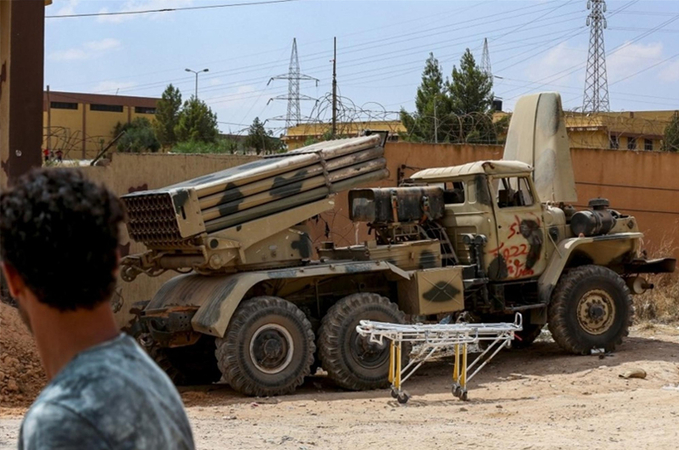
The commandos for hire who landed in Benghazi in June 2019 had arranged, at great expense, to procure every weapon and tool needed for an assault on Libya’s government. They obtained drones, inflatable speedboats, night-vision goggles, a mobile command center and even gear for jamming enemy communications.
And there were the helicopter gunships: three AH-1F Cobras, configured with mounts for machine guns and rocket launchers. The U.S.-made aircraft had been given to Jordan years earlier, and leaders of the operation traveled to Amman believing they had a deal to acquire them. In a status report to comrades, a commando team member described the helicopters as packed up and waiting to be loaded onto transport planes bound for Libya.
“Can be operational in seven days,” said the report, which was obtained by The Washington Post.
Only a last-minute intervention by Jordanian officials prevented the gunships’ departure for Benghazi, the rebel-held city on Libya’s northeastern coast. Once there, officials at the United Nations think, the American-made weapons might have helped tip the balance in an offensive intended to overthrow a U.N.-backed government based in Tripoli that the United States officially supports.
Scores of documents obtained by U.N. experts in an 18-month investigation have shed new light on the unusual 2019 attempt by private security companies to insert Western military experts and weapons into Libya on behalf of Khalifa Hifter, the commander of a rebel army in eastern Libya who is seeking to take control of the country with the backing of Egypt, Russia and the United Arab Emirates.
The plan, the subject of a U.N. report, underscores a weapons-proliferation challenge that Biden administration officials have vowed to confront: the flow of U.S. arms and equipment into Middle Eastern war zones, aided at times by U.S. allies as well as soldiers of fortune. Among other lines of inquiry, U.N. officials have investigated the role of Erik Prince, the Blackwater founder and former private military contractor who officials allege tried to use his personal influence to help secure the release of military equipment bound for Libya.
Any transfer of U.S.-made military aircraft and heavy weapons to a third party is a potential violation of U.N. arms embargoes as well as U.S. laws governing foreign military sales. But U.S. and U.N. investigators are examining multiple incidents involving different types of American-made military hardware, including C-17 transport planes and Javelin antitank missiles, that ended up in Libya or Yemen, according to current and former U.S. and U.N. officials familiar with the investigations who spoke on the condition of anonymity to discuss sensitive intelligence.
Some of the weapons have been traced directly to governments that received the arms from the United States. But often, the transactions involved middlemen, including private security contractors seeking to profit from civil wars and insurgencies from South Asia to North Africa, the officials said.
“There’s a wild, wild West of criminal networks and arms traders providing weapons and [flouting] all kinds of international rules and norms,” said William Lawrence, a former State Department official and diplomat who served in Tripoli. “Libya is emblematic of the problem.”
Last month, the Biden administration announced a temporary freeze on missile sales to Saudi Arabia and a review of a pending sale of F-35 fighter jets to the UAE. Proposed weapons sales to the two U.S. allies had drawn bipartisan objections in Congress, in part because of concerns about the countries’ past use of American weapons in proxy wars in the Middle East and North Africa.
Congress is separately investigating the transfers. While private arms traffickers are drawn to wars to pursue profits, the United States is obligated to use its leverage with allies to prevent the unauthorized use of American-made weapons in some of the world’s most brutal conflicts, said Rep. Tom Malinowski, D-N.J., a member of the House Foreign Affairs Committee.
“The responsibility here rests with governments to stop this kind of behavior,” Malinowski said. “There are countries involved that are considered partners and allies of the United States.”
– – –
Documents obtained or seen by The Post offer a rare glimpse into what investigators describe as one of the most unusual guns-for-hire operations in Libya’s 10-year history of conflict after the toppling and killing of dictator Moammar Gadhafi.
The papers, acquired by a panel of U.N. officials probing alleged arms violations, include flight logs, manifests, financial records and communications among individuals allegedly involved in the operation that unfolded over the spring and summer of 2019. Among the records is a status or “situation” report – called a “sitrep” – written by a team member and describing in detail the plan to insert a team of Western military operators and equipment into Libya at the height of a rebel offensive intended to capture the capital and overthrow the country’s U.N.-backed government. The memo, obtained by The Post, refers to the private contractors collectively as the “Opus Group.” It was written by a team member identified in the document as “Opus 1.” Three current and former U.N. and U.S. investigators vouched for the document’s authenticity.
The plan fell apart before it could be fully launched, with many of the would-be participants fleeing Libya by boat for the island of Malta, current and former U.N. officials said. While the plan has been previously reported on by other publications, including Rolling Stone and the New York Times, the “sitrep” document and other records reveal the full scale of the group’s effort to acquire sophisticated arms – including Cobra helicopters – to support a strike team of up to 20 Western military experts, including South African, British and Australian military veterans and at least one American.
At the time of their arrival in Benghazi in the late spring of 2019, Libya’s Government of National Accord in Tripoli appeared to be clinging to power by the flimsiest of threads. The Libyan National Army, or LNA, the patchwork of militias led by Hifter, had captured the capital’s outskirts in a spring offensive that appeared poised to overrun the capital within weeks.
According to U.S. and U.N. officials familiar with the events, who spoke on the condition of anonymity to discuss sensitive intelligence, Hifter had approved a plan to acquire helicopters and experienced, Western-trained military experts to bolster his efforts to storm Tripoli. Among the options under consideration, the officials said, was a plan to use a private commando force to kill or capture top political and military leaders, some of whom had been identified on a hit list as potential targets.
Around April 2019, Hifter procured the services of a group of private security and logistics contractors based in the UAE, and they collectively referred to themselves in the documents as the “Opus Team.” According to financial records and other documents obtained by investigators, the chief logistical and financial backers of the team were Opus Capital Assets and Lancaster6, two companies headquartered in Dubai. Lancaster6 is headed by Christiaan Durrant, a former Australian air force pilot. Durrant also has held senior management positions with Opus Capital Assets.
Durrant, responding to a query from The Post, referred to a previous written statement in which he denied any role in the June 2019 operation other than to provide “engineering inspections and recommendations” on aircraft acquired in Jordan.
“I am not, never have or will be a mercenary,” Durrant said in a statement provided to the Australian Broadcasting Corp., “or a leader of such.” Durrant, who has been interviewed by the U.N. panel investigating the events, acknowledged in his prepared statement that he participated in efforts to set up a “logistics hub” in Libya, in part to help provide security for oil and gas infrastructure. Durrant said neither he nor his companies were involved in efforts to supply weapons to Libyan combatants. “We don’t breach sanctions; we don’t deliver military services, we don’t carry guns,” Durrant said in his prepared statement. He said he had no knowledge of the origins of several of the documents attributed to the Opus Group.
Emails and text messages requesting comment from Hifter and from Opus Capital Assets’ senior management in Dubai did not receive a response.
The sitrep suggests that the Opus team had invested considerable effort and expense in acquiring weapons and hardware for the strike, and that by mid-June 2019, the group had nearly everything it needed.
By the time the report was written, on June 18, 2019, Opus had significant assets on the ground, including an intelligence “fusion and targeting cell” as well as a “cyber team” for communications and radio jamming, the document states. Two high-speed inflatable vessels had been acquired for the mission and were “ready and fueled in Malta awaiting the advance team’s arrival in Benghazi,” it said. The boats had been mounted with guns in anticipation of stopping and commandeering enemy supply vessels, the report said.
Investigators who examined the document said the report reflects a sophisticated planning effort for the raid, as well contingency arrangements for evacuating any wounded personnel or captives, and for fleeing Libya in the event the mission failed.
The last of the major acquisitions were waiting in Jordan. Members of the band flew to the Jordanian capital in mid-June, apparently believing they had cut a private deal with a group of Jordanian officials to acquire three AH-1F Cobras, believed to be priced at about $6 million each, according to current and former U.S. and U.N. officials familiar with the investigation.
The gunships had been disassembled for shipping and were ready to be loaded onto a pair of Russian-made cargo planes the team’s leaders had arranged to be in Amman for the pickup, current and former U.N. officials said. In addition to the Cobras, the Opus group anticipated getting a supply of small arms, ammunition and night-vision equipment from their Jordanian contacts. A military drone also had been purchased and was due to arrive in Amman within days, the sitrep said.
“Team can be effective within 7 days if the [government of Jordan] supports with an export of controlled items, including helicopters, air ammunition, ground weapons, ground ammunition and night vision,” the report said.
– – –
But the plans were thrown into chaos when the Jordanian government refused to cooperate.
Shortly before the Opus team arrived in Amman, the authorities there began looking into the scheme, concerned about potential violations of U.S. regulations, current and former U.N. officials said. At the time, Jordan was in the process of selling some of its surplus Cobras, which were being phased out to make room for newer aircraft. Negotiations were underway to sell some of the helicopters to the Philippines, subject to approval by the U.S. government.
No formal permission had been granted for releasing the Cobras to Opus, so the Jordanians balked at letting the aircraft leave the country, the officials said. Members of the Opus team continued to pressure the Jordanians anyway, insisting that they were conducting a humanitarian operation and that their plans had been approved at the highest levels by the U.S. and UAE governments, according to private communications given to U.N. investigators and seen by The Post.
A flurry of calls to Washington found no support for the visitors’ claims, the officials said. Then, an inspection determined that the Opus transport planes that had arrived in Amman were already partly filled with other weapons, apparently bound for Libya, according to an official familiar with Jordan’s internal investigation of the incident.
“They [Opus team leaders] were adamant that they had all the approvals,” including permission from the Trump administration to acquire the Cobras, said the official, who, citing the ongoing investigations, agreed to an interview on the condition that neither he nor his country be identified. “There was no official approval.”
Durrant, in a statement to The Post, denied that Opus ever claimed that the acquisition attempt had official U.S. blessing.
“This is totally false in every part,” he wrote in an email message.
As part of the investigation, U.N. officials have sought to interview Prince, a former Navy SEAL and private military services contractor, current and former U.N. officials said. The U.N. panel was seeking information about at least two phone calls made by Prince to Jordanian officials, allegedly asking that the Cobras be released to the Opus team, the officials said. Prince is a former business associate of Durrant’s.
A lawyer representing Prince said the former military contractor had broken no laws. “Erik Prince had absolutely nothing to do with any operation in Libya in 2019, or at any other time,” the lawyer, Matthew Schwartz, said in an email.
For Opus, Jordan’s refusal to release the helicopters was a serious – and ultimately fatal – blow to the mission.
“Despite confirmations by all hierarchical parties involved that [the government of Jordan] would support the Opus operation,” the sitrep’s author wrote, “the support has not yet materialized, which has had serious impact on the project.” The group was arranging to purchase helicopters elsewhere, he wrote, but “this places considerable legal risk on Opus and is beyond the scope of the agreed contract.”
Indeed, the planned mercenary raid fell apart within days after the report was penned. When an Opus delegation traveled to Benghazi to brief Hifter on the events, he erupted in fury, angered by the group’s failure to secure the U.S.-made gunships that had been promised, according to the two officials familiar with investigation of the incident.
Fearing that they might be arrested, the mercenaries left Libya in their inflatable vessels and fled to Malta, the officials said. They arrived on July 2 and were detained by customs officials, then released.
Hifter’s offensive against the Tripoli government faltered soon afterward. Despite weeks of steady advances and drone strikes on central Tripoli, Hifter’s fighters were slowly driven back by government troops bolstered by increasing military support from Turkey.
On June 26, just over a week after the memo was written, Hifter’s army was driven from Gharyan, a key LNA stronghold south of the capital, and the retreating convoys were decimated in an aerial attack. Hifter would try again to take Tripoli, but he has not regained his momentum.

 พายุฤดูหนาวเล่นงานเทกซัสต่อเนื่อง ชาวบ้านกว่าครึ่งยังไม่มีน้ำใช้ จนต้องแซะหิมะไปต้ม


 รัฐมนตรีสาธารณสุขอาร์เจนตินาลาออกหลังเพื่อนอ้างความสนิทสนมแซงคิวฉีดวัคซีนก่อนคนอื่น
 2 สาวอเมริกันลงทุนปลอมตัวเป็นคนแก่เพื่อให้ได้ฉีดวัคซีนก่อนคนอื่น
 นักอนุรักษ์และยูเนสโกหวั่นว่าการสวนสนุกแห่งนี้จะสร้างความเสียหายให้นครวัดซึ่งเป็นมรดกโลก
 ผู้เชี่ยวชาญเตือนคนอยากเล่น Clubhouse ระวังแอพพลิเคชั่นปลอม เผลอคลิกอาจถูกแฮกเกอร์ล้วงข้อมูล
 With their power out since Monday morning, Evelyn Hernandez, 15, and her sister, Daeslyn, 1, use a samping stove on their family’s front porch in Houston to keep warm. Photo by Callaghan O’Hare for The Washington Post
 ประเทศร่ำรวยตุนวัคซีนเกินความต้องการใช้ทำประเทศยากจนขาดแคลน

