Chiefs assistant coach Britt Reid involved in car accident that reportedly injured two children
InternationalFeb 06. 2021Britt Reid, an assistant coach for the Kansas City Chiefs
By The Washington Post, Mark Maske
Britt Reid, an assistant coach for the Kansas City Chiefs and the son of Coach Andy Reid, was involved in a multiple-vehicle accident that reportedly injured two children Thursday night in the Kansas City, Mo., area.
One of the children suffered life-threatening injuries, Kansas City television station KSHB reported.
The Chiefs said in a written statement Friday that they were aware of the incident.
“The organization has been made aware of a multi-vehicle accident involving Outside Linebackers Coach, Britt Reid,” the team said in its statement. “We are in the process of gathering information, and we will have no further comment at this time. Our thoughts and prayers are with everyone involved.”
According to KSHB, authorities were attempting to determine whether driver impairment was a factor in the accident. The station reported that, according to a search warrant, a police officer said that “a moderate odor of alcoholic beverages” was detectable and Britt Reid’s eyes were bloodshot and red. According to the warrant application, Reid told the police officer that he’d had two to three drinks and also took Adderall by prescription.
The officer wrote in the warrant that he observed signs of impairment, and the officer’s request to draw blood from Reid, made after Reid was transported to a hospital due to stomach pain, was approved by a Jackson County Judge, KSHB reported. According to the station, the accident occurred on an interstate near the Chiefs’ practice facility just after 9 p.m. local time Thursday.
The pickup truck reportedly being driven by Reid struck one of two vehicles stopped on an entrance ramp. One vehicle had run out of gas and the other vehicle was driven by a family member who had been summoned to help. According to KSHB, a 5-year-old child in the back seat of one vehicle suffered life-threatening injuries and a 4-year-old child suffered non-life-threatening injuries.
The Chiefs are scheduled to travel to Tampa on Saturday and face the Tampa Bay Buccaneers in Sunday’s Super Bowl at Raymond James Stadium. The Chiefs did not immediately respond to a request for comment on reports that Britt Reid is not expected to travel with the team. The NFL did not immediately respond to a request for comment.
The Chiefs spent the week in Kansas City, practicing at their own facility, because of changes to the usual Super Bowl procedures brought about by the coronavirus. Teams normally spend the week leading up to the Super Bowl in the city in which the game is to be played.
Britt Reid, 35, was sentenced to eight to 23 months in jail and five years’ probation in 2007 on gun and drug charges after pointing a gun at another driver following a dispute. In 2008, he pleaded guilty after being arrested on a charge of driving under the influence.
He is in his eighth season with the Chiefs and has spent the past two as the team’s outside linebackers coach. He previously had served as a defensive quality control coach, assistant defensive line coach and defensive line coach.
House approves budget plan as President Biden emphasizes willingness to approve stimulus without GOP votes
InternationalFeb 06. 2021Speaker Nancy Pelosi, D-Calif., walks to the House floor on Thursday. Washington Post photo by Salwan Georges.
By The Washington Post, Jeff Stein, Erica Werner, and Rachel Siegel
WASHINGTON – President Joe Biden on Friday sent his strongest message yet that he intends to move forward on his economic relief plan without Republican support, as the House gave final approval to a budget bill that will allow him to do just that.
The House voted 219-209 to approve the budget plan, which the Senate had already passed early Friday morning, beginning the process of turning Biden’s stimulus proposal into legislation. House Speaker Nancy Pelosi, D-Calif., said Friday she aims to pass Biden’s stimulus plan through the House within two weeks.
The rapid movement by congressional Democrats came as Biden gave his sharpest criticism to date of the Republican approach to the stimulus package, suggesting further negotiations with the GOP could cause an unacceptable delay to critical relief.
“Are we going to say to millions of Americans who are out of work – many out of work for six months or longer, who have been scarred by this economic and public health crisis – Don’t worry, hang on, things are going to get better’ ” Biden said in remarks at the White House on Friday. “That’s the Republican answer right now. I can’t in good conscience do that. Too many people in the nation have already suffered for too long.”
Biden’s declaration that he will not wait for Republicans represents a pivotal moment in his presidency, given his pledges restore bipartisanship to Washington. Biden spent 40 years shaping a political identity as a figure who reaches across the aisle – often attracting mockery or derision for it – and he campaigned on pulling the country together after the divisiveness of the Donald Trump era.
Biden invited Republicans to the White House for negotiations over the stimulus, and White House officials said they would still try to incorporate GOP ideas into the final package. But on Friday, Biden sounded ready to push ahead with only the Democrats’ tiny majorities reliably behind him.
“I see enormous pain in this country. A lot of folks out of work. A lot of folks going hungry, staring at the ceiling at night wondering, ‘What am I going to do tomorrow?’ ” Biden said. “So I’m going to act, and I’m going to act fast.”
The budget plan passed by the House will direct committees to start working on the details underlying Biden’s $1.9 trillion stimulus package. The Senate approved that measure in the early-morning hours Friday by a 51-50 vote, with Vice President Kamala Harris casting the tiebreaking vote in the chamber after more than 15 hours of debate.
The stimulus package would include checks up to $1,400 for low- and moderate-income families, extended jobless benefits, and provide $160 billion to strengthen the public health response to the pandemic, improving the vaccine distribution and increased testing, among other measures.
The Friday votes are the latest sign of a more partisan effort underway in pursuing final passage of Biden’s relief package through a narrow majority.
Top Democrats in both chambers say they are moving with an increased sense of urgency, as the economic recovery from the pandemic continues to show signs of stalling. Meanwhile GOP lawmakers have called for slowing down the relief effort and substantially scaling back the $1.9 trillion effort, which conservatives have derided as unnecessarily increasing the federal deficit.
For his part, Biden, on Friday, accused Republicans of “rediscovering” the danger of the deficit, which rose during the Trump administration with massive tax cuts.
A new jobs report out Friday provided the latest glimpse of the faltering economy, which added just 49,000 jobs in January, an anemic amount of growth, coming a month after the labor market shed jobs. The U.S. has only recovered about half of the 22 million jobs it lost between February and April.
“We now have three disappointing months in a row. We have to admit we’ve stalled out. There’s a danger of double-dip recession,” Austan Goolsbee, who served as a senior economist in the Obama administration, said on CNBC Friday morning while talking about the January jobs report.
Indeed, Democrats have been rushing the stimulus package through, in part, because tens of millions of Americans would begin to lose federal unemployment benefits under existing law in mid-March.
Biden on Friday hosted House Democratic leaders, including Pelosi and House Majority Leader Steny Hoyer, D-Md., at the White House to make the case for swiftly passing the relief effort. He also cited increases in suicides, drug abuse and violence against women during the pandemic.
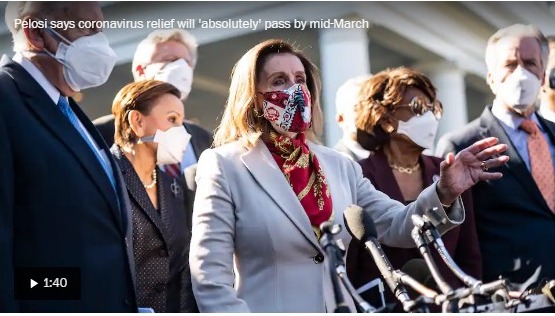
Pelosi also told House Democrats in a letter Friday that they aim to “finish our work” on the relief package before the end of February. Asked if she could guarantee the legislation would be passed before unemployment aid expires for millions of Americans in mid-March, Pelosi said: “Absolutely. Without any question. Before then.”
“Hopefully in a two-week period of time, we will send something over to the Senate,” Pelosi said, flanked by the Democratic committee chairs. “We hope to be able to put vaccines in people’s arms; money in people’s pockets; children safely in schools; and workers in their jobs.”
Earlier on Friday, the Senate passage of the budget resolution moved the “budget reconciliation” process along, clearing the way for the final stimulus package to pass the Senate with a simple-majority vote, instead of the 60 normally required. That allows Democrats to move forward with no GOP votes if necessary, although Democrats and Biden officials insist that they hope Republicans will join them.
The Senate spent most of Thursday afternoon and Friday morning voting on some 45 amendments on a range of issues, including passing a motion that said stimulus payments should not go to affluent Americans.
“The American people deserve for the conversation about next steps to begin with them and their needs. Not partisan rush jobs. Not talking points,” Senate Minority Leader Mitch McConnell, R-Ky., said on the Senate floor on Thursday. “It will not serve Americans to pile another huge mountain of debt on our grandkids for policies that even liberal economists say are poorly targeted to current needs.”
Not all Democrats have been thrilled with Biden’s approach. Sen. Joe Manchin, D-W.Va., the most conservative Senate Democrat, has said he would strongly prefer a bipartisan bill than one approved only with Democratic votes. On Friday, a bipartisan group of centrist House lawmakers called the Problem Solvers Caucus called for Congress to first approve legislation boosting vaccine distribution — an approach rejected by the White House.
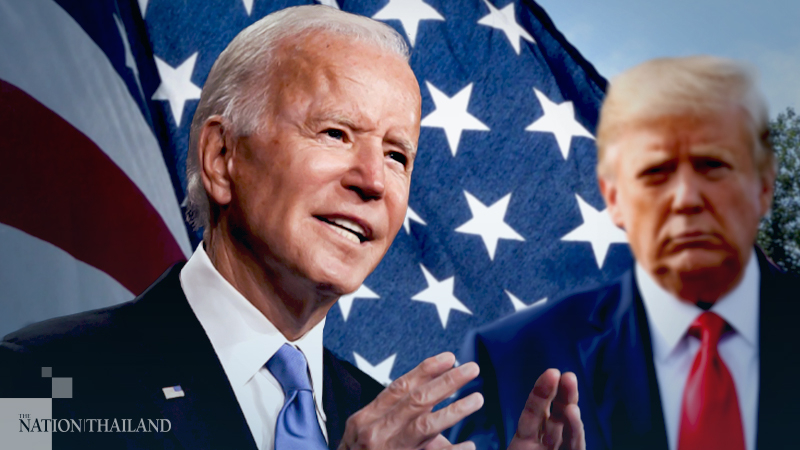
WASHINGTON – President Joe Biden said Friday that former president Donald Trump should not have access to classified information in the form of the briefings usually given to ex-presidents, citing Trump’s “erratic behavior” and the risk that he might recklessly reveal sensitive information.
Biden stopped short of announcing that he had officially decided to prevent his predecessor from receiving the briefings, which are traditionally given before former presidents travel abroad, particularly in an official capacity. But Biden has the unilateral authority to deny intelligence access to anyone he chooses, and his remarks amounted to a statement that Trump – who for four years controlled the entire U.S. security apparatus – was himself a security risk.
Denying the briefings to a former president would be an unprecedented action, and Biden’s remarks, made during an appearance on the “CBS Evening News” with Norah O’Donnell, emphasized the president’s concern, and that of other officials, that Trump poses a risk to national security because of what he might disclose.
Asked by O’Donnell whether Trump should receive the briefings, Biden replied, “I think not.”
White House press secretary Jen Psaki, during her daily press briefing Monday, when asked whether the Biden administration would provide Trump with intelligence briefings, said that she had raised the question with Biden’s national security team and that the issue was “under review.”
The White House on Friday did not immediately clarify whether Biden’s comments to CBS News represented an official White House policy or was simply an expression of the president’s opinion in response to a question.
A spokesman for Trump did not respond to requests for comment.
Explaining his reason for wanting to withhold sensitive information from Trump, Biden said, “because of his erratic behavior unrelated to the insurrection.”
That was a reference to the events at the heart of the Senate impeachment trial that Trump faces next week. Trump was impeached after encouraging a throng of supporters on Jan. 6 to march to the Capitol in an effort to pressure Congress as it moved to certify Biden’s electoral college victory. A mob broke into the Capitol, forcing Congress to suspend its proceedings and resulting in several deaths.
As president, Trump selectively revealed highly classified information to attack his adversaries, gain political advantage and impress or intimidate foreign governments, in some cases jeopardizing U.S. intelligence capabilities.
The Washington Post reported in May 2017, for example, that Trump had revealed highly classified information to the Russian foreign minister and the Russian ambassador to the United States during a White House meeting, jeopardizing a valuable source of intelligence on the Islamic State.
In Friday’s interview, O’Donnell pressed Biden on his past characterizations of Trump.
“You’ve called him an existential threat. You’ve called him dangerous. You’ve called him reckless,” she said.
Biden replied, “Yeah, I have. And I believe it.”
When asked to describe his “worst fear” were Trump to continue receiving classified information, to which he had unrestricted access as president, Biden said, “I’d rather not speculate out loud. I just think that there is no need for him to have the – the intelligence briefings.”
He added, “What value is giving him an intelligence briefing? What impact does he have at all, other than the fact he might slip and say something?”
Even before Trump left office, it was clear that his post-presidential life, like his time in office, would deviate starkly from tradition. He declined to attend Biden’s inauguration or welcome him to the White House, as departing presidents have done for their successors for decades. And now he faces an impeachment trial for an alleged offense during his presidency.
Current and former U.S. officials said Friday that they shared Biden’s concern about giving Trump access to national secrets.
“President Biden is certainly correct about the lack of any value in providing Trump intelligence briefings,” said David Priess, who, as a CIA officer, briefed George H.W. Bush for many years after he had left the presidency.
He noted that the briefings are provided because former presidents have a unique role in national life. They are often seen as representing the United States, especially by foreign leaders, for the duration of their lifetime.
“Traditionally, these briefings have kept former presidents informed enough to serve as confidential advisers to the current president if needed, to offer perspective during an international crisis or before high-level negotiations with a foreign leader, for example,” Priess said.
“But there’s no chance of Biden reaching out to Trump for that,” he added. “So why would Biden run the risk of Trump’s disclosure of sensitive information by agreeing to such briefings?”
Last month, before Biden’s inauguration, the chairman of the House Intelligence Committee also said Trump should be denied access to official secrets after he left office.
“There is no circumstance in which this president should get another intelligence briefing, not now and not in the future,” Rep. Adam Schiff, D-Calif., said on CBS’s “Face the Nation.”
Schiff helped lead the first impeachment effort against Trump, starting more than a year ago, after Trump suggested to the president of Ukraine that his country should investigate Biden – at the time a potential rival for the presidency – and his family.
“Indeed, there were, I think, any number of intelligence partners around the world who probably started withholding information from us because they didn’t trust the president would safeguard that information and protect their sources and methods,” Schiff said. “And that makes us less safe.”
While in office, Trump also drew criticism from intelligence officials for his relentless attacks on the intelligence community, which he often portrayed as a den of conspirators fabricating information about his campaign’s contacts with Russia. Trump also ordered the declassification of intelligence that U.S. officials warned could expose sensitive sources of intelligence that could not easily be replaced.
All presidents exit the office with valuable national secrets in their heads, including procedures for launching nuclear weapons, knowledge of the country’s intelligence-gathering capabilities, information about assets inside foreign governments and plans for new and advanced weapon systems.
But until Biden took office, no new president had voiced concern that his predecessor might expose what he knew or act recklessly with information he received after leaving the White House.
Some intelligence experts have previously said that Trump could be seen as a counterintelligence risk: He was in debt and angry at the U.S. government, particularly what he described as a “deep state” conspiracy that he said tried to stop him from winning the White House in 2016 and resisted him while he was in office. Trump also falsely claimed that he was the victim of an illegal effort that robbed him of reelection.
Former presidents generally receive briefings before they travel overseas, especially if they are doing so at the behest of the administration of the day, so that they can be apprised of recent developments and know what subjects they might want to explore, or avoid, with particular foreign leaders. They are often seen as valuable assets by the incumbent White House, given their stature and access to the top levels of foreign governments.
The briefings are usually delivered by current intelligence officers, including those who have experience briefing the sitting president. But former presidents do not receive the same classified daily briefing as a sitting commander in chief.
Biden’s comments about security briefings came just days before the Senate was scheduled to open Trump’s second impeachment trial. House impeachment managers, or prosecutors, are preparing their case that the president, among his alleged offenses, “gravely endangered the security of the United States and its institutions of government” by inciting the mob that attacked the Capitol.
Trump’s defense team is expected to deny any incitement, saying the president was exercising his right to free speech in questioning the election results, and to argue that the Constitution does not provide for the impeachment trial of a president after he has left office.
Biden, in the interview aired Friday, declined to comment on whether he would vote to convict Trump if he still were a senator.
“Look, I ran like hell to defeat him because I thought he was unfit to be president,” Biden told O’Donnell. “I’ve watched what everybody else watched, what happened when that – that crew invaded the United States Congress. But I’m not in the Senate now. I’ll let the Senate make that decision.”
Primary analysis of Phase III clinical trials of the AstraZeneca Covid-19 vaccine conducted in the UK, Brazil and South Africa showed the vaccine is safe. There have been no hospitalisations in more than 22 days after the first shot was administered.
The results were published in The Lancet.
Results demonstrated 76 per cent efficacy of the vaccine after the first dose, and with an inter-dose interval of 12 weeks or more, the vaccine’s efficiency rose to 82 per cent.
The report also showed the vaccine’s potential to reduce asymptomatic transmission of the virus, based on weekly swabs obtained from volunteers in the UK trial.
Data showed that PCR positive readings dropped by 67 per cent after a single dose, and 50 per cent after a two-dose regimen.
The primary analysis was based on 17,177 participants, including 332 symptomatic cases, from the Phase III UK (COV002), Brazil (COV003) and South Africa (COV005) trials led by Oxford University and AstraZeneca. This study included an extra 201 cases.
Sir Mene Pangalos, executive vice president of BioPharmaceuticals R&D, said: “This primary analysis reconfirms that our vaccine prevents severe disease and keeps people out of the hospital. Also, extending the dosing interval not only boosts the vaccine’s efficacy but also enables more people to be vaccinated upfront. Together with the new findings, we believe this vaccine will have a real impact on the pandemic.”
Professor Andrew Pollard, chief investigator of the vaccine trial and co-author of the paper, said: “These new data provide important verification of the interim data that has helped regulators such as the MHRA in the UK and elsewhere around the world to grant the vaccine emergency use authorisation.
“It also helps support the policy recommendation made by the Joint Committee on Vaccination and Immunisation for a 12-week prime-boost interval, as they look for the optimal approach to roll out and reassures us that people are protected 22 days after a single dose of the vaccine.”
Data will continue to be analysed and shared with regulators around the world to support their ongoing rolling reviews for emergency supply or conditional approval during the health crisis. AstraZeneca is also seeking Emergency Use Listing from the World Health Organisation for an accelerated pathway to vaccine availability in low-income countries.
The vaccine can be stored, transported and handled at normal refrigerated conditions (2 to 8 degrees Celsius) for at least six months and administered within existing healthcare settings.
AstraZeneca continues to engage with governments, international organisations and collaborators around the world to ensure broad and equitable access to the vaccine at no profit for the duration of the pandemic.
In addition to the programme led by Oxford University, AstraZeneca is conducting a large trial in the US and globally. In total, Oxford University and AstraZeneca expect to enrol up to 60,000 participants globally.
The AstraZeneca Covid-19 vaccine has already been granted a conditional marketing authorisation or emergency use in close to 50 countries, spanning four continents including in the EU, several Latin American countries, India, Morocco and the UK.

 องค์การอนามัยโลกเผยข้อมูลการแจกจ่ายวัคซีนจากโครงการ COVAX
 กองทัพเมียนมายังไล่บล็อกโซเชียลมีเดียไม่หยุด ล่าสุดถึงคิวทวิตเตอร์แล้ว
 Britt Reid, an assistant coach for the Kansas City Chiefs
 Speaker Nancy Pelosi, D-Calif., walks to the House floor on Thursday. Washington Post photo by Salwan Georges.

 การแข่งขันกันขยายอิทธิพลระหว่างสหรัฐกับจีนจะบีบให้สหรัฐไม่สามารถลงดาบเมียนมาหนัก เพื่อนบ้านอย่างไทยจึงหนีไม่พ้นถูกกดดันให้จัดการแทน
 ทารกโรมาเนียวัย 6 สัปดาห์เสียชีวิตหลังเข้าพิธีศีลล้างบาป ท่ามกลางเสียงเรียกร้องให้ปรับเปลี่ยนพิธีกรรม
 หญิงไต้หวันถูกปรับ 2 แสนเหรียญไต้หวันฐานชวนแฟนค้างคืนด้วยตอนตัวเองกักตัว
 ชาวเมียนมาแห่แชร์คลิปบุคคลหน้าคล้ายลูกชายมินอ่องหล่ายโปรยเงินฉลองรัฐประหารสำเร็จ


