เจ้าหน้าที่สืบสวนของ UN ยังเคยกล่าวว่า “กองทัพดำเนินการสังหารและข่มขืนชาวโรฮิงญาด้วยเจตนาฆ่าล้างเผ่าพันธุ์ ซึ่งควรถูกดำเนินคดีในข้อหาก่ออาชญากรรมร้ายแรงตามกฎหมายระหว่างประเทศ”
รวมถึงเฟซบุ๊ก Asians Never Die ก็ร่วมเผยแพร่ข่าวสารดังกล่าว จากนั้นไม่นานชาวเน็ตโดยเฉพาะคนเอเชียก็ร่วมใช้รูปดังกล่าวมาตั้งเป็นรูปโปรไฟล์ทั้งบนเฟซบุ๊ก อินสตาแกรม และทวิตเตอร์ เพื่อแสดงความอาลัยและร่วมเรียกร้องให้เกิดความยุติธรรมต่อต้านการเหยียดผิวและเชื้อชาติ
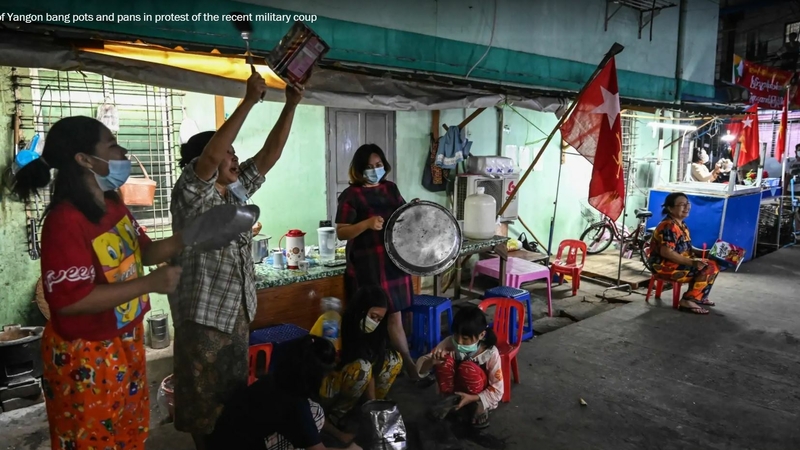
At 8 p.m. Tuesday, the banging of pots filled the air in Myanmar’s largest city. Residents of Yangon, the country’s former capital, unleashed a volley of pan rattling, drum beating and horn honking, a dissonant moment of dissent a day after the military seized power in a coup.
The banging of pots and pans is often associated with celebration: Throughout the coronavirus pandemic, people across the globe took to clanging their kitchenware at 7 p.m. to hail essential health workers beginning overnight shifts.
The noisy practice is also associated with a legacy of protest dating back to at least the 19th century, when French women banged pots and pans outside their Paris homes to protest economic conditions and food shortages. Since then, movements around the world have followed each other in using common household items to sound their dissent.
Here are some examples.
– – –
Cacerolazo in Latin America
The banging of pots and pans in Latin America – or cacerolazo – gained prominence in the 1970s because conservative women used the practice to oppose the election of leftist President Salvador Allende in Chile.
“It was an ideal tool for women because the pots symbolized their femininity. But it also was a statement about the lack of food,” Margaret Power, a professor of Latin American history at Illinois Institute of Technology told Vox. “It was accessible. It was a way that somebody could stay within their home or their neighborhood at a time when women’s lives were a bit more controlled.”
The act evolved in the country in 1984, emerging as the sound of protests against Chilean dictator Augusto Pinochet and later spreading across South America in response to the 2001 financial crisis in Argentina, 2013 elections in Venezuela and, in 2020, to protest Brazilian President Jair Bolsonaro’s pandemic response.
– – –
George Floyd protests
In the United States, demonstrators made wide use of pots and pans over the summer, when mass demonstrations against racial injustice sparked by the death of George Floyd in Minneapolis prompted some U.S. cities to issue nighttime curfews. Unable to go out and march, people banged kitchen implements instead.
– – –
Iceland’s pots and pans revolution
In Iceland, protesters reeling from the effects of the country’s handling of the 2008 financial crisis took their pots and pans into the streets. Demonstrations calling for the government to resign had broken out across the country since the fall of 2008. On Jan. 20, 2009, as parliament reconvened after a Christmas recess, around 2,000 people gathered outside the building intent on making noise.
The gathering was dubbed by the media the “pots and pans” or “kitchenware” revolution. One Icelandic writer, talking to the New Yorker, called it the “night of the long spoons.” Demonstrators also brought other culinary items, hurling trays of pasta at riot police, who responded with pepper spray.
– – –
Spain
In Spain, the banging of pots and pans most recently emerged as a form of protest against Prime Minister Pedro Sánchez’s strident shutdown measures to combat the coronavirus. Spaniards also banged their kitchenware during a televised speech by King Felipe VI in March amid a financial scandal involving the king’s father.
In the past, the practice was used to protest the Iraq War in 2003 and as part of the 2017 protest movement in Catalonia, where the practice is called cassolada.
Doubts loom over Tokyo Olympics without vaccine, isolation rules
InternationalFeb 05. 2021A pedestrian wearing a protective mask passes an advertisement for the now-postponed Tokyo 2020 Olympic Games in Tokyo on Jan. 14, 2021. MUST CREDIT: Bloomberg photo by Toru Hanai
By Syndication Washington Post, Bloomberg · Ayai Tomisawa, Yuki Hagiwara
Covid-19 countermeasures unveiled by the organizers of the delayed Tokyo Olympics don’t include mandatory vaccinations or quarantines for those arriving in Japan for the Games, fueling doubts on whether they can go ahead this summer as planned.
Coronavirus tests will be required before arrival in Japan and then at least every four days, with movements limited to a predetermined plan. The first version of the “Playbook” unveiled Wednesday was light on many details, such as what would happen if participants, athletes or other staff test positive.
With thousands of people from around the globe set to descend on Tokyo, where the pandemic still isn’t under control, citizens remain nervous. Just 16% of Japanese say the event should be held as planned this summer. The country declared a state of emergency last month, seeking to reduce infections and pave the way for the Olympics, which were postponed last year.
“A 14-day quarantine period is needed to be certain that you haven’t developed an infection that you could spread to others,” said Norio Sugaya, a visiting professor at Keio University’s School of Medicine in Tokyo and a member of a World Health Organization panel advising on the pandemic. “There is a risk that the infections will spread within the Olympic Village, and they may spread to the country as well. Now is not the time to discuss large-sized face-to-face events.”
The organizers won’t require athletes and teams to be inoculated to take part, but said instead that they’ll work with each national Olympic committee to “encourage and assist their athletes, officials and stakeholders to get vaccinated in their home countries, in line with national immunization guidelines, before they go to Japan.”
Instead of a 14-day quarantine, those arriving in Japan will be asked to submit an “activity plan” detailing locations they will visit, accommodations and method of transportation.
The playbook is an important step in clarifying the conditions under which the games can take place. The document was prepared by the Tokyo Organizing Committee, the International Olympic Committee and the International Paralympic Committee.
Organizers said they will decide more specifics in an update in April, to make use of the latest testing technology and other developments. Participants will need to submit a negative test before departure for Japan and may be tested on arrival.
“It’s questionable whether these rules are viable or not,” said Kenji Shibuya, professor and director of the Institute of Population Health at King’s College London.
That also means that the participants will have to comply with the rules in the playbook, whether they have been vaccinated or not, they added.
Teams were told not to join events as spectators, and not to use public transport. They will also have to download a contact tracing app. They will not have to quarantine when they arrive in the country. Athletes will be housed in the Olympic Village rather than being dispersed around hotels in Tokyo, organizers said.
Despite speculation over the future of the games, the organizers insisted Wednesday that they would go ahead. They cited the knowledge gained on how the virus spreads since the decision last March to postpone the Games, as well as the successful resumption of thousands of other sports worldwide among reasons for their optimism.
The playbook made no specific mention of how spectators would be handled. Decisions on that question, including the number allowed and the prospects for overseas spectators, will be made within the next few weeks, Christophe Dubi, IOC Olympic Games Executive Director, said on a video conference.
The Tokyo 2020 Committee has already indicated that it will need to decide on whether to impose limits on attendance or restrict spectators from entering the country by this spring, due to the ticketing process.
The Australian Olympic Committee has “every confidence” the games are going ahead and is “doing everything we can” to ensure its team can arrive safely and compete. The playbook is a “very good start,” spokesman Strath Gordon said in an emailed statement. “We know there is more detail to come.”
The playbook will be updated as the pandemic situation changes ahead of the games, which are set to kick off on July 23, a year after they were originally due to start.
“Tokyo is the best-prepared city we have ever seen,” Dubi said.
By Syndication Washington Post, Bloomberg · Joe Mayes, Tim Ross
The U.K. has passed the peak of its latest wave of the coronavirus pandemic, officials said, as the country reached the milestone of vaccinating 10 million people, about 15% of the population.
“We are on a downward slope of cases, hospitalizations and deaths,” Chief Medical Officer Chris Whitty said at a televised news conference Wednesday. “This peak, at least, we are past.”
But Whitty, a senior adviser to Prime Minister Boris Johnson, said infections are still widespread and the state-run National Health Service would be “back in trouble extraordinarily fast” if social restrictions are lifted.
Britain’s immunization program — the most successful so far in Europe — puts the country on track to provide shots to 15 million citizens and carers at greatest risk from the disease by Feb. 15. Johnson said it will be possible to begin easing the lockdown only three weeks after that date, once those vaccinated have received the benefits of the immunization.
Johnson, who will publish a plan for relaxing the curbs on Feb. 22, said there are “signs of hope” but warned the number of people with the disease is still “alarmingly high.” A further 1,322 deaths were reported Wednesday.
Johnson said he’s “very hopeful” schools will reopen on March 8, though doesn’t want to move too soon and then have to go “in reverse.” He also said he’d support a statue in memory of Captain Tom Moore, the centenarian who became a U.K. icon by raising money for the NHS, who died Tuesday.
The rapid roll out of coronavirus vaccines is a rare success for the U.K. government in its handling of the pandemic, which has left more than 109,000 people dead and caused the deepest recession for more than 300 years.
Johnson is under mounting pressure to ease restrictions from lockdown skeptics in his own party who fear shutting up businesses and schools will inflict lasting scars on the economy and society. News that vaccines are effective at cutting transmission of the disease has fueled their argument.
“With better and better news by the day on the vaccination roll out and its effectiveness, the government has got to start addressing its mind to the harms caused by the measures we’re putting in place,” said Mark Harper, chairman of the so-called covid Recovery Group of Conservative members of Parliament. “Lockdowns and restrictions cause immense damage to people’s health and livelihoods, and we need to lift them as soon as it is safe to do so.”
Johnson has promised to review the pandemic response after the priority groups have been given vaccines. Schools will be the first facilities to reopen in England, starting no earlier than March 8 under the government’s plans.
Malaysia PM seeks balance as economy reels from virus curbs
InternationalFeb 05. 2021Malaysian flags hang from lamposts near the the office complex of the prime minister in Putrajaya, Malaysia, on Sept. 23, 2020. MUST CREDIT: Bloomberg photo by Samsul Said.
By Syndication Washington Post, Bloomberg · Anisah Shukry, Anuradha Raghu
Struggling with elevated numbers of covid-19 cases, Malaysia’s government is trying to strike a balance that will protect lives while ensuring that economic activity can continue, Prime Minister Muhyiddin Yassin said Thursday.
While a total lockdown would be the best way to control the surge in cases, that would have negative repercussions for the economy, Muhyiddin said in the televised address. Instead, tighter protocols — known as Standard Operating Procedures, or SOP — will be imposed while essential businesses continue to operate.
“The government listens to your views by not shutting down the economy during the Movement Control Order period,” Muhyiddin said. “So please reciprocate this gesture by complying strictly with the SOPs so that we can ensure business and trade will continue to operate, while at the same time helping break the chain of Covid-19 transmission at the workplace and in the community.”
Movement Control Orders, Malaysia’s strictest form of lockdown, are in force in all but one state and will continue until Feb. 18.
Still, the government will allow car-wash services, hair salons and night markets to reopen starting Friday, Defense Minister Ismail Sabri Yaakob said in a separate briefing on Thursday. The government is studying whether to allow more businesses to operate throughout the MCO period as well, he said.
Here are key points from the prime minister’s address:
– Repeat offenders of health protocols will face higher fines and possible imprisonment.
– The government is working with 31 private hospitals to treat non-Covid patients, easing pressure on government-run hospitals burdened with Covid cases. The government will compensate owners whose premises are used as Covid screening centers.
– Malaysia will begin a nationwide vaccine rollout by the end of this month. The aim is for 80% of population to get free vaccine.
– The first phase of vaccinations, which will last until April, will focus on inoculating 500,000 frontline workers, followed by the elderly and high-risk groups between April and August. The third leg of the program will run from May through next February to immunize those age 18 and above.
– Muhyiddin said he will advise the king to dissolve parliament after the virus is brought under control.

 ขณะนี้ไวรัสโคโรนากลายพันธุ์ไปแล้วประมาณ 4,000 สายพันธุ์แต่เชื่อวัคซีนจะยังคงต้านไวรัสได้
 ‘อเมริกากลับมาแล้ว’ ไบเดนประกาศนโยบายครั้งใหญ่ครั้งแรกหลังรับตำแหน่งผู้นำสหรัฐ
 ทางการอังกฤษยกเลิกใบอนุญาตออกอากาศของสถานีจีน ส่วนจีนโต้ว่าบีบีซีรายงานเฟคนิวส์
 นักการเมืองและนักเคลื่อนไหวในเมียนมาอย่างน้อย 147 คนถูกจับกุมหลังการรัฐประหาร ล่าสุดคือวิน เต็ง มือขวาออง ซาน ซูจี
 บริษัทเบียร์ยักษ์ใหญ่ของญี่ปุ่นประกาศตัดสัมพันธ์การค้าบริษัทของกองทัพเมียนมา
 ชาวเน็ตโดยเฉพาะชาวเอเชียร่วมกันเปลี่ยนรูปโปร์ไฟล์เพื่อไว้อาลัยคุณตาชาวไทยถูกทำร้ายจนเสียชีวิต พร้อมร่วมต้านการเหยียดเชื้อชาติ


 A pedestrian wearing a protective mask passes an advertisement for the now-postponed Tokyo 2020 Olympic Games in Tokyo on Jan. 14, 2021. MUST CREDIT: Bloomberg photo by Toru Hanai
 Malaysian flags hang from lamposts near the the office complex of the prime minister in Putrajaya, Malaysia, on Sept. 23, 2020. MUST CREDIT: Bloomberg photo by Samsul Said.

