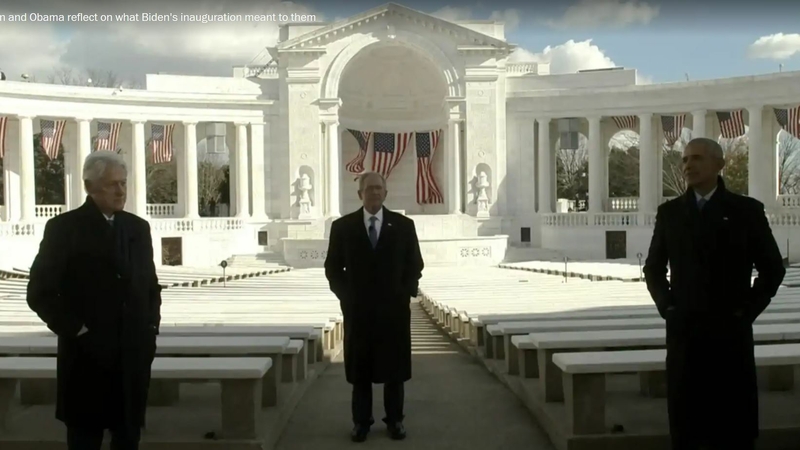
Standing in the Memorial Amphitheater at Arlington National Cemetery alongside his two predecessors in the White House, former president Barack Obama noted that inaugurations are central to American democracy.
“Inaugurations signal a tradition of a peaceful transfer of power that is over two centuries old,” Obama said in a joint video released late Wednesday with former presidents George W. Bush and Bill Clinton.
Although former president Donald Trump’s name was never uttered in the nearly three-minute clip, it served as an unsubtle rebuke to the latest member of the ex-presidents club, who has spent months torpedoing the norms surrounding the peaceful transfer of power.
Obama recalled that one of his “fondest memories” of his inauguration was Bush and former first lady Laura Bush welcoming him and former first lady Michelle Obama to the White House – a courtesy that Trump and former first lady Melania Trump didn’t afford the Bidens on Wednesday.
“It was a reminder that we can have fierce disagreements and yet recognize each other’s common humanity, and that as Americans we have more in common than what separates us,” Obama said.
Trump became the first commander in chief in more than 150 years to skip his successor’s inauguration, which was heavily guarded by the military after a mob provoked by Trump stormed the Capitol earlier this month in an attempted insurrection.
In his farewell speech on Wednesday morning, Trump never mentioned Biden’s name, although he did wish the “new administration great luck and great success.” Biden said he still hasn’t spoken to Trump, but told reporters that his predecessor did leave him a “very generous” letter, following one tradition after ignoring many others.
In the video, the former presidents presented a starkly different vision of bipartisan cooperation – one that echoed Biden’s calls for unity in his inaugural address. Bush, the sole Republican standing between the two Democrats, noted that their mere presence together sends a vivid message.
“The fact that the three of us are here talking about a peaceful transfer of power speaks to the institutional integrity of our country,” he said.
Clinton suggestedBiden’s win opened opportunities for America to change for the better.
“This is an unusual thing. We are both trying to come back to normalcy, deal with totally abnormal challenges, and do what we do best, which is try to make a more perfect union,” he said. “It’s an exciting time.”
All three ex-presidents urged Americans to find ways to talk in a moment when the nation is politically fractured.
“We’ve got to not just listen to folks we agree with, but listen to folks we don’t,” Obama said.
Bush added that “if Americans would love their neighbors like they would like to be loved themselves, a lot of the division in our society would end.”
These three former presidents, Obama stressed, stood ready to help Biden however they could.
“You’ve got all of us here rooting for your success,” he said. “We will be available in any ways that we can as citizens to help you guide our country forward.”
Biden signs order Thursday requiring masks on planes, buses, trains and at airports
InternationalJan 22. 2021Joe Biden and Kamala Harris don masks during an August event in Wilmington, Del. MUST CREDIT: Washington Post photo by Toni L. Sandys
By The Washington Post · Michael Laris
WASHINGTON – President Joe Biden signed an order Thursday mandating mask usage in airports and on many planes, trains, ships and intercity buses, the White House said.
The moves are part of a new strategy released Thursday to confront the coronavirus pandemic that has killed more than 406,000 people in the United States.
Airline workers have described the dangerous results of passengers refusing to follow mask requirements issued by airlines. Safety reports filed with the federal government show flight attendants being repeatedly taunted and verbally abused by passengers, including some who called the virus a “political hoax.”
Biden’s action comes on the heels of earlier order Wednesday – the first he issued as president – requiring masks on federal property. Together, the orders come as close to a national mask mandate as his federal powers allow, because only states and municipalities can require residents to wear masks at a local level.
The Trump administration rejected calls from Congress, unions representing transportation workers and public health experts within the Centers for Disease Control and Prevention to require masks.
Biden’s move marks a clear break from Trump’s handling of masks, although some specifics, including how it might be enforced, remain unclear pending the release of the order. It will require masks “on certain public modes of transportation and at ports of entry to the United States,” according to a White House strategy document released Thursday.
Biden had said before his inauguration he would require masks for “interstate travel on planes, trains and buses,” and CDC officials previously indicated that interstate travel is where their existing authority lies. The precise role of the Department of Transportation was immediately clear.
Biden’s pick for transportation secretary, Pete Buttigieg, appeared Thursday before the Senate Commerce Committee for a hearing on his nomination. In prepared remarks, he pointed to the need to face the broad dangers stemming from the coronavirus pandemic.
“Safety is the foundation of the department’s mission, and it takes on new meaning amid this pandemic,” according to his remarks. “We must ensure all of our transportation systems – from aviation to public transit, to our railways, roads, ports, waterways, and pipelines – are managed safely during this critical period, as we work to defeat the virus.”
The White House said Thursday the pending order “directs applicable agencies to take immediate action to require mask-wearing on many airplanes, trains,” maritime vessels and intercity buses.
The strategy also seeks more aggressive action by the Occupational Safety and Health Administration, including considering emergency standards on mask-wearing and other matters. “Biden is taking steps to cover workers not typically covered by OSHA . . . by directing agencies like the Department of Transportation to keep workers safe,” according to the strategy document.
Biden’s pending order, “Promoting COVID-19 Safety in Domestic and International Travel,” also will instruct agencies “to develop options for expanding public health measures for domestic travel and cross-border land and sea travel and calls for incentives to support and encourage compliance with CDC guidelines on public transportation.”
The CDC previously outlined the reasoning behind its “strong recommendation” to wear masks during travel.
“Traveling on public conveyances increases a person’s risk of getting and spreading COVID-19 by bringing people in close contact with others, often for prolonged periods,” the CDC said.
“People should wear masks when traveling into, within, or out of the United States on conveyances,” the agency said in the earlier guidance. “Local transmission can grow quickly into interstate and international transmission when infected people travel on public conveyances without wearing a mask and with others who are not wearing masks.”
Experts in psychology and decision-making said resistance to mask usage, including on planes, has been driven by politization at the highest levels of the U.S. government and beyond, and is also fueled by the inconsistent messaging and the insidious nature of a virus that can be spread so easily by those who don’t even know they are infected. Experts said one shortcoming has been a lack of careful testing of public health messages to make sure they are convincing.
Biden White House officials said their strategy will include “world-class public education campaigns” on mask-wearing, testing and vaccinations, which will be coordinated on the federal, state and local levels and include the private sector.
“They will be anchored by science and fact-based public health guidance. The Administration will work to counter misinformation and disinformation by ensuring that Americans are obtaining science-based information,” the according to the strategy.
By The Washington Post · Paul Schemm, Emily Rauhala
Going forward, the United States will work with – not against – the World Health Organization. That was the message delivered Thursday by President Joe Biden’s chief medical adviser.
In remarks to the U.N. health agency’s executive board, Anthony S. Fauci confirmed that the United States will halt its withdrawal from the WHO and work cooperatively to fight the coronavirus pandemic.
That will mean opting into Covax, a multilateral plan to distribute coronavirus vaccines that has drawn support from more than 170 nations but was spurned by President Donald Trump during his feud with the WHO.
Fauci’s remarks, delivered on Biden’s first full day in office, signaled the new administration’s desire to restore the United States’ relationship with an organization it helped found and shape after months of WHO-bashing and threats.
“The United States stands ready to work in partnership and solidarity to support the international covid-19 response, mitigate its impact on the world, strengthen our institutions, advance epidemic preparedness for the future, and improve the health and well-being of all people throughout the world,” Fauci said.
Mending ties with the WHO is part of a broader push to restore U.S. leadership in global public health and reengage with traditional allies after four years of Trump’s “America First” foreign policy.
The Biden administration’s national covid-19 strategy, for instance, promises that the country will “rebuild health security alliances, elevate U.S. efforts to support the Global Health Security Agenda, and revitalize U.S. leadership.”
Fauci’s address represented a striking reversal of tone.
“I join my fellow representatives in thanking the World Health Organization for its role in leading the global response to this pandemic,” he said. “Under trying circumstances, this organization has rallied the scientific and research community to accelerate vaccines, therapies and diagnostics.”
The agency’s director general, Tedros Adhanom Ghebreyesus, thanked Fauci for his remarks and for recommitting to the covid-19 fight, calling it “a good day for the WHO and a good day for global health.”
“We have a lot of work to do, and lessons to learn, to end the pandemic and meet the long list of global health challenges we face – the world will be better able to meet them with you,” Tedros said.
The last year has been anything but easy for the WHO, which has been at the heart of a complex global health crisis as well as an acrimonious political conflict.
Trump was highly critical of the organization and its director general, accusing them of mishandling the initial outbreak and being too subservient to China.
In July, after months of threats, Trump issued a letter announcing the U.S. withdrawal from the WHO after a year. In September, the Trump administration announced it would not participate in Covax because of its link to the WHO.
Some elements of Trump’s critique have resonated beyond the White House. The WHO’s actions in the early days of the pandemic have also been criticized by an independent panel, for instance, and reform measures are under discussion.
But few supported the Trump administration’s undermining of the agency mid-pandemic, and Biden promised as a presidential candidate to reverse course. Hours after taking office, the new president signed directives to reengage with the WHO.
Questions about China are likely to remain front and center in the days ahead. Fauci on Thursday expressed support for WHO-led efforts to determine the origins of the pandemic with a mission sent to China, amid fears that Beijing will obstruct the agency’s efforts.
“The international investigation must be robust and clear,” he said, “And we look forward to evaluating it.”
NEW DELHI – India only started vaccinating its own population against the coronavirus a few days ago, but it is already using its manufacturing heft to generate goodwill with its neighbors.
India’s government has made the calculation that it has enough vaccines to share. The result is a form of vaccine diplomacy that appears to be unlike any other in the world.
Since Wednesday, the Indian government has sent free vaccines to Bangladesh, Nepal, Bhutan and Maldives – more than 3.2 million doses in total. Donations to Mauritius, Myanmar and Seychelles are set to follow. Sri Lanka and Afghanistan are next on the list.
The shipments reflect one of India’s unique strengths: It is home to a robust vaccine industry, including Serum Institute of India, one of the world’s largest vaccine makers.
Early in the pandemic, Serum Institute formed a partnership to produce the Oxford-AstraZeneca vaccine. By this year, the company had already stockpiled 80 million doses. Some of that production will be delivered this month to the Covax initiative backed by the World Health Organization to distribute vaccines to poorer countries.
On Thursday, a fire broke out at a building under construction at Serum Institute’s headquarters in which five people died, reported New Delhi Television. The company said the blaze would not impact its production of the AstraZeneca vaccine.
In the race to combat the pandemic, several countries are using vaccine production as a route to enhance their global influence. But the Indian government seems to be the first to deliver multiple gifts to neighboring countries.
China has made a concerted push to sell its vaccines to countries around the globe for months but only recently announced donations to Myanmar, Cambodia and the Philippines. It is not clear if the free vaccines have been shipped.
On Thursday, Pakistan’s foreign minister had a call with his Chinese counterpart and announced that China would donate 500,000 vaccine doses by Jan. 31.
India’s diplomatic initiative has its own hashtag – #VaccineMaitri, or vaccine friendship – and received a high-profile plug from Prime Minister Narendra Modi. India is “deeply honoured to be a long-trusted partner in meeting the healthcare needs of the global community,” he wrote on Twitter.
The push comes at a time when the virus is in retreat in India. The country is a distant second to the United States in terms of coronavirus cases, with about 10.6 million in total. Daily cases have dropped significantly since last fall.
India launched its nationwide vaccination drive, one of the world’s largest, on Jan. 16. The country is aiming to vaccinate 300 million people by the summer, starting with 10 million health-care personnel. Regulators fast-tracked the approval of two vaccines – the AstraZeneca vaccine and, more controversially, a vaccine called Covaxin developed in India that does not yet have efficacy data.
So far India is providing the AstraZeneca vaccine to its neighbors. Some analysts questioned whether the donations would have a lasting impact on existing sources of tension, such as a boundary dispute with Nepal.
“You have neighbors who resent India’s overweening ways as it is,” said Manoj Joshi, a foreign-policy analyst and senior fellow at the Observer Research Foundation in New Delhi. “I don’t think they’re going to be so terribly grateful that they forget all that.”
Conspicuously absent from the list of countries receiving free vaccines is Pakistan, India’s rival and neighbor to the west. The relationship between the two countries hit a recent nadir in 2019 when they engaged in their first aerial dogfight in nearly 50 years following a terrorist attack in Kashmir.
Pakistan recently approved the AstraZeneca vaccine. It has not approached India about a potential shipment, said two Indian officials who spoke on the condition of anonymity because they were not authorized to discuss the matter. “We’ll cross that bridge when we come to it,” one of the officials said.
A spokesman for Pakistan’s foreign ministry referred queries to the health ministry, which did not respond.
India is monitoring the supply of vaccines on a weekly basis to make sure it can meet both domestic needs and demands from other countries, one of Indian officials said. Commercial exports of the AstraZeneca vaccine – including to Brazil and Morocco – will begin within days.
Countries that received the free vaccines this week expressed their thanks. On Wednesday, an Indian military transport plane landed at the only international airport in Bhutan, a tiny Himalayan nation wedged between India and China. It carried 150,000 doses of the AstraZeneca vaccine, enough to vaccinate more than one-tenth of the total population targeted for immunization.
Lotay Tshering, Bhutan’s prime minister, said in a statement that the Bhutanese people were “immensely grateful” for the vaccines. “It is of unimaginable value when precious commodities are shared even before meeting your own needs.”

 รัฐบาลไบเดนเสนอขยายระยะเวลาข้อตกลงอาวุธนิวเคลียร์กับรัสเซียที่กำลังจะสิ้นสุดออกไปอีก 5 ปี
 พรรคคอมมิวนิสต์จีนปลดเลขาพรรคเมืองจี้หยวนหลังถูกแฉเคยตบเพื่อนร่วมงานจนหัวใจวาย
 องค์การอนามัยโลกคาดผู้ป่วยโควิด-19 ทั่วโลกอาจแตะ 100 ล้านคนภายในสิ้นเดือนม.ค. แต่เชื่อวัคซีนเอาอยู่
 หญิงรายหนึ่งตัดสินใจจบชีวิตตัวเองระหว่างกักตัวอยู่ที่บ้านเพราะรู้สึกผิดที่ติด Covid-19
 ความเคลื่อนไหวนี้เกิดขึ้นหลังจากจีนคว่ำบาตรเจ้าหน้าที่ระดับสูงในรับบาลทรัมป์ 28 คน รวมทั้งรมว.ต่างประเทศ ไมค์ ปอมเปโอ
 ไอเอสโผล่เคลมอยู่เบื้องหลังระเบิดพลีชีพกรุงแบกแดด ดับอย่างน้อย 32 ศพเจ็บอื้อ
 Joe Biden and Kamala Harris don masks during an August event in Wilmington, Del. MUST CREDIT: Washington Post photo by Toni L. Sandys