เรายังไม่อาจรู้ว่าไบเดนจะใช้นิยามแบบไหนที่จะกำหนดว่าประเทศใดเสรีหรือไม่เสรี ดังนั้นเราจึงอาจใช้มาตรฐานของ Freedom House ซึ่งเป็นเอ็นจีโอทรงอิทธิพลในด้านส่งเสริมประชาธิปไตยและได้เงินสนับสนุนจากรัฐบาลสหรัฐ
บลินเคนจากนั้นก็กล่าวเสริมคำตอบนี้ยืดยาวโดยสรุปก็คือสหรัฐในยุคไบเดนจะต้องสร้างประชาธิปไตยก่อนทั้งในและต่างประเทศและอ้างการจัดอันดับประชาธิปไตยของ Freedom House พร้อมชี้ว่าประชาธิปไตยเป็นแหล่งพลังของสหรัฐด้วยในเรื่องต่างประเทศ แต่ตอนนี้มันถดถอยลงและเป็นโอกาสให้ประเทศอำนาจนิยมอย่างจีนและรัสเซียฉวยโอกาสให้เป็นประโยชน์กับตน
Biden’s unity plea is met with reminders that divisions run deep
InternationalJan 21. 2021Danny Meehan holds a protest sign as he and Pamela Meehan walk past members of the news media outside the Arizona Capitol in Phoenix on Wednesday, Jan. 20, 2021. MUST CREDIT: Photo for The Washington Post by Courtney Pedroza
By The Washington Post · Eva Ruth Moravec, Christine Spolar, Austyn Gaffney, Carissa Wolf, Griff Witte · NATIONAL, POLITICS
AUSTIN, Texas – They had lost a sister to covid-19 and watched in horror as the Capitol of the nation their father had immigrated to was trashed by white supremacist rioters.
A supporter of Donald Trump protests outside the Arizona Capitol in Phoenix on Wednesday, Jan. 20, 2021. MUST CREDIT: Photo for The Washington Post by Courtney Pedroza
So when Norma and Sylvia Luna – both Texas teachers – heard Kamala Harris take the oath of office to become America’s vice president on Wednesday, the tears flowed.
“It brings me hope, just watching this. It makes me proud to be an American again,” said Norma Luna, 49, who wore a Biden/Harris mask, Converse sneakers and a string of pearls as she watched the inauguration festivities on a smartphone at the Texas Capitol.
“We feel like we can breathe again,” added Sylvia Luna, 43.
Yet their cause for celebration was a source of angst elsewhere on the Texas Capitol grounds. To Jacob, who came sporting a “TRUMP THAT” baseball cap, the presidency had just been handed to the wrong man after a fraudulent election. “There were just too many inconsistencies,” said the 33-year-old, who declined to give his last name.
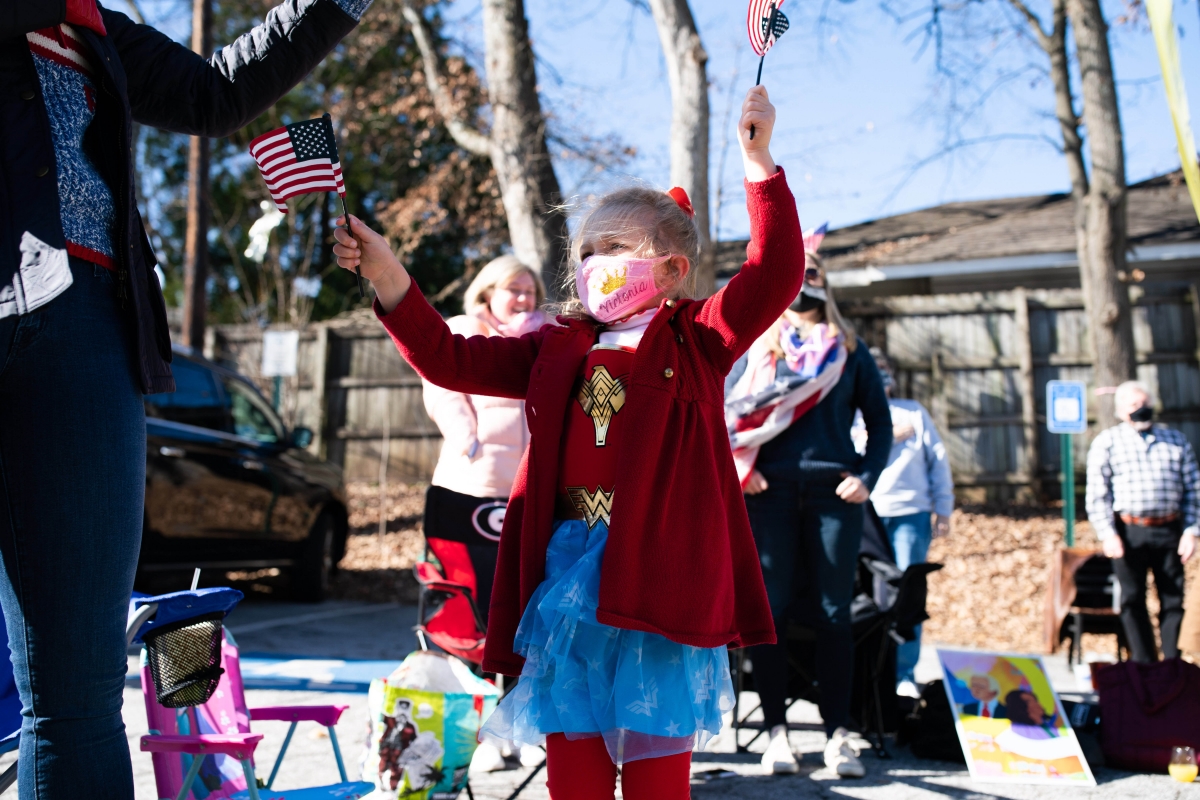
The theme of Joe Biden’s inauguration was “America united.” But in the nation’s 50 state capitals – the laboratories of American democracy – there were ample reminders that divisions run deep.
Victoria Walker attends an Inauguration Day event at Manuel’s Tavern in Atlanta on Wednesday, Jan. 20, 2021. MUST CREDIT: Photo for The Washington Post by Kevin D. Liles
The attitudes of those who showed up – either to joyously celebrate or to bitterly protest – were not the only evidence. The National Guard troops, armored Humvees and chain-link fences that surrounded many capitol complexes were added proof that toxic America’s partisanship has recently bled into violence – and could do so again.
“There is a general threat to all 50 state capitols,” said Colorado Gov. Jared Polis, a Democrat, on inauguration eve as he became the latest state leader to activate National Guard troops. Thousands had been deployed to capitals across the country late last week, ahead of a weekend in which potentially violent demonstrations were predicted by the FBI – but never materialized.
Once again on Wednesday, security officials’ worst fears were not borne out: In some states, it was close to business as usual. In others, demonstrations were small and peaceful, with occasionally tense moments.
At Colorado’s Capitol complex in Denver, dozens of “anti-fascist” demonstrators burned an American flag and yelled epithets at police, forcing officers to temporarily withdraw. In Portland, police used smoke bombs during a confrontation with far-left activists. And in Tallahassee, Fla., a Trump supporter and a Biden backer screamed at each other.
“It shouldn’t be like that,” said Molly Siddall, 18, after verbally sparring with a Trump supporter who yelled discredited conspiracy theories about Democrats and pedophilia. “That’s the problem with this country.”
Yet in a nation where the national Capitol was ransacked two weeks ago, the lack of significant strife Wednesday counted as an important step as Biden attempts to turn down the national temperature.
“His aim is to unify us,” said Willy Stokman, a lone demonstrator on an otherwise deserted Utah Capitol lawn in Salt Lake City on Wednesday. “I am hopeful that people and politicians take him up on that, because it doesn’t have to be so divisive.”
In one of the nation’s most evenly split states – Pennsylvania, which voted narrowly for Biden in 2020 after Trump eked out a victory four years earlier – security was tight Wednesday at the Capitol in Harrisburg. But the scene was calm.
Police on horseback and National Guard troops were positioned around the perimeter of the 10-block complex. On the Capitol steps, several Biden supporters waved U.S. flags and signs as a smattering of passing vehicles honked their approval. A lone Trump supporter wore a robe with the words “Impeach China Joe” affixed to it.
Matt Convery, 41, of Wallingford, said he had hoped to take his family to Washington for the inauguration but scrapped that plan after the insurrection on Jan. 6. He said he came out in the bitter cold with his sign reading “Biden” and “Truth over lies” because he watched the video of the Capitol siege and felt he needed to do something.
“I’ve never done anything like this, but wanted to do something for democracy,” he said. “It feels good.”
Across the street, Liz Albayero, 26, was behind the barista counter of the Fix Café, topping lattes with small, foamy pictures of Kamala Harris that she had found on Instagram. It was her own little way to celebrate.
“It’s so amazing to see a woman there,” said Albayero, who came to Harrisburg from her native El Salvador as a student five years ago. “I feel a part of it with her.”
Albayero, who watched on the shop’s television as the inauguration played out, said she is studying for her citizenship test and plans to vote in the next presidential race. She said she is a Harris fan – but Biden’s history is an inspiration, too. “He never gave up – no matter what happened in his life,” she said.
When Jennifer Lopez broke out in Spanish, she laughed, and when Garth Brooks sang “Amazing Grace,” she hummed along.
“This kind of represents the opposite of the last administration,” Albayero said. “I’m a minority and the last administration made me feel like I didn’t matter. It didn’t represent me.”
In Kentucky’s capital, Frankfort, Roger Abner was narrating a different experience. The candidate he had backed, Trump, was jetting to Florida after leaving the White House. And Abner was wondering why there were not more of the 45th president’s fans around to show their support.
“We feel like we don’t have a voice anywhere else since they closed off social media,” said Abner, a 29-year-old construction worker, as he stood outside a heavily guarded Capitol complex. “We actually expected a lot more people like us to be up here,”
Instead there were a few, including Abner and his childhood friend, Curtis Pavlik, 27.
Pavlik, a truck driver, wore a green T-shirt with the letters LGBT – which in this context, the shirt made clear, stood for Liberty, Guns, Beer and Trump. He carried a long steel pole with an American flag obscured by a yellow “Don’t tread on me” Gadsden-flag insignia. The response to the Jan. 6 riot – including attempts to shut down far-right social media networks – had, he said, “instilled fear into quite a few people and that’s why you don’t see a big crowd here.”
Both men had voted for Trump each time he ran, but neither approved of the Capitol riot. “There’s nothing to gain there. You have no plan to take over the government. You couldn’t if you wanted to,” Abner said.
And Pavlik said he will be rooting for Biden’s success.
“I’m not going to wish for him to fail,” he said. “I want him to do what’s good for the country. Do I think that’s what’s going to happen? Absolutely not. Do I want that to happen? Of course.”
Other Trump supporters appeared less interested in conciliation.
At Georgia’s Capitol, Rhonda Beach watched on a smartphone as a president she regards as illegitimate was sworn in.
“All of it was compromised. Every bit of it,” said the 50-year-old. “They didn’t even try to hide that they were stealing it.”
As she spoke, hundreds of police and National Guard members stood watch, having shut down streets for several blocks.
At other capitols, the security presence was barely visible. In Boise, Idaho, normal legislative work went on, undisturbed by any threats to the democratic order.
Steve Ellefson was determined to keep it that way.
“I’ve got to ring this bell!” Ellefson, 70, said as he tried to put all of his weight behind a large bell inscribed with the word “liberty.”
Ellefson sat alone near the Idaho Capitol when the clock struck noon, Eastern time. He could not quite push the bell hard enough to make it ring, but he still celebrated for a moment with praise for the Bidens. He also stood ready to serve his country.
“I am here to protect the Capitol from insurrectionists,” he said.
He had watched the Jan. 6 riot with tears in his eyes, and decided he could help protect Idaho’s legislature from a similar fate. With no threats – or even other people – to be seen, the retired bail bondsman concluded Wednesday that he probably would not be needed. But he was ready, he insisted as he thumbed the pages of a book, any time that changed.
“I’ve got a flashlight, an apple, potato and three cans of pop,” he said, “so if I have to fight, I’ll fight.”
By Syndication Washington Post, Bloomberg · Naomi Kresge, Janice Kew
Pfizer and BioNTech built the case that their Covid-19 vaccine will protect against the new variant of the coronavirus that emerged in the U.K. with results of another lab trial.
Like previous work out of the University of Texas Medical Branch, the results published on Wednesday showed that antibodies in the blood of people who had been vaccinated were able to neutralize a version of the mutant virus that was created in the lab. The study was published on preprint server BioRxiv prior to peer review.
Unlike the earlier study, which focused on one crucial mutation, the new research tested all 10 mutations located on the virus’s spike protein, which helps it bind to cells in the host.
Antibodies in the blood of 16 volunteers in a previous German trial of the vaccine were just as effective against the lab-created mutant strain as they were against the original virus. The result “makes it very unlikely that the U.K. variant viruses will escape” protection from the vaccine, wrote the research team, led by BioNTech Chief Executive Officer Ugur Sahin.
The BioNTech team is nevertheless ready to adapt the vaccine if needed in the future, it said. That could become necessary to protect against other strains amid evidence another variant that emerged in South Africa may be harder to check.
A separate study on that strain raised concern. Scientists found that half of the blood samples from a handful of patients who already had Covid-19 don’t have the antibodies needed to protect against the South African variant, which is spreading around the globe.
The findings, from South Africa’s National Institute for Communicable Diseases, suggest that those individuals may no longer be protected from re-infection. In the other half, antibody levels were reduced and the risk of re-infection couldn’t be determined, according to the institute. The findings weren’t peer-reviewed and were based on a small sample size.
Jack Ma emerges for first time since Ant, Alibaba crackdown
InternationalJan 21. 2021A livestream of Jack Ma, co-founder of Alibaba Group, addressing teachers at an annual event he hosts to recognize rural educators, is recorded from a laptop computer in Hong Kong, on Jan. 20, 2021. MUST CREDIT: Bloomberg photo by Justin Chin.
By Syndication Washington Post, Bloomberg · Lulu Yilun Chen, Coco Liu
Jack Ma resurfaced for the first time since China’s government began clamping down on his business empire nearly three months ago, appearing in a live-streamed video that sent Alibaba Group’s stock soaring but left plenty of unanswered questions about the billionaire’s fate.
Ma spoke briefly on Wednesday during an annual event he hosts to recognize rural teachers. In one video of the event circulated online, China’s most famous entrepreneur can be seen touring a primary school in his hometown of Hangzhou. Ma, who had stayed out of public view since regulators suspended the initial public offering of his fintech company Ant Group, told the teachers he’ll spend more time on philanthropy. He didn’t mention his run-ins with Beijing.
Ant confirmed the authenticity of the video, first posted on an online blog, but declined to comment further.
Speculation about Ma’s whereabouts and his standing with President Xi Jinping’s government had reached a fever pitch in recent weeks, after regulators ordered Ant to overhaul its business and began an antitrust investigation of Alibaba. Beijing’s crackdown followed an October speech by Ma in which he infamously rebuked “pawn shop” Chinese lenders, regulators who don’t get the internet, and the “old men” of the global banking community.
Ma’s comments on Wednesday struck a much different tone, echoing themes espoused by the ruling Communist Party. A former English schoolteacher, he spoke about the importance of reviving China’s countryside and narrowing income disparities by encouraging the return of younger talent to rural areas.
“Recently, my colleagues and I have been studying and thinking. We made a firmer resolution to devote ourselves to education philanthropy,” Ma said during the event. “Working hard for rural revitalization and common prosperity is the responsibility for our generation of businessmen.”
While Ma’s exact whereabouts remain unclear, his emergence in a public forum may help quell some of the more dire rumors about his fate in a country where media coverage is often tightly choreographed. Among the earliest outlets to report on his video address was an online news outlet backed by the Zhejiang provincial government.
Ma had kept out of public view since regulators in November scuttled Ant’s $35 billion IPO, tightened fintech regulations and launched a separate probe into Alibaba — all in a span of weeks.
“Jack Ma’s unexpected re-emergence — just as sudden as his earlier disappearance — is likely a sign that his relationship with Beijing’s regulatory authorities has stabilized,” said Brock Silvers, a managing director at private equity fund Kaiyuan Capital in Hong Kong.
But Ma probably isn’t out of the woods, Silvers added. “A path acceptable to all parties may have been identified, but Ant Group still looks likely to be dis-aggregated and regulatory restrictions will almost surely take a significant bite out of Ant’s former valuation.”
The clampdown on Ma’s empire is part of a broader campaign to rein in a generation of Chinese tech giants that Beijing views as wielding too much control over the world’s second-largest economy.
The government has increasingly sought to exert influence over the extent to which companies from Tencent Holdings to ByteDance amass data and direct commerce and media. The same month Ant’s IPO was scuttled, the nation’s top antitrust watchdog published new guidelines warning tech giants against monopolistic practices from forced exclusive arrangements to collusion on data. While Ant and Alibaba have borne the brunt of that assault since November, investors have since sold off peers from Tencent to Meituan. Both stocks rallied more than 3% on Wednesday.
While Alibaba’s surge added about $58 billion to the company’s market value, Ma’s standing with Beijing remains unclear. As of early December, the man most closely identified with the meteoric rise of China Inc. was advised by the government to stay in the country, a person familiar with the matter has said. Debate about his whereabouts arose because Beijing has in the past quietly detained billionaires that have run afoul of the law, without immediate trial.

 สาวกทรัมป์ถึงกับผิดหวังเมื่อพบว่าพิธีสาบานตนเป็นไปอย่างราบรื่น และเสียความรู้สึกที่ถูกหลอกให้เชื่อว่าจะมีเหตุจลาจล
 ชาวอเมริกันยังคงไม่ยอมกัน แม้ทรัมป์จะยอมถอยออกจากทำเนียบขาวแล้วก็ตาม
 เผยแผนการทำงานของไบเดนและฝ่ายบริหารชุดใหม่ ลุยทำงานอย่างรวดเร็วแบบที่ไม่เคยมีมาก่อน
 ชมภาพบรรยากาศพิธีสาบานตนเข้ารับตำแหน่งประธานาธิบดีของไบเดน


 โจ ไบเดน กล่าวสุนทรพจน์ครั้งแรกหลังรับตำแหน่งอย่างเป็นทางการ ย้ำอเมริกันต้องสามัคคีกัน
 พิธีสาบานตนของไบเดนและแฮร์ริสเป็นไปด้วยความเรียบร้อย ไม่มีเหตุไม่คาดฝันอย่างที่กังวล
 ประธานาธิบดีคนใหม่ของสหรัฐจะมีจุดยืนต่อไทยเช่นไร แล้วเขาจะมองไทยสำคัญแค่ไหน
 Danny Meehan holds a protest sign as he and Pamela Meehan walk past members of the news media outside the Arizona Capitol in Phoenix on Wednesday, Jan. 20, 2021. MUST CREDIT: Photo for The Washington Post by Courtney Pedroza


 A livestream of Jack Ma, co-founder of Alibaba Group, addressing teachers at an annual event he hosts to recognize rural educators, is recorded from a laptop computer in Hong Kong, on Jan. 20, 2021. MUST CREDIT: Bloomberg photo by Justin Chin.

