A new vaccine could help fight the third generation of smallpox and monkeypox, a leading virologist explained.
Dr Yong Poovorawan posted on his Facebook on Wednesday that vaccine manufacturer Bavarian Nordic had come up with the MVA-BN vaccine from Modified vaccinia Ankara, modified from vaccinia virus. It is a live, non-replicating vaccine for smallpox and monkeypox.
The vaccine is administered by subcutaneous injection to create immunity, but it will not cause pustules. It is as efficient as vaccines in the past, he said.
It could be administered to people with low immunity while it is not completely forbidden for pregnant or breastfeeding women.
People will be administered two doses at an interval of four weeks between each dose. However, people who have been vaccinated against smallpox only need one dose of the vaccine.
People who have been infected could receive the vaccine within four days to prevent the disease or reduce the symptoms.
The vaccine is called Imvanex in Europe and Jynneos in the US, but it has not been registered yet in Thailand.
A leading Thai virologist has urged people in at-risk groups to get a fourth dose of Covid-19 vaccine now if they received their third dose more than four months ago.
Dr Yong Poovorawan explained in a Facebook post that immunity from the first three doses drops significantly after a few months, leaving recipients vulnerable to infection again.
The number of new Covid-19 cases in Thailand has dropped below 5,000 per day but experts warn this downward trend could reverse as the effects of vaccination wear off.
The Public Health Ministry last week revealed results of its study on the effects of vaccination with two, three or four doses.
It found that two vaccine doses had the least efficacy against Omicron infection, but are 75 per cent effective in preventing severe symptoms which require ventilators.
Three jabs are 15 per cent effective against Omicron infection, but 93 per cent effective in preventing symptoms that require ventilators.
Four jabs are 76 per cent effective in preventing Omicron infection, but 99 per cent effective in preventing symptoms that require ventilators.
Yong confirmed that a fourth dose will boost immunity and protect people in at-risk groups against serious illness if they do get infected. At-risk groups include seniors aged over 60, front-line medical staff, and people with underlying conditions.
Thailand has enough vaccine doses available to protect this group of people, he added, urging them to get a fourth dose if it had been at least four months since their last vaccination.
Meanwhile, he advised healthy young people who have received three doses to wait for an update on the situation before getting a fourth shot.
A leading Thai virologist has shed light on how monkeypox can spread and how people can protect themselves.
In a Facebook post on Saturday, Dr Yong Poovorawan said that outside Africa, the disease was originally transmitted from animals to humans, especially from pet rodents like the Gambian pouched rat and Prairie dogs.
This time, however, there is no indication that monkeypox was transmitted by animals. However, he said, there is no need to worry because it can only be contracted through close contact with an infected person. Monkeypox does not spread as easily as Covid-19, so the spreading is limited to small areas.
He said in the past, people were inoculated against the virus, and if they did get infected after inoculation, they developed very few blisters.
Meanwhile, he said, the Jynneos vaccine (or Imvamune or Imvanex in Europe) can be used to provide immunity against the virus. However, he added, the inoculation is only advised for people who come in contact with infected persons.
A virologist explained how people can get infected with monkeypox and what precautions they should take.
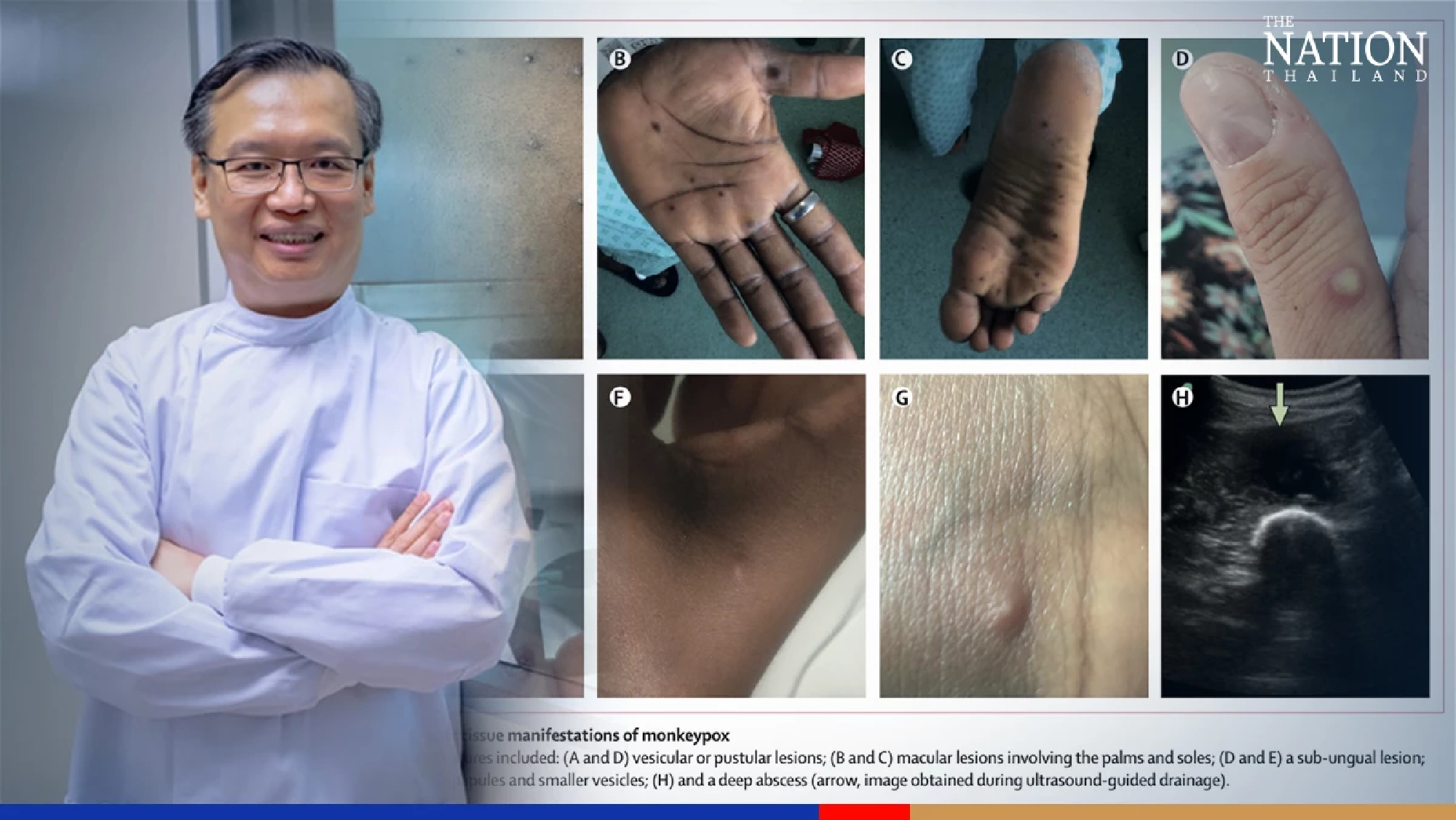
In a Facebook post on Saturday, Dr Anan Jongkaewwattana said the virus is at its strongest in pustules, based on samples collected from patients in the UK from 2018 to 2021.
The virus was also found to be present in the upper respiratory tract based on mucus and saliva samples collected. In comparison, blood samples showed a lower amount of virus, though it could also be detected in urine samples.
Based on this information, he said, the virus can be spread in many ways. Direct contact with pustules or lesions is most risky, though people can also pick up the infection from mucus, saliva, blood or even urine while using a shared toilet.
“It may be sensible to continue using masks because monkeypox is reaching us,” he said.
The Public Health Ministry believes the frozen sample of smallpox vaccine dating back 40 years may offer a key to the prevention of monkeypox.
After a discussion on the subject with the World Health Organisation (WHO), Public Health Minister Anutin Charnvirakul said on Friday that the frozen sample will be sent to the Department of Medical Sciences (DMSC) for analysis.
The department will then check to see if it can be developed into a vaccine or medicine.
“The vaccine was kept for 40 years and must be inspected to see if it can be beneficial. Even the WHO cannot tell if this vaccine can work against the current version of monkeypox,” Anutin said.
Dr Kiatiphum Wongrajit, the ministry’s permanent secretary, said the vaccine may still be effective as it can be cultured.
Separately, DMSC director-general Suphakit Sirilak said people likely to be infected will undergo an RT-PCR test for monkeypox. Samples will be collected via a nasal swab if there is no rash or from the rash excretion.
People who have travelled from Africa or the UK and have a fever will be tested, while those who have developed a rash will be separated.
He added that some 10,000 doses of the vaccine had been frozen, and the department will take a while to see if it is safe and uncontaminated. It will also check to see if the vaccine can still provide some immunity.
He added that according to information dating back to the 1980s, this vaccine can provide 85-per-cent protection against smallpox, but he said this data was too old.
Also, he said, this vaccine came from a live virus so it could reproduce quickly, but the inspection process will take a long time and a committee will first have to be set up.
If there is a monkeypox case in Thailand, then the virus will be cultured to compare the immunity developed by people who received their smallpox jab in 1980.
As of Thursday, the number of monkeypox cases across the world rose by 35 to 344. The top five countries with the most cases are Spain with 120, followed by the UK with 77, Portugal with 49, Canada with 26 and Germany with 13.
Monkeypox was first discovered in 1958 when two outbreaks of a pox-like disease occurred among monkeys kept for research. The first human case of monkeypox was recorded in 1970 in Congo during a period of intensified effort to eliminate smallpox.
[2] EpiCast report: NSCLC Epidemiology Forecast to 2025. GlobalData. 2016
[3] The National Lung Screening Trial Research Team. Reduced lung-cancer mortality with low-dose computed tomographic screening. N Engl J Med. 2011;365(5): 395-409.





 SootinClaimon.Com