The Krungthai Bank’s business analysis arm, COMPASS, believes the MRT Purple Line’s southern extension will attract up to 80-billion-baht real-estate investment in the Tao Poon-Rat Burana area.
Phacharaphot Nuntramas, COMPASS’ executive vice president, said the 110-billion-baht extension of the MRT Purple Line will be a boon for the real estate market as it will attract investments from the private sector.
He reckons the extension will boost the sale of homes in the area by 25 per cent to 9,600 units this year from 7,700 units between 2018 and 2020.
Once the Covid-19 situation eases, the condominium developments in Bang Sue and Khlong San areas and townhouses in the Pracha Uthit-Phutta Bucha area, in the below 3-million-baht price bracket and those no more than 5 million baht, will benefit the most.
He said these units meet homebuyers’ needs and grant 30 to 40 per cent of the price as profit for the developer.
He also expects the number of convenience stores in the area to rise by two- or threefold. Currently, there are four to five convenience stores per 10,000 people in Thailand.
Kanit Umsakul, an analyst with COMPASS, said government investment in this project will boost GDP growth by 0.1-0.2 per cent. Though many construction sites were temporarily closed at the start of the third quarter, construction resumed in the middle of the quarter and many developments may meet their deadline in the fourth quarter.
He also believes the real-estate sector will grow significantly next year because the government plans to boost foreign ownership percentage in condominiums. Foreigners can currently only own 49 per cent. The government is also planning to allow foreigners to buy land and houses worth more than 10 million baht.
As for Bangkok and its adjacent provinces, COMPASS speculates that the number of properties bought will rise by 4.8 per cent or by 370 billion baht during the rest of this year, and by 5.1 per cent or 389 billion baht in 2022.
However, it says the number of condominium units bought will drop by 4.4 per cent or 249 billion baht until yearend, though it will rise by 3.2 per cent or 257-billion-baht next year.
Mr. Nattha Kahapana, Deputy Managing Director and Head of Phuket Operation, Knight Frank Thailand, said that resale condominiums are considered a good indicator of pricing in the condominium market, reflecting the state of the market at any given time period and amid any situation.
There are different factors in play, such as location, condition of the project, project developer’s brand, lifestyle of residents, juristic person administration, and rental returns. For condominiums that are completed and ready for occupancy, the transactions that take place reflect real demand and supply in the local market. As such, the selling prices aptly represent the needs of buyers and sellers.
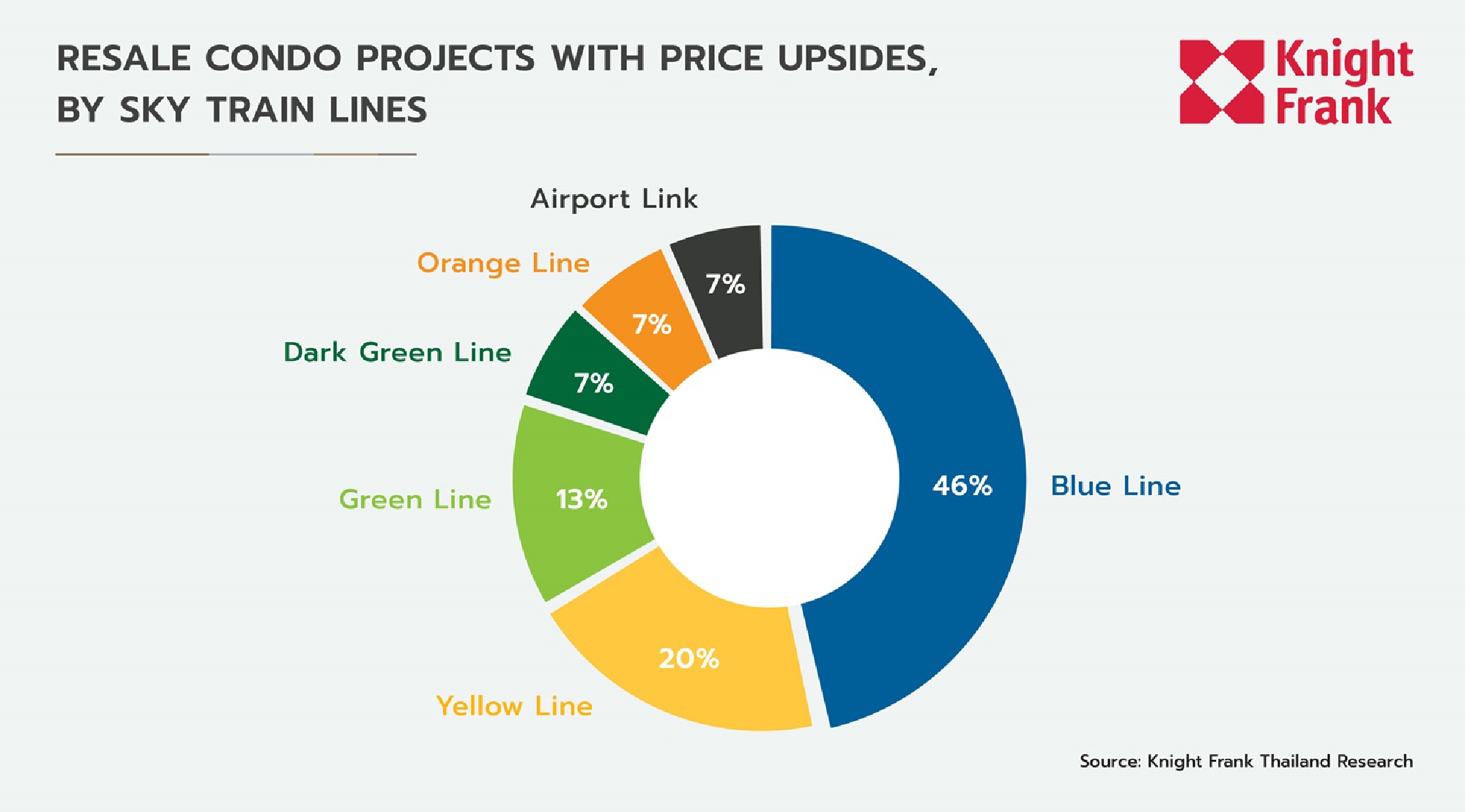
From a September 2021 survey among a sample group of resale condos located no more than 300 metres from a Sky Train station and from projects not older than 3 years with over 50 percent of the units sold, it was found that, in some cases, the asking prices in the resale market are higher than the initial prices offered by the developer. Most of these units are located near the Blue Line of the Sky Train, around Ratchadaphisek Station; the resale asking price is 162,000 baht per sq m., an upside of 22 percent. In the vicinity of Bang Phlat Station, resale condos have asking prices ranging from 87,000 to 120,000 baht per sq m., representing an upside of 10 to 22 percent. Around Sam Yan Station, despite the fact that they are leasehold condominiums, there is also an upside of 8 percent, with an asking price of 149,000 baht per sq m. The Charan 13 Station area has a resale price of 130,000 baht per sq m., with an upside of 19 percent.
The end of the Green Line at Pu Chao Saming Prai Station has resale condominium prices of 90,000 baht per sq m., which marks an upside of 14 percent. Around the Yellow Line at Thiphawan Station, the resale asking price is 111,000 baht per sq m., an upside of 16 percent. The pre-sale prices of projects in these locations are not high compared to the Green Line locations in the Sukhumvit area. Also, a portion of the units were sold through promotions intended to speed up sales and help developers maintain their cash flow during the Covid-19 crisis, which is reflected in the resale market’s moderate price upside. Additionally, many resale units tend to be quite well positioned within the projects. They have more selling points than other units in the same project as the customers who snap them up during the early sales stages tend to have the option to choose a good location first, for example. As for super luxury condos priced at 300,000 baht per sq m. and up, the upside has been quite limited. However, their target group of buyers are in a very niche market, so if there are products and services that cater to the needs of this group, it is believed that there would still be demand. This group possesses financial stability and has not been affected by the Covid-19 crisis.
Knight Frank Thailand Reveals Survey Results of Resale Condominiums, still Generating an Upside in the Covid-19 Crisis
Knight Frank Thailand Reveals Survey Results of Resale Condominiums, still Generating an Upside in the Covid-19 Crisis
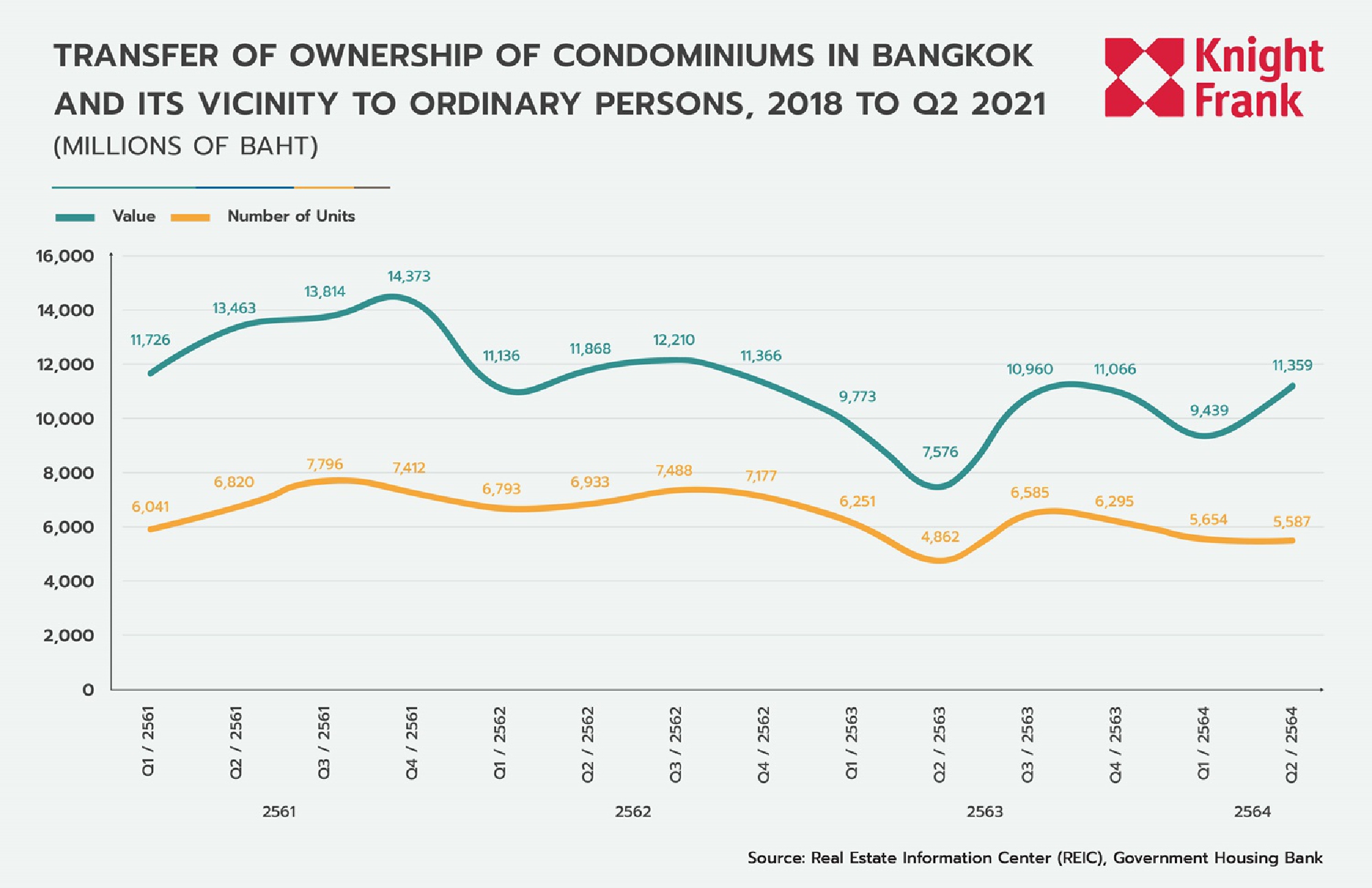
Resale Condo Ownership Transfers in Q2 2021 Recovered to Pre-Crisis Levels in Terms of Value
Ownership transfers of condominiums in Bangkok and its vicinity among ordinary persons in 2019, before the Covid-19 crisis, amounted to 11.136 to 12.210 billion baht in value. During Q2 In 2020, the transfer value decreased to 7.576 billion baht; it then gradually increased until Q2 2021, to 11.359 billion baht, which is at the same level as during the pre-epidemic period. In terms of the number of unit transfers, it is still recovering but has surpassed its lowest point in Q2 2020. This recovery in transfer value shows that the middle to upper segment of the condominium resale market is likely to recover. Meanwhile, condos in the lower priced segment is showing a slower recovery due to weak purchasing power as well as commercial banks tightening their lending terms amidst high NPL and SML levels, despite any positive outlooks.
Knight Frank Thailand Reveals Survey Results of Resale Condominiums, still Generating an Upside in the Covid-19 CrisisKnight Frank Thailand Reveals Survey Results of Resale Condominiums, still Generating an Upside in the Covid-19 Crisis
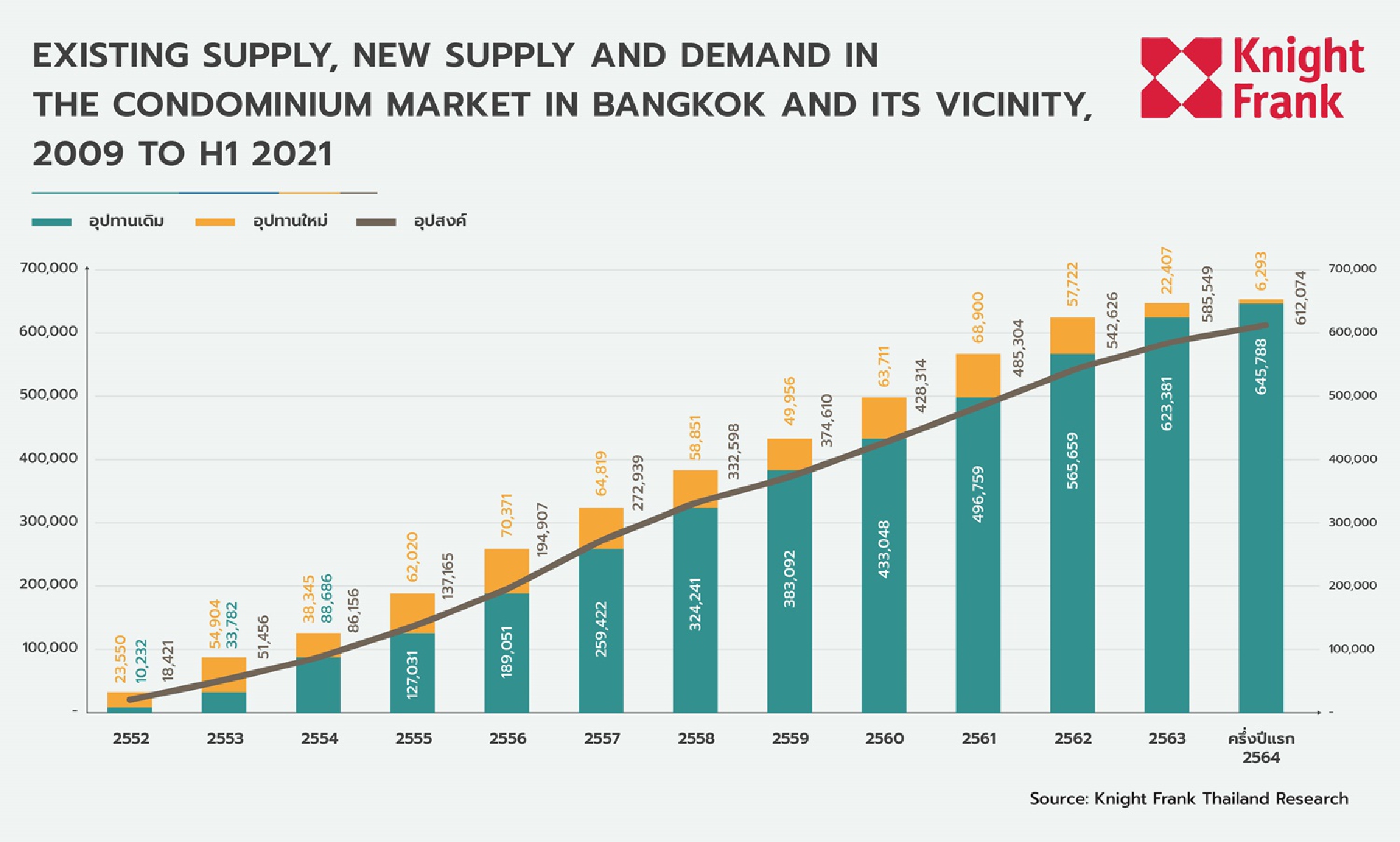
Condominium market was more balanced from 2020 to June 2021, with 23 new projects that sold well with pre-sales of over 80 percent.
Before the Covid-19 epidemic, the condo market was in an uptrend. The average new supply increase was 56,000 units per year, while demand increased by an average of 52,000 units per year as the supply continued to increase. This caused excess supply that required longer sales periods and oversupply concerns arose. In 2020, the launches of new projects slowed considerably due to concerns surrounding the Covid-19 epidemic. As a result, new project launches dropped by 60 percent to about 22,000 units – a dramatic shift from the past, which boasted an average of 56,000 new units launched per year amidst fairly stable demand. In the first half of 2021, developers offered promotions with significantly reduced prices so demand has been at 50,000 units per year, bringing demand and supply in the condo market back to a more balanced state. A survey conducted by the Research and Project Development Consultancy of Knight Frank Chartered (Thailand) Co., Ltd. found that, since 2020, there have been 23 newly launched condominium projects with 6,316 units that achieved pre-sales levels higher than 80 percent. This implies that confidence in the market has increased, and it is on a path of recovery once mass vaccinations and virus controls are in place.
Knight Frank Thailand Reveals Survey Results of Resale Condominiums, still Generating an Upside in the Covid-19 CrisisKnight Frank Thailand Reveals Survey Results of Resale Condominiums, still Generating an Upside in the Covid-19 Crisis
8 October 2021, Bangkok – Dr. Karndee Leopairote, Executive Vice President of FutureTales Lab by MQDC, said the lab with Arup Foresight and Innovation, Australia, has researched 5 future scenarios in the next 30 years to 2050 for Greater Bangkok, which extends 150 km east from the city. The scenario analysis covers 6 dimensions: Live, Work, Learn, Play, Mobility, and Sustainability.
“The 5 future scenarios for Greater Bangkok are an extension of megatrends research we’ve published. In researching urbanization, future scenarios can help us find the futures we all want, which doesn’t just involve people but also biodiversity, other organisms in the ecosystem, and the environment. These future scenarios don’t clearly show what will or won’t happen. They help provide a more comprehensive analysis. Each scenario presents both opportunities and challenges. They help inspire us to prepare in time for future events,” said Dr. Karndee.
Dr. Anne Kovachevich, Head of Arup Foresight and Innovation, Australia, said: “As the world starts to emerge from the COVID-19 pandemic, it is an interesting time to look out to 2050 and imagine the possible futures of Greater Bangkok. The last few years have seen major shifts in the way we work, live, commute, and play, and alongside that a demonstration of the human ability to adapt. Climate change impacts are clearly visible and becoming more common and extreme; the importance of health and wellbeing has been highlighted by the pandemic and cities are designing in active, healthy solutions; an aging population requires solutions for keeping both body and mind active. Amongst others, we have drawn on a few of these global trends to create 5 plausible futures for the city. These scenarios can be used to test strategies, help identify blind spots, or consider future complexities and opportunities for Greater Bangkok.”
Dr. Pannin Sumanasrethakul, Foresight Research Director at FutureTales Lab by MQDC, said that research revealed 5 future scenarios for Greater Bangkok.
Technotopia
The main factors driving this scenario are developments in automation, regional transport, and community engagement. In this scenario, a 7-year-old child may join classes online from his bedroom using VR devices. In the next 30 years, after the global impact of COVID-19, tech companies and advanced countries will bring new technology. Thailand may start thinking and operating under the governance of tech giants.
Ensuring debt management by 2030, this will help Thailand to catalyst the domestic economy and develop the city and its surroundings reaching toward population of over 25 million people. Thailand could thereby become one of Asia’s business hubs by 2050.
Urban Playgrounds
People of all ages will pay more attention to health and exercise. Policies will promote the development of the city to support activities and develop its people’s skills, also attracting more workers from abroad. Technology will meet the needs of residents, helping those with physical handicaps.
Thailand should aim to develop the city and its surroundings so people of all ages can live healthily and safely. The well-being of city residents should be promoted by 2030 with active lifestyles. That would help Thailand by 2050 will be able to attract people globally who are interested in active lifestyles.
Decentralised Resilience
Adapting to climate change includes co-creating residential areas with communities. Transport in Bangkok and its surroundings cities adjusts to rising water levels. Taking care of people in the city and its surroundings is a priority. Drought and flooding are set to be the main challenges, affecting transport and the food system. Adaption and relocation will fuel inequality. Older areas affected by issues such as rising sea levels will contrast with newly developed neighborhoods. Poorer people will have to evacuate to abandoned buildings or move further out of the city. Informal innovations in the city may include floating houses or housing pods. Abandoned buildings may be used for vertical farms.
Based on this scenario, Thailand should focus on solving the problems of drought and flooding in Bangkok and its surroundings. This will lead to the development of mixed-use industrial areas and new lifestyles by 2030. Thailand will thereby have a city that copes with various natural disasters and manages these problems well by 2050.
Accelerated Generations
Education and skill development are greatly improved in Bangkok and its surroundings to bring older adults back into the labor market. The community is involved in helping design the city to meet the needs of urban development and take care of the environment. To meet the needs of older adults and bring them back into society Thailand must apply the proper economic concepts. Implementing values that focus on family and environmental balance by 2030, Thailand will achieve leadership in startups by 2050. People of all ages will be integrated into the workforce, where the knowledge and expertise of older adults will combine with the new concepts of younger generations.
Transforming Lifestyles
Tourism will grow as environmental protection helps drives ecotourism and health tourism. Developing the skills of people in the tourism industry will also be important. The tourism industry’s outlook will be altered by the pandemic. Rather than looking at tourist numbers, the industry will focus on visitors who stay a long time, drawn by physical and mental well-being. Access to good quality of life and healthcare encourages people to slow down and value well-being and the environment.
Under this scenario, Thailand should focus on skills development to devise a strategy for the city and its surroundings to be a green megacity by 2030 that restores physical and mental health. Developing skills will attract workers from all over the world to a city that promotes well-being, including learning, which is the main goal for 2050.
“FutureTales Lab by MQDC has analyzed and studied each scenario from various angles for the next 30 years. For policymakers and communities we can provide recommendations for urban development, enabling everyone to prepare for achieving a desired future together,” said Dr. Sumanasrethakul.
Reference: Future of Urbanization Scenarios research.
The Export Acceleration Mission (EAM) is initiated by MATRADE in order to link Malaysian companies with foreign partners as well as encourage them to explore trade opportunities aboard.
Malaysia External Trade Development Corporation (MATRADE), Malaysia’s National Trade Promotion Agency is spearheading a Virtual Export Acceleration Mission (EAM) to Thailand from 26 to 28 October 2021. The objective of the programme is to provide a networking platform as well as to build a business partnership between Malaysian and Thai business community.
The Export Acceleration Mission (EAM) is initiated by MATRADE in order to link Malaysian companies with foreign partners as well as encourage them to explore trade opportunities aboard.
A total of ten (10) Malaysian companies under MATRADE from sectors such as food & beverage, healthcare, skincare and IT business solutions will be participating in the mission which aims to boost exports of Malaysian products and services in Thailand.
During the mission, MATRADE through its Bangkok office will be coordinating virtual business meetings with leading importers and buyers.Complementing this, programmes that have been arranged for the Malaysian companies include briefing on export opportunities in Thailand by MATRADE Trade Commissioner in Bangkok and relevant authorities. Among programmes planned during the mission includes, virtual business meetings, briefing on Doing Business in Thailand and Rules & Regulations as well as How to register product in Thailand.
According to Mr. Norman Dzulkarnain Nasri, MATRADE’s Trade Commissioner, Thailand is the 8th largest trading partner for Malaysia. In 2020, the total trade between Malaysia and Thailand amounted USD19 billion with the top trading products were Electrical & electronic product, Chemicals & chemical product, Transport equipment, Crude petroleum and Machinery, equipment & parts.
He also added that Malaysia and Thailand can complement each other in terms of its trade engagements especially on border trade and trade agreements. Potential products that Malaysian company can explore in Thailand are Fast Moving Consumer Goods (FMCG), Halal, Processed Food, Healthy Products, Ready-to-eat Food, Medical Products, Medical related products, Pharmaceutical, Lifestyle Products, Electronic Components, Automotive Parts and many others.
In this regard, The Embassy of Malaysia in Bangkok encourages Thai and Malaysian companies to leverage on MATRADE’s office here. Thai business community kindly contact MATRADE Bangkok to get more info about the programme or any other enquiries pertaining to Malaysian products and services.
We therefore contribute to deliver our product value which underlines “healthy concept” such as less sugar or no sugar through new product development or quality improvement to highly satisfy consumer need.
“Birdy®” reinforces itself as the top market leader of RTD canned coffee in Thailand which has been contributing to deliver its product value to meet Thai consumer’s need, reflected in the award of the No.1 Brand Thailand 2020-2021”in category of RTD canned coffee according to consumer survey conducted by Marketeer Magazine.
Mr. Wonnarate Suckeeluk, Processed Food & Beverage Business Department Manager of Ajinomoto Co., (Thailand) Ltd., stated that “Birdy® has been striving for the product improvement to meet consumers’ need both in term of quality and taste together with creating better health of consumers. We therefore contribute to deliver our product value which underlines “healthy concept” such as less sugar or no sugar through new product development or quality improvement to highly satisfy consumer need. These was shown in a variety of our product formula improvements including new product introduction such as Birdy® Black Less Sugar, Birdy® Robusta Less Sugar, Birdy® latte Less sugar, which reduced 50% sugar from the original, Birdy® Espresso Less sugar, that reduce 30% sugar but still authentic coffee taste and aroma as Birdy’s key unique including new product Birdy® Black Zero with 0% sugar. All products have been certified the “Healthier Choice Logo” in order to become the preferable healthy option for Thai consumers. This accomplishment of Marketeer No.1 Brand award shows the trust that consumer given to us as a quality coffee brand in their mind while reflecting our unchanging commitment to promote Healthy Living Society to Thai people in accordance with our Ajinomoto Group Creating Shared Value policy (ASV)”.
Birdy® promotes Healthy Living to Thais, reflecting in the Marketeer No.1 Brand 2020-2021
“Birdy®” is the pioneer of RTD canned coffee market of the country since 1993 and hold customers’mind as the number one position for over 28 years. The product commits itself to always grows with Thais and support everyone to go through any difficult situation together as its slogan that Birdy® always supports Thais.
Logistics services company WHA Corporation is set to witness growth at the end of the year after much of Thailand reopens to foreign visitors from November.
WHA chairwoman Jareeporn Jarukornsakul said the reopening would send a positive signal to businesses related to industrial estates, including those of her corporation. The business, she pointed out, will grow at the end of the year, with this growth becoming more obvious at the beginning of 2022. Jareeporn said WHA land sales will surpass the 2021 target of 820 rai – 750 in Thailand and the remaining 70 in Vietnam. She said WHA’s performance in this fourth quarter is expected to keep growing due to the improved rate of land transfers. Also, the value of WHA Premium Growth Freehold and Lshld REIT (WHART) was reportedly increased to more than THB5.5 billion, with a promising margin of returns.
WHA warehouse rental areas will total 2.56 million square metres at the end of the year, Jareeporn also revealed. Furthermore, the WHA will invest in three WHART projects in a bid to increase its rental area by 184,329 square metres. WHA’s new buildings will be rented by big players in the e-commerce market, namely Alibaba Group and Shopee Xpress, Jareeporn said. She also announced that the properties added to WHART would touch THB480 billion in value in the future, while total management areas were expected to increase by 1.58 million square metres. Therefore, WHART will still be the biggest trust in Thailand related to distribution centres, warehouses and factories, she added.
Tesla Inc. has joined the trillion-dollar-valuation club as the member with the lowest revenue.
The electric-vehicle maker’s shares have run past several milestones over the past couple weeks amid a rush of positive news, including reaching a rarefied $1 trillion in market value on Monday. That helped further bolster sentiment among investors, who are betting on Tesla’s potential for rapid future growth as EVs become mainstream and eventually replace gas-driven cars.
However, unlike its trillion-dollar peers, Tesla’s valuation touched that level before its revenue could reach the $50 billion mark.
Even though Tesla is the fifth-biggest company on the S&P 500 Index when ranked by market capitalization, it is in the 89th place when ranked by last year’s annual revenue. It is preceded by Capital One Financial Corp. — which had $31.6 billion in revenue last year versus Tesla’s $31.5 billion and is valued at $75 billion. The company with the biggest revenue on the index is Walmart Inc. — a mammoth $559.2 billion that dwarfs its own valuation of about $417 billion.
“If you look at Tesla’s revenue for the next year or so, valuation looks stretched,” Wedbush analyst Daniel Ives said by phone. However, Ives’ $1,100 price target on Tesla reflects the opportunity for the company to capture a major share of the EV market over the next five to 10 years, along with high margins, the analyst said.
Tesla’s valuation milestone came as car-rental company Hertz Global Holdings placed an order for 100,000 of its vehicles, a move that signals EVs are here to stay and gives bulls confidence that Tesla’s sky-high valuation is sustainable too.
“Wall Street is starting to believe the skyrocketing move with Tesla’s stock price is nowhere near over since Tesla has a massive lead in the EV space and improving growth potential as the U.S., European and Asian markets for electric cars grows,” Oanda analyst Edward Moya wrote in a note on Monday.
Tesla shares jumped as much as 6.1% on Tuesday, after closing up 13% on Monday. The company’s valuation now hovers around $1.1 trillion.
As the table shows, Tesla’s last annual revenue is considerably lower than that of Facebook Inc.’s, which entered the trillion club earlier this year before slipping back below that level. That also gives Tesla a very expensive price-to-sales multiple. The EV maker’s shares are currently trading at 21 times its sales, with the same ratio hovering at 8 times for Facebook and estimated to be around 6.6 times for the NYSE FANG+ Index.
Tesla also has a considerable debt load, that puts it in the 162nd place when ranked by 2020’s total debt. For the current year, Tesla reported total debt of $10.1 billion as of Sept. 30.
“Looking at current valuation multiples and market share for Tesla has been a loser’s game for years,” said Matt Weller, global head of market research at Forex.com & City Index. However, Weller noted that at some point, likely as more competition enters the market and interest rates start to rise, “investors will start to question whether the company will be able to deliver on its massive promises.”
European Central Bank officials have some convincing to do about their commitment to rock-bottom interest rates, at a time when investors are growing skeptical.
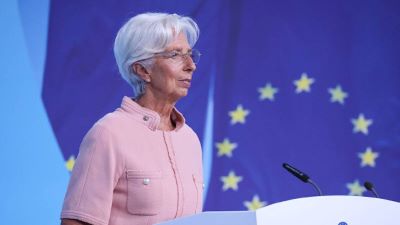
Financial markets have stubbornly ignored recent warnings from policymakers including Chief Economist Philip Lane that they’re wrong to anticipate a rate hike at the end of next year. The task of persuading people otherwise will fall to President Christine Lagarde as she presents the Governing Council’s latest decision on Thursday.
With inflation spiking, stoked by supply bottlenecks and rising energy, investors are betting that global momentum for withdrawal of monetary stimulus as espoused by the Federal Reserve will soon enough pull the ECB in its wake.
That notion has been fed further by a public debate among officials wondering how to transition from emergency bond purchases, despite the institution’s new low-rate pledge established after Lagarde’s strategy review refocused minds on lackluster price increases.
Back in September, she suggested that financial-market speculation of some eventual tightening in the future was broadly on track. Since then, amid more evidence of inflation, investors started bringing forward expectations for a liftoff in rates. They now see the deposit rate, currently at -0.5%, reaching zero by the end of 2024.
“The market is well ahead of the likely ECB response,” said Giles Gale, head of European rates strategy at NatWest Markets. “We would expect Lagarde to remind the market that they are serious enough about their forward guidance that this path represents a pretty unlikely high-inflation scenario.”
Guiding investors will be a key challenge for Lagarde as she presents the outcome of a decision that has been flagged only as a stepping stone toward a showdown in December between policy makers determining the future of stimulus.
Data on Friday is expected to show consumer-price growth in the 19-nation euro area further approaching 4%, twice what the ECB aims to reach in the medium term. So far, policy makers have insisted that’s largely transitory.
The ECB’s latest forecasts show inflation slowing to 1.5% in 2023 — not enough to justify higher rates based on policy makers’ latest manual that says forecasts must show price pressures at 2% for some time before such a step can be considered.
Investors initially pared back rate-hike expectations when presented with that guidance in July. Bets on increases in borrowing costs picked up as the economy staged a strong summer recovery, and as price growth broke through 3%.
Even so, Lagarde showed little sign of alarm at the end of September, when markets priced in a 0% deposit rate in four years’ time. “Our forward guidance has already led to a better alignment of rate expectations with our new inflation target […] We expect to see further progress toward an even tighter alignment between the expected time of lift-off for our policy rates and the most likely inflation outlook,” Lagarde said at ECB Forum on Central Banking.
Now that rate-hiking bets have kept surging, it’s unlikely that the president can still be as sanguine. If such a trend continues along with a broader tightening of financial conditions guiding policy decisions, it risks curtailing the ECB’s room to gradually phase out crisis support and move to more standard ways of supporting the economy.
“It makes sense for the ECB to be focusing its discussion on the balance sheet, rather than rates at this stage,” said Mohammed Kazmi, a portfolio manager at Union Bancaire Privee.
That focus might have distracted the ECB, said Michael Leister, head of rates strategy at Commerzbank.
“The rate hike repricing was very, very swift,” he said. “You can excuse them for dealing with other issues first.”
While Lagarde hasn’t remarked on the move, some of her colleagues are on edge. Greek Governing Council member Yannis Stournaras said Oct. 7 that rate bets “are not in accordance with our forward guidance.” Italy’s Ignazio Visco warned on Oct. 18 that “perhaps the market has been a bit too hectic.”
Lane, a member of the ECB Executive Board, expressed concern just last week.
“It’s challenging to reconcile some of the market views with our pretty clear rate forward guidance. Various Governing Council members have been indicating [that] markets may not have fully absorbed rate forward guidance,” Lane said at conference on monetary policy approaches.
Even if Lagarde and her colleagues manage to change perceptions this week, their policy will remain vulnerable to investor preoccupations guided by surging global prices.
“Short-end pricing may correct somewhat lower on Thursday,” said Jan von Gerich, chief strategist at Nordea Bank Abp. “But in the bigger picture, global inflation worries still have room to escalate.”
WASHINGTON – Senate Democrats this week are preparing to propose a new tax increase that would raise billions of dollars from a handful of the richest Americans, attempting to create perhaps the most narrowly focused tax policy in postwar history.
But criticisms of the proposal have emerged – including from at least one top Democrat – and party leadership is still considering more traditional approaches to taxing the rich.
Senate Finance Committee Chairman Ron Wyden, D-Ore., said Monday he will “in a matter of days” release a tax on billionaires that economists and tax experts project could raise more than half of its revenue from just 10 people, including Tesla co-founder and CEO Elon Musk and Amazon founder Jeff Bezos. (Bezos is the owner of The Washington Post.) Estimates vary widely on exactly how much money the plan would bring into federal coffers, in part because no such idea has ever been put into effect.
While Democrats have increasingly eyed the plan as a way to win the support of Sen. Kyrsten Sinema, D-Ariz., who has expressed opposition to increasing the corporate tax rate, some legal scholars have warned it could get struck down by the Supreme Court. And while negotiations are rapidly evolving, Democrats are considering swapping the billionaire tax for a separate 3% “surtax” on millionaires earning more than $5 million per year, according to two people familiar with the negotiations who spoke on the condition of anonymity to reflect internal negotiations. Details remain very much in flux.
The competing tax plans show the difficult trade-offs Democrats must weigh as they try to come to agreement on new sources of revenue to pay for President Joe Biden’s climate and social spending plan – which could cost as much as $1.75 trillion over 10 years – by the end of this week.
The surtax on multimillionaires – originally pitched in House Democrats’ tax plan from September to pay for Biden’s economic package – may prove easier to administer and less vulnerable to legal challenge. But the billionaire tax would fall on far fewer people and, if successfully implemented, could do substantially more to reverse the massive concentration of wealth that Democrats have for years called reflective of a dangerous increase in U.S. inequality.
“If there’s a sliver of good news, it’s that there may be at least enough political cohesion to target a class that clearly has a great deal of resources way in excess of what it needs,” said Darrick Hamilton, an economist at the New School. “When you see billionaires being able to go to space and back for hobby and fun – in a society worried about floods on a periodic basis – that’s a problem.”
Democrats billionaire tax would heavily target 10 wealthiest Americans, but alternative plan is emerging
Billionaires have been able to pay low effective tax rates in part because the value of their company stock holdings is not subject to capital gains taxes until they are sold. Wyden’s plan would amount to a major shift in the U.S. tax code by leveling a 23.8% tax on the increase in stock value – or “unrealized capital gain” – even before those assets are sold.
As a result, the plan would fall primarily on billionaires who have held onto their publicly traded stock holdings – an easily measured and publicly identifiable criteria. Their private business holdings, such as Musk’s SpaceX or Bezos’s Blue Origin, would likely not fall under the tax.
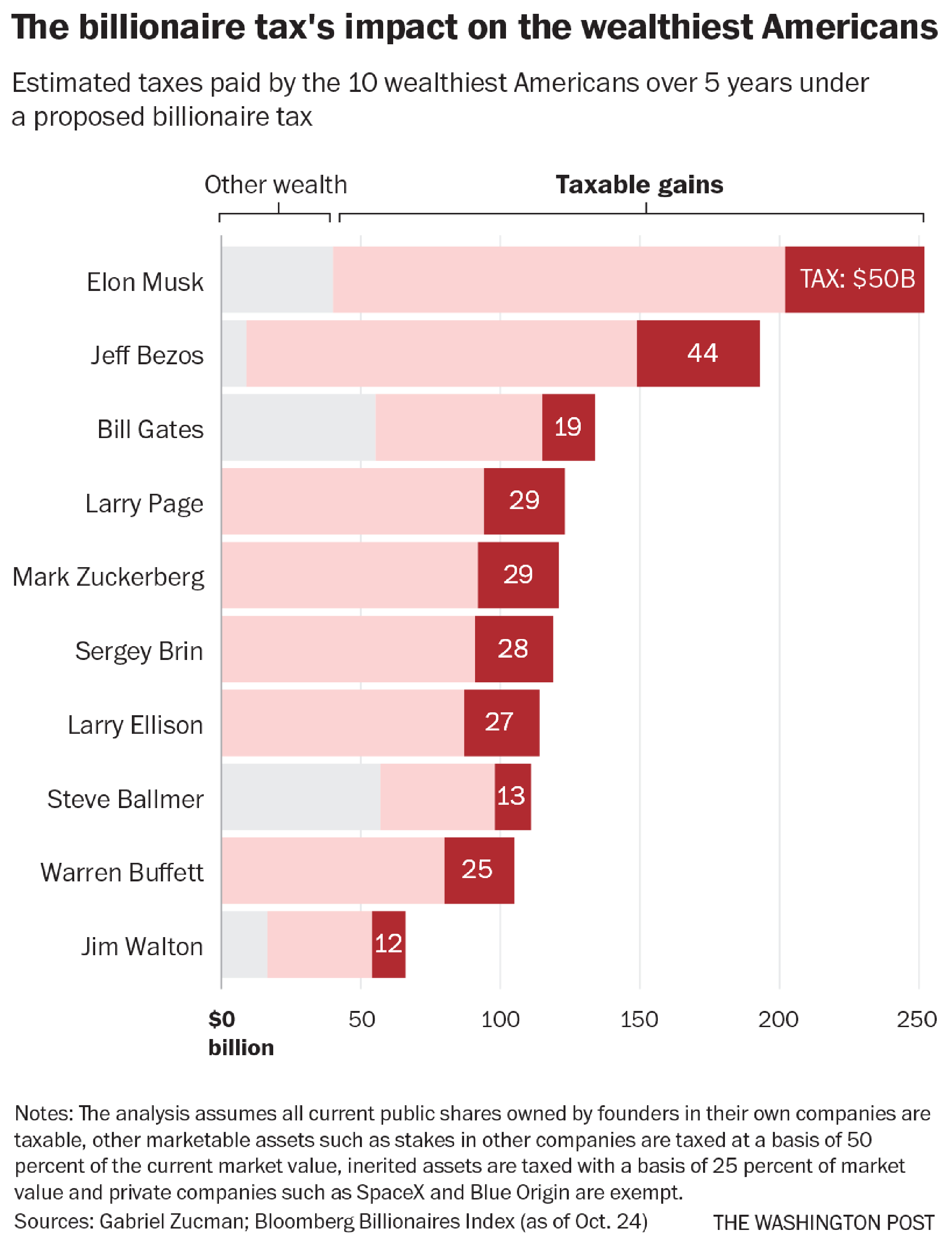
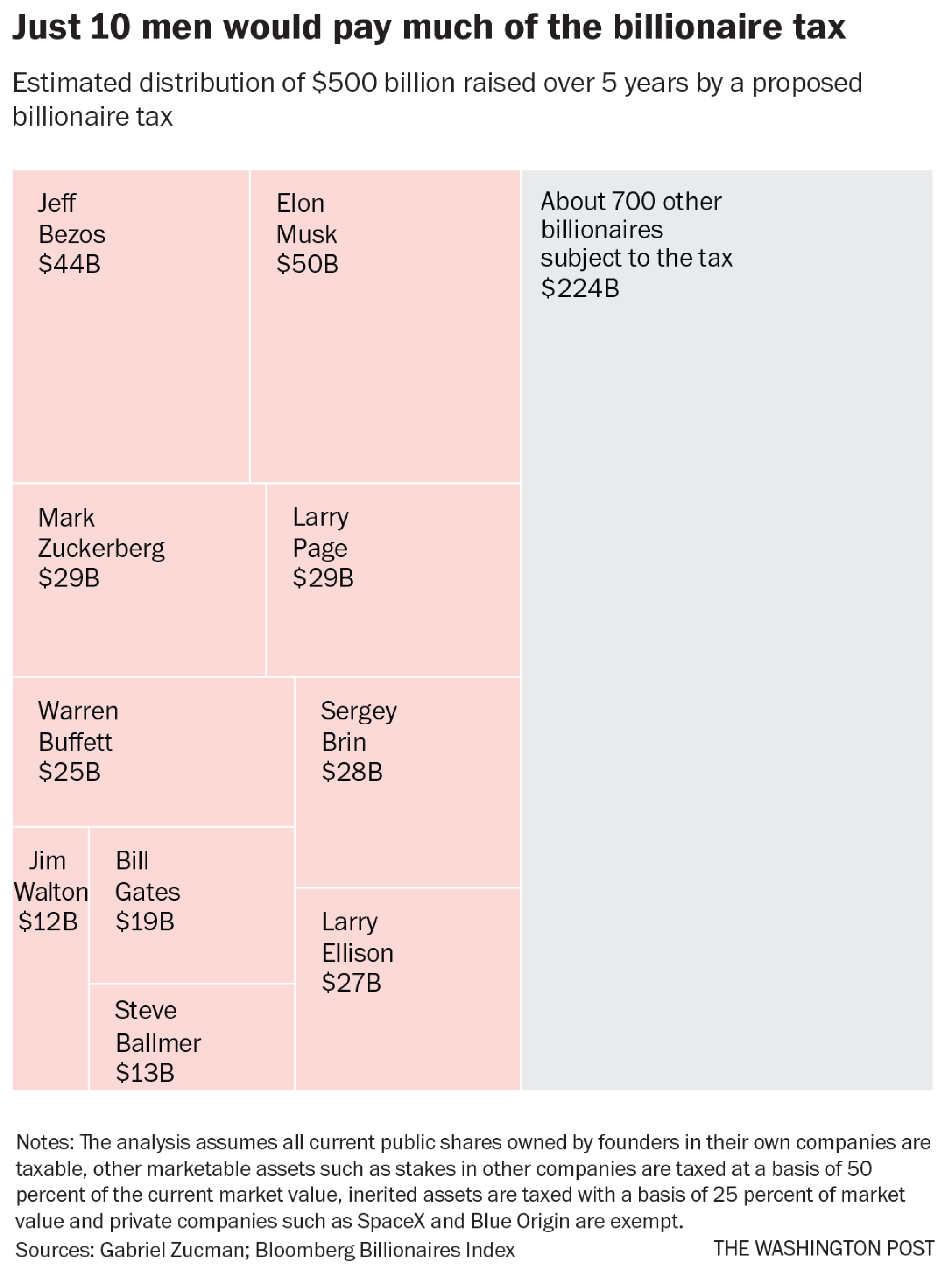
Figures for how much the tax would raise over 10 years range from between $250 billion and upward of $500 billion. But roughly half of its potential new revenue would likely be paid by just the 10 wealthiest Americans, including Musk, Bezos, Bill Gates, Mark Zuckerberg and Warren Buffett, according to an estimate by Gabriel Zucman, an economist at the University of California at Berkeley. Several other tax experts supported his broad conclusions.
According to Zucman’s analysis, Musk would pay as much as $50 billion under the tax over its first five years, while Bezos could pay as much as $44 billion, according to economists’ estimates.
Musk weighed in on the proposal Monday evening, suggesting on Twitter that it could mark the beginning of a much more aggressive taxation campaign by Democrats. “Eventually they run out of other people’s money and then they come for you,” he wrote.
He also wrote: “Who is best at capital allocation – government or entrepreneurs – is indeed what it comes down to. The tricksters will conflate capital allocation with consumption.”
Collectively, the wealthiest 10 Americans own roughly $1.3 trillion, and the Wyden plan would require them to pay a combined $276 billion in taxes. These taxes would essentially fall on billionaires’ lifetime earnings. But, once paid, the billionaires would only pay further taxes on additional increases in unrealized stock gains. That distinguishes the Wyden plan from Sen. Elizabeth Warren’s, D-Mass., wealth tax, which would indefinitely reduce billionaire wealth every year.
Democrats have increasingly viewed the billionaire tax as a way to pay for the economic package in part because of the tremendous increase in wealth at the top of the income distribution since the beginning of the pandemic. The top five billionaires saw their wealth increase 82% since the pandemic began, adding $370 billion since the S&P 500’s pre-pandemic peak in February 2020, according to calculations based on the Bloomberg Billionaires Index.
These calculations are based on wealth as of Sunday, Oct. 24, but revenue estimates will evolve along with billionaire’s wealth. On Monday alone, the total wealth held by Musk skyrocketed by as much as $36 billion due to a new order of Teslas from the rental company Hertz.
The new law would see Musk and his peers paying orders of magnitude more than they had before. A June report from the nonprofit news organization ProPublica found Buffett paid $23.7 million in taxes from 2014 to 2018. He would pay about a thousand times that number under the new proposal. Musk paid $455 million over that time, the report found, or about a hundred times less than he’d pay under the new proposal. Bezos’s new tax bill would be about 10 times what he paid in the earlier five-year period.
“It is being written so that when nurses and firefighters pay taxes with every paycheck, billionaires, who have figured out how to not pay taxes because they don’t take a wage, they’re going to have to pay their fair share,” Wyden told reporters on Monday night.
But questions abound about implementing the billionaire tax. Steve Rosenthal, senior fellow at the nonpartisan Tax Policy Center think tank, said it would be far simpler to enact Biden’s initial plan to tax capital gains when they are inherited – a proposal abandoned due to opposition from centrist Democrats – than create a new part of the tax code for billionaires.
Rosenthal also raised the question of how to ensure billionaires do not simply evade the tax by moving their publicly held stock into more opaque forms of assets, such as private companies. Wyden’s plan proposes an interest penalty on privately held assets, but such an idea is untested.
“While only a few taxpayers would pay the new tax, many more would need to value all their assets annually, including their privately-held businesses,” Rosenthal wrote in a blog critiquing the idea. “Taxpayers close to the line might move in and out of the new tax regime frequently. How would the IRS determine whether all billionaires filed properly?”
House Ways and Means Committee Chairman Richard Neal,D-Mass., has also expressed reservations about the billionaire tax idea. Neal said House Democrats previously had looked at the idea and concluded then – as now – that “it will be a challenge.” Neal raised a number of areas to address, including what the government would do when billionaires had bad years and had taxes owed to them.
“I like the politics of it, yeah, I think it’s sensible,” he said. “I think the implementation of the plan may be a bit more challenging.”
Democrats billionaire tax would heavily target 10 wealthiest Americans, but alternative plan is emerging
Other tax experts say a conservative-dominated Supreme Court would be unlikely to uphold the new tax. The constitutionality of a tax on wealth remains unclear, and it is unclear if the administration could successfully convince the court that the measure is instead an income tax – which would be permissible under the 16th Amendment.
“If I were a justice, I would uphold it . . . But I’m not. Six Republican-appointed judges on the Supreme Court are,” said Daniel Hemel, a tax law professor at the University of Chicago. “There are lots of constitutional ways to do this, and we’ve picked the one constitutionally problematic option.”
Zucman rejected the argument that the tax could prove complicated to implement. He said it “would be the most progressive tax in history,” noting the next closest – the estate tax – raises roughly $20 billion a year, possibly as little as 5% of the Wyden plan.
“For these guys, the truth is it’s so easy to enforce the tax because it’s so obvious what they own,” Zucman said.
U.S. stocks traded near all-time highs as corporate earnings helped boost sentiment amid lingering concerns about inflation and growth.
The S&P 500 and Dow Jones industrial average set records as Tuesday’s round of earnings kicked off, with United Parcel Service Inc. and General Electric Co. gaining after strong results. Facebook Inc. dropped as a pledge to buy back more shares and increase spending on digital offerings was offset by a revenue miss. Big-tech peers Twitter Inc., Alphabet Inc. and Microsoft Inc. are reporting after the market close on Tuesday.
“I don’t think anybody’s too worried about the big tech names,” said Ross Mayfield, investment strategy analyst at Baird. “Their performances are all incredibly strong in absolute standards that the bar is just so high for them at this point that it can be harder to meet expectations.”
The Stoxx Europe 600 index also rose 0.8% to close at a record high. Reckitt Benckiser Group Plc gained after the maker of Strepsils throat lozenges raised its sales forecast and Novartis AG advanced on news it may spin off its generic-drug unit.
The 10-year U.S. Treasury yield fell and the dollar gained. The debate over price pressures continues: former Treasury Secretary Lawrence Summers said officials are unlikely to deal with “inflation reality” successfully until it’s fully recognized.
“We’re coming off a 40-plus-year bond-bull market,” said Megan Horneman, portfolio strategy director, Verdence Capital Advisors, on Bloomberg TV and Radio’s “Surveillance.” “And right now we’re looking at interest rates that should be a lot higher from here. So with duration, as high as it is in the fixed income market, you have to be very cautious around fixed income.”
Earnings season is helping to counter concerns that elevated inflation and tightening monetary policy will slow the recovery from the pandemic. Some 81% of S&P 500 members have reported better-than-expected results so far, though Citigroup Inc. warned that profit growth may be close to peaking.
WTI crude oil traded above $84 a barrel as investors weighed the outlook for U.S. stockpiles and prospects for talks that may eventually help to revive an Iranian nuclear accord, allowing a pickup in crude exports.
Gold fell to $1,790 an ounce and Bitcoin slid to $62,000.
Some of the main moves in markets:
Stocks
The S&P 500 rose 0.2% as of 4:02 p.m. EDT
The Nasdaq 100 rose 0.3%
The Dow Jones industrial average was little changed
The MSCI World index rose 0.2%
Currencies
The Bloomberg Dollar Spot Index was little changed
The euro was little changed at $1.1599
The British pound was little changed at $1.3763
The Japanese yen fell 0.4% to 114.13 per dollar
Bonds
The yield on 10-year Treasurys declined two basis points to 1.61%
Germany’s 10-year yield was little changed at -0.12%
Britain’s 10-year yield declined three basis points to 1.11%
Commodities
West Texas Intermediate crude rose 1% to $84.58 a barrel


 Knight Frank Thailand Reveals Survey Results of Resale Condominiums, still Generating an Upside in the Covid-19 Crisis
 Knight Frank Thailand Reveals Survey Results of Resale Condominiums, still Generating an Upside in the Covid-19 Crisis
 Knight Frank Thailand Reveals Survey Results of Resale Condominiums, still Generating an Upside in the Covid-19 Crisis
 Knight Frank Thailand Reveals Survey Results of Resale Condominiums, still Generating an Upside in the Covid-19 Crisis
 Knight Frank Thailand Reveals Survey Results of Resale Condominiums, still Generating an Upside in the Covid-19 Crisis
 Knight Frank Thailand Reveals Survey Results of Resale Condominiums, still Generating an Upside in the Covid-19 Crisis


 Birdy® promotes Healthy Living to Thais, reflecting in the Marketeer No.1 Brand 2020-2021


 Democrats billionaire tax would heavily target 10 wealthiest Americans, but alternative plan is emerging
 Democrats billionaire tax would heavily target 10 wealthiest Americans, but alternative plan is emerging
