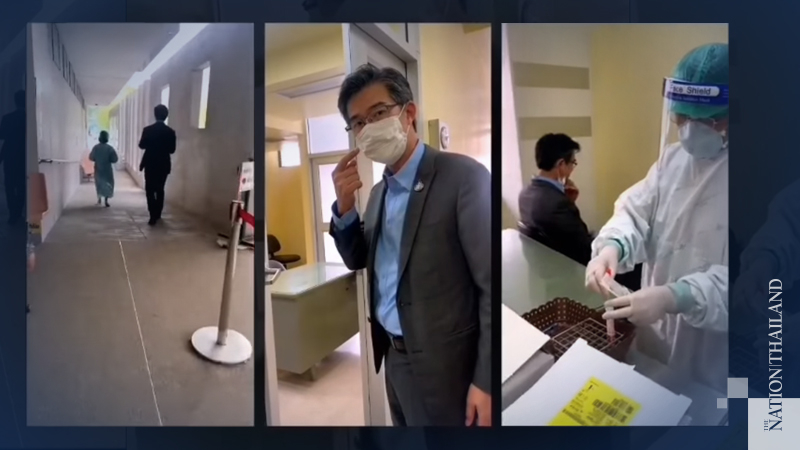
One member of the Centre for Covid-19 Situation Administration (CCSA) team has been identified as facing the highest risk of infection after a TV anchor tested positive on Friday.
Paveena Faktong, who works closely with the anchor, was named as high risk after the entire team, including spokesman Dr Taweesin Visanuyothin, underwent swab tests and got negative result.
Meanwhile, members of the press were told to leave Government House earlier than usual due to a sanitising operation. A big clean is planned for Santimaitree Building in the complex. The building is an operation centre for CCSA and where a press briefing is held twice a day.
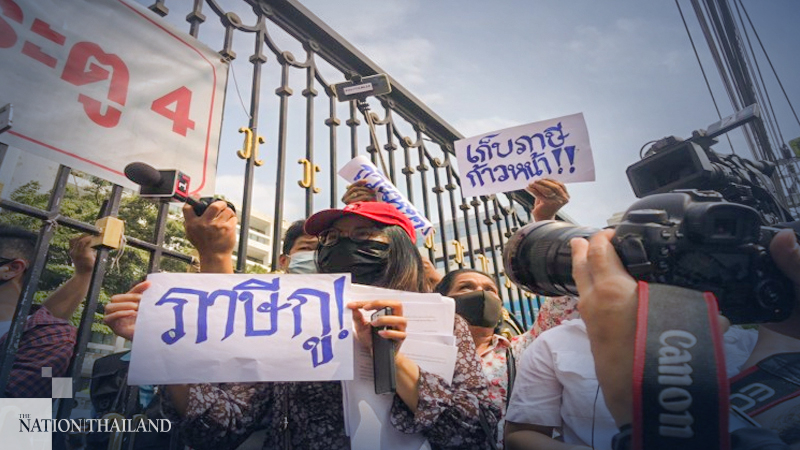
Pro-democracy protesters gathered outside the Commerce Ministry on Friday to demand that the government cut spending on the military and monarchy in order to help Thais suffering amid the second wave of Covid-19.
Ratsadon protesters led by Panupong Jadnok attempted to deliver a petition of their demands but were blocked from entering the ministry building in Bangkok.
Panupong said they were demanding that the government offer monthly payments of Bt3,500 to all Thais aged 18 and over for three months. He said this measure would cost around Bt52.5 billion.
The Ratsadon group also called on the government to import more Covid-19 vaccines and distribute them as fairly as possible. This would not only curb the pandemic but also help stabilise the country’s economy, they said.
Meanwhile the government must help relieve people’s living costs by reducing water, electricity and internet bills for at least three months, said the protesters. Students’ tuition fees should also be reduced as they had been forced to study online due to the virus crisis.
Ratsadon’s petition was received by a ministry representative, before the demonstrators dispersed.
Panupong vowed they would return next Friday if there was no response to their demands.
“The government should not treat us like beggars. The remedial cash must be distributed as widely as possible”.
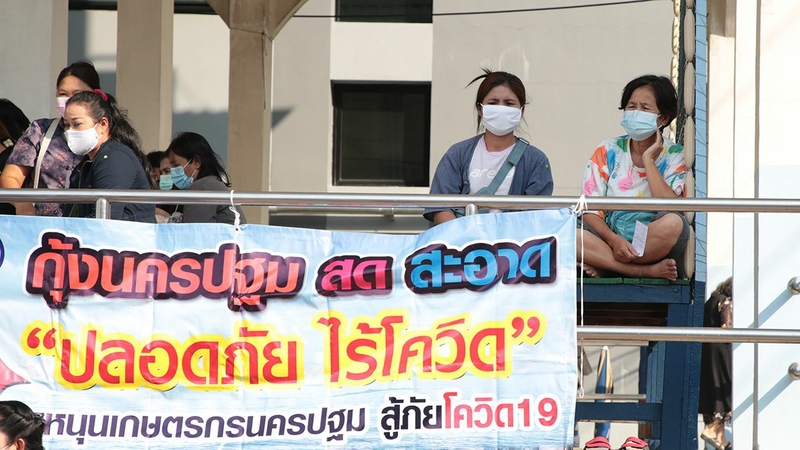
People flocked to Samut Prakan’s Pak Nam area on Friday to pick up giant river prawns at ridiculously cheap prices.
The catch had been brought to the Deep Sea Fishery Technology Research and Development Institute’s parking area by Nakhon Pathom breeders, who claimed their prawns were free from Covid-19.
This offering was part of a cooperation between Samut Prakan’s Provincial Commercial Office, Provincial Fisheries Office and Provincial Agriculture and Cooperatives Office.
An alleged rapist was found dead in his prison cell in Ayutthaya’s Nakhon Luang Police Station early on Friday.
The suspect, 35-year-old Nirut Kiaosawat, who hanged himself with a shoelace, was arrested on Thursday for allegedly raping an 11-year-old.
Rape is a problem Thai society has been struggling with for several years. The Pavena Foundation for Children and Women announced in late December that it had dealt with 10,147 cases of abuse in 2020, 863 of which were rape cases.
Founder Paveena Hongsakul said the number of rapes her foundation dealt with last year had risen by 9.8 per cent from 786 cases in 2019.
Of the assaulters, 43.26 per cent were friends, lovers or acquaintances, 30.6 per cent relatives or family members and 5.6 per cent neighbours.
Also in December, the Women and Men Progressive Movement Foundation announced an unprecedented rise in sexual assaults in Thailand compared to data collected between 2017 and 2019.
According to data, of the 333 cases of sexual assault reported in 2019, 43.9 per cent were rapes and most victims or 47.3 per cent were aged between 11 and 15.
The five provinces with the largest number of rapes are Bangkok, Chonburi, Khon Kaen, Krabi and Udon Thani.
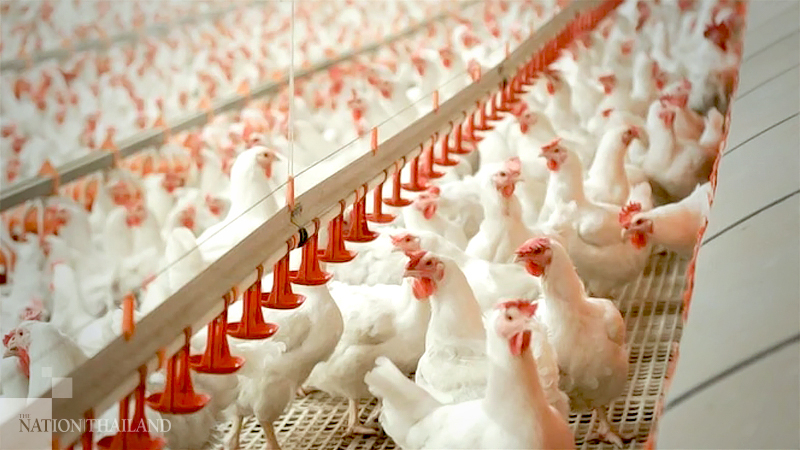
The Covid-19 crisis drove down Thai exports of processed, refrigerated and frozen chicken in 2020 to 945,000 tonnes worth Bt105 billion, from 950,000 tonnes worth Bt111.5 billion in 2019, said the Thai Broiler Processing Exporters Association on Friday.
“The outbreak resulted in lockdowns in Japan and the European Union, which are Thailand’s biggest markets,” said association head Kukrit Areepakorn.
“The situation was especially bad in Japan, since they called off the 2020 Olympic Games, meaning they cancelled orders of chicken from us that were expected to feed participants and tourists.”
Kukrit added that in the past year Thai chicken exporters had to increase shipment volumes to secondary markets such as China (up 82 per cent) and Singapore (up 59 per cent).
“The association forecasts chicken exports this year will rise 1 per cent to Bt106 billion from 950,000 tonnes, mostly due to the availability of Covid-19 vaccines in several countries,” said Kukrit.
“Meanwhile, after Brexit the United Kingdom will halve its import tariffs for Thai chicken outside the normal quota, while the recovering economy in China will also push up demand for Thai chicken.”
Among negative factors that could hit exports this year are a new wave of Covid-19, the shipping container shortage, increased freight fees and a strengthening baht, said the association.
“Moreover, shrinking demand during the outbreak has also lowered the price of Thai chicken in EU markets, from an average US$2,000 per tonne in 2020 to only $1,300-$1,500 per tonne in January,” added Kukrit.
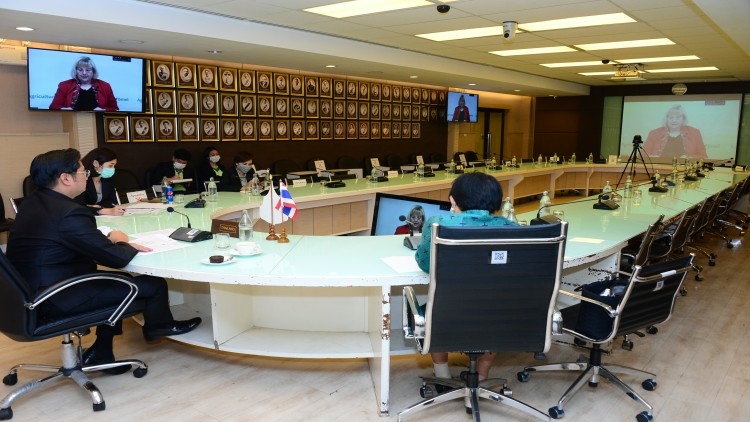
Thailand lays emphasis on a 3-S policy — safety, security and sustainability — in the agricultural sector and food system, a senior official told the 13th Berlin Agriculture Ministers’ Conference on Friday through teleconference.
Rapibhat Chandarasrivong, assistant permanent secretary at the Ministry of Agriculture and Cooperatives, told the meeting that Thailand has emphasised the 3-S policy by promoting food safety to attain international standards and nutritionally building food security, which can ensure the well-being of farmers.
The ministry is ready to support sustainable agriculture that is environmentally friendly, including prevention of plant and animal diseases and bringing technology and innovation to agriculture. The ministry also supports participation in the Global Soil Partnership (GSP), under the Food and Agriculture Organization (FAO) and water resource preservation on the global stage.
He emphasised the support for sustainable soil and water resources management. Thailand is ready to participate in various commitments and would work with the FAO and related agencies to support the implementation of the global food system policy to push for practical results to achieve Sustainable Development Goals (SDG) 2 (zero hunger), SDG 13 (climate change) and SDG 15 (life on land) goals, he said.
It is also important to store Big Data on soil, water, climate change, diseases of plants and animals, said Rapibhat, adding that would lead to accurate production planning.
The goal of the World Food Systems Leadership Summit (2021 UN Food Systems Summit), of which Thailand has been appointed a National Dialogues Convenor, is to collect information from all sectors involved in the food system and use it to prepare policies and activities to report to the leadership meeting at the end of this year.
Energy Absolute (EA) expects the proportion of its revenue to change this year, especially since its electric vehicle-related business has been growing.
EA director Amorn Sapthaweekul said the power plant business will drop from 60 per cent to 50 per cent, and biodiesel business from 40-45 per cent to 30-35 per cent. The remaining 10 to 20 per cent of the business will be contributed to by the EV business, he said, adding that EA’s total revenue this year will grow by around 20 per cent thanks to the growth of EV.
Amorn also said the construction of EA’s battery plants will be completed in the first quarter, which will contribute to growth, especially since the batteries can support both electric cars and boats that EA produces.
He also said the company has received orders for some 400 to 500 electric public vehicles and products will be ready for delivery at the end of the first quarter.
Its electric boats, meanwhile, will be delivered in March to state agencies to be used for public transport between Bangkok and neighbouring provinces.
He added that EA will build more charging stations nationwide to increase the number of stations from 400 to 1,000 as originally targeted.
Residents in 47 areas of Bangkok will not be able to use tap water from 10pm on Saturday to 8am on to Sunday due to maintenance work on a water main in a park on Rama VI Road, the Metropolitan Waterworks Authority (MWA) said on Friday.
The 47 areas are:
1. Rama VI Road
2. Ratchawithi Road
3. Yothi Road
4. Sri Ayutthaya Road
5. Phetchaburi Road
6. Banthat Thong Road
7. Phya Thai Road
8. Rama I Road
9. Rong Mueang Road
10. Charu Mueang Road
11. Charat Mueang Road
12. Nikhom Makkasan Road
13. Krungkasem Road
14. Phloenchit Road
15. Rajdamri Road
16. Ratchaprarop Road
17. New Petchaburi Road
18. Sawankhalok Road
19. Larn Luang Road
20. Rama V Road
21. Nakhon Sawan Road
22. Rajdamnoen Klang Road
23. Rajdamnoen Nai Road
24. Rajdamnoen Nok Road
25. Damrongrak Road
26. Bamrung Mueang Road
27. Luang Road
28. Rachinee Road
29. Charoen Krung Road
30. Tri Phet Road
31. Tee Thong Road
32. Phahurat Road
33. Chak Phet Road
34. Worachak Road
35. Chakkrawat Road
36. Yaowarat Road
37. Song Wat Road
38. Samsen Road
39. Ratchasima Road
40. Prachathipatai Road
41. Nakhon Chai Si Road
42. Amnuay Songkhram Road
43. Sukhothai Road
44. Phitsanulok Road
45. Luk Luang Road
46. Wisut Kasat Road
47. Phra Sumen Road
The MWA apologised for inconvenience caused by the water cuts, adding that residents who faced problems could contact its 24-hour call centre on 1125.
The Food and Drug Administration (FDA) approved AstraZeneca’s viral vector vaccine after studying the 10,000 pages of documentation submitted on December 22, FDA chief Paisan Dankhum said on Thursday.
The approval is based on effectiveness, quality and safety. The import licence and vaccine certificate is effective for one year.
The first lot of 50,000 doses will be imported from Italy next month. When the vaccine arrives, the Department of Medical Sciences will conduct random tests to see if the vaccine is of the quality specified by the company. Similar batches will be sent in March and April.
As for the manufacturing deal signed between AstraZeneca and Siam Bioscience, a factory will be registered and production will kick off in May.
Strict measures were put in place in many provinces after a new wave of infections originating from a shrimp market in Samut Sakhon and a gambling den in Rayong hit the country in mid-December.
However, now that the number of new cases is dropping, some provinces are making moves to ease some measures.
Ayutthaya:
Provincial governor Panu Yaemsri announced on Friday that health establishments, spas and foot-massage operators can reopen provided they are willing to comply with Covid-19 control measures. Operators will also be given guidelines on reopening their businesses safely and correctly.
Nakhon Ratchasima
Travellers from controlled areas no longer need to quarantine for 14 days.
A statement released by provincial governor Wichian Chantaranothai on Friday said:
1. Travellers from the 23 highly controlled provinces, such as Bangkok, Kanchanaburi, Chachoengsao, Tak, Chumphon, Nakhon Nayok, Nakhon Pathom, Nonthaburi and Pathum Thani, etc, need to follow these guidelines:
• Travellers staying for more than 14 days are required to report to the village headman, district chief, health officer or communicable disease control officer within 12 hours for screening and risk assessment.
• If staying overnight, the traveller has to report to provincial health officials as well as observe strict control measures.
2. Travellers from the five “red-zone” provinces, namely Samut Sakhon, Rayong, Chonburi, Chanthaburi and Trat, are required to quarantine for 14 days, report to the village headman or health volunteer within 12 hours and present documents showing the necessity of travel.
3. Holding large gatherings:
• If fewer than 300 people are participating, the organiser has to notify the district public health office;
• If more than 300 people are participating, the event must be approved by the provincial communicable disease committee.




 Wichian Chantaranothai

