Public Health Minister Anutin Charnvirakul said on Tuesday that his ministry was considering replacing the current Thailand Pass system with a vaccine passport for screening foreign arrivals.
He was speaking at the opening ceremony of Thailand MICE Day 2022 at Bangkok’s IconSiam shopping complex.
Hosted by the Thailand Convention and Exhibition Bureau, the event aims to promote meetings, incentive travel, conventions and exhibitions in the country after the Test & Go system for foreign arrivals ends on April 30.
“Vaccine passports are an international standard used to screen foreign arrivals based on each visitor’s vaccination history. We could use this to replace Thailand Pass,” Anutin said.
“The ministry is working on designing the process that can verify a person’s vaccine history, and will evaluate the situation again.”
Based on the current situation, the minimum requirement for a vaccine passport should be three doses of Covid-19 vaccine, as two jabs alone are not enough to raise immunity for a prolonged period, Anutin pointed out.
He insisted that Covid-19 insurance would still be a prerequisite for all foreign arrivals even after Thailand switches to vaccine passports.
“We are trying to return everything back to normal as soon as we can so people can go back to living their lives as they did before the outbreak, but the timing and measures must be carefully decided upon to prevent any future problems,” Anutin said.
“Currently, the ministry is maintaining the ‘3 adequacies’ policy to support the full reopening of Thailand, that is ensuring we have adequate drugs and medical supplies, adequate health professionals, and adequate hospital beds for Covid-19 patients,” he added.
From May 1, those who wish to enter the country must register via Thailand Pass and present a vaccine certificate as well as evidence of Covid-19 insurance with coverage of US$10,000 (THB342,000). If a traveller is unvaccinated, he/she must also present either a negative RT-PCR result taken within 72 hours of departure, or evidence of a 5-day booking at an alternate quarantine facility. There will be no tests upon arrival, but visitors are advised to take an antigen test (ATK) during their stay in Thailand.
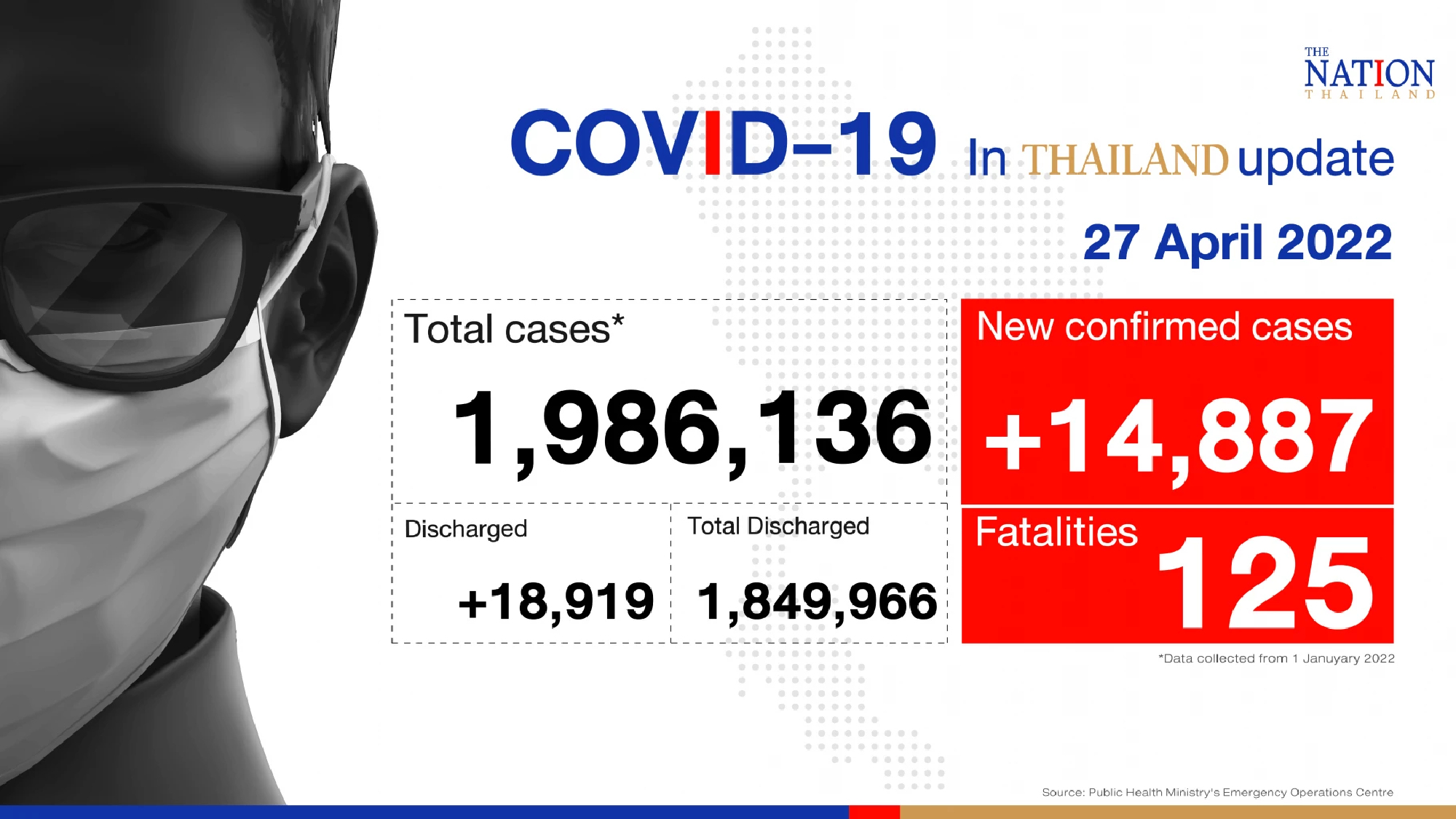
Ministry of Public Health reported on Wednesday (April 27) morning that in the past 24 hours there are 14,887 new patients who tested positive for Covid-19, 71 of whom have arrived in Thailand from abroad.
Death toll increased by 125, while 18,919 patients were cured and allowed to leave hospitals.
Cumulative cases in the country since January 1, 2022 are at 1,986,136.
The Cabinet on Tuesday bumped up the monthly allowance for some 10 million elderly Thai citizens for the next six months.
Speaking to reporters after the weekly Cabinet meeting, Prime Minister Prayut Chan-o-cha said the government has allocated about 8 billion baht for the new rate, which will go into effect this month.
He said the government is concerned that the elderly population will have been indirectly affected by the Covid-19 crisis as their children may not be able to provide enough financial support.
“Hence, the government has decided to increase their monthly allowance for six months, so they have a better quality of life,” Prayut said.
“The government attaches importance to taking care of all groups and we do not want to leave anyone behind in this crisis.”
A government press release listed the changes based on ages as follows:
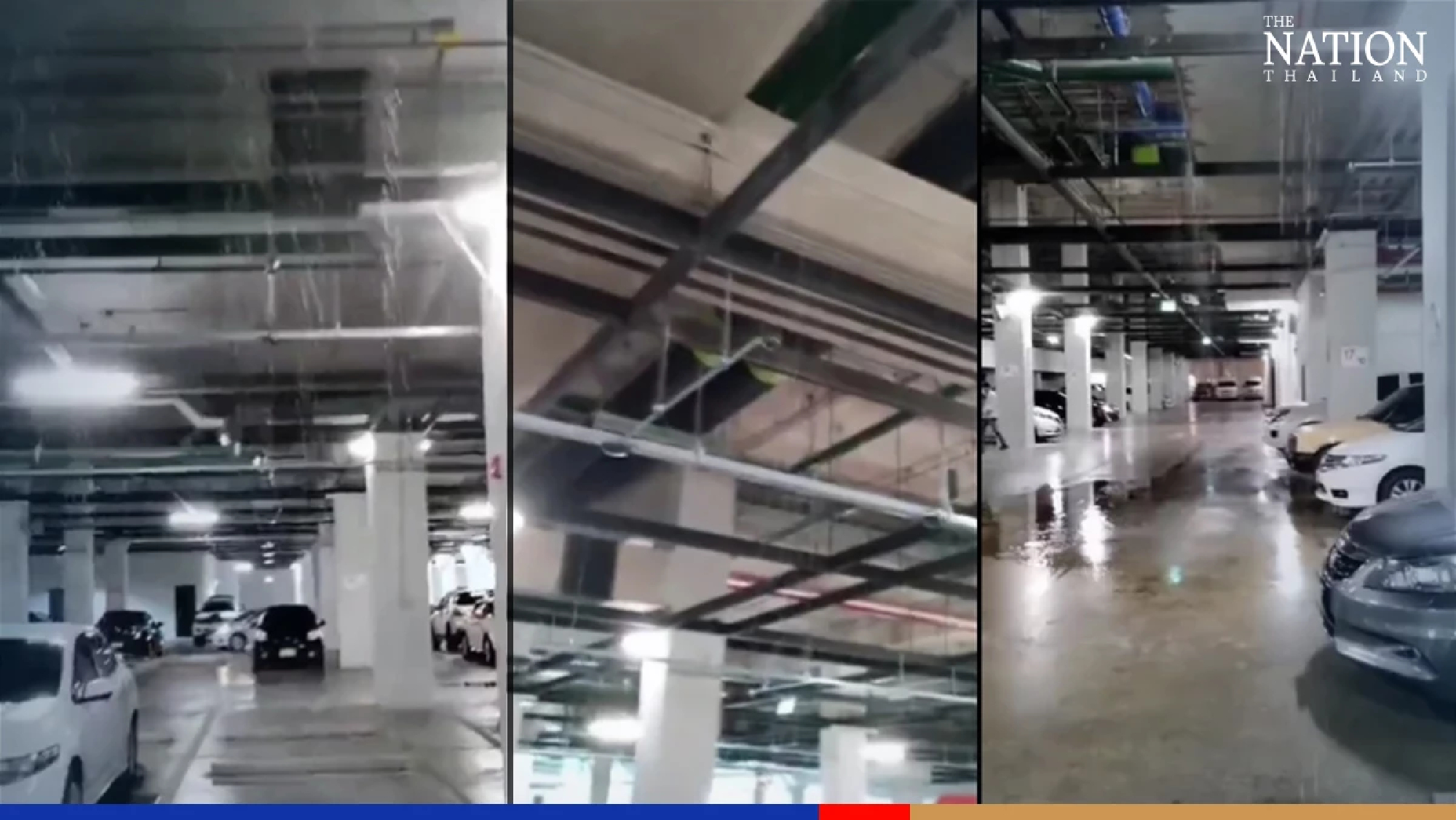
The parking area at Parliament complex in Bangkok’s Dusit district was partly flooded on Monday after water gushed out of water pipes.
Former Democrat Party MP Watchara Petthong said on Tuesday that the incident took place at 5pm, adding that the complex could get flooded even without rains.
He blamed the flooding on defective construction, and warned that such incidents would expose people to risk of electrocution.
This is not the first time such an incident has taken place inside the huge complex, built at a cost of THB12.2 billion baht.
Between September and October last year, rainwater had leaked into several areas of the building, including the Suriyan Hall where MPs convene their meetings, and the office of Parliament President Chuan Leekpai, he said.
The incident happened again on March 1 when a large tap-water pipe on the eighth floor of the complex broke, causing leakage that looked like a big waterfall in the rooms of advisory teams and the House of Representatives deputy secretary-general, he added
The leaked water cascaded down three elevator shafts from the eighth floor to the basement, forcing suspension of the elevator service.
Watchara claimed that there were a series of other similar incidents that have gone unreported due to cover-ups by Parliament’s permanent officials.
The investigation into the death of TV actress Nida “Tangmo” Patcharaveerapong in late February, which sparked many theories and plenty of debate, was finally wrapped up on Tuesday.
At a press conference on Tuesday, police ruled out murder and concluded that she died in an accident caused by negligence and recklessness.
Pol Lt-General Jiraphat Phumphichit, chief of Police Region 1, met the press at Police Region 1 headquarters to announce the conclusion of the case. The case was then forwarded to public prosecutors in Nonthaburi, who then slapped the six suspects with relevant charges in court.
The suspects were released on bail and public prosecutors said they would set up a three-member panel to review the report.
Tangmo, 37, reportedly fell off a speedboat into the Chao Phraya River on February 24 and her body was found two days later. She was on the boat with five others, who now face criminal charges. A sixth person is also facing charges for allegedly advising the five suspects to keep quiet.
Jiraphat became the chief investigator of the case, which fast captured public interest and became the talk of the town.
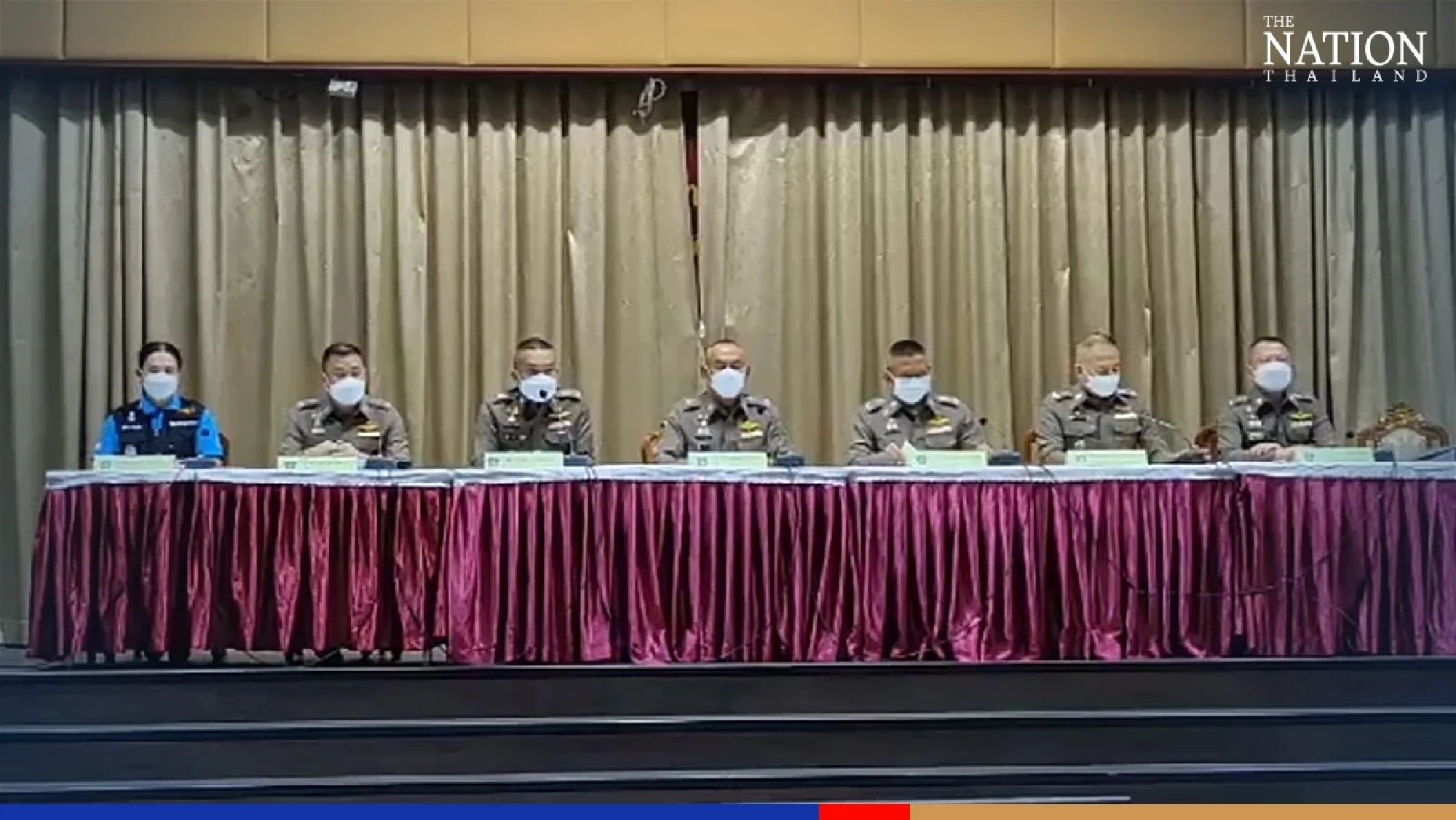
He and six other senior investigators told the press that they had interrogated the six suspects and recorded testimony provided by 124 witnesses.
The 2,249-page investigative report is supported by 88 times of evidence, 47 pieces of documentary evidence and 200 video clips.
The police team also provided details of the charges faced by the suspects:
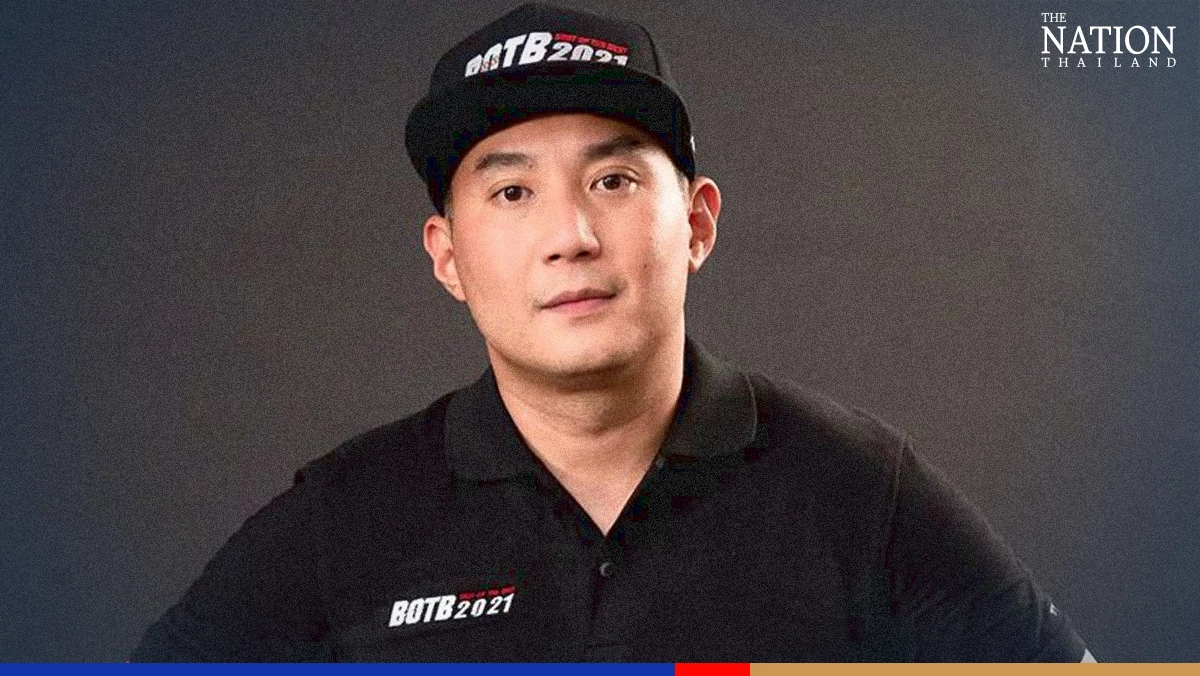
1. Tanupat “Por” Lerttaweewit
• Negligence causing death in violation of Section 291 of the Criminal Code. The offence carries a maximum jail term of 10 years and/or a maximum fine of Bt200,000.
• Violating the 1913 Navigation in the Thai Waters Act by using a boat with an expired licence.
• Violating the law by driving a boat without a licence.
• Violating Section 119 of the navigation law by jettisoning waste into a river.
• Violating Section 172 of the Criminal Code by providing false testimony to the police.
2. Phaiboon “Robert” Trikanjananun
• Negligence causing death.
• Violating navigation law by driving a boat without a licence.
• Violating the law by using a boat with an expired licence.
• Violating Section 119 of the navigation law by jettisoning waste into a river.
3. Wisapat “Sand” Manomairat
• Negligence causing death.
4. Nitas “Job” Kiratisoothisathorn
• Violating Section 184 of the Criminal Code by helping others to escape the criminal penalty and destroying evidence.
• Violating Section 119 of the navigation law by jettisoning waste into a river.
5. Idsarin “Gatick” Juthasuksawat
• Violating Section 184 of the Criminal Code by helping others escape the criminal penalty or destroying evidence.
• Violating Section 172 of the Criminal Code by providing false testimony to the police.
6. Pheem (surname withheld)
• Violating Section 184 of the Criminal Code by helping others escape the criminal penalty, destroying evidence and telling others to give false statements to police.
At the press conference, police also showed a video clip to try and establish what the investigators think happened on the night of February 24 before and after Tangmo fell off the speedboat.
Jiraphat confirmed that based on GPS records and other evidence including phone records and video feed from security cameras along Chao Phraya’s banks, Tangmo fell off the boat at 10:34:09pm.
He and other investigators confirmed that Tangmo was at the rear of the boat when she fell, before cutting the meeting short and saying that they needed to rush the case to the public prosecutors.
Mysterious circumstances
Tangmo’s death has been shrouded in mystery as several prominent lawyers and public figures rejected the account provided by the five who were on the speedboat with the actress.
That fateful night, Tangmo joined Tanupat, Phaiboon, Wisapat, Nitas and Idsarin on the speedboat after having dinner with them at a riverside restaurant. They were to drink wine on the boat.
Social media has been buzzing over the past two months about whether Tangmo’s death was really an accident and what actually happened that night. The most common questions raised were: Did Tangmo fall from the front or the back of the boat? Was it a real accident? If so, was some information being concealed or was it murder in disguise?
Owing to this public attention, a Senate committee on justice also stepped in to look into the case. The panel was pushed by one of its high-profile members, retired forensics chief Khunying Porntip Rojanasunan, who has long been an opponent of the Thai police. Police suspicions also prompted a second autopsy on March 17.
Porntip has repeatedly said she does not believe Tangmo fell off the back of the boat and does not believe the big, deep gash in the victim’s inner right thigh was caused by a propeller blade.
However, police dismissed her claims and confirmed to the press on Tuesday that Tangmo did indeed fall from the back of the boat and the wound had been caused by the blade.
Earlier Wisapat told police that Tangmo fell off the boat while she was trying to urinate over the rear edge of the speedboat.
But many questioned Wisapat’s testimony, arguing that Tangmo was wearing a tight bodysuit and was too conservative to have exposed herself in public.
At the press conference, police said they had never confirmed that Tangmo had gone to the back of the boat to relieve herself, adding that they had simply quoted Wisapat’s claim.
Police also pointed out that no signs of urine could be found on the back of the boat because it had been washed off by water.
Meanwhile, Jiraphat said no help was being offered to the suspects and that they face the charge of causing the death of another through negligence. He also insisted that it was an accident caused by negligence and that someone should be held responsible.
New suspect
Pheem, a new name added to the list later, has been charged with advising the five suspects to not meet police immediately after the incident.
The five had disappeared from the scene on the night of the incident and only showed up to meet police at 8pm on the following day.
After wrapping up the press conference, the team escorted the suspects along with eight boxes of evidence and investigation report to hand them over to the prosecutors in Nonthaburi.
Meanwhile, Tangmo’s mother Panida Siriyudthayothin and her lawyer Decha Kittiwitthayanan said they were pleased with the police investigation team’s explanation.
Panida said she can now focus on the cremation of Tangmo’s body and will consult their Protestant priest about scheduling rites.
The 25-year-old owner of a roller skating and roller blading rink has traversed from Chiang Rai to Yala province on his Rollerblades, covering 2,051 kilometres in 55 days.
Jitruek Narat reached Betong, the border town of Yala, on Monday afternoon.
He had left Chiang Rai’s Mae Sai district, which is the top part of Thailand, on March 1.
When he skated into Betong, Jitruek was welcomed by officials at security checkpoints and local residents. They congratulated him for being the first person to be able to travel with Rollerblades from the topmost to the bottommost points of the country.
Speaking to reporters after his arrival, Jitruek said he loves extreme games, and he especially loves roller blading and roller-skating sports. He is now teaching rollerblading and roller-skating at his own training rink in Nakhon Pathom province. He is also a coach for children and youths of the Skate for All Academy in Bangkok.
Jitruek said he wanted to set a record with his Rollerblades, so he decided to rollerblade from Mae Sai to Betong.
He said no one has travelled from the top to the bottom of the country on skates, although there have been people who have run or biked along the route.
Jitruek said he travelled about 15 to 30 kilometres a day, and on average took about one or two days to pass through a province.
He looked for a shelter to rest only when dusk fell. He stayed at temples when he could not find a hotel.
Jitruek recounted that when he skated past a sightseeing or tourist destination, he always took pictures to promote the provinces that he had passed through.
The skating trainer said he loved the southern border provinces because there are several beautiful sightseeing spots in the provinces, including waterfalls and seasides. He added that residents of southern border provinces were also kind and treated him with foods and drinking water with smiling faces.
Jitruek said he would visit major tourist destinations in Betong, such as the Aiyerweng Skywalk to see the sea of mist, the Betong hot springs, the Muen Buppha flower garden, and the winter flower garden.
He would later travel by bus to Yala downtown to meet people who love rollerblading and he would travel by bus to the Hat Yai airport in Songkhla province from where he will fly back to Bangkok.
Four Northeastern, or Isaan, provinces — Nakhon Ratchasima, Ubon Ratchathani, Udon Thani and Khon Kaen — will be included in Michelin Guide Thailand 2023.
The sixth edition of this guide will be released at the end of 2022.
Michelin Guide International Director Gwendal Poullennec said their inspectors had been impressed with the flavourful and distinctive Isaan cuisine, as it employs simple cooking methods yet delivers subtle and complex flavour profiles.
Isaan cuisine also features food preservation techniques, using local wisdom in ensuring a longer shelf life for fish and seasonal vegetables as food ingredients, he added.
“Many Isaan-born chefs are playing a significant role in elevating Isaan food to the next level, using local ingredients combined with their superior cooking skills, setting a new standard for more high-quality local food,” he said.
“This is a great sign that the Northeastern region of Thailand will soon be an interesting tourist destination for local gastronomy, contributing to a good economy for local communities and markets.
Meanwhile, Tourism Authority of Thailand (TAT) Governor Yuthasak Supasorn said the launch of Michelin Guide Thailand in the past five years has been a valuable contribution to TAT’s mission to promote Thailand as an international gastronomic destination.
He said the number of Michelin-starred, Bib Gourmand award winners, and selected dining establishments has increased each year, thanks to Michelin Guide’s exploration of new territories across the country and local restaurants striving to improve quality and service.
These efforts have helped drive awareness and set new trends for gastro-tourism among local and international travellers on a broader spectrum, he added.
“Thailand’s Northeastern region has vast potential – in terms of culinary culture and history, diverse tourist attractions, as well as charming local lifestyle,” he said.
“Moreover, the Northeastern region has a lot of outstanding local food and handicraft products, with more than 34 registered Geographical Indication items to look out for when shopping for souvenirs.
“With the launch of the upcoming 2023 Michelin Guide Thailand edition, we hope that not only will the entire world become aware of the vibrant culinary scene of the Northeastern region of Thailand, but also boost tourism and the local economy at the same time,” he added.
From left: Nicolas Achard and Yuthasak Supasorn
Since the first edition of Michelin Guide Thailand launched in 2018, the number of overall selected eateries has increased from 126 to 361.
Of these, the number of Michelin-starred eateries has grown from 17 to 32, and Bib Gourmand award winners have gone up from 35 to 133.
The coverage has expanded from Bangkok in the 2018 edition, to now include Phra Nakhon Si Ayutthaya, Chiang Mai, Phuket and Phang Nga in the 2022 edition.
The Mohan border checkpoint in China has issued Thai durian exporters an ultimatum to resolve their Covid-19 problem in five days, starting Monday, failing which they will be banned.
Sanchai Puranachaikiri, president of the Thai Fresh Fruit Traders and Exporters Association, said in an interview with news outlet Thansettakij that Chinese officials had issued a warning letter to Thai durian exporters.
The letter said that the Mohan border checkpoint officials had found Covid-19 disease in imported durians several times during random testing. It also reported the latest results from durian consignments on Saturday. A total of 82 Thai durian trucks arrived at the Mohan border checkpoint on Saturday. Six of them, or 7.32 per cent tested positive, according to a nucleic acid test for Covid-19.
The checkpoint will speak with related companies to reinforce Covid-19 prevention measures and order related organisations to solve the issue within five business days.
If the issue is not solved after five business days, the Mohan border will ban durians from Thailand.
Sanchai said that the government should issue clear and definitive measures to ban exporters found to be lax. He said these operators should stop operating for two weeks to resolve their problem.
The government should stop exporters from exporting durians for seven days to let some 100 pending durian cargos enter China first.
If the government still lets them export durians, the new cargo will be stuck with the leftover cargo and this will cause more damage.
He added that the Ministry of Agriculture and Cooperatives and provincial agricultural offices should enforce Good Agricultural Practice Plus standards strictly.
The Office of Agricultural Affairs in Guangzhou also posted on Facebook on Monday that the Mohan checkpoint has strict Covid-19 prevention measures.
Operators should control and prevent contamination of their products and packages by taking maximum caution.
The Department of Medical Services (DMS) has warned people to avoid a new drug “Happy Water”, which is being sold illegally at entertainment venues, as it could cause death.
Department deputy director-general Dr Manus Potaporn said on Tuesday that the “Happy Water” drug was recently found to be sold in entertainment venues by a drug trafficking network.
It is made from several other drugs including ecstasy, methamphetamine, diazepam, caffeine, tramadol, or drugs affecting the nervous system, and is mixed with hot water or sweet drink.
The drug is known to affect the mind and nerves, and users feel dreamy, active and energetic, and experience fun.
The drug has been gaining popularity among Thai and foreign tourists and might spread to a wider circle, he said.
Manus said it is a worrying matter because using several drugs at the same time or using a high amount of drugs while drinking alcoholic beverages could be dangerous to the body and brain, and could even cause death.
Dr Sarawut Boonchaipanichwattana, director of the Public Health Ministry’s Princess Mother National Institute on Drug Abuse Treatment, said that the drug trafficking network is currently mixing several drugs and claims that it could intensify the effects, more than using a single type of drug.
Apart from entertainment venues, the drug was also found to be sold on social media platforms.
People who would like to get more information on drugs and related crimes could call 1165, or contact at the website http://www.pmnidat.go.th.
Those who would like to treat drug addiction could go to the Princess Mother National Institute on Drug Abuse Treatment in Pathum Thani Province, or six Tanyarak Hospitals in Chiang Mai, Mae Hong Son, Khon Kaen, Udon Thani, Songkhla and Pattani provinces.
Bangkok’s famous New World mall, which became a tourist attraction over the years, will finally be demolished.
The structure in Bangkok’s Banglamphu area, which has been abandoned for 33 years now, even served as an art exhibition site for Silapakorn University students in 2020.
However, the Phra Nakhon district office said on Monday that the owner has been contacted and has agreed to demolish the building.
District chief Vason Boonmuenwai said the structure was not stable and could pose a danger to residents.
The site had been cordoned off for demolition work on Monday, and Vason reckons the job will take between eight and 12 months.
The New World mall, which opened in 1983, was once bustling with shoppers but had to be shut down in 1994 when the Bangkok Metropolitan Administration (BMA) took the owner to court for illegally adding seven floors to the building. In 1997, the court ordered that floors five to 11 be removed and in 2004 a part of the building collapsed killing a passer-by.
The building was closed in 2004, but holes in the roof allowed rain to get into the building, flooding the lower floors, which then became a breeding ground for mosquitos. The locals then released fish into the water, inadvertently turning it into a tourist attraction.
However, the site was cordoned off in 2014 and the fish removed.
The owner Kaew Pooktuanthong also owns Kaew Fah Plaza, which suffered similar problems.




 He and six other senior investigators told the press that they had interrogated the six suspects and recorded testimony provided by 124 witnesses.
 1. Tanupat “Por” Lerttaweewit
 2. Phaiboon “Robert” Trikanjananun
 3. Wisapat “Sand” Manomairat
 4. Nitas “Job” Kiratisoothisathorn
 5. Idsarin “Gatick” Juthasuksawat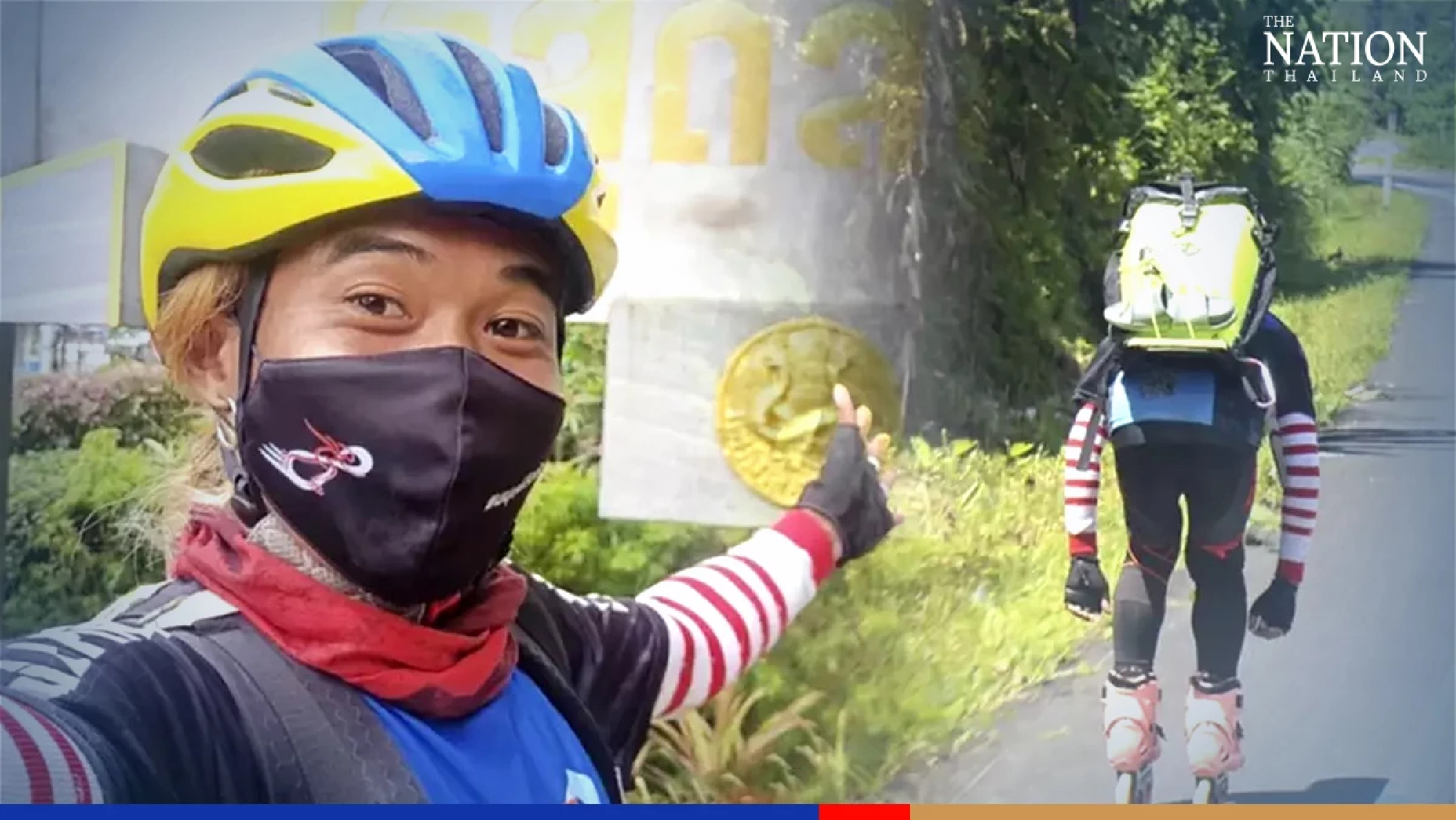

 He looked for a shelter to rest only when dusk fell. He stayed at temples when he could not find a hotel.
 Jitruek said he would visit major tourist destinations in Betong, such as the Aiyerweng Skywalk to see the sea of mist, the Betong hot springs, the Muen Buppha flower garden, and the winter flower garden.
 From left: Nicolas Achard and Yuthasak Supasorn


