Kanchanaburi park rangers snare suspected bird-hunter
NationalFeb 16. 2021Photo credit: Department of National Parks, Wildlife and Plant Conservation’s Facebook
By THE NATION
A 64-year-old man caught snaring wild birds in Kanchanaburi’s Sai Yok National Park has been charged with four offences.
Park officials on an anti-logging patrol found the man lurking in the forest on Sunday afternoon and suspected he was planning an ambush, according to the Department of National Parks, Wildlife and Plant Conservation.
Searching the man, they discovered 24 snares, a wild bird and what they suspected was a chicken used as bait. They detained the suspect, who was identified as Sombat Nilubon, 64, a Kanchababuri local living in Sai Yok sub-district.
Sombat was charged with hunting protected species without permission, possessing a protected species, harming the species, and bringing weapons into the forest.
Panusaya “Rung” Sithijirawattanakul, a key leader of the anti-establishment movement, visited the Constitutional Court, Justice Ministry, Criminal Court, police headquarters and the premier’s office on Tuesday to demand fairness and respect of people’s rights.
Police officers were stationed at the different sites while she read her statement.
Panusaya and 24 other protesters have been summoned on Wednesday to hear charges in relation to an earlier rally held at Sanam Luang.
Pro-democracy protesters led by Jatupat “Pai Dao Din” Boonpattararaksa began a march from Nakhon Ratchasima to Bangkok on Tuesday morning, calling on authorities to release four fellow protesters, including Parit “Penguin” Chiwarak.
On February 9, the Criminal Court denied bail to Parit and three other Ratsadon pro-democracy leaders – Arnon Nampa, Somyos Prueksakasemsuk and Patiwat “Bank” Saraiyam.
The four are accused of lese majeste law and sedition over their role in an anti-government rally at Thammasat University’s Tha Prachan campus last September.
Parit was also charged for participating in the “Mob Fest” rally on Ratchadamnoen Road on November 14-15.
The marchers are walking from Nakhon Ratchasima’s Thao Suranari Monument to Bangkok’s Democracy Monument – a distance of about 250 kilometres.
Separately, members of a royalist network gathered before Parliament on Tuesday afternoon to submit a petition opposing any change to the lese majeste law (Article 112).
Pansuwan Nakaew, a representative of the group, said it was right that those who defame the monarchy should be punished by the lese majeste law. He added that several countries also had laws to protect their monarchies.
Democrat Party spokesperson Rames Rattanachaweng accepted the letter on behalf of the House speaker, who was busy overseeing the censure debate in Parliament.
The Department of Special Investigation (DSI) and police on Tuesday announced they have arrested modelling agent Danudet “Nene” Saengkaew, 28, over charges of child pornography.
Danudet had been arrested on February 11 at his office, “Nene Modeling”, in Pathum Thani’s Khlong Luang district.
“The DSI has been tracking the suspect after an Interpol tip-off in 2018 that a lot of child pornographic material circulating in the dark web had originated from Thailand,” DSI chief Pol Lt-Colonel Korawat Parnpraphakorn said.
“This tip-off first led to the arrest of Thakorn Atthapathomchai, 30, in Bangkok’s Wang Thong Lang district on November 21, 2020.
“Investigators learned that Thakorn would contact parents via Facebook saying he was a modelling agent and would get them to bring their children in for an audition. He would then sexually assault the youngsters in a closed room,” he added.
The DSI chief said Thakorn has reportedly confessed that the photos and videoclips he had taken of assaulting or raping minors were being stored at the Pathum Thani modelling. This led to a crackdown on Danudet’s agency.
Thakorn has been sentenced to nine years in prison over several charge, including raping minors and violating the Computer Crime Act.
“Officials found more than 500,000 pornographic images of children on computers and hard-disk drives at the agency, as well as video cameras, mobile phones, sex toys, lubricant jellies and condoms,” added Korawat. “Officials are investigating to see how Danudet’s agency was involved in Thakorn’s crimes.”
Danunet was initially charged with violating the Computer Crime Act by uploading pornographic material into a computer system, which carries a maximum punishment of five years in prison and/or Bt100,000 in fine.
Deputy Prime Minister Prawit Wongsuwan opened up on his Vietnam War experience in a rare walk down memory lane during an exclusive interview to Nation TV.
Prawit, a former commander-in-chief of the Royal Thai Army, said he had never expected to be in the high position he holds now. In his younger days, Prawit said he thought he should take part in wars whenever possible so that he could get promoted.
Prawit recalled that he was stationed in Phu Phan district of Sakon Nakhon province for eight months after his graduation from Chulachomklao Royal Military Academy.
The young Prawit decided to register himself for the Vietnam War. Before he took part in his first operation on a foreign battlefield, he underwent six months of training in Kanchanaburi province.
Prawit said that in Thailand, soldiers had mostly fought gun battles, but in Vietnam the soldiers were supported by aircraft. He said one of the key principles to avoid an offensive was to minimise visibility. He added that his experience in Vietnam had taught him real life lessons of war, and of how to live with each other.
He downplayed the hardships he had to face, saying they were unavoidable as he had chosen to be a soldier.
Dr Taweesin Visanuyothin, the spokesperson of the Center for COVID-19 Situation Administration (CCSA), has revealed on Tuesday that the cluster found among resident of Chula Niwas building, Chulalongkorn University, has increased to 22 cases — 14 men and eight women.
Patients of the cluster have a cough, phlegm, muscle ache, and fatigue
Index case, or the first case, detected on January 29, a document delivery man, 56. He lived in Chula Niwas building on the 12th flood. Seven cases, residents of Chula Niwas building, possibly infected from him. Three of them are security guards, carrying the virus to spread to a security guard training centre.
Chart shows number of patients in Chula cluster, representing in colour with light blue show patients livin on 12th flood of Chula Niwas building, dark blue is patient live in Chula Niwas building, orange is people in a security guard training centre, yellow is patient in a private company, and white is in other sources.
Five key factors for this cluster to spread widely includes; living in the same risk area, being co-workers working in the same area, eating together, joins the same activities in large number, and finger scanner which found a number of virus, meaning they didn’t clean the most shared touchpoint regularly.
Dr Taweesin urges public to keep clean and frequently clean their hand since it might become the virus carrier to their bodies.
The Cabinet on Monday set the price of final-stage sugarcane with a sweetness of 10 commercial cane sugar (CCS) at Bt833.22 per tonne and set the yield rate for processed sugar for the 2019/2020 crop year at 357.09 per tonne, the government’s deputy spokesperson Ratchada Thanadirek said.
“The price of ripe sugarcane with different CCS values will be adjusted by Bt49.99 per CCS level,” she added.
She went on to say that the Industry Ministry’s new proposed rates for final-stage sugarcane and returns on manufacturing and sale of processed sugar are higher than for young sugarcane and sugar at early processing stage. Hence, she said, this means the Sugarcane and Granulated Sugar Fund will not have to cover the difference for sugarcane farmers and sugar mills.
“The new price and return rates are also in compliance with the World Trade Organisation [WTO]’s regulation on sugar dumping, which Thailand has been in dispute over with Brazil,” she said.
In 2016, Brazil filed a complaint with the WTO that Thailand’s subsidies had led to the dumping of Thai sugar in foreign markets, which violated WTO’s rules.
The measures cited in Brazil’s complaint were the Thai government’s sugarcane price guarantee scheme, soft loans for farmers and the ethanol subsidy scheme, in which molasses is used as the main ingredient in the production of the biofuel.
Industry Minister Suriya Juangroongruangkit had previously said that the sugarcane harvest for 2020/2021 crop year will be lower than the previous year due to the government’s policy to ban the burning of crops in a bid to reduce air pollution.
“Farmers will no longer be able to harvest sugarcane quickly by setting fire to their fields,” he said. “The ministry has instructed the Sugarcane and Granulated Sugar Fund to lend harvesting machines to farmers so there is no shortage of raw sugar.”
Thammasat University reported in its Thammasat Today Facebook page on Tuesday that a medical student at the university’s Rangsit campus has tested positive for Covid-19.
The university urged people to take care of themselves and avoid going to crowded places.
The Faculty of Medicine later issued a statement saying 47 people had come in contact with the infected student. Of them, 42 have tested negative and five are awaiting results.
On Monday, the university reported that a member of the Faculty of Law at the Rangsit campus had tested positive for Covid-19.
Three mutated strains of Covid-19 being watched closely, Thai official says
NationalFeb 16. 2021Dr Opass Putcharoen, chief of Thai Red Cross Emerging Infectious Diseases Clinical Centre
By The Nation
Health officials are keeping a close watch for three mutated Covid-19 viruses, Dr Opass Putcharoen, chief of Thai Red Cross Emerging Infectious Diseases Clinical Centre, said.
They are:
▪︎B.1.1.7 strain, which first spread in the UK before spreading to the United States and European countries. The mutation developed the virus to bind better to the human cell surface and multiply quicker. Thus, a lot of viruses will be found in the nasal cavity, leading to easier infection. It may also be associated with slightly greater morbidity and mortality than the regular virus strain.
▪︎Strain B.1.351, a mutant virus that has spread in Africa and South Africa. The mutated virus binds well to human cells and can avoid immunity from vaccination. This causes a significant decrease in the effectiveness of the vaccine.
▪︎Strain P.1, a mutant virus spread in Brazil, similar to the mutant virus in Africa.
Dr Opass said that the virus normally mutates all the time. When multiplying in the human body, there will be a gradual mutation. In the first wave of the pandemic, there was information that the virus was mutating every two months. Mutations have not been observed in the recent outbreak.
Meanwhile, the strains that spread in Thailand are still the ones that came from Myanmar.
However, if Thailand is unable to stop the transmission from human to human, this virus may potentially mutate into a local species in Thailand in the future. It may change the virus’s characteristics, so the best solution right now is to prevent the outbreak by wearing a mask, keeping social distancing, washing your hands frequently and getting vaccinated, he said.
The Thai health system has detected all strains from the United Kingdom, found in Thai people and foreigners travelling from the UK and the infected area. The Africa strain has been found in only one Thai man returning from Tanzania.
The Cabinet has approved a notification on the nuclear weapons prohibition treaty, deputy government spokeswoman Traisuree Taisaranakul said.
The Treaty on the Prohibition of Nuclear Weapons will be forwarded by the Ministry of Foreign Affairs to Thailand’s Permanent Mission at the United Nations in New York City, to submit to the UN secretary-general.
The treaty is the first legally binding international agreement to comprehensively prohibit nuclear weapons with the eventual aim of eliminating them. It was adopted on July 7, 2017, opened for signature on September 20, 2017, and entered into force on January 22, 2021. Thailand is among the initial proponents of a nuclear weapons ban.
If there is an amendment to the draft that is not material or contrary to the interests of Thailand, the Ministry of Foreign Affairs is authorised to consider the changes without seeking approval from the Cabinet.
She said that the draft announcement for the treaty notifies that Thailand has never owned, controlled nuclear weapons, or other nuclear bombs on the territory of the Kingdom of Thailand or anywhere under the jurisdiction or control of the Kingdom of Thailand which other states own, possess or control.
Thailand had to take action as the treaty was signed and ratified on September 20, 2017. After Honduras became the 50th state to ratifify on October 24, 2020, the treaty went into effect on January 22, 2021. Therefore, Thailand had to hurry the draft announcement to meet the timeframe set in the treaty, requiring Thailand to submit notices to the UN chief within 30 days, or February 21, 2021.

 Photo credit: Department of National Parks, Wildlife and Plant Conservation’s Facebook
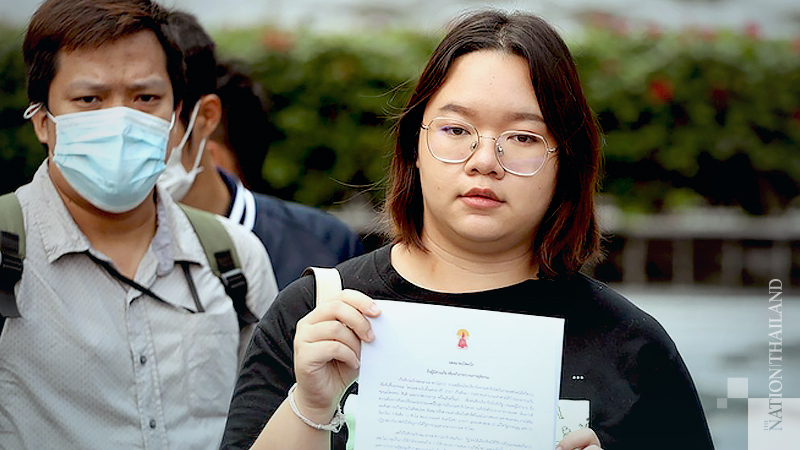 Panusaya “Rung” Sithijirawattanakul


 Dr Opass Putcharoen, chief of Thai Red Cross Emerging Infectious Diseases Clinical Centre
 Traisuree Taisaranakul

