SRT plans to buy 184 AC diesel trains #ศาสตร์เกษตรดินปุ๋ย

#ศาสตร์เกษตรดินปุ๋ย : ขอบคุณแหล่งข้อมูล : หนังสือพิมพ์ The Nation

https://www.nationthailand.com/business/30379948?utm_source=category&utm_medium=internal_referral

SRT plans to buy 184 AC diesel trains

Dec 28. 2019
By THE NATION

The State Railways of Thailand (SRT) will propose to the board on January 16 a plan to procure 184 air-conditioned diesel trains at a budget of Bt20 billion.

SRT acting governor Worawut Mala said that the state agency would submit the revised plan to the board.

In a separate matter, he said civil work construction of the double track railways is on course. It is estimated that the construction of the first phase of the three routes will be gradually finished and in operation in 2024.

The first phase of the development of the southern Nakhon Pathom-Chumphon route is expected to be finished in 2021, and the northern Lop Buri-Pak Nam Po route in 2022. The first-phase construction of the Isaan segment of the Map Kaboa-Jira Junction route is expected to be completed in 2023.

Trump’s stock market rally is very good, but still lags Obama and Clinton #ศาสตร์เกษตรดินปุ๋ย

#ศาสตร์เกษตรดินปุ๋ย : ขอบคุณแหล่งข้อมูล : หนังสือพิมพ์ The Nation

https://www.nationthailand.com/business/30379959?utm_source=category&utm_medium=internal_referral

Trump’s stock market rally is very good, but still lags Obama and Clinton

Dec 29. 2019
File Photo/ Getty Images

File Photo/ Getty Images
By The Washington Post · Heather Long

U.S. stocks are closing out a terrific year and President Donald Trump loves it. He’s bragged about the stock market hitting record highs six times this week alone on Twitter.

On Friday, be boasted “Trump stock market rally is far outpacing past U.S. presidents,” and he vowed that the “BEST IS YET TO COME!” Trump is making the economy and stock market a key focus on his reelection campaign. He often likes to claim this is the “best” or an “unprecedented” scenario, even when that is not the case.

While the stock market has performed well under Trump, it is not an unprecedented performance. Trump’s stock market returns still lag behind Obama and Clinton at this point in their first terms.

The Dow Jones industrial average has gained about 45% since Trump was sworn in nearly three years ago. The Dow was up about 53% at this point in Obama’s presidency and a whopping 57% in Clinton’s early years in office. How much credit presidents deserve for market gains – or losses – remains a big debate, but Trump points to the stock market frequently as a barometer of how he’s doing as president.

Trump’s claim that stocks are “far outpacing” what occurred under prior presidents is based off a CNBC article that uses data from Bespoke Investment Group showing that stock market performance under Trump is better than the typical gains for a president’s initial three years in office. Bespoke did not claim that Trump is presiding over the best gains of all time.

Still, the rally under Trump now outpaces Republican presidents from the recent past, including Ronald Reagan, at this point in their presidencies. And Trump might be able to claim an especially big milestone for 2019.

This could be the best year for stocks since 1997. Most investors watch the S&P 500 index, which tracks 500 of America’s largest publicly traded companies. It is up 29.3% so far this year.

The best calendar year for stocks under Obama was 2013, when the S&P 500 finished the year up 29.6% as the economy was rebounding from the Great Recession. If this year tops that mark, it would be the best for stocks since the late 1990s.

Roughly half of Americans have money in the stock market – mainly through pensions or 401(k) retirement funds.

If the S&P 500 ends the year up 30%, it would be only the fifth time since the 1950s that the index has crossed that 30% threshold. The stock market is open Monday and Tuesday, the last chance for an end-of-year rally.

While Trump likes to take credit for the stock market’s great 2019, he rarely mentions last year when U.S. stocks posted a negative annual return. Stocks tanked last December after Trump proclaimed he was “tariff man,” a signal his trade war would ramp up more, and the Federal Reserve indicated it would likely hike interest rates further.

“We had a bear market at the end of 2018, so stocks were beaten down at the end of last year. We had a low starting point, so the 2019 market increase was magnified,” said Gus Faucher, chief economist at PNC Financial Services Group.

Many Wall Street analysts say Trump’s tax cuts and deregulatory push helped fuel the stock market rise in Trump’s first year in office, but they credit much of this year’s gains to the U-turn at the Fed.

Trump has repeatedly lashed out at the Fed, calling its leaders “boneheads” for keeping interest rates too high. This year, the Fed cut interest rates three times and Fed Chair Powell promised he would do whatever it takes to keep the economy humming.

Investors cheered as the Fed shifted gears and stimulated the economy. Lower interest rates make it cheaper to borrow money and encourage people to invest in stocks since they earn so little interest in savings accounts or on bonds.

“This year was all about the fact that the Fed cut rates,” said Bran McMillan, chief investment officer at the Commonwealth Financial Network. “It’s not so much that companies are doing great. It’s that investors looked at interest rates and realized stocks were going to be the place to be and they were willing to pay up for that.”

Some are warning that the stock market is now overvalued and exhibiting similar signs to the dot-com boom, but McMillian notes that a recession and market downturn tend to go hand-in-hand. Recession fears have largely abated in recent months as hiring and consumer spending have remained strong.

For now, cautious optimism abounds on Wall Street. Most economists predict another year of solid growth around 2% and stock market gains, albeit far more modest ones than this year’s. A scenario like that bodes well for Trump’s reelection, according to historical models.

Egat receives 65,000 tonnes of LNG from Petronas #ศาสตร์เกษตรดินปุ๋ย

#ศาสตร์เกษตรดินปุ๋ย : ขอบคุณแหล่งข้อมูล : หนังสือพิมพ์ The Nation

https://www.nationthailand.com/business/30379952?utm_source=category&utm_medium=internal_referral

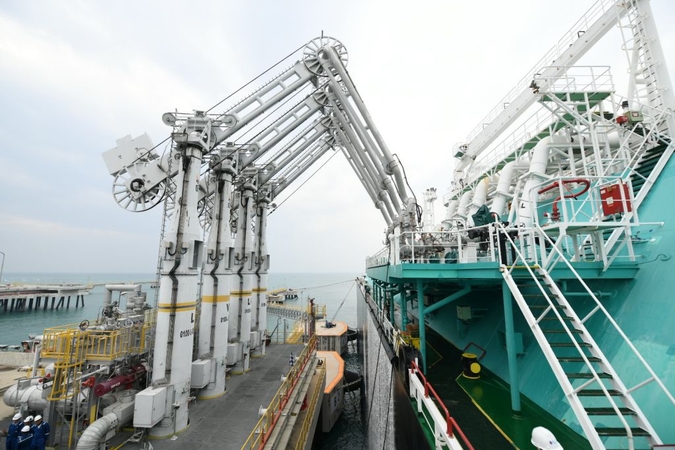
Egat receives 65,000 tonnes of LNG from Petronas

Dec 28. 2019
By THE NATION

The Electricity Generating Authority of Thailand (Egat) on Saturday (December 28) received the first lot of liquefied natural gas (LNG) totalling 65,000 tonnes delivered by Malaysia’s Petronas LNG.

The LNG cargo arrived at an LNG-receiving terminal of PTT LNG in Rayong. The Malaysian firm won the bid for the procurement and import of 130,000 tonnes of LNG by state-owned Egat.

Egat will procure and import LNG in two stages of 65,000 tonnes each in the spot markets, in line with the resolution of the Energy Policy Administration Committee on August 30 this year that Egat can import LNG from spot markets not exceeding 200,000 tonnes. The second shipment is due in April next year.

Its LNG import is also in line with the government’s policy of promoting competition in LNG trading and procurement and preparing for the liberalisation of LNG import.

Egat passed this first lot of LNG into PTT’s gas pipelines in order to power Egat’s Unit 5 of the Bangpakong power plant in Chachoengsao province, and Unit 4 at Wang Noi plant, Ayutthya province. The second shipment will fuel the newly-built Unit 1 of the South Bangkok power plant in Samut Prakarn province, in addition to Unit 5 of Bangpakong power plant in Chachoengsao province, and Unit 4 at Wang Noi plant, Ayutthya province.


On land, Australia’s rising heat is ‘apocalyptic.’ In the ocean, it’s even worse. #ศาสตร์เกษตรดินปุ๋ย

#ศาสตร์เกษตรดินปุ๋ย : ขอบคุณแหล่งข้อมูล : หนังสือพิมพ์ The Nation

https://www.nationthailand.com/news/30379965?utm_source=category&utm_medium=internal_referral

On land, Australia’s rising heat is ‘apocalyptic.’ In the ocean, it’s even worse.

Dec 29. 2019
Strands of bull kelp at Shelly Point in Tasmania. The Tasman Sea is warming, and once plentiful giant kelp forests have rapidly declined. Indigenous artists rely on a kelp habitat for traditional jewelry and basket making. MUST CREDIT: Washington Post photo by Bonnie Jo Mount

Strands of bull kelp at Shelly Point in Tasmania. The Tasman Sea is warming, and once plentiful giant kelp forests have rapidly declined. Indigenous artists rely on a kelp habitat for traditional jewelry and basket making. MUST CREDIT: Washington Post photo by Bonnie Jo Mount
By The Washington Post · Darryl Fears

BRUNY ISLAND, Tasmania – Even before the ocean caught fever and reached temperatures no one had ever seen, Australia’s ancient giant kelp was cooked.

Rodney Dillon, 63, on indigenous land in Bruny Island, Tasmania. Dillon, who hunts for abalone nearby, said the area used to be filled with giant kelp. MUST CREDIT: Washington Post photo by Bonnie Jo Mount

Rodney Dillon, 63, on indigenous land in Bruny Island, Tasmania. Dillon, who hunts for abalone nearby, said the area used to be filled with giant kelp. MUST CREDIT: Washington Post photo by Bonnie Jo Mount

Rodney Dillon noticed the day he squeezed into a wet suit several years ago and dove into Trumpeter Bay to catch his favorite food, a big sea snail called abalone. As he swam amid the towering kelp forest, he saw that “it had gone slimy.” He scrambled out of the water and called a scientist at the University of Tasmania in nearby Hobart. “I said, ‘Mate, all our kelp’s dying, and you need to come down here and have a look.’

“But no one could do anything about it.”

Climate change had arrived at this island near the bottom of the world, and the giant kelp that flourished in its cold waters was among the first things to go.

Over recent decades, the rate of ocean warming off Tasmania, Australia’s southernmost state and a gateway to the South Pole, has climbed to nearly four times the global average, oceanographers say.

More than 95 percent of the giant kelp – a living high-rise of 30-foot stalks that served as a habitat for some of the rarest marine creatures in the world – died.

Giant kelp had stretched the length of Tasmania’s rocky east coast throughout recorded history. Now it clings to a tiny patch near Southport, the island’s southern tip, where the water is colder.

“This is a hot spot,” said Neil Holbrook, a professor who researches ocean warming at the Institute for Marine and Antarctic Studies at the University of Tasmania. “And it’s one of the big ones.”

Climate scientists say it’s essential to hold global temperatures to 1.5 degrees Celsius (2.7 degrees Fahrenheit) above preindustrial times to avoid irreversible damage from warming.

The Tasman Sea is already well above that threshold.

The Washington Post’s examination of accelerated warming in the waters off Tasmania marks this year’s final installment of a global series. which identified hot spots around the world. The investigation has shown that disastrous impacts from climate change aren’t a problem lurking in the distant future: They are here now.

Nearly a tenth of the planet has already warmed 2 degrees Celsius (3.6 degrees Fahrenheit) since the late 19th century, and the abrupt rise in temperature related to human activity has transformed parts of the Earth in radical ways.

In the United States, New Jersey is among the fastest-warming states, and its average winter has grown so warm that lakes no longer freeze as they once did. Canadian islands are crumbling into the sea because a blanket of sea ice no longer protects them from crashing waves. Fisheries from Japan to Angola to Uruguay are collapsing as their waters warm. Arctic tundra is melting away in Siberia and Alaska, exposing the remains of woolly mammoths buried for thousands of years and flooding the gravesites of indigenous people who have lived in an icy world for centuries.

Australia is a poster child for climate change. Wildfires are currently raging on the outskirtsof itsmost iconic city and drought is choking a significant portion of the country.

Nearly 100 fires are burning in New South Wales, nearly half of them out of control. Residents of the state, where Sydney sits, wear breathing masks to tolerate the heavy smoke, which has drifted more than 500 miles south to the outskirts of Melbourne.

This is happening even though average atmospheric temperatures in Australia have yet to increase by 2 degrees Celsius (3.6 degrees Fahrenheit).

The ocean is another story.

A stretch of the Tasman Sea right along Tasmania’s eastern coast has already warmed by just a fraction below 2 degrees Celsius (3.6 degrees Fahrenheit), according to ocean temperature data from the Hadley Center, the U.K. government research agency on climate change.

As the marine heat rises and the kelp simmers into goo, Dillon and other descendants of Tasmania’s first people are losing a connection to the ocean that has defined their culture for millennia.

Aboriginals walked to present-day Tasmania 40,000 years ago during the Stone Age, long before rising sea levels turned the former peninsula into an island.

Cut off from Aboriginals on the mainland, about a dozen nomadic tribes were the first humans to live so close to the end of the Earth, fishing amid the giant kelp for abalone, hunting kangaroo and mutton birds, turning bull kelp into tools, and fashioning pearlescent snail shells into jewelry for hundreds of generations.

But that was before British colonizers took their land and deployed an apartheid-like system to wipe them out.

Now, as descendants try to finally get full recognition as the first people and original owners of Tasmania, climate change is threatening to remove the marine life that makes so much of their culture special.

Two of the most severe marine heat waves ever recorded struck back to back in recent years.

In the first, starting in 2015, ocean temperatures peaked at nearly 3 degrees Celsius (5.4 degrees Fahrenheit) above normal in the waters between Tasmania and New Zealand. A blob of heat that reached 2 degrees Celsius was more than seven times the size of Tasmania, an island the size of Ireland.

The region’s past heat waves normally lasted as long as two months. The 2015-2016 heat wave persisted for eight months. Alistair Hobday, who studied the event, compared it to the deadly 2003 European heat wave that led to the deaths of thousands of people.

“Except in this case, it’s the animals that are suffering,” said Hobday, a senior research scientist at the Commonwealth Scientific and Industrial Research Organization, a government agency.

South of the equator, Australia’s summer stretches from December to February – and soaring temperatures turned the mainland deadly this year. An estimated 23,000 giant fruit bats – about a third of that species’s population in Australia – dropped dead from heat stress in Queensland and New South Wales in April.

The bats, called flying foxes, cannot survive temperatures above 42 degrees Celsius (107.6 degrees Fahrenheit). Another 10,000 black flying foxes, a different species, also died. Bodies plopped into meadows, backyard gardens and swimming pools.

A month later, more than 100 ringtail possums fell dead in Victoria when temperatures topped 35 degrees Celsius (95 degrees Fahrenheit) for four consecutive days.

The warming waters off Tasmania are not just killing the giant kelp, but transforming life for marine animals.

Warm-water species are swimming south to places where they could not have survived a few years ago. Kingfish, sea urchins, zooplankton and even microbes from the warmer north near the mainland now occupy waters closer to the South Pole.

“There’s about 60 or 70 species of fish that now have established populations in Tasmania that used not to be here,” said Craig Johnson, who leads the ecology and biodiversity center at the Institute for Marine and Antarctic Studies at the University of Tasmania. “You might see them occasionally as sort of vagrants, but they certainly did not have established populations.”

But the region’s indigenous cold-water species have no place to go. Animals such as the prehistoric-looking red handfish are accustomed to the frigid water closer to the shore. They cannot live in the deep-water abyss between the bottom tip of Tasmania and Antarctica.

“It’s a geographic climate trap,” Johnson said. Marine animals unique to Australia – the wallabies and koalas of the deep – could easily vanish. “So there’s going to be a whole bunch of species here that we expect will just go extinct.

“You know, it’s not a happy story.”

– – –

Every time he dives for abalone, Rodney Dillon plays his part in what is arguably Tasmania’s saddest story of all.

At 63, he’s getting too old for the occasional plunge. Before a dive on a windy day in September, two people had to wrestle his wet suit over a thick athlete’s body softened by time.

Dillon persists because diving puts a favorite food on the family table, and, more important, it carries on a dying Aboriginal custom nearly ended by the British crown and the Australian governors it appointed.


Under the water, amid swaying emerald stalks of kelp, Dillon thought that he glimpsed the world his ancestors saw.

“I sometimes got lost in the kelp. I would lose concentration from catching food and go to look, sort of sky-gaze, at the beauty of the light coming through,” he said.

The light dimmed for the natives known as the Palawa in the late 1700s, when the British established a penal colony for convicted outcasts at Sydney harbor and looked south for more land to conquer.

Between 4,000 and 7,000 Aboriginals were spread out over Tasmania, then known as Van Diemen’s Land, when the British military arrived with a group of convicts in 1803. Within 50 years, all but 200 of the Aboriginals were dead.

In a history that isn’t widely known in Australia, let alone the wider world, Aboriginal land was seized without a treaty, said Lyndall Ryan, author of “The Aboriginal Tasmanians,” a history of how the native people met their demise.

When the natives tried to defend the kangaroo hunting and abalone fishing grounds that sustained them, they were routed.

“Genocide was government policy for more than 200 years,” Ryan wrote in an email to The Post.

At the time, British archaeologists adhered to junk science that said Aboriginals were the last link between humans and apes.

When William Lanne, the last full-blooded Tasmanian Aboriginal man, died in 1869, a researcher cut off his head, stole it to England for study, then displayed it in a museum. After Truganini, the last full-blooded woman, died seven years later, her skeleton was placed on display at a museum in Tasmania against her wishes. “Don’t let them cut me,” she said on her deathbed.

With their deaths, Tasmania declared that Aboriginal Tasmanians were extinct.

Around 1910, after Australia became a nation under the British, officials launched a program that removed mixed-race Aboriginal children from their mothers.

In his book, “Australia’s Coloured Minority: Its Place in the Community,” author A.O. Neville partly explained the young country’s motive. Assimilation of black Aboriginal and Torres Strait Islander people could be assured only by “breeding out the colour” of their skin.

As a “protector of Aborigines” in Western Australia for 21 years ending in 1936, Neville had a guiding influence on the child removal program.

Over six decades, welfare workers across Australia took children, some of them at birth, from any parent the state deemed unfit, up to an estimated 50,000. Brown children were placed in white institutions, church social programs and homes to promote intermixing.

“Generally by the fifth and invariably by the sixth generation, all native characteristics of the Australian Aborigine are eradicated,” Cecil Evelyn Cook, the “chief protector of Aborigines” in North Australia, said in 1933. “The problem of our half-castes will be quickly eliminated by the complete disappearance of the black race, and the swift submergence of their progeny in the white.”

Ancient Aboriginals likely would not recognize the 20,000 or so Tasmanians who currently identify as their descendants. The large majority are white.

Dillon said dark-complexioned Aboriginals on the mainland doubt his heritage because of his appearance.

Like most Aboriginals in Tasmania, his skin is pale. His eyes are blue-green, the color of the sea. White locks atop his head swirl like ice cream.

“People make nasty comments all the time,” he said.

Dillon’s great-great-grandmother, Fanny Cochrane Smith, is known as the last speaker of the indigenous Aboriginal language. He is considered an elder among his people in Tasmania, and he is leading them in speaking out against discrimination.

The Tasmanian Aboriginal Center, formed in the 1970s, is demanding full recognition by the government. Nearly 200 years after the British arrived, Tasmania became the first Australian state to apologize for engaging in child removal and has also given back a small portion of land.

In 2008, then-prime minister Kevin Rudd apologized to the “Stolen Generations.” That year, the state of Tasmania agreed to dole out 5 million Australian dollars to victims and their kin.

At her house in Launceston, Nanette Shaw, a descendant, clings to the traditions of her forebears by fashioning bull kelp into baskets.

Shaw, 66, said she turned to basketmaking to ease the trauma she experienced while growing up as an Aboriginal.

“It centers me,” Shaw said. She suffers from depression and alcoholism, and the craft is her distraction. “I have not been drinking for nearly 10 years. Sometimes the depression takes over, and rather than walk down and get a bottle, I’ll do this.”

But if impacts from climate change worsen, the traits can’t be handed down to children, she said.

The shells are disappearing amid a mix of warming water and pollution. As recently as two decades ago, it was hard to walk on the beach without stepping on them, she said. “Now you’re walking on pure sand,” Shaw said.

Ninety miles away on Scamander Beach, her friend Patsy Cameron found bull kelp to gift to Shaw and several handfuls of jewelry-quality shells.

But it now takes nearly a day to collect them, as opposed to two hours years ago.

“If climate change destroys the seaweed, our shell supply will disappear along with the kelp forest,” said Cameron, 72.

“It’s getting hotter and that heat, it’s affecting not only the giant kelp, but the color of the abalone is changing,” Dillon said.

“We just take too much out of the Earth and we don’t put it back,” Dillon said. “Australia is one of the worst if you know about coal. How much coal do we need to dig up? And we’re too stupid to see what this is causing . . . because we make money out of it.”

And now, Australia is caught in a record-breaking heat wave.

– – –

The heartbreaking video went viral late in November: A koala bear slowly walked through wildfire.

The marsupial, euthanized days later because its burns didn’t heal, was just one victim of the many wildfires that started burning in the Australian spring and are still going at the start of summer.

At least nine people have died and 700 homes have been destroyed. One woman in New South Wales took a few of her house’s charred remains to Australia’s Parliament in early December with a message for Prime Minister Scott Morrison.

“Morrison, your climate crisis destroyed my home,” Melinda Plesman wrote in bold red letters.

Morrison is an ardent supporter of coal excavation in a country that produced 44 million tons in 2017. Australia is the world’s leading exporter of coal, mostly to Asia, and the fourth-largest producer.

A few weeks before the koala – nicknamed Lewis – was euthanized, the newly reelected prime minister took his advocacy for coal to a new level. He pledged to outlaw environmental demonstrations, calling the protests a “new breed of radical activism” that is “apocalyptic in tone.”

One month later, a Sydney Morning Herald headline described conditions in Australia’s most iconic city as “apocalyptic,” as residents choked in a smoky haze from bush fires. A coalition of doctors and climate researchers declared it a public health emergency.

The bush fires have arrived amid record heat and particularly dry conditions that experts say are being made more common thanks to climate change.

The country experienced a five-day heat wave in the state of Victoria that shattered records. The Friday before Christmas was the hottest December day on record, measuring 47.9 degrees Celsius (118.2 degrees Fahrenheit) at the Horsham weather station.

Rescuers searching for human survivors in the scorched remains of forests have discovered koalas, a creature found only in Australia, burned to death in eucalyptus trees where they sought shelter. At the Port Macquarie Koala Hospital, where Lewis was put down, it was called “a national tragedy.”

The tragedy playing out underwater is much worse, but invisible to most.

In 1950, giant kelp stretched over 9 million square meters in a thick band along Tasmania’s coast, said Cayne Layton, a research fellow at the marine and antarctic institute. Today, it covers fewer than 500,000 meters in little spots on the coastline.

Giant kelp is lovely but fragile. It needs cool, clean, nutrient-rich water to survive, and it’s losing all three.

It is a serious loss. Divers coveted swimming amid plants that grew like the mythical beanstalk to glimpse some of the world’s rarest creatures. Squid fed there, red handfish hid there, spiny pipehorse lounged about, and rock lobster were abundant.

The most recent study – nearly 10 years old – estimated that 95 percent of giant kelp had been lost to warming and pollution, Layton said, and is probably much worse now.

The less spectacular common kelp, which grows on the coastal slope leading to deep water, is overtaking the spaces where giant kelp grew, Layton said. Along with long, straplike bull kelp that clings to giant rocks near the shore, common kelp appears to be more tolerant to warming temperatures.

But even these species aren’t safe. The warming water has introduced a new plague: long-spine sea urchins, an animal that greedily devours kelp.

A single urchin was found in the cold waters off Tasmania by divers conducting a survey in 1978. Now, there are more than 18 million, according to the most recent survey by the Institute for Marine and Antarctic Studies.

Sea urchins prefer warm water. They swarm rocky reefs where kelp grows, leaving oceans barren and devoid of life.

Kelp forests’ “importance is equal to forests on land,” said Layton, “so if you can imagine what the world would be like without trees, that’s what a world without kelp forests would be like.”

Scientists say there is only one explanation for why sea urchins migrated so far from their warmer natural habitat near Sydney to the cold waters around Tasmania: the East Australian Current.

The current, made famous in the film “Finding Nemo,” is fed by a vast stream of tropical water that reaches Australia’s coast after traveling all the way from South America. The water then flows south down the east coast of Australia and then swings back east just north of Sydney.

At that point, the warm-water current splits, with some water flowing southward toward the Tasman Sea in the form of swirls of tropical water called eddies – and this secondary branch has intensified.

This extension of the East Australian Current is spewing thousands of eddies deeper southward toward Tasmania, carrying the larvae of warm-water species to places they had never been.

According to research compiled by Professor Gretta Pecl at the University of Tasmania, toxic algae blooms lurk where giant kelp once flourished. Abalone have gone from healthy to “stressed.” The brightly colored Maori octopus is being replaced by the gloomy octopus, more common to the waters near Sydney. And a yellow-bellied sea snake has migrated to the habitat.

The warmer water disintegrated most of the giant kelp over two decades and contributed to the massive, record-breaking marine heat wave of 2015.

“You can’t say that this event was due to climate change,” said Holbrook, the ocean scientist. “But what you can say is that the intensity was much more likely due to climate change.

“You liken it to smoking,” he said. “If you smoke cigarettes, you increase the likelihood of getting lung cancer.”

– – –

The marine heat wave left something behind when it finally ended: disease.

A sickening smell at the shallow Pipe Clay Lagoon is how Pacific oyster mortality syndrome introduced itself to Steve Calvert.

The syndrome, known as POMS, turned his small oyster farm in the lagoon into a mass grave, and the smell of the dead stretched for miles. Calvert lost 75% of his oysters in 2016. Other farmers in the region’s five major farming areas lost nearly 100% of their stock.

Oyster mortality disease had stricken France, China, the United States, New Zealand and even Sydney, but never pristine Tasmania.

“We’ve got a reputation in Tasmania of having pure water and some of the freshest air in the world,” said Calvert’s son, Liam, a manager at the farm. “So that’s part of why there’s an attraction to the Tasmanian oyster, because people think pristine-forest freshness and all that kind of thing.”

Climate change had raised the region’s water temperatures to an ideal level for the contagion. POMS joined warm-water toxic algal blooms as a new threat to the region’s aquaculture and fisheries.

In an encouraging sign that Tasmania’s aquaculture can adapt, scientists had prepared the Calverts and other farmers for the possibility that POMS would strike.

“We’ve been working with industry for quite a long time, and we’ve always had the philosophy that scientists need to know how to farm and farmers need to know how to do science,” said Sarah Ugalde, a research fellow at the University of Tasmania.

Ugalde and her team persuaded the farmers to buy oysters from other areas that survived a disease outbreak. They used that stock to cultivate a disease-tolerant oyster. The Calverts lost about a million oysters but rebuilt the stock with spat – oyster babies – recommended by scientists.

Tasmania’s $25-million-per-year oyster farming industry is thriving. The product price, driven up to $1 per oyster from demand during the disaster, stayed the same, helping the Calverts to increase revenue.

“It’s good performance work, and there’s a good return for the hard work,” Steve Calvert said. “We still love this ocean.”

It’s a matter of adapting to a warming world.

“Generally, there’s been a lot of work that’s gone into trying to estimate how fisheries production . . . will change with climate change,” Johnson, the marine institute researcher, said.

“For southeastern Tasmania, which accounts for most of Australia’s fishery production, the projections are that the fishery production will decline,” Johnson said in his office by the water.

“Like I said, it’s not a particularly happy story.”

Democrats weigh the cost of ambition #ศาสตร์เกษตรดินปุ๋ย

#ศาสตร์เกษตรดินปุ๋ย : ขอบคุณแหล่งข้อมูล : หนังสือพิมพ์ The Nation

https://www.nationthailand.com/news/30379964?utm_source=category&utm_medium=internal_referral

Democrats weigh the cost of ambition

Dec 29. 2019
Amy Klobuchar, D-Minn., is pictured at the Democratic debate in November. Klobuchar has said her priority as president would be a $1 trillion infrastructure program. MUST CREDIT: Washington Post photo by Toni L. Sandys

Amy Klobuchar, D-Minn., is pictured at the Democratic debate in November. Klobuchar has said her priority as president would be a $1 trillion infrastructure program. MUST CREDIT: Washington Post photo by Toni L. Sandys
By The Washington Post · Toluse Olorunnipa

In 2019, Democrats running for president announced a slate of multitrillion-dollar proposals aimed at transforming the country and combating the economic and social ills they blame for giving rise to President Donald Trump.

But as the year comes to a close, the mounting price tag of those plans has become a point of contention between the liberal and moderate wings of the party.

“No one inside the Beltway seems to ask how much the status quo costs,” Sen. Bernie Sanders, I-Vt., wrote Thursday on Twitter, defending his proposals by citing estimates of deaths caused by air pollution and a lack of health care. “We have the resources – and a moral obligation – to pass Medicare for All and a Green New Deal.”

Sanders’ agenda would cost more than $50 trillion over 10 years, more than the plans of any other Democratic candidate. Like the others, he would pay for his plans by raising taxes on corporations and the wealthy.

As Democrats seek to appeal to a broad swath of voters, candidatesare airing proposals that include government-supported health care and child care, free college, student loan forgiveness, transformative climate policies, massive pay raises for teachers, and a universal basic income, among others.

A Washington Post review of the major spending proposals of the leading Democratic presidential candidates found 10-year costs ranging from about $4 trillion to more than $50 trillion. The annual federal budget now is about $4.5 trillion.

Even the most sparse of the 2020 plans dwarfs what successful Democrats pushed before. As she seized the Democratic nomination in 2016, Hillary Clinton proposed a 10-year agenda estimated at $1.45 trillion, according to the Committee for a Responsible Federal Budget.

The rapidly rising price tags and expansive reach of the current plans has led to charges of socialism from Republicans. But in recent weeks, more-moderate Democrats have been the most vocal critics of their liberal colleagues’ spending plans.

“On issue after issue, we’ve got to break out of the Washington mind-set that measures the bigness of an idea by how many trillions of dollars it adds to the budget or the boldness of an idea by how many fellow Americans it can antagonize,” South Bend, Indiana, Mayor Pete Buttigieg said during the Democratic presidential debate this month in Los Angeles.

Sen. Amy Klobuchar, D-Minn., who has said her priority as president would be a $1 trillion infrastructure program, has questioned the practicality of her competitors’ more expensive proposals.

“Where I disagree is, I just don’t think anyone has a monopoly on bold ideas,” she said during the debate. “I think you can be progressive and practical at the same time.”

The Post analysis focused only on the broad categories of health care, housing, the environment, criminal justice, education, child care and other anti-poverty initiatives. Using self-reported estimates from the campaigns of the candidates leading nationally and in early states – Sanders, Buttigieg, former vice president Joe Biden and Sen. Elizabeth Warren, D-Mass. – the review found a shared desire to strengthen the social safety net, enlarge the federal government and reduce inequality. But each arrived at different ways of doing so, with varying price tags.

Sanders, for example, would increase minimum salaries for teachers to $60,000 and provide free breakfast and lunch to every public school student in the country, as part of an agenda that tops $51 trillion over 10 years. Among a set of plans with a total 10-year cost exceeding $30 trillion, Warren proposes subsidizing child care for almost all Americans and reducing rental costs nationwide by 10 percent.

Biden’s agenda, a more moderate set of proposals costing more than $4.1 trillion over 10 years, calls for tripling funding at low-income schools and making community college free.

Buttigieg, who unveiled a $1.1 trillion 10-year economic plan in November, now has spelled out more than $5.5 trillion in federal initiatives. He has criticized Warren and Sanders for their free college programs that would provide a universal benefit, regardless of income.

Trump has seized on the Democrats’ spending proposals and led the GOP characterization of them as socialists. He has warned that the true outcome of Democrats’ plans would be higher taxes.

“They say, ‘We’re going to give away your health care. We’re going to do free education. We’re going to cut student loan debt down to nothing,’ ” Trump said in September during a speech to the House Republican Conference in Baltimore. “Everything is given away.”

Yet Trump signed a $1.4 trillion spending bill this month that will add more red ink to the record $23 trillion national debt. Republicans’ signature legislative achievement under Trump, a massive 2017 tax cut whose benefits skewed toward corporations and the wealthy, has helped pushed the annual federal deficit past $1 trillion.

But many Republicans, following Trump’s lead, have largely abandoned the concerns about debt and deficits they expressed during former president Barack Obama’s tenure.

Democrats have likewise felt free to sidestep discussions about the $23 trillion national debt during their primary contest, said Mark Zandi, chief economist at Moody’s Analytics.

“The fetters around fiscal responsibility have been thrown off,” said Zandi, who has analyzed the spending plans of several Democratic presidential candidates. “There’s no real political constituency for fiscal discipline either on the Republican or Democratic side.”

Indeed, several trailing Democratic candidates have, like Klobuchar and Biden, been critical of the spending surge – but have found voters largely shrugging off their concerns.

Other lower-polling candidates in the historically large primary also have built their candidacies around costly and ambitious initiatives.

Entrepreneur Andrew Yang has backed a universal basic income of $12,000 per year for every American adult, which he estimated would cost $2.4 trillion per year – or $24 trillion over 10 years. He has also proposed giving $100 in “Democracy Dollars” for every American voter to use to participate in the political system.

Sen. Cory Booker, D-N.J., has proposed “baby bonds” for every newborn. Several candidates have expressed openness to the idea of providing reparations to the descendants of enslaved Americans.

For his part, Trump has boasted at rallies about spending trillions of dollars on the military and giving more than $28 billion in payouts to farmers affected by the trade war he sparked with China and other countries. Speaking to a conservative group in West Palm Beach, Florida, on Dec. 21, Trump praised his administration for securing more than $2.5 trillion in military spending, dismissing the idea that the increased funding had added to the growing budget deficit.

“Let me tell you about budgets: I’m a big budget person, but when it comes to the military, there is no budget,” he said.

In his 2016 campaign, Trump differed from other Republicans by brushing aside proposals to curb Social Security and Medicare spending, which members of his party had long argued were necessary to halt runaway deficits. He has pledged to get serious about fiscal discipline and reducing the deficit if reelected, but his campaign has not put forward a plan to cut spending.

Democrats have said Trump’s 2016 election and the policies he’s pursued while in office require bold countermeasures that will level the playing field for middle-class Americans. They’ve sought to outdo one another by targeting primary voters concerned about issues including systemic racism, climate change and education.

An NBC News/Wall Street Journal poll released this month found that 56 percent of Democratic primary voters prefer candidates who propose “large scale policies that cost more” compared with 38 percent who like candidates pitching less-expensive policies that would bring less change but potentially be easier to pass into law.

With just a few weeks before primary voting begins, some of the more-moderate candidates are increasingly hopeful voters will be repelled by the rising price tags of the most ambitious proposals. Biden, who is leading the national race in most polls and leads with voters who prefer smaller-scale change, has repeatedly challenged his rivals to explain how they would pay for their spending programs.

Warren has been the most detailed in outlining the costs of her various plans and how she would pay for them. With a 2 percent “wealth tax” on fortunes exceeding $50 million and other tax hikes on the wealthy, Warren has said she would be able to fund a broad expansion of the federal government’s social contract without raising taxes on middle-class Americans.

Warren advanced in the polls earlier this year as she released dozens of plans offering vast benefits to most Americans by redistributing wealth that has become increasingly concentrated among the rich.

Calculators on her campaign website allow Americans to find out how much money they would save through her plan canceling student loan debt, and how much extra cash they would receive from her proposal to provide an extra $200 monthly for everyone receiving Social Security.

Her momentum appeared to stall after she was pressured to release her own plan for universal health care. Warren’s $20.5 trillion proposal, her most expensive plan yet, would be funded through an array of taxes on the wealthy and corporations.

Both Sanders and Warren, who continue to face bipartisan questions about the costs and feasibility of their health-care plans, have said most Americans would pay less for health care under a government-run system that eliminates premiums, deductibles and the private insurance companies that collect them.

But over the course of the year, several Democratic candidates backed away from Medicare-for-all, citing its requisite tax increases and its upending of the private insurance industry.

“I believe this hits the middle class too hard,” Sen. Kamala Harris, D-Calif., wrote in July about Sanders’ proposal to pay for his Medicare-for-all plan with a 4 percent income tax on most families. Harris, who had proposed an ambitious agenda estimated at more than $12.3 trillion, dropped out of the primary this month.

In addition to his Medicare-for-all proposal eliminating out-of-pocket health-care costs, Sanders has also pledged to have the government wipe out all $1.6 trillion in outstanding student loan debt. His proposal, announced in June, went even further than Warren’s pledge to eliminate debt for 95 percent of the people who have student loans.

Sanders has pledged to pay for his agenda by reversing Trump’s tax cuts and imposing a wealth tax and a series of tax hikes on the finance industry and more. He has acknowledged that his health-care plan would raise taxes on middle-class Americans, but he insists that would be offset by the trimmed costs.

Candidates have also touted 13-figure price tags as they’ve competed to show their visions for combating climate change.

Warren’s $3 trillion plans include a tenfold increase in federal spending on clean-energy research and development. She also proposed a $10.7 trillion “green jobs plan” to invest in environmentally friendly industries. Buttigieg’s $1.5 trillion plan creates a national extreme weather insurance program. Biden’s $1.7 trillion plan aims to achieve net zero emissions of carbon pollution by 2050.

Sanders has boasted that his plan, the most expensive at $16.3 trillion, would declare climate change a national emergency, eliminate fracking, and ban all imports and exports of fossil fuels.

Several candidates have pushed ahead with expensive plans by arguing that the cost of not acting far exceeds the price tag for their proposals.

“My opponents and critics say, ‘Bernie, you’re proposing to spend a lot of money on climate,’ ” Sanders said recently at a rally in Los Angeles. “And I say, ‘What is the alternative?’ ”

Others have followed the example of Trump, who was able to win in 2016 by making broad promises that connected with voters while disregarding political structures of Washington policymaking, such as detailing how he would pay for it, said Michael Strain, an economist at the right-leaning American Enterprise Institute.

“These policies are so large and so different from what we’ve seen that it’s hard to come up with a good estimate of how much they would cost and how disruptive they would be,” Strain said of the Democratic proposals. “That creates political space for the candidates to argue the best-case scenario.”

Slavery cost him his family. That’s when Henry ‘Box’ Brown mailed himself to freedom. #ศาสตร์เกษตรดินปุ๋ย

#ศาสตร์เกษตรดินปุ๋ย : ขอบคุณแหล่งข้อมูล : หนังสือพิมพ์ The Nation

https://www.nationthailand.com/news/30379963?utm_source=category&utm_medium=internal_referral

Slavery cost him his family. That’s when Henry ‘Box’ Brown mailed himself to freedom.

Dec 29. 2019
Henry

Henry “Box” Brown emerges from a wooden crate after mailing himself to freedom as several people, including abolitionist Frederick Douglass (holding a claw hammer at left) look on. MUST CREDIT: Library of Congress
By The Washington Post · Sydney Trent 

Henry Brown had reached the nadir of his despair. The Virginia slave’s pregnant wife and three children had just been sold away after their owner’s effort to extort money from Brown to prevent the sale.

“My agony was now complete, she with whom I had traveled the journey of life in chains … and the dear little pledges God had given us I could see plainly must now be separated from me forever, and I must continue, desolate and alone, to drag my chains through the world,” recalled Brown in an account he wrote in 1849.

But that is not what Henry Brown did. Instead, he imagined a wholly original way to escape his misery.

He would mail himself to freedom in a box.

The plan – one of the most sensational slave escapes of the antebellum period – would later become fodder for Brown’s art as an actor, magician, singer and hypnotist who toured the United States, Canada and England in the mid-19th century.

Although Brown’s performances – which included re-enacting his boxed escape, disguising himself as an African prince, and hypnotizing white spectators – appalled sober-minded abolitionists, there was likely a method to his magic, said Martha Cutter, a professor of English and Africana Studies at the University of Connecticut who has researched Brown.

His antics could be viewed as “a way of trying to take control of this incredibly grave trauma of enslavement,” said Cutter.

Brown, she said, “blows it up and plays with it.”

In recounting his first few decades of life as an enslaved person in Louisa County, Virginia, and later Richmond, there’s no sign of the outlandishly creative performer Brown would become. He hints at a possible reason: “They robbed me of myself,” he wrote.

He had been born a slave, sometime around 1815, in Louisa County. After the farmer who owned his family died, the teenage Brown went to work at a tobacco factory in Richmond, where he was permitted to take a wife on a neighboring plantation.

Brown’s wife, Nancy, was later sold to another slaveholder, who began blackmailing Brown into renting a house for Nancy and the children and making payments to keep him from selling the young family away. Finally, Brown could no longer meet the slaveholder’s demands, and his family was sold to a plantation in North Carolina.

It was then, according to the 1849 narrative, that an idea flashed in Brown’s mind “of shutting myself up in a box and getting myself conveyed as dry goods to a free state.”

Brown managed to talk a fellow church choir member, a free black man, as well as a sympathetic white shoemaker, into aiding with his passage to Philadelphia. A carpenter was enlisted to make the box – a wooden rectangle about 3-by-2-feet wide and 2.5 feet high, with three small holes for air.

On the morning of March 29, 1849, Brown – however tall or short, we do not know – folded himself into the box carrying an awl should he need more air holes and a small flask of water “should I feel getting faint,” he wrote.

Brown’s co-conspirators nailed the box shut, marked “This Side Up With Care,” and hustled Brown off to the offices of the Adams Express Company, where the journey got off to an inauspicious start.

The box was jostled this way and that until, Brown relates, he was bumping along heels up in a wagon to the train depot. There, the crate was shoved into a baggage car, where Brown fell on his side before being pushed head down again aboard the steamer to Philadelphia.

“I felt my eyes swelling as though they would burst from their sockets, and the veins on my temples were dreadfully distended with pressure of blood upon my head,” Brown wrote. “I felt a cold sweat coming over me that seemed to be warning that death was about to terminate my earthly miseries.”

Luckily, a weary man threw the box down on its side, and he and his companion took a seat until the steamer stopped in Washington, D.C. There, Brown was carried on a wagon to the train depot and the box was thrown onto the ground, audibly cracking Brown’s neck and knocking him “insensible,” he wrote.

At last, Brown arrived in Philadelphia after a 27-hour journey, a bit battered but intact. From there he was ferried to the office of a Quaker merchant and abolitionist. After emerging from the box a free man, Brown burst into singing Psalm 40: I waited patiently for the Lord; and he inclined unto me, and heard my cry.

And so began the transformation of Henry Brown from a man oppressed by slavery into Henry “Box” Brown, a traveling entertainer who mocked popular racist ideas and pushed wildly against the boundaries that circumscribed his life as a black man.

Brown moved to Massachusetts and, with the help of abolitionists, went on tour, where he recounted his daring escape to spectators who also thrilled to it as a miracle of the modern postal delivery system. (Meanwhile, Frederick Douglass openly disapproved of the way Brown divulged his secrets, believing it would make it difficult for another enslaved person to succeed at such a plan, and history appears to have judged him correct, Cutter said.)

After the Fugitive Slave Act was passed in 1850, Brown moved to Great Britain, where he remained for several decades before moving back to the United States and then to Toronto, where he died in 1897. Across the Atlantic, Brown’s act became fully his own, freed from the editing of abolitionists, such as the white evangelist who had ghost-written the 1849 narrative with Brown, according to Britt Rusert, associate professor in the Afro-American Studies department at the University of Massachusetts in Amherst.

One of Brown’s first acts in Britain was to publish a new narrative in 1851 – “Written by Himself,” he declared – which conveyed the same core facts of his early life in a much plainer and less preachy style.

In the beginning, he toured with a 49-scene panorama of his enslavement and escape painted on canvas panels and sang plantation melodies. A man with a knack for self-promotion, he even staged a dramatic re-enactment of his boxed journey, shipping himself from Bradford to Leeds, before he took a turn to the more fantastical, Rusert wrote in her book “Fugitive Science: Empiricism and Freedom in Early African American Culture.”

Wearing brightly colored clothing, his head wrapped in a turban, and brandishing a sword, Brown strode the streets as an African prince – free as a black man to look and move as he pleased in what Cutter calls “a mockery of slavery.”

As a “mesmerist,” the precursor to the modern hypnotist, Brown literally took control, in one act hypnotizing a group of white English spectators into believing they were sheep while he led them around the stage, throwing cabbage their way, Cutter said. (Who, she suggests, was the animal now?)

Following Brown everywhere was the box, now his literal middle name. He burst forth from one as part of his performances and made watches and handkerchiefs appear and disappear with a mirrored box as a medium. Once a desperate last resort, it had become a tool of creativity and freedom.

And yet, as successfully as Brown attempted to push its boundaries, the box would remain a box. And Brown was still inside, in a double bind not unfamiliar to many black artists today.

“It’s telling that the box continues to be part of his performances in order for him to remain legible . . . in order for him to build and maintain this celebrity identity,” Rusert said. “In that way, I don’t think he ever escapes the box.”

A federal judge will not reverse Georgia’s decision to purge 100,000 voters #ศาสตร์เกษตรดินปุ๋ย

#ศาสตร์เกษตรดินปุ๋ย : ขอบคุณแหล่งข้อมูล : หนังสือพิมพ์ The Nation

https://www.nationthailand.com/news/30379962?utm_source=category&utm_medium=internal_referral

A federal judge will not reverse Georgia’s decision to purge 100,000 voters

Dec 29. 2019
By The Washington Post · Hannah Knowles 

Georgia does not have to reinstate almost 100,000 voters removed from its rolls this month, a federal judge ruled Friday, backing the state over activists who said the purge violates people’s rights.

The decision is a victory for officials who called the removals routine and a blow to voting rights advocates who worry such purges will disenfranchise Democratic-leaning low-income voters, young people and people of color. Georgia’s recent removal of more than 300,000 voters has launched a new fight over registrations in a state where last year’s tight race for governor led to allegations of voter suppression and an investigation in Congress.

A group founded by Democrat Stacey Abrams, who narrowly lost the gubernatorial race, has sought to undo much of the latest purge, which came days after a judge backed cutting as many as 234,000 voters in Wisconsin, another state that will be closely watched in 2020. Abrams’ group, Fair Fight Action, argues that 98,000 voters who were cut should have stayed on the rolls for longer under a change this year to state law that lengthens the process leading up to a voter’s removal. It also contends that Georgia has violated the Constitution by removing voters over-zealously for inactivity, echoing others around the country concerned by so-called “use it or lose it” policies.

But Judge Steve Jones of Georgia’s Northern District Court declined to intercede in the purge, ruling that the issue of the 98,000 voters is outside his purview and saying that Fair Fight Action and a host of fellow plaintiffs have not shown they’re likely to prevail on the question of constitutionality.

Jones added, however, that Georgia has to make “additional diligent and reasonable efforts” to make people aware of the court’s decision and the canceled voters’ need to re-register, noting that the fast-approaching Monday deadline to do so for a special election in one state House district. And Jones expressed “serious concern” that it’s not clear how this year’s change in state law applies to the 98,000 contested voter registrations, saying the plaintiffs can seek “emergency relief” from a state court better fit to weigh in.

Lauren Groh-Wargo, Fair Fight Action’s CEO, said her group shares Jones’ concern about state law interpretation and is “exploring additional legal options,” while Secretary of State Brad Raffensperger touted a ruling backing “Georgia’s decision to continue to maintain clean voter rolls.”

“Despite activists’ efforts and lawsuits that only waste taxpayer dollars, Georgia is continuing to ensure every eligible voter can vote and voter lists remain accurate,” Raffensperger said in a statement.

The legal tussle stems from Raffensperger’s release this fall of a list of about 313,000 voters who the state had deemed “inactive” and who were slated to lose their registrations.

Fair Fight Action and other groups concerned about voter purges zeroed in on the roughly 120,000 voters who were going to lose their registration because they hadn’t made contact with election officials for years. The state soon restored about 22,000 of them.

But 98,000 registrations have remained under fierce debate.

Until recently, Georgia law called for voters to be marked inactive if they failed to return a postcard following no voting activity or contact with election officials for three years. People who didn’t vote for two general elections after that would be cleared from the rolls.

This year, though, in a bill signed by Republican Gov. Brian Kemp in April, legislators lengthened that “no contact” period of three years to five. Fair Fight Action said the law should apply to voters marked inactive before the shift, while the state says it’s not retroactive.

Jones wrote Friday that it’s not his place to interpret state law. Although he did not rule definitively on the plaintiffs’ claim that Georgia’s voter removals violate the First and Fourteenth Amendments, he also indicated he’s not convinced that it amounts to illegal voter disenfranchisement.

The plaintiffs had argued that voters cut from the rolls are likely to be disenfranchised because Georgia does not notify people that they have been dropped, meaning someone could learn they’re canceled when they show up to cast their ballot – when it’s too late. Voters must register weeks in advance of an election in the state.

But Judge Jones pointed to the state’s case that voters can easily restore their canceled registrations the same ways people initially sign up. He did not see “a substantial likelihood of success” for the argument that returning a prepaid, pre-addressed notice or re-registering would place a severe burden on voters.

Large removals of registered voters have become political flash points around the country, especially in states expected to be battlegrounds in 2020.

Purging rates have risen nationwide in recent years, according to analysis from the Brennan Center for Justice. Officials are culling their lists more aggressively, the center’s experts say, amid lawsuits and activist pressure, and many states are also subject to less federal scrutiny after the landmark 2013 Supreme Court decision that ended extra review of voting changes in places with a history of discrimination.

The Brennan Center points to Georgia as one state that dramatically increased its purging in the years after the 2013 ruling. The state cleared 1.5 million voters from its rolls between the 2012 and 2016 elections – double what it cut from 2008 to 2012.

Sao Paulo skyline fills up with new towers as real estate booms #ศาสตร์เกษตรดินปุ๋ย

#ศาสตร์เกษตรดินปุ๋ย : ขอบคุณแหล่งข้อมูล : หนังสือพิมพ์ The Nation

https://www.nationthailand.com/news/30379961?utm_source=category&utm_medium=internal_referral

Sao Paulo skyline fills up with new towers as real estate booms

Dec 29. 2019
A luxury apartment building stands in the Vila Nova Conceicao neighborhood of Sao Paulo on May 6, 2019. MUST CREDIT: Bloomberg photo by Victor Moriyama.

A luxury apartment building stands in the Vila Nova Conceicao neighborhood of Sao Paulo on May 6, 2019. MUST CREDIT: Bloomberg photo by Victor Moriyama.
By Syndication Washington Post, Bloomberg · Fabiola Moura, Vinícius Andrade, Patricia Lara 

Sao Paulo real estate has never been so hot.

Walking around Brazil’s wealthiest city, it’s impossible to avoid the construction sites suddenly breathing life into formerly empty lots. One street alone in Itaim Bibi, the city’s financial district, has five skyscrapers going up. Newspapers are packed with ads for new high rises targeting just about anyone with a steady paycheck.

A pedestiran crosses the street in Sao Paulo on Feb. 27, 2018. MUST CREDIT: Bloomberg photo by Jessica Nolte.

A pedestiran crosses the street in Sao Paulo on Feb. 27, 2018. MUST CREDIT: Bloomberg photo by Jessica Nolte.

And then there are the real estate brokers. In some neighborhoods, they seem to be everywhere, waiting to pounce on any passer-by who might seem like a potential buyer. They lurk outside of bakeries and wait at traffic lights, proffering leaflets showing grand renderings of buildings covered in lush green plants or packed with all the services of a five-star hotel.

The resurgence stems from a combination of repressed demand after years of sluggish growth and record-low interest rates. Economists point to the construction boom as a sign that things are turning around, citing an industry expansion rate in the third quarter that was twice as fast as the increase in gross domestic product. The jump comes after 20 consecutive quarters of contraction for the sector.

Builders started construction of more than 36,000 new residential units — mostly apartments — in Sao Paulo in the first 10 months of the year, putting 2019 on track for the most new projects since at least 2004, according to the city’s chapter of the Builders’ Association, Secovi. Average prices inched up 2% this year through November to about 9,000 reais ($206 per square foot) per square meter, according to the FipeZap index.

“2019 is going to be the best year” in terms of sales and new projects, said Emilio Kallas, vice president of Secovi’s local chapter and chief executive officer at privately-held Kallas Incorporacoes e Construcoes. “The effect of lower rates on the economy is being underestimated.”

A dramatic drop in interest rates — the benchmark Selic has gone to 4.5% from 13.75% just three years ago — boosted demand for mortgages. New real-estate loans to individuals totaled 78.4 billion reais this year through October, an 9% increase compared to the same period last year, and the trend is accelerating. October was the best month since December 2016, according to central bank data.

With about 20 million people living in the metropolitan area — or roughly 10% of Brazil’s population — Sao Paulo is the financial capital of the country and the home for most of the new residential projects. But the boom already visible there will soon be felt across Brazil, according to Eduardo Fischer, co-chief executive officer of MRV Engenharia e Participacoes, the world’s third-largest homebuilder. Sao Paulo is home to MRV’s largest development, a 7,300-apartment, 51-tower mammoth for lower-income buyers, at an average price of 230,000 reais.

“Sao Paulo had a head start because it’s a stronger market and is already growing,” Fischer said in an interview. “It will happen next in other capitals and states in the following quarter and years.”

While prices in other cities like Manaus and Florianopolis also rose as the sector recovers, they’re still falling elsewhere in the country, leaving average prices unchanged for the year, according to FipeZap.

The new high rises range from low income units to the ultra-luxurious — think “zen rooms” and pet care services. The Iconyc, which describes itself as “born between New York and Ibirapuera” and sells four-bedroom apartments for about 2 million reais, offers shared game rooms for adults and children, as well as two pools — one complete with a ceiling designed to evoke starry nighttime skies. The St. Leopold building offers as many as nine parking spots per apartment, a common perk for Sao Paulo’s wealthiest. Prices posted online start at 15 million reais.

A few blocks over on the tree lined Faria Lima Ave., the VN is part of a new trend of tiny studio apartments popping up in Sao Paulo. Owners looking to escape the confines of their 22 square-meter apartments can socialize on a rooftop garden or the ground-level cafe, amenities the builder hopes will appeal to millennial clients. The smallest unit costs about 500,000 reais, coming to 23,000 reais a meter, and all apartments have been sold, according to builder Vitacon.

The turnaround is attracting investors such as BlackRock Inc. Ed Kuczma, who oversees $1.9 billion in the company’s Latin American equity funds, and is overweight on homebuilders.

“The sector is in a unique moment with low interest rates and housing prices below previous peak levels,” he said.

The portion of the country’s GDP that stems from building activity grew 1.3% in the third quarter, more than double the economy’s 0.6% advance, according to the national statistics agency. The possibility of further rate cuts — which the central bank left on the table on its latest decision last week — have added to the optimism the economy will rebound in 2020, growing twice as much as the 1% forecast for this year.

“The economy is advancing toward an important inflection point where the private sector is the main source of growth,” Kuczma said. “Out of all the investible economies in Latin America, Brazil appears to be the one that can accelerate GDP growth the fastest in 2020.”

The year socialism became a dirty word-again #ศาสตร์เกษตรดินปุ๋ย

#ศาสตร์เกษตรดินปุ๋ย : ขอบคุณแหล่งข้อมูล : หนังสือพิมพ์ The Nation

https://www.nationthailand.com/news/30379960?utm_source=category&utm_medium=internal_referral

The year socialism became a dirty word-again

Dec 29. 2019
A flag flies over the Social Democrat Party (SPD) headquarters in Berlin on June 3, 2019. MUST CREDIT: Bloomberg photo by Krisztian Bocsi.

A flag flies over the Social Democrat Party (SPD) headquarters in Berlin on June 3, 2019. MUST CREDIT: Bloomberg photo by Krisztian Bocsi.
By Syndication Washington Post,  Bloomberg · Flavia Krause-Jackson 

It was a bad year to be any kind of socialist in Europe. The decline has been long and agonizing for a once-dominant force, but in 2019 falling popularity reached new depths and raised questions over whether reinvention can lead to a revival.

A decade ago, the prime ministers of Britain, Spain, Greece and even Hungary were from the center-left. Many went on to swiftly lose power, but then socialist governments emerged in France and Italy. Now the political brand looks like an anachronism.

Populism has tested the ability of mainstream parties to adapt and some on the center-right are regaining their footing. That cannot be said of the traditional left. It gravitated toward the middle ground in the 1990s, and then paid a price for selling out. But a pendulum swing to 1970s-style radical ideology has been shown to be just as out of sync with the times.

This year ends with the humiliation of the Labour Party in the U.K.’s Dec. 12 election and Germany’s Social Democrats more unpopular than at any time in living memory. In Italy and Spain, the center-left are in government only thanks to precarious alliances with the anti-establishment groups that grew from the 2008 financial crisis.

For Jacob Funk Kirkegaard, a senior fellow at the Peterson Institute for International Economics in Washington, the malaise runs deep, indeed as far back as the Cold War era of the early 1970s. “There has not been a charismatic and genuine left-wing leader who made a true difference in Europe since Willy Brandt,” who won a Nobel prize for building bridges between east and west and paving the way for German reunification.

This is what the parties are facing as we enter 2020:

– Britain

Brexit-battered voters were turned off by Labour leader Jeremy Corbyn’s promises of a socialist revolution, which was to include everything from nationalizing industry to free broadband.

The Sky News channel broadcasts breaking news on the U.K. general election and leader of the Labour Party Jeremy Corbyn's resignation on a giant advertising screen at Liverpool Street railway station in London on Dec. 13, 2019. MUSTS CREDIT: Bloomberg photo by Bryn Colton.

The Sky News channel broadcasts breaking news on the U.K. general election and leader of the Labour Party Jeremy Corbyn’s resignation on a giant advertising screen at Liverpool Street railway station in London on Dec. 13, 2019. MUSTS CREDIT: Bloomberg photo by Bryn Colton.

The party lost Scotland years ago, but this month areas of England’s post-industrial north abandoned Labour, some for the first time in their history. Harking back to the wilderness years in the 1980s, Corbyn is the most unpopular opposition leader in British history.

Tony Blair returned Labour to power by dragging the party to the center, winning three back-to-back elections. But his catastrophic decision to follow the U.S. into war in Iraq wrecked his legacy and made him toxic at home. His warning this week was existential.

“The choice for Labour is to renew itself as the serious, progressive, non-Conservative competitor for power in British politics, or retreat from such an ambition, in which case over time it will be replaced,” Blair told an audience.

– Germany

At the heart of the identity crisis is a harsh reality: working class voters have been abandoning the very parties whose raison d’etre was to protect them. Blue collar workers are switching sides. Today there are not only fewer of them-as economies have evolved to more high-skilled labor-but those left are more socially conservative and opposed to immigration.

Like its counterparts elsewhere in Europe, Germany’s Social Democratic Party has struggled to find the antidote for a tidal wave of anti-immigration sentiment and to stop the Greens sopping young environmentally-conscious voters.

The SPD is now pinning its hopes on a pair of unknowns to lead it out of an existential funk after governing with Chancellor Angela Merkel’s conservatives damaged the brand. Today, the SPD, the country’s oldest party, polls in fourth place with less than 15%. The Greens could potentially displace the SPD in the coalition down the line.

Proposals like a tax on the wealthy and an increase of the minimum wage were dismissed by one SPD critic as a “warmed-up box of socialist moth balls.” “If they move further to the left, the SPD will stop being a people’s party,” warned Andrea Roemmele, professor of political communication at the Berlin-based Hertie School.

– France

When it comes to a plunge in popularity, few leaders can better Francois Hollande, the country’s most reviled president. His socialists are on life support and his former prime minister pronounced the party “dead and gone.”

For sure, the French socialists were always prone to infighting. In 2002, their failure to unite behind their candidate for president allowed far-right leader Jean-Marie Le Pen to make the run off against incumbent Jacques Chirac. But this time the way back seems much longer.

President Emmanuel Macron was the beneficiary more recently, creating a centrist party that triumphed in 2017. He has since emerged as the strongest voice in the European Union.

– Italy

Political fluidity is another challenge, especially in parts of southern Europe without a two-party system or where the political landscape has fragmented beyond recognition. Gone are the days when you stuck to your tribe for life.

Voters are willing to get experimental and there is no better political laboratory than Italy where parties surge and disappear in the blink of an eye. There, the strangest alliances are forged, such as that between rival populists.

It explains how the center-left has changed its name countless times. Its latest incarnation as the Democratic Party is trying to rebuild its support base and is in government with the populist Five Star Movement. But together they poll about the same as Matteo Salvini’s anti-immigration League, which is itching for an election and will eventually get one.

– Spain and Portugal

When that time comes, the center-left strategy in Italy is to lure voters away from Five Star. In Spain, it’s a gamble that Pedro Sanchez was banking on when he called two elections in the space of a year to try and shake off his dependence to far-left populists Podemos. It hasn’t worked out.

Pedro Sanchez, Spain's prime minister waves to supporters while celebrating at Socialist party headquarters in Madrid on Nov. 10, 2019. MUST CREDIT: Bloomberg photo by Angel Navarrete.

Pedro Sanchez, Spain’s prime minister waves to supporters while celebrating at Socialist party headquarters in Madrid on Nov. 10, 2019. MUST CREDIT: Bloomberg photo by Angel Navarrete.

He too is trapped in a marriage of mutual, and temporary convenience. That leaves Portugal as a left-wing oasis in Europe, but one that increasingly feels like an exception.

– Greece

Tribal politics was the norm in Greece until the country became the epicenter of Europe’s debt crisis. Two parties traded power since the junta fell in 1974. But then as the socialist Pasok party became the biggest political casualty of the upheaval, a group further to the left filled the vacuum.

Alexis Tsipras’s Coalition of the Radical Left, or Syriza, shot to power in 2015 and effectively challenged Europe to a duel over austerity and Greece’s euro membership. He blinked, turned into the Marxist fireband tamed into submission by Brussels and was ejected from office this year. He left with his international reputation enhanced, but at home the conservative New Democracy is back in power.

– Malta

On the Mediterranean island of half a million people, the Labour Party was enjoying a long stint in government until the country’s legacy of failing to tackle corruption caught up with it. Joseph Muscat, prime minister since 2013, was lauded for Malta’s economic growth. Now he’s the lightning rod for anger over a murder scandal.

Two years after the brutal murder of journalist Daphne Caruana Galizia, the police investigation has reached Muscat’s inner circle. He denies any involvement and resigned, saying he will step down next month. Protesters want him gone now.

– Scandinavia

In Sweden, a far-right surge rocked a beacon of liberal democracy. The Social Democrats managed to cobble together a government, but for first time in decades they are no longer the most popular party in most opinion polls as the anti-immigration Sweden Democrats overtook.

The Social Democrats in Denmark at least were able to return to power this year, though in part by adopting some policies of its anti-immigrant rival by tightening controls.

– Eastern Europe

In eastern Europe, socialist parties have been on the slide for years as right-wing populist leaders like Hungary’s Viktor Orban and Jaroslaw Kaczynski in Poland cemented their power by portraying some opponents as apologists for communism. Kaczynski’s Law & Justice Party won a second term in October with an outright parliamentary majority, albeit against a main opponent that’s from the center-right.

But in Romania, the left-leaning Social Democratic Party was part of the government for more than a decade until its minority administration collapsed last month. For former party leader and national strongman Liviu Dragnea, it arguably couldn’t get any worse. He was jailed in May for corruption.

Trump retweets – then deletes – a post naming the alleged whistleblower #ศาสตร์เกษตรดินปุ๋ย

#ศาสตร์เกษตรดินปุ๋ย : ขอบคุณแหล่งข้อมูล : หนังสือพิมพ์ The Nation

https://www.nationthailand.com/news/30379958?utm_source=category&utm_medium=internal_referral

Trump retweets – then deletes – a post naming the alleged whistleblower

Dec 29. 2019
President Trump

President Trump
By The Washington Post · Colby Itkowitz

President Donald Trump retweeted and then deleted a post naming the alleged whistleblower who filed the complaint that became the catalyst for the congressional inquiry that resulted in his impeachment by the House of Representatives.

On Friday night, Trump shared a Twitter post from @surfermom77, who describes herself as “100% Trump supporter,” with his 68 million followers. That tweet prominently named the alleged whistleblower and suggested that he had committed perjury.

By Saturday morning, Trump’s retweet had been deleted.

For months, Trump has threatened to disclose the identity of the whistleblower, complaining that he should be able to face his accuser. In the past few days, he has inched closer to doing so. On Thursday night, the president retweeted a link to a Washington Examiner story that used the name.

The alleged whistleblower has also been named in other conservative media, including Breitbart News. He was named by a contributor on Fox News, and Donald Trump Jr. has tweeted the name.

The whistleblower’s identity has been kept secret because of whistleblower protection laws, which exist to shield those who come forward with allegations of wrongdoing by the government. Whistleblower advocates say this anonymity is important, because it protects those who speak up from retaliation and encourages others to come forward.

The White House did not immediately respond to request for comment.

The Washington Post has chosen not to publish the name. Vice President for Communications Kris Coratti said The Post “has long respected the right of whistleblowers to report wrongdoing in confidence, which protects them against retaliation. We also withhold identities or other facts when we believe that publication would put an individual at risk. Both of those considerations apply in this case.”

Trump and his allies claim the law does not forbid disclosing the identity of the whistleblower. Federal laws offer only limited protection for those in the intelligence community who report wrongdoing, and those in the intelligence community have even fewer protections than their counterparts in other agencies.

The 1998 Intelligence Community Whistleblower Protection Act did not detail any protections for whistleblowers from retaliation – instead merely describing the process to make a complaint.

Whistleblower attorney Bradley P. Moss told the The Post in September that the law does not apply to members of Congress who might disclose the whistleblower’s name. “This is all very, very fragile, and a lot of the protections that we understand to exist are based more on courtesy and custom than anything written down in law,” Moss said.

Moss is the law partner of Mark Zaid, one of the whistleblower’s attorneys, though he has had no involvement in that case.

The whistleblower, who works for the Central Intelligence Agency, filed an official complaint that, among other concerns, pointed to a July 25 phone conversation in which Trump asked Ukrainian President Volodymyr Zelensky to investigate former Vice President Joe Biden, a Democratic presidential candidate.

After several months of investigation, the House voted Dec. 18 to impeach Trump on charges of abuse of power and obstruction of Congress. The Senate will hold a trial, where the Republican-majority is expected to acquit, in early 2020, once House Speaker Nancy Pelosi transfers the articles of impeachment.

Congressional Republicans have demanded the whistleblower testify as part of the impeachment probe. Democrats have countered that the whistleblower’s testimony is unnecessary because other witnesses have corroborated and expanded on the original complaint, which was based on secondhand information.

The president has repeatedly disparaged the whistleblower, though never by name, in tweets, interviews and rally speeches. In late September, Trump accused the whistleblower’s sources of being “close to a spy,” adding, “you know what we used to do in the old days when we were smart? Right? With spies and treason, right? We used to handle them a little differently than we do now.”

In early November, the whistleblower’s attorney sent White House counsel Pat Cipollone a cease-and-desist letter, demanding the president stop denigrating the whistleblower.

“I am writing out of deep concern that your client, the President of the United States, is engaging in rhetoric and activity that places my client, the Intelligence Community Whistleblower, and their family in physical danger,” wrote attorney Andrew Bakaj. “I am writing to respectfully request that you counsel your client on the legal and ethical peril in which he is placing himself should anyone be physically harmed as a result of his, or his surrogates’, behavior.”

The whistleblower, who is reportedly still at his job, is driven to and from work by armed security officers when threats are elevated. Threats against him seem to spike whenever Trump tweets about him, The Post has previously reported.

The Twitter feed for Surfermom77, who identifies herself as “Sophia” on the social media site, is a daily stream of pro-Trump and anti-Democrat memes and propaganda. In 2016, the account shared the false conspiracy theory that President Barack Obama was Muslim.

In the days after Christmas, Trump retweeted more than a dozen posts from users affiliated with QAnon, the conspiracy theory that there is a “deep state” secretly plotting to take down Trump. The FBI has identified QAnon as a potential domestic terrorism threat.

On Saturday morning, former solicitor general Neal Katyal, a frequent Trump critic, reacted to Trump’s retweet, writing on Twitter: “Who would want to live in a country where its leader could just name the identity of a whistleblower and invite retaliation against him? Despicable, unAmerican, and @MittRomney your country (and your Party) needs you now.”

Former Democratic Sen. Claire McCaskill (Mo.), who sponsored whistleblower protection legislation in the Senate, singled out another Senate Republican on Saturday, tweeting at Sen. Charles Grassley, R-Iowa, who co-founded the Senate Whistleblower Protection Caucus and has authored and co-authored many of the nation’s whistleblower protection laws. “@ChuckGrassley where the hell are you?” McCaskill tweeted. “We worked hard on whistleblower protections. I thought your desire to protect and defend whistleblowers was in your bones. Was I wrong? What happened to you?”

Representatives for Grassley and Romney did not immediately respond to request for comment.