Tesla hits China milestones with tax break, first local Model 3 #ศาสตร์เกษตรดินปุ๋ย

#ศาสตร์เกษตรดินปุ๋ย : ขอบคุณแหล่งข้อมูล : หนังสือพิมพ์ The Nation

https://www.nationthailand.com/business/30379939?utm_source=category&utm_medium=internal_referral

Tesla hits China milestones with tax break, first local Model 3

Dec 28. 2019
The first 15 units of Model 3 sedans assembled at Tesla's new multibillion-dollar Shanghai plant will be delivered to company employees on Dec. 30, according to a Tesla representative. MUST CREDIT: Bloomberg photo by Qilai Shen

The first 15 units of Model 3 sedans assembled at Tesla’s new multibillion-dollar Shanghai plant will be delivered to company employees on Dec. 30, according to a Tesla representative. MUST CREDIT: Bloomberg photo by Qilai Shen
By Syndication Washington Post, Bloomberg

Tesla Inc. secured a tax break in China just days before the delivery of its first locally built cars, marking a major milestone for Elon Musk’s company as it pushes to expand in the world’s largest electric-vehicle market.

The China-built Model 3 was included Friday on a list of vehicles qualifying for an exemption from a 10% purchase tax in the country. The first 15 units of Model 3 sedans assembled at Tesla’s new multibillion-dollar Shanghai plant – its first outside the U.S. – will be delivered to company employees on Dec. 30, a Tesla representative said by phone.

The shares gained 0.2% to $431.9 in New York as of 9:37 a.m. local time. The stock has surged since the carmaker reported a surprise profit on Oct. 23, and is now more than double its year low of $178.93 in June.

Chief Executive Officer Musk is counting on the China plant to help build on recent momentum for the company in the world’s largest market both for EVs and autos in general. The Model 3 will compete with electric cars from local contenders such as NIO Inc. and Xpeng Motors, as well as global manufacturers including BMW AG and Daimler AG.

The Shanghai Gigafactory, which only broke ground at the start of this year, is a crucial test of Musk’s bid to keep his carmaker profitable as he bets big on Chinese appetite for electric cars. Originally just a muddy plot about a 90-minute drive away from Shanghai’s city center, Musk has said he’s never seen a factory built so quickly.

With Tesla’s volatile stock price and strained finances, investors will be watching closely how the ramp-up unfolds. The multibillion-dollar investment will be a deciding factor to determine whether Tesla will be able to take on local competitors and fend off challenges by the likes of Mercedes-Benz, BMW and Audi.

The launch will also provide clues about Tesla’s ability to truly go global. The company is planning to follow up with a production facility in Europe, where it is enjoying burgeoning sales growth in several markets.

Musk has predicted Tesla will make at least 1,000 cars a week in Shanghai by the end of the year – a volume the company’s original factory in California spent months trying to hit – and has said a weekly rate of 3,000 is a target at some point.

Tesla said in October the locally built Model 3 will be priced from about $50,000. On top of the tax exemption announced Friday, the China-built model this month qualified for a government subsidy of as much as about 25,000 yuan ($3,600) per vehicle.

The company may lower the price of the locally assembled sedans by 20% or more next year as it starts using more local components and reduces costs, people familiar with the matter have said.

Texas oil and gas sector contracts amid ‘challenging’ conditions #ศาสตร์เกษตรดินปุ๋ย

#ศาสตร์เกษตรดินปุ๋ย : ขอบคุณแหล่งข้อมูล : หนังสือพิมพ์ The Nation

https://www.nationthailand.com/business/30379937?utm_source=category&utm_medium=internal_referral

Texas oil and gas sector contracts amid ‘challenging’ conditions

Dec 28. 2019
By Syndication Washington Post, Bloomberg · Simon Casey
The contraction of the oil and gas industry in and around Texas continued in the fourth quarter as shale producers cut back on spending and jobs, the latest survey from the Federal Reserve Bank of Dallas showed.

The bank’s business activity index was -4.2 for the final three months of the year, compared with -7.4 in the third quarter, according to its report published Friday.

The survey covers the 11th Federal Reserve District, which includes not just Texas but energy-rich parts of Louisiana and New Mexico. The bank’s indexes for capital spending, employment and employee hours were also negative for the fourth quarter.

The data showed oilfield service companies bearing the brunt of the slowdown, while exploration and production companies reported a small uptick in business activity. Overall, the survey will likely reinforce the existing gloom surrounding oil and gas, with shale producers struggling — and largely failing — to achieve consistent free cash flow and investor returns in the face of stagnant oil prices and a plunge in the price of natural gas.

Next year may bring little respite. On average, respondents in the survey said they expect the price of West Texas Intermediate crude to be $58.54 a barrel by the end of 2020. The benchmark traded Friday at around $61.80. The expectation for Henry Hub gas is $2.51 per million British thermal units, about 20-30 cents above where it currently trades.

The controversial practice of gas flaring also featured in the latest survey. A lack of pipeline capacity was the main reason for flaring most frequently identified by respondents.

As usual, the Dallas Fed’s quarterly report includes unattributed comments from respondents, which provide color in addition to the survey data:

– On E&P: “The capital markets for oil and gas remain extremely difficult. The risk appetites of the banks for energy lending are much lower.”

“We have noticed an uptick in comments by acquaintances associating our business with the global warming narrative. We can see this eventually raising our costs of doing business.”

“We are having to divest properties in order to keep from dropping employees.”

“It is a very challenging operating environment for smaller E&P operators and oilfield service firms; the service quality of these smaller oilfield service firms may suffer. Viability of some oilfield service firms is a concern due to financial concerns. Operators will want to work with fewer, more financially stable and safer suppliers.”

– On oilfield services: “Access to capital for the oil and gas industry is the main driver of uncertainties for our business. The current trends in customer demands on our equipment (hydraulic fracturing) versus the prices our customers are willing to pay are unsustainable.”

“There is an oversupply of oilfield services for onshore activity, which is reducing margins.”

– On flaring: “No one wants to flare gas; that is like burning money! It is only flared or vented out of necessity or accommodation to ephemeral situations.”

“The flaring of natural gas is wasteful and should not be allowed by the Texas Railroad Commission. Flaring is energizing environmentalists and encouraging investment funds to go ‘green,’ which will further constrain oil and gas investments.”

Bizarre fortunes flourish as world’s richest gain $1.2 trillion #ศาสตร์เกษตรดินปุ๋ย

#ศาสตร์เกษตรดินปุ๋ย : ขอบคุณแหล่งข้อมูล : หนังสือพิมพ์ The Nation

https://www.nationthailand.com/business/30379930?utm_source=category&utm_medium=internal_referral

Bizarre fortunes flourish as world’s richest gain $1.2 trillion

Dec 28. 2019
Jeff Bezos, founder and chief executive officer of Amazon.com, during a news conference at the National Press Club in Washington on Sept. 19, 2019. MUST CREDIT: Bloomberg photo by Andrew Harrer.

Jeff Bezos, founder and chief executive officer of Amazon.com, during a news conference at the National Press Club in Washington on Sept. 19, 2019. MUST CREDIT: Bloomberg photo by Andrew Harrer.
By Syndication Washington Post, Bloomberg · Tom Metcalf, Jack Witzig

The leveraging of a giant social-media presence, a catchy tune about a family of sharks and a burgeoning collection of junkyards are just a few of the curious ways that helped make 2019 a fertile year for fortunes to blossom around the world.

Kylie Jenner became the youngest self-made billionaire this year after her company, Kylie Cosmetics, signed an exclusive partnership with Ulta Beauty Inc. She then sold a 51% stake for $600 million.

It has been almost two months since the Washington Nationals captured their first World Series championship, but people around the world are still singing along to the baseball team’s adopted rallying cry: “Baby Shark, doo-doo doo-doo doo-doo.” The Korean family that helped popularize the viral earworm are now worth about $125 million.

Even car wrecks proved to be a treasure trove. Willis Johnson, the gold-chain-wearing Oklahoma native who founded Copart Inc., has amassed a $1.9 billion fortune by building a network of junkyards to sell damaged autos.

The emergence of atypical fortunes underscores just how much money the uber-rich accumulated in 2019.

And the richer they were at the start of the year, the richer they got. The world’s 500 wealthiest people tracked by the Bloomberg Billionaires Index added $1.2 trillion, boosting their collective net worth 25% to $5.9 trillion.

Such gains are sure to add fuel to the already heated debate about widening wealth and income inequality. In the U.S., the richest 0.1% control a bigger share of the pie than at any time since 1929, prompting some politicians to call for a radical restructuring of the economy.

“The hoarding of wealth by the few is coming at the cost of peoples’ lives,” Rep. Alexandria Ocasio-Cortez, a self-described democratic socialist, said in a Dec. 12 tweet as the U.K. began to vote.

Still, the defeat of Britain’s socialist opposition leader Jeremy Corbyn, whose campaign included attacks on billionaires and calls to “rewrite the rules of our economy,” gave an added boost to mega-fortunes.

Leading the 2019 gains was France’s Bernard Arnault, who added $36.5 billion as he rose on the Bloomberg index to become the world’s third-richest person and one of three centibillionaires — those with a net worth of at least $100 billion.

In all, just 52 people on the ranking saw their fortunes decline on the year.

Amazon.com’s Jeff Bezos was down almost $9 billion, but that drop is because of his divorce settlement with MacKenzie Bezos. The e-commerce titan is still ending the year as the world’s richest person after Amazon shares jumped on Thursday. The company reported a ‘record breaking’ holiday season with billions of items shipped and “tens of millions” of Amazon devices like the Echo Dot sold.

Here’s what the year looked like for the 0.001%:

2019 winners:

– The 172 American billionaires on the Bloomberg ranking added $500 billion, with Facebook ‘s Mark Zuckerberg up $27.3 billion and Microsoft co-founder Bill Gates rose $22.7 billion.

– Representation from China continued to grow, with the nation’s contingent rising to 54, second only to the U.S. He Xiangjian, founder of China’s biggest air-conditioner exporter, was the standout performer as his wealth surged 79% to $23.3 billion.

– Russia’s richest added $51 billion, a collective increase of 21%, as emerging-market assets from currencies to stocks and bonds rebounded in 2019 after posting big losses a year earlier.

2019 declines:

– Rupert Murdoch’s personal fortune dropped by about $10 billion after proceeds from Walt Disney’s purchase of Fox assets were distributed to his six children, making them billionaires in their own right.

– Interactive Brokers Group Inc.’s Thomas Peterffy saw his wealth slump by $2.1 billion as investors weighed a reshaped competitive landscape for brokerage businesses after rival Charles Schwab Corp. eliminated commissions and agreed to buy TD Ameritrade Holding Corp.

– WeWork’s Adam Neumann saw his fortune implode — at least on paper — as the struggling office-sharing company’s valuation dropped to $8 billion in October from an estimated $47 billion at the start of the year. Still, SoftBank Group Corp.’s rescue package left Neumann’s status as a billionaire intact.

New Billionaires

– White Claw, the “hard seltzer” that was the hit of the summer among millennials, helped boost Anthony von Mandl’s net worth to $3.6 billion.

– Mastering the art of fast-food deliveries proved rewarding for Jitse Groen, whose soaring Takeaway.com NV lifted his wealth to $1.5 billion.

– The popularity of soy milk gave eight members of Hong Kong’s Lo family a combined $1.5 billion.

Despite the widespread gains, plenty of the world’s richest people may be happy to wave farewell to 2019. The year included messy details of the Bezos divorce and the Jeffrey Epstein saga, which enveloped a who’s who of financiers and entrepreneurs, after the convicted pedophile arrested in July by federal agents after stepping off his private jet at Teterboro Airport in New Jersey.

Through it all, their bank balances remained robust, as a record bull market got a December kick with an easing of trade tensions between the U.S. and China, a resolution to Britain’s political stalemate and a blowout U.S. jobs report.

KTZ unveils inter trade app for 30 markets in 24 countries #ศาสตร์เกษตรดินปุ๋ย

#ศาสตร์เกษตรดินปุ๋ย : ขอบคุณแหล่งข้อมูล : หนังสือพิมพ์ The Nation

https://www.nationthailand.com/business/30379925?utm_source=category&utm_medium=internal_referral

KTZ unveils inter trade app for 30 markets in 24 countries

Dec 27. 2019
By THE NATION

KT ZMICO Securities has launched KTZ Inter Trade Application, a real-time global trading platform that enables investors to trade in 30 markets across 24 countries worldwide.

This application runs on both iOS and Android devices with user-friendly design that helps make offshore trading hassle-free.

The company will drive its wealth businesses as well as to expand its retail customer base following the app’s launch.

Thongmakut Thongyai, Chief Executive Officer of KT ZMICO Securities Co Ltd, said:” the company places great emphasis on finding the best solutions to fulfill investors’ needs and to be able to support customers in achieving their investment goals”.

“With this in mind, the company has introduced KTZ Inter Trade Application so that our investors could capture boundless opportunities beyond the domestic market”.

“Evidently, there are a number of interesting offshore markets with high growth potential, such as the Dow Jones Index in the US that is reaching all-time-high despite the on-going US-China trade”.

KTZ Inter Trade Application offers access to 30 markets in 24 countries across four continents including North America, Europe, Asia and Australia.

This trading application is extremely simple to use, compatible with every platform and investors can instantly view stock quotes and trade online for 24 hours (real-time).

“Moreover, there is no minimum transfer requirement and we also use all-in-fees commission rates.”

“We hope that KTZ Inter Trade Application will be able to better accommodate the growing number of investors who are keen to trade online and are interested in offshore markets. It comes with added convenience for investors to access global investment news and information, especially those in the well-developed stock exchanges such as NASDAQ, NYSE, AMEX, LSE, and Euronext. Hence, customers are likely to become more informed of the opportunities that awaits them,” said Tintrakarn Phithaksung, Senior Executive Vice President and Head of International Markets at KT ZMICO Securities Co Ltd.

KTZ offers access to a number of the world’s largest stock markets, such as in the United States, Japan, Hong Kong, Canada, United Kingdom, Germany, Switzerland, and Australia.

Additional features on KTZ Inter Trade Programme such as technical graphs and historical trade reports are also provided free of charge.

Nok Air boosts its fleet strength #ศาสตร์เกษตรดินปุ๋ย

#ศาสตร์เกษตรดินปุ๋ย : ขอบคุณแหล่งข้อมูล : หนังสือพิมพ์ The Nation

https://www.nationthailand.com/business/30379915?utm_source=category&utm_medium=internal_referral

Nok Air boosts its fleet strength

Dec 27. 2019
By THE NATION

Nok Airlines has added two new Boeing 737-800 aircraft to its fleet this month, increasing its capacity to serve passengers in the high season.

The airlines’ chief executive officer, Wutthiphum Jurangkool, said that this raises the total number of aircraft in Nok Air’s fleet to 24.

The addition also serves the carrier’s plan to expand its local and international routes, he added.

What a decade of Netflix did to Hollywood #ศาสตร์เกษตรดินปุ๋ย

#ศาสตร์เกษตรดินปุ๋ย : ขอบคุณแหล่งข้อมูล : หนังสือพิมพ์ The Nation

https://www.nationthailand.com/business/30379933?utm_source=category&utm_medium=internal_referral

What a decade of Netflix did to Hollywood

Dec 28. 2019
By Syndication Washington Post, Bloomberg Opinion · Tara Lachapelle · OPINION
It was the decade that altered the very definition of “TV” – Noun: Netflix. Verb: to stream.

The industry’s struggle to adapt to the new terminology sparked a merger mania that has rapidly condensed the market for entertainment content and pay-TV services into the hands of a powerful few. Here’s a look at what the rise of Netflix Inc., the intrusiveness of Big Tech and a decade of dealmaking did to the media and entertainment landscape:

Of course, the big screen isn’t quite so big anymore: Netflix alone generates more revenue than the entire North American box office. Originally a DVD-by-mail service whose biggest competitor was the Blockbuster store, Netflix is now nearly as valuable as Comcast Corp. (For a time, it was even worth more than the cable behemoth.) It has also lured some of Hollywood’s most sought-after directors and actors, while others have taken their movie-making talents to Apple Inc. and Amazon.com Inc. That’s as Lions Gate Entertainment Corp., the studio that produced “The Hunger Games,” is barely able to hang on to its independence. CBS and Viacom recently became ViacomCBS Inc., but they, too, may be industry prey. Discovery Inc. was able to corner the market for unscripted domestic and culinary programming by taking ownership of HGTV and the Food Network. But the mega-deal of the decade was AT&T Inc., a once prosaic phone company, swallowing Time Warner, the parent of HBO.

The so-called streaming wars didn’t begin on any particular date, but an important one was April 2, 2010. That was the day the Netflix app appeared on the Apple iPad. Within a few months it was in the iPhone app store and suddenly streaming could fit right in our pockets, traveling wherever we went. Not long before, Netflix had struck a fateful distribution agreement with the Starz premium cable channel, which held the rights to major movies months after they left theaters. Starz would later regret the arrangement, but for Netflix, it meant gaining backdoor access to thousands of films, including hits made by Disney (which would later ink its own deal with the service). And just like that, a $9-a-month app became a viable and satisfying alternative to cable TV.

Then came the mergers.

Few industries were maimed by technology these last 10 years more than media – print media absolutely, but also the entertainment giants, where the figures at stake were even larger. By 2015, the industry’s center of power was shifting as cracks formed in the traditional pay-TV model. A now-infamous earnings report that summer from Disney showed that cable subscribers were dropping the company’s ESPN channel, the most valuable network on the air – what was supposed to be the Teflon of TV. The typical $100-a-month-or-so cable bundle that force-fed consumers far more channels than they ever needed was going the way of antennas. AT&T, which had just bet big on satellite dishes by acquiring DirecTV, turned its focus to content assets and spent 857 days straining to close its deal for Time Warner.

Sprouting from all these mergers are new Netflix-copycat services, such as the Disney+ app that launched in November and AT&T’s HBO Max, which is set to launch in May. Apple TV+ subscriptions also went on sale last month, while Comcast’s Peacock service – named for the logo of its NBCUniversal division – arrives in April.

Cord-cutting and consolidation redefined the media landscape in the 2010s. The next decade will usher in a new roster of leaders tasked with trying to make financial sense of the industry shape-shifting. Longtime media moguls such as Disney CEO Bob Iger and John Malone, the influential owner of Charter and Discovery, are on their way toward retirement; Iger, 68, has a scheduled date of December 2021, while the 78-year-old Malone has started to lighten his load. A bedridden Sumner Redstone is 96 and his daughter Shari Redstone is 65; AT&T CEO Randall Stephenson is 59; and Charter CEO Tom Rutledge is 66. Comcast Chairman and CEO Brian Roberts is 60, though the company’s unusual articles of incorporation say he can hold onto his job for the rest of his life. However, Comcast did recently announce that Steve Burke will retire as NBCUniversal’s CEO at the start of the new year.

For investors and consumers alike, it’s an uncertain road ahead. My cynical prediction: An already shrinking industry will get even smaller.

In rural New York state’s Trump Country, a season of need on family farms #ศาสตร์เกษตรดินปุ๋ย

#ศาสตร์เกษตรดินปุ๋ย : ขอบคุณแหล่งข้อมูล : หนังสือพิมพ์ The Nation

https://www.nationthailand.com/business/30379941?utm_source=category&utm_medium=internal_referral

In rural New York state’s Trump Country, a season of need on family farms

Dec 28. 2019
Anne Lee mucks out the main dairy barn Dec. 4 during nightly chores at the Lee family's farm in Berkshire, N.Y. MUST CREDIT: Washington Post photo by Carolyn Van Houten

Anne Lee mucks out the main dairy barn Dec. 4 during nightly chores at the Lee family’s farm in Berkshire, N.Y. MUST CREDIT: Washington Post photo by Carolyn Van Houten
By The Washington Post · Annie Gowen

BERKSHIRE, N.Y. – The grocery list took Anne Lee hours to make, an exercise in her increasingly desperate effort to feed her family of seven.

“Chicken noodle soup?” she wondered as she sat at her kitchen table with a pen and notepad. “No, I’ll make chicken and biscuits. That’s more filling.”
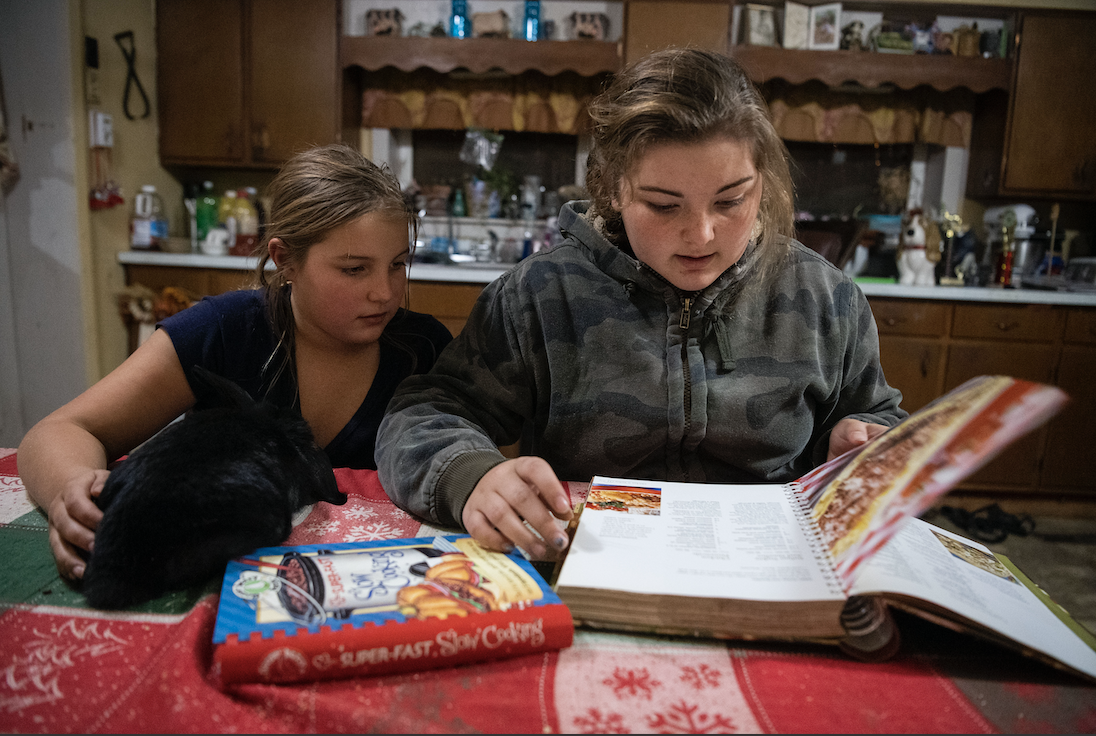
Brooke Lee, 9, holds her rabbit while she helps her sister Paige Lee, 13, look for a recipe to cook Dec. 3 in the kitchen at the Lee family's dairy farm in Berkshire, N.Y. MUST CREDIT: Washington Post photo by Carolyn Van Houten

Brooke Lee, 9, holds her rabbit while she helps her sister Paige Lee, 13, look for a recipe to cook Dec. 3 in the kitchen at the Lee family’s dairy farm in Berkshire, N.Y. MUST CREDIT: Washington Post photo by Carolyn Van Houten

These days, Anne has only about $175 each month to spend on food, beyond the eggs, milk and meat that her family’s dairy operation supplies. So this has become her monthly ritual, going through several drafts to create an affordable meal plan that keeps her husband and five kids from going hungry.

She knows the prices from the discount grocery store by heart. Crushed tomatoes for chili: $1 a can. Potato tots for roast pork: $1.69 a bag.

“I wish I could make lasagna, but it’s expensive,” she said.

Cheese is $2.49 for a half a pound. Fresh vegetables are pricey, too, except for cheap bags of onions and potatoes. Even “Fruit?” had a question mark next to it.
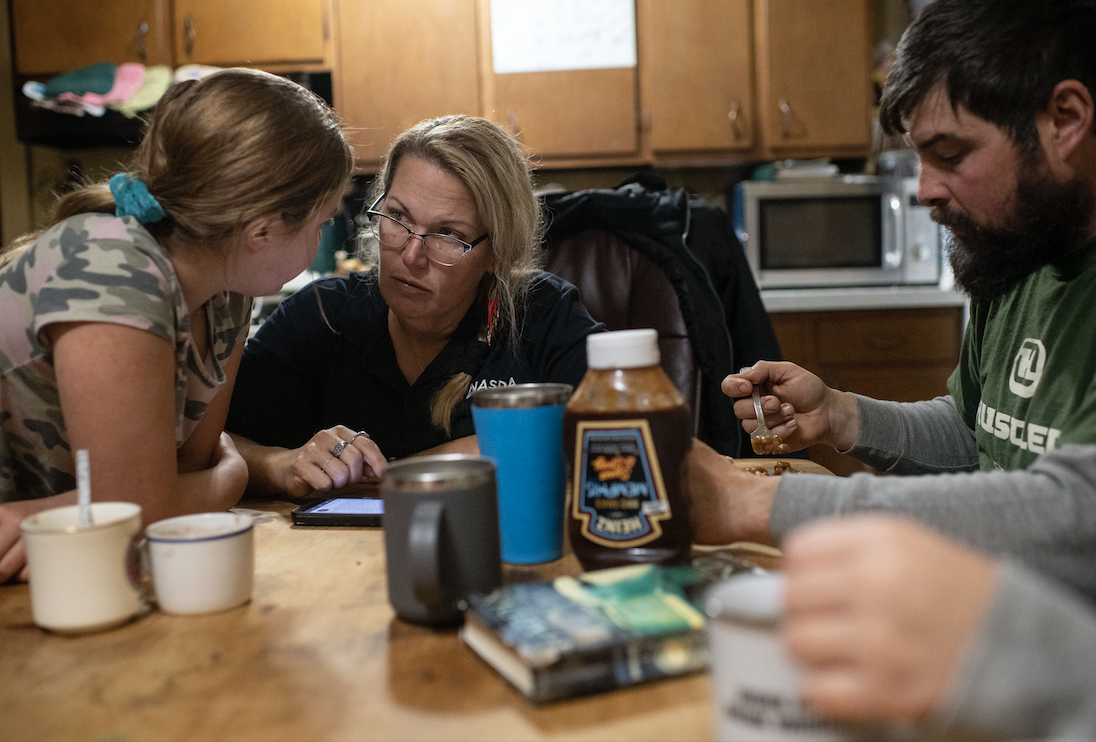
Brooke Lee, 9, and her mother, Anne Lee, read an article out loud about projected milk prices for 2020 during dinner Dec. 4 at the Lee family's dairy farm in Berkshire, N.Y. MUST CREDIT: Washington Post photo by Carolyn Van Houten

Brooke Lee, 9, and her mother, Anne Lee, read an article out loud about projected milk prices for 2020 during dinner Dec. 4 at the Lee family’s dairy farm in Berkshire, N.Y. MUST CREDIT: Washington Post photo by Carolyn Van Houten

When Anne and her husband, Andy, took over his parents’ 305-acre dairy farm in 2013, they made a good living. But years of falling milk prices, complicated by President Donald Trump’s trade wars, have left the couple nearly $200,000 in debt.

Farmers around the country are struggling to pay for basics like groceries and electricity as farm bankruptcies rise and farm debt hitsa historic high. Calls from farmers in financial crisis to state mediators have soared by 57 percent since 2015.

“We’re supposed to be feeding the world, and we can’t even put food on our own table,” Anne said.

She has had less and less money for groceries each month, until one day in October when there was hardly any food in the house, and she started to investigate options she never would have considered before, like food stamps and food pantries.

“This is what need feels like,” she told her husband.

As she worked on the grocery list, her three girls, ages 9 to 13, wandered inside for lunch, clutching hats, gloves and a bunny named Snickers that they wanted to shelter from the cold. There were turkey leftovers from the Thanksgiving meal that only happened because Anne’s sisters had brought most of the food. The girls served themselves.

“Mom, I need cauliflower for my soup – and peppers,” said the oldest, Paige, 13, who makes dinner for the family some nights.

“That’s a big wish list, OK?” said Anne, 40. “Let’s see what we can make happen.”

At one point she looked up from the grocery list and frowned.

“Is that your second sandwich?” she asked Brooke, 9. She was thinking about the only loaf of bread in the house – about her husband and her 15-year-old son, Jason, who had yet to come in from the barn and needed their lunch too.

Chastened, Brooke put the top back on the Miracle Whip.

– – –

It was Anne and Andy’s 18th wedding anniversary, and in between the chores and list-making and snow falling, Anne wanted some time alone with her husband, even if it just meant climbing into his battered Ford pickup to ride into town to get fuel for the tractor. On their honeymoon, the college sweethearts built a bed for the back of Andy’s truck and drove across the United States. There won’t be anything like that or even a date night this year – “that takes moola,” said Breanna, their 11-year-old.

Andy protested at first that Anne had too much to do at home, but by the time they were slip-sliding along the icy road, one of his hands covered hers. After nearly two decades together, the pair still steal kisses until the kids squeal, “Get a room!”

They talked for a while about the custom butcher shop they are building on their property that they hope will one day make things easier financially. But Andy grew quiet when they drove past an empty dairy farm, animals gone, barn collapsed – out of business since the last farm crisis in the 1980s.

“I don’t want to end up like that,” he said.

The decline in the dairy industry – driven by global overproduction and drop in American liquid milk consumption – hit rural New York hard, with the state losing more than 1,100 dairy farms since 2012, according to federal statistics. Then, last year came retaliatory tariffs from Mexico and China on dairy products after Trump-imposed tariffs on steel and aluminum, a $125 million blow to New York’s dairy farmers, according to one state estimate.

About a half a dozen farms have closed around the Lees, and the ones that remain are bad off, Anne says, though self-reliant farmers often don’t discuss their troubles openly.

Anne handles the farm’s finances and juggles the bills by cutoff date, with the top priority keeping the 65 dairy cows – their livelihood – well-fed. She’s stopped answering the landline phone because it’s always bill collectors. The electric company is threatening to shut off their service.

The decline in milk prices has meant a gradual diminishment of what once was a middle-class lifestyle for the Lees – and the food budget that went with it. First they gave up delivery pizza. Then the Sam’s Club membership. Then regular grocery stores. Then apple and blueberry picking at nearby farms in the summer.

Now Andy, 39, misses the Little Debbie snack cakes Anne used to tuck into his sack lunch. Breanna and Brooke miss salad. Jason, a ninth-grader, went out and shot two more deer so the family would have more venison this winter. And then there’s Paige, rarely a complainer, who vaulted to the eighth-grade honor roll for the first time recently by tuning out the stress at home and doing her homework in study hall. Anne has noticed that Paige doesn’t eat half what she usually used to eat, but she hasn’t asked her daughter about it. Some things are private.

The Lees got $4,100 in federal bailout money this year, part of the Trump administration’s $28 billion trade aid package for hurting farmers, which has been criticized for benefiting large operations over family farms. A study by the nonprofit Environmental Working Group found that 60 percent of the money that flowed to New York state went to the top 10 percent of farmers.

The Lees are grateful for what they received, but it’s not enough to make a difference when the milk check is down $4,000 a month, Anne said.

In this part of New York – older, whiter, poorer than other parts of the country – voters chose Donald Trump in decisive percentages during the 2016 presidential race, the Lees among them. Like many farmers, they think their taxes are too high, their creeks and streams are over-regulated and that Trump still has their best interests at heart.

“We’ve had unfair trade for years and years. Somebody had to fix it, and he’s trying to fix it,” Anne said.

“I know a lot of people don’t like it but, you know, this was going to have to happen in order to make U.S. products become more competitive,” said Andy. “It’s going to hurt for a while.”

Anne has tried to help out by getting several part-time jobs – agriculture survey taker, substitute school aide and teacher, liquor store assistant manager and a movie extra at Syracuse’s film hub – which has been hard for Andy to accept.

“I’m supposed to be the primary provider in the house,” he said. “Now I can’t do that, my wife’s got to do that? It means I’m not doing a good enough job.”

He has been so down lately – so sure he’s failing the farm that’s been in the family since 1952 – that Anne couldn’t bring herself to tell him what she was about to do. She’d quietly asked for a Christmas basket from the local community center and learned about a mobile food pantry in a nearby town where she won’t be recognized.

Now she was going to apply for food stamps.

– – –

Anne pulled up in front of the Thomas P. Hoke Human Services Center, a low-slung building painted in red and white stripes. She stepped past the bearded man with a cane sitting on the steps – who seemed oblivious to the cold – entered the building and went through the metal detector.

She was there to finalize her application for the Supplemental Nutrition Assistance Program (SNAP), formerly known as food stamps, and had thought there would be a helpful social worker on the other side of the door. Instead she found a documents kiosk and a clerk named Courtney with blue eyeglasses and metal gauges through her stretched earlobes. The waiting room was crowded with families, people coughing, babies crying.

“Put healthy food on the table” a sign on the wall said. Another: “Stop Medicaid Fraud.”

“What are you trying to do today?” Courtney asked.

“I don’t know; I’ve never been here. I just want to do my SNAP,” Anne said. “Do I need to give my federal tax return or my state tax return or what?”

“Your guess is as good as mine,” Courtney said.

Anne scanned her pay stubs from her various jobs, which last year earned her $5,330. Then the Schedule F tax form that showed net farm income of -$12,979.

“Is there anything I can do today to find out if I get approved?” she asked.

They’d get back to her in 24 to 48 hours, Courtney said. Or by Monday, someone else said later in the day when she called in to check. Or in three weeks when she’d be notified in the mail, a third person said.

Anne was skeptical about whether she would be approved for benefits, anyway. An estimated 197,000 farmers, farmworkers, fishermen and forestry workers use SNAP, according to a study by the Center on Budget and Policy Priorities, but farmers say they sometimes find it difficult to qualify because of complicated rules governing self-employment income. And the Trump administration has long-term plans to tighten SNAP eligibility for many.

But Anne had hoped to get her benefits before Christmas, which might free up a little extra money for simple gifts for the kids, like gloves or a dinosaur toy for her youngest, Levi, 6. Now it didn’t look like that was happening.

“This sucks,” she said.

She was back on the street in less than 20 minutes, far faster than expected, regretting paying $1 for two hours of street parking.

“Before, we were very private,” she said as she climbed into her car. “Now I feel like everybody can see our entire life.”

– – –

This is what need feels like.

The regulars at the monthly food giveaway outside a little white church in Richford, New York, start lining up at 6:30 a.m., holding their places in line with a kind of honor system of laundry baskets and wheeled grocery carts, then return to their cars to wait out of the cold. Anne showed up around 10, clutching grocery bags, and surveyed the place-savers stretched down the block.

“I’m not prepared for this,” she said.

The night before, she’d curled up in the leaf-green wing chair she’d put in an upstairs closet and opened her rose-patterned journal.

“Tomorrow, we go to the food bank,” she wrote. “Andy doesn’t know. I’m afraid if he knows it will upset him. I am so nervous about going. I don’t want people to judge me. I don’t want someone to recognize me and the kids find out and get picked on at school. It is very nerve wracking. But my mom always said it’s there for people that need a helping hand. Use it when you need to and help support it when you don’t. So maybe I can help volunteer.”

Now she was shivering in line, jumping up and down, waiting for the food truck to arrive. Organizers with raw, gloveless hands tried to check everybody in, but the computer was running slow.

“Look at her, she’s doing the hop, skip and jump,” one of the regulars said about Anne.

Finally the truck, a mobile food pantry from the Food Bank of the Southern Tier, pulled in and unfurled its doors, and the line began to move. Volunteers passed out milk, eggs, apple juice, frozen vegetables, tomato soup, chickpeas, cornflakes, canned pears, potatoes and rice. Anne grabbed two bags of apples and six bags of grapes. Fruit would be a question mark on the list no longer.

It was more than she could carry. It was almost more than could fit in the trunk of her car.

“Pretty good deal, huh?” said Peggy Andersen, one of the volunteers.

“I’m really excited,” Anne said.

Anne was able to cross so many items off her master grocery list that once she got to Aldi she only spent $73.12, and then another $39.38 at the scratch-and-dent store that sells day-old bread and dented cans of food. She was $62.50 under her $175 budget. Now, she may be able to keep the lights on in the house and put a little toward the $459 electric bill.

Back at home, the slate-blue farmhouse with the tin star over the door, the grocery bags covered the kitchen table, the pine bench where the kids sit and do homework, and the floor. There was so much food it would not all fit in the refrigerator, and some items would have to be stored on the side porch.

Andy came in from the barn for coffee and gave the spread a quizzical once-over, and Anne quickly copped to her stop at the food pantry. A complicated look passed over his face that she later explained was part relief – that she hadn’t bought all of it herself – and part defeat that she had to ask for help.

“We gotta do what we gotta do, I guess,” he said, and went back outside.

Later, the kids discovered the few treats Anne had bought at Aldi – $1.49 onion bagels for Brooke, the fourth-grader, and $1.49 off-brand cocoa rice cereal for Levi, the first-grader. They started eating fistfuls of the grapes.

“Mom, where did you get all these grapes?” Brooke asked.

“They gave them to us. At the food pantry,” Anne answered.

“Tell them that we love them!” Levi said loudly.

– – –

In the evenings, the children put on their Carhartt coveralls and help Andy with chores in the barn, even Levi, working to unwind hay to feed the Holsteins from a bale bigger than he is. One night after chores, they paused to play before dinner. The kids slid down a small hill on a plastic sled and Grandpa’s old Flexible Flyer, the dogs barking and following them down. Snowballs arced through the air, followed by shrieks and laughter. A fat little half-moon rose.

Pretty soon it was time to go in. The family gathered around the table, and Brooke made scratch-and-dent store hot cocoa with rainbow marshmallows for everyone as others started dishing up dinner, which was tangy crockpot chicken with canned carrots and baked beans.

Anne, scrolling through Facebook, saw a hopeful headline.

“Hey, Andy,” she said. “Listen to this.”

Anne, and then Brooke, began to read out loud a Farm Progress article that quoted two University of Wisconsin at Madison economists predicting a further rise in the price of milk and “good times ahead for dairy farmers.” A first phase of the trade deal with China still to be finalized might also bring some relief.

“So, is it going to be better for us in 2020?” Breanna asked.

“It’s always going to be better for us in 2020, and 2021, and 2022,” said Anne.

“Have to be positive,” said Andy.

“We’re all still together and we all still have a roof over our heads,” Anne said.

“I mean about milk prices,” Breanna said.

“I guess that’s what they’re saying,” Anne said.

Then Levi wanted to know if there were any baked beans left, and Anne put the phone down to help him get more food.

Wheat could be surprise big winner of the U.S.-China trade deal #ศาสตร์เกษตรดินปุ๋ย

#ศาสตร์เกษตรดินปุ๋ย : ขอบคุณแหล่งข้อมูล : หนังสือพิมพ์ The Nation

https://www.nationthailand.com/business/30379938?utm_source=category&utm_medium=internal_referral

Wheat could be surprise big winner of the U.S.-China trade deal

Dec 28. 2019
Wheat sits ready for harvest in a field in Tribune, Kansas. MUST CREDIT: Bloomberg photo by Michael Ciaglo.

Wheat sits ready for harvest in a field in Tribune, Kansas. MUST CREDIT: Bloomberg photo by Michael Ciaglo.
By Syndication Washington Post, Bloomberg · Isis Almeida, Michael Hirtzer

In the agriculture world, news of the partial U.S.-China trade deal has sparked a lot of buzz about soybeans. It turns out, wheat could actually end up being a bigger surprise winner.

Speculations is mounting that China will work to fill its wheat-buying quota as part of the detente, a pledge it failed to stick to in the past. While the allotment, set by the World Trade Organization, could be filled by supplies from any country, it still means additional global demand at a time the market is tighter.

Purchases of soybeans, meanwhile, are likely to be hampered by a deadly pig disease that’s reducing demand. The oilseed is crushed to make cooking oil and meal, a key ingredient in hog feed.

“The potential that China could secure an additional 5 to 6 million tons of world wheat annually is underpinning Chicago Board of Trade wheat,” Chicago-based consultant AgResource Co. said in a report Thursday.

Wheat traders expect China will soon release the quota, according to AgResource, and prices are already reacting. On Friday, futures for March delivery rose as much as 2.2% to $5.61 a bushel in Chicago, the highest for a most-active contract since August 2018. Futures traded in Paris reached the highest since June.

If Chinese purchases were to reach the quota mark of 9.6-million metric tons, that would represent a big jump in demand. In the six years through 2017, buying has averaged less than 50% of the allotment.

China will likely fill its quota with the cheapest wheat in the market. While that’s usually grain from the Black Sea, U.S. supplies have been getting more competitive and international buyers have recently turned to American shipments.

In the week ended Dec. 19, American exporters sold 715,000 tons of U.S. wheat. That follows the previous week’s sales of 868,600 tons, which was the most in six years, according to USDA figures, excluding skewed data released after the federal government shutdown earlier this year.

Relatively tighter corn supplies in South America and wheat in top shipper Russia have made American grain more competitively priced. Heavy rain in Europe is also making it harder for growers there to plant, with Consultants Strategie Grains expecting the crop to drop by 3.6% in the European Union. In western Australia, wheat yields have been disappointing due to hot and dry weather.

China hasn’t purchased significant volumes of American supply since October. But, underscoring U.S. wheat’s competitiveness in world markets, other top Asian importers including Indonesia, Japan, Philippines and Taiwan have snatched up supplies in recent weeks, according to USDA data.

Corn could also benefit if China moves to fill grain quotas, but to a smaller degree. At 7.2 million tons, the allotment is not only smaller, but the Asian nation has historically done a better job of filling it, meaning it wouldn’t represent a very big increase in demand.

“The impact on corn values is far less,” AgResource said.

TBA to announce guidelines on protection of clients’ data #ศาสตร์เกษตรดินปุ๋ย

#ศาสตร์เกษตรดินปุ๋ย : ขอบคุณแหล่งข้อมูล : หนังสือพิมพ์ The Nation

https://www.nationthailand.com/business/30379921?utm_source=category&utm_medium=internal_referral

TBA to announce guidelines on protection of clients’ data

Dec 28. 2019
Getty Images

Getty Images
By THE NATION

The Thai Bankers’ Association (TBA) will issue practice guidelines for commercial banks in handling clients’ personal data, following the enforcement of the personal data protection law in May next year.

The Personal Data Protection Act, B.E. 2562 (2019) regarding the collection, use, or disclosure of personal data will come into effect on May 28, 2020.

The association’s president Predee Daochai has said that banks might have to adjust their working process to be in compliance with the law.

For example, he said, they need to request clients’ consent and ask them to sign on the consent every time the banks want to collect, use, and disclose their personal data. Each individual client has the right to agree or reject such a request.

The association has set up a team to study the law and its possible impacts on the banks, he added.

Thakorn Piyapan, head of Krungsri Consumer Group, said banks would feel the impacts from personal data protection law and the debt collection law next year, adding that further study is needed as banks must ensure maximum protection of clients’ data.

Protection of clients’ data goes beyond confinement of the banks, it also covers their merchant partners.

He said that Krungsri is considering using technology to convert client data transfers between the bank and its merchant partners in the way that, if leaked, their identities will not be known.

Trump’s quest to shatter GOP economics reached its culmination in 2019 #ศาสตร์เกษตรดินปุ๋ย

#ศาสตร์เกษตรดินปุ๋ย : ขอบคุณแหล่งข้อมูล : หนังสือพิมพ์ The Nation

https://www.nationthailand.com/business/30379936?utm_source=category&utm_medium=internal_referral

Trump’s quest to shatter GOP economics reached its culmination in 2019

Dec 28. 2019
File Photo/ President Trump

File Photo/ President Trump
By The Washington Post · Jeff Stein 

President Donald Trump shattered Republican orthodoxy on an extraordinary range of economic policies in 2019, setting up a more populist record for him to tout during a 2020 campaign in which Democrats already are slamming him for abandoning working people.

From trade to spending, from the Federal Reserve to paid parental leave, Trump has embraced policy changes that historically are more in line with the approach of Democrats than Republicans in establishing a forceful role for government in setting the terms of the economy.

It is a sharp contrast to his first two years, when his main achievements included cutting regulations and a significant tax overhaul that emphasized reducing corporate tax rates – traditional bastions of policymaking for the GOP.

Trump has still pursued cuts to government spending that pinch poorer Americans – tightening rules on food stamp and allowing states to reduce Medicaid enrollment, for instance – that have fueled constant Democratic accusations he has betrayed voters.

But the breadth of Trump’s break with the GOP is striking.

On trade, Trump has reached a “phase one” trade deal with China that reportedly includes promises to buy far more in U.S. exports. He has completed a revamp of the North American Free Trade Agreement with Mexico and Canada that some liberals are cheering for labor protection and pharmaceutical policies.

Trump co-opted a demand from the left to urge the Federal Reserve to cut interest rates despite the relatively strong economy, a position the central bank ultimately adopted after seeing signs the economic expansion might waver.

The president has blown away traditional GOP concerns over the rising federal deficit, cutting bipartisan deals to expand government spending and even extend a new paid leave benefit to the federal workforce. He unilaterally implemented a farm bailout that could prove more expensive than the auto bailout was a decade ago – a move that conservatives had criticized as wasting taxpayer dollars.

And while taking action against President Barack Obama’s health care law in court, the Trump administration has avoided moves to immediately blow up the law while pushing to allow states to import cheaper prescription drugs – a longtime liberal position opposed by many Republicans.

Trump’s steps away from conservative economic orthodoxy have been building since the 2016 presidential campaign, when he shocked GOP elites on his way to a blowout victory in the Republican primary. But in many ways they appeared to reach their culmination in 2019.

“The administration this year has appeared to change its focus away from working with Congress on more typical Republican proposals, and toward an increasing focused on populist priorities,” said William Hoagland, senior vice president at the Bipartisan Policy Center and former Republican staff director for the Senate Budget Committee.

Some analysts say the emphasis on populist economics could upend the 2020 presidential election, as the issues that may have helped give Democrats control of the House in the 2018 midterms – particularly the attempt to repeal Obamacare and the Republican tax law – could recede while other White House initiatives become more prominent.

The Trump administration is likely to continue its aggressive trade actions in its fourth year, turning to negotiations with the United Kingdom, Europe, and possibly India and Vietnam, said Peter Navarro, assistant to the president for trade and manufacturing policy, in an interview.

These economic priorities serve as a contrast with the highly partisan politics of impeachment, which is expected to play out with a Senate trial early next year.

Democrats maintain Trump sold out his working-class base to the GOP donor class after his election, but the attack may grow less potent as the tax cut in particular loses its immediacy.

Celinda Lake, a Democratic pollster at Lake Research Partners, said that Democratic elites such as lawmakers, think tank leaders, and consultants have been alarmed by Trump’s economic populism.

“Typically, Republicans offer things like the deficit and the stock market – the upscale economic agenda – but Trump is trying to include the semblance of a working class economic agenda,” she said. “It isn’t real when you look underneath the hood, but it sure looks real absent an alternative.”

Trump’s policy shift also illustrates his power over congressional Republicans.

Two core party constituencies for decades – free market traders and deficit hawks – are at risk of being effectively exiled from the GOP, as some Republican lawmakers quietly fume at being sidelined repeatedly over policy matters.

“I see the restraints coming off all over the place. It’s been a less cautious approach as Trump has realized he doesn’t have to pay attention to traditional Republican advisers,” said Ed Dolan, an economist at the Niskanen Center, a libertarian-leaning think tank. “There don’t seem to be any conservative voices around him anymore that disagree with him.”

Less trade uncertainty, lower interest rates and more government spending will mean an economy growing faster than it otherwise would, even if expectations remain for a modest 2 percent growth in 2020. That could be a boon to the president’s reelection prospects, though Democrats say Americans are still hurt by stagnant wages and widespread economic anxiety.

Trump’s policies could still create longer term risk.The surge in federal deficits and cuts to interest rates may limits the tools America has to respond to an economic downturn, should one arrive in the final year of Trump’s first term or later.

And, politically, Trump could remain vulnerable on health care, a top concern among voters, having overseen a rise in both costs and the number of people without insurance.

“I really say it’s mostly lip-service,” said Dean Baker, an economist at the left-leaning Center for Economic and Policy Research, of Trump’s populism while in office. “If you look at his big changes, it’s really the tax cut that went to the top 1 percent and there’s no dispute from that. The rich have really benefited and everyone else gets a show.”

Trump may point to steady economic growth and historically low unemployment numbers, but critics say those are largely disconnected from his populist economic policies.

“Most of the jobs that have been created are in the services-type industries – his constituency in the middle of the country may not be helped by a lot of these policies,” said Chris Rupkey, chief financial economist at MUFG Union Bank. “And trying to change these forces of globalization – it won’t have an impact for 10 or 20 years, if it happens at all. These are very slow-moving forces.”

Kayleigh McEnany, a spokeswoman for Trump’s reelection campaign, said in a statement: “Trump promised to change decades of failed trade policy, revive manufacturing, and bring relief to middle class families. He has done all that and more.”

Trump’s presidency began with an unsuccessful effort to undo President Obama’s 2010 health care legislation, which would have cut federal spending but also cost millions of Americans their health insurance. Republicans then united successfully around a more than $1.5 trillion tax cut.

“When Trump first came into office, the priorities he agreed with – the tax bill, repealing Obamacare – required legislation, and so he needed hill Republicans led by orthodox conservative Paul D. Ryan,” said Doug Holtz-Eakin, a Republican economist and former director of the Congressional Budget Office.

But since Democrats gained control of the House starting in 2019, the White House has either had to compromise with House Speaker Nancy Pelosi, D-Calif., or act unilaterally.

“What changed this year is that for the policy issues on the table he could move unilaterally, and he did,” Holtz-Eakin said. “These are nontraditional Republican positions and they have come to the fore in the past year.”

Among the most serious clashes with his own party has been over trade. Republicans have traditionally resisted tariffs and supported large business groups in their quest for expanding international markets. Democrats have typically led the charge to crack down on China trade practices and revamp NAFTA.

Trump flipped this dynamic upside-down. After blasting America’s trade relations with foreign nations as a presidential candidate, Trump took action on the issue by launching a trade war with China and slapping increasingly aggressive tariffs on other countries.

Business groups that had been strongly supportive of the tax overhaul criticized Trump for raising prices for American consumers and disrupting global supply chains.

Trump’s advisers were in the meantime willing to agree to significant concessions to House Democrats and labor groups to seal a new trade agreement with Canada and Mexico, angering some Republicans but also earning the pact bipartisan cover.

“Trump’s unique brand of populism is essentially an economic nationalism based on an America first perspective, applied to both domestic policies and the international trade arena. This revolution has repositioned the Republican Party into the party of the working class,” said Navarro, the Trump trade adviser.

“In the past, Republicans were willing to sacrifice our economy on the altar of national security – but if you do that you wind up losing both.”

Perhaps just as surprising is how Trump has upended the GOP positions on both monetary and fiscal policy.

The president demanded Federal Reserve Chair Jerome Powell reverse course and back off raising interest rates. At the same time, the president has rejected Fed nominees pushed by traditional conservatives who likely would have raised rates.

“It seems that [Trump’s] appointments are fully on board for the critique leftists have been making about monetary policy,” said Sam Bell, founder and policy director of Employ America, a left-leaning organization advocating on economic policy.

A spending splurge under Trump may mark an even more dramatic retreat in conservative economic policy, as annual deficits have risen to close to $1 trillion despite the sustained run of economic growth.

Trump campaigned on preventing cuts to Social Security and Medicare, largely bucking long-standing GOP calls to reduce the national deficit by targeting America’s two large government programs. In practice, his administration has gone even further than avoiding cuts to those programs, expanding federal spending in multiple budget deals while opportunistically using them to win concessions on other priorities, such as Space Force.

Trump’s policy opportunism may be novel for American politics, but his grab bag of economic positions fits a bigger global trend of conservative populists like Boris Johnson in the United Kingdom, who has pledged to increase spending on Britain’s national health program.

“Populist forces are a global phenomenon. They cut across the traditional left-right cleavage. Many populists aren’t traditional free-market neoliberals or fiscal conservatives in their economic policies,” said Pippa Norris, a political scientist at Harvard.

Whether that will permanently remake the Republican Party, on the other hand, remains an open question.

“Republican lawmakers privately still believe the deficit is a problem and support free trade – but they’re not going to say that publicly because it’s not where their voters are,” said Brian Riedl, a budget analyst at the libertarian-leaning Manhattan Institute. “I’m not sure Trump has changed the minds of Republican lawmakers as much as he has won over the base and lawmakers understand crossing the president is political suicide.”