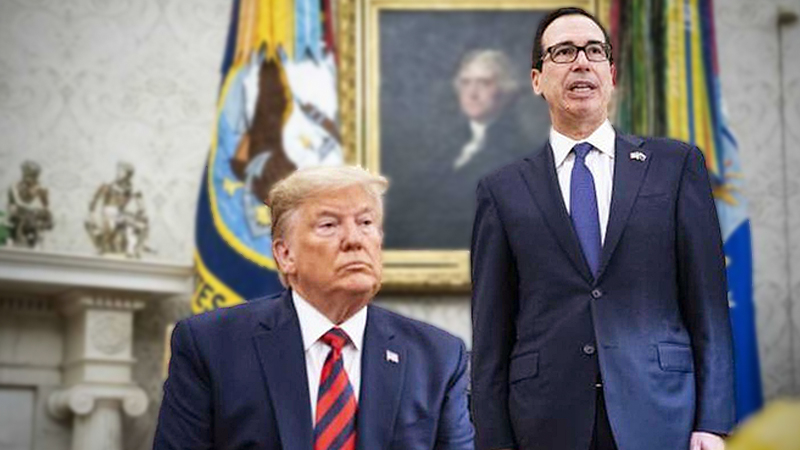
Trump faces deadline on participating in House Judiciary Committee impeachment probe

#ศาสตร์เกษตรดินปุ๋ย : ขอบคุณแหล่งข้อมูล : หนังสือพิมพ์ The Nation

https://www.nationthailand.com/news/30379166?utm_source=category&utm_medium=internal_referral

Trump faces deadline on participating in House Judiciary Committee impeachment probe
Dec 07. 2019
By The Washington Post · John Wagner

321 Viewed

WASHINGTON – President Donald Trump faces a 5 p.m. deadline Friday to announce whether he intends to have a lawyer participate in the remaining impeachment proceedings before the House Judiciary Committee, as Democrats accelerate their attempt to remove him from office.

The White House declined to participate this week in the committee’s first hearing, during which four law professors testified about whether Trump’s conduct toward Ukraine amounts to an impeachable offense.

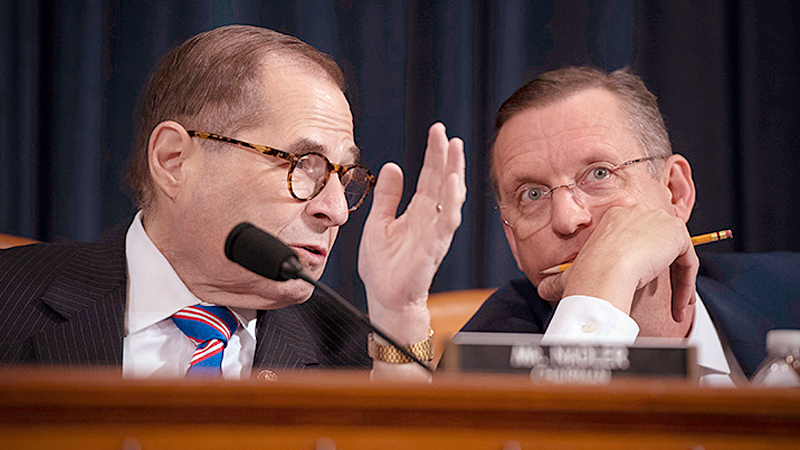
House Judiciary Committee Chairman Jerrold Nadler, D-N.Y., gave Trump an ultimatum about participating in a letter addressed to him a week ago.

“In particular, please provide the Committee with notice of whether your counsel intends to participate, specifying which of the privileges your counsel seeks to exercise, no later than 5:00 pm on December 6, 2019,” Nadler wrote. “I look forward to your prompt response.”

Democrats have said Trump’s decision on whether to participate could affect the timing of a full House vote on impeachment. If he does participate, the proceedings could be extended.

House Speaker Nancy Pelosi, D-Calif., directed committee chairmen Thursday to begin the process of drafting articles of impeachment against Trump, with many Democrats anticipating that a full House vote could come before Christmas.

“His actions are in defiance of the vision of our founders and the oath of office that he takes to preserve, protect and defend the Constitution of the United States,” Pelosi said Thursday. She also praised her ranks’ “somber approach to actions, which I wish the president had not made necessary.”

At the heart of the Democrats’ case is the allegation that Trump tried to leverage a White House meeting and military aid, sought by Ukraine in the face of Russian military aggression, to pressure President Volodymyr Zelensky to launch an investigation of former vice president Joe Biden and his son Hunter Biden, as well as a probe of an unfounded theory that Kyiv conspired with Democrats to interfere in the 2016 presidential election.

White House spokesman Hogan Gidley said he expects the White House to respond by the end of the day Friday. “I’m not going to get ahead, obviously, of how we are going to respond,” Gidley told reporters at the White House.

He added that he found it “somewhat interesting” that Pelosi had announced plans to move forward with articles of impeachment before hearing if a Trump lawyer would participate in the Judiciary Committee proceedings.

Pelosi said Fridat Trump’s participation in the House Judiciary Committee impeachment proceedings would offer “a chance to show innocence.”

“Anything they have that is exculpatory, this is their moment,” she told reporters at the Capitol. “But they have a consciousness of guilt, and that’s why they may not show up. We’ll see. Maybe they will. They have till 5 o’clock today.”

The Judiciary Committee has another hearing scheduled on Monday, during which lawyers for the House Intelligence Committee are slated to present findings from a 300-page report that concluded Trump put his personal political interest above the national interest.

In tweets Thursday, Trump urged the House to impeach him quickly, if Democrats intend to do so, saying he was eager to participate in a trial in the Republican-led Senate.

Trump returned to Twitter Friday morning to retweet a half-dozen tweets from allies taking issue with the impeachment process.

Among them was one from his campaign manager, Brad Parscale, who wrote: “The Democrats are right about one thing – someone did abuse their power. But it’s not @RealDonaldTrump. It’s THEM.”

House Majority Whip James Clyburn, D-S.C., said during a television appearance Friday that Democrats would be free to vote as they choose on articles of impeachment without pressure from party leadership.

“I think it would be a bit unseemly for us to go out whipping up a vote on something like this,” Clyburn said during a CNN interview. “This is too serious. This is too much about preserving this great republic, and I think we ought to leave it up to each member to decide how he or she would like to vote.”

Clyburn said lawmakers should consider “their own constituents and what they think is in the best interests of their love for country.” He acknowledged that Democrats could lose some votes but would not predict how many.

“I have not counted,” Clyburn said. “I do know we’ll have some voting against impeachment.”

More than 500 legal scholars have signed an open letter asserting that Trump committed “impeachable conduct” and that lawmakers would be acting well within their rights if they ultimately voted to remove him from office.

The signers are law professors and other academics from universities across the country, including Harvard, Yale, Columbia, the University of California at Berkeley, the University of Michigan and many others. The open letter was published online Friday by the nonprofit advocacy group Protect Democracy.

“There is overwhelming evidence that President Trump betrayed his oath of office by seeking to use presidential power to pressure a foreign government to help him distort an American election, for his personal and political benefit, at the direct expense of national security interests as determined by Congress,” the group of professors wrote. “His conduct is precisely the type of threat to our democracy that the Founders feared when they included the remedy of impeachment in the Constitution.”

Also Friday, a new report by a watchdog group says that 50 members of Congress have visited a Trump property since the beginning of the House impeachment inquiry.

“While Congress is charged with providing unbiased checks and balances on the president, including President Trump’s conflicts of interest related to his businesses, many members have chosen to forgo these responsibilities while enjoying the political benefits that visiting and spending money at Trump properties provides,” says the report by Citizens for Responsibility and Ethics in Washington.

“That’s especially problematic now, as members of Congress are tasked with considering how to perform their constitutional duty as the impeachment process moves forward,” the report said.

According to the group, more than 100 members of Congress have visited a Trump property since he took office. Of those, five are Republican members of the House Judiciary Committee, the panel tasked with drafting articles of impeachment.

They include Reps. Matt Gaetz, R-Fla., Tom McClintock, R-Calif., Andy Biggs, R-Ariz., Louie Gohmert, R-Texas, and Jim Jordan, R-Ohio. The campaign committees of Biggs, Gohmert and Jordan have also spent money at a Trump property, according to the group.

Meanwhile,three Republican Senate committee chairmen announced Friday that they are seeking records and transcribed interviews from two people who, they claim, could bolster an advanced by Trump that “elements of the Ukrainian government were actively working to undermine” his prospects against Democrat Hillary Clinton.

“Contrary to the popular narrative in the ‘main stream media’ that Ukrainian involvement in the 2016 election has been debunked, or ‘no evidence exists,’ there are many unanswered questions that have festered for years,” Homeland Security Chairman Ron Johnson, R-Wis., said in a statement.

Also involved in the effort are Finance Chairman Chuck Grassley, R-Iowa, and Judiciary Chairman Lindsey Graham, R-S.C.

In a statement, Graham said that the hacking of Democratic National Committee servers in advance of the 2016 election was done “by the Russians and no one else.” But, he added, “[w]hether there’s a connection between Democratic operatives and Ukrainian officials during the 2016 election has yet to be determined. It will only be found by looking. We intend to look.”

More than 500 law professors say Trump committed ‘impeachable conduct’

#ศาสตร์เกษตรดินปุ๋ย : ขอบคุณแหล่งข้อมูล : หนังสือพิมพ์ The Nation

https://www.nationthailand.com/news/30379165?utm_source=category&utm_medium=internal_referral

More than 500 law professors say Trump committed ‘impeachable conduct’

Dec 07. 2019
PHOTO CREDIT: Washington Post photo by Jabin Botsford

PHOTO CREDIT: Washington Post photo by Jabin Botsford
By The Washington Post · Matt Zapotosky

388 Viewed

WASHINGTON – More than 500 legal scholars have signed on to an open letter asserting that President Donald Trump committed “impeachable conduct” and that lawmakers would be acting well within their rights if they ultimately voted to remove him from office.

The signers are law professors and other academics from universities across the country, including Harvard, Yale, Columbia, the University of California at Berkeley, the University of Michigan and many others. The open letter was published online Friday by the nonprofit advocacy group Protect Democracy.

“There is overwhelming evidence that President Trump betrayed his oath of office by seeking to use presidential power to pressure a foreign government to help him distort an American election, for his personal and political benefit, at the direct expense of national security interests as determined by Congress,” the group of professors wrote. “His conduct is precisely the type of threat to our democracy that the Founders feared when they included the remedy of impeachment in the Constitution.”

House Speaker Nancy Pelosi, D-Calif., announced Thursday that she was directing committee chairmen to draft articles of impeachment against Trump, a day after the House Judiciary Committee heard testimony from four constitutional scholars on the matter. Three law professors who were called for that hearing by Democrats argued that Trump’s behavior was impeachable, while one invited by Republicans argued that the process was moving too quickly.

Those who signed on to the Protect Democracy letter said they “take no position on whether the President committed a crime.” Earlier this year, Protect Democracy gathered signatures for a similar letter, in which hundreds of former federal prosecutors signed on to a statement asserting that special counsel Robert Mueller’s findings would have produced obstruction charges against Trump – if he were not a sitting president.

“But conduct need not be criminal to be impeachable,” the group of professors wrote. “Impeachment is a remedy for grave abuses of the public trust.”

The group noted in particular that Trump’s conduct seemed to be directed at affecting the results of the 2020 election, and thus it was not a matter that could be left to voters at the polls.

The impeachment inquiry has focused on what Democratic lawmakers say were Trump’s efforts to pressure his Ukrainian counterpart to announce an investigation into a potential 2020 rival, former vice president Joe Biden, in exchange for a White House meeting and the release of hundreds of millions of dollars in military aid. Trump has rejected Democrats’ allegation that he engaged in any sort of corrupt quid pro quo.

“Put simply, if a President cheats in his effort at re-election, trusting the democratic process to serve as a check through that election is no remedy at all,” the professors wrote. “That is what impeachment is for.”

Because Democrats control the House, Trump will almost surely be impeached. The matter would move then to the Senate for a trial to see if he should be removed from office. There, it seems unlikely that Trump would be ousted. The Senate is GOP-controlled, and two-thirds of senators would have to vote against the president.

Wall Street says it cares about diversity. But most big banks won’t share complete workforce data.

#ศาสตร์เกษตรดินปุ๋ย : ขอบคุณแหล่งข้อมูล : หนังสือพิมพ์ The Nation

https://www.nationthailand.com/news/30379160?utm_source=category&utm_medium=internal_referral

Wall Street says it cares about diversity. But most big banks won’t share complete workforce data.

Dec 07. 2019
By The Washington Post · Renae Merle, Jena McGregor

468 Viewed

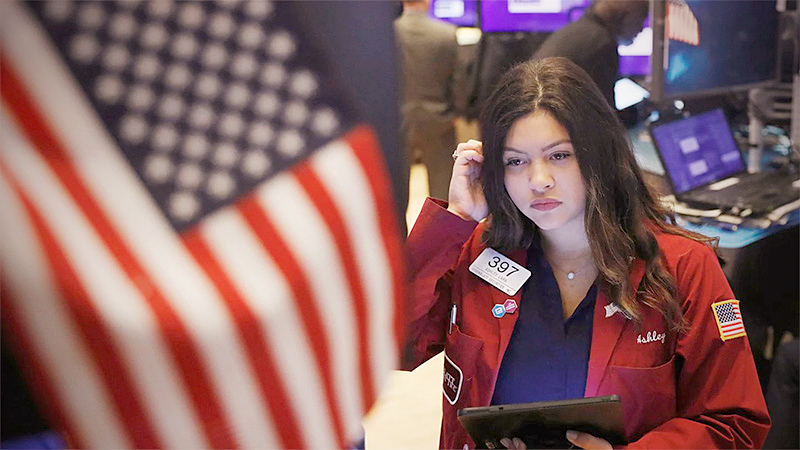
Allison Gamba spent 10 years at Goldman Sachs gunning for a promotion to managing director. She said she worked long days and significantly increased the profits from the stocks she traded for the bank on the New York Stock Exchange.

Gamba made a point of telling co-workers she didn’t want children, she said, hoping to avoid the perception she was on the “mommy track” rather than the “promotion track.” Then a mentor pulled her aside and suggested she and her husband adopt a child to allay any fears that she would be distracted by a pregnancy.

“It was a very uncomfortable feeling. I knew he really liked me, and I think he was just warning me,” she said.

After leaving Wall Street, Gamba joined thousands of current and former female employees suing Goldman Sachs for gender discrimination in a long-running lawsuit. Goldman Sachs has denied the lawsuit’s allegations, and said in a statement that Gamba’s business unit was “performing poorly and undergoing extensive downsizing.”

For years, Wall Street has promised to bring more women and people of color into its upper ranks, but none of the country’s largest banks – those with at least $200 billion in assets – is headed by a woman or a person of color.

And only two of the 15 biggest banks in the country – TD Bank and BNY Mellon – agreed to publicly disclose their most recent government diversity reports in response to a request from The Washington Post.

“It’s going to take a lot for them to actually change. You have to fix the past to deal with the future,” Gamba said.

All of the banks already submit the workforce diversity data requested by The Post to the federal government each year through two-page forms known as EEO-1s. Companies with 100 or more employees are required to submit the forms each year, showing a breakdown of their U.S. workforce by race and gender across 10 job categories. The forms do not identify workers by name or contain trade secrets.

The data the industry does share with the public shows slow progress:

– At JPMorgan Chase, the country’s largest bank, with $2.7 trillion in assets, women and African Americans made up 25.8 percent and 2.9 percent respectively of senior executives in 2015, rising to 26.3 percent and 3.7 percent last year.

– In a yearly report, Wells Fargo, which has nearly $2 trillion in assets, told shareholders that women and minorities at “levels 2-4” had reached 41 percent and 19 percent of its workforce, respectively. The categories aren’t explained, and Wells Fargo didn’t offer more insight into its racial makeup. At The Post’s request, it released percentages but not the raw data it reports to the government. The data shows that women made up 24 percent of the bank’s senior workforce in 2015, rising to 31 percent last year. Black employees made up 8 percent of senior roles, falling to 4.1 percent in 2018.

– At TD Bank, one of two banks to share its full EEO-1 reports for the three most recent years, there was one black woman among 72 senior executives in 2015. There were no black women in its top ranks last year out of 42 senior executives overall.

– BNY Mellon, which has $1.7 trillion in assets, has released its full EEO-1 reports for the past few years. In 2018, the data showed BNY’s U.S. executive tier, made up of 14 people, was all white, except for one Asian man. The bank has since added two black executives.

– Capital One has made bigger improvements in promoting Hispanic and Asian employees into top roles than black employees, who were 2.4 percent of senior executives in 2016 and 2.6 percent last year.

– BB&T released data about its workforce diversity for the first time in 2019, showing that 8 percent of executives and senior managers are “persons of color,” but did not release its EEO-1 report to The Post. (Regulators approved its $66 billion merger with SunTrust last month, creating the country’s sixth-largest bank, with $500 billion in assets.)

– SunTrust also only provided vague information, showing that 18 percent of executives and senior managers were people of color in 2017, increasing to 19.2 percent last year.

– Bank of America publishes EEO-1 data for its three top job categories, as well as “all other” and “total” figures. The data show slight improvements across most major racial groups and women in the United States at its highest ranks. The percentage of female executives ticked up slightly, from 31.3 percent in 2016 to 33.4 percent in 2018.

– At Morgan Stanley, the share of female executives in its U.S. workforce dipped from 18.4 percent in 2016 to 17.8 percent in 2018, while the share of black executives rose from 1.9 percent to 2.2 percent.

Banks have struggled to increase the number of black employees in their upper ranks.

A 2017 report from the Government Accountability Office found that between 2007 and 2015, African Americans in first-, mid- and senior-level management jobs fell, from 6.5 percent to 6.3 percent, even while overall minority representation in financial services management rose.

The industry has been “treading water,” said Martin Davidson, a professor at the University of Virginia who has consulted with banks on their diversity programs. “Firms that are built and developed in ways that support and privilege predominantly white male managers and leaders – cultures that are built so they move people who fit that prototype – will always continue to nurture those kinds of people,” he said.

Last year at Goldman Sachs, 2.7 percent of its senior executives were black, compared with 3 percent in 2012. The only black member of the executive committee, who is in charge of diversity efforts, announced in October that he was leaving to lead a company in Silicon Valley.

The bank has made a renewed effort to address its lack of diversity, including a goal to increase the percentage of black entry-level recruits in the Americas to 11 percent and Hispanic or Latino entry-level recruits to 14 percent. In November, it announced its newest class of managing directors included its highest percentage yet of female and black employees.

At Citigroup, black employees fell from 16 percent of the bank’s total U.S. workforce in 2009 to 10.3 percent last year, and black executives now account for less than 2 percent of its senior ranks. Following a request from The Post, Citigroup, which released its entire EEO-1 data between 1999 and 2016, disclosed percentages for 2017 and 2018 across race and gender for most job categories, as well as a total workforce figure.

The bank said it is working to improve those figures, partnering with several universities to identify diverse summer associates, hosting career symposiums for students at historically black colleges and training employees to spot subtle biases. It is “one of the areas that honestly worries me the most,” said Sara Wechter, Citigroup’s human resources chief.

HSBC’s U.S. operations have increased the number of black employees in senior ranks from 16 in 2015 to 25 as of May of this year even as its overall workforce declined, according to company data.

“The hiring numbers look good and we have seen some great movement, but it’s just not fast enough,” Maureen Gillan-Myer, HSBC’s head of human resources for North America, said in an interview.

The industry’s reputation as a bastion of white men have also turned Wall Street into a target of Democratic lawmakers and investors. The powerful House Financial Services Committee has established a first-of-its kind subcommittee dedicated to the issue.

The banking industry has voiced support for workforce diversity for years but has struggled to “make meaningful success,” said Rep. Joyce Beatty, D-Ohio, chairwoman of the House Financial Services subcommittee on diversity and inclusion. Diversity “cannot merely be the ‘nice thing to do.’ It must penetrate the company’s mission, practices, and organizational culture. It must start at the top with the CEO and permeate throughout management. It must be intentional.”

Some banks said the EEO-1 form requested by The Post does not accurately reflect their workforce and that figures they provide to the government can be easily misinterpreted. What counts as a senior executive at one firm may be a middle manager at another, industry officials said. Others cited potential privacy issues for employees, argued that what they share is comparable to other banks, or declined to comment.

The U.S. Equal Opportunity Employment Commission, which collects the forms each year, publishes a list of more than 800 job titles on its website, noting which categories each falls into.

At Charles Schwab, the only bank among the top 15 that does not disclose race or gender data, shareholders holding 40 percent of shares voted this year to require the company to disclose its diversity data.

“Our management and our board believe our efforts are best spent on ensuring our employees enjoy a rich and inclusive culture” rather than “focusing on data that can portray an inaccurate picture of the culture of our firm,” Schwab spokesman Glen Mathison said in a statement.

New York City Comptroller Scott Stringer, who advises the city’s public pension funds, is pressuring Charles Schwab to disclose more about its workforce. “These companies have almost no people of color in senior positions,” said Stringer. “It’s an absolute national disgrace, and we have targeted these companies because they’ve earned the right to be targeted.”

State Street, a large financial services company, drew international attention to the low number of women on Wall Street in 2017 when it deposited the statue of a petite girl in high-top sneakers in the shadow of the New York Stock Exchange. “Fearless Girl” illustrates “the power of women in leadership, and the potential of the next generation of women leaders,” the company said at the time.

But women were only 29 percent of its senior executives last year, compared with 28 percent in 2015, according a yearly report. The company is aiming to increase that figure to 33 percent within three years. The bank did not respond to a question about why it would not disclose its EEO-1 form but said in a statement: “While we have made significant progress increasing the representation of women and employees of color in senior roles within the company, we are not yet satisfied and there remains much to do.”

To be sure, women have secured some of the industry’s top jobs. The chair of Wells Fargo’s board, Elizabeth Duke, is the first woman to hold that role in the industry.

In October, Citigroup, where 33 percent of its U.S. executives are now women, named Jane Fraser president of the bank and CEO of its global consumer banking business, making her the heir apparent to succeed CEO Michael Corbat.

The industry’s slow progress has disappointed even some of its stalwart boosters.

After more than 20 years in finance, Maura Cunningham launched Rock the Street, Wall Street, a year-long program that provides financial literacy training in hopes of encouraging high school girls to consider a career in finance.

“We tell them if they want to change the world, you’ve got to know the numbers; if you don’t know the numbers, you won’t get a seat at the table,” she said.

But Cunningham said her faith was shaken after her daughter joined a global financial company’s office in Chicago and complained of the culture there – having footballs thrown over her head and hearing comments about her body while waiting for the elevator. “I said, ‘keep your head down,’ ” Cunningham said. “But after a year, she said, ‘I’m out.’ ”

It was a tough lesson, Cunningham said. “It showed me the light, and I said the culture has to change.”

In addition to Goldman, several other major banks are also fighting discrimination lawsuits in court.

In 2018, Faye Boatright, a black former managing director at U.S. Bancorp, sued the bank, alleging she was paid less than white male peers for the same or similar work, was given fewer support staffers and had clients taken away. Boatright also alleges in the lawsuit she was given a “baseless” negative performance review after complaining about discrimination.

The U.S. Equal Employment Opportunity Commission found the case had “probable cause,” according to the complaint, and the case is ongoing.

A U.S. Bancorp spokeswoman, Rebekah Fawcett, said in an email that U.S. Bancorp “thoroughly investigated Ms. Boatright’s concerns when she first raised them. Her allegations have no merit. Ms. Boatright was paid equitably and treated fairly during her time at the bank.”

Meanwhile, seven black financial advisers sued Morgan Stanley in 2016, alleging they were less likely than white peers to be connected with the clients of departing brokers and assigned to high-producing teams, making it more difficult for them to earn equal pay and remain at the firm.

“There’s this prevailing and harmful assumption that white clients would prefer to do business with white advisers,” said Suzanne Bish, a lawyer representing the advisers. “It’s a way [the firms] avoid looking at their own conduct and their own practices.”

A judge dismissed the claim, a move Bish said they will appeal, and ordered three of the advisers to address their complaints through arbitration.

Kwesi Coleman, one of the seven advisers who sued the bank, said his white colleagues excluded him from conversations after team meetings and a manager only shared a potential client lead with him once – a database of alumni of historically black colleges. After he spent his own money to earn a designation that would help market himself to National Football League players, he alleges the firm would only let him use it if he shared his revenue with a white financial adviser. After he filed a complaint with human resources, Coleman said, the firm later relented.

“I’ve always had to do more to get a leg up. . . . Going in, I knew I would have to work harder,” said Coleman, who joined Morgan Stanley as a trainee in 2012 with an MBA and more than 10 years of industry experience. “What I didn’t expect was to be basically held back. I didn’t expect to have opportunities withheld.”

Once, Coleman said, a white colleague noted the long hours he was working, stopped by his desk and asked: “How many top producers do you see that look like you?” he recalled. “He said, ‘Most people with money want to work with other people who look like them.’ He said it like it was nothing.”

Morgan Stanley declined to comment regarding Coleman’s specific allegations but in a statement “vigorously” denied the accusations in the lawsuit.

“Contrary to the dated and misguided assumptions in the complaint, we wholeheartedly believe diverse teams are often stronger teams, and that clients recognize the value that diversity of background, thought and perspective brings when they are looking for advice,” the statement said. The bank also said it allocates “substantial resources” to its diversity efforts and that “while there is much more to do, we are making steady progress.”

Phone records from AT&T and Verizon obtained in impeachment inquiry spark controversy

#ศาสตร์เกษตรดินปุ๋ย : ขอบคุณแหล่งข้อมูล : หนังสือพิมพ์ The Nation

https://www.nationthailand.com/news/30379161?utm_source=category&utm_medium=internal_referral

Phone records from AT&T and Verizon obtained in impeachment inquiry spark controversy

Dec 07. 2019
By The Washington Post · Cat Zakrzewski

451 Viewed

WASHINGTON – Phone logs subpoenaed from Verizon and AT&T put a spotlight on the powerful tools at lawmakers’ disposal as they seek to investigate President Donald Trump in the impeachment inquiry.

The records were some of the strongest circumstantial evidence included in the House Intelligence Committee’s impeachment report this week, revealing extensive contact between Trump’s personal attorney, Rudy Giuliani, and the Trump administration during critical points of the Ukraine saga. They also exposed calls between a Giuliani associate who has been indicted in New York, Lev Parnas, and the ranking Republican on the House Intelligence Committee, Rep. Devin Nunes of California.

Republican lawmakers are blasting Democrats’ decision to publish the records of Nunes’ calls, as well as call records from John Solomon, a conservative columnist formerly at The Hill. Nunes said in a Fox News interview the inclusion of the phone records in the impeachment report is an infraction of his “civil rights” and promised to explore “whatever legal remedies I have.”

“They have now set a precedent where Adam Schiff can go get any phone number he has to AT&T and AT&T is going to comply,” Nunes said.

Sen. Rand Paul, R-Ky., called Schiff’s move “brazen and shameful” in an op-ed for Fox News yesterday. Rep. Jim Banks, R-Ind., asked Sen. Lindsey Graham, R-S.C., to subpoena Schiff’s records in response, a move the South Carolina Republican shut down.

But Democrats deny legally asking the telecom companies for any phone records belonging to members of Congress or journalists. The report doesn’t say whose records the committee subpoenaed, but the records suggest they targeted the calls of Giuliani and Parnas.

“The Republican Minority of the three committees has had access to these subpoenaed records and the subpoenas themselves, and knows full well that neither Mr. Nunes nor Mr. Solomon were subpoenaed, nor were their call records,” a committee official said in a statement.

AT&T said that it ensures the requests it complies with are valid.

“Like all companies, we are required by law to provide information to government and law enforcement agencies,” AT&T said in a statement. “In all cases, we ensure that requests for assistance are valid and that we act in compliance with the law.”

Verizon did not respond to a request for comment.

The entire saga has set off perhaps the most heated debate about phone metadata in Washington since former government contractor Edward Snowden’s 2013 revelations of the intelligence community’s broad collection of such records. The intelligence community and law enforcement’s use of phone records has been heavily scrutinized in the intervening years. But the impeachment inquiry report highlighted that congressional investigators target companies with subpoenas for communications records, too.

“It’s not all that unusual for Congress to obtain and publish communications (texts, emails, phone records, etc.) under their investigatory and subpoena powers,” said Casey Burgat, a resident senior fellow at the think tank R Street Institute, in an email.

It’s rarer for one member of Congress to target another with subpoenas, but not entirely unheard of, experts say. Daniel Schuman, the policy director at the progressive organization Demand Progress, said such a subpoena might be issued during an ethics investigation into lawmakers for alleged behavior like harassment. The committee might start by obtaining records from the individuals involved, but could ultimately turn to phone companies for the full record.

“They will often ask the providers for this information,” he told me.

Republicans are also turning up the pressure on the companies for complying with the subpoenas in the impeachment inquiry. Nunes said on Fox News that AT&T should have fought the request from the Democrats.

“AT&T should have at least went to court to see if what they were going to do was the right thing,” Nunes said.

Jim Baker, a former FBI general counsel who previously worked for Verizon, said the companies “have a rigorous legal process for assessing these requests.”

“They don’t just hand over this stuff willy nilly,” Baker, who now serves as the R Street Institute director of national security and cybersecurity, told me.

Paul, the senator who emerged as a key advocate for privacy during the debate sparked by Snowden, said Schiff’s ability to obtain the records “may not have been illegal” but “it certainly was wrong.” He’s calling on the House to formally censure Schiff for his conduct. In the same op-ed, Paul urged an overhaul of privacy laws to ensure that members of Congress aren’t subpoenaing records from companies about people’s communications without their knowledge.

“Part of the problem lies with Congress writing its own rules for subpoenas and investigations, without any thought of due process,” Paul wrote.

Trump’s pro-Wall Street record could limit his populist appeal in 2020

#ศาสตร์เกษตรดินปุ๋ย : ขอบคุณแหล่งข้อมูล : หนังสือพิมพ์ The Nation

https://www.nationthailand.com/news/30379162?utm_source=category&utm_medium=internal_referral

Trump’s pro-Wall Street record could limit his populist appeal in 2020

Dec 07. 2019
By The Washington Post · Tory Newmyer

426 Viewed

President Donald Trump’s pro-Wall Street record will leave him little room on the campaign trail next year to reprise the anti-industry pose he struck in 2016.

That was in fresh evidence as Treasury Secretary Steven Mnuchin, the onetime Goldman Sachs executive, appeared on Capitol Hill to defend the Trump administration’s deregulation of the financial services industry and criticize Democratic proposals to tax and scrutinize it.

Mnuchin spent most of his time before the House Financial Services Committee in the weeds of financial oversight. But the hearing also offered a preview of what Democratic strategists believe will be a potent line of attack to press against Trump on the campaign trail.

And at least one former Trump official agrees the president is vulnerable on this front. “There’s some truth to the idea that it would be smart for a Democrat nominee to focus on the closeness between the Trump White House and Goldman Sachs,” the former White House official tells me, speaking on the condition of anonymity to offer a candid assessment. “That would be some inherently good messaging for Democrats to use.”

Mnuchin in his appearance offered a full-throated critique of a tax on financial transactions embraced by some Democratic presidential candidates, including Sens. Bernie Sanders, I-Vt., and Elizabeth Warren, D-Mass., and entrepreneur Andrew Yang. And the Treasury secretary faced sharp questions from Democrats about the administration’s moves to shrink the Financial Stability Oversight Council, the post-crisis board charged with coordinating the federal government’s regulation of the financial system.

Mnuchin said the Treasury Department is working to study the impact of the potential financial transactions tax. “I am very concerned that that would destroy our capital markets, and the cost to American holders of mutual funds would bear the majority of the cost,” Mnuchin said.

But it likely will remain a popular concept on the campaign trail: A version introduced by congressional Democrats would raise an estimated $777 billion over a decade, a considerable sum for the party’s White House hopefuls looking to fund pricey social welfare expansions while reining in the industry.

To be sure, not all Democratic presidential candidates are embracing a financial transactions tax. But even former vice president Joe Biden, arguably the field’s moderate pacesetter, is pushing a tax plan that would mean a significantly higher burden for big banks. His plan, released this week, would bump the corporate rate up from 21% to 28 percent, effectively halving the windfall the industry reaped from Trump’s tax cuts.

Democratic pollster Celinda Lake says the Trump cuts, whose second anniversary arrives this month, present a ripe target for Democrats to make the case the president has betrayed the populist pitch he made in 2016. She said focus groups she’s conducted with disaffected Trump voters reveal they are “really, really mad” about the corporate windfall the cuts yielded, “and a remarkable number of people know about companies like Amazon that aren’t paying any taxes.” (To that end, Biden is proposing a 15 % minimum corporate tax.)

Lake says going after the failed promise of the tax cuts could become “a very powerful component” of a broader case against the president’s coziness with corporate interests. Another focus group of Trump voters – conducted in Michigan’s swing Macomb County by Democracy Corps, a project by Democratic strategists James Carville and Stanley Greenberg – struck on the framing back in March 2017. From that report:

“When his cabinet is described as full of campaign donors, Goldman Sachs bankers (bailed out by the taxpayers) and people who use undocumented workers in their homes, they question whether this is the Donald Trump they voted for.”

But the former White House official argued not all Democratic candidates are on the same footing when it comes to challenging Trump’s Wall Street advocacy. Trump, he said, can lean into his trade wars – anathema to C-suites and Wall Street – to argue his populist credentials are intact if he’s running against a more moderate, trade-friendly Democrat. “Both sides are going to attempt versions of the same argument against the other,” he said. But “Sanders will have a better time making the argument against Trump than a Biden or [South Bend, Indiana, Mayor Pete] Buttigieg.”

German spy chief says Huawei can’t be ‘fully trusted’ in 5G

#ศาสตร์เกษตรดินปุ๋ย : ขอบคุณแหล่งข้อมูล : หนังสือพิมพ์ The Nation

https://www.nationthailand.com/news/30379159?utm_source=category&utm_medium=internal_referral

German spy chief says Huawei can’t be ‘fully trusted’ in 5G

Dec 06. 2019
By Syndication Washington Post, Bloomberg · Patrick Donahue

663 Viewed

Germany’s spy chief said Huawei Technologies Co. “can’t fully be trusted,” signaling security hardliners in Chancellor Angela Merkel’s government want to keep the Chinese technology giant out of the country’s fifth-generation networks.

Bruno Kahl, the president of Germany’s Federal Intelligence Service, or BND, gave public testimony in Berlin Tuesday in which he was asked about the risk level of Huawei’s presence in the expanded 5G network and its ties to the government in Beijing.

“The trust in a state company that has a very high level of dependence on the Communist Party and the country’s intelligence apparatus is not present,” Kahl told a panel of lawmakers overseeing German intelligence agencies.

Merkel’s government earlier this year ruled out an outright ban on the Chinese equipment supplier as Germany builds ultrafast 5G networks, defying warnings by the U.S. government and security hawks that Huawei equipment poses a risk of exposure to Chinese espionage.

That position was reinforced this month by reports the Chancellery had intervened to soften draft securities standards by removing the ability of authorities to identify “untrustworthy” vendors. The Chancellery has denied any intervention, saying there had never been a clause to ban Huawei.

Kahl signaled the government is still processing its security measures, saying “I have not been able to see that a definitive decision has been taken one way or the other.” The panel he was addressing was holding its annual public session; it usually meets behind closed doors.

Even after Merkel ruled out a full ban, with an eye toward maintaining trade relations with China, officials in the BND as well as the foreign and interior ministries still wanted tools to potentially keep Huawei out if they sensed a security risk for Germany. The ability of authorities to determine whether equipment contained backdoor features that could be exploited by China is “very limited if not to say hopeless,” Kahl said.

Even if it were possible, he added, a software update could “immediately” alter the network and open it to “sabotage or espionage.” The company didn’t immediately respond to a request for comment.

Kahl underscored that a block on Huawei would have to be for core areas of 5G networks. “There may be areas where a participation doesn’t have to be excluded,” he said.

NATO took some knocks but survives its 70th anniversary party

#ศาสตร์เกษตรดินปุ๋ย : ขอบคุณแหล่งข้อมูล : หนังสือพิมพ์ The Nation

https://www.nationthailand.com/news/30379158?utm_source=category&utm_medium=internal_referral

NATO took some knocks but survives its 70th anniversary party

Dec 06. 2019
Soldiers stand guard near an armored vehicle on the perimeter of the NATO leaders' meeting near Watford, England, on Dec. 4, 2019. MUST CREDIT: Bloomberg photo by Hollie Adams.

Soldiers stand guard near an armored vehicle on the perimeter of the NATO leaders’ meeting near Watford, England, on Dec. 4, 2019. MUST CREDIT: Bloomberg photo by Hollie Adams.
By Syndication Washington Post, Bloomberg · Marc Champion

447 Viewed

NATO’s 70th turned out to be less like a birthday party and more a Thanksgiving dinner for a large dysfunctional family: Not all of them got on, a few snide remarks were made, but in the end everyone seemed to accept they’re stuck with each other.

After a tumultuous build-up in which French President Emmanuel Macron had warned that the alliance might not reach its 75th anniversary intact, and Turkey threatened to hold a key planning document hostage, even President Donald Trump came to NATO’s defense.

“We had a very successful meeting,” said an evidently relieved Chancellor Angela Merkel of Germany, citing the unity she had seen among the alliance’s 29 leaders. “So I’m very pleased.”

The brief final declaration made few concessions to Macron’s demands for upending NATO’s priorities and focus, or his call for re-engagement with Russia. The alliance was open to dialogue with Moscow, according to the communique, but only “when Russia’s actions make that possible.” Erdogan’s threat to block the planning document didn’t materialize.

There were multiple opportunities for the two-day meeting to go awry, starting with Trump’s Twitter account. But absorbed by impeachment proceedings back home, the president mainly celebrated his own success in helping to make NATO stronger by driving up European defense budgets. He also joined in rebuffing Macron’s pre-summit description of the alliance as ‘brain dead.’

Wednesday’s round table discussion passed without the brawl some had feared over NATO’s future and purpose, 30 years after the end of the Cold War that it was created to counter. The declaration set out a focus on new technological and cyber threats, while for the first time mentioning China as a challenge and extending the alliance’s remit into space.

Macron and Merkel, whose relationship has become increasingly difficult, even had a two-hour make-up dinner Tuesday night, at celebrity chef Gordon Ramsay’s restaurant in London’s Savoy Hotel.

“In like a lion, out like a lamb,” Alexander Vershbow, a former NATO deputy secretary general and U.S. Ambassador to Russia, said of the two-day meeting.Macron’s concerns were really about the reliability of U.S. leadership, following Trump’s October decision to greenlight Turkey’s military incursion into Syria without consulting allies, according to Vershow.

Speaking on a call from the Atlantic Council think tank he added that these concerns were shared by others, too, but that they concluded NATO unity “was too important to put at risk.”

At times leaders did clash in public, including during a testy exchange between Trump and Macron. The U.S. president also called Justin Trudeau “two-faced,” when reporters drew his attention to a moment when the Canadian prime minister was overheard making fun of Trump, for holding lengthy impromptu press conferences.

Perhaps the most dangerous moment passed already on Tuesday afternoon, when the U.K.’s Prime Minister Boris Johnson and his French and German counterparts met in Downing Street with the main target of Macron’s attacks, President Recep Tayyip Erdogan of Turkey. The four leaders had what all sides said was a good and civilized, if brief, discussion on Syria.

That meeting appeared to follow the same pattern as the wider NATO event. Despite substantial differences ranging from Turkey’s human rights record to whether to treat Syria’s Kurdish People’s Protection Units as terrorists (the U.S., France and U.K. treat them as allies against Islamic State), the pressure to stay engaged was stronger.

Policymakers in Ankara have tried to shape a public message that Turkey remains indispensable as the frontier between its Western neighbors and the Middle East’s extremists, as well as the refugees who flee them. At times, Erdogan backed that message up with threats to send the more than 3.6 million refugees Turkey already hosts to the European Union.

That’s a threat to which Merkel is particularly sensitive, after politics in Germany was upset by the arrival of about 1 million refugees in 2015-2016. Though not in the room on Tuesday, Europe’s East European leaders have pushed hard to avoid triggering a breakdown in relations with Ankara. Bulgaria led the charge to water down EU sanctions on arms sales to Turkey, after its troops crossed the Syrian border in October.

For its part, Turkey needs the EU’s financial aid and markets, as well as a political buffer to relieve Erdogan’s increasingly close, but also one-sided, relationship with Russia’s President Vladimir Putin. According to Turkish and German officials familiar with Tuesday’s meeting, the EU-3 agreed to discuss Erdogan’s request for help in turning the buffer zone it controls in north eastern Syria into a safe haven for returning refugees – so long as the United Nations controls resettlement.

If NATO survived the Wednesday’s meeting unscathed, the underlying tensions are unlikely to vanish. Macron’s focus on building up the EU as a security force of its own, rebalancing with Russia to survive a more serious rivalry between the U.S. and China will not go away, said Thomas Gomart, director of the French Institute for International Relations, a Paris-based think tank.

“Macron really believes that if Europe stays on its current path, it will disappear as a geopolitical entity,” its markets left at the mercy of leaders in Washington and Beijing, Gomart said in an interview at NATO Engages, a conference held on the margins of the leaders meeting. “He won’t drop it.”

On Wednesday, Trump canceled a planned press post-summit conference to fly home, saying he’d already held enough and had nothing left to say. It wasn’t clear how long his new-found love for NATO allies would last. At a leaders’ lunch on Wednesday, he let it be known he wasn’t done with getting alliance members to shoulder more of the alliance’s defense burden.”If they don’t, we’ll get them on trade. One way or the other, they’re paying, folks,” Trump said. “That I can tell you.”

Merkel visits Auschwitz for the first time in her 14 years as German chancellor

#ศาสตร์เกษตรดินปุ๋ย : ขอบคุณแหล่งข้อมูล : หนังสือพิมพ์ The Nation

https://www.nationthailand.com/news/30379157?utm_source=category&utm_medium=internal_referral

Merkel visits Auschwitz for the first time in her 14 years as German chancellor

Dec 06. 2019
File Photo: German Chancellor Angela Merkel /Credit Washington Post

File Photo: German Chancellor Angela Merkel /Credit Washington Post
By The Washington Post · Loveday Morris

435 Viewed

BERLIN – German Chancellor Angela Merkel made a symbolic official visit to the former Nazi concentration camp of Auschwitz on Friday, for the first time in her 14 years as premier.

After walking through the infamous wrought-iron gates topped with the German words “Arbeit Macht Frei” (Work sets you free), Merkel listened to the account of a camp survivor before giving a speech in which she warned about growing anti-Semitism in Europe and “dangerous historical revisionism.”

“This is a story and a history that has to be told time and again, to ensure that we remain vigilant,” she said. “To ensure that these crimes are not repeated, to ensure that we fight anti-Semitism.”

Nazi Germany executed more than 1.1 million people at Auschwitz-Birkenau during the Holocaust, the vast majority of whom were Jews. The gas chambers at the site near Krakow, Poland, were key in the Nazi campaign to wipe out Europe’s Jewish population. More than 6 million Jews were killed.

Merkel’s trip, the first by a German chancellor in almost a quarter-century, comes just two months after a deadly shooting at a synagogue in Halle, and as Germany once again grapples with rising anti-Semitism. In the attack on Yom Kippur, the holiest day on the Jewish calendar, a 27-year-old far-right gunman fatally shot two people near the synagogue after failing to break inside, police said.

Josef Schuster, president of the Central Council of Jews in Germany, described the trip as “extremely positive.” Given Merkel’s “very clear attitude” toward the crimes of the Nazis, it should not be a cause for criticism that she has not made an official visit to the site until now, he told Die Zeit newspaper.

Merkel has visited other concentration camps, including Dachau and Buchenwald in Germany. She is the third German chancellor to visit Auschwitz. Helmut Schmidt visited in 1977, and Helmut Kohl in 1989 and 1995.

She was invited to attend the ceremony for the 10th anniversary of the Auschwitz-Birkenau Foundation, which oversees the site. The German government announced that it would donate 60 million euros, or about $67 million, to the foundation.

Larger commemorations are planned for the 75th anniversary of the liberation of Auschwitz next month, but Merkel had been keen to ensure that she was able to visit before her term ends, according to German press reports. New leadership in her party’s coalition partner has added uncertainty to the future of her ruling alliance in recent weeks.

Merkel is attended alongside Polish Prime Minister Mateusz Morawiecki and paused for a minute’s silence at the “Black Wall” where Nazi SS officers carried out executions by firing squad.

3.5 million expats rank Kuala Lumpur as second easiest city to get settled in Asia

#ศาสตร์เกษตรดินปุ๋ย : ขอบคุณแหล่งข้อมูล : หนังสือพิมพ์ The Nation

https://www.nationthailand.com/news/30379130?utm_source=category&utm_medium=internal_referral

3.5 million expats rank Kuala Lumpur as second easiest city to get settled in Asia

Dec 06. 2019
By Sin Chew Daily/ANN

738 Viewed

KUALA LUMPUR – A total of 3.5 million expats vote Taipei as the best city to settle in Asia, followed by Kuala Lumpur in the Expat City Ranking 2019.

Expats vote Taipei as the best city to settle in Asia, followed by Kuala Lumpur in the Expat City Ranking 2019.

Kuala Lumpur is ranked second in Asia, the first time Kuala Lumpur made it to top three positions in the world.

The survey by InterNations on expats living in various cities indicate Ho Chi Minh city comes in third and Singapore bags the fourth place.

In Kuala Lumpur, 75% of the expats felt at home (versus 64% globally), while 69% were happy with their social life (versus 55% globally).

Language does not seem to be a problem, as 92% find it easy to live in the city without speaking the local language (versus 47% globally).

Expats has little to complain about when it comes to Local Cost of Living and Finance & Housing Indices.

Close to four in five (78%) are satisfied with the local costs of living (versus 43% globally) and 75% find housing affordable (versus 36% globally).

However, expats’ satisfaction with their work life was mixed, ranking Kuala Lumpur 26th worldwide in the respective index.

While expats were generally satisfied with their jobs (5th), they were not happy with the local career opportunities (50th). Only 47% of respondents rate the latter positively, which is just below the global average (51%).

A total of 12 Asian cities featured in the ranking which is based on InterNations’s annual Expat Insider survey that covers more than 20,000 expatriates representing 178 nationalities living in 187 countries or territories.

Taipei retains its top position since last year. For other Asian cities, Bangkok is listed as 20th, Tokyo 26th, Jakarta 33th, Shanghai 43th, Hong Kong 52nd, Beijing 60th, Seoul 63th and Yangoon 73rd .

In the statement, InterNations said, expats find that they are easily settled in most Asian cities except for Tokyo, Beijing, Seoul and Shanghai.

Based on the ranking, Taipei, Kuala Lumpur, Ho Chi Minh City, Singapore, Montréal, Lisbon, Barcelona, Zug, The Hague, and Basel are the best cities to move to in 2020. Whereas Kuwait City (82nd), Rome, Milan, Lagos (Nigeria), Paris, San Francisco, Los Angeles, Lima, New York City, and Yangon (73rd) are the world’s worst cities.

In 2019, a total of 82 cities around the globe are analyzed in the survey, offering details about five areas of expat life — Quality of Urban Living, Getting Settled, Urban Work Life, Finance & Housing and Local Cost of Living.

‘An attack on Dawn is an attack on us all’: Journalists rally against siege of Islamabad offices

#ศาสตร์เกษตรดินปุ๋ย : ขอบคุณแหล่งข้อมูล : หนังสือพิมพ์ The Nation

https://www.nationthailand.com/news/30379129?utm_source=category&utm_medium=internal_referral

‘An attack on Dawn is an attack on us all’: Journalists rally against siege of Islamabad offices

Dec 06. 2019
By Rana Bilal
Dawn.com/Asia News Network

407 Viewed

Journalists across various cities protested on Thursday against the siege of Dawn’s Islamabad offices by a mob earlier this week.

The mob on Monday had staged a demonstration against the publication of a news report regarding the origins of the London Bridge attacker who stabbed two persons to death last week. The charged mob, carrying banners and chanting slogans against the newspaper, had remained outside the office building for nearly three hours, besieging the premises and making the staffers hostage.

On Tuesday, dozens of people had also staged a protest demonstration outside Karachi Press Club against Dawn. The participants had threatened to besiege the offices of the media group if “prompt action was not taken against the management and outlets of the organisation for publishing false news.”

Today’s protests were held by the journalist fraternity in Islamabad, Karachi, Lahore, and Quetta outside the Dawn offices and local press clubs in a show of solidarity with the publication. Participants held banners inscribed with slogans in support of Dawn and strongly condemned the attack.

Participants in Karachi carried banners from the Karachi Union of Journalists, Hyderabad Union of Journalists and Sukkur Union of Journalists condemning the siege and pledging solidarity with Dawn.

Addressing the Karachi protest, Editor Dawn Zaffar Abbas said that “one by one, all of the media organisations are being suppressed” and called on all media houses to come together and remain united at such a time.

“When Geo is attacked, we remain quiet. When Dawn is attacked, most of us, again, remain quiet. When the distribution of Jang newspaper and The News is prevented, others seek to take advantage of the situation.”

Abbas said that the circulation of Dawn was also being stopped in certain cities once more. “We must understand, the editors as well as the owners, that when someone views it as an opportunity to cash in on greater sales in such times, then what has happened with us can happen with them too. That’s why we all need to stand together,” he said.

He asked of the authorities: “What is our fault? That we are publishing news reports? If we have violated any laws, if we have committed treason, there are laws for that. File a case against us, drag us into court, jail us, but what is this? You don’t like the newspaper, you don’t like the news it publishes, so you gather government employees and stage a protest against it?”

Chants of “shame, shame” followed, after which he went on to say: “You stop our paper from distribution in parts of the country, you force cable operators to stop broadcasting our TV channel.

“Democracy will never be able to take flight in the country this way. If democracy has to flourish then freedom of expression and freedom of the press will have to be valued.

“If you do not value these, you will have to bear the brunt of the resulting loss.”

In Islamabad today, banners from the Pakistan Union of Journalists and Human Rights Commission of Pakistan were seen in the protest.

Awami National Party leader Afrasiab Khattak addressed the gathering and vowed to “stand by freedom of the press at all cost”. He said that “even Zia was not as harsh on the press as is the current regime”.

Protesters chanting slogans outside Dawn's Islamabad offices. — Photo by Inamullah Khattak

Protesters chanting slogans outside Dawn’s Islamabad offices. — Photo by Inamullah Khattak

In Lahore, a sizable number of the journalist community gathered outside the city’s Dawn offices. Participants chanted slogans of “until the media is free, our fight will continue” and “an attack on Dawn, is an attack on us all”. They called on the government to stop such attacks on media offices.

“We have come to express solidarity with Dawn and its workers,” said a participant of the protest in Lahore.

“An attack on Dawn is an attack on media freedom. Journalism is the fourth pillar of the state,” said another.

Senior journalist Zulfikar Mehto lamented that Dawn’s offices were forcibly shut and “the editor was issued threats”.

A protest in support of Dawn was also held outside the Quetta Press Club. Besides senior journalists, members of civil society from various schools of thought also participated.

“Times are worse today than when we had a dictatorship,” said President Quetta Press Club Razaur Rehman. “All of the country’s journalists will remain united in the future against such elements,” he vowed.

Pakistan Federal Union of Journalists (PFUJ) President Shehzada Zulfikar said that journalists, television channels and newspapers are not “enemies of the state”. “There is a difference between creating disturbance and protesting,” he said, adding that a difference of opinion over a news report is anyone’s right.

Pakistan Union of Journalists President (PUJ) Ayub Tareen said that it was shameful to have asked journalists to apologise in front of the cameras. “Only with free media will civil society and political parties function effectively.”

A large number of journalists also gathered on the call of Khyber Union of Journalists (KhUJ) to protest outside the Peshawar Press Club.

KhUJ President Fida Khattak addressed the crowd, condemning the restriction on media by the incumbent government.