N. Korea says it tested super-large multiple rocket launcher under leader’s guidance

ศาสตร์เกษตรดินปุ๋ย : ขอบคุณแหล่งข้อมูล : หนังสือพิมพ์ The Nation

https://www.nationthailand.com/news/30378883?utm_source=category&utm_medium=internal_referral

N. Korea says it tested super-large multiple rocket launcher under leader’s guidance

Nov 29. 2019
(Photo: Yonhap)

(Photo: Yonhap)
By The Korea Herald/Asia News Network

208 Viewed

North Korea said Friday it successfully tested a super-large multiple rocket launcher’s successive firing system under leader Kim Jong-un’s guidance in the launch of two projectiles the previous day.

On Thursday, South Korea’s military said the North fired two projectiles from what is presumed to be a super-large multiple rocket launcher from Yeonpo in the country’s eastern South Hamgyong Province toward the East Sea.

The North’s official Korean Central News Agency said the Academy of Defence Science conducted the drill to “finally examine the combat applicability” of the launcher. Kim expressed “great satisfaction” over the test results.

The test-fire “proved the military and technical superiority of the weapon system and its firm reliability,” the report said.

The commanders of the North’s military expressed gratitude to the leader “who saw to it that lots of arms and equipment of powerful performance were developed and perfected this year for the military and technical strengthening of the Korean People’s Army,” it said.

Thursday’s firings marked the 13th major weapons test North Korea conducted this year, and the fourth test of its super-large rocket launcher system, which is presumed to be a 600-millimeter diameter one. The North previously tested the weapon on Aug. 24, Sept. 10 and Oct. 31.

The latest projectiles were fired within a 30-second interval and flew around 380 kilometers, reaching a maximum altitude of around 97 km, according to the Joint Chiefs of Staff.

The JCS has expressed “strong regret” about the launches, saying they will not help efforts to ease tensions on the Korean Peninsula.

North Korea resumed its major weapons tests in May after an 18-month hiatus. In previous tests, it launched new types of short-range missiles, including its version of Russia’s Iskander, as well as an upgraded version of a submarine-launched ballistic missile, the Pukguksong-3.

Further heightening tensions on the Korean Peninsula, the communist country conducted firing drills involving coastal guns on its border islet of Changrin in the Yellow Sea on Saturday under the guidance of leader Kim.

The series of military moves came amid stalled nuclear negotiations between the United States and North Korea since the collapse of the Hanoi summit in February.

The two countries held their last working-level talks in October in Stockholm, but the meeting also ended without much progress, with Pyongyang accusing Washington of failing to come up with a new proposal.

North Korea has been ramping up pressure on the US, saying it won’t talk about denuclearization until Washington drops its “hostile policy” against Pyongyang. (Yonhap)

Hundreds in Hong Kong hail Trump’s endorsement of Bills while pro-Beijing camp sees red

ศาสตร์เกษตรดินปุ๋ย : ขอบคุณแหล่งข้อมูล : หนังสือพิมพ์ The Nation

https://www.nationthailand.com/news/30378882?utm_source=category&utm_medium=internal_referral

Hundreds in Hong Kong hail Trump’s endorsement of Bills while pro-Beijing camp sees red

Nov 29. 2019
By The Straits Times/Asia News Network

205 Viewed

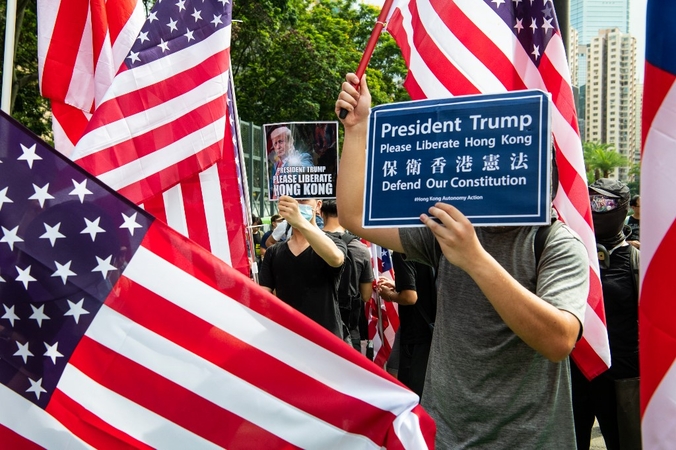
Hundreds gathered in Hong Kong’s Central financial district on Thursday night (Nov 28) to celebrate the signing of a Bill in the United States that supports the city’s pro-democracy protesters.

Some participants waved American flags while the crowd shouted slogans like “fight for freedom, stand with Hong Kong”.

Prominent activist Joshua Wong, who lobbied for the new US laws, said it was a “remarkable achievement” that human rights triumphed over crucial US-China trade talks.

He said he hoped more countries would set up similar mechanisms to sanction Hong Kong officials who undermine the city’s freedoms. “Now is the time for the Western world to stand with Hong Kong,” he said.

But Hong Kong’s former leader Leung Chun Ying said whoever initiated the Bill did not have the interests of the city in mind.

“It’s a proxy thing. I don’t think they have Hong Kong’s freedoms, democracy, and Hong Kong’s human rights in mind. It’s all about China,” he said when asked at a panel session at the Foreign Correspondents Club in Hong Kong.

The pro-establishment camp in the city is angry about the move, saying that it undermines Hong Kong interests and that the business community now wants to cut investments in the US.

The Hong Kong government called the US action unwarranted and unreasonable, saying it would send the wrong message to protesters and not help ease tensions.

A furious Beijing summoned the US ambassador on Thursday to demand that Washington stop interfering in its domestic affairs, warning that there will be repercussions that the US will have to shoulder after President Donald Trump signed the Hong Kong democracy Act into law.

Vice-Foreign Minister Le Yucheng called US Ambassador Terry Branstad in, after the ministry issued a strongly worded statement chastising the US for its “naked hegemonic act” and for supporting violent protesters who broke the law.

“The nature of this is extremely abominable, and harbours sinister intentions,” said the statement issued hours after the signing.

China has warned of countermeasures should Mr Trump approve the law, which receives wide support from Congress. “The motive is clearly to destroy Hong Kong’s prosperity and stability, the ‘one country, two systems’ practice, and undermine the Chinese nation’s endeavour to realise great rejuvenation,” said the statement.

When asked at a regular news briefing on Thursday what countermeasures Beijing would take, Foreign Ministry spokesman Geng Shuang would only say: “What should come will come sooner or later.”

In a tweet, nationalistic tabloid Global Times’ editor-in-chief Hu Xijin said China is considering putting “the drafters of the Hong Kong Human Rights and Democracy Act on the no-entry list”, which would bar them from entering mainland China, Hong Kong and Macau.

The Hong Kong Liaison Office issued a similarly stern statement expressing its outrage and condemnation of the Hong Kong Human Rights and Democracy Act, which permits the US to impose sanctions on officials for human rights violations in Hong Kong.

“Any tricks that attempt to undermine Hong Kong’s prosperity and stability and hinder China’s development will never work,” said the statement.

The new law mandates a yearly review of whether Hong Kong is autonomous enough to keep its special trading status with the US. A second Bill signed by Mr Trump bans the sale of tear gas and rubber bullets to the Hong Kong police.

The US has a substantial economic stake in Hong Kong, and any policy change would affect bilateral relations and the US’ own interest, said a spokesman for the Hong Kong government.

Adding to the flurry of statements were those from the Office of the Commissioner of the Foreign Affairs Ministry in Hong Kong and the Hong Kong and Macau Affairs Office, with the latter labelling the US as “the most culpable black hand to create havoc in Hong Kong”.

The US law is seen as another win for the pro-democracy movement in the city, coming days after pan-democrats scored a landslide victory in the district elections.

China scholar Adam Ni said the Chinese perception is that the US is leveraging the Hong Kong unrest as part of its larger effort to contain the rising superpower.

Concrete countermeasures by Beijing are unlikely at this point, given how precarious bilateral ties are and trade talks are still ongoing.

“I think this adds to the atmosphere of confrontation and distrust between China and the US,” said the visiting scholar at the Institute of International Relations at National Chengchi University and co-editor of China-focused newsletter China Neican.

Trade talks are unlikely to be scuppered as both sides have a high stake in reaching a deal of some sort.

“I think the trade deal is too big of a deal for China to jeopardise for the sake of retaliating in relation to the US’ latest move on Hong Kong,” said Mr Ni.

EVA Air to launch direct flights to Phuket next year

ศาสตร์เกษตรดินปุ๋ย : ขอบคุณแหล่งข้อมูล : หนังสือพิมพ์ The Nation

https://www.nationthailand.com/news/30378881?utm_source=category&utm_medium=internal_referral

EVA Air to launch direct flights to Phuket next year

Nov 29. 2019
By Wang Shu-fen and Chiang Yi-ching
The China Post/Asia News Network

348 Viewed

TAIPEI (CNA) — EVA Air, one of Taiwan’s largest carriers, announced Wednesday that it will start operating direct flights to the Thai island of Phuket next year, making it the only airline to fly directly between Taiwan and the holiday hot spot.

Phuket is the largest island in Thailand, the airline noted, and a world-renowned tourist destination.

Currently, travelers making the trip between Taiwan and Phuket have to take a connecting flight. The new direct route will allow them to save at least six hours on transit stops out and back, according to the airline.

EVA Air will offer three round-trip flights per week on the route starting April 2, with the outbound flights departing from Taiwan Taoyuan International Airport on Tuesday, Thursday and Saturday at 11:05 a.m. and arriving at Phuket International Airport at 2:20 p.m.

The return flights will take off at 3:30 p.m. and arrive at Taoyuan at 9 p.m., according to the airline.

The new route means that EVA Air will be operating flights to 13 destinations in Southeast Asia, offering a total of 145 flights per week.

Trump makes surprise visit to U.S. troops in Afghanistan

ศาสตร์เกษตรดินปุ๋ย : ขอบคุณแหล่งข้อมูล : หนังสือพิมพ์ The Nation

https://www.nationthailand.com/news/30378878?utm_source=category&utm_medium=internal_referral

Trump makes surprise visit to U.S. troops in Afghanistan

Nov 29. 2019

Photo credit: Washington Post

Photo credit: Washington Post
By The Washington Post · Missy Ryan, Philip Rucker325 Viewed
BAGRAM AIR BASE, Afghanistan – President Donald Trump visited Afghanistan for the first time on Thursday, delivering Thanksgiving greetings to U.S. troops deployed here in the United States’ longest-running war and announcing that he had resumed peace negotiations with the Taliban.

Making an unannounced trip, Trump touched down at 8:30 p.m. local time at Bagram air base – the primary hub for U.S. air operations located outside the capital of Kabul – after secretly departing from Florida in the dark of night.

Trump has long wanted to draw down forces in Afghanistan, and he said during a meeting here with Afghan President Ashraf Ghani that he had restarted peace talks with the Taliban that he had broken off almost three months ago, and was hopeful of brokering an accord.

“The Taliban wants to make a deal and we’re meeting with them and we’re saying it has to be a ceasefire and they didn’t want to do a ceasefire, and now they do want to do a ceasefire,” Trump said. “I believe it’ll probably work out that way.”

The Trump administration appeared to be on the brink of striking a deal to jump-start the peace process in September, when the president extended and then canceled an invitation for Taliban representatives to come to Camp David to cement an agreement to reduce U.S. forces.

This is Trump’s second visit to a combat zone; he visited troops in Iraq the day after Christmas in 2018. Vice President Mike Pence made a surprise trip last week to Al Asad air base in Iraq, where he served turkey and greeted troops.

Addressing about 1,500 military personnel assembled in an aircraft hangar here, Trump said, “We are winning like we haven’t won in a long time.”

He told the crowd he wanted to win the war in Afghanistan, and “we don’t play for ties,” but explained victory would not be achieved on the battlefield, but rather through “a political solution” determined by people in the region.

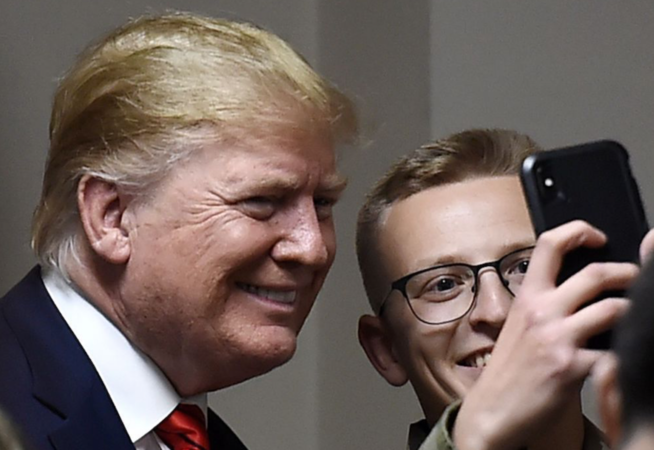
The president also served turkey to troops in a cafeteria and posed for photos with many of them.

Trump was on the ground at Bagram for about three-and-half hours after flying there overnight from the United States. His visit was shrouded in secrecy and kept off his public schedule, and aides took extreme security precautions to transport the commander in chief to Afghanistan.

Trump, who had been vacationing with family at his Mar-a-Lago Club in Palm Beach, Florida, flew from an undisclosed Florida airport after nightfall Wednesday to Joint Base Andrews near Washington, where he boarded Air Force One for the 13-hour flight to Afghanistan.

The president’s aircraft took off without lights and with its cabin window shades drawn shut to preserve secrecy. To limit suspicions about Trump’s whereabouts, White House staff members sent tweets from the president’s Twitter account during the time he was flying.

Air Force One descended and touched down at Bagram in complete darkness, and once on the ground, the president was flanked by combat troops wearing night-vision goggles and bearing rifles.

First lady Melania Trump remained in Florida, and the president was accompanied by a retinue of senior aides, as well as Sen. John Barrasso, R-Wyo. He was joined here by Mark Milley, chairman of the Joint Chiefs of Staff, who already had been traveling in the region.

During Trump’s bilateral meeting with Ghani, he confirmed that he would like to reduce the number of U.S. troops in Afghanistan to 8,600, down from about 13,000 currently.

“We’ve made tremendous progress and at the same time we’ve been drawing down our troops,” Trump said.

Ghani told Trump that “Afghan security forces are taking the lead now.”

Trump’s visit had a political dimension, too. With House Democrats poised to impeach him for abusing his office and military leaders alarmed by his intervention in war crimes cases, Trump stood with cheering service members as a reminder that for all his troubles in Washington, he remains the commander in chief.

After Trump addressed a campaign rally-style crowd in the hangar, Ghani took the stage to heap praise on him.

Ghani celebrated Trump as the architect of a strategy that had helped weaken the Islamic State and al-Qaida, and personally credited him for the killing of ISIS leader Abu Bakr al Baghdadi – which Ghani suggested was more important than the killing of the former al-Qaida leader Osama bin Laden, mastermind of the Sept. 11, 2001, terrorist attacks on the United States.

“I’d like to thank you for your leadership, for your determination,” Ghani told Trump. He also expressed gratitude to Trump for “your very principled decisions regarding putting limits on the type of peace that will ensure the gains of the past year and ensure your security and our security.”

Trump has repeatedly questioned why the United States has kept troops in Afghanistan after nearly two decades of fighting, billions of dollars in aid, and more than 2,000 U.S. military lives have failed to transform the country.

Nineteen U.S. service members have been killed this year in Afghanistan by hostile forces, an increase from 2018.

Trump campaigned in 2016 on withdrawing the United States from foreign wars, but in 2017, he agreed to authorize an increase in U.S. forces as part of a major strategy overhaul of the war. The president’s patience appears to have been wearing thin, however.

Trump complained on Twitter in September that American forces have been acting as “policemen” for Afghanistan. “That was not meant to be the job of our Great Soldiers, the finest on earth,” he wrote.

The Afghan army continues to struggle to mount offensive operations and suffers high casualties 18 years after international forces first arrived in the wake of the Sept. 11 attacks.

Ghani recently announced a step forward in his country’s battle against the Afghan branch of the Islamic State after at least several hundred of the hard line militants surrendered to the government.

But the Taliban still poses a formidable threat, retaining an estimated force of 40,000 to 60,000 militants who hold sway across many of Afghanistan’s remote areas and represent the only form of governance in certain places.

Gen. Austin “Scott” Miller, commander of the U.S. coalition forces here, has already executed a modest reduction in the U.S. force level to about 13,000. But further withdrawals appear to be on hold for now as diplomats seek a breakthrough in hoped-for peace talks.

It remains unclear whether Trump will order more troops home in the absence of a political resolution for the war.

Miller has said he could conduct the current mission, which includes training and support for Afghan forces and a parallel counterterrorism effort, with as few as 8,600 U.S. troops. There are 13,000 American troops in Afghanistan.

The concern about Afghanistan’s future is compounded by prolonged uncertainty surrounding the results of presidential elections in September. Ghani, a former World Bank official, is seeking another term; his challengers include Abdullah Abdullah, who has served as chief executive since September 2014.

Military commanders point to some improvements in Afghanistan’s fighting ability, but anticipate the Kabul government would face an existential threat if foreign troops were to withdraw.

For the Pentagon, the fact that the Afghanistan war has stayed largely out of the headlines of late has been beneficial as officials try to better position the Afghan government.

https://www.washingtonpost.com/video/politics/trump-the-taliban-wants-to-make-a-deal/2019/11/28/b87ac487-e169-4be3-9082-ae0b07bff58a_video.html

https://www.washingtonpost.com/video/c/embed/b87ac487-e169-4be3-9082-ae0b07bff58a

Philippine military to look into security threat from Chinese stake in power grid

ศาสตร์เกษตรดินปุ๋ย : ขอบคุณแหล่งข้อมูล : หนังสือพิมพ์ The Nation

https://www.nationthailand.com/news/30378876?utm_source=category&utm_medium=internal_referral

Philippine military to look into security threat from Chinese stake in power grid

Nov 29. 2019
By Philippine Daily Inquirer/Asia News Network197 Viewed

Manila – The Philippines is looking into the possible security threat of China’s co-ownership of the country’s lone power transmission line.

Lawmakers recently called for a review of the 40-per-cent stake of State Grid Corp of China in the National Grid Corp of the Philippines (NGCP), which won the bid in 2009 to run the power lines.

In a statement, the Armed Forces of the Philippines (AFP) said the matter was within the bounds of the NGCP and also with the National Power Corp.

“NGCP is privy to the contract, the provisions therein, and the necessary safeguards in place. Hence, they are in the best position to answer that at this time,” AFP spokesperson Brig-General Edgard Arevalo said in a statement.

But he also said they would remain involved in discussions with related agencies on the security concerns.

“That does not mean however that we will not be discussing the security aspect of the issue with concerned agencies. We will participate on matters relevant to our competency,” he said.

“We submit that Congress is well within its powers to conduct an inquiry if it so desires given its oversight and legislative functions,” he added.

Survey finds extended weekday playing of online video games among Japanese young people

ศาสตร์เกษตรดินปุ๋ย : ขอบคุณแหล่งข้อมูล : หนังสือพิมพ์ The Nation

https://www.nationthailand.com/news/30378873?utm_source=category&utm_medium=internal_referral

Survey finds extended weekday playing of online video games among Japanese young people

Nov 29. 2019
By Syndication Washington Post, The Japan News-Yomiuri700 Viewed

Nearly one in five people ages 10 to 29 plays video games for three hours or more on weekdays, according to a nationwide survey on young people’s addiction to video games, also known as gaming disorder.

Released Wednesday, the survey was the first of its kind to be conducted in this nation.

As the impact on people’s lives and health has become clear, the government intends to strengthen measures against game addiction from next fiscal year.

The survey was part of the projects overseen by the Health, Labor and Welfare Ministry, and was conducted from January to March this year by the National Hospital Organization Kurihama Medical and Addiction Center in Kanagawa Prefecture.

Responses were received from 5,096 people ages 10 to 29, and the center inquired about the situation of 4,438 of them who had played games in the past year.

Asked how many hours they spend playing games on weekdays, 60 percent of respondents said they spend one hour or more on games, while 18.3 percent spend three hours or more.

By gender, 24.6 percent of male respondents and 10.4 percent of female respondents said they spend three hours or more. The percentage of people who play games for three hours or more on holidays was 37. 8 percent. More than 20 percent of all respondents answered that sometimes they could not stop playing when they were supposed to.

In addition, 2.8 percent of respondents said they would play games for six hours or more on weekdays. Among that group, more than 20 percent said they continued to play games even if their studies were adversely affected or they lost their jobs, or that playing games was more important than studying, working, socializing with friends or family events.

About 40 percent of respondents who said they played games for six hours or more continued to play games despite experiencing headaches, sleep disorders and other health problems.

The World Health Organization identified gaming disorder as a mental illness in May this year, but there are no guidelines for its treatment.

“With the spread of smartphones, an increasing number of young people are becoming addicted to online games, which has adversely affected their daily lives. It’s necessary to prepare guidelines and manuals for those who receive consultations and doctors who treat patients,” said Susumu Higuchi, director of the center.

From next fiscal year, the ministry plans to add game addiction to training programs, aimed at the use of alcohol, drugs and gambling, for people involved in local health care.

TikTok owner, Huawei are helping China’s campaign to repress Uighur Muslims, report finds

ศาสตร์เกษตรดินปุ๋ย : ขอบคุณแหล่งข้อมูล : หนังสือพิมพ์ The Nation

https://www.nationthailand.com/news/30378872?utm_source=category&utm_medium=internal_referral

TikTok owner, Huawei are helping China’s campaign to repress Uighur Muslims, report finds

Nov 29. 2019
By The Washington Post · Anna Fifield729 Viewed

BEIJING – Chinese tech giants including ByteDance, TikTok’s parent company, and Huawei Technologies are working closely with the Communist Party to censor and surveil Uighur Muslims in China’s western region of Xinjiang, according to a report published Thursday.

New evidence of links between the security apparatus and China’s biggest tech companies come just days after TikTok shut down the account of an American teenager who’d sought to highlight China’s human rights abuses in Xinjiang during what began as a make up video.

After widespread condemnation for censoring an American, TikTok backtracked and reactivated 17-year-old New Jersey high school junior Feroza Aziz’s account.

In a detailed new report, experts at the Australian Strategic Policy Institute’s International Cyber Policy Centre concluded that many Chinese tech companies “are engaged in deeply unethical behavior in Xinjiang, where their work directly supports and enables mass human rights abuses.”

“Some of these companies lead the world in cutting-edge technology development, particularly in the AI and surveillance sectors,” Fergus Ryan, Danielle Cave and Vicky Xiuzhong Xu write in the report. “But this technology development is focused on servicing authoritarian needs, and as these companies go global (an expansion often funded by [Chinese] loans and aid) this technology is going global as well.”

This should give Western policymakers pause, they said.

Many Western policymakers have become increasingly concerned about the potentially nefarious capabilities of Chinese technology.

Some members of Congress have asked American intelligence services to determine whether the TikTok, a short-video app that has exploded in popularity among young people, poses national security risks. Meanwhile, the Trump administration has blacklisted Huawei, concerned that the Chinese government will have access to information that passes through its new 5G technology.

These concerns relate to the use of the technology abroad, but the ASPI report says China’s powerful security apparatus is already harnessing the power of the country’s innovations to further its aims at home.

This is most evident in the western region of Xinjiang, where at least a million Muslims have been detained in re-education camps designed to wring their culture and religion from them and make them assimilate with the country’s Han majority.

Testimony from numerous people to have escaped China and troves of leaked documents all show that the camps are not the vocational training centers that the Chinese government says they are.

ByteDance did not respond to request for comment on the report’s findings Thursday afternoon.

The report said the company has been “collaborating” with the Chinese government to disseminate its propaganda about Xinjiang.

Xinjiang Internet Police began working with Douyin, the local version of TikTok, last year and built a “new public security and Internet social governance model” in 2018. Then in April, the Ministry of Public Security’s Press and Publicity Bureau signed a strategic cooperation agreement with ByteDance to promote the “influence and credibility” of police departments nationwide, the ASPI experts said.

The agreement also reportedly says ByteDance will increase its offline cooperation with the police department, although the details of this cooperation are not clear.

Over the same period, ByteDance has flourished. Its TikTok app has been downloaded a billion times, of which nearly 100 million came from the United States, and it has a jaw-dropping valuation of $75 billion.

ByteDance has also been working with Xinjiang authorities under a program called “Xinjiang Aid,” whereby Chinese companies open subsidiaries or factories in Xinjiang and employ locals who have been detained in the camps. Its operations are centered on Hotan, an area of Xinjiang considered backward by the Communist Party and where the repression has been among the most severe.

ByteDance has been guiding and helping Xinjiang authorities and media outlets to use its news aggregation app and Douyin to “propagate and showcase Hotan’s new image,” according to the ASPI report.

ByteDance is uniquely susceptible to being used by the Communist Party because of its closeness to the censorship and surveillance apparatus of the Party-led state, the authors wrote.

“Beijing has demonstrated a propensity for controlling and shaping overseas Chinese-language media,” the authors wrote. “The meteoric growth of TikTok now puts the CCP in a position where it can attempt to do the same on a largely non-Chinese speaking platform – with the help of an advanced AI-powered algorithm.”

Leaked documents have previously shown how ByteDance censors content that the Chinese government disapproves of, including Tiananmen Square, Tibetan independence, or the banned religious group Falun Gong.

In the case of Huawei, which is locked in an existential battle with the Trump administration, there is evidence of extensive and direct work with Chinese security organs in Xinjiang, including helping authorities there with the “digitization requirements” of public security projects.

“Together with the Public Security Bureau, Huawei will unlock a new era of smart policing and help build a safer, smarter society,” a Xinjiang government website quoted one Huawei director as saying last year.

When the Xinjiang Public Security Department and Huawei signed the agreement to establish an “intelligent security industry” innovation lab in the regional capital of Urumqi last year, a local official said Huawei had been supplying “reliable technical support” for the department, according to the report.

Huawei has also participated in a program called “Safe Xinjiang,” which the ASPI experts said was “code for a police surveillance system.”

The tech giant reportedly built the police surveillance apparatus in Karamay and Kashgar prefectures, which have become a central part of the ubiquitous monitoring system in Xinjiang.

A Huawei statement said it doesn’t comment on specific customer programs but affirms that its technology complies with the laws where it is sold.

“Huawei does not operate safe city networks on behalf of any customers,” the statement added.

Technology companies “are intrinsically linked” with many aspects of Xinjiang’s crackdown on religious and ethnic minorities across the region, which has involved arbitrary detention, coerced labor practices and at-home forced political indoctrination, the report said.

“The Chinese tech companies in this report enjoy a highly favorable regulatory environment and are unencumbered by privacy and human rights concerns,” it concludes. Many are engaged in deeply unethical behavior in Xinjiang, where their work directly supports and enables mass human rights abuses.”

European Parliament declares climate emergency

ศาสตร์เกษตรดินปุ๋ย : ขอบคุณแหล่งข้อมูล : หนังสือพิมพ์ The Nation

https://www.nationthailand.com/news/30378871?utm_source=category&utm_medium=internal_referral

European Parliament declares climate emergency

Nov 29. 2019
By The Washington Post · Luisa Beck, Rick Noack, Quentin Ariès

640 Viewed

BERLIN – The European Parliament declared a climate emergency on Thursday, a largely symbolic move that nonetheless pressures member states to pass more decisive legislation to curb emissions.

In recent months, hundreds of similar declarations have been passed – most of them by regional or local administrations. Thursday’s E.U. vote is significant because it was passed by a parliament that represents more than 500 million citizens, vastly expanding the number of people worldwide who live in jurisdictions that have declared such an emergency.

Thursday’s move also puts pressure on the European Commission under its new president-elect Ursula von der Leyen, who is the first woman to hold the job.

As president of the European Union’s executive branch, she commands a vast machinery of E.U. bureaucrats who manage the bloc’s day-to-day business. The European Parliament is directly elected by voters across all 28 E.U. member states.

The declaration could add further pressure on von der Leyen, who has pledged to increase efforts to fight climate change. Referring to what she calls a European Green Deal, she elaborated this week that Europe would become the first continent to reduce emissions to net-zero by 2050, and that targets for cutting greenhouse gas emissions by 2030 must be made “more ambitious.”

“If there is one area where the world needs our leadership, it is on protecting our climate,” she said on Wednesday. “This is an existential issue for Europe – and for the world.”

The European Commission is scheduled to present a first draft of a European Green Deal later in December.

But some members of the European Parliament and activists are already skeptical about how serious von der Leyen is about her plans and – even if she is – if her mandate gives her enough leeway to pass them.

Von der Leyen has pledged extra funds to help more carbon-intensive economies in the E.U. make the transition to climate-neutral industries, but it is still unclear where those funds will come from.

“The Commission’s structural and political constraints are likely to produce a set of watered-down, piecemeal solutions,” wrote David Adler and Pawel Wargan from the international activist coalition Green New Deal for Europe in an op-ed for Politico. “Meanwhile, the clock on climate and environmental breakdown keeps ticking away.”

Scientists estimate that current targets would lead to up to 3 degrees Celsius of global heating and cause catastrophic changes across the globe, including floods, cyclones, long-lasting heat waves, and record-breaking wildfires, among others. To meet the goal set by the Paris agreement to stay below a 1.5 degrees Celsius temperature rise, the required cuts in emissions are now 7.6 percent per year on average, according to a 2019 report by the U.N. Environment Program.

TikTok admits error after penalizing 17-year-old user who posted political videos

ศาสตร์เกษตรดินปุ๋ย : ขอบคุณแหล่งข้อมูล : หนังสือพิมพ์ The Nation

https://www.nationthailand.com/news/30378845?utm_source=category&utm_medium=internal_referral

TikTok admits error after penalizing 17-year-old user who posted political videos

Nov 28. 2019
By The Washington Post · Tony Romm, Drew Harwell

472 Viewed

TikTok on Wednesday acknowledged it had erred in penalizing a 17-year-old who had posted witty but incisive political videos, promising it would restore her ability to access her account on her personal device.

The company’s apology – coupled with a new pledge to reevaluate its policies – still failed to satisfy the teen, Feroza Aziz, who again raised concerns that she’d been the victim of censorship by the fast-growing, Chinese-owned social-media app.

“TikTok is trying to cover up this whole mess,” she told The Washington Post. “I won’t let them get away with this.”

The saga started earlier this week, when Aziz tweeted that her profile had been temporarily suspended. She attributed the penalty to the fact she had recently shared a satirical video that urged viewers to research the harrowing conditions facing Muslims in China’s detention camps. Her comment quickly garnered widespread attention because TikTok is owned by a China-based tech conglomerate, ByteDance, though the company has sought to stress recently its U.S. operations are independent from Beijing’s strict censorship rules.

TikTok, however, said it had penalized her not for her comments about China but rather a video she’d shared earlier – a short clip, posted on to a different account, that included a photo of Osama bin Laden. Aziz’s video violated the company’s policies against terrorist content, TikTok said, so the company took action against her device, making any of her other accounts unavailable on that device. TikTok said her videos about China did not violate its rules, had not been removed and had been viewed more than a million times.

But the video in question – a copy of which she shared with The Washington Post – actually was a comedic video about dating that the company had misinterpreted as terrorism, Aziz said.

By Wednesday evening, TikTok had reversed course: The company said it restored her ability to access her account on her personal device. TikTok also acknowledged that her video about China had been removed for 50 minutes on Wednesday morning, which it attributed to a “human moderation error.”

“We acknowledge that at times, this process will not be perfect. Humans will sometimes make mistakes, such as the one made today in the case of @getmefamouspartthree’s video,” wrote Eric Han, the head of safety at TikTok U.S., referring to Aziz’s account.

“When those mistakes happen, however, our commitment is to quickly address and fix them, undertake trainings or make changes to reduce the risk of the same mistakes being repeated, and fully own the responsibility for our errors,” Han continued.

In doing so, TikTok for the first time offered detail about the actions it has taken to police its platform: In November, the company said, it banned 2,406 devices associated with accounts that violated rules about terrorism, child exploitation or spam. It was part of that sweep that Aziz’s own device had been banned, locking her out of her account there.

Aziz, however, said late Wednesday she isn’t convinced.

“Do I believe they took it away because of a unrelated satirical video that was deleted on a previous deleted account of mine? Right after I finished posting a 3 part video about the Uyghurs? No,” she tweeted Wednesday.

TikTok’s policies have drawn critical attention in Washington, where investigations have begun into whether the platform presents a national security risk.

Related Story:

A 17-year-old posted to TikTok about China’s detention camps. Her account was suspended

Imported used cars will be banned next month, here’s what you need to know

ศาสตร์เกษตรดินปุ๋ย : ขอบคุณแหล่งข้อมูล : หนังสือพิมพ์ The Nation

https://www.nationthailand.com/news/30378880?utm_source=category&utm_medium=internal_referral

Imported used cars will be banned next month, here’s what you need to know

Nov 29. 2019
By THE NATION

486 Viewed

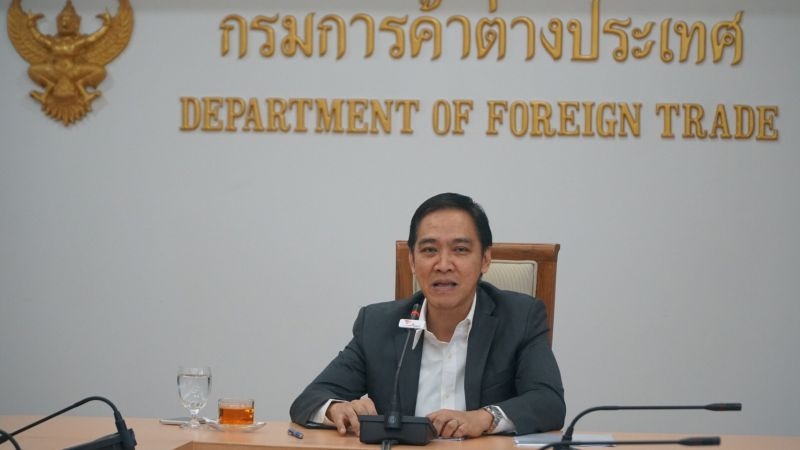
Keerati Ratchano, director-general of the Foreign Trade Department, said this week that his department is now readying measures to comply with the Commerce Ministry’s ban on the import of used cars for personal use.

The directive, which was announced in July, comes into effect on December 10 and aims to reduce air pollution and improve safety on the roads.

“After December 10, all used vehicles imported for personal use will be confiscated and destroyed immediately,” he said. “There will be no auction of confiscated cars like in the past, and the owners will be fined a sum 5 times the imported value.”

Keerati added it is usually takes his department 25 days to approve import applications, so anyone planning to import a used car for personal should scrap the idea as the ban will take effect in 11 days.

The import of specialised used vehicles such as tractors, cranes and vehicles donated to government, state enterprises, charity organisations e.g. ambulances and fire trucks will be allowed under Ministry of Commerce’s guidelines, he added.

Meanwhile, the import of used vehicles for uses other than personal, such as diplomatic vehicles, prototype vehicles for research and testing, vehicles to be modified for export, vehicles for museum display, and military vehicles will be under supervision of related agencies and not affected by the ban imposed by the Foreign Trade Department.

“However, as with vehicles that are imported to be modified and later exported, entrepreneurs must strictly follow the regulations of the Customs Department and Industrial Estate Authority of Thailand,” Keerati added.

Related Story: Govt to ban import of used cars for personal use starting in December