[Digital Simplicity] Why web novels draw eyeballs and investors
Apr 18. 2021
By The Korea Herald / ANN
Munpia, one of the biggest web novel platforms in South Korea, is reportedly in talks with major portals Naver and Kakao to sell a controlling stake.
There is no doubt that storytelling matters in the era of digital content and the category of web novels deserves attention, considering its potential as a source for other multimedia content.
Munpia, which started as an online community in 2002, now boasts over 100 million page views on the strength of some 400,000 visitors per month. With 47,000 writers registered for the site, Munpia offers a wealth of online fiction, targeting specific genres such as fantasy, romance and martial arts. Local media estimate that the valuation of Munpia would surpass 300 billion won ($268 million).
Naver and Kakao want to strengthen their content pools by purchasing a major stake in Munpia, where a torrent of new stories is generated by aspiring online writers and scrutinized by readers who tend to open their pockets only for genuinely interesting ones.
As with webtoons, web novel writers have to earn the trust of readers with creative and addictive stories. This is no easy task, as Munpia and other web novel platforms adopt a grueling system where uninteresting stories get filtered out.
On Munpia, all the stories follow a serialization format. One installment has a relatively short length optimized for web reading, and is generally priced at 100 won. But there is a tricky condition. Web novel writers are required to put out 15-25 installments free-of-charge, and readers respond to the stories through page views and comments.
If a writer fails to persuade readers during the initial period, Munpia does not allow the writer to turn the story into a paid series. In other words, writers have to prove that their stories, serialized in a daily installment, are interesting enough to make money, and those which pass the test are likely to have a potential for turning into other media such as webtoons.
Meanwhile, general e-book titles are yet to carve out a meaningful share in the overall publishing market. Although some bestselling titles are also gaining readers on e-book platforms, a simple conversion from paper to electronic format does not offer a convincing merit for mainstream readers.
This is why domestic e-book service providers have embraced subscription models in which readers are charged a monthly fee for access to a big pool of e-book titles, including bestsellers, instead of focusing on the sales of individual titles.
In fact, there is no way for ordinary readers to judge whether a long-form novel is interesting for their tastes, unless they actually buy the title, regardless of whether it is in paper or electronic format.
Ridi, a major e-book provider, turned an operating profit for the first time last year, not because of the resounding success of its e-book business but because of its strategy to diversify products into webtoons and other multimedia content.
Years ago, print newspapers used to provide a key platform for serialized novels and cartoons. Now, they do not have any control over the distribution of such content as they did not invest in the platform and related solutions.
Portals’ attention toward Munpia is expected to prompt other content-oriented companies to look for web novel platform providers. But such expansion strategy is limited to large sites as it takes a lot of money to turn a web novel or webtoon into a TV series or movie. More importantly, those who mastermind such digital strategies should understand that a simple one-source multiuse model is bound to fail.
An expert on Chinese affairs, SRIKANTH KONDAPALLI is Professor of Chinese Studies at Jawaharlal Nehru University. He completed his Chinese studies in India as well as in China, and obtained a Ph.D. He learnt Chinese at Beijing Language & Culture University.
He has written books on China and his articles on China have been published in leading Indian and international journals. He got the K Subramanyam Award in 2010 for Excellence in Research in Strategic and Security Studies.
In an interview with ASHOK TUTEJA, Kondapalli talks about, among other things, the India-China military stand-off, trade ties between the two countries, and why China has become aggressive against its neighbours.
Excerpts:
Q. Do you see the possibility of the current Sino-Indian military stand-off at Eastern Ladakh coming to an end any time soon?
A. On 10 February 2021 after the Chinese side indicated disengagement from the Pangong Tso theatre, the Indian side responded positively and both began the disengagement and de-escalation process.
Both sides exchanged a detailed written agreement for “phased, coordinated and verifiable” disengagement and “synchronised de-escalation” of troops at the western sector of the border with China, although implementation of this is a complex and complicated process given the violence that erupted on 15 June last year at Galwan that left 20 Indian soldiers dead (and four Chinese, according to Beijing).
If China and India have to focus on their respective nation-building processes, they have to come to terms on the border sooner than later. It is not clear if the current disengagement process is coming to an end soon. Following the 1988 agreement between India and China during PM Rajiv Gandhi’s visit to Beijing, it was decided that pending territorial dispute resolution, peace and tranquility should prevail in the border areas in order to focus on other aspects of bilateral relations like trade, economy, tourism etc.
Now that we have uncertainty on the borders, caused mainly by China disregarding the five agreements on confidence building measures, India has stated that peace on the borders is essential to re-starting bilateral relations. On the other hand, China is arguing that bilateral relations should be improved forthwith regardless of the situation on the borders.
Moreover, China stated that India “should meet half-way” on the borders which was rejected by India stating that first China should go back to March 2020 positions on the border. These suggest that the disengagement process will mostly likely be slow.
Q. The last round of senior commanders’talks apparently did not yield a positive outcome. Don’t you agree with suggestions that the standoff can’t be resolved unless there is intervention at the highest political level on the two sides?
A. The 11th round of corps commanders meeting did not result in a joint statement indicating that there were mutual differences in implementing the disengagement process. The meeting comes after a series of online interactions and physical meetings between the two ministries. Prime Minister Narendra Modi visited Ladakh to meet the troops.
He also gave a “free hand” to the Indian military to address the issue on the borders. China’s Foreign Minister Wang Yi visited Tibet although it is not clear if he had meetings with the military. President Xi Jinping made statements to his troops for “battle ready” preparations. External Affairs Minister Dr S Jaishankar and Defence Minister Mr Rajnath Singh met their Chinese counterparts in Moscow.
The National Security Advisor had telephonic interactions with his Chinese counterpart, the Special Representative on the border issue. All these suggest that the leaders are aware of the situation on the borders. As the militaries of both countries are under civilian control, it is certain that the border incidents since March 2020 have been cleared by the civilian leaderships.
In this backdrop of continuous civilian leadership association with the situation on the borders, it is doubtful if their “intervention” again would result in disengagement. It is possible that the issue could be resolved if the costs for one or both parties are high. China relented in February this year because after their occupation of Pangong Tso Finger 8 to 4 areas, the Indian military occupied the Kailash ranges which proved costly to China.
Q. Even if the current situation in Ladakh is resolved,do you think IndiaChina relations can ever become normal again?
A. Eventually, the situation in Ladakh will be resolved although the time frame is uncertain. India’s basic position is that peace and tranquillity should prevail on the borders before bilateral relations could become normal. Secondly, if China had reneged on the five CBMs agreements signed in 1993, 1996, 2005, 2012 and 2013 and deployed troops in March 2020 in the areas close to the Line of Actual Control, then there is no guarantee that China will not disturb peace on the border again in the future.
Mutual trust that has been built since the 1976 diplomatic normalisation has been destroyed by China in the last one year’s military misadventures in the western sector. China has to first show its sincerity in resolving the issue for normalising relations.
Q. Can India trust China after the Ladakh stand-off?
A. The June 15 incident last year has destroyed trust between India and China. The incident led to the deterioration in bilateral relations. In order to rebuild trust again, it may take ages. The current Chinese Cold War statements reflected in their extreme nationalist tabloids or official statements on “what is right and wrong” does not help resolve the trust levels between the two countries.
India had initiated the two “informal summit meetings” at Wuhan and Chennai in hopes of improving and stabilising relations with China in the context of the current global disruptions. Yet India has been left high and dry with the situation in the western sector of the border. The twin tragedies of Galwan and Covid-19 pandemic that spread from Wuhan (when three students from Kerala returned) have led to public anger in India.
Q. China wants decoupling of trade ties from the border issue between the two countries. Do you think India can afford to do that, given the public sentiments against China after the Galwan Valley clash?
A. China’s position is that regardless of the situation on the borders, India should open its market to Chinese products. This has also been the theme during the RCEP negotiations. While China has not yet addressed the huge trade deficits (of over $900 billion in favour of China in the last decade), it still wants to explore the Indian market.
Even though it has become a member of the World Trade Organisation and recently championed globalisation, it is still restrictive in its trade practices with non-tariff barriers and others to the detriment of Indian products. On the other hand, India had stated since 1988 that peace on the borders is a sine qua non of the bilateral relations. These two positions have to be reconciled before normalising relations.
Q. Why has China become so aggressive against all its neighbours over the last few years,especially after the outbreak of Coronavirus?
A. The 19th Communist Party Congress in 2017 (which is under implementation till 2022) stated that China should “occupy the centre-stage” in regional and global orders.
In addition, China’s leader stated that its “core interests will not be sacrificed for developmental interests” suggesting that Beijing will be assertive on its perceived interests on Tibet, Xinjiang, South China Sea, Taiwan, Senkaku Islands, borders with India and others.
China’s emergence since 2010 as the second largest economy in the world following its favourable engagement policies with the United States which diverted global investments, markets, technologies and others to China helped the latter to flex its muscles.
China has become the largest trading partner with over 128 countries in the world and frequently exercises political pressures on them. While China stated that it tackled Covid 19 pandemic in an “open, transparent and responsible” manner after the 23 January 2020 lockdown of Wuhan, over 5 million people from Wuhan travelled to different destinations in the world (including three to Kerala), thus spreading the pandemic.
As every country today is busy addressing Covid-19 infections, China thought this is an opportunity for further assertiveness. This is clearly visible in the Taiwan Straits, South China Sea, India-China border areas or coercive diplomatic postures on Australia or other countries.
Q. Why is the ‘Quad’ grouping an anathema to China?
A. Much of the China rise is in the high seas — investment flows, imports and exports (nearly $4 trillion), ship building and others. Much of China’s encroachments are also in the maritime domain — South China Sea, Senkaku Islands, the “two ocean strategy” since 2009 (on Indian and Pacific Oceans) and others.
The “Quad” and the Indo-Pacific focus is on maritime areas as well — Pacific and Indian Ocean, Bay of Bengal and South China Sea. The Quad and the Indo-Pacific signatories are advocating free and open region, rule of law, freedom of navigation, maritime security, infrastructure, counter-terrorism, North Korean WMD proliferation and others.
On all these issues, China has to answer a number of questions. It walked away from the UNCLOS dispute resolution in South China Sea and eventually The Hague tribunal quashed in July 2016 any “historical claims” in the region. China’s “territorial sea” concept is exclusive and has no scope for high seas free transport. China’s proposed Code of Conduct intends to be an exclusive club.
Also, the proposed Quad+ could include Vietnam, South Korea, Indonesia or other countries, in addition to UK, France and Germany which have shown interest. This is problematic to China as it is a beneficiary of the Asia-Pacific construct since the 1980s and the ground seems to be slipping away for new actors like Japan, Australia, India and others.
Q. Do you see the possibility of China joining hands with Russia and Pakistan to counter the ‘Quad’?
A. China has criticised the Quad for being a Cold War relic, with ideological (democracy) leanings and exclusive regional grouping. Russian foreign minister Lavrov criticised the Indo-Pacific in December 2020 and recently visited Guilin in China and New Delhi and Islamabad. It appears, although Russia is not a major maritime country, at China’s behest and for realpolitik considerations, it has been siding with China.
Western sanctions on Moscow for its role in Crimea are also a major driver in Russian calculations. It is not clear what would be Pakistan’s role as it is still a major non-NATO ally of the US, although there were tensions with the US on counter-terrorism compliance issues.
Q. Do you foresee any possibility of India and China joining hands to meet the challenge posed by Covid-19?
A. After Covid-19 began spreading, India and China cooperated in organising health officials’ online coordination with SAARC countries and Eurasian countries. Both are also cooperating at the UN-led Covax initiative on vaccines.
US sanctions also target Pakistani firms, individuals in move against Russia
Apr 18. 2021
By Dawn / ANN
WASHINGTON: Ten of the 32 individuals and entities sanctioned by US President Joe Biden on Thursday for participating in Russia’s alleged cybercrimes are based in Karachi and Lahore, shows an official US statement.
On Thursday, President Biden expelled 10 Russian diplomats and sanctioned almost three dozen individuals and companies in retaliation for a massive cyber-hacking of US federal agencies and interference in the 2020 presidential election.
On Friday, the US Department of the Treasury issued a statement identifying these individuals and entities. The list names some Pakistani individuals as well, including Ahmed, Shahzad (a.k.a. Amin, Shahzad) of Lahore, born 14 Dec 1987, national ID #3420204688179. The list includes several email addresses as well.
The official US statement says he has been booked under Cyber2, Election-EO13848, a 2018 executive order which imposes certain sanctions for foreign interference in a US election.
Another individual is Hasnain, Syed Johar of Karachi, born on Dec 30, 1987; national ID #4220106151401. He too is accused of interference in a US election.
10 of 32 individuals and entities sanctioned are based in Karachi, Lahore
Hayat, Muhammad Khizar, a.k.a. Hayat Jaffri of Karachi, born July 14, 1994; national ID # 4210191597005 faces the same charge.
As does Raza Mohsin (a.k.a. Amiri) of Karachi, born May 25, 1986; national ID # 4220198261523.
Raza, Mujtaba Ali (a.k.a. Lilani), Mujtaba Ali of Karachi, born Oct. 21,1987; who also has a digital currency address is also accused of interference in a US election.
As is Raza, Syed Ali (a.k.a. Zaidi), of Karachi, born Oct,1992; national ID #4220157603253. The list includes his cell phone numbers as well.
The statement says that all these individuals are involved in various IT companies and are linked to each other as well.
The companies are identified as Fresh Air Farmhouse, Karachi, phone number 923453272659; alt. phone number 923209299030.
The statement claims that the company is linked to Raza Mohsin and Raza, Mujtaba Ali.
Another company is simply identified as LikeWise, Shop # 5, Jamshed Quarters, Karachi, phone number 923452179668; and registration number 4220198261523. This company is also identified as linked to Raza, Mohsin and Raza, Mujtaba Ali.
The third company is M K Soft-Tech, 631-C, 6th Floor, Mashriq Center, Stadium Road, Karachi and this too is linked to Raza, Mohsin and Raza, Mujtaba Ali.
Secondeye Solution (a.k.a. Forwarderz), Karachi, only has a website and email addresses.
The US media noted that President Biden’s second round of sanctions aimed at Russian President Vladimir Putin were tougher and more sweeping than the last. Russia is accused of hacking the networks of at least nine federal agencies five months ago to gather US secrets in the SolarWinds cyberbreach.
Russia also allegedly tried to influence the 2020 presidential election by waging disinformation campaigns to help Donald Trump, mirroring meddling efforts in the 2016 election.
Russia has denied all the allegations and pledged to respond in kind. Last month, the US targeted seven Russian officials and more than a dozen government entities over the alleged poisoning of Kremlin critic Alexei Navalny.
In a call with Russian President Vladimir Putin on Tuesday, Mr Biden vowed to defend US national interests “firmly”, while proposing a meeting with Mr Putin to find areas where the two countries could work together.
Mr Biden later told reporters he “was clear with President Putin that we could have gone further, but I chose not to do so”. The United States, he said, was “not looking to kick off a cycle of escalation and conflict with Russia”.
Japan to set bolder 2030 goals after striking deal with US to fight global warming
Apr 18. 2021
By The Straits Times / ANN
TOKYO – Japan will set bolder climate targets for 2030 next week and promote the adoption of renewable energy in developing countries, Prime Minister Yoshihide Suga has said in what will be a marked policy shift for a country historically wedded to fossil fuel.
The announcement came as Mr Suga and US President Joe Biden launched a bilateral climate partnership on Friday (April 16) during their summit at the White House.
“Japan and the United States are both committed to achieving net-zero emissions by 2050, and we know to do that will require setting and meeting our 2030 goals,” Mr Biden said as he vowed to take the lead with Mr Suga to combat the climate crisis.
Their joint initiative, however, puts the onus on Japan to shift its policy goalposts, with the country having earned a bad reputation for its addiction to coal despite Mr Suga’s pledge last October to achieve net-zero carbon emissions by 2050.
Japan, the world’s fifth-largest carbon emitter, still generates about three-quarters of its energy from coal and thermal power sources such as liquefied natural gas. It has until recently avoided investing heavily in renewable energy, saying it was too expensive and unreliable.
As many as 22 new coal-burning power plants are being built or being planned in Japan, which officially still has not explicitly ended support for the export of such power plants.
All eyes will be on whether Mr Suga reverses course and spells out a clear direction on the future of coal for Japan at a government meeting expected on Tuesday (April 20), before the two-day virtual climate change summit hosted by Mr Biden, which begins on Thursday.
With the Japanese government under pressure from environment groups and domestic businesses to do much more – and much faster – Japan may effectively double its 2030 emissions reduction target.
Citing sources, domestic media reported that Japan may raise its target to between 40 and 50 per cent – from the current goal of a 26 per cent cut in emissions from fiscal 2013 levels which environmentalists say is not good enough for the country to achieve the 2050 net-zero goal.
Still, Japan’s greenhouse gas emissions fell to a record low in the fiscal year ending March 2020, Environment Ministry figures showed on April 13, with emissions falling to 1.21 billion metric tonnes of CO2 equivalent or a 14 per cent decline from fiscal 2013 levels.
The government is also considering a blanket halt on the export of coal power plants to developing countries such as Vietnam and Indonesia.
Tokyo has long argued that building coal-fired power plants was the most cost-effective way for developing nations to balance their explosive electricity demand with economic growth and has sought to promote “clean coal”, a concept that environmentalists say is an oxymoron as this still emits greenhouse gases.
As recently as in December, Japan inked a deal to provide US$636 million (S$849 million) for a new coal-fired power station in Vietnam.
However, the US-Japan Climate Partnership agreement on Friday noted the “particular vulnerabilities of developing countries to the impacts of climate change, as well as their sustainable development imperatives”.
In line with this, the two countries pledged to support developing nations to “rapidly deploy renewable energy, drive the decarbonisation of their economies, and accelerate diverse, ambitious, and realistic transition paths in the region.”
Suga, U.S. vice president agree on free, open Indo-Pacific
Apr 18. 2021
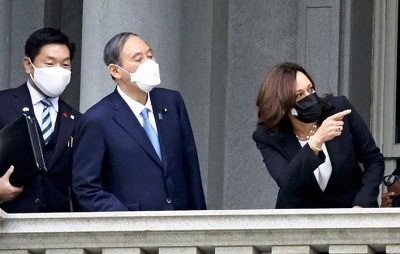
U.S. Vice President Kamala Harris, right, and Prime Minister Yoshihide Suga, center, appear together in Washington on Friday morning. Photo Credit: The Yomiuri Shimbun
By The Japan News / ANN
WASHINGTON — Prime Minister Yoshihide Suga and U.S. Vice President Kamala Harris agreed that Japan and the United Sates will cooperate to realize a free and open Indo-Pacific region at their meeting held in Washington on Friday.
Suga called on Harris to visit Japan as soon as possible.
The meeting was held ahead of a summit meeting between Suga and U.S. President Joe Biden.
Harris told Suga that Japanese-Americans in California, where she is from, contributed to the nation’s economic development.
She also expressed hope for “the work that our nations will do together to continue with peace and prosperity” in the Indo-Pacific region.
Suga said he “puts high importance on [the United States’] cooperating with its allies and partners.”
China urges US, Japan to stop meddling in China’s domestic affairs
Apr 18. 2021
By China Daily / ANN
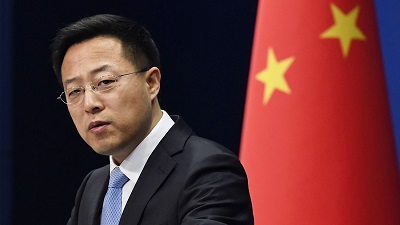
BEIJING — China on Saturday urged the United States and Japan to immediately stop meddling in China’s domestic affairs and harming Chinese interests.
“We urge the US and Japan to take China’s concern seriously, abide by the one-China principle, and immediately stop meddling in China’s domestic affairs and harming Chinese interests,” a Chinese foreign ministry spokesperson said in a statement. “China will take all necessary measures to resolutely defend its sovereignty, security and development interests.”
The spokesperson made the remarks when asked to comment on a US-Japan joint leaders’ statement, which was released after their meeting, expressing concern over issues relating to Taiwan, the Diaoyu Islands, Hong Kong, Xinjiang and the South China Sea.
The spokesperson said that Taiwan and the Diaoyu Islands are both Chinese territory, adding that issues relating to Hong Kong and Xinjiang are purely China’s internal affairs, and China has indisputable sovereignty over islands in the South China Sea and waters around them.
The spokesperson stressed that the US-Japan joint leaders’ statement has grossly interfered in China’s domestic affairs and severely violated basic norms governing international relations.
“China deplores and rejects it. We have stated our solemn position to the US and Japan through the diplomatic channel,” said the spokesperson.
The US and Japan are actually ganging up to form cliques and fanning bloc confrontation while talking about “free and open,” the spokesperson said. “This anachronistic move runs counter to the aspiration for peace, development and cooperation shared by the overwhelming majority of countries in the region and beyond.”
It will only enable the world to see with increasing clarity the detrimental nature of the US-Japan alliance, which attempts to undermine regional peace and stability, the spokesperson said.
Suga-Biden statement refers to ‘peace, stability’ across Taiwan Strait
Apr 18. 2021
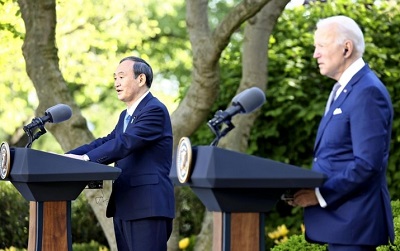
Prime Minister Yoshihide Suga, left, and U.S. President Joe Biden attend a joint press conference after a summit meeting at the White House in Washington on Friday. Photo Credit: Masanori Genko/The Yomiuri Shimbun
By The Japan News / ANN
WASHINGTON — At the Japan-U.S. summit meeting in Washington on Friday, Prime Minister Yoshihide Suga and U.S. President Joe Biden affirmed their commitment to strengthening the Japan-U.S. alliance and emphasized the importance of peace and stability in the Taiwan Strait, where China has been stepping up military pressure.
Following the summit meeting at the White House, Japan and the United States released a joint statement.
At a joint press conference, Suga said, “We agreed to oppose any attempts to change the status quo by force or coercion in the East and South China Seas, and intimidation of others in the region,” with regard to China’s hegemonic activities in the region.
“Japan and the United States are two strong democracies in the region, and we’re committed to defending and advancing our shared values, including human rights and the rule of law,” Biden said, expressing his intention to cooperate with Japan on policies relating to China.
Regarding Taiwan, the two leaders said in the joint statement that they “underscore the importance of peace and stability across the Taiwan Strait and encourage the peaceful resolution of cross-Strait issues.”
It is the first time the Taiwan issue has been included in a joint statement by Japanese and U.S. leaders since a 1969 meeting between Prime Minister Eisaku Sato and U.S. President Richard Nixon, and the first time since Japan and the United States normalized their diplomatic relations with China in the 1970s and broke off relations with Taiwan.
The document also states that the two countries “share serious concerns regarding the human rights situations in Hong Kong and the Xinjiang Uyghur Autonomous Region.”
Suga stressed the significance of the statement, titled “Global Partnership for a New Era,” saying, “It will serve as a guiding post for our alliance in the times ahead.”
Tokyo and Washington will begin full-fledged talks on further strengthening their alliance aiming to counter China.
“I conveyed my resolve to reinforce Japan’s defense capabilities [at the summit meeting],” Suga said. “We also agree to accelerate the review underway between our two countries on the specific means to strengthen our alliance.”
At the talks, Biden clearly said that Article 5 of the Japan-U.S. Security Treaty, which stipulates U.S. defense obligations to Japan, applies to the Senkaku Islands in Okinawa Prefecture.
Regarding North Korea, Suga and Biden reaffirmed their commitment to urge an immediate halt to Pyongyang’s nuclear and missile development programs and call for a resolution of the issue of Japanese citizens abducted by North Korea.
The two leaders also discussed the growing number of incidents of discrimination and violence against Asians in the United States.
“We agreed that discrimination by race cannot be permitted in any societies,” Suga said. “President Biden’s comments that discrimination and violence cannot be allowed and that he firmly opposes [such actions] were extremely encouraging.”
Suga and Biden also announced agreements on economic cooperation and climate change.
In the economic field, the two countries will cooperate in developing and protecting supply chains with the aim of reducing dependence on China for semiconductors and other products.
At the talks, Suga invited Biden to Japan at an early stage.
The two leaders held a one-on-one meeting, followed by a small group meeting and an expanded meeting, lasting about 2½ hours.
Participants in the latter meeting included, on the U.S. side, Secretary of State Antony Blinken, Defense Secretary Lloyd Austin, Treasury Secretary Janet Yellen and National Security Advisor Jake Sullivan, and on the Japanese side, Manabu Sakai, deputy chief Cabinet secretary, and Shigeru Kitamura, secretary general of the National Security Secretariat.
Over 23,000 prisoners released under general amnesty on Myanmar New Year Day
Apr 18. 2021
Families and relatives seen waiting for the release of prisoners in front of Insein Prison. Photo Credit: Eleven Media
By Eleven Media / ANN
A total of 23,407 prisoners from various prisons across Myanmar were granted a general amnesty today including over 800 from Insein Prison in Yangon Region and about 2800 inmates from 5 prisons in Mandalay Region.
More than 800 prisoners from Insein prison were granted pardon today (Myanmar New Year Day) at 11:00 am according to Insein prison.
Families and their relatives waited in front of Insein prison since the early hour of this morning to receive them.
About 2,796 prisoners from Mandalay Obo, Myingyan, Meikhtila. Yamethin and Nyaung-U prisons in Mandalay Region were granted clemency and majority of them have already served a quarter of their sentences. They were released from their sentences in accordance with criminal code 401, sub-section (1).
“From Obo prison, 1300 male and 267 female prisoners were released in accordance with TV announcement. Twelve vehicles transported them to respective townships. In the past, they were transported to their wards or streets. Since 8:00 am this morning, we are releasing them under the instructions of State Administrative Council,” said in charge of Obo prison.
Six students from all Burma students union were released but some students were still serving their sentences. They were arrested for protesting Rakhine State affairs and protesting war.
Myanmar Television has announced that 23,407 prisoners were granted pardon on Myanmar New Year Day, today.
ASEAN leaders announce plan for in-person special summit on Myanmar situation
Apr 18. 2021
By Vietnam News / ANN
JAKARTA — Leaders of the Association of Southeast Asian Nations (ASEAN) will convene a meeting in Jakarta, Indonesia on April 24 to discuss efforts in building the ASEAN Community, external relations and regional issues, including the crisis in Myanmar.
Plans for the meeting have been in the works. Earlier on April 16, regional news sources revealed that leaders of 10 ASEAN members, including Commander-in-Chief of Defence Services of Myanmar Sen. Gen. Min Aung Hlaing, are to attend the meeting.
The meeting was advocated by host Indonesia and its Minister for Foreign Affairs Retno Marsudi in the past few weeks, with support from Malaysia, Brunei, Singapore and the Philippines.
Cambodian AKP news agency on April 16 reported that Prime Minister Samdech Techo Hun Sen has confirmed his attendance.
Brunei, which currently holds the rotating Chairmanship of ASEAN, showed its support for the meeting to discuss the situation in Myanmar.
According to a joint statement issued following a meeting between Sultan of Brunei Hassanal Bolkiah and Prime Minister of Malaysia Muhyiddin Yassin, ministers and high-ranking officials of the two countries have been asked to prepare for the meeting held at the ASEAN Secretariat in Jakarta.
The statement also expressed concern for the deteriorating situation inside the country, and “urged all parties to refrain from instigating further violence, and for all sides to immediately exercise utmost restraint and flexibility.” — VNS
Indonesia needs nationwide deradicalization centers
Apr 17. 2021
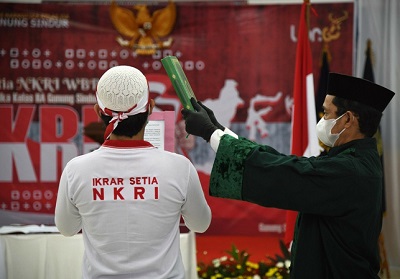
Loyalty oath: A terrorist convict pledges allegiance to the state upon completing a deradicalizaton program at Gunung Sindur prison in the West Java regency of Bogor on Thursday. As many as 34 terrorist convicts have completed the program. (Antara/Law and Human Rights Ministry public relations bureau)
By Irfan Idris and Ardi Putra Prasetya The Jakarta Post/ANN
Terrorist groups have conducted 11 attacks since the beginning of the COVID-19 pandemic last year. These attacks resulted in the killing of two police officers, seven civilians and seven terrorists, and injuring three police officers and 20 civilians.
Ten attacks were perpetrated by two pro-Islamic State (IS) groups, namely East Mujahidin Indonesia (MIT) and Jamaah Anshorud Daulah (JAD).
Two of the most recent attacks took place in South Sulawesi and Jakarta. On March 28, two members of JAD conducted a suicide attack on a Catholic church in the South Sulawesi capital of Makassar, killing them and wounding 20 people. Several days later, equipped with an airsoft gun, a young woman, Zakiah Aini, attacked the National Police headquarters in Jakarta with herself as the only casualty.
These 11 attacks highlight five important indications about the current terrorism developments in the country.
First, although JAD only conducted three attacks, its attacks attracted more attention than MIT’s attacks because they employed families to conduct the attacks and that their attacks were dispersed around Indonesia, namely in South Kalimantan, Central Java and South Sulawesi whereas the attacks conducted by MIT were limited to Central Sulawesi.
Additionally, JAD’s attacks, especially the ones that included bombings, were deadlier than attacks by MIT. JAD’s Makassar suicide attack alone could have resulted in the killing of 20 civilians had it not been for the church’s security guard stopping the perpetrators from entering the church premises and detonating their explosives there.
Previously, on May 13, 2018, JAD members conducted a series of similar suicide attacks on churches and a police station in Surabaya killing at least 20 people including the perpetrators and their accomplices consisting of three families; 10 family members in total.
Second, despite their threats of attacking Chinese nationals during the pandemic, police, police informants and non-Muslims remained the main target of Indonesian terrorists. The police remain as targets as they continue to prevent terrorists from achieving their goals of enforcing Islamic law and establishing an Islamic state based on their interpretations. This is in addition to the arrests and killing of JAD members by the police. Non-Muslims are targeted because the group is following the call issued by IS-Central to attack “God’s enemies” in March 2020 in their al-Naba newsletter.
Third, though the pandemic has reduced the amount of funds channeled to these terrorist groups, this has no impact on their motivation to conduct attacks. In the first half of 2020, these groups experienced a reduction in financial contributions of up to 72 percent as compared to what they received in 2019. This reduction is due to the loss of jobs and dwindling businesses experienced by their members and donors. To alleviate this financial constraint, groups have turned to robbery. Subhan’s group planned to rob a bank and stores owned by Chinese Indonesians in Central Java in March 2020. However, their plans were foiled with their arrests prior to executing their plans. Conversely, MIT successfully robbed health department officers in Poso in August 2020. They seized food and electronic devices carried by the officers without inflicting any casualties.
Despite their dire financial problem in the first eight months of the pandemic, their commitment to conducting attacks is unaffected as evident from the increasing number of attacks during this period. As compared to the eight attacks in 2019, there were 11 attacks since the start of the pandemic.
Fourth, from January to April 9, 2021 police have arrested 112 terrorist suspects. However, this does not mean a lack of foot soldiers for terrorist groups because recruitment continues to take place both offline and online. Additionally, an estimated 1,000 official JAD members remain free despite their obvious affiliation to the IS and their support for the terrorist attacks conducted by their fellow members. For this reason, we should expect new perpetrators to surface from these recruitments.
Fifth, the attack at the national police headquarters signifies an urgent need for the government to improve the security of their facilities and their early detection of terrorist threats. The fact that Zakiah was able to penetrate the police headquarters shows that government facilities are not guarded well enough.
To prevent future terrorist penetration, the government needs to secure its facilities with a security system like that implemented at airports. This requires the government to install x-ray machines and full body scanners in its facilities. The government also needs to improve its database and surveillance of terrorists to detect and disrupt their plans prior to fruition.
The government and society need to take the following steps to prevent future attacks. First, the government through the National Counterterrorism Agency (BNPT), the National Police, the Ministry of Religious Affairs and the Ministry of Social Affairs need to set up deradicalization centres in the 18 provinces where extremists, particularly JAD members and their associates, operate. These provinces include North Sumatra, South Sumatra, Bengkulu, Jambi, Lampung, Banten, Greater Jakarta, West Java, Central Java, East Java, West Nusa Tenggara, South Sulawesi, Central Sulawesi, East Kalimantan, West Kalimantan, Central Kalimantan, Maluku and Papua.
The government should also issue a law making it mandatory for JAD members who are still free and their associates to participate in the deradicalization programs conducted in these centers. The program participants should be assessed to have completed the programs only when they have abandoned extremism completely. Therefore, these programs should not be constrained within a specific timespan. This means that the participants should attend these programs until they are assessed to be deradicalized.
To ensure a correct assessment of the participants’ level of extremism, by working with countering violent extremism and counterterrorism experts, the government needs to create a thorough assessment tool that can measure the participants’ level of extremism.
Second, the government needs to empower local governments and civil societies to help the central government run deradicalization programs in the centers. Such empowerment includes providing trainings to ensure that they can run both nationally standardized and individually tailor-made programs.
Third, the government needs to work with private businesses to fund these centers. The large number of centers and the length of the deradicalization programs require large amount of money. As the government is financially tied with mitigating the COVID-19 pandemic, seeking assistance from private businesses to fund these centers is ideal.
*** Irfan Idris is the director of deradicalization at the National Counterterroism Agency (BNPT) and Ardi Putra Prasetya is a PhD student at the University of Indonesia. The views expressed are personal. The original article was published in Stratsea.