Fresh protest, vandalism in HK

ศาสตร์เกษตรดินปุ๋ย : ขอบคุณแหล่งข้อมูล : หนังสือพิมพ์ The Nation

https://www.nationthailand.com/ann/30376549

Fresh protest, vandalism in HK

Sep 22. 2019
By chinadailyhk.com739 Viewed

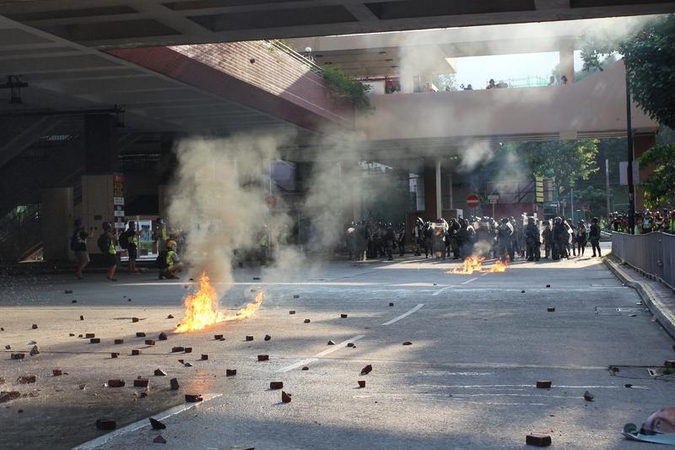
HONG KONG – Radical protesters, many dressed in black, blocked roads, set fires, threw gasoline bombs and vandalized public facilities in Tuen Mun on the west side of Hong Kong on Saturday.

The special administrative region is in a fourth month of anti-government protests that started with opposition to the now-withdrawn extradition bill.

All photos are taken by China Daily staff.


S. Korea raises typhoon alert level to ‘vigilance’ from ‘attention’

ศาสตร์เกษตรดินปุ๋ย : ขอบคุณแหล่งข้อมูล : หนังสือพิมพ์ The Nation

https://www.nationthailand.com/ann/30376544

S. Korea raises typhoon alert level to ‘vigilance’ from ‘attention’

Sep 21. 2019
High waves are seen in waters off South Korea's southern island of Jeju on Saturday. (Yonhap)

High waves are seen in waters off South Korea’s southern island of Jeju on Saturday. (Yonhap)
By The Korea Herald
Asia News Network

420 Viewed

The interior and safety ministry on Saturday elevated the weather alert level to “vigilance” from “attention” as Typhoon Tapah tracking northward is expected to affect parts of the country’s southern region over the weekend.

Interior Minister Chin Young presided over a meeting of related ministries and provincial governments to make the decision and discuss ways to minimize potential damage from the typhoon, this year’s 17th, Yonhup news agency reports.

The officials decided to check vulnerable areas, such as steep slopes, and ensure that measures are well in place to prevent flooding, power outages and other problems that could occur as the typhoon approaches.

“I ask citizens to refrain from going outside when the country is under the influence of the typhoon and ensure their safety when there are concerns about the possibilities of landslides or flooding,” Chin said.

The Korea Meteorological Administration (KMA) said that Typhoon Tapah is expected to pass through the waters east of the southern island of Jeju during daytime Sunday and then move past the Straits of Korea and toward the East Sea at night on the day.

Pagasa: ‘Nimfa’ exits PAR, ‘Habagat’ to bring rain over Luzon, Metro Manila

ศาสตร์เกษตรดินปุ๋ย : ขอบคุณแหล่งข้อมูล : หนังสือพิมพ์ The Nation

https://www.nationthailand.com/ann/30376529

Pagasa: ‘Nimfa’ exits PAR, ‘Habagat’ to bring rain over Luzon, Metro Manila

Sep 21. 2019
Satellite image of Severe Tropical Storm Nimfa (Tapah) as of September 20, 2019, 10:30 pm.-Photo by NOAA

Satellite image of Severe Tropical Storm Nimfa (Tapah) as of September 20, 2019, 10:30 pm.-Photo by NOAA
By The Philippines Daily Inquirer

Asia News Network

434 Viewed

MANILA, Philippines — Severe Tropical Storm “Nimfa” has exited the country while the southwest monsoon or “habagat” will continue to bring rain over Luzon, including Metro Manila on Saturday, the state weather bureau said.

In its 5 a.m. weather bulletin, the Philippine Atmospheric, Geophysical and Astronomical Services Administration (Pagasa) said the weather disturbance slightly intensified and left the Philippine Area of Responsibility (PAR) at 2 a.m.

Nimfa was last spotted 705 kilometers northeast of Basco, Batanes while moving at 25 kilometers per hour (kph) north northwest.It is packing maximum sustained winds of 110 kph and gustiness of up to 135 kph. 

Pagasa said Metro Manila and the rest of Luzon will experience scattered rain and thunderstorms.

Anwar: Asean’s future not determined by China, US

ศาสตร์เกษตรดินปุ๋ย : ขอบคุณแหล่งข้อมูล : หนังสือพิมพ์ The Nation

https://www.nationthailand.com/ann/30376516

Anwar: Asean’s future not determined by China, US

Sep 21. 2019

Amwar/Photo by The Star

Amwar/Photo by The Star
By The StarAsia News Network

122 Viewed

SINGAPORE: Asean’s future must not be determined by China or the United States, says PKR president Datuk Seri Anwar Ibrahim, calling on members of the regional grouping to however maintain good ties with the two superpowers.

He said he did not believe that the trade war would adversely affect ties between Asean member countries as relations among them tended to be acceptable, although there were challenges.

“The best way forward for us (Asean) is to engage with both nations for our own survival and economic success.

“We need to maintain good cordial relations with both the East and the West, ” he said at a dialogue at the Milken Institute Asia Summit on Thursday.

The Port Dickson MP was asked about Asean’s future as the regional grouping faces potential division due to the rivalry between Washington and Beijing.

Expressing his optimism, Anwar said there were opportunities and that “we have to look beyond the immediate problems and see whatever benefit we can obtain”.

“I’m more optimistic if you can garner the best brains within the countries… with international support, we can drive this problem.”

On the current haze situation, Anwar said: “We in Asean need to deal with the whole idea of governments.

“I’m optimistic because in the sense that you can get the governments in Asean to look at it. If they don’t, then there must be a sense of outrage among the public because it is affecting millions of people.”

Anwar stressed that the three affected countries – Indonesia, Malaysia and Singapore – must partly shoulder the responsibility and “do something”.

“It is not a blame game between (the three countries)… some say Indonesia’s at fault but Malaysia’s companies are involved and Singapore has a lot of shares there.”

He also expressed his hope that the companies involved be held accountable for their actions.

Schoolkids call for change to tackle climate crisis

ศาสตร์เกษตรดินปุ๋ย : ขอบคุณแหล่งข้อมูล : หนังสือพิมพ์ The Nation

https://www.nationthailand.com/ann/30376515

Schoolkids call for change to tackle climate crisis

Sep 21. 2019

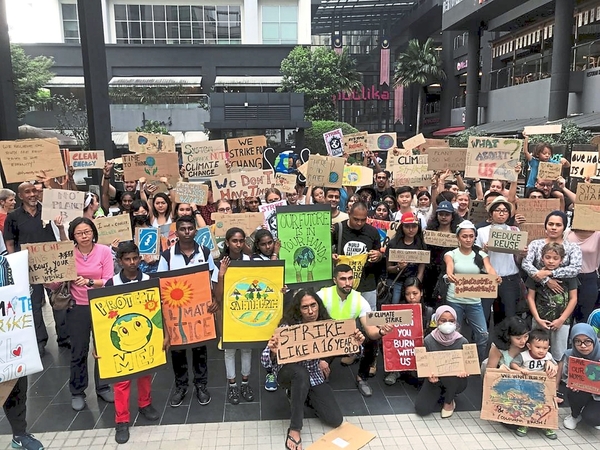
Taking a stand: Protestors, young and old, holding up placards demanding for urgent government action on climate change during a climate strike in Kuala Lumpur yesterday.-Photo by The Star

Taking a stand: Protestors, young and old, holding up placards demanding for urgent government action on climate change during a climate strike in Kuala Lumpur yesterday.-Photo by The Star
By The StarAsia News Network

137 Viewed

KUALA LUMPUR: Year Five pupil Sasirani Manogaran joined three classmates at a table to write down their aspirations for the future.

“I want fresh oxygen. I want no pollution. I want people to love recycling, ” she wrote on a piece of paper.

The SJK (T) Sungai Ara pupil in Penang was among those who participated in the Global Climate Strike in Kuala Lumpur yesterday.

“I am so worried about my future, ” Sasirani said.

She said she was very worried about climate change and how human action led to forest fires and the stifling haze.

“Adults are so selfish. They never think about nature and about our future. They think it is more important to use plastics and are not working to stop climate change, ” she added.

Malaysia kicked off its participation in the Global Climate Strike yesterday with dialogue sessions, speeches and mini workshops.

About 200 people, including schoolchildren and families carrying placards, attended the gathering at the Publika Shopping Gallery.

Eugene Chang, 15, said the education system is not doing enough to teach students about climate change.

“Whether or not schools want to pick up this responsibility, it is important for schools to educate students about climate change. If we don’t do anything about it, we will suffer, ” he said.

Gurpreet Singh, 32, said Malaysians needed to correct the defeatist attitude that they could not influence change by contributing their bit.

“When we talk about the environmental crisis, the knee-jerk reaction is ‘will that make a difference?’”

“This behavioural change is the first step we need to take. If we don’t believe we can affect change, change will never be a reality in Malaysia, ” the CEO of Me.reka said.

Spearheaded by 16-year-old Swedish climate activist Greta Thunberg, the global campaign demanding urgent government action to address the climate crisis is taking place ahead of the UN Emergency Climate Summit on Monday.

A big rally is planned today in Kuala Lumpur, with over 250 people expected to gather and march from Sogo KL to Dataran Merdeka from 4.30pm.

Pressure group Klima Action Malaysia, which is leading the rally, has joined hands with Greenpeace Malaysia and Amnesty International Malaysia on the initiative.

Their four demands are to “smash” the wall of political and media silence on the climate crisis, declare a climate emergency for financial and policy mobilisation, raise awareness among Malaysians about the climate crisis and increase visibility on climate narrative from developing countries.

The strikes calling for climate justice, taking place around the world, have seen an unprecedented turnout.

In Australia, The Guardian reported that over 100,000 people picketed in Melbourne while hundreds and thousands showed up in Sydney, Perth and Brisbane.

Photos of people marching for climate justice in the Philippines, Indonesia, Japan, Singapore and more are also being shared on social media.

China’s power consumption continues to grow in first 8 months

ศาสตร์เกษตรดินปุ๋ย : ขอบคุณแหล่งข้อมูล : หนังสือพิมพ์ The Nation

https://www.nationthailand.com/ann/30376511

China’s power consumption continues to grow in first 8 months

Sep 21. 2019
In this undated photo, engineers replace capacitors at a power transmission facility in Chuzhou, Anhui province. (SONG WEIXING / FOR CHINA DAILY)

In this undated photo, engineers replace capacitors at a power transmission facility in Chuzhou, Anhui province. (SONG WEIXING / FOR CHINA DAILY)
By China Daily
Asia News Network

133 Viewed

China’s power consumption continued to grow in the first eight months of this year, despite marginal blips from rising trade tensions and lower industrial off-take.


Power consumption in the first eight months rose 4.4 percent year-on-year to 4.7 trillion kilowatt-hours, according to data from the National Energy Administration.

Lin Boqiang, head of the China Institute for Studies in Energy Policy at Xiamen University said that the growth rate slipped from 9 percent in 2018, mainly due to the structural changes in China’s economy, with the government shifting more focus to the tertiary sector amid growing uncertainties from international trade relations.

Power consumption in the first eight months rose 4.4 percent year-on-year to 4.7 trillion kilowatt-hours, according to data from the National Energy Administration

“Even among secondary industries, which took up nearly 70 percent of the total power consumed, a growing number of businesses are embracing energy-efficient and low-carbon production processes to achieve high-quality development. That may have an influence over power consumption in the sector,” Lin said.

Lin added that the lingering trade tension in global markets also had an impact over businesses in the secondary sector, which was reflected in the total power consumption in the sector.

In the first eight months of this year, power consumption in the secondary sector edged up 3 percent to 3.2 trillion kWh. The growth rate was down from 7.3 percent in the first eight months of 2018.

China’s power consumption is likely to see steady growth during the rest of 2019, according to an industry report by the China Electricity Council, a nonprofit association of power companies and institutions.

According to the report, China’s total power consumption will increase 5.5 percent year-on-year in 2019 from 6.8 trillion kWh last year. It was also pointed out in the report that the actual growth rate might be lower than the prediction if the average temperature this summer is lower than that of last year.

Total installed capacity is likely to reach 2 billion kilowatts by the end of this year, a year ahead of the goals set to be met by 2020. Installed capacity of non-fossil electricity will account for 42 percent and reach 840 million kilowatts, according to the report.

Yu Chongde, a spokesman for the CEC, said that by the end of this year installed capacity for solar power will surpass 110 million kilowatts across the country, a goal that was originally set for 2020.

“That marks a great step in China’s efforts to achieve green production and sustainable economic development,” said Lin.

Patriotic HK tycoon Tsang Hin-chi dies at 85

ศาสตร์เกษตรดินปุ๋ย : ขอบคุณแหล่งข้อมูล : หนังสือพิมพ์ The Nation

https://www.nationthailand.com/ann/30376510

Patriotic HK tycoon Tsang Hin-chi dies at 85

Sep 21. 2019
Photo by China Daily

Photo by China Daily
By China Daily
Asia News Network

338 Viewed

HONG KONG – Hong Kong patriotic tycoon Tsang Hin-chi, a pioneer in China’s industrial development, died in his hometown in Meizhou, Guangdong province, on Friday afternoon. He was 85.


The Goldlion Group confirmed Tsang’s death in an announcement on Friday evening, adding that the company will always remember him.

Tsang founded the famous manufacturer of menswear in 1968, and has steadily invested in the manufacturing industry on the mainland since the early days of the country’s reform and opening-up.

Hong Kong Chief Executive Carrie Lam Cheng Yuet-ngor, in expressing her “deepest condolences”, said the successful entrepreneur was a trailblazer among overseas Chinese who contributed to the country’s economic reform that started 41 years ago.

Tsang was devoted to contributing to the country’s development, dedicated to serving the public, and made important contributions to Hong Kong’s smooth transition in 1997, Lam said.

He was among the first batch of people in Hong Kong to have been awarded the Grand Bauhinia Medal in 1997 — the highest award under Hong Kong’s honors and awards system.

Tsang was a member of the Standing Committee of the National People’s Congress, the country’s top legislature, from 1994 to 2008

During a grand gathering in Beijing on Dec 18, Tsang was one of 100 Chinese awarded a medal as a “reform pioneer” for outstanding contributions to the country’s advancement. The ceremony was held to mark the 40th anniversary of China’s reform and opening-up.

Tsang was recognized for his support to the development of education, aviation, sports, science and healthcare on the mainland, with donations of more than HK$1.2 billion ($153 million) since the 1970s.

Tsang was a member of the Standing Committee of the National People’s Congress, the country’s top legislature, from 1994 to 2008. He was appointed a member of the Hong Kong Basic Law Consultative Committee in the 1980s.

Choy So-yuk, a Hong Kong deputy to the NPC, said she was sorry to hear of Tsang’s death. She spoke highly of the philanthropic entrepreneur’s patriotism, noting that when NPC members visited areas of poverty on the mainland, Tsang would donate to the construction there.

Albert Au Yeung, a senior Hong Kong journalist who interviewed Tsang over 10 years ago, recalled that Tsang was an easygoing person, very friendly to journalists, and often invited journalists to gatherings at his home. Though at that time Tsang already had some health problems, the tycoon continued his charity for the country, Au Yeung said.

Tsang also organized many media tours to the mainland to promote Hong Kong journalists’ understanding of the country’s development, Au Yeung added.

Vietnamese goods shine in Thailand

ศาสตร์เกษตรดินปุ๋ย : ขอบคุณแหล่งข้อมูล : หนังสือพิมพ์ The Nation

https://www.nationthailand.com/ann/30376462

Vietnamese goods shine in Thailand

Sep 20. 2019
Customers visit a Vietnamese booth at the “Vietnamese Week in Thailand 2019”, which officially opened on September 18 in Bangkok, Thailand. — VNS Photo Linh Anh

Customers visit a Vietnamese booth at the “Vietnamese Week in Thailand 2019”, which officially opened on September 18 in Bangkok, Thailand. — VNS Photo Linh Anh
By Viet Nam News/ANN

559 Viewed

HÀ NỘI — Vietnamese businesses are proudly presenting their products at the “Vietnamese Week in Thailand 2019”, which officially opened on September 18 in Bangkok, Thailand.

This is the fourth year in a row that the Vietnamese week has been organised in the city.

Themed “Taste of Việt Nam”, the five-day event has attracted the participation of 45 Vietnamese businesses, with the main purpose of promoting Vietnamese commodities in Thailand as well as creating export opportunities for Vietnamese suppliers in the Thai market.

The event is a project in the framework of ‘Promote Vietnamese enterprises’ direct participation in foreign distribution networks up to 2020’ which was endorsed by the Prime Minister in his Decision No 1513/QĐ-TTg dated September 3, 2015.

At the fair, co-organised by Việt Nam’s Ministry of Industry and Trade and Central World, Vietnamese businesses introduced their products with high export potential such as phở (noodles), tea, coffee, snacks, fresh fruits and spices.

The total exhibition area spans nearly 1,000 square metres of CentralWorld shopping centre. The event is expected to welcome 500,000 visitors over five days.

“In recent years, Việt Nam’s Government has encouraged Vietnamese suppliers to engage in international retail systems including in Thailand. ‘Vietnamese Week in Thailand 2019’ is an important event held annually since 2016,” said Đỗ Thắng Hải, deputy minister of Industry and Trade of Việt Nam at the opening ceremony.

In order to promote and export Vietnamese products to its retail system, Central Group Vietnam has recently co-operated with the Ministry of Industry and Trade to conduct market research, select potential products which are suitable for the Thai market, as well as organise practical training courses to improve the capacity and quality of Vietnamese suppliers and develop the unique products for Thai market, Hải said.

In his remarks, Thai Deputy Prime Minister cum Minister of Commerce Jurin Laksanavisit said the event showed the vision and determination of Việt Nam’s Ministry of Industry and Trade and Central Group in strengthening economic relations, connecting investment and business by exchanging products and services.

“The relationship between Thailand and Việt Nam is not merely co-operation between two countries but it is also connected with the community of ASEAN countries, so we need to closely collaborate with each other and with our ASEAN pals to develop more together,” Laksanavisit said.

Jariya Chirathivat, executive vice-president of business development at Central Group, said: “Vietnamese Goods and Tourism Week is one of the activities that Central Group attaches great importance to. After each year of organisation, our enthusiastic staff have tried to closely follow the instructions and suggestions of the Việt Nam’s Ministry of Industry and Trade to execute the programme with increasing scale and quality.”

“This activity helps realise Central Group Việt Nam’s vision of contributing to the prosperity of Việt Nam and improve the quality of life of Vietnamese people. We are happy to be a part of Việt Nam.”

Nguyễn Lâm, sales manager of Vietnamese Gia Lai-based cashew nuts processor Hải Bình Gia Lai Co Ltd, told Việt Nam News this was the second year his company had brought products to the event.

“We tried to renovate our design to make it more eye-catching, hoping to connect with Thai partners in the business matching session,” Lâm said.

In the first seven months of 2019, the total import and export turnover between the two countries reached US$10.2 billion, up 6.6 per cent over the same period in 2018. In particular, Việt Nam’s export turnover to Thailand reached approximately $3.2 billion, up 1.5 per cent. Việt Nam’s import turnover from Thailand reached $7 billion, up 9.2 per cent over the same period in 2018. — VNS

Japanese business becomes the first foreign company buying Taiwan baseball team

ศาสตร์เกษตรดินปุ๋ย : ขอบคุณแหล่งข้อมูล : หนังสือพิมพ์ The Nation

https://www.nationthailand.com/ann/30376461

Japanese business becomes the first foreign company buying Taiwan baseball team

Sep 20. 2019
Lamigo Monkeys won 2018 CPBL championship (PHOTO: Yeh Cheng-hsun | 葉政勳攝)

Lamigo Monkeys won 2018 CPBL championship (PHOTO: Yeh Cheng-hsun | 葉政勳攝)
By NOWnews Sports Center and Carol Kan
The China Post/ANN

292 Viewed

TAIPEI (The China Post) — Taiwan professional baseball team, Lamigo Monkeys, announced today that Japan-based e-commerce giant Rakuten, Inc. had completed the deal of purchasing the team.

Rakuten became the first foreign company to purchase or run a team in the Chinese Professional Baseball League (CPBL).

The Rakuten-sponsored new team will participate in CPBL starting from next year.

Since La New Corporation started to sponsor and manage the baseball team, named Law New Bear then, the team has won six CPBL championships, including the season 2017 and 2018.

The popularity of Lamigo Monkeys is the top in CPBL. Since 2014, every year, the team has the highest amount of audience entering the arena to support the team.

Lamigo Monkeys General Manager Justin Liu (劉玠廷) said, “Thanks Rakuten a lot for recognizing our efforts in the past 16 years.”

Rakuten completes the deal of purchasing Lamigo Monkeys today (PHOTO: Yeh Cheng-hsun | 葉政勳攝)

Rakuten completes the deal of purchasing Lamigo Monkeys today (PHOTO: Yeh Cheng-hsun | 葉政勳攝)

Rakuten is known for sponsoring Tohoku Rakuten Golden Eagles in Nippon Professional Baseball’s Pacific League since 2005. Therefore, Rakuten said they would utilize what they’ve learned from past experiences in managing the Japanese team to support the Taiwanese team.

Baseball is not the first business that Rakuten has in Taiwan. Started from 2008, the Japanese company has expanded its business in various sectors in Taiwan, such as e-commerce and digital books. They even have obtained approval to run online banking in Taiwan starting next year.

Liu revealed that Rakuten would continue managing Taoyuan International Baseball Stadium, where the Lamigo Monkeys is based, adding that the Rakuten would invest more and hold on to most of the employment.

The team’s new name, uniform and logo will be published afterward.

Overseas study no longer only for the elite

ศาสตร์เกษตรดินปุ๋ย : ขอบคุณแหล่งข้อมูล : หนังสือพิมพ์ The Nation

https://www.nationthailand.com/ann/30376460

Overseas study no longer only for the elite

Sep 20. 2019
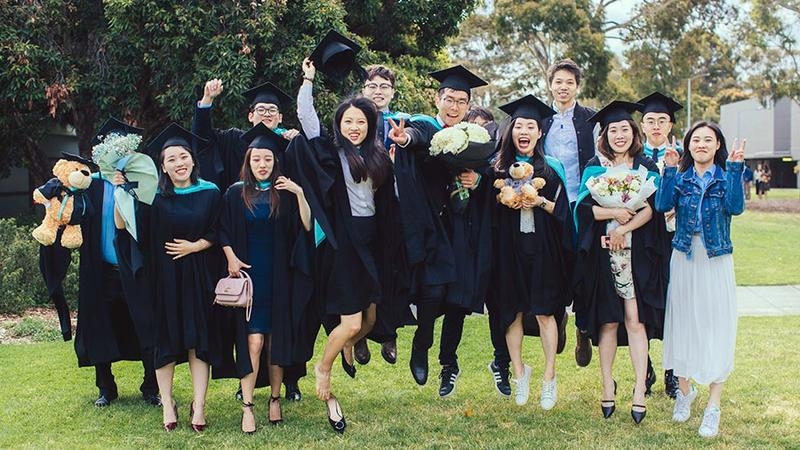
Students pose for a graduation photo at Monash University in Melbourne, Australia, last year. (ZHANG XIAOLI / FOR CHINA DAILY)

Students pose for a graduation photo at Monash University in Melbourne, Australia, last year. (ZHANG XIAOLI / FOR CHINA DAILY)
By Zou Shuo
China Daily/ANN

25 Viewed

In recent decades, millions of Chinese have attended schools and colleges in other countries. Zou Shuo reports.

“My son has been enrolled by a university in the United States.””I will go to a Canadian university as a visiting scholar next month.” “It’s so hard to find a job in Europe, so I will return to China after I graduate.”

Sentiments such as these have become increasingly common among Chinese students as the country’s economic growth and rising income levels mean that going overseas to study is no longer only for the elite.

As the country further opens up to the world, going abroad to study has become a common activity, with self-funded students accounting for the majority of those heading overseas.

Last year, 662,100 Chinese went abroad to study, a rise of 8.83 percent from 2017, according to the Ministry of Education, which added that 90 percent of the students were self-supporting and only 65,800 received public funding.

According to a report in May by Vision Overseas Consulting Co, a subsidiary of New Oriental Education and Technology Group, and Kantar Millward Brown, most parents whose children want to study overseas hold regular jobs, accounting for 43 percent of the total, a rise of 14 percentage points from 2015.

Middle-level managers accounted for 35 percent of the parents, while 22 percent were high-level executives.

It also found that the main reasons students choose to study overseas included expanding their horizons, enriching their life experience and improving their employment prospects and language skills.

Seventy years ago, when the People’s Republic of China was founded, the picture for students going abroad was very different.

In September 1950, China sent 25 college graduates to Czechoslovakia, Poland, Romania, Hungary and Bulgaria. They were the first batch of overseas students since the founding of New China, according to the book 60 Years of Overseas Study by Miao Danguo, a retired official at the Ministry of Education’s Department of International Cooperation and Exchanges. However, the students, who were all government-funded and learning engineering skills, only visited communist bloc countries.

By 1965, China had sent 10,689 students to 29 countries, with about 80 percent going to the Soviet Union, the book said.

During most of the “cultural revolution” (1966-76), China suspended its overseas study program, so no students went abroad to study from 1966 to 1972, it said.

The program was restarted in 1973, when seven students were sent to Japan to learn the language. From 1973 to 1978, when China began implementing the Reform and Opening-up Policy, about 2,000 students were sent abroad, mainly to study foreign languages, according to the book.

In June 1978, Deng Xiaoping announced that China would increase the number of students it sent abroad. “Rather than just sending a handful of students, we should send thousands of them,” he said.

In December 1978, a group of 52 science and technology experts was chosen to become the first citizens of the PRC to study in the US.

Deng’s strategy proved successful. After two or three years as visiting scholars at top institutions in the US, most of the intellectuals returned to help rebuild the country.

Hua Luogeng (right) discusses his experiences as a student in the Soviet Union with academics from several universities in 1953. (PHOTO / XINHUA)


Liu Shaoqi (right), Zhou Enlai (left) and Zhu De, the former Chinese leadership, meet students returning from Soviet Union and other countries in 1959. (PHOTO / XINHUA)

A novel experience

In 1984, Wang Huiyao went to the University of Winsor in Canada to study for a master’s in business administration. Back then, going abroad to study was still a novel experience as Chinese people knew little about the outside world, he said. The feeling was mutual.

“The Western students had odd views about China, and one even asked to touch my head to see if anything was different”, he said.

To help them understand China, he held lectures to introduce the country. Wang later found an internship at the Canadian Imperial Bank of Commerce in Toronto.

After the policy to encourage students to return started in 1993, Wang decided to come back and start his own business. He founded a company that introduced foreign investment to China.

In 2008, Wang founded the Center for China and Globalization, aka CCG, a nongovernmental think tank dedicated to the study of Chinese public policy and globalization, and conducted research into a wide range of social science disciplines, including global migration, foreign relations, and the development of international talent, foreign trade and investment.

CCG has grown into one of China’s largest think tanks, with its headquarters in Beijing and offices in Shanghai, Shenzhen and Guangzhou (both in Guangdong province), Qingdao, Shandong province, and Hong Kong, as well as representatives in major cities overseas.

Wang is one of many overseas returnees who have made a contribution to China’s development in the wake of reform and opening-up.

More than 70 percent of presidents of prestigious universities and over 90 percent of academicians at the Chinese Academy of Engineering and the Chinese Academy of Sciences had studied overseas by the turn of the century, according to a report by People’s Daily.

From 1978 to the end of last year, 5.86 million Chinese studied overseas. More than 4.32 million completed their studies, and over 3.65 million returned soon after doing so, according to the Ministry of Education.

The proportion of people who returned almost directly after graduation was around 80 percent last year. In 1987, the rate was about 5 percent, and in 2007, it stood at 30.6 percent, the ministry said. Last year, the number was 519,400, a rise of 8 percent from 2017, it added.

The returnees are increasingly equipped with the skills required to support China’s economic development and industrial upgrading, and as such they have become an important pillar of the national labor force.

Scientist Qian Xuesen (right) returns to Shanghai in 1955 after studying in the United States. (PHOTO / XINHUA)


Candidates take the TOEFL exam, the leading English-language test for overseas study, in Nanjing, Jiangsu province, in 1989. (XIE BAI / FOR CHINA DAILY)

Heading to a peak

Since 2010, China has been the largest source of international students, and there is no sign its lead will be overtaken anytime soon.

Yu Minhong, founder and CEO of New Oriental Education and Technology Group, estimates that the number of Chinese studying abroad each year will peak at between 700,000 and 800,000.

“Considering China’s economic growth and rising household incomes, the annual number of Chinese studying abroad will continue to grow for several years. Then it will fluctuate in line with the annual birthrate and the economy,” he said.

Yu estimates that at the peak 80,000 to 100,000 Chinese will be in primary and secondary education abroad, while 400,000 to 500,000 will be attending colleges and universities. Moreover, 100,000 to 200,000 will be pursuing postgraduate education, and 50,000 to 100,000 will be undergoing skills training at vocational schools.

Economic considerations and the capacity of international universities to absorb extra students will limit the rise, as foreign schools cannot simply expand their enrollment plans to take on more students, he said.

He added that more than 80 percent of those who pursue education overseas return to China and contribute to the country’s development.

“From a long-term perspective, it is a positive thing. China’s policies will continue to support overseas study, and the Chinese people are aware that having more people study abroad can have a positive effect on the country’s long-term development,” he said.

Contact the writer at zoushuo@chinadaily.com.cn