Axiata and Telenor’s mega-merger plan derails due to complexities

ศาสตร์เกษตรดินปุ๋ย : ขอบคุณแหล่งข้อมูล : หนังสือพิมพ์ The Nation

https://www.nationthailand.com/ann/30375922

Axiata and Telenor’s mega-merger plan derails due to complexities

Sep 07. 2019
By THE STAR
ASIA NEWS NETWORK
KUALA LUMPUR

453 Viewed

The merger of Asian operations between Malaysian telecommunications giant Axiata Group Bhd and Norway’s Telenor SA has been called off.

Axiata and Telenor’s Digi.com said in separate filings to the Malaysian stock exchange that both parties had mutually agreed to end discussions over a non-cash combination of their telecom and infrastructure assets in Asia.

“Over the last four months, both parties have been working on due diligence and finalising transaction agreements to be completed within the third quarter of 2019.

“Due to some complexities involved in the proposed transaction, the parties have mutually agreed to end the discussions,” Axiata said.

However, both parties acknowledged the “strong strategic rationale” of the proposed transaction and did not rule out a possible future transaction.

Trading in the shares of Axiata and Digi was suspended at midday on Friday.

In the statement to stock exchange authority Bursa Malaysia, Axiata chairman Ghazzali Sheikh Abdul Khalid said, “The board acknowledges the strong strategic rationale of the proposed transaction and is equally cognisant of the level of complexity of such a deal that extends across nine countries and 14 major entities.

“Regardless of the expressed synergies of the merger, we are confident that the termination of the proposed transaction does not affect the group in achieving its digital champion ambitions.”

In a separate statement, Digi said its board was informed by Telenor ASA (Telenor), the parent company of Digi’s largest shareholder, Telenor Asia Pte Ltd, that Telenor and Axiata had agreed to end discussions on the proposed transaction.

“The board has been informed that over the last four months, both parties have been working on due diligence and finalising transaction agreements to be completed within the third quarter of 2019.

“Due to some complexities involved in the proposed transaction, the parties have mutually agreed to end the discussions. Both parties still acknowledge the strong strategic rationale of the proposed transaction,” it said.

The Star’s StarBiz had earlier reported all indications point to the mega-merger being called off.

Apart from the sheer complexity of the deal, which involves 14 entities across nine countries, the stumbling blocks involved commercial issues, national and staff interests, and Indonesia’s reluctance to give its blessings, as it sees Norway as being part of the European Union’s pressure on palm oil imports. Without Indonesia as part of the enlarged group, the odds of the deal materialising were basically zero.

“Both parties are trying their level best, as the merger would take them beyond their existing boundaries to create an Asian powerhouse. But the sheer complexity and the very long list of outstanding items surrounding commercial, national and staff interest make it terribly challenging.

“Some items on the list can be modified, some others are not agreeable to both parties, and the deal-breaker items are still hanging. So, with so many items still outstanding, they may just not want to drag on any longer and merger talks may have been halted. They may just call it off,” said an industry executive with knowledge of the deal.

HK leader announces withdrawal of extradition bill

ศาสตร์เกษตรดินปุ๋ย : ขอบคุณแหล่งข้อมูล : หนังสือพิมพ์ The Nation

https://www.nationthailand.com/ann/30375837

HK leader announces withdrawal of extradition bill

Sep 04. 2019
In this television screenshot, Hong Kong Chief Executive Carrie Lam Cheng Yuet-ngor announces the withdrawal of extradition law amendment bill in a speech to the members of the public, Sept 4, 2019.

In this television screenshot, Hong Kong Chief Executive Carrie Lam Cheng Yuet-ngor announces the withdrawal of extradition law amendment bill in a speech to the members of the public, Sept 4, 2019.
By China Daily
Asia News Network

570 Viewed

HONG KONG – Chief Executive Carrie Lam Cheng Yuet-ngor announced on Wednesday the withdrawal of the extradition law amendment bill, which has been the cause of protests throughout the Asian business hub for the last three months. 

Lam announced the decision in a television speech in the afternoon. 

The proposed changes to the extradition laws, introduced by the government of the Hong Kong Special Administrative Region to plug legal loopholes in the laws covering the handling of fugitives, was suspended by the government on June 15. 

The formal withdrawal of the bill is a key demand of the protesters, who have been agitating on the streets since June 9, unleashing mindless violence, shattering the peace, and inflicting heavy damage on the city’s tourism and businesses. 

The withdrawal is expected to calm the protesters and pave the way for a dialogue that Lam announced earlier to bring the city out of its political impasse. 

Below is the full text of Carrie Lam’s speech delievered to members of the public: 

Fellow citizens, 

For more than two months, protests arising from the Fugitive Offenders Bill have continued. Our citizens, police and reporters have been injured during violent incidents. There have been chaotic scenes at the airport and MTR stations; roads and tunnels have been suddenly blocked, causing delay and inconvenience to daily life. Visitors wonder whether our city is still a safe place for travel or business. Families and friends have been under stress, and arguments have flared. We have also seen abuse and bullying in some schools and on the Internet. For many people, Hong Kong has become an unfamiliar place. 

Incidents over these past two months have shocked and saddened Hong Kong people. We are all very anxious about Hong Kong, our home. We all hope to find a way out of the current impasse and unsettling times. 

Of the “five demands” raised by the public, we have in fact responded on various occasions: 

(i) First, on withdrawing the Bill. On June 15 I announced that the Bill was suspended and later reiterated that “the Bill is dead” and that all the legislative work had come to a complete halt; 

(ii) Second, on setting up a Commission of Inquiry. The Government believes that matters relating to police enforcement actions are best handled by the existing and well-established Independent Police Complaints Council (IPCC), which was set up for exactly this purpose. In addition to handling complaints against individual police officers, the IPCC has undertaken a fact-finding study, under its powers, on the handling of large-scale public order events that took place after June 9. One focus will be the Yuen Long incident on July 21 which attracted serious public concern. The study aims to ascertain the facts, to assess the police handling of protests, and to make recommendations to the Government. The IPCC has established a panel of international experts to assist in its work and will make its findings and recommendations public; 

(iii) Third, on the matter of the protest being a riot. We have explained that in fact there is no legal effect on how such incidents are described or categorised. The Department of Justice has assured the public that each and every prosecution decision is based on the evidence collected, and is in strict accordance with the relevant law and the Prosecution Code; 

(iv) Fourth, on dropping charges against protesters and rioters and shelving prosecutions. I have explained that this is contrary to the rule of law, and is not acceptable. It also goes against the Basic Law, which states that criminal prosecutions must be handled by the Department of Justice, free from any interference; 

(v) Fifth, on implementing universal suffrage. Indeed, this is the ultimate aim laid down in the Basic Law. As we said before, if we are to achieve this, discussions must be undertaken within the legal framework, and in an atmosphere that is conducive to mutual trust and understanding, and without further polarising society. 

Our responses to the five demands have been made with full consideration of different constraints and circumstances. I recognise that these may not be able to address all the grievances of people in society. However, should we all think deeply whether escalating violence and disturbances is the answer? Or whether it is better to sit down to find a way out through dialogue. 

Many would say that we need a common basis to start such a dialogue, and that this has to start with the Chief Executive. I now present four actions to initiate this dialogue. 

First, the Government will formally withdraw the Bill in order to fully allay public concerns. The Secretary for Security will move a motion according to the Rules of Procedure when the Legislative Council resumes. 

Second, we will fully support the work of the IPCC. In addition to the overseas experts, I have appointed two new members to the IPCC, namely Mrs Helen Yu Lai Ching-ping and Mr Paul Lam Ting-kwok, SC. I pledge that the Government will seriously follow up the recommendations made in the IPCC’s report. 

Third, from this month, I and my Principal Officials will reach out to the community to start a direct dialogue. People from all walks of life, with different stances and backgrounds are invited to share their views and air their grievances. We must find ways to address the discontent in society and to look for solutions.  

Fourth, I will invite community leaders, professionals and academics to independently examine and review society’s deep-seated problems and to advise the Government on finding solutions. After more than two months of social unrest, it is obvious to many that discontentment extends far beyond the Bill. It covers political, economic and social issues, including the oft-mentioned problems relating to housing and land supply, income distribution, social justice and mobility, and opportunities for our young people, as well as how the public could be fully engaged in the Government’s decision-making. We can discuss all these issues in our new dialogue platform. 

Fellow citizens, lingering violence is damaging the very foundations of our society, especially the rule of law. Some people, though not many, attacked the Central Government’s office in Hong Kong and vandalised the national flag and national emblem. This is a direct challenge to “One Country, Two Systems”. Both have put Hong Kong in a highly vulnerable and dangerous situation. Irrespective of our grievances, or the depth of discontentment towards the Government, we cannot agree or accept that violence is a solution to our problems. Our foremost priority now is to end violence, to safeguard the rule of law and to restore order and safety in society. As such, the Government has to strictly enforce the law against all violent and illegal acts. 

My team and I hope that the four actions just announced can help our society to move forward. Let’s replace conflicts with conversations, and let’s look for solutions.
No-strike, wage deal clears hurdle for Hyundai Motor in H2

ศาสตร์เกษตรดินปุ๋ย : ขอบคุณแหล่งข้อมูล : หนังสือพิมพ์ The Nation

https://www.nationthailand.com/ann/30375809

No-strike, wage deal clears hurdle for Hyundai Motor in H2

Sep 04. 2019
(Yonhap)

(Yonhap)
By The Korea Herald
Asia News Network

103 Viewed

Union approves proposal amid growing uncertainties in business environment, cold public eye on ‘aristocratic’ labor

Unionized workers and the management at Hyundai Motor reached an agreement early Tuesday on this year’s wages, after the union voted not to stage sit-in protests amid intensifying uncertainties over the business environment and the local auto industry.

In a vote held Monday, 56 percent of Hyundai Motor workers approved a revised wage and collective bargaining deal, according to the union.

The union formally approved the management’s proposal without a strike for the first time in eight years, clearing hurdles for the South Korean carmaker that had feared a considerable delay in vehicle production.

Hyundai Motor’s union, founded in 1987, staged strikes almost every year, with exceptions in 2007 and for three years beginning in 2009.

Protests are normally staged before signing wage deals, and those protests have been blamed for dragging production efficiency down, delaying the launch of new vehicles and raising business uncertainty for a carmaker that is already struggling from fierce market competition and industrial transformation.

The union, known for its hard-line stance, said the vote to accept the management’s proposals came as uncertainties in the business environments grow and that the public eye toward the union’s plan of staging protest, in this particular time of the economy going down the hill, no longer remain amicable.

“The union has voted to approve the company’s revised proposals as uncertainties in business environments grow further over an escalating US-China trade war, Japan’s export curb and a slowdown in the auto industry,” the union said in a statement.

Prime Minister Lee Nak-yon expressed gratitude toward both sides, saying they were making a “mature” decision.

“It suggests that we can have a developed labor-management culture,” Lee said at a Cabinet meeting Tuesday.

“The government will help labor and management overcome difficulties through cooperation,” he said.

By deciding not to stage protests this year, the 50,000-member Hyundai Motor union said it hoped to prevent itself from becoming isolated from the community and counter critical views among people who believe it makes excessive demands. Unionized workers, particularly in the manufacturing sector, have been blamed for threatening management ahead of each annual wage deal despite their relatively high income.

This year, the management’s proposal included raising the basic monthly salary 1.7 percent or 40,000 won, one and a half months of wages and 3 million won in addition for performance-based pay. The proposal also added bonus in cash between 2.2 million and 6.2 million won per person.

The union had demanded the company to pay 30 percent of its net income as a bonus package and add 123,526 won in basic monthly pay. The carmaker posted a net income of 1.87 trillion won for 2018 financial year that ended in March.

The agreement will speed up the planned delivery of popular vehicles such as the Palisade, possibly help the company to increase sales, according to industry insiders and watchers.

“The management and the labor reaching the deal without a strike this year, alleviates business uncertainties in the remaining second half in which the company is planning to launch a series of new cars,” said a senior manager at Hyundai Motor.

From January to August, Hyundai sold a total of 2.85 million vehicles, down 4.3 percent from 2.98 million a year ago. It has achieved 60 percent of its annual sales target of 4.68 million units this year.

Myanmar, Mongolia, Bangladesh, Brunei, and Pakistan’s working week among 10 longest in world – Borne

ศาสตร์เกษตรดินปุ๋ย : ขอบคุณแหล่งข้อมูล : หนังสือพิมพ์ The Nation

https://www.nationthailand.com/ann/30375777

Myanmar, Mongolia, Bangladesh, Brunei, and Pakistan’s working week among 10 longest in world – Borne

Sep 03. 2019
Photo credit: Freepik

Photo credit: Freepik
By Azlan Othman of Borneo Bulletin/ANN

327 Viewed

Bruneians’ 47-hour working week among 10 longest in worldc

According to data compiled by the International Labour Organization (ILO), the average person in Brunei Darussalam clocks in 47 hours in an average working week – the same as in Pakistan and Bangladesh.

Brunei is among the countries where people work the most hours in a week.

In the Netherlands, the average person works 32 hours a week.

Australia, New Zealand and Rwanda have average working weeks of 33 hours; the people in Denmark and Norway work an average of 34 hours; and Belarus, Georgia and Germany have average working weeks of 35 hours.

The average working week in the United Kingdom (UK) is 36 hours – the same as in Austria, Canada, Finland, France, Israel, Sweden and Switzerland.

Of the 10 countries where people work the most hours per week, nine are in Asia. Qatar has the longest average working week of all (49 hours), followed by Myanmar (48), Mongolia (48), Bangladesh (47), Brunei (47) and Pakistan (47).

In both Ireland and the United States, people work an average of 37 hours every week – an hour more than in the UK. Europe’s longest working week can be found in Montenegro, where people work an average of 43 hours.

On average, Bruneians are at work seven to eight hours a day, for five days a week.

According to the Labour Force Survey 2017 conducted by the Department of Economic Planning and Development (JPKE), there are more than 180,000 workers in this country with more than 90 per cent categorised as employees, with around 75,000 (40 per cent of 180,000) being employed in the public service sector.

https://borneobulletin.com.bn/bruneians-47-hour-working-week-among-10-longest-world/

Philippines, Brunei, Vietnam navies to sail together ahead of Asean-US exercises

ศาสตร์เกษตรดินปุ๋ย : ขอบคุณแหล่งข้อมูล : หนังสือพิมพ์ The Nation

https://www.nationthailand.com/ann/30375773

Philippines, Brunei, Vietnam navies to sail together ahead of Asean-US exercises

Sep 03. 2019
Asean-US maritime exercise opening ceremony at Sattahip naval base, Thailand. (Photo courtesy of the Philippine Navy)

Asean-US maritime exercise opening ceremony at Sattahip naval base, Thailand. (Photo courtesy of the Philippine Navy)
By Frances Mangosing/Philippine Daily Inquirer/ANN

362 Viewed

MANILA, Philippines — The Philippine contingent for the first Association of Southeast Asian Nations (Asean)-United States maritime drills in Thailand will lead a trilateral sail with ships from counterparts from the Royal Brunei Navy and Vietnam People’s Navy ahead of the exercises.

“As of this writing, the participating Philippine Navy vessel, BRP Ramon Alcaraz (PS-16), carrying the components of Naval Task Group 80.5 is currently in lead of a trilateral sail with ships from Royal Brunei Navy and Vietnam People’s Navy going to the designated exercise area,” Navy Task Group 80.5 commander Capt. Hilarion Cesista said in a statement issued on Monday evening.

The Philippines, Brunei and Vietnam are three of the four members of the Asean that have claims in the South China Sea, a strategic waterway where US and China are battling for influence.

The 10-member Asean and the US kicked off the inaugural naval exercises at the Royal Thai Navy headquarters in Sattahip, Thailand on Monday. The Philippine Navy was represented by Fleet-Marine Ready Force commander Commo. Toribio Adaci Jr.

Co-led by the navies Thailand and US, the exercises will be carried out in the “international waters in Southeast Asia, including the Gulf of Thailand and South China Sea” before concluding in Singapore, the US Navy’s Pacific Fleet said in a statement.

The exercises, set to take place from Sept. 2 to 6, will include eight warships and four aircraft from seven countries, and more than a thousand personnel that represent all 10 Asean member states and the US.

This is the first time that the Asean will be holding a joint exercise with the US as a regional bloc. Last year, Asean conducted maritime drills with China, despite conflicting interests with four Southeast Asian claimants over the South China Sea.

Throughout the exercise, ASEAN member states and US forces will operate together under a combined task force structure, executing a variety of realistic scenarios designed to reinforce interoperability in areas such as visit, board, search and seizure, maritime domain awareness, division tactics and maritime asset tracking, the 7th Fleet said.

“AUMX builds greater maritime security on the strength of Asean, the strength of our navy-to-navy bonds, and the strength our shared belief in a free and open Indo-Pacific,” Rear Adm. Joey Tynch, commander of Task Force 73 was quoted as saying.

South Korea, Thailand agree on high-tech industry cooperation, closer defense ties

ศาสตร์เกษตรดินปุ๋ย : ขอบคุณแหล่งข้อมูล : หนังสือพิมพ์ The Nation

https://www.nationthailand.com/ann/30375763

South Korea, Thailand agree on high-tech industry cooperation, closer defense ties

Sep 03. 2019
By The Korea Herald/ANN

527 Viewed

South Korea and Thailand agreed Monday to team up to cope with the fourth industrial revolution, expanding their time-honored ties to high-tech sectors.

South Korea and Thailand agreed Monday to team up to cope with the fourth industrial revolution, expanding their time-honored ties to high-tech sectors.

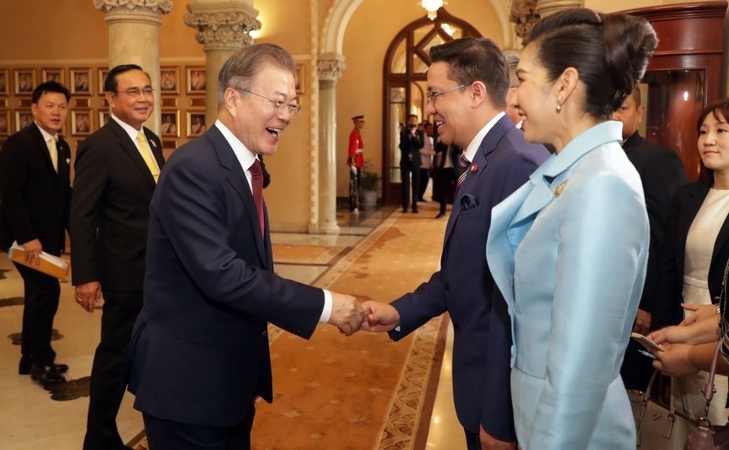
They also signed an accord on exchanging and protecting military intelligence, as President Moon Jae-in and Prime Minister Prayut Chan-o-cha had summit talks at the Government House of Thailand, also known as Thai Ku Fa, in Bangkok.

“In today’s talks, Prime Minister Prayut and I agreed to further deepen the ‘strategic partnership’ (between the two nations) and open a future together of peace, co-existence and co-prosperity in East Asia,” Moon said in a statement.

First, he added, the two sides will strengthen cooperation on new industries, such as bio, robotics and future cars.

The Moon administration is seeking synergy between its innovative growth drive and Bangkok’s “Thailand 4.0” initiative.

He said South Korea and Thailand will work together in science fields, including the development of light source accelerator, research-purpose reactor and science satellites.

“In particular, (I) hope that South Korea, which has become the third nation to develop the fourth-generation light source accelerator, will participate in Thailand’s accelerator project,” Moon said.

Thailand, he stressed, is one of the most important partners for his government’s New Southern Policy intended to strengthen and broaden partnerships with Southeast Asian nations and India.

Moon said Thailand is South Korea’s traditional friend, having dispatched thousands of troops to help fight against North Korea during the 1950-53 conflict. Shortly after the outbreak of the war, Thailand sent a total of 6,326 service members. Among them, 129 were killed in action and five others went missing, with 1,139 wounded, according to official data.

Speaking at the start of his summit with Moon, the prime minister also noted that Thailand’s relations with South Korea have expanded to various sectors, including education, investment and technology.

He said he has enjoyed watching a Korean drama, titled “Descendants of the Sun,” which features a love story between a special forces soldier and a female doctor.

“Among Thai people, South Korean movies, singers and K-pop music are popular, as well as South Korea’s home appliances,” he said. “Last year, 1.8 million South Koreans visited Thailand and 550,000 Thai tourists went to South Korea.”

More than 400 South Korean firms are doing businesses in Thailand, the second-largest economy in Southeast Asia after Indonesia.

In addition to such people-to-people exchanges, Prayut said, the two sides have great potential for economic cooperation.

“President Moon’s trip this time is a very good opportunity,” he added.

On the occasion of the summit, South Korea and Thailand also signed five other memorandums of understanding on Industry 4.0, smart cities, Korean-language education, water development and railways.

Moon arrived in Bangkok on Sunday, becoming South Korea’s first leader to visit the Southeast Asian nation in seven years. He’s also the first foreign leader to travel to Thailand since the launch of the Prayut administration in July. (Yonhap)

Laos health minister highlights achievements to Asean meeting

ศาสตร์เกษตรดินปุ๋ย : ขอบคุณแหล่งข้อมูล : หนังสือพิมพ์ The Nation

https://www.nationthailand.com/ann/30375757

Laos health minister highlights achievements to Asean meeting

Sep 03. 2019
Bounkong Syhavong

Bounkong Syhavong
By VIENTIANE TIMES
ASIA NEWS NETWORK
60 Viewed

Laos has been increasingly successful in protecting people’s right to healthcare with the majority of the population now having greater access to better quality health services, according to its Minister of Health, Assoc Professor Dr Bounkong Syhavong.

He was speaking to the recent 14th Asean Health Ministers meeting and related meetings held in Siem Reap, Cambodia, at which he highlighted the successful efforts of health authorities in working with Asean member countries to deliver medical services to the public.

For several years, Laos has continued to develop the capacity of medical staff at central, provincial and district hospitals and community dispensaries, aiming to meet the 2030 Sustainable Development Goals on healthcare and universal healthcare coverage, the minister said.

“The ministry has been developing its human resources while continuing to strengthen healthcare facilities and improving health services through higher-quality treatment and technical innovation,” he added.

In response to public demand, the ministry has embarked on health sector reform by implementing new government policies.

There is also funding for health services for the poor and improved human resources in the sector, with a particular focus on increasing access to better quality services and reducing the mortality rate of mothers and children.

According to the ministry, Laos signed an agreement with the Cambodian Public Health Ministry and regional bloc health ministers on August 30 to set up the Asean Centre for Active Ageing and Innovation.

This will open in Bangkok during the 35th Asean Summit in November.

During the meeting in Siem Reap, Laos and other Asean member countries agreed on the need for a universal healthcare scheme, disease prevention, the “one health approach”, communicable disease control, special care for seniors through health checks, lowering the mortality rate of mothers and children, and food security.

Regional health ministers also endorsed the Asean Leaders’ Declaration on Asean Vaccine Security and Self-Reliance.

Vietnam’s retail sales up 11.5 per cent

ศาสตร์เกษตรดินปุ๋ย : ขอบคุณแหล่งข้อมูล : หนังสือพิมพ์ The Nation

https://www.nationthailand.com/ann/30375754

Vietnam’s retail sales up 11.5 per cent

Sep 03. 2019
A woman shops for fruits at a supermarket in HCM City. (Photo: VNS)

A woman shops for fruits at a supermarket in HCM City. (Photo: VNS)
By VIET NAM NEWS
ASIA NEWS NETWORK
HANOI

108 Viewed

Vietnam’s total revenues for retail trade and services reached an estimated VND3.21 quadrillion (US$137.4 billion) in the first eight months of 2019, up 11.5 per cent year on year, the General Statistics Office (GSO) announced last week.

This positive growth proves rising demands by local people, GSO statisticians said, adding that if the price factor was excluded, purchasing power in the first seven months increased by 9.03 per cent, higher than the 8.9 per cent recorded in the same period of last year.

Retail sales of goods during the period were estimated at VND$2.44 quadrillion, surging 12.5 per cent year on year or accounting for 76 per cent of the total revenue.

Among all sectors, purchases of educational and cultural products grew by 14 per cent year on year, followed by food and foodstuff (13.6 per cent), home appliances (11 per cent) and textiles and apparel (10.5 per cent) and transportation (8.5 per cent).

The localities with the highest purchasing power growth rates included Quang Ninh (20 per cent); Binh Duong (18 per cent); Thanh Hoa (15 per cent); Hai Phong (14.7 per cent) beside to Nghe An and Binh Dịnh (14 per cent) and Da Nang (13.5 per cent). Meanwhile, two economic hubs of HCM City and Hanoi lagged behind with respective growths of 13.3 per cent and 13 per cent.

According to GSO, revenue from accommodation and catering services rose 10 per cent year-on-year to nearly VND386 trillion ($16.56 billion), making up 12 per cent of the total revenue.

During the same period, travel service revenues totaled VND29.7 trillion, with Binh Dịnh Province witnessing the largest increase at 19 per cent, followed by Thanh Hoa and Khanh Hoa at 15 per cent and 14.5 per cent respectively and HCM City at 13 per cent.

Revenues of other services were estimated at VND355 trillion, 7 per cent higher than the same period last year.

According to the Vietnam Institute for Trade Research, the goods retail market is seeing an increase at mini marts and convenience stores.

The institute forecast that convenience stores would see double-digit growth in the next three years and reach 37.4 per cent growth in 2021.

Under the domestic trade development strategy, total sales of goods and services would grow by 13 per cent each year through 2020 and by 14 per cent per year in the 2021-25 period.

The Foreign Investment Agency’s statistics showed the wholesale and retail sector ranked third in attracting foreign direct investment in January-August period with total registered capital of $1.2 billion, accounting for 5.2 per cent of the country’s total FDI.

Lights, camera, cooperation

ศาสตร์เกษตรดินปุ๋ย : ขอบคุณแหล่งข้อมูล : หนังสือพิมพ์ The Nation

https://www.nationthailand.com/ann/30375750

Lights, camera, cooperation

Sep 03. 2019
Thai students attend the opening of the 14th China-Thailand Film Festival in Bangkok on August 24. 

Thai students attend the opening of the 14th China-Thailand Film Festival in Bangkok on August 24.
By CHINA DAILY
ASIA NEWS NETWORK

116 Viewed

The curtain fell Sunday night on the 14th China-Thailand Film Festival in Bangkok, an event that celebrated China-Thailand cultural ties and the 70th anniversary of the founding of the People’s Republic of China.

The nine-day festival featured both Chinese and Thai films, as well as Chinese TV series including “The Wandering Earth”, “Running to the Spring”, “Inhuman Kiss” and “Bikeman”that were shown at several venues across the city.

The event aimed to highlight China’s flourishing film industry and offer insights into Chinese culture through the medium of film.

Vietnam Airlines launches cash and miles payment method

ศาสตร์เกษตรดินปุ๋ย : ขอบคุณแหล่งข้อมูล : หนังสือพิมพ์ The Nation

https://www.nationthailand.com/ann/30375749

Vietnam Airlines launches cash and miles payment method

Sep 03. 2019
The launch of cash and miles payment allows Vietnam Airlines’ passengers to enjoy its 4-star services at attractive prices. (photo: courtesy of Vietnam Airlines)

The launch of cash and miles payment allows Vietnam Airlines’ passengers to enjoy its 4-star services at attractive prices. (photo: courtesy of Vietnam Airlines)
By VIET NAM NEWS
ASIA NEWS NETWORK
HA NOI

114 Viewed

Passengers can pay for Vietnam Airlines flights with a combination of cash and Lotusmiles when buying tickets from today.

This scheme, the first of its kind in Vietnam, is exclusively for Lotusmiles members purchasing tickets on the website or at its ticket offices, the airline said, adding that it is working to extend this payment method to its mobile app.

Starting from 2,000 Lotusmiles miles per passenger per flight, members can use miles to pay for a part of a flight’s cost or the whole value of a flight operated by the carrier (not including payment of taxes, fees, and additional costs). The value of the miles used for the payment depends on the time of purchase, departure date, itinerary and booking class.

In addition, Lotusmiles members can use cash and miles to buy a ticket for an accompanying passenger if they share a reservation code, select the seat in advance and purchase checked baggage during the payment process.

To mark the 20th anniversary of the Lotusmiles programme, Vietnam Airlines is offering 2,000 bonus miles for new members registered by September and on the 20th day of each month until December 31.

The cash and miles payment method has been implemented by many major airlines in the world including Emirates (UAE), Lufthansa (Germany), Delta Air Lines (US), Thai Airways (Thailand) and EVA Air (Taiwan).

The launch of this payment method allows Vietnam Airlines’ passengers to enjoy its 4-star services at attractive prices, the carrier said in a statement.