ANN: Return of Rohingyas: Japan willing to mediate

ศาสตร์เกษตรดินปุ๋ย : ขอบคุณแหล่งข้อมูล : หนังสือพิมพ์ The Nation

https://www.nationthailand.com/ann/30373967

ANN: Return of Rohingyas: Japan willing to mediate

Jul 31. 2019
Visiting Japanese Foreign Minister Taro Kono receives a paper flower as a gift from a Rohingya girl as he arrives at a Rohingya camp in Cox’s Bazar’s Kutupalong yesterday. Photo: Anisur Rahman

Visiting Japanese Foreign Minister Taro Kono receives a paper flower as a gift from a Rohingya girl as he arrives at a Rohingya camp in Cox’s Bazar’s Kutupalong yesterday. Photo: Anisur Rahman
By The Daily Star, of Bangladesh

182 Viewed

Japan has offered to mediate between Bangladesh and Myanmar for early repatriation of the Rohingyas, said Foreign Minister Dr AK Abdul Momen following a meeting with his Japanese counterpart in Taro Kono.

“Japan thinks that repatriation of Rohingyas should happen quickly. They are even ready to mediate in this regard,” he told reporters.

“If need be, Japan will invite Myanmar and Bangladesh in Tokyo for mediation. They have investments in both Bangladesh and Myanmar. Most importantly, Myanmar wants a peaceful solution to the problem because it if is prolonged, more problems will be formed.”

Japanese Foreign Minister Taro Kono, who arrived in Bangladesh on Monday night, visited the Rohingya refugee camps yesterday morning. On his return to Dhaka, he paid homage to the Bangabandhu Memorial Museum in the city and then held meeting with Dr Momen at the Meghna State Guesthouse yesterday evening.

The third visit of Taro Kono to Bangladesh comes in less than two months after Prime Minister Sheikh Hasina’s visit to Japan in late May.

At the meeting, the two ministers discussed issues of security, economic cooperation, people-to-people contact and counter-terrorism. Updates of various projects that involve Japanese investments were also discussed.

The Rohingya issue came up prominently as Taro Kono visited the camps in Cox’s Bazar. He is scheduled to fly to Nay Pyi Taw today, where he will meet Myanmar’s State Counsellor Aung San Suu Kyi.

Abdul Momen said Taro Kono would tell Myanmar to speed up the repatriation.

“We said if repatriation does not take place quickly, Japan’s investments both in Bangladesh and Myanmar may not be safe,” he said.

The Rohingya crisis must be addressed soon to ensure the interest of Japan, Myanmar and Bangladesh.

“We hope the repatriation process would begin soon.”

Asked about the Rohingyas’ demand for a guarantee of citizenship, Momen said, “We agree with them on safety, security and free mobility. We don’t want to get into the citizenship issue.”

At a press briefing at Hotel Sonargaon in the capital later, Japanese Foreign Ministry’s Deputy Press Secretary Jun Saito said Japan wanted to expedite the repatriation of the displaced Myanmar nationals. For that, Japan is also ready to promote dialogue between Myanmar and Bangladesh.

He said both Bangladesh and Myanmar are good friends of Japan and it wanted to work constructively to address the crisis.

About its investments in Myanmar, Jun Saito said business and human rights were two separate issues.

“We will uphold human rights and not compromise on that matter,” he told reporters.

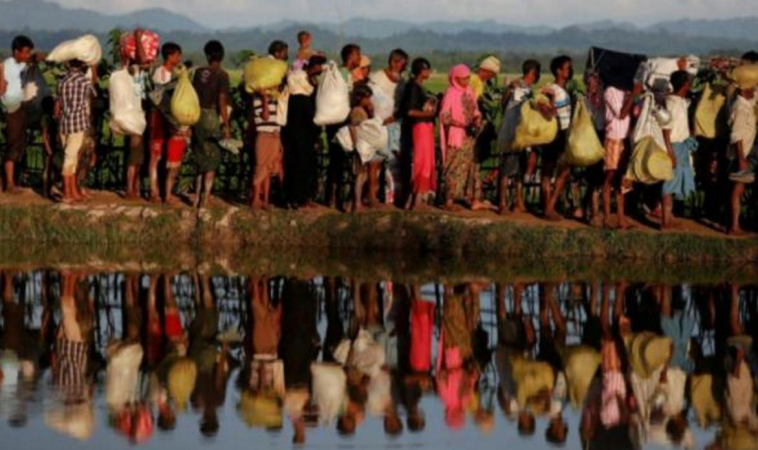
On criticism that Japan had not been vocal in demanding justice for the Rohingyas who had faced atrocities in Rakhine since August 25, forcing 750,000 Rohingyas to flee to Bangladesh, Jun said, “We want the facts to be known first. Investigation is going on. We support that.”

Asked if Japan supports the Rohingyas’ demand of guaranteed citizenship, the Japanese official said it was a delicate issue and had to be dealt “case by case”.
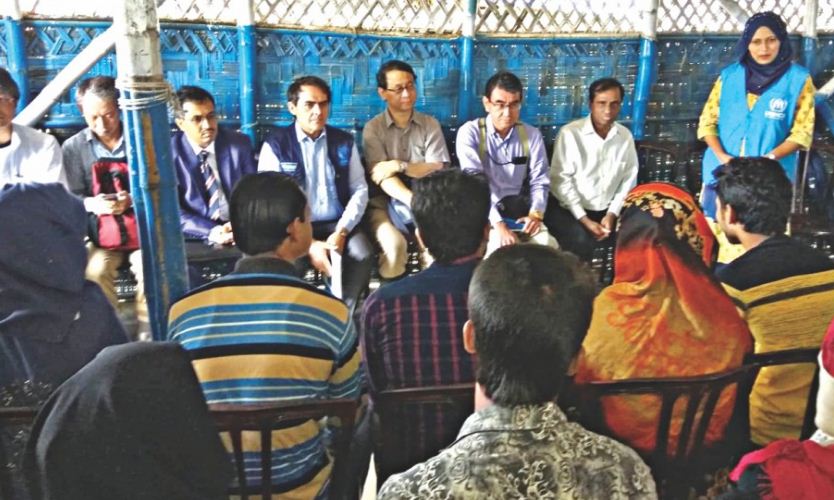
 The Japanese minister talking to some refugees there. Photo: Anisur Rahman

The Japanese minister talking to some refugees there. Photo: Anisur Rahman

ROHINGYAs WANT CITIZENSHIP

The Rohingyas have said they don’t want to stay in Bangladesh for long and wish to return to their homeland in Myanmar with the guarantee of citizenship, reports our correspondent in Cox’s Bazar.

“We want to go back to our own country. But we should be given citizenship. Whenever Myanmar will declare us citizens, we will return there,” Enamul Hasan, a Rohingya teacher, told visiting Japanese Foreign Minister Taro Kono at a refugee camp in Cox’s Bazar’s Kutupalong yesterday.

During the visit to the camps, Taro Kono went to a Rohingya Registration and Food Distribution Centre, run by the UN Refugee Agency, and saw food distribution and registration operations there.

He then talked to a few Rohingyas. A Rohingya girl named Monowara gave him a paper flower as a present.

During the meeting, Hamida Khatun said they did not want to be a burden on Bangladesh and that they wished to return to Myanmar.

They want to return to their place of origin, from where they were uprooted, and live in peace and safety, she said.

Rohingya repatriation was scheduled to begin on November 15 last year, but the refugees were unwilling to go back. They said the situation in the Rakhine State was not conducive to their return and that they had no guarantee of citizenship there.

Yesterday, the Japanese minister also visited some other refugee camps as well as oversaw a water reservoir and supply project running with financial assistance from Japan.

Japanese Ambassador to Bangladesh, Hiroyasu Izumi, and Bangladesh’s Refugee, Relief and Repatriation Commissioner Mohammad Abul Kalam were also present.

https://www.thedailystar.net/frontpage/rohingya-crisis/rohingyas-tell-the-Japanese-foreign-minister-we%E2%80%99ll-return-with-citizenship-1779529

Laos zeroes in on indicators delaying country’s investment climate

ศาสตร์เกษตรดินปุ๋ย : ขอบคุณแหล่งข้อมูล : หนังสือพิมพ์ The Nation

https://www.nationthailand.com/ann/30373944

Laos zeroes in on indicators delaying country’s investment climate

Jul 31. 2019
By Vientiane Times
Asia News Network

83 Viewed

The government will take steps to raise Laos’ ranking on the World Bank’s ease of doing business (EDB) index over the rest of this year, in a bid to improve the country’s investment climate.

Minister of Planning and Investment Dr Souphan Keomixay told Vientiane Times recently the government will expedite efforts to tackle the indicators which have not progressed as anticipated.

These include Indicator 4: registering property, Indicator 7: paying taxes, Indicator 9: enforcing contracts, and Indicator 10: resolving insolvency.

However, these indicators are associated with national macroeconomic policy and the enactment of legislation which the government still finds challenging.

Representatives of government sectors have attended several meetings to discuss indicators 4 and 7, but they still don’t have specific action plans to address the issues.

Concerning indicators 9 and 10, the government set up a committee to supervise these matters in May this year, but it too does not yet have a plan to implement projects relating to these issues.

At present, the government is in the process of enacting a bankruptcy law which should serve as a legal instrument to handle insolvency related issues.

Government officials and representatives of the World Bank Group and business met in Vientiane recently to share ideas and get more input to make the draft law more comprehensive.

Meanwhile, progress had been made on Indicator 1: starting a business; Indicator 2: dealing with construction permits; Indicator 3: getting electricity; Indicator 5: getting credit; Indicator 6: protecting minority investors; and Indicator 8: trading across borders, according to Dr Souphan.

Nevertheless, it is essential to enact or revise legislation to further improve indicators 1, 5, 6 and 7.

In the meantime, economists say the government needs to further fast track the approval process for investment project proposals and ensure that all laws are adequately enforced.

Without progress in this respect, it will be hard for Laos to accomplish the set goals. Transparency and fair treatment of all investors are also critical to improve the country’s business climate.

In 2017, Prime Minister Thongloun Sisoulith announced Laos’ ambition to reach a two digit EDB ranking by 2020.

However, the country slipped 13 places from 141st in 2017 to 154th in 2018, sending a signal that the two-digit target is unlikely to be achieved by 2020.

In June, Mr Thongloun told the National Assembly the government would strive to intensify measures this year and in 2020 to improve the business climate so the ranking would rise and the two digit objective be achieved by 2022.

Despite several accomplishments, the government also needs to pay special attention to facilitating business operations and accelerating business start-up transparently.

Almost 400 families hit by flash flooding in Luang Prabang

ศาสตร์เกษตรดินปุ๋ย : ขอบคุณแหล่งข้อมูล : หนังสือพิมพ์ The Nation

https://www.nationthailand.com/ann/30373941

Almost 400 families hit by flash flooding in Luang Prabang

Jul 31. 2019
By Vientiane Times
Asia News Network

184 Viewed

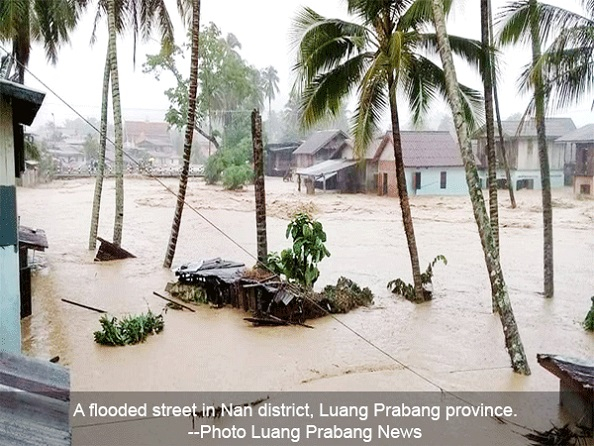
Almost 400 families in eight villages of Nan district, Luang Prabang province, found their homes inundated after torrential rain throughout Monday night caused flash flooding.

Nan district Governor, Mr Sivone Vongkhamchanh, told Vientiane Times that the night long downpour caused flooding in low-lying areas of the district.

“At 7am the Nan River overflowed and flooded Nafai, Paphai, Simoungkhoun, Nalao, Phonhin, Sibounheuan, That and Nakhern villages, with at least 372 families affected according to initial reports,” he said.

“Local authorities are helping to move the villagers to safe areas and have been using boats to take their belongings to higher ground. Fortunately, no one has been injured or killed,” he added.

“The water level started to fall around noon on Tuesday when the rain eased,” Mr Sivone said. Authorities are now assessing the damage caused to houses, farmland and other property.

Meanwhile, people in northeast, central and southern regions of Laos are advised to be on the alert for severe weather while a tropical depression passes over the country from July 30 to August 4, according to a warning issued on Monday by the Meteorology and Hydrology Department, Ministry of Natural Resources and Environment.

A weather warning for strong winds and heavy rain has been issued for the capital and the provinces of Phongsaly, Huaphan, Xieng Khuang, Luang Namtha, Oudomxay, Bokeo, Luang Prabang, Xayaboury, Xaysomboun, Vientiane, Borikhamxay, Khammuan, Savannakhet, Saravan, Champassak, Xekong and Attapeu.

During strong winds, people are advised to keep away from advertising signboards, trees and other unsecured structures at risk of collapse.

People who live in low-lying areas along rivers should be aware of the possibility of heavy rains, flash floods, landslides and other hazards. Everyone is advised to check weather forecasts issued by the department while monitoring national and local news for weather updates.

Singapore remains Indonesia’s top foreign investor in first half

ศาสตร์เกษตรดินปุ๋ย : ขอบคุณแหล่งข้อมูล : หนังสือพิมพ์ The Nation

https://www.nationthailand.com/ann/30373939

Singapore remains Indonesia’s top foreign investor in first half

Jul 31. 2019
Workers inspect a production facility at Pfizer Indonesia’s factory in Pasar Rebo, East Jakarta. Foreign direct investment rose 4 percent year-on-year during the first half to Rp 212.8 trillion, according to the latest data issued by the Investment Coordinating Board on Tuesday. (JP/Wendra Ajistyatama)

Workers inspect a production facility at Pfizer Indonesia’s factory in Pasar Rebo, East Jakarta. Foreign direct investment rose 4 percent year-on-year during the first half to Rp 212.8 trillion, according to the latest data issued by the Investment Coordinating Board on Tuesday. (JP/Wendra Ajistyatama)
By The Jakarta Post
Asia News Network

97 Viewed

Singapore remained the largest foreign investor in Indonesia during the first half, with investments of US$3.4 billion comprising 5,348 projects, according to the latest investment data issued by the Investment Coordinating Board (BKPM) on Tuesday.

During the same period, Japan was the second-largest with investment of $2.4 billion comprising 3,708 projects, followed by China as the third largest with investment of $2.3 billion comprising 1,518 projects.

Japan replaced China as the second-largest foreign investor in the first half thanks to a higher increase in investment during the period.

Meanwhile, Hong Kong was in fourth place with investment of $1.3 billion comprising 1,068 projects, followed by Malaysia in fifth place with investment of $1 billion comprising 1,432 projects.

The realization of investment stood at Rp 395.6 trillion (US$28.2 billion) during the first half, up 9.4 percent in the same period last year. FDI rose 4 percent year-on-year (yoy) to Rp 212.8 trillion during the first half, whereas domestic investment showed higher growth at 16.4 percent yoy to Rp 182.8 trillion. (hen)

TOPICS :

FDI investors Sin

Japan, India to team up in race to discover water on moon

ศาสตร์เกษตรดินปุ๋ย : ขอบคุณแหล่งข้อมูล : หนังสือพิมพ์ The Nation

https://www.nationthailand.com/ann/30373937

Japan, India to team up in race to discover water on moon

Jul 31. 2019
By The Japan News
Asia News Network

119 Viewed

The government has decided to join forces with India in the race to discover water on the moon, with the two countries planning to try to land an unmanned rover on the moon’s south pole as early as fiscal 2023, according to The Yomiuri Shimbun reported.

Frozen water is believed to exist inside craters and other areas of the moon’s poles where sunlight does not reach. The government plans to use the rover to excavate in such areas and discover water on the moon for the first time. The Japan Aerospace Exploration Agency (JAXA) and Indian Space Research Organization (ISRO) have already held meetings on the project, and Japan’s Committee on National Space Policy and other bodies are set to begin discussions before making an official announcement.

The government’s Strategic Headquarters for National Space Policy, led by Prime Minister Shinzo Abe, decided last month to make the Japan-India lunar mission a priority item on the schedule of its Basic Plan on Space Policy when it is revised at the end of this year.

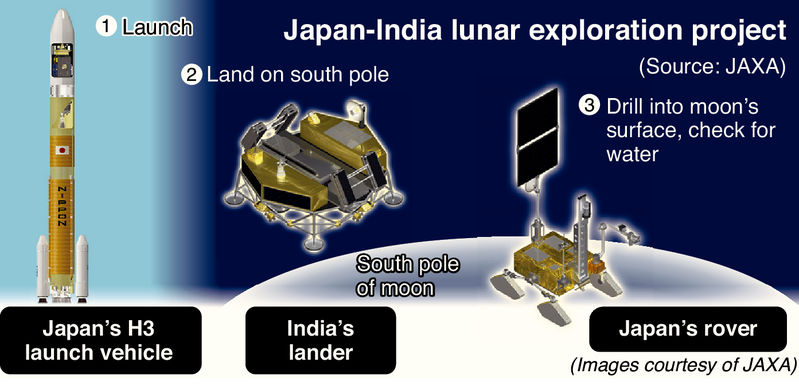
Japan will be in charge of launching the rocket and developing a lunar rover, while India will develop a lander for the mission.

Japan’s H3 launch vehicle, which is under development, will send the rover-loaded lander to the moon sometime around fiscal 2023. The lander is expected to touch down on the moon’s south pole, where water likely exists. The rover will then explore an area 500 meters square to try to detect water using onboard analysis equipment.

On July 22, India launched the unmanned spacecraft Chandrayaan-2 in an effort to land in the vicinity of the moon’s south pole. Japan, meanwhile, plans to launch its own lander, SLIM, in fiscal 2021 to make a pinpoint landing on the moon’s surface. The government decided that integrating the results of these projects would give the two countries the lead in the race to discover lunar water.

The moon has a radius of about 1,700 kilometers, or about one-fourth the radius of the Earth. A series of recent uncrewed probes conducted by India and the United States have revealed that water is highly likely to exist on the moon’s north and south poles in the form of ice. However, a water sample has not yet been collected. Besides providing drinking water, the hydrogen and oxygen extracted from lunar water could be used to fuel rockets, transforming the moon into a base for man’s future development of space.

As a result, many countries are joining the race to explore the moon’s poles. The U.S. National Aeronautics and Space Administration (NASA) is trying to send astronauts to the moon’s south pole by 2024 under its Artemis lunar exploration program, which would mark the first manned moon landings since the historic Apollo missions. China is also aiming to land an uncrewed probe on a lunar pole and bring moon rocks back to Earth in 2020 or later.

“We want to get ahead of the world in confirming the presence of water on the moon,” said Takeshi Hoshino, a principal engineer at JAXA. “Finding water on the moon would lead to broadening the range of activity for humankind and make lunar exploration more active than ever.”Speech

HK police charge 44 over rioting

ศาสตร์เกษตรดินปุ๋ย : ขอบคุณแหล่งข้อมูล : หนังสือพิมพ์ The Nation

https://www.nationthailand.com/ann/30373931

HK police charge 44 over rioting

Jul 31. 2019
Sheltered by umbrellas, well-prepared protesters, in clear labor divisions, are dismantling metal barriers from the roadside in Causeway Bay, one of Hong Kong's business districts, on Sunday. [Photo/China Daily]

Sheltered by umbrellas, well-prepared protesters, in clear labor divisions, are dismantling metal barriers from the roadside in Causeway Bay, one of Hong Kong’s business districts, on Sunday. [Photo/China Daily]
By China Daily
Asia News Network

119 Viewed

Hong Kong Police have charged 44 people for rioting as of Tuesday, following an illegal assembly held in Western District on Hong Kong Island on July 28.

Among them, a 33-year-old man was also charged with assaulting a police officer.

Separately, a 24-year-old man was charged with the possession of offensive weapons. All of them will appear in the Eastern Magistrates’ Court on Wednesday.

In a statement issued Tuesday night, the police stressed that an active investigation is underway and will not rule out the possibility of further arrests.

The police arrested a total of 49 people comprising 32 men and 17 women, aged between 16 and 41. Two men were released on bail pending further investigation, while another two people were temporarily released.

The law enforcement action was taken after an illegal assembly was held in Western District on Hong Kong Island on July 28, during which radical protesters blocked roads along Connaught Road West and Des Voeux Road West near Western Street.

They set up roadblocks using umbrellas, wooden planks, bamboo sticks and railings; pried up pavement bricks; demolished roadside fences; damaged street signs and lampposts as well as attacked police officers at the scene with lethal weapons, such as bricks and sharpened iron rods.

Although the police had repeatedly warned the protesters who charged the police cordon lines to leave immediately and that they were participating in an illegal assembly, the protesters refused to leave and continued to perform various acts that disturbed the peace and also attacked police officers.

After repeated warnings were ignored, the police took action to disperse them at about 7 pm on Sunday to restore social order.

The case has been followed up by the Crime Headquarters of Hong Kong Island.

Fiscal, monetary policy to help keep economy stable

ศาสตร์เกษตรดินปุ๋ย : ขอบคุณแหล่งข้อมูล : หนังสือพิมพ์ The Nation

https://www.nationthailand.com/ann/30373930

Fiscal, monetary policy to help keep economy stable

Jul 31. 2019
Photo by: China Daily

Photo by: China Daily
By China Daily
Asia News Network

87 Viewed

Political Bureau meeting decides to avoid real estate market stimulus

China will not change its real estate policies to provide short-term stimulus to the economy, but instead will make fiscal policy more effective and “keep liquidity reasonably ample” in the second half of this year, participants in a top leadership meeting said on Tuesday.

“The long-term management mechanism of the real estate sector should be implemented and the industry will not be used as means to stimulate the economy in the short term,” Xinhua News Agency reported on the meeting of the Political Bureau of the Communist Party of China Central Committee. Xi Jinping, general secretary of the CPC Central Committee, presided over the meeting.

“Proactive fiscal policy and prudent monetary policy should be well implemented,” the report said. “Fiscal policy should be strengthened and made more effective, and the tax and fee reduction policy should be implemented more thoroughly.”

Participants agreed that “monetary policy should be neither too tight nor too loose, and liquidity should be kept reasonably ample”, the report said.

Analysts said the meeting signaled an important policy direction by showing that the government is shunning stimulation through boosting the property market, which is the right way to deal with economic weakening.

“It is a very correct decision,” said Qu Tianshi, China economist for Bloomberg Economics. “The country should not blindly use the property market to stimulate the economy just because the economy is slowing down. Such practices … exacerbate the risk of asset bubbles.”

“The political bureau meeting said liquidity should be kept ample, meaning the banks’ reserve requirement ratio (cash required as reserves) and the interest rate may be cut in the second half,” said Liang Haiming, dean of Hainan University Belt and Road Research Institute.

Fiscal policy will be tilted toward small and mini-businesses and startups, with more tax and fee cuts tailored to their needs, said Liang, who is also chairman of the China Silk Road iValley Research Institute.

Robin Xing, chief China economist at Morgan Stanley, said there is further room for fiscal easing on infrastructure investment to stabilize growth in the coming two quarters.

“As prevailing uncertainty around trade will still weigh on private sector confidence, we continue to expect policy efforts to boost direct public spending. On the fiscal front, the pace of government bond issuance will likely remain relatively fast at around June’s level in the coming couple of months to support infrastructure spending,” he said.

The Political Bureau meeting said China’s economy is facing “new risks and challenges” and the country will continue to carry out supply-side structural reform, boost domestic consumption, further open up the economy and stabilize foreign trade and employment.

On Monday, Xi said that “while difficulties and challenges in economic operations should be noticed, the economy’s long-term improving trend remains unchanged”.

“(China will) unswervingly deepen supply-side structural reform and foster new growth engines to push high-quality economic development in a down-to-earth manner,” he said.

WORLD’S TIGER DAY: Cambodia to import and release six tigers | Asia News Network

ศาสตร์เกษตรดินปุ๋ย : ขอบคุณแหล่งข้อมูล : หนังสือพิมพ์ The Nation

https://www.nationthailand.com/ann/30373870

WORLD’S TIGER DAY: Cambodia to import and release six tigers | Asia News Network

Jul 30. 2019
By Phnom Penh Post
Asia News Network

330 Viewed

Six tigers will be brought into Cambodia from India and released into the Srepok Wildlife Sanctuary in Mondulkiri province in 2022, while wildlife protection organisations have urged all stakeholders to raise awareness of the importance of tiger conservation.

Provincial Department of Environment director Keo Sopheak told The Post on Monday that India had agreed to export six tigers and release them into the sanctuary to help restore the species to Cambodia.

According to Wildlife Alliance, the last record of a tiger in Cambodia was in November 2007 in Srepok Wildlife Sanctuary.

Sopheak said: “From 2022 to 2023, if we think that the amount of food available for tigers has sufficiently increased, we will implement the plan and release them here.

“According to the plan, we will release six tigers to be brought in from India. The Indian government has agreed to the scheme.”

Srepok Wildlife Sanctuary, which spans more than 300,000ha, was chosen because experts considered the area to be abundant with food suitable for tigers, such as gaur, banteng and deer, he said.

On Sunday and Monday, the World Wide Fund For Nature in Cambodia (WWF-Cambodia) and the provincial Department of Environment marked Global Tiger Day in Sen Monorom town in Mondulkiri province with sprint races, artistic performances, educational games, question and answer sessions and an exhibition.

Global Tiger Day has been celebrated every July 29 since 2010, the last Chinese Year of the Tiger, when it was launched by leaders of the 13 tiger range countries – countries where tigers still roam free – and NGOs working to protect the species from extinction.

Together, these advocates for wild tigers decided that by the next Year of the Tiger in 2022, the focus should be to double their global population, which at the time was estimated to be in the region of 3,200.

WWF-Cambodia said: “This year, Global Tiger Day in Cambodia was run as a nationwide campaign to raise awareness about the benefits of putting tigers back to the Eastern Plains Landscape while also pointing out one of the biggest threats toward wildlife in Mondulkiri – the snaring crisis.

“Mondulkiri is home to Cambodia’s largest populations of Asian elephants and banteng. There are many other rare and endangered species including gibbons, panthers and 334 species of birds. Of these, 14 species have been placed on a ‘red list’ as globally endangered.

“Our objectives on Global Tiger Day and beyond are to raise awareness about how snares can affect wildlife, biodiversity and the livelihoods of the communities and about how bushmeat consumption can affect people and nature.

https://www.phnompenhpost.com/national/kingdom-import-and-release-six-tigers

ANN: Rohingya Repatriation: Dhaka hands over fresh list of 25,000

ศาสตร์เกษตรดินปุ๋ย : ขอบคุณแหล่งข้อมูล : หนังสือพิมพ์ The Nation

https://www.nationthailand.com/ann/30373867

ANN: Rohingya Repatriation: Dhaka hands over fresh list of 25,000

Jul 30. 2019
By THE DAILY STAR/of Bangladesh

635 Viewed

Bangladesh yesterday gave Myanmar a fresh list of Rohingyas for their repatriation, which has not yet begun in nearly two years after the influx.

Bangladesh’s acting foreign secretary Kamrul Ahsan said the list with names of 25,000 Rohingyas of 6,000 families was handed over to a Myanmar delegation during a meeting at the state guesthouse Meghna.

The meeting was held between Bangladesh foreign ministry officials, led by Kamrul, and the Myanmar team, led by the country’s Foreign Affairs Permanent Secretary Myint Thu.

On Saturday and Sunday, the visiting delegation met with Rohingyas in their camps in Cox’s Bazar to convince the refugees to return to Myanmar.

Rohingya repatriation has been a contentious issue as the UN says the conditions in Rakhine are not conducive to their return.

On the other hand, the situation has worsened since clashes between Arakan Army and Myanmar army intensified early this year.

Earlier, Bangladesh had handed over lists of some 30,000 Rohingyas in two phases for verification of their identity, but only 8,000 of them were verified. However, they were not willing to go back to Myanmar when repatriation was scheduled to begin on November 15 last year, a year after signing of an agreement between Bangladesh and Myanmar.

Rohingyas say they want guarantee of citizenship, freedom of movement, recognition of ethnic identity and return to their place of origin from where they were uprooted during a crackdown since August 25, 2017.

Some 750,000 Rohingyas fled the violence to Bangladesh and joined about 300,000 others who had fled earlier waves of violence.

After the meeting yesterday, Kamrul told reporters that building trust among the Rohingyas was a major issue.

“One such visit can’t solve these issues. They [Myanmar] need to come more to create confidence among them [Rohingyas],” he told reporters, reports UNB.

The acting foreign secretary said Rohingyas would not go back to their homes until the trust was rebuilt. “We won’t force anybody to go against their will.”

Myanmar’s Foreign Affairs Permanent Secretary Myint Thu said they were trying to convince the Rohingyas to go back to Myanmar, but Rohingya representatives, during their discussions at Rohingya camps, smiled when they were requested to return.

“I asked them [Rohingyas] that this is the right time for them to consider whether they should go back or not because we explained to them the key issues. So, this is their personal decision,” he told reporters.

On the slow progress of repatriation from the Myanmar side, Myint Thu claimed they have been ready for the repatriation since January 23, 2018.

“We’re ready to welcome them… we’re ready to receive them. But the only thing is they have to decide it themselves. We’ve provided them with information. We’ve heard their voices and concerns.”

Myint Thu said this time they brought representatives from the Asean, which conducted the preliminary need assessment in Northern Rakhine in March this year and they shared their experiences.

“We’ll continue to engage with people through a joint working group mechanism, as well as our collaboration with the government of Bangladesh,” he said highlighting their cooperation with Asean friends.

The Myanmar delegation leader said they would continue to discuss the repatriation as well as how they would cooperate between the two governments, Asean member states and friendly countries to help accelerate the verification and repatriation process.

A representative of Asean, who attended the meeting, said what they did in Northern Rakhine was a preliminary need assessment to review the repatriation plan, assess the readiness of the facilities and find the areas for collaboration.

“This is part of a series of assessments,” he said indicating that they may expand the assessment in Cox’s Bazar.

The official also said the Rohingya community wanted that their voices need to be heard. “And we want to listen to them.”

Commenting on Asean’s involvement, Kamrul said, “We would say this is a good sign. It can be said the repatriation process is moving in the good direction.”

A foreign ministry official told The Daily Stat the fact that Myanmar delegation has directly talked to the Rohingyas and wished to continue the dialogue was somewhat “melting of ice”.

He said the Bangladesh side has requested a meeting in a month with the Myanmar officials dealing the verification of Rohingya identities.

“We raised the issue why identity of only 8,000 Rohingyas were verified when we had earlier handed over list of some 30,000. Myanmar officials agreed to hold the meeting but said they need approval from their higher authorities,” the official said.

Kamrul said UN Secretary General’s Special Envoy on Myanmar Christine Schraner Burgener was serving as a bridge between the UN system and the government of Myanmar on the issues of Rakhine.

“So, she’s helping us resolve the issues,” he said.

Myint Thu said the factsheet that they prepared and circulated in the camps included Christine’s suggestions. “So, we came up with a factsheet providing information on the repatriation process, access to justice, access to education, health and social services and then citizenship issues.”

https://www.thedailystar.net/frontpage/news/rohingya-repatriation-dhaka-hands-over-fresh-list-25000-1778953

Work on Mekong railway bridge running ahead of schedule

ศาสตร์เกษตรดินปุ๋ย : ขอบคุณแหล่งข้อมูล : หนังสือพิมพ์ The Nation

https://www.nationthailand.com/ann/30373859

Work on Mekong railway bridge running ahead of schedule

Jul 30. 2019
Photo by: Vientiane Times

Photo by: Vientiane Times
By Vientiane Times
Asia News Network

168 Viewed

Construction of a bridge across the Mekong River in Luang Prabang which will carry the Laos-China railway is running ahead of schedule, according to Chinese construction companies.

The companies in charge of the bridge and railway construction project on Sunday invited local and foreign media to attend a ceremony to celebrate the connection of the two sides of the bridge.

The connection was completed seven months ahead of schedule, significantly accelerating the overall construction of the 414-km railway, which is slated for completion in 2021, according to information made available at the ceremony.

The 1,458.9-metre long bridge spans the Mekong between central Luang Prabang and the other side of the river in Chomphet district. The bridge has five main piers including 34 spans planted in the river.

The Laos-China Railway Company, which is in charge of the whole railway construction and operation project, said as quoted in Xinhua yesterday that construction of the Luang Prabang Mekong River bridge was one of the most challenging tasks.

This bridge is one of 160 along the total length of the railway and its construction involves some of the most complicated bridge building techniques.

The China Railway No. 8 Engineering Group (CREC-8), which is supervising the construction of two bridges over the Mekong, said the construction of the other bridge was progressing smoothly and would be completed by the end of 2019 as scheduled, Xinhua reported.

Construction of the Laos-China railway, which is the first external rail route to connect to China’s rail network, began in 2015.

Chinese construction firms have promised that the railway will be completed and operational in 2021, in time for the 46th anniversary of the founding of the Lao PDR.

The railway is a part of the China-sponsored Road and Belt Initiative, which aims to connect China with neighbouring countries and beyond.

The railway, which runs from the Lao-Chinese border at Mohan-Boten to Vientiane is a part of the larger Kunming-Singapore rail link. It will have an operating speed of 160 km per hour.

Once the Laos-China railway is operational, transport between the two nations will be much cheaper than at present and improved connectivity will boost the exchange of tourists and goods between the two countries.