US won’t send officials to China’s Belt and Road forum

ศาสตร์เกษตรดินปุ๋ย : ขอบคุณแหล่งข้อมูล : หนังสือพิมพ์ The Nation

http://www.nationmultimedia.com/detail/asean-plus/30368299

Banners are displayed along a street ahead of the Belt and Road Forum in Beijing on April 22.//AFP

US won’t send officials to China’s Belt and Road forum

ASEAN+ April 24, 2019 16:54

By AFP

2,262 Viewed

Beijing – Washington will not send officials to a Beijing summit on Chinese President Xi Jinping’s signature global infrastructure project, the US embassy said Wednesday amid a raft of disputes between the two powers.

    Leaders from 37 countries and officials from dozens more are expected to attend the Belt and Road Forum from Thursday to Saturday, but Washington has dismissed the initiative as a “vanity project”.

“The United States has no plans to send officials from Washington to the Belt and Road Forum,” a US embassy spokesperson told AFP in an email.

“We call upon all countries to ensure that their economic diplomacy initiatives adhere to internationally-accepted norms and standards, promote sustainable, inclusive development, and advance good governance and strong economic institutions,” the spokesperson said.

    Chinese Foreign Minister Wang Yi told journalists at a briefing last week that American diplomats, state government representatives and members of the business community will be attending the forum.

At the first Belt and Road summit in 2017, the US was represented by White House adviser Matt Pottinger.

Since then, more countries have signed up to Belt and Road, most notably Italy, which became the first G7 nation to join the global scheme that aims to link Asia to Europe and Africa through massive investments in maritime, road and rail projects.

MMA fighter beats up man allegedly masturbating during beach photo shoot

ศาสตร์เกษตรดินปุ๋ย : ขอบคุณแหล่งข้อมูล : หนังสือพิมพ์ The Nation

http://www.nationmultimedia.com/detail/asean-plus/30368295

File photo : Joyce Vieira//her Instagram video

MMA fighter beats up man allegedly masturbating during beach photo shoot

ASEAN+ April 24, 2019 16:34

By Philippine Daily Inquirer
Asia News Network

2,931 Viewed

RIO DE JANEIRO – A Brazilian mixed martial artist pummeled a man after he allegedly refused to stop fondling himself while watching her during a beach photo shoot.

Joyce Vieira, 27, was at a Rio de Janeiro beach posing for a swimsuit shoot on April 8 when she noticed a man nearby, reported Folha de São Paulo via Deadspin on Friday, April 19.

When she approached him, she said his pants were down and his penis was erect as he made moaning sounds.

While she had not intended to use her mean martial arts moves in jiu-jitsu, Muay Thai and boxing outside of the ring, the amateur fighter’s skills were put to use when the man challenged her.

Vieira approached him to deliver punches and kicks, and when the man tried to fight back, this fueled her anger even more.

“[His] punch made me even angrier. I wanted to kill him,” she was quoted by Folha de São Paulo. She said the man began screaming and eventually ran away.

Pictures of the incident show Vieira in a one-piece swimsuit striking the man in black shorts.

The suspect has been identified as 27-year-old Josinei Ferreira. He was arrested after Vieira filed a report with local police.

Ferreira has been charged with sexual harassment; however, he was released after claiming that he was urinating and not masturbating. The case is ongoing.

CCTV shows bomber calmly entering Sri Lanka church

ศาสตร์เกษตรดินปุ๋ย : ขอบคุณแหล่งข้อมูล : หนังสือพิมพ์ The Nation

http://www.nationmultimedia.com/detail/asean-plus/30368292

 This still image taken from Sri Lankan closed-circuit TV on April 21, 2019 shows a suspected bomber (C) with backpack on his way to enter St. Sebastian's Church in Negombo, Sri Lanka.//AFP
This still image taken from Sri Lankan closed-circuit TV on April 21, 2019 shows a suspected bomber (C) with backpack on his way to enter St. Sebastian’s Church in Negombo, Sri Lanka.//AFP

 CCTV shows bomber calmly entering Sri Lanka church

ASEAN+ April 24, 2019 16:02

By AFP

4,169 Viewed

Negombo, Sri Lanka – Chilling CCTV footage has emerged showing a suicide bomber calmly patting a child on the head and shoulder moments before he walked into a packed Sri Lankan church, unleashing carnage.

The images capture the final seconds of serenity before the calm was shattered with a series of coordinated attacks that would between them claim more than 350 lives at six sites across Sri Lanka.

Security camera footage from outside St Sebastian’s Church in Negombo shows a bearded man in a light blue shirt, navy trousers and sandals appear on a pathway and cross a courtyard outside the church.

As he approaches his target, he passes a young girl and briefly pats her head and shoulder, with the young girl glancing up at him as he continues on towards the church.

    The girl is the granddaughter of Dilip Fernando. The 66-year-old retiree had come to St Sebastian’s for Mass, but seeing how crowded it was, decided to try and find a service elsewhere.

That decision probably saved their lives. Some of his family, including his granddaughter, stayed but were outside the church and survived.

Inside, the service was drawing to an end and the hundreds who crammed in to celebrate Easter Mass were preparing to leave.

Those who could not find a seat in the packed church had gathered outside to listen, some holding children in their arms.

Captured from another camera, the suspect can be seen leaning forward while walking, the straps of his backpack fastened across his waist and chest, indicating the weight of the deadly load.

Those gathered outside the church scarcely give him a second glance, while inside, the pews are packed with worshippers, young children fidgeting and ceiling fans whirling against the heat.

The suspect walks past two open doors connecting the church to the covered passageway outside, and enters the church through the third.

He takes a few steps towards the central aisle and the altar.

Then the footage stops.

The bomb he detonated ripped through the church, killing dozens in what is believed to be the deadliest attack in Sunday’s carnage.

Fernando’s extended family, who were sitting outside the church, said they had seen the bomber.

“At the end of the mass they saw one young man go into the church with a heavy bag,” Fernando said.

“He touched my granddaughter’s head on the way past. It was the bomber.”

Japan’s sterilised ‘eugenics’ victims to get payout

ศาสตร์เกษตรดินปุ๋ย : ขอบคุณแหล่งข้อมูล : หนังสือพิมพ์ The Nation

http://www.nationmultimedia.com/detail/asean-plus/30368279

File photo : Japan's Prime Minister Shinzo Abe
File photo : Japan’s Prime Minister Shinzo Abe

Japan’s sterilised ‘eugenics’ victims to get payout

ASEAN+ April 24, 2019 13:34

By AFP

Tokyo – Thousands of Japanese people — some as young as nine — forcibly sterilised under now-defunct eugenics laws, will receive government compensation after lawmakers passed historic legislation on Wednesday.

    Following the unanimous vote, Prime Minister Shinzo Abe voiced “sincere regret” and said the government “apologised wholeheartedly” over the notorious policy.

Some 16,500 mentally disabled people were sterilised without their consent under the law that remained in force until 1996, according to health ministry data.

Each victim will receive 3.2 million yen ($29,000) under the measures passed on Wednesday — an amount derided by campaigners as “failing to meet the seriousness” of the damage suffered.

    The issue hit the headlines last year after a Japanese woman, now in her 60s, sued the government over a sterilisation operation carried out in 1972 after she was diagnosed with a mental disability.

Lawyers and campaigners have long criticised the government and parliament for failing to compensate victims long after the eugenics law was abandoned in 1996.

About 20 victims have so far filed lawsuits across the country seeking compensation of up to 38 million yen.

The first verdict over the issue will be announced on May 28, and plaintiffs’ lawyers have vowed to seek compensation they say matches the gravity of the harm suffered.

“It is understandable that lawmakers have been hurrying to enact the law to pay one-off compensation to ageing victims,” lawyers said in a statement before the legislation was passed.

But without sufficient compensation, it is not a “true solution to the issue,” they charged.

Tokyo has pledged to pay the compensation “swiftly” but the government will likely continue to battle in court against victims claiming more.

Germany and Sweden had similar eugenics laws and governments there have also apologised and paid compensation to the victims.

Under Japan’s law, some leprosy patients were also forced into abortions under policies that forbade them from having children.

In 2005, a Japanese court for the first time ordered the state to pay damages to a former leprosy sufferer affected by this law.

Earthquake rattles northeast India, Tibet

ศาสตร์เกษตรดินปุ๋ย : ขอบคุณแหล่งข้อมูล : หนังสือพิมพ์ The Nation

http://www.nationmultimedia.com/detail/asean-plus/30368277

Photo : UNGS
Photo : UNGS

Earthquake rattles northeast India, Tibet

ASEAN+ April 24, 2019 13:12

By AFP

New Delhi – A 5.9-magnitude earthquake struck India’s northeastern state of Arunachal Pradesh early Wednesday and was felt in neighbouring Tibet.

    The epicenter of the shallow quake was about 40 kilometres (25 miles) southeast of Along, and 180 kilometres southwest of the state capital Itanagar, according to the US Geological Survey.

It struck at 1:45 am (2015 GMT Tuesday). The USGS revised the magnitude down from 6.1.

Arunachal Pradesh is India’s least densely populated state, but is still home to more than 1.2 million people, according to the state government’s website.

    There were no reports of casualties or damage in neighbouring Tibet, with Chinese national seismology authorities saying there were no villages within 20 kilometres of the earthquake or towns within a 50-kilometre radius.

New Delhi and Beijing for decades have disputed control of Arunachal Pradesh — a dispute that remains unresolved.

India considers Arunachal Pradesh one of its northeastern states, while China claims about 90,000 square kilometres (34,750 square miles) of the territory.

Arunachal Pradesh also borders Myanmar and Bhutan.

USGS estimated there was a “low likelihood” of casualties and damage from the quake.

New pacts expected to boost Asean GDP growth

ศาสตร์เกษตรดินปุ๋ย : ขอบคุณแหล่งข้อมูล : หนังสือพิมพ์ The Nation

http://www.nationmultimedia.com/detail/asean-plus/30368234

  • Asean SecretaryGeneral Lim Jock Hoi, left, and acting Commerce Minister Chutima Bunyapraphasara, right, at the signing ceremony of the Asean Trade in Services Agreement and the Fourth Protocol to Amend the Asean Comprehensive Investment Agreement.
    Asean SecretaryGeneral Lim Jock Hoi, left, and acting Commerce Minister Chutima Bunyapraphasara, right, at the signing ceremony of the Asean Trade in Services Agreement and the Fourth Protocol to Amend the Asean Comprehensive Investment Agreement.

New pacts expected to boost Asean GDP growth

ASEAN+ April 24, 2019 01:00

By Phuwit Limviphuwat
The Nation
Phuket

3,442 Viewed

THE SIGNING of two agreements to liberalise investment and services trade within Asean was the highlight of the 25th Asean Economic Ministers’ Retreat (AEMR), which concluded yesterday.

With the signing of these two agreements, Asean’s GDP is expected to increase by five per cent in the next five years, said Asean secretary-general Lim Jock Hoi.

The first agreement, the Asean Trade in Services Agreement [ATISA], aims to raise the standards and efficiency of services regulations within the region. This will, in turn, expand opportunities for services trade and investments for the region’s private sector.

“The role of services trade in the Asean economy is becoming more and more important,” acting Commerce Minister Chutima Bunyapraphasara said yesterday during the ATISA signing ceremony.

“Asean export of services has more than tripled from US$113.4 billion (Bt3.62 trillion) in 2005 to $360.5 billion (Bt11.51 trillion) in 2017. However, intra-Asean share of trade in services has remained stable over the years,” she stated. Hence, the ATISA is designed to address this issue.

The ATISA will replace the current Asean Framework Agreement on Services (AFAS), which has been in use since 1995.

The new agreement lays out the principles that will help boost trade in services, such as requiring equal treatment of foreign and local businesses. Another principle of the ATISA is to promote transparency and efficiency in services trade regulations and support the growth of Small and Medium Enterprises (SMEs).

Furthermore, the ATISA also requires member countries to publicise their trade and services regulations.

The ATISA will come into effect 180 days after the signing ceremony. Asean members are given five years to consider which regulations on services trade they would like to preserve after the agreement is effective.

“This agreement will allow Thai investors to find further opportunities to invest in sectors such as healthcare, tourism and hospitality within Asean,” Chutima said.

The second agreement, the Fourth Protocol to Amend the Asean Comprehensive Investment Agreement [ACIA], is aimed at making the region more attractive for investors through streamlining of regulations. It will be binding on the ACIA member countries to not establish regulations that may unnecessarily cause obstacles for investors in the region. For example, governments will be prohibited from requiring investors from Asean member countries to deliver their products only to certain markets.

New Thai strategy

The ATISA is in line with Thailand’s strategy to boost services trade to make up for weakening export figures. Deputy Prime Minister Somkid Jatusripitak had instructed the Commerce Ministry earlier this month to strengthen Thailand’s services sector for strong tourism figures.

Largely due to the ongoing US-China trade war and the weakening global economic condition, Thai exports in March contracted 4.9 per cent year on year, leading to a 1.6 per cent contraction in exports in the first quarter of this year compared to the same period last year, according to the Commerce Ministry. Observers see long-term benefits from these two new agreements, stressing the growing importance of services trade and investments in the region.

“Since the global financial crisis, global growth in goods trade, which is fuelled by the manufacturing industry, has been slowing, and the Asia Pacific region is by no means immune to this trend,” Andy Mason, lead economist for East Asia and Pacific Region of the World Bank, said.

To address this problem, Thailand will need to increase the productivity of its services sector as well as promote more trade in services, Mason suggested. “Thailand should enter into multilateral trade deals and commit itself to liberalising trade in services,” said Sudhir Shetty, chief economist for the East Asia and Pacific Region at the World Bank. Deunden Nikomborirak, research director in economic governance at the Thailand Development Research Institute (TDRI), said: “In the Asean region, up to 90 per cent of total foreign investment goes to the services sector. However, Thailand’s policies still lean heavily towards manufacturing, neglecting the services sector. Thailand contributes up to 18 per cent of total Asean GDP, but only attracts 2.9 per cent of total foreign investment in the Asean region.

“Therefore, Thailand is heavily underperforming and will benefit from liberalising regulations in the services sector,” she said. Key financial institutions such as the Bank of Thailand (BOT) and the National and Social Economic Development Council both stated earlier this year that Thailand should push for further private investment to drive growth amid weakening exports. “From now on, the growth engine of the country will be powered by tourism and investments,” said BOT Governor Veerathai Santiprabhob.

More than 50 feared killed in landslide at Myanmar jade mine

ศาสตร์เกษตรดินปุ๋ย : ขอบคุณแหล่งข้อมูล : หนังสือพิมพ์ The Nation

http://www.nationmultimedia.com/detail/asean-plus/30368239

x

More than 50 feared killed in landslide at Myanmar jade mine

ASEAN+ April 23, 2019 20:17

By Agence France-Presse
Yangon

More than 50 people were feared dead after a landslide in northern Myanmar engulfed jade miners while they were sleeping, local police said Tuesday, the latest deadly accident in a notoriously dangerous industry.

Dozens die each year in landslides caused by jade mining, a poorly regulated industry rife with corruption and sandwiched between the country’s borders with China and India.

Local police described a freak accident in Kachin state on Monday night so big it created a huge “mud lake” that buried the miners as well as some 40 vehicles.

“Fifty-four people are missing in the mud,” a duty officer from Hpakant township police station told AFP, asking not to be named.

“There’s no way they (the missing) could have survived.”

Only two bodies had been recovered so far.

The Ministry of Information confirmed the accident and number of missing, adding that the area was mined by Myanmar Thura Gems and Shwe Nagar Koe Kaung companies.

Myanmar Thura Gems director Hla Soe Oo told AFP by phone he was on his way to the site and had no further details.

Local media shared images, unverified by AFP, that showed the walls of a mine stretching vertically a couple of hundred metres above a vast pool of mud, revealing only the tops of two yellow excavation vehicles.

Hundreds of onlookers gathered nearby, staring at the site and taking photos with their phones.

– Prized in China –

The open jade mines in Kachin’s Hpakant township have turned the remote area into a vast moonscape-like terrain.

Fatal landslides in the area are common with victims often from impoverished ethnic communities looking for scraps left behind by big firms.

A major collapse in November 2015 left more than 100 dead.

In July last year, the bodies of 23 landslide victims were recovered after a days-long search hampered by heavy monsoon rains.

The jade industry is largely driven by insatiable demand from neighbouring China, where the translucent green gemstone has long been prized.

Watchdog Global Witness estimated that the industry was worth some $31 billion in 2014, although very little reaches state coffers.

Northern Myanmar’s abundant natural resources — including jade, timber, gold and amber — help finance both sides of a decades-long civil war between ethnic Kachin insurgents and the military.

The fight to control the mines and the revenues they bring frequently traps local civilians in the middle.

A 17-year ceasefire broke down in 2011, and since then more than 100,000 people have been displaced by fighting — some of them multiple times.

On coming to power in 2016, civilian leader Aung San Suu Kyi promised to make the peace process with the country’s myriad armed groups her top priority — a pledge that has yet to yield significant results.

New quake strikes as Philippines hunts for survivors

ศาสตร์เกษตรดินปุ๋ย : ขอบคุณแหล่งข้อมูล : หนังสือพิมพ์ The Nation

http://www.nationmultimedia.com/detail/asean-plus/30368193

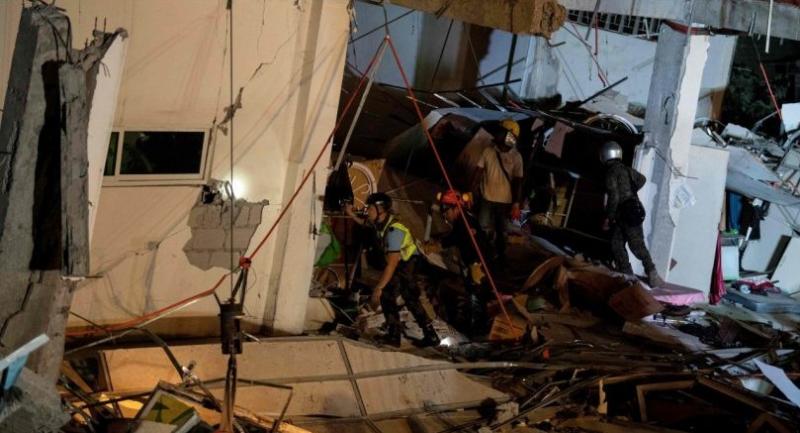
  • Rescue workers search for survivors in a collapsed Chuzon Super Market in Porac, Pampanga, after a powerful earthquake hit northern Philippines on April 22, 2019. AFP
    Rescue workers search for survivors in a collapsed Chuzon Super Market in Porac, Pampanga, after a powerful earthquake hit northern Philippines on April 22, 2019. AFP

New quake strikes as Philippines hunts for survivors

ASEAN+ April 23, 2019 14:12

By By Aagence France Presse

Philippine rescuers were scrambling Tuesday to reach some two dozen people feared buried under a building near Manila that collapsed a day earlier in a strong earthquake, as a powerful new tremor hit the nation.

    The US Geological Survey put the fresh quake on the central island of Samar at 6.3 magnitude, which is stronger than the one that hit close to the capital in the north on Monday.

Authorities were assessing possible damage from the latest quake, which struck at a depth of 70km, but warned that residents should expect aftershocks.

The worst of Monday’s damage was in the province of Pampanga, which was the site of most of the 11 fatalities, disaster officials said. More than 100 others were injured by falling rubble, including in Manila, according to police.

    The toll could rise as crews fanned out across the mostly rural region to assess damage in isolated hamlets that lost power and communications in one of the area’s strongest tremors in years.

More than 400 aftershocks have been registered since the initial quake, Philippine seismologists said.

Scores of rescuers in the town of Porac were using cranes and jackhammers to peel back the pancaked concrete structure of a four-storey market building where the Red Cross said 24 people were unaccounted for.

“Every minute, every second is critical in this rescue,” Cris Palcis, a volunteer sniffer dog handler, told AFP. “Time is short for the people under the rubble so we have to be quick.”

Pampanga Governor Lilia Pineda told journalists that rescuers could still hear at least one person trapped beneath the rubble, but the digging was proceeding delicately to avoid accidentally crushing the survivor.

The quake also damaged several centuries-old churches which were crowded with worshippers in recent days as the majority-Catholic Philippines marked the Easter holiday.

– ‘Really swaying’ –

Father Roland Moraleja, who is based in Porac, said the 18th century belfry of Saint Catherine of Alexandria church collapsed in the quake.

“It was the only part left from the old church,” he told AFP. “The historical value is now gone, but we are hopeful that it will rise again.”

High-rise buildings in the capital swayed after the tremor struck Monday evening, leaving some with large cracks in their walls.

Thousands of travellers were stranded after aviation authorities shut down the secondary Clark Airport, which is located on the site of the former US military installation that lies about an hour’s drive north of the capital.

It was still closed on Tuesday as officials assessed the heavy damage to the terminal building and some cracking on the air traffic control tower.

The quake was centred on the town of Castillejos, about 100 kilometres (62 miles) northwest of Manila, local geologists said.

Seismologists put the Monday’s tremor at 6.3 initially, but subsequently downgraded it to a 6.1 magnitude.

Dani Justo, a martial arts instructor, told AFP she was at her southern Manila home when the quake struck.

“The clothes hanging on our line were really swaying. My shih tzu (dog) dropped flat on the ground,” she added.

The Philippines is part of the Pacific “Ring of Fire”, an arc of intense seismic activity that stretches from quake-prone Japan through Southeast Asia and across the Pacific basin.

Green electricity spurs clean development in eastern China

ศาสตร์เกษตรดินปุ๋ย : ขอบคุณแหล่งข้อมูล : หนังสือพิมพ์ The Nation

http://www.nationmultimedia.com/detail/asean-plus/30368141

x

Green electricity spurs clean development in eastern China

ASEAN+ April 23, 2019 01:00

By CHINA DAILY
ASIA NEWS NETWORK
SHANGHAI

IF YOU WERE walking or driving along the coast of East China’s provinces such as Jiangsu, Fujian and Guangdong, you’ll likely notice rows of white turbines offshore.

These are wind farms, a scene straight out of Europe, the leader in offshore wind energy. Only, they bear testimony to the rapid technological development of offshore wind-based energy in China.

As waves lap at the seemingly floating towers, electricity is generated by harnessing powerful winds that rotate the giant blades of these fans installed on the sea.

With 11 coastal provinces, China has abundant offshore resources: a coastline of 18,000 kilometres, and more than 3 million square km of sea |area.

Factors like falling production costs brought about by the technological improvements in the past 10 years, are encouraging the construction of offshore wind farms.

In the not too distant future, the cost of building offshore wind farms will likely match that of their onshore counterparts.

There are other factors to consider here. Consumption of electricity has always limited the development of clean energy in the country.

For example, the development of onshore wind farms, which are usually constructed far from the power consumption cluster in the east, has been slow in the past few years as the segment matured.

The installed capacity of onshore wind farms in 2017 reached a five-year low of 1,160 MW, according to the Chinese Wind Energy Association.

Given offshore wind farms’ proximity to coastal city load centres in China, their steady development could mean they could potentially contribute more than half of the clean energy consumed in China in the future.

The offshore segment offers an opportunity to the coastal regions to further reduce their over-reliance on imported coal-fired electricity that not only causes emissions but is expensive and inflexible.

In addition, the offshore wind farms, unlike their onshore counterparts, do not require land resources, while their utilisation hours are 20 per cent to 70 per cent higher.

Small wonder, China is witnessing cutting-edge R&D of offshore wind turbines.

Domestic firms such as Goldwind and Dongfang Electric already have capabilities to produce high-capacity machine units that adapt to the country’s complex coastal marine environment and don’t rely on imports anymore.

They have laid a solid foundation for the commercial development of the country’s offshore wind power sector.

Economy of scale now marks the renewable energy sector. Many provinces have laid out a blueprint for the offshore wind power development for the next few years.

For instance, Jiangsu province has approved 24 offshore wind power projects with a total capacity of 6.7 GW. China aims to build seven large-scale wind power generation bases in Gansu, Xinjiang, Hebei, Jilin, Inner Mongolia and Jiangsu in 2020, to boost clean energy consumption.

Experts think the government may plan for the needed grid-connection arrangements to keep pace with the acceleration in the offshore wind sector’s development.

What may spur good news next is that turbine costs are continuously falling. The country is gradually catching up in the fields of oceanographic engineering, long distance power transmission and facility maintenance.

It is highly likely that the turbines might continue spinning offshore without feeding off any government subsidies. Such a scenario would |help countries to move to a more reliable, cheaper and cleaner energy economy.

Shanghai streamlines visa, work approval procedures to draw talent

ศาสตร์เกษตรดินปุ๋ย : ขอบคุณแหล่งข้อมูล : หนังสือพิมพ์ The Nation

http://www.nationmultimedia.com/detail/asean-plus/30368143

x

Shanghai streamlines visa, work approval procedures to draw talent

ASEAN+ April 23, 2019 01:00

By CHINA DAILY
ASIA NEWS NETWORK
SHANGHAI

SHANGHAI has opened a talent hub in its free trade zone aiming to streamline procedures for attracting and retaining foreign professionals.

At the Shanghai Pudong International Talent Hub, located in the heart of Zhangjiang Hi-Tech Park in the Pudong New Area, visa applicants can obtain work and residence permits by making a single visit. Also unveiled is a one-stop online service platform, where applicants manage to book physical examinations and apply for both permits by filling in one online form.

Previously, foreign professionals had to make at least three trips to government departments – for foreign experts affairs, human resources and public security – to obtain a work visa.

A professional team will also assist family members with the relevant procedures. Under the initiative, applications can receive approval in five days, said Xiao Lin, a director in charge of administrative approval systems in the Pudong New Area.

“This is achieved by cutting the number of approval phases by 70 per cent, shortening the examination time by 60 per cent, and halving the types of materials,” Xiao said.

Ulrich Jablonka, a manager at the Shangri-La Group, was among the first group of foreign professionals to benefit from the streamlined policies. He said he was most impressed by the “efficiency and enthusiasm” of the government officials.

Wang Fanglei, a human resources director at Shanghai Suoguang Visual Products Co, also touted the convenience of the new system when she helped a Japanese foreign expert apply for credentials.

“Information such as birth date and nationality are automatically recorded when the scanned version of a passport is uploaded. The system can also adjust the photos to fit corresponding requirements in size and precision, saving time and improving accuracy,” she said.

To better serve foreign talent, a number of domestic and international human resources industry leaders have also set up offices in the talent hub, including Manpower, Shanghai Foreign Service Group, CDP Group and Liepin.com.

Shanghai has spared no efforts in simplifying procedures to make itself a magnet for top-notch global talent. For instance, top-talent confirmation letters issued by local administrators can make it easier for foreigners to get an R visa, which is issued to high-level personnel and top professionals.

Since last year, holders of this visa are permitted to stay in China for 180 days at a time and make multiple entries for up to 10 years. The previous limit was five years.

Efforts are also made to serve foreign professionals across East China’s Yangtze River Delta Region. A regulation stipulates that foreigners employed by entities in the region but who are based in Shanghai’s Hongqiao Central Business District are eligible to apply for and renew work visas in the zone.