
Latest : Jolo twin blasts death toll reaches 20, with 81 others injured

ศาสตร์เกษตรดินปุ๋ย : ขอบคุณแหล่งข้อมูล : หนังสือพิมพ์ The Nation

http://www.nationmultimedia.com/detail/asean-plus/30363016

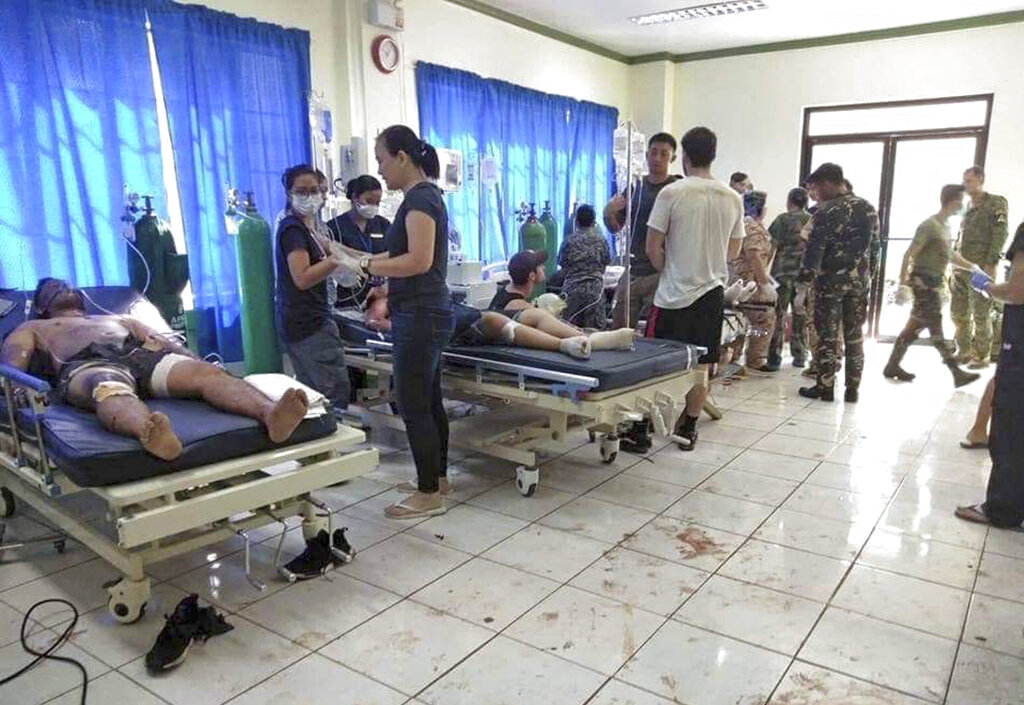
  • bomb victims receive treatment in a hospital after two bombs exploded outside a Roman Catholic cathedral in Jolo, the capital of Sulu province in southern Philippines where militants are active Sunday, on January 27.
  • In this photo provided by WESMINCOM Armed Forces of the Philippines, a soldier views the site inside a Roman Catholic cathedral in Jolo, the capital of Sulu province in the southern Philippines after two bombs exploded Sunday, Jan. 27.

Latest : Jolo twin blasts death toll reaches 20, with 81 others injured

ASEAN+ January 27, 2019 13:31

By Philippine Daily Inquirer
Asia News Network

2,989 Viewed

OLO, Sulu — The death toll in two explosions that hit a Roman Catholic cathedral in Jolo, Sulu on Sunday reached at least 20, with 81 others reported injured, police said. Read more: https://newsinfo.inquirer.net/1078076/jolo-sulu-blast-bombing-death-toll-injured-news#ixzz5dnolfHzn Follow us: @inquirerdotnet on Twitter | inquirerdotnet on Facebook

As of 1:10 p.m., Police Regional Office 9, recorded 5 soldiers and 15 civilians killed and 14 soldiers, 2 police officers and 65 civilians injured in the twin blasts, which happened about a minute apart while Mass was being celebrated at the Cathedral of Our Lady of Mount Carmel.

Seven of the casualties were transported via helicopter to nearby Zamboanga City.


Police corrected an earlier death count, which was higher due to double counting, according to a report by the Associated Press.

Two blasts just a minute apart

Witnesses said the first blast was inside the cathedral, sending sent churchgoers, some of them wounded, to stampede out of the main door.

Army soldiers and police officers posted outside were rushing in when the second bomb went off about one minute later near the main entrance, causing more deaths and injuries.

The military was checking a report that the second explosive device might have been attached to a parked motorcycle.

The first explosion scattered the wooden pews inside the main hall and blasted window glass panels, and the second bomb hurled human remains and debris across a town square fronting the cathedral, witnesses said.
 

Troops on heightened alert

Cellphone signals were cut off in the first hours after the attack.

The witnesses who spoke to The Associated Press refused to give their names or were busy at the scene of the blasts.

Troops in armored carriers sealed off the main road leading to the church, while vehicles transported the dead and wounded to the town hospital.

“I have directed our troops to heighten their alert level, secure all places of worships and public places at once, and initiate pro-active security measures to thwart hostile plans,” said Defense Secretary Delfin Lorenzana in a statement.

“We will pursue to the ends of the earth the ruthless perpetrators behind this dastardly crime until every killer is brought to justice and put behind bars. The law will give them no mercy,” Malacañan Palace said in Manila. “The enemies of the state boldly challenged the government’s capability to secure the safety of citizens in that region. The [Armed Forces of the Philippines] will rise to the challenge and crush these godless criminals.”

Nearly a week after BOL plebiscite

Jolo island has long been troubled by the presence of Abu Sayyaf militants, who are blacklisted by the United States and the Philippines as a terrorist organization because of years of bombings, kidnappings, and beheadings.

A Catholic bishop, Benjamin de Jesus, was gunned down by suspected militants outside the cathedral in 1997.

No one has immediately claimed responsibility for the latest attack.

It came nearly a week after minority Muslims in the predominantly Roman Catholic nation endorsed in the first of two plebiscites the proposed Bangsamoro Organic Law (BOL), which would create a new autonomous region to replace the Autonomous Region in Muslim Mindanao.

Western countries welcome pact

Those who approved of the proposed the law hope it will end nearly five decades of a separatist rebellion that has left 150,000 people dead.

Although most of the Muslim areas approved the autonomy deal, voters in Sulu province, where Jolo is located, rejected it.

Sulu province is home to the Moro National Liberation Front (MNLF), a rival rebel faction of the Moro Islamic Liberation Front (MILF).

The MNLF is opposed to BOL, as are smaller militant cells that are not part of any peace process.

Western governments have welcomed the autonomy pact.

They worry that small numbers of Islamic State-linked militants from the Middle East and Southeast Asia could forge an alliance with Filipino insurgents and turn Mindanao into a breeding ground for extremists.

“This bomb attack was done in a place of peace and worship, and it comes at a time when we are preparing for another stage of the peace process in Mindanao,” said ARMM Gov. Mujiv Hataman.

“Human lives are irreplaceable,” he added, calling on Jolo residents to cooperate with authorities to find the perpetrators of this “atrocity.”

Various threat groups still suspect

Security officials were looking “at different threat groups and they still can’t say if this has something to do with the just-concluded plebiscite,” Director General Oscar Albayalde, chief of the Philippine National Polic, told ABS-CBN TV network.

Secretary Hermogenes Esperon Jr., the national security adviser, said that the new autonomous region, to be called the Bangsamoro Autonomous Region in Muslim Mindanao (BARMM), “signifies the end of the war for secession.”

“It stands for peace in Mindanao,” Esperon, a former AFP chief, said.

Aside from the small but brutal Abu Sayyaf Group, other militant groups in Sulu include a small band of young jihadis aligned with the Islamic State group, which has also carried out assaults, including ransom kidnappings and beheadings.

Abu Sayyaf militants are still holding at least five hostages — a Dutch national, two Malaysians, an Indonesian and a Filipino — in their jungle bases mostly near Sulu’s Patikul town, not far from Jolo.

Government troops have pressed on sporadic offensives to crush the militants, including those in Jolo, a poverty-wracked island of more than 700,000 people. A few thousand Catholics live mostly in the capital of Jolo.

Diversionary move?

There have been speculations that the bombings may be a diversionary move by Muslim militants after troops recently carried out an offensive that killed many IS-linked extremists in an encampment in the hinterlands of Lanao del Sur province, also in the south.

The area is near Marawi, a Muslim city that was besieged for five months by hundreds of IS-aligned militants, including foreign fighters, in 2017. Troops quelled the insurrection, which left more 1,100 mostly militants dead and the heartland of the mosque-studded city in ruins.

On May 23, 2017, President Rodrigo Duterte declared martial law in the whole of Mindanao to deal with the Marawi siege, his worst security crisis, which lasted until the military retook the city five months later, on Oct. 23.

His martial law declaration has been extended to allow troops to finish off radical Muslim groups and other insurgents but bombings and other attacks have continued.

Urgent : M’sia may be removed as para swimming host, says IPC

ศาสตร์เกษตรดินปุ๋ย : ขอบคุณแหล่งข้อมูล : หนังสือพิมพ์ The Nation

http://www.nationmultimedia.com/detail/asean-plus/30363012

Urgent : M’sia may be removed as para swimming host, says IPC

sports January 27, 2019 09:53

By The Star
Asia News Network

LONDON: Malaysia’s hosting of the para swimming championships in Kuching, Sarawak is on the line following a decision to bar Israeli athletes from entering the country.

“Malaysia will not host any event that has representation from or participation of Israel,” said Foreign Minister Datuk Saifuddin Abdullah.

Israel has called on the Inter­na­tional Paralympic Commit­tee (IPC) to change the venue if it could not persuade Malaysia to lift the edict before the July 29 to Aug 4 event.

The IPC said a decision would be issued today on Malaysia’s hosting of this year’s world para swimming championships.

The IPC governing board is meeting here to also discuss the suspension of Russia’s Paralympic committee and a spokesman said an update on Russia’s status would be made on Feb 8.

Russia has been barred from Para­ly­mpic competition since August 2016 over allegations of state-sponsored doping that also led to the suspension of the country’s athletics federation and its anti-­doping agency.

Ahok confirms he will wed 21-year-old girlfriend

ศาสตร์เกษตรดินปุ๋ย : ขอบคุณแหล่งข้อมูล : หนังสือพิมพ์ The Nation

http://www.nationmultimedia.com/detail/asean-plus/30363011

Photo : suar.grid.id

Ahok confirms he will wed 21-year-old girlfriend

Breaking News January 27, 2019 09:09

By The Jakarta Post
Asia News Network

JAKARTA – A wedding is on the cards for former Jakarta governor Basuki Tjahaja Purnama.

Former Jakarta governor Basuki “Ahok” Tjahaja Purnama, who prefers to be known as “BTP” following his release from prison, met with the leader of Hanura party, Oesman Sapta Odang (OSO), on Friday evening.The meeting was recorded on camera and uploaded on OSO TV, a YouTube channel owned by OSO, and it quickly went viral as it answered a burning question; will there be a wedding soon?

After complimenting BTP on “looking younger”, OSO asked the former governor, “Is the rumor true that you’re getting married?” to which BTP replied, “Yes. Because my mother said ‘Hok, I cannot take care or live with you, I’m in my 70s. How long [do I have to take care of you]?”

“My mother also said ‘your wife should be my replacement to cook, make cakes and take care of you’. The last one didn’t want to,” he added. BTP said his mother had advised him to get married right away, before reaching the age of 55.

He confirmed his plans to marry Second Brig. Puput Nastiti Devi, a police officer. “Yes, it’s her. She has been helping [my mother] cook for a long time now.”

BTP told OSP that it all started when full police protection for his family was ordered by Gen. Tito Karnavian following the “411” rally in 2016. “I didn’t think that I would date a female police officer. That never entered my mind,” he said.

“A friend of mine came and said that I should marry somebody with ‘the same palm lines’. My ex-wife, in Chinese beliefs, could not accept her luck and that is why we parted. It doesn’t mean [my future wife] has to have the same lines on her palms as I do, but it means that our fate is the same,” BTP said.

Read also: Marriage forms signed: Wedding bells for BTP and Puput?

Following this conversation with his friend BTP asked to meet Puput, then his wife’s aide, and to his surprise, the lines on their palms matched. He also mentioned that Puput came from a family of police officers.

Halfway into the interview with OSO, BTP invited Puput to join in and show her palms to the camera to compared them with his.

According to BTP, his relationship with Puput has led to an improvement in his mother’s health. “My mother is now healthier. Her cholesterol level is below 200,” he said.

“She knows that there will be somebody to take care of her son. She already trusts me,” Puput chimed in.

When asked whether she was of Chinese ancestry, Puput said she had no knowledge of any Chinese ethnicity, “I don’t know about that, all I know is that my whole family is Javanese, but yes, most of my family have fair skin and chubby cheeks.”

Rumors about the impending marriage between BTP and Puput had been circulating weeks prior to his release. Both families denied the rumors, although City Council speaker Prasetio Edi Marsudi had confirmed the Feb. 15 wedding. “I will be their witness,” he said as quoted by tempo.co recently.

Basuki Tjahaja Purnama divorced his wife, Veronica Tan, in April 2018.

Can Thaksin make a political comeback?

ศาสตร์เกษตรดินปุ๋ย : ขอบคุณแหล่งข้อมูล : หนังสือพิมพ์ The Nation

http://www.nationmultimedia.com/detail/asean-plus/30363010

Can Thaksin make a political comeback?

politics January 27, 2019 08:46

By Philip Olingai
The Star
Asia News Network

“ELECTIONS are finally here – on March 24” was the front page headline on Thursday of The Nation, an English-language newspaper in Thailand.

Finally, almost five years after ousting the elected government of Prime Minister Yingluck Shina-watra with the barrel of a gun, the military junta has called for an election.

The March 24 elections will end the military rule that began in 2014. Army chief Prayut Chan-o-cha led a bloodless coup that toppled the government then led by the Pheu Thai party. The coup leader took over as prime minister.

What happened to Shinawatra then was history repeating itself.

In 2006, the military launched a coup against her brother, then Prime Minister Thaksin Shina-watra, when he was in New York City to attend the United Nations General Assembly.

I remember that coup. At that time, I was The Star’s Thailand correspondent based in Bangkok and also the Asia News Network (ANN) editor.

That night, I was home in Bangna near Bangkok when I received a phone call saying there was an ongoing coup. I rushed to the nearby The Nation office where I worked.

Thasong Asvasena, a journalist from The Nation, told me not to worry as friendly soldiers had arrived to secure the newspaper’s premises. I looked out the window and saw armed soldiers surrounding the building.

It was called the Happy Coup as many Bangkokians hated Thaksin. They were delighted to see the end of his reign.

But that was not the end of Thaksin’s political grip on Thailand. The billionaire is like the Terminator. He’ll be back – through political parties linked to him.

Although he was in self-imposed exile, his party, the People Power Party (PPP, a reincarnation of his Thai Rak Thai party which had been banned by the military junta) won the election in 2007.

A year later PPP lost power in a “judicial coup” in which Prime Minister Somchai Wongsawat, who is married to Thaksin and Yingluck’s sister, was forced from office by a Constitutional Court ruling. The court disbanded PPP for electoral fraud and barred its leaders from participating in politics for five years.

Opposition leader Abhisit Vejjajiva, from the Democrat party, formed a coalition and became Prime Minister.

In 2011, an election was called. Pheu Thai (the reincarnation of the banned PPP) won in a landslide victory and Yingluck became Thailand’s first female prime minister.

In 2014, the military seized power. It was the country’s 12th coup d’etat since the first in 1932.

Now, in 56 days, Thais will go to the polls. The big question is, can the self-exiled Thaksin, whose party has never lost an election, make a political comeback through his Pheu Thai alliance?

On Friday in Bangkok, I met Sean Boonpracong, a former national security adviser to Prime Minister Yingluck, and Cod Satrusayang, the managing editor of ANN, to get their insights into Thai politics.

“Can Thaksin make a comeback?” I asked them in separate interviews.

“Absolutely, because essentially the Thai Rak Thai, PPP and Pheu Thai parties – which are the incarnations of Thaksin’s political base – know how to capture the political aspirations of the people,” said Boonpracong.

After more than four years in power, the military junta could not deliver what the people wanted, he said.

Boonpracong said early polls – by various credible pollsters – indicate that Pheu Thai and its allies, such as Thai Raksa Chart and Future Forward (led by auto parts billionaire Thanathorn Juangroong-ruangkit), could win 272 to 300 seats for MPs out of 500.

“It looks like Pheu Thai will still win. Despite the odds stacked against them, despite the military drafting a Constitution that’s supposed to be anti-them, despite the redrawing of the constituencies, they will still win,” said Satru-sayang.

The question now, said the ANN editor, is not whether Pheu Thai will win – “But whether they’ll win by a large enough margin so that the other side can’t call in the clause that can put in place an unelected prime minister who is not an MP,” he said.

The electoral odds are stacked in favour of the military junta, though.

There will be 750 representatives – 500 MP posts (constituency and party lists) from the lower house of Parliament (like our Dewan Rakyat) up for grabs and 250 from the upper house (like our Dewan Negara) comprising junta appointees and military brass. These 750 people will decide who will be prime minister.

In theory, the junta needs parties aligned to it, such as Phalang Pracharat, to have 126 MPs win seats as it has 250 senators (who are not elected, remember). The math is 126 + 250 = 376, which is a simple majority.

Whereas Pheu Thai and its allies have to have 376 MPs win to form the government, as the 250 senators are all junta appointees.

In a nutshell, the junta leaders can still remain in power even without an elected representative majority.

Even if Pheu Thai and its allies win most of the votes, there is no guarantee that it can form the government because the electoral system favours the military junta, said Boonpracong.

“Pheu Thai (and its allies) have to win the lower house seats overwhelmingly,” he said.

When I was working in Bangkok from 2006 to 2010, Thailand was divided into two groups: “I love Thaksin” and “I hate Thaksin”. There was no middle ground. And those who loved Thaksin hated those who hated Thaksin. And those who hated Thaksin had no love for those who loved Thaksin.

Thaksin has been in voluntary exile since 2006, and I was curious to know whether he is still a divisive figure.

Well, after more than four years of junta rule, the divisiveness – based on social media postings – has reduced, Boonpracong said.

“As he has not been in power for 12 years, essentially, they (those who hate him) can’t blame Thailand’s ills on the bogeyman that is Thaksin,” he said.

Satrusayang said Thaksin is really popular in rural areas, especially in the north-east and north. The former prime minister, he said, is still popular among the poor because of his populist policies, such as cheap health care and loans when he was in power.

“They also have a feeling that they voted for this guy and the Bangkok elites keep overthrowing him over and over again – as if they know better. There’s an us (the poor in the north and north-east) against them (elite Bangkokians) mentality,” he said.

Boonpracong said: “Thaksin is just a politician who we should not overpraise. But overall he has he has done a lot of good for the people on the periphery who make up 70% of the bottom rung of Thai society.

“He has moved the earth to make their life better economically,” he said.

Bangkokians, Boonpracong feels, are less angry at Thaksin. “They feel that Thailand’s economic performance the last five years under the junta has been less dynamic than our neighbours’,” he said.

Satrusayang, however, feels that Thaksin is still hated by most Bangkok people. But there’s not as much intensity between the red shirts (pro-Thaksin) and yellow shirts (anti-Thaksin), he said.

“The yellows and reds agree that they hate the military more because it has been in power for too long,” he said.

“The yellows aren’t going to vote for Pheu Thai and reds won’t vote for the Democrats (or junta aligned parties) but the military is the central figure of hate now.”

According to Satrusayang, this is because when the military came into power it promised that it would be gone in a year.

“Now it has been more than four years. They kept on postponing the elections, they keep on lying, they keep on infringing on civil liberties.”

The military junta, except for Prime Minister Prayut Chan-o-cha, is not popular, said Satrusayang.

“Prayut is decently popular because he is seen as a funny uncle. But Deputy Prime Minister Prawit Wongsuwan is hated because of his watch scandal,” he said. (Wongsuwan is said to own a collection of undeclared luxury watches.)

It looks like Thaksin’s alliance will win the popular vote but it won’t be easy for it to form the government.

It needs about 100 senators to switch sides or for the junta (under pressure from a higher power) to blink on polling night.

Child protection agencies urge Italy to let rescued minors land

ศาสตร์เกษตรดินปุ๋ย : ขอบคุณแหล่งข้อมูล : หนังสือพิมพ์ The Nation

http://www.nationmultimedia.com/detail/asean-plus/30363001

Migrants watch a vessel of the Italian coast guards from the Dutch-flagged rescue ship Sea Watch 3, as 47 migrants including minors, are stranded aboard the vessel anchored off Syracuse, Sicily, on January 26, 2019./AFP

Child protection agencies urge Italy to let rescued minors land

Breaking News January 27, 2019 01:00

By Agence France-Presse
Rome

Save the Children and other aid agencies on Saturday appealed to Italy to allow minors rescued in the Mediterranean to land, amid the latest diplomatic row over the fate of migrants saved at sea.

“These young people have already suffered enough violence and abuse during their journey to Italy and are particularly vulnerable,” Raffaela Milano, the director of the Italian arm of Save the Children, said in a statement.

She called for an “immediate” response to the call by Catania prosecutors to allow the minors on board the Dutch-flagged rescue ship Sea Watch 3, currently sheltering from bad weather off Sicily, to be disembarked.

The United Nations refugee agency (UNHCR), its children’s agency (UNICEF) and the International Organization for Migration (IOM) also called for an “urgent” solution for the minors and other migrants, saying the situation was “critical”.

But far-right Interior Minister Matteo Salvini repeated his refusal to take in the migrants, and claimed the 13 unaccompanied minors were nearly 18 years old and not children.

“I will not change my mind. Italy’s ports are closed and will remain closed to people traffickers and their accomplices,” he said.

Salvini has insisted Germany or the Netherlands take responsibility for the 47 mainly sub-Saharan African migrants, who were rescued off Libya by the German NGO Sea Watch a week ago.

“Dutch ship and German NGO? Amsterdam or Berlin are waiting for you,” he said.

Dutch Migration Minister Mark Harbers said his country “was not obligated” to find a solution, telling Italy’s Corriere della Sera daily that the Sea Watch 3 had acted “of its own initiative”.

“It is up to the captain to find a safe port for the 47 migrants he saved,” he said in the interview, adding that the Dutch government would “not participate in an ad hoc solution”.

‘Every minute counts’

“For three days we have faced storms, strong winds and heavy rain,” a doctor on board told ANSA news agency.

The migrants “are wet because there is not enough room under cover. They have no room to rest,” she said, adding that many of them had scars from violence inflicted on them in Libya.

The mayor of Syracuse, Francesco Italia, has said he would welcome those rescued and some inhabitants in the Sicilian coastal city on Saturday hung white sheets from their balconies, with the message “let them disembark”.

Dozens of residents gathered for a sit-in on the beach, where the ship could be seen just over a mile out.

Sea Watch called for “an end to this odyssey” and cited a 16-year-old Guinean onboard who left home two years ago to find work to support his family after his father died, and who said he was forced in Libya to work at gunpoint for no pay.

“They killed one of my friends in front of me. He was killed because one morning he couldn’t get up to go to work,” he said.

Milano warned that “every extra minute spent on the ship… is likely to leave indelible marks that these youngsters will carry with them for the rest of their lives”.

Migrants rescued by ships have frequently been left in limbo since Italy’s anti-immigration government began turning them away last summer.

Since coming to power last year, Italy has been demanding greater solidarity from reluctant fellow EU states.

But EU members have failed to agree on a permanent mechanism to relocate migrants who reach Europe’s shores, even though arrivals have dropped sharply since a peak more than three years ago.

Hope fades for 300 missing in Brazil dam disaster

ศาสตร์เกษตรดินปุ๋ย : ขอบคุณแหล่งข้อมูล : หนังสือพิมพ์ The Nation

http://www.nationmultimedia.com/detail/asean-plus/30363002

Brazilian President Jair Bolsonaro overflies the mud-hit area in Corrego do Feijao near the town of Brumadinho in the state of Minas Gerias in southeastern Brazil, on January 26, 2019./AFP

Hope fades for 300 missing in Brazil dam disaster

ASEAN+ January 27, 2019 01:00

By Agence France-Presse
Brumadinho, Brazil

Hopes were fading Saturday that rescuers would find more survivors from at least 300 missing after a dam collapse at a mine in southeast Brazil, with nine bodies so far recovered.

Seven bodies were recovered Friday hours after the disaster, after a torrent of mud broke through the dam at the iron-ore mine close to the city of Belo Horizonte, in the state of Minas Gerias, around 1:00 pm.

By early Saturday the official death toll had risen to nine, local firefighters said, who also doubled the number of people presumed missing from the previous toll to nearly 300 people.

Romeu Zema, the governor of Minas Gerais, told reporters that while all was being done to find survivors, “from now, the odds are minimal and it is most likely we will recover only bodies”.

Brazil’s new president Jair Bolsonaro, who rushed home from the World Economic Forum in Davos, Switzerland, is scheduled to fly over the disaster zone Saturday along with his defense minister.

The mine is owned by Brazilian mining giant Vale. It was involved in a 2015 mine collapse in the same state that claimed 19 lives and is regarded as the country’s worst-ever environmental disaster.

Vale shares plummeted on the new accident, losing eight percent in New York trading.

Minas Gerais officials obtained a court order blocking Vale’s bank account in the state to the tune of $270 million, money that would used for victim relief, according to the G1 news website.

‘Where are our relatives?’

The massive, muddy flow from the collapse barreled towards the nearby town of Brumadinho, population 39,000, but did not hit it directly.

Instead, it carved its way across roads, vegetation and farmland, taking down a bridge, and damaging or destroying homes.

Television images showed people being pulled out of waist-high mud into rescue helicopters, dozens of which were in use by late Friday because land access had been cut off.

Brazil’s new government reacted to its first major emergency by launching disaster coordination between the defense, mining and environment ministries and the authorities in the affected state of Minas Gerais.

Bolsonaro’s environment minister raced to the area late Friday.

“Where are our relatives?” wailed Raquel Cristina, one of several people demanding information about their missing kin in the mud-hit area.

“My five-year-old nephew is asking me if his dad died. What do I tell him?” asked another, Olivia Rios.

Some of the firefighters used earth-moving machinery to dig down to engulfed dwellings.

Would-be rescue volunteers were warned away because of the slippery, perilous piles of mud. Media were urged not to use drones to avoid collisions with the helicopters.

Up to 150 of those missing worked in the company’s administrative offices which were closest to the dam break, the firefighters said.

Walter Morais, a member of the Red Cross team sent to the disaster zone, told AFP that his relief group “will begin humanitarian actions helping people who were rescued and are homeless”.

‘Human tragedy’

Vale CEO Fabio Schvartsman called the incident a “human tragedy” and was resigned to more deaths being confirmed at his company’s mine.

“We’re talking about probably a large number of victims — we don’t know how many but we know it will be a high number,” he told a media conference in Rio de Janeiro.

Schvartsman, who had his two-year term renewed last month by Vale’s board, said it was an “inactive dam” that was in the process of being decommissioned that burst apart “very violently, very suddenly”.

Its contents — tailings, or mining byproducts mixed with water — cascaded into another dam, which overflowed, he said.

The disaster recalled trauma from the 2015 dam break near Mariana, in Minas Gerais. That accident released millions of tons of toxic iron waste along hundreds of kilometers (miles). Vale was joint operator of that dam, along with the Anglo-Australian group BHP.

The Brazil office of Greenpeace, the environmental activist group, said Friday’s dam break was “a sad consequence of the lessons not learned by the Brazilian government and the mining companies”.

Such incidents “are not accidents but environmental crimes that must be investigated, punished and repaired”, it added.

Myanmar’s first LGBT pride boat parade sets sail

ศาสตร์เกษตรดินปุ๋ย : ขอบคุณแหล่งข้อมูล : หนังสือพิมพ์ The Nation

http://www.nationmultimedia.com/detail/asean-plus/30363003

Members of the Myanmar's lesbian, gay, bisexual, and transgender (LGBT) community sit while they take part in the Yangon Pride festival in Yangon on January 26, 2018. (Photo by YE AUNG THU / AFP)
Members of the Myanmar’s lesbian, gay, bisexual, and transgender (LGBT) community sit while they take part in the Yangon Pride festival in Yangon on January 26, 2018. (Photo by YE AUNG THU / AFP)

Myanmar’s first LGBT pride boat parade sets sail

ASEAN+ January 27, 2019 01:00

By Agence France-Presse
Yangon

Rainbow flags flew high and gay anthems blasted out over Yangon’s river as a flotilla of boats took to the water of Myanmar’s biggest city on Saturday for the country’s first-ever Pride boat parade in a sign of growing acceptance for LGBT rights.

Some 600 revellers partied under a blazing sun as the discreet community slowly emerges into the limelight in a country where gay sex remains illegal.

Compared to just five years ago when the festival got off the ground, “Myanmar LGBT people, especially young people, are now more courageous and more ‘out’,” said Hla Myat Tun, co-director of &Proud, which organises the celebration and other events across the country.

Last year marked a milestone after authorities granted permission to hold the event for the first time in a public park with some 12,000 people coming along.

Flushed with their success, organisers re-branded this year’s event as a true ‘Pride’, even if a full march through the streets remains an elusive goal in a country still wary of protests.

Billboards sporting huge photos of LGBT couples were plastered across the city in the build-up to the festival.

The boat party kicked off the packed programme of events that will include films, debates and the much-anticipated drag queen Olympics, featuring handbag throwing and stiletto races.

But there is a very serious message beneath the flamboyance.

Perceptions can be very different away from the main cities and many LGBT people often still face discrimination in the socially-conservative country.

“Most non-LGBT people are not understanding LGBT persons,” said 28-year-old activist and transgender woman Shin Thant, adding that a lot more work is needed to combat the comical stereotypes of LGBT people reinforced by TV and film.

The festival’s theme this year is “Heroes” to celebrate those who are standing up to fight for the community.

Macho actor Okkar Min Maung was recognised as a role model after shocking the country with his coming out Facebook video last year.

He was travelling in the US, but his mother accepted the award on his behalf, saying she was happy to have a gay son.

With rainbow flags painted on his cheeks and pink beads round his wrist, make-up artist Thu Yar Zaw, 25, told AFP how much the festival means to him.

“At work people didn’t accept me being gay. I was quite depressed, but I don’t have that feeling any more.”

US delays returning asylum seekers to Mexico

ศาสตร์เกษตรดินปุ๋ย : ขอบคุณแหล่งข้อมูล : หนังสือพิมพ์ The Nation

http://www.nationmultimedia.com/detail/asean-plus/30362996

x

US delays returning asylum seekers to Mexico

Breaking News January 26, 2019 15:20

By Agence France-Presse
Tijuana, Mexico

The United States has delayed its plan to send asylum seekers back to Mexico while their claims are processed, as the Mexican government said Friday it “disagrees” with the policy.

US and Mexican officials had said President Donald Trump’s controversial “Remain in Mexico” policy would be put into effect Friday at noon with the return of 20 Central Americans at the San Ysidro border crossing between San Diego, California and the Mexican city of Tijuana.

However, no asylum seekers had been sent back by Friday evening, said an AFP correspondent at the border, and Mexican authorities said the program had been delayed.

A Mexican immigration official in Tijuana, speaking on condition of anonymity, said the first returns had been pushed back, possibly to Monday or later.

“It’s not that simple. It’s a very delicate migration situation,” the source told AFP.

“These are migrants who have a court date with a judge (to seek asylum), which means US authorities have accepted that their lives could actually be in danger. If anything happens to them in Mexico, their families could sue the US government for failing to protect them.”

Earlier, foreign ministry spokesman Roberto Velasco said the Mexican government was not happy with the new policy, but would accept the migrants for “humanitarian” reasons.

“The Mexican government disagrees with the unilateral measure implemented by the United States government. However… we reiterate our commitment to migrants and human rights,” Velasco told a news conference.

Mexico will give returnees humanitarian visas that allow them to stay in the country temporarily while they await their court dates in the US, he said.

The US plans to continue presenting 20 people a day at San Ysidro, and eventually extend the policy to other points along the 3,145-kilometer (2,000-mile) border, Velasco said.

Fighting ‘catch and release’

Announced last year, the policy is meant to stop what Trump calls “catch and release” — allowing migrants who cross the border without papers and claim asylum to leave detention and remain in the United States while their cases are processed.

The US Department of Homeland Security says it is facing a “humanitarian and security crisis” on the southern border, caused by a broken immigration system “exploited by smugglers, traffickers, and those who have no legal right to remain in the United States.”

It says at least 80 percent of asylum claims are without merit — mostly by poor refugees from violence-wracked Honduras, Guatemala and El Salvador.

Many of them never show up for their court hearings, department officials say.

The system is badly backlogged, with 800,000 asylum requests currently pending.

But the “Remain in Mexico” plan — which Homeland Security has since rebranded the “Migrant Protection Protocols” — has been sharply criticized by opponents on both sides of the border.

Migrants have been tortured, raped and killed in Mexico’s often violent border regions, and the new policy violates the right of people whose lives are genuinely at risk to seek asylum in the US, activists say.

The new policy “is not only unlawful but could lead to dire and catastrophic consequences for those who are seeking to access the asylum process in the United States, a right which is enshrined in both domestic and international law,” Katie Shepherd, a lawyer at the American Immigration Council, told AFP.

Authorities in Tijuana said the returnees would initially be housed in a government-run shelter.

Mexico will not accept unaccompanied minors, people with health problems or those who have appealed a rejected asylum claim, said Velasco.

The policy limbo came as Trump announced a deal to reopen the US government after a record five-week shutdown triggered by his fight with Congress over funding for a border wall, which he says is the only way to stop illegal immigration.

The deal with opposition Democrats does not include funding for the wall.

‘Great for Canada’ if US drops extradition request for Huawei CFO

ศาสตร์เกษตรดินปุ๋ย : ขอบคุณแหล่งข้อมูล : หนังสือพิมพ์ The Nation

http://www.nationmultimedia.com/detail/asean-plus/30362995

x

‘Great for Canada’ if US drops extradition request for Huawei CFO

ASEAN+ January 26, 2019 15:15

By Agence France-Presse
Ottawa

Ottawa’s ambassador to China told a Canadian newspaper Friday that it would be “great for Canada” if the US dropped its extradition request for Huawei CFO Meng Wanzhou.

The remarks to The Vancouver Star come one day after he walked back comments that the detained Chinese executive has a “strong case” against extradition to the United States.

“From Canada’s point of view, if (the US) drops the extradition request, that would be great for Canada,” ambassador John McCallum told the Star.

Meng was arrested on December 1 while changing planes in Vancouver at the request of the United States, which says she committed fraud by lying to bankers about allegedly violating American sanctions on Iran.

She has been released on bail, but her arrest has sparked an escalating diplomatic crisis between Ottawa and Beijing.

McCallum on Tuesday briefed lawmakers on the plight of two Canadians detained in China and a third placed on death row in what are widely seen as retaliatory moves by Beijing.

After the briefing he told Chinese-language media in Markham, Ontario that he believed the US extradition request is seriously flawed.

He cited political comments on the case by US President Donald Trump, the “extraterritorial aspect” of Meng’s case, and the fact that Canada did not sign on to the Iran sanctions that Washington wants her extradited for.

McCallum’s remarks were immediately panned by opposition parties and others for seeming to undercut the strict hands-off approach to judicial matters touted by the Canadian government.

The following day he issued a statement saying that he “misspoke,” and “regrets” that his comments “have created confusion.”

On Friday, speaking at a charity lunch in downtown Vancouver, McCallum told the Star that if the United States strikes a trade deal with China it should also benefit Canada.

“We have to make sure that if the US does such a deal, it also includes the release of our two people. And the US is highly aware of that,” he said.

Canadian officials did not have any immediate reaction to the comments when contacted by AFP.

Meng’s extradition hearing is expected to start in February. The process could take months or years.

Pope to tackle dwindling vocations to priesthood at Panama meeting

ศาสตร์เกษตรดินปุ๋ย : ขอบคุณแหล่งข้อมูล : หนังสือพิมพ์ The Nation

http://www.nationmultimedia.com/detail/asean-plus/30362994

x

Pope to tackle dwindling vocations to priesthood at Panama meeting

ASEAN+ January 26, 2019 14:49

By Agence France-Presse
Panama City

Pope Francis will meet young student priests on Saturday on the fourth day of his visit to Panama for World Youth Day celebrations, a day after the clergy sex abuse scandal haunting his papacy returned to the spotlight.

The 82-year-old Argentine pontiff will begin the penultimate day of his visit to Panama by celebrating mass in the centuries-old colonial Cathedral Basilica of Santa Maria la Antigua, Panama’s patron saint.

He will then visit the country’s major seminary of San Jose, and address the ever present problem of dwindling recruitment to the priesthood.

Around the globe, there were 414,969 Catholic priests at the end of 2016, more than 800 less than in 2014, according to the Vatican. There were nearly 700 less people joining the priesthood over the same period.

Francis himself acknowledged at a general audience in August that the scandals of abuse and cover-up by Church leaders has caused a decline in vocations to the priesthood in Ireland.

The pope and the Archbishop of Panama, Cardinal Jose Domingo Ulloa, will host a lunch at the seminary for 10 young people of different nationalities attending the WYD, a tradition at the mass gatherings, held every three years.

Francis will preside over an evening vigil with an expected crowd of some 200,000 pilgrims at the three-kilometer long Metro Park on the outskirts of Panama.

-Swipe at Trump’s wall-

Late Friday, in a swipe at US President Donald Trump’s plans to build a border wall against Central American migrants, the pope told hundreds of thousands of young pilgrims that it was “senseless” to condemn every immigrant “as a threat to society.”

The Argentine pontiff was speaking at the end of a solemn ceremony commemorating Christ’s Crucifixion, which drew the largest crowd of pilgrims of his five-day visit.

The Vatican faced questions Friday over why the pope, who addressed hundreds of Central American bishops the day before, had not spoken out against the scourge of clergy sex abuse afflicting the Church.

His spokesman Alessandro Gisotti said that it was never far from Francis’ mind because the Church was under “incredible pressure.”

But it was “not necessary” the pope should raise the issue at every gathering of bishops or young people, he said.

Gisotti said next month’s meeting of leading bishops in Rome would be a unique chance to provide them with “concrete measures” to tackle the “terrible plague.”

In his evening homily, Francis returned to his theme of defending migrants during this visit to Central America, the hub for migrant caravans heading north through Mexico to the US border.

The Church wanted to foster a culture “that welcomes, protects, promotes and integrates, that does not stigmatize, much less indulge in a senseless and irresponsible condemnation of every immigrant as a threat to society.”

In the crowd was 23-year-old Honduran student Wiston Medina. “Many of my friends have lost their jobs and gone to the United States. Everyone in Honduras has family in the US, they left looking for a better future,” he told AFP.

Also Friday, Francis visited a youth penitentiary outside the capital.

“Where people’s lives are concerned, it seems easier to post signs and labels,” stigmatizing “not only people’s past but also their present and future,” he told the center’s young inmates, many of whom are serving time for serious crimes.

He told them they were not defined by the labels society had given them, as offenders.

“Keep fighting, all of you, to seek and find the paths of integration and transformation.”