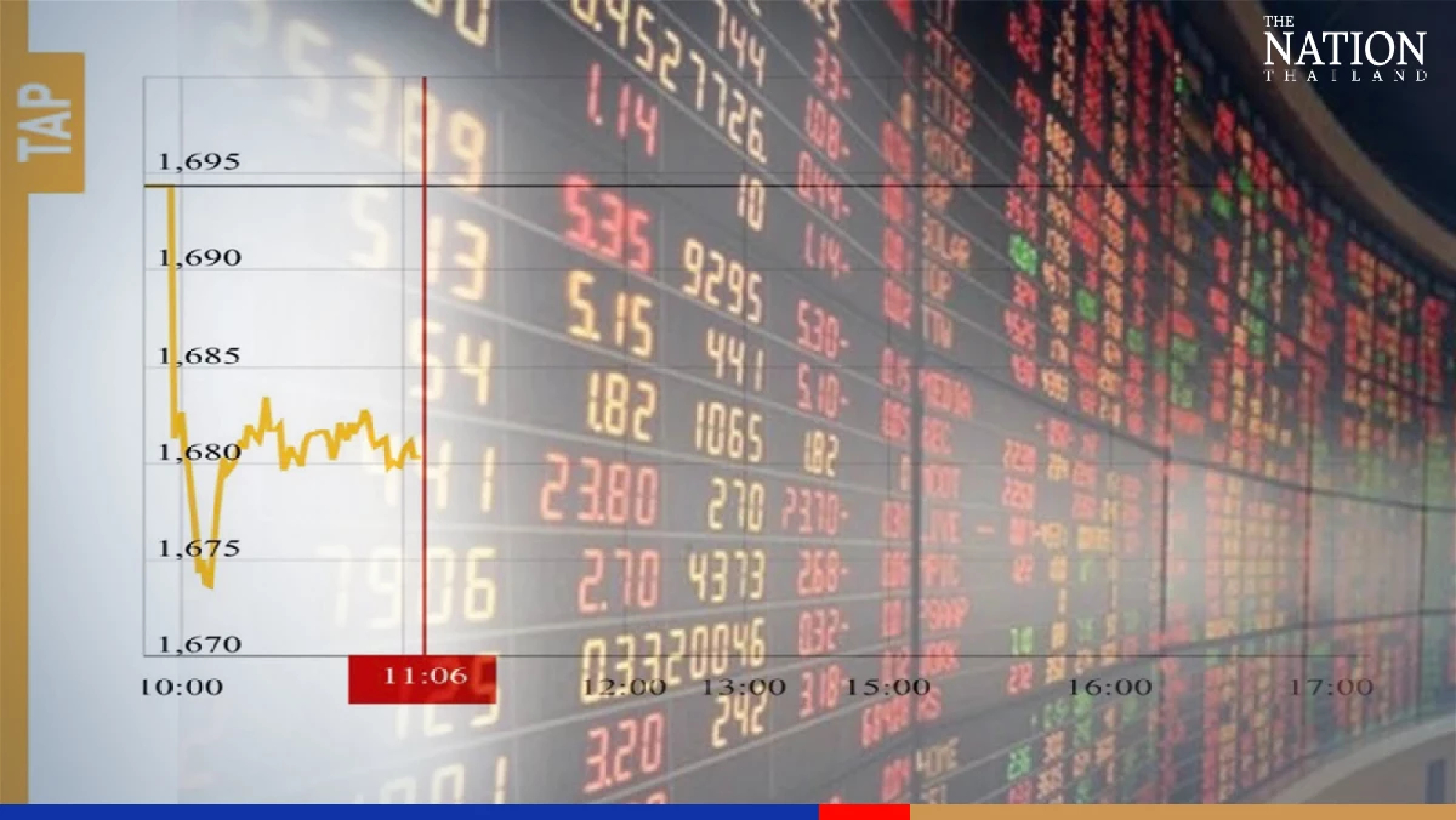
The Stock Exchange of Thailand (SET) Index is expected to fluctuate between 1,670 and 1,680 points on Wednesday, Krungsri Securities said.
It said the index was currently under pressure due to Russia-Ukraine tensions after a host of countries imposed sanctions on Russia in response to President Vladimir Putin’s decision to recognise the independence of Donetsk and Luhansk republics in eastern Ukraine.
“However, mass buy-ups of company shares that are expected to grow based on their business turnover last year would help boost the index,” Krungsri Securities said.
It recommends the purchase of the following companies’ shares as an investment strategy:
• PTTEP, Top, IVL, SPRC and BCP, which would benefit from the rising price of oil and the gross refining margin.
• PSL and TTA, which would gain from the rising freight rate.
• IVL, Banpu, TU, CPF, ORI, WHA, Amata, HMPro, CRC, BLA, UBE, Forth, TH and ONEE, that are expected to grow based on their business turnover last year.
The SET Index closed at 1,691.12 on Tuesday, down 3.20 points or 0.19 per cent. Transactions totalled 93.07 billion baht with an index high of 1,691.62 and a low of 1,673.31.
The latest network infrastructure upgrades will further enable Thailand’s push into the digital economy, in line with government ‘Thailand 4.0’ policy and its ‘fourth industrial revolution’
Juniper Networks (NYSE: JNPR), a leader in secure, AI-driven networks, today announced that Nipa Cloud (Nipa), a leading cloud services provider in Thailand, has selected Juniper Networks to strengthen its existing network infrastructure in support of Nipa’s growth momentum, and in anticipation of further growing demand for endpoint flexibility amidst Thailand’s rapidly transforming digital economy.
As Thailand’s first full-service OpenStack public cloud services provider powered by Tungsten Fabric, Nipa is committed to offering technologically advanced cloud solutions that match up competitively to the solutions from global providers while simultaneously creating unique value add for the localized market through greater flexibility, multiple availability zones (AZ), modularity and local understanding as a homegrown provider.
With this ‘glocalized’ approach, Nipa’s award-winning cloud solutions have rapidly gained market share amidst stiff competition, especially as Thailand’s economy builds out a strong IT infrastructure to support sustained growth into the digital era as per the government’s ‘Thailand 4.0’ policies and its fourth industrial revolution.
This push has seen even further recent impetus, with the ongoing post-pandemic recovery spurring Thai businesses to increasingly prioritize innovation and investment toward cloud spending. Outpacing global forecasts, Thailand’s spending on cloud infrastructure is projected to grow 28.2% in 2022 alone, with infrastructure-as-a-service (IaaS) expected to see the highest growth figures as Thai enterprises scale up infrastructure and migrate complex workloads to the cloud to better enable a remote work culture.
In light of its strong growth momentum and this increasing demand for cloud services across Thailand’s enterprises, Nipa has deployed EVPN-VXLAN solutions from Juniper Networks, including the QFX5120 Series Switches and MX10003/MX204 Series Universal Routing Platforms, to upgrade its campus and data center networks and better differentiate its offerings.
These upgrades allow Nipa to now deploy a common set of policies and services across campuses with support for Layer 2 and Layer 3 VPNs. In addition, Nipa is now able to better deliver enhanced throughput, scalability, capacity, performance, and security – enabling Nipa to continue the development of its ground-up cloud solutions, uniquely built for Thailand’s fast-developing enterprises and it’s rapidly transforming digital ecosystem.
Supporting Quotes: “Thailand is amid a massive digital transformation, with consumers and enterprises alike accelerating their transition to the cloud. As our nation drives toward Thailand 4.0, it is key that infrastructure providers like Nipa Cloud adapt and transform to stay ahead of the pack. Through our partnership with Juniper Networks, we can introduce new infrastructure-as-a-service capabilities with multiple locations and lower the cost of the cloud. This will offer our customers and partners access to agile, cost-effective, and secure services that will help drive sustainable growth in Thailand’s digital economy.”
– Dr. Abhisak Chulya, Founder and CEO, Nipa Cloud
“We are delighted to partner with Nipa Cloud to support their vision toward enabling Thailand 4.0 through the digital transformation of the country’s enterprises. Nipa Cloud plays a key role in driving the nation’s technological growth and through Juniper’s experience-first networking approach, we are committed to helping them deliver world-class cloud solutions to its end customers. All of which are crucial in bringing digitally-accelerated post-pandemic recovery and in ensuring Thailand’s continued economic growth.”
– Perry Sui, Senior Director, ASEAN & Taiwan, Juniper Networks About Juniper Networks Juniper Networks is dedicated to dramatically simplifying network operations and driving superior experiences for end-users. Our solutions deliver industry-leading insight, automation, security, and AI to drive real business results. We believe that powering connections will bring us closer together while empowering us all to solve the world’s greatest challenges of well-being, sustainability, and equality. Additional information can be found at Juniper Networks (www.juniper.net) or connect with Juniper on Twitter, LinkedIn, and Facebook.
Purra, Thailand’s first mineral water certified by the Aquacert institute from France, is kicking off its marketing campaign with three limited-edition label designs under the concept “My Everyday Natural Wonders”.
Purra, Thailand’s first mineral water certified by the Aquacert institute from France, is kicking off its marketing campaign with three limited-edition label designs under the concept “My Everyday Natural Wonders”.
The concept showcases the beauty and wonders of nature with the brand’s fashion essence and the “Home café starter kit”, a collectible with the same design on the bottle for all fashionistas.
Boonrawd Trading Co Ltd’s chief marketing officer Titiporn Thammapimookkul said that Purra’s strengths have always been its quality and benefits delivered at a premium level, adding the brand is also well-differentiated with its fashion essence, contributing to its success and constant growth.
He pointed out that Purra is Thailand’s first and only brand to be certified by the world-class Aquacert institute, which guarantees the brand’s manufacturing and product quality.
“Purra has always been innovating in terms of marketing, constantly driving excitement in the market with new collections and designs which ultimately make the brand stand out from competitors,” he said.
He explained that “My Everyday Natural Wonders” campaign features three limited-edition label designs inspired by France — a colourful flower shop in Paris, the Mont Blanc Mountain at night, and painter Claude Monet’s water lily paintings.
“Each Purra design tells a story of freshness and hydration along with Purra mineral water’s benefits,” he said. The label designs are the work of famous Thai illustrator, Pasinee “Jeep” Kongdechakul, who has previously worked with numerous global brands.
Purra’s new collection will be available with limited edition label designs of 600ml in 7-Eleven stores and special packs of both 600ml and 1,500ml will be available in leading department stores from today until April 2022.
Retail oil and gas had only small contributions to make in energy giant PTT’s 186-per-cent jump in net profit in 2021, even as the company continues to cope with the fallout of Covid-19, the group’s top executive said.
Speaking on the “Inside Thailand” programme on the MCOT channel, PTT president and CEO Auttapol Rerkpiboon said on Monday that the oil and retail business accounted for only 2 per cent of the total over-100 billion baht net profit.
PTT reported a net profit of 108.36 billion baht for 2021, up 70.59 billion baht, or 186.9 per cent on the 37.76 billion baht in 2020.
He said the net profit mainly came from natural gas, petroleum exploration and production, and its petrochemical and refining businesses, thanks to recovering demand in line with the global economy and the company’s investment expansion at home and overseas.
He also pointed out that net profit from PTT Oil and Retail Business (OR) accounted for only 2 per cent of total net profit as the company maintained the fuel price even though its costs had gone up due to the rising oil price.
He added that PTT had to utilise more than 100 billion baht of the net profit to repay debt, inject funds into its businesses, pay dividend to the government, invest under the company’s plan and run corporate social responsibility programmes.
He added that the company is still operating projects to help people cope with the Covid-19 crisis, such as supporting medical supplies and operating its field hospital.
“PTT had spent up to 2 billion baht last year to offer a helping hand to society, such as boosting employment, stimulating tourism and cutting LPG and NGV prices,” he said, adding that PTT will follow up on the situation closely.
Buyers of Thai jewellery will soon be able to verify their purchases via blockchain, in a move to lift the industry to international standards.
The Commerce Ministry has asked the Gem and Jewellery Institute of Thailand (GIT) to help local jewellery producers use blockchain technology so customers can trace the origins of gems used in their products.
Traceability has become a big feature of the gems trade in Europe and the US over concerns surrounding so-called “blood diamonds”, or gems mined to fuel conflicts or war.
Rubies and jade mined in Myanmar have come under an international spotlight over concerns that they fund the country’s military dictatorship and its brutal campaigns against citizens.
“Now, Europe and American brands have started requiring makers to declare the origins of gemstones, which can be traced back and verified using blockchain technology,” Deputy Commerce Minister Sinit Lertkrai said.
“Thai makers must adapt themselves to this development.”
The minister said GIT was asked to educate Thai jewellery makers on accountable business practices, environmental issues and technology used to trace gems’ origins.
He warned that Thai jewellery makers who were too slow to adopt these technologies would “fail to catch the train”.
Jewellery was Thailand’s fifth-highest exports earner in 2021, at Bt194.65 billion. Thailand ranked as the world’s third-largest exporter of gemstones and 17th largest exporter of jewellery last year, Sinit said.
GIT and the Responsible Jewellery Council (RJC) will launch free online transparency and good governance training for gems traders on March 9, GIT director Sumet Prasongpongchai said.
The training will be carried out using Zoom Meeting application
Conducted via the Zoom app, the training will be led by RJC executive director Iris Van der Veken and GIT deputy director Thanong Leelawatanasuk as well as representatives from Precious Metal Refining Co Ltd and Pranda Jewellery Plc.
The Cabinet on Tuesday approved lowering the withholding tax rate to 17 per cent for highly skilled foreign professionals in target industries.
Asource from the Cabinet meeting said the draft royal decree on tax measures was approved to attract high-skilled foreign talent. The move means highly skilled foreign workers in government-targeted sectors will pay a flat rate of 17 per cent tax on their income.
The decree will also exempt wealthy foreigners, wealthy foreign pensioners and high-skilled foreigners with long-term residency visas from being taxed on income or assets earned before they moved to Thailand.
The tax exemption is aimed at drawing more wealthy foreigners to live in the Kingdom, the source said.
Earlier, the Cabinet approved a measure to grant 10-year residency visas to four groups of foreigners – “wealthy global citizens”, “wealthy pensioners”, “work-from-Thailand professionals” and “high-skilled professionals”.
The source said the decree approved on Tuesday would set a rate of 17 per cent withholding tax for targeted-industry employers to deduct from salaries of high-skilled professionals. Targeted businesses are exempted from paying corporate income tax in a move designed to promote investment, especially in the Eastern Economic Corridor.
The draft decree states that high-skilled foreign professionals can choose not to add the income on which they pay withholding tax to their yearly taxable revenue.
The Stock Exchange of Thailand (SET) Index slumped below 1,700 points in morning trade on Tuesday amid uncertainty over the Russia-Ukraine standoff.
The SET Index closed at 1,678.73 points, down 15.59 points, or 0.92 per cent, in the morning session on Tuesday with transactions totalling 8.16 billion baht.
Tisco Securities senior strategist Apichat Poobunjirdkul predicted the SET Index on Tuesday would fall, seeing the day’s support level at between 1,670 and 1,680 and the resistance level at between 1,705 and 1,710.
He said Russia-Ukraine tensions intensified after Russian President Vladimir Putin ordered troops to station in Donetsk and Luhansk republics in eastern Ukraine. The move came after Putin’s decision to recognise the independence of two breakaway regions.
Meanwhile, US President Joe Biden signed an executive order to bar Americans from trade and investment in Donetsk and Luhansk republics in response to Putin’s move.
“However, the Thai stock market would not fall sharply as the index gained positive sentiment from over a 4-per-cent rise in oil price, due to Russia-Ukraine tensions,” he said.
He also advised investors to follow the Centre for Covid-19 Situation Administration’s meeting on Wednesday, to see whether additional measures to contain the spread of Covid-19 will be announced after the level 4 Covid-19 alert was sounded nationwide.
The baht opened at 32.27 to the US dollar on Tuesday, weakening from Monday’s close of 32.16.
The Thai currency is likely to move between 32.20 and 32.35 during the day, Krungthai Bank market strategist Poon Panichpibool predicted.
Poon said the baht is likely to fluctuate and weaken as the number of Omicron patients is increasing, which might force the government to enforce strict prevention measures again.
However, the baht will not weaken much due to gold sales.
Poon suggested that speculating foreign investors might sell Thai stocks due to the increasing risk of a Russia-Ukraine conflict. Some investors might opt to decrease their possession of risky assets.
If foreign investors sell Thai stocks, it will pressure the baht to weaken. Poon added that the baht would weaken in the range of 32.40 to 32.50 to the dollar, the range exporters are waiting for to sell their dollars.
The Stock Exchange of Thailand (SET) Index is expected to fall to between 1,680 and 1,685 points on Tuesday, Krungsri Securities said.
It said the index is being pressured due to tensions between Russia and Ukraine, making investors turn to safe-haven assets.
“However, the rising oil price would help boost the index,” Krungsri Securities said.
It recommends the purchase of the following stocks as an investment strategy:
• PTTEP, TOP, PTTGC, IVL, SPRC and BCP will benefit from the rising price of oil and gross refining margin.
• PSL and TTA will benefit from the rising freight rate.
• IVL, SPRC, BANPU, TU, CPF, ORI, WHA, AMATA, HMPRO, CRC, BLA, ITEL, UBE, FORTH, TH and ONEE are expected to grow based on their business turnover last year.
The SET Index closed at 1,694.32 on Monday, down 18.88 points or 1.10 per cent. Transactions totalled 104.94 billion baht.
Thailand’s economy performed better than expected in the fourth quarter of 2021, expanding 1.9 per cent year on year, according to official figures on Monday.
Reuters had forecast a 1.4 per cent expansion from October to December.
Meanwhile gross domestic product (GDP) for the whole year rose 1.6 per cent, the National Economic and Social Development Council (NESDC) reported.
Fourth-quarter exports expanded 16.6 per cent for products and 30.5 per cent for services, but overall investment contracted by 0.2 per cent year on year.
“The 2021 economic growth was higher than our forecast of 1.2 per cent,” said NESDC secretary-general Danucha Pichayanan. For this year, the NESDC forecasts 3.5 to 4.5 per cent expansion of GDP driven by rising domestic demand, exports and the recovery of tourism after Covid-19 restrictions are lifted. However, Danucha warned that economic recovery could be slowed by risk factors such as a surge in domestic virus infections or a new variant in the future that could trigger travel restrictions.
Other key figures for Thailand’s economy in 2021 are as follows:
– Product exports expanded 18.8 per cent
– Private consumption expanded 0.3 per cent
– Overall investment expanded 3.4 per cent
– Agricultural, forestry and fishery sectors expanded 1.4 per cent
– Industrial sector expanded 4.9 per cent
– Retail and wholesale sectors expanded 1.7 per cent
– Hotel and food service sectors contracted 14.4 per cent
– Transport sector contracted 2.9 per cent
NESDC also forecast that US dollar exports in 2022 will expand by 4.9 per cent, private consumption by 4.5 per cent, private investment by 3.8 per cent, and public investment by 4.6 per cent. Inflation of 2022 is predicted at 1.5-2.5 per cent, with a current account surplus of 1.5 per cent of GDP.










 The minister said GIT was asked to educate Thai jewellery makers on accountable business practices, environmental issues and technology used to trace gems’ origins.