The baht has strengthened to 33.20 per US dollar from an opening of 33.25, Kasikorn Research Centre reported on Monday morning.
It said the dollar had seen no new supporting factors while investors in the currency are monitoring the US inflation rate.
Moreover, the increased price of commodities has stimulated the selling rate of the dollar, the centre added.
The centre also predicted the baht to move between 33.10 and 33.40 today, while relevant factors included investing money of foreign investors, the Covid-19 situation in Thailand, and the direction of oil price worldwide.
The price of gold in Thailand on Monday morning was unchanged from the one-time trading price announcement on Saturday.
A9.26am report from the Gold Traders Association showed the buying price of gold bar at THB28,200 per baht weight and selling price at THB28,300, while the buying and selling price of gold ornaments is THB27,697.32 and THB28,800, respectively.
The spot gold price on Monday morning was hovering around US$1,795 (THB59,462) per ounce after Comex gold at close on Friday rose by $14.4 to $1,796.3 per ounce due to support in buying gold as a safe-haven asset amid concerns about rising US inflation.
Krungsri Securities forecast the Stock Exchange of Thailand (SET) Index on Monday would fluctuate between 1,635 and 1,655 points.
It said the index gained positive sentiment from rising oil price of above US$83 per barrel, the government’s move to lift the curfew in 17 provinces and the Bank of Thailand’s move to relax loan-to-value (LTV) mortgage rule.
“However, the index would be under pressure due to uncertainty the US Federal Reserve signalling it would taper its quantitative easing in November and mass sell-offs of shares after the index hit the resistance line,” Krungsri Securities said.
It also recommended buying of the following companies’ shares as an investment strategy:
▪︎ AOT, AAV, BA, MINT, KBANK, SCB, CPN, CRC, HMPRO, CPALL, AMATA, WHA, MAJOR, BTS and BEM, which benefit from the country reopening.
▪︎ PTT, PTTEP, TOP, PTTGC, SPRC and BCP, which benefit from rising oil price and gross refining margin.
▪︎ GULF, CHG, BCH, BDMS, KCE, PSL and TTA, whose third-quarter profit is expected to grow.
The SET Index rose by 0.28 points or 0.02 per cent to 1,643.70 on Monday morning, witnessing a high of 1,645.91 and a low of 1,643.18 in opening trade.
255 electric vehicles (EVs) have been registered in September, bringing total EV registration in the nine months of 2021 to 1,485 units, increasing 42.4 per cent year on year, according to the Federation of Thai Industries Automotive Industry Club.
“As of September 30, Thailand recorded cumulative number of BEVs (battery electric vehicles) at 3,547 units, increasing 92.56 per cent from the previous year,” said club vice president and spokesman Surapong Pisitpattanapong. “Meanwhile, the number of HEVs (hybrid electric vehicles) was at 180,175 units, increasing 11.29 per cent year on year. Plug-in hybrid electric vehicles (PHEVs) were recorded at 29,401 units, increasing 337.25 per cent year on year.”
For electric motorcycles, the club reported total number of BEVs at 5,548 units, increasing 102.93 per cent year on year, and HEVs at 8,510 units, increasing 31.96 per cent year on year. Lastly, Thailand recorded total 123 electric buses at the end of September, increasing 2.5 per cent from the previous year.
“The government has been supporting the manufacturing of electric buses by domestic factories. We estimated that this year up to 500 units will be produced domestically,” said Surapong.
He further added that the government set the target that by 2027 Thailand will use 282,240 electric vehicles or 26 per cent of total vehicles used in the country, and will manufacturer at least 380,250 electric vehicles, or 17 per cent of total vehicles manufactured in the country.
“The export of electric vehicles and their parts are expected to grow at 5 per cent annually, while the investment in research and development of technology related to electric vehicles is expected to increase by 20 per cent by 2027,” he said. “We also expect to have trained not less than 30,000 skilled personnel in the fields related to electric vehicles and have installed additional 5,000 public fast charge stations for electric vehicles nationwide by 2027.”
TOKYO – Major Japanese companies are putting more focus on the development of femtech-related products and services that help women deal with wellness issues they face.
From moisture-absorbing underwear for use during menstruation and menstrual cups, to items that help women deal with the physical issues that occur during pregnancy or menopause, a wide range of products make use of technology to support women.
In the past decade, femtech goods and services have become popular overseas, mainly in countries in Western Europe and North America. In Japan, the market is growing, centering around goods and services related to menstruation.
A start-up’s online sales of femtech products have been leading the way in Japan, but this year, major companies dealing in clothing and daily goods have entered the market. There is now a broader selection of such goods and services for women.
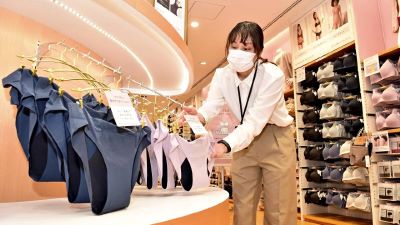
In mid-September, Uniqlo Co. started selling period underwear that can absorb 1-1.5 ounces (30 to 40 milliliters). The triple-layered underwear made with the company’s Airism material is also antibacterial and odor- and water-resistant.
Uniqlo has set the price at $17.50 (1,990 yen), lower than similar products being sold for around $45 (5,000 yen) by major underwear manufacturers.
“There were many requests for the product from customers, and their response after its release was great,” said Tadashi Yanai, chairman and president of Uniqlo operator Fast Retailing Co. “By discovering the needs of people who face various situations, we want to continue developing better products.”
According to a public relations official at the company, the product has been well-received by people across a wide age range. A typical comment is along the lines of, “As the material feels smooth and comfortable, I have no sense of discomfort, even if I wear it all day long.”
Unicharm Corp. has developed a menstrual cup and began selling the product on a limited basis in late April. A 30-year-old from Chiba Prefecture, who started using the product after giving birth, said: “I can’t even feel it. Daily life during my period has become very comfortable.”
New types of services related to femtech have also started. From this month, the Prince Park Tower Tokyo has been offering an overnight package for women to heal mentally and physically through listening to infrasound or bathing in a natural hot spring.
The global femtech market is projected to reach $50 billion (5.7 trillion yen) in 2025, according to U.S. market research firm CB Insights, which is why major companies are being drawn to this sector.
Another reason has to do with productivity in Japan. According to the Economy, Trade and Industry Ministry, the annual economic loss due to menstruation is $6 billion (682.8 billion yen).
“Pushing ahead with the improvement of the working environment for women will lead to enhanced productivity at businesses,” the ministry said in a presentation material.
In Japan, women tend to avoid discussing topics related to their physical health such as menstruation. Many women often put up with their period-related symptoms, considering it normal to be in pain.
According to a labor force survey taken by the Internal Affairs and Communications Ministry, however, the employment rate of women ages 15 and over was 51.8% in 2020, up 5.5 percentage points from 2010. As the number of working women has increased and topics such as menstruation are more visible than before via social media and the like, women’s interest in femtech goods and services has grown.
As the economy ministry anticipates that the femtech sector has the potential to become a growth industry, in June it began extending support. For instance, it has designated 20 business schemes with femtech-related service projects to be eligible for government subsidy.
For many people in Japan, their attention was first drawn to femtech thanks to Fermata Inc., which was founded in October 2019. The company started selling only femtech-related products online. This proved so popular that it began selling some of its items at a store in the Roppongi district of Tokyo in 2020.
That year, when various femtech-related products came on the market, was dubbed the “first year of femtech in Japan.” This year as well, the trend continues.
A country which hosts scores of outstanding startups that make it an example for the world.
Australian Ambassador Allan McKinnon will enlighten the audience about his experiences in successfully developing and effectively promoting startup in Australia, a country which hosts scores of outstanding startups that make it an example for the world.
See you at our informative & exciting “Virtual Forum: Thailand Startup in the Post-Covid Era” on October 29, 2021, from 2PM to 4PM
For three centuries, a handful of insurers have dominated the market from the City of London. The upstart intent on challenging them rents two floors just outside the district in an area known as Silicon Roundabout, where its employees work while lounging on cushioned windowsills.
Marshmallow, a car insurance app which recently became the U.K.’s second Black-founded firm to reach a billion-dollar valuation, won’t be working from its current Old Street digs for much longer. It’s moving to a nearby office with triple the space after headcount grew more than threefold during the pandemic and as it plows ahead with expansion plans into Europe.
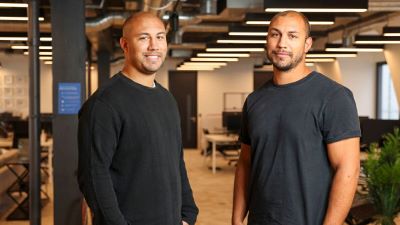
Founded by identical twins Oliver and Alexander Kent-Braham, the startup is the latest insurtech firm targeting a sector ripe for disruption. Investors have taken notice in the wake of Investec’s early backing after Oliver met the bank’s co-founder Bernard Kantor during an internship there. Since launching four years ago, Marshmallow’s valuation has leaped to $1.25 billion.
“It was really clear again and again that insurers play this hugely pivotal role in society, yet they probably weren’t digitizing fast enough,” Oliver Kent-Braham said in an interview. “We found that we were able to use data that other insurers aren’t using.”
Watching the ascent of app-based financial services like Monzo Bank, the 29-year-old brothers wondered if the insurance sector’s comparatively archaic underwriting methods was an opportunity waiting to happen. When a South African told them of the eye-watering amount he was forced to pay for motor insurance in the U.K., they asked around and found that was a common complaint from recently arrived foreign residents — regardless of their driving ability.
Initially working from the lounge of a Virgin Active gymnasium for nine months, the twins devised an algorithm aimed at lowering premiums for immigrants and expats. The startup attracted backers such as Investec and tech investor Passion Capital and has since sold more than 100,000 policies.
Those figures are of course nothing like the millions of drivers served by established rivals such as Admiral Group and Direct Line Group, but it’s early days. Indeed, much of Marshmallow’s recent growth was achieved amid the pandemic’s reduced traffic levels, and the end of U.K. lockdowns potentially poses another challenge for the firm.
“Insurers are spending big on tech so this won’t be the death of insurance,” said Bloomberg Intelligence insurance analyst Kevin Ryan. “The advantage insurtechs have is a lack of baggage — they don’t have legacy systems to digitize and they can be quick and agile.”
Marshmallow achieved its so-called unicorn status last month following a fresh round of fund-raising. The second of just two black-owned firms out of 48 U.K. startups that have become unicorns, it narrowly missed out on being the first when Zepz, a money transfer service that also targets immigrants, surpassed that valuation just weeks earlier.
Those mark important milestones for what has been an under-represented group of companies. Startups with black founders received just 0.24% of all venture capital invested in the U.K. in the past decade despite black people making up 3.5% of the population, according to an Extend Ventures report.
While Kent-Braham didn’t recall any major hurdles in Marshmallow’s fund raising, he said that connections via the university you attend can make all the difference when seeking investor attention. In the U.S., a dozen universities produce 42% of all venture capitalists with Harvard and Stanford topping the list, according to a report by Crunchbase.
“You go to one of these universities, and your network is automatically connected to them,” said Kent-Braham, who went to Bristol Business School in the U.K.
One of Marshmallow’s backers is London-based Impact X Capital, which seeks to invest in under represented firms. CEO Eric Collins has been vocal about the entrenched bias faced by start ups led by minorities.
“Networks are very school oriented, regionally oriented, some here in the U.K. would say class oriented,” Collins said in an interview. While Marshmallow currently covers “a small portion of the market, there is a lot of growth that can actually be done here.”
Investments in insurtech have more than tripled in the past six years, totaling $48 billion so far this year, according to insurance collaboration platform Sønr. The data also shows that merger and acquisition activity is booming, with the firm predicting that 2021 volumes will be more than double last year’s.
But Kent-Braham says Marshmallow has no interest in being swallowed up by one of the City’s behemoths, and is instead focused on continuing to chip away share from established competitors.
“Some insurers aren’t great run companies, some are better run, but I think that the industry could play its role a bit better in terms of trying to prevent people going through bad scenarios,” he said.
The worlds steelmakers need a makeover. Their industry is one of the dirtiest, and its blamed for about 7% of global carbon emissions.
The biggest producers essentially rely on the same manufacturing processes they used a century ago, and now they face a reckoning. With the planet’s viability at stake because of global warming, producers know they must adapt to survive in a low-carbon future.
Sweden’s SSAB, with operations from Alabama to Shanghai, partnered with utility Vattenfall and miner LKAB to produce the first fossil-free steel by substituting green hydrogen for coal. Deliveries of the clean metal started in August, with customers including Volvo, Mercedes-Benz and Cargotec Oyj of Finland.
It all starts at LKAB’s mines deep inside the Arctic Circle. The area has one of the richest iron ore deposits in the world, and the raw material has been extracted from there since the late 19th century. The stuff is mixed with additives and rolled into pellets about the size of a marble – but heavier – and then taken by electric train to Lulea, home to the hydrogen-powered Hybrit works.
Hybrit is a venture between the companies, who are spending $232 million (2 billion Swedish kronor) on a trial run through 2024. The main building, emblazoned with the logo “Fossil-Free Steel,” is relatively small and indistinct, but the companies are drawing up an industrial-scale version for about $1.15 billion (10 billion kronor). It would be a few hours’ drive away in Gallivare and could open by 2026.
Many producers are pursuing green steel, but huge barriers remain. The technologies are limited to pilot projects capable of producing only small amounts of the alloy, and they have higher operating costs than carbon-intensive methods. Spotify Technology’s billionaire founder, Daniel Ek, is backing H2 Green Steel, a Swedish startup set to begin production by 2024.
The steel industry needs investments of $30 billion annually just to keep pace with demand over the next 30 years, according to the Mission Possible Partnership, an advocate for speeding up decarbonization in the highest-emitting industries. Making those assets net-zero compliant will require another $6 billion a year.
Hybrit’s path to green steel continues in a tent about the size of an ice hockey rink, with heaps of the pellets riding a conveyor belt to the plant. Inside, they’re heated and then shaped into bricks of sponge iron – the raw material for steelmaking. What’s unique is Hybrit’s use of green hydrogen, still a nascent technology but already central to net-zero pledges by the European Union and China.
Iron pellets await melting at the Hybrit fossil-fuel free plant in Lulea, Sweden, on Oct. 6, 2021. MUST CREDIT: Bloomberg photo by Mikael Sjoberg
Hybrit burns the clean fuel – and not dirty coal – to remove oxygen from the iron ore. That emits only water vapor. Hydrogen isn’t a new invention – it’s been used in zeppelins and space rockets – but producing it with renewable energy makes it virtually emissions-free. Governments and companies want to use green hydrogen to power vehicles, ships, planes and factories.
While northern Sweden is rich in renewable energy, the weather makes supplies intermittent, so the Hybrit project is assembling a storage system for green hydrogen. “The industry wants to run 24/7,” said Mikael Nordlander, a decarbonization executive at Vattenfall.
The prototype will be buried about 30 meters underground. Since spring, workers have been blasting away granite and gneiss. It’s wet, smelly and noisy. After completion, the fuel will be held in a tank about 100 cubic meters in size, equal to a couple of shipping containers. If tests are successful, the setup could be supersized to hold 1,000 times more hydrogen – enough to fill London’s Royal Albert Hall.
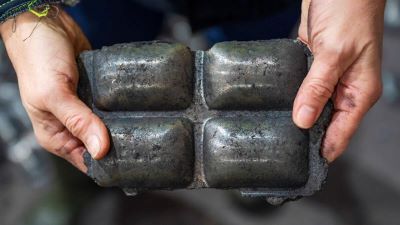
What comes out of the Hybrit plant is fossil-free sponge iron brickets, resembling a cluster of soap bars. They’re shipped to SSAB’s plant in Oxelosund, south of Stockholm. The first steel plates were made this summer and delivered to Volvo in August.
Volvo unveiled the first vehicle made with green steel Oct. 13. The electric dump truck weighs 8 tons, has a virtual driver and is meant for quarries and mines. “If you look into the microscope, the steel is identical,” said Lars Stenqvist, Volvo’s chief technology officer. “Going fossil-free is something many of our customers are asking for.”
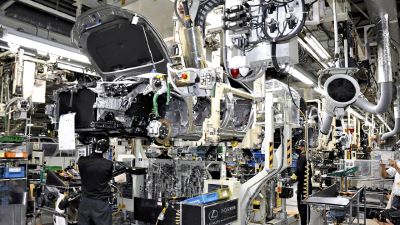
Japanese automakers expect production to be down by at least 1.3 million units in fiscal 2021 due to the global semiconductor shortage and the covid-19 pandemic in Southeast Asia, according to eight major manufacturers.
The cut is equivalent to 5% of the automakers’ total annual production in fiscal 2020 when they produced 23.35 million vehicles.
Under Nissan Motor Co.’s new production plan, the company will reduce its global production for October and November by about 30% from the planned level. The company did not indicate the specific number of units.
The company said it could not secure the parts needed to assemble finished vehicles due to a shortage of semiconductors and stalled production of auto parts in Southeast Asia.
At the end of July, Nissan indicated that it expected to cut production by 250,000 units in total this fiscal year, and Nissan executives said that there was a strong possibility that production would fall further due to the pandemic situation in Southeast Asia.
Seven other automakers are also cutting production for the same reason.
On Oct. 15, Toyota Motor Corp. announced it would cut global production in November by between 100,000 and 150,000 units. The automaker has announced several production cuts since August, lowering its full-year production plan from the initial 9.3 million units to around 9 million units.
In August, Honda Motor Co. lowered its forecast for global sales for the current fiscal year by 150,000 units to 4.85 million units.
The company has announced a series of domestic production cuts since August, which may further lower its sales volume forecast.
Honda has said it is minimizing the impact, but that the situation will continue to be uncertain.
Suzuki Motor Corp. expects the impact of the semiconductor shortage to continue throughout the current fiscal year, and expects to reduce production by 350,000 units, the largest among the eight automakers.
Since the second half of last year, Japan, the U.S. and China have seen rebounds in automobile demand, which had dipped following the outbreak of the COVID-19 pandemic.
If the production cuts continue, Japanese automakers might miss out on the bump in demand.
The automobile sector is a key industry that accounts for about 20% of all domestic manufacturing shipments.
From steel manufacturing to parts makers, a wide range of industries are involved in the production of vehicles, supporting Japan’s manufacturing sector.
Large-scale production cuts will have a negative impact on the performance and employment situation of such companies, potentially putting the brakes on the economy’s pandemic recovery.
The Nation Thailand and Springnews invite you to listen and discuss the direction of Thai startups in the virtual seminar.
The Nation Thailand and Springnews invite you to listen and discuss the direction of Thai startups in the virtual seminar “Thailand Startup in Post Covid Era 2022”.
• Special talk on “Startup Experience in Australia” by Allan McKinnon, Australian Ambassador to Thailand
• Seminar on the startup direction in the future by prominent entrepreneurs in Thailand
See you at our informative & exciting “Virtual Forum: Thailand Startup in the Post-Covid Era” on October 29, 2021, from 2PM to 4PM






 Iron pellets await melting at the Hybrit fossil-fuel free plant in Lulea, Sweden, on Oct. 6, 2021. MUST CREDIT: Bloomberg photo by Mikael Sjoberg