This report focuses on the region’s consumer markets, surveying the outlook for consumption and identifying major shifts in consumption patterns and behavior over the next decade.
While the COVID-19 pandemic continues to affect economies in Asia and around the world in fall 2021, this research aims to look beyond the economic effects of the pandemic, focusing on the factors that may influence long-term consumption growth in Asia to 2030 and beyond.
As Asia’s consumer markets are not only growing rapidly buy diversifying and segmenting, the 3 changes in perspectives are key to understanding new consumption paths in the region;
Surging up the income pyramid
From people moving into the consuming class to moving within the consuming class
Asian consumers are expected to account for half of global consumption growth in the next decade, equivalent to a $10 trillion opportunity. Globally, one of every two upper-middle-income and above households is expected to be in Asia, and one of every two consumer transactions is likely to occur in the region.
Beyond income: Redrawing Asia’s consumer map by McKinsey
An increasing number of people are projected to join the consuming class, defined as spending more than $11 a day in 2011 purchasing power parity (PPP) terms. In 2000, only 15 percent of Asia’s population was part of the consuming class; the incomes of the remaining three billion people were still insufficient to support discretionary spending. However, over the next decade, a significant reversal is likely. By 2030, three billion people, or 70 percent of Asia’s total population, may be part of the consuming class.
Beyond income: Redrawing Asia’s consumer map by McKinsey
2. Ten consumer shifts that matter
From people moving to cities to diversifying segments within cities
Cities will continue to be the main source of the region’s consumption and consumption growth and are expected to account for more than 85 percent of it over the next decade.
But the urban consumption is changing, a new focus is now needed to take account not only of which city is likely to offer the most promising opportunities, but of which consumers within each city.
A combination of social, demographic, and technological change is making this diverse region even more varied. Source of consumption growth are diversifying and segmenting. A consumer might be young Japanese person living alone whose social life is largely online; a South Korean “Insta-granny”, or a senior citizen newly conversant in social media; a high-spending-and high-borrowing-Chinese Gen Z; or a Filipina who has succeed in securing a better-paid job and has more say over household financial decisions.
Across Asia, households are getting smaller, and single-person households are becoming more common which already account for 15 to 35 percent of the total in Advanced Asia and China.
Beyond income: Redrawing Asia’s consumer map by McKinsey
3. Beyond income: Value shifts to new consumption curves
From income-driven S-curves to market-specific consumption curves
As the relationship between income and consumption breaks down in some instances, new consumption curves are emerging in specific product categories. Income-driven S-curves may flatten or shift as business innovation and new technologies enable more people, even on lower incomes, to afford goods and services.
Consumer shifts could move to 15 to 65 percent of value pools to new consumption curves, depending on the sector.
An example is “access curves” emerging in categories such as mobility, gaming, and banking, where business model innovation and digital platforms unlock latent demand by enabling lower-income consumers to obtain services that they could not previously access or were priced out of.
Beyond income: Redrawing Asia’s consumer map by McKinsey
Larges demographic shifts are creating new opportunities to innovate products for example;
New growth angles are changing the Asian financial sector in areas like payments, wealth management, and financing.
Demographic and societal shifts are changing the nature of housing demand and an emerging shift to rental and other housing models instead of buying.
It is time for companies to redraw their consumer growth map of Asia
Looking at new angles and consumptions growth
Find new growth angles: Given that urbanization and rising incomes may no longer be sufficient to understand consumption growth, companies may look carefully at which of the ten growth angles are relevant to their business.
Understand the new consumption that may play out in each sector: Consider new consumption categories that may emerge and how new demand may be unlocked by innovation in business models or product development.
Radically reimagine the future of consumption: Consider the possible futures and include new approaches in their forecasting process. To do so, they could consider revamping their usual long0term planning processes and blend elements of design, broad based signal scanning, and analytics.
Responding to rapid change and rising diversity, companies are adopting a more agile operating model
Create an agile resource-reallocation process: Yearly planning cycles, sticky budgets, and status quo business reviews may need to be replaced by frequent resources reallocation discussion in which genuine trade-offs are considered
Increase speed to market of innovation: Consider opening up innovation cycles, for instance by seeking out external partnerships, localizing R&D, and employing more rapid test-and-learn approaches to product development.
Empower local decision making: local autonomy and talent are crucial to making the right decision for the right markets at the right time.
Ensure the board is fit for the digital age: To address the digital deficit on boards, members need better knowledge about the technology environment. They also need faster, more effective ways to engage the organization and operate as a governing body and, critically, new means of attracting digital talent.
The price of gold in Thailand on Tuesday morning was unchanged from Monday close.
AGold Traders Association report at 9.21am said the buying price of a gold bar was THB28,150 per baht weight and selling price THB28,250, while the buying and selling price of gold ornaments is THB27,636.68 and THB28,750, respectively.
The spot gold price on Tuesday morning hovered around US$1,804 (THB59,789) per ounce after Comex gold at close on Monday surged by $10.5, hit the highest level in almost 6 weeks, to $1,806.8 per ounce due to support in buying gold as a safe-haven asset amid concerns about inflation and the fall in US government bond yields.
Krungsri Securities forecast the Stock Exchange of Thailand (SET) Index on Tuesday would fluctuate between 1,625 and 1,645 points.
It said the index gained positive sentiment from rising oil price in line with economic recovery and the Bank of Thailand’s move to relax loan-to-value (LTV) mortgage rule.
“However, uncertainty over the US Federal Reserve’s move to taper its quantitative easing on November 2-3 and mass sell-offs of shares whose third-quarter performance is expected to drop would pressure the index,” Krungsri Securities said.
It also recommended buying of the following companies’ shares as an investment strategy:
▪︎ PTT, PTTEP, TOP, PTTGC, SPRC and BCP, which benefit from rising oil price and gross refining margin.
▪︎ GULF, CHG, BCH, BDMS, KCE, PSL, TTA, BANPU and LANNA, whose third-quarter profit is expected to grow.
▪︎ HMPRO, CPALL, TNP and KK, which benefit from the government’s economic stimulus measures.
The Nation Thailand and Springnews invite you to listen and discuss the direction of Thai startups in the virtual seminar.
The Nation Thailand and Springnews invite you to listen and discuss the direction of Thai startups in the virtual seminar “Thailand Startup in Post Covid Era 2022”.
• Special talk on “Startup Experience in Australia” by Allan McKinnon, Australian Ambassador to Thailand
• Seminar on the startup direction in the future by prominent entrepreneurs in Thailand
See you at our informative & exciting “Virtual Forum: Thailand Startup in the Post-Covid Era” on October 29, 2021, from 2PM to 4PM
Walt Disney Co. raised the price of a single admission to its California theme parks on the busiest days by 6.5% to $164, part of the companys shift to a system that ties admissions costs to demand.
As part of the move, the slowest days will remain at $104, the same as it has been since 2019, Disney said Monday. The company created a tiered format for ticket prices in 2016, with weekend, summer and holiday prices higher than other days. With this latest step, the company now has six tiers.
The changes suggest companies are feeling comfortable about raising prices as the pandemic ebbs and consumers start to spend again. Disney is confident that higher-end consumers are more willing to spend freely. The company’s second-highest-priced tier is increasing to $159 from $154.
The company’s two theme parks in California, Disneyland and California Adventure, last increased prices in February 2020, before the pandemic prompted an extended shutdown.
Disney said demand has been strong since its California resort reopened in April. The world’s largest theme-park operator has been using price increases, a new reservation system and other tools to help manage demand and maximize revenue.
The changes offer “guests more ticket choices to meet a variety of budgets as it moves closer to dynamic pricing designed to spread visitation throughout the weeks, months and year,” Disney said.
This month, the company began rolling out a new ride reservation system. Priced at $20 in California, it will allow purchasers to access shorter lines. The company said its highest-priced annual pass, which costs $1,399 for year-round access, is sold out.
Disney also has been introducing new attractions, such as the Avengers-themed campus that opened in June at the California Adventure park. The company’s parking-lot trams, closed since the coronavirus, will reopen next year.
Late last year, Mark Zuckerberg faced a choice: Comply with demands from Vietnams ruling Communist Party to censor anti-government dissidents or risk getting knocked offline in one of Facebooks most lucrative Asian markets.
In America, the tech CEO is a champion of free speech, reluctant to remove even malicious and misleading content from the platform. But in Vietnam, upholding the free speech rights of people who question government leaders could have come with a significant cost in a country where the social network earns more than $1 billion in annual revenue, according to a 2018 estimate by Amnesty International.
So Zuckerberg personally decided that Facebook would comply with Hanoi’s demands, according to three people familiar with the decision, speaking on the condition of anonymity to describe internal company discussions. Ahead of Vietnam’s party congress in January, Facebook significantly increased censorship of “anti-state” posts, giving the government near-total control over the platform, according to local activists and free speech advocates.
Zuckerberg’s role in the Vietnam decision, which has not been previously reported, exemplifies his relentless determination to ensure Facebook’s dominance, sometimes at the expense of his stated values, according to interviews with more than a dozen former employees. That ethos has come under fire in a series of whistleblower complaints filed with the U.S. Securities and Exchange Commission by former Facebook product manager Frances Haugen.
While it’s unclear whether the SEC will take the case or pursue action against the CEO personally, the allegations made by the whistleblower represent arguably the most profound challenge to Zuckerberg’s leadership of the most powerful social media company on Earth. Experts said the SEC – which has the power to seek depositions, fine him and even remove him as chairman – is likely to dig more deeply into what he knew and when. Though his direct perspective is rarely reflected in the documents, the people who worked with him say his fingerprints are everywhere in them.
In particular, Zuckerberg made countless decisions and remarks that demonstrated a hard-line devotion to free speech. Even in Vietnam, the company says that the choice to censor is justified “to ensure our services remain available for millions of people who rely on them every day,” according to a statement provided to The Post.
Haugen references Zuckerberg’s public statements at least 20 times in her SEC complaints, asserting that the CEO’s singular power and unique level of control over Facebook mean he bears ultimate responsibility for a litany of societal harms. Her documents appear to contradict the CEO on a host of issues, including the platform’s impact on children’s mental health, whether its algorithms contribute to polarization and how much hate speech it detects around the world.
For example, Zuckerberg testified last year before Congress that the company removes 94 percent of the hate speech it finds – but internal documents show that its researchers estimated that the company was removing less than 5 percent of hate speech on Facebook. In March, Zuckerberg told Congress that it was “not at all clear” that social networks polarize people, when Facebook’s own researchers had repeatedly found that they do.
The documents – disclosures made to the SEC and provided to Congress in redacted form by Haugen’s legal counsel – were obtained and reviewed by a consortium of news organizations, including The Washington Post.
In her congressional testimony, Haugen repeatedly accused Zuckerberg of choosing growth over the public good, an allegation echoed in interviews with the former employees.
“The specter of Zuckerberg looms in everything the company does,” said Brian Boland, a former vice president of partnerships and marketing who left in 2020 after coming to believe that the platform was polarizing society. “It is entirely driven by him.”
A Facebook spokeswoman, Dani Lever, denied that decisions made by Zuckerberg “cause harm,” saying the claim was based on “selected documents that are mischaracterized and devoid of any context.”
“We have no commercial or moral incentive to do anything other than give the maximum number of people as much of a positive experience as possible,” she said. “Like every platform, we are constantly making difficult decisions between free expressions and harmful speech, security and other issues, and we don’t make these decisions inside a vacuum – we rely on the input of our teams, as well as external subject matter experts to navigate them. But drawing these societal lines is always better left to elected leaders which is why we’ve spent many years advocating for Congress to pass updated Internet regulations.”
Facebook has previously fought efforts to hold Zuckerberg personally accountable. In 2019, as the company was facing a record-breaking $5 billion fine from the Federal Trade Commission for privacy violations related to Cambridge Analytica, a political consultancy that abused profile data from tens of millions of Facebook users, Facebook negotiated to protect Zuckerberg from direct liability. Internal Facebook briefing materials revealed the tech giant was willing to abandon settlement talks and duke it out in court if the agency insisted on pursuing the CEO.
The current chair of the SEC, Gary Gensler, has said he wants to go much harder on white-collar crime. Experts said Gensler is potentially likely to weigh the Haugen complaint as he looks toward a new era of corporate accountability.
Zuckerberg “has to be the driver of these decisions,” said Sean McKessy, the first chief of the SEC’s whistleblower office, now representing whistleblowers in private practice at Phillips & Cohen. “This is not a typical public company with checks and balances. This is not a democracy, it’s an authoritarian state. . . . And although the SEC doesn’t have the strongest track record of holding individuals accountable, I certainly could see this case as being a poster child for doing so.”
Zuckerberg, who is 37, founded Facebook 17 years ago in his college dorm room, envisioning a new way for classmates to connect with one another. Today, Facebook has become a conglomerate encompassing WhatsApp, Instagram and a hardware business. Zuckerberg is chairman of the board and controls 58 percent of the company’s voting shares, rendering his power virtually unchecked internally at the company and by the board.
An ownership structure that gives a single leader a lock on the board’s decision-making is “unprecedented at a company of this scale,” said Marc Goldstein, head of U.S. research for the proxy adviser Institutional Shareholder Services. “Facebook at this point is by far the largest company to have all this power concentrated in one person’s hands.”
Zuckerberg has long been obsessed with metrics, growth and neutralizing competitive threats, according to numerous people who have worked with him. The company’s use of “growth-hacking” tactics, such as tagging people in photos and buying lists of email addresses, was key to achieving its remarkable size – 3.51 billion monthly users, nearly half the planet. In Facebook’s early years, Zuckerberg set annual targets for the number of users the company wanted to gain. In 2014, he ordered teams at Facebook to grow “time spent,” or each user’s minutes spent on the service, by 10 percent a year, according to the documents and interviews.
In 2018, Zuckerberg defined a new metric that became his “north star,” according to a former executive. That metric was MSI – “meaningful social interactions” – named because the company wanted to emphasize the idea that engagement was more valuable than time spent passively scrolling through videos or other content. For example, the company’s algorithm would now weight posts that got a large number of comments as more “meaningful” than likes, and would use that information to inject the comment-filled posts into the news feeds of many more people who were not friends with the original poster, the documents said.
Even as the company has grown into a large conglomerate, Zuckerberg has maintained a reputation as a hands-on manager who goes deep on product and policy decisions, particularly when they involve critical trade-offs between preserving speech and protecting users from harm – or between safety and growth.
Politically, he has developed hard-line positions on free speech, announcing that he would allow politicians to lie in ads and at one time defending the rights of Holocaust denialists. He has publicly stated that he made the final call in the company’s most sensitive content decisions to date, including allowing President Donald Trump’s violence-inciting post during the George Floyd protests to stay up, despite objections from thousands of employees.
And his capacity for micromanagement is vast: He personally chose the colors and layout of the company’s “I got vaccinated” frames for user profile pictures, according to two of the people.
But the former employees who spoke with The Post said his influence goes far beyond what he has stated publicly, and is most felt in countless lesser-known decisions that shaped Facebook’s products to match Zuckerberg’s values – sometimes, critics say, at the expense of the personal safety of billions of users.
Ahead of the 2020 U.S. election, Facebook built a “voting information center” that promoted factual information about how to register to vote or sign up to be a poll worker. Teams at WhatsApp wanted to create a version of it in Spanish, pushing the information proactively through a chat bot or embedded link to millions of marginalized voters who communicate regularly through WhatsApp. But Zuckerberg raised objections to the idea, saying it was not “politically neutral,” or could make the company appear partisan, according to a person familiar with the project who spoke on the condition of anonymity to discuss internal matters, as well as documents reviewed by The Post.
Ultimately, the company implemented a whittled-down version: a partnership with outside groups that allowed WhatsApp users to text a chat bot if they saw potential misinformation or to text a bot built by the organization Vote.org to get voting info.
When considering whether to permit increased censorship in Vietnam, one former employee said, Zuckerberg’s line in the free speech sand seemed to be constantly shifting. Warned that catering to a repressive regime could harm Facebook’s global reputation, according to one of the people, Zuckerberg argued that going offline entirely in Vietnam would cause even greater harm to free speech in the country.
After Zuckerberg agreed to increase censorship of anti-government posts, Facebook’s transparency report shows that more than 2,200 posts by Vietnamese users were blocked between July and December 2020, compared with 834 in the previous six months. Pro-democracy and environmental groups, meanwhile, have become a target of government-led mass reporting campaigns, the documents and interviews show, landing people in jail for even mildly critical posts.
In April 2020, Zuckerberg appeared to shoot down or express reservations about researchers’ proposals to cut down on hate speech, nudity, graphic violence and misinformation, according to one of the documents. The pandemic was in its early days and coronavirus-related misinformation was spreading. The researchers proposed a limit to boosting content the news-feed algorithm predicts will be reshared, because serial “reshares” tended to correlate with misinformation. Early tests showed limiting this could reduce coronavirus-related misinformation by up to 38 percent, according to the document.
“Mark doesn’t think we could go broad,” said Anna Stepanov, the director giving the readout from the Zuckerberg meeting, about the CEO’s response to the proposal to change the algorithm. “We wouldn’t launch if there was a material trade-off with MSI.”
Zuckerberg was a bit more open to a proposal to allow algorithms to be slightly less precise in what the software deemed to be hate speech, nudity and other banned categories – enabling it to delete a broader array of “probable violating content” and potentially reducing such harmful material by as much as 17 percent. But he only supported it as a “break the glass” measure, to be used in emergency situations such as the Jan. 6 insurrection, the documents said. Account demotions – which would have preemptively limited accounts that algorithms predicted were most likely to promote misinformation or hate – were off the table.
Facebook’s Lever says “probable violating” proposals were not break the glass measures and the company did implement them across categories such as graphic violence, nudity and porn, and hostile speech. Later, it also implemented the algorithm change fully for political and health categories that are in place today.
The Wall Street Journal first reported on the document’s existence.
The document that finally reached Zuckerberg was carefully tailored to address objections that researchers anticipated he would raise. For each of the nine suggestions that made their way up the chain, the data scientists added one row to list how the proposals would affect three areas he was known to care about: free speech, how Facebook is viewed publicly and how the algorithm change might affect MSI.
One former employee involved in that proposal process said those who worked on it were deflated by Zuckerberg’s response. The researchers had gone back and forth with leadership for months on it, changing it many times to address concerns about clamping down on free speech.
Zuckerberg, said a former executive, “is extremely inquisitive about anything that impacts how content gets ranked in the feed – because that’s the secret sauce, that’s the way this whole thing keeps spinning and working and making profits.”
“People felt, it was Mark’s thing, so he needs it to be successful. It needs to work,” the person added.
In 2019, those in the company’s civic integrity division, a roughly 200-person team that focused on how to mitigate harms caused by the platform, began to hear that Zuckerberg himself was becoming very worried about “false positives” – or legitimate speech being taken down by mistake. They were soon asked to justify their work by providing estimates of how many “false positives” any integrity-related project was producing, according to one of the people.
“Our very existence is fundamentally opposed to the goals of the company, the goals of Mark Zuckerberg,” said another person who quit. “And it made it so we had to justify our existence when other teams didn’t.”
“Founder-CEOs have superpowers that allow them to do courageous things. Mark has done that time and again,” Samidh Chakrabarti, the former head of the company’s civic integrity unit, who quit recently, tweeted this month. “But the trust deficit is real and the FB family may now better prosper under distributed leadership.”
Even as Facebook is facing perhaps its most existential crisis to date over the whistleblower documents, lately Zuckerberg’s attention has been elsewhere, focused on a push toward virtual-reality hardware in what former executives said was an attempt to distance himself from the problems of the core Facebook, known internally as the Big Blue app. The company is reportedly even considering changing its name to align better with his vision of a virtual-reality-driven “metaverse.” Facebook has said it doesn’t comment on rumors or speculation.
The former employees said it was also not surprising that the document trove contains so few references to Zuckerberg’s thoughts. He has become more isolated in recent years, in the face of mounting scandals and leaks (Facebook disputes his isolation). He primarily communicates decisions through a small inner circle, known as the Small Team, and a slightly bigger group of company leaders known as M-Team, or Mark’s team. Information that gets to him is also tightly controlled, as well as information about him.
Even criticizing Zuckerberg personally can come with costs. An engineer who spoke with The Post, and whose story was reflected in the documents, says he was fired in 2020 after penning an open letter to Zuckerberg on the company’s chat system, accusing the CEO of responsibility for protecting conservatives whose accounts had been escalated for misinformation.
One document, a 2020 proposal that indicates it was sent to Zuckerberg for review – over whether to hide like counts on Instagram and Facebook – strongly suggests that Zuckerberg was directly aware of some of the research into harmful effects of the service. It included internal research from 2018 that found that 37 percent of teenagers said one reason that they stopped posting content was because wanting to get enough like counts caused them “stress or anxiety.”
(The like-hiding study, named Project Daisy, was also reported by the Journal. In 2021, the company ultimately did offer an option to hide likes on Instagram, but not on Facebook. Facebook says it didn’t implement Project Daisy because a test showed mixed results for people’s well-being and that the 2018 study used in the presentation “cannot be used to show that Instagram causes harm because the survey wasn’t designed to test that, nor does the data show it.”)
Over the summer, executives in Facebook’s Washington office heard that Zuckerberg was angry about President Biden charge that coronavirus misinformation on Facebook was “killing people.” Zuckerberg felt Biden had unfairly targeted the company and wanted to fight back, according to people who heard a key Zuckerberg adviser, Facebook Vice President for Global Affairs Nick Clegg, express the CEO’s viewpoint.
Zuckerberg is married to a physician, runs a foundation focused on health issues and had hoped that Facebook’s ability to help people during the pandemic would be legacy-making. Instead, the plan was going south.
In July, Guy Rosen, Facebook’s vice president for integrity, wrote a blog post noting that White House had missed its own vaccine goals, and asserting that Facebook wasn’t to blame for the large number of Americans who refused to get vaccinated.
Though Biden later backed off his comment, some former executives saw Facebook’s attack on the White House as unnecessary self-sabotage, an example of the company exercising poor judgment in an effort to please Zuckerberg.
But complaints about the brash action were met with a familiar response, three people said: It was meant to please the “audience of one.”
U.S. stocks rose as traders geared for a string of earnings reports from technology heavyweights including Facebook Inc., while keeping in mind inflation concerns and rising covid-19 risks.
Consumer discretionary, energy and materials sectors led the S&P 500 higher after the benchmark index whipsawed traders at the start of the session. PayPal Holdings Inc. rose after the company said it isn’t pursuing an acquisition of Pinterest Inc., ending days of speculation over a potential $45 billion deal. Tesla Inc. advanced after receiving an order for 100,000 cars from Hertz Global Holdings Inc. Still to come: the five largest U.S. technology companies are set to report earnings, starting with Facebook on Monday.
“This year, broad market indices have benefited from robust earnings growth-the rising tide lifts all boats adage has been in full effect,” said Principal Global Investors Chief Strategist Seema Shah. “But as the economy slows and market conditions become more challenging, selectivity will be key. Staying overweight equities, with a focus on factors such as quality, will be increasingly important for investors aiming to balance portfolios in the market environment ahead.”
Oil pared gains after hitting $85 a barrel for the first time since 2014 with traders focused on upcoming talks between Iran and the European Union that may lead to a revival of a 2015 nuclear deal.
Yields on shorter-maturity Treasuries fell and the dollar edged higher after Federal Reserve Chair Jerome Powell flagged that inflation could stay higher for longer, fueling investor concern that sticky price increases may force policymakers to raise borrowing costs. Gold advanced above $1,800 an ounce.
Global equities have remained resilient despite risks from price pressures stoked by supply-chain bottlenecks and higher energy costs. Treasury Secretary Janet Yellen is among those counseling the inflation situation reflects temporary pain that will ease in the second half of 2022. Investors are wary that tighter monetary policy to keep inflation in check will stir volatility.
Traders are also monitoring an outbreak of the delta virus strain in China that is expected to worsen. The nation sought to allay concerns about the economy’s slowdown with a lengthy state media commentary outlining how the government is managing risks and remains confident about achieving its targets for the year.
The Stoxx Europe 600 index edged higher. The basic-resources sector advanced as crude oil and metals rose earlier, while banks increased on HSBC Holdings Plc’s bright outlook.
Some of the main moves in markets:
Stocks The S&P 500 rose 0.5% as of 4 p.m. EDT
The Nasdaq 100 rose 1%
The Dow Jones industrial average rose 0.2%
The MSCI World index rose 0.3%
Currencies
The Bloomberg Dollar Spot Index rose 0.1%
The euro fell 0.3% to $1.1611
The British pound was little changed at $1.3765
The Japanese yen fell 0.2% to 113.72 per dollar
Bonds
The yield on 10-year Treasurys was little changed at 1.63%
Germany’s 10-year yield declined one basis point to -0.11%
Britain’s 10-year yield was little changed at 1.14%
Commodities
West Texas Intermediate crude fell 0.4% to $83.45 a barrel
The Stock Exchange of Thailand (SET) Index closed at 1,634.20 on Monday, down 9.22 points or 0.56 per cent. Transactions totalled 65 billion baht with an index high of 1,645.91 and a low of 1,631.29.
The index fell after rising by 5.87 points or 0.36 per cent on Thursday. The index on Friday was closed for substitution for Chulalongkorn Memorial Day.
In the morning session, Krungsri Securities forecast the SET Index on Monday would fluctuate between 1,635 and 1,655 points.
It said the index gained positive sentiment from rising oil price of above US$83 per barrel, the government’s move to lift the curfew in 17 provinces and the Bank of Thailand’s move to relax loan-to-value (LTV) mortgage rule.
“However, the index would be under pressure due to uncertainty the US Federal Reserve signalling it would taper its quantitative easing in November and mass sell-offs of shares after the index hit the resistance line,” Krungsri Securities said.
The 10 stocks with the highest trade value today were KBANK, BBL, BANPU, SPALI, AOT, CPALL, IRPC, SCB, BDMS and LH.
Other Asian indices were up with one exception:
Japan’s Nikkei Index closed at 28,600.41, down 204.44 points or 0.71 per cent.
China’s Shanghai SE Composite closed at 3,609.86, up 27.26 points or 0.76 per cent, while the Shenzhen SE Component closed at 14,596.72, up 103.90 points or 0.72 per cent.
Hong Kong’s Hang Seng Index closed at 26,132.03, up 5.10 points or 0.020 per cent.
South Korea’s KOSPI Index closed at 3,020.54, up 14.38 points or 0.48 per cent.
Taiwan’s TAIEX Index closed at 16,894.24, up 5.50 points or 0.033 per cent.
Continuation of an outstanding growth in the 3rd quarter +40% compared to 2019 and +31% compared to 2020 at constant exchange rates
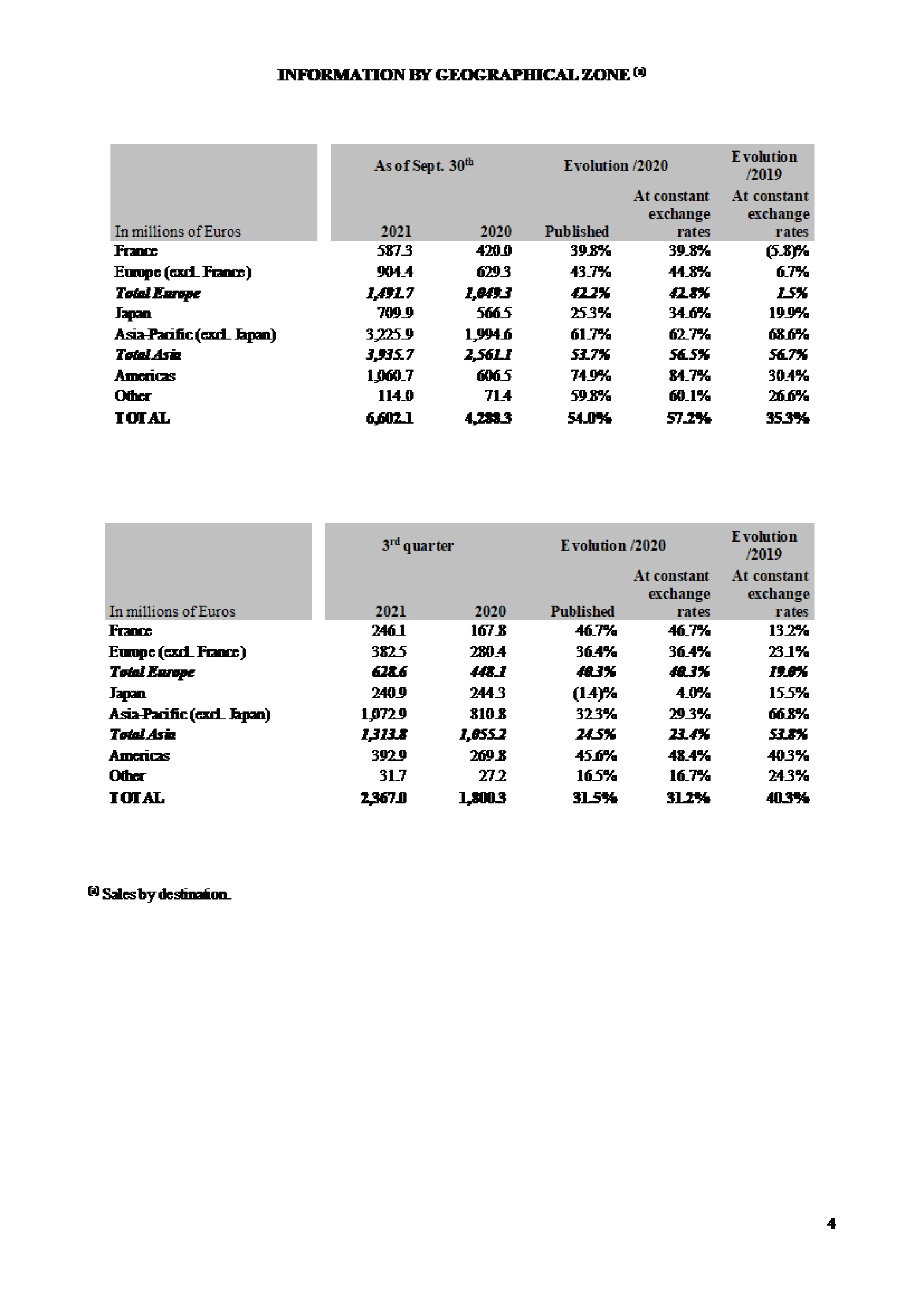
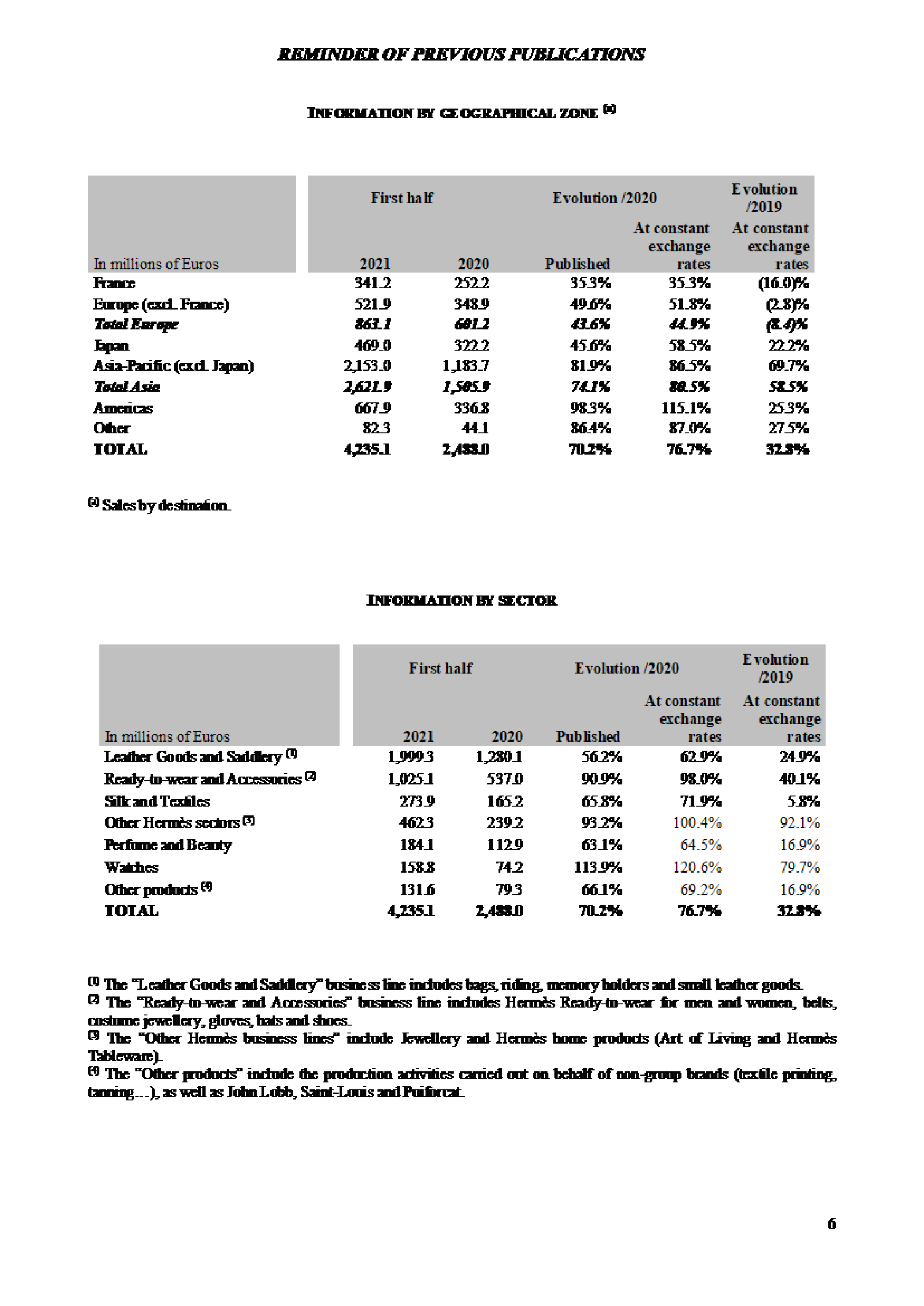
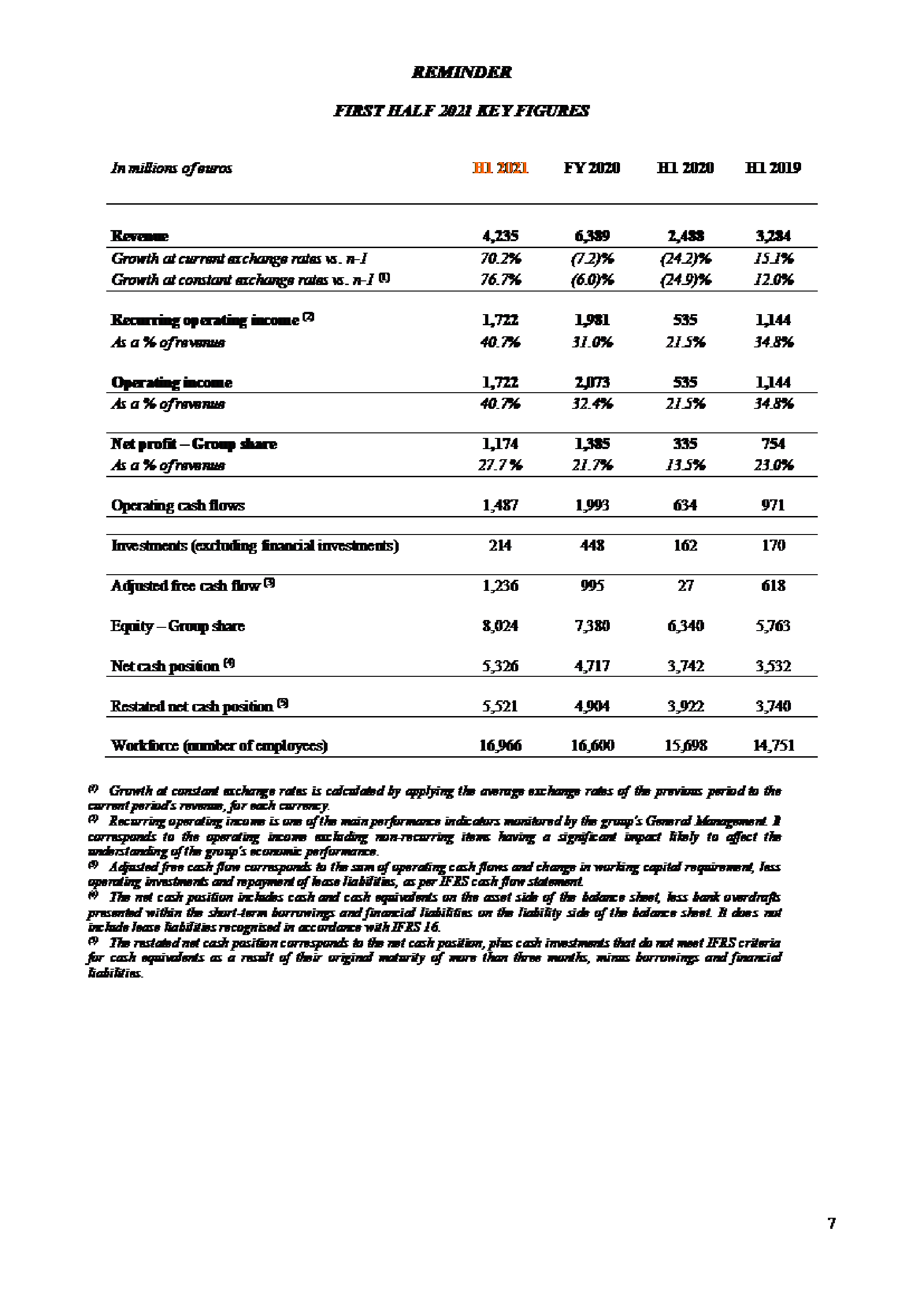
The Group’s consolidated revenue amounted to €6,602 million at the end of September 2021, up 57% at constant exchange rates and 54% at current exchange rates compared to the same period in 2020. This increase is of 35% over two years.
In the third quarter, the Group’s consolidated revenue reached €2,367 million. Sales growth was outstanding at +31% at constant exchange rates compared to 2020 and reached +40% over two years. The activity benefited from an upturn in sales in Europe, an acceleration in America and a sustained dynamic in Asia.
Axel Dumas, Executive Chairman of Hermès, said: “The performance of the third quarter reflects an atypical year, during which we continue our strategic investments and accelerate job creations. In a world that remains unstable, the balance between our sixteen métiers and between our locations around the world, allows us to move forward with optimism and caution, while continuing to create beautiful, high quality, sustainable objects.”
Sales by geographical area at the end of September (at comparable exchange rates, unless otherwise indicated)
At the end of September 2021, all the geographical areas confirmed their strong growth, with each one posting double-digit growth in the third quarter compared to 2019. Over the first nine months of the year, sales in the Group’s stores increased 60% at constant exchange rates compared to last year, and 43% compared to 2019. The network continued to develop with store openings and extensions, and online sales increased worldwide. Wholesale activities remain penalised particularly by travel retail.
• Asia excluding Japan (+63% and +69% over two years) continued to see sustained activity, driven by an excellent third quarter (+29% and +67% over two years). It gained from a remarkable performance in Greater China and other countries in Asia, despite new restrictions in Australia, Thailand and Malaysia in the third quarter. In September, Hermès unveiled a second store in Shenzhen, our 28th address in mainland China.
• Japan (+35% and +20% over two years) confirmed its solid growth, thanks to the loyalty of local customers, despite restrictions due to the health state of emergency.
• America (+85% and +30% over two years) accelerated significantly at the end of September, driven by an outstanding performance in the third quarter (+48% and +40% over two years). A new store opened in Florida’s Aventura Mall on October 1st.
• Europe excluding France (+45% and +7% over two years), and France (+40% and -6% over two years), strongly recovered in the third quarter, with double-digit growth compared to 2019 (+23% and +13% respectively). They benefitted from the support of local customers, growing online sales and the partial return of tourist traffic. The store in Milan reopened in July after renovation and extension work, boasting two extra floors. In September, petit h moved into the rue de Sèvres store in Paris in a location designed to reflect the dialogue created by the métier between sustainability, the creation of objects and the reuse of materials.
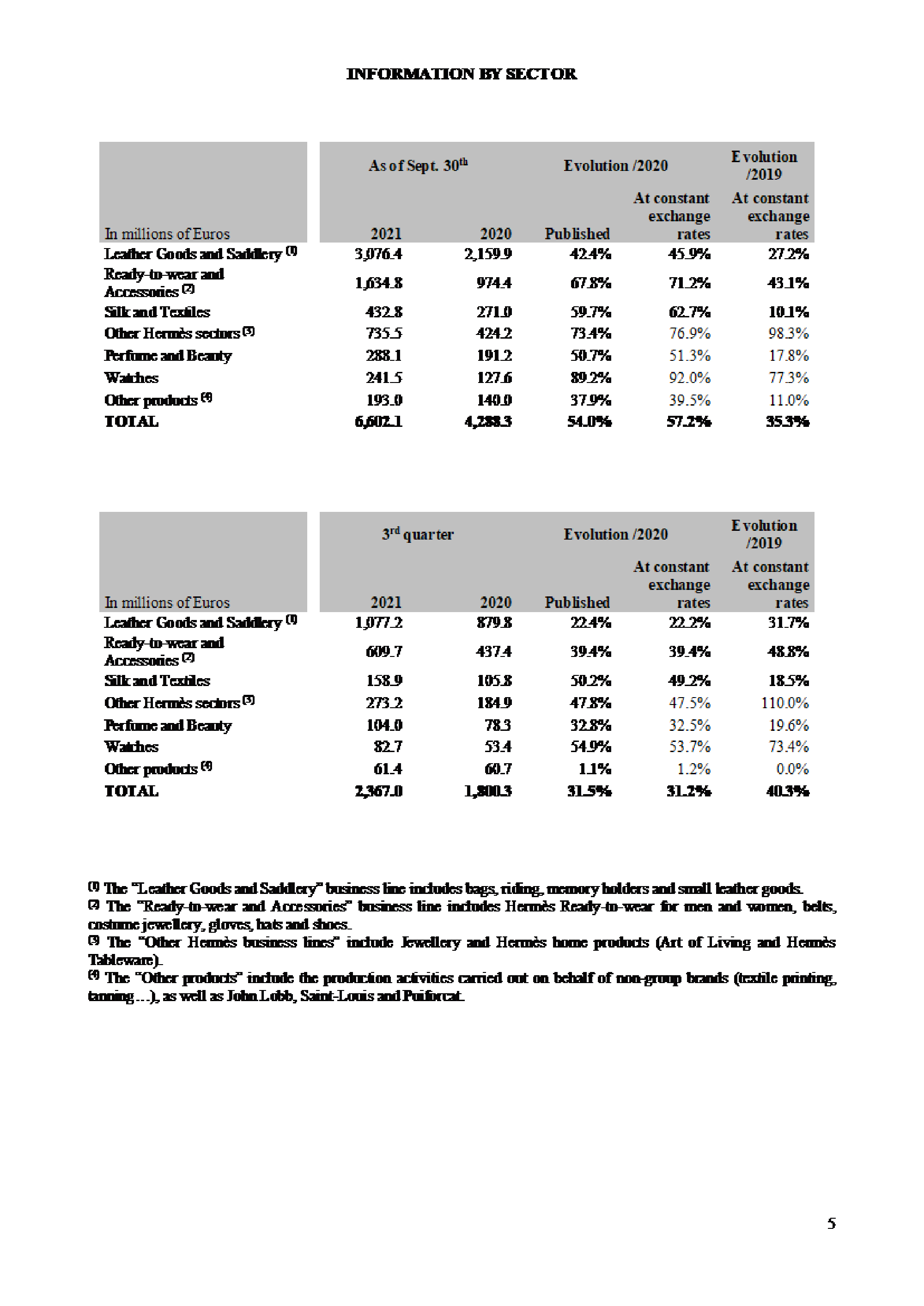
Sales by business line at the end of September (at comparable exchange rates, unless otherwise indicated)
At the end of September 2021, all the business lines posted double-digit growth, both compared to 2019 and 2020, with an excellent performance over the third quarter and an outstanding increase in Ready-to-wear and Accessories, Watches and Other Hermès Business Lines (Jewellery and Homeware).
Sales in the Leather Goods and Saddlery division (+46% and +27% over two years) benefitted from significant deliveries over the third quarter and sustained demand. The maroquinerie de Guyenne (Gironde), the 19th leather goods workshop of the house, opened in September, reasserting our local presence in France and the creation of jobs. The increase in production capacities continues, with the Louviers site (Eure) planned for 2022, the Sormonne site (Ardennes) for 2023 and a new site in Riom (Puy-de-Dôme) for 2024. In September, faithful to our commitments to know-how transmission and education, Hermès opened the École Hermès des savoir-faire (Hermès school of know-how), which is accredited by the French Education Department and will award a State-approved diploma in leatherworking expertise.
The Ready-to-wear and Accessories business line (+71% and +43% over two years) pursued its dynamic growth, thanks to the success of the ready-to-wear, fashion accessories and footwear collections. The Women’s Spring-Summer 2022 fashion show, unveiled early October, revealed a solar collection with aerial silhouettes, after the Men’s collection early July, around an artistic performance filmed in real time.
The Silk and Textiles business line (+63% and +10% over two years) performed well. A new printing line has been inaugurated as part of the development of the production site in Lyon to meet demand.
Perfume and Beauty (+51% and +18% over two years) benefitted from the successful launches of the H24 Perfume for Men and Twilly Eau Ginger, from the development of the Beauty line, with the sustainable, refillable limited edition of Rouge Hermès Éclat de la nuit. After the launch of Beauty in China in July, the métier continues its deployment to expand with hand care products this fall.
The Watches business line (+92% and +77% over two years) confirmed its excellent performance, reflecting the technical watch-making expertise and creativity of the collections, with the success of the men’s watch Hermès H08 and other classics of the house.
The Other Hermès business lines (+77% and +98% over two years) confirmed their momentum, thanks to Homeware and Jewellery.
A responsible, sustainable model
In September, the MSCI ESG rating index published an “A” rating in its analysis of the house’s resilience to environmental, social and governance risks.
Hermès was ranked second best Textiles and Clothing company out of 174 firms in the Sustainalytics ranking, with “low” exposure to ESG risks.
Lastly, the group has been included in the CAC 40 ESG index, after entering the V.E (Vigeo-Eiris) “Advanced” category.
These results reflect the sustainable dimension of Hermès’ craftsmanship model, and our ongoing efforts to improve our social and environmental performance.
Highlights
At the end of September, currency fluctuations represented a negative impact on revenue of €139 million.
Over the first nine months, Hermès International redeemed 142,131 shares for €162 million, excluding transactions completed within the framework of the liquidity contract.
Outlook
In a context of gradual improvement in the health situation, the group is continuing its investments and accelerates job creations. Despite a high comparison base in the 4th Quarter, the group is approaching the end of the year with confidence.
Our highly integrated craftsmanship model and balanced distribution network, as well as the creativity of our collections and our customers’ loyalty, give us confidence in the future.
In the medium-term, despite the economic, geopolitical and monetary uncertainties around the world, the Group confirms an ambitious goal for revenue growth at constant exchange rates.
2021 is marked by the Odyssey, we continue our journey remaining confident in the future, facing the uncertainties of the world whilst remaining true to who we are.
Thanks to its unique business model, Hermès is pursuing its long-term development strategy based on creativity, maintaining control over know-how and singular communication.
The press release on Revenue at the end of September 2021 is available on the Group’s website: https://finance.hermes.com.
Upcoming events:
• 18 February 2022: publication of the 2021 annual results
• 14 April 2022: Q1 2022 revenue publication
• 20 April 2022: General meeting of Shareholders 2022
The research on “Harmonious Justice: Thailand’ s Approach to Harmonious Justice” and “the UN Handbook on Restorative Justice Programs” (Second Edition)” promise to equip judicial personnel with practical tools to remove obstacles, facilitate remedy, and enforce laws.
“Agroup of teenagers attacked a health volunteer out of misunderstanding while he was on guard at a local hospital in Si Sa Ket province. Later on, attackers not only knelt down to ask for an apology through the arrangements of their family and community leaders but also offered Bt20,000 compensation. The victim forgave and returned Bt20,000”.
This case, a solid example of how “community can take part in judicial process”, was highlighted during a webinar on “Harmonious Justice: Background and Expectations of Thailand’s Criminal-Justice Process”. Held by the Thailand Institute of Justice (TIJ), the webinar took place on 15 September 2021 to introduce the research on “Harmonious Justice: Thailand’s Approach to Restorative Justice” and the Thai translation of “UN Handbook on Restorative Justice Programs” (Second Edition)” to provide judicial personnel with tools to upgrade their work and knowledge that can apply to Thai context.
Research Shows Restorative Justice Reduces Reoffending Rate, Presents Solution to Problems in Judicial Process, Prison Overcrowding
TIJ advisor Prof. Dr. Kittipong Kittayarak, who has advocated restorative justice in Thailand throughout the past few decades, told the webinar that restorative justice promised solutions based on the consensus of all relevant parties including victims and offenders thus paving way for remedy as well as harmony.
“Instead of focusing on retribution, Thailand should change its paradigm and embrace restorative justice. Several foreign countries have already jumped on this path. Excessive emphasis on retribution-based punishment has not only overwhelmed courts and prisons but it has also failed to curb crimes,” he pointed out.
Restorative justice in essence resonates with Thailand’s deep-rooted culture. Therefore, if the concept applies systematically, it should be able to solve many judicial issues. Importantly, the proper application must include clear identification of crimes’ root causes. Restorative justice is about bringing parties in conflict together on a voluntary basis for heart-to-heart talks in an appropriate atmosphere to encourage repentance, forgiveness, and then the new beginning. Restorative justice process must also recognize that parties involved must be forgiving for harmony to really happen.
Prof. Dr. Kittipong hoped that the concept of restorative justice would be used outside judicial system too, for example at schools where bullying was reported. In his view, harmonious justice will materialize not just with the introduction of supportive laws, legal mechanisms, and strategies but also the engagement of communities. When communities acknowledge the concept, they will be able to help take care of both offenders and victims.
Conducted nationwide through collaboration with foreign experts, a TIJ research has found that restorative justice can prevent reoffending when communities play an active role in support of judicial process.
“Restorative justice can fill the gap within Thailand’s criminal justice system. Retribution now separates offenders from victims, depriving them of opportunities to clear up the air and to reach mutual understanding. Victims have little participation in judicial process and end up having no say about what their remedy should be,” Prof. Dr. Kittipong commented.
Research Shows Restorative Justice Reduces Reoffending Rate, Presents Solution to Problems in Judicial Process, Prison Overcrowding
Mr. Ukrit Sornprohm, lead researcher and project manager at TIJ, said victim-centric judicial system accorded importance to the remedial process as it improved the relationships among parties in conflict and promoted social harmony. When restorative process was integrated into justice system, victims and offenders could talk in a way that led to repentance, the show of responsibility, and the delivery of remedy.
According to him, the restorative justice concept can apply to the stage of legal enforcement too. In Thailand, the Corrections Department has deployed the concept in designing activities between prisoners and victims/communities as well as among prisoners, and in preparing prisoners’ social reintegration. Even though the application has run into some problems, it marks progress for restorative justice in Thailand.
Presently, restorative justice has been most accepted in juvenile cases in Thailand. Directors of juvenile observation and protection centers are allowed by laws to consider using restorative justice. With this option, young offenders will not have criminal records and get opportunities to improve their behaviors. Their family will take part in restorative-justice talks with victims.
According to research findings, key indicators of restorative-justice success should be offenders’ improved behaviors/ability to avoid reoffending; agreements reached by parties in conflict; and victim satisfaction.
Research Shows Restorative Justice Reduces Reoffending Rate, Presents Solution to Problems in Judicial Process, Prison Overcrowding
Prof. Yvon Dandurand, another key researcher, revealed during the webinar that Canada’s justice system complied with international standards, and all its states were required to promote restorative justice. He said restorative justice promised to satisfy victims during the remedial process, reduce reoffending rate, offer offenders’ smoother reintegration into society, and boost public confidence in the justice system. According to him, restorative justice worked especially well in cases where parties in the conflict used to have good relations before. If offenders are underage, parents/guardians will be engaged in the decision making process. Both victims and offenders can opt-in or opt-out of the restorative justice stage, with full information on their choices provided.
Research Shows Restorative Justice Reduces Reoffending Rate, Presents Solution to Problems in Judicial Process, Prison Overcrowding
Mrs. Santanee Ditsayabut, director of Nitivajra Institute, disclosed that a total of 612,830 cases reached Thailand’s courts of first instance in 2019. Of them, 103,121 resulted in jail terms while 265,840 led to suspended jail terms. Statistics back to 2013 also revealed that 30 percent of convicts had reoffended for three consecutive years. These figures reflect that although courts have meted out retributive punishments, reoffending rate is still relatively high.
Believing that “overwhelmed courts and prisons” are proofs of the ineffective judicial process, Mrs. Santanee described restorative justice as a solution. She also pointed out that restorative justice would encourage repentance, not just confession, and lead to proper remedy.
Research Shows Restorative Justice Reduces Reoffending Rate, Presents Solution to Problems in Judicial Process, Prison Overcrowding
National Human Rights Commissioner Ms. Pitikan Sithidej strongly recommended restorative justice for environmental-crime cases in which ethnic groups were accused of encroaching on national parks despite the fact that their families had lived there for generations. She added that medical-malpractice cases should also be handled on the basis of restorative justice.
Mr. Atiruj Tunbooncharoen, presiding justice of Chon Buri Court, said the criminal justice process now attached importance to remedy for victims and even encouraged mediation before the cases came to courts. However, he pointed out that the restorative justice process was not without challenges given that remedy was mostly in the form of financial compensation and sometimes victims felt they were not compensated emotionally.
Also, Mr. Atiruj pointed out that courts needed supervisors from communities to watch over suspects who were bailed out without a bond.
Research Shows Restorative Justice Reduces Reoffending Rate, Presents Solution to Problems in Judicial Process, Prison Overcrowding
TIJ executive-director Prof. Phiset Sa-ardyen reckonedthat challenges existed for the implementation of restorative justice especially in the face of the huge number of cases, the need to efficiently protect criminal victims’ rights, and legal constraints. However, he explained that in essence, it took community engagement and understanding for restorative justice to materialize as at its heart were cooperation from all sides and a focus on victims.
The research on “Harmonious Justice: Thailand’ s Approach to Harmonious Justice” and “the UN Handbook on Restorative Justice Programs” (Second Edition)” promise to equip judicial personnel with practical tools to remove obstacles, facilitate remedy, and enforce laws.
You may download the full research and the Thai translation of the UN Handbook from


 Beyond income: Redrawing Asia’s consumer map by McKinsey
 Beyond income: Redrawing Asia’s consumer map by McKinsey
 Beyond income: Redrawing Asia’s consumer map by McKinsey
 Beyond income: Redrawing Asia’s consumer map by McKinsey






 Research Shows Restorative Justice Reduces Reoffending Rate, Presents Solution to Problems in Judicial Process, Prison Overcrowding
 Research Shows Restorative Justice Reduces Reoffending Rate, Presents Solution to Problems in Judicial Process, Prison Overcrowding
 Research Shows Restorative Justice Reduces Reoffending Rate, Presents Solution to Problems in Judicial Process, Prison Overcrowding
 Research Shows Restorative Justice Reduces Reoffending Rate, Presents Solution to Problems in Judicial Process, Prison Overcrowding
 Research Shows Restorative Justice Reduces Reoffending Rate, Presents Solution to Problems in Judicial Process, Prison Overcrowding
 Research Shows Restorative Justice Reduces Reoffending Rate, Presents Solution to Problems in Judicial Process, Prison Overcrowding
