Thai Life Insurance invites online application for tax exemptions
CorporateJan 29. 2021Sawat Naruvorawong, senior executive vice president of Thai Life Insurance Public Company
By The Nation
Thai Life Insurance (TLI) has advised customers to submit the consent form for exemptions on tax last year via its Thai Life Insurance app or at http://www.thailife.com. The company said that to reduce the Covid-19 risk, there was no need to apply in-person at its branches.
However, customers unable to complete the process online could still fill in a physical consent form at any TLI branch or customer service centre.
In the 2020 tax year, the Revenue Department increased the exemption limit for health insurance premiums from Bt15,000 to Bt25,000. Eligible for tax exemption in 2020 are combined policies (health, life insurance and living allowance deposits) of up to Bt100,000,” said Sawat Naruvorawong, senior executive vce president and chief life operation officer of Thai Life Insurance Public Company.
The BTS Skytrain is offering a six-month extension on tickets due to expire between December 21 and January 30.
The move, which is aimed at softening the financial impact of Covid-19, comes ahead of schools reopening on February 1.
Passengers can ask to have their tickets extended at ticket booths from February 1 to July 31, said Keeree Kanjanapas, president of Bangkok Mass Transit System (BTS).
He also asked passengers to cooperate in preventing the spread of the virus by wearing face masks on the Skytrain and checking in via the Thaichana app, BTS Skytrain app or via Line @btsskytrain.
BTS has boosted its rush-hour service to one train every 2 minutes 25 seconds in order to avoid crowding and lessen the Covid-19 risk.
Across finance today, organisations are challenged to manage large volumes of structured and unstructured data coming from disparate systems. As the global economy evolves rapidly to recover from the prolonged impact of Covid-19, the finance function continues to feel the pressure to generate significant value-added insights for the organisation.
The ability of CFOs to leverage digital and intelligent technologies to position their finance function as the catalyst to drive data-driven insights and identify strategic opportunities, will determine the future of their organisations.
Shift to building smarter bots
The first wave of a financial digital core was led by the adoption of Robotic Process Automation (RPA). The RPA ability to automate repetitive rules-based processes, to open email attachments, complete e-forms, and initiate workflows, record, re-key data, make calculations, generate reports and work around the clock was revolutionary. The benefits of automation are obvious in cost reduction, lower error rates, improved service, turnaround time reduction and increased scalability of operations, with improved controls and compliance.
However, RPA has its limitations. Bots are able to follow logical rules-based processes – but unable to see patterns, understand the logic behind the data or extract meaning from images, text or speech.
Since late 2019, organisations have been seeking to scale these solutions by integrating intelligent and cognitive AI capabilities such as speech recognition, natural language processing (NLP) and machine learning (ML) to automate perceptual- and judgement-based tasks and predictions that were once reserved for humans.
This has shifted the paradigm, extending automation to a whole new potential. Organisations are now able to become more efficient and agile as they transform into fully dynamic digital businesses.
Montri Khongkruephan
Benefits of intelligent cognitive automation
Machine learning, autonomics, machine vision, NLP and deep learning offer the ability to extract meaning from images, text or speech, detect patterns and anomalies, predictions analysis, recommendations and decisions.
A modernised financial digital core driven by RPA and intelligent cognitive capabilities has the ability to eliminate closed tasks and provide real-time analytics to support business objectives. Leading organisations are leveraging the digital core to reimagine financial processes, enhance strategic business partnership through real-time analytics to rapidly respond to business changes and M&A activities.
A recent Deloitte survey found executives of organisations currently scaling intelligent automation have already achieved an average 27 per cent reduction in costs, as compared to the expected 22 per cent, from their implementations to date.
Digital finance controllership
In digital finance controllership, a specialised combination of accounting knowledge and flexible in-memory financial applications is being used to modernise business data and logic.
Finance controllers can now transform business and finance processes, achieving higher efficiency, speed and accuracy, including by automating predictions and decisions on the basis of structured and unstructured inputs.
By combining internal financial information and operational data with external information to make sense of an increasingly complex world, financial controllers are able to generate new insights and identify hidden patterns.
Many ERP systems are faced with the challenge of automating the full end-to-end Close, Consolidate and Report process but often do not fully support the linkages within the business. This can lead to a fragmented, manual and inefficient close, as well as to inefficiencies throughout the accounting period.
In contrast, integrated systems promote a clean transactional data flow from source directly to financial systems (sub-ledgers and general ledgers), reducing the number of transaction-level variances that require manual reconciliation.
The previously fragmented and manual financial close management is being replaced with a hub-and-spoke model where applications can now work in synchronization within a single data source.
RPA software helps to pull, aggregates fragmented financial data, while the processing of the data are under the direction of more advanced intelligent and cognitive technologies. When the AI algorithm has completed processing its functions on the raw data, RPA then pushes the final output answers to the target systems.
How to start?
Embracing intelligent cognitive technology requires strategic transformational change and design thinking, but can play a key role in ensuring long-term implementation success.
As financial controllerships embark on their modernisation journey it is critical to establish a clear, long-term vision and road map that has buy-in and input from key stakeholders across the risk and finance organisations. There is a need to examine the opportunities of AI to address today’s business challenges, prioritise the opportunities, articulate how the intelligent cognitive automation will add value to the business, and align the next steps.
In summary, financial controllers have the opportunity to harness sophisticated intelligent cognitive technologies, analytical tools, and methods. The importance lies in the ability to identify quick-wins and decisions to address key pain points such as manual journal entries, data aggregation processes, manual reconciliation processes, and product control and reporting preparation processes.
This targeted automation of manual processes will help to enhance overall data quality, reduce costs, increase processing speeds, and better manage the risk of reporting errors in the near term, providing a quick turnaround in ROI. This, in turn, will pave the way to longer-term investments and strategy to incorporate more sophisticated intelligent cognitive capabilities such as machine learning, predictive analytics and AI to achieve a true transformation in digital finance controllership.
Montri Khongkruephan is a partner, and Joeyvoen Teo a senior manager, of audit & assurance at Deloitte Thailand.
The baht opened at 29.98 to the US dollar on Friday, strengthening from Thursday’s close of 30.01.
The Thai currency is likely to move between 29.95 and 30.05 and in line with the dollar, Krungthai market strategist Poon Panichpibool said.
On Thursday night, financial markets were in a risk-on state in response to the rise in listed companies’ turnover and strong US economic data despite the Covid-19 impact.
The abovementioned factors helped stock markets to rebound after falling the previous day. The S&P 500 and Stoxx 50 indexes rose by 0.9 and 0.6 per cent respectively, while the US Ten-Year Treasury yield increased by over 3 basis points to nearly 1.05 per cent as investors reduced their holdings in safe-haven assets.
The US dollar index fell by 0.12 per cent to 90.54 points, causing market-sensitive currencies to rise. Meanwhile, alternative assets such as bitcoin jumped by 6.2 per cent to $32,912.
Poon noted that the market would continue monitoring global economic data and listed companies’ performance as the financial market is likely to face high volatility due to the Covid-19 outbreak, the delay in Covid-19 vaccine delivery, together with uncertainty over the rollout of economic stimulus measures and the central bank’s monetary policy easing.
He also mentioned that the dollar tended to strengthen amid a demand for safe-haven assets and market fluctuations.
The price of gold was unchanged in morning trade on Friday after increasing by Bt50 per baht weight at close on Thursday, the Gold Traders Association reported.
As of 9.26am, the buying price of a gold bar was Bt26,100 per baht weight and selling price Bt26,200, while gold ornaments were priced at Bt25,635.56 and Bt26,700, respectively.
Spot gold price moved to US$1,843 (Bt55,267) per ounce in the morning, while Comex (Commodity Exchange) gold to be delivered in February dropped by $7.7 to $1,841.2 per ounce on Thursday due to the rise in US Ten-Year Treasury yield. Comex closed in negative territory for the longest time in nearly two years, since March 2019.
Hong Kong gold price rose by HK$10 to $17,030 (Bt65,872) per tael, the Chinese Gold and Silver Exchange Society reported.
GameStop’s steep stock rally lives another day as shorts give up
EconJan 29. 2021Signage is displayed at a GameStop Corp. store in Oswego, Ill., on April 1, 2019. MUST CREDIT: Bloomberg photo by Daniel Acker.
By Syndication Washington Post, Bloomberg · Paul Jarvis, Bailey Lipschultz
GameStop had the biggest day yet of its dizzying rally, adding more than $10 billion in market value, as bullish day traders kept the upper hand over short sellers.
The shares advanced 135%, to $347.51, at the close Wednesday after triggering three volatility halts. The video-game retailer’s market value has risen more than 18 times this month, to about $24 billion, making GameStop bigger than nearly half the companies in the S&P 500 index.
Euphoria born in day-trader chat rooms has turned GameStop into the biggest story of the retail era, its improbable surge an emblem of the newfound power of individual investors. At the same time, it’s become a major headache for institutional investors betting it would fall.
The meteoric rally has left short sellers counting the cost in a battle with day traders who have taken to the Reddit social media platform to encourage others to follow their lead. Melvin Capital closed out its short position, while Citron Capital’s Andrew Left said the firm covered the majority of its short in “the $90’s at a loss of 100%.”
“It does feel like rationality and fundamentals are just kind of dead,” J Capital Research co-founder Anne Stevenson-Yang said by phone. “If you’re short you’re in a very difficult position because you have to buy the stock to get out, so you end with a heavily overvalued stock.”
The story catapulted past the market and was said to have caught the attention of Treasury Secretary Janet Yellen and others in the Biden administration. Sen. Elizabeth Warren, D-Mass., said she intends to make regulators “wake up and do their jobs.”
Federal Reserve Chair Jerome Powell sidestepped several questions about the market implications of GameStop’s rally, refusing to comment on any individual stock or a single-day move in the equity market. Instead, he said financial-stability vulnerabilities overall are “moderate.”
GameStop did not respond to requests for comment.
The stock’s gains were fanned late Tuesday after Tesla CEO Elon Musk tweeted a link to a Reddit thread about the company. Famed fund manager Michael Burry warned that the manic rally has gotten out of hand, calling the stock’s rise “unnatural, insane, and dangerous.”
Venture capitalist Chamath Palihapitiya, who pushed the gains higher Tuesday after tweeting about buying calls, said on CNBC that he closed his GameStop position. He said he will donate $500,000 from his profits and original position to the Barstool Fund for small businesses.
“It really just goes to show the classic saying that markets can stay irrational longer than you can stay solvent,” said Greg Taylor, chief investment officer at Purpose Investments. “So you can try to fight this as long as you want but at some point you just have to give in and just step to the sidelines. That feels like the phase of the market we’re in right now, where things are going a little crazy and definitely divorced from fundamentals.”
Another note of caution was provided Wednesday by Bank of America analysts. While raising their price target to $10 from $1.60 to reflect the stock’s recent surge, they noted that GameStop is in “a weaker not a stronger place” and reiterated their underperform recommendation.
“While it is difficult to know how much very high short interest and retail ownership could continue to put upward pressure on the shares, we think fundamentals will again factor into valuation,” analysts led by Curtis Nagle wrote in a note. “We remain skeptical on the potential for a turnaround.”
“It is unwise to try to stand on principle against an angry mob,” said Wedbush Securities analyst Michael Pachter, who had a price target of $16 for GameStop as of Jan. 11. “The shorts have to mark their investments to market value, so if they’re short at $20 thinking the stock will go to $10 and it goes to $300, they lost $280 trying to make $10. Frankly, I’m surprised they didn’t close much lower than here.”
The short squeeze has set off a search for other companies that might be similarly vulnerable, with Express, Bed Bath & Beyond and AMC Entertainment among stocks surging Wednesday.
Online brokerages including Robinhood and Charles Schwab were hit again by service disruptions as the wild swings transfixed traders. TD Ameritrade told clients in a message that it has put in place several restrictions on some transactions in GameStop, AMC and other securities.
“The thing about these manias is there’s always enough people who make 600% or 1,000% and tell everybody about it that everybody gets excited about it,” said Anne Stevenson-Yang. “The thing is it’s not the majority of those people and eventually a whole bunch of people lose money.”
Tesla slumps after first results as a blue chip disappoint
EconJan 29. 2021Elon Musk, founder of SpaceX and chief executive officer of Tesla Inc., during a discussion at the Satellite 2020 Conference in Washington, D.C., on March 9, 2020. MUST CREDIT: Bloomberg photo by Andrew Harrer.
By Syndication Washington Post, Bloomberg · Dana Hull, Gabrielle Coppola
Tesla reported lower-than-expected profit and record revenue, mixed results that disappointed investors used to razzle-dazzle from the newly minted member of the S&P 500 Index.
The electric-vehicle market leader reported an adjusted fourth-quarter profit of 80 cents a share Wednesday, falling short of analysts’ consensus for $1.03 and well below the blowout result a year earlier — before the global pandemic set in. The results marked a sixth straight profitable quarter but also the first time the company missed Wall Street’s estimate for earnings per share since July 2019.
Tesla shares pared an early drop of as much as 7.3% on Thursday, trading down 4.8% to $823.01 as of 9:51 a.m. in New York. The stock has soared more than 850% since the beginning of last year.
“Given the run in the name, an earnings ‘miss,’ no specific 2021 guidance and potential supply constraints, we could see the stock take a breather,” Joe Spak, an analyst at RBC Capital Markets, wrote in a report. “But, to long-term believers, there is likely little to deter their thinking.”
The Palo Alto, California-based company, which joined the S&P 500 last month, said operating margins shrank to 5.4% in the latest quarter, down from 9.2% the previous three months. It blamed price cutting in China, supply-chain costs and a big pay package for Chief Executive Officer Elon Musk and other executives.
“It was a mixed bag,” Gene Munster of Loup Ventures said in an interview, noting the dip in margins was accompanied by price reductions to win market share. “It’s negative for today but good for the long term, given the EV market is nascent.”
The results capped Tesla’s first full-year profit. The company has defied skeptics by achieving sustained growth and been rewarded with an $819 billion market capitalization, dwarfing other carmakers. Its success has helped spur a rally in shares of other companies with lofty EV strategies, both old and new.
“2020 was a defining year for us on many levels,” Musk said on the quarterly earnings call. “We delivered almost as many cars last year as we have produced in our entire history, really an incredible growth rate despite a very challenging 2020.”
Tesla did not give a specific number for how many cars it expects to deliver in 2021, but said that it anticipates beating last year’s 50% growth rate, which would require handing over roughly 750,000 vehicles. It delivered almost 500,000 globally in 2020.
But that growth is coming at a cost. Tesla said the average selling price of its vehicles in the fourth quarter was 11% less than a year ago. That compares with a 3.1% gain in average transaction prices for all new vehicles sold in the U.S. last year to a record $36,786, according to market researcher TrueCar.
Musk has said he would be willing to sacrifice profitability to sell more and cheaper cars. But the CEO warned employees in an internal email last month that Tesla’s shares could get “crushed” if investors start to worry about its ability to deliver on profit expectations.
Chief Financial Officer Zachary Kirkhorn indicated the “noisy” quarter — due in part to higher executive compensation tied to the rally in Tesla’s shares — was more of an anomaly than the new normal. “Operating margin will continue to grow and remain industry leading,” he said on the call.
Tesla’s revenue hit $10.74 billion in the quarter, surpassing analysts’ estimate for $10.38 billion and up from $7.38 billion in the year-earlier period.
The company earns money by selling regulatory credits to automakers that need them to comply with carbon-emissions standards in the U.S., Europe and elsewhere. Investors view this revenue as a double-edged sword because they want to know Tesla can be profitable from its core business: making and selling cars. Sales of regulatory credits rose to $401 million in the last three months of the year, from $397 million in the third quarter.
Tesla did not specify its supply-chain cost issues, but Kirkhorn said the company is working “extremely hard” to mitigate the impacts of a global semiconductor shortage.
Tesla’s surging market valuation allowed it to raise cash repeatedly last year and accrue what Musk has called a “war chest” for investment in new factories and battery technology. The automaker is building two assembly plants in Germany and Austin, Texas, which will dramatically increase its production capacity.
Kirkhorn said Tesla can now afford to expand to meet expected demand in a way it hasn’t been able to previously. “This is an important point on capital efficiency that we haven’t had the luxury to do in the past,” he said.
Tesla has been upgrading its factory in Fremont, California, to launch refreshed versions of its S and X models with new powertrains and interiors. A photo in the shareholder letter shows a small screen for passengers in the back seat. The first deliveries of the Model S began in 2012, and speculation about a refresh has circulated for months.
While Musk has promised to launch a $25,000 model by 2023, he’s not ceding ground on high-margin luxury cars. Tesla said a “Plaid” version of its flagship S sedan will go on sale next month, followed by the updated Model X in April. The company claims the high-performance version of the S will the fastest-accelerating car in the world, beating out the Porsche 918 Spyder and Bugatti Chiron.
The much-anticipated Cybertruck pickup is on track to debut later this year, but Musk said high-volume production won’t begin until 2022. He also said Tesla plans to join others racing to build electric vans but cautioned that battery-supply constraints will force the company to pace its debuts of new vehicles.
“We will take as many batteries as they can produce,” the CEO said, mentioning leading suppliers such as Panasonic Corp., LG Chem Ltd. and Contemporary Amperex Technology Co. Ltd. “We urge them to increase their production, and we will buy as much as they can send to us.”
By The Washington Post · Rachel Siegel, Andrew Van Dam, Erica Werner
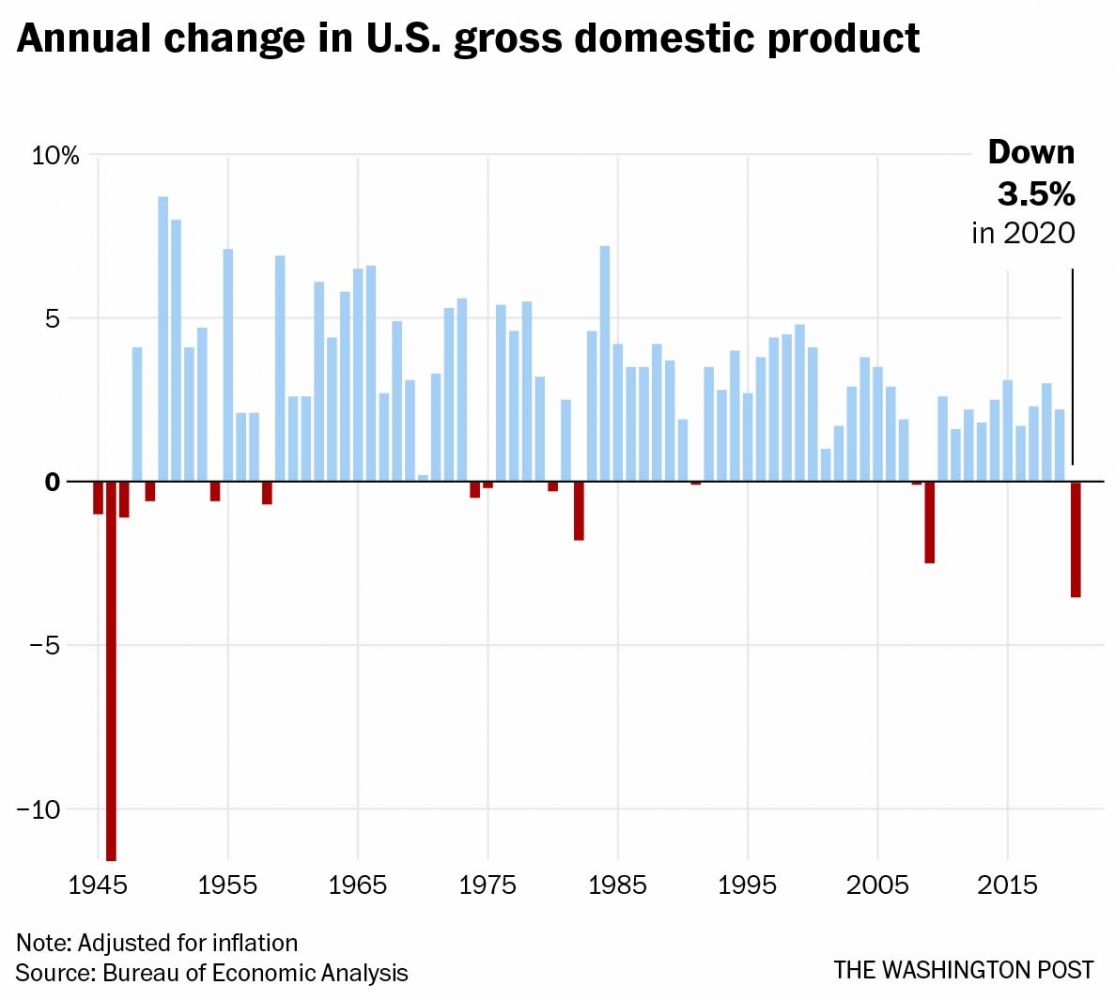
The U.S. economy shrank by 3.5% in 2020, as the coronavirus pandemic ravaged factories, businesses and households, pushing U.S. economic growth to a low not seen since the U.S. wound down war-time spending in 1946.
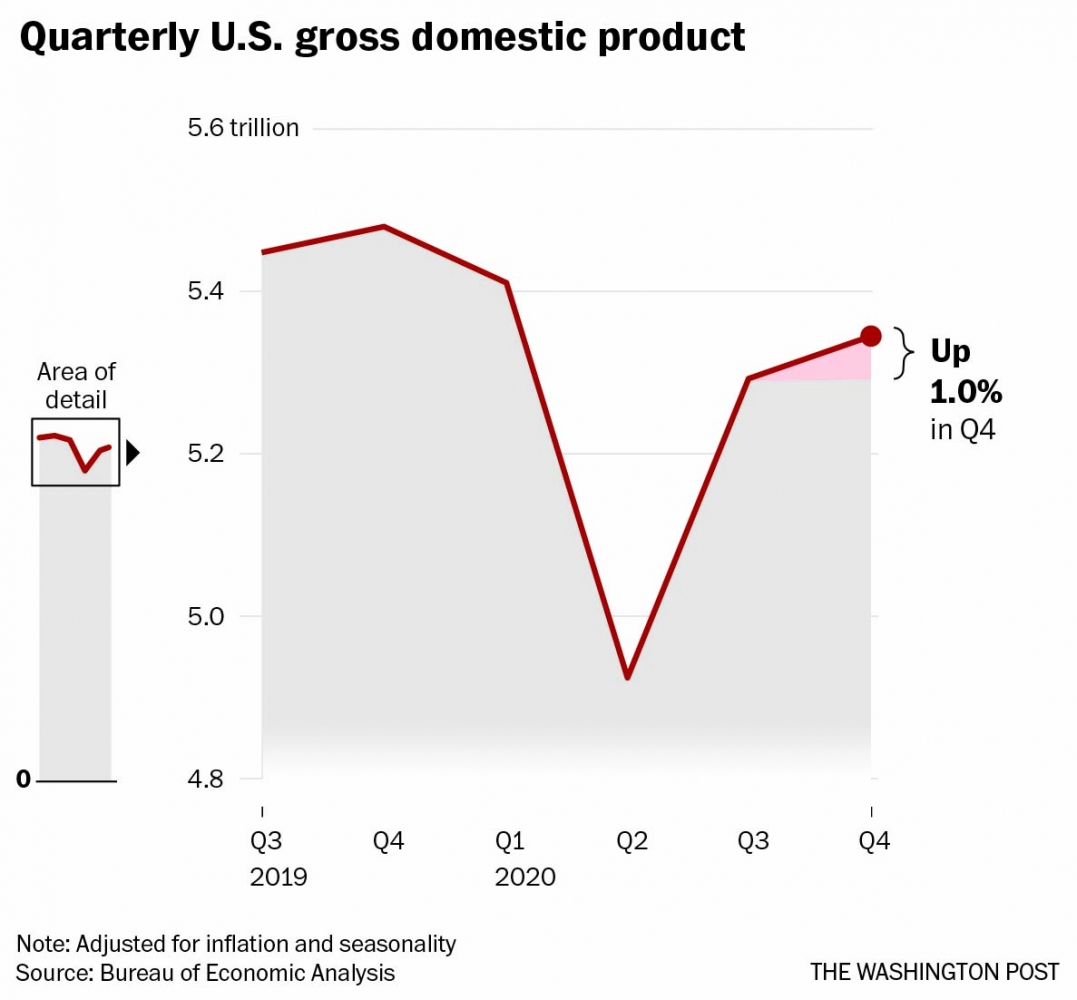
Overall, the economy was surprisingly resilient in the second half of the year, given the fall-off at the start of the public health crisis, according to data released Thursday from the Bureau of Economic Analysis. Yet, the 1-percent growth in the fourth quarter signaled a faltering recovery and a long road ahead with 9.8 million jobs still missing and 23.8 million adults struggling to feed their families.
“Twenty-twenty has no precedent in modern economic history,” said David Wilcox, senior fellow at the Peterson Institute for International Economics and a former director of the domestic economics division at the Federal Reserve. “The influenza of 1918 and 1919 predates our modern system of economic statistics, and since World War II, there’s never been a contraction that even remotely approached the severity and the breadth of the initial collapse in 2020.”
It’s the first time the economy has contracted for the year since 2009, when gross domestic product shrank by 2.5% during the depths of the Great Recession. The next worst plunge was 1946, when the economy shrank by 11.6% as the nation demobilized from its wartime footing.
Consumer spending slowed down in all 15 categories tracked by the BEA, as the sectors that powered third-quarter growth faltered. Americans spent less on restaurants and hotels, a surprising third-quarter bright spot, and the growth of spending on motor vehicles and health care slowed after a steep third-quarter acceleration.
“There has been a broad recovery but, economically speaking, we’re not out of the woods yet,” said Ben Herzon, executive director at IHS Markit.
Senate Majority Leader Chuck Schumer, D-N.Y., seized on the new GDP figures in a speech on the Senate floor, arguing that they make the case for passing a big new relief bill.
“Given these economic numbers, the need to act big and bold is urgent,” Schumer said. “Given the fact that the GDP sunk by 3.5% last year, we need recovery and rescue quickly.”
President Biden has proposed a $1.9 trillion rescue package with money for individual Americans and cities and states, as well as coronavirus testing and vaccines, among other provisions.
Schumer reiterated Thursday that he intends to take steps to move the package forward next week, with or without GOP support. Many Republicans say the proposal is too costly and unnecessary on top of about $4 trillion in relief that Congress already passed, including $900 billion in December.
Even as the economy shed jobs like never before in 2020, personal income grew significantly, BEA data shows, largely because of $1,200 stimulus checks and enhanced unemployment benefits provided by the Cares Act. Disposable personal income grew faster for lower-income households than it did for the average household, according to an analysis published Thursday by Jason Furman, a senior fellow at the Peterson Institute for International Economics and a former top economist in the Obama administration, and Wilson Powell III of the Harvard Kennedy School.
However, those gains were front-loaded and have begun to erode. Federal stimulus drove personal income to record highs in the late spring, but the levels fell off significantly in the second half of the year as relief programs under the Cares Act wound down or expired. Congress also approved a $900 billion stimulus package last month, which sent Americans new $600 stimulus checks and newly extended unemployment benefits to $300 a week through mid-March.
“The package enacted at the end of December was completely welcome, but we’re clearly seeing that it took some time to roll out and get that aid to folks,” said Wendy Edelberg, director of the Hamilton Project at the Brookings Institution and former chief economist at the Congressional Budget Office.
This is the last GDP report from former president Donald Trump’s tenure. Until the pandemic, Trump was on track for an economic record that put him near the middle of the pack among recent presidents. But the coronavirus crisis ensured that Trump oversaw the slowest economic growth of any president in the period since World War II.
Economic chaos reigned in 2020. In the second quarter, gross domestic product contracted at the fastest quarterly rate ever for the United States, as the pandemic walloped workers and businesses and kept millions from leaving their homes.Then, in the third quarter, GDP soared at a record pace as parts of the economy reopened and businesses brought workers back onto their payrolls.
The nascent economic recovery was propelled by a rebound of sales of automobiles and household goods such as furniture, and in renovations and supplies for home offices. Consumer spending – which accounts for more than two-thirds of U.S. economic activity – used to be driven by an ever-growing demand for services, including leisure and hospitality, and restaurants and bars.
But as the pandemic warped tried-and-true shopping habits, economists watched consumers move their spending from services to goods. Purchases of computers, home office equipment and fire pits quickly overtook those of hotel rooms and movie tickets.
In fact, 2020 was the best year ever for Bedford Fields Home & Garden Center in the forested hills of Bedford, a suburb of Manchester, N.H.
When the pandemic hit, “literally everybody became gardeners,” office manager Tracey Auger said. The GDP category that includes nurseries and garden-supply stores was one of fastest-growing in 2020.
“So many people were home, and we were deemed essential and one of the few places people could go to shop,” Auger said. “They needed somewhere to go, a project to do.”
Auger, who has worked at Bedford Fields for nine years, said the shop has based its 2021 orders on the assumption that this year will be somewhere between a normal year, like 2019, and the housebound plant madness of 2020. Bedford Fields has doubled its seed order for 2021 and has secured a full order of plants; after months of shortages, growers have finally caught up to surging demand.
But for every business that has thrived in the era of social distancing, dozens of others have continued to suffer as customers stay home and governments restrict activity at high-contact businesses such as bars, restaurants and event centers.
Speaking at a news conference Wednesday, Powell said the pace of the recovery in economic activity and employment has moderated in recent months, with service-sector workers – mainly women and people of color – struggling to regain a foothold in the workforce.
“That is really the main thing about the economy, is getting the pandemic under control, getting everyone vaccinated, getting people wearing masks and all that,” Powell said. “That’s the single most important economic growth policy that we can have.”
The businesses that have been hit hardest disproportionately employ women, people of color and workers without college educations. Americans in those groups are suffering. Economists call it the K-shaped recovery: The top end of the economy continues to improve, even as lower earners fall further behind.
Constance Hunter, chief economist at KPMG, pointed to different slices of the economy that have their own versions of the K-shaped recovery. Among corporations, tech companies such as Zoom and Netflix are soaring. Airlines, less so.
For workers, Hunter said that among Americans who can work from home, the unemployment rate is 3.9%. The rate is 8.5% for people who have to report to a job site.
“In general, the GDP number is informative about the economy,” Hunter said. But “because of this corporate K, a household K, a geographic K, we have to dig under the hood in a different way.”
In the fourth quarter of 2020, spending from state and local governments fell 2.5% from the same quarter last year, adjusted for inflation. That’s the sharpest decrease since mid-2012, and mirrored the toll from 2008-2009 financial crisis.
In the years after the Great Recession, economists pointed to the slow return of public-sector jobs as a drag on the broader recovery. The coronavirus crisis has once again spurred many left-leaning economists and policymakers to push for continued aid to state and local governments.
“I just want us to learn the lessons from the 2008-2009 Great Recession,” said Lisa Cook, an economist at Michigan State University. “With greater funding for state and local governments, [a relief package] will stem the adverse affects of what we’re seeing with respect to the virus.”
Cristal Farrington, 48, was laid off in May after more than two decades of climbing the corporate ladder at New York City firms that buy and distribute specialty foods and restaurant equipment.
Farrington is looking for whatever work she can get but said she was not optimistic that business would pick up in 2021, because the timelines for vaccine rollout and reopening remain fuzzy. And even if things turn around, it will be years before Black women like her are welcomed back into the workforce, she said.
“People of color, we’ve always been on the edge, teetering,” Farrington said. “Because we always know we’re going to be the first ones let go and the last ones hired.”
Economists surveyed by the Wall Street Journal predict a strong rebound in 2021, with the economy growing by 4.3%. That would be the best year since the late 1990s, as high earners unleash the billions they have saved during the pandemic.
One bright spot in 2020is that the personal saving rate hit the highest on record, and some businesses are betting that – combined with a vaccine rollout, the December stimulus and any future Biden administration stimulus – all that saving will power a swift rebound.
The online review site Yelp this week reported that more businesses reopened in December than in any month since June. It also augurs well for this year that, in December, interest in wedding planning soared 22% above its 2019 level – a sign of hope for the battered live-events industry.
By Syndication Washington Post, Bloomberg · Vildana Hajric, Lu Wang
U.S. equities mounted a comeback from their worst loss since October as moves to limit retail traders’ speculation in some companies opened the door for hedge funds to load up on stocks they had been ditching.
The S&P 500 index rose more than 1% after trading platforms restricted activity in stocks whipsawed by Internet chatter, from GameStop to AMC Entertainment and American Airlines. Hedge funds that had shorted the stocks were burned in recent days, leading them to reduce holdings in shares they loved so they could cut risk.
That dynamic reversed Thursday, and a Goldman Sachs basket of stocks favored by hedge funds jumped the most since early November, halting a five-day slide. An index of the most-shorted shares tumbled more than 8%, the most since March. GameStop whipsawed, rising as much as 39% in early trading before plunging as much as 68%. It was down 34% midafternoon in New York. AMC sank 54%, American was up 8.4% and Tootsie Roll lost 13%.
The trading restrictions sparked outrage on the WallStreetBets forum where day traders have convened to drive the manic rallies that burned hedge funds across Wall Street. Washington took notice of what some have called inequitable rules, with Democratic and Republican lawmakers criticizing restrictions imposed on retail investors.
All 11 industry groups in the S&P 500 traded higher, with sentiment boosted by solid corporate earnings from the likes of Mastercard and Comcast and a surprise drop in jobless claims.
Stocks have seen volatile trading after a prolonged rally that spurred talk of possible asset bubbles and predictions of a pullback given a raging pandemic and patchy rollout of vaccines. The turmoil created by Internet chat rooms has stoked fears of broader consequences for Wall Street, particularly hedge funds, but that fear seemed to fade Thursday.
“Earnings are great, and guidance is better, and we’re picking up the pace of getting vaccines out, and eventually we’ll have fiscal stimulus coming out of Washington,” said Arthur Hogan, chief market strategist at National Securities. “The market is trying to digest a lot of things at the same time.”
The Stoxx Europe 600 index edged higher. Earnings beats from STMicroelectronics and Diageo were accompanied by a miss from Swatch Group and a revenue drop at EasyJet.
The benchmark 10-year Treasury yield rose after touching the lowest level since Jan. 5. Bitcoin climbed past $32,000. Stocks in Hong Kong and Australia saw the bulk of Asian losses.
– – –
These are some key events coming up in the week ahead:
– U.S. personal income, spending and pending home sales come Friday.
These are the main moves in markets:
Stocks
– The S&P 500 index jumped 1.4% as of 3:40 p.m. Eastern time.
– The Stoxx Europe 600 index rose 0.1%.
– The MSCI Asia Pacific index fell 1.7%.
– The MSCI Emerging Market index fell 1.3%.
Currencies
– The Bloomberg Dollar Spot index slipped 0.2%.
– The euro rose 0.2%, to $1.2133.
– The British pound rose 0.4%, to $1.3743.
– The Japanese yen weakened 0.1%, to 104.21 per dollar.
Bonds
– The yield on 10-year Treasurys rose four basis points, to 1.05%.
– Germany’s 10-year yield rose one basis point, to -0.54%.
– Britain’s 10-year yield rose two basis points, to 0.285%.
Commodities
– West Texas Intermediate crude fell 1% to $52.34 a barrel.
Signs of economic recovery in December, but virus sapped sentiment: Finance Ministry
EconJan 29. 2021Kulaya Tantitemit, acting director-general of the Fiscal Policy Office, is flanked by Pisit Puapan, left, executive director of the macroeconomic policy bureau, and Wuttipong Jittungsakul, fiscal policy adviser, at the press conference on Thursday.
By The Nation
The Thai economy showed signs of recovery in December, as domestic and external demand drove up car sales and exports, but consumer confidence sagged after the resurgence of Covid-19, the Finance Ministry said on Thursday.
Domestic consumption improved in December, judging by car sales and new registration of motorcycles which increased 16.4 per cent and 10.6 per cent respectively, said Kulaya Tantitemit, acting director-general of the ministry’s Fiscal Policy Office (FPO).
Meanwhile, farmers’ real income rose by 12.1 per cent.
These indicators were consistent with a rise in value-added tax revenue of 2.8 per cent from November. Contraction of VAT collection in December also decelerated to -4.4 per cent year on year. However, the surge in virus cases dragged down the consumer confidence index to 50.1 from 52.4 in November.
Private investment also showed signs of recovery as imports of capital goods rose 7.3 per cent year on year. Sales of commercial car sales – trucks and other types of vehicle used by businesses – increased 15.8 per cent year on year, rising for the fourth consecutive month. Cement sales expanded 1.4 per cent year on year or 0.3 per cent from the previous month. However, business tax revenue on property transactions fell 15.9 per cent year on year.
Thai exports expanded 4.7 per cent from the same period last year, the first rise in eight months. Exports to the US rose 15.7 per cent, growing for the seventh months in a row. Exports to Japan and Australia increased 14.9 and 13.5 per cent respectively, while exports to China and India returned to positive territory, rising 7.2 per cent and 14.5 per cent respectively.
However, supply-side activity fell from November, with the purchasing managers’ index (PMI) dropping 2.4 per cent year on year.
Foreign tourists numbered only 6,556, most of them from Europe. Domestic travellers in December dropped 31.9 per cent year on year, after a 23.4 per cent drop in November.
Economic stability held steady against a public debt-to-GDP ratio of 50.5 per cent at November-end and international reserves of US$258.1 billion at the end of December, Kulaya added.

 Sawat Naruvorawong, senior executive vice president of Thai Life Insurance Public Company
 Joeyvoen Teo


 Signage is displayed at a GameStop Corp. store in Oswego, Ill., on April 1, 2019. MUST CREDIT: Bloomberg photo by Daniel Acker.
 Elon Musk, founder of SpaceX and chief executive officer of Tesla Inc., during a discussion at the Satellite 2020 Conference in Washington, D.C., on March 9, 2020. MUST CREDIT: Bloomberg photo by Andrew Harrer.

 Kulaya Tantitemit, acting director-general of the Fiscal Policy Office, is flanked by Pisit Puapan, left, executive director of the macroeconomic policy bureau, and Wuttipong Jittungsakul, fiscal policy adviser, at the press conference on Thursday.
